Focus on Food

Focus on Food

Roll, Roll, Roll Your Oats

The renaissance of porridge
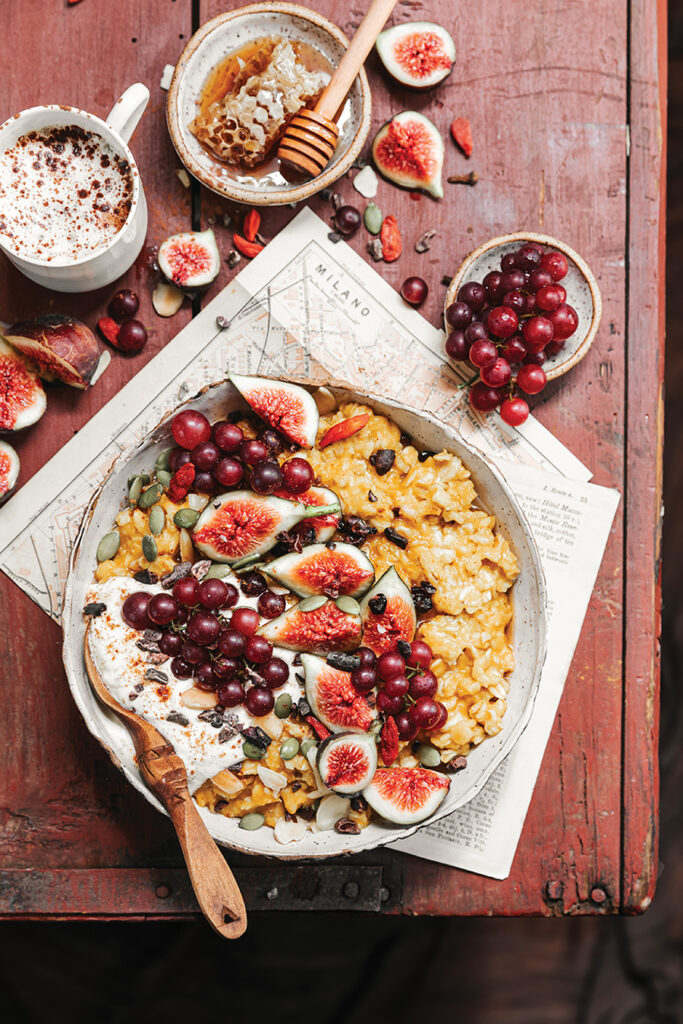
Story and Photograph by Rose Shewey

Many moons ago, around the time when candy cigarettes and slap-on bracelets were the cat’s pajamas, a serving of oatmeal seemed more like a punishment to me than a meal worth savoring. My mom cooking oats for us usually meant one of two things: The 7-year-old me had not eaten “right” for a while and needed proper sustenance; or we had simply run out of other breakfast foods (namely bread) before grocery day.

While my brother and I despised cooked oats and feigned tummy aches at the sight of it, we were completely sold on an oatmeal rendition we had been introduced to in our neighbor’s kitchen: raw oats soaked in cold milk for just a minute or two, served with a dash of cacao and a sprinkling of brown sugar. Love, instantly. To us, it was the perfect composition of a refreshing, lightly sweetened, satisfying oat snack, minus the mush. While cooked oats weren’t our jam, this chilled adaptation became a staple in our meal rotation through much of my childhood. My brother, now in his 40s, still eats his oats chilled. Meanwhile, I have made room in my life for traditionally cooked, warm and comforting, creamy oatmeal.

Though porridge, which can be made from any whole grain, is making a comeback as a whole, oatmeal in particular seems to take center stage. Denmark has an established chain of restaurants that serves nothing but porridge for breakfast, lunch and dinner. Savory oatmeal has gone viral on social media this year with masala oats, a traditional Indian breakfast dish, on the rise. Many speculate that the gluten-free craze has contributed to the revival of oatmeal; some believe that studies showing oatmeal aids weight loss are to be credited for it — which is a bit of mystery to me, seeing that the vast majority of people jazz up their oats with fat and sugar. I, however, have a different take on the renaissance of oatmeal.

While oatmeal hardly falls in the category of “acquired taste,” I have numerous friends who, much like myself, went from total rejection to complete adoration of this humble dish. Aside from the fact that I actually enjoy the taste and texture of oatmeal nowadays, I’m drawn to it for another, fairly significant reason. Oatmeal has a unique way of grounding me. However complicated life gets, a bowl of oatmeal is the epitome of simplicity and instantly connects me with the quiet, unrushed aspects of my life. It’s like a warm hug on a chilly day — oatmeal nourishes body and soul. I believe that this sentiment is quietly shared among many of us who embrace this scrumptious, gratifying dish, and may be much more relevant in explaining the recent popularity of oatmeal. But if I happen to lose a few pounds down the road, eating buttery, sugar-sprinkled oatmeal, I’ll happily stand corrected.


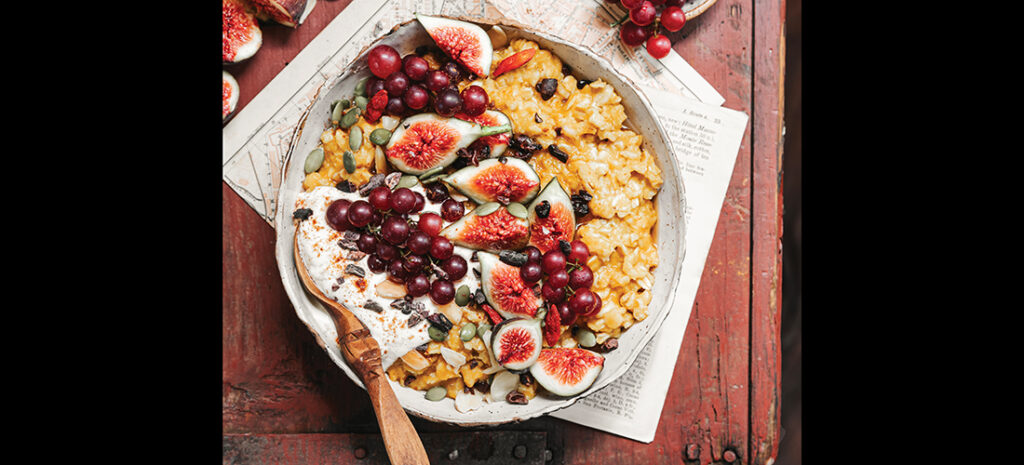
Creamy Pumpkin Oatmeal

(Makes 2 Servings)

Ingredients

1 1/2 cups water

Pinch of salt

1 cup rolled oats

1/2 cup pumpkin puree

3/4 teaspoon ground cinnamon

1-2 tablespoons sweetener, to taste (honey, maple syrup or granulated sugar)

1/2 teaspoon pumpkin spice, optional (see note)

Directions

Bring water and salt to a boil, then add oats. Stir to combine, then add remaining ingredients. Simmer for 5-10 minutes until you reach your desired consistency; remove from heat and allow to rest for 1-2 minutes before serving. Top with seasonal fruit, such as figs, grapes or pears; add pumpkin seeds, cacao nibs, sliced almonds or other chopped nuts, to taste.

Note: Add pumpkin spice for more flavor. To make your own pumpkin spice, combine 1 heaping teaspoon ground cinnamon, 1/4 teaspoon ground nutmeg, 1/4 teaspoon ground ginger and 1/8 teaspoon ground cloves.   PS

German native Rose Shewey is a food stylist and food photographer. To see more of her work visit her website, suessholz.com.


In the Spirit

In the Spirit

Which Sweet Vermouth?

Finding the best cocktail companion

By Tony Cross

One of my best friends is an avid beer drinker. He gets off on all of the subtle complexities that make beer and all of the varietals unique. He sent me a message last week asking, for probably the third time, “What’s the name of that damn vermouth again?”

My friend and his wife were at a cocktail lounge in Canada where they enjoyed a few classic drinks. The negroni was one of them. For someone who never drinks cocktails, he was amazed at the possibilities when combining spirit, sweet and bitter. Now, if he could only remember which vermouth they used, he could recreate the drink at home. Because we live to serve, here are a few sweet vermouths and how to pair them with some of the classics — including his. Now he’ll have a paper trail.


Manhattan

The first time I made a proper drink, it was a Manhattan. I had special-ordered a case of rye whiskey from our ABC and taken a trip to a wine shop in Southern Pines to purchase a bottle of vermouth. Rittenhouse was the rye and Carpano Antica was the vermouth. The drink forever changed the way I viewed cocktails. I’ve always been adamant about making Manhattans with Carpano, but I do change the specs from time to time. Lately, I’ve been using Mancino vermouth. It was birthed in Asti, Piedmont, in 2011, when owner Giancarlo Mancino wanted to create the world’s finest vermouths with hand-picked botanicals and spices. The Mancino vermouth is a little more full-bodied than the Carpano, with notes of baking spices and juniper. Trying this on its own, with or without ice, is a great way to understand your vermouth’s flavor profile before adding it to your cocktail. It’s also great as an aperitif.

2 ounces rye whiskey

1 ounce Mancino vermouth

2 dashes Angostura bitters

Put whiskey, vermouth, and bitters into a cold mixing vessel, add ice, and stir until cocktail is properly chilled and diluted. Strain into a chilled cocktail coupe. Garnish with Luxardo or brandied cherry.


Red Hook

In the 2000s, there were a number of bartenders who created cocktails that were spins on the classic Brooklyn cocktail, which consisted of rye whiskey, dry vermouth, maraschino liqueur and Amer Picon, a hard to find French apéritif. One of these variations, the Red Hook, caught my eye when I was behind the bar. I had seen a video where bartender Jamie Boudreau showed how to barrel-age this stirred cocktail. I was “hooked.” (Apologies to all.) Even though Boudreau might have been the first to barrel-age the Red Hook, it was originally created in 2003 by bartender, Vincenzo Errico at the Milk & Honey bar in New York City. The cocktail still uses rye whiskey and maraschino liqueur but incorporates the sweet vermouth Punt e Mes. This Italian vermouth translates to “point and a half” — one part sweet, one-half part bitter. That little bit of bitterness from the vermouth is exactly why using Punt e Mes is the perfect fit.

2 ounces rye whiskey

1/2 ounce maraschino liqueur

1/2 ounce Punt e Mes

Combine whiskey, maraschino liqueur and vermouth in a chilled mixing vessel. Add ice and stir until drink is chilled and diluted. Strain into a chilled cocktail coupe. Garnish with maraschino cherry.


Negroni

Last but not least, we have the beloved negroni. This cocktail can be considered a cocktail and an apéritif. It’s lovely to enjoy right before dinner because it really does awaken your taste buds. At the same time, it’s perfectly fine to enjoy a negroni any time you feel like having a drink. The drink is easy to create — the first time I learned, it was 3/4 ounce (each) of gin, Campari and sweet vermouth. Later I upped the amount of each ingredient to an ounce, and then began adding a bit more gin than the other two ingredients. I also rearranged the types of gin. For example, a London Dry like Beefeater’s is a great go-to because of the juniper and orange notes, but a Plymouth gin will make the cocktail more earthy and soft. Campari was always a staple but I could swap out several vermouths. One of my favorite vermouths to use is Carpano Antica — the vermouth my friend keeps forgetting. With its notes of orange and vanilla, it creates the perfect bridge between the higher proof gin and bitter Campari. If you’ve never tried a negroni, I implore you to.

1 1/4 ounces gin

3/4 ounce Campari

3/4 ounce Carpano Antica

You can create this cocktail three ways. The first is to build it in the glass you’ll be drinking from. To do this, simply combine all ingredients in a rocks glass, add ice, stir, and garnish with an orange slice. The second, is to put all the ingredients in a chilled mixing vessel, add ice, and then strain into a rocks glass over ice. Lastly, and this is done to completely control the dilution, repeat the second method but strain into a chilled cocktail coupe. If straining over ice in a rocks glass, garnish with an orange slice; if straining into a coupe, garnish with orange peel, expressing the oils over the cocktail before adding to the glass.  PS

Tony Cross owns and operates Reverie Cocktails, a cocktail delivery service that delivers kegged cocktails for businesses to pour on tap — but once a bartender, always a bartender.

Art of the State

Art of the State

Careful Chaos

Chieko Murasugi’s art subverts order and changes perspectives

By Liza Roberts

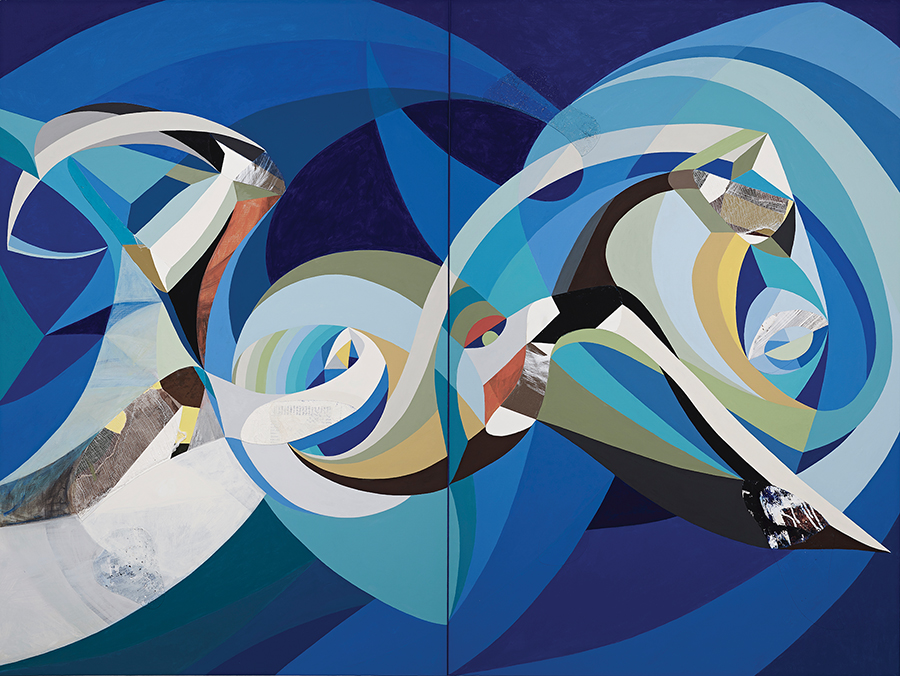
Abstract painter Chieko Murasugi has navigated conflicting perspectives all her life. She holds a Ph.D. in visual science and works as an artist; she is the Tokyo-born daughter of Japanese immigrants who was raised in Toronto and lives in America; she is a former impressionist painter who has turned to visual illusion to anchor her geometric art.
“I want to make the elusive, disparate, confusing, multifaceted nature of the world absolutely clear,” says Murasugi. “I want to be clear in my view that the world is unclear.”

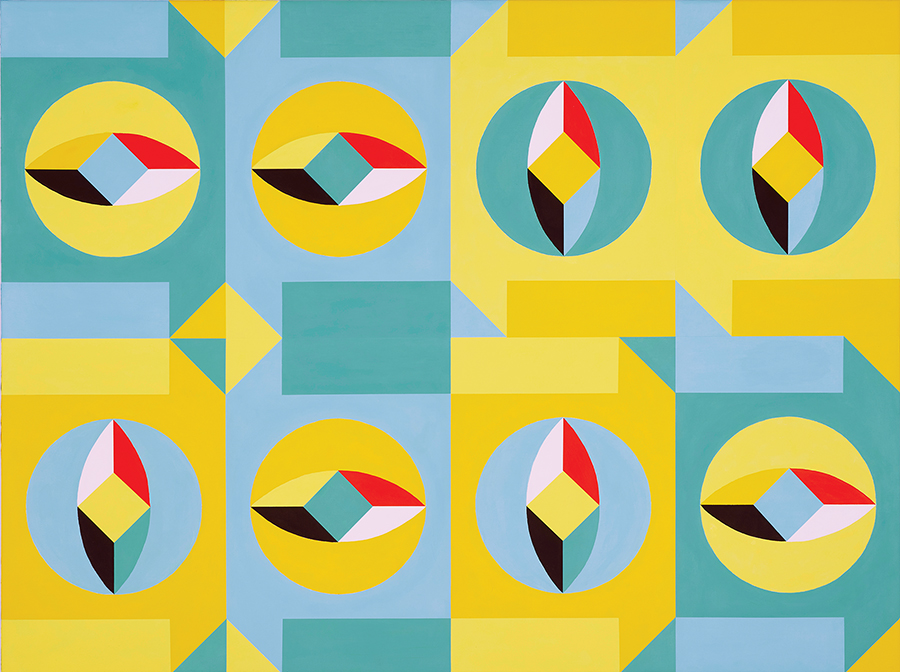
Illusions underpin this message; her interest in them is one of the few things that has remained constant in her life. As a scientist, Murasugi studied visual perception because she was fascinated by mysteries like 3D illustrations that seem to flip upside down or right-side up depending on the angle of the viewer, or the ghosts of afterimages, or the way the interpretation of a color changes depending on the colors that sit beside it. Now, as an artist, she uses phenomena like these to tweak a viewer’s perception, to make a picture plane shift before their eyes, to turn it from one thing into another. She populates these paintings with crisp, unambiguous, flat-colored shapes. “I have clarity and I have ambiguity at the same time,” she says. “And that’s really at the crux of my art. It’s the ambiguity, the clarity, the dichotomy.”

Her art creates it, and she’s long lived it. Murasugi grew up in a “very white” Canadian suburb, “very clearly a minority.” As a child, her father, a descendant of 1600s-era samurai, showed her maps of Japan’s former reach across Asia, and told her “Americans took it away.” He told her about how American forces firebombed downtown Tokyo, and how he and her mother barely escaped with their lives.

But these were not facts she’d been taught in school, or heard anywhere else. “I had taken world history, and I had not heard anything about the firebombings of Japan,” she says. “And so everywhere I went, I was presented with diverging, often conflicting, but very disparate narratives. Who am I supposed to believe?” When she was studying for her doctorate at York University in Canada, she recalls, her professors proudly touted the department’s significance in the field. Then she went to Stanford to do postdoctoral work in neurobiology and nobody had heard of her colleagues at York University. “Again, I had to shift my perspective,” she says. Fueling those shifts was an overwhelming curiosity, she says, “always wanting to know why. Why, why, why. Curiosity has been the driving force of my life.”

Years later, when Murasugi left her accomplished academic career and the world of science for art, her viewpoint shifted again. In a deeply rooted way, she was coming home; she had always drawn and painted, and she studied art in college as well as science. Even at the height of her successful scientific career as a professor and research scientist, Murasugi believed that she didn’t truly belong. She thought she wasn’t quantitative, logical or analytical enough, that “there was something that was missing in the way that I was thinking,” she says. With art, the opposite was the case: “I knew I could do it.”

After she moved to North Carolina with her husband several years ago, this innate conviction took her back to school, to the University of North Carolina at Chapel Hill for an MFA. There she met fellow artists she respected and joined with to co-found and co-curate an artist-run Chapel Hill exhibit space called Basement, which has earned a reputation as an incubator for emerging artists and which regularly exhibits their work to the public.

Over the last 18 months, Murasugi has found fresh directions, resulting in a new body of work, called Chance, that explores randomization, color theory, chance and chaos. “My mother was basically dying when I began this series,” she says. “Her impending death, having to process her death, is what inspired it. And I continued it for about a year, because I was just bereft.” Murasugi’s mother survived World War II “by chance” and always thought of her life as defined by that good fortune; this fueled Murasugi’s experimentation with art made, in part, “by chance.”

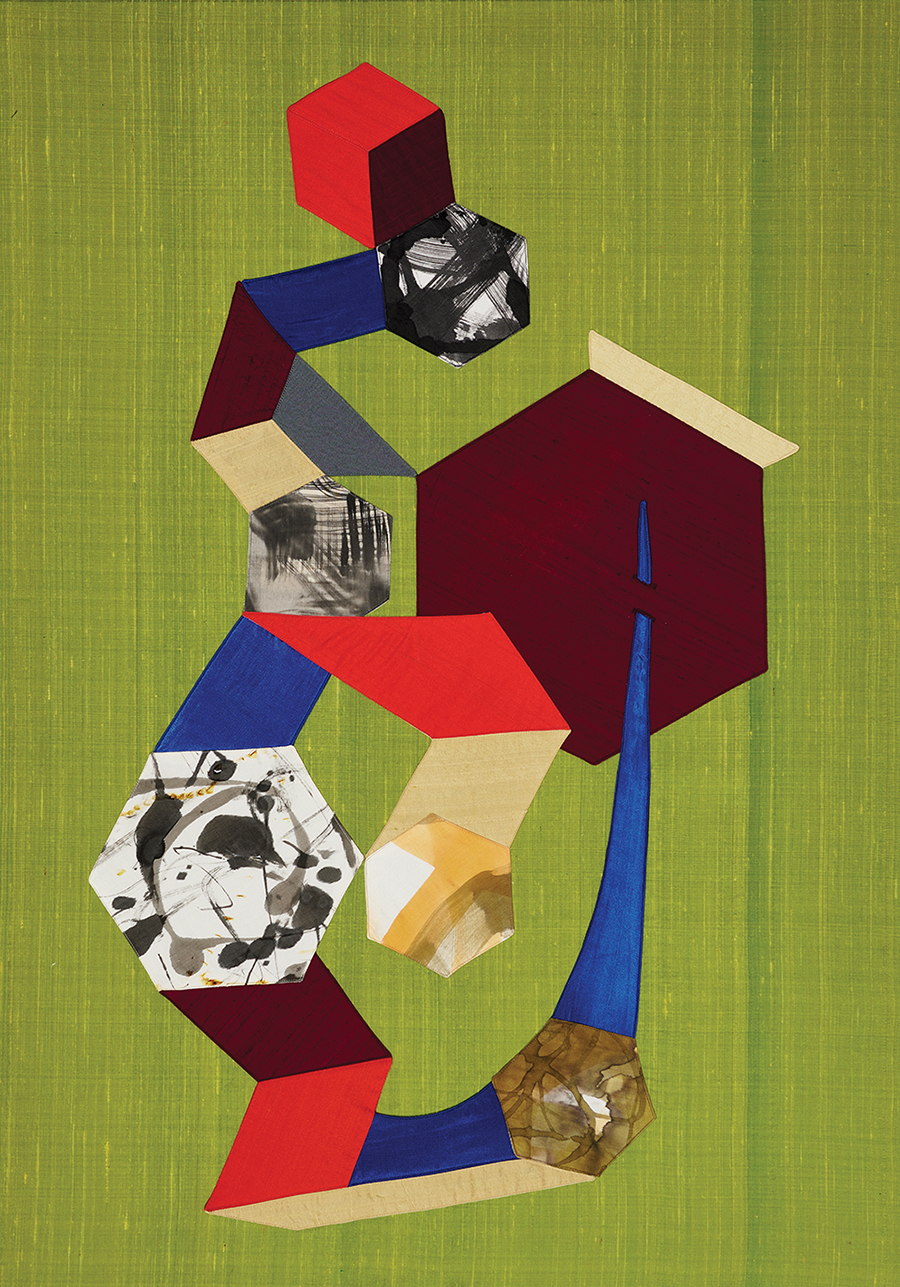
Using an algorithm available on the website random.org to arrange her own colors, shapes and patterns into random arrangements and compositions, Murasugi created a series of colorful, geometric works. In late summer 2022, she posted these works on the Instagram feed of Asheville’s Black Mountain College Museum + Arts Center, part of her digital residency with the museum. She also exhibited them at Craven Allen, her Durham gallery.

More recently, Murasugi has returned to the illusion-anchored canvases she began a few years ago — what she now refers to as her “old way of painting.”

It has been “a huge struggle,” she says, because “the end point is unknown.” Unlike the work made with the guidance of the randomizing program, “the trajectory is not straightforward” with these newer, intuitive paintings. “It’s forward and backwards, left and right. I’ve always worked this way, before I went to the Chance series, and I’d almost forgotten how difficult painting is. Both fun, and excruciatingly difficult.” Some of the pieces currently underway will find their way to CAM Raleigh for a show called Neo-Psychedelia that opens Nov. 10. She will also have a piece featured and sold at ArtSpace’s ArtBash, a fundraising gala, on Nov. 18, also in Raleigh.

Murasugi’s work has also been exhibited in museums in San Francisco, New York and across the South, and is in the collections of the City of Raleigh and Duke University. Its abstraction welcomes any interpretation at all; its subtle illusory elements gently subvert them. “People have said to me over the years: Your work is so beautiful. And I think, well, I hope it doesn’t stop there,” she says. “As long as they see that there were two ways of looking at it.”  PS

This is an excerpt from Art of the State: Celebrating the Art of North Carolina, published by UNC Press.

Hometown

Hometown

Picture This

A wallet-sized memory

By Bill Fields

A fall ritual, as certain as football and Halloween, was the school picture.

It seems to be the thing now for parents to pose their kids with a sign as they depart for the first day of classes, a label of grade and year reminding everyone in the family and on social media of the historic moment, often occurring now in the ungodly heat of summer.

In the dark ages of my youth, I’m sure a minority of families documented the coming of another academic year with Polaroids or Kodak snapshots in a primitive version of the current practice. But most of us relied on the visit of the nomadic professional photographer, who would show up around the same time the bags of bite-sized candy were being stocked at the A&P.

We would be alerted by our teacher in advance of the taking of the school pictures, so haircuts and clothing could be considered. Going to public school and not wearing uniforms, the latter factor was a biggie — for our parents if not ourselves. Over the years, I wore T-shirts, short-sleeved seersucker, mock turtlenecks and wide-collared golf shirts. Senior year of high school, for reasons unknown, the boys were decked out in light blue tuxedo jackets. (I must have liked the look, owing to my allegiance to the Tar Heels or that I was able to rent that color on the cheap at Storey’s in the Town and Country Shopping Center. I wore one to the prom the forthcoming spring. Paired with black pants, it made me resemble a giant indigo bunting who had spent too much time at the feeder.)

Regardless of grade or costume, we would make our way to the photographer’s makeshift studio on the appointed day. The flash attachment for Dad’s Brownie camera or flashcubes for my Instamatic were no match for the pro’s equipment: Strobes bounced into white umbrellas, evenly illuminating subject and background. Take a seat on a stool, smile (or not), click. It was over quick. I couldn’t tell you the identity of anybody who was behind the camera in those years but was fascinated to hear, years later, from a friend who grew up in New Castle, Pennsylvania, outside Pittsburgh, that the major leaguer Chuck Tanner had an off-season gig as school photographer in his hometown. That was a long time ago.

When the photo proofs were made available weeks later, especially as we moved into junior high and beyond, it was obvious that a comb or Clearasil would have been a good idea on picture day. Until about eighth grade, I sported a crew cut. The year I began to go to the barber shop less frequently, my school picture documents why some classmates called me “Wolf Head” for a while. Fortunately, the transitioning hair and the nickname were short-lived.

I don’t recall us ever not ordering a set of prints, regardless of how I looked. A popular “package” comprised an 8×10, two 5x7s and a sheet of wallet-sized images. Using scissors to separate the small ones was a challenge, but most of them ended up in a drawer, never having to worry about being faded by sunlight.

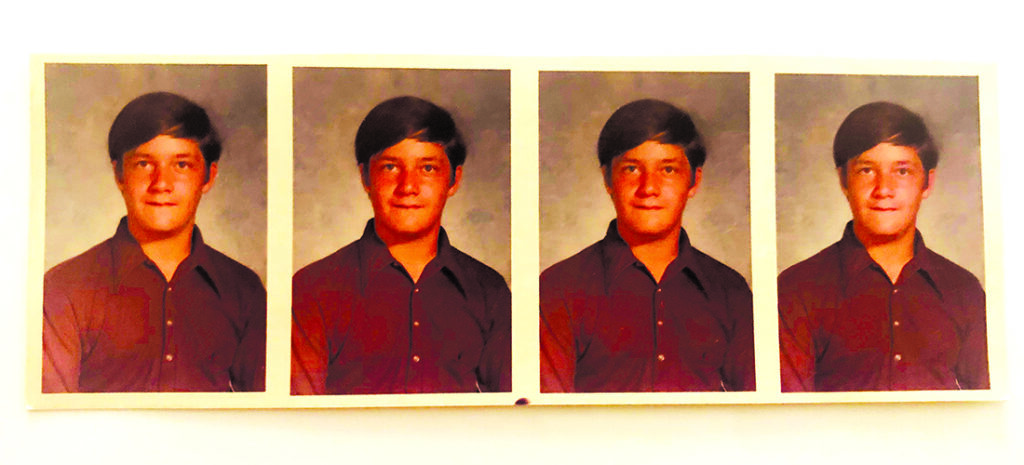
For a long time, a nearly complete collection of my school pictures, along with those of my sisters, was stored in my childhood home, a file of growing up and growing older. Recently I came upon a strip of wallet-sized images in a box of my stuff. In them I don’t look like a carnivorous wild animal, so I’m guessing ninth or 10th grade. I used to tease my father about an unfortunate brown leisure suit of his, but this school picture proves I once wore brown, too.

Years after Dad was gone, I finally looked through his last wallet. There was the usual stuff: driver’s license, credit card, doctors’ appointment reminders, golf handicap card, receipts for gasoline, a few dollars in folding money. And in one of the plastic slots behind the snap enclosure there was 17-year-old me, imagining the skies ahead, skies the color of my coat.  PS

Southern Pines native Bill Fields, who writes about golf and other things, moved north in 1986 but hasn’t lost his accent.

Bookshelf

Bookshelf

October Books

FICTION

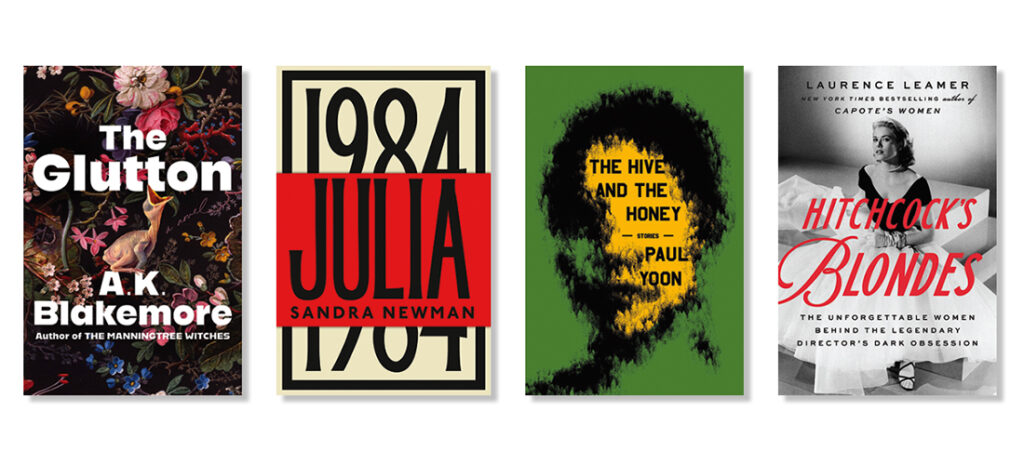
The Glutton, by A.K. Blakemore

1798, France. Nuns move along the dark corridors of a Versailles hospital where the young Sister Perpetué has been tasked with sitting by the patient who must always be watched. The man, gaunt, with his sallow skin and distended belly, is dying — they say he ate a golden fork, and that it’s killing him from the inside. But that’s not all. He is rumored to have done monstrous things in his attempts to sate an insatiable appetite . . . an appetite they say tortures him still. Born in an impoverished village to a widowed young mother, Tarare was once overflowing with quiet affection: for his mother, for the plants and little creatures in the woods and fields around their house. But soon life as he knew it is violently upended. Tarare is pitched down a chaotic path through revolutionary France, left to the mercy of strangers, and increasingly, bottomlessly, ravenous. This exhilarating, disquieting novel paints a richly imagined life for The Great Tarare, The Glutton of Lyon in 18th-century France: a world of desire, hunger, poverty, chaos and survival.

Julia, by Sandra Newman

Julia Worthing is a mechanic, working in the Fiction Department at the Ministry of Truth. It’s 1984, and Britain (now called Airstrip One) has long been absorbed into the larger transatlantic nation of Oceania. Ruled by an ultra-totalitarian party whose leader is a quasi-mythical figure called Big Brother, Oceania has been at war for as long as anyone can remember. In short, everything about this world is as it is in George Orwell’s 1984. All her life, Julia has known only Oceania and, until she meets Winston Smith, she has never imagined anything else. She is an ideal citizen: cheerfully cynical, always ready with a bribe, piously repeating every political slogan while believing in nothing. She routinely breaks the rules, but also collaborates with the regime when necessary. Then one day she finds herself walking toward Winston Smith in a corridor and impulsively slips him a note, setting in motion the journey through Orwell’s now-iconic dystopia, with twists that reveal unexpected sides not only to Julia, but to other familiar figures in the 1984 universe.

The Hive and The Honey, by Paul Yoon

A boy searches for his father, a prison guard on Sakhalin Island. In Barcelona, a woman is tasked with spying on a prizefighter who may or may not be her estranged son. A samurai escorts an orphan to his countrymen in the Edo Period. A formerly incarcerated man starts a new life in a small town in upstate New York and attempts to build a family. The Hive and the Honey is a bold and indelible collection that portrays the vastness and complexity of diasporic communities, with each story bringing to light the knotty inheritances of their characters. How does a North Korean defector connect with the child she once left behind? What are the traumas that haunt a Korean settlement in Far East Russia? Yoon’s stunning stories are laced with beauty and cruelty, the work of an author writing at the very height of his powers.

NONFICTION

Hitchcock’s Blondes: The Unforgettable Women Behind the Legendary Director’s Dark Obsession, by Laurence Leamer

Alfred Hitchcock was fixated not just on the dark, twisty stories that became his hallmark, but also on the blonde actresses who starred in many of his iconic movies. The director of North by Northwest, Rear Window and other classic films didn’t much care if they wore wigs, got their hair coloring out of a bottle or were the rarest human specimen — a natural blonde — as long as they shone with a golden veneer on camera. In Hitchcock’s Blondes, Leamer offers an intimate journey into the lives of eight legendary actresses whose stories helped chart the course of the troubled, talented director’s career, from his early days in the British film industry, to his triumphant American debut, to his Hollywood heyday and beyond. Through the stories of June Howard-Tripp, Madeleine Carroll, Ingrid Bergman, Grace Kelly, Janet Leigh, Kim Novak, Eva Marie Saint and Tippi Hedren — who together starred in 14 of Hitchcock’s most notable films and who bore the brunt of his fondness and fixation — we start to see the enigmatic man himself. After all, “his blondes” (as he thought of them) knew the truths of his art, his obsessions and desires, as well as anyone. 


CHILDREN’S BOOKS

The Scariest Kitten in the World, by Kate Messner

Little Kitten, Vampire Puppy and Spooky Baby Goat might be scary if they weren’t so darn cute. This adorable read-aloud is fun for the fall or anytime you’re up for a giggle. (Ages 3-8.)

Things in the Basement, by Ben Hatke

When Milo is sent by his mother to fetch a sock from the basement of the historic home they’ve moved into, he finds a door in the back that he’s never seen before. Turns out, the basement of his house is enormous. In fact, there is a whole world down there. Milo learns that to face his fears he must approach even the strangest creatures with kindness in this creepy-fabulous graphic novel. (Ages 8-12.)

Forever Twelve, by Stacy McAnulty

Unlike most 12-year-olds, Ivy’s favorite holiday is the first day of school. This year that day brings not only fascinating new courses and instructors, but a new school, new rules and new friends — some of whom have a very dark secret. School, science and secrets, this one is sure to be a hit for fans of The Miscalculations of Lightning Girl, Coraline, or The Trials of Morrigan Crow. (Ages 10-12.)

Percy Jackson and the Olympians: The Chalice of the Gods, by Rick Riordan

For the first time in more than 10 years there’s a new title in the Percy Jackson series. The original heroes from The Lightning Thief — Percy, Annabeth and Grover — are reunited for their biggest challenge yet, getting Percy to college when the gods are standing in his way. (Ages 9 and up.) PS

Compiled by Kimberly Daniels Taws and Angie Tally.

The Omnivorous Reader

The Omnivorous Reader

Read and Dead

A librarian’s cozy mystery series

By Anne Blythe

Librarians are good at deciphering mysteries. Just ask any card-carrying library fan. They can be sherpas, of a sort, guiding readers from behind the confines of their reference desks to a world of information often only a bookshelf or computer click away.

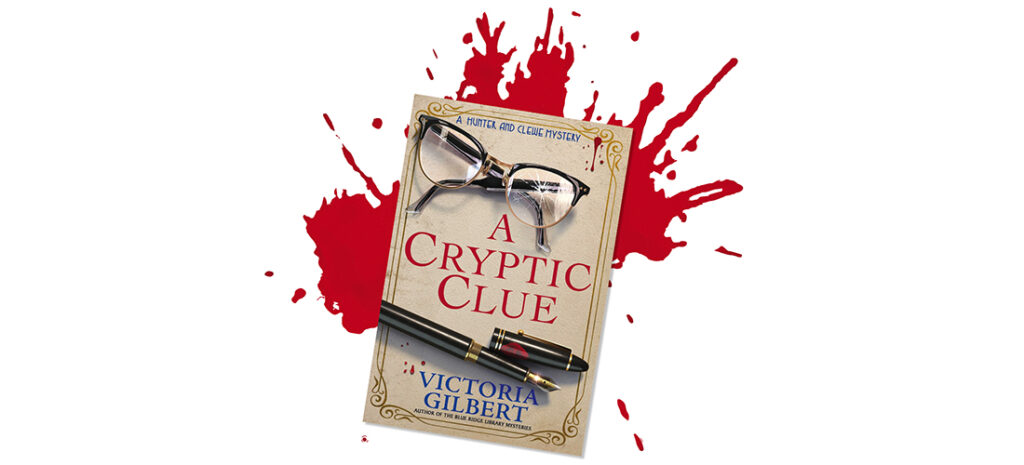
Some are good at creating them, too, as Victoria Gilbert, a former librarian-turned-mystery writer, shows in A Cryptic Clue, the first book in her new Hunter and Clewe cozy mystery series.

Raised in the “shadows of the Blue Ridge mountains,” Gilbert has been a reference librarian, a research librarian and a library director so, in the vein of “write what you know,” it’s easy to see why the protagonist in her new series is Jane Hunter, a 60-year-old university librarian forced into early retirement and a new chapter in life.

Gilbert’s Jane has tinges of Agatha Christie’s Miss Jane Marple in her, although she is a divorcee, not a spinster, who still wants to work for a living to pad her paltry pension. That desire to find a new vocation leads Gilbert’s chief sleuth to her new boss, Cameron Clewe — Cam, to those who know the 33-year-old unconventional multi-millionaire well — who was looking for an archivist and hired Jane sight unseen. Cam not only inherited tremendous wealth at a young age, but also an estate so large that it houses a private library, guest quarters and grand rooms where the well-to-do and those aspiring to affluence gather for glamorous galas, glitzy fundraisers and seasonal soirees.

Although Jane describes her new boss as “leading man material,” he’s a nervous type whose lack of a filter makes him a blunt, often humorless, speaker.

“I didn’t realize you were so old,” Cam says upon meeting Jane in his library. “And rather heavier than I expected, given that photo on the university website.”

Jane, on the other hand, is a woman used to working with college students and the mother of a grown daughter, an actress with a middle name that might as well be “drama.” She checks herself instead of blurting out the first thing that pops into her mind.

“That photo is a bit dated,” Jane responds, keeping her eyes on the prize she did not want to lose. Her Social Security payments wouldn’t kick in for at least two more years. She needs the work. Furthermore, she’s interested in sifting through and cataloging “the books and papers connected to classic mystery and detective authors” that have been amassed in Aircroft, Cam’s mansion. “As for my current appearance — years working in academia has taken its toll, it seems. But I am certain you hired me for my expertise, not my looks.”

Such is the beginning of the relationship that brings two Sherlocks from very different circumstances together to solve a mystery that holds a reader’s interest through the very last page.

The whodunit kicks off on a Monday at Aircroft after a charity fete over the weekend. Jane walks into the library on her first day of work, travel mug filled with coffee in hand, to find the body of Ashley Allen crumpled on the floor, “unquestionably, irrevocably dead.”

After “fighting the urge to retch” and scanning the crime scene with a surprisingly calm detachment, Jane staggers into the hallway, slumps against the wall and slides to the floor. “There’s a dead body in the library,” Jane thought. “That room meant to be my workplace is now a murder scene.”

It’s not just any body, either. Ashley was Cam’s ex-girlfriend, someone Jane had seen her new boss arguing with days earlier while touring the garden grounds. More than 100 people had been at Aircroft for the party the night before. Ashley had been there too, and was still clad in her silver sequined dress.

“You do realize who will be their number one suspect, of course,” Cam says after seeing the crime scene.

Quickly Cam decides to be proactive and use his resources to investigate Ashley’s death on his own. He turns to Jane for help. “I refuse to lounge around while the authorities build a case against me,” Cam declares. But, as his assistant Lauren points out, Cam is agoraphobic, rarely venturing out past the gates surrounding his home. That’s where Jane comes in.

“I’ll need help collecting information from the wider community. Which is what I’d like you two to do,” Cam tells Jane and Lauren. “Bring me back any clues you uncover, and I can piece it together, and perhaps solve this case before the authorities start casting about for a scapegoat. Namely me.”

The hunt for clues is added to Jane’s assigned duties. As Cam sets out to collect information from the kitchen staff and guests who had been staying in his house, Jane pursues the story outside Aircroft, casting about town for hints why the beautiful and wealthy Ashley has been killed, presumably by a fatal head wound delivered with a blunt object.

There is no shortage of suspects, either. Ashley left a trail of aggrieved casualties from former romances, business ventures and injurious family dynamics. As Jane and Cam glean the many storylines from Gilbert’s cast of characters, suspects are added to and subtracted from the list. Jane’s landlord, Vince, a retired reporter from the local newspaper, and his girlfriend, Donna, a former secretary at the local high school, provide background depth to clues that Jane turns up from her sleuthing.

In addition to the love interests and resentful entrepreneurs wooed and abandoned by the victim, readers meet the quirky Aircroft house guests, the detached Allen family — all of whom were to be left out of the deep-pocketed grandmother’s will — their housekeeper and others.

Gilbert keeps her readers guessing while entertaining them with snippets about mystery writers and their well-known characters, such as Archie, the droll narrator and sidekick to Nero Wolfe, the armchair detective brought to life by Rex Stout.

As Jane and Cam cross suspect after suspect off their lists while unraveling the mystery of Ashley’s killer, they uncover new secrets and riddles that are tidily wrapped up at the end of the novel. As the two share a pizza with the riddle solved, it’s clear more sleuthing is ahead.

“We could investigate those cold cases you mentioned, and maybe take on a few cases for other people,” Cam tells Jane.

“Maybe focus on cases where justice didn’t seem likely to be served?” Jane adds.

“Exactly,” Cam responds.

Exactly, indeed. Gilbert’s fans will be looking forward to whatever comes their way.  PS

Anne Blythe has been a reporter in North Carolina for more than three decades covering city halls, higher education, the courts, crime, hurricanes, ice storms, droughts, floods, college sports, health care and many wonderful characters who make this state such an interesting place.

Tea Leaf Astrologer

Tea Leaf Astrologer

Libra

(September 3 – October )

To (pick a verb, any verb), or not to (same verb). Such is the life of a Libra. On October 4, the existential turmoil will subside when Mercury (the messenger planet) enters your sun sign, offering the clarity of thought and speech you so desperately desire. Enjoy it while it lasts. The new moon solar eclipse on October 14 has the potential to incite some wildly dramatic changes. Treat yourself to a restorative day of self-care. Frankly, you’re going to need it.

Tea leaf “fortunes” for the rest of you:

Scorpio (October 23 – November 21)

Turn the compost.

Sagittarius (November 22 – December 21)

Moisturize.

Capricorn (December 22 – January 19)

Check the expiration date.

Aquarius (January 20 – February 18)

Someone needs a larger pot.

Pisces (February 19 – March 20)

The animals are trying to tell you something.

Aries (March 21 – April 19) 

Stick to the plan.

Taurus (April 20 – May 20)

Don’t spoil your supper.

Gemini (May 21 – June 20)

Phone a friend.

Cancer (June 21 – July 22)

Consider the scenic route.

Leo (July 23 – August 22)

Three words: mineral foot soak.

Virgo (August 23 – September 22)

It’s funnier than you think.  PS

Zora Stellanova has been divining with tea leaves since Game of Thrones’ Starbucks cup mishap of 2019. While she’s not exactly a medium, she’s far from average. She lives in the N.C. foothills with her Sphynx cat, Lyla. 

PinePitch

PinePitch

Philharmonic Fun

The Carolina Philharmonic hosts its annual gala fundraiser on Tuesday, Oct. 3, at 6:30 p.m., at the Fair Barn, 200 Beulah Hill Road S., Pinehurst. Chef Mark Elliott will orchestrate the meal, and Maestro David Michael Wolff and the junior orchestra will perform. Proceeds from the dinner and charity auction support music education programs. Cost is $150 per person. For more information call (910) 603-0444 or go to www.carolinaphil.org.


Penultimate First

In the next-to-last First Friday of the 2023 season, enjoy the blues sound of Eddie 9V on Oct. 6 from 5 p.m. to 8 p.m. on the stage at Sunrise Square next to the theater, 250 N.W. Broad St., Southern Pines. The usual rules apply. No Cujos allowed. There will be food trucks, and Southern Pines Brewing Company will be on-site to administer hops and barley on demand. For additional info call (910) 420-2540 or go to www.sunrisetheater.com.


AutumnFest

We’re talking running, magic, dancing, arts, crafts, food and way, way more. Hey, the Arts Council of Moore County and Southern Pines Parks and Rec have been doing this since 1978. Activities begin at 9 a.m. and last until 4 p.m. on Saturday, Oct. 7 at the Downtown Park in Southern Pines, 145 S.E. Broad St. For additional information call (910) 692-7376 or, better yet, just show up.


The Corner of Ghosts and Goblins

Trick-or-treat the downtown businesses of Southern Pines in Boofest 2023 beginning at 5 p.m. on Friday, Oct. 20. After your candy buckets are full, gather at the Downtown Park, 145 S.E. Broad St., beginning at 5:30 p.m. for Halloween games, crafts and the best dog costume raffle. If you need more information call (910) 692-7376.


It’s Not Easy Having a Good Time

Watch The Rocky Horror Picture Show outdoors on the Sunrise Square next to the theater, 250 N.W. Broad St., Southern Pines, on Friday, Oct. 27 at 6:30 p.m. There will be another showing on Oct. 28. Same Bat time, same Bat channel. If you need costume advice call
(910) 420-2549 or go to www.sunrisetheater.com.


Feelin’ Fearless?

Ride a hay-covered wagon down the winding path and into the haunted woods on October’s spookiest Friday the 13th from 7 p.m. to 10 p.m. at the Campbell House Grounds, 482 E. Connecticut Ave., Southern Pines. You’re fair game for every haunted creature of the night. Be prepared for light, sound, smell, maybe even liquid substances. For daredevils of all ages. Cost is $5 per victim. Campbell House Grounds, 482 E. Connecticut Ave., Southern Pines. Info: (910) 692-7376.


Classical Gas

Enjoy the classical guitar virtuosity of Meng Su in the McPherson Theater of the Bradshaw Performing Arts Center at Sandhills Community College, 3395 Airport Road, on Thursday, Oct. 5, from 7 p.m. to 8:30 p.m. She has performed in over 30  countries around the world in halls such as the Concertgebouw, Palau de Musica, Tchaikovsky Hall and the National Centre for the Performing Arts in Beijing. Cost is $30. For more information go to www.ticketmesandhills.com.


Indigenous Peoples’ Day

The celebration begins on Sunday, Oct. 8, at 2 p.m. at the Weymouth Center for the Arts & Humanities, 555 E. Connecticut Ave., Southern Pines. There will be a presentation, land acknowledgment and history, smudging ceremony, prayer song and traditional dances with Kaya Littleturtle of the Lumbee Tribe. Admission is free but registration required. The celebration continues on Monday, Oct. 9, with an outdoor children’s event, traditional dance showcase, friendship dances, corn husk doll-making, storytelling and songs. For more information go to www.weymouthcenter.org.


Monte Carlo in Moore

Celebrate Carolina Horse Park’s 25th anniversary from 6 p.m. to 10 p.m. at Village Pine Venue, 1628 McCaskill Road, Carthage, on lucky Friday the 13th with roulette, craps, blackjack and poker, plus raffles to invest your winnings. There will be a silent auction, hors d’oeuvres, and an open bar. Wear your best James Bond cocktail attire. Tickets are $85 for one and $150 for two. Info: www.carolinahorsepark.com

Simple Life

Simple Life

Farewell to Golf 

But With Apologies to Sam Snead, Not Just Yet

By Jim Dodson

It began with a few simple questions on a beautiful October evening last year as my best friend — and oldest golf rival — and I were walking up the ninth fairway of the club where we grew up playing and still belong. As usual of late, Patrick Robert McDaid and I were all squ

It began with a few simple questions on a beautiful October evening last year as my best friend — and oldest golf rival — and I were walking up the ninth fairway of the club where we grew up playing and still belong. As usual of late, Patrick Robert McDaid and I were all square in our friendly nine-hole match.

As we approached our tee shots in the fairway, he suddenly said: “Can you believe we both turn 70 next year?”

I laughed. “If I forget, my aching left knee reminds me every morning.”

Pat also laughed. “Isn’t that the truth.”

I could tell, however, that something else was on his mind, the benefit of more than 58 years of close friendship. We began playing golf with — and against — each other the year we turned 12.

“Do you think we’ll take one of those trips again?” he asked.

We both knew what he meant.

Over the 40 years I worked as a columnist and contributing editor for several major golf publications, my oldest pal and I had roamed the Holy Land of Golf, as we call it — Scotland, England and Ireland — more than half-a-dozen times in each other’s company, often on the spur of the moment with few, if any, arrangements made in advance, armed only with our golf clubs and hall passes from our wives.

Before I could reply, he chuckled and added, “Remember that time in Scotland when you locked the keys in our rental car and we had to stay another night at that guest house near Southerness?”

“How could I forget it? You’ve never let me live it down.”

“The owners invited their crazy neighbors over just to hear your golf stories.”

“Actually, it was your crazy fly-fishing stories they wanted to hear. You were more fun than a drunken bagpiper.”

“Good whisky helped.”

We hit our approach shots onto the green. I lagged my 20-footer to the edge of the cup and tapped in. As he stood over his 10-footer for birdie, he reflected, “I loved those trips. All those great old courses and golf on the fly.”

As I watched, he rolled his birdie putt dead into the cup, sealing my fate with a 1-up victory. It was an annoying trend of late. His short game had gotten markedly better from years of regular practice, while mine had declined from benign neglect. I sometimes joked that moving to Pinehurst — the Home of American Golf, as it’s rightly known —  was the worst thing I could have done to an aging golf game because I had no regular buddies to play with. I arrived there in 2005 a 2.5 index player and left a decade later a limping 10.5. All work and little play had left Jimmy one step closer to dufferdom.   

“I’m thinking we should do it one last time before the boneyard summons,” Pat declared.

“You’re probably saying it because, for the first time in half-a-century, you’re regularly beating me.”

“That’s true,” he admitted as we walked off for me to buy the beer. “But it would be even sweeter to finally beat you in some of the classic courses you love best.”

Pat is a persuasive fellow, probably the reason he’s such a successful industrial go-to guy for one of the nation’s leading home improvement chains. To begin with, he’s blessed to the marrow with “the craic,” a delightful Irish slang word derived from Old English that denotes a natural ability to charm and engage almost anyone in friendly conversation. I’d witnessed my old friend work his Celtic magic too many times to deny its validity. Some years back while chasing the ball around Ireland, a mutual friend with a wicked sense of humor bestowed Pat the perfect nickname of “The Irish Antichrist,” owing to his supernatural ability to disarm and coerce a smile from almost everyone we met. More than once, I must concede, we drank for free for the evening.   

Over his latest victory beer, I told Pat something Sam Snead said to me almost 30 years ago as we were playing the Greenbrier’s famous Old White course on a similar autumn afternoon. I was there to write about him for my “Departures” golf column. Sam liked me, in part because I was good friends with his best friend, Bill Campbell, the legendary amateur. Snead was almost an honorary son of Greensboro where he won the Greater Greensboro Open a record eight times, including six times at Starmount Forest, where Pat and I were soon sitting at the bar with our beers.

“How old are you now, son?” Slammin Sam asked me that faraway afternoon.

“Just turned 40, Mr. Snead.”

“What a great age. That’s the prime of life — makin’ good money, got a wife and kids, probably playin’ your best golf ever. I wrote a book about that called Golf Begins at Forty. You should read it.”

I promised to lay hands on a copy — when I got old.

“But here’s the thing,” he went ahead. “Someday you’ll blink your eyes and be 70 or 80 years old. It’ll happen that fast, you’ll hardly believe it. You’ll suddenly be saying farewell to golf. That’s when you better grab hold of as many golf memories as you possibly can. That’s the beauty of golf. If you keep after it, you can play till your last breath. No other game on Earth let’s a fella do that.”

I watched him tee up his ball. “Just so you know,” he added over his shoulder, “I got plans to play at least to 100.”

And with that, 81-year-old Samuel Jackson Snead striped a splendid drive to the heart of the 17th fairway.

“So, who won the match?” demanded the Irish Antichrist.

“That’s not the point,” I said as we sat at the bar. “Sam was just sharing a little golf wisdom about enjoying the game as one ages.”

“Good for him. I guess this means we’re off to the Holy Land next year. By the way, I get at least four strokes a side.”

“No way. Three for 18,” I said firmly, pointing out the three-stroke difference in our official handicap indexes. This was nothing new. Over five plus decades, we’d argued about everything from the prettiest Bond girl to the absurdity of orange golf balls.

A good friend, it’s said, knows all your best stories, but a best friend has lived them with you.

Over 10 days near summer’s end, in the 58th year of our friendship, we played eight classic British golf courses during the heaviest rains in England’s recorded history. It was a slog, almost impossible at times as gale force winds blew our handicaps to pieces. Between us, we easily lost a dozen golf balls.

But we had the time of our lives.

Somehow, unforgettably, we ended up in a tie.  PS

Jim Dodson can be reached at jwdauthor@gmail.com.

Focus on Food

Focus on Food

A Cottage for the Holidays

New ways to celebrate old traditions

Story and Photograph by Rose Shewey

In the cultural heart of Moore county — yes, I mean Aberdeen — lives a family of three who celebrate Christmas a tad differently. That family is mine. Whether you have a religious or folksy perspective on Yuletide, holiday traditions have evolved over time. But with roots in the Old World and a heartfelt sense of nostalgia, my family preserves its own slice of “Old Christmas” in our home, similar in many ways to an Appalachian Christmas, and closely resembling the festivities of my childhood.

In the old tradition, Christmas actually doesn’t start until, well, Christmas Day, and is celebrated several weeks into the new year. A live tree or branches won’t be brought into the house until Christmas Eve, or winter solstice day at the earliest, and will be kept inside until the first or second week of January. Ornaments are mainly handmade. The Christ Child or St. Nicholas bring presents. Or, if you’re drawn to Nordic folklore as we are, little “tomten” takes care of the gifts.

And the time leading up to Christmas? December always has been, in many cultures, a time of introspection and slowing down, as opposed to hustling from one event to the next. Embracing the darkest time of the year to find clarity, to reflect on the old and anticipate the new, may not be everyone’s cup of eggnog, but to us seems intuitive and in tune with the rhythm of the year.

Though I was raised in the ’80s, what I am about to say might make you think I grew up in a Dickens novel. In my childhood, there was hardly any candy before Christmas Day, and we’re keeping it that way in our house. We mainly had nuts and fruit to nibble on, with the odd chocolate-covered gingerbread doled out by my grandmother. We didn’t make gingerbread houses every single year, but on those Christmases when we did, the hand-crafted gingerbread houses are among the sweetest, most magical memories of my childhood. In contrast to today’s custom of covering nearly every inch of your gingerbread house with candy, we mainly decorated ours with almonds and icing.

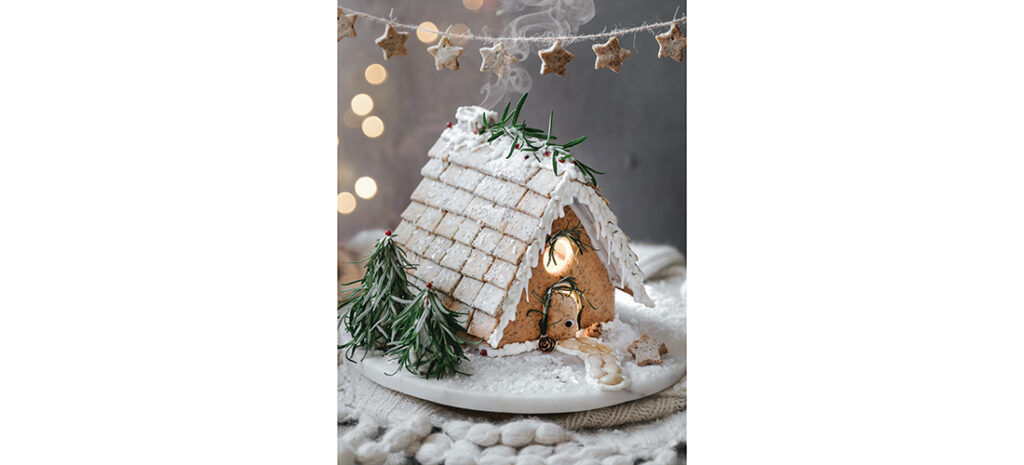
While gingerbread houses — the first ones date back to the 16th century — are everything when you have kids, there are other ways to enjoy this whimsical Christmas tradition. This year, we are making cracker cottages for a savory version of the original. These salty, herb-infused holiday homes remind me of the plain and simple, yet timelessly beautiful, gingerbread houses of the past. Cracker cottages are no less enjoyable to build, and add a sense of calm and rustic charm to your tablescape and, of course, make an excellent appetizer and perfect addition to your charcuterie board. 


Almond Poppy Seed Crackers

(Basic recipe yields about 30 crackers)

1 cup blanched almond flour

1 tablespoon golden flax meal

1/2 tablespoon poppy seeds

1/2 teaspoon fine sea salt

3 tablespoons water

Seed, dried herbs, powdered onion or garlic, to taste (optional)


Preheat oven to 350°F. In a small bowl, combine all ingredients and mix with a fork until it resembles a dough. Roll out mixture between two sheets of parchment paper to about 3-4 millimeters thickness. Remove the top parchment paper and section dough with a knife or pizza wheel into desired cracker shapes. Transfer parchment paper with cutouts to a baking sheet and bake for 20-25 minutes, or until crackers turn golden brown (the outer edge will always turn darker then the center).


Cracker Cottage

Create your own template for a cracker cottage or print out a gingerbread house template from any of the free sources online. For a small cracker cottage, you will likely need to triple the basic cracker recipe; it’s best to work in batches and make more as needed. Prepare the dough as per the recipe above, but use your template instead of sectioning dough into crackers. Assemble the house right before use. To assemble, use cream cheese as “glue.” For intricate details, such as icicles, mix 8 ounces of cream cheese (room temperature) with one egg white and refrigerate until it has a firm enough consistency to pipe icicles and other decorative elements.  PS

German native Rose Shewey is a food stylist and food photographer. To see more of her work visit her website, suessholz.com.