
PinePitch November 2023

PinePitch November 2023

Question Everything

Be prepared to be transported to a world where secrets fester and the line between reality and illusion blurs when the Judson Theatre Company presents Gaslight, performed on Broadway as Angel Street, in five performances beginning at 7 p.m. on Thursday, Nov. 16, and running through a 3 p.m. matinee on Sunday, Nov. 19 at BPAC’s Owens Auditorium, 3395 Airport Road, Pinehurst. Set in a charming Victorian London townhouse, Gaslight, starring Jennifer Hope and Matthew Tyler, revolves around a seemingly perfect marriage, beneath which lies a sinister plot. Sanity is questioned and strange occurrences unfold in a heart-pounding journey to unravel a dark mystery. For more information go to www.ticketmesandhills.com.

 

The Last First

The Main Squeeze, an American funk band from Bloomington, Indiana, will bring down the curtain — if there was a curtain on the outdoor stage — on the First Friday concerts for 2023. The music begins at 5 p.m. and wraps at 8 p.m. on Friday, Nov. 3, on the Sunrise Square adjacent to the Sunrise Theater, 250 N.W. Broad St., Southern Pines. Everyone knows the drill. Food trucks. Check. Beer for imbibing. Check. Cujos? No so much. It’s the last one of the year, so leave your pets at home and wander by. For additional information call (910) 420-2549 or go to www.sunrisetheater.com.


Sugar Plums and Mouse Kings

Gary Taylor Dance presents The Nutcracker, from 7:30 p.m. to 9:30 p.m., on Friday, Nov. 24, at BPAC’s Owens Auditorium, 3395 Airport Road, Pinehurst. There will be additional performances of this holiday classic by Pyotr Ilyich Tchaikovsky on Nov. 25 and Nov. 26 at 2 p.m. For information and tickets go to www.ticketmesandhills.com.
 

Let There Be Light

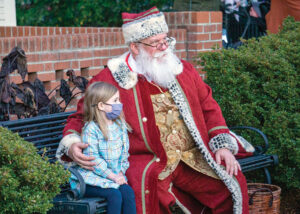
Ring in the holidays at Southern Pines’ annual tree-lighting celebration on Saturday, Nov. 25, from 4:30 p.m. to 6 p.m. In addition to block after block of colorfully decorated trees, keep an eye out for Santa Claus. He’s available for pictures. Bring your own camera but no autographs, please. For information call: (910) 692-7376.


From Apartheid to Democracy

William Lucas, a 33-year veteran of the U.S. Foreign Service, joins the Ruth Pauley Lecture Series with a talk titled “The Mandela-DeKlerk ‘Miracle’” on Thursday, Nov. 9, at BPAC’s Owens Auditorium, 3395 Airport Road, Pinehurst. Lucas was twice assigned to the U.S. Embassy in Pretoria, South Africa, as a political officer serving from 1981-83 and again from 1988-91. He was the director, African Affairs, at the National Security Council in 2006. His current projects include a book on the transition from apartheid to democracy in the ’80s and ’90s, based on interviews with key South African and American officials as well as declassified documentation obtained under the Freedom of Information Act. For additional details go to www.sandhillsbpac.com.


11th Hour, 11th Day, 11th Month

Downtown Southern Pines’ Veteran’s Day Parade will be from 10 a.m. to 12 p.m. on Saturday, Nov. 11. Bring the whole family to support our troops and veterans. All veterans are invited to join the parade. For more information call (910) 692-7376 or leaf through a history book. Freedom isn’t free.



Golf Talk Live

Join Southern Pines native and longtime PineStraw contributor Bill Fields in conversation with his old colleague and PineStraw editor Jim Moriarty as they discuss their decades covering golf and writing about it on Nov. 15 at 5:30 p.m. at the Weymouth Center for the Arts and  Humanities, 555 E. Connecticut Avenue, Southern Pines. Fields, who will be at Weymouth as a writer-in-residence, has contributed multiple features to PineStraw and penned over 100 of his “Hometown” columns since it first appeared in the magazine in Dec. 2014. He was born in Moore County, graduated from Pinecrest High School in 1977 and from the University of North Carolina – Chapel Hill in 1981. Fields has been a writer and editor for multiple golf publications and is currently a researcher on NBC’s golf telecasts, serving as the little voice whispering interesting facts into Dan Hicks’ ear. The program is free of charge but registration is required. For info go to www.weymouthcenter.org.
 

Sandhills Originals

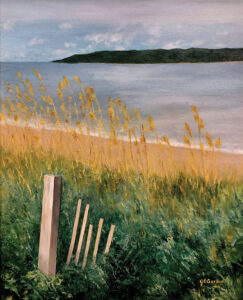
The Artists League of the Sandhills begins its 29th Annual Art Exhibit and Sale on Friday, Nov. 3, from 5 p.m. to 7 p.m., at 129 Exchange St., Aberdeen. The show continues on Saturday with a “meet the artist” session from 11 a.m. to 3 p.m. The exhibit and sale runs through Dec. 15. For additional information go to www.artistleague.org.
 

Take a Deep Breath

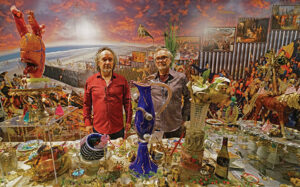
World-renowned glass artists Einar and James De La Torre will give a glass-blowing demonstration at Starworks, 100 Russell Drive, Star, from 5:30 p.m. to 7:30 p.m. on Thursday, Nov. 9. There will be live music by Laura Jane Vincent and beverages available from the Starworks Café and Taproom. The House of Odell & Luella food truck will be on-site. The event is family and pet friendly, if everyone is on a leash. Well, the pets anyway. Tickets are $5. For more information go to www.StarworksNC.org.

Simple Life

Simple Life

A Cure for the Summer Blues

And a homecoming for a flat-coated retriever

By Jim Dodson

As I write this, I’ve just returned from East Hampton, New York, where I sat on the porch of a beautiful old house that belongs to my friends, Rees Jones, the famous golf architect, and his wife, Susan. The sun had just come up and the first birds were chirping. Susan’s gardens were lush from recent rains. It was the day after Labor Day and the summer crowds were finally winding their way home.

I’d be lying if I said I was sad to see this particular summer go. It was a real doozy back home in Carolina, the hottest and driest summer I can recall, which explains why I spent many days watering my wilted gardens that seemed prepared to give up the ghost.

But I’m already in a November state of mind.

November, you see, is one of my two favorite months, when I pause to take inventory of the year, count my blessings and thank the Lord for unexpected gifts.

This year I’m starting early with a dog named Blue. He was the one great thing about summer’s end — besides summer’s end.

Up till the moment my wife, Wendy, found him, I was feeling intense lingering grief over the loss of my beloved dog Mulligan at the end of August last year.

Mully, as I called her, was 17 and had been my faithful traveling pal since the October day in 2005 when I found her running wild and free on the shoulder of a busy highway near the South Carolina line, a filthy, joyful, black pup that raced into my arms as if she knew I was there to save her — though I’m convinced it was the other way around. Whichever it was, we found each other and shared an uncommonly powerful bond to the very end.

One of the saddest moments of my life was watching her soulful brown eyes close for the last time as she lay at my feet in the garden she helped me build. Or it felt like it at the time.

Grief is such untidy business. It squeezes your heart at unexpected moments. Every time I saw a dog that looked like Mully — a flat-coated retriever and border collie mix — I found myself almost aching with returning sadness.

Even our aging and sweet old pit bull, Gracie, whom I call Piggie for the way she snorts when eating and sleeping, seemed to keenly feel Mully’s absence, despite the fact that pits are not known for displaying much emotion. 

One day last fall, I happened to open an app to Red Dog Rescue and there was a black-and-white female puppy looking for a forever home. I was sure Mully was sending her to us. So, on a lark, I filled out the paperwork and supplied proper references. A week or so later, we drove to a farm down in Asheboro to pick her up.

We named her Winnie — either after Winnie-the-Pooh or my late friend Winnie Palmer, Arnold’s wonderful wife — I’m still not sure which.

It wasn’t long before I started calling her Wild Winnie. She is an exceptionally smart and insanely joyful mix of Labrador retriever, English springer spaniel plus something her DNA results termed as “Super Mutt.” She is every bit that and more.

In truth, however, I wasn’t sure life in an old suburban city neighborhood would be sufficient for our beautiful Super Mutt’s needs.

But I was wrong. Winnie quickly attached herself to Gracie the Bull and my wife, Wendy, who took her to training classes and soon had her performing an impressive repertoire of obedient commands. Wendy also began taking Winnie to Country Park’s BarkPark, where she fell in with a band of rough-and-tumble regulars named Roger, Jack and Ellie that run, wrestle and chase each other until they drop from exhaustion.

Winnie, in short, has been a joy. Without fail, she jumps into my lap every morning to give me a soppy lick of gratitude for finding her.

But she’s clearly one of the girls. Wendy is her sun and moon. I’m just Wild Winnie’s fun playmate.

I was OK with that until the end of August, when the first anniversary of losing Mully approached.

My intuitive wife seemed to divine that my normal “summer blues” were worse than ever this year. One afternoon as we shared a cool drink beneath the shade trees, she handed me her iPhone and said, smiling, “So what do you think?”

It was a photo of a beautiful black flat-coated retriever that looked exactly like Mully.

“He’s over in Tennessee, a rescued young male who belonged to a lady who had to give him up. They say he’s sweet as can be, loves other dogs and even cats. They’re taking a load of rescued dogs to New England and will be passing through western Virginia this Friday evening. If you’re interested. I’ve already cleared our references.”

For several seconds I said nothing, just stared at the photo.

“You need your dog,” my wise wife quietly said.

So we drove to western Virginia and picked him up. On the two-hour drive home, he climbed up front and placed his head in my lap and fell asleep.

We named him Blue, my forever cure for the summer blues. After a bath, he was so black he was blue. My daughter, Maggie, suggested the name.

Blue follows me everywhere, lies at my feet and already answers to his name. Piggie and Winnie adore him. Ditto Boo Radley, the cat.

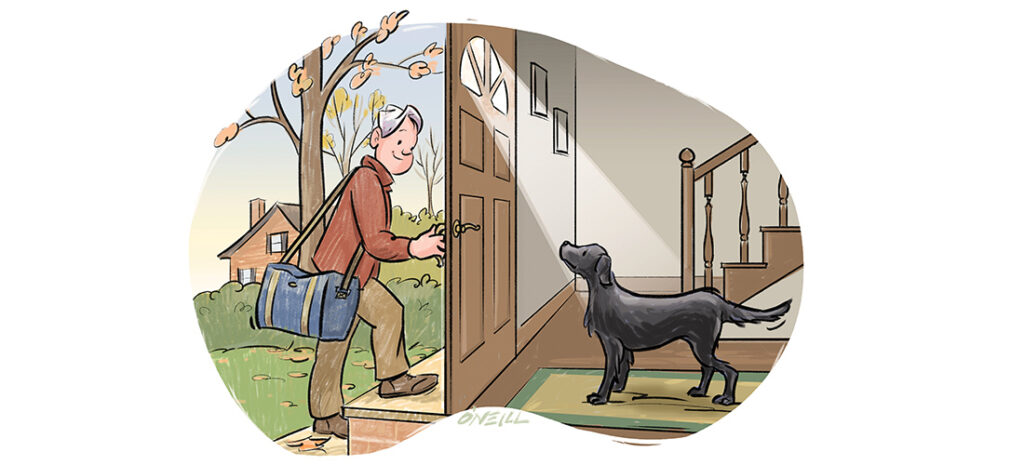
On the evening I arrived home from New York, Blue was the first one to greet me at the door, hopping up to give me a lick on the chin.

It was good to be home.

For both of us. PS

Jim Dodson can be reached at jwdauthor@gmail.com.

Almanac October 2023

Almanac October 2023

October dares you not to look away.

These early days of autumn, deciduous trees edging toward full glory, you wouldn’t dream of it. Brisk mornings enliven your senses. You can nearly taste the crispness through your skin.

As golden light alchemizes a brightly colored skyline, yellow becomes more than yellow; red, sharper and truer; orange, otherworldly so.

The merging of light and leaves mesmerizes you. There is nothing soft about this symphony of color. Nothing subtle. The dance is as stunning as molten gold.

Trees become torches. Foliage laps against cerulean skies like ravenous flames licking silent blue heavens. This amalgam of color transforms your very being. You feel both awestruck and emboldened. Ancient and brand new.

Suddenly, a gust of wind sends a wave of leaves swirling earthward. Another gust follows, releasing howling, coppery flurries.

The wind goes rogue.

Wave after furious wave, the leaves descend with reckless abandon. As starling murmurations flash across a brilliant sky, the fleeting beauty makes you ache.

The paradox is arresting: The season has reached its full potential, and there’s nothing to do but watch it make a raging, riotous exit. 

Do not look away, you tell yourself. A shock of crimson shakes from open branches. Do not miss one glorious moment.

October commands your faithful presence. As the trees free themselves of all adornment, you soften to their naked truth. This, too, shall pass

Hold tenderly this precious knowing — this visceral aliveness — and, in the next breath, let it go.

There is a far sweet song in autumn

That catches at my throat,

I hear it in each falling leaf

And in each wild bird’s note . . .   

— George Elliston, “Mine Own” (1927)

Birds of Autumn

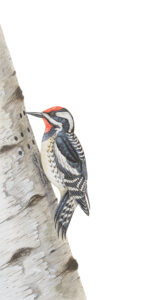
Yellow-bellied sapsuckers arrive; ruby-throated hummingbirds depart for warmer climes. Birds come and birds go.

This month, as nature dazzles us with her warm and glorious hues, keep watch for white-throated sparrows, pine siskins and yellow-rumped warblers — winter residents whose songs are as distinctive as their field marks.

Oh, Sweet Canada, Canada, sparrows whistle.

Warblers perform their soft, slow trills. 

Pine siskins stun us with their harsh and wheezy zreeeeeeet.

Winter is nigh, the birds seem to say.

In other words: Enjoy the show. 

Flower of the Dead

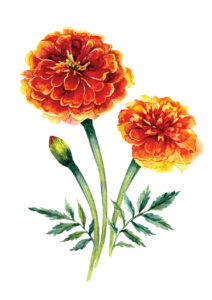
Nothing says autumn like a field of fiery marigolds. Or a tidy garland of them. 

Although October’s vibrant birth flower has long been associated with grief and loss, its uses have been — and continue to be — vast. Because their sunny orange and yellow hues are believed to dispel negativity — and to help guide wandering spirits to altars for the dead — marigold garlands are commonly used in religious ceremonies in Asia, Latin America and Mexico.

They’re also a choice natural dye, companion plant and, depending on the variety, edible flower. Bust out a batch of marigold-and-saffron shortbread this season and see if you ever crave pumpkin spice again.  PS

Southwords

Southwords

The Ancient Ways

The primitive art of pumpkin carving

By Jim Moriarty

There are things in the modern world into which far too much thought has been invested. One is pumpkin carving. Search the web long enough and you can find out how to etch T.S. Eliot’s “The Love Song of J. Alfred Prufrock” into your front doorstep decoration, backlit with electric lights and read by Jeremy Irons.

The array of hand tools necessary for modern pumpkin carving is slightly less complicated than a tray full of surgical instruments used in a heart transplant. Keyhole saw. Fleshing tool. Awl. Drill and interchangeable bits. Melon baller. Petroleum jelly — and I’m not at all sure I even want to know what that’s for.

Apparently in the 21st century, it’s not uncommon to make the initial incision from the back of the pumpkin, or the side, or however you want to describe the part of the pumpkin that is neither top nor bottom. Once you’ve cracked its chest and the outer pumpkin seal has been broken, the modern gourd is subjected to a form of liposuction. After all the icky stuff is removed with scooping devices — melon ballers, it seems, can be obtained in a great variety of sizes and grip options — the inner wall is then thinned to a thickness of no less than 1/2 inch but no greater than 3/4 inch by scraping away the orange flesh with some sort of diabolical loop instrument that looks as though it would have been used in medieval times to remove the tongue of the village heretic.

After you’ve hollowed out and squeegeed the interior to a lustrous sheen, you then apply the stencil to the outer surface using either industrial grade duct tape or T-pins borrowed from your child’s voodoo doll. This is where all right-thinking persons should draw the line. Did Picasso use a template to paint Guernica? Did Michelangelo stencil Adam onto the Sistine Chapel ceiling? Yet, they press on.

Once the stencil is in place, using some kind of  needle, puncture the outer skin every 1/8 to 1/4 inch along the outline of the design. Remove stencil, plug in and engage the three-speed electric drill or, if you’re etching, scrape the skin away with linoleum cutters. Work outside to in. This, as it turns out, is where the petroleum jelly comes to the rescue, applied to the bare flesh (the pumpkin’s, that is) the way you apply a poultice to a boil. Soon you’ll have a design more magnificent than, and equally as complex as, the four laws of thermodynamics.

There is, however, another way. You can go old school.

First, get you a pumpkin. Next, get you a knife.

I’m not talking just any knife. Go to the kitchen drawer and pull out the biggest, most dangerous carving knife you can find. Full-on Chucky.

Using a blue Bic, draw two equilateral triangles for the eyes — point up, naturally — and a mouth with two upper teeth and one lower. Then, insert your carving knife into the top of the pumpkin at a slight angle to the perpendicular, cutting all the way around the peduncle. (The stem, I’m told.) Lift the lid, trim the bottom.

Using your bare hands, scrape out the innards until your fingernails turn orange. Go in right up to your elbow if you must, scooping out handfuls of slimy, fibrous pumpkin entrails. Young children pressed into service may get the dry heaves. Pay them no mind. Put the slop into a big pile and begin separating the seeds from the goop. Place the seeds on a greased cookie sheet, sprinkling garlic salt liberally on top. Place the tray in the oven on broil. Cook until they’re turned to ash.

As the odor of burning garlic wafts through the kitchen, plunge the knife into the pumpkin, more or less following the Bic drawing for the eyes and mouth. Freelancing is allowed though not encouraged. When finished, use the butt end of your carving knife — being careful not to put your eye out — and tap the cutouts until they fall into the hollow pumpkin. Remove. Once empty, use the sharp point of the knife, employing the twisting motion of an assassin, to dig a spot in the bottom of the pumpkin’s interior. Take a candle from the dining room table, light it and drip the wax into the wound you’ve carved in the base. Place the bottom of the candle in the pumpkin before the wax hardens. The candle won’t stay upright long but, if you’re lucky, it’ll get you through one night. After that you’re just eating leftover candy anyway.  PS

Golftown Journal

Golftown Journal

Their Cup Runneth Over

But it wasn’t always that way

By Lee Pace

It was 40 years ago when the Ryder Cup pivoted from a sleepy, ceremonial tea party to one of the world’s most anticipated and watched sporting events. On Oct. 16, 1983, Lanny Wadkins nailed a wedge shot to a foot on the final hole at PGA National Golf Club for a birdie and the clinching point for the American team, nipping the Europeans 14 1/2 to 13 1/2.

Jack Nicklaus, the non-playing captain, went down on his knees to kiss Wadkins’ divot. He drank champagne from the Ryder Cup itself during a victory celebration that Wadkins recently said, “To this day, that was probably the best party I’ve ever seen.”

Meanwhile, European captain Tony Jacklin seethed. “We just missed this time,” he said. “But I promise you, when the Americans come to England in two years, it’ll be a different story.”

You think? 

Though it took four years for the effects to truly manifest themselves in the drama at Palm Beach Gardens, the decision in 1979 to expand the Great Britain and Ireland team to include all of continental Europe was the change that created the spectacle of the modern matches. This year, in a Ryder Cup contested in the countryside outside of Rome on a Marco Simone Golf Club course in the shadows of a castle built 1,200 years ago, Jon Rahm of Spain, Viktor Hovland of Norway and Northern Ireland’s Rory McIlroy highlight a European team with an English captain and five co-captains that included a Dane, two Italians, one Spaniard and a Belgian.

Before the GB&I team composition changed, the Americans held an 18-3-1 record in the biennial competition. The tie featured the famous Nicklaus/Jacklin match in 1969 with the U.S. retaining the cup. America’s dominance through those years included a 9 1/2 to 2 1/2 lambasting of the team from Great Britain — as it was called then — at Pinehurst in 1951. Beginning with the matches in ’79 when the U.S. opponent was all of Europe, the record heading into the 2023 matches in Italy was Europe 11 wins, America nine wins, and one tie — a result that allowed Europe to retain the cup in 1989.

Two men with connections to the Sandhills and North Carolina were on the front lines in the 1970s when the PGA of America and the British PGA made the decision that changed golf history.

Henry Poe, a native of Durham and a Duke University graduate, was president of the PGA of America in 1975-76.

Don Padgett Sr. was a longtime club professional in Indiana and the PGA vice president and then president during that era. Padgett would later serve as Pinehurst’s director of golf from 1987-2002 and was instrumental in Pinehurst’s quest to land major championship golf that today includes U.S. Open number four coming next June and four more on the calendar through 2047. 

“To show you just how far off the radar screen the Ryder Cup was at that time, the 1975 competition almost didn’t get on television,” Padgett said in 2002. “George Love, the kingpin at Laurel Valley and the local chairman of the event, had to guarantee the commercial time to get ABC to agree to show the competition. Can you imagine that today? It’s gone from the club having to beg for TV coverage to today where NBC pays millions of dollars to televise the Ryder Cup.”

The 1975 rosters underlined the competitive imbalance in the two squads. The Americans had nine players who would win Grand Slam events — Billy Casper, Ray Floyd, Lou Graham, Hale Irwin, Gene Littler, Johnny Miller, Lee Trevino, Tom Weiskopf and Nicklaus. By contrast, the GB&I team had only British Open champion Jacklin among major-championship winners on its roster. The score that year? The U.S. won, 21-11.

The 1977 Ryder Cup Matches were held at Royal Lytham & St. Annes Golf Club in England. Poe, the pro at Redding Country Club in Pennsylvania, was chairman of the matches, and Padgett was president of the PGA. They were riding around the course in a golf cart, and Poe said, “Don, I’m really getting concerned about the Ryder Cup. Several of our players have said they don’t care if they ever play again. There’s just no competition.”

It was clear that some change was going to have to be made to strengthen the GB&I team in order to keep the players’ interest. Nicklaus said in a letter to Lord Derby, captain of the British PGA, that the Ryder Cup had become a social affair for the Americans — and little else.

“It is vital to widen the selection procedures if the Ryder Cup is to continue to enjoy its past prestige,” Nicklaus told Lord Derby, who was also president of Royal Lytham & St. Annes Golf Club.

Poe suggested that afternoon that he and Padgett try to get Lord Derby to sit down and discuss the issue. It was incumbent on the British to expand the boundaries of the GB&I team. They had breakfast with him the next morning, and Lord Derby seemed receptive to the idea.

“Henry was close friends with Lord Derby,” Padgett remembered. “That relationship helped him get Lord Derby to consider the proposition. By then the British PGA was conducting a true European tour, and we believed the team fielded by the British PGA should reflect that. I think Lord Derby and the GB&I team were tired of losing.”

When the 1979 Ryder Cup came to the Greenbrier in West Virginia, the American opponent was now a true European team, one not limited to the British Isles — and there were a couple of young Spaniards on the squad named Seve Ballesteros and Anthony Garrido.

“Seve was young and good-looking and had a slashing, charging game,” Padgett said. “He was like a young Arnold Palmer. And he had a wonderful short game. You could see things might be different down the road.”

The United States still dominated at the Greenbrier, 17 to 11, and won handily two years later at Walton Heath, 18 1/2 to 9 1/2. But new faces on the European team were spicing things up. Bernhard Langer from Germany and Jose Maria Canizares of Spain joined the squad in 1981. The British PGA now had a much broader pool of talent from which to draw, and the European players brought a more durable quality to their team. They played week-to-week on courses offering more variety and difficult playing conditions than the American tour. Travel was more challenging and amenities less in abundance.

“It all goes back to relationships, which are so important in all of business but particularly in golf, which is a fairly small world,” Padgett said. “Henry’s relationship with Lord Derby got the ball rolling. I’m sure things would have changed eventually had Henry not made that appeal to Lord Derby back in 1977. But I don’t think they would have changed as soon.”

Since then we’ve been treated to the “War by the Shore” at Kiawah in 1991 (Langer still wondering if that damn putt will fall), Justin Leonard’s 45-foot bomb at The Country Club in 1999, Darren Clarke harnessing the grief over his wife’s recent passing to go 3-0-0 at the K Club in Ireland in 2006, Ian Poulter’s birdie binge to fuel the “Miracle at Medinah” in 2012, and the steely Patrick Reed edging Rory McIlroy 1-up at Hazeltine in 2016.

“The European and the American teams are more patriotic now than ever,” Nicklaus says. “I think that’s great. It is the one week where one of the world’s best golfers is not playing just for himself. He’s also playing for 11 others, for his country and for an enormous amount of pride.”  PS

Lee Pace has written about the Pinehurst experience for more than three decades from his home in Chapel Hill. Write him at leepace7@gmail.com and follow him @LeePaceTweet.

Naturalist

Naturalist

The Fly in Wasp’s Clothing

The best costumes are made by Mother Nature

Story and Photographs by Todd Pusser

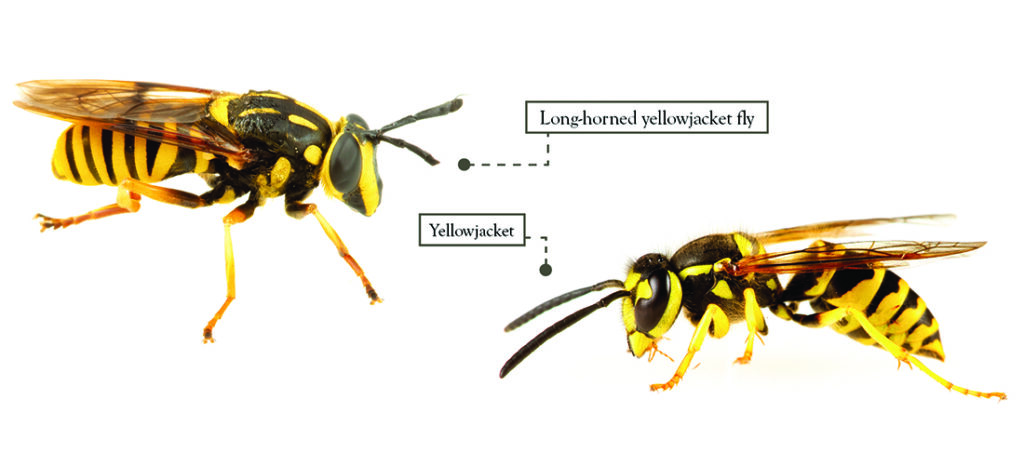
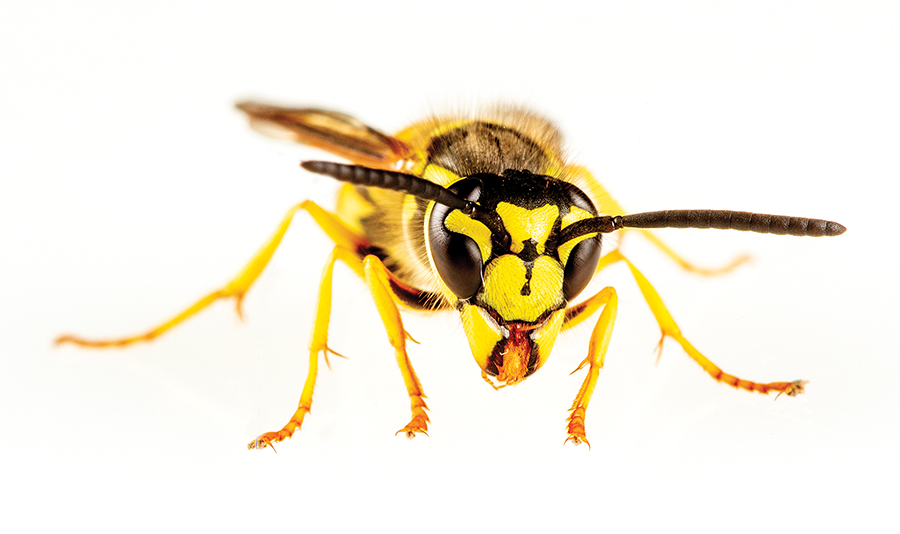
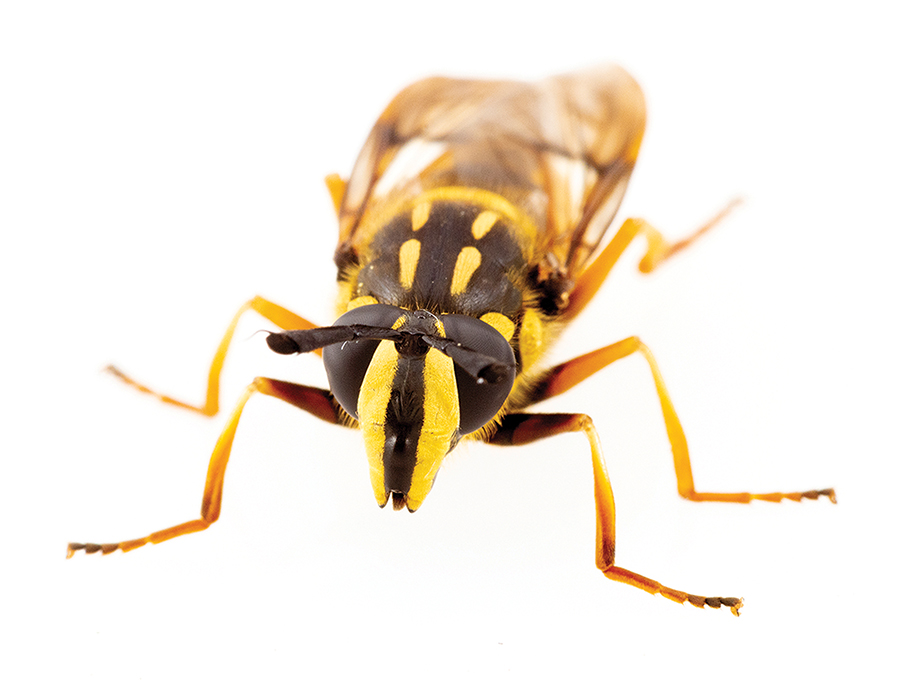
Staring through a macro lens at the critter resting in the center of my photo tent, I have to constantly remind myself that I am not going to get stung. With large eyes and striking black and yellow markings, it looks for all the world like a wasp — a yellowjacket, to be more precise. Only when it rubs its forelimbs over its eyes does it begin to reveal its true identity. It is a rarely observed type of hover fly and a perfect doppelganger for the venomous wasp.

The day before, Floyd Williams, a retired ranger from Merchants Millpond State Park with a keen naturalist’s eye, captured the fly in his yard in Gates County. Well aware of my interest in unusual animals, he phoned to inform me of his prize, the Sphecomyia vittata. Not being well-versed in the scientific names of flies, a quick Google search revealed a much more manageable common name, the long-horned yellowjacket fly.

Like most people, I have never given flies much thought, other than when I am trying to shoo one out the car window or when I slap a deer fly taking a nibble from the back of my neck. Aside from politicians, and perhaps the Duke men’s basketball team, flies are among the most detested of all living things.

Yet for all the public apathy, flies are vital components of a healthy ecosystem. Need something to break down that pile of dog poop in the backyard? There’s a fly for that. Need something to pollinate those bright flowers in the garden? There’s a fly for that. How about ridding insect pests that raid those same gardens? You guessed it. There’s a fly for that. Sporting an infinite array of shapes and sizes, flies provide a wealth of underappreciated environmental services.

As I fiddle with my exposure, the hover fly begins to slowly walk across the floor of the photo tent. Reaching inside, I gently prod the fly with a toothpick, in an effort to move it to the center of the tent, back into camera range. Upon feeling the nudge to its abdomen, the fly suddenly lets out a sharp and unexpected buzz. I marvel. Not only does this fly look like a yellowjacket, it sounds like one too! The buzz only adds to the illusion. As far as mimics go, this one takes the top prize.

Flies of every kind are eaten by a plethora of animals. Spiders, birds, lizards, small mammals, even wasps relish a juicy fly. If one is going to fly about out in the open, during daylight hours, as hover flies (aka flower flies) do, it pays to look like something unappetizing, or better yet, dangerous.

Defenseless organisms that masquerade as dangerous ones employ an evolutionary survival strategy that biologists refer to as Batesian mimicry. Named for the Victorian naturalist Henry Walter Bates, who spent years trouncing around the forests of the Amazon and first discovered the natural phenomenon, this form of mimicry is surprisingly common. Most of the 6,300 or so species of hover flies found around the world bear a striking resemblance to wasps and bees.

Finishing up my session, I take the photo tent outside and open the side panel. With the toothpick, I gently nudge the wings of the hover fly, coaxing it to take off. In a flash, the fly zips out of the photo tent and lands a few yards away on the purple flowers of a backyard butterfly bush, perhaps needing a refreshing sip of nectar after its glamour shots. A five-lined skink, lounging on the railing of our deck, next to the flowers, pays it no mind. Nor does a cardinal singing nearby.

Later, scrolling through the photos on my computer screen, I find myself full of childlike wonder, once again marveling at the extraordinary resemblance of the hover fly to a yellowjacket. Even zooming in on the details of the legs, antennae and body, I find it difficult to establish that it is indeed a fly.

The optical illusion serves to drive home an important lesson: One need not travel to some distant or remote tropical jungle to discover remarkable wonders in nature. The wild right outside the front door is just as full of extraordinary creatures, if one only stops and takes the time to look.  PS

Naturalist and photographer Todd Pusser grew up in Eagle Springs. He works to document the extraordinary diversity of life both near and far. His images can be found at www.ToddPusser.com.

Birdwatch

Birdwatch

Enticing the Baltimore Oriole

Red carpet treatment for an occasional guest

By Susan Campbell

Northerners who relocate to central North Carolina often ask me about birds familiar to them that seem absent here in our fair state. One that is close to the top of the list is the Baltimore oriole. Its striking plumage and affinity for sweet feeder offerings make it a real favorite among backyard bird lovers.

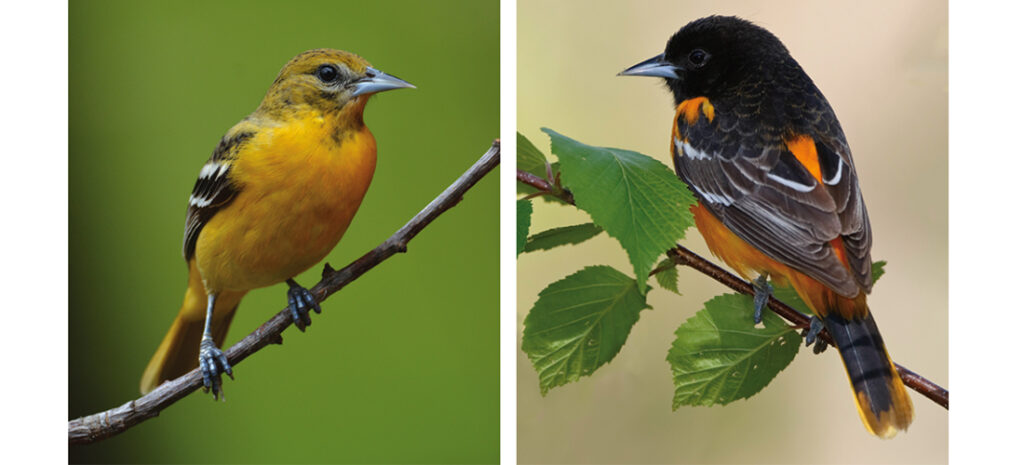
Male Baltimore orioles are unmistakable with bright orange under parts, a black back and head, as well as two bold white wing bars. Females and immature birds are yellow to light orange with the same white wing bars. They have relatively large, yet pointed, bills, which are very versatile while foraging. Males sing a very melodic song made up of several clear, whistled notes.

As it turns out, Baltimore orioles actually do nest in North Carolina — if you venture far enough west. In our mountains they can be found weaving their elaborate nests that dangle from high branches, often over water. Following two weeks of incubation, the young will spend another two weeks before they fledge. By mid-summer the adults spend their days in the treetops, looking for caterpillars and small insects to feed their growing families.

However, since these birds winter throughout Florida and all the way down into Central America, you might spot a few as they pass through in spring or fall. There is also a chance one or two might spend the winter in your neighborhood if you have the kind of habitat they seek out in the cooler months. Should your yard be to their liking, they may return year after year, bringing others (presumably family members) with them. I know winter oriole hosts in the eastern half of the state who count a dozen or more birds frequenting their feeders October through March every year.

Baltimore orioles will seek out areas with lots of mature evergreen trees and shrubs of which a significant portion bear some sort of fruit. These birds are relatively large and colorful so require thick cover for protection from predators — especially fast-flying bird hawks such as Cooper’s and sharp-shinneds. Without this, it has been my experience that they will not linger long even if food is plentiful. Should they feel safe, the odds are they will settle in and become a regular backyard fixture. Baltimore orioles will continue to consume any insects they happen upon but will switch to a diet of berries and whatever fruit or sweet treats they find at bird feeders. They are known to enjoy not only suet mixes with peanut butter but also orange halves, grape jelly and even marshmallows. They also will avail themselves of sugar water from hummingbird feeders they find still hanging. There are special, large sugar water feeders made for orioles that usually contain partitions for placing other solid treats as well. Baltimore orioles definitely enjoy mealworms, too, should your budget allow.

A few very lucky people have been treated to the out-of-place Scott’s oriole, as well as Bullock’s oriole, here in North Carolina. Interestingly, these mega-rarities have turned up at sites without any other orioles present. Keep in mind that we sometimes find western tanagers at feeders in winter. The females and immature birds of this species look very similar to female or immature Baltimore orioles, differing only in the shape of their bills and the color of their wing bars.

Personally, I have had Baltimore orioles show up for a week or so but then move on. In spite of setting out the red carpet (including suet, jelly, oranges, mealworms and sugar water), they have not been enticed to stay long. Maybe this fall will be a different story . . . PS

Susan Campbell would love to receive your wildlife sightings and photographs at susan@ncaves.com.

Crossroads

Crossroads

A Mission that Rings True

The Village Chapel turns 125

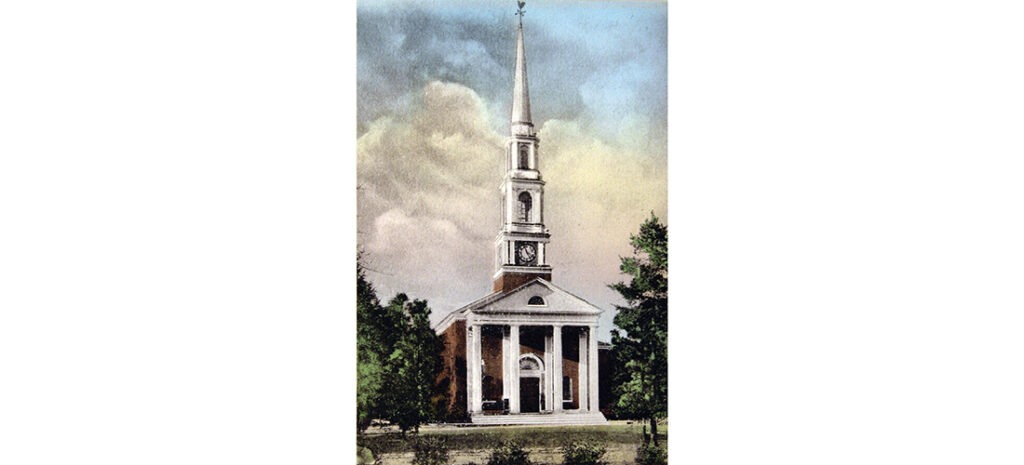
“The Village Chapel has stood here through all these years, with its slender spire, its beautiful proportions, its chaste simplicity, its friendly and devout spirit, to bless and inspire those who come under its influence. Some have been gracious enough to say that the Chapel is the heart of Pinehurst.”    — Dr. Thaddeus A. Cheatham, Pastor, The Village Chapel (1908-1950)

By Steve Woodward

Dr. Thaddeus Cheatham penned the above sentiment upon his retirement after guiding Pinehurst’s first church, The Village Chapel, during a remarkable span of 42 years. His words resonate today, on the eve of the Chapel’s commemoration of its 125th anniversary, which will be formally celebrated on Oct. 29.

Little is known about Cheatham before the Episcopalian priest arrived in Moore County in 1908 but he was the right man at the right time.

The Chapel as it stands today was built in 1924 and held its first service on March 1, 1925. Its roots, however, trace to the establishment of a religious society envisioned by Pinehurst’s founder, James Walker Tufts, and formally organized in 1898 by his close friend Dr. Edward E. Hale, a Unitarian pastor.

The Village Chapel became the heart of Pinehurst long before a “slender spire” towered overhead. Tufts believed that the destination he created to attract refugees from Northern winters would not succeed unless it was held together by something more than a moderate climate. He called it Christian unity and, in pursuing that objective, Tufts and Hale formed one of the first interdenominational churches in the United States.

With the evolution of the Pinehurst Religious Association around 1897, seasonal visiting worshippers began gathering in Pinehurst’s first lodging, The Holly Inn, for Sunday services. In ensuing years, they assembled in the Casino Building, which in that era meant “community center.” Ultimately, a village hall was erected and Sunday worship relocated there — as long as someone could round up a visiting pastor.

A Catholic congregation eventually began meeting for Mass under the same roof, re-enforcing the spirit of unity Tufts sought. As observed by The Pinehurst Outlook, interdenominational worship achieved an “ideal sought by many.”

Cheatham’s arrival stabilized the Sunday schedule and, by 1923, his leadership was inspiring Chapel members to dream of erecting an elegant new building on the Village Green. Unfettered generosity made possible the chapel that would soon be constructed. A frequent visitor, Mary Bruce, initiated the building fund by presenting Cheatham a check for $5,000 ($89,000 in 2023 dollars) from her death bed in New York when he visited after Easter 1923. According to Chapel archives, news of the donation spurred pledges exceeding $40,000 within 20 minutes after Cheatham formed a building committee. Among the donors was Pinehurst No. 2 course architect Donald Ross, already well on his way to fame as one of golf’s premier designers. When Leonard Tufts, James’ son, was advised that cash was flowing in, he donated prime Village Green land. No hearings. No bonds.

When The Village Chapel opened its doors, Pastor Cheatham could not have known that 25 more years of stewardship lay before him. From the second half of the 20th century through the present, the roster of senior pastors has multiplied to 11. Rev. Dr. Ashley Smith became senior pastor upon the retirement after a decade of service of Rev. Dr. John Jacobs in 2022. Smith arrived at the Chapel to serve as associate pastor in 2011.

The Chapel has long been known for its music. In 1988 music director John Shannon oversaw installation of the Chapel’s second carillon. It was equipped with speakers housed in the Chapel’s steeple. This carillon soon became a mainstay in the village. Westminster chimes play each hour. Hymns emanate every three hours. Payne Stewart famously remarked following his U.S. Open victory in 1999 that hearing the bells gently piercing the silence relaxed him as he was teeing off on the 18th hole in the decisive final round.

Robust community support for Village Chapel expansion would repeat across the decades. In 1961, an administrative wing was added. Chapel Hall was christened three decades later. Beginning in 2021, Heritage Hall rose amid the longleaf pines to accommodate the Chapel’s fast-growing youth ministry and was dedicated on Sept. 18, 2022.

The Chapel’s footprint more than ever is tied inextricably to the identity of the village. Added to the National Register of Historic Places in 1973, the Chapel affirms James Walker Tuft’s legacy and remains a beacon, singularly devoted to its mission.  PS

Steve Woodward resides with his wife, Jackie, in Pinehurst, three minutes away by car from The Village Chapel. He is a recovering journalist who focuses on blogging and managing several community websites, leaving little time for tortured rounds of golf. 


The Pastors of The Village Chapel

Rev. Dr. Edward E. Hale, Unitarian: 1896 – 1903

Rev. Alleyne C. Howell, Episcopalian: 1907

Rev. Dr. Thaddeus A. Cheatham, Episcopalian: 1908 – 1950

Rev. Adam W. Craig, Presbyterian: 1951 – 1959

Right Rev. Louis C. Melcher, Episcopalian: 1959 – 1966

Rev. Charles W. Lowry, Episcopalian: 1966 – 1973

Rev. Henry C. Duncan, United Methodist: 1973 – 1987

Rev. Bobby C. Black, United Methodist: 1987 – 1997

Rev. Edward E. Galloway, United Methodist: 1997 – 2001

Rev. Larry H. Ellis, Baptist: 2001 – 2011

Rev. Dr. John R. Jacobs, Episcopalian: 2012 – 2022

Rev. Dr. Ashley N. Smith, Interdenominational: 2022 – Present

(Source: The Village Chapel)

Out of the Blue

Out of the Blue

Fall Faves

The crown of the calendar

By Deborah Salomon

The primordial connection between humans and the seasons has survived for millennia. Spring invigorates. Winter draws us to the fireside. Autumn, ah autumn, is a mixed blessing: relief from summer’s searing heat, harbinger of winter’s cruel chill.

These days, climate change is messing with both extremes, confusing plants and wildlife.

I’m an autumn gal, not a fan of summer vacations. My favorite autumn sub-season is called Back to School. Its talismans (talismen? taliswomen?) still evoke a pang rooted in a variety of experiences, good and not-so, beginning with . . .

Plaid cotton dresses: Through fifth grade I attended a progressive all-girls private school that required uniforms — navy jumpers, white blouses, knee socks and lace-up shoes. Then we moved to a different planet where I was plunged into public school, where girls wore plaid cotton dresses. My mother didn’t approve. Sensible skirts and blouses for me. Penny loafers? Not a chance.

The resulting quest for autumn plaid survives in long-sleeved shirts that look old-fashioned but complement jeans weathered by wearing, not a chemical bath.

Absolutely necessary for b-to-s: ring binders covered in a medium-blue fabric, with metal rings that snapped hard, sometimes on fingers. The fabric surfaces welcomed ball-point graffiti, including names of boyfriends, or school teams, cartoons or pop singers. Designs were psychedelic before psychedelia had been invented. My binder suffered from lack of artistry.

Then, as autumn progressed, brown and navy corduroy replaced those lightweight plaids. Whatever happened to real corduroy, just cozy enough for late October? All I could find was a jacket at Walmart, with the texture of mashed potatoes.

Long before the overuse of “pumpkin spice” in every conceivable food, the first fall McIntosh apples released their cider — with its incredible aroma — at New England cider mills, also the source for cider doughnuts, which added a new dimension to coffee breaks. Starbucks and Dunkin’ . . . don’t bother trying. Even three dollars and a fancy name can’t buy that smell.

As the leaves fell and days shortened generations “laid in” for winter, a necessary evil, beginning with gray, damp November — on nobody’s Best Month list. February turns the corner, with spring only a whiff away, signaled by early March fiddleheads, the tightly coiled fern leaves growing by streams and rivers, exquisite sautéed in garlic butter. Forage them quickly, before they unfurl to a bitter leaf.

During times of shock and uncertainty, with hurricanes flooding the West Coast and pandemics decimating populations, mortgage rates escalating and wildfires destroying forests, affirming our connections to weather, crops, seasons offers some comfort. Bears still hibernate, birds fly south and return to nest in the same tree. Thanksgiving happens no matter how expensive the turkey. Snowmen justify the blizzard. Spring flowers predict hay fever until the cows come home to be relieved of milk that reappears as lick-quick July ice cream cones.

But as long as leaves flame red and orange, October crowns the calendar. Breathe it in, before November shows up in a wooly turtleneck.  PS

Deborah Salomon is a contributing writer for PineStraw and The Pilot. She can be reached at debsalomon@nc.rr.com.

Pleasures of Life Dept.

Pleasures of Life Dept.

Pickleball Pandemonium

Investigating the recreational craze

By Jenna Biter

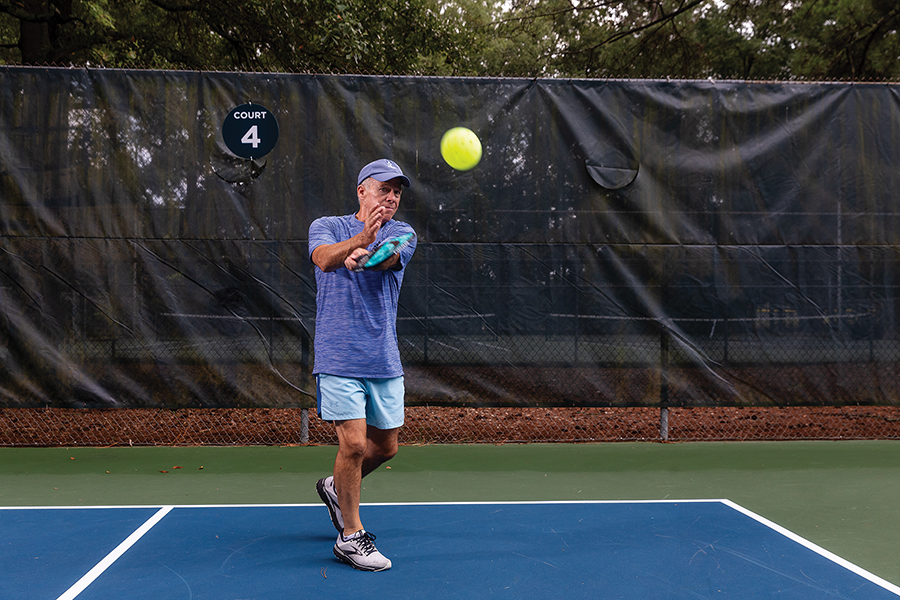
Any day of the week, split the baseball fields off W. Morganton Road and pull into the parking lot at Memorial Park, around, say, 8 o’clock in the morning. Directly through the windshield, you’ll see a pair of empty tennis courts, nets sagging low. They seem to let out a prolonged sigh as the color slowly drains from their hard, green faces as if they’re the sad relics of a popular pastime from a past time.

To their left, a constant thwack, thwack, thwacking drowns out the imagined groans of the aging courts next door.

“Hi, Sam or Chuck or Michelle,” somebody inevitably sings as they push through a chain-link gate into a space bubbling with laughter and the sound of endless thwacking spilling out of the half-dozen slick new pickleball courts.

The public facility replaced a different set of sorry tennis courts at the turn of the summer. Since then, the leftover hardcourt has looked on glumly, little more than spectators watching the new kids on the block.

Originally championed by the silver-haired demographic because its play area takes up one third of the real estate of a tennis court, pickleball’s popularity is winning over younger generations, too. More than just the latest excuse to pull a hamstring, it’s the fastest-growing sport in the United States and has been for three years.

With all the hype, from televised matches to pickleball style guides, you’d think the darling of court sports was imagined yesterday by a brilliant Ivy League dropout. Errrrr, wrong. The first pickleball match was played well before Neil Armstrong walked on the moon, in a lazy summer slump of 1965. Determined to entertain their bored children, a gaggle of desperate dads — one of them, Joel Pritchard, a Washington state congressman — slapdashedly devised the sport out of a badminton court, ping-pong paddles and a wiffleball.

Pickleball is the improv sketch of the sports world. Even its name sounds like the butt of a quirky dad joke. So the legend goes, the Pritchard family dog, a cockapoo named Pickles, zig-zagged across the backyard court sniping the game ball, giving the sport its name. In defiance of this urban legend, the Pritchards themselves maintain the pooch ‘n fetch came later. In fact, the paddle sport’s name derived from the term “pickle boat,” rowing slang for a scull full of misfits. Because the sport was thrown together piecemeal, Joel’s wife, Joan, dubbed it pickleball.

After nearly six decades of play, the sport — if it can be elevated to that status, pickleball  — has spread from that backyard in Washington, through perhaps a jillion senior centers and YMCAs, to thwack its way into mainstream recreation areas from Seattle to Sarasota, Burbank to Boston.

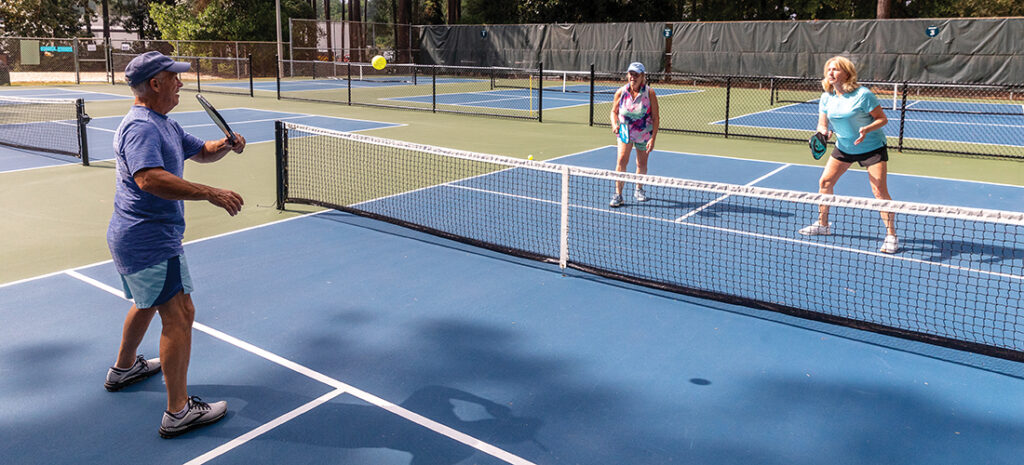
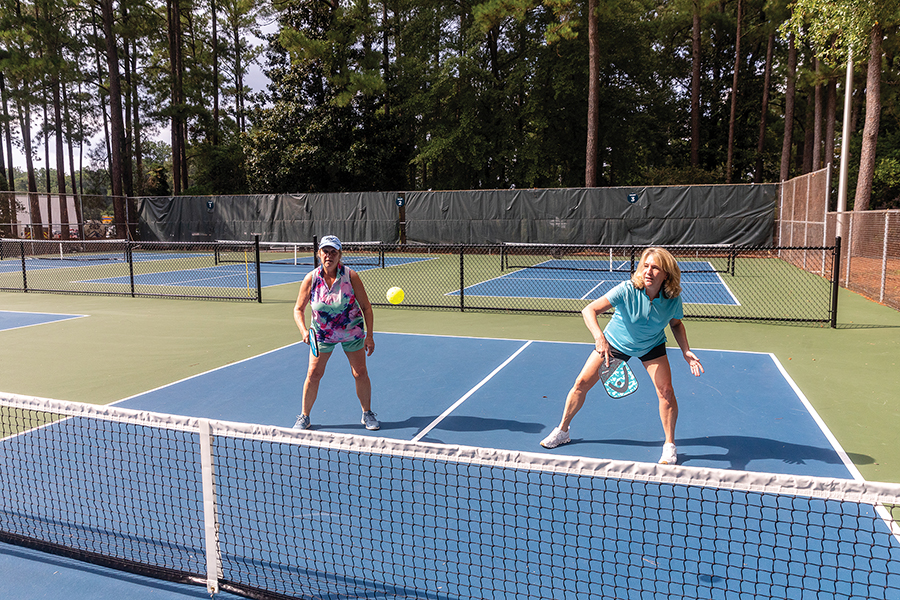
Its simplicity is a big reason the sport has been so readily adopted. Usually played in doubles, only the serving team can score. The serve must be hit underhand, diagonally to the opposing pair. Faults include: a shot hit out of bounds, a shot that doesn’t clear the net, or when something happens in a no-volley zone called the “kitchen.” Play to 11 and win by two. There are more rules, but that’s enough to get on the court. The skills of Novak Djokovic are not required.

I was no pickleball pro when I arrived at Memorial Park on a golden Friday morning. With a borrowed paddle and my laces cinched down tight, I was as ready as I needed to be to join a warm-up doubles match. “It’s just about getting your paddle on the ball,” one player said, coaxing me onto the court. That first solid thwack snuffed out any pregame jitters. The blunt feedback of a middle-of-the-paddle hit was more satisfying than I could have imagined, although finesse rather than strength is king on the court.

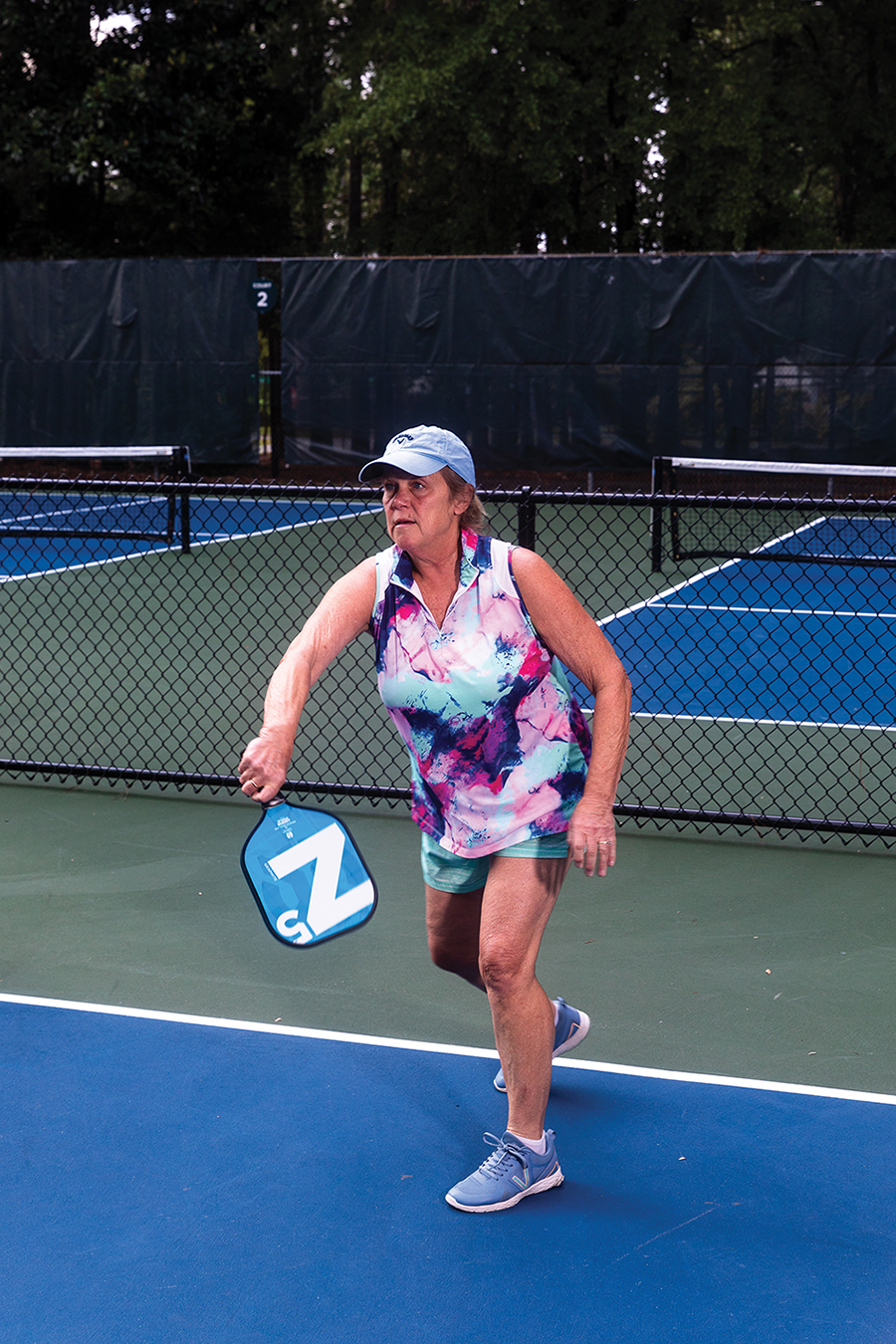
“The challenging part, coming from a tennis background, is you’re used to hitting the ball hard,” says Anne Merkel, a five-to-six day a week pickler. “And that’s not it. The goal is to try to get up close and just dink it. It’s very strategic. Some compare it to playing chess — it’s all about angles.”

I took the advice, finessing the ball left and right, trying to place it out of the opponents’ reach. Sometimes it worked, though not often enough. We lost the truncated scrimmage in a dismal showing, 5–0. Regrettably, I had to go. Revenge would have to wait. Walking to the car, I phoned my husband, “We need pickleball paddles,” I said.

Beginner or advanced, with or without a partner, from sunrise till quits, people tumble into Memorial Park and, smooth like butter, they seamlessly rotate into matches. This is how the courts have been since they opened in June.

“I love it because it’s fun, the camaraderie, but there’s that little bit of competitiveness,” Merkel says. “Pickleball is for everybody.”  PS

Jenna Biter is a writer and military wife in the Sandhills. She can be reached at jennabiter@protonmail.com.