Birdwatch

BIRDWATCH

Cleanup on Aisle 9

The unparalleled scavenger

By Susan Campbell

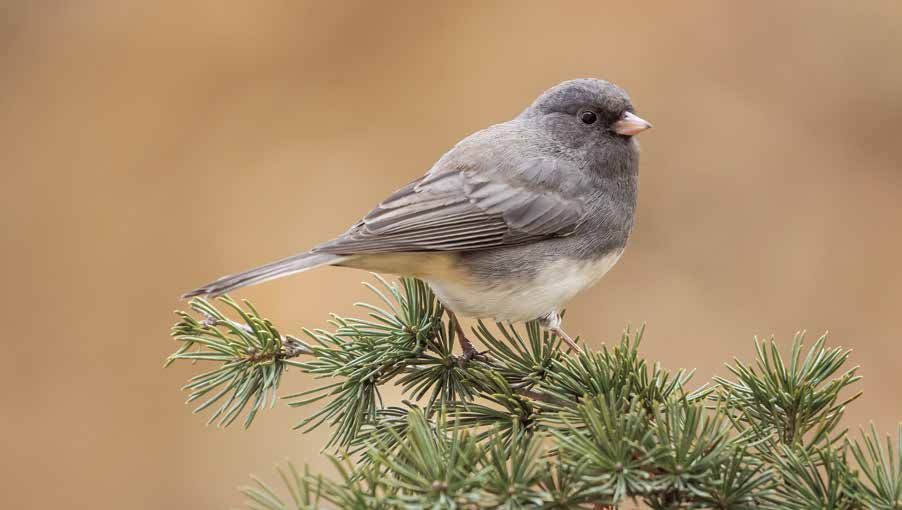
There! By the edge of the road: It’s a big, dark bird. It looks like it could be a wild turkey. But . . . is it? A closer view reveals a red head and face with a pale hooked bill, but a neck with feathers and a shorter tail. Definitely not the right look for a turkey — but perfect for a turkey vulture. This bird is also referred to as a buzzard or, for short, a “TV.”

Making an identification of these odd-looking individuals is somewhat harder these days since wild turkeys have made a good comeback in the Piedmont of North Carolina. Turkey vultures and turkeys can occasionally be seen sitting near one another in an agricultural field where they may both find food or are taking advantage of the warmth of the dark ground on a cool morning.

Turkey vultures, however, are far more likely to be seen soaring overhead or perhaps perched high in a dead tree or cell tower. They have a very large wingspan with apparent fingers, created by the feathers at the end of the wing. The tail serves as a rudder, allowing the bird to navigate effortlessly as it’s lifted and transported by thermals and currents high above the ground. These birds have an unmistakable appearance in the air, forming a deep V-shape as they circle, sometimes for hours on end.

It’s from this lofty vantage that turkey vultures travel in search of their next meal. Although their vision is poor, their sense of smell is keen. They can detect the aroma of a dead animal a mile or more away. They soar in circles, moving across the landscape with wings outstretched, sniffing all the while until a familiar odor catches their attention.

Turkey vultures are most likely to feed on dead mammals, but they will not hesitate to eat the remains of a variety of foods, including other birds, reptiles and fish. They prefer freshly dead foods but may have to wait to get through the thick hide of larger animals if there is no wound or soft tissue allowing access. Toothed scavengers such as coyotes may actually provide that opportunity. Once vultures can get to flesh, they are quick to devour their food. With no feathers on their head, there are none to become soiled as they reach into larger carcasses for the morsels deep inside.

Vulture populations are increasing across North Carolina — probably due to human activity. Roadways create feeding opportunities year-round. Landfills, believe it or not, also present easy meals. In winter, the northern population is migratory and shifts southward, so we see very large concentrations in the colder months. The large roosting aggregations can be problematic. A hundred or more large birds inhabiting a stand of mature pines or loitering on a water tower does not go unnoticed. 

Except for birdwatchers and those who live near a roost site, most people overlook these impressive birds. Often taken for granted, they are unparalleled scavengers, devouring the roadkill our highways inevitably produce.

Southwords

SOUTHWORDS

The Monster

And other commonsense solutions

By Ashley Harris

It was a delicate operation. The patient sat dejected on the floor, his “arm” dangling uselessly by his side. Just five minutes earlier, I had innocently slid the hose of my precious vacuum along the floor under the nightstand to suck up loose tumbleweeds of dog hair. Suddenly, the comforting whir of the motor was replaced by a death rattle.

“Help!” I screamed to my husband, J.P. But when I ran into the living room, I saw that he had on headphones, the protective gear worn by any baseball fan whose wife was doing loud chores. “I need you!”

“The Dodgers are playing the Padres.”

“This is an emergency!” I clenched my teeth.

Of all the vacuums I have ever owned, my 7-year-old, swivel-headed model is my favorite. We move together like Nureyev and Fonteyn, sweeping across the floor in artistic harmony.

I hauled the victim into the kitchen for triage. We peered down the dark hole of the hose and, even with the flashlight, couldn’t see anything.

“Can you think of something you might have vacuumed up that could be clear?”

Aha! I hadn’t seen the cap to my hairspray in weeks and, I confessed, it was clear.

“Congratulations,” J.P. said. “You have managed to vacuum up something that perfectly matches the diameter of the hose. That takes finesse.”

I had no time for clever remarks. “Let’s try this,” I said, handing over a steak knife. This tool remains one of my favorite commonsense solutions, useful for tasks well beyond its intended purpose. Never mind the scar I still bear on my left hand from the time, at 6 years old, I used one to pry a hardened collar of glue from my Elmer’s.

I held the hose steady while J.P. tried to jiggle the cap free, but the trusty knife did not work. We had no more luck with the screwdriver or the pliers, and the situation grew more dire with every attempt. Each tool we poked into the hose only pushed the cap even farther down, along with my heart.

“Why don’t we try the drill?” asked J.P.

For a normal person, the space between a crazy idea and better judgment is at least 30 seconds. Not for me. In my mind, this was pure genius. Why didn’t I think of it myself?

The cordless drill is J.P.’s most cherished tool, the equivalent of my vacuum. “Now, I don’t know how safe this is,” he warned. “You’re going to have to hold the hose perfectly still while I drill into the cap. If you move, the drill could damage the hose or worse, hit you. You sure you want to do this?”  

I dismissed the pesky notion that most deadly accidents happen in the home because I was as desperate as I was stupid. I held the hose, standing at arm’s length, in case J.P. slipped. And he drilled and drilled, rattling my bones with every thrust and parry. Still, the cap would not yield.

“This is going to take forever,” he said, glancing back at the Dodgers in the bottom of the seventh.

“What about The Monster?” I asked, in a wave of inspiration.

The Monster, a three-quarter inch drill bit, emerges from the toolbox only for special occasions, like when we needed to drill drainage holes in the discarded satellite dish we use for the seat in the swing we made for Tulsi, our bossy corgi.

“That could work,” J.P. said. “But we have to be very careful. You have to hold the hose, and you cannot move a muscle.”

I held on with both hands, shaking like an apprentice snake wrangler holding her first python. With one shove, that pesky cap shattered, spewing plastic shrapnel all over the kitchen. Hallelujah! We did it!

I plugged my vacuum back into the electrical outlet, and a quick flip of the on button confirmed that suction was fully restored. J.P. donned his headphones and planted himself in front of the television and I was happily vacuuming again, sucking up the shards of my sin.

PinePitch October 2025

PINEPITCH

October 2025

If It’s October, It’s AutumnFest

There’s music. There’s food. There are arts. There are crafts. There’s stuff to do. Sponsored by the Arts Council of Moore County and Southern Pines Parks & Rec, the 47th annual AutumnFest in the Downtown Park in Southern Pines, 145 S.E. Broad St., kicks off on Saturday, Oct. 4, at 9 a.m. The festivities end at 4 p.m., in time for dinner at a local bistro. For more information call (910) 692-7376.

Fabulous Farms

Prancing Horse hosts its 34th annual self-guided tour of five of the most beautiful equestrian facilities in the Sandhills from 11 a.m. to 4 p.m. on Sunday, Oct. 19. The tour begins at Prancing Horse Farm, 6045 U.S. 1, Vass, and all proceeds benefit the Prancing Horse Center for Therapeutic Horsemanship. For more information visit www.ticketmesandhills.com.

Boo!

If you have yet to witness the sight of hundreds of ghosts, goblins, witches and warlocks wandering the streets of Southern Pines, hang out for a spell on Friday, Oct. 24, when kids and parents are invited to trick-or-treat the downtown businesses from 5 – 7 p.m. After the bags and buckets are full, gather at the Downtown Park, 145 S.E. Broad St., for Halloween games, crafts and a magic show from 7 – 7:30 p.m. For more information call (910) 692-7376.

The Divine Pearl

Girl with a Pearl Earring, by Johannes Vermeer, is one of the most enduring paintings in the history of art, yet the painting itself is surrounded by mystery. Art on Screen, presented jointly by the Arts Council of Moore County and the Sunrise Theater, will show a film seeking to investigate the many unanswered questions associated with this extraordinary piece. Who was this girl? Why and how was it painted? Professor Ellen Burke will offer a pre-film lecture and discussion at the Arts Council’s Campbell House on Monday, Oct. 27, at 5:30 p.m. and a follow-up on Wednesday, Oct. 29, at 10 a.m. For more information go to www.sunrisetheater.com.

Old and Awesome

Over a hundred vendors line the streets when the two-day Cameron Antique Fair begins on Friday, Oct. 3, at 9 a.m. in the town’s historic district. The sidewalks roll up at 5 p.m. each day. There’s food and lots and lots — and lots — of stuff. For more information go to www.townofcameron.com.

First Friday

The Grateful Dead tribute band Bearly Dead brings the streets of Southern Pines to life — see what we did there? — on the greenspace next to the Sunrise Theater, 250 N.W. Broad St., on Friday, Oct. 3, from 5 – 9 p.m. Y’all know the drill. No outside alcohol — you can buy it there. Food, too. And pets larger than a gummy bear need to stay at home. For more info (as if we didn’t know what we need to know by now) you can visit www.sunrisetheater.com.

Fair of Fairs

The 47th annual Holly Arts & Crafts Festival takes over the village streets in Pinehurst from 10 a.m. to 4 p.m. on Saturday, Oct. 18. The festival features over 200 crafters encompassing pretty much everything you can think of — from woodworking to glass, stitched art to lawn ornaments, hand-crafted jewelry to metal sculpture — and more. The village boutiques, shops and restaurants will have specials and sales on, too. For additional information go to www.pinehurstbusinesspartners.com

Paul Reiser Brings His Comedic Wit to BPAC

Thursday, October 16th at 7 PM

Six Questions with Paul Reiser

Will you have any leisure time to experience golf, food or something completely unexpected in Pinehurst?

PAUL: I generally don’t have any leisure time when I do these shows. I fly in and then move on. So hopefully, there’ll be food, but that should be about it. I do love barbecue.

What small, everyday detail of life still makes you smile or laugh out loud, no matter how many times you notice it?

PAUL: This is as small as you can get. When you floss, something ends up on the mirror, and there should be a way to avoid that. I haven’t figured it out yet. So, you know, a mirror should not be responsible for your dental hygiene.

If you drop your Mad About You character into 2025, what would surprise him the most about relationships today?

PAUL: You know, nothing would surprise me because I’m in the same relationship now that I was when I created Mad About You, so my marriage continues to entertain me and baffle me and challenge me and support me.

If you could go back and sit in the audience of any performance in history, whose show would you choose?

PAUL: Probably Ed Sullivan and The Beatles in 1964. Just to say I was there. That would’ve been interesting. I’m curious to see if the room was aware of the world shifting in that moment. That would’ve been interesting.

Who’s someone outside the entertainment world that has shaped the way you see your craft?

PAUL: My kids have helped me — and my wife. Certainly my wife, who likes to point out during tense moments, “You know, without me, you have no act at all.” So I owe the majority of my act to interacting with my family.

If you weren’t a comedian or actor, what career would you be most curious to try for a year?

PAUL: Open heart surgery. I imagine that would be a kick. You know, just to see the expression on the guy’s face when I show up and he goes, “Do you have any medical training?” And I go, “No, but I’m gonna take a whack at it.” I think that would be entertaining.

For more information and tickets, go to sandhillsbpac.com or ticketmesandhills.com.

The Naturalist

THE NATURALIST

The Butterfly of Death

Encountering the black witch moth

Story and Photographs by Todd Pusser

“Todd, you’re going to want to see this!” shouts Maurice Cullen from his backyard. “And bring your camera!”

I can tell by the urgency in his voice that Maurice has found something pretty cool. For the past hour, beneath the light of an August moon, I have been standing in his neighbor’s yard trying to photograph sphinx moths nectaring on flowers, and I already have my camera in hand. I race over to his backyard gate, open it, circle the swimming pool and approach Maurice, who is standing in the far corner of the yard, next to a wooden fence.

“Check this out,” he says pointing the narrow beam of a flashlight up into a Chinese privet tree. There, in the center of a large branch overhanging the fence, is an immense brown-colored moth, with sharply pointed wings.

“It’s a black witch,” says Maurice excitedly. “Take some pics before it flies away!”

Fumbling with the controls of my camera and adjusting my flash power, I frame the moth in my viewfinder. Its long proboscis is buried deep within a steady stream of sap leaking from a small crack in the tree’s bark. The sap, a natural sugary concoction that entices all manner of insects the same way blood in ocean water attracts sharks, has been leaking from various cracks along the tree’s trunk and limbs all summer, drawing in such winged wonders as red-spotted purple butterflies and giant cicada killer wasps.

Snapping off a few frames of the witch, I note the distinctive comma-shaped marks on its forewings and a prominent white line running across its hindwings, a telltale field mark identifying this particular moth as a female. Measured from wingtip to wingtip, black witch moths are the largest insects in North America, with some having wing spans that surpass 7 inches. The one that Maurice and I are staring at is somewhat smaller, with a wingspan of “only” 6 inches or so. With such large wings, the moth resembles a bat in flight.

An hour earlier, I had seen a large moth streak across the neighbor’s yard in the fading twilight and had brushed it off as a more common silkmoth, possibly a Polyphemus moth. It was likely the black witch making a beeline for the sap well on the privet tree.

Black witch moths are found throughout the Neotropics, from the Caribbean down to Brazil. The moths are powerful migrators and frequently reach the southern United States and points farther north. Historically, they were rarely observed as far north as Virginia, where we are currently standing. Now that most people have powerful cameras buried within their phones and loaded with a plethora of citizen-science apps, like Inaturalist, black witch moths are being reported more frequently throughout the continental United States. Still, Maurice, at 66 years of age and a lifelong butterfly and moth watcher, has never seen one alive in the state. It’s a cause for celebration, albeit a cautious celebration, as few animals harbor as many myths and superstitions as the black witch moth.

In Colombia, legend states that sorceresses who have died and failed to enter the gates of heaven have been cast back to Earth in the form of black witch moths. In Mexico, the black witch moth is known as the Mariposa de la Muerte, the butterfly of death. It is believed that if one flies into someone’s home, that person will soon perish. In other parts of Mexico, people say that if a black witch moth flies over your head, you will soon lose your hair — a fate some view as worse than death. In Jamaica, the black witch moth is called a Duppy Bat, and is believed to be a lost soul. In other parts of the Caribbean, the moth is thought to be an actual witch in disguise, and to see one means someone has cast an evil spell on you.

Continuing to take photos, I stop briefly to review the images on my camera’s LCD. Glancing back up to the tree limb, the black witch moth is no longer there, having disappeared into the inky black sky like some ghostly apparition. “Ahhh, man, that’s disappointing,” sighs Maurice, who wanted more time to ogle the winged marvel. I laugh nervously, hoping that the moth has not exited the yard by flying over my head.

Lorem ipsum dolor sit amet, consectetur adipiscing elit. Ut elit tellus, luctus nec ullamco

Instead, I choose to think about the more cheerful legends surrounding the black witch moth. One in particular stands out above all others. In the Bahamas, folklore calls black witch moths Money Bats. Locals believe that if you are fortunate enough to see one, prosperity will soon follow.

Perhaps tonight on the way home from Maurice’s, I’ll stop at the local gas station and buy a Powerball ticket. 

rper mattis, pulvinar dapibus leo.

Omnivorous Reader

OMNIVOROUS READER

Getting Semi-Real

Jason Mott’s People Like Us

By Anne Blythe

Jason Mott gets one thing out of the way right off the bat in People Like Us — his latest novel is semi-fictional. Or at least that’s what the National Book Award-winning author of Hell of a Book wants you to believe.

“Whole fistfuls of this actually happened, sister!” he tells us in the forward. “So, to keep the lawyers cooling their heels instead of kicking down the front door with those high-priced Italian loafers of theirs, some names and places have been given the three-card monte treatment and this whole damned thing has been fitted with a fictional overcoat.”

People Like Us is the story of two Black authors — one on tour in the wintry climes of Minnesota after a school shooting, and the other being chauffeured around Europe, or “Euroland,” as he calls it, as the guest of a super-wealthy benefactor we know only as “Frenchie.”

They’re both exploring the idea of the American dream and whether such a notion is truly attainable within the confines of their lives. One is pondering that question from inside U.S. borders, the other from the outside.

Readers likely will notice many parallels between the real life of the acclaimed Columbus County resident and UNC Wilmington professor who’s a five-time author now. Mott started writing People Like Us as a memoir that delved into his relationship with America.

But along the way a couple of his Hell of a Book characters — Soot and The Kid — kept dropping into his story. So it evolved into this description-defying, pseudo-memoir/novel that will make you laugh out loud at its devilishly delicious humor, then sink into the grave realization that Mott is deftly addressing some serious social commentary.

Because both protagonists feel compelled to travel with concealed weapons, the gun culture in America and abroad is one such theme. So is the precarious state of the nation.

Mott is not preachy about these topics. He is subtle and inviting as he gets readers to think about American identity, and the complexities that Black Americans confront in a land where racial “othering” still exists.

One of the beauties of his writing is he can turn a phrase that will stop you dead in your tracks and force you to linger for a minute or two to admire his imagination, wit and way with words. Mott describes a scene about a seismic shift on a par with the protests that followed the murder of George Floyd this way: “It was like watching Sisyphus — a man who never skips leg day — finally get that super-size rock of his farther up the hill than he ever did before. And, just for a second, you can believe that, hell, maybe he’ll finally get it over the top.”

Mott’s prose will take you on a madcap adventure or somber journey with a cast of intriguing characters. We reconnect with Soot, the character in Hell of a Book who becomes invisible or one of “The Unseen” after witnessing his father shot by police while out on a jog. He’s an author now, in Minnesota, reckoning with the suicide death of his daughter, Mia, amid the aftermath of a school shooting.

Then there’s The Kid, who is older than he was in Hell of a Book, mysteriously seizure-prone now, living in France and going by the name Dylan — or at least the author living it up bourgeois-style in Europe believes the two are one and the same despite being told otherwise.

We get to know The Goon, the giant Black Scottish bodyguard and driver employed by the eccentric Frenchie to squire around the nameless author in a Citroën so decrepit and aged it seems like it’s “about to pull a hamstring.” 

Dylan is with them as they go from book event to book event in Italy and France. Along the way, the author, who sometimes pretends to be the better-known Colson Whitehead or Ta-Nehisi Coates, runs into Kelly, a funeral director and former girlfriend from the States. She hops in with the trio as the four of them seek a “Brown Man’s Paradise.”

Just as the gun used in an accidental shooting toward the end of the book hangs suspended in air “like a steel question mark,” so too does the notion of whether leaving America, as Mott poses, “just might be the new American dream.”

Dylan, who fled to “Euroland,” sheds light on that idea in deep conversation with the author, who is debating himself whether a comfortable home can really be had outside the homeland for people like him.

“There’s a hierarchy here, just like everywhere,” Dylan told him. “You’re either French-born White or Italian-born White or English-born White or Whatever-born Whatever . . . or you’re an Other. Well, where do the Others go? What do you do when your home doesn’t love you and all the other homes you tried to make a life in don’t love you either?”

That question lingers as Mott wraps People Like Us, fodder for one more semi-fictional book.

Art of the State

ART OF THE STATE

Taking a Breath

Daniel Johnston’s art and life find new meaning

By Liza Roberts

Celebrated Seagrove ceramic artist Daniel Johnston has always asked his work to carry a lot of weight. The clay vessels and pillars and bricks he forms and fires in Randolph County are beautiful; they’re also packed with a powerful purpose that has fueled his ambition for years. His works carry complicated stories about land, especially the place where he makes them and his life there. They’re dense with technical prowess, the multicultural lineage of that learning, and the demonstration of those skills. And they’re conceptual, freighted with ideas, wise to the history of art and its evolutions.

But lately, Johnston has begun making art differently. He’s thinking about it differently. The catalyst has been his marriage to artist Kelsey Wiskirchen and the February birth of their first child, Joseph Elliott Johnston.

“There’s the feeling that I have a greater purpose in life as a father,” he says. “The work, I can see, has had a bit of a breath. In a way, if it had a life of its own, it would thank me for taking the pressure off of it a bit.” If his art no longer needs to prove his human worth, Johnston muses, perhaps it can begin to speak for itself: “It frees my work up to be more mature.”

At the moment, that new work is destined for a substantial fall installation at the Gerald Peters Gallery in Santa Fe, New Mexico. He plans to install his pieces there — as many as 50 large pots and several of the wall-hung clay brick assemblages he calls “block paintings” — in a series of rooms he’ll create out of 80-odd discarded wooden walls he salvaged from the High Point Furniture Market.

Building environments for his work is not new for Johnston. “So much work that is impactful and changes people’s lives, it’s all content in context. The architecture of the room, it gives it context, and, in a way, it removes the pressure from that object. [The installation is] a bit of a Trojan horse, so that the viewer can softly let [the object] in,” he says. “If I can start controlling how you feel, then I’m able to allow you to see my work in the way I want to communicate it.”

Also on display within this context, possibly: previously unseen paintings made not of clay, but of paint on canvas or board. “This would be the first time I’ve ever exhibited paintings that weren’t three dimensional,” he says. His constructed wood-walled installation would be a good place to show them, he says, because they’d become part of a larger artistic immersion. “If you go into an installation, you are walking into an installation, you’re not walking into an exhibition of paintings.” Still, he’s not yet ready to commit. “Maybe I won’t exhibit them if I don’t feel they’re strong enough.”

Taking his time is part of his practice. Abstracted, sketch-like paintings of vessel-shaped forms have shown up on his studio walls in recent years, but the paintings he may include in the Santa Fe installation are likely to be inspired by the landscape of New Mexico and the tobacco barns of North Carolina. Some will be painted on land he owns next to Carson National Forest in New Mexico, and some will be painted at home in Seagrove. “I’m absolutely in love, architecturally, with the tobacco barn,” he says. “It’s just such a brilliant piece of architecture.”

Homeplace

Johnston lives and works in a house and studio he built with his own hands. It reflects his long-held appreciation of the tall, timbered barns traditionally used to cure tobacco. It’s a log cabin the size of two barns put together, with big pots all around it, some sunken in the grass and some on pedestals.

It sits on 10 acres of land he bought at age 16 with money he’d originally saved for a Ford Mustang — land where, at that young age, he built himself a shack to live in, alone, after he dropped out of school. Years later he felled the trees to build this house and studio.

When I first met Johnston there seven years ago, he was humble as he told his story and surveyed his place. Growing up not far from there in extreme poverty as the child of tenant farmers, “in my mind,” he says, “land was power.” He told himself early on he would make for himself a different kind of fate. 

The same could be said of his art.

About 15 years ago, after lengthy apprenticeships with potters in Thailand and England and with Seagrove’s internationally revered Mark Hewitt, Johnston became a leading American maker of big pots. He perfected a technique to turn 100-pound lumps of clay into giant vessels that could hold 40 gallons apiece and made them in huge numbers, a series of 100 pots one time, 50 pots another. The acclaim was exciting, but then became disillusioning. It broke his heart to see them carted away, one by one. It was the groupings, he realized, that held the meaning: “People had to have a piece of it. As soon as they had that jar, it had no context.”

Johnston eschews that kind of work today. Now, he’s not concerned with demonstrating his finesse or with making beautiful objects unless they have conceptual meaning. At the North Carolina Museum of Art in 2019, he sunk 183 individual wood-fired ceramic pillars in a permanent installation across the gentle hills of the park landscape to evoke an organic border, fence or outcropping. In 2021 at NC State University’s Gregg Museum of Art & Design, he built a massive wire-mesh, house-shaped frame — a temporary building at once empty and full — to hold several giant pots, many irregularly shaped, and some put together like bricks in a foundation. It was a paradox: lonely but inhabited, open but caged, refined but deformed.

“I’ve never thought of myself as a potter, and I don’t really like the title. I want to work with my mind, not my hands,” he says. “Like Duchamp’s Fountain.” He’s referring to a porcelain urinal the French conceptual artist Marcel Duchamp exhibited in 1917, considered a seminal moment in 20th-century art. Duchamp rejected what he called “retinal” art, or art designed to please the eye, and wanted his art to provoke the mind instead. “I think about that a lot,” Johnston says.

Recently, caring for his newborn son and also for his aging father, who suffers from dementia, has allowed Johnston to spend more time in thought than his typical schedule of constant studio work allows.

“I’ve been working my mind, which is really probably the place that I spent the least time before he was born,” he says. “I can look back now and see that I had filled my time with things that kept me from using that bit of my brain. And so now it’s the opposite of it. I’ve had a huge amount of space to use that part of my brain.” The result, he says, is the kind of artistic evolution that lies beyond the acquisition of skills. “The nice thing is that once you have the security of your skills and your abilities under your belt, there’s always a huge amount of room to improve. But so much of the work is mental and thought at that point. And so I have been working that way.” 

Golftown Journal

GOLFTOWN JOURNAL

Sledge Family Values

Key players in Pinehurst’s history

By Lee Pace

Today Moore County has approximately three dozen golf courses and the 10th highest tourism economy in the state of North Carolina. In fiscal year 2023-24, hotels in the Sandhills reported a 21.7 percent increase over the previous year in room collections.

The U.S. Open at Pinehurst in 2024 drew more than 225,000 people to town and, according to a USGA study, generated a $200 million economic impact.

Heady numbers, indeed.

There are only a handful of people left who can remember when there were just four courses at Pinehurst Resort, when the town shut down for the summer, when the second hole on Pinehurst No. 2 was a challenging par-4 negotiated with a driver off the tee and a long iron into the green. 

Bill Sledge is one of them.

“We lived in Elm Cottage, which is about 300 yards from the second fairway of No. 2,” says Sledge, who turned 94 in July 2025. “We were open eight months of the year. No one was here in the summer. My dad and I would walk to the second fairway, take a few clubs and a shag bag, and he taught me to play golf. He was maybe a 12- or 13-handicap, which wasn’t bad considering he didn’t play golf until he came to Pinehurst. But that’s where it started. I’ve loved the game all my life.” 

Sledge is proud of having shot his age nearly 1,700 times by the time he gave up the game in 2024 because of dwindling eyesight.

“We didn’t have high school golf teams when I was growing up,” he says. “Then, early in my adult years, all I played was tennis. I got back into golf probably in the 1980s and have loved every minute of it.”

Isham Sledge was born in Nash County in 1892 and attended Kings Business College in Raleigh. He was hired as a bookkeeper in 1911 by Leonard Tufts, the son of Pinehurst founder James W. Tufts. Tufts incorporated the business in 1920 and made Sledge secretary/treasurer. Over time, Sledge became a key player in the resort’s evolution until his death in 1958.

“An accountant for Pinehurst came to Dad’s funeral and told me if not for my dad, Mr. Tufts wouldn’t have been able to keep Pinehurst after the Depression,” Sledge says. “My dad put together a consortium of banks that enabled Mr. Tufts to continue to operate. When I started to work for the company in 1955, we were still paying off that debt. It was like $150,000  a year, which doesn’t seem like anything today, but it was a lot of money in those days.”

Isham Sledge first lived in an apartment on the second floor of the Department Store Building, which now houses the Villager Deli, the Gentleman’s Corner and other businesses. He bought Elm Cottage on Cherokee Road in 1920 when he married, and the house remained in the family for some 70 years. Bill Sledge was born in 1931 (he had two older sisters, Nancy and Katherine) and has lived for many years with his wife, Ruby, in their home at Country Club of North Carolina.

“I think the village has done a good job retaining its charm,” Bill Sledge says. “I am sure Robert Dedman makes plenty of money, but they plow so much right back into the property. It’s been amazing to watch. You can’t really change the village. We’ve never allowed any McDonald’s or Kentucky Fried Chicken or any of that sort of thing.”

Leonard Tufts had four children — Richard, James, Albert and Esther. The three boys stayed in Pinehurst and were part of the mid-1900s management team, and their sister lived in New Hampshire. Isham bought Esther’s share of the company after World War II. Bill attended Davidson College and Cornell University and entered the hotel management business. He worked at Pinehurst for about a decade during the latter stages of the Tufts era, which ended in 1970 when Diamondhead bought the resort.

Sledge remembers the great amateur golfer Frank Stranahan coming with his parents every April. The Stranahans owned the Champion Spark Plug Co. in Toledo, Ohio, and their wealth allowed Frank the freedom to travel the country and play the amateur golf circuit. He won the 1949 North & South Amateur over local favorite Harvie Ward, who had beaten Stranahan the previous year.

“We had a three-bedroom suite on the second floor right over the entrance to the hotel,” Sledge says. “The Stranahans would stay a month in April, and the North & South Amateur was always played at that time. Frank loved to lift weights, and this was long before hotels had fitness centers. The bellmen always talked about having to carry Frank’s weights and barbells upstairs.”

Sledge was in college at Davidson when the 1951 Ryder Cup was held at Pinehurst.

“My dad gave me and my best friend a couple of tickets, and so we got to see Ben Hogan and Byron Nelson and Sam Snead up close,” he says. “All the great names were here.”

The ’51 Ryder Cup and the North & South Open held immediately afterward were watershed events in the resort’s history. Richard Tufts was running the resort at the time and became disenchanted with the professionals’ demands for higher purses. It aggravated him that half of the United States team that beat Great Britain and Ireland in September of 1951 did not stay in town to play in the North & South, which over its half-century existence was considered one of golf’s major championships.

Tufts discontinued the North & South Open and in its place established the North & South Seniors, which started in 1952 and still runs today.

“That was probably the most successful thing Pinehurst ever did under the Tuftses, creating the North & South Seniors,” Sledge says. “That filled the hotels. Not only ours but the Magnolia and Manor and Pine Crest and everything else in town. The golfers brought their wives, and it was a big thing — the golf and the social element. Then a group called the Three Score and Ten started coming the week after the North & South Seniors. That was two weeks of big business.” 

After a two-decade hiatus from hosting professional golf events, Pinehurst and the PGA Tour reunited in 1973 with the one-off World Open. The Tour visited Pinehurst for a decade, then returned for the 1991 and ’92 Tour Championships. The dominoes by then were falling toward a relationship with the USGA and a run of four U.S. Opens from 1999 through 2024.

Now Pinehurst has its North & South Seniors and four more U.S. Opens on the  calendar.

“It’s turned out pretty well for everyone,” Sledge says. “And to think, there wasn’t a soul in town in July when I was coming along.” 

Almanac October 2025

ALMANAC

Almanac October

By Ashley Walshe

October is an ancient oak, quiet and delighted.

“Come, sit with me,” he whispers gleefully. “We’re nearly to the best part.”

The air is ripe with mischief and mystery. Can you smell the soil shifting? Feel the seasons turning in your bones?

Come, now. Rest at the roots of the mighty oak. Press your back against the furrowed bark and listen.

Goldenrod glows in the distance. Blackgum and sourwood blush crimson. A roost of crows howls of imminent darkness.

“Of course,” breathes the oak, hushed and peaceful. “But the darkness only sweetens the light.”

As a swallowtail sails across the crisp blue sky, birch leaves tremble on slender limbs; a crow shrieks of wet earth and swan songs.

You close your eyes, feel the vibration of sapsucker rapping upon sturdy trunk.

“Do you feel that?” you ask the oak.

“I feel everything,” he murmurs.

When you open your eyes, the colors are different. The green has been stripped from poplar and maple, reds and yellows made luminous by the autumn sun. 

At once, the great oak shakes loose a smattering of acorns.

“Watch this,” he softly chuckles, sending the gray squirrels scurrying.

A sudden rush of wind sends a shiver down your spine. Leaves descend in all directions, wave after fluttering wave, in kaleidoscopic glory.

The goldenrod is fading. The sunlight, too. The swallowtail,
gone with the wind.

“Things are getting good now,” smiles the oak, his mottled leaves gently rustling.

You sense your own soil shifting. Feel the sweet ache of new beginnings. Let yourself drop into ever deepening stillness.

Soup’s On

It’s winter squash season. As the autumn days shift from crisp to chilling, what could be sweeter — or more savory — than roasted delicata, cinnamon-laced and fork tender? Acorn squash tart with maple, ricotta and walnuts? Cream of squash soup (butternut or kabocha) served with a crispy hunk of sourdough?

And let’s not forget pumpkin (and pumpkin spice) mania. It’s all here. Enjoy!

Center of the Cosmos

Until the first frost arrives — weeks or days or blinks from now — delicate blossoms sway on tall, slender stems, brightening the garden with color and whimsy.

Hello, cosmos.

One of October’s birth flowers (marigold, the other), cosmos are said to symbolize harmony and balance, their orderly petals having inspired their genus name. Native to Mexico, this daisy-like annual thrives in hot, dry climes. It’s the traditional flower for a second wedding anniversary gift and, according to The Old Farmer’s Almanac, was once thought to attract fairies to the garden.

Could be true. Just look how the butterflies take to them.

Dissecting a Cocktail

DISSECTING A COCKTAIL

The Cosmopolitan

Story and Photograph by Tony Cross

In the fall of 1988, bartender Toby Cecchini was working at The Odeon in New York City, chatting with his co-worker Melissa about her previous night out with friends. They were visiting from San Francisco and introduced her to a cocktail that was making its way across the gay bar scene.

“It’s called The Cosmopolitan,” she said. “Wanna see it?”

“Why not?” replied Cecchini.

She proceeded to make him a cocktail with vodka, Rose’s lime juice, Rose’s grenadine, and a twist of lemon. Oh, that’s cute, Cecchini recalls thinking.

“It was in one of those V-shaped martini stems (very of the times), and I thought that it was funny, because you don’t put cocktails in a martini glass, you only put a martini in a martini glass,” Cecchini said on the podcast Cocktail College. “I thought that was clever — and it was very cute — but it was disgusting. It was Rose’s, fake, cloying, lime cordial and Rose’s grenadine, which is even worse; just simple syrup artificially colored red . . . And I thought, I can make that better.”

So, he did. “Because we made our margaritas with Cointreau and fresh lime juice, I thought, oh, there’s the base, and Absolut had just come out with Absolut Citron — it was the first flavored vodka that we had ever seen, and it was absolutely mind-blowing.” For the red coloring, Cecchini decided to use cranberry juice, since he was used to making Cape Codders all day long. He made it for the servers at The Odeon, and it quickly became the staff drink.

Word of mouth had regulars at the bar asking for “Toby’s drink.” Soon random guests and celebrities began asking for his Cosmopolitan. “Madonna would come in for lunch several times a week and ask for the ‘pink drink,’” he says. And the rest is history: The Cosmopolitan became an instant hit in the bartending community and even had a resurgence a decade later when it was glorified in the Sex in the City series.

Here are Cecchini’s exact specs. Feel free to change the vodka if you’d like, or even the garnish (perhaps a twist of orange?), but do not change the orange liqueur or cranberry juice — Cointreau and Ocean Spray all the way. 

Specifications

1 1/2 ounces Absolut Citron

3/4 ounce Cointreau

3/4 ounce fresh lime juice

3/4 ounce Ocean Spray Cranberry Juice Cocktail

Garnish: lemon twist

Execution

Combine all liquid ingredients into a cocktail shaker and fill with ice. Shake hard until your mixing vessel starts to frost on the outside. Double strain into a chilled cocktail coupe. Garnish with lemon twist.

Poem October 2025

POEM

October 2025

Little Betsy

A ghost is no good to a child.

Maybe he crooks a finger, as if to beckon

the girl to play. Maybe he bounds spritely

down corridors, into kitchens.

But if she hands him a dolly or ball

and he reaches with his spectral hand,

he cannot clutch the gift, and if his failed grasp

surprises him, if the lack of resistance —

for everything real resists the touch —

unbalances him, his incorporeal fingers

might graze the child’s offering hand.

What would you call the gooseflesh

raised by the frolicsome dead?

There is no joy in it, only a deep well

of longing cold, the kind that claws

through every crack in the wall.

— Ross White