Hometown

Hometown

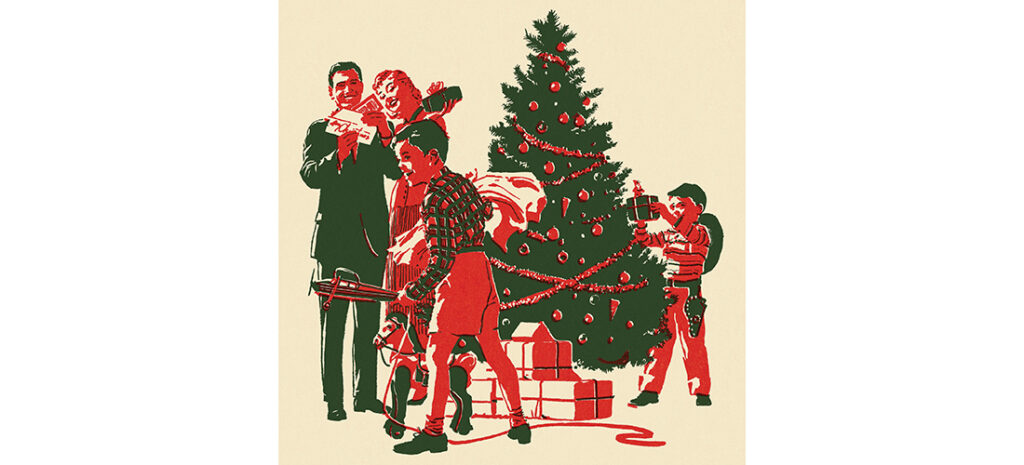
The Unscathed Christmas

When bad things don’t happen to good people

By Bill Fields

Looking back on the Christmas season, I realize that we were lucky.

It wasn’t just that our family had a roof over our heads, that we always had enough food and presents to make us happy, or that we never let disputes occurring in our spirited Monopoly games that were an entertainment centerpiece escalate into unpleasantness. (The adults at the table even indulged very young me when I wanted to be able to put houses and hotels on Baltic Avenue even though I didn’t own Mediterranean.)

Although a vicious intestinal bug did hit us one year with the ferocity of a Dick Butkus tackle, the miracle was that we survived each holiday season without serious harm. We didn’t have a fireplace, so there was no danger of a stray ember setting fire to G.I. Joe’s fatigues or tissue paper that had swaddled a something new from Collins department store. In place of the real thing, after one of my mother’s largest lapses in judgment, we were the proud owners of imitation logs illuminated by orange incandescent bulbs. The “flames” flickered from foil circles that rotated near the lights, although one would have needed a lot of enhanced eggnog to feel warm.

Our fire threat came from another source. We had two sets of Christmas lights, those to decorate the camellia in the front yard and those to string on the Christmas tree in our living room. They were labeled “outdoor” and “indoor,” but the difference was less than that between Carolina and sky blue. The large bulbs on each strand seemed to approximate the heat of a glowing briquette charring a steak.

Before moving on to white pines and later firs or spruces, we were a cedar tree clan. Even if we regularly filled the red stand with water, those things would get pretty crispy. It’s a wonder there was never a real fire next to the faux logs, not that there wasn’t a close call. The same angel that graced the top of our trees for many years — well into the era of tiny lights that didn’t heat up — bore a melted spot from her years of service with the big bulbs.

We skirted a lot of trouble around Christmas time, when you think about it. Nobody crashed when a neighbor got a mini bike. We avoided getting hit by a car when testing new tennis rackets by playing a set with an imaginary net out in the street. Lawn darts landed only in the rye overseed. Bruises and scrapes were the worst that came from tackle football. Dad somehow managed to get the barbecued chicken done when he cooked out in the dark. 

Indoors, there were potential hazards everywhere. Owing to my father’s job at Proctor-Silex, there was gifting of irons for a few years, but no one ever dropped one of the heavy devices on themselves in their zeal to unwrap such a utilitarian present. Nobody tripped over the Hot Wheels track after I set it up to emulate the Rockingham drag strip, but I heard a few curse words when an adult stepped on a plastic soldier or Tinker Toy. 

Santa Claus never forgot to bring bags of walnuts, pecans and Brazil nuts. The pick that went along with the nutcracker could have been classified as a weapon of war so sharp was the point, but we escaped with minor puncture wounds for which a little mercurochrome would do the trick. A dab of butter took care of any burns from rogue Crisco escaping a cast-iron skillet.

But the kitchen hazards didn’t stop at the stove. Man was going into space, but he also had time to invent the electric knife. The whir of the blades was part of the Christmas soundtrack as much as “Jingle Bells” or “It Came Upon the Midnight Clear.” Mom worried as Dad took on a turkey or a ham or a roast. There was the occasional grinding of metal on platter if he misjudged his cut, but fortunately the only red on the table came from the apple rings.  PS

Southern Pines native Bill Fields, who writes about golf and other things, moved north in 1986 but hasn’t lost his accent.


Bookshelf

Bookshelf

December Books

FICTION

The Exchange, by John Grisham

What became of Mitch and Abby McDeere after they exposed the crimes of Memphis law firm Bendini, Lambert and Locke and fled the country? The answer is in The Exchange, the riveting sequel to The Firm, the blockbuster thriller that launched the career of one of America’s favorite storytellers. It is now 15 years later, and Mitch and Abby are living in Manhattan, where Mitch is a partner at the largest law firm in the world. When a mentor in Rome asks him for a favor that will take him far from home, Mitch finds himself at the center of a sinister plot that has worldwide implications — and once again endangers his colleagues, friends and family.

NONFICTION

Babusya’s Kitchen: Recipes for Living and Eating Well in Ukraine, by Returned Peace Corps Ukraine Volunteers

Peace Corps volunteers created this cookbook from the recipes they learned while serving in the small towns and villages across Ukraine. The cookbook serves as a fundraiser for Ukraine Relief Efforts through the RPCV (Returned Peace Corps Volunteers) Alliance for Ukraine as well as a culinary delight. In addition to the traditional Ukrainian recipes that “provide a window into rural living,” the volunteers include recipes that helped new cooks in a foreign country share American cooking traditions with international friends.

The Secret Lives of Color, by Kassia St. Clair

This unknown history of color tells the unusual stories of 75 fascinating shades, dyes and hues, and the vivid history behind them. From the brown that changed the way battles were fought to the white that protected against the plague; from Picasso’s blue period to the charcoal on the cave walls at Lascaux; from acid yellow to Kelly green; and scarlet women to imperial purple, these surprising stories run like a bright thread throughout history. St. Clair turned her lifelong obsession with colors and where they come from into a unique study of human civilization.

Holidays on Ice, by David Sedaris

No matter what your favorite holiday is, you won’t want to miss celebrating it with the author The Economist has called “one of the funniest writers alive.” Sedaris’ beloved holiday collection is new again with six more pieces, including a never-before-published story. Along with timeless favorites from Santaland are Sedaris’ tales of tardy trick-or-treaters (“Us and Them”); the difficulties of explaining the Easter Bunny to the French (“Jesus Shaves”); what to do when you’ve been locked out in a snowstorm (“Let It Snow”); the puzzling Christmas traditions of other nations (“Six to Eight Black Men”); what Halloween at the medical examiner’s looks like (“The Monster Mash”); and a barnyard secret Santa scheme gone awry (“Cow and Turkey”). The Country Bookshop has autographed copies.

Museum Bums, by Jack Shoulder and Mark Small

What do Hieronymus Bosch, the Roman cult of Antinous and the peach emoji all have in common? Butts, of course! Divided into six categories of keisters, this humorous history book takes you on a whirlwind tour of the finest rear ends in museums around the world — from the lusciously rendered bottoms of Renaissance paintings to the abstract curves of contemporary art. Heritage scholars and art educators Small and Shoulder pair illuminating social commentary, historical context and lively captions with captivating depictions of tasteful — if cheeky — bums in art. Including an angel slyly copping a feel in a 16th century triptych, a 25,000-year-old bodacious Venus, and Cezanne’s dreamy booty-ful bathers, this assortment of artistic behinds is both a celebration and study of the bounty of beautiful bottoms and their everlasting impressions.


CHILDREN’S BOOKS

How Does Santa Go Down the Chimney? by Mac Barnett, illustrations by Jon Klassen

It’s the age-old question. How does he do it?  If anyone would have access to Santa’s secret file, it’s the team of Klassen and Barnett. With insider info, holiday hilarity and, well, dogs, this is going to be a must-have holiday book. (Ages 3-8.)

The Christmassy Cactus, by Beth Ferry

Oh, my, the cuteness. Cactus will poke her way into your heart in this delightful holiday story of a tiny green spiny cactus who holds her own against giant green shiny trees and proves that holiday wishes do indeed come true. (Ages 3-6.)

The Met: 5,000 Years of Awesome Objects, by Aaron Rosen, Susie Hodge, Susie Brooks, and Mary Richards

You’ll get lost in this history of art for children featuring 5000 years of the most unusual, bizarre, fascinating and awesome objects — practically a museum in itself. (Ages 8-14.)

The Jules Verne Prophecy, by Larry Schwarz and Iva-Marie Palmer

When Owen finds himself stuck in Paris for the summer with his mom, he is sure the whole vacation will be a boring flop, but a mysterious skateboarder, a rare Jules Verne book and a few new friends really turn things around. This wild ride of an adventure journeys through the most amazing sites in Paris, including the Eiffel Tower, the catacombs and a secret skatepark. (Ages 9-12.)  PS

Compiled by Kimberly Daniels Taws and Angie Tally.

December PinePitch 2023

December PinePitch 2023

Toys for Tots

Eat in or drive thru at the 33rd annual Toys for Tots toy and food drive on Sunday, Dec. 10, from 11 a.m. to 4 p.m., at Beefeater’s Restaurant, 672 S.W. Broad St. in Southern Pines. Sponsored by the Mark “Brook” Westbrook Memorial Foundation, a 501(c)3 nonprofit, the cost is either a $10 per-plate donation, an unwrapped toy, or five cans or boxes of non-perishable food. Of course, more is always better. Santa will be on-site from 12 p.m. to 3 p.m. The plates are chopped barbecue or grilled chicken, cole slaw, baked beans, rolls, tea or soda, and dessert. There are nuggets for the kids. Word on the street is Santa is a nugget kinda guy.

Elf on Parade

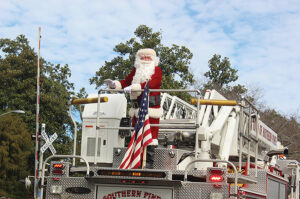
Marching bands and Santa Claus. What’s not to like? The Southern Pines Christmas Parade will be on Saturday, Dec. 2, from 11 a.m. to 12:30 p.m. Santa does the full loop, beginning at Vermont Avenue, down the west side of Broad Street to Massachusetts Avenue, across the tracks then back up the east side of Broad. If any additional information is necessary you can call the North Pole hotline at (910) 692-7376.

And, if you missed him in Southern Pines, the jolly old rascal will be in Vass for its annual Christmas parade on Saturday, Dec. 16, at 11 a.m. There will food and vendors at the Vass Lakeview School, 141 James St., Vass. For more information call (910) 245-4677 or go to www.townofvassnc.gov.

Keeping Christmas Well

The Uprising Theatre Company will present its inventive re-creation of Charles Dickens’ holiday classic, A Christmas Carol, on Tuesday, Dec. 19, at 7 p.m., at The Village Chapel, 10 Azalea Road, Pinehurst. Each show will begin with caroling, to get everyone in the mood. There will be additional performances on Dec. 20 and Dec. 21, also at 7 p.m. For tickets and more information go to www.ticketmesandhills.com.

You Say It’s Your Birthday

It’s Sandhills Community College’s 60th anniversary, and everyone is invited to attend the gala celebration on Monday, Dec. 4, at 7 p.m., at BPAC’s Owens Auditorium, 3395 Airport Road, Pinehurst. The event is for ages 13 and up and the dress is casual but, you know, decent. The lobby opens at 6 p.m. and the curtain rises at 7. The event is free of charge. Tickets can be secured in advance at
www.ticketmesandhills.com.

Look Out Below

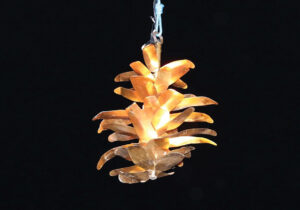
The traditional Pine Cone Drop ringing in the New Year (a bit early) will happen on Friday, Dec. 29, near the railway station in Southern Pines from 6 p.m. to 8 p.m. There will be live music, carnival games, face painting and early bedtimes for all. For additional information call (910) 692-7376.

Weymouth Wonderland

The Weymouth Center for the Arts & Humanities, 555 E. Connecticut Ave., Southern Pines, will hold its Outdoor Wonderfest and Market Friday, Dec. 1, and Saturday, Dec. 2, from 10 a.m. to 4 p.m., and again on Sunday, Dec. 3, from noon to 4 p.m. There will be local vendors and artisans to fill Christmas gift lists, crafts, face painting and plenty of food. The marketplace is open to the public. Admission is by any monetary donation. For additional information visit www.weymouthcenter.org.

Lights, Wreaths, Action

The Episcopal Day School will hold its 44th annual Candlelight Tour of Homes on Sunday, Dec. 3, from 1 p.m. to 5 p.m., featuring five unique Pinehurst and Southern Pines houses decked out in full holiday regalia. The tour’s tariff is $20 in advance and $25 the day of. For information and tickets you can go to www.ticketmesandhills.com or visit the Episcopal Day School front office.

A Tradition Like No Other

The annual Murphy Family Christmas Concert features two shows at 3 p.m. and again at 7 p.m. on Sunday, Dec. 17, at the Sunrise Theater, 250 N.W. Broad St., Southern Pines. For information and ticketing for this must-see annual celebration of the season call (910) 420-2549 or visit www.sunrisetheater.com.

In the Spirit

In the Spirit

Dissecting a Cocktail

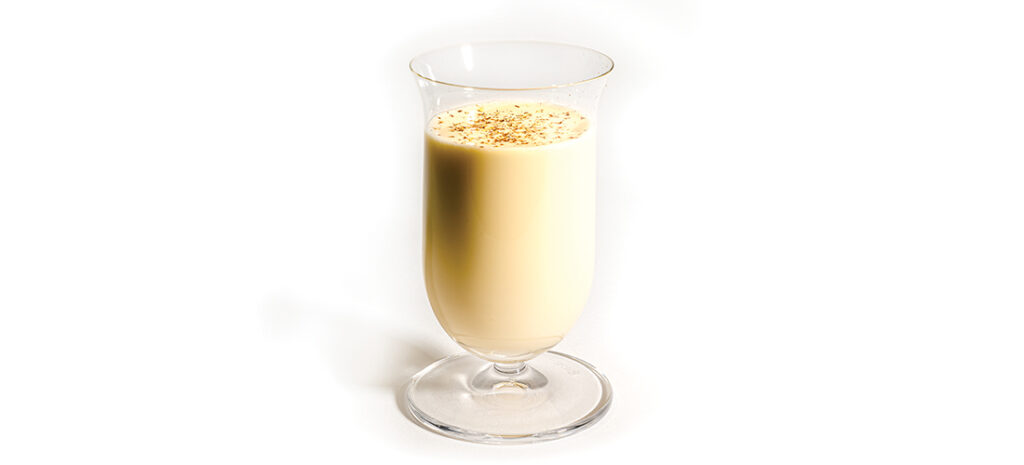
Jeffrey Morgenthaler’s eggnog

By Tony Cross

As a child, I loved it when my mother broke out the eggnog during holiday parties. However, when I reached adulthood, I couldn’t stand more than a cup of the store-bought goop. That all changed a decade ago when I whipped up boozy eggnog from a recipe I found on Portland bartender Jeffrey Morgenthaler’s blog. Not only is Morgenthaler’s version silky smooth, but the flavor profile is insane.

There’s no rum or cognac in this one — there is, however, añejo tequila and Amontillado sherry. Say what? I know, I squinted the first time I read that, too. The combination of a dry, nutty sherry and semi-sweet tequila is perfect for this Yuletide cheer. The first weekend that I made this a cocktail special when I was behind the bar, we almost sold out by Saturday lunch. Not only was it popular with our patrons, but our host, who worked the day shift, pleaded with me to give him any leftovers before we closed for Christmas. This is the best eggnog you’ll ever taste.


Eggnog

12 large eggs

450 grams baker’s sugar

15 ounces Amontillado sherry

12 ounces añejo tequila

36 ounces whole milk

24 ounces heavy cream

Fresh nutmeg, for garnish

In a stand mixer on low speed, beat eggs until smooth. Slowly add sugar until incorporated and dissolved. Slowly add sherry, tequila, milk and cream. Refrigerate overnight and serve in small, chilled cups. Dust with fresh nutmeg before serving. Makes approximately one gallon.  PS

Tony Cross owns and operates Reverie Cocktails, a cocktail delivery service that delivers kegged cocktails for businesses to pour on tap — but once a bartender, always a bartender.

Pleasures of Life

Pleasures of Life

The Forever Christmas Tree

What goes around comes around

By Tom Allen

Vintage is all the craze, a buzzword for something that was once outdated but has become desirable and hip. Millennials, remembering those iconic treasures from their childhood, rummage through thrift stores for everything from clothes to kitchen utensils to furniture begging the label “retro.” 

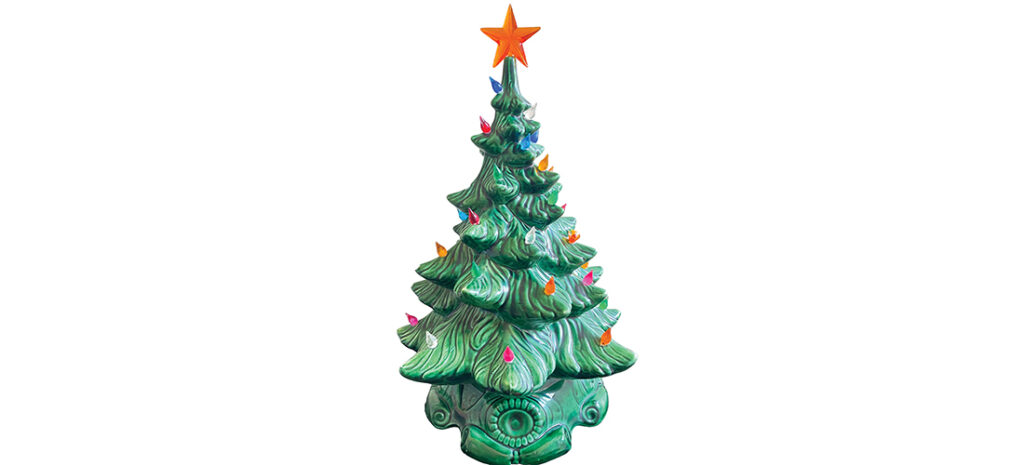
Vintage Christmas qualifies. Holiday retro is in high demand. Take your mother or grandmother’s beloved ceramic Christmas tree. Popular in the ’60s and ’70s, by the time the earth-toned ’80s rolled around, the trees lost popularity, partly due to aesthetics, also because bulky cathode ray tube televisions were replaced by flat screens. Where to place Granny’s beloved ceramic tree became a challenge.

My mother was gifted a 12-inch ceramic tree in the early ’70s, crafted by a friend who found a retirement hobby making funky owls and mushroom-embossed napkin holders, at a rural ceramics shop. The tree, dark green and flocked with ceramic snow, held multi-colored translucent plastic bulbs. A 60-watt bulb, screwed into the base, illuminated the tree, which rested on a tea cart in the hallway of my childhood home. The tree was visible, and enjoyed, from my parents’ rocker recliners, but only for a few days in December. My mother, a minimalist before the word found its way into the urban dictionary, decorated a week before Christmas. I still remember the thrill of hearing the click of the tree’s on/off light switch, which produced that instant, multi-colored illumination. Pure joy.

Decorations came down a couple of days after the holiday. An elementary school teacher who cherished her holiday break, Mom disliked anything that might capture dust, like a ceramic Christmas tree. More dust meant more cleaning, and more cleaning meant less time to enjoy her break. Though she and my dad enjoyed the tree for years, her pragmatic side always won out. No 12 days of Christmas for their tree, living or ceramic.

My mother’s last Christmas was spent in hospice care, at an assisted living center. I brought her beloved ceramic tree and placed it on a chest of drawers, easy for her to see and enjoy from her hospital bed. The tree’s lights dissipated some of the room’s darkness and cushioned the sadness of her pending loss. That year, she allowed the treasure to stay up after Christmas. The tree was shining bright when she died on a snowy night in late January.

Mom’s ceramic tree made its way home to our house, where we enjoy those same multi-colored lights from Thanksgiving until late winter. I would leave the tree up year round. Last year my wife drew the line on Valentine’s Day.

No longer relegated to the yard sale bin as they were 30 years ago, mid- to late-century ceramic trees are in high demand. Whether made by a beloved aunt or mass produced in the U.S., don’t expect to snag a tree in your local thrift shop for 10 bucks. Vintage trees can go for several hundred dollars. Newer ones, their production outsourced overseas, are still pricey. Smaller versions can be found at Michael’s or Hobby Lobby. I’ve seen larger beauties at Gulley’s Garden Center in Southern Pines, and even on Etsy and Amazon. 

The Vermont Country Store, known as “purveyors of the practical and hard-to-find since 1946,” sells “Made in China” ceramic trees from $15 (5-inch) to over $100 (16-inch). If you’re lucky enough to find one at an antique store, made years ago in the U.S. or by someone’s great-aunt, prepare to pay top dollar. 

Our millennial daughters care little for the Barbie ornaments and personalized creations of their childhood, but both have their eyes on Grandma’s ceramic tree. Sorry, girls, gotta wait on that one.  PS

Tom Allen is a retired minister who lives in Whispering Pines.

Naturalist

Naturalist

How Now Sea Cow

Heeding the ocean’s call

Story and Photographs by Todd Pusser

Some songs just resonate. With his recent passing, Jimmy Buffett’s “A Pirate Looks at Forty” has played on a near continuous loop on my radio. A perennial favorite, its opening refrain strikes a particular chord:

Mother, mother ocean, I’ve heard you call. 

Wanted to sail upon your waters since I was three feet tall. 

You’ve seen it all, you’ve seen it all.

As a kid, the ocean’s call was powerful. Fed on weekly doses of The Undersea World of Jacques Cousteau, I could not wait to strike out on my own and explore the horizon line far beyond land-locked Eagle Springs. And now, like the middle-aged mariner in Buffett’s song, the feeling of being born in the wrong century and unable to fit into the modern world creeps into the recesses of my mind from time to time. The second verse continues:

Watched the men who rode you, switch from sail to steam. 

And in your belly, you hold the treasures few have ever seen. 

Most of ’em dreams. Most of ’em dreams.

I frequently find myself daydreaming about those early Victorian-aged explorers who set off on years-long voyages across the globe, imagining their thrill in discovering new lands and encountering unknown animals for the first time. The closest I have come to that enchantment, happened while attending the University of North Carolina in Chapel Hill, where a scuba diving class taken as an elective during my sophomore year introduced me to one of nature’s true marvels. To finalize our certification, we had to make a checkout dive in open waters beyond the gymnasium swimming pool. Over Thanksgiving break that year, the class journeyed down to Crystal River National Wildlife Refuge, along the west coast of Florida, where warm, gin-clear freshwater springs provided the perfect environment to complete the scuba training.

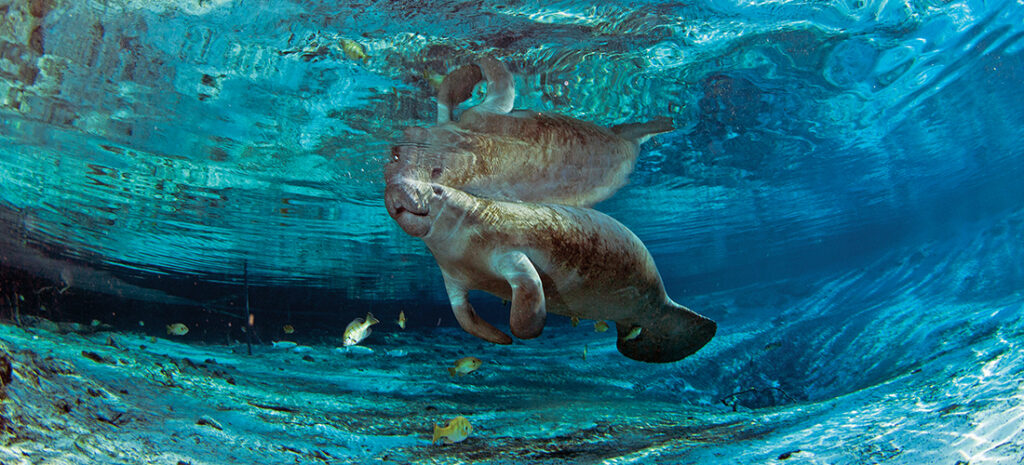
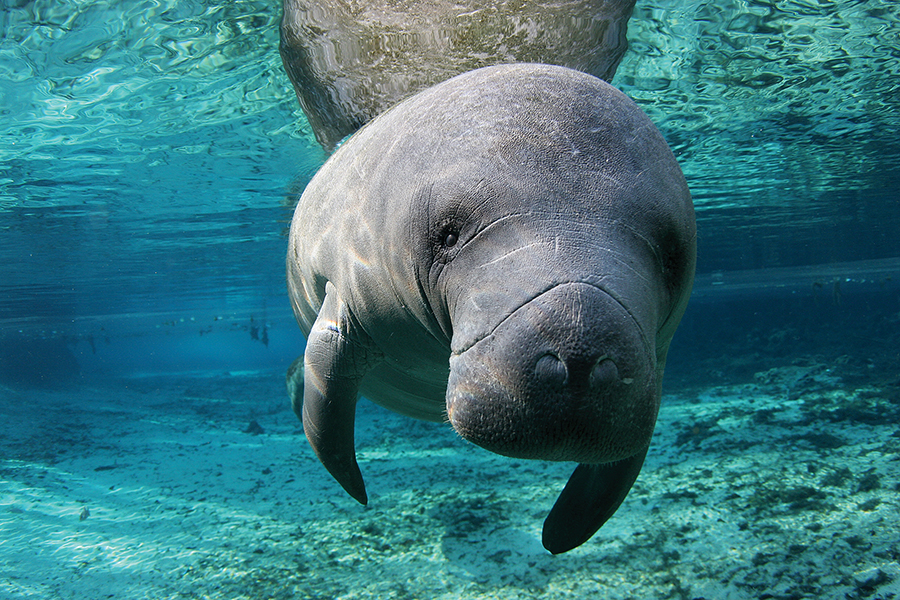
During our first dive, while kneeling on the sandy bottom 20 feet below the water’s surface, a large shadow passed over my head. Glancing up, I saw a wild Florida manatee swimming slowly by. Awestruck, in that moment I felt the same wonder those early naturalists likely experienced when encountering such a large animal for the first time.

It was actually Christopher Columbus who first wrote about the manatees of the New World, in his famed journal from 1492. Having encountered three manatees off the coast of what is now the Dominican Republic, he called them “mermaids.”

For the uninitiated, a Florida manatee is a sofa-sized marine mammal that possesses a broad, paddle-shaped tail, two small flippers and a whiskered face reminiscent of a walrus, minus the tusks. True herbivores, with a propensity for dining on vast quantities of seagrass, manatees are often referred to as “sea cows.” 

How Columbus mistook such creatures for the voluptuous sirens of myth and legend is unknown. Granted, he had just spent six long, lonely months at sea, sailing across the Atlantic. Columbus later commented in his journal, more prudently, that “they were not as beautiful as they are painted.”

For such large animals, manatees are quite curious and disarmingly docile. Swimmers and snorkelers from all over the world flock to Crystal River, the only place in the United States it is legal to enter the water with these endangered mammals.

Incidentally, among the staunchest advocates for manatees over the last four decades was none other than that tropical troubadour Jimmy Buffett. In 1981, Buffett joined forces with then-Florida Gov. Bob Graham to form the Save the Manatee Club, a nonprofit organization that continues to this day to campaign for manatee conservation.

Appearing in numerous public service campaigns, Buffett used his immense celebrity to raise awareness for the plight of manatees. He donated money to erect signs throughout Florida waterways warning speeding boaters about the docile mammals; and he was the brains behind the Adopt-A-Manatee Program, an ingenious initiative that engages and inspires the public and has raised millions since its inception in 1984. The adoption model has been so successful that it has been used by numerous conservation groups around the world to raise funds for the protection of other endangered species; everything from whales to gorillas have benefited from Buffett’s genius.

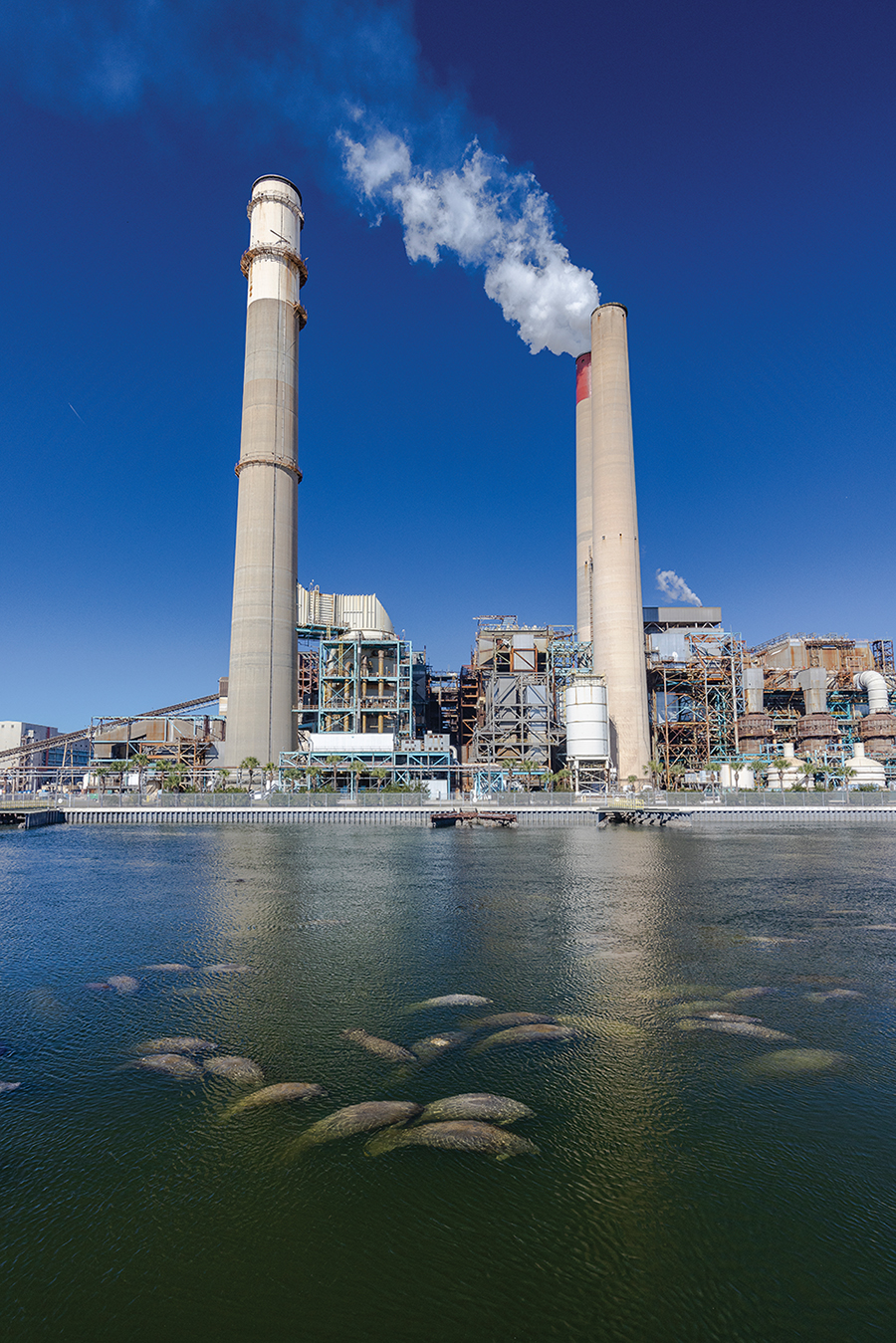
Just this past winter, when a powerful cold front swept out of the Arctic Circle down to the Gulf of Mexico, I visited a waterway next to a nuclear power plant along the shore of Tampa Bay. Despite their large size, manatees lack an insulating blubber layer like that found in whales. As such, the half-ton mammals are particularly vulnerable to cold water temperatures and can quickly suffer from hypothermia.

Hundreds of manatees had crowded into the small canal, where warm water was being discharged by the power plant. Just as many tourists were packed onto a long wooden boardwalk overlooking the canal, gawking at the gentle giants resting in the murky green water. A young boy standing nearby looked up at his father with excited wide eyes and shouted, “Look at all of them!” Followed quickly by, “Wow. Just wow!”

Once again, the ocean’s call was ringing loud and clear.  PS

Naturalist and photographer Todd Pusser grew up in Eagle Springs. He works to document the extraordinary diversity of life both near and far. His images can be found at www.ToddPusser.com.

Birdwatch

Birdwatch

Wintering Waterbirds

Ducks, geese and swans, oh my!

By Susan Campbell

The arrival of cold weather in central North Carolina also means the arrival of waterfowl. Our local ponds and lakes have been documented to be the winter home to more than two dozen different species of ducks, geese and swans. Over the years, as water features both large and small have been added to the landscape, the diversity of waterfowl has increased significantly. Although we are all familiar with our local mallards and Canada geese, a variety of aquatic birds frequent our area from November through March.

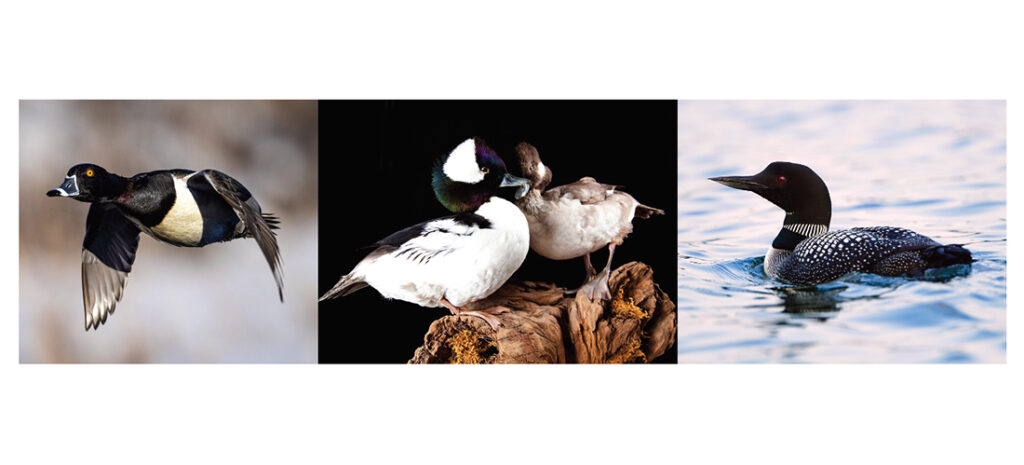
Certainly the most abundant and widespread species is the ring-necked duck, flocks of which can be seen diving for aquatic invertebrate prey in shallow ponds and coves. The males have iridescent blue heads, black sides and gray backs. They get their name from the indistinct rusty ring at the base of their necks. The females, as with all of the true duck species, are quite nondescript. They are light brown all over and, like the males, have a grayish blue bill with a white band around it.

The most noticeable of our wintering waterfowl would be the buffleheads. They form small groups that dive into deeper water, feeding on vegetation and invertebrates. The males have a bright white hood and body with iridescent dark green back, face and neck. They also sport bright orange legs and feet, which they will flash during confrontations. The females of this species are also drab, mainly brown with the only contrast being a small white cheek patch. Interestingly, bufflehead is the one species of migratory duck that actually mates for life. This is generally a trait found only in the largest of waterfowl: swans and geese.

There are several types of aquatic birds similar to ducks that can be identified if one can get a good look, which usually requires binoculars. Common loons can occasionally be seen diving for fish on larger lakes in winter, and even more so during spring and fall migration. Their size and shape are quite distinctive (as is their yodeling song which, sadly, they do not tend to sing while they are here).

Be aware that we have another visitor that can be confused with loons: the double-crested cormorant. This bird is actually not a duck at all but is (along with its cousin the anhinga) more closely related to seabirds, e.g. boobies and gannets. It is a very proficient diver with a sharply serrated bill adapted for catching fish. It is not uncommon to see cormorants in their “drying” pose. Their feathers are not as waterproof as those of diving ducks, so they only enter water to feed and bathe. Most of their time is spent sitting on a dock or some sort of perch in order to dry out.

Two other species of waterbird can be found regularly at this time of year: pied-billed grebes and American coots. Pied-billed grebes are the smallest of the swimmers we see in winter, with light brown plumage, short thick bills and bright white bottoms. Surprisingly, they are very active swimmers. They can chase down small fish in just about any depth of water. In some years, American coots can be quite abundant. These black, stocky birds with white bills are scavengers, feeding mainly in aquatic vegetation. They can make short dives but are too buoyant to remain submerged for more than a few seconds. Given their long legs and well-developed toes, they are also adept at foraging on foot. You may see them feeding on grasses along the edge of larger bodies of water or even on the edge of golf course water hazards.  PS

Susan Campbell would love to hear from you. Feel free to send questions or wildlife observations to susan@ncaves.com.

Almanac November 2023

Almanac November 2023

November opens our eyes to invisible worlds.

On a quiet morning, the soft trill of a single cricket coloring the darkness, you pull the old cookbook from the kitchen cupboard and cradle it by lamplight. Your hands know what to do, turning stained and cockled pages with gentle intention. Running your fingers over the food-smudged recipes, you think of the hands that held this relic before yours; all the homecooked meals; all the gatherings; all the love.

Slowing down, you delight in the soft rustling of each page, the fingerprints, the swell of memories. The journey is as sacred as the destination.

When you turn to the recipe — the one you’ve nearly memorized but could never forsake — your eyes dance from list to countertop, countertop to list. You tick off each item before dropping into an ancient, ancestral rhythm.

Your hands know what to do — measuring, whisking, mashing — and as you study each ingredient, you see them not as what they are, but where they’ve been:

Eggs warm from the hen.

Sweet potatoes buried in dark earth. 

Fields of wheat.

Cinnamon and nutmeg trees.

Sugarcane swaying in a spring breeze.

Yes, what you’re baking has a name. But it’s more than what you see. More than warm crust and vibrant orange filling. It’s sweetness harvested from darkness; prayers folded into faithful mixing bowls; the quiet song of summer’s final cricket.

Morning breaks slowly. Beyond the kitchen window, eddies of golden leaves gather and disperse, here and gone as quickly as the seasons.

An amalgam of spices warms the kitchen. As you place the cookbook on the shelf, your own hands sweeten the harvest — an eddy of unseen gifts folded into a family treasure. 


The thinnest yellow light of November is more warming and exhilarating than any wine they tell of. The mite which November contributes becomes equal in value to the bounty of July.   — Henry David Thoreau

Days to Remember

The first frost is nigh. Daylight saving time ends on
Nov. 5. Autumn is edging toward winter.

Between Dia de los Muertos (Nov. 1–2) and Thanksgiving (Nov. 23) are a ton of lesser-known holidays awaiting their time in the sun. Below are a few them. Of course, Veterans Day (Nov. 11) belongs up here.

Nov. 5 – Pumpkin Deconstruction Day (yep, exactly what it sounds like)

Nov. 6 – Marooned Without a Compass Day

Nov. 8 – Dunce Day

Nov. 13 – World Kindness Day

Nov. 14 – National Pickle Day

Nov. 15 – Clean Your Refrigerator Day

Nov. 17 – World Peace Day and Homemade Bread Day (more twofers like this, please)

Turn! Turn! Turn!

Turn back the clock; turn the compost; turn your focus inward.

As the garden journeys toward dormancy, we, too, slow down. And yet, these darker days awaken the dreamer, guiding us toward unopened books, forgotten crafts, the stovetop, the woodpile and the hearth.

From these quiet spaces, potent questions emerge.

What are you willing to let go of? How might this foster your growth?

As you nurture the roots of your wildest longings, feeding the soil of what’s true, you are minding the very fabric of what’s possible.

Such is the magic of this fallow season.  PS

Southwords

Southwords

Window Dressing

A remarkable find

By Scott Sheffield

Normally I’m not one to believe in miracles, or the supernatural, or even coincidences, but on that day, in that moment, I could have believed in all three.

It was Thanksgiving and my Maine family had come to visit, as they had several times before. This time there was a difference, a big difference in a small package. In addition to my daughter, her husband and his mother (the usual trio), there was a baby girl — my granddaughter, Alaina, barely more than a year old.

As was our custom on the Saturday after Thanksgiving, we went to Southern Pines for a stroll up and down Broad Street and Pennsylvania Avenue, admiring the Christmas decorations and popping into stores as we lollygagged. This time our route included The Little Toy Shop. It just so happened I had learned of a visit to this particular store by a certain gentleman from the far North. He was a quirky fellow by reputation, one given to sporting a hoary beard, wearing a bright red suit and exercising a penchant for giving gifts to children.

While my son-in-law waited dutifully in line for my granddaughter’s turn with Santa, the rest of us were fully engaged preventing Alaina, despite her being in a stroller, from “inspecting” (tossing on the floor) the vast array of toys and games on the lower shelves within what seemed like her 10-foot reach. Eventually, Alaina’s turn came with the jolly old elf, though she seemed less interested in him than the candy canes sitting in a jar just beyond her grasp. Requisite photos were taken.

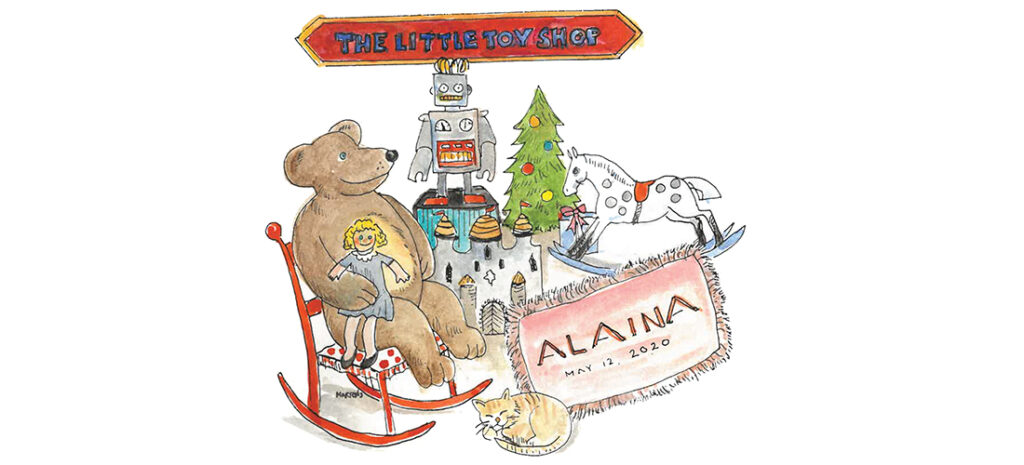
With Alaina off Santa’s lap and fastened into her carriage, we headed back up Broad Street, slowed at times as Alaina tried to pet every dog we passed. Soon after crossing Pennsylvania, I saw the sign for Living on the Bliss, a store owned by the friend of a friend. As we looked in the window and I explained the personal connection, suddenly, I stopped. Inside on a shelf, snuggled into an array of specialty items, one in particular caught my attention — a gray pillow with large pink lettering stitched across the top. I confess, pillows in general are not something that would normally catch my eye. This one was different. The first name on the pillow was the same as my granddaughter’s. I was about to say something when I noticed that in smaller print below “Alaina” were names identical to my granddaughter’s middle name and surname. Sure, sometimes stores put personalized items on display so customers can see what a finished product might look like, but those three names? Not likely.

Then I saw a date and time printed under the name that were also familiar. It was the exact moment of Alaina’s birth, month, day and year. How could this be? While I was standing there dumbfounded, Grandma said she didn’t care how it got there, she was going to buy it. We went inside and she snatched the pillow out of the display and marched over to the check-out counter. Cassie, the daughter of the owner, Cindy Miller, was ready to ring up our purchase. I asked her how in the world my granddaughter’s name and birth information came to be on the pillow. (Her birth weight, length and the town where she was born were also there.) Unbeknown to me, my close friend Deborah — an honorary aunt to Alaina — had decided to make a gift of the pillow to my daughter’s family at Thanksgiving, but Deborah’s schedule prevented her both from being with us on that day and picking up her surprise. On a whim, the Millers decided to put the pillow on display in the window.

It was truly a special delivery.  PS

Scott Sheffield is a contributing writer for PineStraw and The Pilot. He may be reached at ssheff@nc.rr.com.

Golftown Journal

Golftown Journal

Shutterbugs

Making art in the golden hour

By Lee Pace

My stock-in-trade over four-plus decades has been the written word, but I admit the layering of subjects, verbs and adjectives pales in comparison to the display of a well-conceived and executed photograph. An advertising executive from the early 1920s is credited with coining the phrase “One picture is worth a thousand words,” and I say bravo to that. In the fat coffee table books I’ve crafted for golf clubs the last two decades, I strive for a mix of 50-50 words and images but admit that if not one word is absorbed, the photos make it worth the toil and tariff.

The Sandhills and its golf courses are evolving more and more today as an exquisite canvas for shutterbugs of all makes and models, and the ability to immediately display the visuals on social media and assorted blogs and digital venues multiplies their visibility a millionfold over the old days of weekly and monthly magazines.

John Hemmer, who had a 45-year association with Pinehurst back in the Tufts family days, took photos of the golf, racquet, shooting and equestrian pursuits at Pinehurst beginning in 1925 and dispatched them to newspapers and wire services. He also made prints in his darkroom and mailed them to the hometown newspapers of resort guests. Today the Tufts Archives has some 85,000 Hemmer images in its vast collection.

In 2012, John Gessner — a frequent contributor to this magazine — won the naming contest for the elaborate putting course Pinehurst built on 2.5 acres outside its clubhouse, suggesting Thistle Dhu in a tip of the cap to the pitch-and-putt venue that James Barber built on his Pinehurst property nearly a century earlier. Four years later, Gessner was the first photographer to capture the unique landscape of The Cradle, the resort’s nine-hole short course adjacent to the massive putting green. His early morning shot has appeared in Forbes, GOLF magazine and other outlets, and depicts the brownish wire grass in the foreground, green fairways and putting surfaces in the middle, and blue sky above, the backdrop punctuated by the classic columns and red roof of the south side of the Pinehurst clubhouse. 

Kaye Pierson began taking photos with her phone from her perch on a golf course mower while on her shifts with the resort maintenance staff and in 2013 snapped what she pegged “First Light at Pinehurst.” The Putter Boy statuette looms at dawn from its location within Thistle Dhu, enveloped by a dew-laden grass, fog and glints of sunlight to the east. The image caught fire on social media and has been featured on prints in resort gift shops.

John Patota has had careers as an engineer and a school system administrator, and all along has enjoyed photography as a hobby and avocation, though these days he’s available for hire. He bills himself on social media as “Pinehurst Photographer” and enjoys taking photos of “people doing the things they love.” He’s all over the North & South competitions at the resort and has a special niche capturing the golf course maintenance staff.

Matt Gibson is a native of the United Kingdom, growing up in London and attending the University of St. Andrews, and for two years has been on staff at Pinehurst as its “digital storyteller.” His background on the sandy landscapes of the British Isles provides excellent perspective to generate and curate a rich mixture of images and video clips.

“I think the best sports photographers are the golf photographers,” he says. “You think about an NFL game or a baseball game, you have the same feel essentially every match, right? There are only a certain number of lines you can find. But every golf course is different. The lines are infinite.”

The photographer who has most caught my eye of late is Chris Auman, the 41-year-old nephew of Clyde Auman, a longtime peach grower and state legislator from West End. Chris was among the thousands of spectators ringing the 18th green of Pinehurst No. 2 when Payne Stewart sank his putt to win the 1999 U.S. Open, and he’s pictured in the lower right of photographer Rob Brown’s classic “One Moment in Time” panorama. Auman has generated numerous images of the village and the Pinehurst golf courses in recent years, finding particular fodder in the magical light of early morning and late afternoon.

Early one morning, he lined up six Adirondack chairs along The Cradle and captured their glow bathed in the orange of the eastern sky. Crisp fall mornings have provided the setup to capture the village at daybreak and a golf setting with the same technique Hemmer used nearly a century ago — framing the hole with the trunk of a pine tree to one side, and boughs of needles and cones hanging at the top. He’s snapped the 18th green of No. 2 from the veranda, dozens of purple tulips and yellow flowers in the foreground. The passing locomotives and freight cars of the Aberdeen, Carolina & Western Railroad as it skirts the western edge of the resort are a favorite prop.

The ideas are endless.

“I’m drawn to the golf courses in Pinehurst and the Sandhills because one, the nostalgia; and two, the natural beauty,” he says. “I love shooting low light around the village and the golf courses. It brings the dew and the haze into play. You get more interesting colors in the morning. The evening with sunsets can be great, but orange is the dominant color.

“Golf brings people together,” he continues. “Not everyone is into golf, but when I take a photograph of a golf course, people can appreciate the photograph. They can appreciate the beauty of the natural landscape. You are actually bringing people into the sport who otherwise wouldn’t be interested in it. A photo like the chairs beside The Cradle — it asks, ‘Wouldn’t you like to be sitting in those chairs right now?’ People always tell me, ‘Well, I’ve been by there a thousand times and I’ve never seen it quite like that.’”

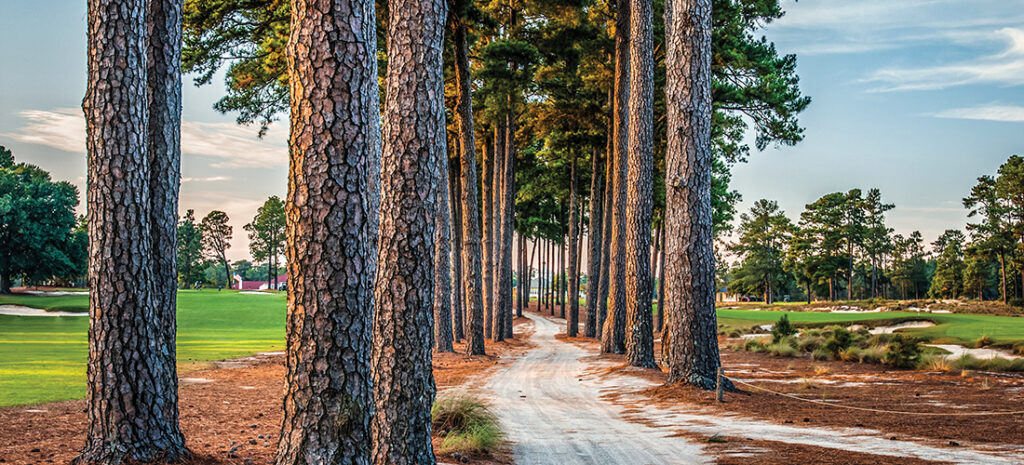
Late one afternoon, Auman was walking with his camera up the sandy path between the 18th holes of course No. 1 on the left and No. 4 on the right. The light was perfect, just kissing the western edges of the tree trunks and the undersides of the pine needles hanging above. There is sand, wire grass, serrated bunkers and a soft sky.

“I looked up and I just thought, ‘Man, that’s the way this place used to look,’” he says. “That’s what James Tufts saw. That’s what Pinehurst is, and that’s what I was trying to capture.”  PS

Lee Pace has written about the Pinehurst experience for more than three decades from his home in Chapel Hill. Write him at leepace7@gmail.com and follow him @LeePaceTweet.