Omnivorous Reader

Omnivorous Reader

A Gift to Art and Us

The legacy of Fred Chappell

By Stephen E. Smith

Courage.

That noun rarely comes to mind when considering the attributes a writer should possess in abundance. But what a writer does — the act of creating through fiction, poetry, drama, etc. — is something anyone could do who has the heart, the skill, and the courage to do it. And courage is what Fred Chappell, North Carolina’s former poet laureate and career-long creative writing teacher, instilled in his students during his 40 years as a professor in the Master of Fine Arts program at UNC Greensboro.

Fred died on Jan. 4 at age 87, and I suspect he would find this highfalutin’ courage stuff a trifle excessive. He would laugh and shrug it off as so much puffery. But in fact, courage was Fred’s greatest gift to his students. They had to demonstrate the fortitude to survive his graduate writing workshops. If you couldn’t take the criticism, you had no business pursuing a writing career. Moreover, you’d be unlikely to take the chances necessary to produce art that’s compelling in its originality. 

Fred taught by example, demonstrating great courage as a writer from his early Southern gothic novels to his last line of poetry, taking his readers into unexpected precincts, exploring new ground within the context of traditional verse and prose, while always challenging and surprising and delighting his readers.

Of the more than 30 books and hundreds of uncollected stories, poems and literary essays that might be reviewed in this space, one book stands out as both traditional, experimental and uniquely ambitious — Midquest: A Poem — for which Fred was awarded the Bollingen Prize.

Originally published as four chapbooks — River, Wind Mountain, Bloodfire and Earthsleep — the poems (each volume is presented as a single poem composed of shorter poems) appeared from 1975 through 1980, when Fred was in his 30s. Constructed around the elements of water, wind, fire and earth, the work that comprised Midquest was a startling achievement following Fred’s first volume of poetry, World Between the Eyes. When other poets were playing it safe with carefully controlled collections of verse, Fred suddenly expanded the national poetic palette by employing a startling range of forms. Reviewers labeled Midquest “a verse-novel,” but such descriptions don’t capture the variety of exploration and the sense of adventure evident in each “poem” in the collection.

The arrival of Midquest had an effect on late 20th century audiences similar to that of Leaves of Grass on 19th century readers. Within a familiar format, there’s an explosion of energy and constant exploration, all of it mingled with Fred’s depth of knowledge, range of diction, and implacable intellectual curiosity. Fred lays it all on the line and he makes it work. Midquest could only have been written by a poet of extraordinary courage.

The poem “Firewood,” which appears in Bloodfire, is nothing less than astonishing. A stream-of-consciousness foray through the mind of a persona who is chopping wood, it’s demanding of readers in its humorous wordplay and levels of philosophic allusions. As the persona hacks away at the heart of oak, he muses in some of the densest language imaginable. Here’s a bit of “Firewood”:

. . . we can

even half read the dark that sucks the fire away

& swallows, hearth being dug out of earth &

overpowering entropy of earth clouds from the

beginning the wild root mass of fire, it was sun

jammed into dirt that raised the tree, Lucretius’

seed of fire ignis semina is seed semina mortuis

(dirt we rose from, dirt we’ll never forget)

of death in that same split second, moment

split by the man’s hand hard as an iron wedge . . . .

And so the poem goes for more than 450 lines that engage, delight, mock, question, enlighten, challenge, amuse, and befuddle the determined reader, all of it sustained by an energy that’s part elegiac, folkloric, spiritual, and droll. If “Firewood” is a trifle demanding of the reader, it’s emotionally immersing and immensely satisfying as a work of art.

I was out of the MFA program and publishing books of poetry when I read “Firewood.” The sheer brilliance of the work left me with the knowledge that I’d never achieve such excellence but that I’d be compelled to try, even if it took forever. Fred’s Midquest had relegated me and my fellow poets to the status of neighborhood rhymesters.

If “Firewood” demonstrates a degree of exclusivity, “Cleaning the Well” from River is generous and inclusive — a narrative poem about a boy lowered into a well to clean out years of accumulated detritus:

Two worlds there are. One you think

You know; the Other is the Well

In hard December down I went.

“Now clean it out good.” Lord, I sank

Like an anchor. My grand-dad leant

Above. His face blazed bright as steel. . . .

Beginning his descent into the unknown, the persona imagines:

Ribcage of drowned warlock gleaming,

Rust-chewed chain mail, or a plangent

Sunken bell tolling to the heart

Of Earth. (They’d surely chosen an art-

less child to sound the soundless dreaming . . . .

What does the poet find? He discovers random objects right out of the possibilities of life:

Twelve plastic pearls, monopoly

Money, a greenish rotten cat

Rubber knife, toy gun,

Clock guts, wish book, door key,

An indescribable female hat.

Hauled back to the surface, the poet muses:

I had not found death good.

“Down there I kept thinking I was dead.”

“Aw, you’re all right,” he said.

Fred followed Midquest with more than 25 books — novels, short story collections, and volumes of poetry — material crafted with his unique combinations of precision, intellect, generosity, and courage. But Midquest remains a singular masterpiece, a poem every lover of great literature should read and cherish.  PS

Stephen E. Smith graduated with an MFA in creative writing from UNC Greensboro in 1971. He was one of Fred Chappell’s students, and a friend. Apprentice House Press will publish Smith’s memoir, The Year We Danced, on May 7.

PinePitch March 2024

PinePitch March 2024

Home Sweet Home

If you own a home in Pinehurst that’s 90 years old, or older, why don’t you put your castle up for consideration in the Historic Plaque Program? Sponsored by the Village Heritage Foundation, whose mission is to encourage the recognition, preservation and restoration of the village’s historic buildings, nominations are being accepted through April 15 for the class of 2024. Candidates may include residences, commercial, institutional or public buildings. Forms and information are available online at www.villageheritagefoundation.org and at the Tufts Archives, in the Given Memorial Library, 150 Cherokee Road, Pinehurst.

Curtain Call

There’s still time to get tickets for the Judson Theatre Company’s production of the coming-of-age, feel-good comedy Butterflies Are Free, starring Morgan Fairchild, at BPAC’s Owens Auditorium, 3395 Airport Road, Pinehurst. Opening night is Thursday, March 7, at 7 p.m. There are additional performances on Friday, March 8, at 8 p.m.; Saturday, March 9, at 2 p.m. and 8 p.m.; and Sunday, March, 10 at 3 p.m. For information and tickets go to www.judsontheatre.com or www.ticketmesandhills.com.

Eggstravaganza

Kids 12 and under will get a chance to meet and greet the Easter Bunny at his (hers? its?) egg hunt, beginning on Saturday, March 23, at 11 a.m., at the Campbell House Park, 482 E. Connecticut Avenue, Southern Pines. Basket-toting little ones must be accompanied by an adult. The EB will be posing for pictures. For more information call (910) 692-7376.

The Fab Four

Take a walk down Penny Lane and experience The Beatles any way you want at “Yesterday and Today: The Interactive Beatles Experience,” at BPAC’s Owens Auditorium, 3395 Airport Road, Pinehurst, on Friday, March 15, from 7 p.m. to 9 p.m.. The audience gets to choose the songs from the lads from Liverpool’s oeuvre as the show is happening. Ob-La-Di, Ob-La-Da. For information and tickets go to ticketmesandhills.com.

Mon Dieu, C’est Mort

Parisian private investigator Aimée Leduc has been framed for the murder of her daughter’s father — now she’s on the lam and must find the real killer to clear her name. New York Times bestselling author Cara Black will clue you in on her latest novel at The Country Bookshop, 140 N.W. Broad Street, Southern Pines, on Saturday, March 16, from 5-6 p.m. For information go to www.ticketmesandhills.com.

Women’s History Month

Buy some buttered popcorn and a white wine spritzer — or a shot of tequila — and settle in for a four-bagger of movies by female directors at the Sunrise Theater, 250 N.W. Broad Street, Southern Pines. How could you not start with Barbie, directed by Greta Gerwig? It shows on Thursday, March 7, at 7 p.m. Then, on Wednesday, March 13, watch Clueless, directed by Amy Heckerling. On Wednesday, March 20, American Honey, directed by Andrea Arnold, will run at 7 p.m. And last, but not least, on Thursday, March 28, Marie Antoinette, directed by Sophia Coppola, will light up the screen at 7 p.m. For information call (910) 420-2549 or visit www.sunrisetheater.com.

Doing 40 in a 25 Zone

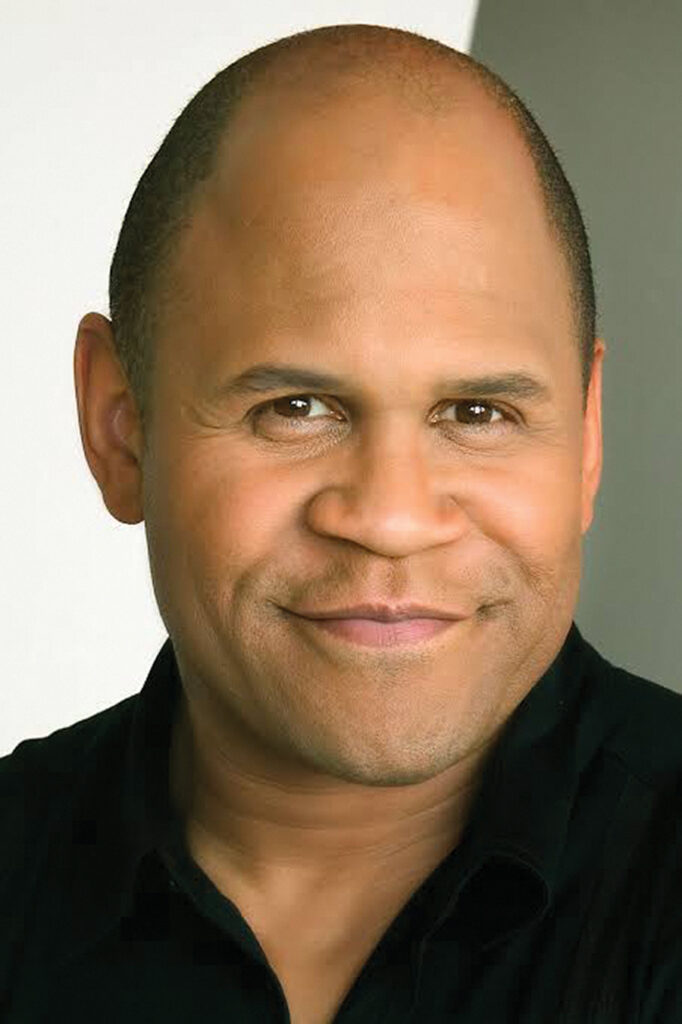
Rondell Sheridan will have you laughing out loud when BPAC’s comedy series continues on Friday, April 5, at 7 p.m. at Owens Auditorium, 3395 Airport Road, Pinehurst. Best known for his role of Victor Baxter on the Disney Channel sitcom That’s So Raven, his one-man show, “If You’re Over 40 and You Know It, Clap Your Hands!” takes a hilarious look at the hurdles of life and love when you reach, you know, that age.

Knocking Out a Nocturne

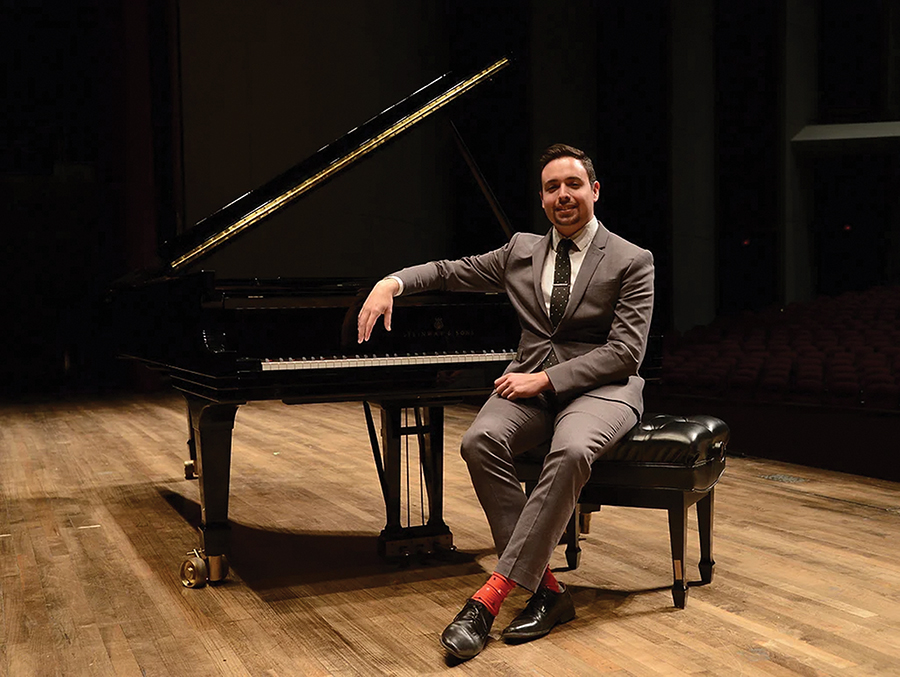
Award-winning concert pianist Dr. Dominic Muzzi will highlight “Sunday with Chopin,” presented by Break a Leg Studios, on March 3 from 3 p.m. to 5 p.m., at the Village Chapel, 10 Azalea Road, Pinehurst. Tickets are $25 and can be purchased in advance or at the door. For more information go to www.tickettailor.com/events/breakalegstudios.

Bad Bogeys for a Good Cause

The 2024 Kelly Cup Golf Championship benefiting the Sandhills Children’s Center takes place on Monday, March 25, at 9 a.m., at the Forest Creek Golf Club, 100 Forest Creek Drive, Pinehurst. Teams must register, and space is limited. There will a lunch following golf, along with auctions of golf rounds and trips. For more information call (910) 692-3323.

You’re Killing Me

And speaking of women . . . the Sandhills Woman’s Exchange will present a dinner theater murder mystery titled “Drop Dead Disco” by the Encore Theatre Players on Wednesday, March 6, at 5 p.m., and again on Sunday, March 10, also at 5 p.m., at the Pine Crest Inn, 50 Dogwood Road, Pinehurst. The cost is $60 per person, and there will be a cash bar. For additional information call (910) 295-4677 or visit www.sandhillswe.org.

League of Women Voters

On Tuesday, March 26, the Moore County League of Women Voters will host its 40th anniversary celebration at 11:30 a.m. at Forest Creek Country Club, 200 Meyer Farm Drive, Pinehurst. The luncheon will feature guest speaker Jennifer Watson, a former mayor of Charlotte and co-lead for the Carter Center’s Strengthening Democracy Project honoring the life and legacy of Rosalynn Carter. Tickets are $55. For more info go to www.lwvmc.org.

March Bookshelf

March Bookshelf

March Books

FICTION

Finding Margaret Fuller, by Allison Pataki

Young, brazen, beautiful and unapologetically brilliant, Margaret Fuller accepts an invitation from Ralph Waldo Emerson, the celebrated Sage of Concord, to meet his coterie of enlightened friends. There she becomes “the radiant genius and fiery heart” of the Transcendentalists, a role model to a young Louisa May Alcott, an inspiration for Nathaniel Hawthorne’s Hester Prynne and the scandalous Scarlet Letter, a friend to Henry David Thoreau as he ventures out to Walden Pond . . . and a muse to Emerson. From Boston to the gritty streets of New York she defies conventions time and again. When the legendary editor Horace Greeley offers her an assignment in Europe, Margaret makes history as the first female foreign news correspondent, mingling with luminaries like Frédéric Chopin, William Wordsworth, George Sand and others. In Rome she finds a world of passion, romance and revolution, taking a Roman count as a lover — and sparking an international scandal. With a star-studded cast of characters and sweeping, epic historical events, this is a story of an inspiring trailblazer, a woman who loved big and lived even bigger.

Memory Piece, by Lisa Ko

In the early 1980s, Giselle Chin, Jackie Ong and Ellen Ng are three teenagers drawn together by their shared sense of alienation and desire for something different. “Allied in the weirdest parts of themselves,” they envision each other as artistic collaborators and embark on a future defined by freedom and creativity. By the time they are adults, their dreams are murkier. As a performance artist, Giselle must navigate an elite social world she never conceived of. As a coder thrilled by the internet’s early egalitarian promise, Jackie must contend with its more sinister shift toward monetization and surveillance. And as a community activist, Ellen confronts the increasing gentrification and policing overwhelming her New York City neighborhood. Over time their friendship matures and changes, their definitions of success become complicated, and their sense of what matters evolves. Memory Piece is an innovative and audacious story of three lifelong friends as they strive to build satisfying lives in a world that turns out to be radically different from the one they were promised.

James, by Percival Everett

When the enslaved Jim overhears that he is about to be sold to a man in New Orleans, separated from his wife and daughter forever, he decides to hide on nearby Jackson Island until he can formulate a plan. Meanwhile, Huck Finn has faked his own death to escape his violent father, recently returned to town. As all readers of American literature know, thus begins the dangerous and transcendent journey by raft down the Mississippi River toward the elusive and too-often-unreliable promise of the Free States and beyond. While many narrative set pieces of Adventures of Huckleberry Finn remain in place, Jim’s agency, intelligence and compassion are shown in a radically new light. Brimming with electrifying humor and lacerating observations James is destined to be a cornerstone of 21st century American literature.

Olivetti, by Allie Millington

Being a typewriter is not as easy as it looks. Surrounded by books (notorious attention hogs) and recently replaced by a computer, Olivetti has been forgotten by the Brindle family — the family he’s lived with for years. The Brindles are busy humans, apart from 12-year-old Ernest, who would rather be left alone with his collection of Oxford English Dictionaries. The least they could do was remember Olivetti once in a while, since he remembers every word they’ve typed on him. It’s a thankless job, keeping memories alive. Olivetti gets a rare glimpse of action from Ernest’s mom, Beatrice, only for her to drop him off at Heartland Pawn Shop and leave him helplessly behind. When Olivetti learns Beatrice has mysteriously gone missing afterward, he believes he can help find her. He breaks the only rule of the “typewriterly code” and types back to Ernest, divulging Beatrice’s memories stored inside him. As Olivetti spills out the past, Ernest is forced to face what he and his family have been running from, The Everything That Happened.


CHILDREN’S BOOKS

Luigi, The Spider Who Wanted to Be a Kitten, by Michelle Knudsen

Oh, Luigi. The temptation of tasty breakfasts and getting tucked into bed have Luigi thinking kittens must live magical lives. So, a kitten he will be! But how long can he keep up this façade, and what might be at stake pretending to be something you’re not? This is a super sweet pet story from the author/illustrator team that created Library Lion. (Ages 3-6.)

Treehouse Town, by Gideon Sterer

Just below the canopy built on sticks and stilts, that’s where you’ll find treehouse town. With sunset lookout towers, nooks for books, and soft willow tree beds, treehouse town has something for everyone. Snuggle up! This sweet story with illustrations that have stories of their own is the perfect read-together. (Ages 3-7.)

Escargot and the Search for Spring, by Dashka Slater

Bonjour! It is the end of winter and time for Escargot to venture back into the world but . . . do his tentacles look a little droopy? His trail not quite so shimmery? Je suis désolé! It’s time to embrace sunshine. And flowers! And bunnies! Follow everyone’s favorite snail and enjoy the delights of spring. (Ages 2-6.)  PS

Compiled by Kimberly Daniels Taws and Angie Tally.

Hometown

Hometown

Dianne and Sadie

Growing up in the sisterhood

By Bill Fields

I consider myself a “semi-only child” because I came into the world so long after my sisters — 14 1/2 years after Dianne and 12 1/2 after Sadie. They were both off at college before I started first grade.

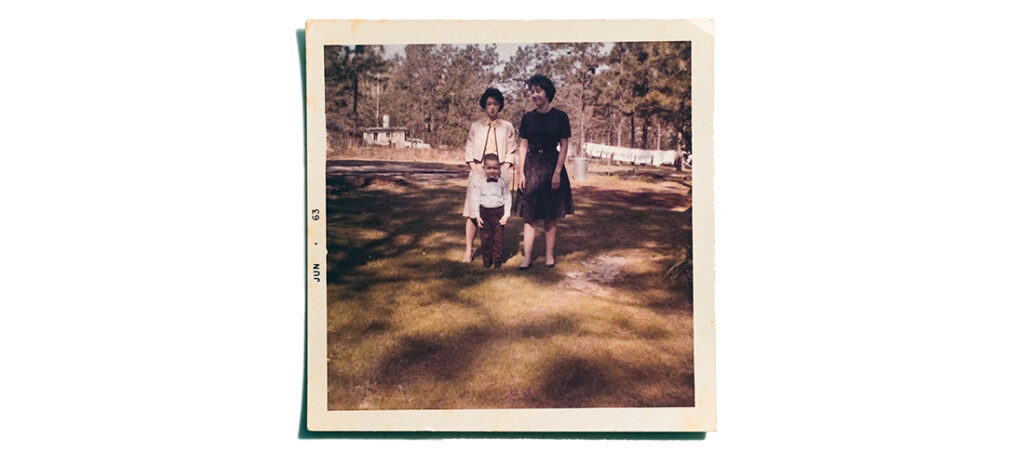
If what they say about an adult’s first memories is correct — that they usually go back to when someone was 3 or 4 years old — my recollections of Dianne and Sadie date to their teenage days in the early 1960s, about the time we posed in our Sunday finest in the backyard in the accompanying snapshot taken shortly after my fourth birthday. (They look more comfortable in their nice dresses than I do in a bowtie.)

I remember wanting to play — and them not wanting me to in equal measure — with their lipstick and fountain pens, and being intrigued when they utilized the upstairs bathroom sink to change the color of a sweater with Rit dye. There was often music, from their tickling the ivories on the upright piano in our living room to 45s spinning on a record player.

One vivid musical memory makes me think I have some earlier-than-average recall. As much as “Moon River” and “Chances Are” were a soundtrack to those days on East New Jersey Avenue, a silly pop song in my sisters’ record collection stands out in my mind. “Itsy Bitsy Teenie Weenie Yellow Polkadot Bikini,” by Brian Hyland, came out in June of 1960, and I’m convinced its lyrics were among the building blocks of my early vocabulary.

When Dianne and Sadie set out to further their educations at Wake Forest and UNC Greensboro, respectively, I tagged along on rides to and from campus. This proximity gave me a backseat vantage point to our father’s frustration upon taking the wrong exit in Winston-Salem or Greensboro, and fatigue after helping haul his daughters’ stuff to their dorm rooms. Once, our family gave Sadie’s roommate a ride to her hometown of Valdese in the North Carolina foothills. It was about a 100-mile trip but seemed like an exotic journey for a little boy who hadn’t seen much beyond Moore County.

My sisters’ college experiences netted me much more than the Wake and UNCG sweatshirts I got from them for Christmas. If they could go to college, why couldn’t I when the time came? That was a lesson more valuable than anything I was learning at East Southern Pines Elementary. And it didn’t hurt that both were fine students, applying themselves in school. Dianne was high school valedictorian, her name on the wall for years next to a painting of the Blue Knight, which was always a source of family pride as I matriculated through those same halls and classrooms until going to Pinecrest as a sophomore.

My sisters weren’t sportswomen, but I could coerce them into shooting a basket. They tolerated my obsession with miniature golf and joined me for countless games on the carpet, although under oath they would confess to not sharing my sadness when the ball disappeared down the chute on the 18th hole.

The difference in our ages mimicked the gaps between our mother and her two older siblings. Mom always hoped the chronology wouldn’t adversely affect our relationship as we aged, that her children would stay connected as they got older, after she was gone.

Five years after our mother passed away not long before her 96th birthday, we are doing what she hoped. My sisters and I haven’t lived in the same area since they left Southern Pines, but despite the geography we remain in touch. Sometimes we talk on a three-way call, a Jetsonian advance from the days when my sisters were lining up to use the party-line phone to speak to a pal, my little self likely tugging on their hemlines.  PS

Southern Pines native Bill Fields, who writes about golf and other things, moved north in 1986 but hasn’t lost his accent.

Golftown Journal

Golftown Journal

Cool Aids

Teaching the feel of a swing

By Lee Pace

The concept of the golf school was still in its infancy in the early 1980s, though pioneers like Peggy Kirk Bell at Pine Needles Lodge and Golf Club had already been entertaining guests for a quarter of a century for multi-day immersions in golf instruction, competition and fellowship.

The management at Golf Digest magazine believed that golf schools at top-echelon resorts taught by the game’s best instructors would be an excellent way to promote the brand and earn a buck, and so by 1982 the Digest schools visited Pinehurst each spring and fall, bringing instruction luminaries like Jim Flick, Jack Lumpkin, Bob Toski and Gary Wiren to the Sandhills.

Wiren spent time not only on the renowned “Maniac Hill” practice ground at the flagship resort, but he and Peggy Kirk Bell were close friends, and Wiren spoke and taught often down Midland Road at Pine Needles.

Today, one of the foundational training aids in the golf instruction centers at both Pinehurst and Pine Needles (and probably most practice ranges in the Sandhills) is one of Wiren’s inventions. In the early 1980s Wiren played off a favorite drill from three-time British Open champion Henry Cotton in which Cotton had golfers simulate impact by swinging against an old tire — shaft leaning forward, hips clearing and head behind the ball. Wiren thought a softer and safer rendition would be to manufacture a large bag of durable fabric and stuff it with towels.

The bright yellow Impact Bag was introduced in 1982 and became one of the most noted training aids in history. It launched Wiren into a sideline of developing and nurturing the creation of devices to help PGA professionals teach and golfers to learn. Today, at 89 years of age, Wiren and his family operate a business called Golf Around the World, built around an online sales catalog of training devices.

“Telling a golfer is one thing,” says Wiren, who played in the 1994 U.S. Senior Open at Pinehurst wearing knickers and carrying his own bag. “Letting them feel is altogether different.”

Wiren lives in West Palm Beach, Florida, and still makes regular trips each January to the PGA Show in Orlando, where a growing section of the floorspace is dedicated to golfing entrepreneurs who have created better mousetraps to augur a player’s ability to find the proverbial light switch in their golf game.

You might find Jim Hackenburg, who was teaching on Martha’s Vineyard in 2007 when he had the idea of attaching a rubber ball about the size of an orange to a flexible shaft that was designed to help golfers feel the proper motion, sequence and tempo of the swing. Today the Orange Whip is as ubiquitous in golf instruction as the Impact Bag.

Holding court in his booth devoted to his Tour Striker line of training aids is Martin Chuck, an Arizona-based teaching pro. Chuck, frustrated in 2008 by his students’ inability to strike the ball with forward shaft lean, took a 5-iron into his club repair shop and ground off the bottom four grooves of the club, rendering it worthless unless the golfer hit down on the ball sufficiently to force contact in the middle of the clubface — not the bottom edge. Any shot hit on the bottom of the clubface would simply dribble along the ground.

Bernie Fay was a blue collar worker and part-time handyman in Chicago who loved golf and a decade ago conceived a 42-inch polymer shaft with an attached elbow cuff that promotes a wider turn and keeping the left arm straight. He put his life savings into what he calls the “Most Important Stretch In Golf,” or MISIG, for a business name.

“I think that golfers know something that other people do not,” Fay says. “They have something in them that others might not: the light of hope. They have figured out spiritual art. Something beautiful. It’s pure, and I am awestruck when I think about it. The light of hope is always on them.”

This year one of the more novel introductions to the eternal hope for a better golf game is Mike Dickson, a Maryland-based instructor who has created and manufactured a line of devices under the LagMaster banner. Like Wiren, Chuck and many others before him, Dickson was confounded over 17 years teaching at Congressional Country Club in Washington with the average golfer’s tendency to “cast” the club, releasing it well before impact.

But instead of solving the problem at the bottom of the move, Dickson’s LagMaster addresses the issue at the top of the backswing and the early part of the downswing. The device is placed on the grip of the club, and with a properly executed backswing, one end of it touches the right shoulder at the top of the backswing (for a right-handed golfer). The feel Dickson is teaching is to keep the end of the device touching the shoulder into the downswing until the left arm is parallel to the ground. To do that, the golfer has to retain the 90-degree angle of the club and the left arm.

Presto: No cast, and an eventual compression of the ball at impact.

Dickson looks around him at the Orange County Convention Center in January 2024 and takes in all the inventions.

“The whole goal of any training aid in this building is to give somebody a sensation, a feeling without me having to describe it or put my hands on your body,” he says. “If you feel it, you’re going to own it.”

Dickson is a proponent of Homer Kelley’s The Golfing Machine, one of the key elements being the action of the right shoulder. Kelley teaches that the right shoulder swings down “on plane,” along the same line as the club shaft and staying “back and down” until after the hit. Tom Watson credits that move with helping him during his late-career success on the PGA Champions Tour.

“That’s what I am trying to accomplish with the LagMaster,” Dickson says. “You have to turn the right shoulder under to maintain the angle. If I can give you a good grip and sequence you the right way, all this other mess goes away. It’s been fun to watch it evolve.

“A guy ordered the device and wrote back immediately. He said, ‘Mike, after the first three swings, I couldn’t believe how different it felt.’ I see that every day.”

Dickson left Congressional in 2021 to start his own golf academy at Little Bennett Golf Course in Clarksburg, Maryland. He teaches there and runs his LagMaster as a side hustle that, he says, “looks like it’s going to be bigger.”

Indeed, the water is warm in the training aids ocean.  PS

Lee Pace has written about golf in Pinehurst and the Sandhills for more than three decades. Write him at leepace7@gmail.com and follow him @LeePaceTweet.

Sporting Life

Sporting Life

Making the Fleet Shipshape

Taking advantage of a little downtime

By Tom Bryant

“Like the Old Man said, there is nothing like being alone on the water in a boat of your own to learn the value of peace, quiet, and responsibility.”  — Robert Ruark, The Old Man and the Boy

Linda and I call March the Bryants’ transition month. Toward the end of February, we would normally leave for Florida in the little Airstream, hoping to be far south before March roared like the proverbial lion.

We liked the west coast the most because it seemed to be more like the old Florida we used to know. Fishing was the put-up reason for turning into snowbirds, but really I think it was just escaping the fickle month of March, and enjoying a little warmth and salt water that really sent us on our way. Later, around the first of April, our wanderlust temporarily sated, we would hook up the compact camper, fire up the Cruiser and make a leisurely trip back to North Carolina, until it was time to head to the beach.

This year, though, was gonna be different. My right knee had given up the ghost, so I was to have replacement surgery and then be as good as new. Only problem was the time involved in getting everything back to working the way it should. So, what to do while healing and learning to walk again? I decided I’d do a little inventory, maybe get rid of some stuff that was outdated, if there is such a thing. Linda, my bride, accuses me of never throwing anything away. I disagree. If I’ve used it once, I’m liable to use it again, and there is nothing worse than needing an item and realizing I disposed of it long ago. So I always think long and hard before any of my stuff hits the scrap pile.

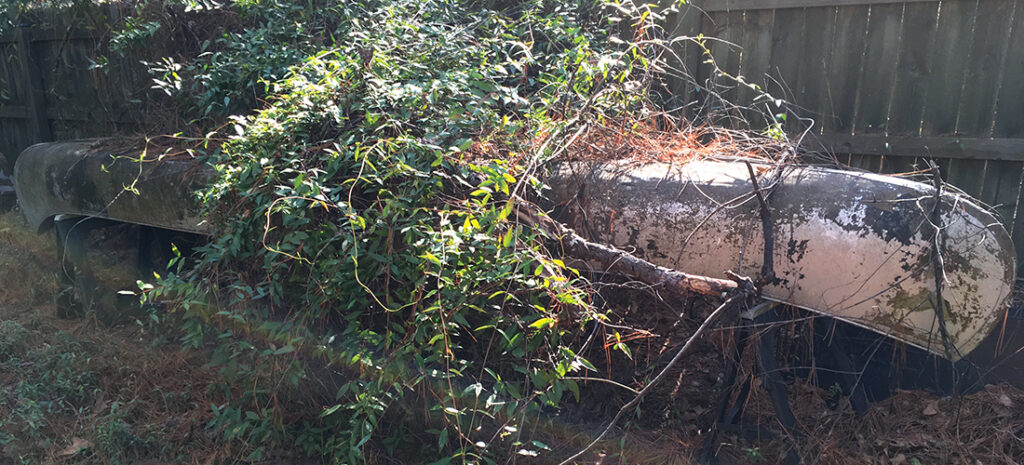
A good example would be my ancient, beat-up Grumman canoe resting in the backyard on a couple of sawhorses right up next to the fence. Now the great thing about an aluminum boat is it’s almost indestructible. To prove the point, just look at old SS Haw River. Every boat has to have a name, so I named the canoe Haw River. She saved a friend and me from drowning a time or two in deadly white water rapids on the Haw. Her very first adventure was on that river up in Alamance County where she proved her worth on a river at flood stage.

Three of us were on what Linda calls another misadventure. The plan was to float the Haw River until it merges with the Cape Fear and comes out in Wilmington. Good plan, except the misnomer float would be like comparing a bull ride to a soft canter on a well-disciplined Tennessee walking horse.

To keep a long, almost deadly, story short, somewhere down close to Pittsboro, old Haw became lodged between two massive boulders, where she promptly tossed her passengers out in the raging current, luckily close enough to a narrow island to be able to scramble up the bank.

We saved what gear we could that evening and spent the night on the little spit of land. The next morning, we swam off to safety. All the little adventures that happened during our rescue is another tale, one that was picked up by the local newspapers. But I diverge from the real point: Old Haw was rescued, and her broken keel was fixed, almost good as new. She ushered us down many more rivers, lakes and bays.

So during this time of rest and recuperation, I’m going to dig her out from under the persimmon tree vines, dust her off (well, it’s gonna take a little more than dusting), and get her recommissioned in the fleet.

The fleet is what the bride calls an accumulation of watercraft resting in our backyard. There’s the old SS Haw River. Then a 16-foot aluminum skiff that my dad gave me early in my fishing days; and resting right close is a 12-foot, wide-beamed, low-to-the-water duck boat named the Widgeon. There is also a Keewaydin canoe designed especially for whitewater. I bought this canoe late in my whitewater paddling career when it seemed as if I was “determined to kill myself” — a direct quote from the bride.

I did spend a lot of my outdoor time on rivers, creeks, lakes, bays, and even the ocean, but mostly on waters that would not be too much for a canoe to handle. If I was to blame anyone for my obsession with a love of rivers and creeks, it would have to be my grandfather.

Granddad’s place in South Carolina has been in the family for generations. It’s a working farm that is still part of the family, and its borders ranged from the banks of Black Creek to the dark waters of the Little Pee Dee River and all points in-between. In a youngster’s mind it was a lot of land. And with Black Creek and, more importantly, Little Pee Dee River, there were lots of opportunities to paddle.

There was one adventure on the Little Pee Dee where I was able to help Granddad add to his own personal watercraft. It was a day like many others on the river. We were up and at ’em early, motoring up the river 4 or 5 miles, then floating back down to Granddad’s river shack, fishing all the way.

Late in the day and a little over halfway back to our put-in point, we decided to take a side trip and investigate a small pond in a cut off the main flow of the river. There are a lot of those in some stretches of the Pee Dee, and now and then we would check them out, sometimes catching a boatload of redbreast fish. This one, though, proved to be a disappointment, and Granddad said, “One more cast there, Bubba, and then let’s head to the barn. It’s getting late and we’ve got to clean these fish for supper.”

I threw my favorite lure under a low-hanging cypress limb, started reeling in and got hung up on something solid just under the surface of the black water. When we paddled over to where the lure was hooked, I could see that my favorite lure was securely snagged to what looked like a log.

Granddad checked it out after I dislodged the lure and said, “I’m gonna get help from your uncles and we’re coming back to get this thing. If I’m not mistaken, son, you’ve hooked a dugout boat.”

Sure enough after my Uncle Hubert and Uncle Tommy helped Granddad drag the ancient dugout boat back to the fish camp, it proved to be an amazing vessel. It was 16 feet long and about 5 feet in the beam, and carved out of an amazingly old cypress. After sitting on dry land for an entire year, it was as seaworthy as the day the long-ago Indians carved it from a felled tree. My uncle’s children still have the prehistoric craft resting in one of the outbuildings on their farm.

Having boats is a tradition in our family, and during this down time, I’m determined to get my fleet shipshape.  PS

Tom Bryant, a Southern Pines resident, is a lifelong outdoorsman and PineStraw’s Sporting Life columnist.

Birdwatch

Birdwatch

An Unlikely Visitor

The rare sight of a western tanager

By Susan Campbell

In the Sandhills and beyond we occasionally find western wanderers soaring overhead, perched in the treetops, or even at a feeder. Birds have wings and so they can (and do) end up anywhere. One of the most exciting parts of watching birds is that you never know who might show up.

Some birds are quite prone to vagrancy. Whether this condition is a result of wandering, getting lost or blown off course, we cannot usually say. Species that are long-distance migrants are, not surprisingly, at risk for mishaps en route. Though studied a great deal, very little about migration is understood. The fact is birds do migrate and most individuals are successful at it, allowing their genes to be passed on to the next generation.

This is not to say that those birds that end up off track are bound to stay lost forever or perish as a result of a wrong turn along the way. In fact, it’s believed that these out-of-place individuals, in some cases, represent the beginning of a range expansion for their species. Records have been kept long enough that we have documented bird populations moving into new areas of the United States.

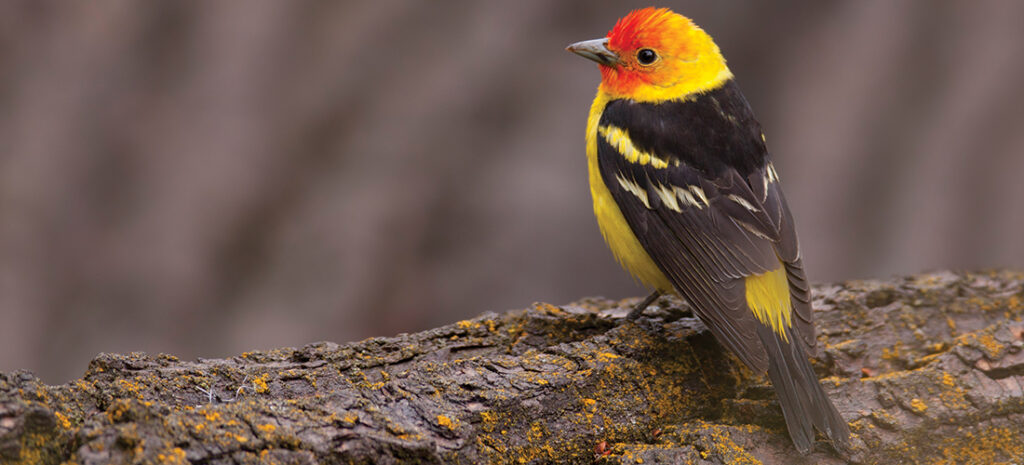
A species that has been observed in the winter more and more frequently, well outside of its normal range, is the western tanager. This small but colorful songbird is found in the warmer months throughout most of the western U.S. in a variety of wooded habitats. They head for Mexico and Central America come fall. However, in the early ’90s, one showed up at a feeder in Wilmington and stayed — not just one winter but returned for two more. It fed on suet, shelled seeds and fruit. Since then, more than a dozen other individuals have been documented along the southern coast of North Carolina. What does this mean? It is probably too soon to tell. But bird lovers in our southeastern counties are keeping their eyes out for westerns each year.

It has been more than a decade since the first western tanager appeared in the Sandhills. But this winter, a male western tanager once again turned up in a Pinehurst yard. The hosts, being bird people, realized they had something out of the ordinary at their feeders. It was tricky seeing the necessary field marks on him given his secretive nature. All tanagers molt twice a year and happen to be drab from early fall through early spring, so identification is a bit tricky when these birds do appear in the East. Unlike our more familiar summer and scarlet tanagers, westerns have noticeable barring on their wings and are brighter yellow on their underparts. 

Interestingly, there was also a western tanager in Apex (outside Raleigh) this season. It, too, was a male, but he arrived with lots of orange and red on his head and face already — clearly an adult bird. Like the Pinehurst tanager he was rather shy at first, but within a few weeks, settled in and began strutting his stuff several times a day, enjoying mealworms and bits of fruit from the big platform feeder.

Though sightings of western tanagers are rare, it pays to be prepared with binoculars and a good field guide should something “odd” show up. The unusual is always possible, whether you are visiting a large wildlife refuge, local park, a McDonald’s parking lot or even in your own backyard.  PS

Susan Campbell would love to hear from you. Feel free to send questions or wildlife observations to susan@ncaves.com.

Tea Leaf Astrologer

Tea Leaf Astrologer

Pisces

(February 19 – March 20)

They say the average person has three to five dreams per night. The average Pisces, on the other hand, exists in a perpetual dream state, operating from a realm of consciousness akin to a bowl of kelp-laden miso soup. Be gentle with yourself this month, especially when a high-pressure deadline threatens to derail you. Should you find yourself floating on a cube of silken tofu, consider it your life raft from a kind and loving universe. 

Tea leaf “fortunes” for the rest of you:

Aries (March 21 – April 19) 

Suffice it to say that the eagle has landed.

Taurus (April 20 – May 20)

Try rearranging the houseplants.

Gemini (May 21 – June 20)

Worrying won’t change the outcome.

Cancer (June 21 – July 22)

Note the spice level warning.

Leo (July 23 – August 22)

Mustard versus vinegar, baby.

Virgo (August 23 – September 22)

A dull knife is most dangerous.

Libra (September 23 – October 22)

Drop the act.

Scorpio (October 23 – November 21)

A splash of lemon goes a long way.

Sagittarius (November 22 – December 21)

They don’t need to understand.

Capricorn (December 22 – January 19)

Invest in a nail brush.

Aquarius (January 20 – February 18)

More tree pose.  PS

Zora Stellanova has been divining with tea leaves since Game of Thrones’ Starbucks cup mishap of 2019. While she’s not exactly a medium, she’s far from average. She lives in the N.C. foothills with her Sphynx cat, Lyla.

Crossroads

Crossroads

History Finds a Home

Taylortown museum preserves town’s heritage

By Audrey Moriarty

It took almost two decades to get there, but in October of 2023, the Taylortown Museum celebrated its one-year anniversary. According to Nadine Moody, volunteer at the museum and a former Taylortown council member, the house where the museum is located — 8263 Main St., in Taylortown — was originally the home of Demus Taylor’s great-granddaughter, Margaret Mangum. Demus Taylor is the founder of Taylortown, and Margaret worked as a teacher at the Academy Heights School, where she taught Moody in third grade. The Mangum home was purchased roughly 20 years ago, when Ulysses Barrett was the town mayor. While the building was intended all along to house a museum, bringing the plan to fruition took time.

If the museum had a little trouble getting off the ground, the house was always busy, serving as a venue for various community events. In the interim a handful of dedicated volunteers decided to begin recording and preserving Taylortown’s history. The group consisted of various members of the community: Gail McKinnon, president of the Historical Society; Jef Moody, vice-president of the Historical Society; Wendy Martin, of the Beautification Committee; Nadine Moody (Jef’s wife); and several others.

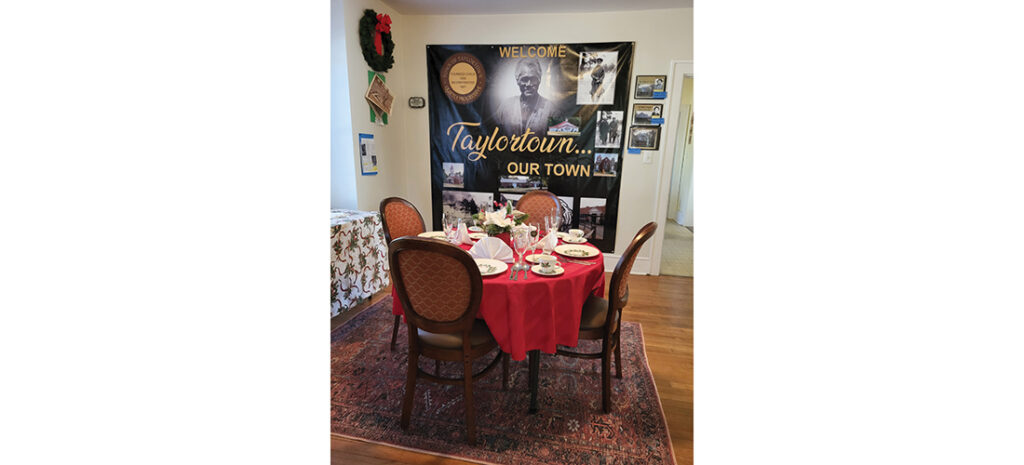
Inside the museum are exhibits of old tools, a display of images of the mayors of Taylortown, photos of local church dignitaries, information on the Academy Heights School, and a large “Welcome to Taylortown” banner, featuring Demus Taylor and some local historic sites.

According to McKinnon one of the ongoing projects the volunteers have begun is an “obituary book” listing the names of spouses, siblings and children, helping community members fill out family trees. They are hoping to get more input from family members of deceased residents to add to their book and family records. “What I wish we could do is to get each Black community to give us a brief history, because we all know each other and are related somehow,” says Nadine Moody.

Gary Brown, another volunteer, is working on a gravesite webpage, identifying and documenting local graves. High on the list of the museum’s current needs is a computer to house the information they’re compiling. The hope is that visitors to the museum will one day be able to search the collection and family data base. Brown, with Martin’s help and donations from Food Lion and local churches, also operates a food bank every Tuesday at Johnny Boler Park in Taylortown.

Recently the museum had a surprise visit from Paula Hall, Demus Taylor’s great-great-granddaughter. The museum is looking for more items to add to its exhibits, and hopes to get a few old canvas and leather carry bags and wood-shafted clubs — an homage to the work Taylortown residents, especially Demus Taylor, did caddying at the Pinehurst Resort. They’re also in search of a closet or curio cabinet for displays. Nadine Moody says 99 percent of their current exhibits were donated by local citizens and businesses. Homewood Suites donated some tables and chairs after a recent renovation and the museum repurposed them, some for workspace, while others are attractively set with dishes and stemware.

Current plans call for expanding the exhibition space to the upstairs portion of the house. “We are so excited,” says Nadine Moody. “We’re busting at the seams.”  PS

The Taylortown Museum is open to the public on Wednesdays and the first Saturday of the month, from 11 a.m. to 2 p.m., and on Thursdays for groups, by appointment. You can reach the Taylortown Museum at (910) 215-0744, or by calling the Town Hall at (910) 295-4010.

Audrey Moriarty is the Library Services and Archives director for the village of Pinehurst.

Focus on Food

Focus on Food

A Missing Delight

The case for mousse au chocolat

Story and Photograph by Rose Shewey

I recently came across a clip of Arnold Schwarzenegger making a protein shake. I watched with intrigue as he cracked a raw egg into his shake and, for good measure, threw in the shell, too! For extra calcium, he said. What a savage move! I know most people wouldn’t go near his concoction because of the raw egg in it, which prompted me to take a quick mental inventory of other foods we eat regularly, perhaps unwittingly, that call for glibbery whites and runny yolks.

On the top of my list: traditionally prepared ice cream, followed by tiramisu and mayonnaise (all of which can relatively easily be made egg free), and lastly, mousse au chocolat, which seems to have gone missing — it’s virtually absent from every dessert menu I have laid my eyes on recently.

So, why is mousse au chocolat not as popular as it used to and deserves to be? Could it be the raw eggs? It stands to reason. Raw eggs have most certainly acquired a bad rap over the past couple of decades. On top of that, a large number of mousse au chocolat recipes in the U.S. call for whipped cream to be folded into the melted chocolate as opposed to peaky egg whites (in fact, the original recipe does not contain cream at all). The result is something between a chocolate ganache and chocolate pudding, at best — tasty, but nothing to write home about. It’s the glossy, whipped egg whites that create the unique frothy texture in mousse au chocolat, which is paradoxically rich and airy at the same time. So, this missing delight finds itself between a rock and a hard place; it’s either made poorly or, evidently, not at all.

The decision is yours, of course. I have safely (but also cautiously) prepared and eaten raw eggs my whole life. Beyond that, I have experimented for over a decade with substituting plant-based whole food ingredients for animal-derived ones and have had great success with a lot of dishes. However, mousse au chocolat is not one of them. As much as I enjoy some avocado or aquafaba “mousse,” they are not a match for the centuries-old original; lacking in structure, like a cheap wine. So, if you have access to fresh, quality eggs, skip all the mousse imposters and make this confection just as people have for over 200 years, with satiny egg whites and creamy yolks for the most extraordinary results.


Mousse au Chocolat

(Serves 4)

200 grams semi-sweet chocolate (12 percent sugar)

50 grams butter

200 milliliters heavy cream

3 eggs

30 grams granulated sugar

In a double boiler, slowly melt chocolate and butter. Whip cream and set aside in the refrigerator. Separate eggs and beat egg whites (with clean beaters) until they form stiff peaks. In a separate bowl, beat egg yolks with sugar until the mixture turns light in color, stir in chocolate-butter mixture, and immediately fold in egg whites and whipped cream, using a spoon or spatula. Do not over-mix to avoid deflating the mousse, then refrigerate for at least 2 hours. Serve with whipped cream and chocolate shavings or any toppings of your choice.  PS

German native Rose Shewey is a food stylist and food photographer. To see more of her work visit her website, suessholz.com.