Pleasures of Life

Find Yourself Up a Tree?

It might be good for you

By Tom Allen

Recently, on a walk in my neighborhood, to log those elusive 10,000 daily steps we’re now told we don’t necessarily need, I had the bejeebies scared out of me. As I passed a thicket of trees, someone called out from above, “Hello, there.”

I’m a man of faith but, really?

Somewhat shaken, I responded, “Hello to you.” And I continued my walk. When I reversed my direction and passed by the same stand of trees, I saw a neighborhood kid, maybe 8 or 9, who had climbed a tree and was sitting on a limb, like the Cheshire Cat, as content as could be. A kid up a tree. Not on his PS5 or Xbox. He climbed a tree and, from what I saw, he wasn’t on a cellphone, scrolling through social media or Googling something he shouldn’t be Googling. He had climbed a tree. And, giving him the benefit of the doubt that he wasn’t trying to scare the bejeebies out of me, he was rather friendly.

The next day, I saw two teenagers gliding down the road on skateboards. Kids at play. What a concept.

A wall at a new elementary school has caused quite a stir with the slogan “In the business of play.” I’ll let the powers that be hash out what welcomes folks at a newly constructed school. But whether you write it on a wall, a billboard or a T-shirt, one thing’s for sure: Children, really all of us, need the gift and therapy play provides.

We’re all familiar with the saying “All work and no play makes Jack a dull boy.” The phrase comes from a collection of proverbs, written in 1659 by James Howell, a British historian and writer. Jack might have been real or fictitious, a friend or a figment. Howell’s father and older brother were Church of England clergy. Maybe James saw his dad and sibling as 17th century workaholics. Maybe they were boring chaps at family gatherings, or maybe they were so busy rescuing souls that they had little time for family, a relaxing hunt in the country, or a nice swim in the Thames. Maybe they, or even Howell himself, had trouble keeping the Sabbath as a day of rest. In his day, a plethora of seventh-day restrictions existed, many prohibiting even a modicum of recreation and revelry. Or perhaps Jack was a boy, a kid, who for whatever reason never skipped stones across a pond, turned somersaults down a hill, chased a butterfly, or even climbed a tree.

When we hear someone’s found themselves “up a tree” that usually means they’re in a pickle. But sometimes, finding yourself up a tree, or in a hammock, or simply doing nothing, might be the best thing. The anecdote is cliché by now, but we are human beings, not human doings.

I’m not advocating putting yourself at risk. Your hips and knees recognize boundaries. But maybe after a year and a half of isolating and masking, we need to give ourselves permission to climb trees and fly kites, to fish and swim, to sing and laugh and do, well, a little of nothing.

St. Luke’s Gospel records the story of Zacchaeus, a fellow short in stature who wanted to catch a glimpse of Jesus when he came into town. Unable to get a good view, he climbed a tree. The story carries a profound message. This little man, a tax collector, despised by his culture and an outcast in his religion, is befriended by one who wants to have dinner with him, but the story, like Noah and his beloved ark full of animals, has been passed down as more of a children’s tale. Why? Maybe because climbing a tree is for kids, not grownups. A beloved British children’s Sunday school song reinforces the idea:

Zacchaeus was a wee little man and a wee little man was he,

He climbed up in a sycamore tree for the Lord he wanted to see,

And as the Lord did pass that way, he looked up in that tree,

And he said, “Zacchaeus, you come down, for I’m going to your house
for tea.”

Our Americanized version replaces “for tea” with “today.”  Either way, the little man who found himself up a tree came out the recipient of quite a surprise.

The next time someone tells you to “go fly a kite” or “take a hike,” the old-fashioned ways of saying “get lost,” try responding with, “Don’t mind if I do.” Or when life finds you in a pickle and “up a tree,” consider climbing one, or at least, sitting beneath its shade, if only to impart insight into the tension between uncertainty and hope. And if someone passes by, offer a kind, “Hello, there.” Who knows, you might just make a friend, get invited to dinner, or find your way back to childhood days, carefree and playful, when summer morphed into fall. I think you deserve it. I think we all do. PS

Tom Allen is minister of education at First Baptist Church, Southern Pines.

Golf’s Unsung Hero

How a unique hobby helped restore a historic course

By Bill Case

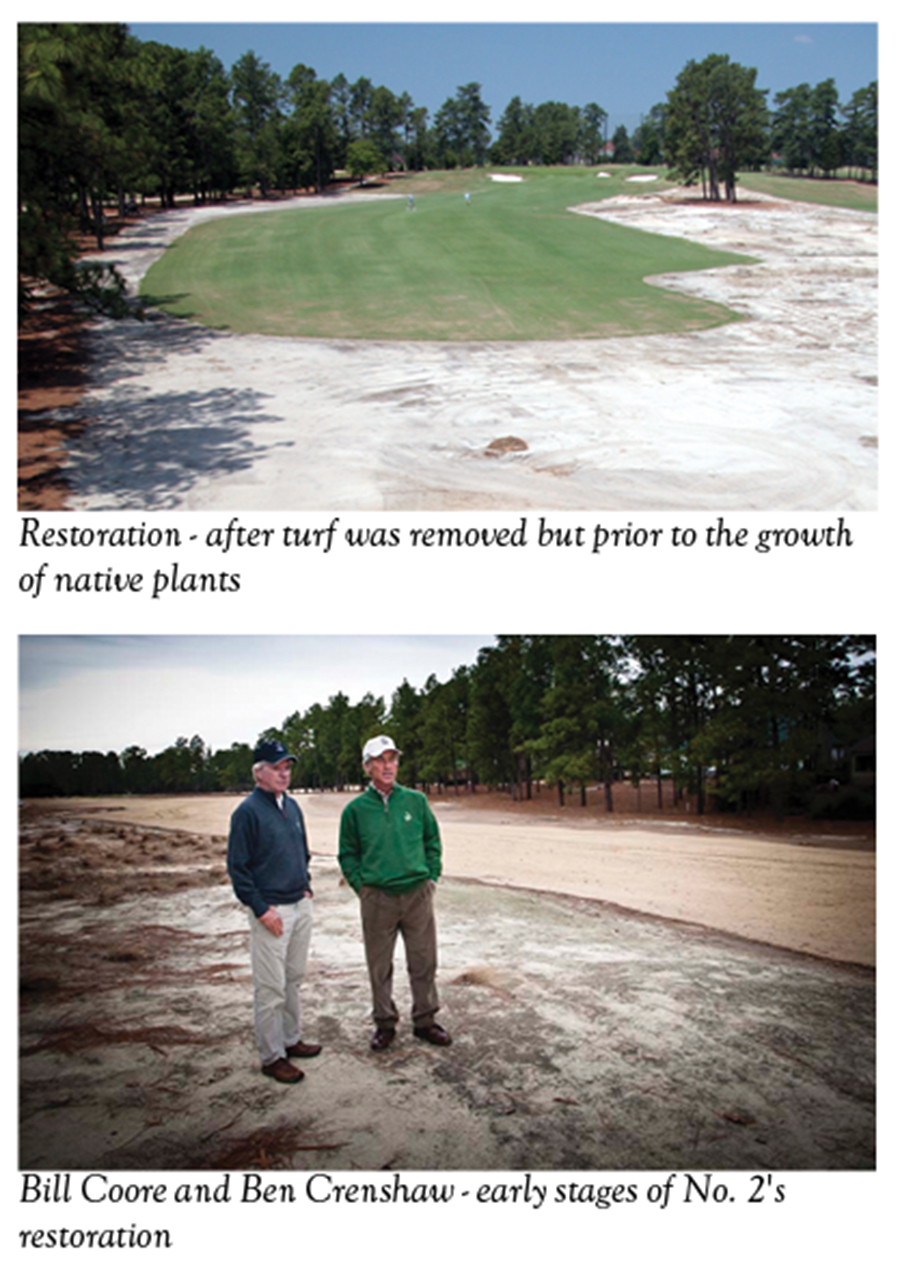
In 2009, Bob Dedman Jr. and Don Padgett II, the gentlemen in charge at the Pinehurst resort, decided to dramatically overhaul Pinehurst course No. 2, one of America’s foremost championship golf venues. They sensed that the layout, built by Donald Ross in 1907 and periodically tweaked thereafter by the legendary architect until his death in 1948, had lost some of its character.

Starting around the early 1970s, Pinehurst had adopted the popular course maintenance formula of the era: lush green grass throughout the course, not just in the fairways. The native pine barren wire grasses and awkward sandy lies that confronted off-target golfers on No. 2 during Ross’ heyday largely disappeared. In their place came acres of 3-inch-deep irrigated grass. Too often, extrication from this cabbage could only be accomplished by hacking a wedge back to the fairway.

To restore No. 2 in a manner that approximated how Ross had presented the course, Dedman and Padgett called upon esteemed course designers Bill Coore and two-time Masters champion Ben Crenshaw. The Coore & Crenshaw website describes its design philosophy as a blending of Bill’s and Ben’s “personal experience and admiration for the classical courses of Ross, MacKenzie, Macdonald, Maxwell, and Tillinghast to create a style uniquely their own.”

The architects have a special connection to Pinehurst. Having already won in his professional debut, a 21-year-old Crenshaw nearly captured his second event as a pro, too, finishing second in the 1973 World Open, three strokes behind Miller Barber. The 144-hole marathon on No. 2 “stimulated my love for Pinehurst,” says Crenshaw. Coore, who grew up in Davidson County, North Carolina, was good enough to make Wake Forest University’s golf team and played No. 2 frequently in the 1960s, usually on $5 all-day passes. “There is no doubt,” he says, “that playing No. 2 gave me an appreciation of traditional, strategic golf courses that eventually pointed me in the direction of course architecture.”

While Coore & Crenshaw’s selection was applauded in golf circles, more than a few aficionados wondered about the potential impact of a drastic change. Why make major modifications to a course that only recently had held one of golf’s most dramatic major championships, the 1999 U.S. Open? What was the benefit of eliminating rough in favor of native waste areas? Didn’t the United States Golf Association prefer deep rough and narrow fairways? Could changing the character of No. 2 jeopardize its status as a championship venue?

Though they didn’t say so publicly at the time, Coore and Crenshaw also harbored misgivings. Coore knew that No. 2’s fairways had once stretched to nearly 50 yards in width. Now they averaged just 24 yards across. If the more generous dimensions were restored, would the USGA find fault or, worse yet, require the fairways be narrowed again for the 2014 men’s and women’s U.S. Opens?

The two architects had no interest in undertaking No. 2’s restoration if it might do more harm than good. Mike Davis, who had been in charge of setting up U.S. Open courses for years and who would become executive director of the USGA in 2011, promised that modifications resulting from the restoration would not be undone by the USGA. Indeed, Davis himself had broached the concept of restoring No. 2 in discussions with Dedman and Padgett.

But there remained a gnawing concern for Coore and Crenshaw — they wanted to know the precise details, dimensions and appearance of the course during the Ross era.

Bob Farren, the man in charge of maintaining the resort’s courses, provided an invaluable first clue. He advised that during the 1980s, his crew had uncovered the entirety of the abandoned fairway irrigation line that Ross had installed in 1932. Farren flagged the path of the defunct line for the architects. Its location confirmed that No. 2’s fairways had previously been configured in a more serpentine fashion. Due to mowing patterns, the fairways gradually became straighter in the 80 years following Ross’ placement of the irrigation line. Farren’s discovery enabled the architects to replot the location and dimensions of No. 2’s fairways to match the old Ross footprint.

But puzzles remained. What did the old native areas look like? Had the location and shape of greens, tees and bunkers changed any over the years? How did Ross sculpt the bunkers? To find answers, Coore and Crenshaw paid a visit to Pinehurst’s Tufts Archives and combed its remarkable collection of historic photos. Their research proved useful in providing an overview of the course’s general appearance, but photos illustrating hole-by-hole details were few. And those that did exist were snapped at ground level. Bill and Ben had hoped to find aerial photos that might provide a clearer, to scale, perspective of No. 2’s architectural details.

Though intimately familiar with Ross’ design style, absent more detailed photos, they were going to have to engage in a significant amount of guesswork. How could they be sure they were accurately restoring the course to the way Ross had left it or, at least, how he would be inclined to draw it up today? “Lord knows,” reflected Coore later, “we didn’t want to be known as the people who messed up No. 2.”
Unbeknownst to the architects, help would soon be coming their way, in the form of Craig Disher, a 65-year-old Washington, D.C., resident who was a decade into retirement after a 31-year career with the National Security Agency. Disher was an enthusiastic golfer, typically scoring in the low 80s at Manor Country Club in nearby Rockville, Maryland. His zest for the game ultimately steered him toward an avocation of his own creation.

It happened in 2004 after Disher read Lost Links, by Daniel Wexler. According to the book, various federal agencies had photographed vast portions of America from the air, and the millions of aerial images housed at Washington’s National Archives and Records Administration included many of golf courses. The United States Geological Service, the most prolific shutterbug among the agencies, had begun the process of photographing the country in the 1930s. There were various reasons for the program, one of which was inventorying America’s arable land. Even though crops aren’t customarily grown on recreational properties like golf courses, the USGS shot them anyway in the event the land might have to be used for food production or other necessities. This had actually taken place during World War II when “Victory Gardens” were patriotically planted on the nation’s courses, and cows grazed on the formerly pristine fairways of Augusta National Golf Club.

Disher thought it would make for an enjoyable project to search for aerial pics of his home course, Manor CC, designed in 1922 by noted golf architect William Flynn. Besides, the place where the USGS images were stored, NARA, was just a 15-minute drive from Disher’s home. After being directed to the cartography and map research room on the third floor, he got a crash course on the ins and outs of researching and retrieving aerial images from NARA’s vast catalog.

Finding images taken in the USGS project wasn’t a particularly difficult task. Rolls of large 9×9 negatives kept in stored cans were indexed by state, county and date. After identifying the rolls pertaining to a particular county, a researcher would request them, then generally wait a day or two before they were made available. Once the rolls were in hand, the researcher could sift through them on a light table, hunting for particular negatives.

The project was right up Disher’s alley. He enjoyed research and the patience, concentration, and persistence it required. A history major at Gettysburg College, his senior thesis (the evolution of Mao Zedong’s communist philosophy and politics) had necessitated innumerable hours wading through hundreds of magazines, newspapers and other documents at the Library of Congress.

“Organizing and cross-referencing them in the era before computers was great training,” Disher says. “My research at NARA mirrored that experience.”

His resourcefulness was augmented by life experiences. After college, during a stint in the U. S. Army, Disher received training in military interrogation at intelligence school and served as an interrogator during the Vietnam War. A significant portion of his employment at NSA had involved the deciphering of encrypted messages. As Disher puts it, that work, in contrast to library research, “primarily takes place in one’s head.”

From NARA’s index, Disher found that rolls of negatives taken in Montgomery County, Maryland (Manor CC’s location), were available. He found aerial images of Manor taken during the years 1940, 1948 and 1951. He photographed the negatives, then used Photoshop on a computer at home. This resulted in sharp black-and-white photographs that depicted the Manor course in riveting detail.

Delighted with the success of his search, Disher soon became a regular at the cartography and map research room, looking for and collecting aerial images of other golf courses in the Washington, D.C., area. It wasn’t long before his quest extended to courses that interested him around the United States. His most frustrating search involved the Lido Golf Club on Long Island, closed permanently due to wartime needs in 1942. Classic golf architecture devotees reverentially extoll this mystical links, ranking it among the finest ever built in the country. Locating aerial photos of Lido became something of a white whale for Disher, especially after he discovered USGS had not taken any photos in the area.

Undeterred, Disher considered whether the Department of Defense might have photographed Lido. Before and during World War II, DOD had arranged for military installations and areas of strategic importance to be photographed from the air. NARA had materials relating to these aerial flights, but researching them could be vexing due to a lack of indexing. However, NARA did hold records showing the flight patterns of planes that had flown on aerial photography assignments. The paths were depicted by the drawing of black lines of the planes’ tracks on acetate sheets. By superimposing those sheets over a geological map, a researcher could determine the general area where photography had taken place.

The information on the acetate sheets had been converted to microfilm. To search for Lido, Disher “had to look at all the microfilm rolls showing tracks of aerial photography planes in Long Island prior to 1942. Each roll of microfilm had to be viewed from start to finish, stopping at each track image to see if it passed over the area of interest.” Once those track images and the associated roll of negatives were identified, Disher would order the can containing them. The wait for the cans took additional time, since DOD images were in cold storage outside of D.C.

“It took me a month, but I finally found an undiscovered 1940 aerial photo of Lido,” he says. Disher shared the image with golf historians, and the highly detailed photograph subsequently appeared in several golf magazine articles, spurring an ongoing movement to someday recreate Lido’s majestic course.
Slowly, people in golf became aware of Disher’s research. Given the architectural trend of restoring classic courses to their original design, old photos — especially aerials — were in high demand. Without any thought of benefitting financially from his unique hobby, Disher cheerfully shared access to his collection gratis with grateful golf clubs and course architects who asked for his help. Disher furnished them 16×20 prints of aerial photos that were used in field work. Later the same prints often found their way to clubhouse walls.

In 2005, the avid golfer and his wife, Susan, acquired a vacation home in Pinehurst. This development, naturally, caused Disher to scope the USGS collection at NARA for images of No. 2. When he got wind of the fact that the Pinehurst resort intended to restore No. 2 to its original Donald Ross design, he thought the USGS photos might be of value to the architects. When he retrieved the images, Craig  found to his frustration they lacked sufficient detail to be of much use. He wondered whether there was a possibility DOD might have also photographed the course. Pinehurst was only 26 miles from Fort Bragg, a base Disher knew well. During his ’60s hitch in the Army, his basic training had been at Bragg. Disher knew area flights involving aerial military photography likely would have departed from nearby Pope Air Force Base. He knew Pope, too. In 1968, he was deployed from there to Vietnam, where he had joined a brigade of the 82nd Airborne Division.

Still, it was a long shot. Even if an aircraft had veered that far west, would the camera have been turned on and clicking after leaving the airspace over the base? Disher found and reviewed the track of a Christmas Day 1943 DOD flight of a plane photographing Fort Bragg. The track showed the plane had, indeed, traveled west toward Pinehurst, reaching the edge of the town before backtracking to Pope. Having identified the flight he was looking for, Disher asked to see the roll that would include the negatives. It would take a week before the roll arrived at NARA. Anxiously, Disher awaited the delivery of the Christmas Day flight photos.

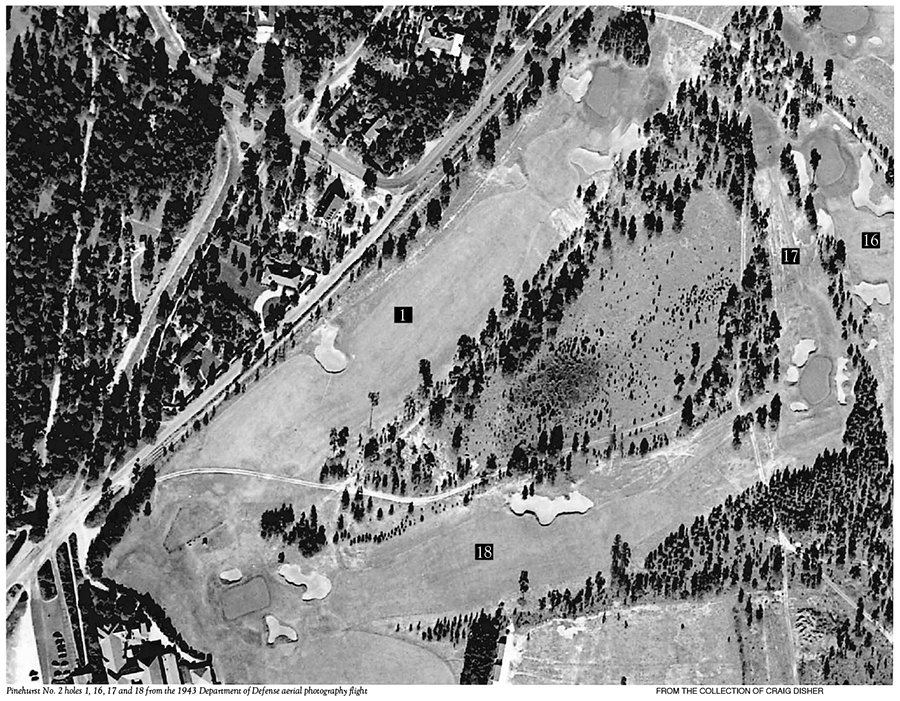
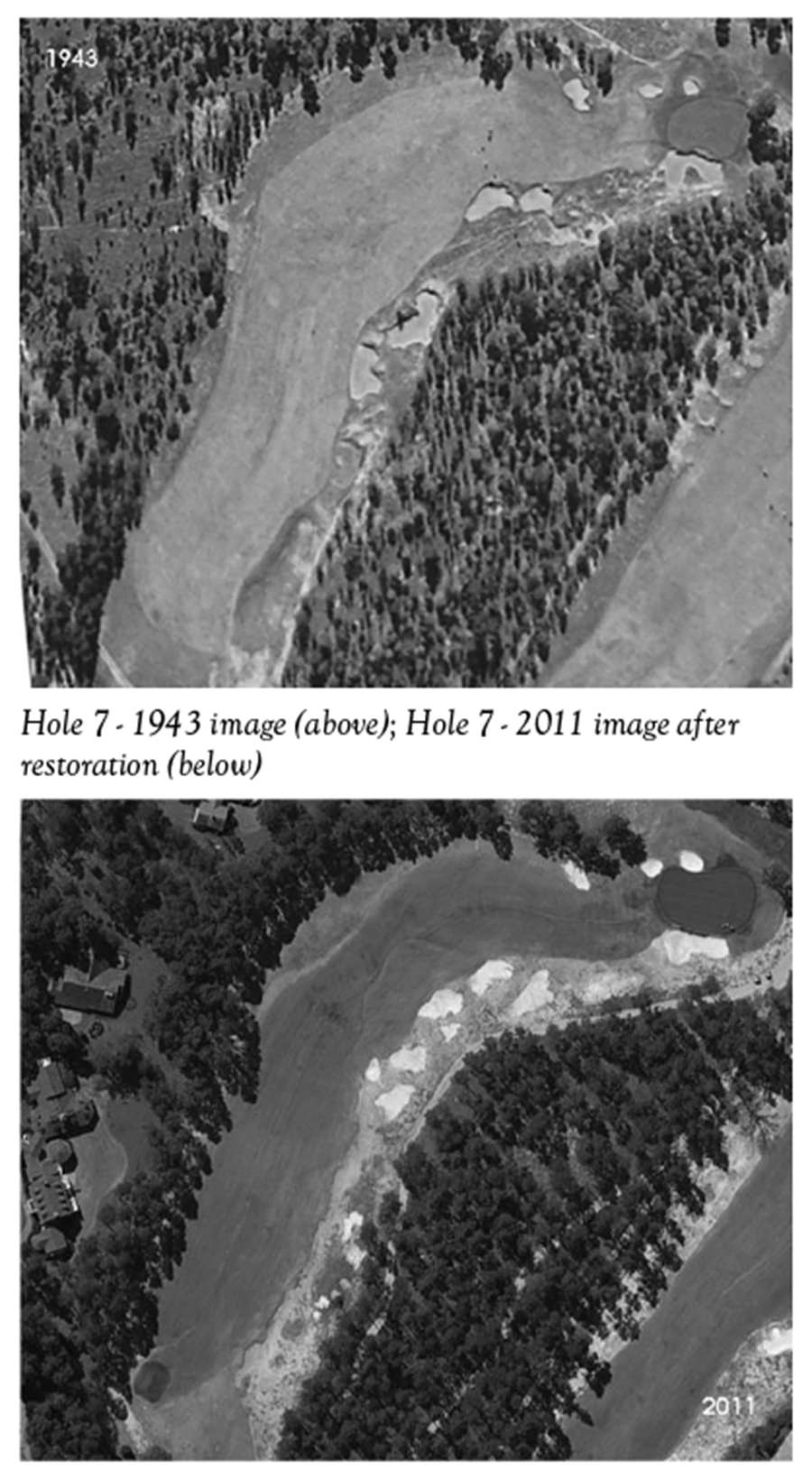
When he finally flashed through the roll, Disher found the images of No. 2. He eyed what were, perhaps, the clearest aerial photos of a golf course he had yet encountered. While aloft over No. 2, the plane had flown lower than was customary. Who knows, maybe the pilot played golf and wanted to take an up-close look at the famous course. Regardless, the details shown of the bunker contouring, tee and green shapes, trees and native areas were strikingly vivid. The aerial camera, clicking away every few seconds, had also captured excellent images of the Pine Needles and Southern Pines courses.

Through a mutual friend, Disher contacted Coore and informed the architect of his find. Arrangements were made for Coore and Crenshaw to stop by Disher’s home in Pinehurst to inspect the photos from the 1943 flight that encompassed the entirety of No. 2. Disher arranged them on his dining room table to appear as a single photograph.
The architects were astonished at what they saw. The photos depicted exactly what they needed to assure themselves they were on the right track. As Crenshaw put it, “it was the confirmation we had been looking for.”

With Disher’s photos serving as their guide, Coore and Crenshaw completed No. 2’s restoration in March 2011. Gone was the matted rough. In its place were the native areas that had characterized Ross’ course. Indigenous plants such as red sorrel, spiderwort and spotted beebalm now grew haphazardly off the fairways. Bunkers were reshaped with the scruffier edges that had marked their appearance in the 1943 aerials. Some bunkers were eliminated, others restored. Several tees were moved to restore the driving challenges Ross had envisioned. Based on the 1943 photograph, the 15th green was widened to its right side by one-third. With areas off the fairway no longer watered, the course looked browner and more natural. Seven hundred of No. 2’s 1,100 sprinkler heads were eliminated, trimming water use in half. Fairways were widened and shaped to approximate their dimensions during the Ross era, thus allowing for alternative routes for approaches into greens.

The restoration was universally praised in golf circles, and the 2014 U.S. men’s and women’s Opens proved to be memorable successes. Fears that the changes to course No. 2 would render it too easy proved overblown. Only three men, including winner Martin Kaymer, and one woman, Michelle Wie, broke par.

“Craig was so instrumental in our work at No. 2,” says Coore of Disher. “I’m not sure we could have accomplished what we did without him.”

Disher became the go-to source for aerial photos of historic courses and has been called upon by architects like Ron Forse, Gil Hanse, Kyle Franz, Jim Urbina and Davis Love Jr. Now 76, Disher is gratified that what began as a pleasant diversion ended up contributing so much to golf. “My research introduced me to some of the nicest people I’ve ever met and taken me to golf courses I never dreamed I would see,” he says. “If you are searching for something you think can’t be found, it probably can be.  PS

Pinehurst resident Bill Case is PineStraw’s history man. He can be reached at Bill.Case@thompsonhine.com.

The Omnivorous Reader

Overseeing the Evil and the Good

Wiley Cash’s new novel weaves a tale of mystery

By Stephen E. Smith

It will come as no surprise to anyone who’s read Wiley Cash’s previous bestselling novels — A Land More Kind Than Home, This Dark Road to Mercy and The Last Ballad — that his latest offering, When Ghosts Come Home, is a sophisticated, skillfully rendered mystery that focuses, despite being set in late October and early November 1984, on the personal, societal and racial conflicts that trouble Americans in the moment.

Cash, like most accomplished writers, is attuned to the environment from which he’s writing (even if the events he’s describing occurred decades ago), and he has, with good reason, consistently drawn on North Carolina as his setting of choice: He was born and raised in Gastonia, teaches at the University of North Carolina at Asheville, and lives in or around the Wilmington/Oak Island area, the region of the state that serves as the locale for his latest mystery.

The coastal setting may be familiar to many North Carolina readers, but the story that unfolds has nothing to do with a family outing at the beach. If the region suggests tranquility, it’s also the source for the grisly ingredients that make for a good whodunit, and Cash’s leap-frogging narrative continually moves forward with an economy of style and structural tension that’s a balance of the familiar with the unexpected. Despite numerous twists and turns, Cash is always the consummate craftsman; not a word or gesture or errant piece of information proves irrelevant.

This storytelling acumen has earned for Cash the status as one of our state’s literary celebrities, and his latest novel places him among such luminaries as Fred Chappell, Lee Smith, Jill McCorkle and Clyde Edgerton. If this suggests a degree of parochialism, it shouldn’t. Cash has earned national accolades aplenty. The Last Ballad was an American Library Association Book of the Year and received the Southern Book Prize, the Sir Walter Raleigh Award and the Weatherford Award — the list goes on and on.

Moreover, the characters he creates aren’t easy Southern stereotypes; they may live in an atmosphere troubled by shifting notions of race and social standing, and they are almost always dangerous to themselves and each other, but their view of the world is more comprehensive, more contemporary, than those of the usual Faulknerian rabble. If his characters exhibit anger, bigotry and violence — all in plentiful supply in the South — Cash never displays contempt for the foolish and unwashed, never sets himself up as arbiter. He simply oversees the evil and good, and allows his readers to make their final judgments based on their view of the available world.

The mystery opens with 63-year-old Winston Barnes, the Brunswick County sheriff and the novel’s protagonist, awakening to the roar of a low-flying aircraft approaching a little-used local airport on Oak Island. Barnes is at a crisis point in his life: His wife is being treated for cancer; his daughter’s marriage is failing after the loss of a child; he’s up for re-election in a few weeks — his prospects are less than promising; and he desperately needs the health insurance that comes with his job. He knows that the disturbance created by the aircraft is reason for concern, and that the publicity generated by his handling of any criminal activity on the island could be crucial to his re-election.

Cash’s strong sense of place is apparent when Barnes leaves home to investigate the downed aircraft, and his use of detail and small observations deftly and beautifully brings the moment into focus: “. . . Winston watched the light from the Caswell Beach lighthouse at the far eastern end of the island strafe the waterway in perfect increments. It flashed in his rearview mirror, and for a moment he could both see and feel its light in his eyes. . . . He had been at this exact spot on the bridge at night what must have been a million times over the years, and each time he felt like he was leaving the bright gleam of the lighthouse for the tiny spot of the beacon light, a light that was overwhelmed by the darkness of the mainland that waited for him in the woods across the water.”

As a young man, Cash took in those same sights on mornings when he drove to catch the ferry to Bald Head Island, where he worked as a lifeguard. “. . . when Sheriff Winston Barnes leaves home in the pre-dawn hours to drive to the airstrip to explore the sound he heard, he drives past dark, shuttered businesses, some of them closed for the off-season and others of them simply closed for the night,” Cash revealed in a recent pandemic/email interview. “I made this same drive every morning before dawn during the summer of 1998 when I was 20 and my parents had first moved to Oak Island. . . . I had to leave my parents’ house to catch the ferry to make it to a shift that began at 7 a.m. It was summer, and the island was incredibly busy, but I was always struck by how those pre-dawn hours were so still and haunting. We’d only recently moved to the island, and everything about it, especially at that early hour, felt strange and haunting. I was observing as an outsider because I didnt belong to it, and neither does Winston.”

When he arrives at the airstrip, Barnes discovers an abandoned DC-3 with its cargo hold empty. Not far from the plane, he happens upon the body of a local Black man, Rodney Bellamy, who has been shot in the chest. From these simple clues the mystery wholly unfolds, and the elements in this straightforward block of information play out in the novel’s action from beginning to end.

The essential characters are quickly introduced — Colleen, Barnes’ daughter; Jay, Rodney Bellamy’s teenage brother-in-law; Ed Bellamy, Rodney’s father and a former Marine sharpshooter; Deputy Billy Englehart, a furtive white supremacist; Bradley Frye, Barnes’ opponent in the upcoming election and the obvious antagonist; and FBI agents Roundtree, Rollins and Grooms, who have ostensibly been assigned to investigate any drug connections with the case. Add to these a cast of cameo characters who agitate the subplots and there’s much to consider by way of human imperfection — race, class, jealously, betrayal, old animosities, personal history — all of it churning up a jumble of possible suspects.

When Cash digs deep into his characters, he reveals the secrets that shape their prejudices, and the straightforward structure of the traditional mystery assumes a vaguely parabolic intent. Set in a time when, believe it or not, racial attitudes were less obvious, readers will sense that Cash is addressing the present racial tensions that plague America. This is no more apparent than in a scene that plays out between Barnes and Vicki, a long-time receptionist at the sheriff’s office. She’d received a deputy’s report concerning Klan members who have been cruising a Black neighborhood brandishing weapons and a Confederate flag, but she’d failed to pass this information on to Barnes, and he’s forced to confront her.

“She hesitated. Winston looked into her eyes, imagined her mind tossing around words and phrases she’d grown up hearing, long-held beliefs that she insisted on holding against Black men like Ed Bellamy and his dead son. Asking her to work against suspicions and beliefs so deeply held as to seem intrinsic to life was like asking Vicki to attempt the impossible task of separating her skin from her own skeleton.”

This epiphany must be similar to what many Americans have experienced in recent years. In a country divided against itself, we are suddenly forced to confront the frightening truth that underlies the attitudes and beliefs of once-trusted friends and acquaintances. 

“The awakening that Winston has to his secretary’s racial and cultural attitudes reflects the experiences that many of us — primarily white folks — have had over the past several years,” says Cash. “There was a time — especially in the South in the 1980s — when political and cultural attitudes were much more implicit, especially with Ronald Reagan sweeping 49 states in the 1984 election. But the past several years have caused those attitudes to become much more explicit, from the politics of vaccines and masks to carrying tiki torches when protesting the removal of monuments to storming the U.S. Capitol to overthrow American democracy. The attitudes and beliefs that were once below the surface have now become markedly apparent. Whether on social media or T-shirts or hats, we’re besieged by markers of political beliefs and cultural attitudes that align with or conflict with our own. And we’re not one bit interested in investigating the roots of our beliefs; we’re much more invested in ferreting out those who don’t agree with us.”

When Ghosts Come Home is a mystery that’s compelling in its suspense and topical intrigues. Cash creates a wealth of fully dimensional characters, and he permeates the novel with a melancholy that will leave readers wondering about an open-ended denouement that invites them, via a gentle authorial nudge, to participate in fleshing out the novel’s most brutal and unexpected consequence, an act of dehumanizing violence and betrayal that could only occur in the frightening world in which we now find ourselves.

When Ghosts Come Home will be in bookstores on Sept. 21. Wiley Cash will read from his novel and sign books at The Country Bookshop at 3 p.m. on Saturday, Sept 25.  PS

Stephen E. Smith is a retired professor and the author of seven books of poetry and prose. He’s the recipient of the Poetry Northwest Young Poet’s Prize, the Zoe Kincaid Brockman Prize for poetry and four North Carolina Press Awards.


PinePitch

First Friday

The bluegrass band Fireside Collective performs on the First Bank Stage at Sunrise Square to benefit the Sunrise Theater, 250 N.W. Broad St., Southern Pines, from 5 p.m. to 8 p.m. on Friday, Sept. 3. There will be food trucks, refreshments and beer from Southern Pines Brewery. No furry friends or rolling, walking or crawling coolers, please. For more information call (910) 692-3611 or go to www.sunrisetheater.com.

Flutterby Festival

Celebrate butterflies and all God’s pollinators at the Flutterby Festival at the Village Arboretum in Pinehurst on Sept. 25 from 11 a.m. to 2 p.m. Educational activities include presentations on the lifecycle, migration and plight of the monarch butterfly. Feed and befriend hundreds of monarchs in the Magical Monarch Butterfly Tent. You can even tag and release a monarch for its flight to Mexico. For more info go to www.villageheritagefoundation.org.

Sweet on Songs

The Sandhills Repertory Theatre presents America’s Sweethearts, the intricate harmony and dance moves of a dazzling trio of women, in three performances at the Bradshaw Performing Arts Center, Owens Auditorium, 3395 Airport Road, Pinehurst. The musical selections include ’50s pop, jazz and Broadway hits. Opening night is Friday, Sept. 3, at 7:30 p.m., followed by a performance on Saturday, Sept. 4, at 7:30 p.m., and a final matinee on Sunday, Sept. 5, at 2 p.m. Tickets are available at www.ticketmesandhills.com.

100 Years and Counting

The Sandhills Woman’s Exchange opens for the fall season — and the beginning of its 100th year celebration — with its traditional lunch offerings on Wednesday, Sept. 8, at 15 Azalea Road, Pinehurst. The gift shop opens at 10 a.m. and lunch is served from 11 a.m. to 2 p.m. For information call (910) 295-4677 or visit www.sandhillswe.org.

Outdoor Flicks

It’s like the drive-in, except you’re on foot. The Sunrise Theater will show The Princess Bride outdoors on Sunrise Square at 8 p.m. on Sept. 10 and again on Sept. 11 at the same time. Tickets are $10. In the event of inclement weather, the movie will be shown inside the theater, 250 N.W. Broad St. Bring lawn chairs or blankets, but leave the food and pets at home, please. For additional info call (910) 692-3611 or go to www.sunrisetheater.com. As an encore, Southern Pines Recreation & Parks will show Frozen 2 at the Downtown Park, Southern Pines, on Friday, Sept. 17. For additional information call (910) 692-7376. 

Fall’s in the Air

Enjoy a late September evening on the grounds of the Weymouth Center with music by Stone Dolls, supper catered by Scott’s Table and beers from the Southern Pines Brewing Company, on Wednesday, Sept. 29, from 5 – 7 p.m. at the Weymouth Center for Arts & Humanities, 555 E. Connecticut Ave., Southern Pines. For additional information go to www.weymouthcenter.org or www.ticketmesandhills.com.

Pig o’ My Heart

The Pinehurst Barbecue Festival, presented by Pinehurst Resort, US Foods and Business North Carolina, will spice up the village of Pinehurst on Labor Day weekend from Sept. 3 through Sept. 5. There are four main events: Music on Magnolia; “Q” School Grilling Classes; Bourbon & Bites; and the Ed Mitchell Pitmaster Invitational. Individual tickets are available or you can go “Whole Hog” and swallow the lot. For more information visit www.pinehurstbarbecuefestival.com or go to www.ticketmesandhills.com. Get saucy.

Doin’ the Charleston

Experience the art, architecture and cuisine of the low country in a four-day celebration of Southern elegance presented by the Arts Council of Moore County. The week’s events open with an exploration of the unique architecture of Charleston, South Carolina, featuring Charleston architects Christopher Liberatos and Jenny Bevan, along with artists Jill Hooper and Patrick Webb, at the Sunrise Theater at 6 p.m. on Tuesday, Sept. 28. That’s followed by a low country cooking presentation by acclaimed author Nathalie Dupree and Sandhills Community College’s Angela Webb at 4 p.m. on Wednesday, Sept. 29, at SCC’s Little Hall. There will be a low country luncheon at 195 on Thursday, Sept. 30. The cost is $55 per person, and all proceeds benefit the Arts Council’s children’s arts program. The week wraps up with a presentation and book signing by Dupree at 10 a.m. on Friday, Oct. 1, in the Moore Montessori Community School auditorium and, at 6 p.m. that evening, the Campbell House will host a gallery opening featuring the artworks of Evelyn Dempsey, Mark Horton, Carol Ezell-Gilson and Ron Rocz. In addition to the above events, all free with the exception of the luncheon, acclaimed children’s author Kelly Starling Lyons will be visiting Moore County schools on Thursday, Sept. 30. For more information call (910) 692-2787.

Simple Life

Golf and Marriage

True love and harmless fun on the links

By Jim Dodson

Not long ago, my wife, Wendy, and I were discussing our 20th wedding anniversary.

“So, Old Baggage,” I said, affecting the accent of a toffee-nosed English aristocrat. “Where exactly would you like to go? SkyMiles and hotel points are the limit!”

“Oh, no,” she came back with feigned horror. “I thought we’d seen the last of that old boy!”

Needless to say, I was pleased when madam suggested motoring down to a lovely old hotel and sporty golf course in South Carolina where we celebrated our 15th anniversary.

But first, friends, a word of caution.

Referring to your dearly beloved as “Old Baggage” does not come without certain risks to domestic harmony, though in this instance it was one of those affectionate inside jokes that long-married couples share to remind themselves of their matrimonial journey through the fairways and thickets of life.

At any rate, while participating in a mixed foursomes tournament during the annual Royal & Ancient Golf Club autumn meetings some years ago, we got paired with an elderly English couple straight from the pages of P.G. Wodehouse — a crusty old RAF Colonel and his long-suffering wife, Edyth, who spent an entire trip around the Duke’s Course in St. Andrews tossing colorful insults at each other.

“Alright, Old Baggage, put your considerable rump into this shot!” he urged his bride. “No half-way measures, girly! Give the old wedge a solid knock!”

“Sod off,” she muttered as she settled over the ball. “How about I give you a solid knock instead?”

Round they went, hole after hole. He grumbled about everything from “elephants buried in the green” to his wife’s choice of exotic leopard-print golf trousers, giving unsolicited advice on almost every shot.

“Try and roll this one close to the hole for a change. Remember, never up, never in!”

“You would know about that,” she snipped. “Perhaps you’d enjoy a nice nap in the bunker?”

Over drinks afterwards, we were surprised to learn they’d been married for 40 years, and that their entertaining Tracy-Hepburn routine was designed to amuse themselves and startle unsuspecting playing partners.

“Lovely way to relieve the marital tensions,” Edyth advised matter-of-factly over her raspberry gimlet.

“Just a bit of harmless fun to keep mixed opponents off balance,” Lionel chortled. “Never fails to put them off their game.”

“It keeps both golf and marriage interesting,” she added coyly.   

“True, Baggage,” he rumbled. “Damned shame, though, about that easy 10-footer for the win you missed on 17.”

“Ah, well.” She gave us an unconcerned smile. “Maybe next time you should hit the ball where you were instructed.”

To paraphrase our late friend John Derr, the CBS Sports broadcaster who worked with the inimitable Henry Longhurst for years (and quoted him frequently), the institution of marriage is only slightly older than the game of golf and not quite as fun. Golf has probably saved at least as many marriages as it’s ruined — and vice versa.

“Blessed be the man or woman who enjoys their spouse’s company on the golf course,” the ageless “One Derr” — as Wendy and I called him — declared at our supper table one evening after we told him about our encounter with the English aristos. “For theirs is a shared adventure of fond memories and pleasant disasters, an unbreakable bond of friendship forged by generous mulligans and preferred lies in a game that cannot be beaten — only endured.”

With his next breath, Derr glanced at me, smiled and added, “You’re a fortunate man to have a beautiful golfing wife, James. But I am placing you on notice that if you pre-decease me, I’m moving in on Wendy.”

He’d recently turned 96.

But John’s point was well-taken. Like many couples who share a love of the game and each other, golf has been a feature of our romance almost since our first hours together.

The day after meeting Wendy at a dinner party thrown in honor of my first golf book, we took a casual Sunday drive that took us to one of Robert Trent Jones’ early golf course designs in upstate New York.  It was there — upon the discovery that she once played in an after-work golf league and had a germ of interest in the game — that I stole my first kiss and Wendy Ann Buynak stole my heart.

The last two decades have indeed been a shared adventure of bogeys and birdies, colorful characters and memorable places, beginning with our first trip out West after we got engaged at The Lodge at Sea Island, where I threw her into the breach at Pebble Beach with a new set of Callaway golf clubs. It was her first full 18 holes of golf, as she later pointed out.

Her caddie that morning had eyes like a roadmap from hell due to an all-night bachelor party. He and half a dozen Japanese gentlemen with video cameras bore witness as Dame Wendy teed up her ball and made a fierce swing. The ball trickled a few feet off the tee.

Without hesitation, she fetched her ball and tried again. This time the ball rolled 10 feet.

“Listen, ma’am,” groaned her suffering caddie, massaging his pink eyes. “Let’s just pick it up and go.”

She blissfully ignored him, teed up again, took dead aim, and calmly swatted her drive to the heart of the fairway. The Japanese gentlemen broke into applause, and I realized this was true love on the links.

The first time my bride broke 100 was on a work trip to France. It happened at the elite Golf Club de Chantilly, a famous old Tom Simpson layout. Nary a soul was visible that drowsy summer afternoon following a leisurely lunch of crusty bread, foie gras and considerable sparkling wine.

The girl in the golf shop — buffing her nails with exquisite boredom — waved us out to an utterly empty course, cuckoos calling dreamily from the surrounding forest.

Somewhere on the back side of the masterpiece, after all that wine and no relief station in sight, nature summoned me into the forest, after which I joked that the lone advantage God gave man over woman at the dawn of creation was the ability to make water on an empty golf course, if need be.

A few holes later, I heard someone call my name and turned to see my new wife squatting behind a clump of bushes, grinning like a schoolgirl. “What was that about man’s advantage on the golf course, monsieur?” she teased.

I had to laugh. “Monsieur is certainly enjoying the view,” I pointed out.

Through a gap in the foliage directly behind her, an elderly gentleman in a blue beret was raking out his veggie garden. He was grinning like a teenager, too.

“Bon soir!” he called out, waving.

“Wee wee,” I replied in the American vernacular.

We’ve had many memorable golf journeys since that incredible week of our early married days, but that time in France ranks atop both our lists of favorite moments.

  Which is why it was no surprise that our anniversary interlude in South Carolina was such a quiet success, a reflective moment that scored well under par as both a golf getaway and a marriage milestone.

The only “baggage” we brought with us was a dozen new golf balls, 20 years of great memories — and a hope for 20 years more of the same.   PS

Jim Dodson can be reached at jim@thepilot.com.

In the Spirit

Online Amaro

Tax write-offs never tasted so good

By Tony Cross

I recently received my online, bi-yearly shipment of spirits. Just under one grand and a week or so later, a big box with lots of stickers sits on my front doorstep like one of those old-fashioned steamer trunks in black and white movies. My latest treasures included a bunch of amari that I cannot get at any local ABC.

Amaro (amari is the plural) is Italian for “bitter” and has been extremely popular over the last decade or so. While lots of cocktail bars use these in mixed drinks, amaro was first intended as a digestif to be taken after a meal. Lots of countries have their own version of digestifs: cognac in France or underberg in Germany, for example. In Italy, it’s amaro. I’ll be using author Brad Thomas Parsons’ book Amaro: The Spirited World of Bittersweet, Herbal Liqueurs as a reference in the quick summary below.

I’m not going to pretend I’m a bitter liqueur scholar. I’m not. I’m neither bitter nor scholarly. I’m listing these in order from lowest to highest ABV (alcohol by volume). The differences are minute, 21-35 percent, but I’m tasting them this way because, well, why not?

Amaro Bráulio

First up is Amaro Bráulio. Created in the Italian Alps in 1875 by pharmacist Dr. Francesco Peloni, this amaro hit me with heavy gentian on the nose right off the bat. Now, I’m not the best taste-tester, but I have a large nose and I work with gentian root quite a lot (it’s one of the ingredients in my business’s tonic syrup). On the palate, I taste some sort of mint, spices and a touch of bitterness. Not too bitter at all, and I’d even say that if you’re a beginner with amaro, this is a good place to start. As far as cocktails go, I would mix this with a cola-tasting rum, like Zaya.

Amaro Lucano

Per the back label: “Created in 1894, Amaro Lucano today still uses the same secret ancient recipe. A skillful blend of more than 30 herbs that the Vena family has handed down from generation to generation.” This amaro doesn’t have that gentian kick like the Bráulio; instead, I’m smelling something sweeter — if I made a Coke from scratch and let it go flat, that’s what it would smell like. Amaro purists are probably wincing right now. There is a lot going on palate-wise. Front palate has me wowed. What the hell am I tasting? Help me out, Brad. “Medium sweetness with herbal bitterness and notes of cinnamon, licorice, and caramel.” OK, I get the licorice and caramel for sure. Cinnamon is pretty faint, but it doesn’t matter — this amaro is delicious. “Headquartered in Pisticci Scalo, a small southern Italian town in the Matera province in the region of Basilicata, the Lucano brand was founded in 1894 by Cavalier Pasquale Vena, and his descendants, now representing the fourth generation, run the family business to this day.” As Parsons also notes, the fifth generation is helping their brand reach cocktail enthusiasts by ramping up production. It’s very impressive how balanced this amaro is with over 30 ingredients. Talk about talent.

Averna

While I’m trying the other three amari on their own for the first time, I poured this one over a big rock with an orange peel last weekend and it was so good I just did it again. Phenomenal after-dinner drink. I’ve had this (and the next amaro on the list) mixed in cocktails, but never have I owned a bottle and savored it on its own. This is an easy sipper for me. Parsons’ book says that the known ingredients are lemon and orange essential oils, and pomegranate. Orange is definitely a standout, which is why adding a peel from the fruit makes its flavors pop. There’s not a lot of bitterness due to the sweetness from a cola flavor. As far back as 1859, the spirit was used by monks who passed the recipe on to Salvatore Averna, a benefactor to San Spirito Abbey in Caltanissetta, Sicily. Soon after, Averna “was the official supplier to the royal house of King Vittorio Emanuele III and the royal coat of arms was permitted to be displayed on the label of the bottle.” Parsons notes that in 2014, Averna was sold to Gruppo Campari for $143 million dollars.

Amaro Nonino Quintessentia

We finish with Amaro Nonino Quintessentia, the most beautiful of the four bottles, and the amaro with the highest ABV. I smell chocolate on the nose. Sue me. I do. On the palate, caramel and orange right off the bat. The flavors (also a nuanced bitterness) linger quite a bit longer than the other amari. I’m guessing this has to do with the higher proof. Parsons calls the bottle and finished product “elegant,” and I couldn’t agree more. Parsons writes that the Nonino family’s “amaro story begins in 1933, when (owner) Benito’s father, Antonio Nonino, made a grappa-based amaro he called Amaro Carnia, named after the nearby mountains. In 1984, Benito and (wife) Giannola developed their proprietary ÙE Grape Distillate, a unique distillation of the whole grape-skins, pulp, and juice — that captures the production elements of a wine distillate with the craft of grappa.” The recipe was reformulated in 1987. The grappa distillate and ÙE were aged for five years in barriques (wine barrels, especially small ones from France that are made from oak) and sherry barrels. Parsons writes about his tastings in New York and Friuli, Italy with one of Benito’s daughters, Elisabetta. She taught him the way she enjoys her family’s spirit, which he refers to as “Elisabetta style.” It’s Nonino in a small glass with two ice cubes and an orange slice. And that’s exactly how I’ll imbibe mine tonight.  PS

Tony Cross is a bartender (well, ex-bartender) who runs cocktail catering company Reverie Cocktails in Southern Pines.


The Kitchen Garden

Of Monarchs and Milkweed

Can you give a butterfly a hand?

By Jan Leitschuh

The iconic, orange and black monarch butterflies are in shocking decline and could use a little help.

Luckily, our kitchen gardens — or any sunny patch of ground — can do more than grow a tomato. Since the life of the monarch butterfly is intimately entwined with that of the milkweed species, what if we were able to lend a little hand on our home turf?

Right now, the monarch butterflies are migrating southward through North Carolina on their awe-inspiring journey to their winter grounds in southern Mexico. But what will they eat? The only food a monarch caterpillar can consume is milkweed. Monarchs have lost an estimated 165 million acres of critical breeding habitat in the United States to herbicide spraying, deforestation and development in recent decades.

Sharp declines in milkweed populations in the agricultural Midwest have been reported. In the early ’90s, the increased spraying of glyphosate, or Roundup, following the introduction of crops genetically modified to withstand the herbicide, wiped out large tracts of perennial milkweed on farmland.

Do you have milkweed in your garden or yard? You could. Right now, and for the next couple of months, milkweed pods will be ripening and releasing their seeds. I gathered some fat pods from a Virginia mountain meadow six years ago and have had milkweed — and monarch caterpillars — ever since.

Throughout the United States, concerned gardeners are creating monarch-safe havens, little habitat “steppingstones” similar in intent to pollinator gardens, to recreate habitat for declining insect populations.

Though the migration is on now, you’ll be hard-pressed to spot the familiar monarch. In fact, seeing one is an Instagram-worthy moment these days. Staggering declines in these showy butterflies were reported in the 2000s. In Mexico, where the bulk of the migratory overwintering population returns to a specific area, the monarchs once occupied 45 acres at their peak in the mid-1990s. Recently, that population plunged to cover a mere 1.65 acres, according to the World Wildlife Fund.

The many troubles of the beautiful monarch butterfly are well documented. Severe and changing weather has damaged eggs and reduced hatch numbers. But most scientists concur that the monarch’s number one threat to survival is the dwindling number of wild milkweed plants available on which to lay their eggs.

This is where gardeners and landowners can fill in some of the gaps.

The story of today’s butterfly began with its great-grandparent leaving the forests of Mexico and heading for the milkweed of Texas. Adult monarchs consume plant nectar, but they lay their eggs exclusively on milkweed. The eggs hatch into the notable green-white-black caterpillars.

After feeding on milkweed leaves for two weeks (if they survive bird and insect predators, that is), they form a chrysalis on the underside of the milkweed leaf, eventually hatching into a bright orange butterfly — their numbers fanning out across the United States as far north as Canada. Given milkweed, another summer hatch ensues.

Finally, on the return trip — happening now — a third generation can hatch. This “super generation” mysteriously returns to the same Mexican forest its great-grandparents left from, though it had never been there. No one knows how this happens. The monarch is the only butterfly known to make this two-way migratory journey as birds do. There are much smaller populations that overwinter in Hawaii, Florida and California, too.

Back to your garden. There are several kinds of milkweed you could add that might suit. The entire milkweed family is catnip to butterflies of all sorts, and other native pollinators. Milkweeds establish large, deep root systems and prefer not to be transplanted. Some species are small and neat, some are large and coarse and are better suited to meadows, back of the border, under power lines and sunny edges of the property.

If you have a very neat, formal urban garden, seek out Asclepias tuberosa, or butterfly weed. Butterfly weed is a small, neat plant that does well in droughts, heat and Sandhills soil. The compact perennial displays flaming orange or cheerful, yellow blossoms. Establish several plants together to ensure sufficient food for hungry young caterpillars. Your local nursery can likely hook you up with a potted plant or three.

A little larger is whorled milkweed, (Asclepias verticillata), about 12-24-inches tall and wide. This white-flowered variety also does well in our dry summer conditions. You may have to order this from a specialty company such as the online retailer American Meadows, which ships potted plants. This unique company also has plenty of informative how-to information on its website.

Buying local? Sorrell’s Nursery in Dunn has a wide selection of native milkweeds that are organically grown — check out their Facebook page. MonarchWatch.Org is another excellent resource with leads on milkweed plants and seed.

Use care with the non-native, pretty, tropical milkweed, (Asclepias curassavica), say experts, as its long season of nectar could cause the monarchs to linger too long up north and get caught out by colder temps in fall. Some feel this is not an issue for Zone 7 and below. If used, experts suggest cutting this variety back in fall and winter.

Swamp milkweed (Asclepias incarnata) prefers moist areas, so if you have a nearby swamp, pond, lake or bog, check it out. Again, unless you have access to wild milkweed seed, you may have to order this.

The best-known milkweed is the common milkweed (Asclepias syriaca). Children enjoy tossing the fluff that carries each seed from this variety’s pod. In World War II, this fluff was used as a kapok substitute in life preservers — two bags of pods would fill one life jacket. This is the one I gathered as ripe seed pods from a sunny, unmown meadow and brought home to the Sandhills.

If you have a little space, or a “back of the border” that you could dedicate to a 36- 48-inch-tall plant, common milkweed produces tremendous lavender-pink blooms in June and is absolutely beloved by many pollinators. During the spring and fall monarch migrations, the abundant milkweed leaves of this plant provide food for a new generation of caterpillars.

One caution, though; your deeply rooted milkweed plot will grow slowly, so be sure to place it in a spot where it can quietly expand. If, after a few years, you want to contain its spread, common milkweed is easy to control by pulling, mowing or cutting.

You can even share with a neighbor who has more monarch caterpillars than available food — just stick a few cut milkweed stalks in a vase or bottle and pass it along. The caterpillars prefer the younger, more tender leaves rather than the leaves of podded stalks.

Besides the host plant milkweed, nectar plants that bloom at different times are needed for the monarch. The caterpillars eat the milkweed, but the parent butterflies need nectar.

Check out the North Carolina Wildlife Federation’s “Butterfly Highway.” Consider putting your butterfly/pollinator garden on the highway at: https://ncwf.org/habitat/butterfly-highway.

There are useful Facebook pages and groups dedicated to assisting monarchs and helping milkweed growers. Monarchs & Milkweed of Wake Forest is a good one, with a friendly community that reports sightings of monarchs, eggs, and caterpillars.

Monarchs, Milkweed and More is another Facebook group. Raleigh Area Monarchs and Milkweed is a third.

If gathering milkweed, select only a few pods, leaving the rest to spread from the mother plants. Look for a pod that has split, showing ripe, brown seeds. Pale seeds are not yet ripe. Or ask around among friends with farms and wilder spaces.

To start milkweed from seed, the easiest way is to emulate Mother Nature and plant them in the fall. I scattered seed across lightly disturbed soil and raked it in. Some separate the milkweed “fluff” from the seed, but I did not. Come spring, I had milkweed.

If you really want to start your seeds in the spring, American Meadows advises that you first break their dormancy with cold stratification. In the wild, says the online wildflower retailer, milkweed plants scatter their seeds quite late in the season. The coming cold would normally kill any seedlings that germinated right away. However, the seeds of milkweed (and other late-season flower plants) “are cleverly programmed to delay germination until after they’ve been exposed to winter’s cold, followed by gradually rising temperatures in springtime.” This adaptation is known as stratification.

So, if you have a little bit of space to offer a safe haven, you may become a critical stop-off for the struggling monarch species.  PS

Jan Leitschuh is a local gardener, avid eater of fresh produce and co-founder of Sandhills Farm to Table.

Almanac

September

By Ashley Wahl

September is deliciously subtle. Like a sly smile in a moment of silent recognition.

The last wave of swallowtails graces the garden. Dinner plate dahlias resemble colorful mandalas and sun-dappled muscadines spill from the vine.

Life hums along. Hummingbirds drink from red spider lilies. The air, too, is like nectar — sweet as it’s been all summer — but something is different. Something not yet palpable.

The trees know, leaves whispering ancient incantations to merge with root and earth. The first to surrender glow with radiant splendor. They cling to nothing, unattached to their green summer glory or the luminous journey to come.

Weeks from now, tree swallows will gather by the hundreds at dusk, swirling across the sky like cryptic, flickering apparitions. But today, sunlight kisses goldenrod. Robins dip and shimmy in warm, shallow water. Plump bees float in endless circles.

By evening, the air is slightly cooler, or so it seems. And at twilight, when shadows dance in the periphery, a mourning dove cries out.

Coo-OO-oo.

Beyond a wild tangle of late summer flowers and grasses, a red fox flashes past, here and gone with the last whisper of golden light.

As darkness falls, all at once it’s clear: Elusive autumn has returned, creeping into consciousness like an impish melody — a dark, playful secret on the tip of your tongue.

The goldenrod is yellow;

The corn is turning brown;

The trees in apple orchards

With fruit are bending down.

— Helen Hunt Jackson, “September”

Harvest Season

The Autumnal Equinox occurs on Wednesday, September 22. The days are growing shorter. As for the glorious bounty of summer? It’s harvest time.

Praise for the apples, pears and figs. Cucumbers, peppers and eggplant.

As the garden gives and gives, offer thanks for the tender young salad greens; the last plump tomatoes; the earliest pumpkins and winter squashes.

And don’t forget the edible flowers.

Like lavender (sweet and minty), marigold (transform your stir fries) and snapdragons (bitter, perhaps, but they sure are gorgeous).\

The Meadow Queen

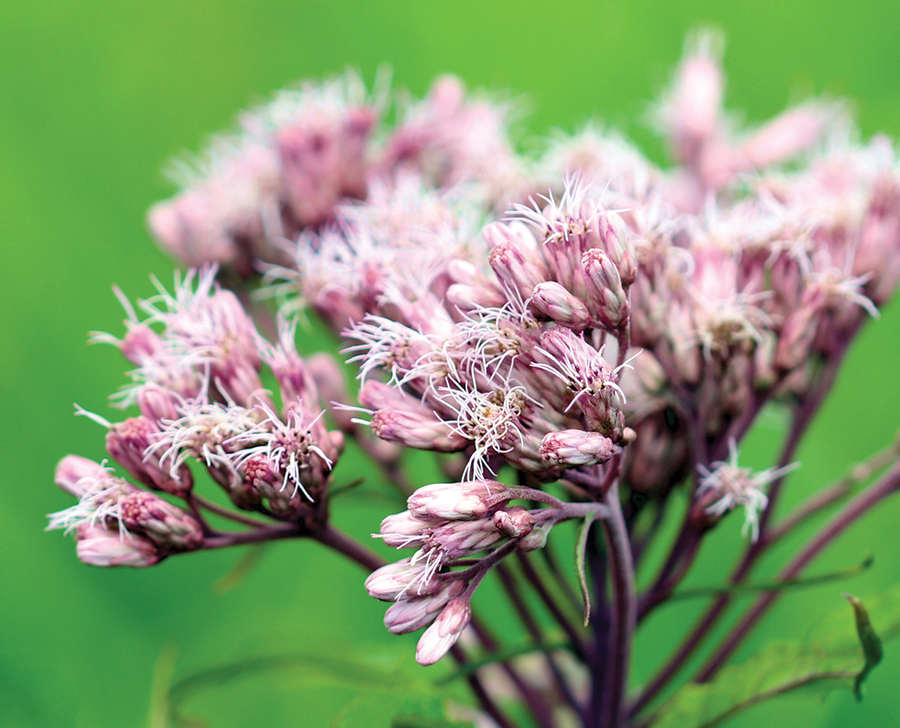
If you’re wondering where that faint yet lingering vanilla fragrance is coming from, stop and smell the purple joe-pye weed — unless you’re allergic.

As the story goes, Eupatorium purpureum received its common name — joe-pye — after a gentleman of the same name presumably used the wild plant to cure typhoid fever. An herbaceous perennial of the sunflower family, joe-pye is a native species that blooms in later summer and attracts a host of bees, butterflies and moths.

Also known as kidney-root, feverweed and Queen of the Meadow, when this towering beauty begins to bloom — clusters of pinkish-purple flowers exploding from 7-foot stalks — watch and listen closely: Summer’s swan song is nigh.

Sporting Life

A Hunt to Remember

One of life’s seasons

“To everything there is a season and a time to every purpose under the heaven.” — Ecclesiastes 3, King James Version

By Tom Bryant

The first time I ran across this quote from the Bible, I thought some guy had stolen the words from my mother. It was one of her favorites.

A good example: When I was able to squeak by, grade-wise, and graduate from high school and was complaining one night at the supper table about not being able to play baseball or football for good old AHS, Mom said, “Son, there is a season for all things, and that season at Aberdeen High School has ended. But a completely new season is beginning for you at Brevard College. Remember what the dean said? If you make the grades and survive probation, maybe you can play baseball for them.”

The favorite quote from Mom came back to me the other evening as I was up in the Roost, a small apartment over our garage. I usually hang out there when I need to write a column or work on my novel. On this particular evening, I was sorting through some dove hunting equipment. I mean, after all, the season is upon us, and that’s the kind of season I like. Dove hunting season is never over or at least will never be over in my lifetime. What’s beyond that is anyone’s guess.

I ran across a small box in the corner of the closet where I store most of my hunting clothes. It was full of a bunch of Ducks Unlimited paraphernalia. At one time I was into that conservation club in a big way because, in the early days, if you were a duck hunter and worth your salt, you were a member of DU. For years I was a sponsor, not particularly because I was such a conservationist, although in reality I am, but primarily because of all the perks that went with the title.

In the beginning years of DU, the cost to be a sponsor in the Alamance County Chapter was two or three hundred dollars, not a trivial amount in those days. My partner and I had just started a small weekly newspaper and were working hard to make ends meet, but we had enough money to sponsor what we considered a noble cause. Also, we figured we would find some good stories by being part of the local chapter. And we surely did.

There was a huge competition between chapters across the state to raise the most money supporting habitat for waterfowl. Jim, my business partner, and I got caught in the middle. But we weren’t alone. Numerous hunters in our area spent countless hours, and some of the members spent big bucks, to make the Alamance Chapter fly.

They were a varied group. Richard Cockman, a furniture company representative, headed the local chapter DU board, along with Dick Coleman, a haberdasher and specialty clothing store owner. Other board members included Ronald and Jim Copland, owners and executive officers of Copland fabrics; Don and Steve Scott, owners and officers of their long-standing family textile company; and Nat Harris, an insurance executive with clients from all over the country. Nat still serves on the board of the North Carolina Wildlife Resources Commission. Also on the board was Bennett Sapp, a clothing broker with one of the first outlets in the Burlington area; and last but not least, Ernie Koury, whose family was into a little of everything, from textiles to real estate holdings. The Ducks Unlimited leaders during those early days carried financial weight as well as a ton of business influence.

The banquets put together for the area sponsors were top of the line. Held at the Alamance Country Club, the event would begin with a cocktail hour. Koury, whose family members were big supporters of UNC-Chapel Hill, would recruit cheerleaders from the university to sell raffle tickets during the libation hour. And they sold a bunch. Items raffled during the banquet were acquired throughout the year from local merchants and were first class. Auction items were even better. Prizes included an oceanfront cottage for a week at Hilton Head Island, South Carolina; a goose hunt in Easton, Maryland; the DU gun of the year; and numerous quality art objects from paintings to sculptures to decoys. The top prize, though, was a puppy, either a bird dog or a Labrador retriever with champion lineage. These pups brought a lot of attention and dollars to the event.

Auction items generated “big bucks for the ducks,” but Jim and I usually stood back and watched. We did buy several raffle tickets and won items too numerous for me to remember.

Sponsors looked forward to the Ducks Unlimited banquet every year, but the greatest perk for me was the opening day dove hunt. I went on several DU dove hunts in those early years, but there is one that was an almost perfect weekend of sport shooting and camaraderie. All hunters have a particular hunt or experience that deserves a gold star in the hunting journal, and this weekend was one of those.

This was before the Weather Channel made a living by reporting one disaster after another and blaming it all on global warming. Growing up in the South, we expected hot weather at the beginning of dove season and looked forward to more of the same on this specific hunt. The Friday before opening day dawned with a hint of coolness in the air. I was up early that morning letting my puppy, Paddle, out of her kennel. The air was still and dry, with low humidity and only a smidgen of a breeze from the northwest. Dogwood leaves in the backyard, already turning a burnt orange color, also added to the false image of an early fall.

Paddle romped around the backyard, did her business and came charging back to me as if to say, “Come on, boss. Let’s go do something, like hunt birds.”

She was a small, young, yellow Lab and had added so much to my hunting experiences that every time I looked at her, I couldn’t help but smile. “No, girl,” I said to her, “we’ve got some doings to take care of before we can head to the fields.”

The doings I referred to was a cocktail party and pig picking that evening at the pool area of the country club. The pig picking had become a tradition for the DU folks the evening before the opening day shoot. It was put on by none other than the famous and popular Junior Teague, a farmer and county commissioner from the southern end of the county.

The next morning, though, all that was just a pleasant memory as I loaded up the old Bronco with guns, my 10-year-old son, Tommy, Paddle, and a cooler filled with plenty of water. We were ready to roll.

Our weather luck was still holding, low humidity with the same soft breeze from the northwest. The jumping off point was a local bank at the shopping center. We would meet the group there, then caravan to the cut cornfield where we would spend the afternoon dove hunting.

In those days, we were hunting the fields of then-Gov. Bob Scott, and what a hunt it was. Suffice it to say, the gold star in the hunting journal had another added to it. As I read the entry I made so many years ago, I recalled Mother and her seasons reflection. I added a thought of my own as a postscript to the note in the journal:

“Mom was right when she emphasized the quote from the Bible, ‘There is a season for all things.’ It’s been my fantastic luck during my lifetime that when one season ended for me, another began.” PS

Tom Bryant, a Southern Pines resident, is a lifelong outdoorsman and PineStraw’s Sporting Life columnist.