Out of the Blue

Out of the Blue

Holiday Mother Lode

With an extra day to celebrate

By Deborah Salomon

Every so often I, as the saying goes, “wax philosophical.” The most likely result is a criticism of some innovation that captures the minds of techies. You know, the ones who stand in line all night to purchase the latest iPhone that promises everything south of open-heart surgery. This time, the trigger was February, which owns far and away more holidays than any other month.

Americans start by hounding a groundhog, continue to boozy Mardi Gras, somber Ash Wednesday, Chinese New Year, Super Bowl Sunday, Valentine’s Day, Presidents Day (formerly Lincoln and Washington’s birthdays). February has been designated American Heart Month as well as Black History Month, although Martin Luther King Day is Jan. 15, his birthday. Each observance has a story which, in days gone by, grade-schoolers would research in an encyclopedia, perhaps for a “project.”

Now they push a few buttons, skim the results, copy, paste and move on to something else.

I doubt cherry pie or the Gettysburg Address would be part of a combined Presidents Day experience. More likely a long ski weekend which, I’ve heard, suggested its creation. I’m thinking Washington and Lincoln deserve their own days, as might FDR, JFK. Otherwise, the new holiday on the third Monday of the month includes all presidents, some less than celebratory.

Obviously, holidays are promoted for commercial gain. In cities with significant Chinese populations, an eight-course New Year’s Chinese restaurant extravaganza makes our Thanksgiving repast look like Pop-Tarts. The candy/greeting card/floral industries thrive on Valentine’s Day, despite the untimely death by decapitation of its patron saint.

I understand how Heart Month plays off Valentine’s Day symbols. However, a typical Valentine’s dinner will include a well-marbled steak, potatoes dripping butter and, for dessert, a hardly healthy heart-shaped cheesecake.

At best, holidays give texture to a society while preserving its heritage. To my knowledge, neither AI nor a 3-D printer has replicated any of the above.

Commercial or not, holidays serve a greater purpose. At best, they bring people together, even blot out horrors. Somewhere in Ukraine, world-famous hand-painted Easter eggs will surface in March.

For 21 years I lived in Vermont, where Blacks make up about 1 percent of the population. Every February the university hosted a soul food dinner, its menu prepared by volunteers. Tickets sold out in a day. Participants, Black and white, came from all over the state to eat chitlins, fried chicken, greens, macaroni and cheese, cornbread, “shiny” beans and peach cobbler. I attended to write a story but had a fantastic time remembering Southern preparations with 20 inches of snow on the ground and temps in the single digits.

February even has a quirky conclusion. Because 2024 is a leap year, this shortest month at 28 days will boast 29, enabling people born that day to have a once-in-four-years celebration.

Because the way things are going, who knows where the world will be next time leap year rolls around? PS

Deborah Salomon is a contributing writer for PineStraw and The Pilot. She can be reached at debsalomon@nc.rr.com.

Omnivorous Reader

Omnivorous Reader

Dicey Drama in Haiti

Looking for treasure but finding trouble

By Anne Blythe

Given the political fracture in this country and the intensified drumbeat of questions about the survival of democracy, it might seem daunting to tuck into Ben Fountain’s Devil Makes Three: A Novel.

The sheer size of the North Carolina native’s latest book — 531 pages — is intimidating enough. When you throw in that it’s a deep dive into life in Haiti immediately following the 1991 military coup that sent President Jean-Bertrande Aristide into exile, you might be tempted to put this novel about abusive power, excessive greed and dictatorship back on the shelf and save it for a less divisive time.

Don’t do that. Instead, open Fountain’s work of fiction. Let the story pull you from a once blissful beachfront through streets littered with butchered corpses and the headless body of a mayor, to crumbling estates, voodoo priestesses and treasure hunts on the turquoise waters lapping against the former French slave colony fallen under the rule of an oppressive military regime. A political thriller and adventure-filled page-turner, Devil Makes Three explores a country in turmoil from different angles through four main characters in their 20s.

Matt Amaker is a rootless American college dropout drawn to Haiti with unrealized ambitions after circulating through the Caribbean as a “dive gypsy.” Alix Variel, the ambitious and beguiling son of a prominent Haitian family, persuades Matt to come with him to Haiti to start a dive shop of their own catering to a wave of the expected tourism before the coup upended the country’s dreams of democracy and prompted international trade embargoes.

Despite the upheaval, Matt and Alix have not given up all hope on ScubaRave being a successful business, and turn their attention to hunting Conquistador treasure and artifacts in the under-explored ocean waters off Haiti.

“Haiti has treasure,” Alix tells Matt while they are smoking a joint and pondering their future.

One wreck he was aware of had as many as 12 cannon among the wreckage. If they were bronze, they could attract high-end collectors, deep-pocketed people who might pay as much as one Saudi oil prince had — $600,000 for a pair of cannon.

“Why the hell are we messing with scuba,” Alix asked. “We should be hunting treasure all the time.”

“Because it’s a really stupid business, that’s why,” Matt responded. “A few people make some money and everybody else loses their shirt. It’s like Vegas, the lottery, it’s mainly just luck. You happen to dig over here instead of a quarter mile over there, that’s the difference between a fortune and wasting your life. Screw that. It’s too random for me . . . Treasure is trouble.”

That prognostication is a driving line of the novel, which also focuses on Audrey O’Donnell, a rookie CIA officer, a sharp and aspiring government agent also known as Shelly Graver who quickly finds herself involved in ethically questionable drug deals and agency-supported operations to keep Aristide out of power.

All the while, she wrestles with the part of her job that calls for manipulating people, even as she’s romantically involved with Alix. Audrey’s belief that it is in Haiti’s best interest “to integrate into the global economy, which last time she checked, was overwhelmingly trending toward the free market American model” puts her in direct opposition to Misha, Alix’s sister and a love interest of Matt’s.

Misha returns to Haiti in the midst of researching and writing a thesis at Brown University with a working subtitle “Psychological Rupture in the Literature of the Black Atlantic.” Instead of going back to school while her homeland is in tumult, she goes to work at a public clinic where the CIA tries to mine the medical records of her patients to test their political loyalties. “The coup d’etat had unfolded as a kind of twisted affirmation of her still gestating dissertation,” Fountain writes.

In a country where the minimum wage was $5 a day in the early ’90s, Misha wrestled with “the contradiction of the lived experience” in her homeland. “Once again Haiti was instructing the world, pushing ahead of the historical curve, and it was paying the price in blood and grief,” Fountain writes. “Why take to the streets if you are already free, as you’d been told every day of your life you were. Forget your slack stomach and aching back, your weary mind. Whatever else might be said or alleged of him, Aristide gave voice to, made visible, the contradiction of the lived experience of the country.”

Despite their differences, Misha and Audrey come together to help save Matt and Alix from the throes of dangerous and misguided adventures brought about by their attempts to “float up” bronze cannon. The men find themselves being arrested by soldiers on “conspiracy to commit terrorism charges” and are thrown in prison.

Haiti’s top general, however, has a keen interest in scuba diving and treasure hunting, and springs Matt from prison on a working furlough to help find Christopher Columbus’ Santa Maria before the 500th anniversary of its sinking in December 1492.

By making Haiti the focus of Devil Makes Three, Fountain is able to weave themes of power, politics, race, history, capitalism, globalism, voodoo and the legacy of plantation slavery throughout the novel using the characters’ dialogue as they down rum and tonics, smoke marijuana and feast on creole dishes.

Whether it’s Fountain’s description of Port-au-Prince as a city with “a dull orange haze hanging over everything like a fulminating cloud of Cheetos dust” or his tightly knit storylines, this Dallas-based lawyer-turned-writer, born in Chapel Hill, raised in Elizabeth City and Cary, gives the reader a lot to digest.  PS

Anne Blythe has been a reporter in North Carolina for more than three decades covering city halls, higher education, the courts, crime, hurricanes, ice storms, droughts, floods, college sports, health care and many wonderful characters who make this state such an interesting place.

Art of the State

Art of the State

Sculpture in Silk

Kenny Nguyen’s unique medium weaves tradition with ingenuity

By Liza Roberts

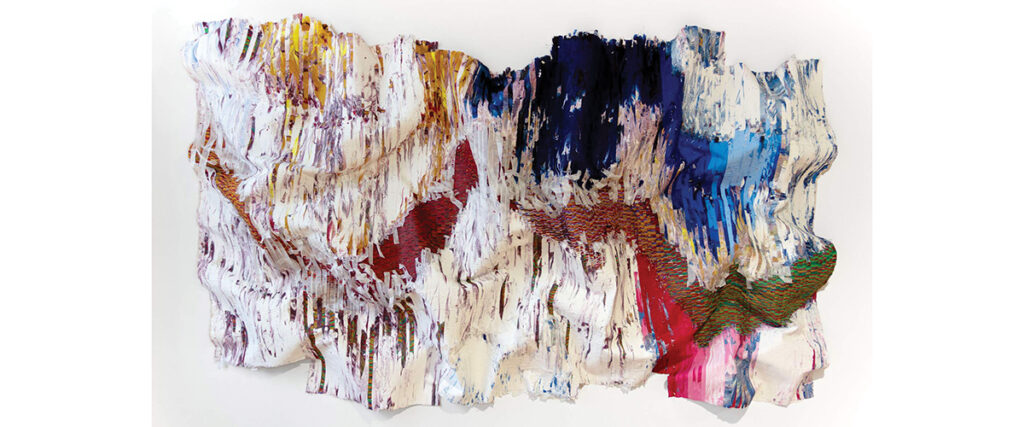
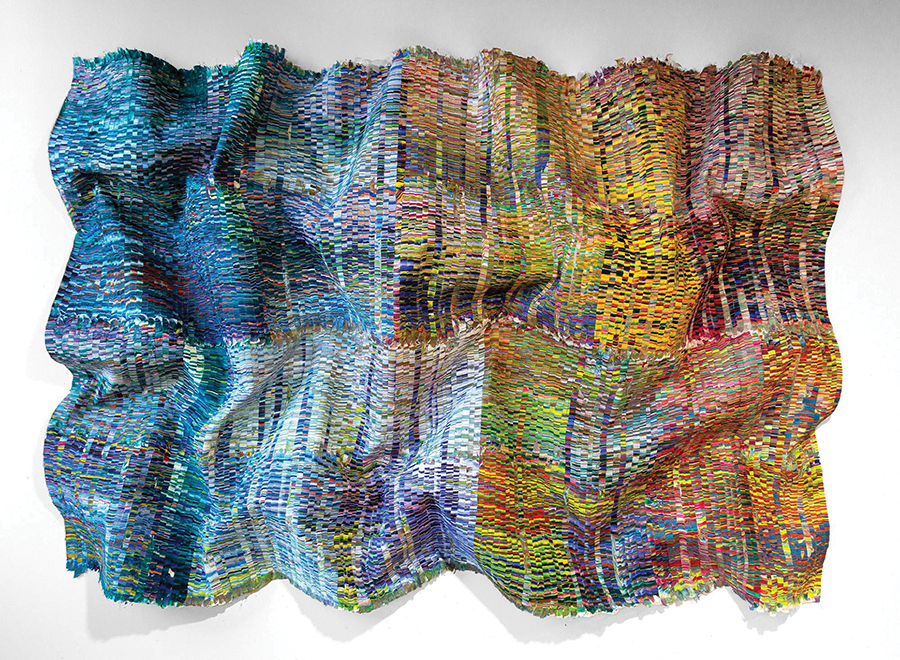
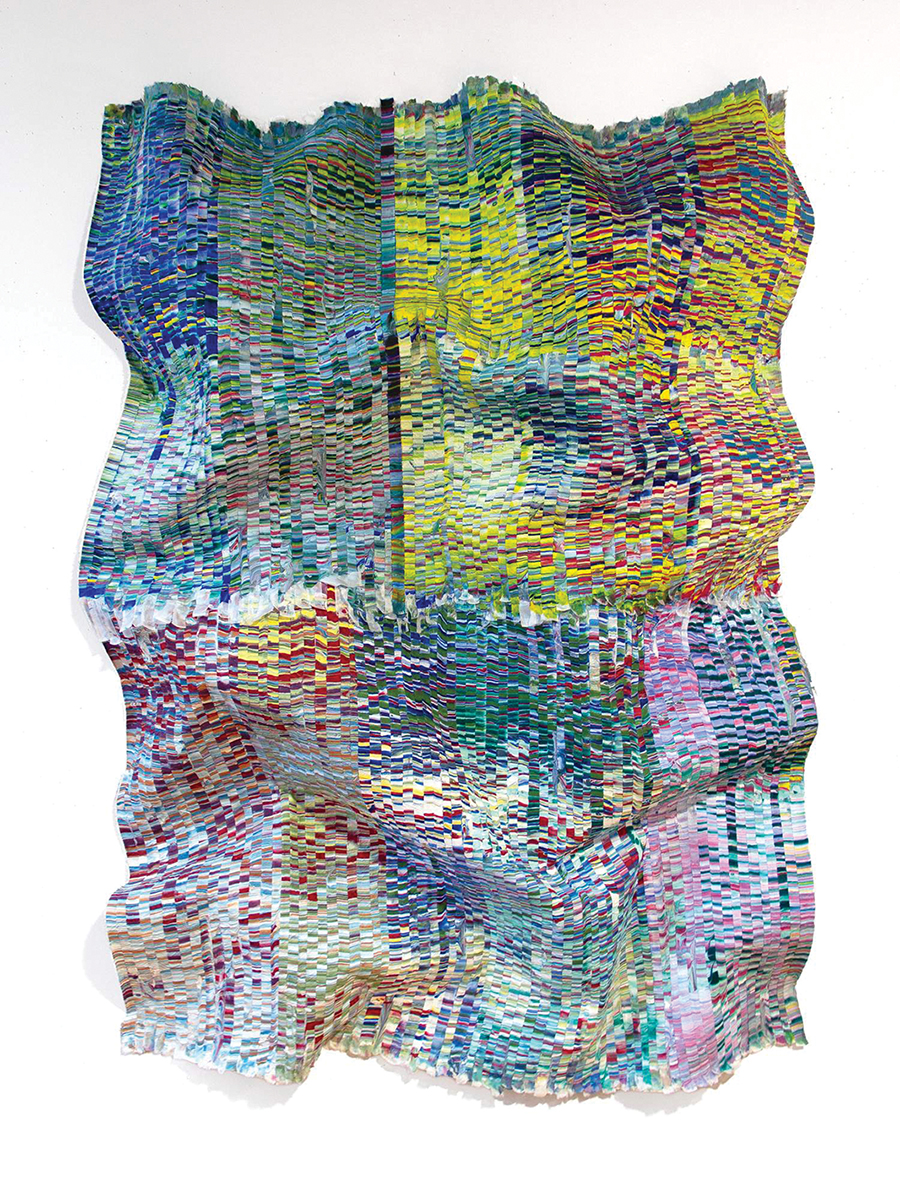
“Every time I start a piece, I imagine there’s a body underneath it,” says Quoctrung Kenny Nguyen, a former fashion designer who makes rippling, three-dimensional sculptures out of paint-soaked silk. “Instead, there’s this absence of a body, in sculptural form. I think it’s beautiful like that.”

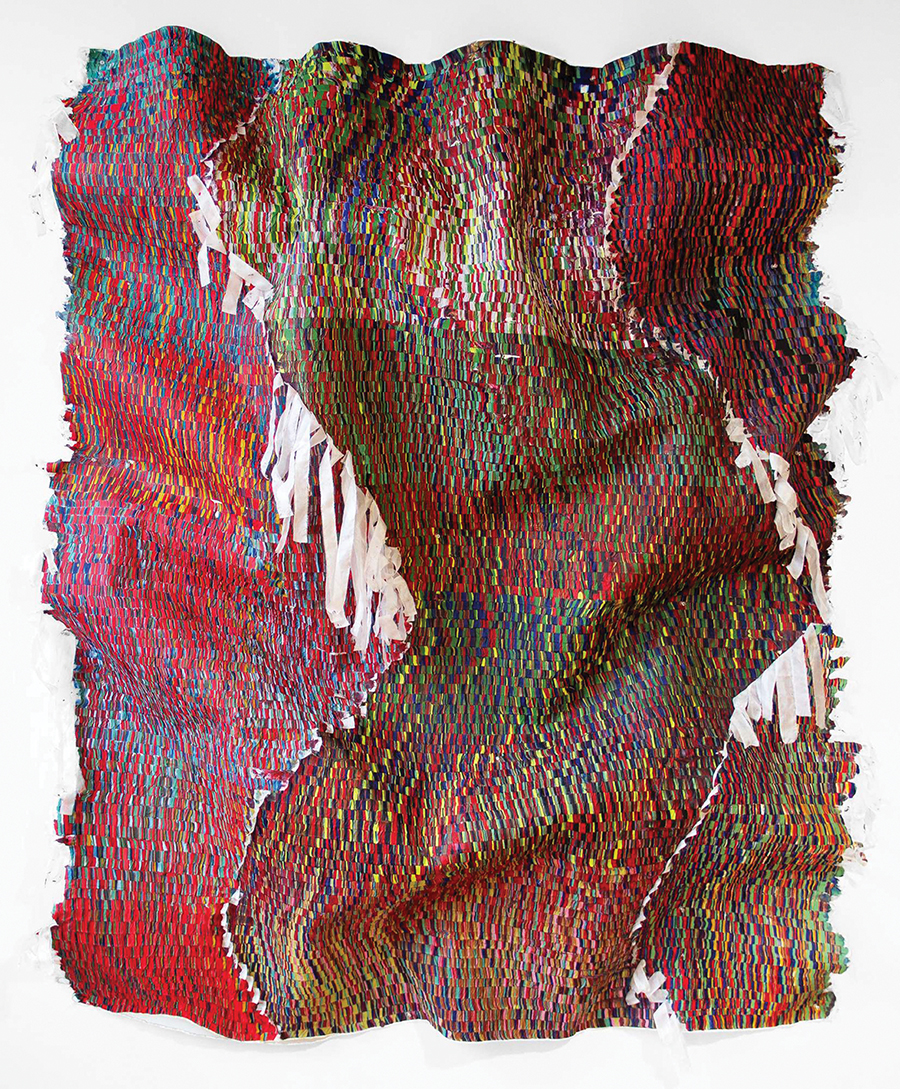
Torn into strips, dredged in paint and affixed to unstretched canvas, Nguyen’s silk segments fuse to become a malleable but sturdy material that he molds with his hands and pins in place. Every time he hangs a piece, he changes the pin placement — and with it the object’s shape, shadow and energy. Some have a “more architectural feel,” others are more organic.

These works explore and illustrate Nguyen’s experience with reinvention, cultural displacement, isolation and identity. His chosen material — with its direct ties to the cultural history of his native Vietnam, where the fabric is revered and traditional “silk villages” keep ancient production techniques alive — is a key component. “Identity is changing all the time,” he says, “and the work keeps evolving, in a continuous transformation.” It all begins with the fabric in his hands. “Silk is already a transformation: from the silkworm, to the silk thread, to a piece of silk. So it’s holding a metaphor.” More than one: “People see silk as a very delicate thing,” he says, “but actually it’s one of the strongest fibers on earth.”

Right: Encounter Series No.5, 2023, Hand-cut silk fabric, acrylic paint, canvas, mounted on wall, 72 x 120 in.

Nguyen’s work has earned him solo exhibitions and dozens of awards, residencies, grants and fellowships all over the world. It began to take off commercially in a big way during the pandemic, when he began using Instagram to share images of his pieces, and after Los Angeles-based Saatchi Art named him a Rising Star of 2020, one of the 35 “best young artists to collect” under the age of 35 from around the world. He now has art consultants and galleries representing his work all over the country and in Europe, and has had to move his studio out of the garage of his family home and into a former textile mill to keep up with demand. He no longer works alone, with three assistants (all art students from UNC Charlotte) helping him with prep work, photography and studio management. His biggest challenge is no longer finding an audience; it’s managing the business.

Nguyen couldn’t have imagined this kind of success when he immigrated here in 2010 from Ho Chi Minh City with his family. He was 19 and had a BFA in fashion design from the University of Architecture Ho Chi Minh City. But he couldn’t find a job and spoke no English. “It was just a culture shock. You can’t communicate with anybody. You feel so isolated. Homeless, in a way. I was struggling,” he says.

Art called him. Nguyen enrolled at UNC Charlotte to study painting — Davidson artist Elizabeth Bradford was one of his teachers — and found himself yearning for a way to incorporate his own culture and passions into the work. In the end, the way those came together was a happy accident.

During the summer of 2018, three years out of UNCC, Nguyen had just arrived at an artist’s residency in rural Vermont, where he planned to continue painting the “very flat, very traditional” types of canvases he’d been creating until that point. He realized that in his rush to get out the door, he’d left a container with most of his colorful paints and brushes behind. In fact, he realized that he’d managed to bring only three materials with him: a bucket of white paint, skeins of silk and some canvas. “What can you do with that?” he wondered. He began ripping pieces of silk, dredging them in paint, affixing them to canvas, “and you know, it just happened.”

Middle: Encounter Series No.12, 2023, Hand cut silk, acrylic, canvas mounted on wall, (Approx.) 75 x 60 x 5 in.

Right: Encounter Series No.4, 2023, Hand-cut silk fabric, acrylic paint, canvas, mounted on wall, 84 x 65 in.


Quickly, he decided he was on to something: “The material was speaking for itself.” Bits of transparent silk dripped off his canvases, letting light shine through. “I decided I didn’t want the frame anymore. I decided: Let’s sculpt it.”

To get there, though, he knew he’d have to manipulate his silk in new ways. “Silk has such a value in the Vietnamese culture,” he says. “For me, to destroy a piece of silk, to cut it into pieces . . . that’s a big deal for me. I pushed myself to do that.”

He hasn’t stopped. “The work is evolving in such an amazing way,” he said in late December. “I’ve just been in the studio nonstop, producing work.” Nguyen says that kind of work ethic has been crucial to his success. Some of it is rooted in his early years working in fashion while in school, some of it is hard-wired, and a lot of it is simply about his love of the work.

“The more that I work with the materials, the more I realize how it works and the more capacity I have,” he says. He’s experimenting with large-scale work, which can be challenging to mold in lasting sculptural forms, but not impossible. His largest works are now as many as 40 feet long, and he makes them in five or six different segments which he then sews together. “It’s not evolving in a straight line,” he says. “There are a lot of tests, and a lot of failures. Little accidents happen, unexpected things happen, and I pick up on that.”

When he’s not working on commission for collectors with requests for particular dimensions or colors, Nguyen often goes right back to where he started, letting colors and shapes come to him intuitively, sometimes reworking old pieces that didn’t originally come together, pulling out paints he hasn’t used in a while, relying on instinct. His materials never stop inspiring his creativity. “It amazes me,” he says, “that the material, this silk, can hold a sculptural form.”  PS

This is an excerpt from Art of the State: Celebrating the Art of North Carolina, published by UNC Press.

Second Chance Manse

Second Chance Manse

Rebirth of a historic landmark

By Deborah Salomon

Color Photography by John Gessner

Black & White Photography by Caroline Deese


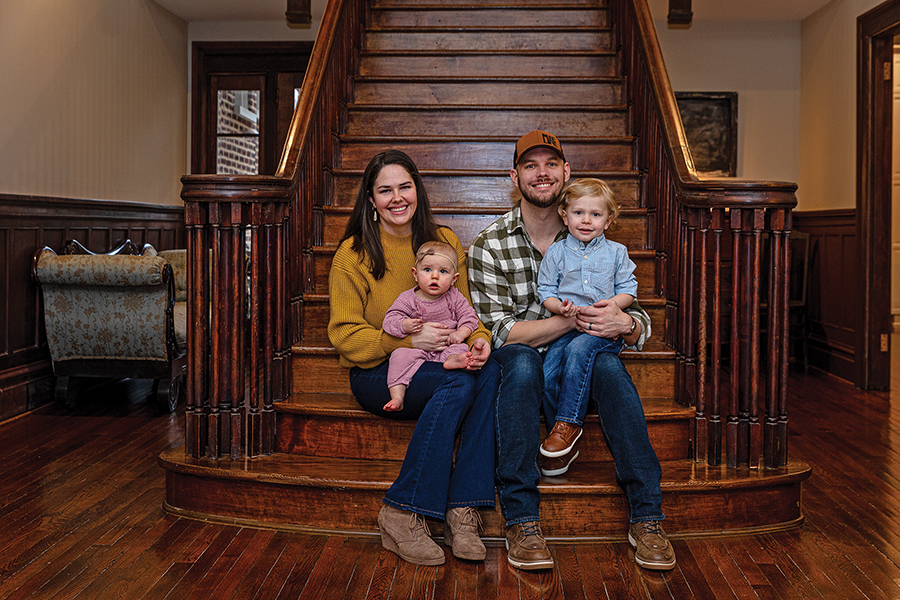
Young family. Old house. The result: spectacular.

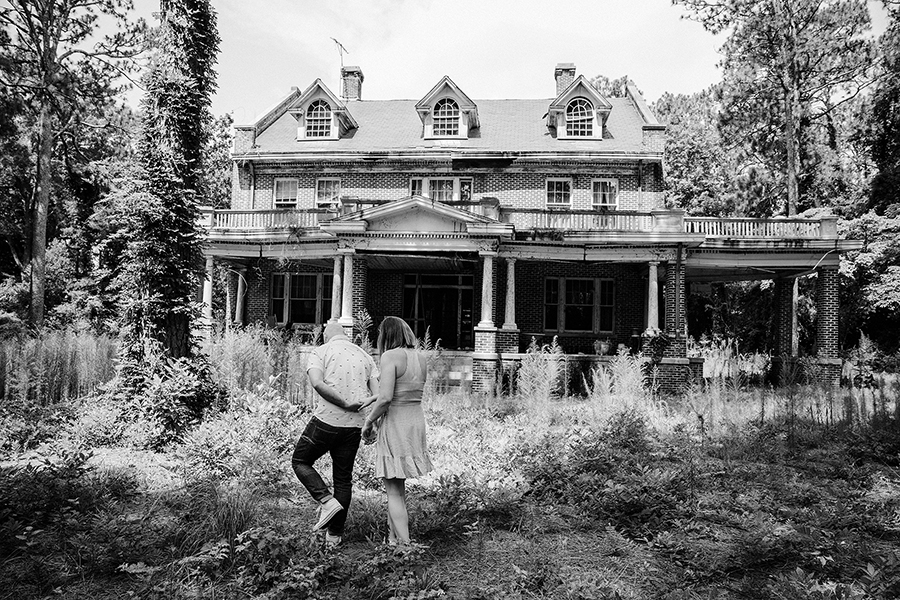
Consider this — the mansion was a wreck, with broken windows and busted walls, its 6,000 square feet strewn with trash and dusty furnishings. The most recent inhabitants were squatters, human and critter.

Creepy. A deep, dark money pit. Most house-hobbyists would run, not walk, in the other direction.

Not Abby and Trey Brothers, she from Mount Airy, he from Albemarle. Abby, a nurse, and Trey, military personnel, were living in Baltimore, preparing a move.

“It was sheer coincidence,” Abby recalls. “I was looking on Zillow for places near Fort Bragg (now Liberty). I found Cameron and zoomed out to Moore County. This was the first house listed. It was the ugliest pretty house I’d ever seen.”

Trey continues: “I saw her face light up, and I knew it was all over.”

That face lights up still at the memory. “It was the same feeling as when I knew I wanted to marry Trey,” says Abby. “You just know.”

That was 2017. Since then, they have begun to fill the six bedrooms with the arrival of William, 3, and Eloise, 8 months.

But first, a job as much period restoration as renovation, which sets this historic property apart from those with classic exteriors and magazine interiors. Its rooms have the ability to propel you back in time — but the trip is made in air-conditioned comfort.

In the late 19th and early 20th centuries, in what became Aberdeen, Page was the name that opened doors. Allison Francis (Frank) Page, one of 10 children, saw the Sandhills as a source of naval supplies, mostly logging and turpentine. He bought land, diversified into railroads and commercial buildings, prospered, and in addition to establishing the town of Aberdeen, he and wife Catherine produced eight offspring. Several gained prominence in government, clergy and banking.

Frank Page died in 1899, after building homes for most of his children on Page Hill. Fourteen years after her father’s death, daughter Frances Page Wilder and her husband, lawyer Thomas Wilder, commissioned popular architect J.M. McMichael, who had designed the local Methodist church, to build a brick homestead outside the compound for their family of nine.

The Great Depression changed everything. The unoccupied house stood vacant for decades, smothered by vines and shrubs. Had it been clapboard rather than brick, story over.

A developer saw the house, which he christened Willow Oak Manor, as a venue for weddings. His plans proved financially impractical. The house appeared doomed.

However, beyond the shambles its aura captivated Abby and Trey. Their plan: obtain a Fannie Mae government loan and do the work themselves. Abby had helped her dad on mission trips, and Trey gained experience working construction. How-to videos and YouTube provided the rest.

“Whatever required a permit we let the contractor do,” Abby says. Which left ripping out 60 tons of plaster in the summer heat. And so much more.

Moving day, after nine months of sweat equity, came in May 2019.

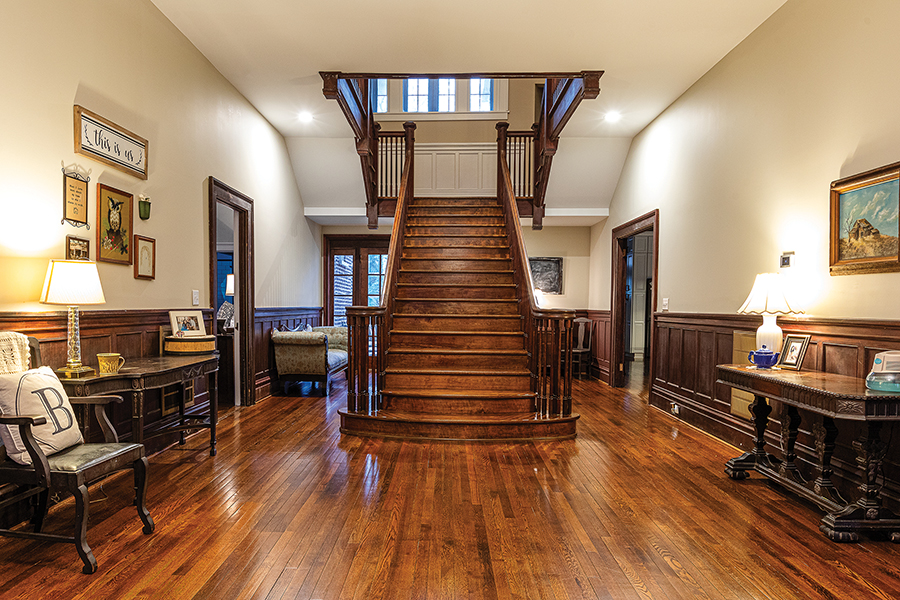
At the outset, they decided to leave the layout mostly intact and keep flooring, paneling, door and window frames dark and wall colors quiet — pale olive, khaki, beige, ochre, grey.

Fronting the house, a porch with veranda proportions previews the spaciousness within, enhanced by tall windows and 12-foot ceilings.

Opposite the front door, the split staircase ornately carved and illuminated by a Phantom of the Opera-worthy chandelier elicits gasps, immediately delivering ancestral elegance, as does the triple-wide entrance hall with a parlor on one side and a study equipped with bookcases — previously kitchen cupboards — on the other.

In the parlor, a settee found in the house suggests the affluent 1920s, as do a massive wardrobe and side tables in the foyer, several dressers and the dining room buffet. Other furnishings lean modern-comfy, practical for a family raising children.

Unfortunately, chimneys had to be capped off. “We had an issue with bats,” Trey says.

Antiquity earns a bye in the main-floor master suite, where an adjoining sunporch has been converted to a spa bathroom; the glass wall wraps around a long bench facing three shower heads.

Upstairs, each child has a bed-playroom the size of master suites elsewhere. Narrow stairs lead to what was a sleeping porch, now a sitting room. Also on the third level is a small maid’s room and bath with original tub, sink and a stairway that leads directly to the kitchen, perfect for guests desiring privacy.

Ah, the kitchen, no place for old-timey anything. “I knew what I wanted — big, the open concept,” Abby says. It required removing walls to create one room from three. Now, the dining room, dominated by her grandmother’s table, is part of the kitchen. Another wall was added, creating a laundry room and pantry. New floors were required but no pricy granite, soapstone or marble countertops. Instead, Trey poured 3,000 pounds of concrete, creating a sturdy textured surface.

Outside, what was once overgrown brush has been cleared for a kiddie playground. A porte-cochère recalls times when guests arrived in elegant motor cars, long before the manor’s neighbors included businesses and tract housing.

Funny how life turns out. Abby grew up in what she calls a little brick rancher. “I never wanted to live in another brick house,” she says. Trey shared a bathroom with three sisters. Now, he has four choices. With grit and determination, Abby and Trey Brothers rescued a landmark from the wrecking ball.

Besides, Trey adds, “The house is a good conversation piece.” Like the time Abby found the initials MFP scrawled on a wall.

“A lady and her granddaughter rang the bell. She said she had lived here. I asked her if she knew who MFP was,” Abby explains.

“That’s me, Mary Frances Poe!” the lady exclaimed. “I stayed in the back bedroom.”

Mission accomplished, except for one detail. So far, Abby notes, no ghosts.  PS

Hometown

Hometown

Watching the River Run

Leaving them one by one

By Bill Fields

A work commitment kept me from attending a reunion last fall for Pinecrest High School’s 1970s classes. I regretted missing the weekend, which, from the reports I got, was well organized and drew a big crowd. Having helped coordinate the 25th reunion for those of us who graduated in 1977, I can only imagine the effort required to hunt and gather 10 classes of folks and successfully pull off such a gathering.

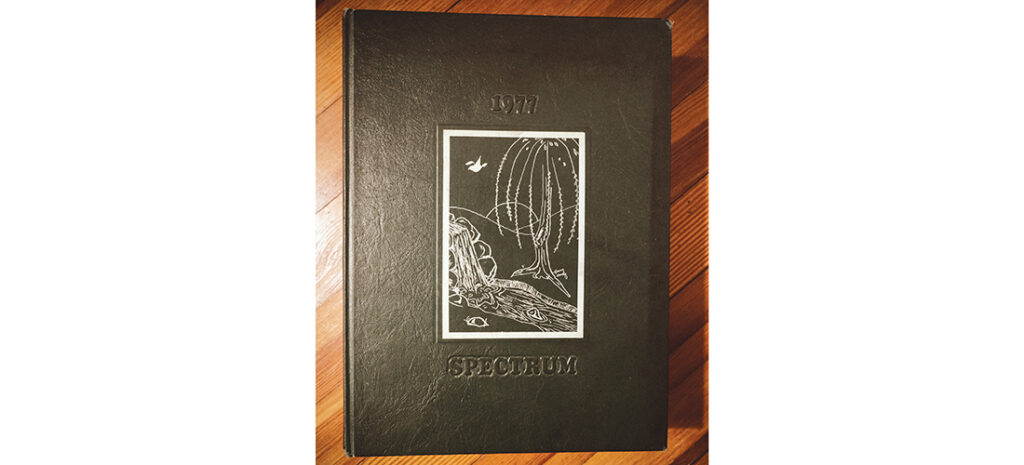
From afar, though, spurred by the big reunion, I’ve been remembering those high school days and my classmates, recollections jogged by my copies of the Spectrum, Pinecrest’s annual, from my sophomore through senior years.

Without even opening them, the yearbooks tell a story. The covers and page edges are smoke-damaged from a November 1984 late night electrical fire in the bedroom loft of an Aberdeen cottage I was renting, a blaze as swift as it was startling.

My companion and I were grateful to get out safely after smelling smoke. It wasn’t the recommended way to get into the pages of The Sandhill Citizen, which ran a captioned photograph of firefighters on the scene in its next edition. That girlfriend and I didn’t go out long. We did see each other a few more times after the fire, which was a Christmas miracle, but she never returned to the apartment after it was repaired.

High school, as the annuals remind me, was much less dramatic than that unusual evening, although it hardly seemed so then. Looking through those yearbooks is to remember the angst about a class in which you struggled or the answer from someone you had finally summoned the courage to ask out.

But I was fortunate to not carry the burdens that weighed down some of my classmates. I came from a stable family, applied myself well — except when the going got tough in math — and had at least a vague sense of what I wanted to do after Pinecrest. When I read the messages written to me in those yearbooks from students and teachers, penned in both Bic and Flair, there are mentions of “level-headedness,” “determination,” “hard working” and “perseverance.” I still don’t really know what Andrew Edwards said, because he wrote his backward. 

At the time, being named “Most Dependable” along with Louise Thompson didn’t seem the flashiest of senior superlatives. I know I haven’t always lived up to that billing, although it is a good one to shoot for. (This column is being filed a day late, unless I’m receiving grace for New Year’s Day, but I’ve met many more deadlines than I’ve missed over decades of typing for a living — and since handwriting scripts on carbon paper for our closed-circuit TV news show senior year at Pinecrest.)

Mostly, those mid-1970s yearbooks make me think of the people who are with me in those yellowing pages, classmates who have prospered or struggled, others who lost their lives in accidents or to illness, some a long time ago, some in late middle-age. Just last year, two of my Pinecrest golf teammates, two good men, Jim Mathews and Charles Reid, passed away.

The theme of the 1977 Spectrum, I was reminded when rereading it recently, came from “Watching the River Run,” a beautiful 1973 song written by Kenny Loggins and Jim Messina. We teenagers probably didn’t appreciate the poignancy of “watching the river run/further and further from the things we’ve done/Leaving them one by one.”

Opposite the lyrics in my yearbook was a message from my late childhood friend Alvin Davis, who took the spread photograph that accompanied them, a wintertime waterscape in black and white, the sun bursting through trees and shining on the river’s surface. Alvin’s words dance through bare branches, memorable not so much for what they are but who said them as we were starting out, paddles in the water.  PS

Southern Pines native Bill Fields, who writes about golf and other things, moved north in 1986 but hasn’t lost his accent.

Tea Leaf Astrologer

Tea Leaf Astrologer

Aquarius

(January 20 – February 18)

Let’s be honest: The foundation is crumbling. So, too, are the walls. That’s Pluto in Aquarius for you, and for the next 20 years, the planet of destruction, death and rebirth will shake us to our collective core. You were, quite literally, born to show us a new way forward. When the North Node of Destiny links up with Chiron (the wounded healer) on February 19, there’s no stopping you from sharing your weirdest, wildest imaginings out loud. Bring on the renaissance, space cake.

Tea leaf “fortunes” for the rest of you:

Pisces (February 19 – March 20)

A box of chocolates, minus the gooey, pink nougat.

Aries (March 21 – April 19) 

Three words: milk of magnesia.

Taurus (April 20 – May 20)

There’s more than one way to peel an orange.

Gemini (May 21 – June 20)

Try not to scare off the neighbors.

Cancer (June 21 – July 22)

Apply rose water.
Leo (July 23 – August 22)

Gentle pressure will suffice. 

Virgo (August 23 – September 22)

Soften the muscles in your face.

Libra (September 23 – October 22)

What if there isn’t a wrong way?

Scorpio (October 23 – November 21)

Best not to skim the fine print.

Sagittarius (November 22 – December 21)

If you can’t laugh at yourself, there’s work to do yet.

Capricorn (December 22 – January 19)

Tighten your bootstraps.  PS

Zora Stellanova has been divining with tea leaves since Game of Thrones’ Starbucks cup mishap of 2019. While she’s not exactly a medium, she’s far from average. She lives in the N.C. foothills with her Sphynx cat, Lyla.

In the Spirit

In the Spirit

Dissecting a Cocktail

Creating the Andie Rose

By Tony Cross

Many years ago, while bartending, I was befriended by PineStraw’s art director, Andie Rose, when she took the time to let me know she had enjoyed her cocktails that evening. A few months later, she asked me to design a cocktail for the magazine’s anniversary issue. A year after that I was invited by mutual friends to a birthday dinner they were hosting for Andie, and I was asked if I would like to create a cocktail in her honor. Of course I would. I knew that Andie has an affinity for old-fashioneds, so I wanted a drink that would be whiskey-forward. However, I wasn’t sure if the other guests would be receptive to a spirit-forward cocktail. I decided to create a sour and build the drink around Monkey Shoulder malt whiskey. Monkey Shoulder is a versatile Scotch whiskey, perfect even for those who usually shun Scotch. Her birthday falls in the first part of March, but it was still cold, so the combination of allspice, orgeat and Angostura enhanced the creaminess and winter spice notes from the whiskey.


Specifications

1 1/2 ounces Monkey Shoulder whiskey

1/2 ounce Rittenhouse Rye

1/8 ounce allspice dram

3/4 ounce orgeat

3/4 ounce lemon juice

1 organic egg white

Angostura bitters


Directions

In a shaking tin, add all ingredients, except for the bitters. Seal tin and shake hard for 10 seconds. Add large cube (or sufficient amount) of ice and shake again for 10-15 seconds. Double-strain over a large rocks glass with large cube. Add three dashes of Angostura bitters over the cocktail.  PS

Tony Cross owns and operates Reverie Cocktails, a cocktail delivery service that delivers kegged cocktails for businesses to pour on tap — but once a bartender, always a bartender.

A Day at the Races

A Day at the Races

Horsing around and around and around

By Jenna Biter

Photographs by Tim Sayer

It’s a brisk winter morning. A cloudless blue sky hangs over Pinehurst. Happy sunshine beams down, tricking villagers into leaving their coats inside while they shuffle out to fetch the paper. Just down Beulah Hill Road, in the shadow of Pinehurst’s famed golf courses, horse trainers at the harness track know better. They climb into jackets, pull on gloves and hike up neck gaiters, then slide into their two-wheeled jog carts behind the rears of standardbred horses.

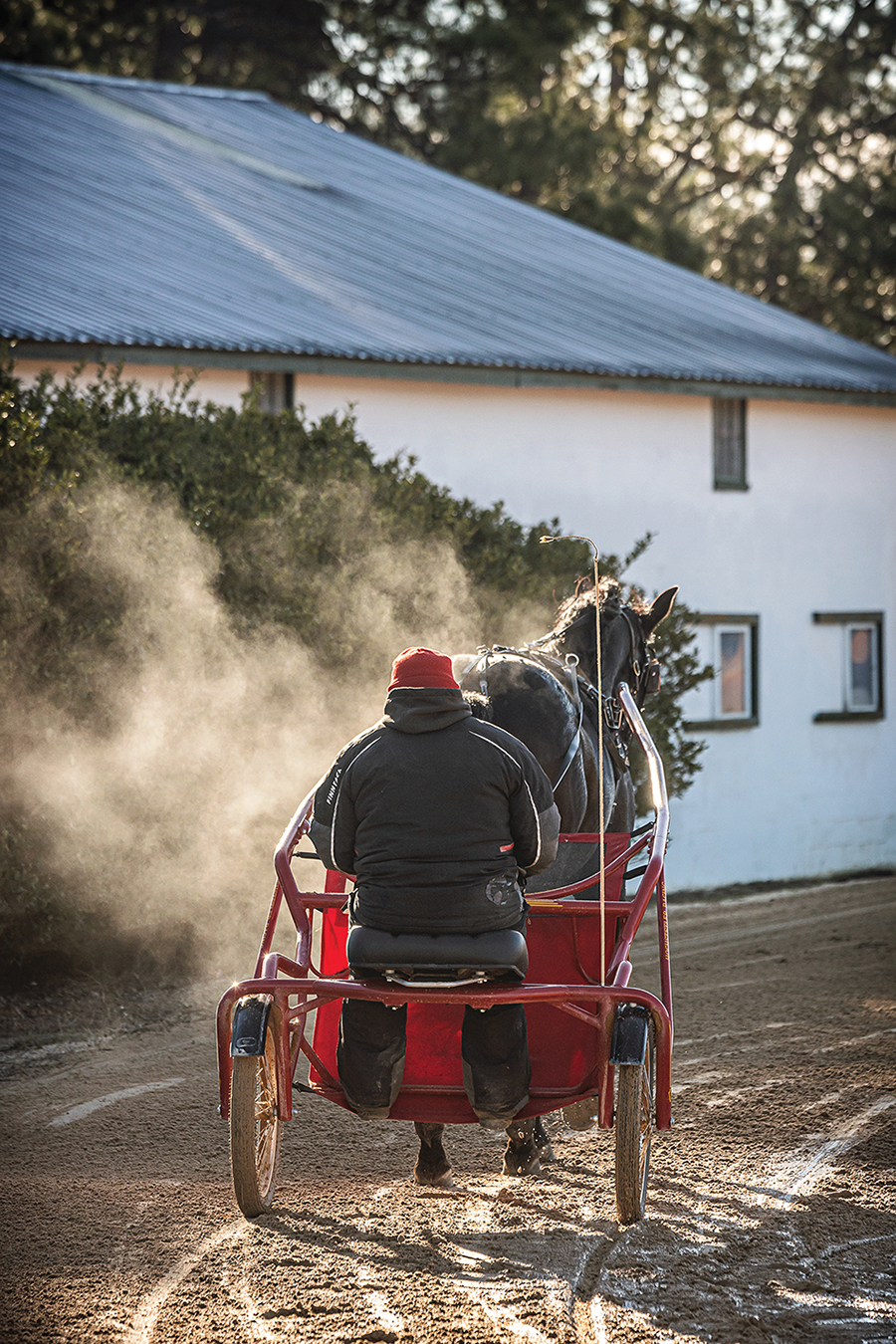
From dawn until a little before noon, sometimes a little after, the trainers rotate through the barns filled with horses, driving them around and around the tracks at the historic harness racing training facility.

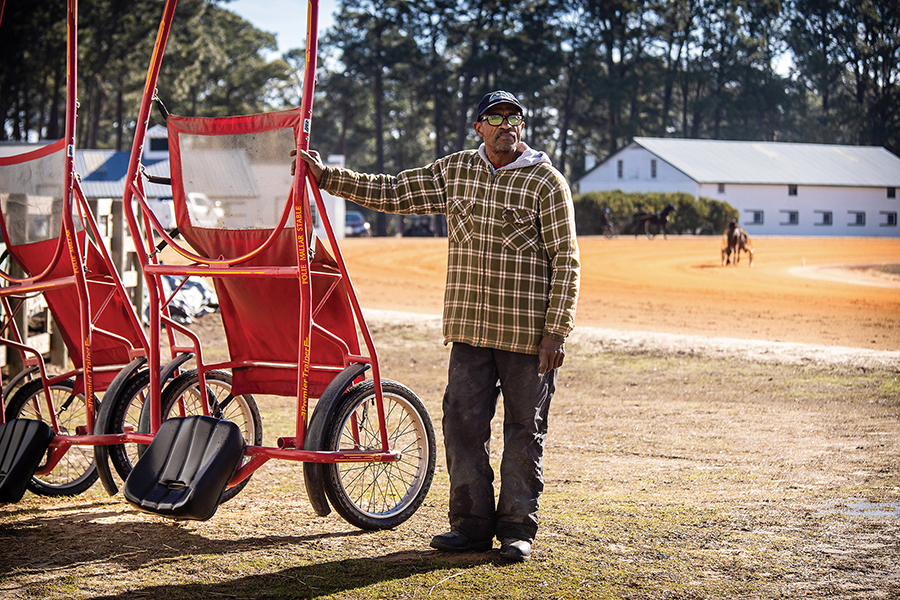
Roland “Polie” Mallar and his second trainer, Billy Cole, are two of them. Both men drive laps in red carts, reclined with their legs straight out and gloved hands ready at the lines.

Ruddy, wind-whipped cheeks sneak out from beneath a neck warmer. Mallar is ahead, wearing a relaxed but stony look of concentration, track pants and a faded ball cap. He’s never been one for protective headgear. Following closely behind, Cole sports the same composed stare, but out from under a cream helmet and with a shield of black facial scruff.

Mallar grew up in Maine in the shadow of his grandfather — the original Roland nicknamed Polie — who trained harness racers. When Polie the younger was still in high school, he already owned horses and ran them in summer fairs.

Cole, on the other hand, grew up in Wagram, where he still lives, and knew nothing about horses until 1985. That changed when a friend who worked at the harness track offered to teach him, hoping to fill a job opening at the training ground.

“I’ve been here ever since,” Cole says.

Right: Roland “Polie” Mallar


“Here” is the Pinehurst Harness Track, the oldest continuously operating horse track in North Carolina. It was built as an amenity for resort guests in 1915, converted to a winter training center for breaking standardbreds in the late 1920s, and bought by the village of Pinehurst in 1992 so the proving ground wouldn’t be steamrolled and developed into something more commercial but far less utilitarian and picturesque.

That same year, the equestrian training center was added to the National Register of Historic Places.

For the past seven or eight years, Cole has worked at the harness track with Mallar, owner of the eponymous Polie Mallar Stable, who has been wintering horses at the facility for something around three decades.

“We were here one year, and then we went to Florida one year,” Mallar says, remembering a brief stint at Spring Garden Ranch, a 148-acre training track half an hour from a different, faster kind of racetrack — the Daytona International Speedway.

“I liked it here in Pinehurst better,” he adds, despite, or maybe even because of, the smaller sprawl and harsher winter weather.

The Moore County training center sits on 111 acres and has three tracks. The first is a half-mile clay oval surrounded by a second oval, a 5/8-mile sand border good for strengthening a horse’s leg muscles. Tucked down a short dirt road, the third track is a 1-mile clay loop used for going fast and qualifying for big harness races up north.

There are no palm trees trackside in Pinehurst, a good thing in Mallar’s view. Pinehurst’s winter chill is a training aid.

“When you leave here to go north and race in the spring, you’re not going into 75- or 80-degree weather,” Mallar says. North American harness races run in four-season regions like the Midwest and Northeast and are also popular in Canada.

Tracy Cormier, owner of the Pinehurst Track Restaurant, a legendary local institution serving breakfast and lunch in the unassuming white-block building looking out at the track, was married to Quebecois horseman Real “CoCo” Cormier.

“He started when he was a kid in Canada,” Cormier says of her late husband of 36 years. “He just loved horses. It was a big French Canadian group of guys, very famous drivers, and they just kept it going.

“Then he came to Pinehurst and just loved it.”

At first, CoCo spent summers at big-purse races in New York and winters training in Pinehurst at the harness track. Then in the ’90s, he, Tracy and their daughter, Danielle, permanently moved to the Sandhills. That’s when the Cormiers bought the restaurant.

For 27 years, Tracy has run the more-than-a-century-old eatery that attracts mostly golfers visiting from across the country and around the globe in search of a good meal and a little local color. After snarfing down a stack of famous blueberry pancakes and draining a mug of black coffee, diners pay in cash, then leave to play golf. Outside, they’re greeted by the clomp clomp clomping of hooves.

That rhythmic sound is how Scott Freeman, the harness track’s superintendent, or “Track Man,” has been diagnosing surface conditions and prescribing daily maintenance during his five years on the job.

“The racetrack talks to me,” Freeman says. “If horses are going by and it sounds like they’re knocking on the door, the surface is too hard. That hurts bone. If they go by and it sounds like a washing machine, that means the surface is too loose. That hurts soft tissue. It causes a horse to strain more.

“So it’s a fine balance,” he adds. “What it’s got to sound like is a kitten wearing sneakers.”

Year after year, between October and May, trainers like Mallar, second trainers like Cole, and grooms and groundskeepers hurry in and out of barns, helping to prepare young horses for their racing debut.

Left: Billy Cole, Right: Tracy Cormier

There’s a quiet busyness to it all. People dressed in sun-faded knock-arounds are always moving something — water buckets, hoses, bags of feed — to somewhere while others brush down sweaty-backed horses after their morning miles. A russet-colored farm dog wanders out of one barn and into another, probably off on his morning rounds. An oddly welcoming smell of manure pervades the entire scene.

Not all the horses who train at Pinehurst are yearlings (horses between the ages of 1 and 2 years old) but most are. Here in the slow and easy South, the babies can acclimate to distractions — tractors, observers and other plucky young horses — one at a time.

“Right now, it’s mostly teaching them manners,” Mallar says. “It’s teaching them to go straight. You got to teach them to go straight before you can teach them to go fast.”

This year, Mallar has 13 horses to train, all of which are standardbreds, the only breed that competes in North American harness racing. The breed’s lineage traces back to a thoroughbred stallion named Messenger who was imported to Philadelphia from England in 1788. Descendants of Messenger’s great-great-grandson Hambletonian 10 dominate the breed. To this day, standardbreds still resemble thoroughbreds, although they are longer, lower and sturdier.

“Some of these top thoroughbreds, they race four or five times a year, and they think that’s a lot,” Mallar says. Some standardbreds can race every week. Thoroughbreds race full tilt, at a gallop with a jockey on their backs, while standardbreds race at a trot or pace, pulling drivers behind them in speedy carts called sulkies.

Trotters move like other horse breeds, with a diagonal gait. Their opposite front and hind legs strike the ground simultaneously. Pacers can trot, but when pushed for speed in second gear, they shift into a lateral gait. Their same-side legs move in tandem: front right with back right and front left with back left. Standardbred horses are among only a handful of animals, including giraffes and camels, that naturally pace.

Regardless of their preferred gait, standardbred yearlings require a solid winter of training to be race-ready come springtime.

“When the horses first get here, most of them, they’ve never had a harness on. They’ve never had a bridle on,” Cole says. “First thing I usually do, I just start brushing them down, let them get used to me.”

Right: Scott Freeman


The trainers slowly introduce young horses to harness and bridle, leg loops called hopples, to help them keep gait, and the jog cart. At that point, they drive each horse around the track daily. Between Mallar and Cole, they exercise all 13 horses throughout a morning, 3 to 3 1/2 miles each.

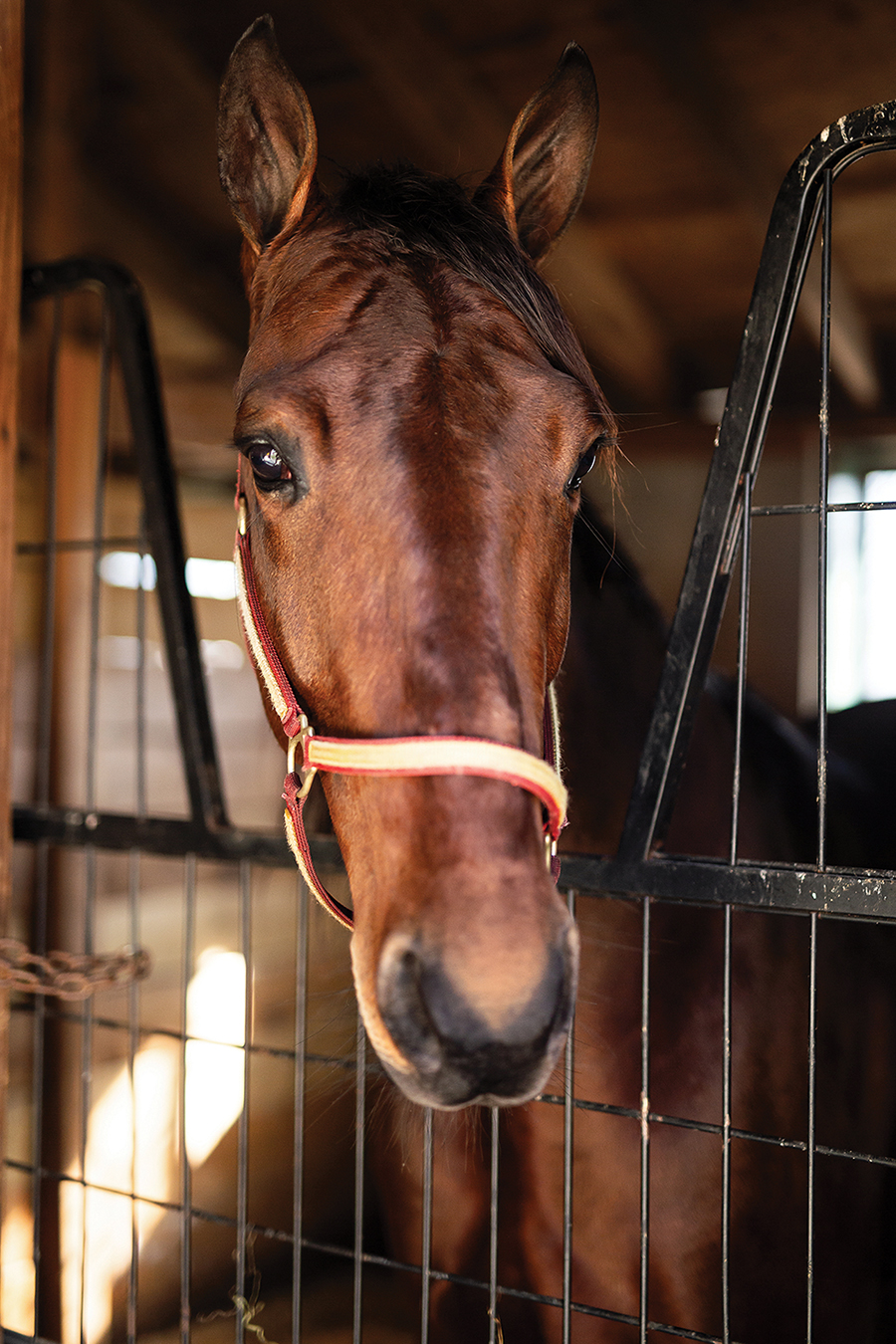
On this winter morning, a velvety, chocolate-colored horse from Mallar’s barn tosses its head and darts in the other direction when it comes face-to-face with a tractor grating the 1/2-mile clay track. Quietly Cole, still recumbent in the jog cart, flicks his steady, experienced hands and somehow transfers his composure down the lines. He pulls the horse into the central grass field, then turns it back to face its fear.

“Most of the time, if they are scared of the tractor, I get them out and around it to get used to it,” Cole says. “Sooner or later that tractor is going to be out there and coming, and you’ll have nowhere to go and be in trouble.” The next time around, Cole’s horse makes a successful lap, even when faced with the big, scary John Deere.

“Once I get a foundation under them, I’d say anywhere between 100 and 250 jog miles, then I’ll start rushing them up a little bit for something like an 1/8th of a mile, teaching them how to step,” Mallar says. “Then we’ll have them pass each other, get them used to other horses moving around.

“I won’t really start putting a watch on them until I get to times between 2:40 and 2:45,” he says. “Then I’ll start dropping them.”

After roughly half a year of training, the now-2-year-olds run in the Spring Matinee, the harness track’s annual exhibition races that introduce the horses to competition in front of a crowd before they ship north to gambling hotspots, such as the Poconos, Yonkers and harness racing’s mecca, the Meadowlands, in New Jersey.

If owners and trainers are lucky, their horses will relish the competition, just like Mallar’s 4-year-old Ken Hanover, who set a track record in the Little Brown Jug in Delaware, Ohio, last year, one of harness racing’s Triple Crown events. That’s because good things come around at the harness track . . . and around, and around.  PS

Jenna Biter is a writer and military wife in the Sandhills. She can be reached at jennabiter@protonmail.com.

Southwords

Southwords

Queen of Bath

It’s a bit of a stretch, sure. But this dream tub sorta works

By Ashley Walshe

If you’re a bath person like me — that is to say, someone who soaks ritualistically — then perhaps you’ve spent time imagining what life could be like if your tub was just a little wider; a little deeper; a little more picturesque.

An elegant garden tub aglow with flickering candles. A cast iron clawfoot laced with salt and rose petals. An hourglass drop-in complete with whirlpool jets.

Such visions used to rule my mind.

Now, having spent the last two years living in a 32-foot travel trailer with my husband and my canine shadow, my dream tub has but one requirement: I can bathe in it.

Which brings me to my current situation.

A standard bathtub holds about 70 gallons of water. Suffice it to say that our RV tub does not. Think farmhouse sink with bobsleigh undertones. Bigger than a breadbox, smaller than a storage tote.

I’ll be honest. It took a while to see potential here. The tub’s fun-size dimensions combined with our 6-gallon hot water heater don’t exactly add up to a space for quiet contemplation and long, soulful soaks. Quick showers are fine. But when baths are your primary indulgence, you consider all your options.

My first bath attempt was, frankly, valiant. I’m no bobsled pilot, but given my daily yoga practice, I was deftly able to navigate the tub’s shallow waters. A knees-to-chest pose, for instance, followed by seated pigeon, a gentle variation of boat pose and — after a bit of ocean breathing — a legs-up-the-wall inversion. 

Despite this series of postures, most of my body was not, in fact, wet. Still, half baths are better than no bath in my book. I lit a candle and resumed my lazy pigeon.

All of this was fine. Really. But when the ankle-deep water began cooling with unholy swiftness, my efforts seemed altogether fruitless.

“I wish we had more hot water,” I mumbled as the basin drained.

“We can try using the electric kettle next time,” my husband offered from the living space. “I’ll even be your bath butler.”

I felt my lips explore the foreign words.   

“Bath butler.” I liked the sound of it.

My bath butler has changed my life. Weekly, per my request or his proposal, I luxuriate in what I’ve taken to calling my Queen’s Bath — a modified version of a full bath, sure, but a yogi can dream.

Pre-kettle, I add a swirl of Epsom salt into the finger-pour of steaming water, get the candle going, flip off the lights and climb in.

If I fits, they say, I sits. 

By now, my bath butler has mastered water control. He knows that, after adding a kettle to my bath, it’s time to heat up the next one. Sensitive and compassionate, he keeps things strictly professional, a trait any honorable bath butler should possess.

“How’s the temperature?” he might ask. Or, “May I bring you a beverage?” Most often, he simply pours and gives a courtly head bow. Role playing at its finest.

Four kettles in, the water nearly hugs my waist. By kettle five, I’m beginning to feel like a Greek goddess. Kettle six? I could not ask for more.

You don’t opt for camper life without sacrificing some modern comforts. Still, we have everything we need: clean, running water; electricity; full bellies and warm hearts.

My butler is the bath bomb on top. 

If it’s true that gratitude is the quickest path to happiness, I think I’m already there. As for my husband?

“I’m happy to bring you water,” he assures me. Although he insists on maintaining his professional butler pose, I pry.

“What’s in it for you?” I ask.

He pours the kettle, shrugs, then clears his throat. “I guess I like the view.”  PS

Ashley Walshe is a former editor of O.Henry and a longtime contributor to PineStraw. She presently lives and bathes near the glittering waters of Lake James.

PinePitch February 2024

PinePitch February 2024

And the Young Shall Lead Them

The Carolina Philharmonic under the direction of Maestro David Michael Wolff will perform side-by-side with the Carolina Philharmonic Youth Orchestra and Chorus in an inspiring evening of music on Saturday, Feb. 3, at 7:30 p.m, at BPAC’s Owens Auditorium, 3395 Airport Road, Pinehurst. For more information go to www.carolinaphil.org.

Last Chamber Session

The Great Room of the James Boyd house, 555 E. Connecticut Ave. in Southern Pines, is the venue for violinist Nicholas DiEugenio and pianist Mimi Solomon in the fourth and final installment of the Weymouth Center for the Arts & Humanities’ Chamber Sessions series on Sunday, Feb. 4, from 2 p.m. to 4 p.m. The couple, currently living in Chapel Hill, met while collaborating on the Beethoven Archduke Trio at the Kinhaven Music Festival in 2010. Tickets for the performance are $30. For more information go to www.weymouthcenter.org.

Walk This Way

Why wait until Valentine’s Day? Wander the sweet village streets of Pinehurst in the Wine & Chocolate Love Affair Wine Walk sipping, sampling, shopping and strolling on Saturday, Feb. 3, from 3:30 p.m. to 8 p.m. Tickets can be purchased at Duneberry Resort Wear and Triangle Wine Co. or at www.eventbrite.com. For more information call (910) 687-0377.

Author! Author!

The Country Bookshop hosts Alan Gratz talking about his latest book, Heroes: A Novel of Pearl Harbor, at the Sunrise Theater, 250 N.W. Broad St., Southern Pines, on Monday, Feb. 19, from 6 – 7 p.m. Then, on Friday, Feb. 23, from 5 – 6 p.m., Steve Berry will discuss his new book, The Atlas Maneuver, at The Pilot building, 145 W. Pennsylvania Ave., Southern Pines. For information and tickets for either, or both, visit www.ticketmesandhills.com.

Honoring Black History Month

Mitch Capel will bring a smile to your face and a tear to your eye when he hosts an afternoon of African American stories told by two-time Grammy award-winner, author and inspirational speaker Willa Brigham and North Carolina Humanities Council Road Scholar Elisha “Mother” Minter on Sunday, Feb. 25, beginning at 2 p.m., at the Weymouth Center for the Arts & Humanities, 555. E. Connecticut Ave., Southern Pines. Admission is free but registration is required. For more information or to register go to www.weymouthcenter.org.

God Save Illinois

Set in Chicago during the Roaring Twenties, sometime chorus girl Roxie Hart murders a faithless lover and convinces her hapless husband, Amos, to take the rap . . . until he finds out he’s been duped and turns on Roxie. The Imagine Youth Theater presents the teen edition of Chicago, on Saturday, Feb. 17, at 7:30 p.m. at BPAC’s Owens Auditorium, 3395 Airport Road, Pinehurst, and again on Sunday, Feb. 18, in a 2 p.m. matinee. This popular musical written by Bob Fosse and Fred Ebb has been adapted to keep the razzle and dazzle while removing the R-rated content. For tickets and information go to www.ticketmesandhills.com.

Double Dose of Love Songs

The “Heart ‘n Soul of Jazz” weekend begins on Thursday, Feb. 8, at 6:30 p.m. with a free concert by the Sandhills Community College Jazz Band, under the direction of Dr. Larry Arnold. Then, on Friday, Feb. 9, at 7:30 p.m., two-time Grammy-nominated vocalist Jane Monheit headlines with The Christian Tamburr Trio. The event is co-sponsored by the Arts Council of Moore County which is celebrating the 50th anniversary of its founding. Among the many events and programs the Arts Council hosts are exhibitions at the Campbell House Gallery, a chamber music series and AutumnFest, in partnership with Southern Pines Parks & Recreation. Both of the “Heart ‘n Soul of Jazz” concerts will be at BPAC’s Owens Auditorium, 3395 Airport Road, Pinehurst. Tickets can be obtained through the Arts Council of Moore County, Campbell House, 482 E. Connecticut Ave., Southern Pines or online at www.ticketmesandhills.com.

They’re Baaaack!

The fifth annual Painted Ponies Art Walk kicks off on Saturday, Feb. 5th, when 16 artistically decorated ponies parade in place on the streets of Southern Pines. They’ll be outside the shops on Broad Street until the end of March, destined to go on the online auction block on Saturday, April 6, proceeds benefiting the Carolina Horse Park Foundation. For more information visit www.carolinahorsepark.com.