They Dined on Mince

One cook’s recreation of mincemeat pie — without a runcible spoon

By Diane Compton

It wasn’t long after I married that my mother joyously gave up her job as executive producer of Thanksgiving. My husband promptly dismissed the old standbys: green bean casserole, sweet potato casserole, Jell-O salad, mashed potatoes and cranberry sauce “fresh” from the can. Having more faith in my culinary skills than actual evidence, he tagged and circled all sorts of derivative recipes from popular cooking magazines and I, eager to please, attempted them all. The family endured many years of this with great kindness and “compliments” such as, ”I’ve never tasted anything like this before!” But a generous pour of good wine and lively conversation overcame any mistakes and thus the day was declared a success.

The arrival of children and the gift of my grandmother’s cookbook, Pure Cook Book, published by the Women’s Progressive Farm Association of Missouri, heralded a return to the classics of the holiday. A virtual time machine, this worn, torn and faded tome took me into her Depression-era farm kitchen. Page stains and handwritten notes marked favorite recipes, among them mince pie. Why not start a new tradition connecting the generations and add this to the holiday table? My suggestion elicited all kinds of family reactions. From the daughters: “Ewww! Sounds gross!” From the husband:  “Hmmmm, I ate it, once.”  From my parents: “What’s wrong with pecan pie?”

Convinced that anything made from scratch would be far, far superior to packaged stuff, I began a search for the perfect mincemeat recipe. The family promised to try it with all the enthusiasm usually reserved for boiled cabbage.

Pies are the dessert of choice for the creative cook. Imagine, between two layers of pastry an infinite universe of fillings with few rules and, given enough sugar and butter, almost always delicious. Grandmother’s cookbook featured eleven recipes for mincemeat. Where to start? Traditional mincemeat really does contain meat. The first recorded recipes go back to the eleventh century where meat and dried fruits were combined with newly available spices — cloves, nutmeg and cinnamon — then soused with lots of brandy. Over the years mincemeat became sweeter as fruit became the predominate ingredient. All the recipes in grandmother’s cookbook still included meat but not a drop of brandy. Oh, yeah, 1930, the Prohibition era. Today, commercially available mincemeat is heavy on fruit, sugar and spice with nary a whisper of meat or brandy. No wonder this wimpy stuff has been relegated to the bottom shelf of the baking aisle. My challenge: to make authentic mincemeat appealing to modern tastes.

This recipe restores both brandy and meat; specifically beef suet to the ingredient list. Suet is a specialty fat found near the kidneys. With a higher melting point than butter, suet adds deeper and more nuanced flavor to mincemeat, maintaining the connection to its carnivorous history.

Another reason to try mincemeat pie? The filling can be made in advance and so can the crust. If you make your own pastry, line the pie dish with rolled dough, wrap and freeze the dish, and it’s ready to go at a moment’s notice. Mincemeat pie needs a top crust. Roll the dough into a circle on plastic wrap, cover with another layer of plastic and roll the circle into a tube before freezing.

Making the mincemeat filling is a great family activity, with lots of chopping and kid-friendly
ingredients. Also, unlike the sugar bomb known as pecan pie, mincemeat is not cloyingly sweet. Start with a 4- or 5-quart heavy saucepan or Dutch oven on the stove and add the following:

3 pounds of apples, peeled, cored and diced. Use a variety of Golden Delicious, Granny Smith, Jonagold or McIntosh.

2 1/2 cups of dried fruit. Try a combination of raisins, golden raisins, currants and maybe some diced dried cherries for fun.

1/4 cup of chopped candied peel (orange or citron)

2 tablespoons minced crystallized ginger (optional, but lovely)

1/4 pound minced suet. Can’t find suet? Beefaphobic? Substitute butter and you’ve made what Grandmother called “mock mince.”

2/3 cup packed brown sugar

1/4 cup molasses

Zest and juice from an orange and a lemon

Pinch of salt

2 cups apple cider

And now, the spices. Mincemeat uses a small amount of several expensive spices, many that you bought before your first iPhone. Don’t do it! Just 2 to 3 teaspoons of fresh pumpkin pie spice is an economical alternative to separate jars of cinnamon, nutmeg, allspice, mace and cloves.

Remember we’re making pies here so don’t get too caught up in the exact ingredients, add more or less of things as you like. Grandmother used what was available. Got a bit of ground venison in the freezer? Be truly authentic and add some to the pot! Don’t tell the kids.

Bring everything to a boil, reduce heat and simmer on low for 2  hours, stirring occasionally. When the mixture begins to thicken, stir more frequently. Add 1/4 cup of brandy and stir often for 15 minutes until thick and jammy. Cool and refrigerate. Filling can be prepared a week in advance.

On pie day, add the filling to your prepared pie dish. Unroll the top crust and place over the filling. Decoratively flute the edges and don’t forget to cut a few vent holes in the top. For a glossy golden crust, brush the dough with a little beaten egg and sprinkle some coarse sugar on top. Bake in a preheated 400°oven for 20 minutes then reduce oven temperature to 325° for another 30 to 40 minutes. Cool completely. Can be made a day ahead.

Mincemeat filling also makes a great cookie that can be baked ahead of the holiday and frozen till needed. Spread a little caramel frosting on top and make it special.

That first year I took great pains to make the pie’s edges and top beautifully decorative because its true, we “eat with the eye” first. Everyone bravely tried a slice because after all, it was pie!  My daughter confirmed, “This is lovely, it just needs a better name.” Forget it, Darling. This traditional holiday pie is a living link to generations of family celebrations.

I treasure my Grandmother’s cookbook and touch the handwritten notes, imagining her as a new bride learning to cook and care for her own family. It was both cookbook and household guide, full of practical medical advice and handy hints, some guaranteed to horrify (remedies made of kerosene, turpentine and gasoline figure prominently). Unfortunately the back cover along with the last chapter “How to Cook Husbands” is missing. I wonder: Did my grandfather have a hand in that?  PS

Diane Compton is tech class instructor and in-home specialist for Williams-Sonoma at Friendly Center.

The Now House

What’s old is new for a first time homeowning couple in Southern Pines

By Deborah Salomon     Photographs by John Gessner

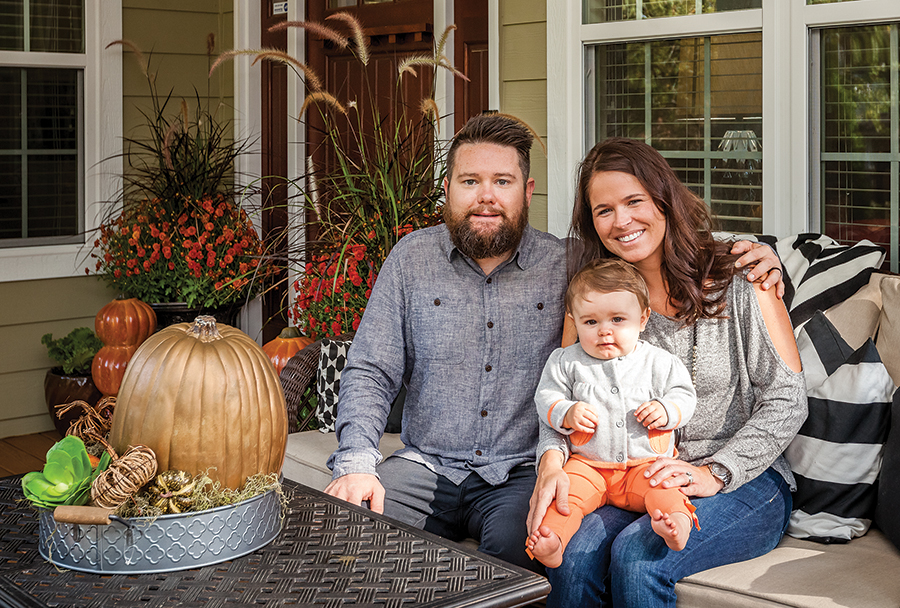
Savvy millennials Ashley and Casey Holderfield built a house to fit, exactly, their lifestyle and demographics. They wanted . . .

A cottage like those built in the mid-1900s near downtown Southern Pines.

A pocket neighborhood popular with other young couples who grew up here, left, and are returning to raise families.

Space skewed per their needs: a huge front porch furnished for entertaining; open interior with large kitchen but small living room and dining nook because “we eat and hang out” at the bar-island, Ashley says.

A shotgun layout with bedrooms off a long unobstructed hall, perfect for 10-month-old Evie’s crawling expeditions.

ps-house3-11-16

Two smaller porches, one for grilling, the other a balcony off the master bedroom.

A vaulted beadboard ceiling with skylights and many windows to stream natural light.

A detached garage, primarily for storage.

Wall space for Ashley’s nascent art collection (including a contemporary splatter painting by the two), furniture in dark woods reminiscent of the Craftsman era interspersed with family heirlooms, like a grandmother’s dining room table, and repurposed finds.

Yes, that bar cart displaying Casey’s bourbon trove was a baby’s changing table, now with tile shelves and brushed metal towel racks. Ashley confidently placed a giant upholstered chair across a tiny corner. Built-in bookshelves keep small objects out of Evie’s reach.

“We use every inch,” Casey says.

Beadboard-paneled doors echo the informality.

ps-house2-11-16

Yet despite a modest 1,600 square feet, the living space and porches have accommodated 30 guests who flow from area to area.

This arrangement bespeaks a professional touch. Ashley studied interior design and architectural planning at Appalachian State University. This is the first home they have owned, therefore her first opportunity to make a statement implemented by a builder-friend who, Casey says, held their hands through the process.

Casey and Ashley have been together since high school, he at Union Pines, she at Pinecrest. They lived in a similar pocket neighborhood in the Myers Park district of Charlotte before deciding in 2010 to repatriate. “My dad grew up in Raleigh so I was familiar with the older bungalow style,” Casey says. Ashley agreed on the motif, which includes tapered porch columns set on brick bases popular in pre-World War II Southern architecture.

Given their definite ideas, new construction seemed more practical than search-and-remodel. But finding an oversized lot choked in bamboo was beyond luck. The couple had made an offer on another piece when Casey’s father discovered this one — and snapped it up.

Ashley and Casey moved in with the senior Holderfields during the six months construction.

ps-house1-11-16

“We oversaw every little detail — I was familiar with suppliers,” Ashley says.       

From the street, a deep setback, mature bamboo and wax myrtles give the house a settled appearance. Pale green siding blends into the foliage. Instead of a walkway, stepping stones through the grass lead to the wide porch, where bold black and white striped fabrics keep the wicker contemporary. Ashley is big on holidays. Fall is their favorite season. Ceramic pumpkins decorate the porch and interior before Halloween, remain in place through Thanksgiving, then lights and multiple trees announce Christmas.

The cottage theme may channel 1930s exteriors, but homes of that era hid cramped kitchens out back. The Holderfields sited their food preparation space a few feet from a front door surrounded by dark-wood panels and moldings. Again, the glass-paned white cabinets suggest informality. The sink, part of the granite island/breakfast bar, faces the living room and mantelpiece-mounted TV. “I like to participate in what’s going on,” Ashley says. However, Casey is the primary cook, while Ashley does the holiday baking.

“Sometimes we open a bottle of wine and cook together,” Casey says. Thanksgiving means a vegetarian brunch followed, later, by roast Tofurkey.

In the master bedroom with a tray ceiling and corner windows (wooden blinds another retro touch), Ashley has, once again, fitted a massive upholstered bed frame into an average-sized room. The guest bedroom has an unusual iron bed, also a family piece. Ashley’s palette throughout derives from nature — deep brown, soft green and, in the master bathroom, oceanic turquoise. “We love the outdoors,” she says, proven by taking a six-month furlough from their jobs to hike the Appalachian Trail in a time frame encompassing the 2014 U.S. Open Championship. Rent from the house supported their adventure.

ps-house4-11-16

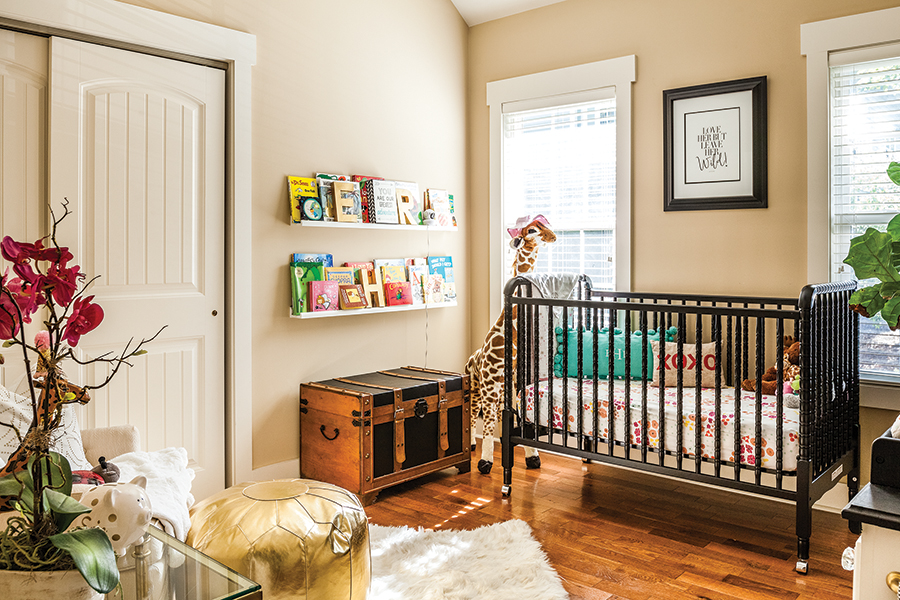
That was before Evie, the princess-resident of the third bedroom. Casey objected to pink, purple, frou-frous, but Ashley found white, sand and teal rather boyish. So, she added a shaggy fur rug and, of all things, a metallic gold fabric ottoman which has become the baby’s favorite, along with a sound machine that lulls her to sleep with a whooshing mimicking the womb environment. Jungle animal prints and a near life-sized baby giraffe complete the assortment.

This nouveau cottage representing trendy urban redevelopment lives well, Casey affirms. Before Evie, they walked downtown to restaurants, bars and First Friday. Now, they and other young parents push strollers to parks, play dates and the farmers market. Later on, the kids will attend public rather than private school, Casey hopes.

“We did a pretty good job for the first time,” he concludes. But, Ashley concedes, now is fast turning into tomorrow.

“It’s almost too small already.”  PS

Landslide

Memories of a campaign that fired up a budding journalist

By Bill Fields

The 1972 election is remembered mostly as a snoozefest because of the landslide victory by incumbent President Richard Nixon over George McGovern, but it woke up an eighth-grader to politics.

I had paid only sporadic attention earlier. I remember the sadness when my mother told me at the breakfast table that Robert F. Kennedy had died after being shot during the 1968 campaign, when we later had a mock election in fourth grade. I recall having a Bob Scott For Governor button and seeing a rare Eugene McCarthy bumper sticker on a car in Southern Pines, where my parents voted at the firehouse precinct on East New Hampshire. That same year, of course, with the Vietnam War and civil rights on the front burner, Jesse Helms was in peak form delivering his conservative editorials at the conclusion of the WRAL Channel 5 television news broadcast, spewed nightly since the year after my birth.

Four years later, as my interests broadened from the sports section to include the real world, I devoured what political news I could get. That meant the Greensboro Daily News that arrived in our yard each morning and forays to the town library to look at The New York Times. One of the Times’ political columnists, Tom Wicker, I would learn later, was born and raised in Hamlet and graduated from UNC-Chapel Hill.

Some Sundays, I settled down in front of Lawrence Spivak on “Meet the Press” and more closely watched the “CBS Evening News” with Walter Cronkite. Scanning the AM dial on winter evenings looking for basketball games from faraway cities, I paused for reports from primaries in New Hampshire or Iowa.

What really fired up my political passion was the presence downtown of the local Democratic and Republican party offices, each of which rented space on or near Broad Street. Although my views had already begun to lean far away from Helms — if he was Manteo, I was Murphy — I was an equal opportunity collector, taking any button or bumper sticker the volunteers for either side would let me have.

Making return visits, I rounded up what I could until realizing that the people manning the offices weren’t too keen on someone who wouldn’t be old enough to vote for a couple of elections hoarding their stuff. The folks were generous enough, though, that I created my own campaign corner in my bedroom, the buttons with their sharp pins and stickers with their pungent smell taking over my bulletin board, new teams to follow in a larger league.

Election Day, Nov. 7, 1972, was quite a day for the GOP. Nixon routed McGovern, winning everywhere except Massachusetts and the District of Columbia. Helms, parlaying the recognition and support from his decade-plus on TV, defeated Democrat Nick Galifianakis for a United States Senate seat in North Carolina. With Scott unable to run because of term limits, Republican James Holshouser beat Hargrove “Skipper” Bowles for N.C. governor.

My immediate impressions of Nixon’s lopsided victory came from the Greensboro paper and the network news shows. “Nixon Wins Re-Election In Landslide,” the large, eight-column headline on the front page blared on Nov. 8. Wicker, acknowledging the rout and trying to look on the bright side, wrote in his Times “In the Nation” column on Nov. 9: “Those of us who have most seriously questioned Mr. Nixon in his first term and in his re-election campaign are all but compelled by the size of his victory to assume the best from him now.”

Like lots of aspiring journalists, before too long I would immerse myself in two books about the campaign: The Boys on the Bus, by Timothy Crouse, and Fear and Loathing: On the Campaign Trail ’72, by Hunter S. Thompson. Although Crouse’s book in particular skewered the rise of pack journalism, those were glory days for print journalism, and newspaper ink was an intoxicating thing.

During college at Carolina, several of us in an advanced reporting class got to huddle with Wicker over a few Heinekens at Harrison’s bar on a Friday afternoon. It was a fascinating couple of hours with a legend generous with his time and his stories, an opportunity that a boy far from a press bus couldn’t have imagined.  PS

Southern Pines native Bill Fields, who writes about golf and other things, moved north 30 years ago but hasn’t lost his accent.

Lauren & Dustin Coffey

LAUREN & DUSTIN COFFEY

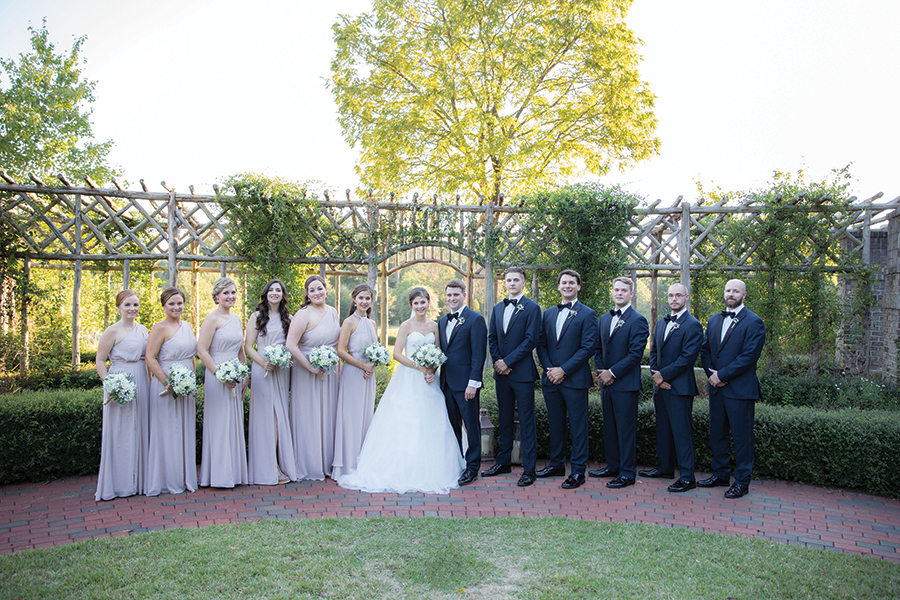
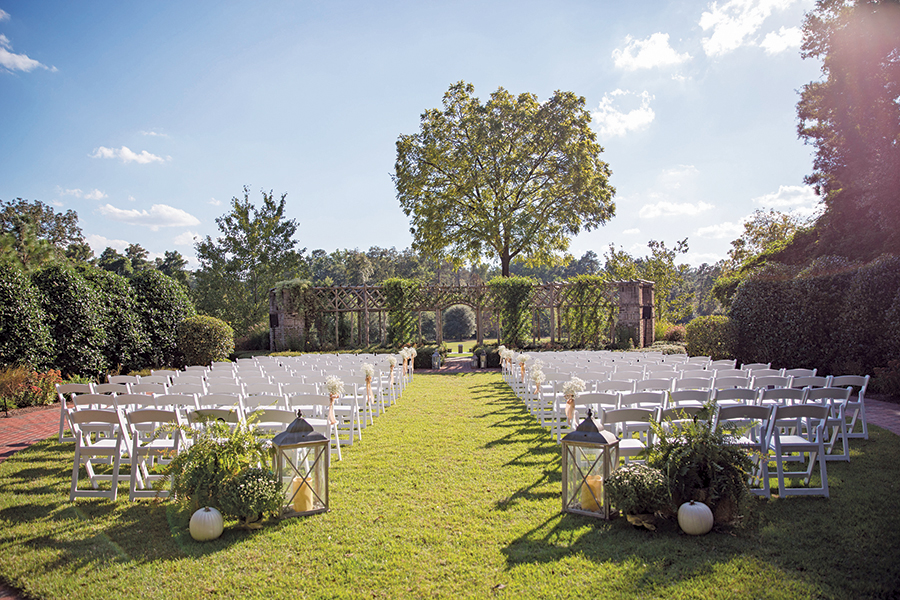
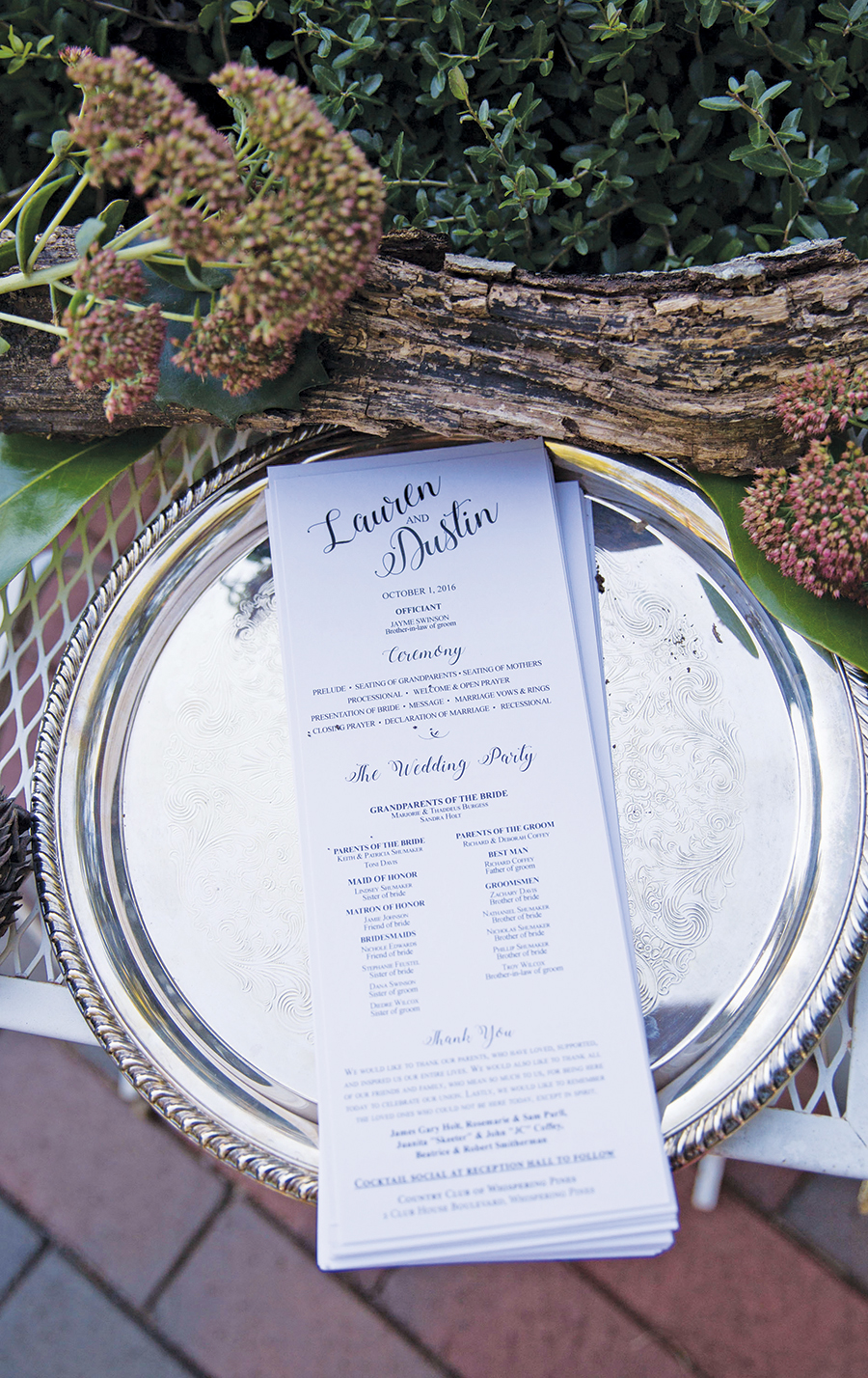
When Maryland native Lauren Shumaker and Dustin Coffey met at the Campbell House in Southern Pines, they did not think that they’d be getting engaged there so many years later. But seven years later, there they were, back in the place where they first met — and on October 1, the couple married on the exact date of their seven year anniversary. It was the little details like these that made their big day so special to them — as wedding favors, they handed out little bags of coffee in honor of their newly shared last name.

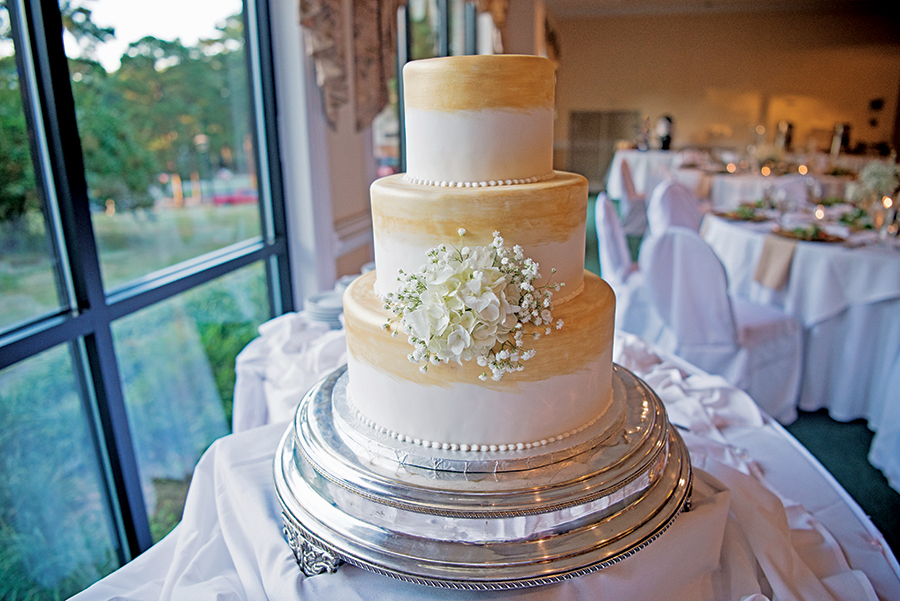
Photography: Boondocks Photography Ceremony: Pinehurst Arboretum | Reception: The Country Club of Whispering Pines, Grand Ballroom | Dress: David’s Bridal | Tuxedos: The Black Tux | Flowers: Carol Dowd, Botanicals | Hair & Makeup: Retro Salon, Hair by Annie, Makeup by Molly | Cake: The Bakehouse

PinePitch

Get Wind of This

Any member of the Golf Capital Chorus will tell you that it’s always a good day for singing, but what makes Saturday, Nov. 5, extra special is that they’ll be joined by international medalists A Mighty Mind for a 7 p.m. performance featuring barbershop harmonies that are downright electric. Tickets for “It’s a Good Day For Singing A Song” are available at The Country Bookshop, Givens Outpost and Heavenly Pines Jewelers, or by calling Larry Harter at (910) 295-3529 or Marty Matula at (910) 673-3464. Pinecrest High School, Robert E. Lee Auditorium, 250 Voit Gilmore Lane, Southern Pines. Info: www.thegolfcapitalchorus.org.

Vessels Made of Clay

The Fall Studio Sale and Open House at Linda Dalton Pottery will be held on Friday and Saturday, Oct. 28 – 29, and Nov. 4–5, from 9 a.m. to 5 p.m. Silent auction features a 13-by-10-inch saggar fired orb with rare North Carolina-grown black bamboo mechanically attached to the lid. All proceeds from the auction of this piece will go to benefit Habitat for Humanity of the NC Sandhills. The Dalton’s studio is located 10 minutes north of the village of Pinehurst. Linda Dalton Pottery, 250 Oakhurst Vista, West End. Info:  (910) 947-5325.

The Music Rx

The fabled healing properties of the Sandhills have long drawn folks to Moore County. Combine that with the curative qualities of an intimate house concert at Poplar Knight Spot and you’ve got yourself a magical formula. Here’s what’s hot at the Spot this month, a Rooster’s Wife lineup sure to spell tonic for mind, body and soul.

Oct. 2 – Harlem-based soul singer/songwriter Caleb Hawley says his two greatest musical influences are Randy Newman and Prince. We say: Yes, please. Tickets: $12 (advance); $15. Listen: calebhawley.com

Oct. 9 – Headliner Danny Barnes speaks banjo. And wait until you hear what The Buck Stops Here has to say in their inimitable Indie meets folk meets Americana-kinda style. Tickets: $15 (advance); $20. Listen: dannybarnes.com; www.thebuckstopshereband.com.

Oct. 16 – Nashville singer-songwriter Irene Kelley is a musical storyteller with a voice like a bluegrass angel. Christiane Smedley opens the show with honest songs that reveal strength through vulnerability. Tickets: $12 (advance); $15. Listen: www.irenekelley.com; www.iamchristiane.com.

Oct. 23 – Slide guitar player and song poet David Jacobs-Strain redefines roots and blues while modern-day troubadour Beth Wood defies labels. Tickets: $15 (advance); $20. Listen: www.davidjacobs-strain.com/home; www.bethwoodmusic.com.

Oct. 27 –April Verch and Joe Newberry. Fiddle plus banjo equals music that will make you feel like step dancing. Tickets: $15 (advance); $20. Listen: aprilverch.com; joenewberry.me/wordpress.

Oct. 30 – Jason Marsalis of New Orleans’ venerable first family of jazz celebrates the release of Heirs to the Crescent City. Tickets: $25 (advance); $30. Listen: jasonmarsalis.com.

Doors open at 6 p.m. All shows start at 6:46 p.m. The Rooster’s Wife, 114 Knight St., Aberdeen. Info: (910) 944-7502 or www.theroosterswife.org.

Top Shelf

Three North Carolina authors will be inducted into the North Carolina Literary Hall of Fame on Sunday, Oct. 16, at 2 p.m. Inductees include best-selling author Clyde Edgerton, prolific mystery writer Margaret Maron, and Pulitzer Prize-winning poet Carl Sandburg. Program participants include Rhonda Bellamy, H. Tyrone Brandyburg, Talmadge Ragan, Bland Simpson, Shelby Stephenson, George Terll and J. Peder Zane. The Hall of Fame is located in the former study of James Boyd, the historic literary gathering place said to have “launched the Southern Literary Renaissance” in the 1920s and 30s. Reception to follow ceremony. Free and open to the public. Weymouth Center for the Arts & Humanities, 555 E. Connecticut Ave., Southern Pines. Info: (910) 692-6261 or weymouthcenter.org.

ps-pinepitch2-10-16

Shaw Season

The eighth annual Shaw House Fair of Vintage Collectibles happens on Saturday, Oct. 8, from 9 a.m. to 4 p.m. Located on its original foundation at the crossing of the famed Revolutionary Pee Dee and Morganton roads, the historic Shaw House was built circa 1820 by a first-generation Scottish settler whose son became the first mayor of Southern Pines in 1887. Come for the vendors and collectibles, food and live music, raffle, historical reenactors from Civil War days and frontier times, demos of old-time crafts, and tours of the homestead. Admission: $2. Proceeds go to maintain the Moore County Historical Association’s five house museums from the 1700s and 1800s, located in Southern Pines and Carthage. Shaw House, 110 W. Morganton Road (corner of Broad Street), Southern Pines. Info: (910) 692-2051 or www.moorehistory.com.

Glad We Met

This month, the Sunrise will stream two Metropolitan Opera performances and a Bolshoi Ballet production — live and in HD. 

Saturday, Oct. 8 – Live via satellite, Wagner’s “Tristan und Isolde” runs from 12–5:05 p.m. This three-act opera is widely acknowledged as one of the peaks of the operatic repertoire. Tickets: $27.

Sunday, Oct. 16 – Direct from Moscow, Bolshoi Ballet’s “The Golden Age” runs from 1–3:20 p.m. With its jazzy score, this ballet is a colorful and dazzling satire of Europe in the Roaring 20s. Tickets: $25 (adult); $15 (child).

Saturday, Oct. 22 – Live via satellite, Mozart’s “Don Giovanni” (with English subtitles) runs from 1–4:22 p.m. Based on the legends of Don Juan, a fictional libertine and seducer, this two-act opera blends comedy, melodrama and supernatural elements.

Sunrise Theater, 250 NW Broad St., Southern Pines. Info: (910) 692-8501 or sunrisetheater.com.

All Keyed Up

On Thursday, Oct. 13, 7 p.m., piano and vocal duo Dr. Jaeyoon Kim and Seung-Ah Kim will perform a free concert at Sandhills Community College. A native of Pusan, Korea, Seung-Ah Kim teaches piano at the University of North Carolina at Pembroke (UNCP), where she plays for a guest artist recital series that has included world famous musicians such as Øystein Baadsvik (tuba), New York City opera singers Anna Vikre (soprano) and Rod Nelman (bass), Dr. Terry Everson (trumpet), and Michele Gingras (clarinet). Praised for his lyric tenor repertoire, her husband, Dr. Jaeyoon Kim, is an associate processor at UNCP whose operatic credits include principal tenor roles in “The Tales of Hoffmann,” “La Bohème,” “Don Pasquale,” “The Merry Widow,” “The Merry Wives of Windsor,” “The Magic Flute” and many others. In 2016, the Kims released Romantic Art Songs, an album featuring art songs by Donizetti, Bellini, Turina, Liszt, Duparc, Rachmaninoff and Tosti. You won’t want to miss this free performance. Owens Auditorium, 3395 Airport Road, Pinehurst. Info: (910) 695-3828 or sandhills.edu.

The Wide Blues Yonder

The last First Friday of the season happens this month, which makes us feel kind of blue, but we won’t sulk just yet. On Friday, Oct. 7, from 5–8:30 p.m., don’t miss the chance to experience Blues Music Award-winner Danielle Nicole (singer/bassist/songwriter) and prodigious blues guitarist Lakota John doing what they do best — stirring our blues-loving souls — at this concert series season finale. Danielle Nicole has a voice like chocolate ganache, and you can hear Lakota John’s old soul sing through his slide guitar. Rain or shine, First Friday concerts are free and open to the public. Food and beverages available for purchase. The Preservation Green (grassy lot) adjacent to the Sunrise Theater, 250 NW Broad St., Southern Pines. Listen: www.daniellenicolekc.com; lakotajohn.com. Info: (910) 692-8501 or firstfridaysouthernpines.com.

Recurring Dream

I stumble from a ladder,

mis-stepping through a rung —

preoccupied, peering up

to some lofty destination,

a change of venue for star-gazing.

During the thrill of ascension,

I loosen my grip, testing

if some trinity might rescue me.

And I fall, dream after dream,

each time I reach the REM —

stratum by stratum, through ice crystals.

Snagged in the belly of combed clouds

I release all I am into wind

free-falling as a piano tinkles

a light-hearted etude.

— Sam Barbee

How to Save the World — One Garden at a Time

Choosing plants that promote biodiversity

By Jan Leitschuh

It’s the web of life, local-scale.

Outside our vegetable gardens — where it seems everything is trying to eat our tomatoes, cabbages and squash — it’s a potential desert out there for insect life, says a prominent naturalist. They don’t have enough to eat.

What, you say? Don’t care about bugs and crawlies? Good riddance?

Understandable, but quite shortsighted, says Dr. Douglas Tallamy, University of Delaware professor and chair of entomology and wildlife ecology. Birds, butterflies, amphibians and animals — and humans — all depend on the biodiversity of native plant communities. And without biodiversity, he says, “They are starving. Many bird species, for example, have declined drastically in the past 40 years.”

This bald fact has profound implications for the human race.

Tallamy is speaking at the Fair Barn in Pinehurst Oct. 30 on “Restoring Nature’s Relationships at Home,” sponsored by Save Our Sandhills. He wants you to know this: As we witness natural systems crashing around us, ordinary citizens are a critical piece of the puzzle going forward.

“It’s in our own self interest to care,” he says, and to care deeply. “We are literally supported by the natural systems that surround us. And the plants form the foundation for the web of life that surrounds us. It is biodiversity that runs the ecosystems that support us.” He pauses for emphasis, and then repeats: “We are supported by natural systems.”

In other words, there’s no more “out there” out there. We have to begin with our own residential landscapes.

Native Sandhills and North Carolina plants evolved in specific local weather, soil and terrain conditions; local bugs, animals and birds adapted right along with them.

We all know by now that native plants are naturally better adapted to a given area.

“Natives have proven themselves to be adapted to what Mother Nature provides in a particular area. They do not need the additional care that most imported plants do,” notes Dee Bartlett Johnson, coordinator at Sandhills Community College’s landscape gardening department. “ If we are trying to lessen our impact on the environment, natives are certainly the way to go; less water and less fertilization are needed.”

And there are even deeper reasons: life itself.

“By restoring natives to our landscapes, we are restoring life to our residential properties,” says Tallamy. We add back critical links in a fragmented habitat, habitat that is needed to restore balance to natural systems.

“There really aren’t enough natural areas anymore to support the biodiversity of life,” says Tallamy, “and those that do exist are chopped up and fragmented. By planting native species on our residential properties, we connect those habitat fragments, throw them a lifeline. Most people think nature is happy and healthy ‘somewhere else’ but there is no ‘somewhere else’ anymore.”

Native plants occupy essential spots in the local ecosystem. “They don’t call it an ecoSYSTEM for nothing,” says Tallamy. “It is a system. Nature, by its very nature, creates specialized relationships between plants and animals in a given area.”

It’s the cosmic dance of interaction and interdependence. The premise of Tallamy’s talk is simple: Native plants evolved in concert with local insects, birds and animals, thus native plants provide for their food and habitat needs better than plants from elsewhere.

Native species are necessary for insects and animals to thrive because they provide critical food and habitat for life. “We plant the beautiful ornamental from elsewhere because it is flashy, but the end result is local creatures are starving because they simply didn’t evolve with the new landscaping and can’t draw nourishment from them,” says Tallamy, also the author of Bringing Nature Home: How You Can Sustain Wildlife with Native Plants (Timber Press, $27.95).

“I’m not trying to recreate the ancient ecosystem,” he once said in an interview with The New York Times. “That is gone. I’m trying to create biodiversity.”

In an opinion piece in 2015, Tallamy wrote, “Plants are as close to biological miracles as a scientist could dare admit. After all, they allow us, and nearly every other species, to eat sunlight, by creating the nourishment that drives food webs on this planet. As if that weren’t enough, plants also produce oxygen, build topsoil and hold it in place, prevent floods, sequester carbon dioxide, buffer extreme weather and clean our water. Considering all this, you might think we gardeners would value plants for what they do. Instead, we value them for what they look like.”

According to a supporting website, BringingNatureHome.com, “Chances are, you have never thought of your garden — indeed, all of the space on your property — as a wildlife preserve that represents the last chance we have for sustaining plants and animals that were once common throughout the U.S. But that is exactly the role our suburban landscapes are now playing and will play even more in the near future.

“If this is news to you, it’s not your fault. We were taught from childhood that gardens are for beauty; they are a chance to express our artistic talents, to have fun with and relax in. And, whether we like it or not, the way we landscape our properties is taken by our neighbors as a statement of our wealth and social status.

“But no one has taught us that we have forced the plants and animals that evolved in North America (our nation’s biodiversity) to depend more and more on human-dominated landscapes for their continued existence.”

For example, oak trees are a tree species that support an enormous spectrum of biodiversity. “But there are no more woods, not like before,” Tallamy says. “We now find those productive oak trees in our front yards, lining our neighborhoods. By planting native plants, we connect those habitat fragments.”

In a geological age so dominated by humanity’s impact on the environment that scientists have recently labeled it the Anthropocene Era, we find that almost 50 percent of the land mass has been transformed by human action. “Our actions have impact,” Tallamy says. “And resolution can begin at home.

“What we’ve done is recognize that plants are pretty. So all these human-dominated ecosystems are going to be decorated with pretty plants. That’s fine in itself, but they often come from somewhere else, often Asia/China.

“Our native ecosystems don’t run on these non-native plants. Native plants, on the other hand, take sun and pass that energy on as food. Insects and other life eat them. These non-native plants are inedible to most insect species here, so they’re not passing their energy on.”

Many of these non-native plants have escaped our gardens and become invasive weed species in nature habitats. Tallamy says that 30 percent of the U.S. plant biomass is now from Asia. “Our natural areas are invaded,” he says.

Most birds rear their young on caterpillars. “It takes 6,000 to 9,000 caterpillars to raise a brood of chickadees. Look at the tiny space of habitat for all those birds crammed in there, 70 to 80 percent in human created areas,” Tallamy says.

“I compared a young white oak in my yard with one of the Bradford pears in my neighbor’s yard,” he wrote. “Both trees are the same size, but Bradford pears are ornamentals from Asia, while white oaks are native to eastern North America. I walked around each tree and counted the caterpillars on their leaves at head height. I found 410 caterpillars on the white oak (comprising 19 different species), and only one caterpillar (an inchworm) on the Bradford pear.”

Tallamy and his wife spend their free time clearing their acreage of autumn olive, burning bush, bush honeysuckle, barberry, miscanthus ornamental grass and other non-native invasives. “It’s a very long list,” says Tallamy. “There are a few key genera of plants that produce about 75 percent of the food. Planting native oaks as a street tree, for example. They support 557 types of caterpillars versus the imported zelkova, which supports zero species of caterpillars. So, if you’re a chickadee, we need a few powerful genera. We can have that crape myrtle, it’s noninvasive — but if it’s all crape myrtle, we’re in trouble.”

Native plantings need not be boring, says SCC’s Johnson. “Many of our natives have amazing blooms,” she says, “but beyond that many of them have year-round interest such as interesting foliage, wonderful fall color and interesting branch structure in the winter. Azaleas will not give you those kinds of interest, and they will be a lot more work than the natives.”

Lawn is unhelpful, notes Tallamy. “It doesn’t sequester carbon, doesn’t help support food webs, or support water systems,” he says. His proposal? “ Let’s cut lawn areas in half. If we all did that, we’d have a new, homegrown national park, 20 million acres in size, scattered all over the place.

“Planting natives is fun, it exposes the kids to nature, and most of all it recognizes that everybody on this planet has a stewardship role. Because it’s the only place we’ve got.”

Three of the top six invasive, non-native plants mentioned by the Smithsonian Insider website include:

Japanese honeysuckle (Lonicera japonica) vs. alternative natives such as Trumpet creeper (Campsis radicans) and coral honeysuckle (Lonicera sempervirens).

Japanese barberry (Berberis Thunbergii) vs alternative natives such as Shrubby St. Johnswort (Hypericum prolificum) and winterberry (Ilex verticillata).

English ivy (Hedera helix) vs. alternative natives such as creeping mint (Meehania cordata), Allegheny spurge (Pachysandra procumbens) and creeping phlox (Phlox stolonifera).

In the vegetable and flower garden, says Taylor Williams, Moore County Cooperative Extension, gardeners may wish to include caterpillar-feeding members of the fennel (Apiaceae) family, including dill, fennel, coriander, etc. Also, all members of the mint family, including basil, lavender, oregano, thyme, bee balms and more in addition to many members of the aster family, especially goldenrods and yarrow, sunflowers, rudbeckia, and Indian blanket.  PS

Dr. Douglas Tallamy’s talk is at 2 p.m., Oct. 30, at the Fair Barn, 200 Beulah Hill Road S., Pinehurst, NC 28374. Admission is free but registration is required. Call 910-295-1900 or register online at www.surveymonkey.com/r/Tallamy.

Jan Leitschuh is a local gardener, avid eater of fresh produce and co-founder of the Sandhills Farm to Table Cooperative.

Patriotic Ladies

By Cos Barnes

The goal of the Army Arlington Ladies is to make sure no soldier will ever be buried alone at Arlington National Cemetery.

Army Chief of Staff Gen. Creighton Abrams is given credit for starting the Arlington Ladies, but in fact it was his wife who created the Army’s version of the organization in 1973 after getting approval from the chaplains. The Air Force began the practice in 1948.

To be eligible for membership an applicant must be sponsored by an active member. Presently there are approximately 75 members. Composed of all volunteers, the organization’s members are wives or widows of soldiers of all ranks, on active duty, retired or deceased, and also ladies who are active or retired military.

Army Arlington Ladies represents and extends sympathy on behalf of the chief of staff of the United States Army and the entire Army family to the next of kin.

Two women are scheduled to work each day, Monday through Friday. Each is provided with an official military escort from the 3rd United States Infantry Regiment, “The Old Guard.” Following the presentation of the flag to the next of kin, AAL sends a condolence card from the chief of staff and his wife, a card from the AAL and other cards of condolence.

The weather never prevents AAL from performing its duties. Through thunder and pouring rain Arlington Cemetery continues its solemn mission even if the government is closed due to weather.

My daughter recently became an Arlington Lady. I am proud of her service. PS

Cos Barnes is a longtime contributor to PineStraw magazine. She can be contacted at cosbarnes@nc.rr.com.

The One That Got Away

A true (and only slight) fishie tale

By Sara Phile

A few years ago, when my boys were 8 and 3, we were renting a home in downtown Southern Pines. Since having a pet would have cost us more, we did not have any. Well, except a fish. “Fishie,” a blue beta, moved into our lives shortly after we moved into our house. The boys could not agree on a name for him. One wanted to name him Harold the Helicopter, the other wanted to name him Spiderman, and there was absolutely no room for compromise, so I made an executive decision and declared his name “Fishie.”

Well, after a few years, Fishie passed away.

I remember that day so clearly because when I found him lifeless under a plant, I was surprised that he lasted as long as he did, and here are a few reasons why.

One afternoon, a few months prior to Fishie’s death, I couldn’t find my phone anywhere, which wasn’t exactly an uncommon occurrence. I had called it numerous times and looked around for a few hours. Kevin, the 3-year-old, was notorious for “hiding it” in random places: under his bed, in his train sets, under the bathroom sink, in the dryer, just to name a few of his favorite hiding spots.

Suddenly, it clicked. I knew he knew. I waited until he was playing contently with his trains before I asked him.

“Kevin, where’s Mommy’s phone?”

“Ow, I don know, Mommy.” Sheepish grin.

“Kevin, where’s Mommy’s phone? I know you know.”

“I don know, Mommy.” His brown eyes darted to the left.

“Yes you do. Tell me now.”

“Well . . . Mommy. Fishie needed to call someone.”

Oh no. A quick glance into the fish tank confirmed that Fishie did indeed need to call someone. In fact, he had been “on the phone” for hours.

There was no reviving my phone, but Fishie was fine.

Another time, after dinner, I realized there was . . . uh . . . something abnormal about the fish tank. As I looked closer, I realized there were peas, yes peas, in there. Along with bread crust. And an entire banana. Sigh. So this was why Kevin had finished dinner unusually early that evening and declared he was “ready for dessert.”

One time the entire can of fish food was dumped into the tank. I caught him (Kevin) in the act of that one and was able to yank Fishie out and rescue him from the downpour.

After I realized Fishie had died, I unplugged the tank and carried it into the bathroom. I dropped Fishie into the toilet, but in the process accidentally dropped a few marbles in as well. I was attempting to retrieve the marbles with the fish floating around the commode when 8-year-old David peeked in the halfway open bathroom door and said, “Uh, Mom, what are you doing?”

“Oh, just trying to . . . uh . . . retrieve something.”

“What?” He blinked.

“Marbles,” I said, as if fishing marbles from the toilet bowl was the most normal activity.

“How did marbles get in the toilet?”

“Well, uh, the fish died this morning, so I am flushing him . . . that’s just what you do when a fish dies and I dropped some marbles in there too.”

David’s eyes widened and he yelled, “Kevin killed the fish!”

“No, Kevin did not kill the fish. Why would you even say that?”

“Yes, he did! Because of all the stuff he put in the tank!” David wailed.

At this point, Kevin, startled by the commotion, threw open the bathroom door and asked what had happened to Fishie.

“Fishie died this morning,” I said, bracing for the reaction.

“Oh no!” Kevin wailed. “I need to say good-bye to Fishie!”

“You killed him,” David said, matter of factly.

“I not kill Fishie! I need to say goodbye to Fishie!”

At this point I had retrieved the marbles and could still see Fishie’s blue fin under the toilet hole.

“OK, then let’s all say goodbye to Fishie.”

The boys, sullen, crowded around the toilet bowl. Fishie’s blue fin peeked out from the hole, but that was it. Kevin, tears slipping from his eyes, exclaimed, “Goodbye Fishie!” as I flushed our pet. David just glared at Kevin, convinced that this tragic event was his fault.

I mentally prepared for a conversation of where Fishie would go, and if we will see him in heaven, and could we get another fish, but after about five minutes both boys began playing with their trains and didn’t mention Fishie again. I cleaned the tank and put it away.

Since Fishie has left us, we have raised several more betas. Bradley, Thomas, Bubbles and Chuckles, to name a few. And in case you are wondering, Fishie was the only one of them who ever needed to make a call.  PS

Sara Phile teaches English composition at Sandhills Community College.

The Walkabout

In beautiful Edenton, history lives and life moves on Sambo time

By Jim Moriarty     Photographs by Kip Shaw

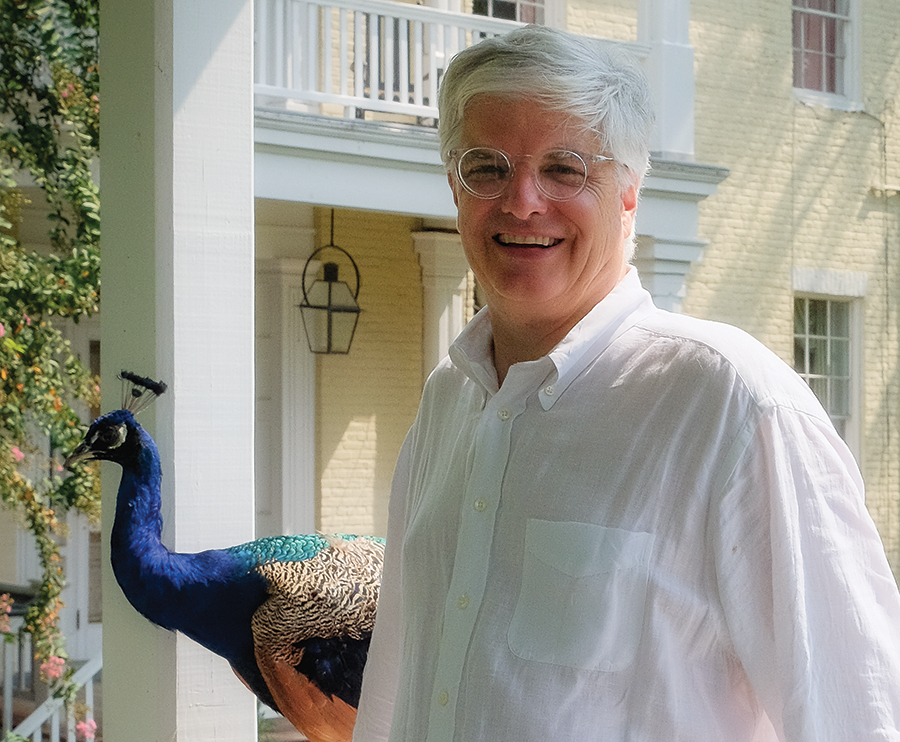
Sambo Dixon wraps his hands around the full quiver of his historic peacock’s tail feathers and repositions the bird to a lookout perch at the top of the garden cupola next to his Edenton house, Beverly Hall. A place for everything and everything in its place. The bird registers its objection with a guttural squawk about half an octave above Harpo Marx’s horn. This was our starter’s pistol.

Trailing behind Dixon on a speed walking tour of Edenton leaves one feeling a bit like the pig at the end of the Michael J. Fox’s leash on a stroll through Grady in Doc Hollywood. There’s not a soul, from mayor to roofer, banker to gardener, who does not greet Edenton’s best-known lawyer when they see him on the sidewalk with his white hair, matching milky opaque eyeglass frames, sockless loafers and khaki slacks. There’s a certain familiarity in a small town attached to someone whose family, on one side or the other, has lived in the same house since 1820.

Dixon is a country lawyer who does a little bit of everything but concentrates on capital cases. His law office is behind Beverly Hall in a building once occupied by slaves. It was his grandfather, Richard Dillard Dixon’s, law office, too. A superior court judge, the elder Dixon was appointed by President Harry Truman to assist as an alternate judge in the Nuremberg tribunals. He tried four cases, including the so-called Doctors’ trial of 23 Nazis. Chief among them was Hitler’s personal physician, Karl Brandt.

Folks scoop up history in Edenton the way most towns recycle plastic. They did it when the old cotton mill closed, turning it into condos and the blocks of workers’ homes into cozy bungalows. Near the peacock’s cupola — the birds’ lineage, spiritually if not directly, runs back a hundred years itself — is an outbuilding Dixon found in Chapanoke, a tiny Perquimans County town, and moved to Beverly Hall as if it was a rusty old Dodge pickup on blocks. He rescued the 18th century house from demolition. “They were going to burn it,” he says as if the prospect was as distasteful to him as drowning puppies.

Dixon stops in front of Beverly Hall as a car rattles down King Street. “That guy, his name is James Bond,” he says, pointing at the car bouncing toward Broad Street, the town’s central business district. “His father buried guns under a church in Edenton during the Civil War.” A mental calculator does a mathematical whirligig and Dixon adds that Bond’s father had been a boy in the 1860s and that Bond, no youngster himself, was a late-in-life baby. We cross King and walk right into Pembroke Hall, a Greek-Revival home on the National Register of Historic Places built in the early 1800s. It’s OK. Dixon was one of the people who pooled the resources necessary to save it. He runs through the sequence of owners like a menu for Chinese food. Workmen are busy getting it ready for the new owner and pay little attention to Dixon, who wants to show off the unobstructed view from the back porches. “It has protective covenants on it,” he says of the vista of Edenton Bay. “There’ll never be anything built over there.”

We cut through Pembroke Hall’s expansive backyard with its ghosts of grand parties past, skip down a few cement stairs and make for the lighthouse beside the small in-town harbor. The wind is blowing off the bay, and it’s hard to catch every word from two strides behind. “Ten-year preservation project,” he says. Then I hear: “It sat at the mouth of the Roanoke River.” There’s something about 1886, which barely qualifies as old in Edenton. “It’s called a screw pile lighthouse because they screwed these things into the sound floor.” We climb up the twisting staircase to the top and duck through an opening onto a tiny catwalk. A workman follows us. He doesn’t want anyone falling through the hole in the floor. Dixon assures him of our agility. “Here’s my favorite part,” he says. “We’ve got the fresnel lens now. We’ll put that back in, hopefully sooner rather than later.” Dixon points across the bay. “That’s Queen Anne’s Creek and that’s Pembroke Creek. Right across Albemarle Sound is where they think the Lost Colony went. You been following that?” It’s known as Site X, discovered after an X-ray examination of a watercolor map drawn by Gov. John White in 1585 indicated the possibility of the existence of the inland location.

ps-edenton2-10-16

And we’re off again, walking down the salvaged parts of the old Chowan River Bridge, cut into sections and made into a breakwater, creating a small sheltered port for boats traveling up and down the Intracoastal Waterway. Behind the lighthouse is the old Edenton Ice Company building. John Conger Glover, formerly of Harris Wholesale Inc., wants to turn what had been his grandfather’s obsolete business into a modern brewpub. “We have a lot of young families now, which is a rarity in eastern North Carolina,” Dixon says.

He explains how even by the late 1700s, the bay was already too shallow to accommodate the larger ships. A hurricane in 1795 would close the ocean inlet completely and Edenton would stay forever small. “My crowd,” is the way Dixon singles out his ancestors. One of them, William Badham Jr., another lawyer, formed the Edenton Bell Battery. “They melted down the church bells and made them into cannons. Captured at the Battle of Town Creek. (One of them, anyway.) They weren’t found for another 125 years. You don’t see many bronze cannons,” he says.

The six-pounder is named Edenton, the 12-pounder St. Paul. The first was found on display at the Shiloh National Military Park and the second at Old Fort Niagara. They’re positioned outside the Barker House, the town’s visitor’s center. Dixon climbs the stairs. “Hey, how you doin’?” he says to a stranger coming out, the first person he’s seen that he doesn’t know. “First political activity by women in America,” he says of the Edenton Tea Party of 1774. “This was the lady. This was her house.” Like the lighthouse, Penelope Barker’s home was moved from its original location two blocks north to the spiffy spot on the water it occupies now. Outside there are more cannon. “These were brought over by a Frenchman on something called the Holy Heart of Jesus (Coeur de Saint Jésus) and nobody would pay for them so he got mad and sunk the ship. At some point they went out and pulled them up. They tried to shoot them during the Civil War when the Northern troops were coming in, and they said it was more dangerous to stand behind them than to stand in front of them.” He points to the scraggly cluster of cypress in the water a few yards away. “That’s the dram tree. Ships coming in would bring West Indian rum and put it in a little bottle and ships going out would make a toast,” he says.

We head toward the Colonial green by way of the path along the water. Two men are fishing. From a distance it looks like all they’ve caught are a couple of missionaries in white shirts and dark ties. Dixon even loves the water in Edenton. “It’s fresh water, too,” he says. “No barnacles. No sharks. No jellyfish.” He asks the men with the poles if they’ve caught anything.

“A mess of white perch,” one replies.

“Good enough to eat?”

“Oh, yeah.”

We cross the street and Dixon knocks on the side door of the house called Homestead. Frances Inglis tells us to come in. While her voice has the quaver of time and her frame is slight, she still has the stamina to command a division of volunteers in straw hats and gardening gloves armed with hand trowels to maintain the grounds at the Cupola House. Inglis played a central role in saving the Jacobean-design house, a National Historic Landmark built in 1758 and the first community-inspired historic preservation in the state of North Carolina. We take a quick tour of Homestead and its double porches. “See through and breeze through,” she says. On a table sits a signed letter from Orville Wright, framed along with a piece of fabric. The note, with handwritten corrections, reads:

As a token of my appreciation of your courtesy in surrendering a piece which you had of our 1905 plane, I present to you two pieces of the “Kitty Hawk” which flew at Kill Devil Hills on December 17, 1903.

I authenticate the above pieces as genuine parts of the original “Kitty Hawk,” plane. They are from parts broken when the plane, while standing on the ground, was overturned by the wind after the fourth flight of the day.

Inglis explains her family had a beach house at Nags Head. “My father had a little canvas canoe. He used to paddle up from the cottage to the sight of the Wright brothers. They had abandoned the place. He gathered up this thing that was a wing tip of the 1902 glider. He had parts of the 1905 plane, the first one to fly two people.”

Next to the Wright brothers table is a wooden chest. On top of the chest is a woven basket of African design, made in the 1850s. The small trunk underneath is the camp chest of Tristrim Lowther Skinner — one of Inglis’ crowd. Inside are his sash, insignia, epaulets and a belt drawn in because he was losing weight. He was killed in 1862 and when she’s asked where, Inglis replies, “Mechanicsville,” in a voice so soft it’s as if the news just arrived. “Trim, they called him,” she says. The Skinner family papers, including letters home from the battlefield, are in the Southern Historical Collection at UNC-Chapel Hill.

Outside Homestead, we race past a large monument. “This is the Joseph Hewes Memorial. He was great friends with John Paul Jones. That’s about him,” Dixon says with a sweep of his hand.  At the other end of the green we hop up the steps and enter the front door of the Chowan County Courthouse, a National Historic Landmark built in 1767, and the oldest active courthouse in North Carolina. The state Supreme Court still convenes there for ceremonial occasions. “They sit up there on those hard, terrible benches, but they love coming here,” Dixon says. Inside, there’s a welcoming committee of two, Judy Chilcoat and Carolyn Owens. One of the ladies taught Sambo Dixon math. He apologizes for that less than stellar bit of history. We go upstairs to the central window facing the green below. “When they ratified the Constitution and the Declaration of Independence and the Articles of Secession, they read them out of this window to the people down below. We had a signer of the Declaration of Independence, a signer of the Constitution and a person on the first Supreme Court from here,” says Dixon.

Behind the courthouse we pass the empty jail building, oldest in the state. Dixon wonders out loud what it might be repurposed for. Perhaps something servicing the nearby 60-room boutique hotel planned for the old Hotel Hinton, a 20th century testimonial to utilitarian architecture already upgraded once into county government offices and then downgraded into deserted. We skip onto Broad Street, a small commercial district so 1950s if you didn’t see Michael J. Fox with his pig, you might see him screeching by in his DeLorean. Dixon points out the bank. “The story I’ve always heard,” he says, “is that during the Depression, there was going to be a run on the bank, so a bunch of local folks went to the mint and got a bunch of one dollar bills and put hundred dollar bills on top and said the bank was safe and it wasn’t.”

Next is St. Paul’s Episcopal Church, organized in the Vestry Act of 1701. “That’s all my crowd,” Dixon says with a gesture so expansive it’s as if the gravestones were acres of corn with too many ears to pick just one. “I’ve got the pew rent books at home from the 1840s. I’ve got 10 or 11 generations buried in this church.” We walk inside and he looks around at the altar and the balconies. “Every part of my life would begin and end here,” he says.

Someone is trimming hedges as we leave. There are vines intertwined with the shrubs, and Dixon offers advice. “Pull them out like this,” he says. “Don’t break them. Put newspaper around them and spray them with Roundup. It goes back to the root and kills them.” Perhaps the only endangered roots in Chowan County.

“These are 1900s houses. That’s the Conger House. It’s got a ballroom,” Dixon says as we march down Church Street. We walk up to the back door of a small house. It belongs to Daryl Adachi, who moved to Edenton after getting chased out of his renovated Vermont schoolhouse by cold winters a decade or so ago. He head-hunts for financial services companies from his computer.

“This is my where-in-the-world-have-you-been room,” says Adachi. “I’ve got France and Italy and England and Mexico and China.” There is a dead icons room with black and white photography of the Kennedys, Elvis, Dr. King and Marilyn. In another room there’s a wall for his alma mater, Notre Dame. And an Asian room. “I lived in Hong Kong and Japan for a while,” he says. “I subscribe to the Sambo Dixon theory of interior decoration — fill every piece of wall, fill every single table. Make sure there is no space that’s left untouched.”

Robert Beasley is back in town, too. He bought the Granville Queen Inn in June of last year and if it’s possible to give the impression of profound gentleness in a single meeting, Beasley is your guy. Born in Edenton, he grew up in nearby Tyner, attended North Carolina A&T and had a career in business services in the D.C. area. “My grandmother, Vashti Twine, worked for one of the wealthiest ladies in Chowan County, Eliza Elliott. I would go with her some days in the summer when she went to the house to pick the vegetables or dust the house because the lady was always traveling. She had this mansion and all these beautiful things. It did something to me, going with her and having an appreciation for the finer things.” The appreciation found expression in the Granville.

On our way back to Beverly Hall, we cut through the engineering marvel of Wessington, the 1850s Georgian mansion next door. Purchased by Richard Douglas, from Charlottesville, Virginia, it has a geothermal power plant that looks like the guts of a nuclear submarine, or what one imagines the guts of a nuclear submarine might look like.

We come full circle in Dixon’s living room. “The house was built as State Bank of North Carolina in 1810,” he says. “They have all this early interior security. There are iron bars that go across the windows at night. Here’s the vault. The two burn marks? The way it stopped being a bank was the teller embezzled all the money, put the books on the floor, set them on fire. There was a run on the bank. He ran out in the back yard and shot himself, but people were so angry they took him down to the courthouse and tried him after he was dead and hung him on the green.”

Dixon points out the Civil War camp chest belonging to William Badham — his crowd. There’s a set of dueling pistols and a silver service. A book by James Iredell, Edenton’s member of the first Supremes, is in a library full of books with old notes and pressed flowers inside. “You never know what you’re gong to find in them,” he says.

Dixon looks at his watch. “I got to go see a guy in jail about a murder.”  PS

Photos of Edenton by Kip Shaw accompanying this article can be found in Hospitality, Edenton Style to be published in November by Pembroke Bay Press, 2333 Locust Grove Road, Edenton, NC 27932.