The Curious Case of Granville Deitz

The twists and turns in the life of the man who gunned down the chief of police

By Bill Case

Southern Pines Police Chief Joseph Kelly made a point of stationing himself at the corner of Massachusetts Avenue and May Street as grade school let out on Wednesday, March 20, 1929. His presence was little more than a casual reminder about the new stop signs installed for the cross traffic going up and down Massachusetts’ steep slope. The first day of spring was tomorrow, but Kelly would barely live to see it.

Parking his cruiser near the school wasn’t exactly high-intensity police work, though May Street had seen some notable exceptions. It doubled as part of what later became State Highway 1, and movers of bootleg liquor would inevitably pass through town. On one occasion a speeding motorist failed to heed the chief’s command to stop. Kelly leaped on the sedan’s running board as the driver swung a hammer at him. Eventually subdued, a search of the stranger’s automobile revealed a cache of contraband hooch. It was reason enough to carefully eye the traffic moving through the intersection on a crisp, sunny afternoon.

It’s unknown why 27-year-old Granville Deitz, a native of mountainous Greenbrier County, West Virginia, happened to be in Southern Pines, driving east on Massachusetts. He later said he was on his way home from Florida. Already wanted on the charge of burglarizing a U.S. post office and for holdups of several small town stores and gas stations, he was a man with something to hide.

Deitz blew through the recently installed stop sign, and Kelly motioned for him to pull over. He complied, parking on Massachusetts just west of the intersection. As Kelly approached the Chevy, something must have aroused his suspicion. Whether it was the car’s South Carolina license plate, the young man’s demeanor or the suspicious tools in the back seat, the chief guessed the slim, dark youth was bootlegging whiskey. At Kelly’s command, Deitz stepped out of the car. The chief bent over to commence his search. According to Deitz, he became angry when Kelly began reading loose mail left in the car. Blows were exchanged and Kelly reached for his gun. Claiming “it was either me or him,” Deitz fired four shots from his own revolver at a distance of three or four feet before Kelly could draw his weapon. A witness, local contractor E.V. Perkinson, gave a far more damning version of events. He testified that as soon as Kelly turned his back and leaned over, Deitz whipped out his gun and fired away.

Kelly was in a bad way, but somehow managed to stagger to his patrol car and drive one block to the residence of Dr. William C. Mudgett, where he collapsed to the ground. Dr. Mudgett made Kelly as comfortable as possible and summoned an ambulance to transport the gravely wounded chief to Highsmith Hospital in Fayetteville, an agonizingly long ride. The Sandhills did not yet have a hospital, though the cornerstone for the new Moore County Hospital had been laid the day before Deitz riddled Kelly’s body with bullets. The 51-year-old police chief died at 2 a.m. the following morning. He was survived by his wife and one child.
Meanwhile, Granville Deitz was in full flight. Abandoning his car, he sprinted south down May to Indiana Avenue, where he jumped into an unattended auto and tried to start it. The car’s owner, Homer Eckert, ran from his house to confront Deitz, who quickly concocted a story, explaining that “a man had been shot” and he urgently needed to rush to the Carolina Hotel in Pinehurst to summon a physician who was staying there. Deceived by Deitz, Eckert offered to drive the killer to the hotel. When they arrived at the Carolina, Deitz asked Eckert to wait for him while he located the phantom doc. The gunman slipped out the hotel’s back door and hijacked Mrs. L.L. Leonard’s cream-colored Buick from the nearby Pinehurst Garage (now Clark Chevrolet Cadillac). Soon he was steaming west on dusty Route 211 toward Candor.

Not knowing where the unidentified suspect was headed, Moore County Sheriff C.J. McDonald, Kelly’s Deputy Chief Ben Beasley and Southern Pines Mayor Paul Barnum quickly organized a posse. Fort Bragg dispatched airplanes to search the back roads for the stolen Buick. Meanwhile Deitz continued west through Candor. Fifteen miles beyond Monroe, he jettisoned Mrs. Leonard’s Buick, fled into the woods, and as The Pilot later phrased it, “vanished into thin air.” Not only had the police chief been murdered in broad daylight, the killer had made his escape from Southern Pines with relative ease. It seemed Granville Deitz was gone for good.

Beasley, who took over as chief in the aftermath of Kelly’s death, expressed confidence that the killer would be rapidly brought to justice, but the evidence he obtained searching Deitz’s Chevy wasn’t much to go on. Several different license plates and hotel keys were found along with some newspaper clippings recounting his own criminal exploits. It was as if Granville Deitz was the spiritual offspring of Bonnie and Clyde reading his own press notices. The most helpful clue came from the letter Kelly may have been reading just prior to the gunfire. It was from Mrs. E.W. Boso of Summersville, West Virginia (near where Deitz resided), addressed to J.L. Boso  in Winston-Salem, and signed, “Mother.”

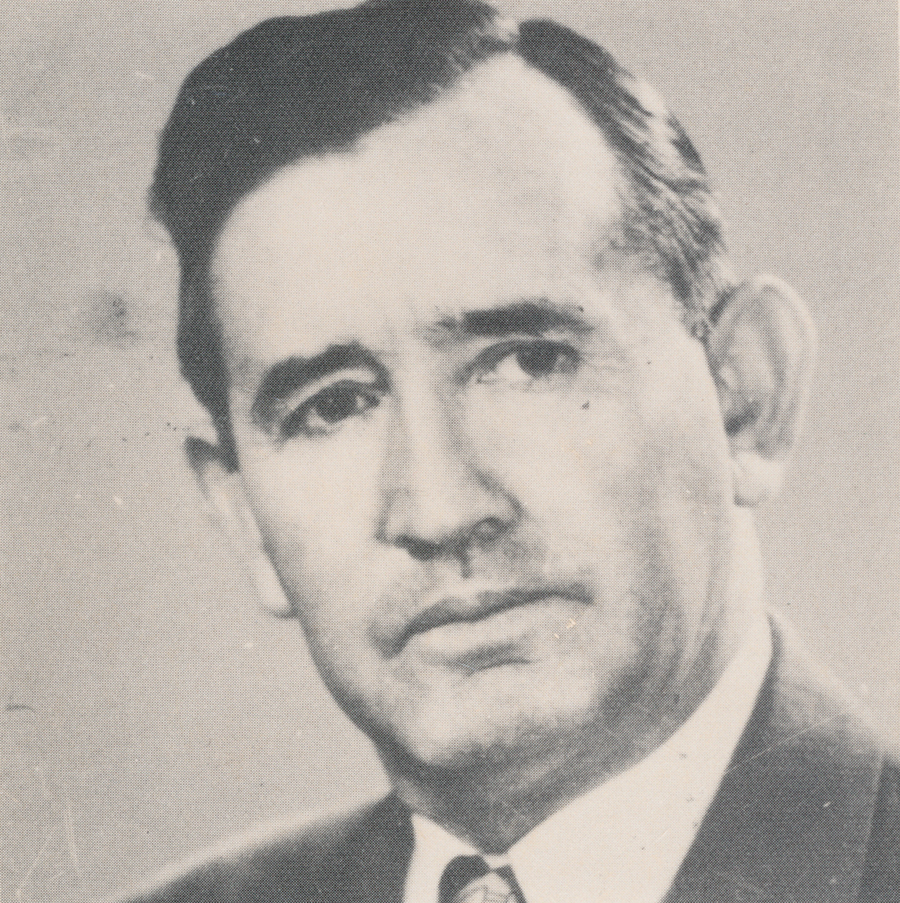
The new chief called the police in Summersville and learned that Boso had been recently apprehended for committing crimes while working in tandem with Deitz, whereabouts unknown. Perhaps it was  Kelly’s discovery of the letter that had been the motive for Deitz’s violent actions. By April 18, The Pilot announced Deitz as the prime suspect in the Kelly killing. The fugitive’s high school picture accompanied the article.

Beasley’s investigation took him to West Virginia, where he learned Deitz had a steady girlfriend in Greenbrier County — Miss Maysel Gibson. While the details are a bit murky, it appears the young lady agreed to cooperate with the police rather than run the risk of aiding and abetting her boyfriend. When it turned out Deitz had fled north to Maine, the authorities asked Gibson to wire him money. A sting was set up in Millinocket, Maine, where two police officers waited for Deitz at the local telegraph office and seized him. He resisted, but to no avail. Beasley’s detective work had resulted in Deitz’s capture nearly seven weeks after the shooting. It was with grim satisfaction that on May 8, Beasley wired the new Southern Pines Mayor A.G. Stutz announcing that he had “Arrived Bangor, Me., 11:30 AM. Stop. Left 1 PM with Granville A. Deitz. Stop. Identification certain. Stop.” 

Extradited to North Carolina, Deitz was charged with first degree murder. The death penalty loomed. The Pilot’s editor, Nelson Hyde, rejoiced. “The man who in brutal cold blood shoots down an officer or citizen is not allowed to go away without the hail of vengeance trailing closely behind him,” he wrote.
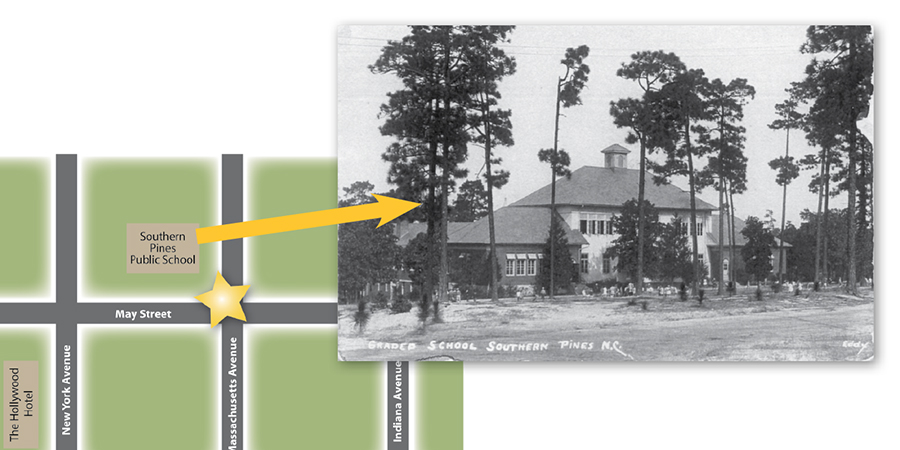
District Judge Thomas J. Shaw set the trial date in Carthage for May 24, 1929 — a mere 20 days after Deitz’s capture. Deitz had precious little time to find counsel, let alone locate witnesses and prepare for a jury trial in which his life was at stake. His mother, Betty Nutter Deitz, rushed in and took charge. She assisted in retaining a defense team, including Fayetteville’s celebrated criminal lawyer Col. C.W. Ostenton. The dusty long-forgotten case docket in the bowels of the Moore County Courthouse show that the defense argued Kelly had no right to arrest Deitz for a stop sign violation, and that there was no evidence of any violation of any ordinance that would have allowed Kelly to detain Deitz. The defense also argued that Granville Deitz “had a right to resist and use all the force which in the judgment of the jury was necessary to free himself.” His argument was akin to a “stand your ground” defense.

The best thing going for the defense, however, was the steadfast support exhibited by Deitz’s family and friends. His mother was said to have “excited much sympathy for her son.” Several locals actually showered Deitz with gifts of books and flowers during his stint in the county jail. The eldest of nine children, Deitz had been the product of a good family. His father, Watson, kept food on the table by teaching, farming, surveying and running the local post office. Deitz’s mother taught school and managed the farm. Dennis Deitz, who idolized his older brother, noted that Granville, though small in stature, reveled in competition in anything, from football to formal debate. “His rebuttals were unmatched,” Dennis Deitz later wrote. “When an opponent made a point and gave his sources and authorities, he would reply by quoting an article from a noted expert, written three years before in maybe the Saturday Evening Post. The judges would be amazed. This unbelievable recall came from Granville’s imagination. The judges or opponents never suspected the truth.” Deitz’s talent with a gun was equally legendary. According to his brother, Deitz could shoot “flying hickory nuts with his pistol from 30 feet away,” and could fire and reload with blinding speed. It proved a lethal skill set.

The lawyers’ technical arguments and family aid weren’t enough for Deitz to overcome the evidence against him, however. The clincher for the prosecution occurred when J.L. Boso’s confession implicating Deitz in their series of gas station holdups was read to the jury. When the Saturday night verdict of guilty to the reduced charge of second-degree murder was read before a packed courtroom, Granville Deitz displayed no visible emotion. He kissed his mother goodbye after being sentenced by Judge Shaw to 25 to 30 years at hard labor in the state penitentiary.

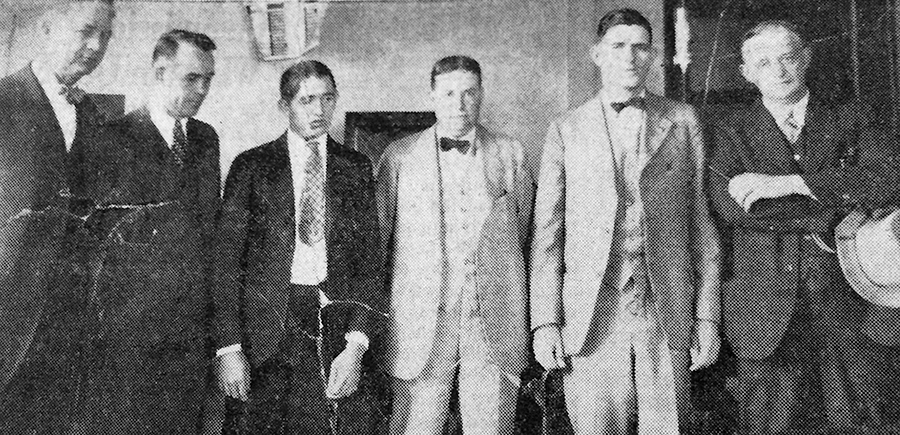
Quite pleased to appear with their somber-looking trophy, the dignitaries who attended the trial posed in a photograph with the uncuffed Deitz. In a public statement after his adverse verdict, Deitz expressed his gratitude for the gifts of well-wishers and appreciation for the manner in which he and his family had been treated. A scathing editorial in the Sanford Herald wondered, “if these same people sent flowers and books to the wife who was made a widow and the children (sic) who lost a father while doing his duty as a sworn officer of the law, at the hands of this bloodthirsty criminal who it is believed took (Kelly’s) life to conceal crimes he had already committed.” In fact, the Southern Pines community had taken up a collection for the benefit of Kelly’s wife and child in addition to raising $2,500 in reward money, $250 of which went to Chief Beasley.

The town collectively breathed a sigh of relief that Kelly’s killer had been brought to justice and would be languishing in state prison for what could be the rest of his life. But Deitz’s escapades were far from over. On Dec. 12, less than seven months after his conviction, Deitz escaped the prison farm by automobile. According to The Pilot, two young women in a car with West Virginia plates had been seen in the area of the prison prior to the escape. Author James Boyd was moved to sarcastic whimsy in his column “Gallberries” carried in The Pilot:

—§—

Granville Deitz by leaving no

address has put some of our people at

a loss.

—§—

They don’t know where to send

him flowers now.

—§—

It was pretty tough to put him

on that farm.

—§—

He ought to have been sentenced

to a greenhouse.

—§—

Just because a man is a murderer

is no sign that he likes life on a farm.

Deitz made his way back home and promptly married Maysel Gibson. Later he remarked, “We knew when we were married that the possibility of eventual capture faced us. But we felt that life without each other would be an empty affair.” Realizing that Greenbrier County would be the first place the North Carolina authorities would look for him, Deitz and his new bride hightailed it north across the Ohio River to Gallia County, Ohio, where he assumed a new name — William Nutter.

Meanwhile, law enforcement and the press in Southern Pines obsessed over Deitz’s whereabouts. Labeled as something of a master criminal, he was the prime suspect in every unsolved crime. Every longleaf pine seemed to have a Granville Deitz lurking behind it. A lone gunman who engaged in a shootout in Heywood County was rumored to be the escaped fugitive. The holdup of a gas station in Vass was thought to be Granville’s work until the suspect was caught in Cheraw, South Carolina, and it was not Deitz after all.

In the July 4, 1930 “Grains of Sand” feature in The Pilot, the question was asked, “Wonder where Granville Deitz is spending the summer vacation?” Actually, Deitz, aka William Nutter, was faring quite well. After having worked in farming and carpentry in Gallia County, he moved 30 miles farther north to Jackson, Ohio, where he caught on with the local Pure Oil distributor making deliveries and collecting bills. Instead of robbing service stations, Deitz was receiving voluntary payments from them. Then, when his boss became ill, “Nutter” was entrusted with running the entire business. He applied himself to the task and kept the operation humming. Maysel taught school and gave birth to Elizabeth in 1931. The William Nutter family  had achieved a high degree of respect in Jackson. Life was as good as it could be for a couple hiding from the law.

But, public fascination with crime and criminals led to exposure. In 1935, a popular detective magazine mentioned Granville Deitz in its “most wanted” section and included his photo. When someone in Jackson saw the picture of the man known as William Nutter, the jig was up. Surely, a shiver ran up Deitz’s spine when police came to arrest him. Taken to the county jail, he awaited extradition to North Carolina once again. But local citizens didn’t turn away from the man they knew as William Nutter. Their outpouring of support led to a petition with 1,000 signatures beseeching Ohio’s governor not to allow his extradition. Deitz later said that the back door to the jail was intentionally left unlocked, but he was done running. Declining his chance to escape, Deitz waived extradition.
“Don’t get me wrong,” Deitz explained. “I didn’t want to come back and serve the long term I’ve got left because it was taking me away from my wife and baby and away from the life in which I was making good . . . There’ll probably be nights when I’ll just lie down and curse myself for not going out that back door in Ohio. But I’ll stop at cursing. I won’t go out any more back doors.”

Chief Beasley never witnessed the return of the fugitive he had labored to apprehend. Like his predecessor, he died in the line of duty, in October 1931, gunned down by a prisoner he was escorting to headquarters. Though reconciled to returning to prison, Deitz wanted out as soon as possible. The family retained Sanford’s J.C. Pittman in 1937. Sheriff McDonald declined to sign a parole petition prepared by Pittman. “Even if Deitz is a ‘changed man,’ I fear it would set a bad precedent for the other prisoners to extend clemency so soon to one who had been an escapee,” said McDonald. With Deitz stuck for the time being, his wife spent her summers in Raleigh taking teaching classes at North Carolina State and visiting her husband.

Lauded as a “model prisoner,” and with the acquiescence of his trial jury and Kelly’s family, Deitz was paroled in October 1940 after only five years of incarceration on the condition that he stay out of North Carolina. “I’m going to West Virginia as fast as I can get there to see my wife and child,” he said. Deitz planned to go back to his old job, which was waiting for him back in Jackson. “I want to go back to being a good citizen.”

We don’t know why, but Deitz decided not to return to Jackson, going instead to his home state of West Virginia, where evidence suggests he became an insurance agent for Mutual of Omaha. A natural salesman, Deitz made a success of his new career and rose to district manager. His entertaining storytelling led to speaking gigs at company sales conventions and local civic clubs, where Deitz would regale the crowd with mountain tales, some true, some folklore. He took the time to write his stories down.

Granville Deitz died in 1966 at age 64 while still on the job with Mutual of Omaha. In 1981, Deitz’s family arranged for the publication of his tales of the hills in a book titled Mountain Memories. A rousing success, it was reprinted three times. Brother Dennis Deitz subsequently published his own popular writings of Mountain Memories one of which discussed the exploits of his revered older brother. Absent in both publications was any mention of an encounter with the law in Southern Pines.

The crime and the killer may forever go unforgiven. Or, perhaps, a life can be redeemed, in part. Either way, Granville Deitz, the omnipresent menace, was a menace no more.  PS

Pinehurst resident Bill Case is PineStraw’s history man. He can be reached at Bill.Case@thompsonhine.com.

Saved by the Dark Side

A family farm goes fungi

By Jan Leitschuh

Mushrooms add a depth of flavor to any number of dishes, meaty, with a hearty umami taste. Growing in dark, damp woodland places, who expected them to save the family farm?

Anyone with eyes has witnessed the shifts in rural agriculture, as the young folk and their young energies leave the farm for opportunities elsewhere, markets wither and long-stewarded properties sell out to housing developers. But some are bucking that trend. Welcome to one 21st century family farm in central North Carolina that has grabbed onto innovation as a way to survive.

Walk into one of the several “barns” on the pretty, rolling acreage here at Carolina Mushroom Farm in Willow Springs. No pink snouts or leathery golden leaves here anymore; hogs and tobacco have given way to at least three types of edible fungi.

Oyster mushrooms, pale and broad, aren’t hard to grow, says Shahane Taylor, 32, one of the four partners in the farm’s mushroom project. He walks to the sterile “prep” building, where special bags of straw are inoculated. Lined up like soldiers in a special 78-degree room are the bags of damp sterilized straw on which the inoculent thrives.

Oyster mushrooms double in size every 24 hours. They have broad, flat, upward-facing layers, and there is indeed a slight oyster-like appearance, unlike the more familiar button mushroom. You can grow oysters yourself, easily, in your kitchen. Besides the actual mushrooms, Carolina Mushroom Farm sells the grow bags too; if you don’t want to do your own research, gather materials, do the sterile prep and inoculation.

The taste of oyster mushrooms? Delicate and sweet. “Like chicken,” Taylor jokes, then adds, seriously, “like a chicken-seafood-y cross.” He likes a vegetable soup with oyster mushrooms.

Valuable shiitake mushrooms are a little trickier and slower to raise. Here, we move to another building where a sterilizing footbath awaits outside the door. Inside, there is another footbath, as well as a hand wash and special ventilation systems with HEPA filters to keep out molds and other contaminants, like foreign spores.

Step into yet another humid, warm room, and metal racks stacked with special blocks of compressed sawdust grow the umbrella-shaped brown caps of the delicate shiitake mushroom, famed for its savory taste and medicinal properties.

Shiitakes have a steak-like flavor that is prized in Asian cuisine, notably miso soup. Very umami, shiitakes are used to top meat dishes, added to stir-fries and used in soups. Shiitake pizza is Taylor’s favorite.

Shiitakes are one of the more popular forms of protein in China, and have a long tradition of medicinal use as well. Apparently, shiitakes have a strong antiviral effect due to natural interferons that inhibit viral replication. It has also been reported that the consumption of shiitake mushrooms lowers blood cholesterol levels.

In Asia, shiitakes are used to support cancer treatments. “Japan has developed an extract from shiitakes known as lentinan. The extract is used with patients undergoing traditional cancer therapy. In fact, in Japan mushroom extracts have become the leading prescription treatment for cancer. Lentinan may also prevent chromosomal damage induced by anti-cancer drugs. There are no known serious side effects,” reports the Mississippi Natural Products Association, a rural farmers’ cooperative.

But trickiest of all to grow are the baby portabella mushrooms.

Here at CMF they are reared on heavy trays of pasteurized compost, alive with beneficial microbes. “They are the most labor-intensive mushroom we grow,” says Taylor. “Baby bellas are especially sensitive in the early stages.”

But portabellas are very popular, so grow them they do. The smaller form, called cremini, is brown and a bit larger than a white button mushroom. They are mild, and can easily sub for the smaller white button ’shrooms in a recipe.

In their most mature form, the creminis grow out to the hefty, popular brown caps we know as portabellas. The large, beefy caps are terrific to grill, fabulous stuffed, and often substituted for meat among vegans. 

Among the three varieties, Carolina Mushroom Farm currently produces 500 pounds of edible fungi a week. They are scaling up quickly to 1,000 to 1,500 pounds in the near future. The quality of the product is excellent, and packaged professionally. Yet, this ambitious venture only came into being in late 2015.

How did this happen to a small family farm in mid-North Carolina? You could start this tale with the farm itself, or begin it in the Marines.

In the Marines, Dion Heckman, 28 and the second of four partners, was a roommate and good friend of Taylor. When they got out of service together in 2010, they continued to hang out.

“We got along really well, it’s just one of those things,” says Taylor. “Dion had a girlfriend who lived near Raleigh, so I’d come visit. And when we got out, Raleigh happened to be where we landed.” There is muffled conversation, and then Taylor comes back with a laugh: “Dion says to tell you he’s the brains of the business.

Both went to Wake Tech on the G.I. Bill, and that’s where Taylor met dark-haired Sabrina in late 2010. Now his fiancée, Sabrina is the daughter of agricultural speaker Jerry Carroll. Jerry is the third of the four mushroom farm project partners. The fourth, Steve Carroll, is Jerry’s brother and a research scientist for BASF.

Dating Sabrina, Taylor naturally got to know her dad Jerry, and got on well with both parents.

Jerry Carroll had been a farm producer, with 6,000 hogs and fields of tobacco on the family land, but saw the agricultural writing on the wall. Ask him why he got out of hogs, and he’ll shoot back, “Twelve cents a pound!” He says at the end he was losing 40 cents per pound and it was the last hog operation in his growing county. With the tobacco buyout in the early 2000s, the golden leaf also left the farm rotation.

There they were, a family farm with 85 rolling acres and several stoutly built farm buildings, the latter nearly paid off. And no crop.

Eventually living on the farm, Taylor hadn’t thought about working there, even with his horticultural experience. His studies had been in business and accounting, and working in media communications. He also worked at a specialty gardening store, and at a hydroponic lettuce farm. 

Heckman was drawn to the farm too. In their free time, they’d go fishing or target shooting there together, talk about the farm, especially the empty buildings. The expensive hog barns were just sitting there, used as farm storage. “We wanted it to be a working farm again,” says Taylor.

Pam Lockamy — Jerry and Steve’s sister — did her research and decided to build a new event space for weddings, to bring agritourism dollars to the throttled-back farm. Her husband, Ray, was looking to retire, and a wedding venue was their retirement plan. A beautiful red barn event space now marks the entrance to the farm, smelling of fresh pine lumber as the family works to complete the lofty interior.

With that plan in the works, the guys returned to look at production again. But producing what?

Jerry Carroll kept staring at the hog buildings. They were strong, well-kept and built to be sterilized. He wondered if there wasn’t a way to use this wasted asset. One day he turned to Taylor and asked the critical question: “What do you know about mushrooms?”

The answer “not much” was no deterrent. “The buildings they grow mushrooms in look just like what we have,” Carroll said.

“We had looked into strawberries,” says Taylor, “but there are a lot of strawberry growers and we wanted something unique. We looked up the top 10 most profitable greenhouse enterprises, and mushrooms were in the No. 2 spot.”

What was No. 1? “Marijuana,” he laughs. “Wouldn’t work here.”

Taylor started on a steep course of research, pulling his buddy Heckman along with him. “To do the scale we wanted to do, we knew we’d need a good team. We’d been best friends, Heckman knew the farm, so it seemed like a natural fit.” So in an era when the average age of the farmer in North Carolina is around 60 years, these two young Marine buddies joined their energies with brothers Jerry and Steve to form a partnership.

Taylor and Heckman began their research at the end of 2015. “When I say we immersed ourselves in it, I mean, we immersed ourselves in it,” Taylor laughs. “It was like going back to school. We’d all been in ag or hort backgrounds, but none of us had grown a mushroom.”

Turns out, the buildings were a perfect fit. Production began in 2016, and by autumn their product was not only showing up in restaurants but in the produce boxes of the local community cooperative, Sandhills Farm to Table, to great acclaim. On the very day of their first SF2T delivery, Sabrina also gave birth to their son, Addelynn.

The family farm, at least on this patch of ground, is not dying out. There is new life on these 85 acres, as the next generation reverses the trend and puts its energy into the age-old business of growing a crop for market.

Cream of Mushroom Soup

2 tablespoons butter

1/2 pound sliced fresh mushrooms

1/4 cup chopped onion

6 tablespoons flour or arrowroot 

1/2 teaspoon salt

1/8 teaspoon pepper

2 cans (14 1/2 ounces each) chicken broth

1 cup half-and-half cream

In a saucepan, heat butter over medium-high heat; sauté mushrooms and onion until tender. Mix flour, salt, pepper and one can broth until smooth; stir into mushroom mixture. Stir in remaining broth. Bring to a boil; cook and stir until thickened, about 2 minutes. Reduce heat; stir in cream. Simmer, uncovered, until flavors are blended, about 15 minutes, stirring occasionally. Yield: 6 servings.  PS

Jan Leitschuh is a local gardener, avid eater of fresh produce and co-founder of the Sandhills Farm to Table Cooperative.

How to Beat the Holiday Hangover

Sure fire drinks to upgrade your new year cocktails

By Tony Cross

Now that the holidays are over, it’s time to regroup and get it together. For most of us that means back to the gym, reintroducing new, or old, diets, New Year’s resolutions — you still do those? — and moderation. There’s nothing wrong with most of these; I usually take a cleanse of some sort to detox the ridiculous amounts of excess that I happily ate, drank and whatevered to my body. Most articles from various publications preach about what you should or shouldn’t do at the beginning of each year. So, in the tradition of cliché January columns on the subject, I bring you: how to drink better this year. I’ve mentioned in previous columns how it’s good to have a handful (maybe I used the word “arsenal”) of drinks in your mental reservoir whenever you’re at a bar or restaurant. This piece of advice still stands.

Cocktail historian David Wondrich once wrote that if you’re a vodka soda drinker, you should probably just continue to drink vodka sodas. Clever, and more than likely true. Most vodka soda fans aren’t drinking for flavor, but if you are, keep on reading. One of my favorite tricks to play on guests is giving them gin instead of vodka. Whenever a patron asked me to come up with something inventive on the fly that used vodka as the main spirit, I would more than likely use Uncle Val’s Botanical Gin. Distilled in Sonoma, California, it tastes nothing like any gin you’re used to. This gin is a huge lemon and citrus bomb. I’ve converted plenty of gin haters with this beauty. Head over to 195 Restaurant or The Bell Tree and ask for one with soda. 195 likes to add a splash of organic grapefruit juice, resulting in your new allegiance to gin.

Hangovers are the worst. The only real cure for them is time, but the best way to make crippling pain hurry up and go away is, you guessed it, a drink. Everyone does the mimosa or bloody Mary, and using fresh ingredients with both will get you a better tasting drink. There are a few ways you can switch up these weekend morning staples. First, replace your bloody Mary vodka with a London Dry Gin. A good two ounces of Beefeater’s turns your bloody Mary into a treat. Why would you do that? Why wouldn’t you? You can’t taste the vodka in a bloody Mary unless you put an insane amount in, and with the gin, the myriad of botanicals blend with all the flavors from the bloody Mary mix. Ironwood and The Sly Fox have great bloodys, and I always order them with gin. That’s a great way to switch it up at brunch. Have you had a Corpse Reviver No.2? This is a classic cocktail dating from the pre-Prohibition era. Don’t get this confused with the first type of Reviver (made with brandy, sweet vermouth and applejack); the Corpse Reviver No.2 is made with gin, Cointreau, Lillet Blanc, and fresh lemon juice (served up in an absinthe rinsed coupe glass). It’s perfect in the mornings, but if you’re having one of those days where it’s taking your funk a little longer to wear off, get to Chef Warren’s, where they make the best in town. This is an equal parts recipe, minus the absinthe. Don’t be afraid, the absinthe is primarily for the olfactory senses.

Corpse Reviver No.2

Absinthe (or Pernod)

3/4 ounce Conniption Gin (distilled in Durham)

3/4 ounce Lillet Blanc (available at Nature’s Own)

3/4 ounce Cointreau

3/4 ounce lemon juice

Take a half bar spoon of absinthe (or Pernod) and swirl (rinse) it in a chilled cocktail coupe, making sure the absinthe completely coats the inside. Discard any remaining absinthe and put the glass back in the fridge/freezer while making the cocktail. Place remaining ingredients into your cocktail shaker. Add ice, shake very well, until the drink is ice cold, and strain it into your coupe glass. Take a swath of orange peel, expressing the oils over the drink. Thank me later when you’re feeling better.

OK, Jamo and ginger guy/gal, you’re next. Probably more popular this generation than a Jack and Coke is the infamous Jameson Irish Whiskey with ginger ale. Popular at restaurants and your local pub — just ask the crew at O’Donnell’s how many bottles of Jameson they go through in a week. More than likely, any establishment with a liquor license that you frequent will be able to mix this up for you, and that’s great, but this is about loading up the arsenal, remember? Decker Platt over at 195 Restaurant carries Monkey Shoulder Blended Malt Whisky. Before you judge, know that Monkey Shoulder blends three Scotch single malts from Speyside, and it sits in used bourbon barrels for three to six months, giving it more of a mellow characteristic. One of the cocktails that Decker can make for you is called a Penicillin. Monkey Shoulder mixed with organic ginger, a local honey syrup, lemon juice and a splash of peaty Scotch whisky makes this a perfect wintertime concoction. Bringing this cocktail up to your nose, you’re tricked into thinking that the drink will taste smokier than it actually is.

Penicillin (Sam Ross, Milk & Honey, New York City, 2005)

1/4 ounce Laphroaig (or other smoky Scotch)

2 ounces Monkey Shoulder Whisky

3/4 ounces honey syrup (3:1)

3/4  ounce lemon juice

2 pieces ginger root

Put the ginger in your cocktail shaker, muddle to release the juice. Combine whiskey, honey syrup and lemon juice in your cocktail shaker, add ice, and shake until ice cold. Pour over ice in a rocks glass. Float Laphroaig on top of the cocktail (do this by pouring the 1/4 ounce over the back of a bar spoon on top of the cocktail). Garnish with a slice of fresh ginger, or candied ginger.  PS

Tony Cross is a bartender who runs cocktail catering company Reverie Cocktails in Southern pines. He can also recommend a vitamin supplement for the morning after at Nature’s Own.

Frozen in Place

When the best tool is the telephone

By Jim Moriarty

I’m not handy. Not to make excuses, but I come by this naturally. As my mother, who suffered from dementia at the end of her days, once explained to me in a depressingly lucid moment, “Your father couldn’t put up a stepladder.”

So, the prospects for the successful completion of virtually any gender-stereotypical task around my house were dismally low. Yet, hope sprung eternal in my wife, the War Department. This was an expectation I viewed with roughly the same enthusiasm the nail has for the hammer. Which brings me to the case of the frozen pipes.

The kitchen in our previous home was added on to the original building. Beneath this one-room expansion was a crawl space. Well, not exactly a crawl space, more like a duck-walking stoop space. And, underneath the floor of this one-room expansion were water pipes, water being a desirable element in almost any kitchen.

Though winters here tend to be blessedly mild, there was a certain inevitability that at some point we would endure a brief snap of weather bitter enough to cause the exposed pipes under this one-room expansion to freeze as solid as the Athabasca Glacier. It was equally predictable that I would be dispatched by the War Department to this version of the Russian front.

A friend of mine, who truly ought to be in witness protection, built the house he lives in near Sleeping Bear Dunes National Lakeshore in northern Michigan with his own two hands. Where he got the knowledge to do all this wiring and plumbing and hammering was as confounding to me as molecular biology. His father couldn’t put up a stepladder either. Anyway, this person — a card-carrying member of the cult of the handy who was held up to me at every turn as the quintessential model of the serviceable American spouse — instructed me on the ins and outs of fixing frozen pipes. How could you go wrong with advice from someone who lives where winter is so snappy you can get Manolo Blahnik snowshoes?

He told me about the butane torch. The flux. The sandpaper. The solder. All of it. He assured me the flux would suck the solder into the newly fashioned pipe joint like smoke out of a hookah in a Paris opium den. Then, in a hushed tone as if the phone line was tapped by Local 421 of the Plumbers and Pipefitters Union, he revealed the secret of a successful watertight seal. Bread. “Bread?” I asked. I could hear him nod.

So, off I went. Equipped with a pipe cutter, my flux, my fire, my sandpaper, my solder and two slices of Bunny Bread, I duck-walked into the Valley of Death. I confess, the actual order in which events transpired over the next several hours remains muddled. I do recall it beginning with the removal of the diseased and fractured section of copper tubing which, if I do say so myself, was accomplished with the skill and precision of a vascular surgeon. Thereafter, things went downhill.

The bread, it had been explained to me, would sop up any excess moisture. I had been properly cautioned that moisture was the Achilles heel of a tight seal. I stuffed the bread into the pipe with my finger like I was packing a charge of black powder into a Civil War howitzer. The pipes were appropriately sanded and fluxed. At the moment of truth, however, when I fired up the torch and applied the solder, the pipe spit at me like an enraged camel.

So, I started over. Same. I started over again. Same. I got more bread. Same. And again. More bread to the front, dammit! And again. And again. Did I already say that the crawl space under the kitchen was at something of an awkward height? It was too high to kneel and reach the pipes but too low to stand. In short, I was frozen, as it were, in what could only be described as a diabolical stress position. Had the War Department piped in Bee Gees music at sufficient decibels I would have confessed to the Ripper murders. Of course, with every aborted attempt and subsequent pipe trimming, the copper tubes got just a wee bit shorter. This resulted in my yanking on the pipes, first to my left, then to my right, in a kind of tug of war to make the ends meet. Still no luck. So often did I stretch the pipes, bread them, sand them, flux them and fire them that I used all the white bread in the house and resorted to wheat. That was when the War Department called our plumber.

Did I mention we had a plumber?

When Jim showed up — the irony that his name was the same as mine didn’t escape me — he looked through the tiny door into my kitchen crawl space where I was crouched, hunks of white and brown bread scattered about my feet, bolts of pain shooting through my lower back and hamstrings, and said, “You havin’ a picnic in there?”

No.  PS

Jim Moriarty is senior editor of PineStraw and can be reached at jjmpinestraw@gmail.com.

Magna Carta Man

“Little old bookbinder” Don Etherington held — and preserved — history with his hands

By Jim Moriarty

Photographs by John Gessner

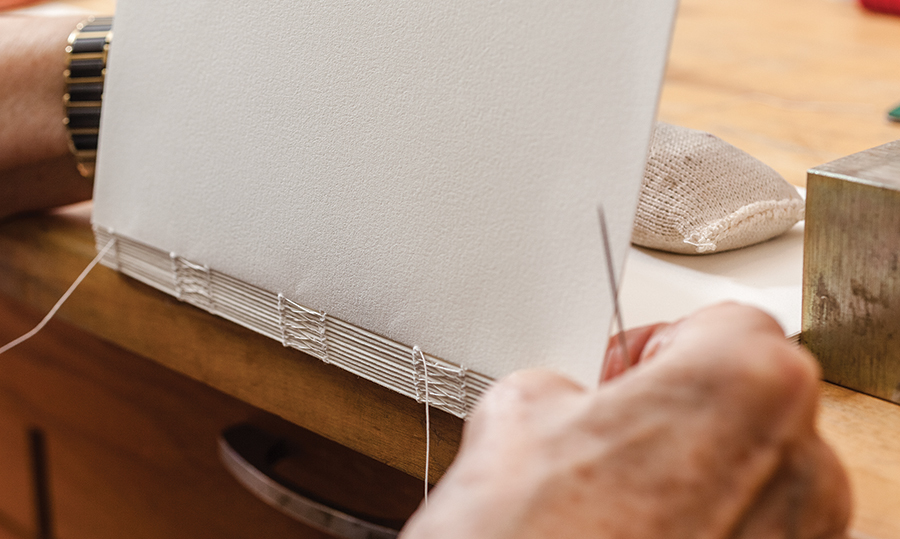
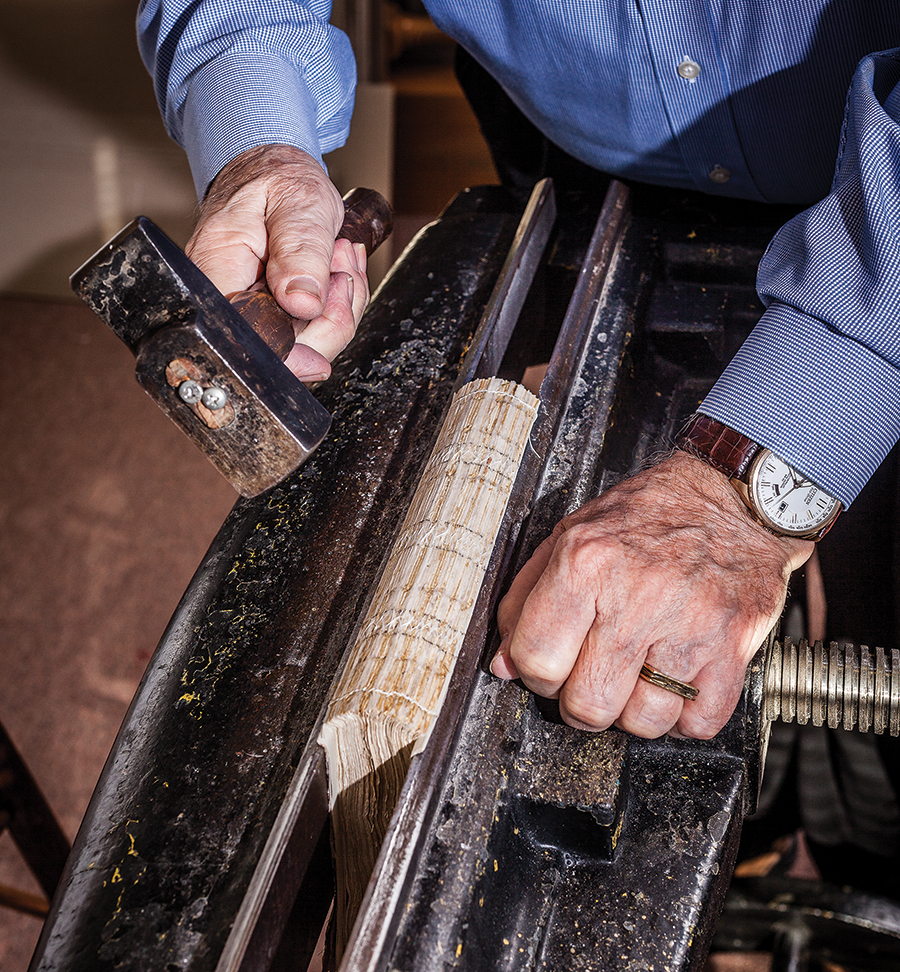
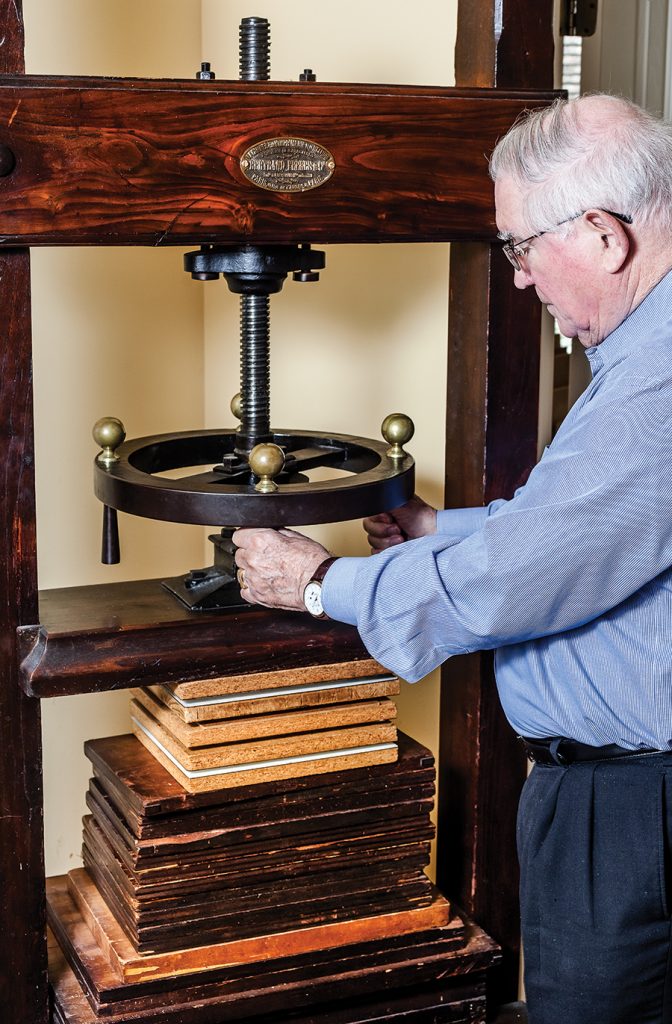
Surrounded by thickheaded hammers, scalpels that look like they’ve escaped from an operating theater and a cast iron vice, Don Etherington sits on a stool in his bookbinding workshop and talks about the heart attack that led to his quadruple bypass surgery as if it was a trip to the Circle K. It was a delightful, warm November day a little over a year ago. He had turned 80 a few months before. He felt a sharp pain in his chest, took a nitroglycerin pill, waited five minutes and took another. The pain didn’t go away so he called 911. His house is four from the corner. By the time the paramedics got him to the end of the road, he was gone.

From the other side of the studio, his wife, Monique Lallier, a designer of artistic book covers as highly prized as Etherington’s own, picks up the narrative. “He said, ‘You know this nurse in the ambulance, she was sooo nice,’” she says, her French-Canadian accent making the encounter in the rear of a rescue vehicle sound just slightly naughty. “I said, ‘Of course she was nice, she was happy to see that you came back.’”

Etherington laughs. “So,” he says, “this is my second time around, actually.”

The first one wasn’t half bad.

“I’m just a little old bookbinder,” Etherington says. Indeed, he is. One who has laid his hands on the 1297 Magna Carta and the Declaration of Independence, to name just two. And it all started with a pair of dancing shoes.

Born in 1935, living in a Lewis Trust building — flats for the poor — in central London, Etherington was a child of the Blitz. His mother, Lillian, cleaned houses. His father, George, was a painter by trade who’d been a prisoner of war for four years during the War to End All Wars and came home a changed man. “He was a hard guy,” Etherington says.

With the exception of roughly half a year when Etherington was evacuated to a house in Leeds that lacked indoor plumbing, buzz bombs and shelters were what passed for a routine childhood. “I used to roam the streets with a bunch of guys,” he says. “I’d go around at night — I can’t believe this myself — with a shopping bag and pick up all the pieces of German shrapnel. I’m, what, 5? It’s beyond imagination. The Blitz, the only time it really affected me, was when the flats got bombed. That night 73 of my school chums got killed in that one air raid. I think it was a doodlebug (a V-1 bomb). It hit the corner of our apartment block, skidded into the shelters, where a lot of people got killed, and it bounced off there into the school.

“It was like part of life. You’d hear the drone coming over and then all of a sudden, it would stop. We could tell where it was going to hit. We’d say, ‘Oh, that’s going to hit Hammersmith or that’s going to hit Kensington.’ We didn’t have that feeling that it was awful and depressing. It was our life. When you go through that, certain things don’t affect you as much. Basically, what I’m trying to say is that we were very resilient and resourceful.”

After the war, barely into his teens, Etherington did two things that would change the trajectory of his life, and he doesn’t know why he did either one. First, at 13, given a list of potential fields of study at the Central School, he ticked off bookbinding, jewelry making and engraving. He was chosen for bookbinding and off he went, still in short trousers. “I came away that first day knowing I loved it,” he says. “From that day on, nearly 70 years, I’ve been happy doing what I’ve been doing, which is very special.”

The second was those shoes.

“I took myself off the streets,” he says. At 14, he bought a pair of dancing shoes, marched into a studio in what was, to him, the fancy Knightsbridge section of London, and took up ballroom dancing. Medals and jobs came his way. He met his first wife, Daisy, when he helped open a dance studio in Wimbledon. “To this day, I don’t know how I went from strolling the streets, getting into all sorts of stuff, from that to doing dancing. The only thing I could say is when I went to Saturday cinema, I loved watching Fred Astaire and Ginger Rogers. I got enamored and thought, boy, I’d love to go to America.” Etherington danced his way into his 80s, including at Green’s Supper Club in Greensboro.

After a seven-year apprenticeship in binding at Harrison and Sons in London, followed by a brief stint restoring musical scores at the BBC, Etherington took a position as an assistant to Roger Powell, the man who bound the illuminated manuscript The Book of Kells into four volumes in 1953. “I went to Roger. He said, ‘What do you know about bookbinding?’ And I said, ‘Absolutely everything.’ For the next few years he showed I didn’t know a damn thing,” says Etherington. His work with Powell and his partner, Peter Waters, was followed by a position at Southampton College of Art, where Etherington developed a bookbinding and design program in addition to producing his own designs, the artistic covers he’s created throughout his life.

In the first week of November 1966, after a period of prolonged rain and threat of the collapse of several dams on the Arno River, a release of floodwater hit Florence, Italy, traveling nearly 40 miles an hour. The Biblioteca Nazional Centrale, virtually under water, was cut off from the rest of the city. The damage was incalculable. Powell and Wright asked Etherington to join the British team being dispatched to Italy to help. “They had 300,000 books floating in the water. Before we got there these student volunteers got them out of the water, out of the mud, out of the oil and put them on a truck to be dried in tobacco kilns up in the mountains. Not to blame them because nobody knew, but it was the wrong technique. Here you’ve got covers floating all around and you’ve got books floating all around. In those days, they weren’t titled. All these scholars were having to try to match up that cover with that book with no indication other than size.”

Out of this disaster, the field of book conservation was born. “We started to talk to German, Danish, Dutch bookbinders and restorers for the first time. We started talking about different techniques. Never would anybody share secrets — including England. All of a sudden, we’re talking together around coffee or whatever. It was just a whole different mindset,” says Etherington.

For two years, he spent between six and eight weeks in Florence teaching conservation techniques to the Italians. His first trip to Italy, at the age of 31, was the first time he’d ever been on an airplane. Etherington stayed in a pensione on the Arno River whose owner looked like Peter Sellers, and his fellow lodgers included two bankers from Milan, a prostitute who didn’t talk much, and a countess who had been married to a high ranking German general in the Weimar Republic who delighted in regaling her dinner companions with personal recollections of the Aga Khan.

Etherington would, himself, hit on a previously untried technique, using dyed Japanese rice paper in mending leather bookbinding to add strength unachievable with the leather alone, an approach that’s still used. “People give him a lot of respect for being one of the early conservators,” says Linda Parsons, who joined Etherington at the founding of what would become known as the Etherington Conservation Center (now the HF Group) in Browns Summit.

Four years after the Florence flood, Etherington was asked by Wright to join him at the U.S. Library of Congress as a training officer. He spent a decade in D.C. in various capacities. Among the projects he consulted on were teaching FBI agents about printing techniques, typefaces and paper characteristics to help them reassemble shredded documents found behind the Democratic party offices at the Watergate Hotel — some of which related to the scandal itself — and preparing Lincoln’s manuscript of the Gettysburg Address for display at the Gettysburg National Military Park. As if he had nothing else to do, Etherington penned a full-blown dictionary, Bookbinding and the Conservation of Books, listing every tool, material and technique related to the field he’d help create.

From the Library of Congress, Etherington was hired to launch a conservation program at the Harry Ransom Humanities Research Center at the University of Texas in Austin. There he was asked by Ross Perot to supervise the care and transportation of the 1297 version of the Magna Carta.

“There’s about 17 versions in existence. The 1297 one was the version the Founding Fathers used to write the Constitution of the United States. Ross is a big collector of Americana. He bought it for $1.5 million, which was pretty cheap at the time. It was found in the archives of a family in England. I was very surprised that England allowed it out. When I saw it, it was in really, really good shape. The ink was very black. There was question whether it was legitimate. Many scholars looked at it and authenticated it but, boy, it was questionable at the time.

“When you have an early document, you have a seal — I think it’s Edward I — and a silk strap. Because of maybe packing it or making sure it didn’t hang loose, someone turned the tie and put it on the back and stuck Scotch tape on it. I know it sounds stupid but it was that way. At some point, it went up for sale. This guy bought it for $22 million so Ross didn’t do too bad.”

By 1987, Etherington had fallen in love with Monique on a trip to Finland. His sons, Gary and Mark, were grown, and he decided to rearrange his life and leave Austin. He and Monique moved to Greensboro to begin a for-profit conservation company in association with Information Conservation, Inc. It would morph into the Etherington Conservation Center. The company performed the conservation and display preparation for the Constitution of Puerto Rico. They prepared and conserved the Virginia Bill of Rights. And Etherington was asked to work on the Charters of Freedom exhibit — the Declaration of Independence, the Constitution and the Bill of Rights — for the National Archives as the parchment consultant on the Declaration of Independence, helping to design how the badly faded document was to be displayed. Like a sure-handed heart surgeon, one concentrates on the process, not the patient.

“A lot of people who are not in this business, they think it’s a little bit scary,” he says. “I try not to think too much about the importance of it to history or to our country or whatever, because once you start doing that, instead of treating it with surety, you’re treating it with tentative hands, and that’s the worst thing that could ever happen to you.”

Etherington’s archive resides at the Walter Clinton Jackson Library at UNCG. “He’s internationally known,” says Jennifer Motszko, the library’s manuscript archivist. “He basically was there at the founding of his field where they started to come up with systemizing ways to preserve and conserve materials. But then he’s become a well-known entity in fine arts binding. You mention him in that circle, he and Monique define that area.”

In celebration of artists and their craft, the UNC Wilmington Museum of World Cultures has designated Etherington and Lallier North Carolina Living Treasures. Etherington has worked on everything from family Bibles to a 14th century Haggadah, from first century Chinese papyrus rolls to a rare copy of James Joyce’s Ulysses, from personal treasures to national ones. Still, every day at 5 p.m., studio work ceases. It’s time for the Etherington Cocktail. One part gin. Two jiggers of sweet Vermouth and a splash of tonic water.

“I’ve been very lucky doing things,” says Etherington.

Now he gets to toast a second go-round.  PS


Positive Outlook

Preston McNeil met Don Etherington when the family’s Chi-Poo, Mali, a Chihuahua/poodle mix, gnawed the edges of the study Bible belonging to his wife, Brenda. McNeil, who moved to North Carolina from New Jersey in 1988, has owned businesses ranging from carpet cleaning to cookie stores, and dabbled in jewelry design. He decided he could add bookbinder to the list by taking the chomped-on Bible apart and putting it back together again.

“So, I did,” he says. “It was a book that worked.” All the new binding lacked was lettering. McNeil found a place where he could have it imprinted. When the man behind the counter made out the invoice he noticed McNeil’s address. It was the same street Etherington lived on. “He said, ‘Take this book and show Don what you’ve done,’” says McNeil. “So, I took it to Don and he goes, ‘Uh, I see some mistakes but you did pretty good.’ He invited me in. And I’ve been going to him from that point on.”

After a couple of years studying with Etherington, McNeil felt confident enough to redo a friend’s Bible. “Then I began to buy my own equipment. Now, I have a full studio downstairs,” he says. And another business, Gate City Binding. “I wish I had learned to do this when I was 36,” says McNeil, who’s actually three decades older than that. “I love it so much.”

His seven-year apprenticeship with Etherington and his new skill set led to a delicate and difficult commission, rebinding the volumes of the Pinehurst Outlook, the newspaper that published continuously from 1897 to 1961, that reside in the Tufts Archives at the Given Memorial Library. The project is being paid for entirely with donations designated for that purpose.

“The majority of the Outlooks I’ve worked with are fully separating from the original binding,” he says. “The spine is deteriorating. Everything is dry-rotting on the interior. The books are all newspapers. If they need to be restitched, they’ll be restitched. If they need to be reglued, I reglue them. Then rebuild the whole spine. It goes from individual papers to a book again. It’s building a book from scratch, essentially.”

Just like his new career is built from scratch. “I take from his mind, put it into my mind,” says McNeil of his mentor, Etherington. “I take from his hands, and I hope it’s coming out of my hands.”

A Good Fit for the Goodmans

A Pinehurst family grows into well-planned home

By Deborah Salomon     Photographs by John Gessner

On the border dividing Generation Xers from millennials sits a beautiful house occupied by a matching family: young(ish), sociable, fit, bright, busy.  The house is stylish yet comfy, practical and pretty — an heirloom-free zone in Pinehurst, better known for senior(ish) CEOs, globetrotters and generals, now attracting this new demographic that enjoys walking or jogging to the village after shooting hoops in the driveway.

Meet the Goodmans: Laura, from New England-prim Wellesley, Massachusetts; Kenny, whose roots extend deep into Tar Heel textile and furniture industries; Cate, 15, an avid participant in Odyssey of the Mind; and sports enthusiast Matthew, 12.

Golden retriever Ruby, and Ollie, a sweet Corgi-blend rescue, complete the portrait.

Kenny (N.C. State) and Laura (Vanderbilt) met in Raleigh. They decided on Pinehurst when Kenny returned to the family business, located in Ellerbe. Laura found the public schools fine and the village friendly: “Here, you walk into a store and everybody says hello, knows your name. That wouldn’t happen in Wellesley.”

They built an 1,800-square-foot house with white vinyl siding, green shutters and a front porch overlooking Pinehurst No. 6, where they were bombarded with stray golf balls. This didn’t work with a new baby. Time to build a forever house, designed to their specifications by Pinehurst architects Stagaard & Chao, known for parabolas and arches, niches, vaulted ceilings and the Fair Barn renovation.

But, Laura maintains, with off-white shingles, and paneled front door flanked by benches, the look combines New England with Old Town cottages commissioned by the Bostonian Tufts family.  Yet those very cottages, many enlarged and restored beyond their original glory, were oblong or square. The Goodmans chose an L-wing, which creates a front courtyard, giving the house on a corner lot facing a well-traveled street more of a manor appearance. Multiple high roof pitches impart the illusion of a second story when there is none, except for an attic playroom.

* * * * * *

Whatever generational banner they hoist, the Goodmans were forward-thinkers when laying this footprint during the great Great Room Era. “I wanted three separate living spaces,” Laura says, “so when the kids want to watch TV we can close the door.” True prescience, considering the house was built in 2002, when Cate was a toddler and Matthew not yet born. Ditto placing the children’s quarters in the L-wing (with its own entrance), the master suite at the opposite end.

The smiling Goodmans welcome friends through a wide front door, into a wider foyer, then straight into the living room overlooking terrace and garden, where father and son throw a baseball. Even the living room is divided by furniture placement into two conversation areas. Architectural niches show off a pair of small antique chests, while the peaked ceiling is softly illuminated by rope lighting tucked into a cornice molding.

Opposite the living room, sunlight streams through bare windows in the dining area, where a wall indentation frames a tall red-lacquered Chinese armoire topped with oversized black ginger jars. Unobstructed access between the two rooms allows setting up long tables for holiday gatherings

Many furnishings came from a family-owned business that closed, other pieces from Pinehurst village boutiques. A velvet slipper chair in the master bedroom originated with Laura’s grandparents. Laura cannot find a word that encompasses their decor style, from a massive drum coffee table to Asian bamboo, sleigh beds and carved French provincial settees, only that the pieces relate beautifully.

“We like clean lines, no clutter,” Kenny adds.

* * * * * *

A guest bedroom in the master suite wing — now Kenny’s home office — highlights a recent palette reversal. Its unusual teal walls set off the white sleep sofa (just in case), a set of Chinese prints illustrating silk-making, bamboo blinds, a retro leather club chair, and a framed newspaper story about his grandfather, who served as Richmond County sheriff for 44 years.

“We never used this room; now we use it every day,” Kenny says.

In a daring move, they painted the wall of wood cabinetry in the master bathroom, also the dark kitchen cabinets, an unusual and soothing dove gray, adding a granite countertop pattern that swirls rather than spatters. Kitchen layout and size is a paradigm of restraint. The island expands counter space, nothing else. “I’m an electric girl,” Laura says, explaining her choice of a smooth cooktop and built-in ovens instead of an industrial gas range. She has a coffee nook and wine rack but no pastry area, refrigerated drawers or wine cellar. The chrome yellow Dualit toaster — a British award-winner used by fine restaurants — stands, statuesque, against the white ceramic tile backsplash.

On one side of the kitchen is a “sitting room” similar to one Laura remembers from an aunt’s house. Upholstery fabric there and elsewhere comes from Goodman textile manufacturing. On the other side of the kitchen, a charming corner breakfast nook with upholstered banquettes and beyond that, the TV room. With door. Family dinner is obligatory, with no electronic distractions. Off to one side, a screened gazebo awaits fine-weather dining.

Whimsy trumps classic in the guest powder room, wallpapered in ragged blue spots on white, straight off a Dalmatian.

In the teens’ wing, a long wall of built-in bookshelves serves Cate’s passion for reading. Matthew likes his room, “because I have a basketball hoop on the wall.” Cate selected colors for her sitting-bedroom, a bright turquoise that compliments her long red hair.

By sizing rooms moderately, the 4,000-square-foot total does not overwhelm, as it might if allocated to a cavernous great room or huge master suite.

“I just like how inviting and warm and light and well-laid-out my house is,” says Cate.  Indeed, gleaming hardwood floors, Persian runners and area rugs, interesting architectural details, fresh colors, a convenient location with other millennials nearby,  backdrops the lifestyle and leisure of a new Pinehurst demographic exemplified by the Goodmans, for whom life certainly seems good.  PS

Splish Splash!

Winter waterbirds have arrived

By Susan Campbell

The arrival of cold weather in the Sandhills means that our local ponds and lakes will become the winter home to more than two dozen different species of ducks, geese and swans. Over the years, as development has added water features both large and small to the landscape, the diversity of our aquatic visitors has increased significantly. Although we are all familiar with our local mallards and Canada geese, nowadays from November through March, observant bird watchers can expect to see ring-necked duck, buffleheads, loons, cormorants, pied-billed grebes and American coots, to name a handful.

Certainly, the most abundant and widespread species is the ring-necked duck, flocks of which can be seen diving in shallow ponds and coves for aquatic invertebrate prey, dining on everything from leeches to dragonflies, midges to mosquitoes, water bugs to beetles. They obviously get their name from the indistinct rusty ring at the base of their necks.  Also look for iridescent blue heads, black sides and gray backs on males. The females, as with all of the true duck species, are nondescript: light brown all over but, like the males, have a distinctive grayish blue bill with a white band around it.

Perhaps the most noticeable of our wintering waterfowl would be the buffleheads. They form small groups that dive in deeper water, feeding on vegetation and invertebrates. The males have a bright white hood and body with iridescent dark green back, face and neck. They also sport bright orange legs and feet that they will flash during confrontations. The females of this species are characteristically drab, mainly brown with the only contrast being a small white cheek patch. Interestingly, the bufflehead is the one species of migratory duck that actually mates for life. This is generally a trait found only in the largest of waterfowl: swans and geese.

There are several types of aquatic birds, similar to ducks, that can be identified if you’re lucky enough to spot them; you’ll likely need a pair of binoculars. Common loons can occasionally be seen diving for fish on larger lakes in winter, and even more so during spring and fall migration. Their size and shape are distinctive (as is their yodeling song; unfortunately, they tend not to sing while they are here). It is important to be aware that we have another visitor that can be confused with loons: the double-crested cormorant, which is actually not a duck at all. This glossy dark swimmer, along with its cousin the anhinga, is more closely related to seabirds (e.g., boobies and gannets), and is a very proficient diver with a sharply serrated bill adapted for catching fish. It is not uncommon to see cormorants in their “drying” pose, when their wings are almost fully extended. (It’s the slight droop that makes them look sort of comical.) Since their feathers are not as waterproof as those of diving ducks, they only enter water to feed and bathe. Most of their time is spent sitting on a dock or some sort of perch trying to dry off.

Two other species of waterbirds can be found regularly at this time of year: pied-billed grebes and American coots. Pied-billed grebes are the smallest of the swimmers we see in winter, with light brown plumage, short thick bills and bright white bottoms. Surprisingly, they are very active swimmers. They can chase down small fish in just about any depth of water. American coots — black, stocky birds with white bills — are scavengers, feeding mainly in aquatic vegetation. They can make short dives but are too buoyant to remain submerged for more than a few seconds. Given their long legs and well-developed toes, they are also adept at foraging on foot. You might see them feeding on grasses along the edge of larger bodies of water or even on the edge of golf course water hazards.

In the coming weeks, if you find yourself in Lakeview, near the dam at Thagard Lake in Whispering Pines, or at a good vantage point along Lake Pinehurst, scan the surface for rafts of floating waterbirds. Of course, you will most likely need your binoculars in order to better make out the shapes and color patterns. But if you can get a good look, take the time to enjoy some of these wonderful, web-footed winter visitors from the far North. PS

Susan would love to receive your wildlife sightings and photographs at susan@ncaves.com.

Two Gents on a Porch

Another overheard conversation at Rosehaven Assisted Living in rural North Carolina

By Clyde Edgerton

“How do you control the climate, anyway?”

“That’s simple: The more you run air conditioning, the colder it gets. Air conditioning controls the climate indoors. That has an overall cooling effect out of doors too, because people used to keep their windows open and now they can’t. So now the air that used to cool houses can be used to cool the climate. It’s figured out with a climate formula. I think Ben Gore came up with it.”

“But I keep hearing ‘global warming.’”

“Very true, but air conditioning has been going on for what, over 60, 70 years. Cars heated up the air for about 50 years before air conditioning ever got started and then the climate started cooling down the Earth’s surface, especially in America. Air conditioning has now cooled down the early hot effect from cars.”

“But they say that temperatures are hotter than ever.”

“That’s because of airplanes. They started building great big airplanes with jet engines in the middle of the last century. Big engines spew out a lot of heat.”

“What do the scientists say? I heard they were saying something.”

“You mean ‘what do weathermen say?’ Those are the ones who know about how hot or cold it is. Scientists know about rocks and trees and chemicals and are usually just professors. I mean, why would you go to anybody but a weatherman to learn about the weather? It’s like why would you go to anybody but a cook to learn about how to cook? Common sense stuff.”

“I guess if you did away with cars and airplanes, then the air conditioning could make global cooling. Yes, common sense. Maybe we can move into an era of common sense.”

“Which had you rather have? Global warming or global cooling? Since we have a choice now.”

“I don’t know. I don’t get around much anymore, so I guess I’d rather keep air conditioning and cut back on cars and airplanes.”

“You know, I remember the times before air conditioning.”

“Oh, yes. Me too. It’s hard to remember how we kept cool.”

“You’d sweat, you’d get damp, and then the air from a fan would cool you down. Before electricity, my mama had a great big hand-held straw fan. You don’t see them anymore.”

“You don’t see a lot of things anymore.”

“Those were the good old days. No erectile dysfunction commercials.”

“No commercials at all. I mean, you had commercials on the radio, maybe for Tide, but they were only every half hour or so.”

“Yeah. Those were the good old days. I remember in our little house we had this big old window fan planted in a window so that it sucked air out instead of blowing it in, and on hot summer nights you’d close every window in the house except for windows beside a bed, and that window fan would pull in cool night air, gentle like, and you’d sleep in just your underwear without a sheet. You’d have that cool night air gently pulled in, keeping you nice and cool, and you’re sleeping with night sounds instead of air conditioning sounds. Before morning, you’d need a sheet. I woke up more rested than I have since.”

“I understand that President Trump is going to recommend opening up houses with the air conditioning on so that we can cool down global warming.”

“Are you sure about that?”

“Oh yeah. It was on the news. That’s what he’s hearing from his advisers.”

“I’m glad Trump doesn’t drink like Bill Clinton did. Remember what Clinton’s nose looked like?”

“You mean ‘looks like.’”

“Yeah. My Uncle Pierce had a nose like that and he drank like a fish. But remember, we said we were not going to discuss politics.”

“Sure. Right. But I’m not so sure letting air conditioning out of your house will stop global warming.”

“But you can. I promise. Think about it. And there are all kinds of benefits. If we go that route, we burn more electricity; if we burn more electricity, we use up more coal, and that gives us more coal mining jobs, which means more coal transportation jobs, which means more jobs making soap. Presto. You kill several birds with one stone.”

“Soap?”

“You handle coal, you get dirty hands.”

“What about a high electricity bill from all that air conditioning?”

“That’s easy. You pay for your air conditioning with the money you save on taxes. It’s called the clean energy credit. Air conditioned air has all the nasty stuff conditioned out of it. It’s clean. Clean energy. Come on, man.”

“Oh. Oh, I see.”

“The future is so bright I have to wear sunglasses.”

“I never thought about it that way. I don’t have any sunglasses.”

“Well, you better get some.”  PS

Clyde Edgerton is the author of 10 novels, a memoir and most recently, Papadaddy’s Book for New Fathers. He is the Thomas S. Kenan III Distinguished Professor of Creative Writing at UNCW.

Saving George

An anchor of enchantment in the front yard

By Jim Dodson

His name is George. That’s what we’ve taken to calling him, at any rate. George is old and bent, weathered by age. We think he might be pushing 100 years old.

I’ve known George most of my life. Grew up just two doors from down from where he lived but I never paid him much notice until recently.

That’s because George is an old tree, Crataegus phaenopyrum, we think, based purely by his leaf pattern and bark. His common name is a Washington hawthorn — hence the nickname we’ve bestowed on him.

But here’s where the sweet mystery deepens.

According to my tree identification book, Washington hawthorns are relatively small flowering trees — in some cases, shrubs — that produce early and abundant white flowers in the spring and vivid red berries that last into winter, a bounty for winter birds, especially cedar waxwings. They’re also reportedly poisonous to dogs, which could be a problem, since Ajax, our shameless golden retriever, will eat anything put before him. On the other hand, he’s one lazy brute, unlike his Greek namesake, and not much for climbing trees. So Ajax is probably safe.

We moved into the neighborhood just before Thanksgiving. On our first day in the Corry house, I stopped to admire George. He was magnificently arrayed with gold and crimson leaves, like Joseph and the Amazing Technicolor Dreamcoat. The neighborhood is famous for its old graceful hardwoods, many of them well over a century old. George is clearly one of the neighborhood patriarchs. That’s why I paused to admire him the afternoon we moved in, suddenly remembering him from my childhood, making a mental note to free him from the tangle of English ivy vines that had grown around him like something from a fairy tale.

In a year of small wonders, it seemed wonderfully providential that we were moving into the Corry house, 100 feet from where I grew up. The Corry boys were my pals growing up. Their parents, Al and Mama Merle, were my parents’ good friends. Big Al was one of Greensboro’s leading builders, and the house he built for his wife and four kids — a gorgeous wooden bungalow with flowing rooms, parquet floors and host of innovative design touches — was one of the first houses built in Starmount Forest after the war.

For more than a year, my wife, Wendy, and I had quietly scouted houses throughout Greensboro. Then one Sunday after I heard the Corry house was for sale, we went for a look. I didn’t let on that the Corry house was always my favorite in the neighborhood. But after she walked through it, on the drive home to the Sandhills, Wendy quietly announced, “I think that’s the house. It just feels like us.”

The Corry kids, all four of them, were thrilled to hear their homeplace was being purchased by a Dodson.

Each quickly got in touch to offer their enthusiastic congratulations. The  Corrys were the most self-sufficient clan I ever knew, natural builders and people full of life. Chris, the oldest boy, actually lived in a tepee with his bride as they built their own dream home west of Greensboro. The Corry boys hunted, fished and could build anything with their hands. They were also crazily musical, playing stringed instruments of every sort. In 1969, son Craig and I made the Greensboro Teenage Talent Show playing guitars and singing Bob Dylan’s “Don’t Think Twice.” We called ourselves Alfred and James.

Big Al informed us that Alfred and James needed something “extra” to win. “You boys need a shtick to impress the judges,” he said.

I asked him why we needed a stick on stage.

Big Al laughed. He hailed from Buffalo, New York. “That’s a Yiddish word,” he explained. “It means a comic gimmick, something to make people laugh. First rule of vaudeville — always leave ’em laughing.”

He suggested that we add kazoos to the act. We thought that was the silliest thing we’d ever heard, but Mama Merle bought us a couple anyway.

The director of the show asked us to play a second song while the judges made up their minds. So we did an encore — with guitars and kazoos. The audience gave us a standing ovation. We wound up in third place. I still have the program. TV host Lee Kinard invited Alfred and James to come on his Good Morning Show at Christmas. We worked up a couple of Christmas carols and did the second one with kazoos. The shtick worked wonders.

Craig grew up to marry Marcy Madden, his first girlfriend from just down the block. He became a veterinarian. Britt, his little brother, was a musical prodigy who became a music teacher and recently signed on to direct the music for Horn in the West. Ginger, the oldest and only girl, became a lawyer.

Like his papa, Chris was a jack-of-all-trades, a born builder of almost anything. He now sports a full-grown gray beard and knows his late mama’s house better than anyone alive because he built much of it with his father and took care of the place until Merle passed away a year or so ago. His wife, Fenna, told me in an email that Mama Merle and Big Al would both be so happy that a Dodson kid had come home again to purchase their house. From faraway California, Ginger wrote that she hoped we would have many happy years living there.

Which brings me back to George.

A week after we got settled, we took ladders, handsaws and a hatchet and liberated George from those wretched English ivy vines. The job took two afternoons, but George looked considerably more at ease, maybe even grateful. My nephew came and helped me clean out the area around his base, where I’ll soon plant Spanish bluebells and English daffodils for the spring.

I also planted six young trees, three Japanese maples I’d raised from sprouts and a trio of river birches like the three I planted once in Maine.

They stood in front of the post and beam house I built on a forested hilltop surrounded by birch and hemlock. The beams were rough-sawn Northern fir, with pegged heartwood pine flooring salvaged from a 200-year-old New Hampshire barn. On cold but sunny winter days, whenever the sun streamlining through that house’s large south-facing windows warmed the beams, you could hear gentle sighs and faint cracking sounds as the wood relaxed, expanded, exhaled.

That peaceful sound told me something I guess I’ve always known. That wood — trees — are something more than just fellow living and breathing organisms.

They are enchanted.

Maybe this explains why one of my first memories of life is of sitting on a low limb in a sprawling live oak next to our house by Greenfield Lake, in Wilmington, waiting for my father to come home from the newspaper where he worked. I was forever climbing trees, much to my mother’s chagrin, and sometimes falling out of them. My dad liked to call me Mowgli, the orphaned boy from Kipling’s Jungle Book, one of the first books I ever read on my own.

Come to think of it, the books I loved early on all seemed to have extraordinary trees in them — Greek and Roman mythology, the Tarzan books, almost every fairy tale I ever read contained forests that were either forbidden or simply enchanted, home to magic creatures, wizards, evil queens and noble woodsmen.

And why not? Plato and the ancient Greeks believed souls resided in sacred groves of trees, and the Buddha found enlightenment sitting beneath a fig. The Egyptian Book of the Dead mentions groves of sycamores where the departed find eternal bliss, and the Bible speaks of a Tree of Knowledge that altered paradise. The Irish word “druid” derives simply from a Celtic word for oak, while in India to this day people seeking miracles hang family rags on trees to make shrines to the gods. My Baptist grandmother always insisted that the dogwood tree with its perfect white petals and crimson heart was a symbol for Christ’s resurrection, and showed me the old Appalachian story to prove it.

The Glastonbury thorn, holds English lore, is a hawthorn tree that is said to have sprouted miraculously from the staff of Joseph of Arimathea when he traveled to Britain after Jesus’ crucifixion. The hawthorn blooms at Christmas, and the queen is traditionally brought one of its blooms with her tea on Christmas morning. In broader English lore, wherever hawthorns and oaks reside together, kindly fairies supposedly live as well.

I do hope that much holds true even if, come springtime, the old tree I liberated turns out to be something quite different.

There’s an old saying that an optimist is someone who plants a tree he may never live long enough to sit under.

That’s probably true for the six young trees I planted around George.

But come spring, home at last, I plan to sit under George when those bluebells and daffodils bloom.  PS

Contact editor Jim Dodson at jim@thepilot.com.

Rocking Porch Resolutions

Even the Romans knew not all change is good

By Tom Bryant

“January,” Bubba said, “was named after the god Janus by the Romans for their ancient calendar. He was supposedly the god of beginnings or transitions. I’m probably telling you something you already know, though. Right, Coot?”

It was early January of a brand new year, and we were kicked back in a pair of rocking chairs in a sunny spot on the wraparound porch of Slim’s country store enjoying the warmth of the mid-afternoon sun. Bubba had his legs stretched out and a steaming, freshly poured mug of hot coffee resting on the arm of his rocker. We had been in the woods early that morning squirrel hunting, a sport Bubba swears was regulated to the back corner by a bunch of yuppies who only enjoy the great outdoors so they can buy more spiffy clothes.

I was halfway dozing and really didn’t pay a lot of attention to what Bubba was saying. He was often coming up with some kind of off-the-wall information. He had bestowed the nickname Cooter on me years ago and it stuck. “Seems like I remember some of that stuff, Bubba. Maybe that’s why a lot of folks make New Year’s resolutions. That’s one type of new beginning, don’t you think?”

“You’re right,” he replied. “But I think you and I fall into the category of transitions. We’re too old for beginnings.”

“Nope, speak for yourself. I don’t consider myself old, maybe slowing down a little, but I can still do about as much as I could a few years back.”

“You don’t get it, Coot. I don’t mean that we can’t start a new beginning; but hey, I’m still working on some I started years ago. I just try to transition them every now and then. That way they feel like a new beginning.”

“So you’re saying some of the New Year’s resolutions you made long ago have just transitioned into things you are doing today? I’m gonna think about that for a minute while I freshen up my coffee. You want some?”

“No thanks, but you can bring me one of those ham biscuits that Leroy made this morning.” Leroy is Slim’s cousin and worked for him part time. He now manages the ancient store after Bubba bought the place when Slim died. The old store didn’t make too much money, but Bubba said it was a deal at any price. He needed a place to get away from too much civilization. It worked out well for both of them. Bubba had his place to go, and Leroy had a job he was familiar with.

I went into the store and said hey to a couple of the regulars who had just arrived. H.B. Johnson was dragging a slat-back chair from the corner to a spot in front of the woodstove. “You and Bubba outside? I saw him when I drove up. He looked like a sleepy old hound dog resting in the sun.”

“You’re not far wrong, H.B. He sort of favors a few hound dogs that I’m familiar with.” The guys laughed, and I poured more coffee before going back outside.

“Take Falls Lake,” Bubba said as I closed the side door and moved to my rocker. We hunted there last week and it’s nothing like what it was on our first visit, remember?” Bubba was on a roll. When he gets on a topic, he chews it front ways, sideways, upside down and backward, like a bulldog with a new ham bone.

“What’s that got to do with resolutions?” I responded.

“Well, the first time we hunted there they had just finished the dam, and we were some of the first to try the spot for ducking. It turned out to be one of the best in the area, and then here came the troops, more duck hunters than you could shake a stick at. Then the dam was closed and the lake filled and pleasure boaters came out all over the place, and duck hunting went south. Now that there aren’t so many hunters, ducks have rediscovered the lake and hunting is getting better. You might say the place has transitioned and we have along with it, thus proving that old Janus wasn’t far wrong.”

“As old as we are, we could probably use that analogy in many of our hunting spots,” I replied. “Take the Sartin farm, for example. Four hundred acres of some of the finest wild habitat in the whole county. Everything from ducks to turkeys and doves, deer and otter and beaver, even good fishing on the creek. All that is gone now, transitioned to 10-acre mini-farms owned by city folk who like to pretend they’re farmers. No new beginnings there. In that case, our good place to hunt and enjoy nature was transitioned slam out o’ business.” I could see Bubba literally chewing that over as he took a bite of his ham biscuit.

“You’ve got a point there, Coot. I guess that situation goes with the territory of living a long time and watching the dubious benefits of progress. Sometimes I think maybe we were born a little too late. Another good example of how progress has done us in would be duck hunting at Currituck. Remember when we would go every winter to hunt with the Whitsons? I think that old crowd there has died off, and the hunting is now so bad that hardly anyone hunts there anymore. Another sign of growth and the ‘benefits’ of development.”

Our conversation continued for a while until we decided to head home in time for our naps. I had a way to drive, so I bade the boys inside goodbye and told Bubba that I’d give him a call later in the week so we could plan our hunt to Mattamuskeet.

On the way home, I mused over our talks about resolutions and New Year’s in general. Bubba and I have seen a bunch of Januarys roll around, and for better or worse, we’ve made the best of whatever came. We’ve still got our health, and in the woods, we’re able to do about anything we want. As Bubba says, we’ve learned to walk around it rather than climb over. A certain amount of wisdom does come with age. I often wonder, though, what will the next generation experience? Will they be able to see tundra swans rafted up by the thousands on Lake Mattamuskeet, or even a wild squirrel scurrying around a giant oak as Bubba and I did that morning?

Time changes a bunch of stuff; and as the ancient Roman god Janus probably knew, not every new beginning is a good thing.  PS

Tom Bryant, a Southern Pines resident, is a lifelong outdoorsman and PineStraw’s Sporting Life columnist.