Almanac

Heat, ma’am! It was so dreadful here, that I found there was nothing left for it but to take off my flesh and sit in my bones.

— Sydney Smith, Lady Holland’s Memoir


Berry Good

If ever you’ve stumbled upon a tangle of wild blackberries, perhaps you have felt the sweet stings of freedom that poet Mary Oliver describes in her poem named for this sultry month. You have tasted the “black honey of summer” and have the scratches on your legs and arms to prove it.

August conjures the soft thuds of the earliest apples; gifts us with eggplant and sweet corn and towering sunflowers; plucks the season’s first ripe figs or else leaves them for the birds.

The air feels like a wet cloth over our mouths and skin. We move in slow motion. We move to the shade. We move indoors, where the fan dances in lazy circles.

Heirloom tomatoes are peeled, seeded and chopped for gazpacho. Watermelon is sliced into tidy triangles. The ants that march along the juicy rinds remind us there is work to do:

Can or freeze the excess harvest.

Stake the vines and prune the shrubs.

Prepare the soil for autumn plantings — beets, carrots, peas
and greens.

But don’t forget to play. When you stumble upon a patch of swollen berries “in the brambles nobody owns,” do as Oliver illustrates. Allow yourself to get lost in the delicious moment. Savor the sweetness of this harvest month. 


Summer set lip to earth’s bosom bare, And left the flushed print in a poppy there.

— Francis Thompson, 1859–1907


Ethereal Wonders

The August sky reveals to us countless wonders. Following the full Green Corn Moon on Monday, Aug. 7, the annual Perseid meteor shower will peak on the night of Saturday, Aug. 12, until the wee hours of Sunday, Aug. 13. Although a waning gibbous moon may compromise the view, it’s possible to see 60 to 100 meteors per hour. Cozy up with the crickets and test your luck. 

Something you can’t blink and miss: A total eclipse of the sun occurs this year on Monday, Aug. 21. Visible for up to two minutes and 40 seconds along a narrow arc that starts in Oregon and slices across the states to South Carolina, the Great American Total Solar Eclipse will cause eerie bands of light to shimmer across the darkening sky as the sun slips behind the hungry moon. Do wear eye protection for this so-called celestial coincidence, and find maps of the path and more information at www.eclipse2017.org. Prepare to be truly dazzled. North America won’t see anything like it until April 8, 2024.

The Sacred Hazel

According to Celtic tree astrology, those born from Aug. 5 to Sept. 1 draw wisdom from the sacred hazel, a tree whose forked branches have long been used as divining rods, and whose medicinal leaves and bark create a potent astringent. If you’ve any doubt that this tree possesses magical properties, consider that it produces the star ingredient of Nutella (and that said ingredient, the hazelnut, is believed to invoke prophetic visions). But back to humans: Analytical and organized, hazel archetypes are often considered the “know-it-alls” of the zodiac. Although they tend to hum with nervous energy, they seem to get along swimmingly with rowans (Jan. 22 to Feb. 18) and hawthorns (May 13 to June 9).

The gladiolus may be the bright and showy birth flower of August, but what says summer like the sunflower? As they follow the sun across the sky, these cheerful giants remind us that we become that which we give our focus. What will you attract this month?

World Class

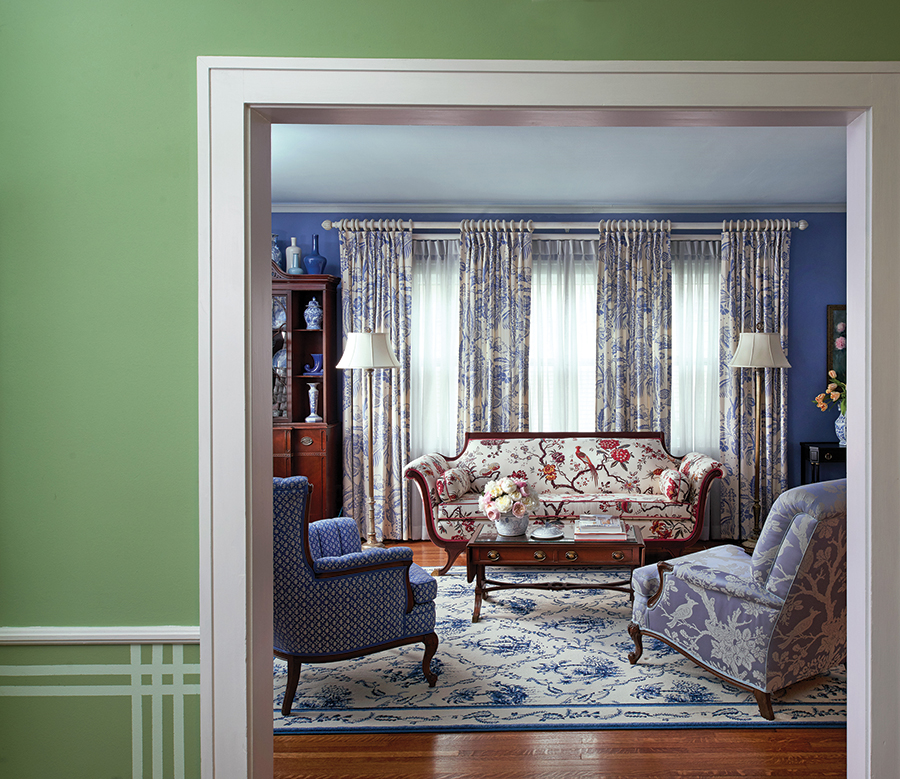
Generations of travel are reflected in a charming eclectic Pinehurst home

By Deborah Salomon   •   Photographs by John Gessner


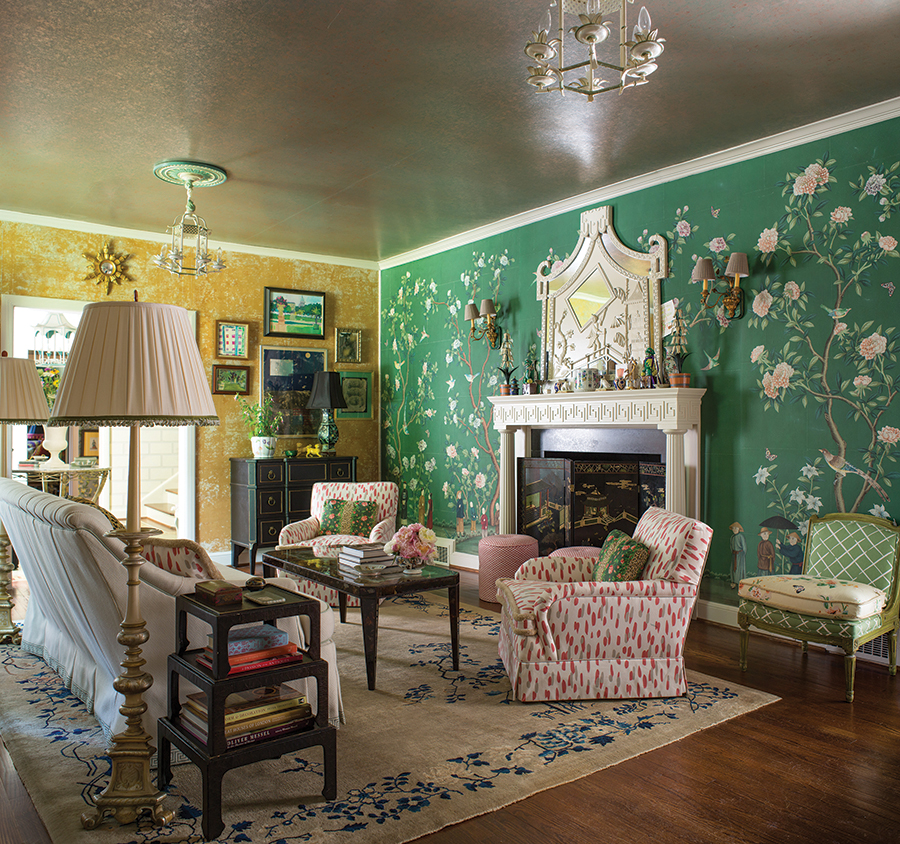
Surely Marco Polo helped furnish Becky Smith’s intensely personal home at Country Club of North Carolina.

Her rationale for the international potpourri: “Just because I like it.”

What Smith likes are pieces from Thailand, Cambodia, China, Vietnam, Burma, England, Australia, the Caribbean, Africa, Switzerland. Her collection of glass canes hang in sunburst formation from the library ceiling. An orchid garden blooms in the breakfast room bay window. Walls of one bathroom crawl with friendly insects hand-painted to match a bug mirror, while a magic dragon mural livens a hallway.

Appropriately, a sign in the driveway announces Uzbeckystan.

The world tour commences at the door where massive stone Foo dogs — mythical animal statuary guarding Chinese palaces and imperial buildings — flank the entrance, while the knocker is a brass lion’s head, either Africa or Anne Klein.

The Smiths, from points north, chose Pinehurst for early retirement during a tour through the South. They already owned a home in Kiawah, S.C., and thought they would end up in Chapel Hill, which had amenities and a cosmopolitan population. “We were driving from Charleston to Chapel Hill and stopped in Pinehurst to play golf with friends,” Smith recalls. Afterward, they wandered into the village and “fell in love.” Their first house was near the village. Then, in 1999, they drew on Steve Smith’s experience as president of a nationwide homebuilding business to plan, with Pinehurst residential designer Suzy Morgan, and build from the finest materials (evidenced by moldings, door frames, cherry floors), a 6,000-square-foot. neo-Georgian residence with public rooms capable of accommodating 100 guests. Their priorities: a main floor master suite and display space for art and furniture collected over several generations.

“My parents and grandparents traveled by ship so you could bring things back,” Smith explains, although transportation rarely interfered with her own acquisitions.

This residence is, more than most, a sum of its parts. Each piece owns a story, a link. Docent Smith shares them eagerly, beginning with those glass walking sticks:

“I went into a country store and saw a glass cane with a hollow bulb and stem. It seems that at the end of the day, blowers would take leftover glass and make whatever they wanted. I found more in New Jersey. Wherever there’s sand, there’s glass.” She also learned that when a glass blower died, small canes were arranged around his grave.

The canes reminded Smith of a wall-mounted starburst of muskets in Williamsburg; the canes were too long for the walls, so she had a special ceiling installed in the octagonal library and suspended them with fishing line.

Smaller canes are wall-mounted throughout the house.

This surfeit of eye candy begs a checklist:

Writing on the walls: Not quite, but many are covered in wallpaper, no longer the vogue. Smith used grasscloth extensively, as well as Asian florals with retro matching fabric window treatments. Blue bows and bunnies cheer her grandchildren’s upstairs quarters; a pale apricot sponged-paint effect papers the master suite. Chinoiserie in the formal dining salon creates Asian serenity. Murals tell another tale. Smith hired North Carolina artist Chris Bernard to paint trees and plants on kitchen and breakfast room walls, along with that hallway dragon and bug bathroom.

By arrangement: This floorplan lacks a contemporary family or great room. Instead, all paths branch off the living room, a salon with multiple seating areas delineated by Oriental carpets. Steve Smith’s onetime office, rich with leather chairs, one an heirloom, overlooks the garden and golf course. The windowless octagonal library, Smith’s idea, seems patterned on a men’s university club. Upstairs, an apartment for their daughter and now-grown grandchildren still displays stuffed animals, a doll house and window seat straight from an English storybook. That formal dining room with Phantom chandelier and uncharacteristically post-modern table leads into a butler’s pantry and kitchen best described as vast, white and functional: two refrigerators and a full-size freezer, two dishwashers, three disposals, multiple ovens, tile floor, endless counter space designed for big parties during Steve’s tenure as Pinehurst mayor. “The caterers thought they died and went to heaven,” Smith says. Weather permitting, the parties spilled out onto the huge terrace and pool deck. She recalls a Western-themed 60th birthday party for Steve, complete with a neighbor’s horse who wandered the property, nibbling greenery. “Steve’s favorite meal was breakfast, so we just served breakfast foods.”

Magic carpets: Smith lifts colors from her Oriental rugs — dusty turquoise and terra cotta in the living room, where upholstery in soothing neutrals do not detract from the art, which includes portraits of the Smiths’ Cavalier King Charles spaniels. Not all rugs arrived via Aladdin. Brightly painted floorcloths — more New England than Southern, although these came from Chana Meeks in Siler City — cover breakfast room and nursery floors.

Whimsy: To relieve the formality, Smith chose grasshoppers for the master suite bedspread, also a Thai puppet settled in a corner on a child’s chair and a mystical Irish doll in the entranceway. Paintings of beach bars (Captiva, Holden Beach, Cedar Key) frequented by the vacationing Smiths entertain the bathroom. Blown glass “witch balls” hang over windows. Keep looking: collections of Royal Doulton character mini-mugs; a dining room sideboard once the top third of an overmantel; stone heads representing the rivers of Ireland guard the garden; finally, a mangle (circa 1930s) for ironing fine cotton sheets dominates a laundry room otherwise equipped with futuristic front loaders.

The Sound of Music: In a house rich in mementos and art objects, the most enchanting are Smith’s antique Swiss and Russian music boxes, some nearly 3 feet long, emitting Dolby-quality sound, which echoes down the long front hallway. One small box hides a mystery: “It worked fine but the case was a disaster,” Smith says. She brought the box to a craftsman for repair. He discovered a hole in the wood with a musket bullet lodged inside. They surmised the bullet hit a tree where it remained, perhaps for centuries, until cut down for lumber.

Tables, tables, everywhere: Many, like the ones holding the music boxes, were made by Smith’s father, an engineer by trade, a fine cabinetmaker by avocation. Smith brands most coffee tables “boring.” Not the main event in her living room — black Chinese lacquer with a kaleidoscope of inlaid flowers. Nor in the library, where elephants tangle under glass on a Thai import. Some armoires and case pieces are custom-made reproduction from a Massachusetts woodworker.

Books, books, everywhere else: Becky collects children’s books. Steve collected signed first-edition mysteries. Laid end to end, the floor-to-ceiling built-in bookcases throughout the house would almost fill a tennis court.

Lady of the orchids: Common kitchen motifs lean more to zinnias, sunflowers and geraniums than orchids. But, in a house filled with exotic mementos, a potted orchid garden humidified by a calla lily fountain seems quite at home in a breakfast area adjoining the kitchen. Smith nurtures 40 plants; as each finishes its blooming cycle she moves it to a screened, shaded, sprinklered orchid cage in the forest which she visits once a week. She became an enthusiast after seeing orchids grow wild in Bermuda, Jamaica, Ecuador, Thailand and Bermuda. “Steve and I owned condos on Captiva. I decided to give myself a present so I bought two orchids, then I studied the varieties and started collecting.” She has grown orchids in cold climates, in houses that provided the ideal northeastern light. Orchids, she discovered, are tough as nails. “But I’m quite brutal. If they start to look skuzzy, I throw them away.” Her best luck has been with the phaleanopsis variety. “I stick to what I’m good at.” She also discovered that plants respond to people. “I’m in my (outdoor) garden every day. Plants know when you’re happy working with them, whether you’re good at it and love it — or couldn’t care less.”

Homeland: The Smith residence, approached by a circular drive, fronted by a goldfish pond, sits on 5 acres bordering CCNC’s Cardinal Course. Its terrace of Hollywood proportions surrounds a pool designed for swimming laps, or simply sitting on the steps. Smith’s potting room opens onto a garden that includes 500 azaleas, rhododendron, dogwood, magnolias and camellias, assuring blossoms year-round.  Obviously, exquisitely, this house and its contents are the distillation of a life rich in travel, adventure, experience and appreciation.

Welcome to Uzbeckystan.  PS

Patron Saint of The Farm

How an unheralded pioneer of women’s golf created a life of meaning and joy

By Jim Moriarty

Charlie Griffin hadn’t given up golf, exactly; he’d just taken a 30-year sabbatical. Senior advisers at the World Bank — his last position was as the director for Human Development in Eastern Europe and Central Asia — don’t generally travel with yardage books in their back pockets. In an effort to reboot his game in retirement, Griffin booked a lesson with Joy Bonhurst at Clubgolf Performance in the Maryland suburbs of Washington, D.C. In their get-to-know-you conversation, Bonhurst asked Griffin where he learned to play. Griffin explained that his aunt taught him the game when he was very young.

“Griffin,” thought Bonhurst. “Aunt” thought Bonhurst. “You must be Ellen Griffin’s nephew.” Guilty as charged. When Griffin stopped at the desk to pay for his lesson, Bonhurst spoke up. “Be respectful of this guy,” she said to the man at the cash register. “He’s from golf royalty.”

Ellen Griffin passed away over three decades ago at the age of 67 following a years-long series of surgeries, 16 in all, the first few for cancer, the rest to treat chronic Crohn’s disease. She tossed in a pair of strokes along the way. After the first one she gave up smoking her Raleigh cigarettes. After the second one she taught herself Spanish. “I don’t believe I’m going to be blotted out when I die,” she once told author Liz Kahn. “But it’s a new experience, and no one knows about it, so why worry?” She died in October of 1986 with the Major League Baseball championship series on the TV in her room at Moses Cone Hospital. Blotted out? As John Wayne said in Big Jake, “Not hardly.”

Blowing the dust off the accolades and achievements is a futile exercise in understatement, even if it was possible to touch all the bases. The Ladies Professional Golf Association’s annual teaching award is named the Ellen Griffin Rolex Award. The first-ever recipient in 1989 was another member of golf royalty, her close friend Peggy Kirk Bell. Together they brainstormed the Golfari name and concept that became a 60-year plus staple at Pine Needles Lodge and Country Club. Griffin created the National Golf Foundation’s Educational Services Program and was the LPGA’s Teacher of the Year, both in 1962. Ten years before that she and Betty Hicks, co-authored the Golf Manual for Teachers, an indispensible tool of its time for college golf instructors. And, in 1944, along with Hicks and Hope Seignious, Griffin was one of the founders of the Women’s Professional Golf Association, a precursor to the LPGA.

The WPGA was launched using cotton money supplied by Seignious’ father, but its eyes were bigger than its stomach. It fostered a fledgling winter tour in Florida in ’45 and published a monthly magazine, The Woman Golfer, in ’46 and ’47 with a newsstand price of 25 cents — assuming you could find it on a newsstand — aided by Smith Barrier, a former sports editor at the Greensboro Daily News. And, though the WPGA surely wasn’t the sole motivating factor, the first U.S. Women’s Open was played in Spokane, Washington, in ’46. The time was ripe for something, just not the WPGA. It lacked three things: the über promoter Fred Corcoran; the über female athlete Babe Zaharias; and the not-so-über but nonetheless reliable money of Wilson Sporting Goods, which came hand-in-glove with Nos. 1 and 2. The 13 LPGA founders (14 if you add Peggy Kirk Bell, which the founders always did) coalesced in ’49. That the LPGA had picked up the baton as the WPGA’s well ran dry bothered Griffin not a whit. She’d never intended to be a nomadic playing professional. She was a teacher, pure and simple. And therein lies the magic.


To say that Ellen Griffin was incorrigibly optimistic would be like saying a golf ball was determinedly round. It was simply one of her properties, like the sleight of hand tricks she pulled on kids of all ages. “She was one of those people that just affected your thinking and your feelings about yourself without directly talking about it,” says sports psychologist Dr. Bob Rotella, who met Griffin through another respected woman teaching professional, DeDe Owens. “We brought her to the University of Virginia a couple of times to do clinics and everyone just loved her. She not only loved teaching players, she loved teaching teachers of players. She just had an incredible ability to make the game really simple. She had that knack of making you feel good.”

Her nephew, Charlie, lived with Griffin while he finished high school in Greensboro in the late ’60s, ultimately on the path to degrees at the University of Iowa, UNC-Chapel Hill, Duke and then the World Bank. “She was a free-thinking, inventive, creative saint, and she showered all of that on me for three years,” he says. “It was just infectious. Her method was Socratic. She was always asking questions so she made a real pest of herself. Ellen was like the most annoying saintly person you’d ever want to be around. She never left you alone.”

The oldest of three children, Ellen’s younger brother Charles became a physician in Dyersville, Iowa, and outlived her. A second brother, George, 10 years younger than Charles, was a Korean and Vietnam War veteran with 20 years in the Army and Air Force, combined. He died in 1977 at the age of 46. Her mother, Helen, was a niece of J. Edgar Hoover. Her father, Charles, was from Snow Camp, North Carolina, the seventh child in a family of 17. He retired with the rank of colonel after 39 years in the U.S. Army, was a veteran of both World Wars, suffered shrapnel wounds to his legs, was awarded a Purple Heart, survived a mustard gas attack, carried an embarrassing tattoo on his left arm — a basket of flowers with “Mother” written underneath — was the power-hitting catcher on the 29th Infantry baseball team at Fort Benning, Georgia, an expert rifleman and one of the best golfers at any base where he happened to be assigned. He saw his 7-month-old daughter for the first time when he returned from France at the end of World War I. That daughter found him behind his trailer in Level Cross, North Carolina, where he suffered a heart attack while shooting mistletoe out of a tree and died at the age of 58.

Between the World Wars, when the family was based in Georgia, Ellen’s father took her to a local golf professional, who gave her a cut down 2-iron with a hickory shaft, which she used to great effect on Fort Benning’s parade ground. “I was lucky my father was in the Army because we could open the golf course every Sunday at 6 a.m. He played 18 holes with me, then took me for a chocolate milk, after which I went to church, and Dad played golf with his men friends,” Griffin told Kahn in The LPGA: The Unauthorized Version. Her brother Charles, whom everyone called June, was pressed into service as a caddie. “My dad taught Ellen to play golf when she was 11. He taught me to caddie when I was 9. I was the original double-bagger on Sunday,” he said at Ellen’s 2002 induction into the LPGA’s Teaching and Club Professional Hall of Fame.

Once Ellen entered Women’s College of the University of North Carolina, now UNCG, part of her never left it, though she ultimately did. She entered in 1936-37, graduated in 1940 and taught physical education at the university straight through to 1968, with the exception of her brief stint at the National Golf Foundation. One of her students was Annette Thompson, who grew up on a farm in Jackson Springs, was part of a graduating class of 26 at West End High School, and would receive the Ellen Griffin Rolex Award in 2002. “It’s hard to verbalize her influence because it was the person more than anything she said or did,” says Thompson. “She had that nebulous quality that makes somebody really special.” Griffin was the faculty adviser for LPGA Hall of Famer Carol Mann. “I took life lessons from her, not golf lessons,” says Mann. “Ellen Griffin was one of the most authentic people I ever met in my life.”

In addition to Griffin’s notes on how to teach virtually any sport known to man or woman, the archive at UNCG’s Jackson Library has two of her scrapbooks, neither one completely full, compiled during her undergraduate years. The edges of the pages crumble and crack like an Indiana Jones map. Nearly everything, one assumes, was worth saving. Terse, businesslike single sentence notes to attend a meeting in a professor’s office. Telegrams from her mother saying she couldn’t be there on such and such a day. A ticket stub from a Nelson Eddy concert in 1937. A coaster advertising something called Trommer’s Malt Beer. A note informing her she was considered overweight — at 62.4 inches and 126 pounds — and a printed card with suggested remedies: 4. Take a cool or cold bath every day; avoid extremely hot baths, as they are weakening. A limerick. A golf essay. A newspaper clipping saying she’d been elected junior class president. Her first semester freshman grades. The starting lineup of the university’s softball team — she was a catcher like her father and batted cleanup. No one item appears any more important than any other. It’s a collage of someone spellbound by life.

Beginning in ’66 and for the next three years, Ellen’s nephew, Charlie, the fourth of Charles’ 10 children from his first marriage, lived with her and her mother on Logandale Court, near old U.S. 421. Ellen drove him to school every day. They played golf every Sunday. “I would wear a suit with shorts underneath. She would drive me to the Catholic church on Market Street, drop me off and then pick me up and we’d go play at the UNCG golf course. That’s how she taught me how to play,” he says.

There was a lot to learn besides golf. “She had to have the latest technology of everything. She had the first color TV. She had the first Amana Radarange,” says Charlie. “That was very important because it made her breakfast much more efficient. Her system of creativity started at 5 a.m. every day. She’d cook two slices of bacon in the Radarange. She made two poached eggs and coffee. She wasn’t sick then but she had a hospital bed she would raise and lower electrically. She had a tray that would roll across the bed like a desk, and she would eat her breakfast and for those two hours think and write and plan. It was a quiet time when nobody could bother her, and it happened every single day of her life that I knew her.”

In 1968, Griffin walked away from her position as an associate professor at UNCG, eventually creating The Farm, her teaching facility in Randleman, on land owned by her brother, June, who relocated, however briefly, from Iowa to North Carolina. “It wasn’t just a business, it was an experience,” says Mann. Griffin kept her money in an old metal cash box. Written on top was, “The sole purpose of business is to make money but that’s not the soul purpose.”

Off Route 62, the land where Richard Petty once took a golf lesson is now occupied by one of June’s stepdaughters and her husband. The driving range is still mowed. There are flags in faux greens for targets. Some persimmon and apple trees remain. The pine trees that Ellen planted along two sides of the range are large enough now to aspire to being described as towering. Queen Anne’s lace grows in great swaths on the edges. Gone are the peacock, Mann, and the peahen, Carol, that once perched on the railing of the outbuilding Ellen called the Tee House. Instead of being full of student desks occupied with golf pupils from ages 7 to 70, it’s a man cave. The guinea hens and the mockingbird have disappeared. The poodles no longer curl up in the sun. The property next door doesn’t have cows anymore. The cement duck pond is dry. There is no need for anyone to shoo a wandering animal out of the line of fire on the range as Griffin did with the 8-iron she constantly carried or the bucket hat she always wore — both of which went to the grave with her — or the pants with the baggy back pockets that seemed to swallow her balled-up fists as she watched a student and asked questions in that low, husky voice. The visitors now are woodchucks and deer.

Dot Germain, Ellen’s protégé who played the LPGA Tour for 15 years and was the person who turned on the baseball games in Griffin’s final hospital room, owned a house through the woods on one end of the property. “She called herself the world’s greatest putter,” Germain recalls. “We’d have putting contests for millions of dollars.” A product of the imagination, of course, like everything else Griffin did. Debbie Massey, who played the LPGA Tour for 18 years, spent another five with Griffin and Germain in Randleman. “The Farm was really like being surrounded by Ellen’s life,” she says. “It was not just golf. It was science and nature and philosophy, psychology and mathematics that absolutely enveloped her life and golf was part of that.”

Sometimes at the end of a long day, Griffin, Germain and Massey would sneak off to play the nearby nine-hole Green Acres Golf Course. “It was
one of those courses that still had those three-wheel carts. You took your
life in your hands every time you played there. She loved that little golf course,” says Massey.

Ellen would get a package of cheese crackers and a chocolate milk, just like her Georgia days. “Sometimes she had me look at her swing,” says Germain. “I’d think, ‘Oh, yeah, she wants me to observe something. Make a suggestion. No, it was, ‘Look how good I am.’ Well, OK, Ellen.”

Griffin knew who she was. A golf lesson with her didn’t start until she knew who you were. Massey had been a ski instructor. “She used my skiing to help teach me because the footwork is very similar. And she knew that I loved mathematics. For my alignment routine she used angles and lines that I could see in the ground. To this day, I see them,” she says. “She used those specific things, skiing and mathematics, to teach me. For someone else it would be something different.”

In the evening at The Farm, after filling her favorite tall beer glass a time or two, Griffin might be seen dancing in the kitchen. A devotee of the New Orleans second line, Ellen loved the strut. “She was a performer, too. She’d get up and she’d get her hands up in the air and she’d start to strut around and she’d say, ‘This is how you do it,’” says Massey. “She’d have us all up banging with spoons, whatever we could find. And you could see her dancing in her golf swing. She had a beautiful swing, very athletic and a lot of footwork.”

In 1971, when Ellen was transitioning from the university to The Farm, something her nephew identifies as a Griffin family trait (“a long, proud tradition of completely throwing your career out the window and going into the great void,” he says), she indulged her artsy side. One of the ways was publishing the sayings she jotted down in those early morning hours that became A Book of Yours. The dedication is to three people, mentioned only by their initials. No one knows who the initials represent. Ellen never told. Each first edition was numbered, the way an artist numbers prints. Germain’s copy is 204 of 240. No. 1 is unaccounted for.

The book’s observations/poems are printed on rough-cut thick pages that surround pieces of exquisite, delicate Japanese rice paper. The last page reads:

One leaf left —

One last leaf

Defying the winds —

Tonight

It has decided

When the air is calm

And

The ripples are ironed on the lake

It will float softly

To the moss bank

And

Pray.

Some artist’s medium is simply being alive. What a masterpiece it was.  PS

Jim Moriarty is PineStraw’s Senior Editor and can be reached at jjmpinestraw@gmail.com

So Bad It’s Good

Famous banned book covers artfully reimagined

Featuring Denise Baker, Romey Petite, John Gessner and Laurel Holden


The first summer I went away to Boy Scout camp at age 11, I took an internationally banned book along for casual reading.

Of course, at the time, I didn’t know it was a famously banned book. It was simply a thick paperback volume from my dad’s overstuffed bookshelf that featured a classical drawing of a nude Aphrodite on its cover. The author had a cool handlebar mustache. I thought it might be about an Englishman’s adventures in the Near East and remember a blurb on the cover that said something to the effect: “The Book that Shocked an Entire Continent.”  The title was My Life and Loves, by Frank Harris.

In fact, the author was a controversial Irishman and author, newspaper editor, short story writer and social gadfly who railed against censorship and puritanism in all forms. His lurid and engaging 600-page memoir — which was banned in Britain and America for 40 years and first published privately in Paris — related colorful tales about his close friendships with leading politicians and celebrities of the Victorian Age. But it also brought down the ire of the U.S. Postal Service and British and American censors for its explicit depictions of the author’s sexual exploits with willing Victorian Age debutantes.

The book, I learned many years later, tainted the otherwise estimable career of Harris, who authored well-respected biographies of Shakespeare, Goethe and his close friend Oscar Wilde, among others. He was also pals with the likes of George Bernard Shaw and Winston Churchill.

Needless to say, My Life and Loves was potential dynamite in the hands of an 11-year-old Tenderfoot Scout and would surely have gotten me sent packing before the Friday Mile Swim had anyone known the revealing subject matter contained therein. I remember telling friends it was just a boring book about Greek and Roman mythology.

Today My Life and Loves is considered a classic of eroticism and historical reporting. I still own a copy.

In this spirit, just for fun — being August and our annual Reading Issue — we invited several talented artists and photographers from our three sister magazines to imagine updated covers for famous banned books of their choosing.

As they lavishly prove, even if you can’t judge a book by its cover, you can sure have fun illustrating something that was once considered so bad for you — it’s good.

Jim Dodson


Ulysses

by James Joyce

Serialized in the U.S. 1918-20. Published 1922. Banned in the United Kingdom until 1930s. Portion of serialized version found obscene in the U.S. in 1921, effectively banning the book. In 1933 United States v One Book Called Ulysses finds book not to be pornographic, therefor not obscene.


Denise Drum Baker taught visual arts for 34 years before retiring from Sandhills Community College three years ago. She’s a printmaker, artist, teacher, mother of two grown and happy children, and an ambassador for Moore County Cultural Arts. She falls into fun orchestrating a sister cities relationship with Newry/Mourne, County Down, Northern Ireland. Carving woodblocks is her favorite form of printmaking because the process hasn’t changed much in over 400 years. She can be contacted at artsnob@live.com.


The Handmaid’s Tale

by Margraet Atwood

Published 1985. Recipient 1985 Governor General’s Award for English Language, fiction; 1986 nominated for Booker Prize and Nebula Award; 1987 recipient Arthur C. Clarke Award. Banned or challenged in some schools for profanity, lurid passages.


Romey Petite is a writer and illustrator hailing from New Orleans and a contributor to PineStraw’s “Bookshelf” column. He is sometimes mistaken for an oddly dressed mannequin when sitting next to the picture window in his most frequently patronized coffee shop. His favorite thing to do is take a walk while listening to a good audiobook. He can be contacted at romeypetite@gmail.com.


Animal Farm

by George Orwell

Written in 1943-44. Published 1945. Banned in the Eastern Bloc until the end of the Communist Era in 1989. Won a Retrospective Hugo Award in 1996. Listed No. 31 on the Modern Library List of Best 20th Century Novels.


Laurel Holden is a native of Southern Pines who graduated from The Center for Cartoon Studies in White River Junction, Vermont, in 2013. She is a writer and illustrator who moonlights as a librarian at the Southern Pines Public Library. She lives in Southern Pines with partner and collaborator, Romey Petite, and their corgi, Felix. She can be contacted at laurelmax.holden@gmail.com.


Fahrenheit 451

by Ray Bradbury

Published 1953. Recipient 1954 American Academy of Arts and Letters Award in literature. Book was completed in two nine-day sessions on a typewriter rented for 10 cents per half hour. Banned in some schools for vulgarity, obscenity and, in one instance, a description of
the burning of The Bible.


John Gessner contributes editorial images to national and international publications including The Wall Street Journal, Golf Magazine, Our State, PineStraw, O. Henry and Business North Carolina, among many others. He creates advertising images, photographic installations and works with writers on coffee table books and special projects. His hobby is music photography. Contact him at john@johngessner.com.


Your Husband is Cheating On Us

Fiction by Jill McCorkle


Your husband is cheating on us. I’m assuming that he hasn’t told you yet. I’m the test wife and he tries everything out on me first, I mean everything. Remember when he got hooked on that massage oil that heats up with body temp? Now maybe you liked it, but I sure didn’t. I got a rash, but of course, I have extremely sensitive skin and always have. I mean, I am Clinique all the way. If you were writing up this triangle (fast becoming a rectangle), then you’d be the one with sensitive skin, the fair, hothouse flower, and I’d be the scrub grass by the side of the road.

And look at you — some tan. I know that you go to Total Skin Care and get in the sunning beds. It’s odd how he tells me all about you. There have been many times when I’ve said, well, why don’t you just go on home then? And of course, that’s the ironic part, because he always does. But, girl, like are you thick? I would know if my man had been out messing around. Like I know your perfume — Chloé — and the fact that you have not picked up on my Shalimar is amazing. I wear the stuff the way it’s supposed to be worn — heavy; I’m one of those women people ask not to be seated next to on the airplane. At my last clerical job they ran a ban on perfume in the workplace after I’d been there a week, so I had to quit on principle. That’s me, a quitter; a principled quitter. When the going gets tough I get the hell out, always have.

I’ve come here today with a proposition for you, but before I get into that, I thought you might like to hear a bit about me. I’d think you’d want to, given that I know everything there is to know about you. I know your mama died last January, and I have to tell you that I almost called you up to give my condolences. I mean, I’d been hearing about how awful her illness was and how you were traveling back and forth to tend to her. I heard you on the answering machine many times when I’d be over here cooking dinner. I’ve got to tell you that I just love your kitchen — that commercial-size stove and those marble countertops. Was he feeling guilty when you all remodeled, or what? You and I both have excellent and very similar tastes. Don’t look at my hair. It’s not a good day. You should see me when it’s just cut and blown dry. Maybe I can show you some time.

Anyway, one of those nights when I heard you on the machine, you were crying so hard that I almost picked up, so strong was my urge to want to comfort you. When Mr. Big got home, I told him there was a message I felt he had to listen to right that minute, and of course, he did, but then did he call you? No, ma’am. And did he call to check on your son, who he had dumped off at the Anderson house and them not even home from work yet? I told him that if I had a son I believe I’d be more responsible with him, and he just pawed the air like l might be dumb. He must do that to you a lot, too. I’m sure he must. I even suggested I excuse myself, go to the mall or something so he could have his privacy but he just waved again and shrugged, like, nayyhh. Well, that was the first time I stopped and asked myself just who in the hell was this man I was sharing my (or your) bed with? I looked at him in a completely different way after that. I mean, how could he hear you sobbing and carrying on like that and not rush to call you? I see your surprise and I’m sorry. We all grow up and find out that the truth hurts. But here’s some truth you might like. I did not sleep with him in your bed that night. I faked myself a migraine (complete with blinding aura) and made him drive me straight home. Do you think he ever looked all around to make sure your neighbors weren’t looking? Hell, no. Either too stupid or just didn’t give a damn, I can’t figure which. I moaned and groaned and talked of the bright lights I was seeing out of my right eye (I told him the left had already shut out in complete blindness), and honey, he drove faster than the speed limit. I have always noticed how men (at least the ones I’ve come into contact with) can’t stand to observe pain. It just sends them right up a tree. I have also faked menstrual cramps with Mr. Big on several occasions, and so I know in great detail (he talks a hell of a lot, doesn’t he?) that you have just terrible periods and always have. My bet is that you’ve faked your share, am I right? Well, either way, I know how you sometimes ask him to crush up some Valium into some juice that you sip through a straw so you don’t have to sit up and straighten yourself out. Genius. Make that Mr. Big Ass work! But honey, I’m not so sure I’d trust him, you know? If I were you I might mix my own cocktails.

But enough about that, I wanted to tell you about me. Get yourself a drink if you like, or a cigarette. I know you smoke. He knows you smoke, even though you think he doesn’t. I mean, the man is slow for sure, but he isn’t completely out of the loop. He has smelled it in your hair, even though he says you spray lots of hairspray and perfume (he doesn’t know you wear Chloé — I do). So come on out in the open and just smoke. I smoked for years and I absolutely loved it. But I quit years ago. I am actually one of those who quit because of Yul Brynner coming on television and saying that, when I saw him there doing that ad, then it meant he was dead. Lord. That was a moving experience. I was holding a cigarette in my hand and was seven months pregnant (yes I have had a life, too), and I felt like Yul was looking directly into my eyes. Talk about an aura. Yul had an aura, and don’t be like Mr. Big and make a joke about his baldness. I felt his soul reach out and grab me by the throat and say, Put out the butt. I went out on my back stoop, took one final drag (a long, delicious drag), and then I thumped that butt clean across the darkened backyard where it twinkled and glowed for just a brief second before dying.

If I was somebody who could like have one cookie at a time or could eat the designated portion written at the top of the recipe or on the side of the box, then I’d ask you to give me a cigarette, but we know better. If I had one cigarette, I’d have a carton. I have always told people that if I was ever given the bad news that my number had been drawn in that great bingo game we call fate and I only had a little bit of time left, that I’d get me a cooler of beer and a carton of cigarettes and several bottles of Hawaiian Tropic (the oil with the red label for tropical-looking people), a tape deck with all my favorites from when I was teenager: Pet Clark and Chad and Jeremy, you know my time, I’m a few years older than you, I think. And I’d just stretch out and offer myself to the sun; a burnt offering. Burnt, greased, and buzzing like a bee.

The baby? You’re asking about my baby? Well, let’s just say that if I had a baby then my last wish would be a very different one. But that’s not something I like to talk about. I’ll tell you what I did come to talk about. You see, I have been thinking that we should get rid of Mr. Big. That’s right, don’t look so shocked until you hear me out. It would be just like in that movie that came out a year or two ago, only I do not want to get into a lesbian entanglement with you. I mean, no offense or anything, it’s just not my cup of tea. Actually I would like some of whatever you’re drinking. Diet Coke is fine. Don’t slip me a Mickey, okay? A joke, honey. That’s a joke. I’m full of them. Probably every joke you’ve heard over the past eight years has been right from my mouth. Mr. Big has no sense of rhythm or timing — in anything, you know?

Truth is you look a far sight better than how he painted you, and you look a damn lot better than that photo of you all in that church family book. I mean it made me sick to see Mr. Big Ass sitting there grinning like he was the best husband in the world when of course I knew the truth. Honey, there are facts and then there are facts, and the fact is that he is a loser with a capital L.

Arsenic is big where I’m from. I guess anywhere you’ve got a lot of pests there’s a need for poison, and then maybe your perception of what constitutes a pest grows and changes over the years. There was a woman from a couple of towns over who went on a tear and fed arsenic to practically everybody she knew. If she had had herself a religious mission like Bo and Peep or Do and Mi, whatever those fools were called who tried to hitch a ride on the comet by committing suicide in new Nikes, or like that Waco Freak, or, you know, that Jim guy with the Kool-Aid down in Guyana, she’d have gotten a lot of coverage – People magazine, Prime Time, you name it. When they finally wised up to her, she had enough ant killer stashed in her pantry to wipe out this whole county. It’s big in this state. Cyanide, too, might be good because you’ve got that whiff of almond you might could hide in some baked goods. But I don’t know how to get that.

I know what you’re thinking, sister. I’ve been there. You see, your husband has been faithful to me for eight long years, and why he up and pulled this stunt I don’t know. Middle-age crazy, I suspect. Maybe he wanted somebody younger and shapelier. Maybe he wanted somebody a little more hot to trot like my oldest friend — practically a relative — who sleeps with anybody who can fog a mirror, and her own little lambs fast asleep in the very next room.

If I had had my own little lamb, my life would have been very different. And I was going to tell you about the real me, so I’ll just begin before I go back to my plan. You keep thinking about it while I do my autobiography for you. You see, I think that my first knowledge that I would live the life I do is when I was in the eighth grade and my foot jumped right into a size nine shoe. Now I’m looking over and I see that you are about a seven and a half, which is a very safe place for a foot to be these days. That’s a safe size. But I hit nine so fast and all of the women in my family said, “Where did she get that foot?” My brother called me Big Foot. My great-aunt said, “Oh my God in heaven, what if she grows into those?” This from a woman who was so wide, her butt took up a whole shopping aisle at the CVS. I mean, it isn’t exactly like I came from aristocracy but they thought so, or at least they thought that a slim little petite foot meant that somebody way, way back stepped off the boat in some size fours.

I maxed out at a size ten when I was a senior in high school. There they are, full-grown pups, and honey, there isn’t a single shoe on the market that I don’t order and wear. Sometimes I have to order a ten and a half (I firmly believe that this is the result of the Asian influence in this country). I finally got to an age where I could look out at the world and say, “Fine — I am of good solid peasant stock; I am earth woman, working the fields, turning the soil.” I can dig with my hands, and I can dig with my feet. My folks aren’t sitting out on the veranda as much as they’d like to be. They are picking cotton and tobacco leaves, and when they get their tired hot bodies back to the shanties at the edge of the field, then here comes The Mister from the Big House. I know that might sound stupid to you, but the size of my feet made me both tough and subservient. I thought long ago that it could all turn around with me meeting the right person at the right time, but that has yet to happen.

You know when I first met Mr. Big, though, I thought it might be happening. Part of the reason I liked him so much that first time is because he talked a lot about you and your son, and he really did seem to care. I even asked him the first time we met in a more personal way, you know, didn’t it bother him that he was cheating on you. He said at the time that it was okay because you were cheating on him; I let it be an excuse because he did look pretty cute back then, but I think I knew that you weren’t really having an affair. I mean, you had a one-year-old. Now, I’ve never had a one-year-old but I sure do read enough, and know enough folks who do, that I know the odds of you having time to run around were out of the question. You were probably lucky to get a shower, am I right?

He showed me a picture of your son the first night I ever met him — a cute little thing, plump and grinning — but after we started sleeping together he never showed me any more pictures of your boy. Or you for that matter, other than Mr. Big’s Holier Than Thou Church Photo. I should have known to leave him alone right then. I should have said Kiss Off and disappeared. And I’m still not entirely sure why I stayed, except that I was very lonely and I knew that he was safe.

I’m still lonely. I know you might think I’m putting too much stock on the size of my feet, but in my mind it is a physical symbol of my difference in my family. They are all over there in the nice warm room lit by firelight, and I’m way off yonder by the barbed-wire fence with snow on my boots while I shiver and peep in. I’ve always felt that way, and therefore, I’m comfortable with it. I used to get hopeful every now and then, but I got over it.

And this woman! She is much younger than you are, honey. And she has got boobs such that you could place a cafeteria tray there (man-made, I’m sure). Short skirts. Over the knee boots, I mean, really. Everybody says I have awful taste in clothes, and I do much better than she does. I mean to tell you Mr. Big has hit bottom. Here he had us, two perfectly good-hearted, good-looking women, and he falls for that? If  I were you, I might even take precautions against disease. She might be packaged to look clean, but that is one sordid thing. Check her out some time. I have her working schedule at Blockbuster’s, and I know her address and phone number. As a matter of fact I’ve already started in harrassing her for you. Don’t thank me. I’m doing it for me, too.

So, I say we bump him off. Real easy. Slip him the poison. Start in small doses and then up it and up it until he’s so sick with what seems to be the flu or some awful stomach problem and then we either choke or smother him, say he did it while trying to be a pig and eat while you weren’t around. If you carry it through, you know, fall completely apart — grieve, rage, mention that hussy whore girlfriend down at Blockbuster, don’t tamper with the will (a document that does not make a single mention of me!), then they’ll believe you, especially when you say that you feel you’ve got to get that man in the ground as quickly as possible.

Done. Then you just go on about your business and I go on about mine and they might put Miss Blockbuster in the slammer. Truth is that I don’t have much business and never have.

I almost had a baby one time. The daddy was nowhere to be found. Get up and shake the sheets, and he’d blown clean out the window and down the road, never to be heard from again. Well, here came a baby. Everybody kept telling me to get rid of it, but when have I ever done what anybody said to me? Never. So I plodded along, planning. I had lots and lots of plans. But it was a bad joke — a fake baby. No breath, no heartbeat. I looked at it and realized that was my life. No breath, no heartbeat. No life for me. I’m a slave girl — a servant. I’m one rung lower than a dog.

Mr. Big is too low to be called a dog; that would be an insult to canines everywhere. He didn’t call you back that time. He was never there for me, not that I ever expected it; but what if just once he had been? What if just once somebody had taken better care of me, taken me to a real doctor, gotten some help. And Mr. Big knows that you’ve been feeling down lately, but does Mr. Big care? No. I say we kill him.

Oh, but I see doubt in your eyes. I see love, and for that I sure am sorry for you. You better lose that light, honey.

Bring him down. Think of Delilah. Cut off his strength and watch him go blind and pull a building down on himself. Sap him while you can.

Oh, my, stop crying. Lord. I didn’t come over here for this. You are not the woman I thought you were from that photo in the church book. You looked to me in that picture like a women who could enlist in a complicated plot, but you are a bundle of jumpy weepy nerves. I know that we’d no sooner put Mr. Big down under, but what you’d be confessing and giving out my name. You are a tattletale. You were probably one in school and you’re still one. I still call and hang up on the tattletale from my school, that’s how much I hate a tattletale.

Oh, yeah, I can see it all, now. You’re sitting there thinking about how you could nail me. The wife would get it easy. A woman under stress conned by the mistress. You’re crazy if you think I’d fall for that one. I may not have any children to worry over, but I have pride. I have dignity. I have the child I almost had and lots of times that keeps me in line. I imagine where he’d be right now, twelve years old — my son waiting for me to get home so he can complain about what I don’t have in the refrigerator. I tell people, maybe men I might’ve just met, “Oh no, I don’t stay out late. My son will be waiting for me.” Don’ think I don’t know what it feels like. I was pregnant. I had mood swings. I studied all those wonderful little pictures of the fishy-looking baby growing legs like a tadpole — moving from water to land, just that easily.

But you have everything for real. You have Mr. Big legally.

You are hopeless woman. I’m the one that ought to be crying! Snap to. Listen to some good advice, because in a minute I’ll be out of here. You tell him that you know all about that little bitch he’s been seeing (she works at Blockbuster Video and wears way too much eye make-up). Tell him he better shape his butt up or you are out of here, sister. Make him sweat. I mean I don’t want a thing to do with him, you know? So use me. Call me by name. Tell him I’ll come to your divorce hearing and help you clean up. Get him back if you want him, and make him behave. But don’t let him off easy. Pitch a blue blazing fit. Scream, curse, throw things. Let him have it, honey. Your husband is cheating on us. Let him have it. And when all is said and done, please just forget that I was ever here; that I ever walked the earth. After all, I’m Big Foot. Who knows if I even exist.  PS

Jill McCorkle is a daughter of Lumberton (NC) and an award-winning author of ten novels and books of short stories. Five of her books have been named Notable Books by the New York Times and four of her short stores appeared in the Best American Short Stories series. Like Lee Smith, her fellow Good Ol’ Girl, Jill is a resident of Hillsborough and a North Carolina treasure.

Mani/Pedi

Fiction by Lee Smith


come here to be touched. I want the lotion, the rubbing, the smoothing, the stroking, the pressing, the kneading fingers, the touch on my toes and feet and legs and hands and shoulders. Oh and I always get the neck massage, too, in addition to the deluxe manicure and the hot stone pedicure and the warm wax treatment on both feet and hands. I especially love the moment when each hand or foot slides into its own plastic bag filled with that melted wax, you think it’s too hot and you can’t stand it, but you can. And I especially love Kim, a round sweet Filipino woman, the salon owner’s wife, who is doing me today, both for her wonderful plump firm hands and also her strength as she goes deep, deep into the tight muscles of my calves and neck. If I can’t get Kim, I ask for Rosa, thin, tense, and angry, or Luis, a gentle, beautiful young man who seems wistful or sad to me though who knows if that is true or not. None of these people speak English beyond the most rudimentary and necessary terms such as “Mani-pedi too-too?” or “Hot-hot?” as I put my feet into the tub, or “You like?” as Kim asks now, massaging my calves, then “Feel so good!” with a nice big smile as she brings the hot towel to cover my knees and lower legs and feet. This is heaven. I smile, too. I love it that we can’t really communicate. I’m not here to talk, I’m here to be touched.


Since Charlie died, many people have actually come up to me and said, “Well, it’s a blessing, isn’t it, after all this time,” or “It’s so sad, but it must be a relief, too.” The fact is, it is not a blessing, and it is not a relief, either. So what if Charlie couldn’t speak to me for the last four years? He knew me, I’m sure of that. The body has its own way of knowing, bone to bone, skin to skin. I believe it comforted him when I touched him or turned him so that we lay curled together side to side like spoons in a drawer, flesh to flesh as in our long life together, two old high school teachers, married for 45 years. The body has a knowledge of its own, this is why I kept him at home and I don’t care what anybody thought of that, my son or his wife or the hospice people or anybody.

So now? I don’t miss Charlie himself, he’d been gone for years. But I do miss his body, his flesh, the feel of him, the touching. So I come here. I come way too often, I know, especially considering that I don’t really have any nails to speak of, I never have. I come too often and I stay too long.

But so does this other woman, also older, like myself, a blowsy, disheveled blonde who occupies the other pedicure chair in this secluded back alcove. I’ve seen her here several times. Today, she has already had her manicure; she waves her hands through the perfumed air, then holds them up to admire her perfect nails, tapered hot pink points, while her feet and ankles soak in the hot tub.

This is a reversal of the standard routine. Usually the pedicure is first, then the manicure while the toenails are drying under the special light at one of the nail stations. I love that special light, so warm on my feet, I love the tiny fan on my fingernails. I tip extravagantly when I leave.

“They already told me I can just soak as long as I want,” this woman suddenly leans forward to tell me, sounding defensive.

What a surprise, a real jolt! I have never talked to any other customer here in The Purple Orchid in this rundown strip mall out on the highway north of town, far from my own staid neighborhood and all my regular haunts. I can’t think what to say.

“I’m having a real bad day,” she goes on, leaning forward, ”but I swear, it always calms me down to come in for a mani/pedi. Kim sweetie, could you come over here and jack up the heat for me, hon? Hot-hot please-please!” she calls, and Kim leaves my chair to go over to her. “Just a little bit more, yes-yes hot-hot, that’s good, that’s good hon, that’s perfect! Thank you, sweetie.”

Kim comes back to me and the other woman settles back in her chair. She was beautiful once, I can see that, about 40 years and 40 pounds ago, in a beauty queen sort of way. In fact she was a beauty queen, I’m sure of it, Miss This or Miss That, back in the day, which was my day, too, of course. But I was not a beauty queen or a cheerleader or a majorette. No, I was in the Beta Club, and the French club, and the band. Flute. This woman’s hair is still fairly full and too long for her age, almost big hair. Hers is not the practiced smile of the professional beauty contestant, though, but an engaging, lopsided grin.

“I tell you what,” she says, looking straight at me, “I really do need to calm down today. I need to focus. I’ve got to get myself together.”

“Well, me too,” I hear myself saying. Maybe this is true.

Kim takes off the hot towel now and massages my feet, rubbing lotion between each toe, buffing that recalcitrant callus with a pumice stone, then trimming my toenails, first one foot, then the other.

“Yeah, I’ve seen you in here before,” the blonde says. “My name is Sandy Neighbors, honey, and my husband is Manly Neighbors, that’s the one that does everybody’s taxes in this whole town, you may have seen his billboards, he’s got them up everyplace, there’s one right near here where Church Street runs into Route 60. Manly Neighbors, he’s got a red tie and a great big old shit-eating grin.”

I start laughing, I can’t help it, I have seen that guy on that billboard, and she’s right. I haven’t laughed in so long it hurts.

“Yeah, he’s real busy right now,” Sandy says. “It’s tax season, you know” — it’s April — “so Mr. Manly Neighbors, Mr. Important, Mr. Big, he just can’t do a goddamn thing with his wife, he’s so busy, he’s a workaholic anyhow, even at the best of times. I think that’s what happens when you grow up poor, you know, you just can’t ever make too much money, you can’t believe it’s real somehow. Him and his mom used to eat the old bread that the Mick or Mack grocery store was throwing out, that’s how poor they was, so I guess we just can’t imagine.”

I really don’t know what to say to that, which doesn’t matter anyway as Sandy Neighbors just goes right on talking while Kim trims my nails and then expertly applies the polish on my toenails, Tijuana Holiday, something new for me, I picked it for the first time today, usually I choose something more subdued such as Dawn Blush which is almost mauve. But who cares? What does it matter?

“Ooh, I just love that red,” Sandy Neighbors says. “And you’ve got the prettiest feet, too!”

I have never been told this before.

“You look real good, honey,” Sandy pronounces now, while leaning way over the side of her pedicure chair to haul up an enormous sequined tote bag which she begins rummaging around in, finally pulling out a bottle of Mike’s Hard Lemonade which I know to be the real stuff that they sell at the liquor store and at the convenience store up the highway where I go to buy my cigarettes, Salems, which I have started smoking again now after quitting for 30 years, nobody knows it though, I don’t do it in public ever, just mostly in the car out on the Interstate or out on the bedroom balcony late at night when I just can’t sleep. Now Sandy is all bent over feeling around in the tote bag again, emerging finally with a flushed face and one of those old churchkey openers that I haven’t seen in years.

“Ta-da!” she pops off the top, throws her head back, and takes a big pull on the bottle then grins at me. “This here is my special lemonade,” she says. “It calms me down real good.” She takes another swig, looks all around as if for spies, then leans across to say to me confidentially, “Actually I’m just going to set over here a while and drink some of my lemonade and try to pass this, this kidney stone that’s just about to bother me to death.”

I was nonplussed. “Can you just do that?” I ask. “Just like that? I mean, pass a kidney stone just because you want to?”

“Well, I don’t know,” she says. “Stick around and we’ll see. But I read in a magazine that citrus is real helpful. And this lemonade is pretty damn good, too. You want to try some?”

“Sure,” I say, and she pops the top of another one and leans way across the pink carpet so I can reach out and get it. I take a big swallow. This stuff is wonderful.

“So what do you think?” she asks. “Pretty good, huh? I think it’s relaxing, too. In fact, I’m getting real relaxed already.”

“I can see that,” I say, settling back, taking another long pull on this longneck bottle, which amuses me, the wordplay, I mean, “long pull” and “longneck.” I used to be a poet in my youth. ”I’m getting pretty relaxed myself.” I take another drink. “So, what’s happening over there? Any progress with that kidney stone?“ I ask, while a part of me seems to have levitated to the ceiling where I hover over us both, me and Sandy Neighbors in our pretty pink alcove which looks like the inside of a seashell, I think suddenly, one of those big curly conch shells that you can blow into.

“Well, I don’t know,” Sandy says, “I can’t tell yet. But I’d really like to go ahead and pass it so I can go on this Senior Water Aerobics Club trip tomorrow. I sure don’t want to pass it while we’re all on the bus. And I’ve already paid for the trip.”

“But where are you going?” I ask, thinking of nearby bodies of water: Kerr Lake, Jordan Lake . . .

“Oh honey, we’re not going swimming! Lord, it’s way too cold for that!” Sandy laughs at my stupidity. “No, honey, we’re going to Savannah on a big fancy bus, it’s a scenic tour kind of thing. Of course I’ve already been to Savannah one time with Manly” — she rolls her eyes — “we had a free trip we won at a Rotary Club raffle. But this trip will be completely different, a girl thing, so it’ll be lots more fun. They’ve got a bar about every 20 feet in Savannah, plus all this old architecture and culture and shit, and low country cooking, that’s what they call it down there, ‘the low country.’”

“I’ve heard that,” I say.

“Hey, you know what? You ought to come along with us!” Sandy cries.

I drain my lemonade, trying to imagine this. Maybe I look doubtful, because she adds, “Without the husbands, you know, why we’ll just have the best time in the world. So you can leave yours at home too.”

“I would,” I say, “but you know, this is kind of short notice.”

She gets out two more longnecks, pops the tops, and hands one over. “Well, even if you can’t make this trip, you ought to join our water aerobics club anyhow, we have a lot of fun in there, splashing around and gossiping. Plus it’s real good for your arthritis and balance and everything.”

This is exactly the kind of suggestion my daughter-in-law and my sister keep making all the time.

“When do you meet?” I ask in spite of myself.

“Ten o’clock Tuesday and Thursday mornings,” she says, “in the pool at the Orange County Recreation Center.”

I shake my head. “I’m a poet,” I say. “That’s when I work.”

“Work?” Sandy snorts. “I thought you said you was a poet.”

“I mean, that’s when I write,” I say, firmly now, convinced of it.

“Well, why don’t you write some other time, then?” Sandy asks with a big shit-eating grin. “You ought to come. You’d just love us!”

“Maybe I will,” I say, just as Sandy grabs both arms of her pedi chair and starts yelling. “Oh oh! Oh my God! Watch out! It’s happening! It’s coming! It’s coming right now!” she shrieks, hanging on for dear life.  PS

Lee Smith, who resides in Hillsborough, is the award-winning author of 13 novels and four short story collections and a beautiful memoir of growing up in rural Virginia called Dimestore, published in March of 2016 by Algonquin Books. She is one of the brightest lights of American fiction, a true gift to the Old North State, and an old friend of this magazine.

Poem

Wild Words

I’ll not read poetry at bedtime anymore —

those wild words gang up,

go roaming in my head,

jump synapses, gathering speed,

picking up more of their kind,

bringing little phrases

to the threshold of my sleep

like proud cats leaving

mice on a doorstep.

Some I shoo away,

but others will not let me rest

till they finally shake me awake,

and with pen scratching sleepily

on the back of a store receipt,

I quickly let them out.

— Laura Lomax

Golftown Journal

A Major Match

Remembering the historic PGA Championship of 1936 in Pinehurst


By Lee Pace

Where have we heard this before? A significant makeover of the renowned No. 2 golf course just prior to a major championship coming to Pinehurst. Technical infrastructure overhauled and updated to handle the massive demands for communicating the scores and developments in the competition. An undercurrent of excitement and energy crackling through the Village as the golf world turns its sights to the Sandhills.

Yes, indeed. It was the PGA Championship. And it was 1936, 81 years before the next PGA is held within the boundaries of North Carolina, at Quail Hollow Club in Charlotte this very month.

“The year-old grass greens, replacing the long-used sand putting surfaces, are small and fast,” an Associated Press dispatch said the week of the mid-November gathering of the top golf pros in the nation. “They’ll be still faster later in the week when they are due for a trimming.”

(That’s quaint and a little hilarious when you think of today’s practice of double-cutting and sometimes rolling the greens twice a day the week of the U.S. Open.)

And from another dispatch: “Eight thousand feet of telephone wire will be strung to keep tabs on the tournament, connecting with booths located at salient points around the course.”

The championship magazine touted “sophisticated entertainment” at Club Chalfonte, one mile from Pinehurst on Aberdeen Road, and encouraged visitors to “Stay at the Manor, a livable hotel that reflects the atmosphere of a fine home.” Four miles away in Southern Pines, the Pine Needles Inn sought to lure guests with a special amenity: “Directly in front of, and adjoining the stately Tudor hotel, is probably the finest eighteen-hole grass putting course in the world, patterned after, but much superior to, the putting course at St. Andrews.”

It was the first big-time, outside event to come to Pinehurst, this 19th playing of the PGA Championship. Of course, the top players and golf universe considered the annual playing of the North and South Amateur and Open Championships at Pinehurst the equal of any competition. The North and South Open, populated mostly by the touring pros, gave Pinehurst and its singular mix of golf-centricity and ambience (it had seven courses by the mid-1930s) a distinct place in the minds of golfers everywhere.

“I can’t help it, Pinehurst gets me,” Scotsman Tommy Armour said. “From morning firing practice on Maniac Hill, to vespers at the movies, Pinehurst is the way I’d have things if it were left to me to remold this sorry scheme of things entirely . . . It’s the last in the vanishing art of fine living.”

The 1936 PGA was particularly significant to architect Donald Ross and his prized No. 2 course because it marked the unveiling of a course with Bermuda grass greens and two new holes — the current fourth and fifth. Since No. 2’s opening in 1907, golfers navigated square putting surfaces made of sand with a clay base. Pinehurst was thought to be too far north for Bermuda greens, but by 1934 Ross and greens superintendent Frank Maples had experimented and found a strain of Bermuda that could survive during the resort’s high season, which ran from October through the spring.

Gone were the flat sand/clay surfaces that caddies had to sweep with a broom and in their place were expanses of the native sandy soil sculpted with furrows, bulges, rolls and hollows, structures similar in Ross’ mind to what he knew from his native Scotland. Now, if a golfer’s approach missed the green, he was faced with the variables of terrain, distance, angles and bounces — and thus was borne the chipping element that has made No. 2 a test for the ages.

“No. 2 has always been a pet of mine,” Ross said. “In building these fine new greens, I have been able to carry out many of the changes which I have long visualized but only now have been able to put into practice.”

“If you haven’t been to Pinehurst recently, you will get a shock next week when you go over to the PGA tournament,” one press dispatch read. “Those famous courses, there for decades, have undergone a miraculous transformation. The Sahara-like greens are no more on No. 2 and No. 3. The sand has been replaced by grass as green as the foliage in the background. As distinctive as those sand greens were, golf on sand is not so pleasant as golf on grass.”

The resort in the mid-1930s had four 18-hole courses and a nine-hole course used by employees and caddies that ran over ground to the east of the No. 2 course and that now is home to the No. 7 course. Ross took the first and ninth holes on that course and made them the fourth and fifth holes on No. 2, and abandoned two holes that existed between the current 10th and 11th.

“I don’t see how a course could be any harder, but at the same time this course is the most pleasant course to play that I’ve ever seen,” defending PGA championship Johnny Revolta said. “You have to play with your head as much as your hands.”

The event marked the first time the PGA Championship had been held at a Southern resort. In its 20 years of competition, the PGA had been held mostly at Eastern clubs with an occasional trip to the Midwest or West Coast. Pinehurst management left no stone unturned in preparing for the event. Ross and Maples laid thousands of pounds of rye grass seed over the fairways of No. 2 to ensure a green and lush turf in the late autumn months, and they and Pinehurst President Richard Tufts agreed to delay the season opening to members and guests until after the tournament. The course opened for practice the week before the championship and was listed at 6,879 yards.

A field of 121 players convened for two rounds of stroke-play qualifying beginning Nov. 16, followed by six rounds of match play for the low 63 qualifiers — plus Revolta, the defending champion who was exempt from qualifying. Joining Revolta as favorites were reigning U.S. Open champion Tony Manero, who had won that summer at Baltusrol, along with Armour, Gene Sarazen, Walter Hagen, Paul Runyan, Leo Diegel and Craig Wood.

Hagen and Byron Nelson were casualties of the qualifying rounds. Falling aside in the first two rounds of match play were Revolta, Sarazen, Runyan and Armour. The three biggest names left in the quarterfinals were Manero, 1933 British Open champion Denny Shute and 1931 U.S. Open champion Billy Burke. Jimmy Thomson beat Wood 4 and 3 in the semifinals, and Shute beat Bill Mehlhorn 1 up.

Shute, 32, was born in Ohio, raised in West Virginia, and at the time was the head professional at Brae Burn Country Club outside Boston. He weighed only 140 pounds and was described as “frail” in one news report. His strengths were an agile short game and deadeye putting stroke — witness his one-putting the first 10 greens in beating Al Zimmerman in the second round. And he was rarely in trouble. “He just kept nailing low, wind-boring irons and whistling woods straight down the middle,” an Associated Press account said of his efforts at Pinehurst.

Shute held a 2-up lead over Thomson through 33 holes of their finals match, and with Thomson beached in a greenside bunker in two shots on the par-5 16th, Shute was certainly in control. He struck what he would later say was the finest shot of his golf career — a 3-wood second shot that settled 5 feet from the cup. Thomson had to at least halve the hole to extend the match. When he blasted out and missed his putt for birdie, there was no point in playing any longer. Thomson conceded the putt to Shute for eagle.

The champion collected a check for $1,000 following his 3-and-2 victory and second of three career major championships (to go with his British Open and the ’37 PGA).

It was perhaps apropos that Shute won at Pinehurst. Thomson consistently outdrove him by 50 to 60 yards during their championship match, proving even in the early days that patience, course management and a deft touch around the greens are the important tools on Pinehurst No. 2.  PS

Chapel Hill-based writer Lee Pace is the author of a dozen books on golf history, including The Golden Age of Pinehurst—The Story of the Rebirth of No. 2.

Sporting Life

The Life Electric

Recalling encounters that were too close to Nature’s fury


By Tom Bryant

In the far distance, down around Camp Mackall, I could hear thunder boomers, or maybe troops practicing with their howitzers. Our weather had been unseasonably cool for a couple of days as a Canada cold front brought in lower humidity and temperatures. I was backed up in the pines bordering a milo field, kicked back on the tailgate of the Bronco at the little farm in the southern part of the county that I lease for bird hunting. It’s one of my favorite spots. Linda, my bride, calls it my escape place.

Thunder became more prevalent, and I watched as giant cumulus clouds rose skyward at a storm’s pace. They were outlined in white from the sun but were an ominous grey, almost a black color deep in the interior. This is going to be some gale, I thought as I watched the clouds become wider and more pronounced. Lightning was skittering across the top, adding a real threat to the storm. It was too late to head home, so I decided to ride it out away from the taller trees and moved the Bronco back in a stand of smaller pines.

The whole southern sky was now a boiling grey mass of rolling clouds, moving north. I had just enough time to roll up the windows and close the back gate before big drops of rain splattered the little vehicle. I climbed in the passenger’s side and had just shut the door when a huge lightning strike illuminated the shadows of the pines like a flash bulb. It was almost simultaneously followed by thunder that seemed to rock the truck. That was too close, I thought, and I watched as a dark grey sheet of rain headed my way, shutting down visibility. From then on, it was a thunder and lightning show.

I’ve had some close calls with thunderstorms and have been extraordinarily lucky a couple of times, so no one respects the power of lightning more than me. As rain hammered the little Bronco, I thought back to a narrow escape I had several years ago. It was the early part of dove season, and I was hunting along a tobacco field where I noticed birds that were picking up sand grit for their craw. I parked the Bronco on a small hill overlooking the area and walked around the tree line to a wooded point anchored by a giant white oak. The spot was bordered on both sides by tobacco and gave me a great view of both fields.

It was a little after 2 o’clock, and I had promised Linda that I’d be home in plenty of time to get ready for a dinner invitation that evening. Over the hills toward the north, I could hear the first ominous sounds of thunder, so I decided to skirt around the closest field to see if I could jump a few birds before calling it a day. A pond anchored the south side of the farm, and my plan was to make a circle around the field, starting at the pond, ultimately ending my walk back at the truck.

A dirt road a little wider than a car bisected the two fields and I came out on the south end, about a mile from my vehicle. Black clouds outlined the northern tree line, and I could see flashes of lightning and hear thunder as the storm headed my way. I decided to cancel the hunt and picked up my pace as I walked toward the Bronco. A few drops of rain hurried me along.

Suddenly, a dove jumped up in the field on my left and I dropped it in the tobacco. Paddle, my little yellow Lab and long-time hunting companion, had died the winter before at the age of 14. I missed her tremendously. She would have found the bird and had it back to me in no time, but now I had to be the retriever. I angled in the field to look up and down the rows of head-high tobacco.

I spotted the dove and hurried to it so I could hopefully beat the storm to the truck. I had just picked up the bird when I had the weirdest sensation. Hair on my arms and the back of my neck seemed to stand up, and the sky became bright under the lowering clouds. Instinctively, I knelt and laid my shotgun down as if I knew what was coming. The gun and I had just hit the ground when a deafening crash of lightning and thunder shook the field. For a second, I was stunned, and then I grabbed the gun and the bird and hustled to the truck in a downpour that drenched me as if I had jumped in the pond.

The next day I rode back out to the farm and found that the white oak tree on the point of land where I began the dove hunt was where the lightning hit. There was a strip down the tree about a foot wide where bark had been slashed in the lightning strike. The spot where I knelt down in the tobacco field was about 90 paces from the tree.

Another run-in with lightning occurred when a good friend and I were paddling the Haw River right below the new dam that would eventually back up waters to form Jordan Lake. It was the beginning of an epic adventure; but as they say, that’s another story for another time. We had just portaged around the dam and were heading down river to where the Deep and the Haw rivers form the Cape Fear River. Right beyond the dam, the banks of the Haw were steep from lake construction, and we were in a hurry to get where we could exit the river because a storm was coming. We didn’t make it. We were on the river in a Grumman aluminum canoe when thunder and lightning began in earnest. It was raining so hard we had to bail water every now and then. Lightning was striking all around us and all we could do was hold on to the brush on the side of the bank and keep our fingers crossed. It worked. Mother Nature decided to let us make it through the storm and continue our trip.

That was close call number two. I hope I don’t have a number three.

In a bit, I drove out to one of the old barns on the farm to use the shed for a refuge. I got a drink from the cooler and a pack of nabs and my dove stool and found a dry corner. It was comfortable under the barn overhang, and I watched as the grey clouds seemed to be getting lighter. Thunder grumbled to the north of the little farm as the storm moved and a steamy haze rose off the fields, promising a return to summer heat. I decided to pack it in for the day. I put my stuff in the truck and fired her up.

The U.S. has a yearly average of 47 fatalities of people struck by lightning. I’m lucky not to have added to that statistic, and I think about that every time I hear the distant rumble of thunder. PS

Tom Bryant, a Southern Pines resident, is a lifelong outdoorsman and PineStraw’s Sporting Life columnist.

Notes From The porch

A Meandering Mind

A smell of pine and men at work


By Bill Thompson

I tend to meander through the past sometimes — more as I get older. Meandering is the perfect word for my thought process since it means there is no obvious direction involved, nothing of substance happening, and no specific goal in mind. Just about anything can set off my meandering. Just the other day, a log truck tried to turn the corner too short as it came out of the woods just down the road from my house. As a result, the trailer overturned and deposited about 20 pine logs on the road. Traffic was held up in both directions. As is the Southern custom, when traffic stops anywhere for more than five minutes, you get out of the car and walk to wherever the source of the holdup is. Part of that effort is to determine what caused the holdup, but the most important element is to tell whoever is in charge of clearing up the situation how to do it.

It was the smell of the pine logs that set off my meandering that day. When I was growing up in the little hamlet of Hallsboro, the lumber industry and farming were the main sources of income for the inhabitants. Even if your primary occupation was farming, you had to cut some of the trees on the farm to either clear the land for planting or provide some cash to tide you over until the crops came in.

Cutting timber assaulted and embraced the senses. Not all the woodland where I grew up was in the swamp, but it was usually wet nonetheless. So when folks went in to cut the trees, the traffic of tractors and trucks created a muck that not only made maneuvering difficult, but also generated a smell of mud and oil and rosin unique to that activity. Combine that with the smell of burning debris created by trimming the trees and clearing the brush, and you have an aroma that lingers and resurfaces in the meandering mind of an old man long after the scene has disappeared from the landscape.

The dormant odor of the woods at the site of the log truck accident stimulated not only my memory of the smells associated with a long-ago time and place, but also made me recall the sounds as well. There was the ringing thud of an ax; the regular, sharp, scrapping sound of the cross-cut saw as two men rhythmically cut through a towering tree; the shout of “Timber!” to warn of the impending crash of the falling arbor; and the powerful silence that followed: a quiet reverence.

Settled in among those old sounds, like the notes of a music chord, is the laughter of the men. Sometimes that laughter was shaded by some rough language that just provided a background like timpani to the brass and strings of the conversation. There were young men learning from old men, learning how to accomplish a job none of them could do alone, a job replete with traditions that could only be passed from person to person, traditions as old as the need for men to provide shelter for their families. Neighbors “swapped work,” assisting each other when none of them could afford to hire help. They were glad for the help and loved the fellowship of labor. It was hard, dirty, back-breaking work, but it was honest work and generated a pride among the loggers, a pride that came from doing a job well.

Out of my memory of those nascent sights and smells emerged a scene that refocused in my meandering mind. There were men in overalls and long denim jackets, wide felt hats, and brogan shoes. They toiled in the mud under tall pine trees. They pulled the newly fallen logs to the loading dock with an old tractor, loaded the logs on old trucks using giant cant hooks and chains to secure the load. They were black men and white men: dressed the same, did the same work, bought their clothes and food at the same store, shared life together. They worked side by side, not because they wanted to but because they had to.

It’s amazing what a meandering mind can conjure. Sometimes it might be real and sometimes it might be imagination or dreams. And sometimes, as my Grandmother Council once told me, “Sometimes the mind wanders just for the sake of wanderin.’” I agree with that.  PS

Bill Thompson is a regular Salt contributor. His newest novel, Chasing Jubal, a coming of age story in the 1950s Blue Ridge, is available where books are sold.