Sporting Life

Man for All Seasons and Sports

But a fisherman first and last

Most of the world is covered by water. A fisherman’s job is simple: Pick out the best parts.  — Charles Waterman

By Tom Bryant

I started fishing at a very young age. It was said that when I was born, my dad put a baseball and glove in my crib, and shortly afterward, my granddad hung a bait-casting rod and reel on the side. My destiny was preordained. When I wasn’t playing baseball, I was fishing.

Over the years, I’ve met quite a few fishermen and fisher ladies, if there is such a term. I’ve fished with some, caught fish with some, listened to many tall fish tales, some of them true, and told many tall fish tales, some of them also true. My granddaddy often said that you could tell a man’s true character by spending an hour or two with him fishing. And I’ve done that. Most recently was with one of the most colorful fishermen friends I’ve met in quite a while, Bennett Rose, a fisherman’s fisherman. A couple of weeks ago, I had the opportunity to have lunch with him.

Bennett could be a knock-off of Ernest Hemingway, or he could fit right in with Augustus McCrae and W.F. Call and their Hat Creek Cattle Company, as told in Larry McMurtry’s famous Western novel Lonesome Dove.  Bennett is a medium-sized fellow with a shock of white hair and beard to match. He has the ease of movement of a natural athlete and walks like a cat. If the room were suddenly turned upside down, he’d land on his feet.

When two fishermen get together, the conversation always starts with the weather, then automatically turns to fishing. When I asked him at what age he started fishing, he looked at me with a baffled look and replied, “I don’t know. I’ve always fished.” Then he added, “Maybe 6?”

Bennett grew up in Greenville, South Carolina, with his two brothers, Porter and Jack, and a sister, Patricia. Like most Southerners, his parents leaned hard toward outdoor sports. Bennett was also encouraged by his grandfather, who had a beach cottage at Pawleys Island in the low country of South Carolina, where he spent many happy days surf fishing.

Bennett’s working life complemented his outdoor sporting life. I asked him how he got into the forestry service trade. “Most everybody living in Greenville worked in a textile mill. I sure didn’t want to do that. I wanted to be outside, so I was lucky enough to get started in a forest managing job; and eventually, I worked for Continental Can Company. I was with them for 13 years managing their forest investments that included over 70,000 acres. They wanted me to move to Raleigh to a desk job, though, and I didn’t want to do that, so I started my own company, Bennett Rose and Associates, Forestry Consultants. I did that for about 17 years.”

Bennett’s son, Smedes, and grandchildren live in New York. When I questioned him about his son’s unusual name, he said, “Smedes was named after my great-grandfather Aldert Smedes. He was an Episcopal priest and actually started Saint Mary’s School in Raleigh.” The conversation turned back to the outdoors. “You not only fish, but I know you love to bird hunt.”

“Yeah, Tom. You know the wild quail that we used to have around here are long gone, and shooting on preserves is just not for me. I was fortunate last year to go out to Texas with my brother Jack, and shoot quail just like it was in the old days. I bet we jumped 25 coveys the first day. What a great hunt. I want to do that again.”

“What other sports do you enjoy?”

“I love snow skiing. I try to go out West to Sun Valley every year for a week or so to see if I’m as good as I once was. And I used to skydive, or I did until it got so expensive.”

That answer took me aback. I had no idea that Bennett had ever done that. “Good grief! How many jumps did you make?”

He looked at me and grinned. “Five hundred thirty-two. It was loads of fun, but the cost finally cut me out of participating.”

“You certainly have done a lot in the outdoor sports category,” I said, “but your reputation that I know about, and the photos on the wall of your porch, testify to salt water fishing, for big fish, red fish, that is.”

Bennett’s porch with its stone fireplace looks like it could be right out of a Garden and Gun magazine feature, and the porch wall probably has 30 to 40 photos of friends and family he has guided on South Carolina fishing trips off the coast of Pawleys Island. In most of the photos, the lucky participant is holding a big red drum, and nearly all the fish are trophy size. “I’ve heard you named this the Wall of Fame.”

“Wrong,” he replied, laughing. “It’s the wall of pain. Tom, we catch and release all of our fish. I use circle hooks so we don’t hurt the fish when we bring them in. I’m sure most of the fish we catch survive.”

I haven’t had the opportunity to fish with Bennett lately; our schedules haven’t seemed to mesh. But there was one trip that Linda, my bride, and I made to Huntington Beach State Park, South Carolina, just a few miles north of Pawleys Island, when Bennett came over for the afternoon, and we did a little surf fishing. I say we, but Bennett did most of the work, bringing everything from his beach cart to the bait we used.

The beach was beautiful as usual, only one other couple fishing, and we set up a little way down from them. Bennett cast out the bait, and I kicked back in a beach chair to watch. After a while, I walked back to the Airstream to get some refreshments, and when I got back to the beach, Bennett was helping the neighbor fisherman pull in a trophy red fish.

I could tell that the fellow was a novice because Bennett was doing all the work. He even ran back to our set-up, grabbed his camera from his tackle box, and rushed back to the lucky fisherman to take a couple of snapshots. After he helped him release the fish into the surf, he walked back to our chairs. I couldn’t tell who was happier, the couple fishing or Bennett.

We watched as the pair packed up and left, heading back to their campsite. “Bryant, do me a favor and find out that fellow’s address, and I’ll send him the prints of his big fish.”

“I know where they’re camped. I’ve seen them down here several times, so I’ll do that tomorrow.”

Bennett was grinning from ear to ear. “That made my day,” he said.

You would have thought Bennett had just pulled in that big fish. Then I realized that what my grandfather said about character is true.

My friend Bennett Rose would have made my grandfather proud.  PS

Tom Bryant, a Southern Pines resident, is a lifelong outdoorsman and PineStraw’s Sporting Life columnist.

Good Natured

For the Love of Chocolate

Don’t worry, be happy — and healthy

By Karen Frye

Good news, chocolate lovers — chocolate is one of the best superfoods there is!

The raw cacao bean (the source of all chocolate) is abundant in minerals, trace minerals, vitamins A, C, B, calcium, magnesium, potassium, manganese, zinc, copper, omega 6, and loaded with antioxidants that protect your cells from premature aging, especially the skin. The polyphenols in the cacao help create good bacteria in the digestive tract, increasing circulation throughout the body and hydration for more youthful and radiant skin.

If you crave chocolate when you are stressed out, there is science-based research that confirms the anandamide (bliss molecule) in cacao feeds the cannabinoid receptors from head to toe, making you feel better.

Many studies on chocolate conclude the same thing: There is something in chocolate that is really good for us.

The cacao bean has always been nature’s best weight-loss and high-energy food. Penylethylamine (PEA) is an organic compound found abundantly in cacao. The process of heating cacao will destroy the PEAs, so you must consume the raw cacao to get the benefit. The PEA molecules increase in our bodies when we fall in love — one reason why love and chocolate have such a timeless connection. The concentration of PEAs with the high content of magnesium in cacao is a natural appetite suppressant, making it a great weight-loss food.

Contrary to popular belief, cacao contains low amounts of caffeine. It is one of the richest sources of an interesting substance called theobromine, a relative to caffeine, but not a stimulant. It’s an effective antibacterial substance that kills the organism that causes cavities. It’s also good for the cardiovascular system.

You can add cacao to your diet in many ways — add the powder to smoothies, hot chocolate, baked goods, or even sprinkle on top of fruit. The cacao nibs (start with the sweet ones) are great for cookies, energy bars and nut mixes.

Here are a couple of recipes using the raw cacao nibs, the healthiest of all chocolates. It is a different taste, but delicious in recipes. Look for a chocolate bar that’s organic and fair trade, with the high amounts of cacao, over 60 percent. Share the health benefits of chocolate this February with a delicious treat that will bring about a feeling of love and well-being.

Cacao Cookie Dough Balls

2/3 cup cashews (or other nuts)

1/3 cup oatmeal

Pinch of salt

1 teaspoon vanilla extract

4 tablespoons honey or maple syrup

1/4 cup cacao sweet nibs

Combine nuts, oats and salt in a food processor and grind until fine.

Add vanilla and honey or maple syrup, and process to combine.

Pulse in the cacao nibs. Roll into balls. Chill on parchment paper.

Superfood Oatmeal

1 cup steel cut oats

1/2 cup crushed walnuts

1 tablespoon cacao sweet nibs

1/2 teaspoon cacao powder

1 tablespoon maple syrup or more to taste

1 teaspoon cinnamon

1 teaspoon nutmeg

1/4 cup raisins

1 cup milk of choice

2-3 cups water

2 tablespoons shredded coconut

Rinse the oats thoroughly. Lightly toast the walnuts.

Combine all the ingredients with 1 cup milk and 1 cup water.

Bring to a boil and reduce heat to simmer. Stir occasionally.

Continue to cook until all of the liquid is absorbed, adding more if needed to desired consistency.

Garnish with shredded coconut.  PS

Karen Frye is the owner and founder of Nature’s Own and teaches yoga at the Bikram Yoga Studio.

The Omnivorous Reader

A Hunger for Life, A Passion for Words

Deep dives into the mythic life of Sir Walter Raleigh

By D.G. Martin

East Carolina University professor and distinguished public historian Larry Tise recently argued that Sir Walter Raleigh’s attempted settlement on the North Carolina coast was an “egregious error” that we have spun “into the romanticized saga of a ‘lost colony.’”

Tise is an expert about Sir Walter, but there is more to the story, as retold in two new books: The Secret Token: Myth, Obsession, and the Search for the Lost Colony of Roanoke, by Andrew Lawler, and Anna Beer’s Patriot or Traitor: The Life and Death of Sir Walter Raleigh.

Although Lawler acknowledges Raleigh’s errors and weaknesses as outlined by Tise, he sets out in great detail the magnitude of his efforts to establish an English colony on the North Carolina coast. “The Roanoke venture lasted for six years and involved two dozen vessels and well over a thousand people crossing the treacherous breadth of the Atlantic to establish England’s first beachhead in the New World. In size, scope, and cost, it far outstripped the later inaugural voyages to Jamestown and Plymouth. It was the Elizabethan equivalent of the Apollo program.”

On March 16, 1584, Queen Elizabeth granted Raleigh the right to colonize the East Coast of North America south of Newfoundland. The next month Sir Walter had two ships on their way conducting an exploratory mission. The ships arrived on the North Carolina coast in July.

After six weeks of scouting and making friends with the native population, the expedition had not found gold mines or a short cut to China. However, it came back with tales of the good life, samples of tobacco and pharmaceuticals, and two natives, Wanchese and Manteo.

Raleigh then organized a much larger effort. On April 9, 1585, five vessels carrying between 400 and 800 men left England. Manteo and Wanchese were on board. So were soldiers and scientists, including a brilliant scholar and linguist, Thomas Harriot; a metallurgist, Joachim Gans; and a draftsman and artist, John White. By June 26 the colonizers arrived and began the process of exploring the nearby sounds and adjoining lands. The results were mixed. While they gained good and valuable information, the expedition ran low on supplies and all but about 100 men returned to England in September.

The remaining men suffered through the winter. Food was scarce, and the formerly friendly natives had become hostile enemies. When a fleet of English ships under the command of Sir Frances Drake appeared in early June 1586, the settlers abandoned the project and returned with Drake to England. The disappointing result did not deter Raleigh from organizing a third effort in 1587 — a group of men, women and families that became North Carolina’s legendary Lost Colony.

In July 1587, the colonists arrived on Roanoke Island led by their governor, John White, whose granddaughter, Virginia Dare, was born on August 18. A few days later, White sailed to England for much-needed supplies. When he finally returned in August 1590, the colony had disappeared, leaving only a carving of “Croatoan” on a tree as a clue.

The mystery of what happened to Virginia Dare, her family and their fellow colonists is the stuff of legend. One fable says Dare grew to be a lovely young woman and was transformed into a white doe, an animal that still haunts coastal North Carolina. A somewhat less fantastical theory maintains she and other colonists made their way to Robeson County, where locals will show you her purported burial site near Red Springs. Other authors suggest the colonists, including Dare, died from hunger, disease, or were killed by Native Americans. Or perhaps, in order to survive, they joined nearby Native Americans and were absorbed by them.

In The Secret Token, Lawler gives a history of the developing interest in Virginia Dare and the Lost Colony. After her baptism certificate in 1587, there was no public mention of her until 1834. In that year, Harvard-trained historian George Bancroft published his influential A History of the United States. Lawler writes, “It is difficult to overstate his impact on the way we see Raleigh’s colony today.”

For Bancroft, the colony was “the germinating seed” for our country and its institutions, “just as important as its revolutionary coming of age.” Lawler writes that in Bancroft’s view, “Roanoke was, in essence, the nation’s humble Bethlehem, and Dare was its infant savior destined for sacrifice.”

Lawler chronicles efforts to learn where the colonists, if they survived, went. To Croatoan, now a part of Hatteras Island? To Site X, a place marked under a patch in a map drawn by John White, located where the Roanoke River flows into the Albemarle Sound? Or to the Chesapeake Bay, near where the Jamestown Colony settled, and where Powhatan, the local Indian king, massacred them?

Maybe it was near Edenton, where in 1937, a California man said he found a large stone inscribed with a message from Dare’s mother, Eleanor, to her father, John White, reporting the death of her husband, her daughter Virginia, and other colonists. Lawler’s account of this likely scam is almost as interesting as the story of the colonists told by Harnett County native and Pulitzer Prize winner Paul Green’s outdoor drama, The Lost Colony.

In Patriot or Traitor Anna Beer devotes only a few pages to Raleigh’s colony on Roanoke Island, saving space for other and more significant parts of his life in chapters titled as follows:

“Soldier” — In 1569, as a teenager, he fought with the Huguenot Protestants in France and later in Ireland.

“Courtier” — By 1581, he had gained a position in the queen’s court.

“Coloniser” — As a favorite of the queen, he was given authority to establish settlements on the North American coast.

“Sailor” — No great sailor himself, he was nevertheless responsible for important naval actions and victories over Spanish naval forces.

“Lover” — Beer writes, “Sir Walter and his Queen were lovers, but it is highly unlikely that their ‘love’ was ever physically expressed. It was an eroticized political relationship, not a political sexual relationship, and Elizabeth was on top.”

“Explorer” — Although he never set foot on Roanoke Island, he personally led two ambitious, risky, and ultimately unsuccessful explorations to Guiana in today’s Venezuela in search of gold.

“Writer” — Beer heaps praise on his prose, “His writing stands shoulder-to-shoulder with that most remarkably rich and enduring of contemporary works, the 1611 King James Bible.”

Beer begins Raleigh’s story, not with these looks into his extraordinary early life, but in 1603. In that first year of the reign of King James I, Sir Walter was found guilty of treason for allegedly plotting against the new king. His sentence, quoted on the first page of Beer’s book, is a horrifying reminder of the gruesome justice of those times:

“You shall be drawn upon a hurdle through the open streets to the place of execution, there to be hanged and cut down alive, and your body shall be opened, your heart and bowels plucked out, and your privy members cut off, and thrown into the fire before your eyes . . . ”

How Sir Walter was able to defer his execution for almost 15 years and use the time to continue active participation in public life is the material for Beer’s final chapters. In conclusion she writes that Raleigh “lived more lives than most people of his time, or of any time” and that he “had a hunger for life, a longing for death, a despair for truth and a passion for words.” PS

D.G. Martin hosts North Carolina Bookwatch, airing on UNC-TV Sunday at 11 a.m. and Tuesday at 5 p.m. The program also appears on the North Carolina Channel, a digital channel carried by many cable systems.

Out of the Blue

Read Them and Weep

Do catalogs describe the way we are?

By Deborah Salomon

Once in a while I stumble upon a catalog (out of the 60-70 received each year) that makes a statement, or speaks for an era, a social movement, a slice of American life — palatable or not. This began with SkyMall, a publication tucked into the seatback pocket of airplanes. It enticed a captive audience with stuff nobody needs, everybody wants, including the Nash Ramblers of electronics.

Walkie-talkie, anyone? Vibrating back scratcher (batteries not included)?

SkyMall crashed and burned along with other travel niceties like pleasant flight attendants and knee space. After that, I investigated a catalog from The Vermont Country Store, perhaps the last purveyor of woolies — those flesh-colored knee-length undies for cold grannies. Last year in this space, it was Harriet Carter’s Distinctive Gifts Since 1958, featuring basically the same gifts as ’58 at a higher price.  Harriet’s pièce de résistance was the tushy-shaped Fanny Bank that awarded each deposit with flatulence.

So, I figured, when Harriet goes low, I’ll go high, starting with Hammacher Schlemmer, a name long revered and mispronounced by aficionados of expensive gadgetry. Moving quickly past a cashmere sweatshirt and outdoor heated cat shelter (with gambrel roof and clear plastic door flaps) to the world’s smallest quadcopter — only 1.1-inch square, with piezoelectric gyros and accelerometers, for CFOs who graduated from paper airplanes but haven’t quite mastered H-S’s sidewinding circular skates that work on grass and dirt.  Dog people appreciate silent dog toys with ultrasonic squeaks only your Lab and the political far right will hear. Of interest to local duffers, golf ball locating glasses with blue lenses that make white golf balls pop out of shady glades. Yeah, right. Ditto the six-person sandless beach mat that “sheds sand that comes in contact with it, using military technology that protects helicopters from dust.”

How about quadcopters?

I wonder which clinic approved the Clinically Proven Circulation Improving Throw that “converts released body heat into therapeutic infrared light that is reabsorbed back into the skin”? That’s after you rub on the snake oil.

I did like H-S’s low-tech Desktop Bat Signal that projects Batman’s logo 26 feet into the night. But I cannot grasp the reasoning behind animated rocking horses for kids. I thought the purpose was making a pony rock. However, the underwater hand-grasp scooter sounds like fun if it didn’t cost $700.

Moving on to rival Sharper Image which, sadly, paled beside H-S — an Electronic Rock ‘N Roll Drum Mat is cheaper than a set of real drums, and makes sufficient noise. I could use that Lost Item Locator, which finds car keys and other stuff. Only problem — this gizmo requires downloading an app, which means finding my cellphone. The personalized bobblehead doll (send photo, choose body type) is positively creepy, at $189. I don’t need a travel mug that, when plugged into a car cigarette lighter, reveals beverage temperature, but I’m intrigued with the potted waterless Levitating Fern, which draws moisture from the air and — get this — floats over an electromagnetic base. Watching a fern float should entertain my cats for hours . . . unless they choose to remain cloistered in that non-fossil-fuel heated house.

The less said about the Surround Sound Shower System, the better. I love Billy Joel, just not diluted by shampoo.

When Femail Creations catalog arrived I thought good job, the Me-Tooers have gone retail. I opened it eagerly, expecting meaningful merchandise from women, for women. I soon realized the distaff creators might be channeling Harriet Carter, circa 1958. No techno-tronics. Instead, coffee mugs blaring “Nurses can’t fix stupid but we can sedate it” and hats embroidered “Garden Hair Don’t Care.” But wait. By page 38 Femails had sunk to a paperweight engraved “Sassy, Classy and a lil’ Bad Assy,” a Ruth Bader Ginsberg necklace and a soap dispenser displaying a familiar bearded face alongside the rhyme: “Wash Your Hands and Say Your Prayers Because Jesus & Germs are Everywhere.”

I’ll spare you the bathroom spray.

Really, girls.

The only tempting item was a plain black cosmetic bag with timeless wisdom attributed to Coco Chanel: “Don’t be like the rest of them, darling.”

Maybe I’m drawn to these catalogs because they illustrate the State of the Union as perceived by vendors: Despite a government in turmoil, hurricanes, floods, blizzards, salmonella, mass shootings, a volatile stock market, immigrants crowding our gates . . . if enough Americans are willing to lay out $99.99 for a rechargeable heated massaging stadium seat, maybe things aren’t so bad after all.

Because the last thing a football fan who pays $500 for a bowl ticket wants is a cold, unmassaged tushy.  PS

Deborah Salomon is a staff writer for PineStraw and The Pilot. She may be reached at debsalomon@nc.rr.com.

Wine Country

What’s on the Plate?

Soul mates for fine wines

By Angela Sanchez

Cheese and wine are natural partners, and wherever there’s good wine, good cheese is sure to follow. It’s a partnership of land, stewardship and artisan craft that’s been around for hundreds of years. If you walk into a small family-owned winery in Spain or Italy you are likely walking into their home. The winery is on the attached property and the vineyards are either there or nearby. No matter the time of day, you’ll be served cheese from their own making or from a nearby farm, simply cut and served with a locally made charcuterie, fruit or olives — perfectly paired and thoughtfully prepared.

We always have a cheese board for family and friends, either before dinner or as a simple meal, and wine is there to complement. For me, a cheese board starts as an idea. The parts and the presentation should be equally fabulous, making it as appealing to the eye as to the palate. Start simply and build from a good foundation. Just like choosing a great wine to enjoy and share, you need to know your company. Are they adventurous eaters and drinkers, or less so?

Regardless of who you are entertaining, take a classic approach to building the tray — three cheeses: one hard, one soft and one blue. If you have guests who don’t care for blue cheese, try a classic Stilton from England or Maytag Blue from Wisconsin. One trick is to add a little local honey or jam to serve alongside. If you are having some great Italian wines like Prosecco and Sangiovese and or Nebbiolo, you can choose three Italian cheeses. My favorites are Pecorino Toscano (a six-month aged sheep’s milk cheese), Robiola (a soft, mixed milk cheese containing goat, sheep and cow’s milk), and Gorgonzola Dolce (a nice semi-soft blue cheese made of cow’s milk). To keep it simple add walnuts or marcona almonds from Spain, a few pieces of quality dried fruit like Turkish apricots, and seasonal fruit like berries and figs in the summer or pears and apples in fall. I like to offer a mixed medium for cheese “carriers.” A cracker with a light addition of rosemary and olive oil and a baguette cut into pieces and served toasted or plain. Keep it simple, interesting and tasty. Open the wines 10-20 minutes in advance — except a sparkling —and bring the cheese up to room temperature 30-45 minutes before serving.

If your company eats meat, add a little charcuterie. Charcuterie is the “art” of preparing meat in various forms by preserving it — prosciutto, salami, bacon, sausages and paté, to name a few. I like to use two meats: speck, smoked prosciutto from Alto Adige in Italy, and sopresatta or salami, like Milano, made with white wine and black pepper. The salty and herbal flavors of the meats can pair well with wines that have been oak-aged like a California chardonnay or Spanish Priorat made from grenache. Classic pairings of paté and Champagne are always a great addition. Try adding cornichons, tiny French pickles, and olives.

For a larger party, offer an additional cheese or cheese spread. A fresh chevré from a local source is a good spreadable option, or perhaps a well-made pimento cheese spread, low on the mayo, can be a fun, regionally inspired complement to the mix. In addition to wine, offer a well-made craft beer to pair with the charcuterie and olives. Stout or a wheat beer, like hefeweizen, pairs nicely with cheese and salty meats.

With a larger group always cut a few pieces of cheese in advance so your guests will know how to cut and eat it, otherwise you’ll be staring at a solid block of cheese all night. The thing I love about a cheese board is how easy it is to make it your own. Add fresh herbs from your garden in the summer or your mom’s homemade jam to pair with the cheeses. Whatever you like will be sure to delight. You can choose the wine around the cheese or the cheese around the wine. Make it an “All American” board with cheeses from the U.S. paired with wines from California and Washington, or go full French or Italian. Keep it simple or go all out. Snack or meal, you can’t go wrong.  PS

Angela Sanchez owns Southern Whey, a cheese-centric specialty food store in Southern Pines, with her husband, Chris Abbey. She was in the wine industry for 20 years and was lucky enough to travel the world drinking wine and eating cheese.

Almanac

Spring violets follow snow; the daffodils push through it.

Whoever grumbles curses at this cold month need only witness an explosion of February Gold, the early bloomer that utterly beams with exaltation.

We thaw from the inside out.

In the garden, wren and titmouse sing out from bare branches, and something within you stirs. You put on the kettle, light a candle, phone a friend you didn’t know could use the extra warmth.

Come over, you say, reaching for an extra mug. 

Some days, just as the daffodils push through snow, your kindness is the February Gold that lights up the world.

Say It in Flowers (or Spoons)

This and every month, red roses say I love you. But if you’re looking to dazzle your sweetheart with something different this Valentine’s Day, here are a few customs from around the world:

Exchange pressed snowdrops (Denmark).

Pin the name of your one true love on your shirtsleeve (South Africa).

Offer carved melons and fruit (China).

Although the Welsh celebrate their patron saint of lovers on Jan. 25, this gift might take the cake: the love spoon. Carved with intricate patterns and symbols, these wooden spoons have been given as tokens of affection for centuries.

Let us love winter, for it is the spring of genius. — Pietro Aretino

This Little Piggy

Tuesday, Feb. 5, marks the celebration of the Chinese New Year. Cue the paper lanterns for the Year of the Pig, a year of wealth and good fortune. Also called the Spring Festival, this lunar New Year is considered a fine time to “sweep away” ill fortune and create space for your abundance to arrive. It’s also a fine time for dumplings.

Because they resemble ancient gold ingots, Chinese dumplings are made by families on New Year’s Eve for the same reasons we slow-cook black-eyed-peas and collards.

In honor of the Year of the Pig, consider trying your hand at homemade dumplings. Or, in case you missed out last month, here’s a Hoppin’ John recipe adapted from The Traveling Spoon Chef on Instagram:

Ingredients:

1 pound dried black-eyed peas

10 cups water

1 medium onion, diced

1/4 cup butter

1 ham steak, diced

1 teaspoon liquid smoke

1 teaspoon salt

1 teaspoon pepper

1 bunch chopped kale (optional)

1-2 cups cooked rice (optional)

Directions:

Soak black-eyed peas overnight in 6 cups of salted water. Rinse and drain well. In a large pot, sauté onion in butter until tender. Next, add one diced ham steak (optional), 4 cups water, liquid smoke, salt and pepper. Add drained black-eyed peas to the pot, cover, and let simmer for 4 hours, stirring occasionally. If desired, stir in kale and rice just before serving. And a pinch of extra luck.

“Save some leftovers for the following day,” says the chef, and call it “Skippin’ Jenny.”

The Garden To-Do

This month, plant your greens, Brussels, peas and beets. Turnips and radishes. Broccoli and carrots. Asparagus. And Irish potatoes, three inches deep.

There is a privacy about winter which no other season gives you . . . Only in winter can you have longer, quiet stretches when you can savor belonging to yourself.
Ruth Stout, How to Have a Green Thumb without an Aching Back

Hometown

Roses are Red, Violets are Blue

Here’s a cheesy Valentine just for you

By Bill Fields

Best guess, they’re from third grade, half a century ago, when my loves were basketball, hamburgers and lightning bugs.

The envelope of Valentine’s cards wasn’t dated, but the greetings contain clues. Most telling is that a few of my classmates wrote their names or mine in cursive. It was a skill we were just learning. And you can sense the effort — intent look, pursed lips, tilted head at the kitchen table the night before — that went into every loop whether the writing was in pencil, pen or felt tip.

In some cases the penmanship, however labored, was better than the spelling. “To Bill Fills,” wrote one friend. Because I was someone who for the longest time thought people were saying “up and atom” when it was really “up and at ’em,” I should cast no stones. (But we were still ducking and covering, and there was an ominous bomb shelter sign at the cafeteria entrance.)

It was a very good time for puns, as indicated by my couple of dozen surviving cards, on which various creatures were utilized in the messaging.

“Valentine, you’re a Honey. Please BEE Mine.”

“I’d really Hoot and H’Owl if you’d be MY VALENTINE.”

“Ostrich your heart — to Include Me!”

“BeCows I Like You, Be Mine!”

Even if animals weren’t part of a pun they often were part of a card.

“You’re my Candidate for a perfect Valentine!” proclaimed a mouse.

“Wanted: Your Heart!” shouted a skunk.

“VALENTINE, I’m NUTS about you!” pledged a squirrel.

A number of the cards weren’t signed but others were. I received greetings from Becky, Bess, Billy, Bobby, Christine, Don, Eddie, Jeff, Jo, Katy, Lynn, Mark, Pat and Randy.

Some, I see on Facebook. Some, I know have passed away. Some, I have no idea.

Their names make me think of water fountains and blackboards, tetherball and teeter-totter, milk cartons and lunch boxes. I wonder if the unsigned cards were from other classmates or my leftovers.

We were very young, 9 years old or soon to be, on Valentine’s Day 1968, doing our best to absorb the lessons from our teacher, Peggy Blue, in reading, arithmetic, spelling and social studies.

For me, it’s possible it has been all downhill since the third grading period of third grade, when Miss Blue commented on my report card, “A fine student in all areas. Good thinker. Splendid manners.” Or, perhaps I merely threw no spitballs and banged the erasers against a pine tree at the end of the day when Miss Blue asked me. I will take credit for showing up regularly — only one day absent and no tardies.

Back then, there weren’t many burdens on a third-grader. Whatever happened in the classroom, there was ball to play after school and television to watch after homework: Family Affair, Bewitched, Lost in Space and Batman.

Not that Valentine’s Day wasn’t without pressure or consequences, because there were clearly choices to be made about the bag of cards each of us had bought at the dime store to distribute to our classmates.

There simply was no way that a tiny cat-head card that said “You’re Nice!” ranked with a larger card of a scuba diver and two inscribed hearts, the top saying “Deep in My Heart I Want You,” the bottom reading “To Be My Valentine!” amid a backdrop of blue water and sea life — plus another tiny heart stuck by his air tank.

Likewise, receiving a 6-inch-tall, violin-playing clown saying “You Play on the Strings of my heart Valentine! Be Mine” pretty much meant that kid liked you. And can there be any doubt about the affection expressed in this card: a skydiver floating to Earth on a heart-shaped parachute asking, “May I Land on Your Heart?”

Jo won the day if not the boy. PS

Southern Pines native Bill Fields, who writes about golf and other things, moved north in 1986 but hasn’t lost his accent.

Simple Life

Letter From an Enchanted Hill

And life-changing leaps of faith

By Jim Dodson

For Christmas, my clever wife gave me a pair of expensive boxer shorts that claimed to be “nothing short of life-changing.”

The gift was the result of a running joke between us. During the consumer melee that is the holiday shopping season, you see, she was amused by my reaction to half a dozen TV spots and radio commercials that claimed their products were “life-changing.”

My short list of disbelief included a magical face cream that can allegedly make you look 30 years younger in less than two minutes, an expensive brain supplement that can supposedly restore failing memory to youthful vigor, and a luxury mattress so “smart” it can cure snoring and calculate your annual earned income credit.

Funny how times have changed. And here I thought it took things like falling in love, surviving a crisis, awakening to nature, taking the cure, making a friend, finding faith or discovering a mentor to change a life. Anytime I hear an ambulance or happy news of a baby being born, I think “someone’s life is changing.”

Looking back, my life has been changed — I prefer to say shaped — by a host of people, events and moments both large and small.

One example that stands out early was my old man’s passion for history and the lessons of nature, which probably explains why both my older brother and I became history nuts as well as Eagle scouts. History and nature, Dad believed, were life’s finest teachers, the reason he brought along a small satchel of classic books on our early camping and fishing trips in order to share bits of timeless wisdom from his favorite poets and philosophers by a blazing fire. This was his version of the Athens School, a campfire Chautauqua. It’s also why I took to calling him “Opti the Mystic.”

“All history is personal,” Opti liked to say, “because someone’s life is being changed. We grow by learning to pay attention because everything in nature is connected — including people and events.”

He illustrated both points powerfully on a cold February day in 1960 when Opti unexpectedly turned up at our new elementary school to spring my brother and me from class. We’d only been in town since the week before Christmas, barely enough time to acquire public library cards and reconnoiter the neighborhood on bikes. But we sensed that one of his entertaining field trips was in the offing, possibly a romp through the nearby battlefield where General Greene’s ragtag army gave Lord Cornwallis and his redcoat army all they could handle.

Instead, a short time later, we wound up standing near the “colored” entrance of the Center Theatre across the street from the F.W. Woolworth building in downtown Greensboro, where four brave young men from A&T State University were attempting to peacefully integrate the all-white lunch counter, an event regarded today as a defining moment in the birth of the nonviolent American Civil Rights movement.

“Boys,” he told us, “this is living history. This isn’t just going to change the South. It’s going to change America.”

The date was February 2, my seventh birthday as it happens, and Opti was right — though that change has yet to be fully realized more than half a century later.

A few days before my birthday this month, my daughter Maggie turned 30. She’s a senior copywriter for a major Chicago advertising firm and a gem of a writer with a bright future, a chip off her granddaddy’s block.

The summer after Mugs (as I call her) turned 7 in the aftermath of a divorce neither of us had seen coming, she and I and our elderly golden retriever took a two-month road trip around America, a fly-fishing and camping odyssey to the great trout rivers of the West. We rode horses, frightened a few stunning cutthroat trout, met a host of colorful oddballs and characters, lost the dog briefly in Yellowstone, blew up the truck in Oklahoma and generally had the time of our lives. I eventually put these adventures in a little book called Faithful Travelers that is still in print two decades later and closest of my books to my heart.

One night, sitting by a campfire on a remote mesa near Chaco Canyon, in a state that calls itself the Land of Enchantment, my precocious companion wondered why her old man had never bothered to write her a letter offering thoughts and advice the way she knew Opti had done for me many times in life. Just days before, she’d written me a letter thanking me for taking her on the trip.

When she and Amos the dog turned in, I tossed another log on our signal fire, sending up a spiral of embers to the gods of Enchantment, reached for a pen and paper bag and jotted the following letter from the heart to my wise and faithful fellow traveler. Every year around our shared birthdays, I take out that letter and read it just to remind myself how all history is personal and everything really is connected in nature.

Dear Maggie,

I’m sorry I’ve never written you a letter before. Guess I goofed, parents do that from time to time. I know you’re sad about the divorce. Your mom and I are sad too. But I have faith that with God’s help and a little patience and understanding on our parts, we’ll all come through this just fine. Being with you like this has helped me laugh again and figure out some important things. That’s what families do, you know — help each other laugh and figure out problems that sometimes seem to have no answer.

Perhaps I should give you some free advice. That’s what fathers are supposed to do in letters to their children. Always remember that free advice is usually worth about as much as the paper it’s written on and this is written on a used paper bag. Even so, I thought I would tell you a few things I’ve learned since I was about your age. Some food for thought, as your grandfather would say.

Anyway, Mugs, here goes:

Always be kind to your brother and never hit. The good news is, he’ll always be younger and look up to you. The bad news is, he’ll probably be bigger.

Travel a lot. Some wise person said travel broadens the mind. Someone wiser said TV broadens the butt.

Listen to your head but follow your heart. Trust your own judgment. Vote early. Change your oil regularly. Always say thank you. Look both ways before crossing. When in doubt, wash your hands.

Remember you are what you eat, say, think, do. Put good things in your mind and your stomach and you won’t have to worry about what comes out.

Learn to love weeding, waiting in line, ignoring jerks like Randy Farmer.

Always take the scenic route. You’Il get there soon enough. You’ll get old soon enough, too. Enjoy being a kid. Learn patience, which comes in handy when you’re weeding, waiting in line, or trying to ignore a jerk like Randy Farmer.

Play hard but fair. When you fall, get up and brush yourself off. When you fail, and you will, don’t blame anyone else. When you succeed, and you will, don’t take all the credit.

On both counts, you’ll be wiser.

By the way, do other things that make you happy as well. Only you will know what they are. Take pleasure in small things. Keep writing letters — the world needs more letters. Smile a lot. Your smile makes angels dance.

Memorize the lyrics to as many Beatles songs as possible in case life’s one big Beatle challenge. Be flexible. Your favorite Beatles song will probably always change.

Never stop believing in Santa or the tooth fairy. They really do exist. God does too. A poet I like says God is always waiting for us in the darkness and you’ll find God when it’s time. Or God will find you.

Pray. I can’t tell you why praying works any more than I can tell you why breathing works. Praying won’t make God feel any better, but you will. Trust me. Better yet, trust God. Breathe and pray.

Always leave your campsite better than you found it. Measure twice, cut once. If all else fails, put Duct tape on it.

Don’t lie. Your memory isn’t good enough. Don’t cheat. Because you’ll remember.

Save the world if you want to. At least turn it upside down a bit if you can’t. While you’re at it, save the penny, too.

When you get to college, call your mother every Sunday night.

Realize it’s okay to cry but better to laugh. Especially at yourself. If and when you get married, realize it’s okay if I cry.

Read everything you can get your hands on and listen to what people tell you. Count on having to figure it out for yourself, though.

Never bungee-jump. If you do, don’t tell your father.

Make a major fool of yourself at least once in life, preferably several times. Being a fool is good for what ails you. We live in a serious time. Don’t take yourself’ too seriously. Always wear your seat belt even if I don’t.

Remember that what you choose to forget may be at least as important as what you choose to remember. Someone very wise once said this to me — but I can’t remember who it was or exactly what it means.

Admit your mistakes. Forgive everybody else’s.

Notice the stars but don’t try to be one. Always paint the underside first. Be kind to old people and creatures great and small.

Learn to fight but don’t fight unless the other guy throws the first punch.

Don’t tell your mother about this last piece of advice.

Learn when it’s time to open your mind and close your mouth. (I’m still working on this one.) Lose your heart. But keep your wits.

Be at least as grateful for your life as I am.

Despite what you hear, no mistake is permanent, and nothing goes unforgiven. God grades on a curve.

One more thing: Take care of your teeth and don’t worry about how you look. You 1ook just fine. That’s two things, I guess.

Finally, there’s a story I like about an Indian boy at his time of initiation. “As you climb to the mountaintop,” the old chief tells his son, “you’ll come to a great chasm — a deep split in the Earth. It will frighten you. Your heart will pause.

“Jump,” says the chief. “It’s not as far as you think.”

This is excellent advice for girls, too. Life is wonderful, but it will frighten you deeply at times.

Jump, my love.

You’ll make it.

Love, Dad

For the record, my fancy new boxers didn’t change my life. They are quite comfortable, in fact.  PS

Contact Editor Jim Dodson at jim@thepilot.com.

The Accidental Astrologer

Fanciful February

This month’s star children are intelligent, intense, creative and sensitive

By Astrid Stellanova

Some of my best friends are February-born, and they bring a lot to the table. They are intense. Intelligent. Sometimes standoffish. But best known as creative and sensitive.

They do something with that intellect, too.

Did you know if you’re February born, you are very likely to become famous? At least three presidents (Washington, Lincoln, and Reagan) were born in February

Liz Taylor, Steve Jobs, and Michael Jordan are all February babies, too. Fancy that, Star Children.

Aquarius (January 20–February 18)

Friends say you’ve been acting more stuck up than a light pole, Sugar. And the reason is why, exactly? You got to this place in life by paying attention. If you can do that, there is an excellent reason for you to stick your nose upward when you win the big prize you seek. You are a gifted and talented star child. It shows.

Pisces (February 19–March 20)

You are a tad bit tetchy these days. After fending off more trouble than a one-eyed horse running at Churchill Downs, you did your best, and Sugar, you came oh-so-close to a photo finish. But, you got shoved to the inside, and second place didn’t feel good. The thing you Pisces children have going for you is more determination than Seabiscuit.

Aries (March 21–April 19)

You’re off like a dirty shirt the first time someone ticks you off. When was the last time you took a day off just for quiet time and dialed things back several degrees? It’s time to let more roll off your back and forget all the slights.

Taurus (April 20–May 20)

Lord, Honey, let’s get past the cooling of the Earth and try and live in the present without all this scorekeeping. Yes indeedy, you were right about a point you made. And you drew a line. But the price was wa-a-ay too high. Maybe slide that line over?

Gemini (May 21–June 20)

You had a handle on things but it broke off, right? You knew before you were stretched thin, and then life showed you just how thin it really was. Now is a time for the easy option. Get centered, Sweet Thing.

Cancer (June 21–July 22)

What happened was about as funny as a three-legged dog race — not a bit funny. Now, don’t waste your time expecting a real apology. But as the person who insulted you sobers/grows/wises up, he will wish he had been kinder.

Leo (July 23–August 22)

If somebody gave you two nickels for a dime, you’d act like you were rich. Is that optimism? Or is it just a little bit nutty? You must pay attention to where the money flows this year and not play Diamond Jim. Nickels matter.

Virgo (August 23–September 22)

Your allies would support you no matter what. But when you saw a snake and called it a lizard, you overplayed your hand. Give them every reason to stay in your corner. They will tip things in your favor. But don’t underestimate your allies.

Libra (September 23–October 22)

Feeling lonely as a loblolly pine tree in a parking lot, are you, Sweet Thing? Well, it is a cold winter, and you struggle till the sun shines, and life feels good. It will feel good again, but you are coming through the most difficult passage and know it.

Scorpio (October 23–November 21)

They peed down your back and said it was raining. That ripped your shirt, alright. But you are not stupid. You still see them as an asset. Good enough, Honey. But keep both eyes open in this pending venture.

Sagittarius (November 22—December 21)

That dog just won’t hunt and you know it straight down to your tippy toes. Even so, Sugar, it’s a real sweet dog and you want to keep it. Not all causes are lost — just one that you have been so committed to for about a year too long. Deep breaths, Sugar.

Capricorn (December 22–January 19)

The problem with somebody you look to for advice is this: If they’re moving their lips, they’re lying. But what wildly entertaining tales they can tell! You feel protective and that is another reason you are so committed to them, mother figure.  PS

For years, Astrid Stellanova owned and operated Curl Up and Dye Beauty Salon in the boondocks of North Carolina until arthritic fingers and her popular astrological readings provoked a new career path. 

The Natural

Golfing, shooting or selling Sandhills real estate, Glenna Collett Vare was a star

By Bill Case     Photographs from the Tufts Archives

From her vantage point on the veranda, the lithe 14-year-old girl watched with interest as her father prepared to hit his drive from the first tee. In his younger days, George Collett won international bicycle racing championships but he could steer his way around a golf course, too. The memory of that shot in the summer of 1917, overlooking what Glenna Collett described as the “magic carpet” of the Metacomet Country Club in Providence, Rhode Island, became permanently imprinted in her mind. “I watched Dad send a long, raking tee shot through the air. It dropped far down the fairway, ” she recalled in Ladies in the Rough, a book she would author a mere 11 years later.

The ball’s soaring flight so captivated the teenager that she rushed to her father’s side with the enthusiasm of a child half her age flying down the staircase on Christmas morning. Despite never having swung a club, she saw no reason why she couldn’t smash a golf ball just like her dad and begged him to let her try. Collett’s self-confidence was grounded in her own athletic prowess. An accomplished swimmer, diver and tennis player, she could hold her own playing baseball with the neighborhood boys, too. Dad agreed to let her give it a go.

Brandishing her father’s hickory-shafted driver, Collett swung away. “With beginner’s luck my first shot off the tee went straight down the fairway,” she recalled. “The length and accuracy of my initial drive stirred the enthusiasm of my father and several spectators.” Elated and intrigued, George encouraged his daughter to play along. It became obvious that her first drive was no fluke. She struck one flush shot after another. It would be her golfing epiphany, writing later that her “head was bursting with the soaring dreams that only the very young and ambitious live and know. As I came off the course after the first game, my destiny was settled. I would become a golfer.”

Collett quickly learned that the naturalness of her swing did not automatically translate into stellar golf. On her next visit to the course, her shots boomeranged in all directions, and a floundering Glenna carded a horrifying and humbling 150. Though she drove it farther than other women at the club, Glenna’s subsequent rounds resulted in scores mostly north of 100. She confessed to being “terribly depressed at my slow progress.”

To lift his daughter out of her funk, George Collett retained two-time United States Open champion Alex Smith, who tutored his daughter twice a week for three years. As proficient a teacher as he was a player, the Scottish-born Smith’s whimsical instruction galvanized the young girl’s game. “Alex gave me a happy philosophy as well as an improved way of handling the putter and mashie,” she wrote. “He strengthened my driving to such an extent that . . . standing five feet six inches and weighing hundred and twenty-eight pounds, I drove a ball off a tee a measured distance 307 yards . . . the longest drive ever made by a woman golfer.”

By the age of 16 Collett acquitted herself with a measure of distinction (but no victories) in Eastern tournaments during the summer of 1919. Fearful that enduring the winter months in snowy Providence would stall her improvement, George and his wife, Adah, pulled their child out of school at Christmas break. While her father stayed behind to manage his insurance business, Glenna and her mother headed south to golf-mad Pinehurst, where they spent the first quarter of 1920 at the Carolina Hotel. While Glenna acknowledged that her chance of passing French back in Providence “went a glimmering,” playing in events like the North and South Amateur proved beneficial to her game. Extended annual visits to the Sandhills would become a happy staple of her life for the next 15 years.
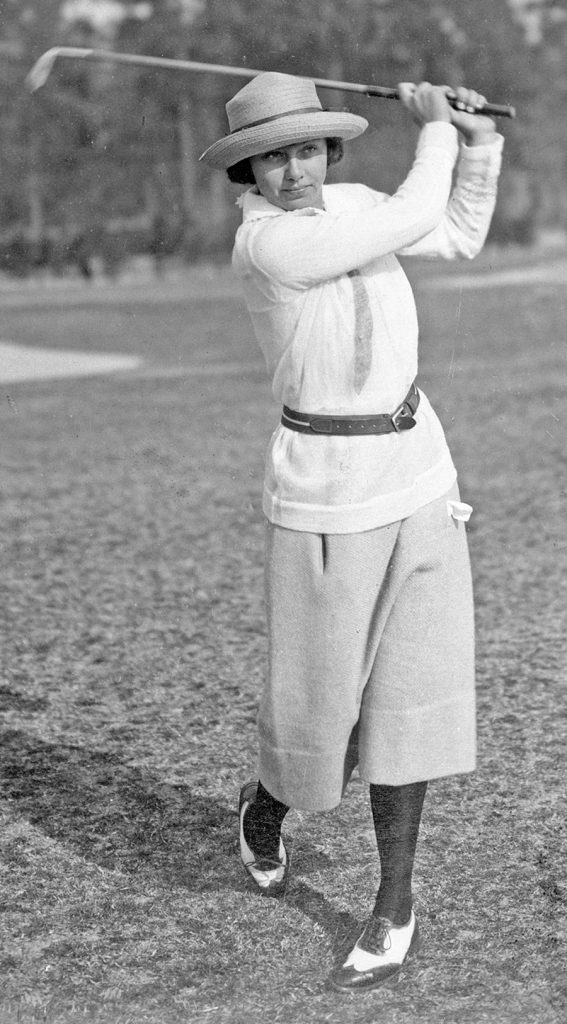
By the time Collett arrived in Pinehurst for the 1922 winter season, she was recognized as an emerging force in amateur golf, the highest level of the women’s game at the time. In March, she captured her first major tournament on course No. 2 in the Women’s North and South, defeating an outgunned Edith Cummings in the final match 4 and 2. The Pinehurst Outlook observed that Miss Collett, as the players of the day were described, was “sure to win many important championships and to be one of the prominent figures in the game for years to come.” Later that season, she won the U.S. Women’s Amateur at the Greenbrier, consistently outdriving her opponents by 50 yards. The new champion revealed something of a superstitious streak. Having consumed lamb chops, stringed beans and cream potatoes the evening before a practice round in which she carded an excellent 75, Collett confessed to “eating the same thing every night as long as the tournament lasted.” She also “wore the same skirt, sweater, and hat.”

Her victory at the Greenbrier was a breathtaking achievement. No other golfer, before or since, ever won a major championship within five years after taking up the game. Public interest in all things Glenna rose to a fever pitch. The fact that the 19-year-old had become a stylish and attractive woman accentuated that attention. Collett acknowledged in Ladies in the Rough that the demands of new-found celebrity presented a wearing Catch 22: “Sooner or later the champion begins to realize that she is supposed to do this and that, either from a desire to be agreeable or an honest wish to live up to the sweet things said about her in sports columns. Most difficult of all is trying to be a ‘good sport.’ As such you are compelled to do many things you don’t give two hoots about, to go to parties when you just long to be in bed, to be nice to people, who ask all sorts of favors . . . but the champion, unless she has the skill of a diplomat, has no way of expressing her gratitude and at the same time refusing.”

Collett relinquished her U.S. Amateur crown in 1923 but successfully defended the North and South title. She also earned trophies at two Florida tournaments and the Canadian Women’s Amateur. Those successes would be dwarfed by Glenna’s monster 1924 campaign. Dubbed the “female Bobby Jones,” she won 11 of the 12 tournaments she entered (including her third straight North and South championship), prevailing in 59 of 60 matches. Her only defeat came at the hands of Mary K. Browne in the semifinal of the U.S. Amateur when, putting from 20-feet on the 19th hole, Browne unintentionally caromed her ball off Collett’s into the hole to close out the match.

Regaining her U.S. Amateur title in 1925 at St. Louis Country Club, Collett capped the championship with a 9 and 8 blowout of the veteran Alexa Stirling. Having retaken America’s most important title, she sailed across the Atlantic in an attempt to win a historic double at the British Women’s Amateur. For once, she found herself overmatched, facing England’s Joyce Wethered in the third round at rugged Troon. When the match ended after 15 holes, the brilliant Wethered stood five under par, leaving her American opponent in the dust. It was the first of several near misses for Collett in that championship. “More than once I have visualized myself, gray-haired and stooped, wearily trudging over the windswept fairways of an English course seeking that elusive title,” she wrote.

The disappointment did little to detract from Collett’s victory parade in America. With each triumph, her star glowed brighter. The legendary Donald Ross considered Glenna’s presence at the resort to be “good advertising,” and her amiability attracted a growing coterie of Pinehurst friends and admirers. Since the queen of American golf had chosen Pinehurst for winter lodgings, a glittering array of eager challengers followed suit. Virginia Van Wie, Helen Hicks and Maureen Orcutt, all championship-caliber players, visited frequently. Collett welcomed her fellow competitors, squaring off against them in tournaments, exhibitions and friendly one-on-one matches.

The 1920s were a golden time in Pinehurst. In addition to the female stars, legends like Walter Hagen, Tommy Armour, Bobby Jones and Jock Hutchison habitually visited, displaying their expertise on the resort’s courses. Golf aficionados flocked to the area in droves, not just to play but also to mingle with their heroes — both male and female.
In 1920, Leonard Tufts sought to capitalize on the good times by launching a real estate venture on 5,000 acres adjacent to the pathway of the old Yadkin Trail (now Midland Road) between Southern Pines and Pinehurst, forming Knollwood, Inc., whose stockholders included himself, Ross, New York steamship lines magnate James Barber, H.A. Page, Pinehurst, Inc., and Waldorf-Astoria, Inc. The first phase of that development was completed in 1924 with the opening of the Mid Pines Country Club, and its 118 room hotel, imposingly situated just behind the 18th green of the Ross-designed course.

In January 1927, Leonard and the other shareholders embarked on a more ambitious phase of the development involving the subdivision and selling of hundreds of residential lots, many adjacent to the new Ross-designed Pine Needles golf course. A key aspect of the plan was the erection of the Pine Needles Inn (now Pine Knoll at St. Joseph of the Pines), a towering Jacobean structure that wowed all who saw it. The normally conservative Tufts reckoned that the booming economy and the imminent widening of Midland Road would result in brisk sales of lots and concluded the risk of borrowing money to finance the project would be minimal. Leonard’s own company, Pinehurst, Inc., was among the entities loaning substantial sums to the venture.

Construction of the golf course and inn proceeded apace. Casting about for a big name who would entice guests to the Pine Needles Inn after its scheduled opening of January 28, 1928, the Knollwood brass thought of Collett, adored by just about everyone. In The Story of American Golf, Herbert Warren Wind likened Collett to his favorite actress, Ingrid Bergman, since both women gave “majestic performance[s] when at work” but “generally scorned the queenly manner.” The admiring Wind praised Collett’s “fine sense of humor at her own expense; she added verve to a party with her high-spirited playfulness; and she was that very rare thing, a good winner.”

In exchange for room, board, free golf and some unknown stipend for herself and her mother, Collett accepted Knollwood’s proposal that she assist in promoting Pine Needles. She and Adah would relocate from the Carolina Hotel to the Pine Needles Inn on its opening day. The Pilot’s Bion Butler heralded Glenna’s arrival in his December 9, 1927 editorial: “She will be a feature of Sandhills outdoor life and probably her admirers will see that she is a central figure in much social contact in the house [Pine Needles Inn].”

Another marketing idea occurred to Leonard Tufts shortly after the New Year. Wouldn’t it be great for Pine Needles to host a women’s tournament coinciding with the opening of the hotel with Collett as the main attraction? Ross had doubts whether the event could be staged with only 30 days’ notice. “I don’t know how much Miss Collett’s say-so would help,” the famed course designer wrote Leonard, “but it might because of the fact she knows them personally.” But Collett’s say-so did have clout, and she successfully recruited a strong field of 54 players for the Mid-South Open, contested a few days after the inn opened for business.

While promotion of Pine Needles and its facilities was important, the Knollwood investors were primarily concerned with generating cash flow from the sales of lots. The Pilot collaborated with Knollwood, running articles above the fold unabashedly highlighting each lot sale, and generally serving as the project’s enthusiastic booster. In one editorial, Butler opined that Knollwood’s success was of paramount importance to “the whole united interest of the whole Sandhills community, for we all advance or stand still or go back together.”

To augment The Pilot’s unwavering support, Knollwood manager J. Talbot Johnson and real estate agent Samuel B. Richardson (both of whom were Knollwood shareholders) embarked on a hard-sell advertising campaign to market the lots. After Ross bought two lots, an ad informed potential buyers that, “Donald Ross is the best authority in this country on values of real estate in the golf belts . . . He puts his money on Knollwood Heights.” Another gambit stressed the fine neighbors one would have by purchasing in Knollwood — most of them wealthy. “Mr. Sylvester,” says one Richardson ad, “is one of the big men in American finance as NCB has resources of around a billion dollars and heads everything else in the continent.” Richardson also stressed that “lots were going quickly” in the “buying whirlwind” and hesitant buyers should pull the trigger while there was still time. “Look at the maps in Richardson’s office,” (located at the Arcade Building  — currently Morgan Miller and Framers Cottage —  in Southern Pines), “and see how these lots are melting away.”
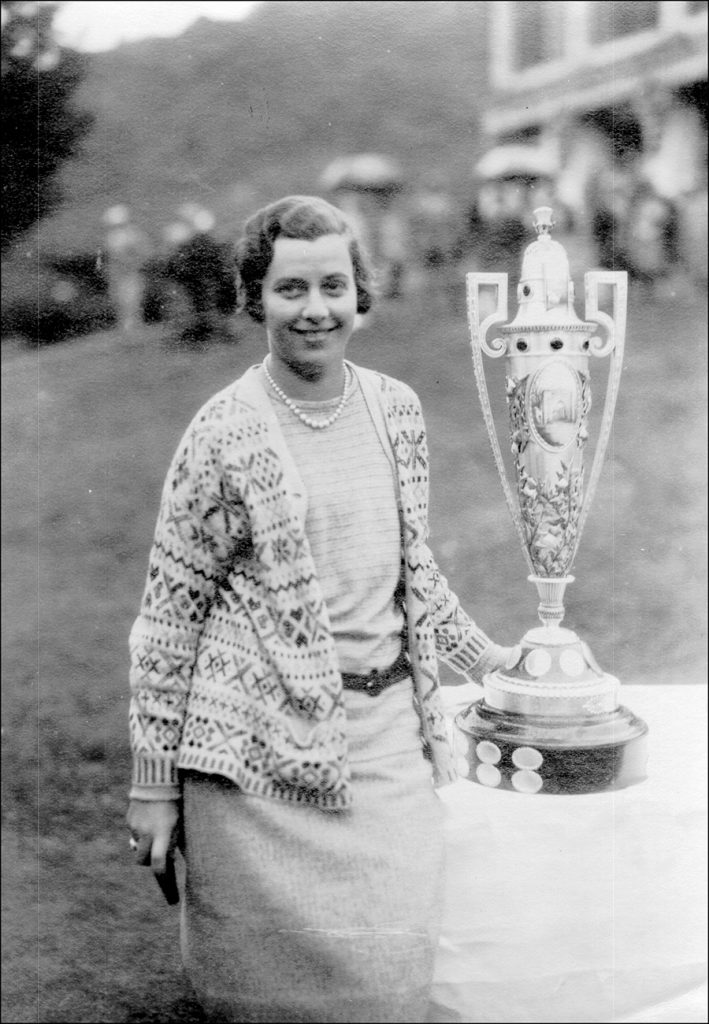
Well, lots were not “melting away” quite as fast as the Knollwood men intimated, but assistance in marketing them would come early in 1928 from an unexpected source — Glenna Collett. It’s not clear what led to her role in arranging and closing the sale of a lot to Wisconsin real estate operator Robert Whittaker in early February, 1928, but whatever it was, Sam Richardson began touting her as a saleswoman extraordinaire. Richardson’s ad in the February 12 Pilot suggested that potential buyers visit Miss Collett at Pine Needles and “get her to drift about Knollwood Heights with you and talk golf and home sites. She will be glad to as she is an enthusiast about Pine Needles and she says she will be glad to sell more Knollwood Heights lots.”

The Pinehurst Outlook also talked up Collett’s sales acumen, saying she was “as hard boiled in procuring a down payment as she is driving off the tee.” For her part, Collett insisted to the Outlook’s columnist “there is no reason why a woman should not be as good a salesman as a man.” She added that participation in sports “especially golf, should be a great help to a woman in business.” Glenna was not the only great amateur golfer selling golf course real estate. The star with whom she was often compared, Bobby Jones, was similarly employed in Sarasota, Florida.

The Whittaker deal jump-started an impressive sales streak by Collett that continued until her return North in April 1928. Richardson’s ads in The Pilot reported them all. The February 17 edition proclaimed “Glenna Collett in action again” after she engineered the sale of lot 456 to Connecticut state Senator Wallace Pierson. On March 9, The Pilot disclosed that Collett had sold three lots to Messrs. Sylvester and Brasleton. On April 13, her biggest real estate score yet made the headlines of the paper when she convinced Michael Meehan to purchase an entire block of seven lots, then talked him into buying five more for his daughter Betty Elizabeth. On a roll, she arranged George Van Kueren’s purchase of three more lots.

Her sales pitch was low-key. Richardson advertised that “Miss Collett has none of the hurrah, boys, style, but she simply interests her friends in discovering what they are anxious to find — the best spot on earth for a winter vacation, and she is a big influence in gathering the golf army together in the Sandhills.”

Collett won her third U.S. Amateur title at The Homestead in the summer of 1928, annihilating her friend Van Wie in the 36-hole final 13 and 12. Talbot Johnson recognized that her status as current national champion rendered her even more valuable to Knollwood. Notwithstanding Johnson’s concern that “selling lots is so secondary to [Collett’s] golf that even the best land prospect would have to wait,” he urged Richard Tufts (Leonard’s son) to arrange for her return for the 1928-29 winter season. “I imagine Glenna is going to be more popular than ever this year on account of having again won the championship,” Johnson wrote. “I am convinced that her name is quite an asset to both Pinehurst and Knollwood and she is a good drawing card for both.”

According to Johnson, Collett’s mother was keenly aware of her daughter’s marketability. Skillfully playing the role of unofficial agent, Adah never passed up an opportunity to remind Talbot that she and Glenna were constantly receiving “propositions from hotels offering not only to give them free board, but to pay railroad transportation.”
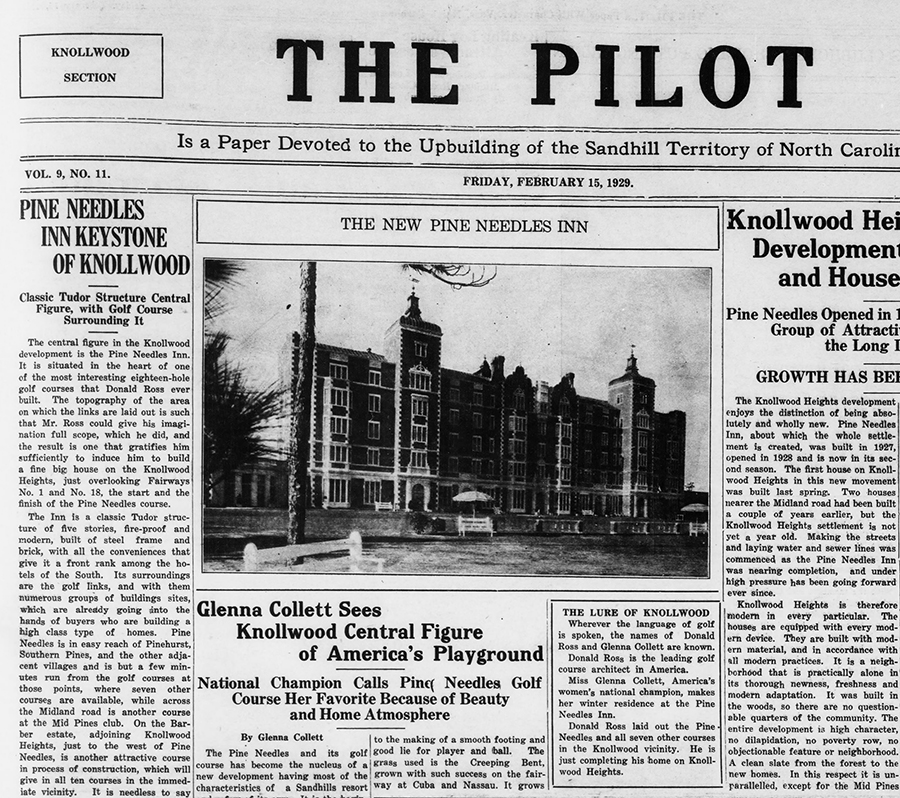
Collett and her mother eventually came to terms with Knollwood for a second year. They would bivouac at the Carolina in December, and then stay at the Pine Needles Inn after that house opened mid-January. Both The Pilot and Knollwood stepped up the marketing campaign in anticipation of their arrival. “With Glenna Collett and Mrs. Collett advocating the delights of Knollwood Heights as a place for a home in the North Carolina golf and vacation belt,” trumpeted one editorial, “the additions to Knollwood’s group this winter will be large.” Glenna herself penned a lengthy article on February 29, 1929, extolling the virtues of the Pine Needles course and Knollwood’s atmosphere. “I have come to prefer the new Pine Needles course to any of the others in the Sandhills,” she enthused, “because of its beauty and the associations that make it seem like home to me.”

Despite the hullabaloo, real estate sales activity slowed to a trickle that winter. Few were buying. Even Collett’s star power was insufficient to reverse the trend, and events in her life contributed to her sales slump. Still mourning her father’s untimely death in 1928, the presence of a handsome blueblood Philadelphian vacationing in Pinehurst provided a further distraction. The name of Edwin H. Vare, Jr. began popping up in The Pilot, linked with Glenna’s. The March 1st Pilot reported that Collett had fired a magnificent 73 at Pine Needles and Vare, her playing partner, carded 85. Vare attended a dinner dance in Glenna’s honor at Lovejoy’s log cabin restaurant in Southern Pines (once located near the present Methodist Church). A romance blossomed. Though not selling many lots, Collett kept busy promoting and playing in the second Mid-South Open at Pine Needles. It was the first tournament in women’s golf where amateurs competed against female professionals. The Chamber of Commerce raised a whopping $50 in prize money.

By the start of the Sandhills’ 1929-30 winter golf season, the shock of the stock market collapse and the looming Great Depression brought prosperity to a screeching halt. Even the wealthy shied away from building “winter homes.” Knollwood could not afford to keep Collett on the payroll despite her repeat victory in the U.S. Amateur championship. However, that did not stop her from continuing her brilliant play while in the Sandhills. She won her record sixth North and South title in March, and participated in an exhibition at Southern Pines Country Club that drew 2,000 spectators. In the summer of 1930, Collett carried home her fifth U.S. Amateur trophy (and third in succession), defeating old rival Van Wie at Los Angeles Country Club. That year, she organized a team competition between the best amateur female players of America and Great Britain that presaged the first Curtis Cup played two years later. Her sole golf disappointment was another defeat by her old nemesis Wethered in the British Amateur final at St. Andrews. Despite the result, Collett viewed the nip-and-tuck match as the most exciting of her career.

Vare and Collett married in June 1931, and she joined him in Philadelphia. The newlyweds would weather the Depression, but the fortunes of Knollwood and Pine Needles plummeted. The inn would shut its doors in 1931 and remain closed until new ownership reopened it in 1935. Creditors forced the liquidation of Knollwood’s assets. Fortunately, the Tufts’ lenders allowed the family members to retain their holdings in Pinehurst.

Glenna Vare dropped out of competitive golf in 1933 after giving birth to son Ned, then daughter Glennie, but she would author a memorable comeback in the 1935 national amateur at Interlachen Country Club in Minneapolis. Smashing her drives far past her finals opponent, the 32-year-old sentimental favorite bested 17-year-old Patty Berg 3 and 2 to record her never equaled sixth national amateur championship. ”I wanted to put ‘Vare’ on that trophy,” the always-competitive Glenna confided to a friend.

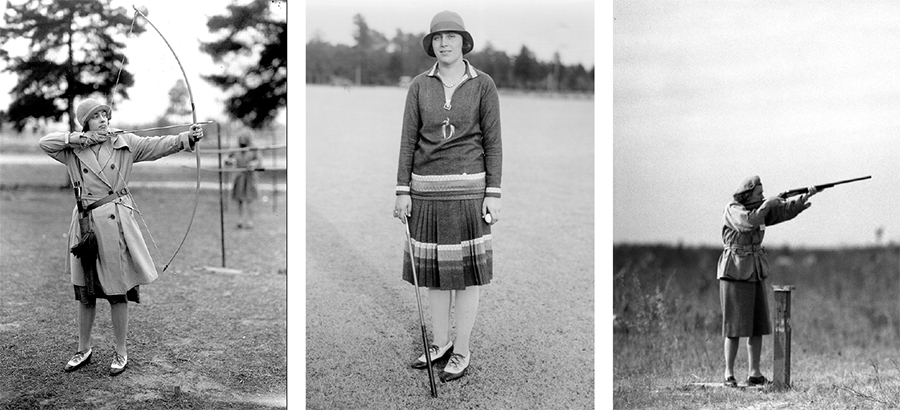
After her resounding triumph, Vare gradually faded away from golf on the national stage, though she continued to play in area events on and near her home course, the Philadelphia Country Club. She discovered new areas of sport to her liking. She trained sporting dogs for field competitions and found her excellent hand-eye coordination translated nicely to rifle shooting. The Vares would visit Pinehurst intermittently over the succeeding years, but sometimes without touching a club. Recounting her achievements during a visit to the Sandhills in 1947, The Pilot marveled that “the versatile Mrs. Vare was the top hand among the women at the skeet range. She has won many titles in her Philadelphia district for her skeet shooting, and she fires from scratch against men and women. She is a crack shot in the field also, and trains her gun dogs for field trials. She rides, swims, dances, and plays bridge just a little better than most anybody else.” While vacationing in the Sandhills in 1956, Glenna pulled off an unusual triple, claiming the medal in a pairs golf tournament, shooting 49 out of 50 targets in skeet, and winning a field trial with her dogs.

As the decades passed, accolades came Mrs. Vare’s way. She was inducted as a member of the inaugural class of the Women’s Golf Hall of Fame in 1950. Though never turning professional, the LPGA honored her by establishing the Vare Trophy, awarded annually since 1953 to the pro with the lowest scoring average. She received the United States Golf Association’s Bob Jones award for sportsmanship in 1965. She would be elected to Pinehurst’s World Golf Hall of Fame in 1975.

As she aged, Glenna devoted much of her time to her family. She reveled in son Ned’s accomplishments on Yale’s golf team, and doted on her grandchildren. She enjoyed summers back in her native Rhode Island, golfing at Narragansett’s Point Judith Country Club with family and friends. According to golf writer Bill Fields, who devoted a chapter to her in his book, Arnie, Seve, and a Fleck of Golf History, she competed in the club’s Point Judith Invitational for more than 60 years, invariably hosting a lobster dinner for her visiting friends.

In 1986 PineStraw editor and best-selling author Jim Dodson interviewed Vare in Narragansett for a story in Yankee Magazine. Then 83, widowed, and still proudly sporting a 15 handicap, Vare bossed him about, ordering Dodson to make himself useful chopping vegetables for soup. At first she stiff-armed any discussion of her golfing career, believing she’d been largely forgotten. Dodson’s Yankee story was subsequently republished in the USGA’s Golf Journal, helping to bring Vare’s exploits to the attention of a generation of golfers unaware of her accomplishments. She passed away three years later in Gulf Stream, Florida. Her daughter Glennie Kalen still lives in her mother’s old haunt of Narragansett and remembers her mom as “reserved, funny, and lucky.”

The latter must have been transferable. While captaining the U.S. side in the Curtis Cup, Vare found a four-leaf clover that she immediately picked and handed to Peggy Kirk, who was struggling mightily in her singles match. The woman who would eventually own Pine Needles with her husband, Warren Bell, rallied to win. If luck be a lady Glenna Collett Vare was her name. PS

Pinehurst resident Bill Case is PineStraw’s history man. He can be reached at Bill.Case@thompsonhine.com.

World Golf Hall of Fame member JoAnne Carner, a five-time winner of the Ladies Professional Golf Association’s Vare Trophy, shot her age last year in the inaugural U.S. Women’s Senior Open Championship won by fellow Hall of Famer Laura Davies at the Chicago Golf Club. The 2nd U.S. Women’s Senior Open Championship will be conducted at Pine Needles Lodge and Golf Club May 16-19. Entries open Feb. 20. Championship tickets and packages can be purchased at USGA.org.