The Omnivorous Reader

Retracing Washington’s Footsteps

Touring a nation divided, then and now

By Stephen E. Smith

When historian Nathaniel Philbrick decided upon the title Travels with George for his most recent book, he took on a hefty obligation. In three words he employed two significant allusions. First, “Travels with” references Travels with Charley, Steinbeck’s classic travelogue (Charley was Steinbeck’s pet poodle) in which the author of Grapes of Wrath takes a thoughtful look at a sedate 1960s America. Second, the name “George” alludes to the George in American history — George Washington.

Oh, no, you might groan, not another book about Washington. His diaries are available in a four-volume set, there are numerous explications of his writings, and we are inundated with scholarly biographies. Barring newly discovered facets of Washington’s life or a passing reassessment of his faults and virtues, what is there left to say about the man?

But if new material were unearthed, Philbrick would likely write about it. He is the author of a dozen popular histories and has a following among middlebrow readers who thrive on fascinating facts about our country’s origins. His works are perceptive and relevant and always worth reading. Travels with George is no exception.

The title immediately divides the book into two distinct narratives that Philbrick skillfully intertwines. The first is the “tour.” When Washington became president in 1789, he found America divided into two factions. There were no Republican or Democrat parties, but the country was split by two opposing views of how the government should function: citizens who favored the Constitution (Federalists) and those who didn’t (Anti-Federalists). If the country were to be united, there was one man who possessed the prestige to encourage a sense of unity. So, it was that Washington set out on a 1789-1791 journey that would take him from Portsmouth, New Hampshire, in the North to Savannah, Georgia, in the South. He embarked on his tour in a fancy horse-drawn coach (the chariot) and kept a sketchy commentary of his journey. Philbrick and his wife travel by car with their dog, Dora, a red, bushy-tailed Nova Scotia retriever. The physical America they encounter would, of course, be unrecognizable to Washington, but the divisions that trouble our politics would not be foreign to his understanding of democracy.

Washington spurned undue adoration. He was not fond of crowds and military honor guards, and he avoided both whenever possible. But he was also sensitive to social and political slights. When Gov. John Hancock of Massachusetts avoided dining with Washington, the first president never forgot the snub. Moreover, the Washington most Americans think they know — Parson Weems’ godlike contrivance — has little in common with the Father of Our Country.

“This is the Washington who was capable of punishing an enslaved worker who repeatedly attempted to escape by selling him to the sugar plantations in the Caribbean,” Philbrick writes. “This is the Washington who in the days before leaving for the Constitutional Convention had an enslaved house servant whipped for repeatedly walking across the freshly planted lawn in front of Mount Vernon.” A particularly ghastly example of Washington’s cruelty was his habit of having living teeth pulled from jaws of his slaves and implanted in his own toothless head.

The new president completed his tour of the Middle Atlantic states and New England before turning his attention to the states south of Virginia, a part of the country with which he was unfamiliar. Once in North Carolina, he spent the night in Tarboro and left early the next morning to avoid the dust that would be kicked up by a company of local cavalry that planned to escort him to New Bern. When he reached “a trifling place called Greenville,” the riders — and the dust — caught up with him.

“By that point Washington had entered a landscape that was new and utterly strange to him,” Philbrick writes, “the domain of the longleaf pine — a species of tree most of us in the twenty-first century have never seen but that in the eighteenth century covered an estimated ninety million acres, all the way south from North Carolina to Florida and as far west as Texas.”

Washington found the North Carolina landscape a bit unsettling. The longleaf forests were dense and shadowy, and he wrote that the landscape was “the most barren country I ever beheld,” but conceded that “the appearances of it are agreeable, resembling a lawn well covered with evergreens and a good verdure below from a broom of coarse grass which having sprung since the burning of the woods, had a neat and handsome look. . . .”

Washington was feted at balls and celebrations. He endured flea-infested beds in dilapidated taverns and the adulation of the ever-present paramilitary escorts. He even inspired a little romantic speculation when he visited with Nathanael Greene’s widow at Mulberry Grove Plantation outside Savannah. From there he passed through Augusta, Camden, Salisbury and Old Salem before returning to Mount Vernon.

The second component of Travels with George is not a comparison and contrast with Washington’s tours, but is more a mildly political semi-narrative supported by documents, maps and photographs. The Philbricks and their dog are agreeable company — their perceptions are folksy and laced with wit and intriguing observations — but inevitably, Philbrick must address the political divisions that trouble contemporary America.

After visiting Greene’s plantation, Philbrick wrote: “I was tempted to believe that a monster had been born in Mulberry Grove. But it was worse than that. A monster is singular and slayable. What haunts America is more pervasive, more stubborn, and often invisible. It is the legacy of slavery, and it is everywhere.” Reinforcing this point of view, Philbrick quotes from observations Washington made in his farewell address to the nation.

What troubled Washington was what might happen if a president’s priority was to divide rather than unite the American people: “It serves always to distract the public councils and enfeeble the public administration,” Washington wrote. “It agitates the community with ill-founded jealousies and false alarms, kindles the animosity of one part against another, foments occasionally riot and insurrection. It opens the door to foreign influence and corruption, which finds a facilitated access to the government itself through the channels of party passions.”

Washington might well have been writing about America at this moment, and readers who find themselves agreeing politically with Philbrick and Washington are likely to experience Travels with George as a pleasant and reassuring read. Those who disagree probably won’t make it beyond the preface.  PS

Stephen E. Smith is a retired professor and the author of seven books of poetry and prose. He’s the recipient of the Poetry Northwest Young Poet’s Prize, the Zoe Kincaid Brockman Prize for poetry and four North Carolina Press Awards.

Simple Life

A Gentle Nudge

Mysteries of the golfing universe


By Jim Dodson

Not long ago, the host of a popular golf radio show asked me who I most enjoy playing golf with these days. We were discussing the various golfers and assorted eccentrics I’ve met, interviewed, and written about over a long and winding career.

“These days, I like to play golf with old guys,” I said without hesitation, “like my friend Harry.”

“So, who is Harry?” he asked.

Harry, I explained, is a gifted artist and nationally known cartoonist I’ve known for many years. He has a wry sense of humor, a beautiful tempo in his golf swing, and a refreshing take on life. Harry is 76 years old, deaf in at least one ear, losing bits of his eyesight, and battling a rogue sciatic nerve in his left leg that sometimes makes swinging a club difficult.

He was once a splendid single-digit player who now aims for bogey golf, and never gets too rattled by whatever the game gives him. He accepts that bad breaks happen and are simply part of this maddening Presbyterian game, not worth fretting about. So are aging body parts that can’t propel the ball the way they once did.

Instead, Harry plays for the occasional fine shot, the rare good break, and the fellowship of his companions that includes a good bit of affectionate needling and laughter. He’s never had an ace, but holds out hope of someday shooting his age, the proverbial goal of every aging golfer.

Though I’m almost a decade younger than Harry — he jokes that I am a pre-geezer in training — I love playing with him because he is a model of what I hope to be like in the rapidly shrinking years ahead: a man who has loved the game since he was a boy and loves it just as much, though differently, as an old man. He is living proof that the game can grow sweeter as the clock runs down.

Golf has been part of his life since he was 10 or 11 years old and an uncle allowed him to pick a club from a barrel of used irons. He chose a battle-scarred 7-iron and the set that went with it.

“It was a set of Dalton Hague clubs, really beautiful. I played with them for years bragging that I owned real Dalton Hague signature golf clubs.” He pauses and chuckles. “They turned out to be Walter Hagen clubs that had just been beaten to death. But oh, how I loved those clubs.”

We often meet late in the afternoon for nine holes at a beautiful municipal course set on a wide lake well out of town, surrounded by mature hardwood forests with no houses, streets or power lines visible anywhere. We often pause to watch the action as shadows lengthen and nature reawakens — deer crossing fairways, waterfowl in flight. We rarely bother to keep a score. We just play, talk, be.

Harry’s favorite hole is the short par-4 seventh that angles down toward the lake, with an approach over a wooded cove to an elevated green backdropped by a breathtaking view of the water. He has sketched and painted it several times, aiming to get it just right. “Isn’t this something?” he’ll say with a note of quiet wonder, pausing before his approach shot that sometimes lands in the water of the cove, sometimes just feet from the pin.

If nothing else, getting older also makes it easier to laugh in the face of Father Time. “That’s the easiest 69 I ever made,” Walter Hagen — aka Dalton Hague — playfully quipped upon turning 69.

One afternoon not long ago, as we were watching a spectacular chevron of geese heading south for the winter over the lake from his favorite spot on the course, Harry told me a little golf story that speaks of wonder and mystery.

After Harry’s mom passed away, her final wish was that Harry and his younger sister take her ashes and those of Harry’s father down to a lake in a park at Carolina Beach, where the couple first met and later married. Harry promised he would do that.

His sister was a busy surgical nurse. Her unpredictable schedule repeatedly delayed their planned journey to the coast. It happened month after month. One afternoon he was playing golf with a partner who was particularly wild off the tee.

“I was helping him look for his ball deep in the woods, when I stepped over a downed tree and saw a golf ball sitting on top of a rotting log — almost like someone had placed it there. I picked it up and tossed it over to my companion. But it wasn’t his ball so he tossed it back. It was a very old ball. When I looked at it, I couldn’t believe what I was seeing.”

The ball’s colorful logo read Carolina Beach.

One word was printed on the opposite side — Mom.

“It sent chills down my spine. A day later, I drove my folks’ ashes down to Carolina Beach — four hours away — and spread them in the lake at a spot that meant so much to their life together. I felt real peace at that moment.”

As he told me this, he pulled the ball out of his bag and handed it to me.

“I’ve carried it with me ever since,” he explained with a very Harry-like smile. “This game, this life, is wonderfully unexplainable, isn’t it?”

Simple coincidence or a gentle nudge from the golfing universe? Harry’s not sure. And neither am I. But that’s part of the wonder of this game.

As we played on, hitting occasional nice shots and mishits that will never be recorded, it struck me that there was, as usual, a nice little message in Harry’s seventh-hole homily, perfectly timed for a couple “old” friends on a golden afternoon at the end of their golf season; yet another reason to be thankful for the game I aim to play just like Harry until I either shoot my age or simply fly away like geese in the autumn.  PS

Jim Dodson can be reached at jwdauthor@gmail.com.


Illustration by Gerry O’Neill

Out of the Blue

Furball Fun

Always up to scratch

By Deborah Salomon

Welcome, fellow felinistas, to Cat Column No. 8. I limit myself to one a year, in January, or else you might shred this beautiful magazine for litter. In the beginning I promised only good news, which continues since my two kitties are still spry in old age, perhaps 14 or 15. Unlike humans and dogs, teeth don’t tell.

So far, they’re not misplacing car keys or forgetting a vet appointment, either.

Recap: The saga began in 2011 when a coal black (even whiskers) kitty with fur as smooth and shiny as satin turned up at my door. I was without cat companions — always two, sometimes three — for the first time in 30 years. Of course I fed him and, six months later, opened the door to the most amazing animal I’ve ever met. Neighbors said his family, who took the trouble to neuter and declaw him, had moved away, abandoning him.

Lucky was at home instantly. He knew how to repay my kindness with love. He is calm, thoughtful, stoic, brilliant. I adore him.

Some months later a fat, lumpy girl with patchwork grey stripes against a white background came begging. Her gait defines “waddle.” She was a neighborhood semi-feral, fed by many, obviously, with a notched ear signifying that some kind soul had her spayed. She was skittish, unfriendly, short on smarts. She hissed at me and, especially, Lucky. I thought about naming her Edith (Bunker) but settled on the eponymous Hissy, which became Missy when she wised up, realized her good fortune and became a sweetie. However, after nine years she still dislikes the world, loves just me . . . and Lucky. She became his handmaiden, deferring to him, washing his face, following him into the yard, respecting his nests.

That’s right: nests. Cats are nesters, especially my Lucky. They find quiet out-of-the-way spots to curl up and sleep, preferably a place with a familiar aroma like a half-full laundry basket. Lucky’s first nest, pre-adoption, was under a bush by my front door. Once inside, he found a flannel jacket that had fallen off the hanger in the back of my closet. After a few weeks the fabric had conformed to his curled-up shape and I had learned the hard way not to shut the closet door.

I had also installed towel-covered perches on two sunny windowsills, which don’t qualify as nests because of visibility.

Next came the cable box, which is warm but only semi-private. He hangs over the sides, so I laid a book of the same thickness next to it. Ahhh . . . his expression conveyed.

To lure him off that nest I put a round, fleece-lined cat bed in a living room corner, underneath a low window. Here, tucked away, Lucky can see what’s going on outside and inside. This was nap central all summer, especially days cool enough to open the window.

Well, Hissy/Missy wasn’t taking this best-nest thing lying down. She would sidle by, checking occupancy, claiming the prime space when available. So, to keep the peace I installed a second fleece-lined bed beside it.

Fat chance.

Nests aren’t just for sleeping I discovered after putting down a cardboard box with an opening cut into one side, so Lucky could claim his fort, defend it from intruders. There he sits inside the box, smiling, while Missy attacks with swats and growls.

Such fun! Great exercise! Costs nothing!

When the game is over, Missy sidles up to Lucky and commences grooming him — a good thing, since arthritis prevents him from reaching nether areas.

I feel his pain in my own joints.

Last week, Missy displayed a rare intelligence. I brought out my suitcase in preparation for a quick trip to visit my grandsons for the first time in almost two years, leaving my kitties with a pet sitter possessing enough certifications to tend the Queen’s corgis. Missy became agitated. She napped less, talked more, even pooped outside the litter box, a sure sign of distress. Could she have remembered what the suitcase signifies? Decades ago we had an Airedale who went berserk, tried to destroy suitcases. A more secure Lucky reacts by curling up inside it, shedding on my new sweater.

A perfect nest, he purrs, albeit temporary.

But their ultimate nest isn’t a nest at all. My kitties found nirvana in full view, on the heating pad that eases my shoulder pain at night. I had to buy a double-wide second pad to accommodate us all. Talk about smart: On the first chilly day Lucky, followed by Missy, jumped on the bed, looking for it.

Sounds crazy, I know. Only animal people will understand my anthropomorphisms, let alone put up with Lucky’s insistent paw at 4 a.m. demanding breakfast and a spin outside before returning to the heating pad(s).

I could relate more but he’s sitting by my desk, giving me that look that says, “lap time.”

And people say cats are aloof and unaffectionate. Maybe, to aloof, unaffectionate people.

Same time, next year?  PS

Deborah Salomon is a writer for PineStraw and The Pilot. She may be reached at debsalomon@nc.rr.com.

In The Spirit

Starting Over

Embracing the flavor of zero ABV drinks


By Tony Cross

I’ve always had a weird relationship with January. Part of me likens the month to 31 Sundays. It’s the day after a raging Saturday night; everything is kind of fuzzy; I’ve come down from the big high that was the holidays and all the excess that comes with it. The other part of me (probably my organs) is looking forward to getting back on track with diet and exercise. I never stopped any of that, but last month I doubled down on the debauchery, so they kind of canceled each other out. Kind of.

This January, I am taking the month off from spirits and am focusing on the year ahead as clear-headed as I can be. I hate February, too, but will have my half-filled bottles of whiskey and rum to see me through. If you’re like me and are taking a sabbatical — or maybe you’re pregnant or maybe you and alcohol don’t have a great relationship — here are some zero-proof drinks that can cheer you up after the big comedown. There are quite a few syrups and such to be made with these drinks, so be prepared. Of course, they’re delicious in spirit-based cocktails, too.

La Luz

Jon Feuersanger, 2019, Death & Co. NYC, New York

Hot off the press! The folks over at Death & Co. have just released their newest cocktail book, Welcome Home. Admittedly, I have not been able to read all of it, but when I first opened the book to skim through it, what did catch my eye was the addition to their repertoire of low- and no-ABV cocktails. The first ingredient in this drink is verjus. Verjus is the juice of unripened grapes. It’s usually acidic and can be dry. You can order it online and get it within the week. The Christmas crunch is over, right? As an alternative to using citrus juices, verjus can be a great base in a non-alcoholic cocktail. It’s also terrific as a balancer in cocktails with spirits in them. Feuersanger writes of his mocktail, “No-ABV drinks can be challenging. Ingredients interact differently with alcohol. I looked to Hawaii to inspire this summery drink. The tartness of the pineapple pulp cordial plays with the acidity and sweetness of the passion fruit purée and gives the drink the weight of a Gimlet or Sidecar. It sounds sweet, but it goes down easy.”

La Luz

1 3/4 ounces Fusion verjus blanc

1 ounce pineapple pulp cordial (recipe below)

1/2 ounce Perfect Purée passion fruit purée

1/4 ounce fresh lime juice

1 dash orange blossom water

1 lime wheel (garnish)

Shake all ingredients with ice, then double strain into a chilled Nick & Nora glass. Garnish with lime wedge.

Pineapple Pulp Cordial

450 grams unbleached cane sugar

450 grams filtered water

100 grams pineapple pulp (left over from juicing pineapple)

Malic acid

Citric acid

Combine the sugar, water, and pineapple pulp in a blender and process until the sugar has dissolved. Strain the mixture through a paper coffee filter or Superbag (available on modernistpantry.com).

Calculate 2 percent of the weight of the above mixture to get X grams of malic acid. Calculate 3 percent of the above mixture to get Y grams of citric acid. Pour X and Y into a storage container and refrigerate until ready to use, up to two weeks.

Business Casual

Jon Mateer, 2019, Death & Co. NYC, New York

Yes, I know — that last drink was a doozy. Fear not. This one doesn’t involve much math, but you will probably need to order a few ingredients online. The first is Giffard’s Aperitif syrup. It’s a great substitute for Campari or Cappelletti Aperitivo — red and bitter. This aperitif has flavors of bitter oranges, gentian root and spice. As a side note, you can enjoy this with sparkling water and an orange slice and be A-OK.

Business Casual

1 1/4 ounces Giffard Aperitif syrup

3/4 ounce chilled brewed black tea

1 ounce red verjus syrup (recipe below)

1 teaspoon cane sugar syrup (recipe below)

1 orange half wheel (garnish)

Stir all the ingredients over ice, then strain into a double old-fashioned glass over 1 large ice cube. Garnish with the orange half wheel.

Red Verjus Syrup

130 grams red verjus

60 grams vanilla syrup (see below)

31.5 grams cinnamon syrup (see below)

In a bowl, whisk together all the ingredients until combined. Transfer to a storage container and refrigerate until ready to use, up to 2 weeks.

Vanilla Syrup

500 grams simple syrup (equal parts sugar and distilled water)

2 grams vanilla extract

Combine in a storage container and shake. Refrigerate until ready to use, up to 2 weeks

Cinnamon Syrup*

500 grams simple syrup

15 grams crushed cinnamon sticks

Blend together and pour into a storage container to sit overnight in refrigerator. Strain out solids the next morning, and refrigerate syrup, up to 2 weeks.

*(The Death & Co. recipe is a bit much, this is a simpler version.)

Cane Sugar Syrup

300 grams unbleached cane sugar

150 grams filtered water

Combine the sugar and water in a blender and process until the sugar has dissolved. Pour into a storage container and refrigerate until ready to use, up to 2 weeks.  PS

Tony Cross is a bartender (well, ex-bartender) who runs cocktail catering company Reverie Cocktails in Southern Pines.


Photograph by Tony Cross

Sporting Life

Desk Diving

Fond memories under a rolltop

    Don’t throw the past away

    You might need it some rainy day

    Dreams can come true again

    When everything old is new again

             – “Everything Old Is New Again,” by Peter Allen

By Tom Bryant

Many years ago, my bride, Linda, gave me an ancient rolltop desk for Christmas. It’s not the big kind, only has drawers on one side, but it fits perfectly in the corner of our den, not far from my favorite leather chair, and close to the fireplace. I’ve spent many restful hours roaming from the desk to the chair, occasionally stoking the fire.

I don’t know how it does it, but it seems as if the desk has a mind of its own and can cause all kinds of interesting stuff to materialize that I had considered long lost. Usually on a miserable rainy or snowy day — after hunting season, of course — I will slide open the rolltop, pull my desk chair in close, and begin to rummage through items that would be like new to me.

I did that recently at the insistence of Linda when she happened to walk through the den at the same time I opened the top. “I don’t see how you can find anything in all that mess,” she said. “Why don’t you take a couple of weeks and shovel through it?” Sometimes Linda can be right funny. She went into the kitchen chuckling.

I did take her advice, pulled the trash can closer, and prepared for an afternoon of fun and cleaning. In the back of the desk are cubbyholes and a couple of small drawers. Immediately, I found a box with a Remington pocketknife in it. It was a gift from George Puckett, a neighbor friend who passed away several years ago. He spent his entire working life with Remington and toward the end of his career, was the manager of Remington’s ammunition plant in Arkansas. I first met him one morning as I went for a walk around the neighborhood. George walked every day, the same route, except when he was scheduled to play golf. We got to know each other pretty well, and I was amazed at the depth of his knowledge about the gun manufacturer Remington. He was especially interested in my outdoor writing, and we had many conversations about enjoying nature, hunting, fishing and camping when times were a lot simpler.

I put the knife back in its cubbyhole, opened the mini drawer next to it, and pulled out a card written long ago by George Atherholt. What a pleasant surprise.

I met George at a Southern Pines Rotary Club lunch meeting where he was the speaker. His talk included an 8-millimeter film of a polar bear hunt in the Arctic, where he was the chief participant. I don’t remember if the hunt was successful, but I had never met anyone who had hunted the frozen tundra of the North, and I wanted to know him better. We became friends and had many conversations about his adventures in the outdoors. I even did a column for The Pilot about his hunting prowess

George was a member of the Sheep Grand Slam Club. To become a certified member, a hunter must harvest all four wild sheep species — the Dall, stone, bighorn and desert sheep — an almost impossible feat today. There are only 1,500 Grand Slam members in the country.

George passed away in his late 90s, and his wit and knowledge are missed around the weekly breakfast tables of the Sandhills Rotary.

The next interesting item I found in the cubby was a license registration for my vintage Bronco, frayed with age and dated 1977. That was the last year Ford made the small jeep-sized vehicle. I bought the little SUV shortly after my partner and I started a weekly newspaper. The compact, small truck served me well for many years. Right now she’s sort of like her owner, slowed down a little but still ready to go. She’s resting in our garage waiting for new adventures.

The fire needed another log, so I went to the wood pile to replenish the hearth supply. In no time, I had a good blaze going again, and I was back at the little desk to resume my meandering through memories.

It’s funny how what goes around comes around. My Bronco, for example. Over 40 years ago, Ford decided to stop manufacturing the small size, and now they’re making them the same dimension again. Chevrolet, not to be outdone, has resurrected the old Blazer, which they had stopped producing many years ago. Toyota ceased manufacture of the FJ Cruiser in the ’70s only to bring back the brand in 2007, then stop production again in 2014. The FJ has, almost overnight, become a collector’s item.

Back in the corner of the desk under some old newspaper articles I was saving for some reason, I found a pair of shooting glasses given to me years ago by my good friend Rich Warters. I had forgotten all about them. Rich, an amazing individual, without equal in the outdoors, has moved to Connecticut, and we surely miss him around the halls of old Moore County.

Rich has a passion for bird dogs, English pointers to be exact, and he owns the national champion. He and I spent many hours in the woods turkey hunting. I felt like a neophyte at the feet of the grand master, and although we never got a turkey, I learned a great deal about the sport listening to and watching Rich.

Ironically, a couple of years after Rich moved, I bagged a big gobbler in the same area he and I had hunted when he was still here. I emailed him a picture of the bird and still remember his reply: “I’m glad you got it when you were out there alone. It’s something you’ll never forget, and the memory would be different if I had been there.”

I kicked back in my desk chair and thought about all the many days afield, and experiences and great friends I’ve accumulated over the years and the many I’ve yet to meet. I gently placed the items I had rummaged through back in their desk places, softly closed the rolltop and moved to my leather chair near the fire. The trash can was still empty. I found nothing to throw away and remembered that everything old can truly be new again someday. PS

Tom Bryant, a Southern Pines resident, is a lifelong outdoorsman and PineStraw’s Sporting Life columnist.

Weekend Away

Falling for Folly

The Madcap Cottage gents decamp for a winter escape


By Jason Oliver Nixon

There is something about a beach town after the season winds down, and the endless streams of SUV-driving visitors pack up and head back to lands farther afield (aka, New Jersey). The air chills. Restaurants resume a sense of normalcy without those tiresome, we-aren’t-on-Open Table waits. The music tones down a notch, and the locals actually say hello.

For a decade I lived year-round in the Hamptons, and every Labor Day, the vibe would shift seismically. For the better. Granted, our coffers were full from the go-go summer season just behind us, so everyone was happy, flush, and ready to hibernate. And there would be no more of those all-too-frequent Range Rover road rage incidents in front of the must-have doughnuts joint until next Memorial Day.

Folly Beach in South Carolina boasts that certain off-season magic, too. My partner, John Loecke, and I had visited this vest pocket-sized beach town briefly in the summer, and it bristles with energy. Think fun, funky and just a dash honkytonk. Rooftop terraces pack in the crowds. The groovy al fresco Mexican eatery Chico Feo hosts hipsters 6-deep at the bar ordering dinner (try the mahi-mahi tacos and pozole if you brave the July hordes), and “Park Here!” placards are as ubiquitous as teens in bikinis with ice cream cones.

But come fall, as we discovered, the pace slows, and by winter the place has largely cleared out. In November, John and I craved some time away — a long weekend to read books, sit by a fire, walk on the beach and cook — and, on a whim, we decided to try a wintertime Folly. We rented a 1920s-era cottage, Camp Huron, that we had spotted on Instagram, and the house lived up to its billing.

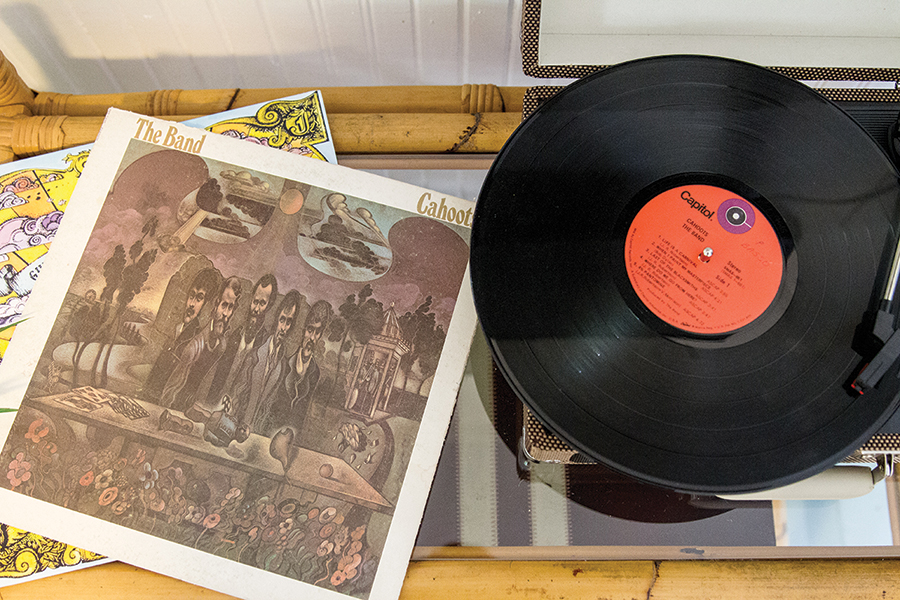
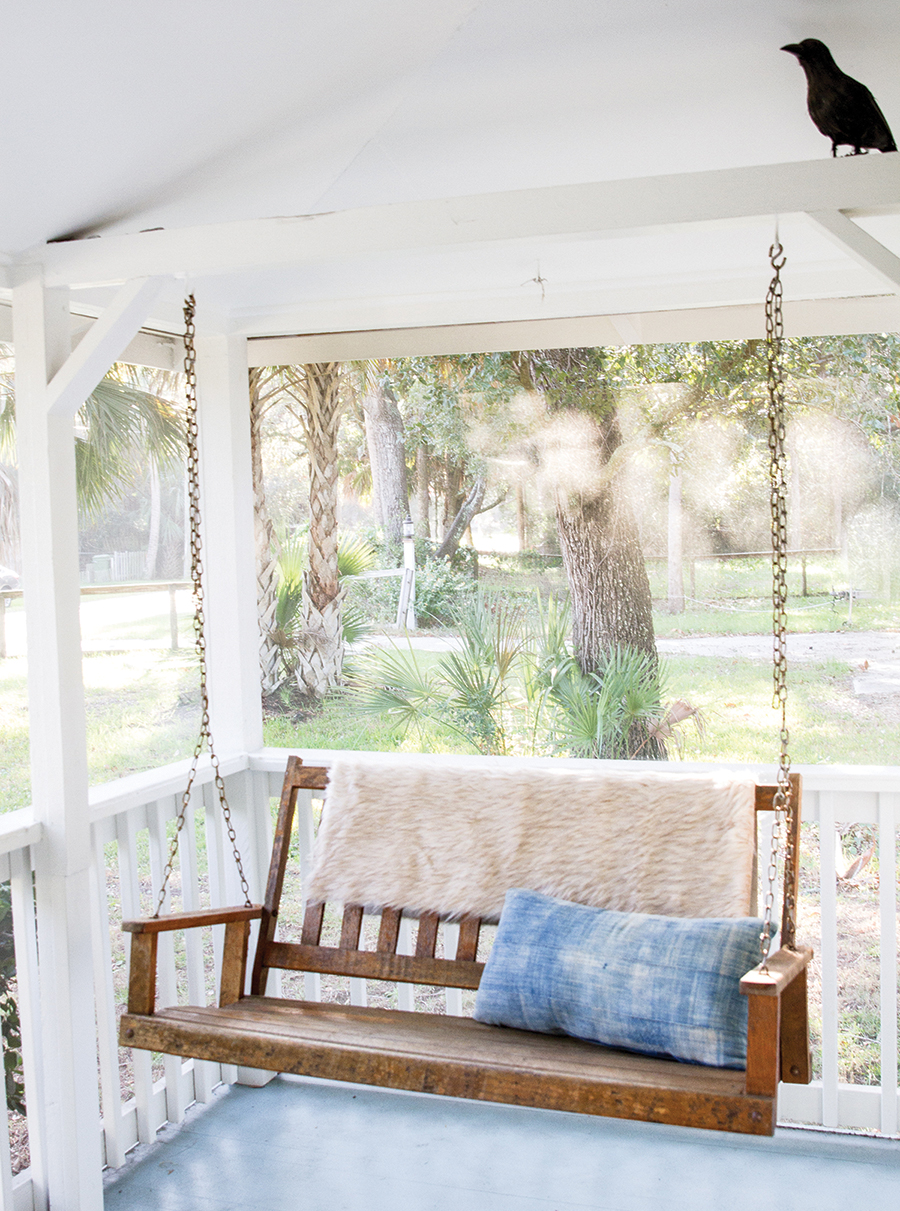
Perfectly situated mere blocks from the action but plunked smack upon a postcard-perfect marsh and the Folly River, Camp Huron proved to be the ideal home base. Think an atmospheric white clapboard, one-story cottage with creaky painted-wood floors, two charming bedrooms, a perfect kitchen, clawfoot tubs, a record player, a firepit and barbecue grill, and a front porch kitted out with party lights. And Hollywood-worthy sunsets.

Says John, “Imagine stepping into the past but with all of the mod-cons, heaps of thoughtful touches, and lightning-fast Wi-Fi. Fluffy towels. Stacks of wood for the marsh-facing firepit. Elvis on the record player. And wonderful rocking chairs on the front porch. Truly, a small slice of heaven.”

The barrier island’s two-blocks-long main drag, Center Street, showcases relaxed, colorful eateries (take note of Taco Boy and Jack of Cups Saloon, in particular) and the usual assortment of beach gear shops and bars. It’s an ideal walking town. In the mornings, we grabbed a coffee at nearby, always-open Bert’s Market with its endless assortment of fresh sandwiches, barbecue and sushi (and oh! the corn dogs).

One evening, we stopped at a terrific seafood food truck near the bridge, Crosby’s Fish and Shrimp Co., and picked up fresh, fresh fish and sat on Camp Huron’s back deck bundled up with heaps of candles. Kicking up the camp experience, we paired our meal with a big bottle of Prosecco and Swiss chocolate s’mores. There was a full constellation of stars overhead, and the occasional trawler passed by in the distance with lights flickering.

John and I walked the dark-sand beach.

We read Nancy Mitford and Caleb Carr — and considered Death in Venice.

With to-go sandwiches in tow from Bert’s, we plunked down on the long strands in scarves and sweaters for a lengthy picnic lunch.

And we spent a stellar day in nearby, more buttoned-up Charleston and environs.

We had biscuits at Callie’s.

Sunrise and its beautiful colors flashed across a wood jetty on Folly Beach, James Island, South Carolina.

We shopped for vintage finds at the always-inspirational Antiques of South Windermere.

Exploration of idyllic Mt. Pleasant was followed by cocktails at the wonderful Post House Inn.

At sunset, we headed back to our restorative beachside retreat for another dinner under the stars paired with a superlative Sicilian white. Cold. Crisp.

Herons bobbed about in the marsh.

And we turned off — ready for a final, blissful morning of doing absolutely nothing.  PS

The Madcap gents, John Loecke and Jason Oliver Nixon, embrace the new reality of COVID-friendly travel — heaps of road trips.

The Kitchen Garden

Backyard Beekeeping

Buzzing around the basics

By Jan Leitschuh

Fancy a new hobby for the new year?

There is a sweet and time-honored pastime that goes hand-in-bee-glove with home gardening — apiculture. A beehive in the yard offers multiple benefits. Backyard beekeeping can plump your culinary garden’s quality and volume, with a delicious honey chaser.

Intrigued? Your timing is impeccable. Bee school is in session.

Beginning beekeeping basics will be explored Thursday nights in Vass, from Jan. 20 through Feb. 24. Taught by Erin McDermott-Terry of the North Carolina State University apiculture program, the course will help you get your hive up and running.

As a keeper of bees, you’d join the likes of such famous people as Sir Edmund Hillary, Sylvia Plath, Henry Fonda, Leo Tolstoy, Martha Stewart (of course!) and, er . . . Sherlock Holmes.

According to the Cornell University College of Agriculture, since 52 percent of United States homeowners describe their neighborhood as suburban (and only 27 percent identify as urban, with 21 percent as rural), new beekeepers are more likely to live in a suburban neighborhood. Since a typical hive only requires a few square feet, almost every backyard has more than enough space for a hive.

Home beekeeper Kim Geddes became interested after reading news reports of declining bees. “I read an announcement in the  paper about beginning beekeeping classes offered near my home, so I decided to enroll,” said Geddes, an engineer who lives just outside Pinehurst. “After taking the classes, I was eager to get started.”

Geddes fell hard for bees and has kept them in her backyard for three years now. “I love all kinds of animals, and I’m also committed to conservation endeavors, so beekeeping seemed like a good fit for my interests,” she said.

During her first year of beekeeping, she noticed her backyard kitchen garden becoming more productive due to the increased pollination. “It’s pretty common that home gardeners, when they get bees, notice a marked improvement in their produce,” said Calvin Terry Sr., of Midnight Bee Supply in Vass.

Honeybees forage flowers for two reasons: pollen for protein and nectar for carbohydrates. Veggies and fruits require pollination to set fruit. In cucumbers, for example, a female flower needs 8-12 pollinator visits in a single day to produce a decent fruit.

It was friendship and opportunity that led avid Southern Pines gardener Cameron Sadler into beekeeping. When friend and beekeeper Marcia Bryant sold her farm to move to Penick Village, she asked Sadler if she would like to house the productive-but-now-homeless hives at her place.

“I said I’d love to have the apiary at my farm if she would be willing to teach me,” said Sadler, who recently retired from Mondelez International and is also Master of Foxhounds with the Moore County Hounds. Besides Bryant and Sadler, neighboring friend Desiree MacSorley also works the apiary.

Sadler later bought her first nuc (a small core colony of bees) from Midnight Bee Supply in Vass. She enjoys the win-win of beekeeping and gardening. Her flowers helped produce sweet honey, and the bees increased the productivity of her veggie gardens.

“I grow a kitchen garden because I love to have really fresh produce, fruit and herbs to eat and cook with,” she said. “I absolutely believe my garden and my bees’ prosperity is due to the positive interaction of the bees with the plants.”

Sold on the idea of a bee yard in the kitchen garden but somewhat intimidated? Feel like you might need ongoing support? The local arm of the North Carolina State Beekeepers Association (NCSBA), the Moore County Beekeepers chapter, welcomes newcomers and meets monthly in Southern Pines on the second Tuesday of every month, according to Master Beekeeper Hugh Madison.

While backyard bees aren’t cuddly like livestock, their proponents can be ardent. “It’s hard to describe the attachment that a beekeeper forms with their bees,” said Geddes. “I felt a sense of pride seeing my girls work so hard in the garden that I provided to nourish them.

“I got into beekeeping because I wanted to address the decline in bee population,” she added. “I had failed to recognize the benefits that I would enjoy by raising bees — not just the sense of pride in addressing a conservation issue, but I was amazed to discover that my row crops produced almost double the yield.”

And the sweet finale for Geddes? “This past year, I bottled 40 pounds of honey!”  PS

Jan Leitschuh is a local gardener, avid eater of fresh produce and co-founder of Sandhills Farm to Table.

Resources: The Vass Bee School, Thursdays, Jan. 20-Feb. 24, $80/person or $140/couple. For more information visit midnightbeesupply.coursestorm.com.
For N.C. State’s online BEES courses and other counties bee schools, visit https://www.ncbeekeepers.org/calendar/courses-bee-schools.
The Moore County Beekeepers chapter holds meetings on the second Tuesday of every month at 6:45 p.m. at the John Boyd VFW Post on Page Street in Southern Pines. All are welcome. Visit the chapter’s Facebook page.

Birdwatch

A Tree of Delights

Decorating can be for the birds, too

By Susan Campbell

This season, why not create a gift for your feathered friends and consider “decorating” a holiday tree just for them? Although a hearty evergreen would be best, anything from a leafless sapling to a young longleaf pine will work. Better yet, a younger American holly or other berry-laden variety would be a terrific choice!

Consider this a project for the whole family, just like hanging ornaments or setting up lights in the yard. Keep in mind that, especially when using an evergreen, you are providing not one, but two, basic needs that all our wintering birds have: food and shelter.

To “decorate” your tree:

— Drape with traditional strings of popcorn and cranberries or other dried fruits for the bluebirds and the blue jays.

— Hang homemade suet on pine cones for the chickadees and nuthatches.

— Nestle shallow cups with sunflower seed or millet on the thickest branches for the cardinals and titmice.

— Smear peanut butter on the bark to attract woodpeckers and wintering warblers.

Last, but certainly not least, your tree will invariably attract natural food in the form of tiny insects. It will take no time for Carolina wrens or ruby-crowned kinglets to find them between the leaves or needles, or under the bark.

It may be that you create your gift to the birds just after Christmas — when your indoor tree is finished providing joy for the family. This is about the time that natural foods are waning and the birds are foraging in earnest. No doubt, bird species large and small will find your arboreal creation before long. Keep track of which ones you see using the tree. It may be a longer list than you might think.

Of course, other wildlife will love this holiday gift, too. In addition to gray squirrels and perhaps a fox squirrel, southern flying squirrels may glide in at night for a snack. A raccoon or opossum may sniff it out. Even a white-tailed deer or two will probably take a nibble. But then, who doesn’t appreciate a treat during this special season?  PS

Susan Campbell would love to receive your wildlife sightings and photos.  She can be contacted at susan@ncaves.com.

Tea Leaf Astrologer

Sagittarius (November 22 – December 21)

When a Sagittarius plays with fire, it’s wonderfully innocent. Sort of. But this bold and short-fused fire sign has a reputation for being more than a little reckless — especially when it comes to affairs of the heart. Pause and reflect during the solar eclipse on the 4th. Who are you? Who do you want to be? Should you splurge for that positively extravagant vegan leather coat? Fortunately, things are looking a bit more auspicious this month. But don’t leave the candle burning unattended.

Tea leaf “fortunes” for the rest of you:

Capricorn (December 22 – January 19)

Two words: humble pie. 

Aquarius (January 20 – February 18)

Ask for a sign. You’ll know it when you see it.

Pisces (February 19 – March 20)

Save the smothering for the bread and butter.

Aries (March 21 – April 19)

You are the Perfect Storm. Don’t hold back.     

Taurus (April 20 – May 20) 

Best not to wait for an invitation. 

Gemini (May 21 – June 20)

Ask again later.    

Cancer (June 21 – July 22)

No matter how hot things get, play it cool.

Leo (July 23 – August 22) 

The quest for perfection doesn’t end well.

Virgo (August 23 – September 22) 

That smile on your face says it all.

Libra (September 23 – October 22)

Sometimes the obstacle is the path.

Scorpio (October 23 – November 21)

When the popcorn is ready, the truffle oil will appear.  PS

Zora Stellanova has been divining with tea leaves since Game of Thrones’ Starbucks cup mishap of 2019. While she’s not exactly a medium, she’s far from average. She lives in the N.C. foothills with her Sphynx cat, Lyla. 

The Creators of N.C.

Cultivating Community

Caroline Stephenson steps out from behind the camera

By Wiley Cash    Photographs by Mallory Cash

According to filmmaker Caroline Stephenson, “It’s all about storytelling.” She should know. She was born and raised in rural Murfreesboro, North Carolina, where she grew up surrounded by stories and storytellers. Despite the rich culture around her, as a young person, Stephenson believed that real art could only be found outside Hertford County. Her father, a retired professor and writer, and her late mother, an architectural historian, regularly traveled with the family to places like Norfolk, Virginia, Washington, D.C., and metropolitan New York, where they would visit museums and view films in art house theatres.

“That made a big impression,” says Stephenson, especially the films. “I wanted to do that.”

The restlessness that Stephenson felt as a coming-of-age artist in rural eastern North Carolina manifested itself not only in her desire to create, but also in an all-too-familiar angst-driven urge to leave home. Like so many young people who think opportunity and adventure are waiting somewhere else, Stephenson says that she “couldn’t wait to get out of there.”

First, she spent two years at St. Mary’s School in Raleigh, and then two years at Boston University before transferring to Columbia College Chicago, where she received her Bachelor of Arts in film. Soon, she was living in Los Angeles, beginning a career that would carry her to places like Prague, Vienna, Athens and Budapest, working as an assistant director on sets for films and television shows like Empire, House and, currently, Tom Clancy’s Jack Ryan.

After marrying fellow filmmaker Jochen Kunstler and having two children, Stephenson felt a call to home. She and her young family moved back to Murfreesboro in 2010, where Stephenson came to terms with Hertford County’s rich cultural heritage as well as its incredible challenges. The county is 60 percent Black, and historical inequities in everything from education to home ownership serve to compound a poverty rate of 22 percent, much higher than the state average. The county’s struggles have also resulted in a dogged spirit of determination that immediately inspired Stephenson and her family to dedicate themselves to supporting the community.

“I’m driven by the incredible people where I’m from,” Stephenson says. “They created beauty, and above all they persevered and were proud.”

To tell the stories of the people of her region, Stephenson stepped behind the camera and relied on the talents that had taken her around the world. She made documentary films about Rosenwald Schools, which educated rural Black children during segregation, as well as a documentary about women who work in chicken processing plants in eastern North Carolina. Other documentaries and screenplays are in the works, all of them highlighting challenges that have either been overcome or are still being faced. 

Like any successful director looking for the best angles and working to make a production as seamless as possible, Stephenson is most comfortable being off camera, outside the glare of the lights.

“I like to be behind the scenes,” she says. “I want other people to shine.”

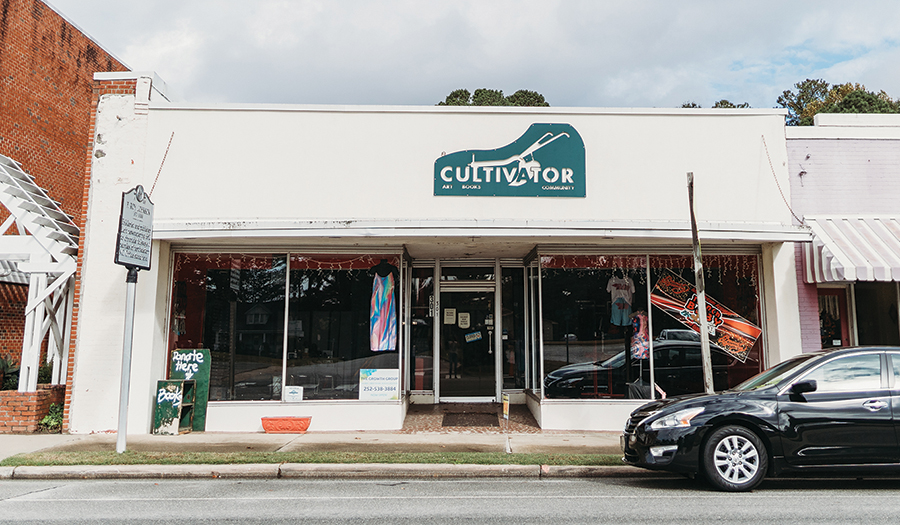
She also wants to make connections between the people and the organizations of Hertford County so they can support one another. In 2016, Stephenson opened Cultivator, an independent bookstore that quickly became a community hub. “We also sold local art and pottery, screened movies, held meetings and educational workshops,” she says. The store was the only bookstore within an hour’s drive in any direction but, as is the case with so many independent bookstores, it was tough to make ends meet. The pandemic made the venture even more difficult, and Cultivator closed its doors in April 2020, but the books — most of which were either donated or left behind after Stephenson’s mother, a voracious reader and book collector, passed away in 2014 — remained.

Stephenson quickly realized that not having a storefront did not have to stop the work of Cultivator, and so she converted her minivan into a bookmobile. “It’s just a folding table, personal protective equipment, and boxes and boxes of free books,” she says. “But we now serve more people than we served with the bookstore.”

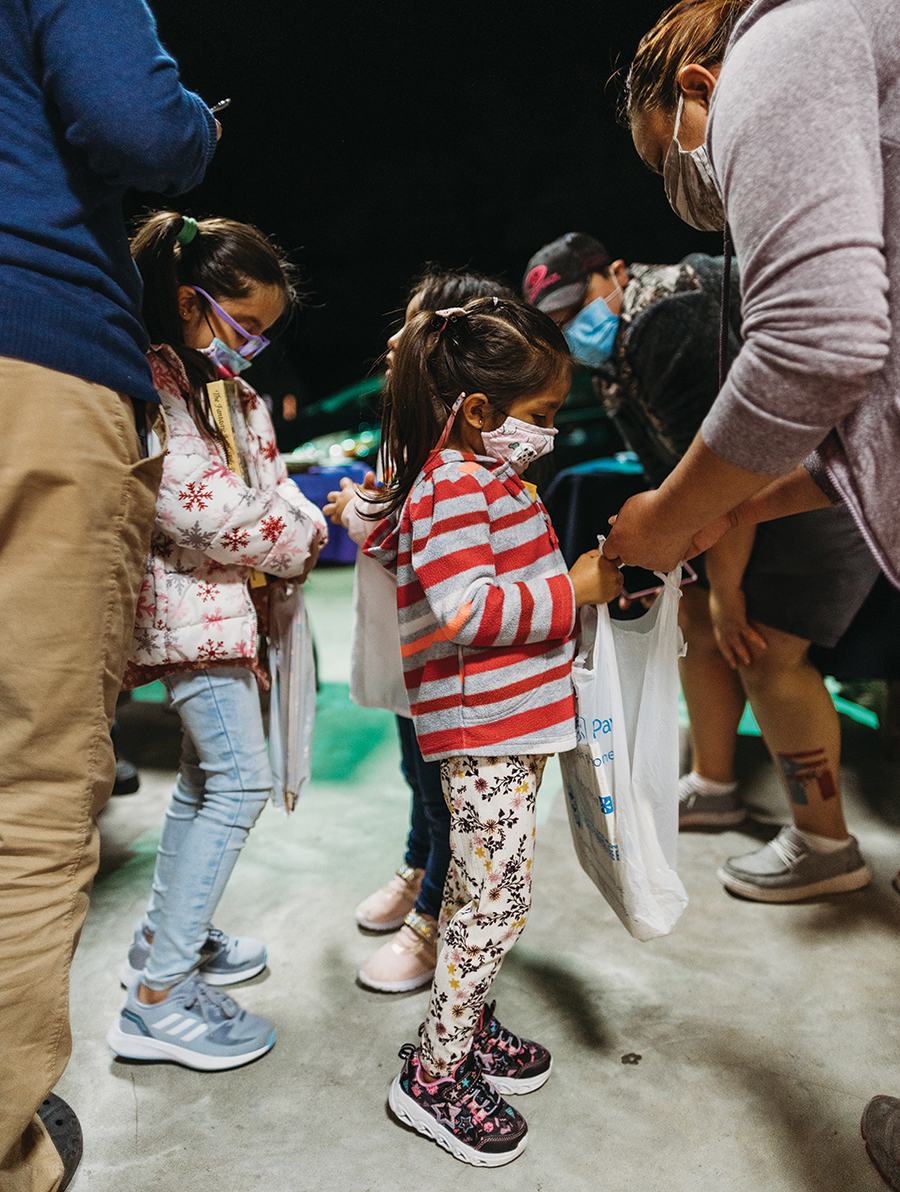
The Cultivator bookmobile regularly sets up in front of libraries, grocery stores, big box stores and churches. Sitting behind a table in the parking lot of Murfreesboro United Methodist Church one chilly night in late October, a volunteer named Christina is handing out books at the church-sponsored monthly bilingual dinner. Young children, many of them Spanish speakers, tote armfuls of children’s books, some written in Spanish. When Stephenson’s name comes up, Christina, who has been a volunteer for 10 years, pauses.

“Caroline is who inspired me to get involved in the community,” she says. “She does for others.”

Andrew Brown owns a family farm with his daughter, Sharonda, and has partnered with Cultivator to address food insecurity in the community. Sharonda is the evening’s featured speaker. The family has also been the subject of one of Stephenson’s documentaries.

“Caroline got things going when she came back home,” Brown says. “You need someone like her to bring people together.”

Inside the church’s fellowship hall, tostadas and accompanying fixings are being placed on long serving tables as a line of hungry diners forms. A woman named Alejandra announces that dinner is ready. Pastor Jason Villegas greets everyone, moving quickly between English and Spanish.

“I met Alejandra at an ESL (English as Second Language) class at Cultivator,” Pastor Villegas says. When Alejandra joined Villegas’ congregation, she encouraged him to preach in Spanish to reach more people in the community. The community dinners began not long after.

When Pastor Villegas says the blessing, he prays first in English, then translates it to Spanish.

“Thank you that we have connection and unity here,” he says. He keeps his eyes closed, but he lifts his hands as if gesturing toward the people around him. “And thank you to Caroline Stephenson for bringing so many of us together.”

Of course, Stephenson is not there to hear this prayer or witness her community’s gratitude. She is overseas on a film set, operating where she is most comfortable, behind the scenes. PS

Wiley Cash is the Alumni Author-in-Residence at the University of North Carolina-Asheville. His new novel, When Ghosts Come Home, is available wherever books are sold.