Bookshelf

February Books

FICTION

A Long Petal of the Sea, by Isabel Allende

In the late 1930s, civil war has gripped Spain. When Gen. Francisco Franco and his Fascists succeed in overthrowing the government, hundreds of thousands are forced to flee in a treacherous journey over the mountains to the French border. Among them is Roser, a pregnant young widow, who finds her life irreversibly intertwined with that of Victor Dalmau, an Army doctor and the brother of her deceased love. As the two refugees flee to France, eventually landing in Chile, where they build a life together, they find no place is immune from political strife. A story about making a home wherever you are.

Apeirogon, by Colum McCann

Named for a polygon with an infinite number of sides, Bassam Aramin (Palestinian) and Rami Elhanan (Israeli) inhabit a world of conflict that colors every aspect of their daily lives, from the roads they are allowed to drive on to the schools their daughters, Abir and Smadar, each attend, to the checkpoints both physical and emotional that they must negotiate. Their worlds shift irreparably after 10-year-old Abir is killed by a rubber bullet, and 13-year-old Smadar becomes the victim of suicide bombers. When Bassam and Rami learn of one another’s stories, they recognize the loss that connects them, and they attempt to use their grief as a weapon for peace.

The Cactus League, by Emily Nemens

Jason Goodyear is the star outfielder for the Los Angeles Lions, stationed with the rest of his team in the punishingly hot Arizona desert for their annual spring training. Handsome, famous and talented, Goodyear is nonetheless coming apart at the seams. Everyone is eager to find out why, even as they hide secrets of their own. Narrated by a sportscaster, Goodyear’s story is interspersed with tales of Michael Taylor, a batting coach trying to stay relevant; Tamara Rowland, a resourceful spring training paramour, looking for one last catch; Herb Allison, a legendary sports agent grappling with his decline; and a plethora of other richly drawn characters, all striving to be seen as the season approaches. A tight debut novel by the editor of Paris Review.

Amnesty, by Aravind Adiga

Danny, formerly Dhananjaya Rajaratnam, is an illegal immigrant in Sydney, Australia, denied refugee status after he fled Sri Lanka. Working as a cleaner, living out of a grocery storeroom, for three years he’s been trying to create a new identity for himself. With his beloved girlfriend, Sonja, his hidden accent and highlights in his hair, he is as close as he has ever come to living a normal life. But then one morning, Danny learns a female client of his has been murdered. The deed was done with a knife, at a creek he’d been to with her before; and a jacket was left at the scene, which he believes belongs to another of his clients — a doctor Danny knows the woman was having an affair with. He’s confronted with a choice: come forward with his knowledge about the crime and risk being deported; or say nothing, and let justice go undone. Evaluating the weight of his past, his dreams for the future, and the unpredictable, often absurd reality of living invisibly and undocumented, he must wrestle with his conscience and decide if a person without rights still has responsibilities.

Salt River, by Randy Wayne White

A local author returns with a thrilling tale of marine biologist and former government agent Doc Ford and his friend, avowed bachelor and beach-bum pal Tomlinson, who is confronted by rash past decisions that escalate to deadly present-day dangers. As a young man, Tomlinson fathered multiple children via for-profit sperm bank donations, and his now-grown offspring have tracked him down, seeking answers about their roots. Doc quickly grows suspicious that one of them might be planning something more nefarious than a family reunion. In addition to watching Tomlinson’s back, Doc encounters a number of unsavory individuals, including a disgraced IRS investigator and a corrupt Bahamian customs agent, after their cut of a cache of precious Spanish coins he quietly “liberated” from a felonious treasure hunter. Doc has no choice but to get creative.

NONFICTION

Race Against Time: A Reporter Reopens the Unsolved Murder Cases of the Civil Rights Era,
by Jerry Mitchell

Mitchell takes readers on the twisting, pulse-racing road that led to the reopening of the investigations into four of the most infamous killings from the days of the civil rights movement. As an investigative journalist with a mission, his work played a central role in bringing killers to justice for the assassination of Medgar Evers, the firebombing of Vernon Dahmer, the 16th Street Church bombing in Birmingham, and the Mississippi Burning case. Mitchell reveals how he unearthed secret documents, found long-lost suspects and witnesses, and built evidence strong enough to take on the Klan. He takes us into every harrowing scene along the way, meeting one-on-one with the very murderers he is seeking to catch. His efforts put four leading Klansmen behind bars, years after they thought they had gotten away with murder. Race Against Time is an astonishing, courageous story as the past is uncovered, clue-by-clue, and long-ignored evils are brought into the light.

The Splendid and the Vile: A Saga of Churchill, Family and Defiance During the Blitz, by Erik Larson

Larson shows, in cinematic detail, how Churchill taught the British people “the art of being fearless.” It is a story of political brinkmanship, but also an intimate domestic drama, set against the backdrop of Churchill’s prime-ministerial country home, Chequers; his wartime retreat, Ditchley; and, of course, 10 Downing Street in London. Drawing on diaries, original archival documents and once-secret intelligence reports — some released only recently — Larson provides a new lens on London’s darkest year through the day-to-day experiences of Churchill and his wife, Clementine, their youngest daughter, Mary (who chafes against her parents’ wartime protectiveness), and their son, Randolph, with his beautiful, unhappy wife, Pamela, and her lover, a dashing American emissary. All comprised Churchill’s “Secret Circle,” to whom he turned in the hardest moments.

Author in Chief: The Untold Story of Our Presidents and the Books They Wrote, by Craig Fehrman

Fehrman opens a rich new window into presidential biography. From volumes lost to history like Calvin Coolidge’s Autobiography, which was one of the most widely discussed titles of 1929, to ones we know and love like Barack Obama’s Dreams From My Father (very nearly never published), and gems like Abraham Lincoln’s collection of speeches, titled Political Debates between Hon. Abraham Lincoln and Hon. Stephen A. Douglas, Fehrman delivers countless insights about the presidents through their literary works.

The Hope of Glory: Reflections on the Last Words of Jesus from the Cross, by Jon Meacham 

The Pulitzer Prize-winning author explores the seven last sayings of Jesus as recorded in the Gospels, combining rich historical and theological insights. For each saying, Meacham composes a meditation on the origins of Christianity and how Jesus’ final words created a foundation for oral and written traditions that upended the very order of the world. In a tone more intimate than many of his previous award-winning works, Jon Meacham returns us to the moment that transformed Jesus from a historical figure into the proclaimed Son of God.

Until the End of Time: Mind, Matter and Our Search for Meaning in an Evolving Universe, by Brian Greene 

From the world-renowned physicist and best-selling author of The Elegant Universe comes this captivating exploration of deep time and humanity’s search for purpose. Through a series of nested stories that explain distinct but interwoven layers of reality — from quantum mechanics to consciousness to black holes — Greene provides us with a clearer sense of how we came to be, a finer picture of where we are now, and a firmer understanding of where we are headed. With this grand tour of the universe, Greene allows us all to grasp and appreciate our fleeting but utterly exquisite moment in the cosmos.

CHILDREN’S BOOKS

Lola Dutch, I Love You So Much, by Kenneth and Sarah Jane Wright

Lola, Gator, Crane and Pig are back, and we love them so much! In this fun follow-up to Lola Dutch When I Grow Up, Lola finds ways to show her friends just how special they all are. Perfect for fans of Ladybug Girl or Pinkalicious. Young listeners can never have too much Lola Dutch. (Ages 3-6.)

In a Jar, by Deborah Marcero

Together, in jars big and small, Llewellyen and Evelyn collected buttercups, feathers and heart-shaped stones. They collected rainbows, the sound of the ocean and the wind just before snow falls. And when a move separates the collectors, they share friendship in a jar across the miles. (Ages 3-6.)

Just Like Mama, by Alice Faye Duncan

Mama Rose makes sure Olivia learns to ride a bike, has her hair braided just so, and that she plays outside every day. Mama Rose tells Olivia one day she will grow her own wings and fly, just like Mama. And Mama Rose tells Olivia she is loved. Just Like Mama is the perfect way to honor everyone who fills the gap when Mama cannot always be there. (Ages 3-6.)

Ashlords, by Scott Reintgen

Ashlords, Davidians, Longhands — three clashing cultures whose names will soon be household names after Reintgen’s brilliant new novel, Ashlords, sets the YA world on fire in January 2020. With Phoenix horse races, powerful young adversaries and a world teetering on the brink of war, fans of Marie Lu’s Legend series or and Suzanne Collins’ Hunger Games will devour Ashlords. (Ages 12 and up.)  PS

Compiled by Kimberly Daniels Taws and Angie Tally

The Accidental Astrologer

The New and the Proud

Transformation is the name of the game

By Astrid Stellanova

The new year’s percolating, the stars are circulating and a new you is brewing. . . Or an old you looking like it is
walking back, doing the Benjamin Button reverse strut.

Time to make self-renewal an inside job, Star Children. It is a brutally difficult process, true enough, but ignore at your own peril. Otherwise, we will be tsk-tsking all of 2020 about how nobody has ever done so little with so much.

Aquarius (January 20–February 18)

In simple terms, karma is best put: “Ha, Ha, Ha!” Someone has made your life complicated, and it appears they have wedged themselves into your reality and have started occupying more than a little space in your head. Evict them. Honeybun, you don’t have to be a cactus expert to recognize a real prick. 

Pisces (February 19–March 20)

Hush up, Puppy! You got what you want, and like the dog chasing the car, you gotta figure out what to do now that you’ve caught it. 

Aries (March 21–April 19)

If it’s the thought that counts, Sugar, you could be sitting in jail. You’ve had to face off with a worthy adversary, so now find your inner peace before they shred that, too.

Taurus (April 20–May 20)

Good heart, bad mouth. That would just about fit on your tombstone. A kinder, gentler world may begin with small things, like you giving up cussin’ and swearin’.

Gemini (May 21–June 20)

Time to get your own health and life on track to avert scary stuff. The seesaw you’re on has you stewing in your own stress, and believing a balanced meal is a cookie in both hands.

Cancer (June 21–July 22)

This month offers chances to alter your life from status quo sis boom blah, to va-va-voom! The changes you crave are reachable; begin at the beginning. Choose differently.

Leo (July 23–August 22)

Yankee or Y’all? Pick a team. Influences have made you question your roots, values, sense of self, even your identity. Honey, get grounded, meditate and re-evaluate.

Virgo (August 23–September 22)

Under threat, you tend to hide in your comfort zone, which is like a sleeping bag kind of comfort; but with no style. Even Norma Kamali couldn’t make over this schleppy look.

Libra (September 23–October 22)

Obsession looms large for you this month. A hobby overtakes you. Were you crazy even before the goat yoga? Check that tendency to overdo anything worth doing. 

Scorpio (October 23–November 21

Time to plunge both hands into the cookie jar. Get piggy with it. Allow yourself to get totally wrapped up in something. Immersion will finally cure an old itch for you.

Sagittarius (November 22–December 21)

Y’all ain’t right. But it has been so much fun playing, you might not want to stop. In the meantime, pay attention to numbers around you. Sugar, seven signifies something.

Capricorn (December 22–January19)

Attitude adjustment: Yeah? No. Say the word, often and firmly, to a very stubborn close one who thinks they will always, and should always, get their way. It stops now.  PS

For years, Astrid Stellanova owned and operated Curl Up and Dye Beauty Salon in the boondocks of North Carolina until arthritic fingers and her popular astrological readings provoked a new career path.

Mom Inc.

No Sweat

But lots and lots of perspiration

By Renee Whitmore

It’s winter break. Most 16-year-olds are Netflix binging, texting back and forth with the friend sitting right next to them, eating too much McDonalds, and overall doing whatever it is 16-year-olds do.

I’m waiting in my car, listening to my latest audiobook, in the parking lot outside the school. He said he would be done at 11 a.m., but I’ve done this enough to know that time is relative when it comes to wrestling practice. It’s already 11:12.

I text him, “I’m here. Groceries in the trunk. Hurry up.”

Time ticks by. I listen to my book and check Facebook for holiday updates. Nothing exciting. I can pretty much hear the ice cream melting in the trunk. Wait, no, it’s 37 degrees outside. It should be fine.

Then I see him, walking with a limp, surrounded by his teammates. He has no shirt on. (Did I mention it’s 37 degrees?) Sweat glistens over his skin. He’s carrying his gym bag with one hand and his wrestling shoes with another. He sees me, continues to limp to the car.

How was it?” I ask after he slides into the passenger seat. “Why are you limping?”

“I had to train with the 152. It was rough.” (Wrestlers refer to each other not by name, but by weight.)

“Are you over?”

“Eight pounds.”

“You have two days.”

“Yeah. I can do it. I’m burning up. Can I turn on the AC?” he says, as he switches the knob from heat to cold and blasts the air. I shiver. (Did I mention it’s 37 degrees outside?)

His next tournament is in two days. Losing 8 pounds in two days sounds like a feat. Heck, I have been struggling with losing the same 5 pounds for a year-and-a-half. But I have learned, for wrestlers, it’s no biggie. They know all the tricks.

I used to hold my breath every time he stepped on the scale at home, wondering how a 5-foot, 6-inch manboy could wrestle in the 120-pound weight class. He’s naturally around 135-140, but this season, as a sophomore wrestling varsity, he decided he was going to wrestle 120 because his height would give him an advantage.

“I have practice again at 3,” he says, as he bites into a protein bar and takes a tiny swallow of water.

“OK.”

We pull into our driveway, he helps me unload the groceries, and before I can even get them all put way, he is running on the treadmill. I know the next two days will be rough. He will limit his food and water intake drastically.

He will take hot baths to “sweat.” I’ll hear him in there, letting lukewarm water out and filling it with steaming hot water over and over. Our water bill . . . well, you’d think we pressure-washed Mount Rushmore.

And he will run. He will run outside and on the treadmill several times a day. I will be trying to drift off to sleep around 11 p.m., and I will hear the hum and rhythm start up and the thump, thump, thump of his feet on the treadmill.

He tries other techniques to lose weight, too. For example, the other day while he was at school, I got a photo text of a half-filled water bottle.

I answered with a question mark.

“It’s spit. I think it’s at least a pound.”

“Gross,” I reply.

The days leading up to a tournament can be grueling, not just for him, but for all of us. No one wants to eat around him. The other day my husband, Jesse, was eating macaroni and cheese in our bedroom. “I don’t want him to see me eat,” Jesse said as he scooped a forkful into his mouth.

And then there’s the irritability that can’t really be avoided. He’s irritable because he’s hungry. I’m irritable because he’s hungry. My husband and other son are irritable because he’s hungry. I pray for patience.

On the day of the tournament, I wait for the text after weigh-ins. It’s just a number.

119.7

119.8

119.9

120.0

And I will breathe a sigh of relief. He made it. I will send him back the emoticon with the flexing biceps. “Now, eat something. Please.”

He will down a sandwich, a few protein bars, Gatorade, and water to get his strength back. In an hour or so, he will wrestle.

And the fun will begin.  PS

When Renee isn’t teaching English or being a professional taxi driver for her two boys, she is working on her first book.

Simple Life

The Winter Gardener

There’s plenty of life stirring beneath the season’s snows

By Jim Dodson

As you read this, the first winter of the new decade is drawing to a close.

Like a certain fabled snowman who danced with the village children until he began to melt away, I rather hate to see it go.

Winter, you see, is my favorite gardening season.

Perhaps this is because I am a son of winter, reportedly born during the height of a February snowstorm on Groundhog Day way back in 1953.

Or maybe my wintry affection stems from two decades of living on a forested hill in Maine, where the snow piled up before Christmas and I learned most of what I know about resourceful living and “making do” — as they say in the North Country — including the art of keeping the home fires burning and loved ones warm.

The light of winter is another of the season’s charms. Clear winter stars over our hilltop provided a dazzling show of celestial beauty, and the feel of the winter sun on your face on a cold, clear afternoon is like a benediction in Nature’s chapel.

Whenever I’m having difficulty falling asleep, I remember cold clear nights when I donned my red wool Elmer Fudd coat and toted a 50-pound bag of sorghum pellets to the spot at the forest’s edge. There, a family of whitetail deer waited patiently for their supper in the arctic moonlight during the hardest nights of year — a memory of fellowship with mythic creatures that never fails to ease me into sleep on my own winter nights.   

It’s possible that my fondness for what poet Christina Rossetti called the “bleak midwinter”  is simply written in the stars. Both my parents were Aquarians with midwinter birthdays just days before my own in early February. Ditto my firstborn child, a beautiful baby girl who appeared during a January blizzard that left the world quilted in white as the golden morning sun spread over Casco Bay, moments after young Maggie’s debut.

When we carried her home to Bailey Island, our unplowed lane lay so deep in snow we were forced to park at the village post office and slide down a steep hill to our back door just steps from the cobalt blue sea. The memory of my newly arrived Southern mother giddily whooping as she tobogganed down the hill on her bottom still makes me smile. Maggie made the trip all bundled into my arms — and claims to remember the journey to this day.

Winter’s other gifts included our annual winter solstice party where friends and neighbors came out of the frigid night to sing and dance for their supper and — because I married into a clan of real Glaswegian Scots — a Hogmanay celebration on New Year’s Eve that included dancing to fiddle reels and toasting with good Islay-made Scotch with Big Ben dialed up on the shortwave radio at 7 p.m. — and sing in bed by nine. The drunks in Times Square could never compete with that.

To some extent or another, of course, every one of these seasonable pleasures can be found in North Carolina winter as well, including cold nights, clear stars, holiday lights, good Scotch and fiddle reels and — despite global warming — the occasional surprise snowfall that stops a madding world in its tracks.

But winter here has one significant advantage over life on a snowy hilltop in Maine.

In the North Country, once the deep cold and snows arrived, I could only tend the fire, browse seed catalogs and picture the ambitious things I planned to do in my garden once the frozen ground thawed and was fully in view again — generally around Easter time, if we were lucky.

Thanks to kinder and gentler Southern winters, however, I am able to get to work planning and digging even before Hogmanay arrives. With Nature at parade rest and stripped to bare essentials, I not only can see the architecture of my garden, but also take stock of last summer’s botanical successes and bonehead miscues.

This year, for example, with the new decade just hours away, I spent five blessedly solitary hours getting gloriously dirty in my winter garden on New Year’s Eve. To briefly review my loves’ labors, I dug up and transplanted seven rose bushes and nine ornamental grasses; moved a mophead hydrangea to a shadier spot and six Russian sages to a sunnier one. I also planted a splendid Leland cypress, raked up the last of the autumn leaves and spread a dozen wheelbarrows worth of new hardwood mulch.

By the time I was finished — and the work finished me — the mistress of the estate required me to strip bare at the side door before entering her gleaming New Year’s kitchen, though she’ll flatly tell you that she never sees me happier than after a few well-spent hours digging in my winter garden, headed for a good soak in the tub or a hot shower.

Dig in the soil, goes the old gardener’s ditty — delve in the soul.

Even William Shakespeare seemed to find this time of year irresistible for contemplation of life’s passing seasons.

That time of year thou mayst in me behold
When yellow leaves, or none, or few, do hang
Upon those boughs which shake against the cold,
Bare ruined choirs, where late the sweet birds sang.
In me thou see’st the twilight of such day
As after sunset fadeth in the west;
Which by and by black night doth take away,
Death’s second self, that seals up all in rest.
In me thou see’st the glowing of such fire,
That on the ashes of his youth doth lie,
As the death-bed, whereon it must expire,
Consumed with that which it was nourish’d by.
This thou perceiv’st, which makes thy love more strong,
To love that well, which thou must leave ere long.

His theme, of course, is the brevity of life.

As February dawns, such wintry thoughts come naturally to my mind as well, for I reach my mid-60s this year and am both amused and astonished how quickly the notion of “old age” has arrived.

Save for a pair of dodgy knees that make gardening’s up and down a bit more challenging, I honestly don’t feel a day over 40 — yet I know I’m in the midwinter of my allotted visitation time, with scarce time to waste for being present in my own days, whatever the season.

“Tho’ I am an old man,” as Founding Father Thomas Jefferson wrote to his friend Thomas Willson Peale in August of 1811, “I am but a young gardener.”

Two and one-half decades ago, when I really was in my 40s, I spent the entire month of February by my own founding father’s bedside, serving as his caretaker as he slipped the bonds of Earth.

What a fine and joyful life he’d led — my nickname for him was “Opti the Mystic” — and what a privilege it was to simply sit by his bed talking about this and that, weather and wives, golf and grandchildren, nothing left unsaid, saying thank-you as his life gently ebbed away.

The end came a few days into March, after a night of sleet gave way to a stunning spring morning full of sunshine and birdsong.

My oldest friend Patrick turned up, seemingly unbidden, suggesting we go play the old goat farm golf course where we learned to play as kids.

I have no memory of how we scored or even what we talked about, though it was the perfect thing to do. Opti would surely have approved.

That afternoon, I dug up some of my mom’s peonies to take home to my snowbound perennial beds in Maine.

I planted them as the spring thaw finally arrived — sometime around Easter.  PS

Contact Editor Jim Dodson at jim@thepilot.com.

Out of the Blue

Confess to the Mess

What would life be without it?

By Deborah Salomon

Life is funny. Accidents happen.

Last week I had an epic kitchen accident. No broken bones or burned fingers, just a royal mess. Yo, Hamlet: To laugh or to cry . . . that is the question. As I sat on the kitchen floor dripping sweet and sour tomato sauce from a bowl of cabbage rolls I was removing from the refrigerator, when I tripped over the cat, other mishaps crept back. At the time these disasters spelled the end of the world. Now, they’re just funny. Like the time . . .

I heard a scratchy noise in the living room fireplace. Bats in the belfry? Leaves blowing around the chimney? The cat heard it too and positioned herself as watchdog. We had a huge stone fireplace in the family room so I let this one be — until the morning two squirrels faced me from the other side of the glass fire screen. They had found winter digs and now . . . what’s for breakfast? I fed the poor buggers peanut butter sandwiches until spring, when the chimney sweep catapulted them into an overhanging tree. A chimney cap sealed the deal.

How ’bout the cop who caught me U-turning? I’ve driven for 65 years without a moving violation. Couldn’t suppress a giggle as I rolled down the window and handed him my paperwork.

“What’s so funny?” he asked.

“Where were you the other 24 times?” I answered. He besmirched
my record only with a warning.

I can’t remember sending a sensitive email to the wrong address but have received such a mistake. Oh my. Will not reveal the juicy details.

Then, the morning I took Tylenol PM (not one, but two!) rather than regular for a headache . . . and fell asleep at work.

When I was about six, my father managed an appliance store owned by a Mr. Greenshield. Daddy complained about him incessantly, called him Mr. Greensh–. I didn’t get it. Then one day my mother took me to the office; Dad proudly introduced his little girl to Mr. Greenshield. Wide-eyed, I chirped, “I thought his name was Mr. Greensh–.”

Not my fault, Daddy.

The two most cringe-worthy mishaps involved spillage. During high school summer vacation I worked on the Red Cross bloodmobile that served Western North Carolina mountain villages. I helped donors fill out forms and learned to type blood. Can’t remember the exact circumstances, only that the nurse handed me a clear plastic container of freshly drawn blood. It was, unexpectedly, warm. I’m not squeamish but, instinctively, I let go. Splashdown. Bloodbath. Stephen King. “Carrie.” Mortification.

The second, a classic tragi-comedy. When my son Danny was about 10, he and pal Jeff asked if they could set up a lemonade stand with real lemonade. Sure. I told them to get the juicer and other stuff ready while I went for lemons. Danny ripped open a 5-pound bag of sugar, which spilled onto the floor. Fearing my reaction he and Jeff hurried to clean it up. Not with the vacuum cleaner. Not with broom and dustpan. With water. Sugar and water become Crazy Glue on a tile floor. It was shiny-sticky (except bumps made by trapped ants) for months.

One apocalypse had a happy ending. We were in Israel for three weeks, in 1981. On the flight over, my eye began itching, which made wearing contacts impossible. It got worse. The desert sun bore down. I had no prescription sunglasses. Misery. A week into the trip we were sitting by the pool when a man approached. “Aren’t you . . . ?” he asked my husband. Yes! They had been high school classmates. Miracle of miracles the friend was now (drum roll, applause) an ophthalmologist. He diagnosed an infection, gave me something to clear it up. God bless.

I’ve saved the best for last — creepy, unbelievable but, true.

In the summer of 1962, I flew with my 5-month-old baby from Raleigh/Durham to New York. Ominous clouds were forming. Sure enough we headed into a storm . . . thunder, lightening, the works. The baby began to cry. I was frantic, terrified.

“Here, try this,” said the nice man sitting beside us, dangling his keys within her reach. That voice, strangely familiar. Could it be? Impossible. I turned towards him, for a good look. I was flying into the abyss beside Rod Serling, originator of The Twilight Zone and spokesman on Eastern Airlines TV commercials. Everybody knew that voice. “TZ” was a sensation. I never missed an episode. Several had similar plots — flying or sailing into the menacing unknown.

Mr. Serling saw the shock on my face, put a finger to his lips and reassured me things would be fine.

Life’s funny. Stuff happens, or else wouldn’t it be boring?  PS

Deborah Salomon is a staff writer for PineStraw and The Pilot. She may be reached at debsalomon@nc.rr.com.

Southwords

Party Animals

The surprise of a lifetime

By Jim Moriarty

When one grows so old that wedding anniversaries might as well be counted with Roman numerals like Super Bowls, there are a few curious rubberneckers who wonder exactly how the disgraceful business got going in the first place. In my case it’s simple: It began on her 21st birthday.

It should be noted that it was the ’70s, which excuses nothing but explains more than one would care to admit, and the occasion was a surprise party. Invitations to the gala were issued in the customary fashion of the day: “Hey, I hear Robin’s having a party Friday night.” Robin was the rarest of all birds, someone who had his own apartment. This meant that his forehead was stamped with the words Event Venue.

She for whom the surprise gala was arranged was scheduled to arrive at, oh, let’s say 8 o’clock. The hour came and went with no sign of the featured dish. As the years have trickled past, I’ve come to realize that time is not a subject she deals with on an even playing field. But I digress. The issue at hand was the ’70s, and barely half an hour after the clock chimed 8, it rang out Bong:30.

Those who know me well know that my own proclivities in recreational consumables are confined almost entirely to barley and hops. Yet here I was surrounded by people staring at a red lava lamp. I resorted to the only thing I felt truly comfortable doing. I began twanging my Ozark harp. Now, my teeth — then as now — are to modern orthodontics what a 1952 set of World Book encyclopedias is to the internet. The uppers are arranged in such a way that, while not totally random, bring to mind the punting formation of a peewee football team. Like Houdini being double jointed, however, it was precisely these irregularities that allowed me — someone with the musical ability of a sugar beet — to so bewitch the assembled partygoers with my virtuosic twanging they were as enthralled as if they were listening to Muddy Waters.

At precisely this point, when I had the navel gazers eating out of the palm of my hand — musically speaking, of course — she for whom the surprise gala was arranged came through the front door. Two things happened. Well, one thing. The thing that didn’t happen was for anyone to summon the wherewithal to yell, as one does at a surprise party, “Surprise!” That nugget was apparently lost in the fog of the ’70s. The thing that did happen was for the celebrant to lock her gaze firmly upon my own (I’d paused the musical interlude, though I was quite prepared to accompany any birthday serenading) and say, “What is he doing here?”

Granted, it didn’t seem as though we’d gotten off on the surest footing but, since she for whom the surprise gala was arranged and I were the only two people at the party who actually seemed to remember it was her birthday, one thing led to another and I eventually suggested we go, pas de deux, for a cup of coffee at the local Dunkin’ Donuts. This she agreed to do even though I now know she detests coffee. Had I known that at the time I would have felt a bit spiffier than I actually did.

It was a rainy, unseasonably chilly night, and we spent some time hobnobbing over warm liquids. Then, in an act of selfless generosity that would have made Mother Teresa blush like a schoolgirl, she suggested we take an extra large bag of doughnuts back to the party, stuffing it full of powdered, glazed and chocolate-covered with sprinkles as if she was packing the muzzle of a howitzer.

When we parked at the curb outside Robin’s apartment, she for whom the surprise gala was arranged exited the car with the bag o’ doughnuts in hand. Unfortunately, she’d seized the bag at the bottom, not the top, and the doughnuts tumbled into the rainy gutter. I can say without fear of contradiction that not even Brooks Robinson at the height of his Gold Glove prowess could have barehanded the slow-rolling grounders with the speed and agility she displayed that night. Having crammed the slightly baptized doughnuts back into the bag from which they’d fallen, she for whom the surprise gala was arranged burst through the door, held the bag high over her head and yelled, “Doughnuts!”

A three-legged antelope on the Serengeti Plain would have had a greater chance of survival than those doughnuts did that night. I said to myself, then and there, this is the lass for me. After all, in every gutter a few sprinkles must fall.  PS

Good Natured

Turning a New Leaf

Boosting your health with olive leaf extract

By Karen Frye

The Bible mentions the olive tree and olive leaf many times. Ezekiel tells us “olive fruit is food and its leaves are medicine.” We know that using olive oil has many heart-healthy benefits, but perhaps you’ve not heard about the power of the olive leaves. Thousands of years ago, the leaves were used medicinally to treat many health issues, including colds and fevers, even malaria.

From modern studies of olive leaf, we have a vast amount of information regarding its powerful properties. Olive leaf helps reduce cholesterol and keeps the arteries and veins flexible. It has demonstrated impressive results in lowering high blood pressure, and reducing blood sugar and inflammation.

It’s a wonderful immune system booster, is great at killing germs, viruses and bacteria, and is a warrior inside the body, seeking out these invading toxins and destroying them. It’s also good for neurological problems, joint and connective tissue/bone health. If you happen to be concerned about the effects of ever-present electromagnetic fields, olive leaf — the richest source of oleuropein — can help with that, too.

There are many sources for olive leaf extract. Barleans makes the best on the market, with the full spectrum of polyphenals, and a total antioxidant capacity beyond others. Barleans olive leaf had more total ORAC (oxygen radical absorbance capacity) than many superfoods, as well as high amounts of vitamins C and E. There are many herbs and foods with healing benefits and immune building properties, but few have the reputation of the olive leaf.

I’m constantly amazed by the plants that we’ve discovered to be beneficial for healing and the prevention of the many maladies we confront throughout life. Our health is so precious, and the plant kingdom, with all its diversity, can assist us on our journey to have the healthiest, happiest lives we can imagine.

This February, you can make your heart — and practically every other system in your body — healthier simply by turning a new leaf.  PS

Karen Frye is the owner and founder of Nature’s Own and teaches yoga at the Bikram Yoga Studio.

Golftown Journal

Sixty-Eight and Counting

Age just a number for Carolinas Hall of Famer

By Lee Pace

Thirty years ago, Paul Simson showed up at the Carolinas Mid-Amateur Championship at Yeamans Hall outside Charleston and realized he forgot to pack his putter before the drive down from his home in Raleigh. He was lamenting that fact in the parking lot when fellow competitor Vic Long said he had an extra Ping Zing putter that Simson could use.

“I shot a career round — a 62 with two eagles and a hole-in-one,” Simson says. “Obviously I asked Vic if I could keep the putter. I gave him a couple dozen balls and we called it square. If a putter feels good and you win with it, how am I going to change?”

Today that putter sits in the Zan Law Hall of History at the Carolinas Golf Association headquarters in Southern Pines, the club having drained scores of birdies and eagles as Simson stormed his way through dozens of amateur golf titles on statewide, regional, national and international levels. Simson retired the club in 2012 in favor of a newer version of the same putter — updated design, tweaked with improved balance and metallurgy qualities.

And the newer Ping Zing Redwood performs quite well, thank you.

“My game is still competitive,” says the 68-year-old Simson. “I’ve had a handful of high finishes and am very competitive 13 years into senior golf with the guys just turning 55. I’m fairly pleased with the state of affairs.”

On the cusp of 2020, Simson has his schedule mapped for a full slate of regional events as well as the British Senior Amateur at Royal Cinque Ports on the Southeast coast of England, the U.S. Senior Am at the Country Club of Detroit, and the Canadian Senior Am at Pleasant Glen Golf Resort outside Vancouver. This year’s N.C. Senior Four-Ball will be contested at Mid Pines in August.

“Some of the travel logistics will be challenging,” he says. “But I’m looking forward to another year. I had some successes in 2019 but some disappointments as well. I look back on 2019 with mixed emotions.”

The highlight of 2019 was teaming with Don Detweiler, a fellow Raleigh resident and Northridge Country Club member, to win three CGA senior four-ball tournaments and give them nine team titles together. One of the victories was by 10 shots when they teamed for 63-62 scores in lapping the field in the Carolinas Super Senior Four-Ball in October at Mount Vintage Golf Club in North Augusta, South Carolina.

“We’ve really been able to shoot some spectacular numbers,” says Simson. “It’s kinda fun to get that far ahead and just cruise along and enjoy yourself. Don is such a good partner and such a good friend, and our partnership has been a very special part of my golf career.”

The burr in his saddle, though, was not winning an individual title and in fact shooting an uncharacteristic 77 in the final round of the Carolinas Super Senior at Green Valley Country Club in Greenville, South Carolina, in August. Simson led after the first round with a 65, but stumbled and allowed Russ Perry of Winston-Salem a window for a five-shot win.

“You would think after as many competitive situations I’ve been in over the years, I wouldn’t still have to work on patience,” Simson says. “But you know how golf is. Somehow it will get under your skin, and you become frustrated and try to force things. You can’t force a golf game. Frustration is what will compromise a good golf score. In two or three events, I made a few mistakes, and rather than focus harder on the upcoming holes, I focused too much on the mistakes I made. Once you hit a golf shot, there’s not a whole lot you can do about it.

“I’m just disappointed I have to keep learning the same axioms. Everyone knows you have to be patient, just like everyone knows that hard swings don’t produce good shots. But guess what — we swing hard all the time.”

Simson’s day job is vice president at Towne Insurance Agency in Raleigh, a career that gives him freedom to travel for lots of golf. He has played in 64 USGA competitions, including the 1998 U.S. Open at The Olympic Club in San Francisco, and 2020 will mark the 36th straight year he’s played in a USGA event. He has won two U.S. Senior Amateur titles (2010 and ’12) and three British Senior Ams. Simson is in the Carolinas Golf Hall of Fame and has collected 38 CGA titles — the most in history. Among his highlights in the Sandhills was winning back-to-back North & South Amateurs at Pinehurst No. 2 in 1995-96, and teaming with son Phillip to win three Carolinas Father-Son titles (2002 at Foxfire Golf & Country Club, 2013 at Seven Lakes Country Club and 2014 at Pinewild Country Club).

And to think — it all started with that Carolinas Mid-Am victory 30 years ago, followed by a breakout three-win summer in 1991.

Simson was fighting a nasty hook in June of 1991 when the N.C. Amateur was played at Alamance C.C. in Burlington. John Maginnes, a young player just out of East Carolina University, had his eyes on the pro tour, but before turning pro shot 65-65 in the first two rounds to take a seven-shot lead. One of his distant pursuers was Simson, who Maginnes says at the time was “some insurance salesman from Raleigh no one had ever heard of.”

Simson opened with a 73 at Alamance and was trying to find something that worked in his warm-up session the next morning.

“Paul, you’re taking the club back way inside.”

Simson looked up and saw friend and fellow competitor Mac McLendon of Lenior standing behind him.

“Really?” Simson responded.

The light bulb popped on.

“At the time we were still playing balata balls, so any imperfection in your swing made the ball really curve,” Simson says. “I was having a terrible time fighting the hook. Sure enough, I started taking the club back on a straight line and started hitting the nicest draw. That put me on plane.”

Simson shot a 65 that day but was still eight shots behind Maginnes at the halfway mark. But that swing tweak wasn’t a one-day wonder. He followed with another 65 on Saturday while Maginnes played well but hardly lights-out, posting a 70. Still, Simson was down by three entering the final round.

A theme emerged that weekend that would wreak havoc in the Carolinas golf community for years to come: working man with a few less hairs and a couple extra belt notches vs. 20-something with a limber back and unlimited hours to play golf. Simson shot a 69 on Sunday and Maginnes a 73, with Simson making a clutch 8-footer to save par on the last hole and win the title by one stroke.

“So Paul Simson wins his first-ever championship in the state of North Carolina and now has set so many records they’ll never be broken — never be broken,” marvels Maginnes, who did play the pro tour but now is a full-time golf broadcaster.

“That was a real thrill,” Simson says. “I went from relative anonymity to being on the front pages in the golf community. That win gave me a little momentum. I had finished second in 10 or 12 CGA events before winning in 1990. I knew then I could win. Winning the State Am the next near kind of opened the floodgates.”

Indeed, Simson followed the victory in Burlington with championships in the Carolinas Am at Pinewild C. C. in Pinehurst in July and then in the Carolinas Mid-Am at Treyburn C. C. in Durham in October. He beat Kelly Mitchum 3 and 1 for the Carolinas Am title, and nudged Larry Boswell by three shots in the Mid-Am.

“Ninety-one was a very good year,” Simson says. “I have very fond memories. That year really propelled me into a situation where I could step up my game and compete on more of a national level.”

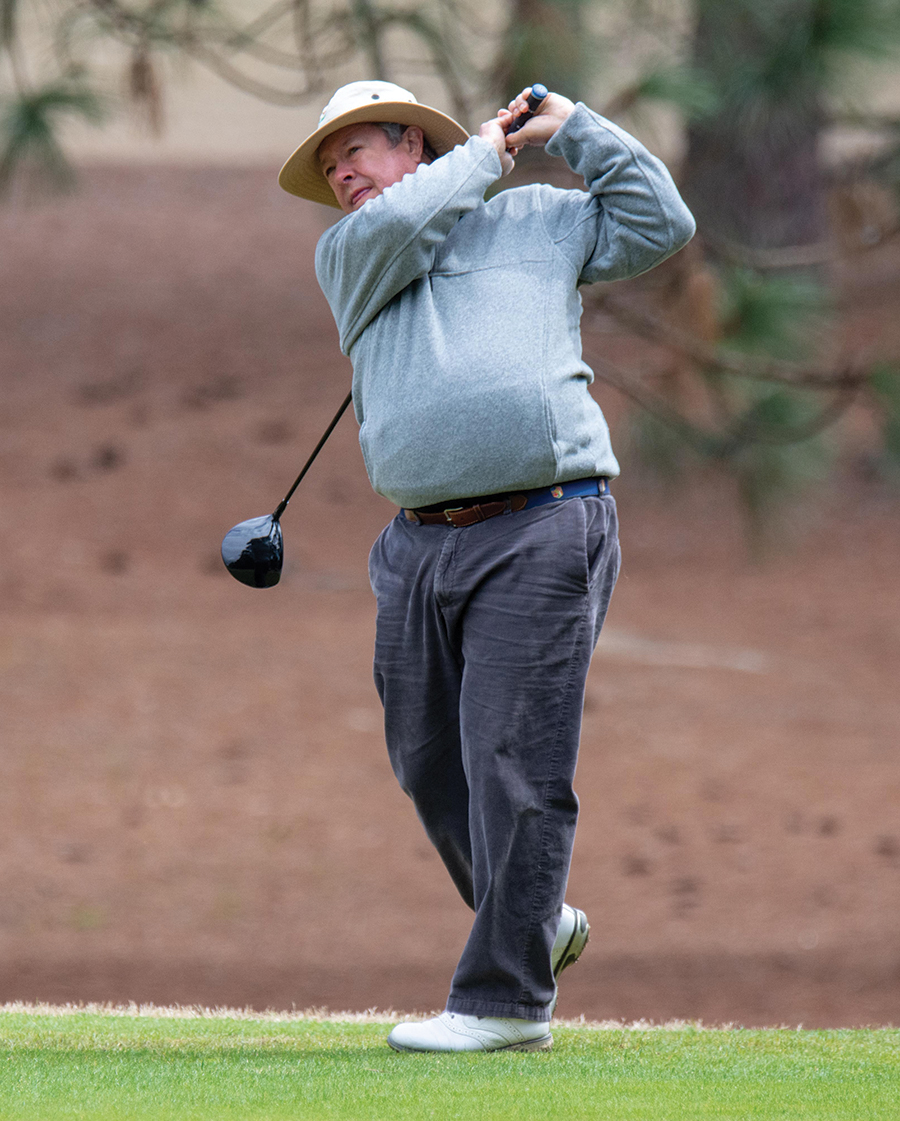
For three decades in the Carolinas, Simson’s trademarks have been a straw fedora, an arsenal of greenside recovery tricks, and an easygoing demeanor effectively countered with an intense zeal to win.

“I think as you get older, you mellow out a bit,” Simson says. “I just love to play, and I love the competition. I get a charge particularly out of playing the college kids I don’t know that well. You beat some of these guys and they say, ‘How’d he beat me? He’s not as good as I am.’

“But in the end, this is a game you play for fun. It’s a lot easier to play for fun than to take it so seriously you make yourself miserable.”  PS

Chapel Hill-based writer Lee Pace has written about great golfers of the Sandhills and Carolinas for more than three decades. Write him at leepace7@gmail.com and follow him at @LeePaceTweet.

Wine Country

Let’s Be Clear

Making sense of the language of wine

By Angela Sanchez

The wine world is awash in confusing terms, so let’s clarify a few.

Ever hear that sulfites, especially in red wines, can give you a headache? Not so fast. Wines have been produced with sulfites for centuries — from the ancient Romans’ use of candles made of sulfur to clean wine storing vessels, to turn-of-the-century Europeans using sulfites to stop bacteria growth. “Sulfites help to preserve wine and slow chemical reactions which cause wine to go bad,” according to the website Wine Folly.

Sulfites aren’t evil, but rather necessary for stabilization and preservation, as well as providing aging potential. A sulfite-free wine will have a very short shelf life. Lower acid wines need more sulfites than higher acid wines to become stable and increase shelf life.  Sweeter wines need sulfites to prevent secondary fermentation.

The United States and Australia are the only wine-producing countries that require notification on the label that the wine may contain sulfites. A low number of people may experience an allergic reaction to sulfites (mainly those suffering from asthma, and only 10 percent of them, or those with strong allergies to highly processed foods). A dry red wine contains about 50mg/L (milligrams per liter) of sulfites while a white wine has, on average, 100mg/L — lower than the content of french fries. Generally, wines range from 5mg/L to around 200 mg/L, and in the U.S. the legal limit is 350mg/L. So, the headache could be the result of a myriad of reasons, but most likely not sulfites.

Some farming and production practices can also be confusing. What does it mean to be sustainably or organically farmed? A wine that is produced using only organic grapes — which have had no pesticides or herbicides used on them — in a vineyard overseen by the USDA Organic National Program and uses only organic material to filter the wine can have a label that reads “organic wine.” Most producers in the U.S. and abroad do not choose to label this way simply because it is too restrictive. In the U.S. you will more often see wines labeled “made with organic grapes” instead, meaning that the vineyard where the grapes were produced is certified organic but that the production method — for instance, the use of sulfites to stabilize the wine, or the use of egg whites to filter it — are not certified organic. The production of the grapes on an organic level and producing a quality wine are the top concerns versus making a wholly organic product.

Stewardship of the land is uppermost in organic farming, producing healthy vines and fruit from well-cared-for land, and maintaining a healthy standard of quality for the soil for years to come. Farming “clean” grapes on even a single vineyard on a property of hundreds of acres is extremely costly and labor intensive but worth it. The cost of certifying the wine itself as organic is less important.

To me, wines that are farmed and produced sustainably provide a more well-rounded approach. Usually a wine that has been produced sustainably — and noted on the label — encompasses practices beyond the winemaking. They include everything from stewardship of the land (perhaps not farming organically but choosing to use as few chemicals as possible), to upholding higher standards for human resources, to committing to alternative energy sources, and constant conservation of soil and water resources. The producer might choose to certify as “sustainably farmed,” meaning they would follow the practices of a certifying body (there are several) by keeping records and reports, often checked by a neutral third party. Or, the producer can simply choose to farm in this manner, without the certification, which can be costly and strict. 

Clarifying some of these terms makes it easier for consumers to be knowledgeable about the winemaking industry and its practices, but also to help them make more informed decisions when choosing what they drink. Here are a few suggestions on what to look for:

Organic: Look for USDA certification on the label for wines made in the U.S.

Made with “organic” grapes: Several great California and Oregon producers have wines in their portfolio that will have this on the label. One of my favorites is from Sokol Blosser Winery in Oregon. 

Certified “sustainably grown”: This certification will show that the wine has met the standards of a specific certifying body. Requirements vary from one certifier to the next, but generally the winery has followed conservation, preservation, environmental and social equity throughout their entire business. The area of Lodi in California has a great certification like this, called Certified Green. Other areas of California use SIP (sustainability in practice) certification to denote these practices.

Elsewhere, look for the Integrity and Sustainability label on wines from South Africa, where nearly 100 percent of wineries carry this certification, showing their commitment to not only the land, soil and environment, but to the human resources that are an integral part of winemaking.  PS

Angela Sanchez owns Southern Whey, a cheese-centric specialty food store in Southern Pines, with her husband, Chris Abbey. She was in the wine industry for 20 years and lucky enough to travel the world drinking wine and eating cheese.

Hometown

Untold Stories

A simple man’s jump into history

By Bill Fields

To my memory, still keen though he has been gone 40 years, Dad wasn’t big on sit-down discussions of serious matters. If, in the early 1970s, we had been wearing Fitbits instead of Timexes, they would have shown considerable steps taken during our “Facts of Life” conversation as we paced around the house one afternoon, each doing his best to speak of anything but the birds and the bees.

We got through that talk, fragmented though it might have been, despite our mutual reluctance. That was not the case when it came to my father’s military service, memories of which were as off limits to me as the bottle of Canadian Club stashed in the far reaches of a kitchen cabinet.

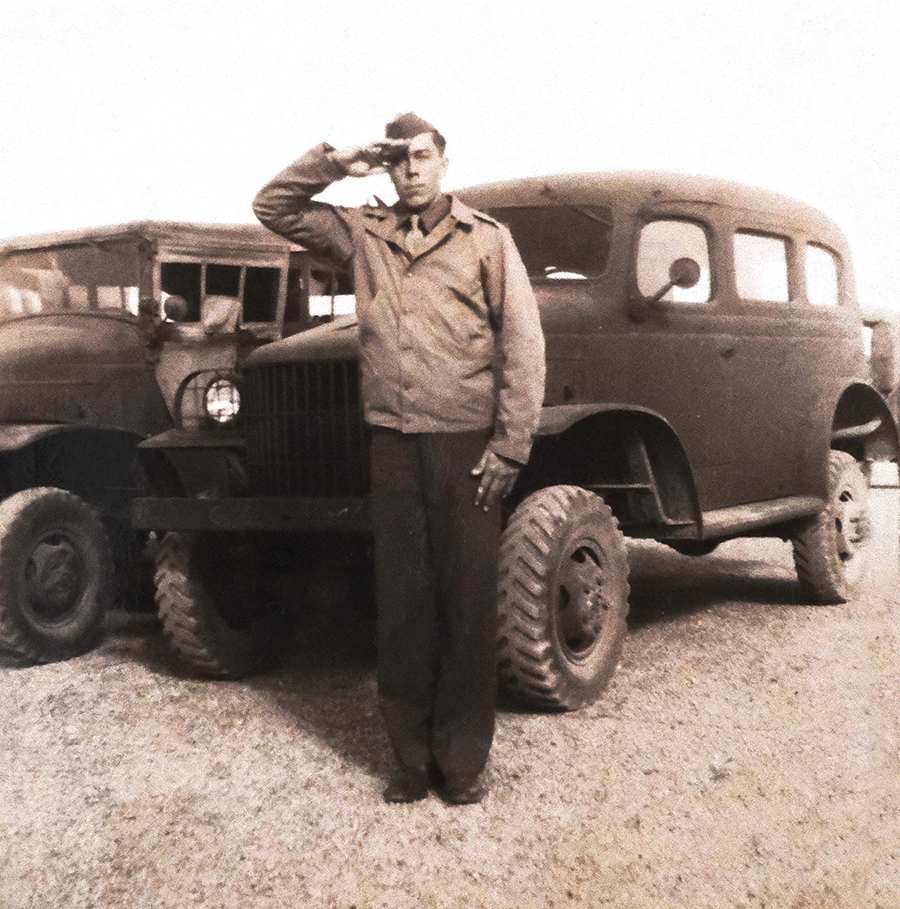
The hard stuff of war had come years earlier as my father, a corporal in the 161st Parachute Engineer Company, fought in the Pacific theater in 1944-45. Like so many others, William E. Fields had been plucked from an ordinary life — in his case, a long-haul truck driver transporting produce from his hometown of Jackson Springs to locales along the Eastern Seaboard — to do extraordinary things in the Allied war effort.

In 2020, the 75th anniversary of the end of World War II, plenty of stories will be told about men and women who never wanted to talk about themselves or what they went through.

Dad was inducted Oct. 15, 1942, in Fort Bragg. By the spring of ’44, he had his wings, a wife and a will. My parents’ first child was due that November, by which time Dad was about 9,000 miles from home. An assistant unit foreman, second in command of a squad of parachute engineers, my father directed combat and demolitions work, and helped erect barriers and traps against the enemy.

His unit of airborne engineers was attached to the 503rd Parachute Regimental Combat Team. After fighting in the New Guinea and Luzon campaigns, Corregidor was next as the United States sought to reclaim the rocky island in Manila Bay overtaken by Japanese forces in 1942.

“The airborne landing was one of the most — if not the most — daring, unusual and successful in the history of airborne operations,” authors James and William Belote wrote in Corregidor: Saga of a Fortress, of the Feb. 16, 1945 operation involving 2,065 paratroopers descending from C-47s only 400 feet above a tiny landing zone on a windy morning. The first time I watched a Pathé newsreel film of the jump, the jeopardy of the troops became very real.

I’ve wondered if my mother, in North Carolina with her infant daughter, Dianne, read this Associated Press account published Feb. 18 in the Charlotte Observer and papers across the country: “Plane after plane dropped 10-man teams, some beyond the cliffs, some in rocky ravines but the majority on the ‘topside’ where they were to the rear of enemy guns pointing out to the China Sea. The ’chutists carried full equipment.”

Dad wasn’t in the majority and became one of hundreds of casualties when he landed on uneven terrain, shattering his right ankle. After a long recuperation, he would recover to walk without a limp but was plagued the rest of his life by tropical ulcer or “jungle rot” on the joint and varicose veins in his right calf.

As I found out just recently from an older cousin to whom Dad once confided a decade after the war, getting badly hurt was only part of his Corregidor story. Wounded and alone after being blown off course, he had to hide in a crater covered by his parachute to avoid being seen by Japanese troops before eventually being rescued and evacuated by comrades. It would be two months before he returned to the United States, and September until he was discharged from a convalescent hospital in Virginia with $144.14 and a Purple Heart that cost much more than that.

On Feb. 16, I will be thinking a lot about an ordinary man and the stories he wouldn’t share.  PS

Southern Pines native Bill Fields, who writes about golf and other things, moved north in 1986 but hasn’t lost his accent.