Sam

SAM

Sam

A kid’s Christmas with an all-time great

By Bill Case

I was 17 and in my senior year at Hudson High School, in the Ohio town of the same name, when I was informed by my parents, Bea and Weldon Case, that we would be spending the 1965 holiday season in Boca Raton, Florida, where they had recently bought an oceanside condominium. I harbored mixed feelings about leaving my hometown during Christmas break — I would miss hanging out with my friends and, for me, the snow blanketing northeastern Ohio reflected the spirit of the holidays better than palm trees.

But there was an undeniable plus to a Christmas vacation in Florida. My folks were members at the Boca Raton Hotel & Club and they assured me I could play golf there. I loved golf and had developed a decent game, sporadically breaking 80; good enough to start on Hudson’s golf team the previous spring. With the ’66 season fast approaching, a few rounds in the sun would give my game a boost.

I started playing golf when I was 8, mostly with my mother, who demonstrated considerable patience with my beginner’s futility. Improvement was agonizingly slow. When I was 10, I finally broke 60 for nine holes, carding a 59. Prior to this personal breakthrough, the legendary Sam Snead had posted a 59 of his own at the age of 46 in the Sam Snead Festival at The Greenbrier where The Slammer served as head professional. As the first sub-60 round shot in a professional event, Snead’s achievement had caused a big buzz in golf circles. Though my score was for only nine holes, our respective 59s created a sort of bond between Sam and me, if only in my imagination.

As a result, Snead became one of my favorites. Mesmerized by the rhythm of his swing, I sought him out in Ohio tournaments like Akron’s American Golf Classic and the Cleveland Open. The year before our Boca vacation, I followed Sam’s group at a practice round during the Thunderbird Classic in Rye, New York. Playing with the seven-time major champion were three young pros I’d never heard of. I knew from reading Snead’s autobiography, The Education of a Golfer, that he was more than happy to take on all comers provided there was money on the line and the wagers to his liking. The chapter titled “Hawks, Vultures, and Pigeons: Gambling Golf” revealed his betting tips. The grousing I overheard at the Thunderbird from his playing partners (i.e., pigeons) confirmed that Sam, per usual, was cleaning up.

On the eve of my first round of golf on our Florida vacation Dad said to me, “There’s a good chance you’ll see Sam Snead tomorrow. You know, he’s Boca Raton’s pro during the winter.” The prospect of encountering Sam, perhaps even meeting him, jumpstarted an adrenaline rush.

I would be going to the course as a single, at least on that day. Mom was finalizing Christmas preparations and Dad was needed on a business call, immersed as he was in expanding the business of Mid-Continent Telephone Corporation, a holding company he and his three brothers founded in 1960. His duties as Mid-Continent’s president left little time for golf, but like many corporate executives, Dad did enjoy playing in pro-ams. He drew several of the game’s greatest as his partners, including Jack Nicklaus, Gary Player, Julius Boros and Tom Watson, twice. On these occasions, Dad, sporting a 14 handicap and a unique golf swing, generally worked his way around the course without embarrassing himself. He attacked the ball with a ferocious fire-and-fall-backward lunge that left observers scratching their heads. Prior to his second game with Watson, Tom greeted him this way: “I’m sorry, sir. I’ve forgotten your name. But I’ll never forget that swing!”

Dad did find time to drive me over to the club in the morning. He told me to take a caddie and handed me $10 to pay the man. I considered this rather extravagant since I generally received just $6 for a double-bag loop at Hudson’s Lake Forest Country Club, but it was Dad’s money, so fine. When I arrived on the putting green at the Boca Hotel’s course, I met my caddie, Jack, a rawboned, wizened smoker probably four times my age. “It’ll be slow out there since you’re a single,” he cautioned me. “And the group in front of us is a fivesome.” A fivesome! That seemed peculiar for a posh resort. “Won’t they let us play through?” I asked.

Following a prolonged drag on the vanishing stub of a Marlboro, Jack shook his head. “Not likely. It’s Mr. Snead’s group.”

It was then that I peered over my shoulder and saw Sam Snead in his signature coconut straw hat, rolling a few putts. “Well,” I thought, “I’m in no hurry, and I’ll get to see Sam hit plenty of shots.”

And that’s what happened for the first two holes. But while waiting at the third tee for Snead’s group to clear the fairway, I saw him, roughly 250 yards away, misfire on his second shot. He angrily launched his club high into the air toward the green. It seemed eons before the whirly-birding iron fell back to Earth — a remarkable, but troubling, sight. The great man seemed in a foul mood. Perhaps Sam was on the losing end that day.

When Jack and I mounted the tee of the sixth hole, a 185-yard par-3, I saw Sam off to the side of the green with his hands on his hips, shaking his head impatiently. His body language left no doubt he was exasperated. I gathered his displeasure stemmed from the inability of a player in his group to escape a greenside bunker.

As I took all this in, the agitated Snead turned in my direction, raised his arm, and waved at me to hit up. An electric shock coursed through my body at the prospect of playing through the immortal Slammer and his fivesome. My hands shook so much it was a struggle to tee up my ball.

Somehow, I steadied enough to strike the shot solidly with my 4-wood. The exhilaration I felt watching the ball fly onto the green and spin to a stop 20 feet from the pin was overwhelming. This tee ball, struck 60 years ago, remains the single most memorable shot of my golfing life. My spikes barely touched the ground as I galloped off the tee toward the green. And even the wheezing Jack found a renewed spring in his step.

At the green, I thanked Snead and his playing partners profusely for their courtesy. But Sam, still miffed, did not react. No “nice shot,” no “take your time,” nothing, except his glowering demeanor. Was it something I’d done? Had I appeared impatient in waiting to play? Anxious to exit Snead’s presence and without lining up, I lagged my putt to a foot of the hole and tapped in. Jack and I double-timed it to the seventh tee as I hyperventilated.

When Dad picked me up after the round, I told him about the sixth hole in vivid detail. “Isn’t it great you got to see one of the greatest golfers of all time, Samuel Jackson Snead?” he said and smiled. “And isn’t it great you rose to the occasion by hitting a good shot? The only thing better would be playing head-to-head with Sam.” I appreciated Dad’s praise, but this “head-to-head” stuff seemed odd.

Christmas morning arrived two days later. I had asked my folks for a Ben Hogan “Sure-Out” model sand wedge (golfers of my vintage will recall its huge flange). The “Sure-Out” had been the difference maker for Julius Boros in his victory at the 1963 U.S. Open. To my delight, the coveted wedge, adorned with a bow around its mammoth flange, was my final present.

Or so I thought. That was when Mom, with a mischievous glint in her eye, said, “Oh, Weldon, don’t we have another small gift for Bill?”

“Almost forgot, but it’s right here,” Dad reached into the pocket of his robe, pulled out an envelope and handed it over. I assumed that inside was a check, maybe for as much as $25.  But instead I found a note in Dad’s handwriting. It read, “You have a tee-time tomorrow at 9:40 a.m. at the Boca Raton Hotel & Club. Your playing partner is Samuel Jackson Snead.”

I was thrilled, stunned, grateful, humbled and over-the-moon. A round with Sam Snead was the most incredible present a young aspiring golfer could imagine. During his epic career, Snead would win 82 PGA tour events, tied decades later by Tiger Woods for the most all-time. He had been triumphant in every important tournament except the U.S. Open where, to his frustration, bizarre occurrences had torpedoed several near victories. His name belongs among the greatest of all time with Jack Nicklaus, Woods, Bobby Jones and his contemporaries Ben Hogan and Byron Nelson, both of whom, like Sam, were born in 1912.

My initial elation was followed by a second wave of worry, intimidation and even dread. Aside from the 4-wood shot, my recent exposure to the Slammer had not been particularly agreeable. If I played like a dog, like the poor soul who couldn’t escape the bunker two days before, would Sam treat me with disdain?  He’d certainly been frosty enough on the sixth green.

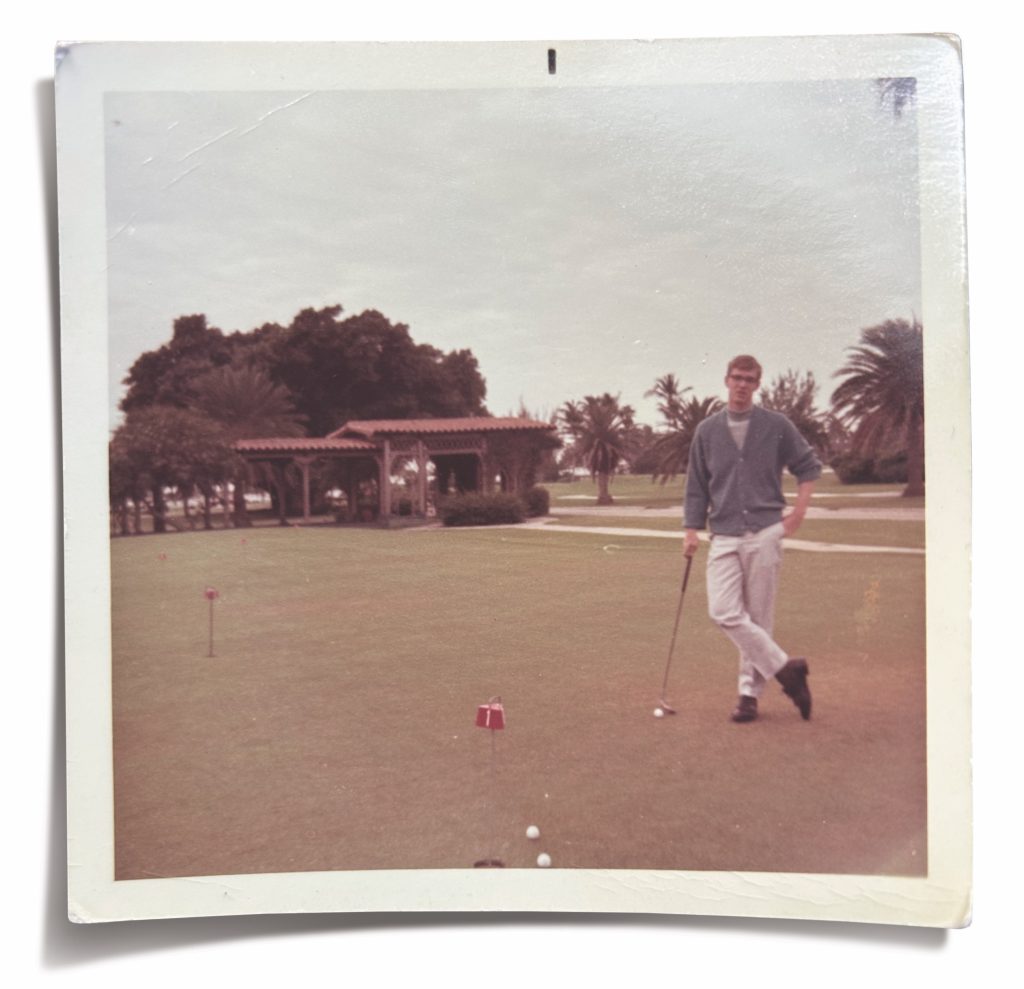
After a fitful night’s sleep. Dad drove me over to the club the next morning. Instead of dropping me off, he parked the car and escorted me to the putting green, where he snapped my picture, a lanky 160-pounder on a 6-foot-1 inch frame. At the appointed time, Dad and I entered the pro shop, where we met Sam. He couldn’t have been friendlier.

“Nice to meet you,” he greeted us in his smooth Virginia mountain drawl. “Bill, I hear you play on your high school team. That’s great. It’ll be just the two of us; we’ll have a good game. And just call me Sam.”

Out to his golf cart we went. Before we teed off, Dad took another photograph, this time of Sam and me. I confess, I’ve lost track of it but I well recall a broadly smiling Snead, nattily attired in red slacks, navy blue alpaca sweater and the ever-present straw hat sitting beside me, who was clearly starstruck.

Boca’s course was jammed, and I envisioned a protracted five-hour round. But when Sam and his familiar straw hat came into the view of players in the group ahead, they invariably waved him through. It was as if the Red Sea parted for us as we sped through foursome after foursome. Since Snead graciously allowed me to hit first off each tee, the golfers in our wake may have concluded I was winning our friendly match. Far from it.

Playing from the regular white tees, Sam nonchalantly made par or birdie on every hole. I was doing OK, mostly avoiding serious trouble. Then I made an unforced error by cutting things too close in laying up short of a stream crossing the fairway. After my ball toppled over the edge and into the water, Sam pithily observed, “If you’re going to lay up, lay up.” Over the years, I have often repeated his advice to players making the same mistake — and I let them know who gave it to me.

Sam was pleasant, but he tended to let me take the lead in our communications. And I felt some pressure to fill the airspace. I had one advantage making conversation — I had read The Education of a Golfer. I asked Sam questions about how he went about fashioning a club from a swamp maple tree limb during his youth. I asked about a boxing match he fought during his teens. And, of course, I fished for details about that incredible 59. The round, it turned out, could have been one shot better since Sam had missed a 2-foot putt.

Then I delved into the betting chapter of the book. Sam quickly warmed to this subject, regaling me with colorful anecdotes about how sharks he encountered tried to fix bets to their advantage. One sought additional strokes by claiming he had recently arrived in Florida from the North and hadn’t touched a golf club all winter. Actually, the hustler had been playing in the Sunshine State for weeks, even trying to conceal his tan from Snead by whitening his hands and face with corn plaster. Sam countered by carefully feeling the man’s calluses when shaking his hand. “When those calluses are thick, that tells you the man’s been playing plenty,” he said.

At one point on the front nine, Sam struck a shot he considered not up to his standard. He muttered, “I just can’t play my best unless I got a bet going.” I responded rather cheekily, “Well, I am sorry, Sam, that I won’t get to see you at your best.” Silence from the Slammer. To my surprise, I was hitting my drives within 20-25 yards of Sam’s. Since he was then 53, I figured he must be losing yardage off the tee. Wondering how much, I began posing a question with, “Now, when you were at your peak . . . ”

As the words left my mouth, I knew this was a misstep. Even assuming his peak was behind him, Snead wasn’t about to acknowledge it. Besides, Sam was still playing great golf in 1965. He finished 24th on the PGA tour money list (there was no Senior or Champions tour available in ’65) despite playing in only 15 events. Snead had won his seventh Greensboro Open earlier in the spring, making him the oldest (52) to have won a PGA Tour event. The record still stands 60 years later.

In a feeble effort to erase my faux pas, I uttered something inane along the lines of, “Not that you aren’t still at your peak.” I forget what was said next but do recall a distinct, if brief, lull in our conversation. If Sam was annoyed by my babbling, he didn’t show it, and our amiable dialogue resumed. It is telling that on the hole following my misbegotten inquiry, Sam let out the shaft and outdrove me by 75 yards.

Dad was waiting for us as we finished on the 18th, done in 2 hours and 45 minutes. After holing out and shaking hands (Snead, quite bald, never removed his hat in these situations), Dad asked Sam how things went.

“Well, your son did just fine,” he offered. “Shot 82 and kept the ball in play — just one double bogey and that was from a mental mistake (the bonehead lay-up). I believe he learned a lesson from that. He should keep on playing.” I absorbed another lesson from the round: Think before you speak.

Sam shot 66 and didn’t seem to be doing anything special. He holed one long putt and birdied the par 5s, but otherwise his round appeared relatively routine. Had I the temerity to bet him, I would have become one of Sam’s countless “pigeons.”

I don’t know for sure the amount Snead charged for the round. I think it was around $150. An old pro friend of mine believes that figure is too low, but an aged article I unearthed in the Sports Illustrated archives reported that in 1959, Snead charged $50 per round and $25 for each additional player. I can only imagine what a superstar like Sam would charge today.

Regardless of the cost, playing with Snead was priceless. There are still times when I have failed to do as Sam counseled — lay-up shots still occasionally roll into the water. But I’ve faithfully followed his advice to keep playing. After all, golf is the game of a lifetime. And my life was enhanced by that unexpected 1965 Christmas present.

The Art of N.C. Wyeth

THE ART OF N.C. WYETH

The Art of N.C. Wyeth

How did his illustrations for Drums get here?

By Bill Case

It was 1927 and, for Southern Pines author James Boyd, life was coming at him fast — albeit in a good way. His first novel, Drums, published two years earlier, had flown off bookstore shelves. To meet the unanticipated demand, publisher Charles Scribner’s Sons had reprinted the novel three times in the first month following its release. Forty thousand copies of the surprise bestseller were sold in five months.

Boyd’s tale, set mostly in North Carolina, was also earning critical acclaim. A New York Post reviewer declared Drums “the best novel written about the American Revolution.” Fellow author (and Boyd confidante) Struthers Burt heaped more extravagant praise, calling his friend’s work, “by far the best . . . American historical novel ever written.”

Buoyed by his surprise hit, Boyd authored a second historical novel for Scribner’s — this one with a Civil War backdrop. The book, titled Marching On, released in the first quarter of 1927, was going gangbusters too. Early sales were bettering those of Drums. On the heels of this latest tour de force, Scribner’s inked a deal for a third novel.

While Boyd’s association with his publisher was financially profitable, it was proving more time-consuming than he preferred, expressing frustration when production demands precluded his engagement in his favored rural pastimes, like foxhunting. The author grumbled to an interviewer, “My brother looks after my money for me; my wife looks after my kids and the house; now if I could get you (the interviewer) to do my writing for me, I could look after my dogs myself and fox hunt during the winter. Seems to me that would be an ideal arrangement for everybody concerned.”

In the fall of 1927, Boyd’s renowned editor, Max Perkins, pitched a new project designed to create a fresh wave of sales — and the author would barely need to lift a finger! Scribner’s wanted to produce a new, lushly illustrated edition of Drums. Boyd would need to make some minor text changes, but the bulk of the creative work would involve the artistic depiction of passages from the novel.

This was not a new concept for Scribner’s. The publisher first featured color illustrations in children’s books in 1904. Well-received, Scribner’s began color illustrating full-length novels, aiming primarily at the juvenile trade. An early one was Treasure Island, published in 1911. A landmark hit, Robert Louis Stevenson’s swashbuckling yarn became the first in a series labeled “Scribner’s Illustrated Classics.”

Subsequent books in the series like Kidnapped, Rip Van Winkle and The Last of the Mohicans told stories of high adventure. The authors of those classics, Stevenson, Washington Irving and James Fenimore Cooper, respectively, rank among the greatest American writers. The fact that Boyd was joining these legends underscored his arrival on the literary scene.

The choice of Drums for the series represented a departure for Scribner’s. While the book contains battle episodes and other dramatic moments, its subject matter was aimed at mature readers. In Drums, intractable political conflicts and social class barriers bedevil the young protagonist, Johnny Fraser. Editor Max Perkins minimized any perceived switch in Scribner’s targeted audience, writing, “Most of the best books in the world are read both by children and adults. This is a characteristic of a great book, that it is both juvenile and adult, and that is what assures it a long life.”

The primary conflict in Drums occurs in the lead-up to the war, when Johnny Fraser is coming of age in the backwoods of North Carolina, and Americans are bitterly divided on the issue of independence. Johnny’s father, Squire Fraser, sees both sides; while acknowledging that taxation without representation is anti-democratic, he is convinced no good will come from revolution. He remains a Loyalist, and Johnny follows his father’s lead.

Squire Fraser seeks to keep his son out of the growing tumult by sending him to Edenton to receive a gentleman’s education, but after war breaks out in Massachusetts, the revolt impacts Edenton, too. The British collector of the port there, Captain Tennant, is forced by a jeering mob to leave the colony. Johnny, a wavering Loyalist, receives his own share of harassment and also departs Edenton. Squire Fraser, still protecting his son, arranges for Johnny’s passage to England, where the young man obtains a clerical position at an import firm in London.

It’s then that Johnny crosses paths with American naval hero John Paul Jones, the “Father of the American Navy.” Jones persuades Johnny to join his ship’s crew. Whether his decision is premised on a newfound fervor for independence or the urging of the charismatic Jones is for the reader to discern.

Johnny is wounded in battle aboard Jones’ ship, the Bonhomme Richard. He returns to North Carolina and rejoins his parents in the backwoods of Little River. Fully invested now in the cause of independence, Johnny joins the militia and is wounded again. The book concludes with the battered Johnny Fraser sitting on his front porch, watching Nathanael Greene’s victorious army march by. As the soldiers are nearly out of sight, he staggers down to the fence and raises his stiff arm in salute to the last man of Greene’s rear guard, far off in the distance.

Scribner’s assigned the artwork for the new edition of Drums to the man unquestionably regarded as the finest illustrator in America, Newell Convers Wyeth, age 45. N.C. Wyeth painted the bulk of the artwork contained in the Scribner’s classics series, beginning with Treasure Island. During his unparalleled career Wyeth also illustrated hundreds of scenes for magazine stories, especially those published by Scribner’s Magazine and the Saturday Evening Post.

Wyeth was raised in Needham, Massachusetts, where his father made a decent living dealing in hay, grain and straw. His mother, an immigrant from Switzerland, was chronically homesick for her place of birth, and her depressed state was an ongoing drain on the family. Nonetheless, N.C. maintained a close relationship with his mother, and after he left Needham, the two corresponded with one another almost daily.

Wyeth displayed immense artistic ability during his teenage years, attending the Howard Pyle School of Art in Wilmington, Delaware. Pyle was then the country’s leading illustrator and quickly recognized Wyeth’s talent, advising his prodigy to submit illustrations to magazines. One of his first compositions was for The Saturday Evening Post — a cowboy astride a bucking bronco that appeared on the Post’s cover the week of Feb. 21, 1903. It was a promising start, and with magazines catering to public thirst for Western-themed stories, Wyeth received multiple commissions.

Pyle believed Wyeth’s cowboy illustrations would gain authenticity if he experienced Western life for himself, so in October 1904, N.C. journeyed west and found employment at a ranch. On Oct. 6, he wrote his mother: “I did my first work of the cowpuncher . . . Elroy and I went out and rounded up about 300 head of cattle, including calves. We started at 7:30 a.m. and were in the saddle continually until 5:15 that afternoon.”

Wyeth remained out west until December. The sojourn led to an explosion in commissions, and Wyeth’s subsequent Western illustrations demonstrated an increased grit and realism gained from his personal experience. With his career off and running, he received offers from magazines at the rate of two or three a week, and demand for his illustrations never slowed. Yet, he often disparaged this genre of painting as unserious, purely commercial and barely art. Though painting illustrations brought him fame and prosperity, Wyeth groused that it prevented him from being “able to paint a picture, and that is as far from the realms of illustration as black is from white.”

Churning out illustrations, however, earned enough to support a burgeoning family. He married Carol Bockius in 1906, and they had five children. Several of his offspring would become talented artists in their own right,  most notably, celebrated mid-century painter Andrew Wyeth. In 1908, N.C. moved the family to bucolic Chadds Ford, Pennsylvania, in the Brandywine Valley, 10 miles from Wilmington, Delaware. He had become smitten with the community’s horse-drawn surroundings during Pyle’s summer school sessions.

Wyeth relished life in Chadds Ford. Its warm meadows and rolling hills provided an idyllic environment for his work. Author David Michaelis described the painter’s peripatetic labors in his biography, N.C. Wyeth: “He had no time to waste. He divided his days, pushing himself to do more than one person could. In the mornings he made studies in the open fields around Chadds Ford. After lunch he cranked out pictures for Scribner’s and The Saturday Evening Post, then returned to the open air in the late afternoon. As the evenings lengthened in May, he remained in the fields and on the riverbanks, sketching, often through supper.”

The hard work paid off. Wyeth’s Scribner’s Illustrated Classics paintings received increasing acclaim. His depictions stood out because they appealed to all the senses. Michaelis wrote, “Wyeth’s illustrations make the viewer not only see and feel but also hear. We hear the clatter of dishes and goblets breaking during a fight, coins falling on heaps, sand squeaking under the feet of the stretcher bearers.”

Illustrator John Lechner added, “Unlike previous illustrators, who designed their compositions neatly on the page, Wyeth’s paintings leapt right out of the book, with a vibrancy and power that made you feel the passion and pain of their subjects.”

An assignment from Scribner’s to illustrate a classic novel required production of 17 individual paintings. Fourteen of them, each depicting a scene from the book, would be sprinkled throughout the text. The cover, title page and end page would also feature illustrations. Scribner’s art director, Joseph Chapin, allowed Wyeth carte blanche freedom in choosing scenes.

Lechner observed the subtlety within N.C.’s selections: “Wyeth was very sensitive to the author’s words, and his philosophy was to avoid depicting scenes that the author describes in detail (what was the point?) and instead illuminate smaller moments that are only briefly mentioned, in order to enhance the story. The resulting illustrations are neither trivial nor superfluous but help develop the characters and advance the story.”

Wyeth used canvases for the classics series that were 47 inches tall and 38 inches wide. For final publication, Scribner’s engravers would reduce the size to 6 1/2 inches by 5 1/4 inches. Wyeth was billing Scribner’s approximately $5,000 for a set of paintings around the time the publisher retained him to illustrate Drums.

Wyeth always read the novel he was illustrating. We know he liked Drums because of a letter he wrote to his father, who apparently did not share his enthusiasm. Recognizing his father was accustomed to stories involving the confrontation of a perfect hero with a perfect villain, N.C. asserted that real life was not like that, claiming modern literature, and Drums in particular, provided more realistic, and thus more interesting, portrayals of human nature. The imperfect Johnny Fraser, according to Wyeth, was “like most of us,” a “fundamentally worthy sensitive person,” yet “vacillating and a victim of influence and circumstances.”

His western trip taught Wyeth that the essence of a scene is best captured by exploring the area where the action occurs, so plans were made for him to visit Edenton. Who initiated the trip is unclear, but Boyd — who had previously visited Wyeth in Chadds Ford — did send Wyeth a telegram inviting him to visit Weymouth on his way to Edenton.

Wyeth responded on Dec. 3, 1927. “I have carefully completed the next to last study of Drums and am now prepared to absorb the material I need from you, Little River Country, and Edenton.” Wyeth planned to arrive at Weymouth on Wednesday, presumably Dec. 7.

The next recorded contact between the author and artist took place later in December when Wyeth wrote Boyd from Edenton extending his “warmest thanks to you and Mrs. Boyd for your kindnesses.” He expressed further gratitude to Boyd “for the use of your motor,” and the “careful but not dull driving of Calvin.” Wyeth’s word pictures were nearly as lush as his illustrations. “For the last two hours, lying by the open window, I have listened to the night sounds of this little town and have contrasted those Johnny Fraser heard so often, and by doing so have enjoyed revealments which, for moments of time, become very poignant and moving,” he wrote. “Dimly bulking against the glow of the moon on the water I can see the angular shapes of three warehouses. There they stand as Johnny Fraser saw them! This afternoon was spent wandering in and about these relics of 1770. My heart went out to them, because you, Boyd, have made them live for me.”

Wowed by N.C.’s eloquence, Boyd responds, “It is an injustice of nature that a man who can paint like you should also be able to write like that . . . I might be obliged to ask myself why I am in the business at all.” Boyd is also struck by the fact that Wyeth’s sentiments present a perfect echo of his own. “Two people are seldom so as one on anything in life,” Boyd writes. “And when that thing happens as with us to be a common enterprise, the coincidence is so far-fetched as to excite a wonder in my mystical Scots nature, only exceeded by my hard-headed Scotch-Irish nature that there must be a catch somewhere.”

There is no hint in their correspondence that James Boyd accompanied Wyeth on his coastal wanderings, but a humorous anecdote in the Jan. 10, 1931 Pinehurst Outlook suggests otherwise, claiming that Wyeth was seeking models for two boys in the story, and that he and Boyd toured the Cape Fear area together in search of suitable subjects. “Stopping at a country school near Wilmington, they looked through the windows and saw in a corner two boys who served Mr. Wyeth’s purpose very well. He and the author, to get a closer view, stooped down and looked through the keyhole. ‘Just the type,’ said the artist, and the author agreed. The schoolteacher, unfortunately, overheard the conversation and opened the door to investigate, and both Mr. Boyd and Mr. Wyeth fell in.”

After the new year, Wyeth began work on his Drums illustrations. In addition to the set of 17 paintings, he agreed to render a number of pen drawings for the new edition. On Jan. 5, 1928, he reported to Boyd on his progress or lack of same. “I am not taking easily to this medium for it is years since I have handled it,” he wrote. “Have done about twenty which I destroyed this morning and feel better for it.”

Wyeth’s message expressed agonized frustration concerning his work, startling when coming from the greatest illustrator alive. “How I do yearn for the technical ability to put down in color and pattern the things that are almost tearing my insides out,” he wrote.

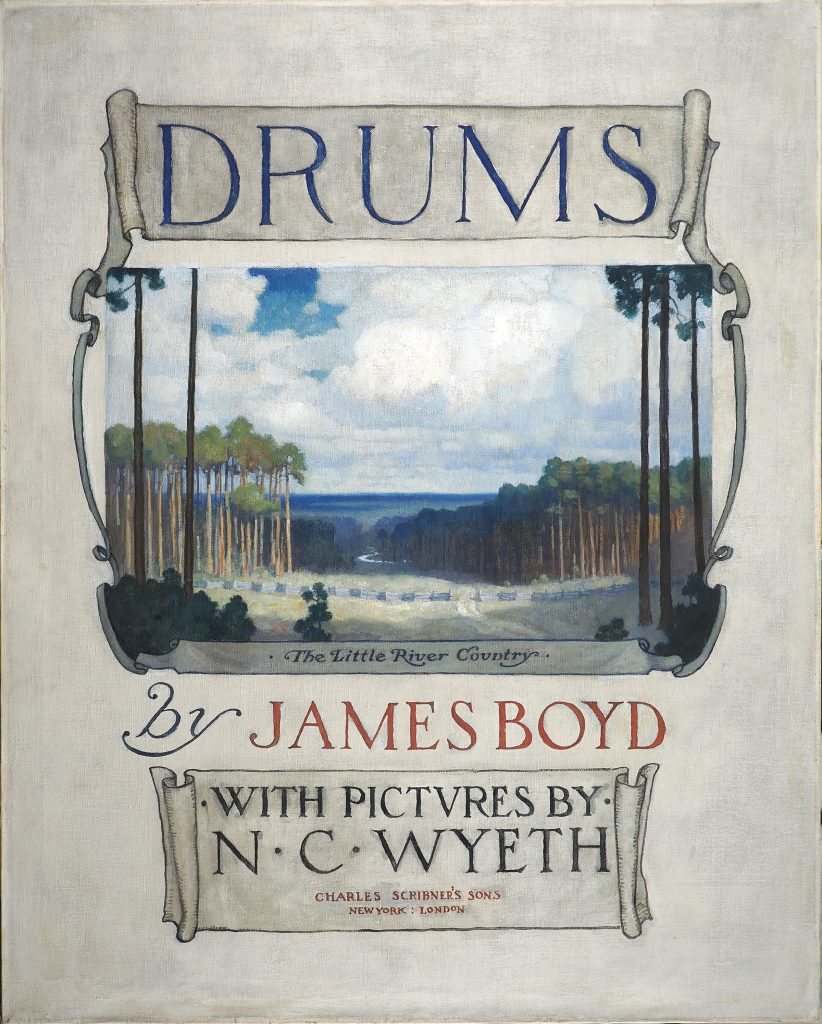
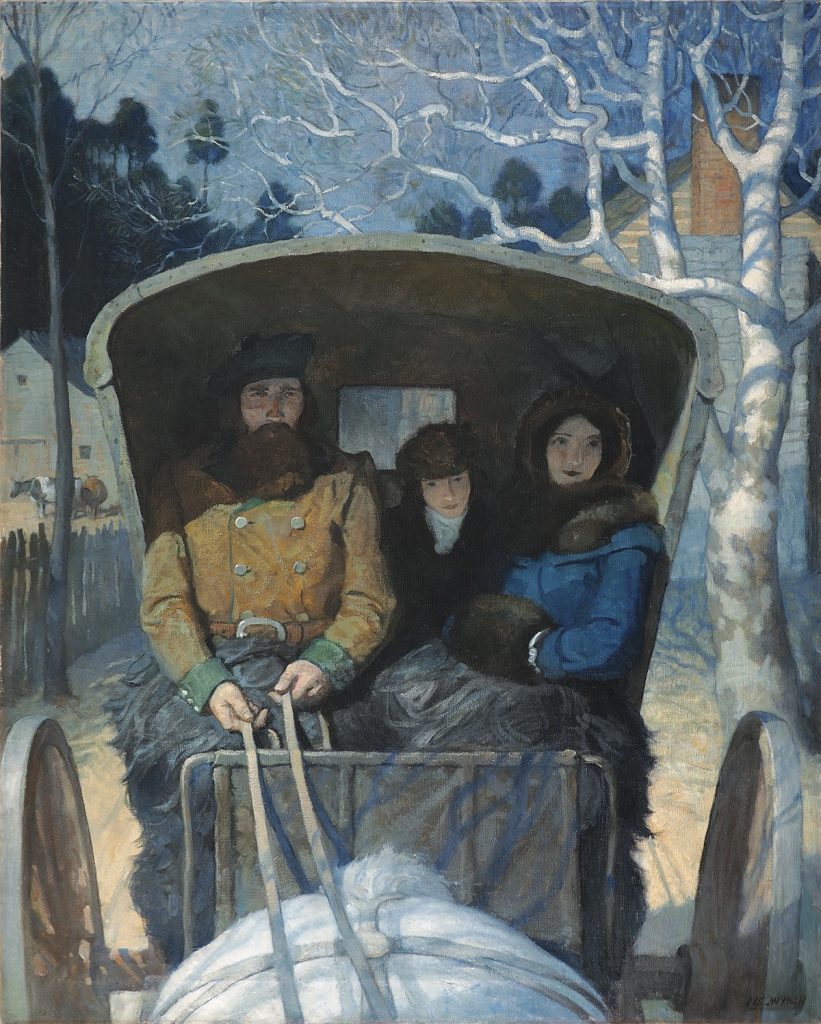
The 17 illustrations for Drums included several of high drama like “The Fight at the Foretop” aboard the Bonhomme Richard; “The Horse Race” (which Johnny won); “Johnny’s Defeat at the Dock,” when he was treated roughly in Edenton; and “Captain Tennant,” where the British official cooly confronts the crowd demanding his departure. Others like “The Fraser Family,” depicting young Johnny and his parents riding their old chaise to church; and “The Mother of John Paul Jones” lack drama, but help the reader visualize the characters. The Drums title page illustration includes a pastoral landscape, supposedly portraying the Little River Country, though it actually came from a Chadds Ford area view.

Though their effusive correspondence suggests an exceedingly collegial friendship, there is no record of further dealings between Boyd and Wyeth following the 1928 publication of the Illustrated Classics edition of Drums, which sold exceedingly well. It’s hard to imagine, however, that they didn’t see one another during the Yuletide stay of Wyeth and his wife, Carol, at Southern Pines’ Highland Pines Inn in 1931 (reported by The Outlook on Dec. 19 of that year). There is no mention there or elsewhere, that the Boyds and Wyeths saw one another. By contrast, Boyd’s hobnobs in Southern Pines with other revered men of the arts like F. Scott Fitzgerald, Thomas Wolfe and John Galsworthy were copiously reported. It’s puzzling.

Even if they did not meet during that visit, the two men presumably had further contact because Boyd wound up acquiring three of the 17 canvases Wyeth painted for Drums: the “Title Page” illustration; “The Fraser Family” painting; and “Captain Tennant.” Those canvases are currently on display at the Weymouth Center for the Arts & Humanities as part of its Celebration of Drums. This year marks the centennial of the novel’s initial publication. The Wyeth paintings are on loan from the town of Southern Pines, which now owns them.

But what were the circumstances of Boyd’s acquisition of the illustrations? When did he take possession of them? Was it possible he got them from Scribner’s instead of Wyeth? Did Boyd purchase the paintings, or were they a gift?

The earliest mention referencing Boyd’s ownership of the illustrations came from a Dec. 7, 1939 Outlook blurb. It read: “Above the fireplace in the Southern Pines Library are two of the original N.C. Wyeth illustrations used in depicting scenes in Mr. James Boyd’s book, Drums. These interesting illustrations, on display through the courtesy of Mr. Boyd, add much color and charm to the reading room of the library.” (The library was then located on Connecticut Avenue and operated independently by the Southern Pines Library Association.)

Michaelis’ biography makes it clear that Boyd obtained the paintings from Wyeth. During N.C.’s early work for Scribner’s, he was squeamish about speaking up for himself, and the publisher kept most of his paintings. Over time, however, he became more forceful in negotiations with the publisher. By 1920, Scribner’s was returning all of Wyeth’s canvases to the artist. A check of Scribner’s archival records confirmed the company sent the Drums illustrations back to Wyeth.

Whether the artist sold or gifted the illustrations to Boyd is a more complicated issue. The fact that Wyeth had previously sent a picture of one illustration to Boyd “thinking it might interest you,” seemed the sort of thing a seller might say to kick off negotiations. But a scouring of Boyd’s personal papers at the University of North Carolina’s Wilson Library revealed no support for this theory. Carrie Hays, administrative coordinator for the town of Southern Pines, compiled background information concerning the paintings, but nothing relates to how Boyd obtained them from Wyeth.

N.C.’s great-granddaughter, Victoria Wyeth, speaks regularly concerning her legendary family’s legacy. (She was featured in Ray Owen’s October 2018 PineStraw article “America’s First Family of Art.”) While Victoria had no information concerning her great-grandfather’s disposition of the paintings, she graciously put me in touch with folks who did at the Brandywine Museum of Art in Chadds Ford.

The museum includes Wyeth’s studio and holds a treasure trove of his paintings along with records of their provenance. Amanda Burdan, the senior curator of the museum, provided valuable, though not conclusive, insight on the issue. “It is most likely that he (Wyeth) sold those three paintings to (Boyd) directly,” she said. “He did occasionally gift paintings, but it tended to be for special occasions like weddings of friends.” Burdan said that “several of the Drums illustrations stayed with the Wyeth family until well after N.C. died in 1945.”

Burdan and her assistant, Lillian Kinney, took a look at Wyeth’s tax records in hopes they might reveal income from sales of illustrations to third parties. There was some, but the records were inconclusive — another rabbit hole.

Sandy Gernhart is the archivist for the Weymouth Center, which houses many Boyd documents. She found a 2005 Weymouth inventory binder that indicates Wyeth gifted the illustrations to Boyd. According to Gernhart — and prior Weymouth Center historian Dotty Starling — it has through the years been “known” at Weymouth that the illustrations came to Boyd by way of a gift from Wyeth. Both women concede there is no documentation, aside from the non-contemporaneous inventory binder, that backs up this lore.

Nonetheless, the apparent closeness of the two kindred spirits during their time together and the generous hospitality exhibited by the Boyds to Wyeth provide strong circumstantial evidence supporting the likelihood of Wyeth’s tendering such a generous gift.

How did the town of Southern Pines eventually obtain ownership of the illustrations? After World War II, the town constructed a new edifice on Broad Street that would house the library — now the home of the town’s utilities office. Soon thereafter, the library came under the town’s umbrella. A wing was added to the structure in 1948 that was dedicated to the memory of James Boyd, who had passed away in 1944. Katharine Boyd contributed a number of historic artifacts to be displayed in the James Boyd Room, including a desk purportedly used by Lincoln while he was in Congress, an autograph collection, several pieces of early American furniture, and the Wyeth illustrations.

Katharine Boyd’s 1969 will (she died in 1974) mentions nothing about the paintings, so presumably she considered them already donated to the town, perhaps when the James Boyd Room was opened in ’48. But if so, the gift, like other dealings in this account, appears to have been accomplished without written record.

The town is permitting the Weymouth Center to display the illustrations throughout most of 2026. As of now, it’s unclear where Wyeth’s illustrations will be housed once they are returned to the town.

Wherever they wind up, security will be paramount. There is no hiding the fact the canvases are valuable. N.C. Wyeth illustrations frequently sell at six figures. The highest amount paid to date is $5.99 million for his Portrait of a Farmer at a Sotheby’s auction in 2018. Wyeth, who belittled the merits and value of his own illustrations, would undoubtedly be gobsmacked at such stupefying prices.

Wyeth died in 1945, one year after Boyd, at the age of 62. His demise was both tragic and mystifying. While driving near Chadds Ford, Wyeth’s car stopped on the track at a railroad crossing. An onrushing train crashed into his auto, killing him and his 3-year-old grandchild. Why Wyeth was stopped on the track remains an unknown.

While a bit of mystery lingers regarding the Wyeth-Boyd relationship and the three illustrations, there is none concerning Wyeth’s artistic greatness. Though in the grand sweep of time the regard given to the works of Boyd and Wyeth may have traveled in different directions, their association, while brief, made for a memorable collaboration.

Nature’s Nightlife

NATURE'S NIGHTLIFE

Nature's Nightlife

In search of wonders in the dark

Story and Photographs by Todd Pusser

Nara City, nestled within Honshu, the largest of Japan’s four main islands, is renowned for its numerous historic temples and shrines. Designated a UNESCO World Heritage Site, the city is perhaps most famous for its resident sika deer, a native Asian species that looks like a stouter, more heavily spotted version of North Carolina’s white-tailed deer.

In the Shinto religion, deer are viewed as messengers between mortals and gods. As such, the sika deer of Nara have been considered sacred for centuries and pretty much have the run of the town. They wander the crowded streets (where they always have the right of way) and frequently panhandle for rice crackers in front of local businesses. Tourists flock from all over the world to see and feed them.

Over the years, hungry deer have learned to bow to people, in customary Japanese tradition, in order to receive a cracker. When our family visited the city this past summer, my daughter spent the better part of two days roaming the streets and parks, constantly exchanging bows and crackers with every deer she encountered. My back ached just watching her.

While bowing deer are indeed charming, my primary reason for visiting Nara lay just outside of town, on a thickly canopied mountain slope that overlooked the city. There, in a forest with the rather foreboding name of Mt. Kasuga Primeval Forest, lives a very special squirrel. Not just any run-of-the-mill-backyard-birdfeeder-raiding gray squirrel, mind you, but one of the largest squirrels in the world — the aptly named Japanese giant flying squirrel. At nearly 3 feet long from the tip of its nose to the tip of its fluffy tail, the squirrel is larger than a house cat.

I first learned about Nara’s giant squirrels from my good friend Jon Hall. Jon, who originally hails from the United Kingdom but currently lives and works in New York City, has obsessively traveled the globe for the better part of three decades in search of mammals. During that time, he has managed to see a third of the world’s mammals — over 2,300 species as of August 2025, an unrivaled number — and has established the internet’s premiere mammal-watching website, www.mammalwatching.com. Jon visited Nara several years ago and saw the squirrels firsthand. Before our family trip, he kindly offered a few tips on how to the find them in the forest that overlooks the town.

Strictly nocturnal, the Japanese flying squirrel emerges from its home tree cavity at dusk. Spreading its flying skin (a thin membrane that stretches between its front and hind legs) like a superhero’s cape, the arboreal rodent glides from tree to tree, throughout the nocturnal forest, in search of nuts, fruits and leaves to eat.

It was just after 10 p.m. when my partner, Jessica, and I first found the squirrels. We had spent the better part of the evening hiking up a steep dirt road through the old-growth forest without much to show for our efforts, other than sore legs and some mild dehydration from the humid, summer night air. It was Jessica who first heard their strange vocalizations, which sound remarkably like the guttural calls of American crows, high up in the canopy.

Clueing in to one particular vocal individual, Jessica spotted the squirrel’s distinctive eye shining among the leaves with her flashlight. “Here’s one,” she exclaimed. I rushed to her side with my camera in hand. There, on a branch 20 feet above our heads, munching contently on a mouth full of leaves, sat the largest squirrel I’d ever seen. Though I have seen other types of flying squirrels — like Southern flying squirrels in the backyard of the home where I grew up in Eagle Springs — those diminutive, big-eyed critters paled in comparison to the size of the furry beast staring down at us.

As we watched in amazement, another giant flying squirrel called out from a nearby tree, and then another quickly responded, just down the slope. We were surrounded.

Eager to take a break from our strenuous hiking, we sat down on the dirt road beneath the squirrels and turned off our flashlights. For several minutes we sat in the dark listening to the grunts and growls of the squirrels as they foraged in the trees above. Fireflies flickered on and off along the edge of the road, and a Ural owl hooted in the distance. All was right in the world.

Suddenly, Jessica jumped up and shouted, “What the hell is that!” Startled, I turned on my flashlight, thinking perhaps she had stepped on a mamushi, a local pit viper that closely resembles a cottonmouth, the venomous denizen of Sandhill swamps. “Get it off!” Jessica shouted. Shining my flashlight on her, she pointed down to her leg. “Hurry!” she said.

Scanning the length of her leg, I finally saw it. Just above the sock line, a leech had attached itself to Jessica’s skin and was sucking her blood like a rabid vampire. My flashlight soon revealed four more leeches clustered on the side of her tennis shoe, each searching for a patch of bare skin. The slimy invertebrates evidently found her irresistible and were swarming her like sharks attacking a bleeding fish.

Now frantic and dancing a jig in the middle of the dirt road, Jessica was shaking her leg left-to-right and up-and-down, trying to dislodge the bloodthirsty vermin. It looked like a scene straight out of the movie Stand by Me, and I couldn’t help but chuckle.

That was a mistake.

“Todd, get these damn things off me! Now!” she demanded. I tried to explain that, unlike ticks, leeches don’t carry any known human diseases and are entirely harmless. This factoid failed to impress. And when I insisted on photographing the engorged leech attached to her leg before removing it, Jessica was neither pleased nor amused. The walk down the mountain and back to our hotel was a long one indeed.

The primeval forest had lived up to its name. I held out hope that our little squirrel-watching adventure left no lasting scars on Jessica, physically or emotionally. No doubt it served to reinforce preconceived notions that venturing into the wild at night can be perilous.

As kids, we are taught to fear the dark in countless fairytales. We learn that the night is filled with perils and dangers. For many, the apprehension of the dark is carried all the way into adulthood. It is a primary reason why humans bathe their yards and city streets with bright lights. Perhaps this fear is innate, stemming from a time our distant ancestors roamed the nocturnal landscape when large predators, with better nighttime eyesight, were much more common.

Growing up, I was always curious about what lurked outside our rural Eagle Springs yard when the sun went down. I have fond memories of sitting outside by our pool, under a star-filled sky, listening to the distant hoots of owls and whip-poor-wills. Humid summer nights found me catching backyard fireflies and placing them in Mason jars. On more than one occasion, turning into our yard late in the evening after a school basketball game, the headlights of my parents’ car would reveal an opossum or raccoon skulking along the edge of the woods. Sometimes we would even see a gray fox.

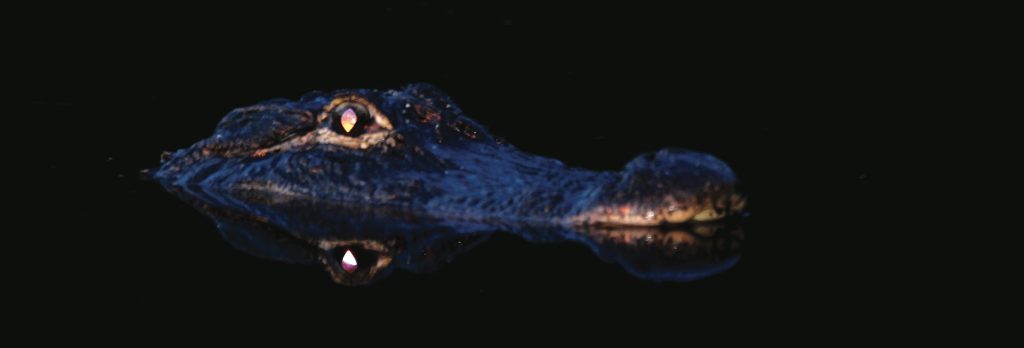
I still venture out after dark, and many of my most memorable wildlife encounters have taken place long after the sun disappeared over the horizon. In Japan this past summer, I watched as the world’s largest owl, the Blakiston’s fish owl, swooped down to catch small fish out of a tiny creek in front of a makeshift blind. In the Yucatan Peninsula, I spotted the eyeshine of large crocodiles hiding among mangroves in a shallow coastal bay. On a hot August night in the Arizona desert, I once found over two dozen rattlesnakes crossing rural blacktop roads under the moon-cast shadows of giant saguaro cacti. Once, off the coast of Costa Rica, a few hundred Eastern spinner dolphins raced over to our ship to play in the bow wave for nearly half an hour under a bright moonlit sky. Bioluminescent phytoplankton in the water caused the dolphins to glow in the dark. The up-and-down beats of their tails in the water, as they raced along with the ship, left spectacular trails of shimmering blue and green light in their wakes. The scene was otherworldly and jaw-dropping.

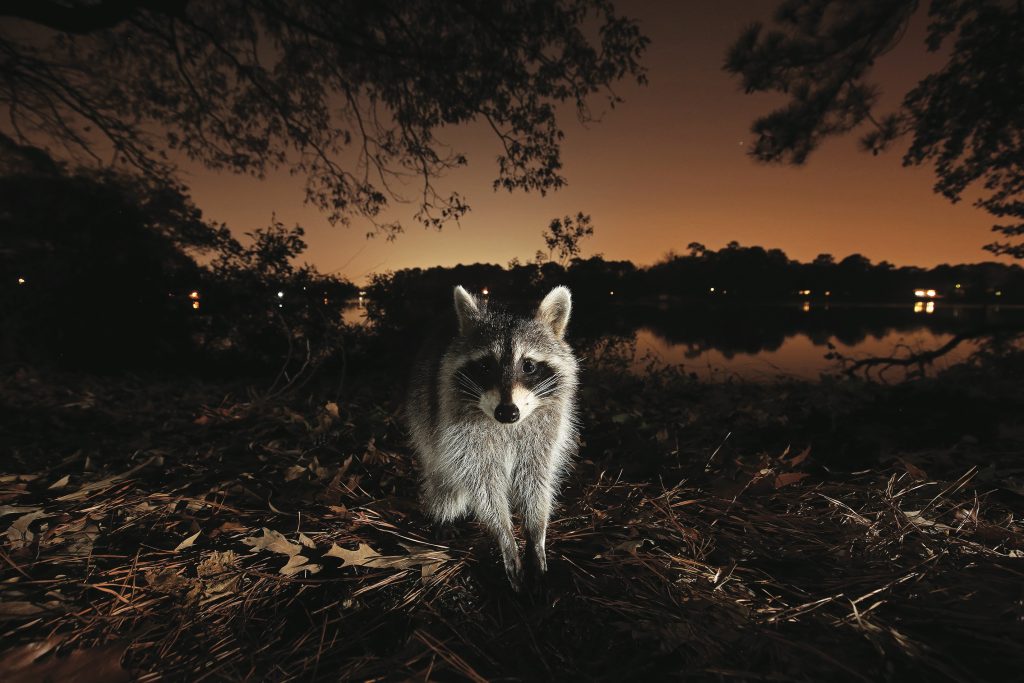
Today, I have many more high-tech “toys” available to me than I did as a kid to aid in my nocturnal wildlife observations. Camera traps with infrared beams allow me to capture spotted skunks on remote mountain sides or crafty raccoons foraging just outside our kitchen window, without me actually having to be physically there. Ultraviolet flashlights allow me to find caterpillars munching on the leaves of trees and shrubs throughout the nocturnal forest. Many caterpillars fluoresce under ultraviolet light, and shining one of these flashlights into a persimmon tree on a September night will cause them to light up like Christmas tree lights.

Perhaps the biggest gamechanger for locating wildlife at night has been the thermal imaging scope. Primarily used by law enforcement and the military, thermal imaging scopes were once prohibitively expensive. In recent years, these high-tech scopes have come down in price and are now commercially available in many brands. The scope, as the name suggests, picks up the body heat of animals (especially mammals and birds), making it possible to virtually see in the dark. A walk in the woods with a thermal scope after sunset will reveal creatures you never knew were around, everything from tiny golden mice scampering about in trees to deer foraging in a field several hundred yards away.

Having all this tech so easily available can be addictive for the curious naturalist. A case in point is my current enthusiasm for North Carolina sphinx moths, derived after reading a story involving an unusual orchid from Madagascar and two of the godfathers of the Theory of Evolution, Charles Darwin and Alfred Russel Wallace. Sphinx moths (or hawkmoths, as they are also named) are spectacular insects with over 1,500 species found around the world. They are well known for hovering in front of flowers like hummingbirds, with many species rivaling the birds in size.

In 1862, Darwin received a spectacular orchid with a foot-long nectar tube from the island of Madagascar. He pondered what type of insect could possibly pollinate so unique a flower. In a letter to his botanist friend Wallace, Darwin exclaimed, “Good heavens, what can suck it!” He went on to speculate that only a moth with an exceptionally long tongue could reach the orchid’s nectar reserve.

Five years later, Wallace predicted such a moth would be similar to a sphinx moth from the nearby African continent that was known to possess a very long tongue. Wallace wrote, “That such a moth exists in Madagascar may safely be predicted, and naturalists who visit the island should search for it with as much confidence as astronomers search for the planet Neptune — and they will be equally successful.”

In 1903, the long-tongued moth was finally found and described, vindicating both Darwin’s and Wallace’s predictions. It was not until 2004 that a BBC film team finally filmed the moth, now called Wallace’s Sphinx Moth, pollinating the orchid for the first time.

Their saga led me straight down a deep rabbit hole. North Carolina has an abundance of native and non-native deep-tubed flowers, and numerous sphinx moths. According to the North Carolina Biodiversity Webpage (www.nc-biodiversity.com), 45 species of sphinx moths have been recorded in the state.

Faster than you can say “What can suck it?”, I ventured out to the closest patch of ginger lilies on a summer night. Ginger lilies, a species native to Asia, possess bright white flowers that open only at night and are incredibly fragrant, making them popular additions to backyard gardens. Their unique blooming strategy suggests the flowers are pollinated by nocturnal insects. With their deep nectar tubes, I reasoned our native sphinx moths would visit them for a sugar rush. Sure enough, my first night sitting out among the lilies in my friend’s yard, I saw numerous rustic sphinx moths hovering in front of the white blooms like nocturnal hummingbirds. I was hooked. 

This past summer found me deploying camera traps around many of North Carolina’s native flowers to see what moths visit them at night. Using ultraviolet flashlights, I spent many evenings looking for glowing sphinx moth caterpillars on grapevines and low-growing shrubs. I even sat out in a large tobacco field near my home in Eagle Springs, watching dozens of sphinx moths hover in front of the white flowers under a bright full moon.

Thankfully, there wasn’t a leach in sight. 

Bookshelf

BOOKSHELF

November Books

FICTION

Party Stories, by Ella Carr

Momentous parties have long provided dramatic scenes in fiction, from Natasha’s first ball in War and Peace to Darcy snubbing Lizzy in Pride and Prejudice to J. Edgar Hoover and Truman Capote rubbing shoulders in Don DeLillo’s “The Black-and-White Ball.” Revelry can be revealing of character, as in Gatsby’s extravagant bash in F. Scott Fitzgerald’s The Great Gatsby and the decadent partying of the jaded expats in Ernest Hemingway’s The Sun Also Rises. More decorous affairs can also reveal profound depths, as in Katherine Mansfield’s “The Garden Party” and the parties at the center of those two modernist masterpieces, Virginia Woolf’s Mrs. Dalloway and James Joyce’s “The Dead.” There is room on this dance floor for humor, as well, in Evelyn Waugh’s “Bella Fleace Gave a Party,” Dorothy Parker’s “Arrangement in Black & White,” and Saki’s “The Boar-Pig.” All sorts of literary greats mingle in this festive gathering, a perfectly entertaining gift for readers and partygoers alike.

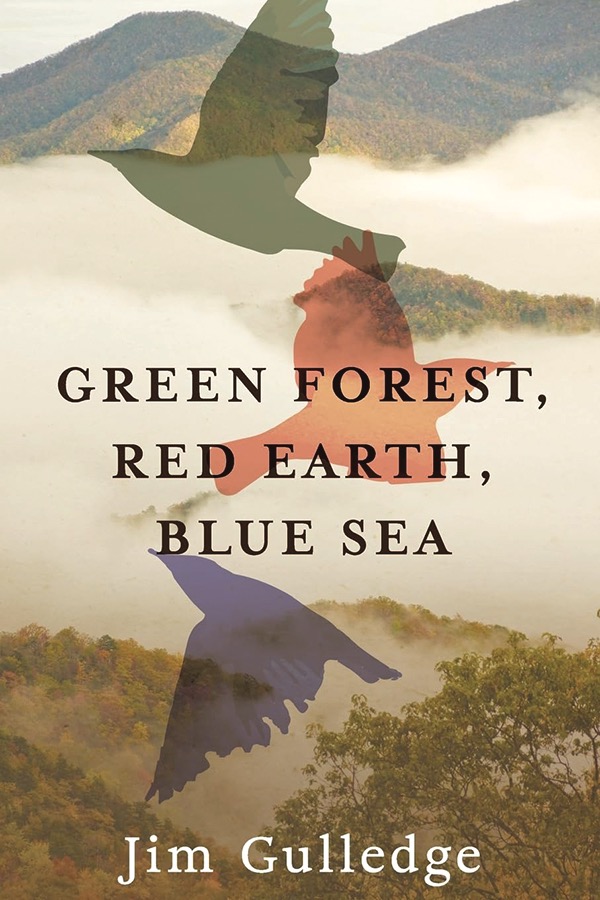
Green Forest, Red Earth, Blue Sea, by Jim Gulledge

A small pocket watch bears witness to the loves and losses of three North Carolina families — the Kellers, Elliotts and McClures. As the heirloom passes down over a hundred years, questions arise. Can strength and goodness be gifted to one’s heirs? What about corruption and evil? Do the lives of ancestors have any bearing on those who come after them? From Reconstruction to the modern age, this sweeping family saga speaks to what binds families together and tears them apart. Powers of darkness and light fight for the minds and hearts of every individual. In a land of beauty populated by Scots Irish pioneers, cotton farmers, Native Americans, fishermen, and pirates, Green Forest, Red Earth, Blue Sea by local author Jim Gulledge is a chronicle of human failings and the power of redemption.

NONFICTION

Rules for Living to 100, by Dick Van Dyke

Dick Van Dyke danced his way into our hearts with iconic roles in Mary Poppins, Chitty Chitty Bang Bang and as the eponymous star of The Dick Van Dyke Show. Now, as he’s about to turn 100 years old, Van Dyke is still approaching life with the twinkle in his eye that we’ve come to know and love. Through pivotal stories of his childhood, moments on film sets, his expansive family, and finding love late in life, Van Dyke reflects on the joyful times and the challenges that shaped him. His indefatigable spirit and positive attitude will surely inspire readers to count the blessings in their own lives, persevere through the hard times, and appreciate the beauty and complexity of being human.

Eleanor Roosevelt’s Nightly Prayer: The Religious Life of the First Lady of the World, by Donn Mitchell

A great woman who was heavily involved in politics, Eleanor Roosevelt is considered one of the most important and beloved first ladies and female leaders. Her faith and beliefs are commonly dismissed as confines of the upbringing that she broke free from, though her dedication to the Episcopal Church and her reliance on Jesus’ teachings imply otherwise. Her nightly prayer, famously recorded in her writing, demonstrates her approach to serving her community and nation. Her inspiration and strength become apparent in the context of her religion and the fulfillment of her beliefs through her actions. In reviewing observations from family members, her own writing and her participation in the church, Mitchell examines the impact of Eleanor’s faith on her work, and by extension, its impact on the world.

CHILDREN'S BOOKS

Dog Man: Big Jim Believes, by Dav Pilkey

Our caped crusaders — Dog Man (aka Scarlet Shedder), Commander Cupcake and Sprinkles — along with Mecha Molly discover that the city has changed and nothing is how it should be. Can Big Jim’s positivity and innocence help our heroes? Will Dog Man, Big Jim, Grampa and Molly have the courage to trust each other and save the day? How does the past help shape the future? And who is the chosen one? Readers will want to hold onto their hero capes as they soar into a new thrilling Dog Man story. (Ages 7-9.)

The Humble Pie, by Jory John

The Humble Pie likes to give others the spotlight. Aw, shucks! They deserve it! But when he’s paired with his best friend, Jake the Cake, for a school project, he soon realizes that staying in the shadows isn’t always as sweet as pie. Readers of all ages will laugh along as their new pie pal discovers that letting your voice be heard can take the cake! (Ages 4-8.)

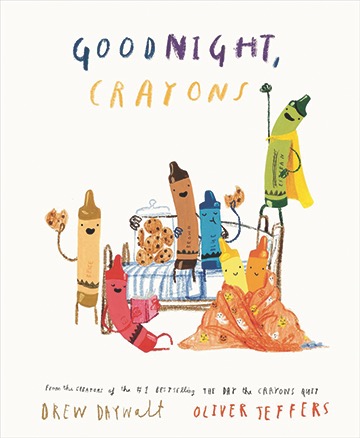
Goodnight, Crayons, by Drew Daywalt

The hilarious Crayons are ready to say good night . . . or are they? The Crayons are getting ready to go to bed, but each Crayon has something special they need to fall asleep. Blue Crayon needs a drink of water, Orange Crayon needs a blankie, Red Crayon needs a story or two or three. What do you need to fall asleep? A humorous, good night story from everyone’s favorite school supplies. (Ages 4-8.)

The Christmas Sweater, by Jan Brett

Yiayia is thrilled with the fantastically adorned Christmas sweater she made for her grandson’s dog, Ariadne. Her grandson Theo loves it too, but he can tell Ari doesn’t feel the same way. Luckily, Theo knows exactly what will show her just how cozy and warm the sweater is — a hike to Echo Lake. And he can wear his new snowshoes! The woods are a winter wonderland and more snow swirls as they hike. Just when they reach the lake, Theo realizes Ari’s sweater has disappeared, along with their tracks and every familiar landmark. Could they have lost Yiayia’s gift and the way home? Luckily, Ari spots something in the snow that turns out to be a surprising solution to their predicament.  (Ages 4-8.)

Dissecting a Cocktail

DISSECTING A COCKTAIL

Kettle to the Coil

Story and Photograph by Tony Cross

Years ago, I was commissioned to create a cocktail for a local event celebrating the famed author Tom Wolfe, who was a frequent Sandhills visitor. The book being highlighted was The Right Stuff, and the committee that hired me thought Tang, the orange drink mix, would be a great ingredient to include as an homage to the earliest astronauts. After a little persuasion, I was able to change their minds. The resulting cocktail that I called Kettle to the Coil did indeed include orange, but not in a powdery form. Instead, I infused the fruit and its oils in a blended Scotch whisky. I also incorporated a syrup with a wine base — pinot noir. Everyone loved the drink, and it ended up on my bar’s menu that year.

A great cocktail to serve during the cooler months, the whisky is rounded out with the orange oils, and the spices added to the pinot noir syrup scream fall weather. You can try this syrup in other cocktails that include whisk(e)y and sugar. It’s also great on its own with sparkling water. Some people get excited for pumpkin lattes this time of the year. I get excited for whisky and red wine.

Specifications

1 1/2 ounces orange oil-infused blended whisky*

1/2 ounce Drambuie

3/4 ounce fresh lemon juice

1/2 ounce pinot noir syrup**

Execution

Combine all ingredients with ice in a shaking vessel. Shake hard until the tin becomes frosted. Double strain into a chilled Nick & Nora glass. Express the oils of an orange coin over the cocktail. Lay orange coin on top.

*Orange Oil-Infused Blended Whisky

Using two 16 ounce Mason jars, add the following: flesh and peel of one medium orange; 1/2 bottle blended Scotch whisky (I use The Famous Grouse). Tighten jar and let sit for three days (shake or swirl the jar for 15 seconds once each day). When ready, pour infusion through a mesh strainer and then again though a coffee filter. Rebottle in the same whisky bottle.

**Pinot Noir Syrup

1 bottle (750 milliliters) pinot noir (preferably a lighter pinot like Willamette Valley)

3 cups granulated sugar

3 cinnamon sticks

1/2 apple (sliced)

1 tablespoon star anise pods

1 tablespoon whole cloves

1/2 tablespoon cardamom pods (crushed)

1/2 teaspoon fresh ground nutmeg

Zest of 6 oranges

Combine all ingredients in a medium saucepan over medium/high heat and bring to a simmer. Let simmer to the consistency of a rich syrup, 15-20 minutes.

Deep Background

DEEP BACKGROUND

Deep Background

Battling the clock for art

By Jim Moriarty

Photographs by Tim Sayer

“I’m officially bionic,” says Derek Hastings. “I have to charge myself once a week.”

In early August Hastings underwent deep brain stimulation (DBS) implantation at Duke Raleigh Hospital. The surgery required placing two electrodes in his brain, attached to wires that run under the skin to a battery roughly the size of a Zippo lighter installed subcutaneously on his chest not far from his heart.

Hastings has Parkinson’s disease, and the surgery is designed, in combination with medication, to minimize his uncontrollable movements (dyskinesia) and tremors.

Halfway through the operation his neurosurgeon brought him out of anesthesia to test whether or not the electrodes were in the right spot. They asked Hastings to extend his arm. His hand shook violently. The surgeon turned on the device and instantly his hand stopped moving. It was like going from Class V rapids to a tidal pool. Pleased with the results, they put him back under and finished the procedure.

Was he nervous before the surgery? Damn right. Who wants someone tap dancing through their skull? But deep brain stimulation was, perhaps, the only way Hastings, at 54, was going to be able to recapture a modicum of what passes for normalcy in a life that was decidedly not normal.

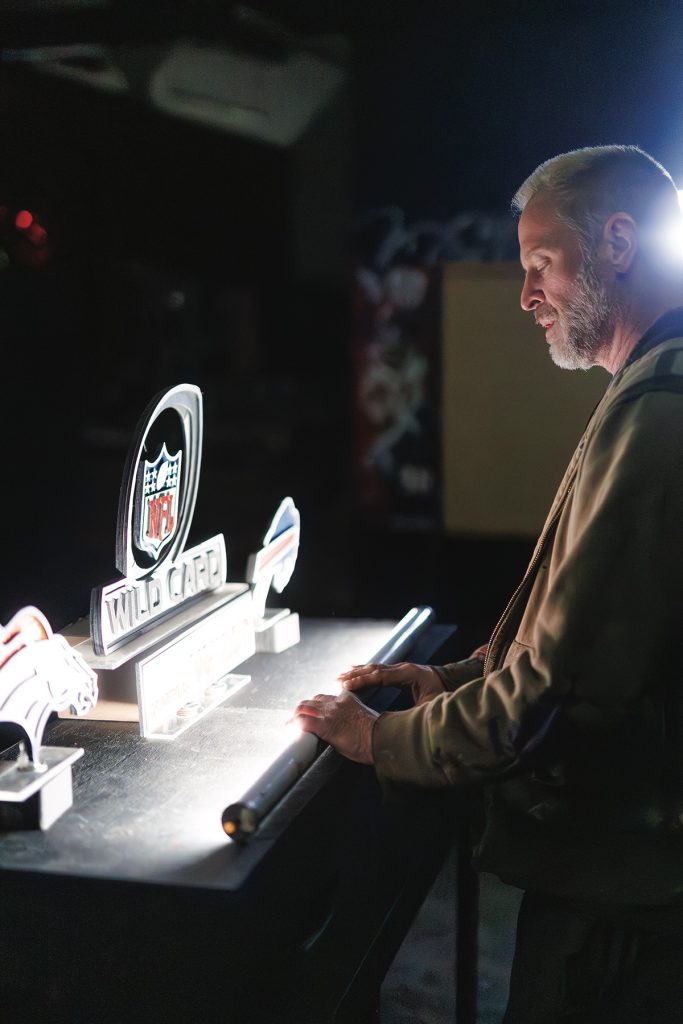
For the last decade and more, you could find Hastings and, as Elliott Gould says in Ocean’s Eleven, “a crew as nuts as you,” pulling all-nighters in a string of warehouses in Southern Pines creating backdrops for The NFL Today show on CBS. With apologies to The Jetsons, covering live sporting events requires something akin to a steamer trunk full of Spacely sprockets and Cogswell cogs. If football is the ultimate team sport, televising it is the ultimate team undertaking. There are directors and audio engineers and replay operators and graphics coordinators and researchers and electrical engineers and camera operators and talking heads and on and on and on.

What Hastings, who’s had a hand in winning three Emmys (two at ABC, one at HBO), and his volunteer crew did was manufacture “feel.” The gritty artwork of their backgrounds gave the pre-game interviews a unifying and distinguishable look achieved because it was done by hand and not by computer. “It was like the glue sprinkled through the show, an aesthetic thread that would kind of tie it together,” says Hastings. “Subconsciously for most people.” It was also more expensive than a graphics app and, in a time when network TV doesn’t reign as supreme as it once did, something of a luxury.

Though “luxury” is hardly the word for the work. The deadline for the finished product was 10 a.m. on Saturday morning. Once Hastings got the subject matter and bullet points from New York, usually on a Wednesday, implementation was up to him. He had a three-day turnaround, soup to nuts. The core group of Moore County helpers included Patrick Phillips, his wife, Jen, Matt Greiner and Karen Snyder. They worked construction, painted sets and backdrops, built a dolly system with — if you can believe it — roller blade wheels, made sunrise runs to Bojangles, helped with bookkeeping, picked up overnighted packages of photos, and pretty much did everything and anything to help a friend out.

“I figured I could come in and help Derek with whatever he might not be able to do physically,” says Patrick Phillips. “If I saw that his alarm was going off for medications, I’d let him know. If he was starting to feel uncomfortable, or get bad, I’d try to make sure he’d eaten. Anything he needed, really. My mentality was, I wanted to give him more longevity.”

Hastings grew up in Miami, the son of two artists who, though divorced, both ended up living in Pinehurst. His father, Lynn Courtlandt Hastings, who passed away in the fall of 2014, was an interior designer, but his printworks are in the collections of both the Smithsonian American Art Museum and the Art Institute of Chicago. His mother, Sandra, who also suffers from Parkinson’s, has won prizes for her ceramics in Arts Council of Moore County competitions at the Campbell House. “I really didn’t have a shot at doing a 9-to-5 banker’s job,” says Hastings.

In something of a misdirection, Hastings went north from south Florida to attend college at Michigan State University, where his major was a smorgasbord of theater, communications, English, film studies and art history. “Which meant unemployment,” he says. While he was at MSU, however, he latched onto half a dozen jobs with ABC as a runner for college football games. Post graduation, he did a stint as a lobbyist’s aide, then moved to L.A. to be an actor.

“I lived in a closet above Arnold Schwarzenegger’s restaurant,” he says, but quickly wound up back in Michigan, out of work and sleeping on a friend’s couch. He reached out to ABC and began going anywhere and everywhere they needed someone. Horse races in Kentucky. Time trials in Indianapolis. The odometer on his leased Mustang recorded miles from Maine to Miami.

“I found out that they had one position in New York that they hired every year from the pool of runners. At the time ABC sports was the global sports leader. They were everywhere. I’m like, I’m going to get that spot,” says Hastings. He did.

Bob Toms, an ABC exec, recognized Hastings’ artistic skills and took him under his wing. Hastings quickly achieved launch velocity. He got his first associate producer contract at 27, bumped up to producer in 1999 when he was honored for design and art direction for the opening graphics of the “Showdown at Sherwood” with David Duval and Tiger Woods, followed by more accolades for work on Super Bowl XXXIV between the St. Louis Rams and Tennessee Titans in 2000. Hastings left ABC to work for Tupelo Honey Productions until the 9/11 terrorist attacks brought its business to a sudden halt, launching him into the freelance world.

Six years later Hastings won another Emmy as a field producer for HBO Sports’ 24/7 Mayweather/De La Hoya. “I spent six weeks in Puerto Rico with Oscar, planning the days, what we were going to shoot,” says Hastings. “That was kind of the pinnacle of me doing that stuff.”

Though Hastings didn’t receive formal credit on ESPN’s award-winning 30 for 30 series production Run Ricky Run, he was instrumental in getting it made. The show’s writer and director, Sean Pamphilon, spent six years shooting the documentary on Miami Dolphins running back Ricky Williams. Pamphilon and Hastings are something of kindred spirits. “It was like we were rainbow fish who saw each other in this sea of sameness,” says Pamphilon. “He helped me do the sizzle reel for Run Ricky Run. We were both broke. We edited it in a trailer park near Santa Cruz, California. It was like The Odd Couple.”

They put together 20 minutes that was so compelling ESPN was hooked before it finished. Run Ricky Run remains the only one of the series shot in cinema verité. “I don’t get that deal if it’s not for Derek,” says Pamphilon.

After Lynn Hastings moved to Pinehurst from Miami in 1990, Derek was a regular visitor. He met and married Rachael Wirtz, who worked for his father. Now divorced, the couple have two daughters, Reade and Elizabeth. It was his daughters who took Hastings off the road in 2011.

“I told myself I wasn’t going to miss another Christmas with my kids,” says Hastings. “I bought this beat-up car and drove all the way back from California. Ended up living in Anthony Parks’ pool house for about nine months.”

There remained the minor hurdle of making a living in a small Southern town when your day job involved working on location with NFL athletes and franchises in 32 cities across the country. Like the players themselves, Hastings got there via the draft.

“We did stuff for NFL Network that kind of got my friend at CBS interested,” says Hastings. The friend at CBS is Drew Kaliski, who was named the producer of The NFL Today (among many other credits) in 2013. “We did all these backgrounds for the NFL Combine. We called it ‘First Draft.’ It was a series of short features on the top 50 players. We’d create these sets, and the players would come up, and I would direct them.” Kaliski thought Hastings could bring a similar feel to their Sunday show interviews.

Hastings’ link at the NFL Network, where he contributed freelance jobs from 2013-20, was Brian Lockhart, another one-time upandcomer at ABC, who today is ESPN’s senior vice-president in charge of all original content. “My first time getting a chance to work with Derek was around 1997-98,” Lockhart says. “I would see the things he was doing, and I would be like, how does that guy do that? I remember being on his heels, trying to soak up all the knowledge he had. Derek was the first person in this business who said to me, ‘Man, you could be really good at this. Trust your instincts.’ He was so generous with his feedback and his encouragement. He was an inspiration then and remains an inspiration to this day.”

The first “studio” Hastings cobbled together in Southern Pines was an open space in a storage building. He worked by the headlights of his car. “I had to call AAA like three or four weeks in a row when my car battery died at 3:30 in the morning. Sometimes friends would come by and give me a jump,” says Hastings. “I think we did six or seven weeks in there.”

In the early going Hastings and members of the merry band built the backgrounds, broke them down, drove to the relevant city and put them back together again. Then, one week in season two, it snowed in Green Bay and a flight got canceled.

“I told my boss I thought I could get some camera gear quickly,” says Hastings, who now uses a broadcast-quality Canon C-300 and multiple lenses rented from a place in Cincinnati. “We built a couple of sets on the fly, shot them and got it up to New York, and they loved it.” No more trips to Green Bay, or anyplace else.

While the backgrounds were becoming more complex and the warehouse space more expansive, Hastings’ health was deteriorating. The tremors began nine years ago, and it was five years before his Parkinson’s was diagnosed. If not for the help of his crew, the work of the last few seasons would have been impossible. At the conclusion of last year’s Super Bowl, they shared a Champagne toast.

“This year felt a little different,” says Hastings. “It felt like closing time. We could just kind of see the writing on the wall.” CBS, recently acquired by Paramount Skydance, didn’t renew Hastings’ contract for a 12th season.

His mother’s Parkinson’s has descended into dementia, and Hastings is looking for a care facility for her near where he now lives in Wake Forest. In the meantime, he shuttles to and from Southern Pines to see her and his cohorts.

His brain surgery has no positive effect on the progression of his disease. It’s a quality-of-life issue and a lifeline, he hopes, tethered to the business he’s spent 26 years doing. He’s had the Super Bowl trophy in his hands at least 15 times. He’s had the run of the NFL Hall of Fame in Canton, Ohio, after dark. He brought his disc golf movie, Chains — along with some of the best disc golf players on the planet — to the Sunrise Theater. He was on the goal line at the Super Bowl in 2010, eye to eye with Anthony Hargrove, the subject of the NFL Network piece “Sinner to Saint” that he helped produce, as the defensive end celebrated. “I have so many things to be grateful for. This business has been amazing,” he says.

Field producing was always Hastings’ wheelhouse. “My kids are grown now. I can travel again,” he says. Deep brain stimulation, he hopes, was the boarding pass. The great unknowable is whether his professional connections and resume will be enough to overcome the stark reality of his Parkinson’s.

“I don’t know what’s next. I really don’t,” says Hastings.

“Myself and Derek, you can never count us out,” says Pamphilon. “I hope the surgery gives him the dexterity and the comfort that he needs to be able to do his job at the highest level, not just because of his capacity to earn but because it feeds your soul. When you have the ability to do something you know no one else can do, that will keep you going. That will bring the sun up for you.” 

Golftown Journal

GOLFTOWN JOURNAL

Doctor of Sport

Mind games with Bob Rotella

By Lee Pace

It’s not often you get an audience with a man who invented an entire industry.

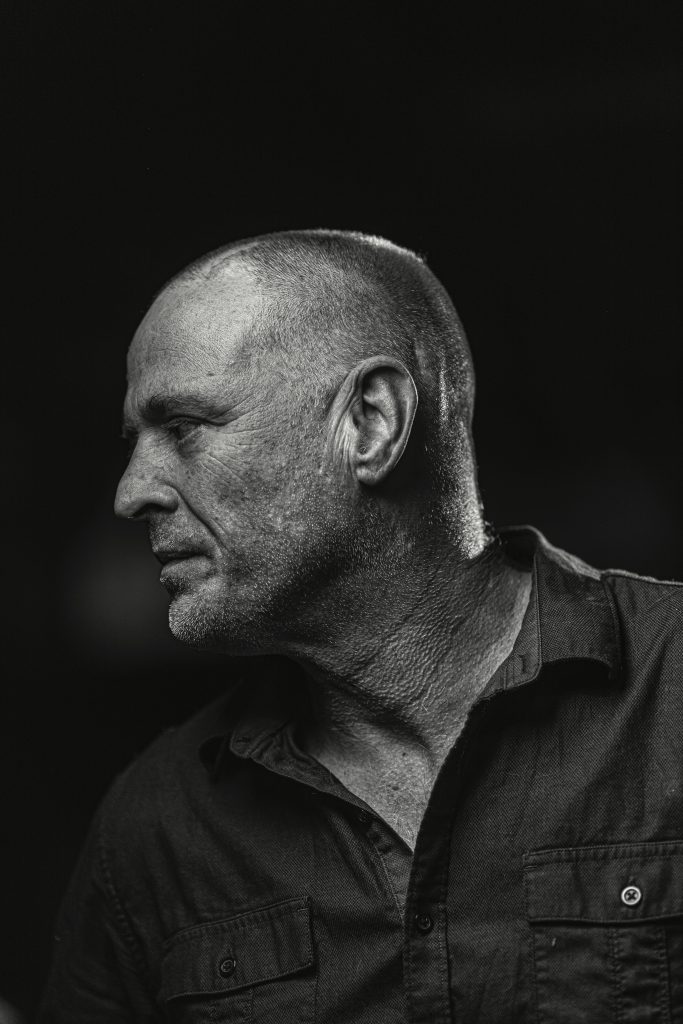
But here on a June afternoon is Bob Rotella — 79 years old, sharp as a tack and fit as a fiddle — rummaging around his basement sports psychology laboratory outside Charlottesville, Virginia.

There are three rooms in his home in the Club at Glenmore community east of town where he has welcomed the likes of Rory McIlroy, Padraig Harrington, Tom Kite, Davis Love III and John Calipari for overnight visits to explore the art and science of the body and the mind in the field of competition. One room is a bedroom. Another is a workout facility. Then there is a “great room” of sorts with mirrors on the walls, a putting carpet and all manner of decorations, from a signed photo from Ben Hogan to a Claret Jug given to Rotella by Harrington after one of Harrington’s two Open Championship victories.

And of course, a couch. What shrink doesn’t have a couch?

“I love competing and playing,” says Rotella, a lifelong athlete and former college basketball and lacrosse player, “but I like helping people’s dreams come true more than anything. That’s pretty much what I do. I try to find something inside an athlete they never knew was there. I mean, I’ve had a lot of fun.”

My assignment to write and publish a coffee table book celebrating the impending centennial of Farmington Country Club (est. 1927) just west of Charlottesville has brought me to Rotella, who used his Farmington membership in the 1970s and ’80s as kind of a research lab to develop theory and practice on how the mind affects sports performance. Old-time members recall the sight of a young Rotella armed with pen and notebook interviewing golfers after matches to probe the depths of how their minds functioned with some hardware on the line.

Growing up in Rutland, Vermont, Rotella was a quarterback and safety in football, and played basketball and lacrosse at Castleton University. He wanted his life’s calling to be in teaching and coaching but over time began to ponder why it was, for example, he and his coaching mates would spend hours ruminating about how to get a player to take his sterling practice skills into the heat of competition and how to get a player to not let a mistake in the first quarter infect his performance the rest of the game.

“The people who were doing psychology with athletes in the early ’70s were all psychiatrists working with drug problems or serious clinical problems,” Rotella says. “I started thinking about it from a coaching perspective and performance enhancement. Some of the stuff these psychiatrists were writing, I thought, ‘What in the hell are they talking about?’”

In 1976, he moved to Charlottesville and joined the faculty at the University of Virginia to teach sports psychology and coach lacrosse. Soon after he got an offer for a tenure-track position that would include starting masters and doctoral programs in sports psychology and working directly with Cavalier athletic teams. He did that for 20 years and in 1996 left to devote full time to his sports psychology practice.

As of mid-2025, he had clients in golf who have won more than 80 major championships and was pegged by Golf Digest among the top 10 golf instructors of the 20th century. He’s ventured off the golf course for relationships with Red Auerbach, Greg Maddux, Tom Brady and Serena Williams, among many others. His work in the 1970s and into the ’80s was the domino that fell and led to a landscape in 2025 that has nearly every professional sports team having a “sports performance” or “sports psychology” consultant on the payroll.

“I took a few things that worked for me in competition and recognized how important the mind is in all forms of competition,” he says. “I got lucky and made a career out of it.”

Rotella has authored a half-dozen books, including his bestseller Golf Is Not a Game of Perfect. The one with most relevance for many golfers in the Sandhills entering turn four of life (present company included) is The Unstoppable Golfer — Trusting Your Mind & Your Short Game to Achieve Greatness. The premise of the book is that as golfers age and lose physical strength, they still have the ability to embrace their mental resources and develop their skills in getting up-and-down from 100 yards in. The short game, he says, is the path to “unstoppable golf.”

“To win this battle with yourself, you must have a good short game,” he writes. “Few of us can  blast the ball 300 yards off the tee. But nearly all golfers have the physical ability required to pitch the ball, to chip it, to putt it.”

This focus on sharp execution of pitching, chipping and putting is nothing new. Players with great short games “should be the cockiest players on the planet” wrote the great English champion Harry Vardon in the early 1900s. “You won’t fulfill your potential as a golfer unless you embrace your short game, love your short game, take pride in your short game, and stop wishing you had someone else’s long swing.”

Unstoppable Golf provides a hard reset of a golfer’s approach to the game. Part of it is mental and developing the ability to believe you have a lethal short game. That comes through practice repetition and taking your skills to the golf course and executing shots under pressure.

“You are what you have thought of yourself, and you will become what you think of yourself from this moment forward,” Rotella says. “Your brain is a faithful servant.”

He hammers hard the human tendency to dwell on the negative, to carry the memory of that chunky 45-yard wedge shot well down the road but dismiss the time you executed a perfect bunker save to break 80.

“I talk a lot about getting people to have an instant amnesia of their mistakes but a long-term memory of their good shots and putts,” Rotella says. “Most people have a tendency to attach strong emotions to their bad stuff and have no emotion attached to the good stuff.”

Rotella’s wisdom applies to all golfers but makes most sense to the senior cabal. An hour to practice? Devote at least half that time, if not more, to the short game area. Take a lesson with your pro around the chipping green, not the full swing turf. Take that $600 you’d spend on a new driver and instead get a set of custom-fitted wedges.

“No matter what level a golfer plays at, the majority of his shots will be within 100 yards of the hole,” Rotella says. “The easiest way to take five to 15 shots off the average player’s handicap is by taking fewer shots around the green.”

Rotella offers the very same advice to a 15-handicapper playing in the club championship that he’d offer to McIlroy or Harrington on the final day of a major championship: Stay focused on your target, visualize the shot, commit to routine, and accept completely whatever happens to the golf ball.

“A lot of people have a dream, and then they’re scared to death they’re not going to get it,” he says. “I really want everyone to see the shot they want, so I want their eyes and their mind to be into where they want the ball to go rather than where they don’t want it to go. It’s really no different from a tour player to a 25-handicapper.”

I’m sold. No more signing up for demo days at the club in lustful pursuit of a driver that might add five yards. Let’s hit 25 pitch shots each from 20, 40 and 60 yards and then climb in the bunker. Do that, Rotella says, and you can evolve into the kind of golfer he pegs as “the silent assassin.”

That has a nice ring, for sure.

Tea Leaf Astrologer

TEA LEAF ASTROLOGER

Scorpio

(October 23 – November 21)

There’s a fine — and in your case, blurred — line between passionate and possessive. When Venus struts into Scorpio on Nov. 6 (where she’ll glamp out until month’s end), that line is primed to become a short leash if left unchecked — and nobody wants to be on the other end of that. A word of advice: Don’t smother the fire. Tempted as you may be to cling fast and tight, a little space will keep the coals glowing red hot.

Tea leaf “fortunes” for the rest of you:

Sagittarius (November 22 – December 21)

Stick to the recipe.

Capricorn (December 22 – January 19)

Pack a lint roller.

Aquarius (January 20 – February 18)

Thaw before cooking.

Pisces (February 19 – March 20)

Don’t overwork the potatoes.

Aries (March 21 – April 19) 

The shortcut won’t be worth it.

Taurus (April 20 – May 20)

Go easy on the garlic.

Gemini (May 21 – June 20)

Cling wrap, baby.

Cancer (June 21 – July 22)

The dishes are piling up again.

Leo (July 23 – August 22)

Shake the rug, darling.

Virgo (August 23 – September 22)

Dare you to bust out the fine china.

Libra (September 23 – October 22)

Serve yourself an extra slice of grace.

NC Surround Sound

NC SURROUND SOUND

Sounds of a City

Music with a connection to place

By Tom Maxwell

Alex Maiolo is a creature of pure energy. It’s not that he talks fast or acts nervous — he’s simply an ongoing conversation about electronic music, geography and whatever else happens to capture his interest. He’s also a singular kind of globetrotter, one who doesn’t sound pretentious about it. He loves Estonia’s capital, Tallinn, so much he made music with the place, a 2021 conceptual performance he called Themes for Great Cities.

Conceived as one of his two main pandemic projects — the other was getting better at making pizza — the musical idea took on a life of its own even as the flatbread faded. He invited Danish musician Jonas Bjerre, Estonian guitarist and composer Erki Pärnoja and multi-instrumentalist Jonas Kaarnamets to collaborate. What resulted was something that felt improvised, unpredictable and exhilarating.

“Even though I was living in Chapel Hill, I was trying to think about, well, what do you miss when you miss a city?” he says.

The obvious things — favorite restaurants, familiar streets — were only part of it. Beneath that, Maiolo sensed a deeper, subconscious connection to place that might be expressed musically. He seized upon the idea of treating the city itself as a collaborator. “I wanted to write a love letter to this incredible city by gathering elements of it and assembling them in a new way,” he says. Sounds and light readings became voltages; voltages became notes. “Every synthesizer is just based on the assemblage of voltages,” Maiolo says. “So, if you have voltages — particularly between negative five and plus five volts — you can make music.”

The group collected source material across Tallinn: gulls shrieking overhead, rainwater rushing down a gutter, chatter in a market, the squeak of trams, cafeteria trays clattering at ERR (Estonia’s equivalent of the BBC). A custom-built light meter called the Mõistatus Vooluringid — “mystery circuit” — captured flickering light and converted it into voltages. These inputs were then quantized, filtered and transformed into sound. Tallinn became what Maiolo called “our fifth band member. And just like with any band member, you can say, ‘Hey, that was a terrible idea’ or ‘way to go, city — that was a good one.’”

From the outset, the goal was to create something that felt alive. “We wanted happy accidents,” Maiolo says. “Quite frankly, I wanted to be in a situation where something could go wrong.” Unlike a pre-programmed, pre-recorded synthesizer session, Themes for Great Cities was designed to court risk through completely live and mostly improvised performance — to create the same adrenaline rush that test pilots might feel, only with much lower stakes. “No one was going to crash,” Maiolo says.

That philosophy made the project’s debut even more dramatic. Originally slated for a 250-seat guild hall built in the 1500s, the show was suddenly moved to Kultuurikatel, a former power plant that holds a thousand. Then came another surprise: The performance would be broadcast live on Estonian national television, with the nation’s president in attendance. “It was far beyond anything I had imagined,” Maiolo admits. “I thought we were going to play to 30 people in a room.”

Visuals by Alyona Malcam Magdy, unseen by the musicians until the night of the show, added a surreal dimension. Estonian engineers captured the performance in pristine quality. “It all came together,” Maiolo says. “The guys I was doing this with are total pros.” The recording was later mixed and pressed to recycled vinyl at Citizen Vinyl in Asheville. Unable to afford astronomical mailing expenses, Maiolo split 150 LPs between Estonia and the United States, carrying them in his luggage.

Though imagined as a one-off, Themes for Great Cities continued to evolve. The group returned to Estonia in 2022 for a new performance in Narva, reworking parts of the score and staging it in a former Soviet theater. “We didn’t record that one because it was similar to the first. But when we do Reykjavik, we’ll record that one and hopefully release it,” he says. Yes, Iceland looks like the next destination. The plan is to work partly in the city and partly in the countryside, where light, landscape and weather can all feed into the music.

The ensemble has grown tighter, but Maiolo emphasizes the lineup will be flexible, with an eye toward incorporating local musicians. Vocals may be added in future versions, perhaps improvised or even converted into voltages to manipulate the electronics. “Anything is possible,” he says.

Though he now lives in San Francisco, Maiolo continues to think of North Carolina as part of his creative geography. He still has his house in Chapel Hill, stays connected to Asheville’s Citizen Vinyl, and carries his records home through RDU.

Maiolo and his partner of seven years, Charlotte, are to be married in Saint-Germain-des-Prés in Paris. Her father, a German who came of age during World War II, once spent a year in San Francisco immersing himself in jazz. Even now, as he struggles with dementia, he plays clarinet and listens to Fats Waller and Oscar Peterson. The sense of music as a lifelong companion, capable of anchoring memory and identity, is yet another thread running through Maiolo’s work.

Ultimately, what began as an experiment has become an ongoing series of collaborations. Each city brings its own textures, rhythms and surprises. Each performance is both a portrait and a partnership. “At the end of the day, it just kind of sounds like music,” Maiolo says nonchalantly, as if jamming with an entire city is an everyday thing.

PinePitch November 2025

PINEPITCH

November 2025

Swifties Unite

Get November off to a Swift start with “Are You Ready For It? A Taylor Experience” at 7 p.m. Saturday, Nov. 1, in BPAC’s Owens Auditorium, 3395 Airport Road, Pinehurst. A national touring Taylor Swift tribute band recreates the pop star’s Eras Tour complete with a live band, performances from every era, all the costume changes, multi-media and audience participation. Will Travis Kelce be there? (We don’t think so because the Chiefs are playing the Bills in Buffalo the next day.) For information or tickets go to www.ticketmesandhills.com.

Classical Concert Series

The Arts Council’s Classical Concert Series hosts pianist Miki Sawada, who has performed at Carnegie Hall, the Toronto Music Festival, the Banff Centre, and with the North Mississippi Symphony Orchestra and Portland Columbia Symphony. She founded the “Gather Hear Tour,” traveling with a piano in a rented van with a mission to connect with Americans across socioeconomic and political divides. “Gather Hear” has given over 90 free performances in seven states and is currently touring North Carolina. The concert, from 7:30 p.m. to 9 p.m. on Monday, Nov. 3, at the Sunrise Theater, 250 N.W. Broad St., Southern Pines, also features Christopher Thompson, a performer-composer who merges contemporary art music, jazz, percussion and notated rap. For information go to www.ticketmesandhills.com.

Open for Art

Meet the members of the Artists League of the Sandhills at the opening reception for its fall exhibit and sale on Friday, Nov. 7, from 5 p.m. to 7 p.m., at 129 Exchange St., Aberdeen. The sale continues on Saturday from 11 a.m. to 3 p.m. For more information go to www.artistleague.org. A few miles up U.S. 1, the Arts Council of Moore County will hold the opening reception for its show “Framing Form” at the Campbell House, 482 E. Connecticut Ave., Southern Pines, from 6 p.m. to 8 p.m., also on Friday, Nov. 7. Call (910) 692-2787 or go to www.mooreart.org for additional information. Both exhibits hang until deep into December.

Stand Up Straight and Salute

The annual Veterans Day Parade is Saturday, Nov. 8, from 10 a.m. to 2 p.m., on Broad Street in Southern Pines. Bring the whole family, wave, applaud and be grateful. If you are a veteran, join the parade and let us honor you. For information call (910) 692-7376 or go to www.sandhillsveteransfestival.com.

Turkey Trot

Make room in advance for those Thanksgiving pounds with a run through the streets and neighborhoods of the village of Pinehurst on Saturday, Nov. 22. There will be a 5K run and a Little Gobbler 1-mile fun run. Races begin at the Village Arboretum, 375 Magnolia Road, Pinehurst. For more information visit www.vopnc.org.

The Last First

Shed a tear and party on at the last First Friday of the 2025 season when Joslyn & the Sweet Compression brings its magical mix of funk and soul to the greenspace beside the Sunrise Theater, 250 N.W. Broad St., Southern Pines, on Friday, Nov. 7. The free-for-all show begins at 5 p.m. and closes down at 9. Y’all know the drill by heart but, just in case, no pets larger than a palmetto bug — and it has to be on a leash — and no outside alcohol. If you need more info go to www.sunrisetheater.com.

Let There Be Light

The Southern Pines tree lighting celebration begins at 4:30 p.m. on Saturday, Nov. 29 in the downtown park. Lighted trees line the streets and Santa can’t be too far away. He’s even available for pics if you have your own camera. What’s a camera you ask? It’s an app on your cell phone. If you need more information about Christmas tree lights or Santa Claus, feel free to call (910) 692-7376.

Author, Author, Author, Author, Author

Lily King discusses her new novel, Heart the Lover, at the Country Club of North Carolina, 1600 Morganton Road, Pinehurst, beginning at 2 p.m. on Sunday, Nov. 9. On Monday, Nov. 10, there’s a book launch for Katrina Denza’s new short story collection, Burner and Other Stories, at 6 p.m., at the Weymouth Center for the Arts & Humanities, 555 E. Connecticut Ave., Southern Pines. On Tuesday, Nov. 18, Libby Buck talks about her debut novel, Port Anna, at The Country Bookshop, 140 N.W. Broad St., Southern Pines. Pace Yourself Run Company and The Country Bookshop will partner for a meet-the-author event with Jared Beasley discussing his new book, The Endurance Artist, on Friday, Nov. 21, at 6 p.m. at the bookshop. Last but not least, Livia and Maya Benson will be at The Country Bookshop at 2 p.m. on Sunday, Nov. 30, to talk about their cookbook Cookies Every Day. For more info on all go to www.ticketmesandhills.com.