The Omnivorous Reader

Mastering the Monsters

A sci-fi novel for our surreal world

By Anne Blythe

If the past couple of years have proven anything, it’s to expect the unexpected.

We’ve battled a virus that has shown its ability to morph and shape-shift. Some people accepted it as real. Others chose not to believe.

The world imagined by Cadwell Turnbull, a creative writing professor at N.C. State University, in his latest work of fiction, No Gods, No Monsters, gives us a similar choice.

There are monsters, gods and humans living together and living apart throughout his book. They force readers to reconsider what is real and what is not, to look at others with a sense that they might be more like you than different — or more different than you know.

Introduced as the first in a trilogy, No Gods, No Monsters opens with a professor sitting at a restaurant in Cameron Village in Raleigh, saying goodbye to his friend Tanya, and his academic life. As Tanya sits across from him, he tells her he has decided to leave his job and go home to St. Thomas in the Virgin Islands (Turnbull’s childhood home), where the professor has unresolved issues over the death of his brother.

Initially, we don’t know the professor’s name or how he’s connected to the characters in the pages ahead. He drops in and out of chapters, sometimes interjecting a jarring and puzzling voice, leaving readers to wonder who he really is and how the many storylines that Turnbull is juggling will come together.

Along the way, we meet a wild variety of characters: bookstore workers who can turn into werewolves; a character named Dragon (a child who can sprout wings and fly); a senator from the Virgin Islands who can become a dog; an invisible sibling; a witch; and more. It’s not until the very end that we can see the novel’s worlds merging. Even then, much remains unanswered, leaving readers to wonder what the next book in the trilogy has in store.

“I’m going to tell you a story,” the narrator says. “And like so many stories, it begins with a body.”

That body belongs to Lincoln, a naked Black man, dead in the street, shot by police.

Laina, Lincoln’s sister, picks up the storytelling. We learn from her that Lincoln had been hooked on drugs and living on the streets, estranged from his family.

At first, it might seem as if this will be another story about an unarmed Black man being shot by police. While that theme pulses through the book, we quickly find out that this story is going to be different.

Suppressed bodycam footage surfaces, and with its release comes a tale of monsters, werewolves and gods on Earth and beyond.

Initially, Laina is in disbelief as she watches the bodycam footage of her brother’s shooting. It’s dark at first, difficult to make anything out. Then she hears the cop say, “I see it. It’s big.”

Then she sees the creature, too. It’s doglike, she says, but “bigger than doglike.” It snarls at the cop and he fires his gun. His target falls to the ground.

As residents from the houses along the street come out to see the aftermath of the shooting, the creature the cop saw lunging at him has become simply a naked man, left slain between two cars.

“I don’t understand,” the cop says.

The bodycam shows that Laina’s brother, at least for a moment, was a werewolf. Turnbull calls that moment “the Fracture.” It’s the instant when someone’s world opens to the realization that monsters are among them. Some people take notice. Others look away.

“Most people outgrew true belief in monsters by adulthood, but even adults knew not to go outside at night during a power outage, go past a certain house or respond to whispers in the dark,” the senator from St. Thomas tells us after we meet her in the Virgin Islands. “Monsters existed in the liminal space of half-belief and practical superstition. Even folks who claimed not to believe in God knew not to tempt devils. Superstition allowed a certain kind of freedom, allowed a certain kind of power.”

The arc of the story can be disjointed at times, adding a touch of mystery, as readers go on a spellbinding journey from North Carolina to Massachusetts to the U.S. Virgin Islands and places in between.

The characters are good and evil, lovable and at times abominable. We see humans transform into werewolves as they shed their clothes and go on four-legged runs in the woods, chasing squirrels and other small critters. We meet a woman who drinks the blood of her sister and can pull her skin off and on. Others lead mundane lives while battling monsters of their own.

Many of these characters eventually come together at a monster march, depicted as a kind of otherworldly Black Lives Matter rally when a large crowd marches through the Boston streets after Lincoln’s death, chanting, “No gods, no monsters!”

By using the sci-fi genre, Turnbull tempts his readers to explore tough and touchy topics such as drug addiction, police shootings, societal divisions and the monsters that can be created when neither side explores the motivation of the other.

Laina introduces us to Ridley, her asexual, transgender, anarchist husband who moved from Harrisonburg, Virginia, where his parents still live, to Massachusetts to open a co-op bookstore. We meet Rebecca, Laina’s girlfriend, who knew Lincoln, and Sarah, her housemate. Both Rebecca and Sarah have the ability to transform into sturdy-legged werewolves.

Throughout Turnbull’s book, we end up wondering whether monsters are people or people are monsters.

“You think monsters are dangerous? Or you think people who believe in them are? Which one? Both?” Sarah asks Ridley after he tells her he might not go to the monster march in Boston because he’s worried about the potential for violence.

“People need to be protected, too,” Ridley tells Sarah.

The book tugs and pulls its characters through inner wars as they deal with a fractured world around them and their own splintered lives. At one point, Ridley sees the Earth open up below a circle of glowing red ants while on a retreat at a collective peanut farm in Virginia. He tumbles into an abyss with monsters so jarring that he stays mum about his experience. What are the consequences of speaking out or the cost of staying silent?

Turnbull’s complex story takes readers across the surface of the Earth and into the many dimensions of the mind as his characters carom through a multitude of societies — some secret from long ago, some modern and seemingly ordinary but very destructive.

Even for people not typically drawn to sci-fi or fantasy novels, settling in with this story is well worth it.  PS

Anne Blythe has been a reporter in North Carolina for more than three decades. She has covered city halls, higher education, the courts, crime, hurricanes, ice storms, droughts, floods, college sports, health care and many wonderful characters who make this state such an interesting place.

Almanac

By Ashley Walshe

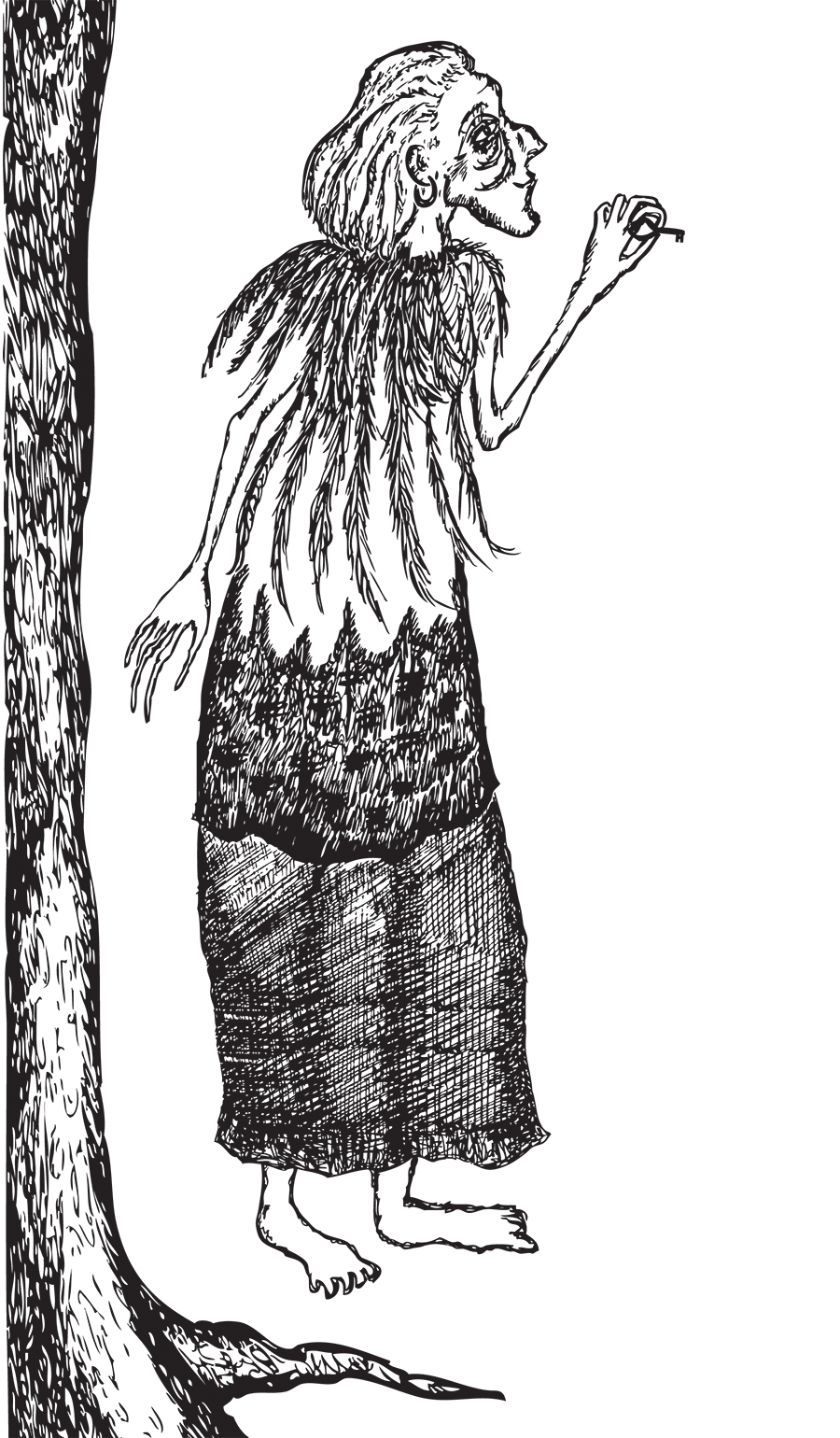
February is a creature from an ancient myth, a wise old woman, a mystical crone goddess. 

At first glance, she is homely, haggard and frightening. Her face is gaunt. Her garments, threadbare. Her skin like gray, crinkled paper.

There is nothing soft or warm or pleasant about her. Time and the elements stripped her of her beauty long ago. She lurks in the shadows, a bag of bones with sunken eyes, crooked fingers and limbs like wind-swept trees. Her icy breath swirls through the air like a ravenous arctic wolf. 

Few have dared to approach — let alone understand — her. Most avoid her like the plague.

She does not require your favor. And yet, should you dare to gaze upon her, she will offer a wisp of a smile. A mysterious light will shine from her deep-set eyes, and while she will not speak with words, you will hear her, clear as a bell in the night: follow me.

Into the darkness you’ll trudge, cold air burning like poison ivy, frozen earth crunching beneath your feet. Rows of naked trees reach toward a grim, abysmal sky, and you wonder how life could possibly grow in this barren landscape, this pregnant silence, this bitter womb of winter.

As she walks, the crone slips her wrinkled hand into her cloak pocket and withdraws a rusted skeleton key. At once it is clear: This is no forsaken beast. She is the chosen one: the gatekeeper between death and life, the end and the beginning, the black of night and the first blush of dawn.

You begin to notice what was already here: early crocuses bursting through the frosty soil; milky white snowdrops and fragrant wintersweet; a host of sunny jonquil. A great horned owl screams out.

The crone does not glow like a young maiden or a new mother. But as you softly gaze upon her, you see the grace of a soul who has witnessed many seasons — a wise one who knows that spring is ever on the silvery horizon. That the only way to it is through it.

Feed the Birds

It’s been a long winter for everybody — especially our winged friends. Feed the Birds Day is celebrated each year on February 3. If ever you’ve wondered where St. Francis of Assisi, patron saint of animals, came up with his “For it is in giving that we receive” line, consider that he’s often depicted with a bird in his hands.

You think winter will never end, and then, when you don’t expect it, when you have almost forgotten it, warmth comes and a different light. — Wendell Berry

Space and Time

According to EarthSky.org, one of the most anticipated sky scenes of 2022 happens 40 minutes before sunrise from February 11–16, when Venus, Mars and Mercury will all be visible in the darkest spell of morning.

Another scene not to be missed this month: The “Winter Hexagon,” a prominent group of stars comprised of Rigel (in Orion), Sirius (in Canis Major), Procyon (in Canis Minor), Aldebaran (in Taurus), Capella (in Auriga) and Pollux (in Gemini). Also called the “Winter Circle,” you can find this asterism by first looking for Orion’s brightest star, Rigel, the bluish star at the lower right (in other words, below the belt). From here, draw a line straight up to Aldebaran, then continue following the bright points counterclockwise until you complete the circle. 

Poem

Long Homestead in Winter

— Las Cruces, circa 1932

Not in any literal sense

a homestead: it was purchased

you learned from an old deed

sent you by a cousin. And in this

winter photo, strange with magic

of the never seen, a study in

whites and grays, foreground

trees and background barn shading

towards true black, porch windows

canvas covered against the cold,

original adobe brooding behind, just

one slender strand of air, smokey

warm you guess, rising from a single

flue suggests habitation, warmth

inside. No one living knows

its history now, when the barn

was built; porch facing pristine snow

now fades into surrounding silence. What

was the day like when someone, your

father perhaps, had hiked out the

back door around towards the railroad

track to capture the snow before it turned

to mud underfoot; foot sodden you suspect

later that morning when indoor

voices might have called to breakfast,

but leave your boots outside. All

gone wherever memories are stored —

you never saw the place in winter

but you slept many a summer night there

on that porch already mythical, heard the Santa Fe

hoot by, carry the present away.

  Julian Long

Julian Long is the author of Reading Evening Prayer in an Empty Church.

The Creators of N.C.

Salt of the Earth

Building a business together

By Wiley Cash    Photographs by Mallory Cash

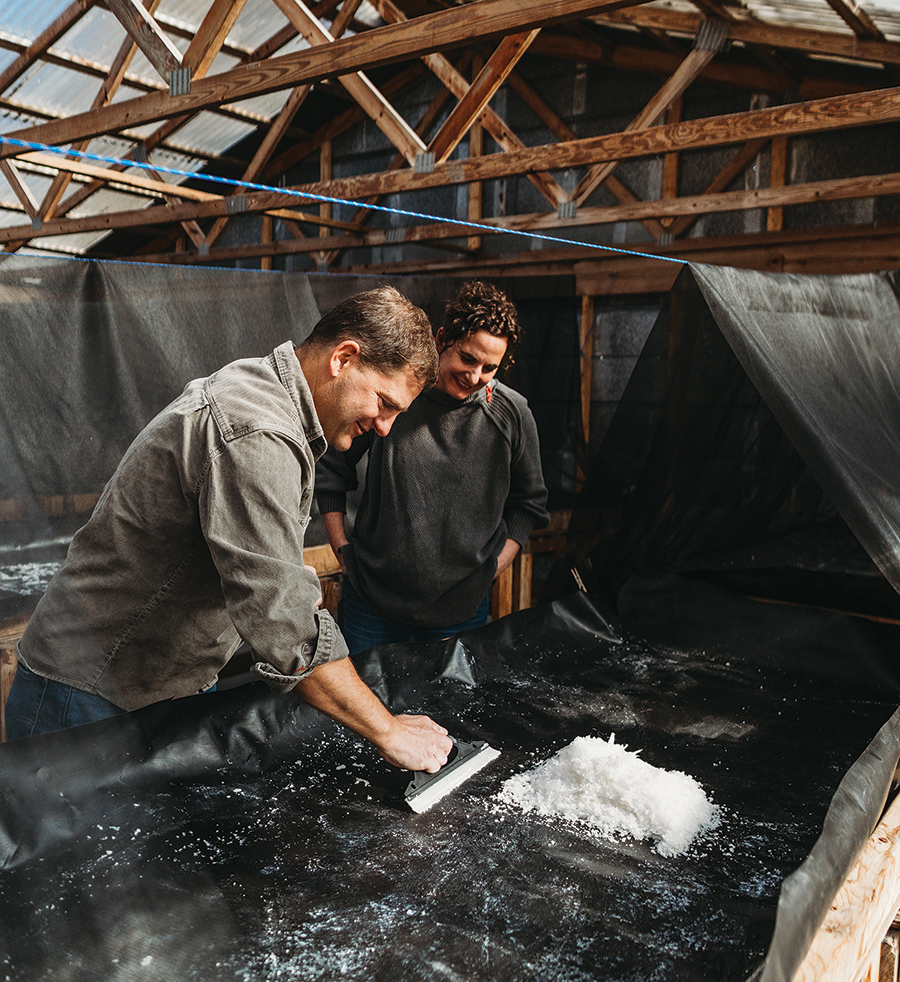
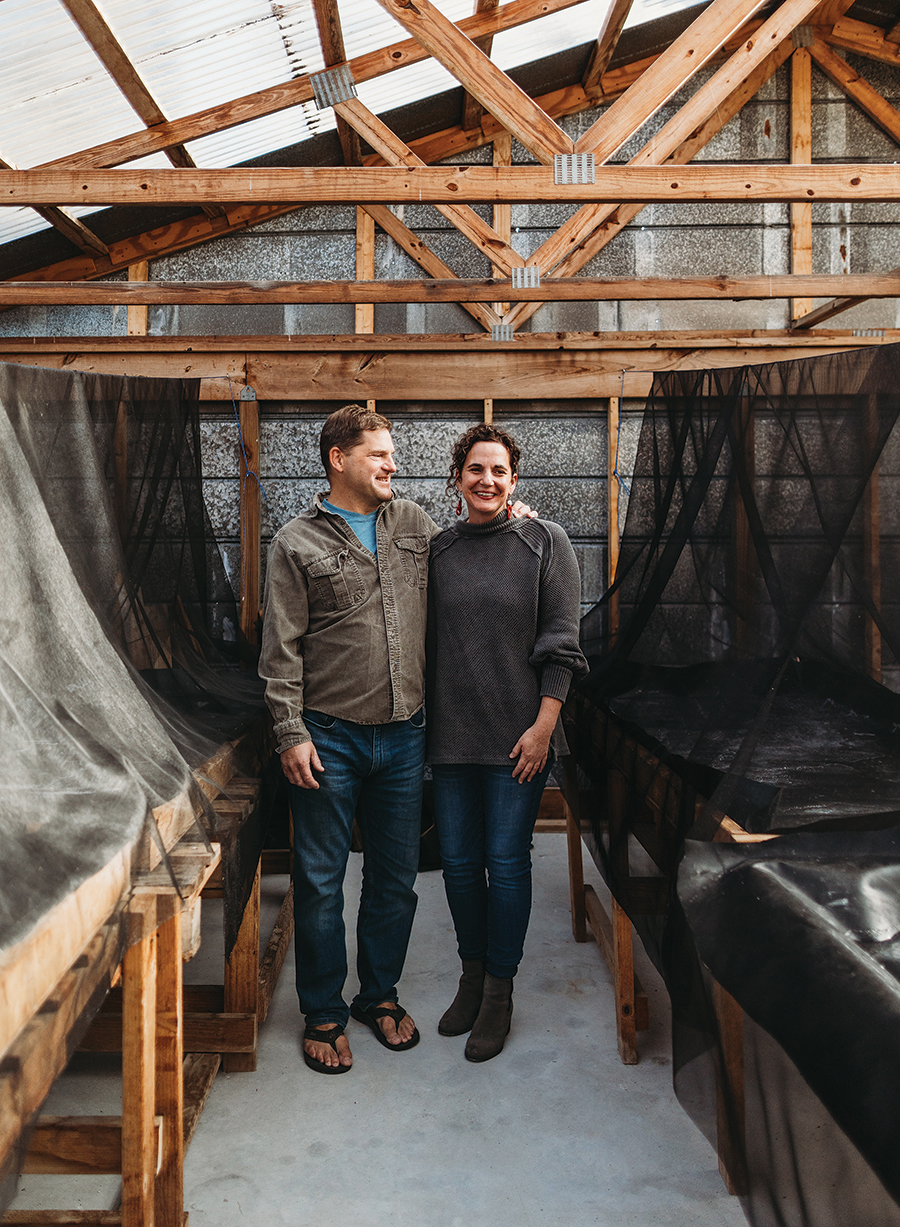
The interior of the building is warm and smells like the ocean. The walls and ceiling are constructed of white corrugated plastic sheets, all of them glowing beneath the bright noonday sun. Nets hang from the ceiling above tables that hold large wooden trays, their bottoms lined with thick, restaurant-grade plastic.

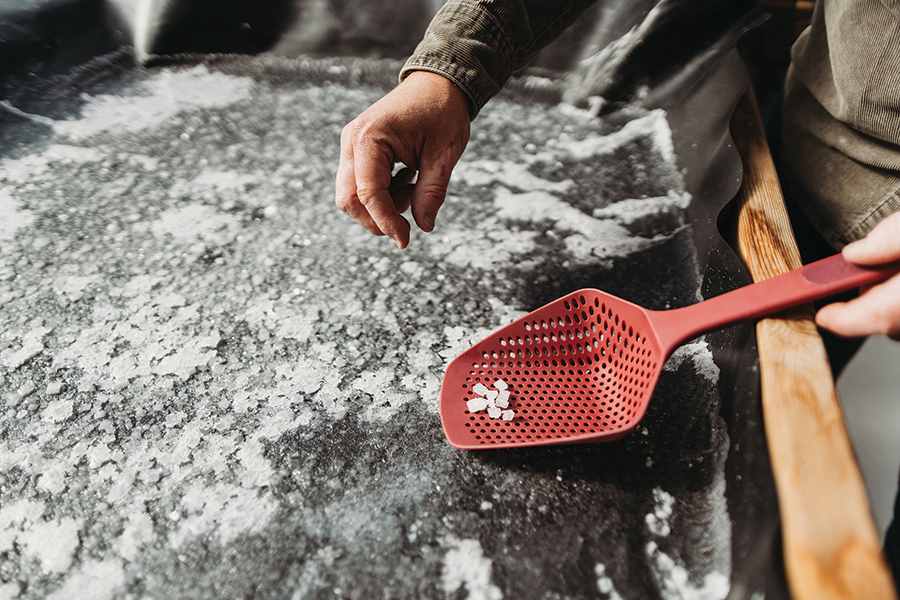
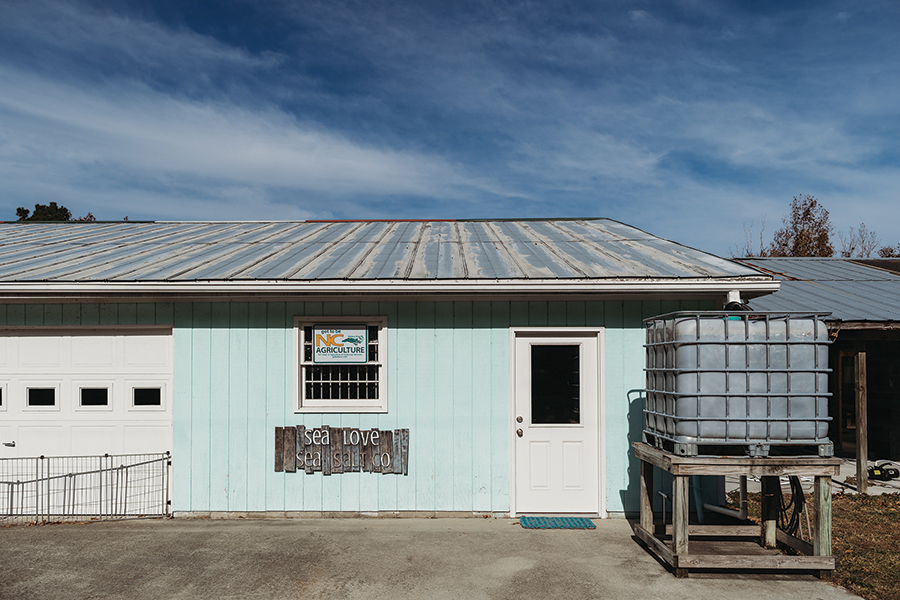
Jason Zombron looks down into one of the trays of white crystals that seem to have arranged themselves in haphazard patterns. If you stare long enough, it appears that the ocean is in each tray, dozens of tides frozen in time, doing their best to return to their previous form. After all, just a few days ago, this salt was floating somewhere in the Atlantic, but now it has made its way here to a piece of land in Burgaw, North Carolina, where Jason and his wife, Jeanette Philips, own and operate Sea Love Sea Salt.

Jason picks up a small shovel and scoops up a load of crystals, which have hardened into countless geometric shapes, from squares to pyramids. Jeanette stands nearby. “I never get tired of this,” she says, her voice quiet as if she’s whispering a prayer. “Every time I witness it happen, it takes my breath away. It sits here with the sun and the heat until it’s ready to be harvested. We’re not doing anything to make this happen.”

While heat and evaporation are the final steps in creating salt, Jeanette and Jason actually do a lot to make it happen before it gets to that point. The venture begins in Wrightsville Beach, where, in a process and at a location that Jason and Jeanette are wisely hesitant to disclose, water is extracted from the ocean and pumped into a 275-gallon tank on the back of a trailer. From there, the water is transported to rural Burgaw and the 3-acre farm that Jason and Jeanette own. The water is then pumped from the trailer to a second tank, where gravity takes over and the real work begins. Jason and Jeanette fill tray after tray with water, kinking the hose to stop the flow while arranging the full trays on tables throughout the salt house. The trays will sit in the heat however long it takes for the water to evaporate, leaving nothing but the salt behind.

The labor can be taxing, and that’s before the harvesting and the blending of salt with other ingredients even begins, but Jeanette and Jason delight in the work. After all, the chance to spend as much time together as possible is what led them to step into the business of making salt.

“Whatever business we set out on, it had to get us together,” Jason says. “That was the most important thing.”

“It feels great because we’re passionate about this,” Jeanette adds. “And it’s the first time we’ve gotten to do something creative together.”

The two met on a blind date in Asheville. At the time, Jeanette was working in public health, and Jason was in sales for an outdoor provisions company. They both traveled a lot, and they wanted to spend more time together. Jeanette’s sister lived in Seattle, and so the young couple set their wagons west. They made a life in the Northwest, forging successful careers and raising two young children, and they soon realized that they were both interested in food, the growing of it, the preparing of it, and, of course, the eating of it. They also began experimenting with various ways of using different kinds of salts in their cooking.

While they loved living in the Northwest, they began to feel hemmed in by their careers and schedules and missed the sense of community they’d felt in the South. Jeanette was born and raised in Decatur, Georgia, and Jason just outside of Washington, D.C.

“We wanted to live close to the water,” Jason says. When they moved to Wilmington a couple of years ago, they began to look for a shared business opportunity they could devote themselves to. They learned that Amanda Jacobs, the founder of Sea Love Sea Salt, was looking to sell her growing business. When they met with Amanda, Jeanette brought along a salt recipe she had developed back in Seattle. While there were other suitors who wanted to purchase the business, “No one else brought Amanda a salt,” Jeanette says.

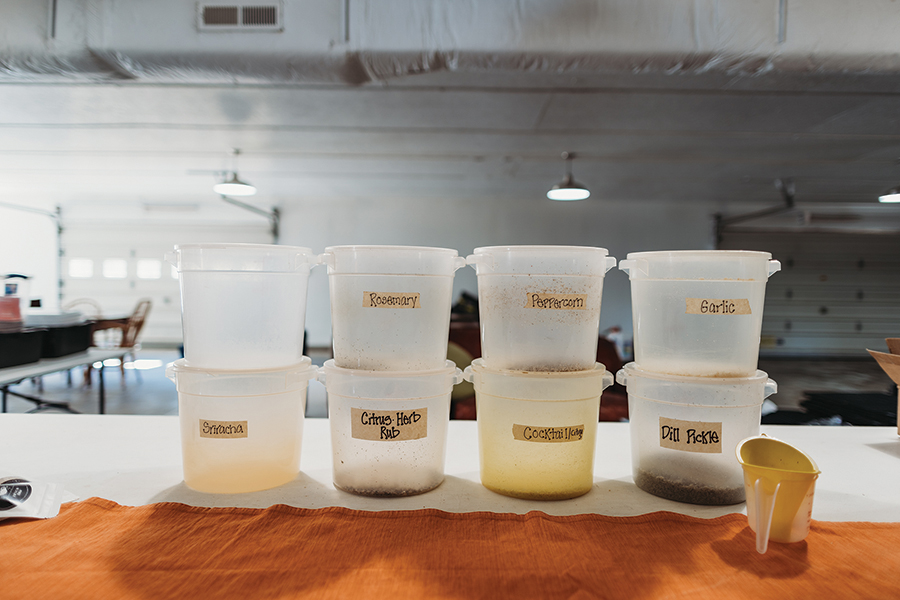
Since purchasing the company, Jeanette and Jason have worked to develop new salts to add to a lineup that already includes citrus, Sriracha, rosemary, dill pickle and others. Two flavors they brought with them from their experiences in Seattle are herb and fennel, and they regularly test various salts at local farmers   markets in Wilmington, tracking the responses of their customers. They also have a thriving connection with numerous local restaurants and breweries, most of whom pride themselves on sourcing local products, as do Jason and Jeanette. Almost all their salts are flavored with North Carolina-grown produce. 

Aside from developing new salts, Jeanette and Jason are planning to develop the land where the business sits. While it contains the salt house and a warehouse, they are building a hoop house to double their capacity — important during the winter, when the time it takes for water to evaporate goes from 10 days in the summer to as long as three weeks in the colder months, when days are shorter. They are planning to host farm-to-table meals featuring local chefs and artists, and are thinking of other creative ways to invite the community to this wooded, quiet piece of land.

Jason pours scoops of salt into fine mesh bags that he hangs from the ceiling, salt that could have begun on the other side of the world, now suspended from the rafters in rural North Carolina.

“People come here for the ocean,” he says. “This is giving them the chance to taste it.” PS

Wiley Cash is the Alumni Author-in-Residence at the University of North Carolina-Asheville. His new novel, When Ghosts Come Home, is available wherever books are sold.

PinePitch

Monument to Freedom

In 2021 ground was broken for the North Carolina Freedom Park in downtown Raleigh. Marsha Warren will speak on “Freedom Park: The Inspiring Story of How a Monument to Freedom is Built while Confederate Statures are Coming Down” on Sunday, Jan. 16, at the Weymouth Center for the Arts and Humanities, 555 E. Connecticut Ave., Southern Pines. Cost is $15 for Weymouth members and $20 for non-members. This is part one of a three-part lecture series. For more information go to www.weymouthcenter.org.

Swing Your Partner

The Carolina Pines Dance Club trips the light fantastic with swing, line, ballroom, shag and Latin dancing on Saturday, Jan. 15, at the National Athletic Village, 201 Air Tool Dr., Southern Pines. Lessons are available at 6:30 p.m.  The dancing goes until 9:30 p.m. Beginners, old hands, couples and singles are all welcome. Cost is $15. For information call (724) 816-1170. 

Tap Into This

The Sandhills Repertory Theatre presents “Jerry Herman on Broadway,” with amazing tap dancing — including a medley of hits from Hello, Dolly! and much more — at the Bradshaw Performing Arts Center, 3395 Airport Road, Pinehurst. Show dates are Jan. 9 at 2 p.m. and 6:30 p.m., and Jan. 10 at 1 p.m. Tickets are $35 for regular seating ($45 at the door) and $75 for VIP lounge seats. Students under 12 admitted free. For information and tickets go to www.ticketmeshandhills or www.sandhillsreporg.

Bluegrass Bonanza

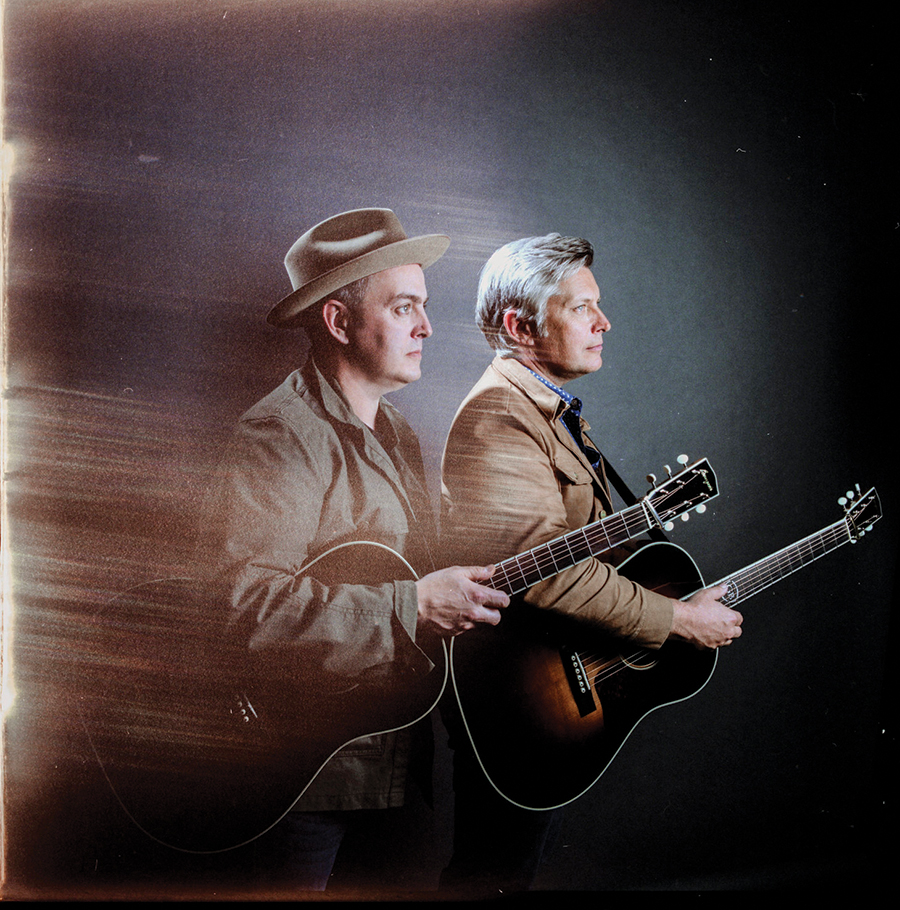
The Gibson Brothers, Leigh and Eric, perform with special guest Vickie Vaughn at 6:46 p.m. on Sunday, Jan. 2, at the Bradshaw Performing Arts Center, Owens Auditorium, 3395 Airport Road, Pinehurst. The brothers were named Entertainers of the Year by the International Bluegrass Music Association in 2012 and 2013. Tickets are $40-$45 and available at www.ticketmesandhills.com.

Warm Up Those Pipes

You can fight off the cold weather with a red-hot aria or two at the beginning and at the end of the month. The Sunrise Theater, 250 N.W. Broad St. in Southern Pines, will show the Met Opera performances of Cinderella at 1 p.m. on Saturday, Jan. 1, and Rigoletto at 1 p.m. on Saturday, Jan. 29. For more information visit www.sunrisetheater.com.

Southwords

Brrrrrrrrrr!

Freezing? Get used to it.

By Kate Smith

“Did you lose a bet?”

It was a little old lady out walking her dog. I’m in my bikini, wringing water out of my hair on the edge of a Whispering Pines lake. High on endorphins, I just laugh. “It’s good for me,” I say.

I’m not naturally hot-blooded. I don’t have the selkie genes — named for the seal folk of Norse mythology — we hear about in people who survive hours in glacial water. And I don’t have a high concentration of that metabolic unicorn, brown adipose tissue. In fact, I have a 97-degree average body temperature, am borderline anemic, and I hate the cold. But I’m trying to change that.

It started back in September. On gut instinct, I bought a used 9-foot longboard and taught myself how to surf. It was meditative medicine and nothing has kept me out of the water since. I don’t mind the rashes, skinned legs from wipeouts in broken seashells, sinuses raw with salt water, or bruises on my ribs. I’m not afraid of sharks, even after seeing one a few feet away on my second day in the water, and I’m not fazed by jellyfish stings or colliding with fishing lines. But as soon as winter hit, the cold has given me a run for my money.

I have Raynaud’s, an autoimmune condition that constricts the tiny blood vessels to my fingers and toes, making them go white and numb from cold exposure as insignificant as the produce aisle in the grocery store. Despite a full wetsuit with hood, gloves and boots, they still go numb, and it doesn’t take long before my dexterity nosedives, and then so do I. A lot.

Add to that the darkness of winter, and despite my best intentions, I’ve found myself huddled in my house for entire weekends, fatigued by the gloom and too cold to surf, the thing that helps the most. I hate the cold. But, really, I’m trying to change that.

I heard about this guy named Wim Hof. He climbed Mount Kilimanjaro in shorts and ran a half marathon above the Arctic Circle barefoot. I figured if this normal dude can train his body to thrive in the Arctic, I can certainly figure it out here in the South for the sake of getting back on my surfboard.

According to Wim, the process of cold adaptation is pretty simple. Do it, safely, until it doesn’t suck so much. The first time I waded into a cold lake, the water felt like razor blades. I dipped under, and came up with my heart pounding, muscles aching, and a little dizzy and disorientated. But when I got back to shore, the blood surged through my body, warming me completely, and brought with it a drug-like euphoria. So, I did it again. And every day since, it’s gotten easier. It’s still cold, but it’s not as painful, and it doesn’t take my breath away. In fact, it makes me feel almost invincible.

Turns out, that’s a normal reaction for cold-water swimmers. It’s evidence of something called cross adaptation. When your body adapts to the physical stressor of cold (or heat, or big changes in oxygen or pressure), you become more capable, physically and psychologically, to handle stressors outside your control. What doesn’t kill you really does make you stronger, and it might even bliss you out. Along with strengthening your immune system, cardiovascular system and metabolism, cold water adaptation floods your body with stress-relieving hormones. When you emerge from ice-cold water, your brain thinks you almost died, and it’s rewarding you for staying alive by making you feel positively giddy.

Swimming in cold lake water did indeed help my body rise to the physical challenge of winter surfing. Soon, I was back at it, albeit sporting one of the warmest wetsuits on the market. But cold water helped me rise to the challenge of my internal winter, too. Every time I surface from beneath and I see spring a little closer ahead, I get a shot of courage and hope.

If Mother Nature can’t stop me, nothing can.  PS

Kate Smith is the clinical herbalist and holistic health coach of Made Whole Herbs.

Hometown

The Suds Chronicles

When a cold one comes in downright handy

By Bill Fields

Some people abstain from alcohol during January, but I don’t think I will be one of them this year.

After getting a COVID-19 breakthrough infection in November and isolating at home for 10 days, one of my first stops upon recovering was for a beer in the tap room of my local — and excellent — craft brewery, Aspetuck Brew Lab. Along with the comfort of seeing familiar faces was the welcome taste of my favorite, Turbidity Lucidity, an American IPA.

The brewery says of TuLu that “this citrusy smooth, crushable IPA is capped off with a double dose of dry-hops and Simcoe and Mosaic lupulin power. Citrus-forward and crisp.” I just know that I like it.

The pleasure of that pint, the first I’d had in two weeks or so because I got sick, started me thinking about my beer life. It started with a sly (or so I thought) sampling of my father’s stash. I was 12, and Dad was in the hospital for a few days. While Mom visited him one evening, I built up the nerve to open one of the Budweisers on the bottom shelf of the refrigerator. So bitter and unappealing was the taste, I doubt if I consumed 2 ounces of the lager. I poured out the rest and put the empty in the outside trash can. I figured Dad wouldn’t notice there were now four cans in the fridge instead of five.

“I see you’ve been into my beer,” he said upon coming home.

“Didn’t like it,” I replied.

That would change in the ensuing years. I wasn’t much of an underage drinker — Dad being a police officer probably had something to do with that — but sure wouldn’t refuse an occasional beer from a friend when we left the Castle of Dreams disco on Tuesday teen night.

Upon turning 18 in 1977, a couple of friends and I were happy-hour regulars on Fridays at 21 Club on West New Hampshire Avenue in downtown Southern Pines. A cool, dimly lit place on a hot summer evening with $1.50 pitchers of Bud to pour into frosted mugs just about defined high living at that point in our lives.

Quantity trumped quality when it came to beer consumption during college in Chapel Hill, whether at Troll’s, Harrison’s or He’s Not Here. Only the place with the great name has survived the decades, but I’ll always remember a Friday afternoon journalism “class” at Harrison’s with the visiting journalist Tom Wicker. The North Carolina native, UNC graduate and New York Timesman held court for three Heinekens and lots of stories before excusing himself to attend another engagement.

I painfully had (way) more than three beers on a Saturday evening in 1985 in Cincinnati, prior to photographing the final round of the LPGA Championship the next day. Nancy Lopez won the tournament by a whopping eight strokes. My victory was making it through the hot afternoon despite a lethal hangover. It was a valuable lesson for the rest of my years on the golf tournament photography trail: all things in moderation, particularly on Saturday night.

I’ve had beers in the den of Curtis Strange, the first person I knew to have a keg in his home (being on the Michelob staff had its advantages, and there was no doubt he believed in the product). I drank a Rolling Rock on Arnold Palmer’s jet and went to a chicken-and-beer place (it’s a thing) with my South Korean hosts on a business trip there. Working at the Tokyo Olympics last year, our activities were restricted because of the pandemic. Fortunately, there was a 7-Eleven in our hotel complex that wasn’t off limits. A 7-Eleven in Japan is stocked with many items, including different kinds of beer, which wasn’t a bad thing to have on hand while watching Olympic rowing or table tennis at night on the Japanese channels.

That Yebisu tasted much better than the Budweiser I had 50 years earlier.  PS

Southern Pines native Bill Fields, who writes about golf and other things, moved north in 1986 but hasn’t lost his accent.


Photograph by Bill Fields

Bookshelf

January Books

FICTION

The Maid, by Nita Prose

A charmingly eccentric hotel maid discovers a guest murdered in his bed. Solving the mystery will turn her once orderly world upside down in this utterly original debut novel. Molly Gray struggles with social skills and misreads the intentions of others, but her obsessive love of cleaning and proper etiquette make her delight in her job as a hotel maid. Molly’s orderly life is upended the day she finds infamous and wealthy Charles Black dead in his bed. Her unusual demeanor has the police targeting her as their lead suspect. This Clue-like, locked-room mystery explores what it means to be the same as everyone else and, yet, entirely different.

The Final Case, by David Guterson

From the award-winning, bestselling author of Snow Falling on Cedars comes a moving father-son story that is also a taut courtroom drama and a bold examination of privilege, power and how to live a meaningful life. A girl dies one late, rainy night a few feet from the back door of her home. The girl, Abeba, was born in Ethiopia. Her adoptive parents are conservative, white fundamentalist Christians and are charged with her murder. The Final Case is an astute examination of justice and injustice.

Mouth to Mouth, by Antoine Wilson

In a first-class lounge at JFK airport, our narrator listens as Jeff Cook, a former classmate he only vaguely remembers, shares the uncanny story of his adult life — a life that changed course years before, when he resuscitated a drowning man, a renowned art dealer, and begins to surreptitiously visit his Beverly Hills gallery. The dealer does not recognize him but casts his legendary eye on Jeff and sees something worthy. He takes the younger man under his wing, initiating him into his world, where knowledge, taste and access are currency; a world where value is constantly shifting and calling into question what is real, and what matters. The paths of the two men come together and diverge in dizzying ways until the novel’s staggering ending.

How High We Go in the Dark, by Sequoia Nagamatsu

A spellbinding debut that follows a cast of intricately linked characters over hundreds of years as humanity struggles to rebuild itself in the aftermath of a climate plague. From funerary skyscrapers to hotels for the dead to interstellar starships, Nagamatsu takes readers on a wildly original and compassionate journey, spanning continents, centuries and even celestial bodies to tell a story about the resilience of the human spirit, our infinite capacity to dream, and the connective threads that tie us all together in the universe.

Violeta, by Isabel Allende

This sweeping novel from the New York Times bestselling author of A Long Petal of the Sea tells the epic story of Violeta Del Valle, a woman whose life spans 100 years and bears witness to the greatest upheavals of the 20th century. Her life is marked by extraordinary events. The ripples of the Great War are still being felt, even as the Spanish flu arrives on the shores of her South American homeland almost at the moment of her birth. She tells her story in the form of a letter to someone she loves above all others, recounting times of devastating heartbreak and passionate affairs, poverty and wealth, terrible loss and immense joy.

NONFICTION

The Vanished Collection, by Pauline Baer de Perignon

It all started with a list of paintings — the names of the masters whose works once belonged to her great-grandfather, Jules Strauss — Renoir, Monet, Degas, Tiepolo and more. Pauline Baer de Perignon knew little to nothing about Strauss, or about his vanished, precious art collection. But the list drove her on a frenzied trail of research in the archives of the Louvre and the Dresden museums, through Gestapo records, to a consultation with Nobel laureate Patrick Modiano. What happened in 1942? And what became of the collection after Nazis seized her great-grandparents’ elegant Paris apartment?

CHILDREN’S BOOKS

Show the World!, by Angela Dalton

It’s a powerful thing to have even one person believe in you. A gift of this powerful little book would encourage anyone to make the world their canvas. (Ages 4-7.)

Dinosaurs on Kitty Island,
by Michael Slack

Awwwww! The kitties on Kitty island are so cute . . . or are they? When the dinosaurs come to play, they’ll see just who is cute and cuddly after all. This perfect read-aloud will have everyone giggling. (Ages 3-6.)

Twisty-Turny House, by Lisa Mantchev

Everyone has their proper place in the twisty-turny house. The cats are upstairs and the dogs are downstairs until one day a bold cat ventures down the stairs and opens the door for everyone to discover the wonders the whole house has to offer. A sweet story of sharing, misconceptions and new experiences. (Ages 4-7.)

Winnie-the-Pooh, by A. A. Milne

January is a great time to snuggle up with a classic, and this stunning new edition of the stories of a silly old bear is the perfect choice. The complete text of the 1926 classic is accompanied by full color versions of the original illustrations by E. H. Shepherd. (Ages 4-10.)  PS

Compiled by Kimberly Daniels Taws and Angie Tally.

Good Natured

New Year, New You

Maintain a healthy microbiome

By Karen Frye

Your body is home to more than 100 trillion micro-organisms. They live on your skin and in every nook and cranny. It is like a community made up of bacteria, viruses, parasites and fungi. This is your microbiome. It’s unique to you — a gumbo based on your genes, where you live, what you eat, your age, the amount of stress you have, even what you touch.

A healthy biome is critical to good overall health. The largest number of micro-organisms are found in your intestinal tract and directly impact digestive health and how your body absorbs nutrients. The bacteria that make up your microbiome also regulate your immune system — about 80 percent of your immune system is located in the gut. Keeping the microbiome healthy and functioning well not only helps to prevent everyday ailments like colds and flu, it prevents more serious issues, too: oral health, bone health, heart health, vulnerability to allergies, even mental health issues like anxiety and depression. Balance of the flora in the intestines is essential for long-term good health from head to toe.

When the microbiome becomes unbalanced (dysbiosis), it can cause intestinal inflammation, leading to leaky gut (an unhealthy intestinal lining). There are a few key players that contribute to this condition. The first, of course, is genetics. Next is what we eat. Processed foods made with little attention to what’s good for the body are a major contributor to the state of health in the microbiome. Stress is also a contributing factor. It affects everything! And some medications, like antibiotics, can disrupt the terrain of the gut that leads to an imbalance of good and bad bacteria.

You can improve your gut health by taking a good probiotic supplement — a huge category in the health world these days. You can add more fermented foods to your daily diet and increase the fiber you consume daily. Chia seeds are a personal favorite. Try to eat as many organic foods as possible to lessen the body’s exposure to chemicals used in the growing process. Avoid fast food, eat more fresh fruits and vegetables. Add in more good fats like olive oil. Diets that are high in sugar and low in fiber are devastating to the microbiome. Artificial sweeteners can have a toxic effect on the friendly bacteria in the gut. Exercise is very beneficial to a healthy microbiome, increasing the diversity of beneficial species. Avoid environmental toxins. Lastly, sleep well and reduce stress.

A healthy microbiome is a major part of a happy, healthy life.  PS

Karen Frye is the owner and founder of Nature’s Own and teaches yoga at the Bikram Yoga Studio.

Tea Leaf Astrologer

Capricorn (December 22 – January 19)

If you agree to disagree with a Capricorn, you may never get the goat off your leg. But if you can learn to appreciate this stubborn Earth sign’s somewhat forceful nature — and, perhaps, let them think they’re right — then you quickly will discover that their hearts are usually in the right place. Driven by passion, Capricorns aren’t afraid to speak their minds. When life gets a little spicy in the wake of the full moon,
don’t poke the fire-breathing goat.

Tea leaf “fortunes” for the rest of you:

Aquarius (January 20 – February 18)

Bowie said it best: Turn and face the strange.

Pisces (February 19 – March 20)

Sure, martyrdom works. For now. But they’re onto you.

Aries (March 21 – April 19) 

Get your popcorn ready.

Taurus (April 20 – May 20) 

Easy, skipper. Smooth sailing entails the whole crew.   

Gemini (May 21 – June 20)

Ready for a miracle? Try listening.

Cancer (June 21 – July 22)

You’re the ringleader of your own spectacular. Dress the part.

Leo (July 23 – August 22) 

Either road will take you there.

Virgo (August 23 – September 22) 

My sources say no.

Libra (September 23 – October 22)

It’s OK to circle back. Not all journeys are linear.

Scorpio (October 23 – November 21)

Use your words.

Sagittarius (November 22 – December 21)

The stars are in your favor this month. Mostly.   PS

Zora Stellanova has been divining with tea leaves since Game of Thrones’ Starbucks cup mishap of 2019. While she’s not exactly a medium, she’s far from average. She lives in the N.C. foothills with her Sphynx cat, Lyla.