Bookshelf

July Books

FICTION

Utopia Avenue, by David Mitchell

Utopia Avenue is the strangest British band you’ve never heard of. Emerging from London’s psychedelic scene in 1967, and fronted by folk singer Elf Holloway, blues bassist Dean Moss and guitar virtuoso Jasper de Zoet, Utopia Avenue embarked on a meteoric journey from the seedy clubs of SoHo, a TV debut on Top of the Pops, the cusp of chart success, glory in Amsterdam, prison in Rome, and a fateful American sojourn in the Chelsea Hotel, Laurel Canyon and San Francisco during the autumn of ‘68. Mitchell’s kaleidoscopic novel tells the unexpurgated story of Utopia Avenue’s turbulent life and times; of fame’s Faustian pact and stardom’s wobbly ladder; of the families we choose and the ones we don’t; of voices in the head, and the truths and lies they whisper; of music, madness and idealism. Can we really change the world, or does the world change us?

The Pull of the Stars, by Emma Donoghue

In an Ireland doubly ravaged by war and disease, nurse Julia Power works at an understaffed hospital in the city center, where expectant mothers who have come down with the terrible new flu are quarantined together. Into Julia’s regimented world step two outsiders: doctor Kathleen Lynn, a rumored rebel on the run from the police; and a young volunteer helper, Bridie Sweeney. In the darkness and intensity of this tiny ward these women change each other’s lives in unexpected ways. They lose patients to this baffling pandemic, but they also shepherd new life into a fearful world. With tireless tenderness and humanity, caregivers and mothers alike somehow do their impossible work.

Crossings, by Alex Landragin

There are two ways to approach this novel — read it straight through in a traditional manner, a tale told in three novellas; or skip around the entire work using the key given in the prologue. Either way, Crossings is a deliciously clever literary treat of love, suspense and historical fiction, combined with the paranormal ability of two separated lovers searching for one another throughout centuries and continents.

Hieroglyphics, by Jill McCorkle

The brilliance of Jill McCorkle is that her novels read as if you are enjoying a marvelous cup of coffee and conversation with a very dear friend. Hieroglyphics is told from the point of view of four people. Lil and Frank, an elderly couple from Boston recently moved to Southern Pines, North Carolina, are forever bound by the grief of having lost a parent tragically at a very young age. Shelley is a young mother fighting her past while raising her troubled child, Harvey, whose dark and vivid imaginings provide daily challenges. Above all, Hieroglyphics is about memories and remembering, loss of love and loved ones, preserving the past and what remains after we are gone. Written with poignancy and wry honesty, this is the work of a master at the top of her game.

The Book of Lost Names, by Kristin Harmel

Inspired by a true story, this historical novel centers around Eva Traube Abrams, a semi-retired librarian who, as a graduate student in 1942, fled Paris to a small mountain town where she forged papers to help Jewish children escape to Switzerland. Determined to find a way to keep track of the children’s real identities, she and a forger, Rémy, entered them in code in an 18th century religious text, one of many books looted by the Nazis during the war. When she sees a photograph containing the priceless volume, Eva knows only she holds the answers but it means revisiting old memories.

NONFICTION

Identity: The Demand for Dignity and the Politics of Resentment, by Francis Fukuyama

The New York Times bestselling author of The Origins of Political Order offers a provocative examination of modern identity politics: its origins, its effects, and what it means for domestic and international affairs of state. In 2014, Fukuyama wrote that American institutions were in decay, as the state was progressively captured by powerful interest groups. Two years later, his predictions were borne out by the rise to power of a series of political outsiders whose economic nationalism and authoritarian tendencies threatened to destabilize the international order. The universal recognition on which liberal democracy is based has been increasingly challenged by narrower forms of recognition based on nation, religion, sect, race, ethnicity, or gender, which have resulted in anti-immigrant populism, the upsurge of politicized Islam, the fractious “identity liberalism” of college campuses, and the emergence of white nationalism. Identity is an urgent and necessary book — a sharp warning that unless we forge a universal understanding of human dignity, we will doom ourselves to continuing conflict.

The Fire Is Upon Us: James Baldwin, William F. Buckley Jr., and the Debate over Race in America, by Nicholas Buccola

On February 18, 1965, an overflowing crowd packed the Cambridge Union in Cambridge, England, to witness a historic televised debate between James Baldwin, the leading literary voice of the civil rights movement, and William F. Buckley Jr., a fierce critic of the movement and America’s most influential conservative intellectual. The topic was “The American dream is at the expense of the American Negro,” and no one who has seen the debate can soon forget it. Nicholas Buccola’s The Fire Is Upon Us is the first book to tell the full story of the event, the radically different paths that led Baldwin and Buckley to it, and how the debate and the decades-long clash between the men illuminates the racial divide that haunts America today.

CHILDREN’S BOOKS

Together We Grow, by Susan Vaught

On a rainy, stormy night, the fox family is at first sent away from the crowded barn, but when the duck opens the door and invites them in, they are gracious and thankful. A sweet, lyrical story that reminds us, there’s always room to be kind to those in need. (Ages 3-5.)

Vinny Gets a Job, by Terry Brodner

When Vinny learns jobs are places to get food and toys, he decides he must have a job of his own. After hilarious, unsuccessful stints at his neighborhood Italian restaurant, flower shop and natural history museum, Vinny’s owner reminds him that he already has a very important job — to be a good dog. Laugh out loud fun for story time or any time. (Ages 3-6.)

Ronan the Librarian,
by Tara Luebbe and Becky Cattie

After discovering an unusual cache in his plunder, Ronan the Barbarian becomes Ronan the Librarian! With a little coercing and some pretty fantastic modeling, Ronan convinces his fellow pillagers that books can indeed be the greatest treasure. (Ages 4-6.)

The Elephant’s Girl,
by Celesta Rimington

Lex and Fisher are zoo kids. They both live in a Nebraska zoo — Fisher with his parents and Lex with her . . . well, with her Roger. After a tornado blew Lex into the zoo as a baby, she was protected by Nyah, an elephant, and then grew up in the care of Roger, the zoo’s train driver. Now, a strange new wind is blowing. It threatens everything important to Lex, and Nyah may just be the key to it all. Fans of Three Times Lucky, Circus Mirandus and Savvy will not be able to put down this clever, fun mystery about a girl, a friend, an elephant and a very special kind of family. (Ages 8-12.)  PS

Compiled by Kimberly Daniels Taws and  Angie Tally

Character Study

Knives Out

The artisan of Aberdeen

By Jenna Biter

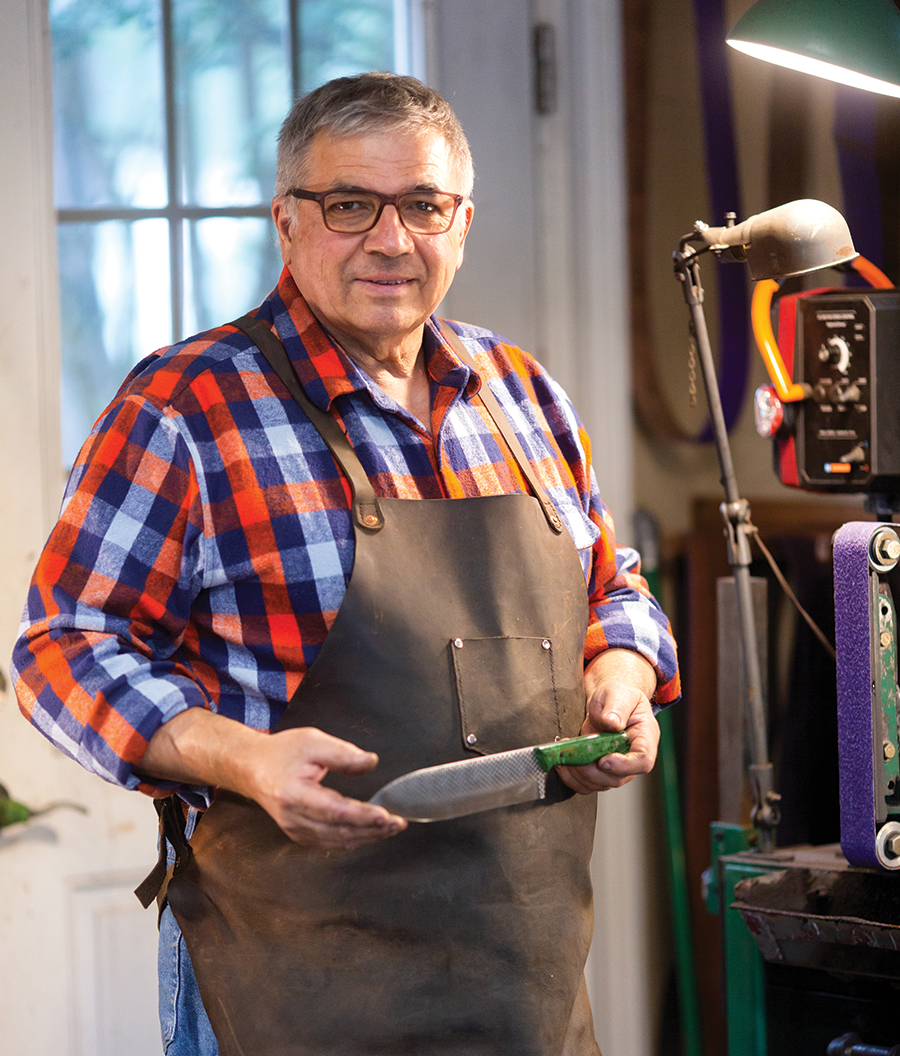
“I’m more of a Japanese maple freak than a bonsai freak, but I can show you,” Joe Marotta says matter-of-factly but somehow merrily, too. He walks through the kitchen and opens the door to the backyard. Trees, 20 or 30, and plants line a bricked walkway, each in a pot of specific size and color, and some with accompanying stands.

“Do you make these?” I motion at the wooden stands.

“Yup,” he says with a grin. Japanese maples of assorted cultivars fill a majority of the pots, and beyond they fill the backyard. Bihou has yellow bark; Shirazz has salmon pink leaves; Radiant has iridescent bark and, when it matures, it will have iridescent leaves, too. “I have about 55 Japanese maples on the property,” he says. Hanna Matoi, a weeping cultivar, is his favorite.

The bonsai are the first stop and, ultimately, the last one on our circular tour of the backyard. A pergola covered in greenery, a wooden swing and raised garden beds planted with tomatoes, onions and eggplant absorb the space between the trees. With his back toward me, he fiddles with a bonsai before heading toward the garage.

“You could just take a small tree or plant and put it in a pot and then it’s a tree in a pot,” he says. “But, if you start trimming them and trying to shape them — that’s the art of bonsai.” He turns, catches my eye and laughs a round laugh. “I’m new to that, too.”

Too. He’s alluding to his other craft, knife making, a skill he’s been honing about as long as he’s been pruning bonsai. In his garage, Joe stands over 26 knives-to-be. It’s where our conversation started nearly an hour ago.

“I was born and raised on a horse farm in Michigan, and we had racehorses,” he says, standing at a worktable in this garage-turned-workshop. With a state-of-the-art table saw, planer, anvil and the works living comfortably in the spaces meant for Fords and Chevys, it probably hasn’t been a garage for some time.

“The other family business, it was a construction business,” he says. “I went the racehorse route, and I became a horseshoer.” For 35 years, two in the Sandhills, he shod horses, before trying his hand at construction, trimming houses for his cousin.

“And, there was a piece of molding or something I put up, and I said, ‘This just doesn’t look good to me; it doesn’t look right.’” His cousin told him to do whatever he needed to do to make it look right. It’s the mantra he’s carried through to the art of bonsai, blacksmithing, woodworking and the nexus of the latter two, knife-making. The warmth of his voice advertises the delight that comes from the discipline of mastery, the joy of knowledge.

“Do you want to hear the rest of the story?” he asks. “In 2017, I was diagnosed with lymphoma, and, halfway through my treatments, they discovered I had kidney cancer.” He pauses. “In January of the next year, after I got my chemo treatments for lymphoma, and I had a good prognosis, they took my right kidney out. Then, after that, they said, ‘As of right now, you’re cancer-free,’ and so far I have been.”

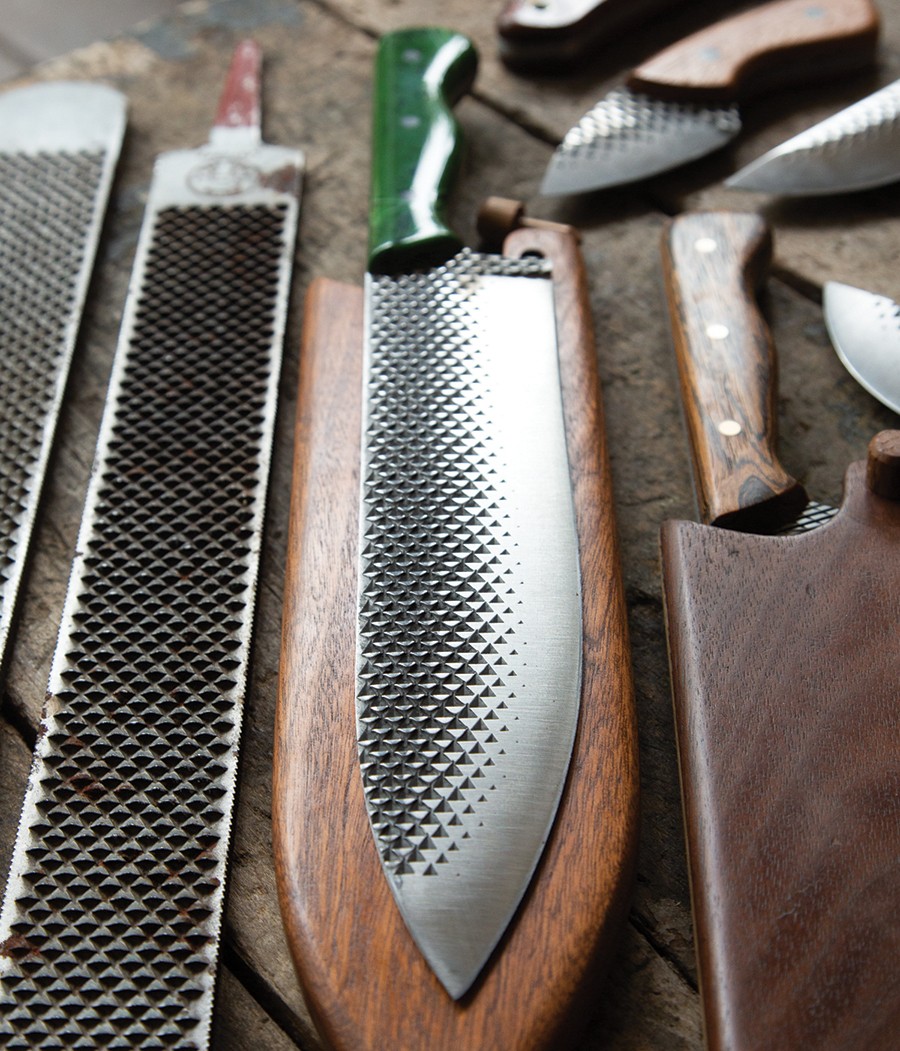
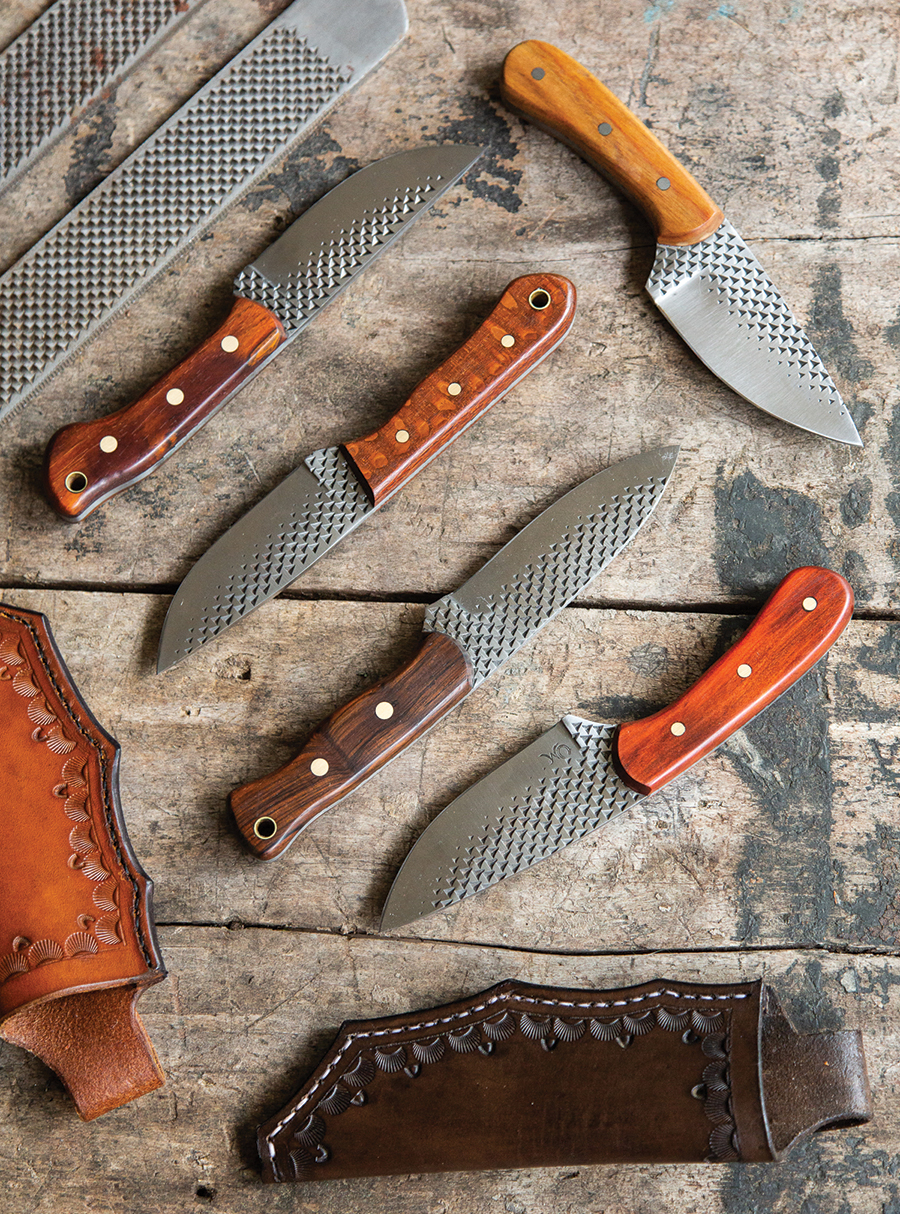
Joe shrugs. “Well, in the meantime, I didn’t have any business, and I wasn’t feeling good enough to do anything, so I decided I would start making knives from horseshoe rasps.”

He holds up a large, metal file. “This is called a big foot,” he says, waving the farrier rasp. “Normally, they’re about 14- to-16 inches. ’Bout halfway through my shoeing career, I switched to these because you get more leverage. Less stress. You don’t work as hard.”

He imitates the filing of a horseshoe in midair. “What I do is I’ll lay them out like this,” he says, setting down the repurposed rasp before grabbing a template to demonstrate how he cuts out the knives. “Because this is so coarse and sharp,” Joe says as he lightly runs his fingers over the nubs on the file, “I knock down the rasp bed.”

Then comes the shaping of the knife on a homemade grinder. Not only does he make the knives, he makes the machinery to make the knives. He flicks on a switch. “You sit there and grind and grind and grind,” he booms over the mechanical humming. Chhhhh, chhhhh, chhhhh . . . the metal and the grinder’s belt meet in a spray of sparks. “Dunk it in water in case it gets hot,” he says and plunges the knife into a bucket.

“The trickiest part is getting the bevel right. When you look down at the knife, you want the taper to be symmetrical,” he says. “After you grind about a hundred knives you get pretty good at it.” He adds modestly, “I’m still not great at it.”

The process courses ahead in almost perpetual motion. Handles-in-progress lay out in a variety of colorful, unfamiliar woods. “I try to use all exotic hardwoods. This is bocote, this is wenge. This is also bocote, but it’s long grain . . . redheart . . . leopardwood,” he lists off the names as he points.

Even the garage-turned-workshop doesn’t have the space for a production line that includes making leather or wooden sheaths — the latter called sayas — to accompany his cutlery, so the process spills into the house. His wife, Cheryl, says, “He wants my sewing room, but he’s not getting it.”

Joe pretends to ignore her but can’t contain a smirk as he explains how he makes the sheaths. “I cut a template out. Stain it and stamp it,” he says, cruising through the process. “Sew this, then put a welt in there, and, now, I just got to sew that together, stain it, finish it and then that’s the sheath.” He walks over to his homemade saddle pony to demonstrate saddle stitching.

Knife-making, machining, leather-making. “How do you have time for all these hobbies?” I ask.

“Ever since I got sick, and I had cancer, all I got is time,” Joe says. For the discipline of mastery, for the joy of knowledge.

“He also does bonsai,” someone chirps from the corner of the room.

“I’m more of a Japanese maple freak than a bonsai freak, but I can show you,” he says matter-of-factly, but somehow merrily, too.  PS

Jenna Biter is a fashion designer, entrepreneur and military wife in the Sandhills. She can be reached at jenna.biter@gmail.com. Marotta Custom Knives are available online at www.marottaknives.com.

Buster Gets a Bath

When I pick him up
and tilt to the bathtub
he falls limp with shock
This cannot be. . . .

Then it’s dark thoughts
from dark eyes, the dog
I love so much hates me
A torture worse than death.

All sudsy now, scent of clover
and dead leaves washed away
with lavender and lemon.
How could you?

The sprayer — that cobra of doom
strikes again and again.
Even if it feels good
I’ll never say so.

After a brisk towel rub
he springs all over the house
a hero home from the war
The bath? It was my idea.

— Ashley Memory

Out of the Blue

A Patriotic Wish

The art and craft of loving country

By Deborah Salomon

If months have a persona, then July must own patriotism. This is confirmed by the paraphernalia at Dollar Tree. Soon as the graduation stuff is cleared away out come the stars and stripes — on everything. Which makes me wonder about the emotion that ties people to their place of origin.

This complicated emotion sends soldiers onto the battlefield. Patriotism is what rises in our throats and spills out of our eyes when the flag is raised in the schoolyard, when an Olympic athlete stands atop the podium, when the national anthem is sung before a baseball game or taps sounds over a military burial. I do not think patriotism can be taught, or learned. Developed, maybe.

It reminds me of the fifth basic taste: umami, which unlike sweet, sour, bitter and salty, is not exactly a taste itself but an intensification provided by glutamate (MSG). Umami makes food taste better. Patriotism makes being an American feel better.

Patriotism has an amorphous quality that can be applied at several levels to all manner of situations. Like living abroad.

Not that Canada is really “abroad.”

Oh, yeah?

I lived in Canada for 26 years — arriving there as a 21-year-old bride who had never been outside the U.S. or even west of the Atlantic Seaboard. Everything was immediately different: The language (try high school/college French in Quebec province). The money (multi-colored). The newspapers (hockeyhockeyhockey). The food (ground beef is “minced beef,” cookies are “biscuits”). The measurements (Celsius, metric). The customs (queue up at bus stops). The schools (11 grades). A hundred more details, all foreign. I was lonely, confused, overcome with a sudden patriotic longing for the familiar.

I reacted by celebrating American Thanksgiving (Canadian T-G is a minor October holiday), putting out an American flag on July 4th.

Look, you guys, an American lives here!

Over the decades, returning from Europe or the Middle East, I always felt a rush of something when the plane touched down.

This emotion may have originated with my father, born in the USA of destitute immigrants from Eastern Europe. He served in France, in World War I, as an ambulance driver because his eyesight wasn’t good enough for the infantry. On Veterans Day he sold red paper poppies. Whenever battlefield visions surfaced, he’d say, “You don’t know how lucky you are, little girl.”

He wasn’t exactly patriotic but definitely had feelings for his country.

On the other hand, my mother thought July 4th was the day Americans got killed driving to the beach or coming home from a fireworks display. Even sparklers were potential funeral pyres. Therefore, my budding patriotism was never fed by a picnic or barbecue.

What happened to simple patriotism, the American way?

What has the American way become . . . anyway?

Certainly not what’s going on in Washington, D.C., suffering its own epidemic of slander, deceit, cronyism, materialism, partisanship.

I wish that this 4th we would stop and taste the umami, enjoy the emotional rush watching young soldiers wearing camouflage fatigues arriving home from deployment, and old soldiers bedecked in combat insignia shuffling down Main Street. Because patriotism dredges up a pride, an inspiration that supersedes the red, white and blue Jell-O mold, the twisted Uncle Sam T-shirt.

Yes, I’m a bit idealistic — apple pie in the sky. But maybe for one day, or maybe a whole month, we could put on a patriotic face, a united front to reassure the world — disillusioned by recent events — that America is still the greatest nation ever.  PS

Deborah Salomon is a staff writer for PineStraw and The Pilot. She may be reached at debsalomon@nc.rr.com.

Birdwatch

Bird on a Wire

Meet “the other bluebird,” the indigo bunting

By Susan Campbell

“What, what? See it, see it! Here, here!!” Where? It’s a bird: high up on a power line singing incessantly, day-after-day during the summer months. This one can only be a male indigo bunting, loudly advertising his territory. He will continue to call out his challenge to everyone and anyone who will listen. His two-syllable, repeated vocalization is unmistakable.

To some, this fella is the “other” bluebird, slimmer but blue all over. Indigo buntings are an iridescent, darker blue than the familiar Eastern bluebird. And, as with all blue birds, their feathers are actually brown. The color we see is not due to actual blue pigmentation but from specialized microscopic structures that reflect and refract in the blue wavelength. And, as with other buntings, this bird has a strong, conical bill, capable of cracking hard-shelled seeds.

Female indigo buntings, however, are camouflaged; equipped with dull feathers that blend in with the habitat. They appear to be mostly brown with a pale throat, a lightly streaked breast and some hints of blue on the back. During the winter, males molt into drab plumage: not unlike our goldfinches. Immature males are often blotchy blue and brown their first spring and, as a result, will not likely breed. But when they don their breeding plumage they are a sight to behold and unmistakable.

Indigo buntings are found in a variety of habitats throughout the Piedmont and Sandhills. They tend to favor forest edges. But you can also look for them in brushy fields or clearings where weedy seed plants and insects are abundant. Associated dense woody growth provides good nesting substrate. Buntings may even be lured to where they prefer small oily seeds such as thistle (nyger). However, these birds have a broad, opportunistic diet. In early spring when seeds and insects are in short supply, they turn to buds, flowers and even young leaves. Indigo buntings eat mainly insects in the summer, not only feasting on a variety of caterpillars but large, hard-bodied beetles, grasshoppers and cicadas.

It should, then, come as no surprise that this species will disappear from areas where scrubby borders have been cut and grass is regularly mowed. “Tidying up” of our subdivisions and parks displaces indigo buntings as well as other migrant songbirds that require low cover. This is one reason why it is important to maintain as much green space in native vegetation as possible in our communities.

But indigo buntings do not stick around all year — as fall approaches, these little bits of the sky will flock up and head south to Central America and the Caribbean. They will fly great distances at night, using the stars to guide them. In fact, indigo buntings were the subjects of early migration research in the 1960s. But, come the following April, they will be back in their favorite haunts, singing their familiar song once again.  PS

Susan would love to hear from you. Feel free to send questions or wildlife observations to susan@ncaves.com

Home by Design

A Room of Our Own

After years of open floor plans, design trend watchers see beauty in dedicated spaces with doors and actual walls

By Cynthia Adams

Every spring and fall, the High Point Market Authority handpicks a group of designers and trend-trackers to scour showrooms for top design trends and products. But how to get around the Market’s COVID-induced closure, the second in its 111-year history (the first being World War II)?

Like everyone else in America, the Market turned to Zoom in mid-May, bringing together tastemakers from around the country to highlight their chicest picks from websites and leading home-furnishing companies’ new product lines. In a virtual confab, Rachel Cannon, Nancy Fire, Joanna Hawley-McBride, Don Ricardo Massenburg, Rachel Moriarty, Ivonne Ronderos, Victoria Sanchez, and Keita Turner presented their finds and posted them for viewing on the Spotters’ Pinterest boards. 

Allow me to break down some key takeaways.

Recent lockdowns made us miss rooms. As in, rooms with walls and doors. Doors that close.

This is a reversal of many seasons’ worth of pooh-poohing discrete spaces. Season after season, tastemakers regularly demonstrated an aversion to them. And not only in print. On HGTV, home flippers would walk in and size up a fixer-upper. Right off the bat they would eye existing sheetrock or plaster walls with the sort of suspicion normally reserved for a sewage leak.

“We need to open this up!” the renovator would declare giving said wall the stink eye. “First thing we’ll do is take out that wall!” 

No matter if there was a 1911-era fireplace in that wall oozing charm, the problem was, that mantel and fireplace required a wall. And walls, if not absolutely essential and load bearing, a renovator term one quickly learned, were verboten.

Having flipped a few houses myself in my single days, I would wail at a hallmark Fixer Upper scene in which Chip and Joanna Gaines proceeded to take a sledgehammer to an architectural detail or quirk that gave a house character. The end result was an open-concept house erected within the gutted shell of a formerly unique structure.

But the times, Children, are a-changin’. 

After sheltering in place, working and home-schooling children, there were just so many days of hearing “Baby Shark” without losing brain cells. Or hearing one’s partner booming away on yet another Zoom call. Or clearing away the breakfast mess before a Skype call could occur.

Weary Mamas and Papas and empty nesters learned there is something to treasure about personal space when one had so little.

After years of open floor plans, the Style Spotters agreed, there is a great realization:

“Open plans are going to change,” one declared.

If you lack the skill set to build a wall in the time of a pandemic, buy a screen, the designers suggested in May. 

Something else the Style Spotters uttered grabbed my attention: comfort. Comfort and coziness are useful in uncertain times, they agreed unilaterally.

So, soft edges (featured on a cabinet by Theodore Alexander) or the organic (citing a Clubcu Oak French Console with a handmade look) were deemed pleasing.

Art and accessories with lots of texture also made the tastemaker’s cut. As did things “organic, creative, imperfect,” or “global and glam” — all reassuring design choices.

In a pandemic-scarred world, “Home is going to be the hub of everything,” one said. 

The humble entryway or grand foyer is changed and weighed with practical needs  (shucking off clothing or sanitizing our hands), as more than one urbanite designer allowed.

Rachel Cannon, whose Zoom space was neutral, tasteful and quiet, says she likes to design for introverts like herself. Though seeking calm in her color palette, she confessed she was not as enamored of the Pantone color of the year, Classic Blue, as her Style Spotting compatriots. Illustrating her preference for soothing elements, Cannon cited Hickory White’s case goods. 

On the opposite end of the personality spectrum, the boho-loving camp did not seek calm. They chose geometric, bold, sexy furnishings among case goods and furniture, as well as art and accessories. They liked candy colors that smacked of fun and games. The radical chic designers favored effusive and tribal-inspired designs in fabrics. Prominently mentioned was Shipibo textiles, created by the Peru’s indigenous Shipibo-Conibo people.

The Style Spotters responded unanimously to a question about favorite projects: The entire group expressed their enthusiasm for designing powder rooms. “You can take risks!” one suggested. As a bonus for extroverted designers, the style-savvy added: It can be bold!

So skip to the loo, my darlings! It may have a dearth of toilet paper, but it does have walls and lockable doors, suitable for when one simply has to shut out the noise. Or corona-avoid everyone.  PS

Cynthia Adams is a contributing editor to O.Henry.

The Style Spotters program is co-sponsored by Crypton Fabric and Studio Designer. More information about the Style Spotters program and the 2020 team can be found www.highpointmarket.org/products-and-trends/style-spotters.

Southwords

What’s in a Name?

A tradition like no other

By Jim Moriarty

When the eldest of the grandprincesses was a wee thing, saying “grandpa” was something of a challenge. What came out, to the everlasting delight of my wife, the War Department, was a word that sounded a lot like “crappy.” This prompted a dispiritingly large number of family members to engage in an inter-generational cabal for reasons that don’t need to be discussed in polite company. Let’s just say that the War Department did everything in her power to encourage the widespread use of the term and thus, from that moment on, whenever I’m in the presence of the grandprincesses — there are two now and one will be driving a car before long — my name is Crappy. That’s with a “y,” not an “ie.” The latter is a fish, for God’s sake.

It can be awkward. For a school assignment, one of the grandprincesses had to write a letter which she dutifully addressed: “Dear Grandma and Crappy.” Her teacher was, if not outright appalled, nonplussed. She attempted to correct my granddaughter, who quite calmly informed her, “That’s what we call him.”

“You call your grandfather Crappy?” the teacher asked.

“Well,” the grandprincess paused to mull the whole thing over, “sometimes I just call him Craps.”

July would ordinarily be the month our family gathers in a beach rental with not enough bathrooms and too many wasps to eat ribs, play goofy golf and pay homage to our expanding list of family traditions. Unfortunately, the current circumstances make it impossible this summer. One of the traditions we’ll miss is the card game Spite and Malice. It was introduced to me by my grandmother, a bridge grandmaster who taught that far more complicated game to guests in fancy resorts like the Belleview Biltmore in Florida and the Carolina Hotel in Pinehurst. Once she tried to teach one of my brothers to play bridge. He made an opening bid. She said, no, you should say xyz because you have this, this, this and this in your hand, correctly identifying nearly every card he was holding. My brother looked at her as if she was possessed by the devil, put his cards down on the table and never came back.

Playing cards with my grandmother was strictly a cash proposition. In the case of Spite and Malice, the stake was a handful of pennies. Grandmother taught the game to me. My mother taught the game to my children. I’ve passed it on to the grandprincesses. It’s a ruthless game whose finest redeeming feature is that it’s almost entirely serendipitous, meaning even the rankest beginner can slam dunk the rest of the table like Michael Jordan soaring over Moses Malone. It can be seriously good for a 5-year-old’s psyche. So can learning how to behave if you’re the dunkee, not the dunker.

However, the tradition that I, personally, will miss the most comes in the kitchen. I’m not well known for my culinary gifts. On those rare occasions when I’m called upon at home to cook something on the back deck, once the deed is done the War Department usually encircles the gas grill with crime scene tape. But, like the blind pig, there is one particular item for which I am justly, and I don’t mind saying, universally renowned — Crappy French toast.

Ah, the sheer cherubic joy of those tender young faces when, on our first full day of our beach rental, I begin morning reveille by rattling pots and pans. I can almost hear the Pavlovian groans now. The ritualistic breaking of the eggs, retaining just the right amount of jagged pieces of shell. The glup-glup of out-of-date milk. The whiff of vanilla and a whisking vigorous enough to give a man the forearms of a slugging third baseman.

The signature feature of Crappy French toast is how it manages to retain such significant amounts of what appear to be flaps of egg white. I confess that over the years I’ve seen some large enough that, if two pieces were to be placed one upon the other, the short stack could have stayed airborne at Kitty Hawk at least as long as the Wright Brothers.

Crappy French toast should not, under any circumstances, be served al dente. This was pointed out to me one July by my son-in-law, whose first piece arguably should have spent a bit more time on the griddle; either that or it could have been used to culture flu vaccine.

In the fullness of time, the grandprincesses have convinced me that Crappy French toast is really nothing more than a vehicle for powdered sugar. Tradition, edible or not, is always rich.  PS

Jim Moriarty is the senior editor of PineStraw and can be reached at jjmpinestraw@gmail.com.

Simple Life

The Garden of America

It may not be Eden, but it comes mighty close if we tend it

By Jim Dodson

The last time I went to church was back in middle March.

Seems like half a lifetime ago.

On Sunday mornings these days — most days, actually — I’m out well before sunrise watering my gardens and watching birds.

The garden has become my church, the place where I work up a holy sweat and find — no small feat in these days of safe distancing and social turmoil — deeper connection to a loving universe. The arching oaks of our urban forest rival any medieval cathedral, and the birdsong of dawn is finer than any chapel choir. It’s the one time of the day when I feel, with the faith of a mustard seed, to quote the mystic Dame Julian of Norwich, that all will be well.

A rusted iron plaque that stood for decades in my late mom’s peony border reminded:

The kiss of the sun for pardon

The song of the birds for mirth,

One is nearer God’s Heart in a garden 

Than anywhere else on Earth.

This well-loved verse is from a poem by Dorothy Frances Gurney, daughter and wife of an Anglican priest who reportedly was inspired to jot this particular stanza in Lord Ronald Gower’s visitor’s book after spending time in his garden at Hammerfield Penshurst, England. The poem later appeared in an issue of Country Life magazine in 1913, gaining Dorothy Gurney a slice of botanical immortality.

Though I descend from a line of rural Carolina farmers and preachers, it wasn’t until I began roaming Great Britain as a golf and outdoors editor for a leading travel magazine in the late 1980s that the verdure in my blood asserted itself and my own passion for landscape gardening took root and began to grow like a Gertrude Jekyll vine.

In those days, it was my good fortune to write about classic golf courses and fly-fishing streams that happened to be near some of Britain’s greatest sporting estates and historic houses.

One of the first I visited in West Sussex was Gravetye Manor, the former home of William Robinson, the revolutionary plantsman who, despite being Irish, has been called the “Father of the English Flower Garden.” Robinson’s pioneering ideas about creating natural landscapes with hardy native perennials, expressed in his famous book The Wild Garden, became the bible of English gardeners and led to a gardening style now admired and copied all over the world.

I showed up there to stay one hot mid-summer afternoon when the 100 acres or so of woodlands and gardens were already past their peak. But like Dorothy Gurney, I was so taken with the sweeping natural landscape that I spent an entire day just walking the grounds looking at plants and chatting with the gardening staff. Among other things, I encountered my first Gertrude Jekyll vine, planted by Robinson’s protégé who went on to partner with Surrey architect Edwin Lutyens to create some of England’s most acclaimed private gardens.

After this, every time I traveled to England, Scotland or Wales with golf clubs and fly rod in tow, I made time to seek out some of the most historic houses and private gardens in the Blessed Isles. During bluebell season, I wandered through the breathtaking New Forest National Park to Chewton Glen — where farm animals by law walk free — and moseyed over to Kent to play a British Open course I’d always dreamed of playing. I also spent a blissful summer afternoon checking out the structural plantings of diplomat Harold Nicolson and the sumptuous gardens of his wife, author Vita Sackville-West at Sissinghurst, an ancient Anglo-Saxon word that means “clearing in the woods.”

I spent a day with Shropshire rose guru David Austin, toured the amazing terraced gardens of Wales’ Powis Castle, checked out the stunning gardens of Stourhead, Hidcote and Kew — even eventually found my way to Hammerfield Penshurst where Madam Gurney was moved to poetry. There I was so impressed by the riotous blue-and-pink peony border — my late mother’s favorite garden flower — I vowed to someday make my own peony border.

Back home in Maine, in the meantime, I cleared a 2-acre plot of land on top of our forested hill, rebuilt an ancient stone wall and began making my own mini-Robinsonian gardening sanctuary. My witty Scottish mother-in-law suggested I give my woodland retreat a proper British name, suggesting “Slightly Off in the Woods.” The name was apt. The garden became my passion.

In 2004, I set off to spend a year exploring two dozen private and public gardens and arboretums all over Britain and eastern America, learning that gardeners are among the most generous and life-loving people of the Earth. Among other things, I went behind the scenes at the famous Philadelphia Flower Show and England’s venerable Chelsea Flower Show, got to pick the brains of America’s most acclaimed gardeners at places like Brooklyn Botanic Garden, Jefferson’s Monticello, Pennsylvania’s Chanticleer and Longwood Gardens, and finished the year by spending six weeks with plant guru Tony Avent and three fellow plant nerds in the wilds of South Africa hunting rare species of plants. During this time I even helped design my first golf course and shape its landscaping, at times wondering if I’d perhaps missed my calling, though what is a golf course but a great big parkland in the tradition of Capability Brown?

One of the most surprising moments came when I called on John Bartram’s historic garden across the Schuylkill River from downtown Philly. I spent an enriching afternoon in the garden of America’s first botanist, learning that Thomas Jefferson frequently turned up in the garden during the long hot tumultuous summer he spent in Philadelphia composing the Declaration of Independence. According to Bartram garden lore, Jefferson jotted notes for his hymn of American democracy while reposing in the shade of a sprawling ginkgo tree on the grounds. The last time I checked, the ancient ginkgo was still standing.

For the Founding Fathers, gardening, agriculture and botany were elemental passions of life. As Andrea Wulf writes in her wonderful and prodigiously researched bestseller Founding Gardeners: The Revolutionary Generation, Nature and the Shaping of the American Nation, a tour of English landscape gardens — like the extended one I took — helped restore Thomas Jefferson’s and John Adams’ faith in their fledgling nation during some of its darkest hours. Gardening also helped make James Madison America’s first true environmentalist.

“The Founding Fathers’ passion for nature, plants, gardens and agriculture is deeply woven into the fabric of America,” she writes, “and aligned with their political thought, both reflecting and influencing it. In fact, I believe it’s impossible to understand the making of America without looking at the founding fathers as farmers and gardeners.”

My book on America’s dirtiest passion, Beautiful Madness: One Man’s Journey Through Other People’s Gardens — was my most fun book to research and write. Since its publication in 2006, I’ve heard from gardeners all over the planet and have made plans for a follow-up book on the diverse gardening passions of America and the adventures of an early 20th-century plant hunter and Asian explorer named Ernest Henry “Chinese” Wilson, whose discovered lilies are probably growing in your garden today.

As any devoted gardener knows, the beautiful thing about a garden is that it is forever changing and never completed. Revision and evolution go hand in hand with making a garden flourish and bloom.

As another July dawns in the midst of a worldwide pandemic and sweeping protests in quest of long overdue social justice and an end to racism, it strikes me that American democracy is really no different from the botanical wonders of the world.

A true gardener’s work is never complete, likewise for a true patriot of the diverse and ever-changing garden that is America. The garden must be tended regularly, weeded and watered, nurtured and fed, pruned and tended with a loving eye.

The good news is, gardens are remarkably resilient. They can take a beating, endure violent storms and punishing drought, yet come back even stronger than ever as a new day dawns. As Jefferson, Adams and that Revolutionary bunch knew, the one thing a healthy garden or democracy can’t abide for long is neglect and indifference.

And so, as mid-summer and our nation’s 244th birthday arrive, I plan to spend even more holy time in my garden — church until further notice — planning a new blue-and-pink peony border in memory of my late mama and thinking about what it means to be a good gardener and a true citizen of this ever-evolving garden we call America.  PS

Contact Editor Jim Dodson at jim@thepilot.com.

Wrangler on Medicare

Or, what I did on my summer vacation

By Jan Leitschuh

It was raining — again. Cold, slushy, May rain, at 6,500 feet.

On my third day of work, as a 65-year-old wrangler on a guest ranch near Yellowstone National Park, my Western saddle suddenly shot forward onto the neck of my startled mount. I was pointed downhill on the slickest, steepest, narrowest slope of the morning’s mountain trail.

Outwardly, I was cool, calling ahead for a halt to the line of guests. Inwardly, I was freaking — how to fix this heavy saddle quickly, with a gaggle of guests in an awkward, uncomfortable, downhill hold?

As I sit homebound in these viral times, I find myself mind-traveling back to my Montana “summer vacation” last year. I had been, by far, the oldest wrangler in a young person’s job. My colleagues were in their early 20s, and I was older than their grannies. My immediate boss was 34 years my junior.

So I needed “street cred,” as it were. I was out of practice. And now I was stuck on a steep, muddy goat track, on an unhappy horse deciding if bucking down the mountain through the guests would solve his saddle problem.

Mid-May in the high country of southern Montana can be a snowy, rainy, muddy mess.

I was bringing up the rear on a lope (Western canter) ride, an option for the more experienced guests. It was so slippery we never chanced the faster gait, just walked and trotted to keep guests safe. The cold, gray clouds tossed some wet snow into the rainy mix. I was riding Sebastian, a nice, sturdy bay gelding with a massive, round barrel. Though I had cinched him up as much as I humanely could, the saddle and pad still let loose on the steepest downhill. When I called downslope to the lead wrangler to halt our ride for a moment, he was so far below, it was a miracle he heard.

How was I going to fix this? With a wall of Douglas fir rising on the right, I slid off the downhill, left side. When my boots hit the greasy clay, they shot out from under me, and I nearly slipped under my mount. Now my hefty horse really towered above me, with his hindquarters even higher uphill. I had to set the heavy saddle backward. Reaching up to reposition an awkward, 40-pound stock saddle loaded with safety gear, with frozen fingers, on an anxious horse pointed downhill, while balancing on two greasy, mud-slicked rocks in the chilly rain, while guests waited in a precarious position of their own, was not the greatest of my challenges in the moment.

I still had to remount.

With a long cowboy slicker and multiple layers of warm clothing hindering flexibility, downhill of a tall, skittish horse, with pounds of slippery clay bricked on my boots and no solid footing, I knew I would have to give it my all to regain the saddle. Over the summer the demands of the job would harden my aging muscles to wrangling tasks — but I was not quite there yet.

Calling on all my reserves, I sprang up off the greasy rocks. My pride, guest safety and new job were at stake. Just as my brain was registering that I was about to fail to haul my aging, clay-heavy, clothing-burdened carcass aboard, I let out a desperate roar of effort and just managed to regain the saddle, feeling an electric “sproing” in my left ribs that left me breathless and panting.
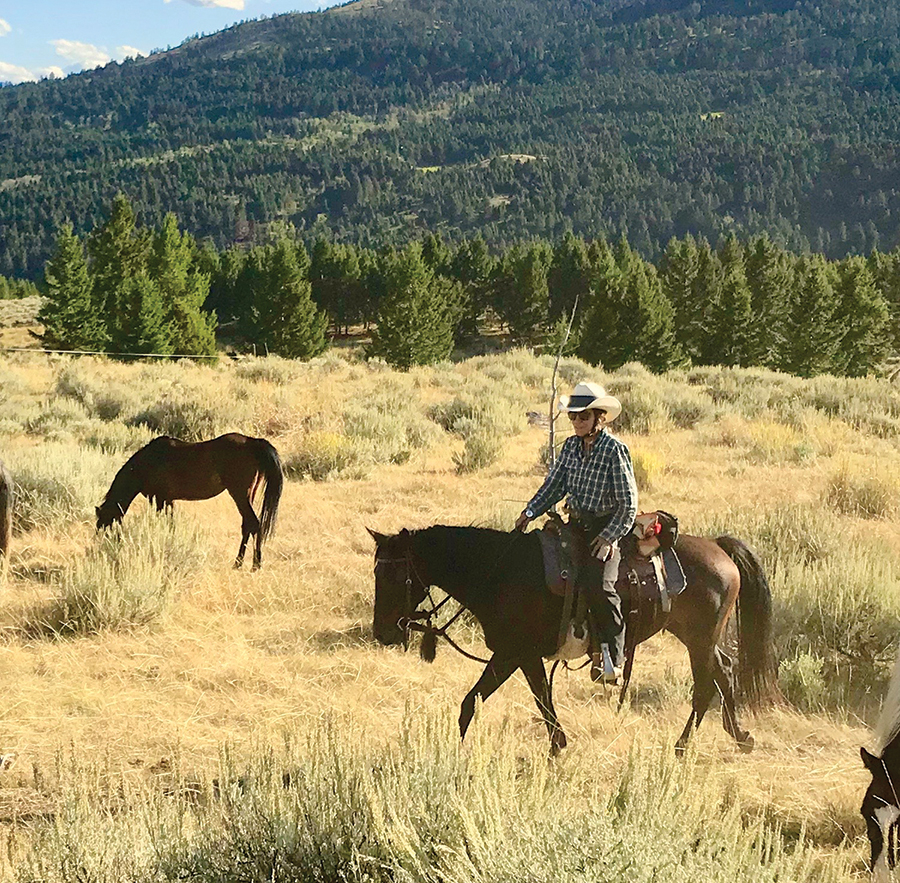
“OK!” I called forward, panting, and the ride started back up. I hoped my hasty saddle reset would last to the bottom of the mountain. I was wet, muddy, used up, hurting and mildly terrified.

At 65, I was the only “wrangler on Medicare” among youth. And I was beginning to see why it was a young person’s job. I thought, “What am I doing here?”

The next day, I broke my foot.

Thus began one of the best summers of my life.

No stranger to horses, I’d been an equine professional most of my life as a teacher, trainer, competitor, clinician, breeder, whipper-in and national dressage judge. I dove deeply into Western horsemanship as well, traveling to California to spend a remarkable winter with a life-changing teacher, the late Tom Dorrance. Yet as I tried to take care of my aging parents through six years of various health crises, while still keeping up my business, I found myself running out of gas and enthusiasm. The joy that had propelled me deeply into horses was gone. I was cooked.

A month after my mother died, I was burning out fast. I’d picked up a book about a woman who hiked the entire Appalachian Trail solo, and electricity shot through me as I read. I dreamed about the AT. The very concept lit a fire under me — Walking! Freedom! The idea hearkened back to my earliest draw to horses: mobility, a means of going places. After a two-year planning process, I sold my show horse, breeding stallion and broodmare, the majority of my horse gear, abandoned my beloved horse country lease, and pared my belongings down to a small storage locker.


And then I walked away. Literally. On the Appalachian Trail, from Georgia to Maine.

When I returned six months later, I honored the clinic commitments I had left stacked up around the country. But when I walked out of the arenas, I knew this chapter of my life was over. My horse interest, the most powerful driver in my life since before I could talk, was absent.

Imagine my surprise when, 15 years later, it came roaring back.

First, Denise, a trainer in Illinois and an old friend, asked me if I would return for a clinic. When I protested that I hadn’t ridden in years, she basically told me they didn’t want my butt, they wanted my eyeballs. I’d always believed in walking the talk. So I phoned up some old students and asked if I could watch them work, and offer what I could, to see if I could still be useful. Turns out it was like riding a bike.

Then, when I found myself retired but in need of some part-time employment, I looked at seasonal jobs and stumbled across “wrangler.”

Wrangler! I could do that! I had done it as a college student, traveling to Colorado for a fabulous, Rocky Mountain summer of trail rides and teaching. Returning to the Rockies would be a dream.

Local support bloomed. With my husband’s blessing, I blasted out applications, résumés and riding videos. Artist/rider Beth Roy loaned me an old campaigner to use in a wrangler video to display the needed skills to employers. Local trainer Kris Hamilton offered me long use of an old Western saddle. To get legged up, another friend, Cricket Gentry, found me a spare horse to ride. One windy day, the mare snapped out a sharp 180 and nearly spun me off — nearly, but didn’t — and as I sat up Cricket shouted, “You still got it!”

Maybe, just maybe, at 65, I still did.

I’d sent out a score of inquiries, but only two guest ranches topped my list. Radio silence. Was I too old?

Two weeks before I would need to leave, I got three offers — and the last one was my top pick. I was ecstatic, wild with joy, even. I was headed to Mountain Sky Guest Ranch, a 19,000-acre luxury dude ranch near Emigrant, Montana, with food, housing and use of the fine facilities included. My new bosses had taken a chance on a 65-year-old. My ranch had fielded over 400 applications for 15 positions. I was truly grateful, and privately vowed to be an asset in every way I could.

The early days were overwhelming.
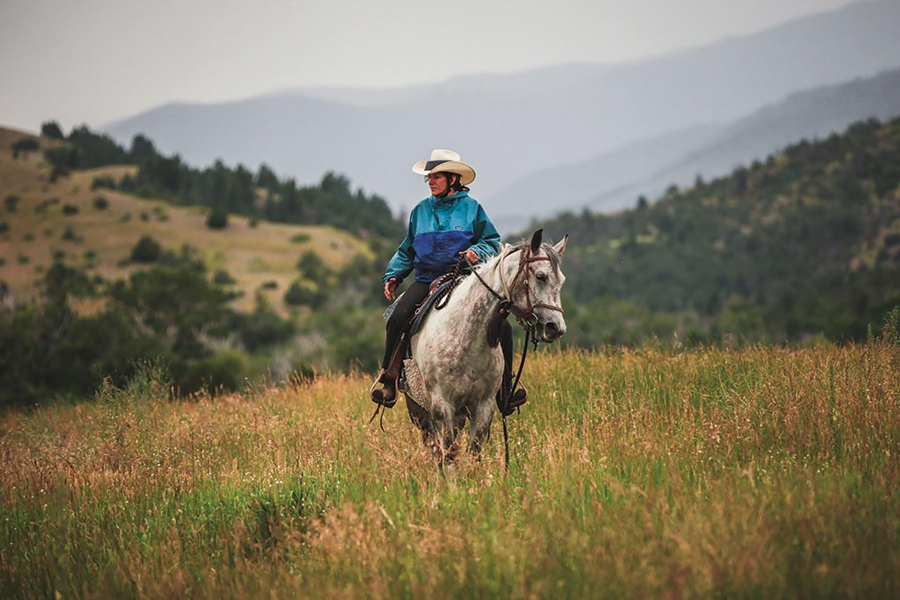
Besides dealing with a broken foot, I had to memorize the herd of 150 horses — their names, habits, health, quirks and traits. There were ranch protocol, safety and first aid classes to master. Multiple trails and local geography had to be learned. Disconcertingly, I was finding my brain wasn’t as nimble as it had been when last I’d wrangled — in college. My young colleagues, unsurprisingly, socialized and shared information mostly among themselves. The work was deeply physical, with us on our feet or in the saddle for 12 hours a day, at times. Rotating staff brought the entire herd of horses down the mountain before daylight each morning, and returned them in the evening.

A young wrangler, Cody, kindly crafted me an iron plate fitted to the bottom of my cowboy boot. If I duct-taped it on every morning, it stiffened the boot sole enough that I could continue to work with the broken metatarsal.

But the “Iron Maiden,” as I called it, was heavy, and my foot ached. I missed my husband. The steep trails were mildly terrifying but I’d wrangled in the Rockies — what was I expecting? There were large critters out there that could eat you. Some days I was too tired to eat, just took a shower and collapsed in my room. So much information to master! I was having trouble sorting out the many trails. My sacroiliac joint sprained itself from limping, and that pelvic glitch was a bigger hindrance than the foot, making lifting heavy items (like saddles) excruciating. The rest of May and most of June, I was in fairly grinding pain, frustrated, tired, hobbling behind my colleagues. My bosses made concessions, and I chafed at my limitations.

But the sun came out in June. I learned the horses and the trails. I genuinely enjoyed the guests, especially coaching them to better horsemanship. Best of all, my deep and primal love of horses came roaring back.

Wranglers are assigned newer horses to bring into ranch routines. My wrangle pony, “Honor,” a funny little Wyoming mustang, utterly stole my heart. Dark bay, almost black, this opinionated little girl could turn on a dime, usually in a whirling spook, but lots of groundwork and attention created a bond between us. She made me laugh. By July, I could call her name across the crowded corral and she would call back, trotting through the mud to find me.

“Homer” was another horse I was asked to ride. An affable bay roan gelding, he’d started an unsettling habit of trotting down hills. Sometimes he would even cut a switchback and plunge down the short cut, disconcerting guests. I was asked to nip that in the bud. Soon I became deeply fond of him as well, and often chose Homer to help flag the other horses when bringing up the herd. He was comfortable, honest and came around swiftly — and even saved my neck one early June morning.

For my first morning “gather,” I was to round up the herd on the mountaintop with another, more experienced colleague. I caught Homer, tacked him, and we set off into the cold dark at a fast clip. New growth sage perfumed the damp, stony mountain, and sometimes sparks flared from our mounts’ steel shoes. It was 4:30 a.m., pitch black, and I soon discovered my tiny backpacking headlamp was useless. I could follow the faint glint of the barbed wire fence, but basically I was gathering blind, trusting Homer to avoid stepping in a badger hole or tripping headlong over a sage bush. I didn’t yet know what I was doing, and it was terrifying. Every brushy crash, in my mind, was a mama grizzly or a mountain lion, neither of which was rare in our world. After an hour, we had somehow gathered the herd at the gate, ready for the long push down from the mountaintop to the ranch. My colleague felt that since it was still early in the season, someone — me — needed to lead the horses to make critical turns and twists. The other would stay on the mountain, waiting for the final corral count to be radioed back, then round up any stragglers.

The first task was to get 100-plus horses down the stony switchback, “Yellow Brick Road,” as we called the quick descent. In several places, the road edge dropped off.

“Get in front of them,” my colleague instructed.

“You mean trot downhill?” I asked. I was quietly agog. I couldn’t see a darn thing. The descent was slippery, steep and rocky. And Homer wasn’t supposed to even trot downhill.

“Go as fast as you have to, to stay in front of them,” he answered. Gulp. OK . . .
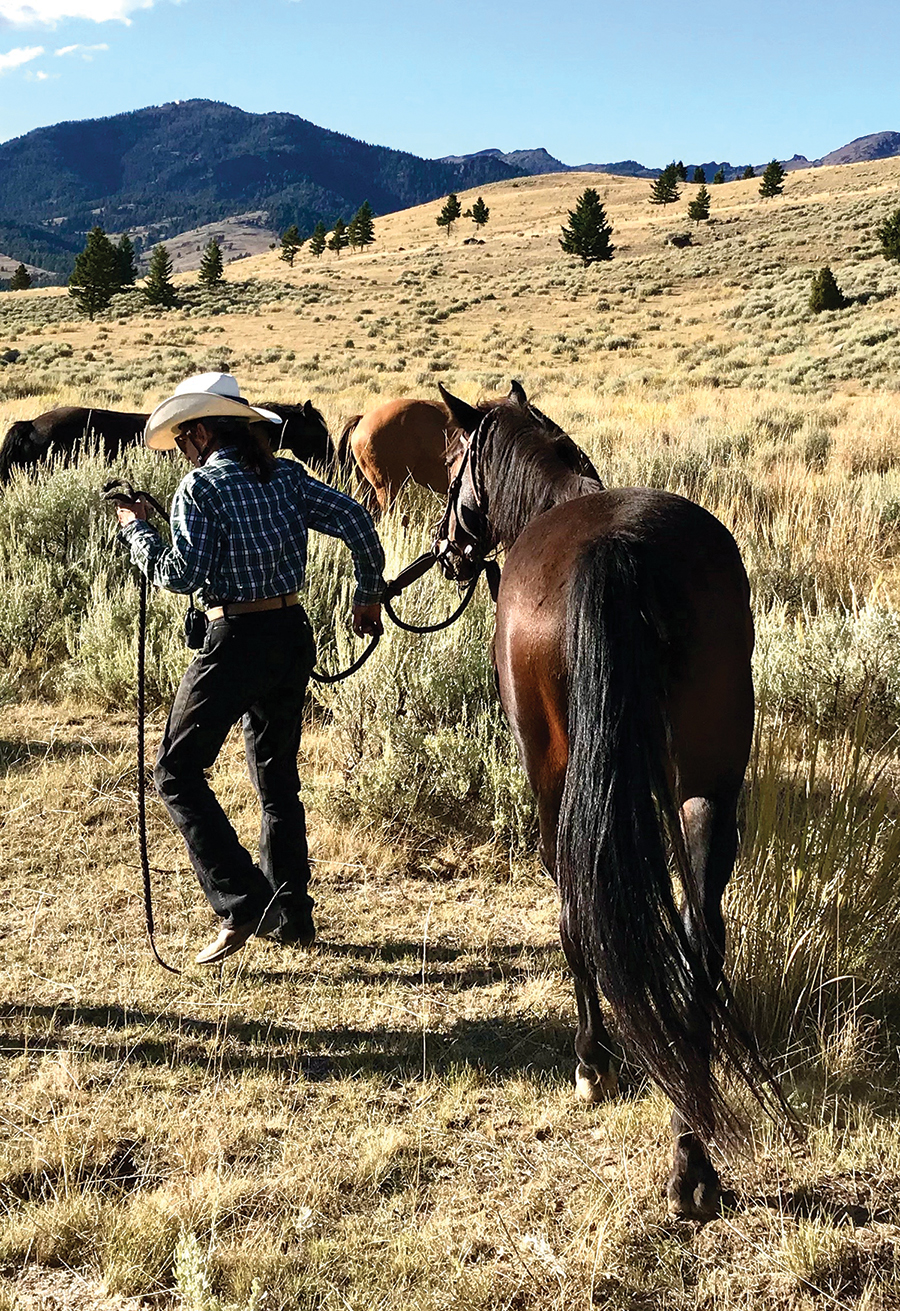
 

“GO!” he urged as he opened the gate. The restless herd churned down the mountain.

We went. Since I couldn’t see, all I could do was hope Homer could. Shut your eyes tight — that’s what I saw for 10 long minutes. On horseback. Downhill. With 100 loose horses hurrying behind me.

I held firm to the saddle horn in case Homer chose to deploy his switchback shortcut move — I didn’t want my horse to disappear from beneath me, leaving me hanging in mid-air like Wile E. Coyote before the inevitable crash. Back and forth we swayed in the dark, fast — too fast — taking the switchbacks, the herd pounding behind us, the edges unseen. It was a total trusting in fate and Homer — and both delivered.

After an eternity, I heard the creek roaring at the bottom of the mountain. We thundered across the wooden bridge, swung a hard left, skirted the leg-swallowing cattle guard across the road, crossed another bridge and turned a hard right up the next slope toward the ranch a half-mile away as the darkness finally yielded to faint shapes. All before coffee.

Every horse was accounted for that morning. Homer got a rubdown, an extra measure of grain, and my complete, grateful loyalty. He was solid. I made a point to look out for him in the herd. One large turn deserves another.

As summer routines settled in, parts healed. The sun-washed days warmed up and grew longer, the scenery was unparalleled, the guests interesting and often international, the four-star food was delicious. I rode other horses — the fine red mare Flower, the gaited pinto Archie, the large grey Badger, the lazy, good-natured Teddy, the grullo Mouse. I respected the horsemanship of my supervisors, and the programs they created to keep guests both safe and entertained.

Breakfast rides, dinner rides, team penning, moving cattle. I grew stronger, slimmed down, came to relish the steepest trails. I found a tribe with some of the older staff in dining, housekeeping, the wellness spa, veterinary. I met some fears, limiting beliefs about aging, barriers, and plowed forward. Late afternoons driving the herd back up the mountain became a favorite activity.

I did see grizzlies, eventually. Also moose, pronghorns, mule deer, fox, marten, airborne cranes and elk. Wildflowers galore, from pink shooting stars, arrowleaf balsamroot, Indian paintbrush to wild roses and postcard fields of purple lupine. Hiking was sublime, even if you did need to carry bear spray. I burned up my senior parks pass on days off visiting Yellowstone, viewing bison, wolves, hot springs, fumaroles, sulfurous mud pots, geysers and more.

Some of the wranglers returned to school in August, but my commitment was through the first week of October. It was a long time to be gone from home. We had cold and snow that last week. Montana was making it easier to say goodbye.

At a last meal in staff dining before I left, the head wrangler, Adam, our main boss, took a seat across from me. “You were as advertised,” he said with a smile. “You just never quit.”

I went to hug Julie, Adam’s assistant and my immediate supervisor. She pulled me to the side. “We got the most effusive praise from guests about you,” said Julie. “Strong finish. Your hard work was appreciated. You are welcome to return.”

When I got home last fall, old friend Trish Greenleaf immediately installed me on one of her horses. We trail ride often. I was back riding and requests for instruction and even colt starting began coming in again. The little work I accept has a richer, different flavor now that I’m retired. I’m gratified (and mystified) that this old passion has re-emerged in my life.

Meanwhile, at ranch elevation, the patchy snow has mostly melted off Emigrant Peak, and the wild raspberries are sweetening. Wild roses perfume the trails. The moose and elk and cattle calved and moved to higher ground, the bears roam, looking for a meal. The ranch herd will have shed their winter coats and sleeked up. This year, the ranch chose to close until at least early August.

I think of Honor and Homer and Flower and friends, and suddenly, it’s not COVID-19 cabin fever I’m feeling. It’s Rocky Mountain fever.  PS

Jan Leitschuh is a frequent contributor to PineStraw magazine.