Horse Heaven

Sliding comfortably into its horse country surroundings an interior decor of memorabilia harkens to an equestrian heyday

By Deborah Salomon     Photographs by John Gessner

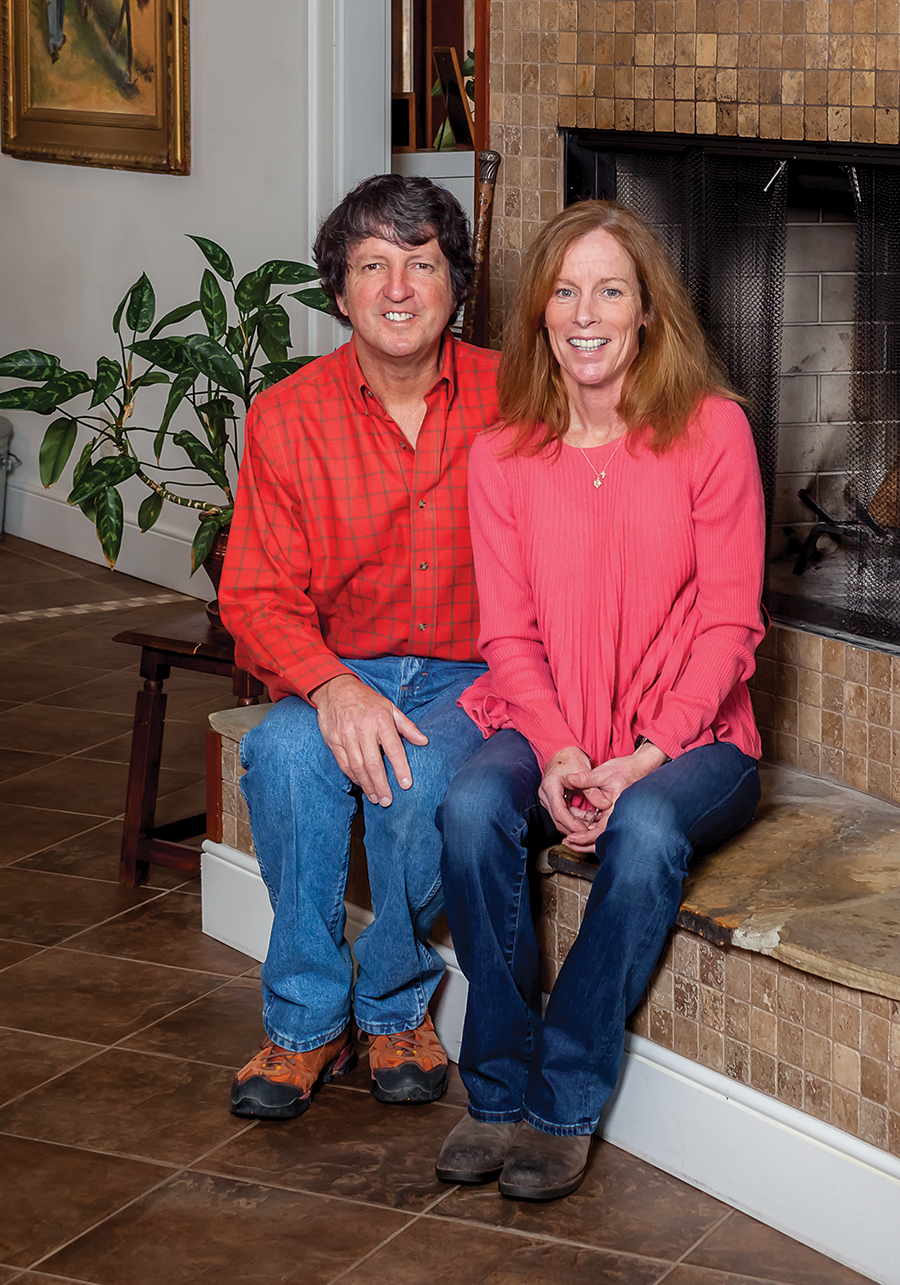
Heirlooms often grace Southern homes: Grandpa’s desk, Auntie’s slipper chair. “We started from scratch. Our furniture’s from Pottery Barn,” says Chrissie Walsh Doubleday, granddaughter of legendary equine trainer Mickey Walsh, founder of Stoneybrook Steeplechase.

“I put it together,” adds husband Peter Doubleday, internationally known horse show manager/announcer and, by the way, descendant of Abner Doubleday, the apocryphal inventor of baseball.

Yet, beyond a standard sectional sofa and some-assembly-required tables and chairs, Doubleday House at Little Squire, the Doubleday’s Adirondak-style lodge, is a veritable bulletin board chronicling two fascinating lives: photos, posters, paintings, stuffed animals, ribbons, figurines, saddle pads, books, awards and, marching atop the kitchen cabinets, 100 beer bottles with interesting labels.

Peter nods an affirmative: “I drank every one.”

Fifty plants, bathed in light from oversized bare windows, provide a greenhouse effect. One precious photo shows Mickey Walsh riding pony Little Squire, sans saddle or bridle. Dominating another wall is a painting of Walsh (who died in 1993) by local artist Dani Devins; this was returned to the family after being auctioned off at hunt balls.

What some brand as clutter, Chrissie calls history.

Chrissie belongs to the land surrounding their home. She grew up in a log house within sight, later lived in a nearby cabin. Her father’s veterinary office was yards away. She, her four siblings and 29 cousins knew every rock, rail and puddle in the compound. Beyond the equestrian life, Chrissie taught chemistry and coached track and field for 28 years at Pinecrest High School.

Peter, from snowy Syracuse, New York, lived down the road when he met Chrissie at a Christmas party. “I knew of the family, of course. They were famous . . .” he says. In 2005, soon after they married, her parents sold them five of their 17 acres for a house. Subsequently, they purchased another five and added a small barn.

Neither had any architectural experience, which didn’t stop Peter from scrawling a plan on a napkin at O’Donnell’s Pub. They liked the work of Southern Pines architectural/interior designer Denis McCullough who translated the napkin into a home unlike neighboring showplaces.

Little Squire defies labels.

Chrissie: “I wanted (the interior) to be a semi-circle and the outside to blend with the trees.” This meant angled interior walls which give the rooms irregular but interesting shapes.

Peter: “I saw a picture of a house with cedar siding, hunter green and blood red trim, like houses in Lake Placid.” The clapboards and shingles also reminded him of “cottages” in the exclusive Hamptons, where he announces events.

Multiple roof pitches and a cupola topped by the weathervane from Stoneybrook complete the rustic appearance. The Irish flag honors immigrants Mickey and Kitty Walsh who arrived in America in the 1920s — and in Southern Pines in 1939.

Chrissie was adamant about layout. “I wanted everything in one room.” That living room-dining room-kitchen-bar with wood-burning fireplace stretches nearly 50 feet facing outward to the terrace, paddock and barn. A long refectory table fills up fast at Thanksgiving and Christmas, since Chrissie’s sister and niece also maintain houses on the property. From the open kitchen in a far corner, the cook stays part of the action. Black granite countertops are covered not with cooking paraphernalia but photos of “good people,” Chrissie says. “We wanted pictures and themes everywhere to reflect horses and racing.” Peter’s artifacts contribute the broadcasting dimension, which include the 1996 Olympic Games in Atlanta. “Peter’s a collector. He just kept putting stuff up and I said  . . . whatever.”

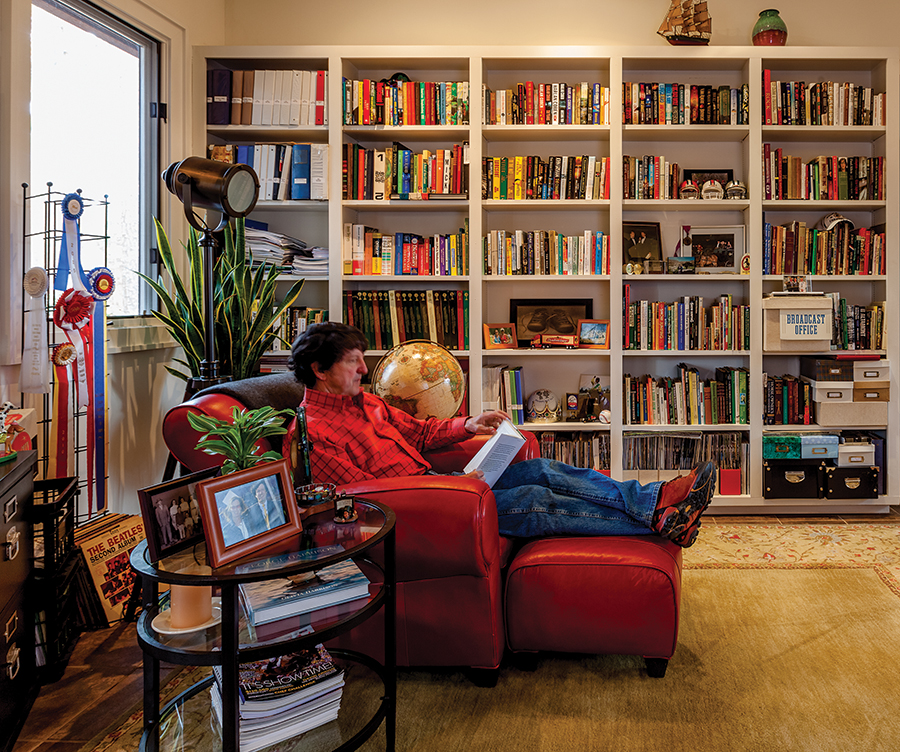
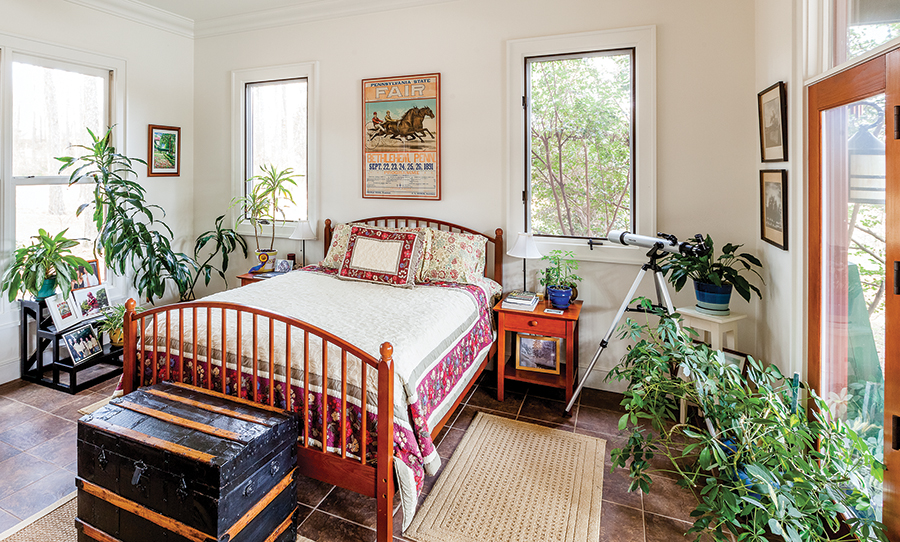
guest suite with separate entrance at one end of this panoramic great room offers privacy. Adjacent to it, a combination “entertainment” room and office. Peter loves music; a wall of CDs covers every genre but classical. “Vinyl’s coming back,” he says, pointing to long-play albums. The opposite wall of shelves displays Chrissie’s books and in the middle, a throne-sized red leather chair and ottoman. On hot afternoons, after barn chores Chrissie retreats here to read. The master suite with small terrace and second wood-burning fireplace — Chrissie’s lifelong dream — occupies the opposite wing.

Their outdoor environments include a small screened porch on the front and a larger one between the house and the patio which, by spring, is filled with flowers and often with guests. The Doubledays have no trouble fitting 100 friends and colleagues inside and out. “Our guests feel at home as soon as they open the door,” Peter says. They especially enjoy the DIY bar with tall vinyl-topped bar stools and well-stocked shelves.

A small pool built long before the house cools hot and dusty riders.

Nothing formal, everything practical and intensely personal. Floors throughout are low maintenance tile brightened with area rugs. Wide, handsomely framed doorways ease the flow from wing to wing. A coffered ceiling buffers noise. No palette unites the décor, although every hue found in nature appears here.

Chrissie got her wish: from a distance, the house melts into the woods.

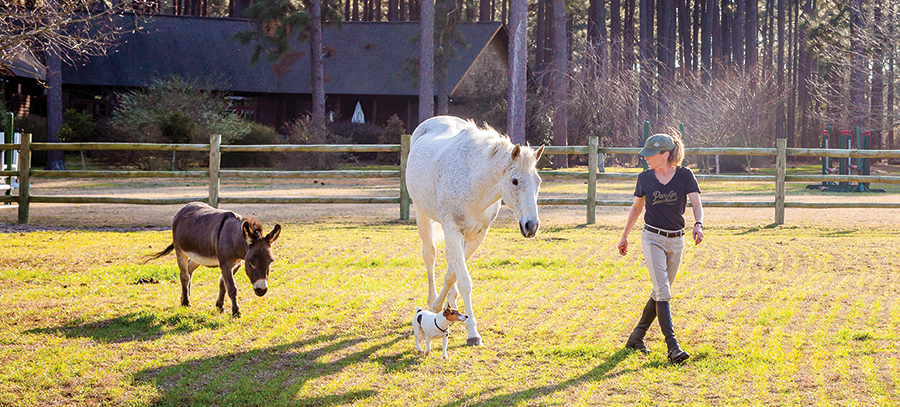
A piece of Chrissie’s heart beats faster in the small barn, shelter to Guac, a retired racer with a speckled coat called flea-bitten gray. Surprisingly, “I’ve ridden all my life but this is the first horse I’ve ever owned. He’s taught me a lot in the saddle and on the ground,” she says. “They test you. I’m supposed to be the boss but we’re still working on that.” Chrissie feeds, grooms, rides and cares for him — and Burrito, his adorable donkey companion — herself. She’s in the barn by 7 a.m., takes a break around noon, out again at 4 p.m. and to “check on things” before bed.

These are happy hours. “I spent a lot of time with my parents before they died,” she recalls. “Afterwards, things sort of fell apart, family-wise. I needed something to fill the void.”

The Doubledays’ luxury is not in antiques or professional-grade kitchen appliances but in living a continuity. “It’s just the two of us; we didn’t need a monster house,” says Peter, although as arranged, the 2700 square feet appear larger. Its location allows the couple to bike into downtown for First Fridays or a pub evening. But mostly they like to stay put. Peter, who travels many months a year, answers to homebody.

“I need a crowbar to get Chrissie out,” he says.

She responds: “I’m just very proud to still own this family property,” which honors her parents and grandparents. “They worked hard to create the farm, and Stoneybrook. It’s the only home either of us has ever built . . .”

And, Peter concludes, “We plan to stay here forever.”  PS

The Right Words

The art of talking, or not

By Renee Phile

Lately I have been trying to keep my boys talking, you know, to keep the conversations going. With Kevin, who is 8, it’s absolutely no problem, but the older one, the 13-year-old, well, his word count has decreased in the past year. Sometimes he will excitedly chat about wrestling or football, or a teacher who he thinks is funny, but all too often his answers are just a few words.

“My day was fine.”

“I learned about prepositions.”

“Yes, I ate the lunch you sent. Yes, the carrots, too.”

Fair enough, but sometimes I just really want a conversation, so I ask the question, “Do either of you have anything you want to talk about?” Most of the time a topic is not given, but comments are.

“We need to get Chinese food.”

“Can we get Little Caesars tonight?”

“Did you get a video of me pinning that guy at my wrestling match?”

Sometimes conversations begin about 5-7 minutes after the boys are supposed to be in bed for the night. Ironically, this is the time frame when suddenly more meaningful topics emerge.

“Mom, do you know what I’ve been thinking about? God. Is He real or not?”

“Mom, you know. I have been wondering. How did I get here? Like, really?”

“Mom, there is a kid at school who is mean to me.”

Yes, of course there will also be the occasional urgent, “Mom, I forgot to tell you that you need to sign this permission slip before tomorrow. Yes, I know I have had it in my book bag for two weeks, but I just remembered. At least I remembered before tomorrow!”

“Mom, I forgot to tell you about the solar system project due tomorrow. I have everything I need except I need help painting Neptune. We didn’t have the shade of green I need for the rings. Can we run to Walmart real quick?

Sometime, though, mornings are when I like to talk. After all, we have a 15-minute drive to school and yesterday morning I asked a question, and here is what I got.

“Does anyone want to talk about anything while we’re driving to school?”

David: “NO.”

Kevin: “Oh! I do!”

David: “No, Kevin, I can’t handle it.”

Kevin: “But I need to tell you something!”

Me: “Go ahead, Kevin.”

David: “UGH!”

Kevin: “David, stop with your attitude!”

David: “Be quiet.”

Me: “What do you need to tell us, Kevin?”

David: (makes disapproving grunts, sighs, and other 13-year-old noises.)

Kevin: “I really want to talk about why quesadillas are better than tacos.”

I mean, what else is there to say? Best topic ever.  PS

Renee Phile teaches English composition at Sandhills Community College.

Hawk

Driving to work, I spotted

the red-tailed hawk perched on the stop sign

at the corner of Courtland & Adams.

Surveying the suburban yards

for his next meal, he looked in my direction,

then turned away, disinterested. 

I lowered my eyes to check the time

and when I looked up again he was gone,

leaving me alone in the warm comfort of my car,

delighted by what I’d seen,

desperate for his return.

—Steve Cushman

Trail of Tears

The sorrowful history of Western expansion

By Stephen E. Smith

During the early-to mid-19th century, an unknown Native American warrior documented his life in pictographs on a buffalo hide. His early years were happy. He owned horses, took two wives, fathered children. Then white-faced figures appear pointing sticks that spit fire. Later, he painted his family dying of smallpox. His last pictograph illustrates the arrival of Jesuits in their black cassocks. There the narrative ends, suggesting, perhaps, that Jesuits are deadlier than smallpox.

Whatever the cause of the warrior’s demise, there’s no denying that the 19th-century collision between Native Americans and westward migrating peoples of European descent was one of the most shameful and tragic chapters in the history of the continent. Peter Cozzens’ meticulously written and thoroughly documented The Earth Is Weeping: The Epic Story of the Indian Wars for the American West is the latest offering in a spate of recent books that graphically detail how shameful and tragic the winning of the West truly was. (An American Genocide by Benjamin Madley and Roxanne Dunbar-Ortiz’s An Indigenous Peoples’ History of the United States, both published in the last year, are also well worth reading.)

Most of these recent Indian histories owe their perspective, at least in part, to Dee Brown’s 1970 Bury My Heart at Wounded Knee, a best-seller that transformed the attitude with which Americans regard indigenous people. Published three years after the founding of the American Indian Movement, Brown portrays the government’s dealings with Native Americans as an ongoing effort to eradicate their culture and religion. Cozzens adopts a slightly more balanced and analytical view of the Indian wars, taking into account the misjudgments and barbarism prevalent on both sides of the conflict.

From the opening chapter, it’s obvious the story Cozzens has chosen to tell is ghastly beyond the power of words. Government policy dictated that indigenous people be concentrated on reservations of ever decreasing size until their will to fight was broken and their cultural cohesion destroyed. The wholesale slaughter of the buffalo was intended to deny food and livelihood to the tribes, and with the arrival of the railroads, the hunting grounds native people had occupied for millennia were opened to white settlement. What resulted was a fight to the death in which the tribes had no chance of prevailing. For white politicians, soldiers and settlers, the primary motivations were greed and racism. Native Americans stood in the way of wealth and progress, and they were perceived as a subhuman species to be dealt with as quickly and as expediently as possible. Even generally peaceable tribes such as the Modoc and Nez Perce were treated ruthlessly.

“The whites were coming now, in numbers incomprehensible to Indians,” Cozzens writes. “They assaulted the Indian lands from every direction. Settlers rolled in from the east, while miners poked at the periphery of the Indian country from the west, north and south and simply overran it when new mineral strikes were made. In Westerners’ parlance, Indians who resisted the onslaught were to be ‘rounded up’ and rendered harmless on reservation land too miserable to interest the whites.” But Cozzens also notes that whites were not solely to blame for the dissolute loss of life and property. “. . . tribes had long battled one another over hunting grounds or horses. Indeed, fighting was a cultural imperative, and men owed their place in society to their prowess as warriors.”

The subjugation of Western indigenous people took place during the 30 years from 1861 to 1891, as the U.S. Army, acting under orders from Eastern politicians, pursued the policy of “mollification and eradication.” Beginning with the Dakota uprising in Minnesota and ending with the tragedy at Wounded Knee and the 1891 surrender of the Oglala Lakotas at Pine Ridge Agency in South Dakota, the story is one of unremitting atrocity, suffering and death.

Former Civil War generals found themselves incapable of adapting to erratic and uncoordinated tribal uprisings. No less a national figure than William Tecumseh Sherman was inept at managing Indian affairs, and Winfield Scott Hancock, the hero of Gettysburg, found himself unable to negotiate with the Cheyenne and burned their villages in central Kansas. Phil Sheridan, who had swept the Shenandoah Valley clear of Confederate troops, found himself incapable of placating the tribes and conducted the Red River War, the Ute War, and the Great Sioux War of 1876-77, which resulted in the death of Lt. Col. George Armstrong Custer and a sizable portion of his command. (For all his faithful service during the Civil War, Sheridan is best remembered for having said: “The only good Indian is a dead Indian.”) President Ulysses S. Grant, whom biographers portray as a friend to Indian people, convened a secret White House meeting to plan strategy for provoking a war with the Lakotas. In the late 19th century, the government, in an effort to eliminate further uprisings, outlawed Native American religious ceremonies, and altruistic white civilians established boarding schools where Indian children were required to speak English, study math and religion, and where they were punished for use of their native language and the exercise of their tribal beliefs.

Insofar as it’s possible to condense a 30-year period of national misadventure into 460 pages of carefully crafted text, Cozzens has produced an exemplary history that’s commendably objective, a reference book for the Indian wars. Beyond the intrinsic value of acquiring historical knowledge for its own sake, thoughtful readers may well gain a perspective on contemporary Native American issues — public health, education, gambling, discrimination and racism, the use of sports mascots, and the desecration of tribal lands. More than 100 years after the surrender of the last Indian tribe, suicide, alcoholism and crime remain serious problems on reservations.

Positive edifications notwithstanding, The Land Is Weeping, for all its detachment, allows for only one conclusion: The 19th-century sweep of “civilization” across the territories west of the Mississippi created for the Native American tribes who inhabited the region the cultural wasteland we now call peace.  PS

Stephen E. Smith is a retired professor and the author of seven books of poetry and prose. He’s the recipient of the Poetry Northwest Young Poet’s Prize, the Zoe Kincaid Brockman Prize for poetry and four North Carolina Press awards.

The Santini Brothers Gene

If you have to ask, you probably don’t have it

By Joyce Reehling

Most people will look at a space, say a living room, and either like it or not. If they like it the way it is, it stays that way . . . forever or nearly forever. I, however, come from a line of women on both sides of my family who have what I call the Santini Brothers gene. When we were growing up there was a moving company called the Santini Brothers, so my dad used that name to refer to my mother’s never-ending desire to change things around in the house. One day the living room was arranged in one way, come home from school and it was another way altogether. The dining room became the den and then flipped back again. Don’t even get me started on curtains.

Science has not been able to isolate this gene but the anecdotal evidence supplied almost entirely by wives, mothers or female lab partners is overwhelming. Though not unheard of, men seldom have it unless they are very lucky and very arts minded. Those of us with the Santini Brothers gene walk through a space and just “feel” something is off, something is not right. Could it be the placement of the lamp? The chair? Maybe if I just switch those two paintings. Most men walk through a space and see the kitchen door.

And then there is the advanced case of the gene when nothing will do but everything in the room must go. No, not out and buy more, but out of this space and into another. I recently switched my living room for the dinning room. No longer as young as I once was, I hired two wonderful guys to come and help me — my Southern Santinis, gentlemen who have a keen eye for how to move things and how to place them correctly. These were no “wham-bam-you’re-moved-ma’am” laborers. Rugs were centered. A 200-year-old dining table from my husband’s grandfather — with six heavy chairs and a sideboard — all got shifted seamlessly and safely, proof that there is art in all trades.

For the cost of a glass of wine, two pals came over that night and we re-hung all the art from the picture molding. We had to restring some of the paintings to adjust for different hanging heights but we accomplished in a little under two bottles what would normally take one person three days.

The odd little tweak here and there can make your space seem new without all the bother of picking up and moving to a new house. Our eyes get so used to what we have that we stop seeing our own world. By switching a few things around we start to see all of it in a new light.

Moving the paintings highlighted what I loved but no longer really saw. Some of them were not hung to their best advantage. Others just needed a little more space around them or to be paired with an aesthetic pal, something that highlighted both.

The next part is where my husband comes home from a trip and sees the change. We had discussed the possibility of trying this but I know he needs to see the deed done before he can relax with it. My husband would hot glue the world in place if left unsupervised. He has no Santini Brothers gene at all.

Many years ago, I devised a rule that saves our sanity in the face of change. It is called the Three Day Rule. Either of us can change anything we want and the other person has to live with it for three days before saying, “put it back.” It has saved us from icy glances, bitten tongues and ill humor and to tell you the truth the “put it back” option has yet to be exercised.

The Santini Brothers gene can give everyone a new lease on life. Change. Try it.  PS

Joyce Reehling is a frequent contributor and good friend of PineStraw.

What’s in a Name?

That which we call a daffodil by any other name still ushers in spring

By Ross Howell Jr.

Despite the cold, when March came to the mountains the boy I once was felt there might again be spring. After a snowy season feeding cattle with their rumps — and mine — bowed against bitter winds, I walked along split-rail fences, melting drifts limning muddy pastures.

The earth was warming with spring, and on sunny afternoons groundhogs nosed from their dens, groggy with winter sleep. I hunted them with my uncle’s pump-action .22.

One afternoon I came upon a sight that filled me with wonder. A neat row of daffodils nodded in the sun at the edge of a wood. Their yellow blossoms were all that remained of what had once been a homestead. I watched them as they danced with the breeze. Their faces were hopeful. I imagined a mother planting them for her family, a thin border next to a log house, long since vanished.

Back then, I didn’t call them “daffodils.” Among my kin, they were known as “jonquils.” In fact, I don’t remember hearing the word daffodil until my senior year of high school, in Mrs. Humphries’s English class, when we read the William Wordsworth poem, “I Wandered Lonely as a Cloud.”

I raised my hand, wanting desperately to impress
Mrs. Humphries. She was a recent Radford College graduate, and quite attractive.

“Yes, Ross?”

“Those flowers sound like jonquils to me,” I said.

“In England, they’re more commonly referred to as daffodils. From the Latin asphodilus, The English ‘daffodil’ is probably adapted from the Dutch, ‘da asphodel,’”
Mrs. Humphries said.

I was crestfallen.

“Why everybody knows that,” my nemesis,
Verna Belcher, hissed from the desk behind me.

A quick poll of my Greensboro neighbors — my “scientific” question was, “When you were growing up, what did you call the yellow flower that bloomed first in spring?”— yielded mostly “jonquil,” though “daffodil” was an occasional response, and even “buttercup.”

It’s complicated.

“In some parts of the country any yellow daffodil is called a jonquil, usually incorrectly,” writes the American Daffodil Society, employing what I expect is their euphemism for the rural South. “As a rule, but not always, jonquil species and hybrids are characterized by several yellow flowers, a strong scent and rounded foliage.”

Now that plant sounds like what I think of as narcissus. So when I say “jonquil,” I should be saying “narcissus”? It’s not that easy.

“The term narcissus (Narcissus sp.) refers to a genus of bulbs that includes hundreds of species and literally tens of thousands of cultivars!” writes gardener Julie Day. “The Narcissus genus includes daffodils, jonquils and paperwhites, among many others, so when in doubt, this is the term to use.”

Just to confuse me further, Day adds this statement: “However, when someone says ‘narcissus,’ they’re usually referring to the miniature white holiday blooms of Narcissus tazetta papyraceous, known as paperwhites.”

Now I have paperwhites in my garden, too. But I call them “paperwhites.” So am I to understand that the flowers I called “jonquils” as a boy I should’ve called “daffodils,” and some of the bloomers I have in my garden now, the ones with the small trumpets, rounded leaves and scent, the ones I’d thought were narcissus, are in fact jonquils?

Not necessarily. Julie Day goes on to say that “daffodil” is “the official common name” for any plant in the genus Narcissus.

“So, if the plant is considered a Narcissus, it is also considered a daffodil,” Day writes. “However, most people use the term ‘daffodil’ when referring to the large, trumpet-shaped flowers of the Narcissus pseudonarcissus. These are those big, showy, familiar bulbs that bloom in spring that we all know and love.”

Got that?

But what about Mrs. Humphries? And the asphodels? Turns out they’re a different genus altogether. But some of their blossoms sure look a lot like jonquils. I mean, narcissus. Oh, you know what I mean.

And what about buttercups?

Things sure were simpler when I was a boy in the mountains hunting groundhogs.  PS

Ross Howell Jr. was rewarded for dividing and replanting bulbs this fall with a display of daffodils that brightened even the most confused and gloomy of March days.

Sunday Man

’twixt Heaven and Earth

By Jim Dodson

It’s Sunday morning in the
kitchen, two hours before the sunrise.

A welcome silence fills the house, and at this hour I often hear a still, small voice that may indeed belong to God but is more often than not the mewing of young Boo Radley, eager to be let out in order to roam the neighboring yards.

On the other side of the door sits old Rufus, balancing a universe, home from his nighttime prowlings, the crankiest cat of the known world, complaining to be let in and fed. The noisy one comes in, the quiet one slips out.

I am a butler to cats.

On the plus side, Sunday morning lies like a starry quilt over the neighborhood at this hour. A thin quarter moon hangs on the western horizon like a paper moon in a school play and Venus shines like a jewel in an Ethiop’s ear. Somewhere, miles away, a train rumbles by, a reminder of a world that is always going somewhere. But luckily I am here on Earth, a Sunday man beneath a hooked moon, for the moment going nowhere except the end of his driveway to fetch the Sunday paper for reading over the week.

Back inside, I sit for spell with my first coffee, reading one of what I call my Sunday morning books that run the gamut from the sonnets of Shakespeare to the essays of Wendell Berry, from Barbara Brown Taylor to Pierre Teilhard De Chardin — with a dash of Billy Collins and Mary Oliver for proper spiritual seasoning.

This particular Sunday is a gem long out of print, one man’s memoir of spiritual rejuvenation first published the year I was born, the story of a successful big-city writer who was forced by reasons of health and age to return to the small Wisconsin town of his birth. There he built a big house on ancestral land but initially struggled to find his place on the ground.

“A man, faced with the peculiar loneliness of where he doesn’t want to be,” writes Edward Harris Heth in My Life on Earth, “is apt to find himself driving along the narrow, twisting country roads, day or night, alone, brooding about the tricks life can play.”

Life is lived by degrees. Little by little, the author’s lonely drives along country roads yield a remarkable transformation of the angry city man. Heth gets to know — and admire — the eccentric carpenter who builds his house. He drops by a church supper and meets his neighbors, including the quirky Litten sisters “who play a mean game of canasta,” know all the village pump gossip “and have an Old Testament talent for disaster.” The ancient Litten girls both feed and inspire him to broader exploration.

His neighbor Bud Devere, a young and burly farmer who always shows up uninvited just to chat, insists that Heth see the Willow Road.

“I did not want to see what Bud saw. But the reluctance began fading away in me, that first time we went down the Willow Road. It covers scarcely more than a mile, but in that mile you can cover a thousand miles.” Traveling along it, the author sees spring wildflowers, undisturbed forests, a charming farmhouse with narcissus and hyacinth in bloom. He feels his pulse slow, and something akin to simple pleasure takes root.

“Bud kept silent. He wanted me to open my own eyes. . . . Since then, I’ve learned how many country people know and enjoy this art of the small scene and event, the birth of a calf, a remembered spot, the tumultuous labor and excitement of feeding the threshers, who come like locusts and swarm for a day over your farm and disappear again at night, the annual Welsh singing competition in the village — these are the great and proper events of a lifetime.”

Funny thing is, I have no idea how this little book, something of a surprise bestseller when it first appeared in 1953, got into my bookshelf, and now into my soul. It just magically appeared, a gift from the gods or perhaps a wise friend who knew I might discover it

Now the sun is up and so are the dogs. I am a butler to them, too. Despite a late frost, birds are singing and there is a new angle to the light — not to mention the first green tufts of daffodils rising like green fingers from the Earth.

Anticipating their Sunday walk, of course, the dogs think every day is the first day of spring. Mulligan, a black, flat-haired retriever I found as a pup a decade ago running wild along a busy highway, trots ahead off the lead, our tiny pack’s alpha girl, while Ajax — whom I call Junior — a golden retriever far too good-looking for his own good — lumbers along toting his own lead, deeply impressed with himself.

The neighborhood is old, with massive hardwoods arching like cathedral beams overhead. A man in his bathrobe steps out and shuffles hurriedly to the end of his sidewalk to fetch his Sunday morning paper. He gives a quick wave, bobbing a neighborly head, and hurries back inside to read.

The news of the world can wait. Because it never really changes, a story as old as cabbages and kings. Besides, we are briefly off the clock of the world all of Sunday, footloose upon the Earth, officially out of range, in search of an earthier divinity. Truthfully, I’m a bit sad to see winter’s cold and prospects of snow give way to the advance of daffodils. I am a winter’s boy, after all, but happy for a wife who is an endless summer girl dreaming of white lilacs in bloom.

“What is divinity,” asked Wallace Stevens in his lovely poem Sunday Morning

“if it can come

Only in silent shadows and in dreams?

Shall she not find in comforts of the sun,

In pungent fruit and bright, green wings, or else

In any balm or beauty of the earth,

Things to be cherished like the thought of heaven?

Divinity must live within herself:

Passions of rain, or moods in falling snow;

Grievings in loneliness, or unsubdued

Elations when the forest blooms; gusty

Emotions on wet roads on autumn nights;

All pleasures and all pains, remembering

The bough of summer and the winter branch,

These are the measures destined for her soul.”

By the time we reach the park, Lady Summer Bough and Lord Winter Branch, the strengthening sun has melted away the year’s final frost. Across the way stands an ancient oak I peddled by a half a million times as a kid on his way to the ball field; it looks like a lighted candelabra, limned with golden morning sun.

Funny how I only recently noticed this.

It is middle Sunday morning at church, our usual pew back right. The young preacher is named Greg. Not long ago we attended his ordination as a priest. My cheeky wife thinks Greg is almost too good-looking to be a priest. Lots of women in the parish seem to share this view.

The gist of his Sunday sermon is the need to look with fresh eyes upon Matthew’s Beatitudes. But the true strength of his Sunday morning message lies in the suggestion that we all should aspire to become our true selves and Christian mystics: “Don’t be scared by that word mystic. It simply means someone who has gone from an intellectual belief system to actual inner experience.” The journey from head to the heart, Greg says, means we are called to be mysticsto chuck rules-based, belief-system Christianity in favor of something far more intimate and organic as the Earth around us.

To coax the point home, he mentions Franciscan friar Richard Rohr’s observation that religion is largely filled with people who are afraid of Hell, and spirituality is for people who have gone through hell.

And with spring on the Sunday doorstep, Father Greg provides the perfect metaphor directly from renewing nature — the mystery of how a caterpillar becomes a butterfly, how becoming our true selves is not unlike the chrysalis that must crack open in order for the butterfly’s wings to gain strength and allow it to fly.

“And as we struggle,” notes the bright new associate rector, “it breeds compassion within our hearts. Just as the butterfly pressed fluid into its wings, our struggle enables compassion to flow through our bodies, a compassion that allows us to empathize with the suffering of others.”

I’ll admit I am a Sunday man who digs a good sermon. And this was a mighty thoughtful one. Young Greg is off to an excellent start, even if — like Junior — he is a tad too good-looking.

Speaking of digging, after a Chicago-style hotdog, I’m home for full Sunday afternoon working in my new garden, digging in the soil and delving in the soul.

Having pulled down an old pergola and cleaned out a handsome brick planter long overgrown with ivy, I lose complete track of time in the backyard planting Blue Angel hostas and a pair of broadleaf hydrangeas, repairing and raising a much-loved birdfeeder, hanging chimes high in a red oak and transplanting ostrich ferns. If one is closer to God’s heart in a garden, then perhaps I am a backyard mystic with dirty hands.

By Sunday sundown, my knees are aching but the healing is real. Renewed for a week of cabbages and kings, we settle down with the Sunday paper and a bit of Netflix before bed, though I tend to doze off halfway through the program.

Old Rufus goes out; Boo Radley comes in. The dogs follow us to bed. For some reason I seem to sleep so well on Sunday nights.  PS

Contact Editor Jim Dodson at jim@thepilot.com

The Set-Up Man

Pinehurst’s Bob Harlow, golf’s promotional genius

By Bill Case   

Photographs from the Tufts Archives

When Bob Harlow learned that golf great Walter Hagen was looking to hire a full-time manager in 1921, the 32-year-old newspaperman quit his job as sports editor of the Associated Press’s Radio Division, and leaped at the opportunity to represent “The Haig.” No other professional golfer had ever hired a personal agent, but then, no other professional golfer had ever been Walter Hagen.

Not yet 30 himself, Hagen had already won the United States Open Championship twice, earning a mere $475 for his second national title. The real money, however, was in exhibitions, and Hagen was both fond of making real money and bad at keeping it once he got it. Enter Bob Harlow, glad-hander of warmth and unflinching good humor, a well-educated world-class multi-tasker who, for roughly a decade — and more, depending on your tolerance for conflicts of interest — would resolutely arrange and manage the myriad details of Hagen’s intense schedule, sometimes as many as five exhibitions a week spread across the map like paint splatters. It was a business relationship requiring nothing more formal than a Champagne toast, a money match made in heaven. Harlow would collect it and Hagen would spend it.

If Hagen knew he needed organizational triage, Harlow seemed particularly well-suited to apply the tourniquet. Herbert Warren Wind, the venerable golf writer, described Harlow as “the only man who could undress, take a shower, dress, call his wife, and write a postcard in something less than nine minutes.” A native of Massachusetts and the son of a Congregational Church minister, Harlow was a graduate of Phillips Exeter Academy and the University of Pennsylvania. Having himself worked for three different East Coast dailies, including the New York Tribune, he knew how to schmooze the local sportswriters whose fawning coverage was required if Hagen’s exhibitions were to produce a handsome gate.

Harlow’s theatrical flair matched Hagen’s own and helped him transform the star golfer into Sir Walter, a Roaring 20s commercial brand. In a 1928 exhibition match between Hagen and Archie Compston, Harlow hired a Scotland Yard detective so massive he looked like the Matterhorn with a brush mustache to stand as Hagen’s bodyguard. Furthermore, and much to the delight of the tabloid cartoonists, Harlow prevailed on the giant of a man to wear a Sherlock Holmes deerstalker hat. Harlow was widely believed to have been the ghostwriter of some of The Haig’s best lines, burnishing the image — apocryphal in degrees — of Hagen the champion carouser, partying the night away before appearing for matches the following day in a chauffeured limousine still clothed in a rumpled tux when, in truth, he was more likely to have watered the potted plants with most of his drinks.

Hagen describes their touring retinue in The Walter Hagen Story. “We had a regular caravan — three or four Cadillacs or Lincolns, my chauffeur heading the group in one, Harlow in the second, my caddie with my clothes and golf equipment in the third. I must have played, at one time or another, every golf course in this country. Guarantees didn’t mean much to me. I’d play for the gate and pray that I’d acquired the type of personality and game to draw the crowds. After the matches we’d stuff the money in a suitcase and gun the motors to the next date.” It was Harlow who was in charge of the cash, the crowd, the persona and the getaway.

Adding even more showmanship — as if that commodity was ever lacking — to many of the exhibitions was the presence of Australia’s Joe Kirkwood, the first of the great trick shot artists, who met Hagen at the 1921 North and South Open in Pinehurst. A 13-time winner of professional events, Kirkwood typically paired with Hagen in four-ball games against local hotshots. Then Kirkwood would display his fabulous array of trick shots with Sir Walter providing humorous commentary. It was a great gig. They roamed the country picking up as much as $1,000 a match at blue blood country clubs but settling for far lesser sums at nine-hole dog-patch layouts and, in the process, inspiring a generation of players to take up the game.
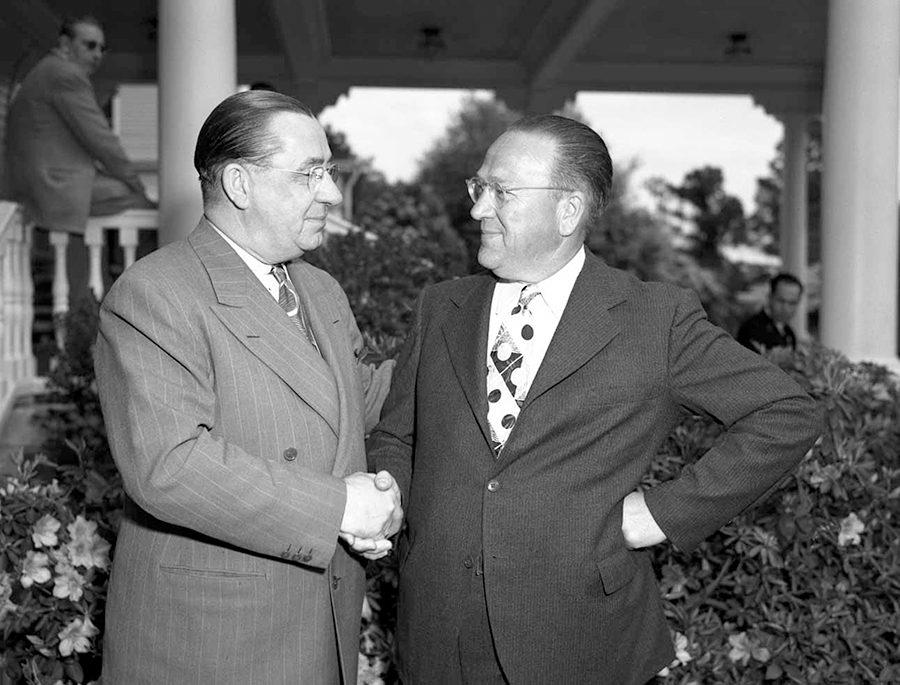
And it didn’t hurt the Hagen-Harlow fortunes that Hagen could pass for a movie star. Deeply tanned, not a single follicle of his immaculate black hair out of place, the always self-assured Hagen packed in the crowds. It was estimated he netted $45,000 annually from exhibitions. And he continued to play brilliantly in the big moments. During their association Hagen captured four Open Championships in Great Britain and five PGA Championships (four in a row from 1924 through 1927). The undisputed king of match play prevailed in 29 consecutive matches during that remarkable string. His unflappability coupled with recurring dramatic recoveries from seemingly impossible situations tended to dishearten opponents.

The only challenger to Hagen’s standing as the world’s finest golfer was the nonpareil amateur Bobby Jones. Both players spent their winters in Florida playing a lot of golf and selling a little real estate at two Gulf Coast country club developments — Jones at Whitfield Estates Country Club (now Sara Bay CC), Hagen at Pasadena Golf Club (now Pasadena Yacht & CC). “Matches of the Century” were a dime a dozen in the era of exhibitions, but if anything deserved the moniker, it would be Hagen v. Jones. In 1925, Harlow brokered the deal right down to the coin flip — a 72 hole home-and-home match to settle bragging rights and promote their respective clubs. It quickly turned into a rout with Hagen handing Jones the most lopsided defeat of his career, 12 holes up with 11 to play.

As if handling Hagen’s business wasn’t job enough, Harlow served as the guiding hand for the first National Golf Show held at New York City’s 71st Regiment Armory in May 1924. He arranged for promotional appearances by Hagen, Kirkwood, Gene Sarazen, Glenna Collett Vare and Alexa Stirling. Sixty-five exhibitors displayed equipment and clothing under one roof. A “Le Petit” (miniature golf) course was available for play, and the 8,000 patrons were wowed by a life-sized two-story clubhouse specially constructed for the exposition. Harlow also arranged for an exhibit of trophies from all of the major championships and, in a classic piece of Harlow marketing, emphasized their importance by posting an armed guard at the display.

In all matters, Harlow was shamelessly quick to leverage his association with Hagen. In February 1926, he wrote to Pinehurst titan Leonard Tufts that he and Hagen would be visiting again since Hagen planned to enter the North and South Open. After dispensing that welcome news, Harlow immediately segued into his sales pitch, writing, “ I should like very much to devote my publicity affairs and promotion work to Pinehurst from that time until after the North and South (Amateur) Championship.” He pointed out that the women’s field the previous year “was not too strong” and that he knew all the top Florida female amateurs and was sure he could get them to attend the 1927 event. Tufts replied that he hadn’t been all that impressed with the number of people Harlow had been able to produce in the past, yet still he consented to house him at the Carolina for “ten days to two weeks and $100 for expenses.”

Harlow and Tufts did the same tango the following February. With the 1927 Southern Open in Atlanta the week prior to the North and South Open, Harlow tried to sell the proposition that if Tufts retained him to represent the resort in Atlanta, “Pinehurst should obtain practically the entire Atlanta field . . . (as) it will be easy for me to persuade them to stop in Pinehurst on their way north.” Harlow naturally followed with his trump card. “I will have Walter Hagen in Pinehurst for the North and South Open as usual.”

Donald Ross opined that, while he was not opposed to retaining Harlow, the pros playing in Atlanta would likely appear in Pinehurst regardless. Club management conjured up a more difficult task for the promoter. “Why not ask him why he cannot bring Bobby Jones here for the North and South?” Harlow agreed to make the ask, but cautioned Jones would likely decline because of law school commitments at Emory University while unabashedly noting that if Jones was ever going to appear for anyone, “he would for Walter Hagen and myself as our association with him has been very friendly.” Tufts provided Harlow the same lodging and expenses afforded him in 1926.

In 1930, the PGA of America hired Harlow as its first official tournament bureau manager. The post involved the day-to-day organization of tournaments and public relations. In the throes of the Great Depression, Harlow faced the tall order of simply keeping what passed for the “tour” alive. Country clubs were closing. Sponsors reduced purses. Other events simply vanished from the calendar. Moreover, the PGA never had been able to schedule a full year’s slate of tournaments. Players still needed club pro affiliations to make ends meet. Harlow’s goal was to build a tour that would alter that paradigm. “It is entirely possible,” he claimed, “that in the future there will be sufficient tournaments and prize money — and with a schedule so changed that it will keep the better players profitably engaged for practically 12 months a year.”

There were plenty of blank spaces in the schedule and Harlow set about filling them. In 1931, the owner of the Miami Biltmore Hotel faced tax problems, and Harlow convinced him his predicament could be eased by holding a tournament on the hotel’s Donald Ross-designed course and donating the proceeds to charity. The Warm Springs Spa, where Franklin Roosevelt had undergone treatment for polio, would be the ideal beneficiary. The resulting Miami-Biltmore Open was a rousing triumph while also offering the tour’s richest purse, $10,000. The fundraising effort led to establishment of the March of Dimes.

Harlow stepped up the fledgling tour’s promotional efforts. He authored the first Tournament Players Record Book, which provided local newspapermen “a ready source of material to promote a tournament and write preview stories.” He continued writing his golf column and began publishing his own periodical, Golf News. Harlow sought to make “permanent news about golf as prominent as major league baseball.” He cajoled Hagen into speaking at fundraising dinners and exhorted local media to go the extra mile to promote tournaments because, like actors in a theater, the pros would not perform their best “playing to empty fairways.”
Prior to Harlow, players arranged their own starting times, teeing up when they wanted with whom they wanted. Hagen was a habitual offender, often appearing hours after he was expected. Harlow instituted mandatory tee times, prevailing on the local papers to publish them 24 hours in advance so fans would know when their favorites would be playing. Aware that there were players who failed to act with proper decorum, he issued a code of conduct, continually reminding pros that tournament golf was a form of show business, and they needed to act accordingly.

Compensation for the head of the PGA’s tournament bureau didn’t look much like the million dollar contracts and private jets enjoyed by today’s PGA Tour pooh-bahs. Moonlighting was more necessity than option. Harlow remained cozy with Hagen and managed the affairs and schedules of other players like Horton Smith, Ed Dudley and Paul Runyan. In the spring of 1932, after convincing American Fork & Hoe Company to underwrite a tour stop in New Orleans, Harlow extended his stay an extra day or two. By the time he left the Big Easy, he’d been sacked as tour manager almost certainly because of perceived conflicts of interest representing star players.

The players, led by Hagen, were outraged. They threatened to break away and form their own tour. In October of 1933, the PGA returned Harlow to his job, but by December of 1936 he was fired again. Despite his undeniable success keeping the tour alive in uncertain times, the higher-ups still seethed that he did not devote full time to the affairs of the tournament bureau.

A preternaturally optimistic person, Harlow, now 48, looked for an environment where he and wife, Lillian, a former New York opera singer, could flourish. Given his previous association with Leonard and Richard Tufts, Pinehurst seemed a logical choice. Maybe the Tuftses could be of assistance. They were. Harlow was hired as head of publicity for the resort in 1937 and held that position until World War II.

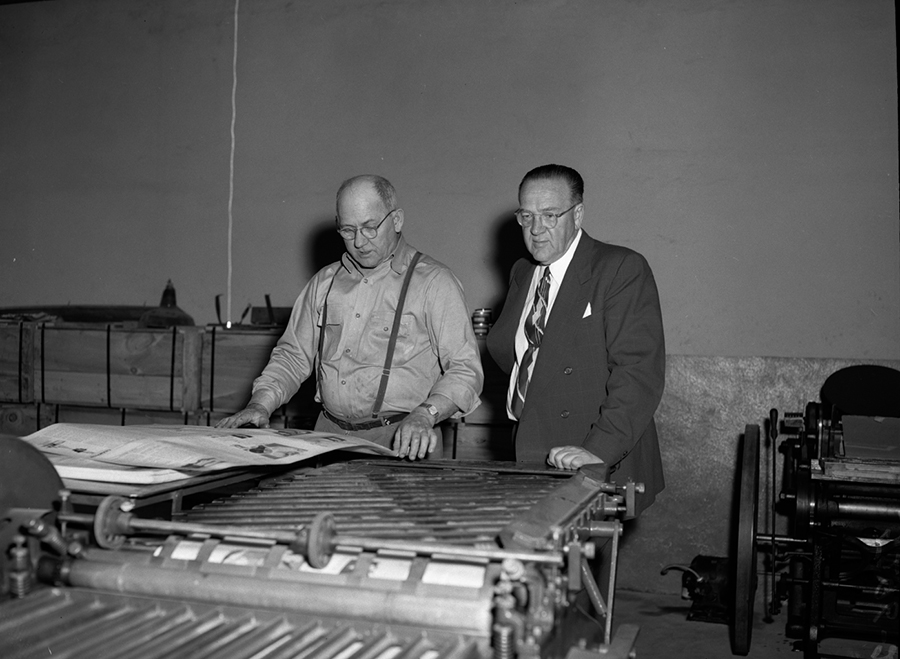
Not long after settling in Pinehurst, Harlow purchased The Pinehurst Outlook, a newspaper hitherto published weekly during the resort’s high season. Begun in 1897, the Outlook had focused on the social comings and goings of guests and members of the town’s swish cottage colony. Its offices were located in The Harvard Building (now the Old Sport & Gallery). Harlow became editor and publisher, and Lillian served as business manager.

In the November 12, 1939 edition of the Outlook, Harlow announced a new publishing schedule — every weekday during the season except Mondays, plus all Sundays. He intended to ramp up golf coverage. “The Editor . . . has long had a desire to assemble the . . . golf news of the world under one journalistic roof, and on this page, each Sunday, will endeavor to present at least a portion of the more interesting golf news which is not widely circulated by the daily press,” Harlow wrote. “It seems that a Pinehurst newspaper is a proper place for such material.”

While some national news would be reported in the Outlook, its general policy would be to avoid the “terrific controversies of the day.” As Harlow put it, “Pinehurst is a resort where visitors wish to forget for a time the problems of this disturbed world.” Still, as the winds of war blew in ’39, Harlow used golf to illustrate frightening changes taking hold in Germany. In one writing, he worriedly speculated what might be occurring at Berlin’s Wannsee Golf Club, ruefully noting that fully half the membership, including its president, Hans Zanuck, was Jewish.

Harlow attracted remarkable talent to his hometown newspaper. Charles Price, a premier golf writer of his generation, cut his teeth covering local events for the Outlook. Nationally known golf writer Herb Graffis contributed a regular column. And Harlow, a gifted essayist himself, composed numerous noteworthy pieces. He was proudest of crafting a series of articles commemorating the Pinehurst resort’s 50th anniversary in 1945. Laboring until 3 a.m. for three successive nights and authoring 24 pages of copy four days in a row, his work still ranks as an indispensable account of Pinehurst’s first half-century.

Believing the scope of the paper’s golf coverage would befit a national publication, Harlow hatched a weekly magazine ambitiously titled Golf World on June 18, 1947. While other golf periodicals existed, Harlow’s new publication raised the bar for scholarly writing about the game. Working in tandem with associate editor Tom O’Neil and with Lillian in charge of circulation and advertising, the magazine garnered 5,000 subscribers the first year of operation. Harlow re-emerged as a player on the national golf stage.

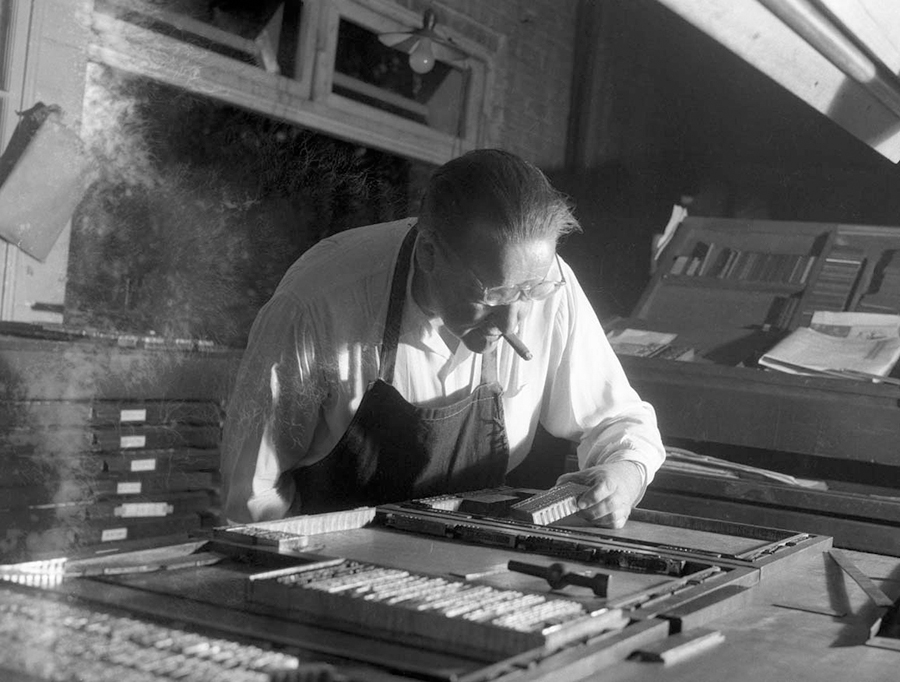
The offices of the Outlook and Golf World moved to the Pinehurst warehouse building, the white structure still located across the road from the 18th tee of PCC course No. 3. The burden of managing two publications proved too great, even for the energetic Harlow. On August 3, 1950, he announced the sale of The Pinehurst Outlook to the Wilson family. (It would cease regular publication in 1961.) With the Harlows able to concentrate their efforts on Golf World, circulation continued to grow, rising to 9,000 in its first five years. The same year he sold the Outlook, Harlow hired 14-year-old Tony McKenzie to do odd jobs, eventually including lithography and typesetting. McKenzie remembers many of golf’s great names breezing in to pay their respects to the publisher in his second floor office. Harlow’s ready supply of Wild Turkey and Seagram’s Seven Crown provided refreshment for the likes of Jimmy Demaret, Lloyd Mangrum, and Hagen himself. Tony remembers Sam Snead coming by too, although the Slammer was known to be abstemious.
On November 15, 1954, Harlow died suddenly at age 65, a victim of coronary thrombosis. By then his little magazine had subscribers in “every state of our country, every province in Canada and sixty foreign countries,” wrote Herb Wind. “Golf World was successful because it had the chatty, everybody-here-knows-everybody-else flavor of a home town newspaper. It had that flavor because Bob Harlow was a hopelessly friendly and companionable man.” The Outlook reported that his untimely death, “cast a pall of gloom over the entire village.” His friend and benefactor Richard Tufts remarked, “The world of golf has lost its best friend . . . I always came away from any contact with him stimulated mentally by his opinions and refreshed by the honesty of his purpose.” Harlow’s successor at the PGA Tournament Bureau, Fred Corcoran, wrote: “He opened the door to riches for American professional golfers. Yet he never forgot that golf is a game.”

A mourning Lillian Harlow announced that Golf World would continue and “. . . will be better than ever. It must be so as a monument to Bob.” And the magazine did continue under the editorship of Dick Taylor without missing a beat. Lillian moved the offices from the warehouse building to Southern Pines, and continued her ownership until 1972. After two interim owners, the New York Times Company bought Golf World in 1989 and relocated the magazine to Connecticut, joining another NYT property, Golf Digest. In 2001, it sold both magazines to Condé Nast. Golf World’s paper publication was terminated following the 2014 Open Championship. At the time, it was the game’s longest running publication. The title survives on Golf Digest’s website.

The list of the magazine’s contributors is long and venerable. It served as a platform for the likes of Ben Wright, Bob Drum, Al Barkow, Lorne Rubenstein, Bob Verdi, Dave Anderson, John Feinstein, Curt Sampson, Geoff Shackelford, Steve Eubanks, Nick Seitz, Moore County resident Jaime Diaz and PineStraw’s Jim Moriarty and Bill Fields, to name just a few.

In 1988, Harlow was inducted into the World Golf Hall of Fame. The only others enshrined for writing about and/or publicizing the game are Corcoran, Wind, Graffis and, most recently, Dan Jenkins. He joined Donald Ross and Richard Tufts as the only Pinehurst residents in the Hall.

Of the notable golf people who have called Pinehurst home, Bob Harlow’s name is rarely mentioned. Among visitors to the modern golf Hall of Fame near St. Augustine, he would rank right at the top of the “Who’s that?” list. But, a trailblazer’s footprints can have a light touch.  PS

Pinehurst resident Bill Case is PineStraw’s history man. He can be reached at Bill.Case@thompsonhine.com.

Almanac

February, a form

Pale-vestured, wildly fair,—

One of the North Wind’s daughters,

With icicles in her hair.

– Edgar Fawcett, “The Masque of Months” (1878)

.

 The Snow Moon

Perhaps no poem paints a more fitting portrait of this time of year than Thomas Hardy’s classic verse about a “blast-beruffled” bird whose joyful song pierces the silence of a dark and desolate eve like an arrow through autumn’s last apple.

Read: February is here. Behold the first glorious explosion of golden daffodils.

Although “Darkling Thrush” is set at the cusp of a new year (and century), its haunting image of “tangled bine-stems” slicing the sky “like strings of broken lyres” invokes, at least for this nature lover, the bleakest yet most beautiful days of winter. Since the heaviest snows tend to fall this month, the full moon on Friday, Feb. 10, has long been called the full snow moon. The Cherokee called it the bone moon because, well, food was so scarce that supper was often marrow soup.

Speaking of soup, now’s time for root vegetable stews and chowders thick with heavy cream and gold potatoes. Make enough and you can eat from it all week — a quick and hearty fix after a cold evening spent pruning the rose bush and deadheading pansies. Through the kitchen window, a brown thrasher gently swings on the suet feeder before disappearing with twilight. It’s cold, but daylight is stretching out a little further every day. The soup simmers on the stovetop. Spring will be here soon.

Say it with Flowers

Violet and primrose are the birth flowers of February. The old folk poem calls the flower blue, but violets bloom mauve, yellow and white, too. Gift a lover a violet on Valentine’s Day and they’ll read: I’ll always be true. As for the primrose, a pale yellow perennial that thrives in cool woodland glades, the message crackles like an ardent fire:
I can’t live without you.

.

Love looks not with the eyes, but with the mind

And therefore is winged Cupid painted blind.

Nor hath love’s mind of any judgment taste;

Wings and no eyes figure unheedy haste.

And therefore is love said to be a child

Because in choice he is so oft beguiled.

– William Shakespeare, A Midsummer Night’s Dream


A Grimm Fellow

Wilhelm Grimm, younger of the Brothers Grimm, was born Feb. 24, 1786, in Hessen, Germany. Perhaps that’s why National Tell a Fairy Tale Day falls just two days later, on Sunday, Feb. 26. In addition to publishing a hefty collection of folk tales — “Hänsel and Gretel,” “Der Froschkönig” (“The Frog Prince”), “Dornröschen” (Sleeping Beauty), “Schneewittchen” (“Snow White”), and on and on — the brothers started writing a definitive German dictionary in 1838, but never did get around to finishing it. Add a little extra magic to this month of love by spinning a tale about fairies or mermaids, or, in the spirit of this bleak wintry season, perhaps something a bit darker. Like the one where the evil stepsisters cut off their toes to make the glass slipper fit.

Shadow Market

A fanciful dealer in dark wares

By D.G. Martin

When Fred Chappell writes, multitudes of fans stop and read. Now retired, he was for more than 40 years a beloved teacher of writers at UNCG, where he helped establish its much-admired Master of Fine Arts in Writing program. He served as North Carolina poet laureate from 1997 until 2002. He is revered by many for his fiction, especially his early works based on his years growing up in the mountains. But his 30 some-odd books show his determination not to be limited to any genre, geography or time.

His latest book, A Shadow All of Light, demonstrates the wide scope of his imagination and talent. It is a magical, speculative story set in an Italianate country hundreds of years ago. Chappell asks his readers to believe that shadows are something more than the images people cast by interrupting a light source. These shadows are an important, integral part of a person’s being. They can be stolen or given up. When lost, the person is never the same.

In Chappell’s tale, an ambitious young rural man, Falco, comes to a big port city (think Venice), where he attaches himself to a successful shadow merchant, Maestro Astolfo. Over time Falco learns the trade of acquiring and selling shadows detached from their original owners. The business is a “shady” one because the acquisition of human shadows often involves underhanded, even illegal methods, something like today’s markets in exotic animal parts or pilfered art.

But Maestro Astolfo and Falco, notwithstanding public attitudes, strive to conduct their business in a highly moral manner. Although losing one’s shadow could be devastating, the situation is mollified if a similar replacement can be secured from shadow dealers like Astolfo or Falco.

Chappell, in the voice of Falco, explains, “No one likes to lose his shadow. It is not a mortal blow, but it is a wearying trouble. If it is stolen or damaged, a man will seek out a dealer in umbrae supply and the difficulty is got around in the hobbledehoy fashion. The fellow is the same as before, so he fancies, with a new shadow that so closely resembles his true one, no one would take note.

“That is not the case. His new shadow never quite fits him so trimly, so comfortably, so sweetly as did his original. There is a certain discrepancy of contour, a minor raggedness not easy to mark but plainly evident to one versed in the materials. The wearer never completely grows to his new shadow and goes about with it rather as if wearing an older brother’s hand-me-down cloak.

“Another change occurs also, not in the fitting or wearing, but in the character of the person. To lose a shadow is to lose something of oneself. The loss is slight and generally unnoticeable, yet an alert observer might see some diminishing in the confidence of bearing, in the certitude of handclasp, in the authority of tread upon a stone stairway.”

After introducing his readers to the complexities of shadow theft, storage and trade, Chappell takes Falco, Astolfo and their colleague Mutano through a series of encounters with bandits, pirates and a host of other shady characters. Mutano loses his voice to a cat. Bandits challenge Falco’s efforts to collect rare plants that eat human shadows. Pirates led by a beautiful and evil woman battle the port city’s residents for control.

Similar to Rogue One: A Star Wars Story, Chappell’s A Shadow All of Light is fast-paced, mythic, and unbelievably entertaining.  PS

D.G. Martin hosts North Carolina Bookwatch, which airs Sundays at noon and Thursdays at 5 p.m. on UNC-TV.