The Cruds

The sacred golf buddy trip reaches 100

By Lee Pace

There’s nothing quite like the golf buddy trip: escape, golf, drinking, golf, gambling, golf, cigars, merciless razzing and needling, hangovers, golf and a special brand of childishness among grown men that few other venues can generate. Some guys are skilled players with deep pockets who play the British Open courses from the tips with a trip concierge. Others are 18-handicappers in cargo shorts who make a beeline from the 18th green to a Myrtle Beach honky-tonk.

In February 1967 a group of eight members at Hope Valley Country Club in Durham discovered that particular elixir of adventure and camaraderie that is the golf buddy trip. They ventured to Myrtle Beach when it was a sleepy town with three golf courses, enjoyed the occasion and decided to take another in the fall. Two more, spring and fall, followed in 1968. Ditto 1969, ad infinitum, and since the sixth trip, each has been a 54-hole weekend.

And so this October, this same group of men, certainly with some additions and subtractions over half a century, will travel to The Dunes Club for another 54-hole event — its 100th trip.

“This piece of paper goes back to the very beginning,” Russell Barringer Jr. is saying in his office at his Durham building supply company as he looks at a faded ledger pad. Across it are pencil notations with names, dates, hotels and golf courses dating back to that first trip when LBJ was president and the Super Bowl had just one Roman numeral.

“If you do the math, we’ve played 307 rounds of golf, with three of them on a special trip we made to Scotland in 1974. That’s 304 days of golf in Myrtle Beach, and we’ve missed eight days to weather. That’s remarkable — only eight of 304 rained out.”

He continues.

“Two hundred and twenty-five rounds have been at The Dunes Club.

“Forty-four men have been in our group. Eleven are dead. Three have resigned. Nine are inactive. That leaves 21 active Cruds left.”

Cruds? What’s a Crud?

Barringer relishes telling the story. The original eight golfers — all of them with handicaps of seven or less — enjoyed the trip so much they decided to expand the group and were talking the trip up to other Hope Valley members. The wife of one prospective member overheard a conversation and interjected: “Who’s going on this trip?”

The names were rattled off — all of them up-and-coming businessmen, doctors, lawyers and stockbrokers in their early 30s — and the woman sniffed, “My husband’s not going out of town with those cruds.”

“The name stuck. We’ve been the Cruds ever since,” Barringer says.

Barringer missed the first trip because he and his wife had a previously scheduled trip to Jamaica planned, but he was on the second trip and has not missed one since. The trip to the beach Oct. 13-16 will be his 99th consecutive, longest by a large margin over Bob Baker’s 80-some straight trips.

“Mr. Barringer’s been talking about number 100 for several years now,” says Dennis Nichol, director of golf at The Dunes Club. “That seemed to be his finish line. He’d say, ‘I’m hanging on for a hundred.’

“This is quite a remarkable group. I’ve known of groups coming to the beach for 20, 25 years, but nothing as long as this group. He runs a tight ship. Some groups are a cluster. They’re hung over, no one’s in charge, and sometimes they’re not even at the right golf course. Mr. Barringer is a stickler for the details, and his guys have such a good time and enjoy each other’s company.”

The Cruds did their share of barhopping in the early days, but no one ever got into serious trouble. One Crud was convinced he was beaten up in the bathroom on the back nine at The Dunes, when in truth he was so hungover his cleats tripped him entering the building and he took a nasty fall. And there was an over-served Crud who one year threw some furniture off the second floor balcony of the motel and resorted to putting the damage charge of $365 on his company credit card. That prompted one member to pen a poem by the next trip that opened:

Twas the second of October at Myrtle Beach shore;

The Cruds were assembled for a weekend galore.

Graciously received by the St. John’s Inn;

If only they’d known of the forthcoming din.

“There’s been a lot of teasing and razzing going back and forth,” Barringer says. “Guys will jump your ass over the smallest thing, but it’s never hateful or serious.”

Barringer assumed the role of secretary/treasurer from that fall trip in 1967 and since then has juggled raising three children, running his business and myriad other commitments with operating a taut Cruds ship. He spent 12 years in active Reserve, and eight others of the early Cruds had some military or service background, so it’s no surprise letters to the members might begin, “You will report to the Thunderbird Motel, 73rd Avenue North, no later than 2300 hours,” and “Officers” were appointed for such responsibilities as handicaps, Bloody Marys and even “regrets & remorses.”

The Cruds stayed mostly at the St. John’s Inn in the early days, sometimes at the Thunderbird, and the charge per man in 1968 was $14 per person per day, including room, breakfast and golf. Barringer joined The Dunes Club in 1974 and later bought a condominium and then a single-family home in the neighborhood, so now eight golfers each year can stay in his homes, and several other members have second homes at the beach as well. Most of their golf has been played at The Dunes, but in the early days they ventured out to courses like The Surf Club. Barringer says none of the Cruds have been heavy gamblers, so they put up $25 per man per day for various competitions.

The Saturday night dinner this October promises to be an emotional one. They’ll take a group photo on the 13th hole at The Dunes, each Crud wearing a navy blazer, off-white slacks and the matching shirts that Barringer has custom-ordered every five trips. The usual table will be set in the dining room for the 11 deceased members, with a photo of each golfer at his place setting, and after the invocation and Pledge of Allegiance, each fallen Crud will be recognized and toasted. It will pain Barringer to see two Cruds with medical attendants nearby, one having suffered a stroke and another needing dialysis four days a week.

“I’m going to make a prediction,” Barringer says. “This 100th trip will be the last by the Cruds as we know them. Four or five years ago, I proposed the idea that we think of turning the group over to our sons. I think the group will go in that direction after 100.

“We’ve really been bonded by golf. The Cruds have been such a part of my life, I don’t want to just let it go. That’s one of the reasons I want to perpetuate the group. I want my kids, now grown adults, to enjoy what I’ve had for so many years.”

Enjoy, indeed: the elegance of The Dunes Club and Robert Trent Jones’ 1948 masterpiece. The scent of the salty air off the Atlantic. A Bloody Mary at the turn. A crisp 7-iron and a good pal ready to giggle if you catch it the slightest bit fat.  PS

Lee Pace’s first book on Pinehurst, Pinehurst Stories, was released just weeks before the 1991 Tour Championship.

October Books

By Kimberly Daniels Taws

Sirius: The Little Dog Who Almost Changed History, by Jonathan Crown (Oct. 4)

Sirius, a very smart fox terrier, takes a circuitous route from Germany to America and back to Germany during the 1930s and ’40s. Having been a movie star in Hollywood, then taken in by Hitler, he realizes he misses his family and escapes to await his reunion with them. A delightful story of a dog that “almost changed history” and learned that home is where your heart is.

El Paso: A Novel, by Winston Groom (Oct. 4)

The author of Forrest Gump returns with his first piece of fiction in 20 years. El Paso expands the classic Western into epic historical fiction. An aging American tycoon and his son race to the desert to find their ranch destroyed and his grandchildren abducted by Pancho Villa. Yankee money and political clout mean nothing against the harsh climate of Mexico. The father and son nearly lose all hope until a twist of fate connects them with a matador in search of his wife, also abducted by Villa. This book is sure to be the hit of the fall.

Bolshoi Confidential: Secrets of the Russian Ballet from the Rule of the Tsars to Today, by Simon Morrison (October/November)

Music historian Simon Morrison presents an enthralling and definitive history of the Bolshoi Ballet, where visionary performances onstage compete with political machinations backstage. A fun and sophisticated read.

Rogue Heroes: The History of the SAS, Britain’s Secret Special Forces Unit that Sabotaged the Nazis and Changed the Nature of War, by Ben Macintyre (Oct. 4)

The author of A Spy Among Friends: Kim Philby and the Great Betrayal returns with this story of the group that forever changed the rules of war, using unconventional tactics to sabotage the German war machine. Most interesting is the mastermind behind the Special Air Service, David Sterling.

Speaking American: How Y’all, Youse, and You Guys Talk: A Visual Guide, by Josh Katz (Oct. 25)

Fantastic graphs show patterns of speech in the United States, including linguistic discrepancies like “lightning bug” or “firefly” and varying terms for BBQ and lawn care. It’s a beautiful package, sure to be an entertaining gift for friends and family members across the country.

Smithsonian’s History of America in 101 Objects, by Richard Kurin (Oct. 25)

This is a well-priced hardcover full of pictures revealing who we are by what we leave behind.

The Tunnels: Escapes Under the Berlin Wall and the Historic Films the JFK White House Tried to Kill, by Greg Mitchell (Oct.18)

In the summer of 1962 West Berliners risked everything to dig tunnels under the wall and provide dangerous escape routes for East Berliners. Eager to report on the story, CBS and NBC both sponsored a tunnel in exchange for the ability to film the escapees. In the end, JFK and Secretary of State Dean Rusk stopped the documentaries. This book is a riveting look at the people creating and surrounding this moment in time.

Cooking For Jeffrey: A Barefoot Contessa Cookbook, by Ina Garten (Oct. 25)

The Barefoot Contessa returns with a unique cookbook reinforcing her no fuss, no problem cooking that has served as a guidebook for home cooks of all ages. This book is a culinary love letter to her husband of more than 40 years and tells the story of their courtship and life together. It’s full of new recipes for the home cook to prepare for any loved one.

We Show What We Have Learned, by Clare Beams (Oct.25)

This collection of short stories is the latest book from Lookout Press, a small press tied to the University of North Carolina at Wilmington’s Creative Writing Department. The stories are tinged with other-worldliness as ingénues at a boarding school bind themselves to their headmaster’s vision of perfection; a 19th-century landscape architect embarks on his first major project, but finds the terrain of class and power difficult; a bride glimpses her husband’s past when she wears his World War II parachute as a gown; and a teacher comes undone in front of her astonished fifth-graders. This collection of short stories is an accomplished delight and sure to appeal to the literary reader.

The General vs. The President: MacArthur and Truman at the Brink of Nuclear War, by H.W. Brands (Oct. 11)

Brands, twice a finalist for the Pulitzer Prize, chronicles the contest of wills between these two historic figures, unfolding against the turbulent backdrop of the Korean War and terrors conjured at home by Joseph McCarthy. From the drama of Stalin’s blockade of West Berlin to the daring landing of MacArthur’s forces at Inchon to the shocking entrance of China into the war, The General and the President vividly evokes the making of a new American era.”

The Mothers, by Brit Bennett (Oct. 11)

This literary coming-of-age novel begins with a secret in the teenage years and asks the question if we ever truly escape the decisions of our younger selves, the communities that parented us, and the choices that shape our lives forever.

CHILDREN’S BOOKS

By Angie Tally

One More Dino on the Floor, by Kelly Starling Lyons. Budding paleontologists will enjoy hip-hopping, foot-stomping, hand-clapping, finger-snapping and counting one to 10 as the dinosaurs get their groove on in this delightful counting book. With bright colorful illustrations and fun rhythmic text, young readers will be tapping their feet to the Jurassic beat. Dinosaur lovers age 3-8 and their families are invited to meet the author, Kelly Starling Lyons, and celebrate National Fossil Day with an afternoon of dinosaur and fossil fun Tuesday, Oct. 11, at 4 p.m., at The Country Bookshop.

Gertie’s Leap to Greatness, by Kate Beasley. It is the first day of fifth grade and Gertie Reese Foy is 100 percent excited! She has two best friends (Genius Jean and sweet kind Junior), she has an amazing summer story to tell, and best of all, she has a plan for greatness that she is sure will bring her long-lost mother back into her world. But when all the things she holds dear are threatened by new girl Mary Sue Spivey, beautiful daughter of a Hollywood movie producer, Gertie must decide what is really important. With the pluck of Ramona Quimby, the cleverness of Mo LeBeau and the stick-to-it-ness of a Penderwick sister, Gertie will charm her way into the hearts of readers. (Age 8-12.)

Projekt 1065. Award-winning, critically acclaimed, North Carolina Battle of the Books author Alan Gratz, author of the powerful WWII historical fiction novel Prisoner B-3087, returns with another gripping World War II story, this time about Michael O’Shaunessey, the son of the Irish ambassador to Nazi Germany who served as a spy in the Hitler Youth. Despising everything the Hitler Youth stood for, from book burning to horrific games, O’Shaunessey was charged with delivering insider information to his parents and the British Secret Service, but when tasked to find out more about Projekt 1065, a secret Nazi mission, O’Shaunessey must prove his loyalty to the Hitler Youth even if it risks the lives of those he loves. Gratz will be at The Country Bookshop Friday, Oct. 7, at 4 p.m., to discuss Projekt 1065 as well as The League of Seven, Gratz’s Steampunk fantasy adventure series, which is on the North Carolina Elementary Battle of the Books list for 2016-17.  PS

Sound and Fury

How the Carolina Theatres of Pinehurst and Southern Pines navigated the leap from silent films to talkies in 1928

By Bill Case

he man in charge of virtually everything in Pinehurst perused the June 1928 edition of Motion Picture News, bypassing the provocative feature on the recent European vacation of Hollywood’s most glamorous couple, Douglas Fairbanks and Mary Pickford. Instead, 32-year-old Richard Tufts concentrated his attention on the trade paper’s lengthy editorial dealing with the rapid emergence of the talking movie — a technological advancement in the film industry likely to alter the business model for movie studio and theater owners alike. One of the many hats Tufts wore in his ubiquitous management of Pinehurst was that of president of Pinehurst Theatre Company, operator of the town’s 5-year-old movie house, The Carolina Theatre, at 90 Cherokee Road.

So, on June 21, 1928, Tufts posted a letter to PTC’s general manager, Charles Picquet, expressing the view that, “Pinehurst should be one of the first to have talking movies.” Ever close with a buck, Richard focused on how the costs of retrofitting the theater to exhibit “talkies” could be minimized. With Picquet’s connections as president of the Carolina Theatre Owners Association and vice-president of the National Theatre Owners Association, Tufts thought he might avoid the estimated $11,000 cost of synchronizing for sound. To him it was product placement Roaring 20s style. “With your influence and with the recognized standing of the
Pinehurst Theatre, it might be possible for us to persuade some of the companies to locate a machine here, pretty much at their expense, in order to obtain publicity for the talking movies,” Richard suggested. Presumably his clientele, the upper crust of the East, once having experienced talking pictures in Pinehurst, would induce theater owners back home to convert to the new technology.

Picquet was the man Richard Tufts tasked with the job of keeping his resort guests and the well-heeled members of the town’s “cottage colony” entertained. Along with his wife, Juanita, Picquet had once been a member of a light opera troupe touring the U.S. and Canada. Whether it was managing the Sandhill Fair, organizing local choral groups, luring performers like humorist Will Rogers for theatrical engagements, or exhibiting feature films, Charlie was in the middle of things. He was a hands-on manager, typically greeting movie patrons wearing a tuxedo with a carnation in his lapel, then scurrying to the projection booth, changing into a blue denim jumper and running the projector. When the last frame flickered out, Picquet would be back at the theater entrance in his tux as the audience filed out.

Picquet wasted no time replying to Tuft’s suggestion, advising him events were moving at a dizzying pace. He said Paramount Pictures had already announced that “75 percent of their new product will be synchronized (talking pictures) and Metro will do the same.” Theaters in Greensboro and Raleigh were showing talkies, as were two movie houses in Charlotte. Picquet believed movie houses everywhere would inevitably have to buy in or close. Manufacturers couldn’t keep up with the demand for sound synchronization equipment, making Richard’s hope of obtaining it gratis seem as fanciful as the movies themselves. Picquet warned that addressing the issue could not be sidestepped: “We cannot escape it no matter how much we would like to.”

Since PTC was its own company, Richard Tufts and Charlie Picquet could not act unilaterally. The support of a majority of the 21 shareholders was required for such an extraordinary expenditure. Those shareholders included some glittering names in the Pinehurst galaxy: Henry C. Fownes (steel magnate and founder of Pittsburgh’s Oakmont Country Club); George T. Dunlap (founding partner of Grossett & Dunlap publishers); Leonard Tufts (Richard’s father and owner of the controlling interest in Pinehurst, Inc.); and Donald Ross (Pinehurst’s unparalleled golf course architect).

In light of Picquet’s sense of urgency, Tufts authored a message on July 16, 1928, to PTC’s shareholders asking for an immediate vote on whether to obtain sound equipment. “It is apparent to the officers of your company that the moving picture industry is about to undergo one of those revolutionary changes which new inventions frequently bring to an industry,” he wrote. Richard made the case that if the requisite synchronization equipment wasn’t put in, “. . . we shall probably lose business during the coming winter as many of our patrons will be accustomed to attending the ‘talking movies’ already installed in practically all the larger cities. We cannot afford to have this happen because we depend wholly on our winter patronage to make money.”

Since smaller theaters around Pinehurst seemed unlikely to make the move for the upcoming season, Richard was confident he’d quickly recoup the investment in box office receipts and wanted PTC to immediately initiate acquisition of the equipment. He framed the proposition this way: “If the ‘talking movies’ are with us to stay, it seems almost axiomatic that the sooner we are on the bandwagon the better off we shall be.”

Like any innovation, talking movies had its detractors. There were respected voices in the motion picture business that believed they were little more than a passing fad. Some trade journals expressed concern that the exorbitant costs of producing a sound movie made them impractical. There were fears the rehearsals necessary for actors to master dialogue would compound production costs. Not all silent stars possessed the voice and thespian skill to make a seamless transition to talkies. Other industry flacks believed the public wouldn’t accept the disappearance of silent movies’ orchestral accompaniment. And, the musicians’ union promised a battle royale to protect its members whose jobs would disappear if the talkies actually caught on. There was enough negativity bandied about to give pause to theater owners concerned about laying down serious cash for an extravagant new sound system.

With Richard Tufts on board, however, shareholder approval seemed a mere formality. He controlled enough stock by himself that he needed very little support from the non-family shareholders to get approval for his plan. The formality proved to be anything but. With an eye toward his own bottom line, J. T. Newton, holder of nine shares, was out. He was “opposed to any such expenditure that would reduce dividends.” George Dunlap ambivalently stated that while it might be necessary to “hook up” with the talking movies, his personal preference “would be the other way.” But it was H.C. Fownes’ opposition that caused Richard to waver on the proposal himself. Fownes argued the concept was only in its formative stages and questioned whether PTC was “in the proper financial condition at present to make the investment.”

Fownes’ reply to Richard had somehow caused a flip in the PTC president’s viewpoint. On July 31, Tufts wrote to Picquet, “The more I think about it, the more I think Mr. Fownes is right.” The purchase of synchronization equipment was suddenly in doubt. What caused Richard to make such a quick about-face? The answer may lie in a parallel theater-related brouhaha.

That dispute involved another movie theater operating at 143 N.E. Broad St. in Southern Pines also named the “Carolina Theatre.” PTC did not own the Carolina Theatre of Southern Pines, but Picquet and Tufts, personally, did. Though the two Carolina Theatres were not under common ownership (one owned by the PTC shareholders, the other by the Picquet/Tufts partnership), Richard considered it beneficial for them to be managed as one, giving Picquet leverage in obtaining films from distributors on terms that a single screen operator could not achieve. The two theaters could coordinate their movie showings and share the costs of a single film rental.

Earlier in 1928, Tufts and Picquet asked PTC shareholders to consider financially participating in the construction of a new theater in Southern Pines to replace the existing one, which Richard described as “a dump.” Fownes, however, rejected PTC’s participation in the construction venture outright. Richard fumed at this unanticipated roadblock and fired off an indignant missive to Fownes declaring that “it would be impossible for Mr. Picquet and me to adjust . . . if the stockholders have lost confidence in the way we have conducted the theater. It would be so much better for us to get out.”

ps-theater2-10-16

The dust-up was resolved only after the landlord of the Southern Pines Carolina Theatre agreed to make overdue improvements. Richard usually avoided run-ins with the elite members of Pinehurst’s “cottage colony.” His atypical outburst probably caused some uneasiness in his relationship with H.C. who was arguably the most prominent cottager of all, serving on the country club’s board of governors and Pinehurst Inc.’s citizen advisory board. Fownes had personally supported a local bond issue and, after the crash of 1929, would help bail out Pinehurst, Inc. by contributing $30,000 to retire its delinquent bank note.

When the issue of PTC’s transition to talking movies arose, Tufts would naturally have been reluctant to engage in another fractious dispute with Fownes. So, when H.C. reported on Aug. 6 that a friend in the film industry had confirmed “it would be a mistake to make an investment to the degree you (Richard) estimated an outfit would cost,” Tufts did not push back. Pinehurst’s Carolina Theatre would remain a silent movie house for the duration of the resort’s 1928-29 season.

Picquet, however, was not inclined to take no for an answer. When he got wind of Fownes’ letter, he composed a diplomatic rebuttal. He informed Richard that he was “glad to see the note from Fownes also as I am anxious to hear all sides of the sound question.”  However, the manager pointed out, “talkies are packing them in even during the most torrid weather while ‘silents’ are suffering and closing . . . Fox has stopped silents. Within a month Paramount and Metro will do the same . . .Within two months all newsreels will be talkies.”

Facing what he was sure would be dismal winter admissions in Pinehurst, Charlie urged reconsideration of the decision in an Aug. 10 message: “I am going on record . . . to predict that we would more than pay for the installation within the next two years in increased attendance and higher admissions . . .The theaters that will clean up . . . are the theaters who get in on it now while there are comparatively few installations.” Picquet also mentioned that, “Contrary to Mr. Fownes’ report, Pittsburgh’s sound theater is doing a turn-away business and the silent ones are doing almost nothing.”

Perturbed at his general manager’s drumbeating, Tufts suggested Picquet was not fully in tune with public taste. On Aug. 27 he wrote he was “very much impressed at the lack of interest shown (in talkies). Most . . . do not like them and prefer the organ music.” He intimated people in the trade were getting ahead of their own customers.

The correspondence between Tufts and Picquet took on a frostier tone. On Sept. 5, Charlie rubbed it in that the Greensboro sound theater was perpetually “SRO” and that in three months, the resulting profits would pay for the equipment. Three days later, Richard noted the impresario’s ongoing “propaganda on talking movies.” No still meant no.

Picquet took a September vacation to New York, where he enjoyed racing days at Belmont Park but also found time to hobnob with fellow movie people. Not above negotiating in the press, when he returned Charlie informed The Pilot that he had concluded, “after tramping Broadway from end to end . . . the ‘talkies’ are here to stay.” With Tufts still opposed, Picquet tried another tack on Oct. 23. He offered “to ‘hock’ my stock with the bank in order to provide funds for the installation.” So sure was he that Richard and H.C. would find his offer acceptable that Charlie began arranging for purchase of the equipment.

Even that gambit misfired. Fownes still objected. He feared PTC would wind up on the hook morally, if not contractually, if the investment didn’t pan out. On Dec. 17, Picquet informed them he had already personally bought the necessary equipment, but that if “Mr. Fownes is unwilling to allow me to put it in, I would suggest that it be installed in Southern Pines.” Charlie also sounded the alarm that the competing theater in Aberdeen was “rarin’ to install one and will get it, if I do not.”

The frustrated Picquet could not resist taking a potshot at H.C. “Of course, Mr. Fownes does not know it, but the silent pictures from now on are going to be ‘sorry’ affairs . . . No less than 15 silent pictures which were booked for November and December, have been withdrawn to make ‘talkies’ . . . This means that the silent pictures will be junk.”

Finally, Tufts relented, allowing Picquet to install sound synchronization equipment in Southern Pines’ Carolina Theatre. Nelson Hyde’s editorial in The Pilot hailed the coming of the talkies: “This week Charlie Picquet expects to present the first talking picture show ever brought to middle North Carolina.” Hyde cited the “courage of the Carolina Theatre’s management” in bringing about the talkies’ arrival.

On March 7, 1929, Southern Pines’ Carolina Theatre debuted its first talkie, The Iron Mask, starring Douglas Fairbanks in his inaugural speaking role. The Pilot remarked that “Mr. Picquet worked feverishly for two days to assemble his new de Forest Phonofilm projector for the Fairbanks production, and the presentation was voted a great success by those present.”

The Pinehurst Carolina Theatre continued to show silent movies as an alternative to the talking variety exhibited by the sister theater in Southern Pines. In April, a Lupe Velez movie was exhibited in silent form at Pinehurst while the sound adaptation was on view in Southern Pines. The Pilot encouraged moviegoers to check out both versions and reach their own conclusions. The verdict, in the Sandhills and everywhere else, came swiftly: the market for silent pictures had vanished altogether. The Pilot observed in November that, “the Pinehurst house has been playing to handfuls while Southern Pines has been turning people away. No longer will the public go to see silent films while they can witness musical comedies and cry with the tragedians . . . (T)his season was only four weeks along when it became evident to Mr. Picquet and others interested in the Pinehurst theater that times have changed and the old dog is dead.”

Once they observed in the fall of 1929 that silent movies in Pinehurst were playing to a nearly empty theater, Tufts and Fownes swallowed their pride and changed course rapidly. In November, they authorized Picquet to acquire a de Forest projector for Pinehurst and get it installed promptly. As astute businessmen, they may have missed the launch, but they weren’t going to miss the boat. Normal delivery would have taken months. But Picquet managed to expedite matters. The Carolina Theatre Owners Association scheduled its annual meeting in Pinehurst for Dec. 9-10, 1929. Lee de Forest, the inventor of the radio tube and the de Forest projector, was slated to speak at the convention. Charlie reasoned that if talking pictures’ grand opening at PTC could be scheduled to coincide with the gathering, he could prevail upon his fellow theater owners to attend. He pitched to the manufacturer that the conventioneers would make for a target-rich audience for de Forest to showcase their projector in action. His pitch worked; delivery was expedited and the equipment installed at the theater in record time. PTC’s first sound movie was presented on Dec. 9 to a packed house. The Love Parade, a musical comedy starring Maurice Chevalier, was well-received by a crowd seeking respite from the jolt of the stock market collapse. Lee de Forest himself came by to offer remarks to the enthralled audience about the revolutionary synchronization system.

Thereafter, neither theater looked back, enjoying good runs for the next 25 years. As consumer tastes changed mid-century, it became increasingly difficult to economically operate a seasonal movie theater. Pinehurst’s Carolina Theatre showed its last film on April 25, 1954. A local theatrical company performed plays for a time, but in 1962, the Pinehurst theater went permanently dark. Subsequent renovation led by new owners Marty and Susan McKenzie transformed the building  into market space by 1981.

Despite advancing health problems and fierce competition from the Sunrise Theatre, Charlie Picquet doggedly kept the Southern Pines Carolina Theatre going. Longtime Southern Pines resident Norris Hodgkins ushered for Charlie at the Carolina Theatre in the late 1930s. Hodgkins remembers that his boss observed formalities not often practiced in other theaters. “Mr. Picquet had us ushers wearing spiffy bellboy uniforms with pillbox hats. If a customer misbehaved, Mr. Picquet tossed him out,” says Norris. “There was no concession stand at The Carolina. No popcorn, no soda. Mr. Picquet believed that food inside the theater detracted from the tone.”

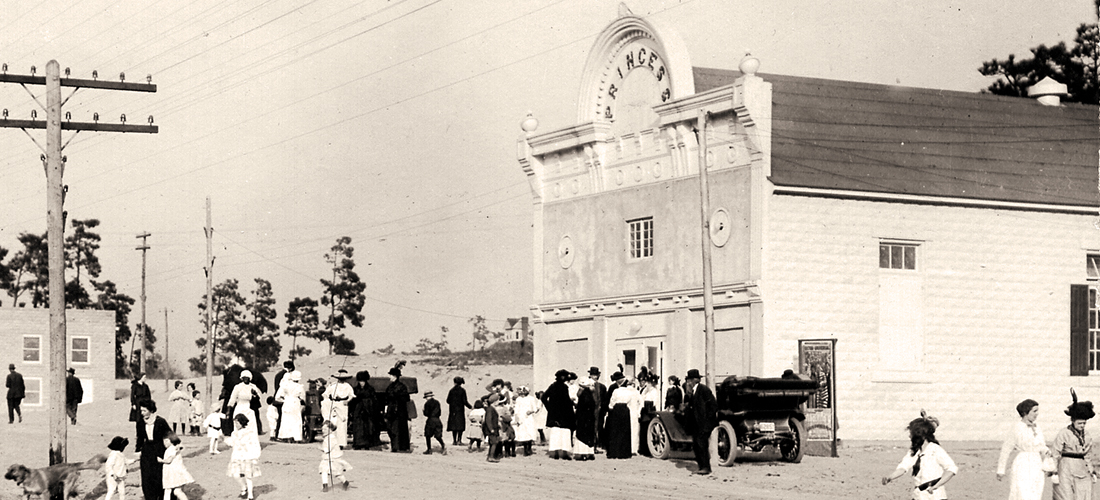
Always nattily attired, Picquet faithfully followed his nightly ritual of personally greeting his theatergoers, then bidding them goodbye after the final credits rolled, a practice he continued until the day he died of a heart attack at age 81 in May 1957. The last movie Charlie showed was a classic: Alfred Hitchcock’s thriller Strangers on a Train. All of Southern Pines’ merchants closed their businesses for an hour to mourn the man who opened the town’s first theater in 1913 — originally named the Princess Theatre — and ran it for 44 years. After Charlie Picquet left its stage, the theater never reopened.

Katharine Boyd paid homage to Picquet in The Pilot, writing that he was “. . . the George M. Cohan type, the trouper through and through: the good friend, the good American.” She noted that Picquet started a competition for musically gifted high school students, the Picquet Cup, and that it “will endure and grow in significance, keeping the name of its donor always before us, up there in the lights where the star’s name goes.”

Today, the Kiwanis Club of the Sandhills continues to hold the Picquet Music Festival each April. Vocal and instrumental students from local high schools compete at the festival for college scholarships. A pioneer and innovator, Charlie’s name remains on the marquee.  PS

Pinehurst resident Bill Case is PineStraw’s history man. He can be reached at Bill.Case@thompsonhine.com.

Peace in the Pines

Euro-minimalism meets Southern practicality

By Deborah Salomon   •   Photographs by John Gessner & Laura Gingerich

Desired by many, attained by few: a peaceful living space.

Trish and Gates Harris succeeded. Their contemporary lakeside home in Whispering Pines integrates Euro-minimalism with function and practicality.

“Ahhh . . . ” the house breathes, from living room with window wall and narrow deck to open kitchen with soapstone countertops, skylight, Italian gas range and espresso machine.

Nothing huge, nothing obtrusive. No clutter, zero tchotchkes.  Bookshelves, a few paintings and family photos against white and neutrals.

“I’ve always wanted to live beside peaceful water . . . and soothe my soul,” Trish says, echoing the psalmist.

This totality represents a startling reversal. For more than 20 years, Gates, an attorney, and Trish, a psychology professor at Sandhills Community College, occupied a rambling home in Weymouth — a 30-minute commute to Gates’ law office in Red Springs. Here, they raised two sons, Max and Will, while collecting mountains of stuff.

When the boys left for college, Trish and Gates made that noise familiar to empty-nesters: downsize. An understatement, in their case.

“We purged!” Trish exclaims. “Moving is a good time to let go.” Furniture that wouldn’t conform was left in the house. Other items they donated or parked by the “free tree,” which Gates characterizes as giving back to the Earth more than throwing away.

“We used to have 30 (cereal) bowls; now we have four,” says son Will, 21, pulling an unusual white one from the cupboard.

Here, the process mirrors the people.

ps-house2-10-16

Gates grew up “poor as church mice” in a tenant farmhouse in Robeson County with one bathroom accommodating six occupants. As a young attorney he worked for A.B. Hardee, developer of Whispering Pines. “I would drive there on business — Whispering Pines looked like the shining city on the hill.”

Raising a family in traditional Weymouth sharpened his appetite not only for cleaner lines, but for less maintenance. In the past, “Gates dug the hole for every plant in the yard — it was never a ballgame on the weekends,” Trish recalls. “Now that’s switched off.”

Gates even purged his power tools since, after the renovation, little needed fixing. “This is freedom for us.”

Trish describes her childhood home in Michigan as a “little post-war cracker box.” Five children, one bathroom. “Growing up, I always wanted to live in a house with a lovely fireplace.” Now she has two, one with raised hearth, both into long walls of painted brick. Nature frames her lifestyle; Trish recently completed hiking the 2,190-mile Appalachian Trail, from Georgia to Maine, over four summers. “I like the peacefulness of water, I like the birds. I’m looking for a kingfish.” Early mornings, she has coffee on the deck, walks, sometimes kayaks across Spring Valley Lake.

This purge/relocation didn’t happen overnight.  The Harrises looked for two years in several lakeside communities. Gates, a Frank Lloyd Wright admirer, wanted something mid-century modern suitable for an interior renovation without enlarging the footprint.

“I knew Gates loved the linear nature of a modern home, one that we could afford to fix up,” Trish says. He identifies Whispering Pines as a hotbed of architects who promoted this style. The elongated brick house they settled on, built as a vacation retreat for Kodak executives in 1973, channeled FLW outside with what Gates calls an Austin Powers interior.

“You know, shag carpet and foil wallpaper,” he cringes.

But it had a sunken living room, aboveground finished basement, screened porch and potential galore. Trish, Gates, their sons and contractor Steve Sims designed the renovation by gut. “(My mother) picked the house,” says Max. After that, “Nothing was decided without agreement,” adds Will, who helped with demolition and carpentry.

ps-house3-10-16

Up came the carpet, but unlike homes built in the ’50s, this one revealed no hardwood underneath — a plus for Gates, who designed wood strip flooring resembling a boat deck. Down came the wall (with typical ’70s pass-through) separating kitchen from dining area; in went the black-and-white Ikea kitchen with soapstone island, significant because the material reminds Gates of college chemistry lab.  Here, illuminated by a skylight, they cook in tandem, “. . . sometimes bumping into each other as we sashay around,” Gates says.

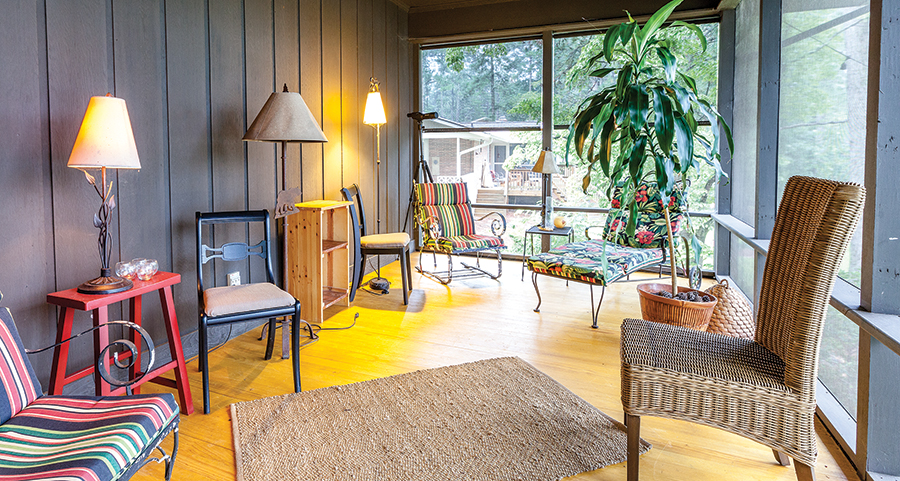
The screened corner porch, where Trish curls up with a blanket and a book on winter afternoons, is a study in forest browns and greens, with iron chairs once belonging to Gates’ mother peeling white paint. Bedrooms follow the shades-of-grey palette. The enlarged master bathroom has an unusual shower with no curtains or glass enclosure. Neither are windows covered, allowing maximum natural light.

Gates paid particular attention to plumbing and lighting fixtures, all with clean, modern sculpturesque lines.

Downstairs, the walkout basement has become a private apartment for the boys, with separate entrance, bedrooms, bathroom, easy-clean slate floor, living area with fireplace looking out toward the dock. Their kitchenette sports a hunk of nostalgia: the well-worn butcher block from Gates’ grandfather’s store in Robeson County.

“I remember chopping neck bones,” Gates grins, miming the action.

The Harrises have traveled the world, living in rather than visiting Europe, India and Asia. At chez Harris, furnishings defy period or style, simply fading into the international aura. Some, like a pair of swivel armchairs, survived the purge, reupholstered. But over them looms a new floor lamp that cuts a parabola through the air. The Swedish sectional sofa stands alone. Pillows from India provide a spot of color along with Oriental runners and a landscape by Pinehurst artist Jessie Mackay. Gates’ reading chair is positioned by the window for view and best light. They both value books, therefore built a wall of bookshelves in the dining area, which also contains chairs that were left in the house, now painted black, and an unusual slat table meant for patio use.  Over the door between dining area and screened porch hangs another family trophy:

“My mother fished once in her life, in Florida,” Gates explains. “She caught a snapper.”

Fine with Trish: “I’m a go-along girl.” She selected furnishings but “Gates drives choices like color and space.” He is an expert on whites, matching nuance to the room.

Then why is the oversized front door with deep panels red?

“Vermilion, actually,” Gates says. Gates and Max spent several weeks in Japan, living on tatami mats, visiting gardens and studying Buddhism and Shintoism. They noticed this color, vermilion, an ancient pigment made from inorganic chemicals applied to lacquerware. The heavy door begged its brilliance. “People say it makes the house look like a Chinese restaurant,” Gates says.

ps-house4-10-16

The total effect seems more an architect’s showplace than a pre-retirement home expressing evolved tastes. However, The Lake House, as the Harris family calls it, expresses multiple personalities rooted in common precepts, a near-nirvana few families achieve. They acknowledge the transition:

“It was weird, coming from a house we’d lived in for 22 years,” Max says.  “Everything here seems fresh and new. It turned out better than I thought.”

“I see my sons’ hands all over it,” Trish adds. “The house balances us out.”

Or, according to Max: “Nothing but good news here.”  PS

Almanac

The Feast of Trumpets

Rosh Hashanah begins at sundown on October 2. Also called the Feast of the Trumpets, this two-day Jewish New Year celebration includes the ritualistic sounding of the ancient shofar (ram’s horn) and foods to evoke shana tovah u’metukaha good and sweet year. Since now is the time of the apple harvest, what sweeter way to celebrate than with a Red or Golden delicious, fresh from the tree? By dipping said fruit in honey, of course. Consider this tasty Jewish custom when your neighbor presents you with a basketful of local apples, but don’t let it stop you from experimenting with cobblers and crisps, cinnamon-laced ciders, and in the spirit of Halloween, perhaps even shrunken apple heads. Granny Smiths work well for this — best if cored and peeled.

Using the tip of a pen, make indentions to guide your carvings. Cut hollows for the mouth and eyes, and carve away the apple flesh around the nose. Exaggerate the features. Your second apple will be better than the first, et cetera, but failed carvings spell homemade pie, so you might flub a few just for fun. Next, soak the carved apple heads in a mixture of lemon juice (1 cup) and salt (1 tablespoon) for a few minutes to help keep the fruit from molding. Pat dry. Now all that’s left to do is wait. A food dehydrator is the fastest and easiest way to dry out — aka shrink — your apple head, but a warm, well-ventilated area should also work. Since the drying process can take over a week, you’ll want to entertain yourself with other projects. In the spirit of carnival season, how about apple juggling?

Speaking of carving, did you know that the first jack-o’-lanterns weren’t made out of pumpkins? Named for the Irish folktale of Stingy Jack — a man who twice fooled the devil yet unknowingly doomed his soul to roam the Earth until the end of time — the tradition of carving grotesque faces into turnips and potatoes to scare off evil spirits is centuries-old. According to legend, Jack’s ghost carries a hollowed turnip aglow with an ember from the fires of Hell. Bet you can guess what happened when Irish immigrants came across their first pumpkin patch.

“Autumn is the hardest season. The leaves are all falling, and they’re falling like they’re falling in love with the ground.”

― Andrea Gibson, poet

National Runner-up

Marigolds are the birth flower of October. Known as the ‘herb of the sun’, these vibrant yellow, red and orange flowers were carried as love charms in the Middle Ages. Although Victorian flower language experts believe them to be symbols of grief, many associate marigolds with optimism. Burpee president David Burpee must have been among them. In the late 1960s, the seed salesman launched a spirited campaign for marigolds to be named the national flower. We chose the rose.

Herbs to Plant this Month:

Dill — Aids with digestion and insomnia.

Oregano — Used to treat skin conditions.

Sage — Increases recall ability.

Fennel — Improves kidneys, spleen, liver and lungs.

The Best Planting Time

Tulip and daffodil bulbs will color your spring garden brilliant if you plant them before the ground freezes. Allow yourself to dream. Imagine your home nestled in a grove of golden flowers, fringed blooms spilling out of planters, window boxes, busted rain boots. The more bulbs you plant the better — and plant them at random. Save pumpkin seeds to plant in spring.  PS

Close Quarters

Grandparents are backyard buddies at the King-Mowery compound

By Deborah Salomon     Photographs by John Gessner

Living with or near the in-laws spawned “All in the Family” and “Everybody Loves Raymond,” award-winning sitcoms exploring the ups and downs, the inevitables and hystericals of family life. By these standards one extended family occupying a cluster of three homes built during the 1920s in the Southern Pines Historic District would flop in prime time. Because harmony, not discord, thrives here.

Really, what’s the likelihood of the father of two toddlers inviting his wife’s parents, Renate and Jim Mowery, to move from Virginia to a classic Weymouth “cottage” renovated, by him, for them? Then, when it came on the market, he purchased and renovated the house next door as lodgings for visiting relatives.

Who is this visionary?

Steve King.

Day job: Oncology radiologist.

ps-mowery2-9-16

Eyebrows were raised, comments made. “This wouldn’t work for all families,” Steve concedes. “But we had a great relationship with my wife’s parents. We had traveled together.” He certainly did not underestimate the advantage of having grandparents 50 yards away.

Steve had lived in his house for many years. He knew the elderly couple beyond the back fence. After they died, he considered acquiring their house for a historic renovation which, he learned, entailed applications, documentation, building restrictions and copious paperwork.

But the ambitious amateur already had a stable of subcontractors and experience gained remodeling his own home. And now, he had a reason. “You’re retired — come live here so you can be around the grandchildren,” Steve proposed.

“I was thrilled,” says Roberta King, the Mowerys’ daughter. “Mom and I are extremely close. I could have my baby and my parents too; we helped each other.”

“It was an interesting process, an outlet for me,” Steve says. “I don’t get to do much creative stuff.”

The idea to invite Renate and Jim jelled when another of the four Mowery daughters was accepted at Duke University Medical School. The chemistry and geography were in place; Renate and Jim, youthful and active, accepted.

Jim, a former Army officer and Reynolds Aluminum executive, met Renate, a language teacher, while stationed in Germany. As a child she lived for 10 years in two rooms with no running water on a farm outside Munich. Jim grew up in a typical Southern post-war family house on a dirt road near Richmond, Virginia. The couple returned to Virginia to raise a family in an impressive Southern Colonial, which Renate had just spent six months refurbishing. Fortunately, yet another daughter was happy to take on that house, facilitating the Mowerys’ relocation.

The best part, Renate beams, was, “Steve did everything.”

“Everything” meant gutting the sunroom (dark walls, smelly indoor-outdoor carpet over concrete), refitting kitchen and bathrooms, building bookcases in almost every room (“I’m a reader,” Jim says), refinishing hardwood floors all without moving walls or altering the footprint, per historic property restrictions.  An addition was, however, possible. In an obvious yet bold move, Steve converted the garage into a “fun” room with bar, entertainment equipment and posters. For a wall he used a massive pair of sliding wooden barn doors. The garage ceiling hid the original patterned tin, which, uncovered, adds texture and antiquity. Across from the garage (which could become a main-floor bedroom if needed) new construction allowed a laundry and bathroom.

As for the rest, “We just wanted something comfortable,” easy-to-please Renate says.

ps-mowery4-9-16

Comfort, in these circumstances, meant restraint. “I had to find a balance between their comfort and budget restrictions,” Steve says. The new kitchen — moderately sized, as are all the rooms — contains no grand appliances or service island. Instead, a sturdy cupboard with drop-leaf table top provides storage, preparation surface and breakfast bar. The kitchen carpet is Renate’s prize: “We were on a Mediterranean cruise. In Istanbul we stopped at a rug place, where I saw this.” She fell in love with the pattern and superb quality. The size was perfect. But she hadn’t brought credit cards or cash ashore. No problem. The merchant followed them back to the ship, where the transaction was completed, and shipped the rug to the United States.

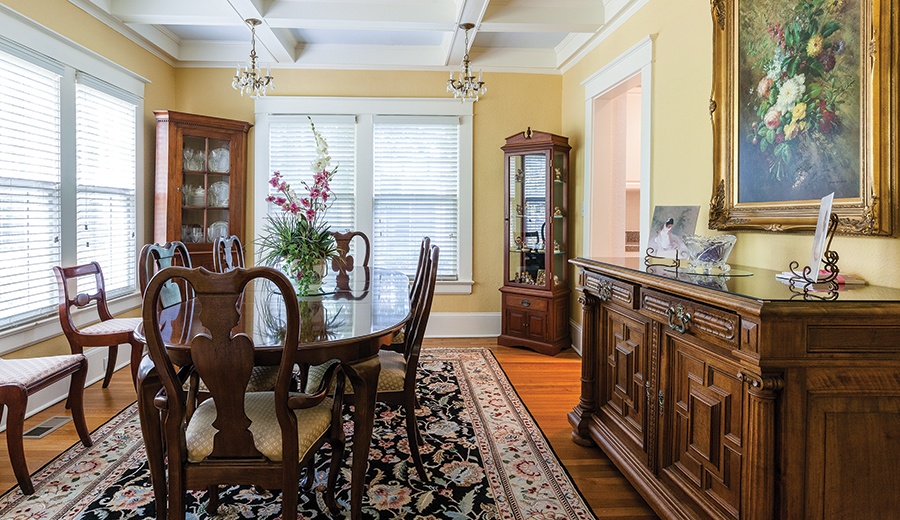
Renate also loves white wicker, using it generously in the sunroom and bedrooms. “To me it’s light, not depressing,” she says. Other furnishings in dark, polished woods suggest European origin; the dining room credenza — weighty, with angular lines — comes from Germany. “Before I said, ‘I don’t want this old thing, it’s not modern,’” but she never regrets keeping it or other handsome heirlooms placed sparingly throughout the house. “I’m not a collector,” Renate adds, with the exception of Hummel figurines displayed in a curio cabinet made by Jim’s dad.

From the coffered dining room ceiling hang four small chandeliers instead of one large. The living room, with fireplace set into a “floating” wall setting off what was once a Carolina room, continues the European aura with graceful velvet upholstered chairs, a Chinese screen, more bookcases, window seats and family portraits. Renate has chosen pastels throughout, except for deep gold walls in the dining room.

The garden is Renate’s design and showplace, with grass so thick, so perfect it appears artificial, bordered by clumps of black-eyed Susans. Flower-filled urns flank the front gate, increasing curb appeal. Renate relates a horticultural omen: “I transplanted a Japanese maple from Richmond. A seed fell into a planter in the front yard, where it grew 6 or 7 feet tall.” Even a weed vine that sprang up over the backyard fence resembles an illustration for “Jack and the Beanstalk.”

Next door to the Mowerys’ white stucco cottage stands the pink stucco three-bedroom guesthouse where well-known Southern Pines residents Peg and Hollis Thompson raised five children. Steve knew the Thompsons; he arranged the purchase before they passed away on the same day in 2015. “I’ll hold onto it awhile as a guest house. I wanted to renovate it, to keep the neighborhood looking nice,” Steve says.

And to keep the family together — a place where 11 cousins, now ages 9 to 22, can gather close to parents and grandparents, just not too close. A place where nobody is crowded at Christmas. A place with a swimming pool, a trampoline, pet accommodations and a long dining table.

ps-mowery3-9-16

The Mowerys have lived in Southern Pines for 13 years now, watching their granddaughters grow from infants to teens. Boundaries have never been a problem, Roberta confirms. “If (my parents) know I’m by myself they might walk in, but if Steve’s home they are respectful.” The Kings’ children beat a path from their house to the gate opening into Jim and Renate’s yard. “My daughters are always running over to Oma’s house to show her something.”

Looking to the future, Roberta also realizes that having her mother and father a minute away may have health care advantages, since Steve is a physician. Several of her friends report waiting too long to make a similar arrangement.

A century ago, multi-generations still lived under one roof or close by. Grandparents were part of a child’s life. Aunts, uncles and cousins visited on weekends. Since then family structure has evolved — or devolved — with unsettling results.

But the old ways work well at the Mowery-King compound except, Roberta notes, for this small glitch:

“All my sisters are jealous.”  PS

Skyline View

This old house returns to its roots

By Jim Moriarty

Sometimes you buy more than a house, you buy a heritage. Early in July, Jennifer Armbrister, her husband, Nicholas Williams, and their 2-year-old son, Mason, moved into Skyline. Armbrister is from everywhere, a self-described Army brat who was in the service herself for nine years. Williams, a Californian, is still active duty, stationed at Fort Bragg, and experienced in places dusty, hot and dangerous.

“We found this place online,” says Armbrister, standing in the kitchen with Mason, who points at a picture of a dinosaur and roars. “There was something about it that drew us to it, both my husband and me. We fell in love with it. There’s this sense of stability and home that I’ve never had before. There’s just something about it.”

Skyline is a house built very near what is now Hyland Golf Club on a bit of landscape elevated enough and once desolate enough that legend has it you could see Carthage 13 miles away. The nearby highway was Route 50 then, U.S. 1 now. Designed and built by a civil engineer, James Swett, construction of the tapestry brick home began around 1917 and was completed in 1920 for $40,000. A large part of the surrounding 108 acres became a peach orchard, but the unhappy convergence of a peach borer infestation and the stock market crash of 1929 plunged the property into foreclosure.

By December 1930, Skyline was back on its feet, literally. Bearing in mind that Prohibition wasn’t lifted (wink, wink) for another three years, it was turned into a nightclub by John Bloxham and Frank Harrington. A hundred people showed up for the opening, entertained by a seven-piece “orchestra” from Pittsburgh that had been booked for the entire season. Graced by a marquee running the entire length of the roofline and blaring CLUB SKYLINE, by the late ’30s the party was over and Skyline swirled down the drain, back into bankruptcy.

In stepped Arch (at the tender age of 61) and Annieclare Coleman with the financial backing of a cousin, Maj. Gen. Frederick W. Coleman Jr., who purchased the property in ’39 from Citizens Bank & Trust Co. The assessed value of the house, the tenant cottage and the 108 acres was $10,000, though the previous owner was on the hook for 35 large. The Colemans set about turning Skyline into Skyline Manor, one of the many boutique hotels and inns of Moore County.

ps-skyline2-9-16.jpg

Once the postmaster of Minneapolis — and with a boost from a Minnesota congressman — Arch Coleman had been appointed to the position of assistant postmaster general of the U.S. in the Herbert Hoover administration. A member of Hoover’s Little Cabinet, Coleman is acknowledged in Hoover’s memoirs as a person possessing “future Cabinet timber,” with the former president tossing in Douglas MacArthur and J. Edger Hoover as a couple of other promising up-and-comers. When FDR beat Hoover in ’32, Coleman found himself out of work and in the depths of the Depression. His granddaughter, Deirdre Newton (a Southern Pines resident), says her mother — Arch and Annieclare’s daughter Ruth — described him as “the only politician who ever left Washington without a penny in his pocket.”  Post-Hoover, he landed, first, with a brother-in-law in Sanford and then at Skyline.

Coleman was Mr. Outside; Annieclare Mrs. Inside. He cultivated eggplant and was in charge of turning the ‘NO’ on or off in front of ‘VACANCY’ on the neon sign by the highway. She did all the cooking. The house was filled with photographs: Coleman with President Hoover; Coleman with the other under secretaries; Coleman with the congressman from Minnesota. The houseguests had names like Delano and Ives and Rathbun.

“Grandma was a big talker and had a very ambitious nature. Grandpa always listened,” says Deirdre Newton of the man she remembers as tall, thin and reserved. “Then, when he got bored with the whole thing, he’d just stand up, go back into his bedroom, lie on his bed and read detective stories.”

Arch and Annieclare’s daughter, Ruth, lived in England. Her husband, Jack Dundas, was an officer in the Royal Navy. He helped with the evacuation of Dunkirk; captained the HMS Nigeria, escorting cargo ships from America to Mirmansk; was the chief of staff to the commander of the Mediterranean fleet when Montgomery was fighting Rommel in North Africa and, by the end of World War II, the assistant chief of naval staff. The war, however, destroyed his health. In 1946, bound for Skyline, Rear Admiral Dundas, Ruth and their five children came to America on the Queen Elizabeth in its first voyage after being refitted from troop transport to luxury liner.

Also arriving after the war was Arch and Annieclare’s son, Archie. He built a stucco cottage located near the manor house for his wife, Madeline, and their daughter, Claudia, still a Southern Pines resident. Archie had a less visible war record. A member of the Office of Strategic Services — the World War II forerunner of the CIA — he was the second-ranking officer of the Istanbul station of the OSS and in direct communication with William “Wild Bill” Donovan, head of the OSS. Archie was a flamboyant Ian Fleming-style, larger-than-life figure who delighted the Dundas girls, Deirdre and her older sister Rosie in particular, with his guitar playing and singing. “He was a fabulous character,” says Deirdre. “We were in love with Uncle Archie.”

Annieclare passed away in 1960. Skyline Manor quickly ceased to be a business when the real and true manager was gone. By the mid-60s, Uncle Archie had moved to Virginia Beach and Arch Coleman stayed close to his children to the end of his life. The property passed on, too, gradually falling into utter disrepair when the next generation of owners discovered what Coleman had, that Skyline was too big for one elderly man to manage. By the ’80s, upstairs rooms were being rented to Sandhills Community College students, and a hairdressing salon popped up like a mushroom in the basement. The house had become more albatross than heirloom.

“It had fallen into disrepair,” says Frank Staples, who grew up next door. “You could stand in the basement and look clean out to the sky.”

In 1990 it was purchased by Jane and Gary Thomas, who spent the next 26 years bringing it back. “When we bought it, it had been empty for a few years,” says Jane. “We really didn’t know what we were getting ourselves into, but it is a special place.” If Jennifer Armbrister and Nicholas Williams share a military kinship with Skyline, their intention is to revisit its business plan, too, eventually transforming it into a home stay guesthouse. Imagine something a few biscuits shy of a proper bed and breakfast.

Claudia Coleman, the intelligence officer’s daughter, is a well-known local artist who lived in the stucco cottage. “It was a wonderful place to grow up,” she says of Skyline.

It looks like Mason will get the chance to find out for himself.  PS

Jim Moriarty is a senior editor at PineStraw and can be reached at jjmpinestraw@gmail.com.

Rising from the Past

The historic town of Badin resolves to survive and thrive again

By Jim Moriarty   •   Photographs by John Gessner

At the center of Badin village is a confounding five-pointed starfish intersection with a right of way that seems to be ruled by nothing more than neighborliness. Where the post office now sits there was once a grand opera house. Built in 1918, it was dropped to its knees by a wrecking ball 41 years later in the days before historic preservation allowed the soul of a town to outrun its bottom line. The theater was the prime stopping point between Richmond and Atlanta for gypsy vaudevillians whose Pullman cars parked on the railroad tracks by the depot that once stood across Route 740 from a convenience store where now even the baitfish seem to have gone belly up. It was a workingman’s town then, a one-trick aluminum pony that fused the men who spent their days in Alcoa’s hot, hazardous pot rooms with imported fun. Staying sometimes as long as a week, W.C. Fields and Mae West were among the entertainers who performed there. On the same stage chorus girls left little to the imagination and Tom Mix shot up silent movie saloons, fire and brimstone preachers lit up the 650 sinners in the main auditorium, another 150 in the balconies.

Across the highway from the convenience store the hulking, desolate and empty factory buildings are covered with sorrowful rust stains as if their mascara was running. Just behind the store the little, historic village tries to climb back up the prosperity cliff it was thrown over when the company ups and leaves the company town. Badin may be more than a hundred years old, but it still has the will to live, and there is much to admire in the ambition.

A long block but a short walk up Falls Road from the starfish crossroads, pushed away from the street into the shade, an imposing red brick church gives the architectural impression of Baptists swallowing up a wandering band of orthodox Greeks sometime in the 1920s. On one side of the church is the old cemetery. Close by on the other side is the Badin Treehouse Co. It may not have a monopoly on food in Badin but it has, at the very least, cornered what passes for the gourmet market. The menu is country eclectic and the décor something of a cross between Savannah art college kitsch and your dotty old aunt’s attic. There are furs, beads, animal heads, jukeboxes, musical instruments, wild turkey feathers, and Frank Sinatra and Etta James in surround sound.

ps-badin2-9-16.jpg

Jodi Wahab is the reluctant restaurateur, having run headlong into code issues in her original location. The plan was to have a coffee house/art gallery a few doors away in the century-old brick building with the RC Cola advertisement painted on its side where she lives with her husband, James, and her two Chihuahuas, Roxie and Allie. Or Ally. Or Alley. The actual spelling being a matter of casual indifference. Wahab got the building in an old-fashioned swap with the artist Roger Thomas, who lived in it for 13 years. “Everybody sees the potential Badin has, especially with the lake area right there,” says Thomas, who got his Route 740 farm in the deal. “I think Badin is a charming town. It’s a very neat historical town.”

The floor inside the front door of Wahab’s Falls Road building is partially covered with a large mural made mostly out of pennies. Her copper art pieces hang on one wall. The other has an elk head and a leopard — as alive as the parrot in “Monty Python’s Flying Circus’” skit — in a cage. There’s an elegant, idle coffee bar anticipating the return of the espresso machine from down the street; an out of operation waterfall waiting for unfinished oil paintings to decorate either side; and a beach cottage room with a mural of Cape Lookout and a floor covered with river sand. “What I wanted was for you to have your cappuccino and to step into my art, just come and sit,” she says. “I’m fighting to get back here.” Wahab has the U.S. franchise for Massimo Zecchi’s art supplies from Florence, Italy, but selling out of a closed coffee shop in Badin has, well, challenges. “Right now there’s no industry, so the town is just having to survive with what we are,” she says.

The town was the invention of a French company headed by Adrien Badin that came to the Yadkin River Basin early in the 20th century to make aluminum and electricity, not necessarily in that order. World War I brought the French invasion to an abrupt end and the project was taken over by the Aluminum Company of America — Alcoa — which finished construction of the Narrows Dam in 1917, helping to create the body of water that now comprises Badin Lake and Lake Tillery. Until the building of the Hoover Dam, the Narrows was the largest overflow dam in the world and it, along with the buildings of old Badin, are listed on the National Register of Historic Places. It also happens to be downriver from one of the most significant Paleo-Indian archeological sites in the southeastern United States.

Like the opera house, Badin’s dwellings were built for the aluminum workers, started by the French and finished by Alcoa. Some were small bungalows but mostly it was condo-style apartments in four conjoined units. These quadraplexes had indoor plumbing, three bedrooms upstairs and hot water that circulated through wood-burning stoves. Because people need roofs more than they need vaudeville, the lodging has outlived the tap dancers of the opera house and a handful of other buildings that became too forlorn to justify their existence to an accountant. “They tore down more buildings and destroyed more property that had historical value to it — it just makes you sick,” says Thomas.

Artifacts from the Hardaway archeological site, a Badin timeline, a refurbished quadraplex apartment and even the 1937 Ford American LaFrance fire truck (aluminum colored, of course) are on display in the visitors center and a pair of nearby museums at the starfish intersection. They open twice a week, on Tuesdays and again on Sunday afternoons. Not that there isn’t a lot of foot traffic in Badin, but if Martha Garber sees a strange face walking by during operating hours, she’s as likely as not to snatch the person right off the sidewalk.

Anne Harwood, who taught education at Pfeiffer University, is the mayor of a town with a zombie tax base. “We are a historic town with unique architecture,” says Harwood. “We’re working to keep Badin as preserved as we can.” When the moment of the great unwinding of the inevitable lawsuits arising from the end of business as usual finally arrives, Harwood sees better times. “Alcoa’s going to be generous — not just to us — they’re going to give some land to Morrow Mountain. We will get the property around the lake. That’s huge,” she says. “Then, we have to decide, with our budget, what we can do with it. Our biggest property tax group is no longer here.”

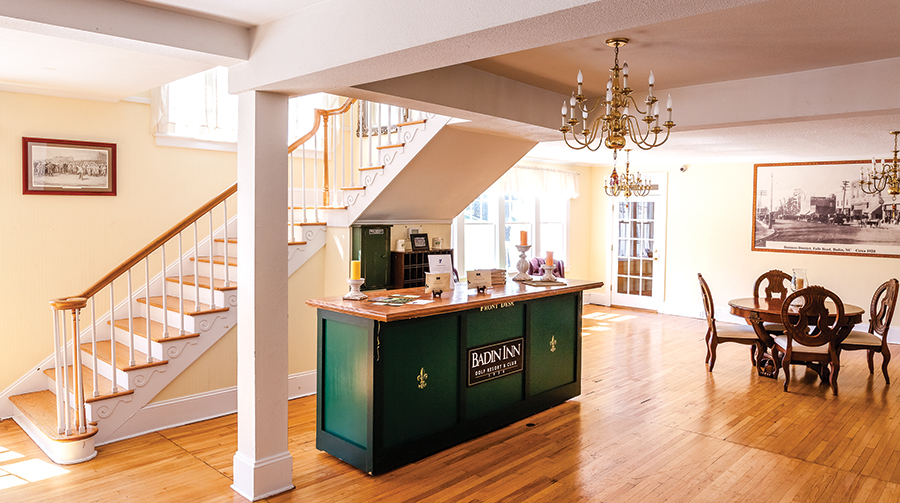
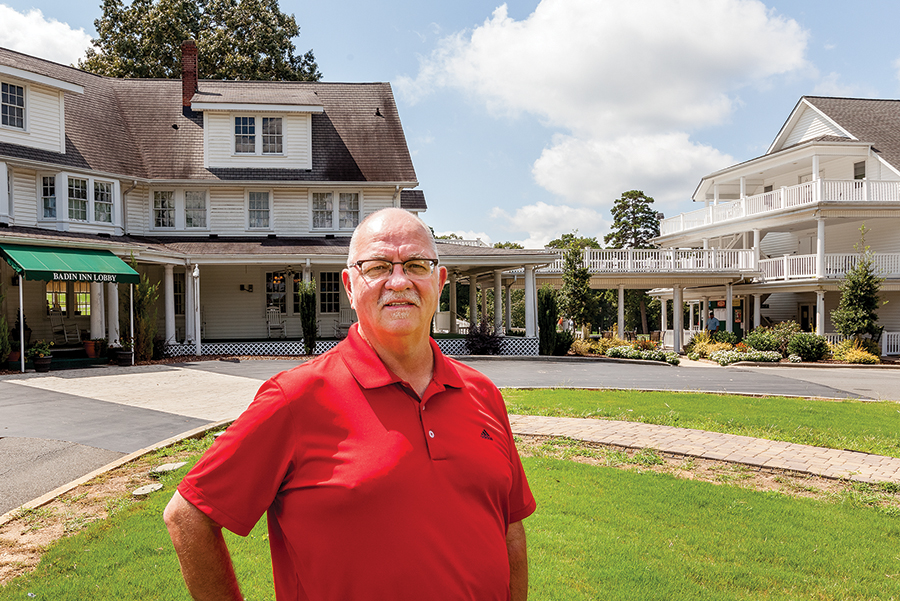
The Badin Inn, built by the French in 1914 as dormitory-style living for staff of the subsidiary of L’Aluminium Française, and its associated golf club are integral to Badin’s hand-over-hand climb back to, if not affluence, at least survivability. Stewardship of the historic structure has fallen into the hands of general manager Mark Eberle from St. Augustine, Florida. He’s partnered this museum piece, a place that’s a little tender loving care and a few investment dollars shy of being adorable, with a nonprofit organization that tries to help kids through golf. The nonprofit is called Music, Art, Literature and Thought and it’s the parent of the faith-based Growing Kids Through Golf. Back in the ’70s Eberle traveled the mini-tours, sleeping in the back of his Dodge utility van, trying to make enough money one week to play again the next. He’s chasing a different goal now. “I started that kids’ program in 1989,” says Eberle. “We’ve always targeted that group of kids that don’t naturally have an opportunity to play golf. Our purpose was never really about creating golfers of the future. We’re just trying to help kids. It was never to create the next Tiger Woods.”

ps-badin3-9-16.jpg

The Inn has some modern suites over the pro shop, but it’s the six rooms on the second floor of the old building with the ghostly footprints of visitors like Sam Snead that are its legacy. The hallway still has a sign that says, “Pull Switch For Air Raid Alarm.” (The aluminum factory would, after all, have been a high value target during WWII.) And, there’s an intercom in the lobby that looks like it could still dial up the ’50s. The third floor remains uninhabitable, almost a metaphor. “This is pretty much Badin,” says Eberle of the Inn and golf course. “It’s a fascinating property, it really is. This is a 100-year-old inn with classic rooms, hardwood floors, furniture to match. Same way with the golf. We spent nine months improving the course, investing in it strongly. The lake is two blocks away. The river is a quarter-mile. Morrow Mountain is right behind us. They didn’t know what they had. This isn’t a resort; it’s a small town, a homey, comfortable, relaxed atmosphere. If you’re looking for a championship golf course, you don’t want to come up here. But, if you want to play golf like it was played in 1924, you’re going to love this place.”

The most famous person from Badin now is the TV personality Star Jones, but that distinction used to be held by Johnny Palmer, the Badin Blaster, who grew up caddying on the old course. A WWII veteran who flew 32 missions over Japan as the side gunner on a B-29, Palmer quit a job as a crane operator at Alcoa to join the tour and won seven times from 1946-54. Dark-haired and olive-skinned, Snead nicknamed him ‘Stone’ because his expression never changed on the golf course. In the finals of the 1949 PGA Championship at Hermitage CC in Richmond, Virginia, Snead took a 2-up lead over Palmer into the last nine holes, bounced his tee shot on the 10th off a transfer truck that kicked it back into play, made a birdie and went on to win, 3 and 2.

After moving to Oklahoma, Palmer spent the last years of his life back in Badin, living in the family apartment in a quadraplex on Spruce Avenue. His son, Jock, lives there still and can be found most days after work at the golf course’s grill. With some prodding Jock recalls a conversation with Gene Littler and Don January on a ferry ride across the Savannah River at a senior tournament. “Your dad was one of the best chippers and putters,” Jock says they told him. “He missed the TV money. He missed the senior tour. They said, hey, never let anybody tell you your dad wasn’t great.”

A lot like Badin.  PS

Jim Moriarty is a senior editor at PineStraw and can be reached at jjmpinestraw@gmail.com

The Amazing Summers of Miss Edie Womble

By Jim Dodson   •   Photographs by John Gessner

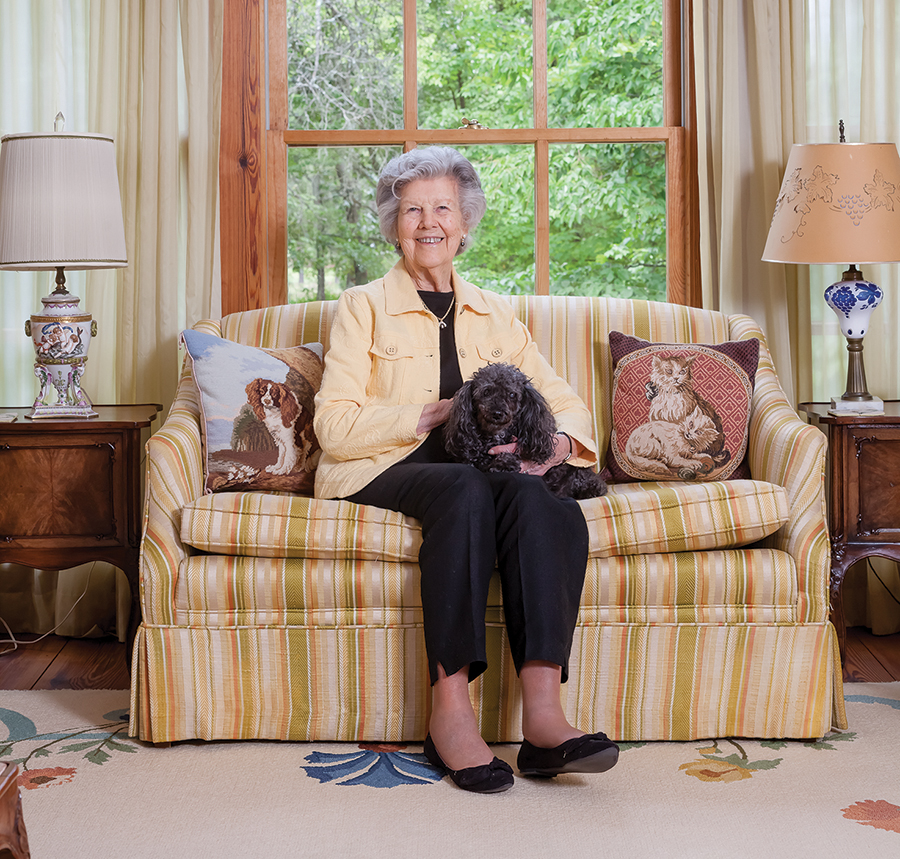
I’ve always loved this table,” says Miss Edie Chatham, smoothing her hand over the weathered surface of the large round table that dominates her expansive kitchen in Pinehurst.

“It’s been in our family for a very long time. My daughter brought it all the way from Louisville when Dick and I built this house 30 years ago. She took it apart and drove all that way here, if you can believe it, attached to the roof of her car. Clever girl. The table was fine, a sign of how well it was made. It just gets better with time.”

Now in her 90s — but don’t tell her we told you so — Miss Edie Chatham knows a thing or two about well-made objects and getting better with time.

From the beginning, her remarkable life has been one of steady exploration and refinement, beginning with a fearless mother who wished her six children to experience a rapidly changing world to a beautiful house Miss Edie herself sketched out on paper, inspired by 19th century houses from the Carolina low country. The New Jersey architect she and her husband, Dick Chatham, engaged in the early 1980s to draw up the plans for their retirement home, after relocating from Elkins to the Sandhills, had never seen anything quite like the simple two-bedroom “country house” Edie Chatham had in mind. It was modest in scale, in tune with the pragmatism of an earlier age, featuring a simple porte cochère and copper roof that turned elegantly green with the passing seasons, wide and welcoming Dutch front doors equipped with sturdy wooden screens, 12-foot ceilings, and a dramatically wide central hallway running front to back of the house, designed to catch the gentlest breeze and provide a place for Edie’s grandchildren to learn to roller skate and ride bicycles.

“He said it was such a waste of space, but I wanted a house that would stay cool on the hottest summer day,” she explains. “I’d lived in almost every kind of house you can imagine up till then, so I knew exactly what I wanted. We only needed a guest bedroom.”

“Don’t try to talk her out of it,” Dick Chatham advised the architect. “When she gets her mind made up, she never changes it.” The architect obliged though later congratulated her on designing the “perfect dog house” because the windows were large enough for the smallest dog to look out.

A local builder named Clealand Fowler did the work, handcrafting a house that feels as settled and welcoming as any low country home place passed down through generations. “Clealand was terrific,” she remembers. “He built the place a little bit by the seat of his pants, creating as we went along, a real craftsman, making the oversized windows and every door by hand. He did the floors, too. While he worked, I researched.”
ps-edie2-9-16.jpgIt was she who found, for instance, a man in Chapel Hill that had heart pine flooring from Richmond, Virginia’s original railway station when it was demolished to make way for a new station. “The boards were gray and weathered, but Clealand sanded them down and fitted them beautifully together, countersinking the nails and staining them with tung oil. They’ve aged so nicely, don’t you think?”

Everything about the house Miss Edie Chatham built seems to have aged nicely, as a matter of fact, from the bathrooms outfitted with old-fashioned fixtures she found at area thrift shops to a sunroom overlooking a backyard woodland where she keeps an eye out for local wildlife, a peaceful sitting room filled with the works of folk artists and American crafts.

Befitting a family home place, mementos and heirlooms and personal treasures emblematic of the long and notable life Edie Chatham has lived grace every room — favorite books and paintings, family photographs, a refrigerator covered by cards and photographs of her large, loving, scattered clan that includes 11 grandchildren and 13 greats. In 2015, son Richard and his wife, Allison, threw a surprise birthday party for his mother that included a low country boil and four days of paying tribute to their extraordinary matriarch.

“I would have been happy with just a lemon pie,” she allows with a laugh, settling down at the aforementioned pine table to chat — albeit a tad reluctantly — about a life rich in experience and surrounded by family and friends, as mentally vibrant as ever. As she sits, her miniature poodle Susie, 17, appears, curling up at her feet. “But it was so wonderful to have the entire family come from everywhere, some from other countries and very far away.”

She pauses and smiles. “We do seem to be a family that likes to travel a great deal. My brothers and sisters and I all shared that trait — a gift given to us by our parents, who believed the more we saw of the world, the better we would understand others and ourselves.”

She smiles, thinking of something.

“I was just speaking to my older brother Bill last evening on the phone. Bill is 99. His mind’s still so sharp. We were sharing memories of those great summers we had growing up, our travels across America with the Georgia Caravans. Bill was a counselor for the boys on our first trip. That was a very different world back then. I don’t suppose children’s summers are anything like that today. Everyone goes their own way. But, oh, what a grand adventure that was!”

She was Edie Womble then, a precocious 13, the fourth oldest of six children of Bunyon Snipes Womble and his highly independent wife, Edith Willingham Womble, from Macon, Georgia.

Bun Womble, as friends called her father, son of a Methodist minister, was one of Winston-Salem’s most successful lawyers. At age 37, he sat on the board of his alma mater, Duke University, and pushed to integrate the school. He later served in the state legislature and was one of the city’s famous 12 elders who gathered monthly at a private home dressed in formal attire to plan the future of Winston-Salem, planning for the growth of neighborhoods, city government, even the merger of the two neighboring towns. “It was Dad who suggested putting the hyphen between Winston and Salem,” says Miss Edie.

Her mother was also a force to be reckoned with.

“Thanks to our parents, we understood how fortunate we were when so many were suffering due to the Depression. We lived in the same neighborhood as the Hanes and Reynolds families but  with  six of us all under the age of 8, we all learned to be each other’s best friends very quickly. We made our own beds and straightened our rooms and our father always walked us to school. Our grandmother lived with us, too. It was bliss.”

Edie’s mother had been around the world three times and held strong views about exposing her six children to the realities of life — even, and maybe especially, with the devastation of the Great Depression sweeping over America.

When an enterprising fellow named Clarence Rose came through town promoting a summer-long caravan of buses designed to show children of the affluent South the key sights and landmarks of America, Edith Willingham Womble signed up four of her oldest children for the year 1933, the lowest point of the Depression — Lila, Bill, Olivia and Edie.

“Dad took us to Atlanta on the train to meet the caravan. There were nine buses that had been customized to carry 16 or 17 children. They were called ‘Spirit of Progress’ buses. The boys and girls were segregated by sex and rode on separate buses based on their ages. Each bus had its own counselor, cook and a full kitchen. Tents and cots came out of the roof to camp, and each camper had his or her own canvas bag with clothing and toiletries and spending money. Dad gave us each  spending money to last the entire summer, all the way to the West Coast and back,” Miss Edie remembers.

Three fine automobiles — brand new Lincolns, she recalls —  took off before  the buses bearing the caravan’s campers. “Rose did things first-class, which is why when he ran short of funds we ate a lot of potato salad later,” Miss Edie explains with a prim smile.

ps-edie3-9-16.jpg

Traveling over rough highways and dirt roads, the caravan’s first major stop was the Chicago World’s Fair of 1933. Celebrating the city’s centennial, the theme of the international exposition was America’s emerging technical innovation. Among the highlights, the German Graf Zeppelin landed and Sally Rand performed for one of the last times. Two other things deeply impressed young Edie Womble. “One was that I got to meet the real Aunt Jemima, the pancake lady. She was very nice to us. Clarence Rose allowed us to wander around the fair in groups of three. I was also struck by models of what highways of the future were going to look like. They looked exactly what interstates do today — four lanes, all paved, overpasses and everything.”

The campers stayed on the grounds of a university in Evanston. If a college or university wasn’t available, the caravan buses camped at local fairgrounds, churches and state parks. “In some towns, people turned out to welcome us. The colleges were the best because most of the roads we were traveling were gravel or dirt roads and we could get showers or baths.”

Onward west they pushed — to the Grand Canyon, Carlsbad Caverns, Yellowstone Park, Los Angeles and Santa Monica, where the children spent a full day riding a roller coaster that went out over the ocean and drank themselves silly on milkshakes. In Los Angeles Edie found a stray kitten she decided to bring home with her to North Carolina. During the return trip, at Yosemite National Park, she witnessed the park’s celebrated 300-foot “Firefall” and met the park’s famous Jaybird Man, who could summon at least 50 different kinds of birds with various whistles. She took photographs with her Brownie camera. She also wrote letters home to her grandmother and the family’s cook, whom she was worried about because her bank back in Winston had folded.

“We honestly didn’t see too many signs of the Depression on the road,” she explains. “The crisis was all still unfolding and we kept moving. We knew it was a difficult time for people less fortunate than we were.”

The cat made it home to Winston-Salem, newly named — what else — “L.A.,” and lived out a nice long life at 200 North Stratford.

The second year she joined Clarence Rose’s caravan, Edie saw Glacier National Park, Banff, Lake Louise and the Calgary Stampede. She brought back a petrified rock from the Petrified Forest National Park in Arizona. “There was no air conditioning in the desert, so we wet towels and placed them on our heads. That was our air conditioning,” she remembers.

By then, she notes, Clarence Rose was running out of money and magic. One night he awakened campers in the wee hours and hustled them to the buses in order to outrun local authorities that were demanding he buy special license plates for traveling through their states. A year or so after the Womble children made their final cross-country trip with Georgia Caravan, Rose’s buses were confiscated and sold at auction. The caravan riders had to find their own way home.

“It was a sad end for Rose. We never learned what happened to him. But I think we learned a great deal about being self-sufficient, being unafraid of the world.”

During the summer of 1939, as the shadow of Adolf Hitler crept over western Europe, Edith Womble sent her three middle children on a traditional continental tour of Europe’s cultural capitals. “She knew it might be the last chance to do that before everything dramatically changed — that life would never again be like she remembered it.” Brother Bill had done his European tour in 1935, and older sister Lila actually lived in France for a time.

Edie, a junior at Duke, traveled with her older sister Olivia, a senior, and a group of girls from Duke chaperoned by a campus house mother named Mrs. Pemberton. They landed in Italy, toured ruins and museums before heading for Germany. During a stop in Prague they saw Nazi banners and flags flying everywhere. “And I remembered Bill telling me how when he was there he saw groups of young men in brown uniforms beating up people on the streets. We didn’t see anything like that, though the guide Mrs. Pemberton arranged to give us a tour took us to the Jewish quarter of the city, where we saw many abandoned apartments and empty streets. It was his way of trying to tell us what was really going on in Europe.”

One evening in Munich, a trio of local German boys invited Edie and a couple of friends to a private home to dine. “Mrs, Pemberton let us go because they were very polite and knew English and seemed harmless. The place where they took us was very grand, probably confiscated from wealthy Jewish people we realized later, with a stone courtyard and gate.  We had been warned not to ask any questions. After an elegant dinner upstairs, we went down to the basement to play ping-pong and something quite startling happened. Soldiers wearing black uniforms of the SS suddenly appeared, and we were whisked out and held at the front gatehouse while they tried to figure out what to do with us. It turned out that Adolf Hitler and his henchmen had arrived to dine in the club and nobody knew we were downstairs. The Fuhrer was just upstairs! Fortunately, after they debated what to do with us, they decided it was smarter to let us go — telling us to get out of there fast and not look back.”

In Budapest, the servant of a polished young man appeared at their table and invited Edie to dance with his employer on the hotel’s revolving dance floor. He turned out to be the nephew of Hungary’s highest ranked government official, the country’s embattled regent. His name was Denes Marie Siegfried Joseph, Count of Wenckheim, aka. “Count Sigi.” He took her horseback riding in the royal forest and to see his family’s hunting lodge, where his staff fed them a lavish dinner. He also took Edie to see the airplanes of his country’s modest air force. “It was just a few planes but he was very proud of them. I was eager to see them because I’d taken flying lessons at Duke.

“Sigi was charming. He sent me flowers and lovely notes. For several days before we headed for France, we went to dinner and danced. One night, to Mrs.Pemberton’s dismay, we stayed out till dawn. Sigi wanted to show me Budapest by moonlight. Given all that was happening around us, I suppose it was terribly romantic,” she allows. “But it wouldn’t last.”

Over the next year, Sigi wrote Edie Womble several passionate letters and sent photographs until his country fell under Communist control. Eventually, he was captured and shot by a firing squad. In Paris, shortly before heading to England and on to Scotland for the boat home, Edie and Olivia  went on a mission for their mother to track down a well-known seamstress their mother first met in Vienna in 1900. The woman  was famous for her needlepoint. “She was living in the Jewish section of Paris, and the taxi driver insisted on waiting for us. We knocked on her door, but there was no answer. Some might have given up, but we were taught by our parents never to give up. Eventually a slit in the door opened, and we told the woman who we were. She let us in and it was incredible, the most beautiful fabrics and needlepoint you can imagine. Her name was Mrs. Joli. She’d fled the Nazis from Vienna. The French foolishly thought the war was over. They were taking paintings and other artwork out of hiding. Olivia and I picked out some patterns for our mother’s two tall Italian chairs and paid Mrs. Joli, who promised to send along the coverings as soon as possible.”
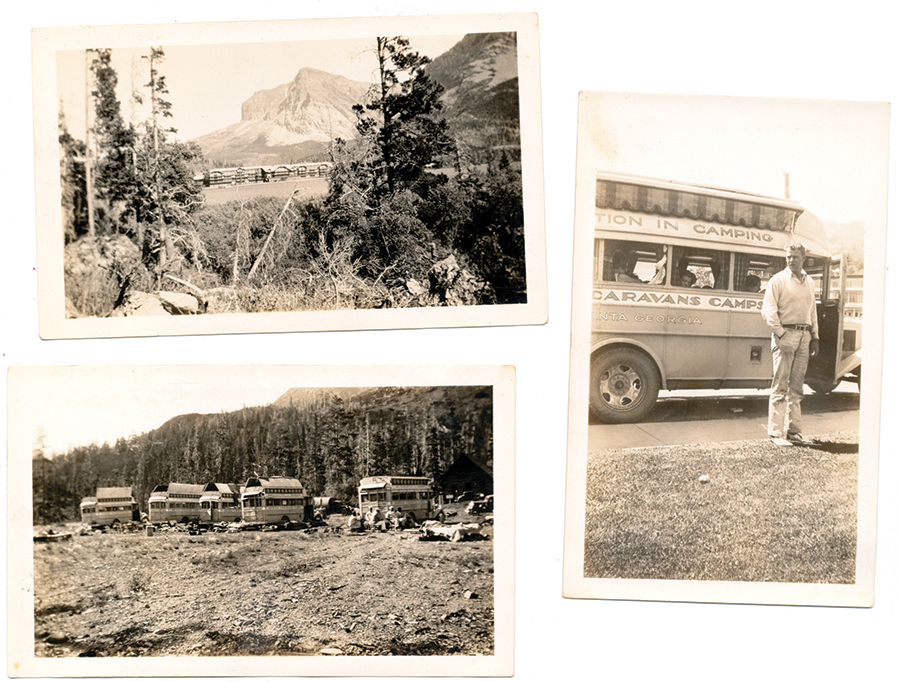
ps-edie4-9-16.jpg

Britain declared war on Germany days later, as the Womble girls steamed for America.

“Because of the outbreak of war, mother thought those coverings would never arrive. But amazingly they did — the very next April. Unfortunately, we never heard from Mrs. Joli again. After the war, I went back to Europe and looked for any trace of her, but she and her family were gone. You don’t have to guess what happened to them, poor things.”

Miss Edie Chatham smoothes her hand over her beloved pine table, sighs and smiles.

“Goodness me. Listen to me, how I’m going on.” She touches a small stack of Sigi’s well preserved letters, each baring a Nazi emblem.

“Nothing of the kind,” assures her captivated her visitor.

There is, after all, something deeply rewarding about sitting in such a peaceful house where the afternoon breeze comes through the open kitchen screen door and a woman of the world recalls the most remarkable summers of her life. Softened by her witness to time and surrounded by her sensible old-fashioned house and large loving family, Miss Edie Womble Chatham seems almost ageless. Some women at 70, observed George Bernard Shaw of Queen Cleopatra, seem younger than most women of 17.

Miss Edie graciously offers her guest another glass of iced tea. Eager to sit and hear more, her visitor happily accepts. PS

Almanac

The full Harvest Moon — also called the Singing Moon — will rise at approximately 7:30 p.m. on Friday, September 16. Owing to its close proximity to the horizon, the moon will appear vast and orange-colored. Don’t be surprised if you get the sudden urge to dance beneath it.

Also, because this month’s harvest includes the first plump grapes, the harvest moon is alternatively known as the Wine Moon. Red wine pairs well with Neil Young’s Harvest (1972) and Harvest Moon (1992). Should you feel inspired to drink from a sterling goblet while dancing on this brilliant night, consider offering a small libation to Dionysus, the Greek god of winemaking and ritual madness.   

three violet asters

Asters (also called Italian starwort or Michaelmas Daisy) are the birth flower of September, their daisy-like blooms a talisman of love and symbol of patience. The ancient Greeks burned aster leaves to ward off evil spirits, and the plant was sacred to both Roman and Greek deities. Those familiar with the hidden language of flowers will tell you that a gift of asters reads:

Take care of yourself for me, Love.

“The crickets felt it was their duty to warn everybody that summertime cannot last forever. Even on the most beautiful days in the whole year — the days when summer is changing into autumn — the crickets spread the rumor of sadness and change.” ― E.B. White, Charlotte’s Web

Plant your garlic now until the first hard freeze — the earlier the better, as large root systems are key. Although it won’t be ready for harvest until next June, growing your own garlic means you’ll be well equipped for cold (and collard) season next fall. Aside from boosting your immune system and enhancing your sautéed greens, garlic, researchers believe, can reduce the risk of various cancers. Roast a head until tender and add it to your rosemary mashed potatoes and squash casseroles.

This month, with the sun entering Libra (the Scales) on the autumnal equinox, we look to Nature and our gardens to remind us of our own need for balance and harmony. On Thursday, September 22, day and night will exist for approximately the same length of time. Mid-morning, when the astrological start of autumn occurs, take a quiet moment for introspection. In the fall, just as kaleidoscopes of monarchs descend for nectar before their mystical pilgrimage to Mexico, we must prepare to journey inward. Breathe in the beauty of this dreamy twilight — this sacred space between abundance and decay. The duality of darkness and light is essential to all of life.

Tolkien fans have double the reason to celebrate the equinox. In 1978, the American Tolkien Society proclaimed the calendar week containing September 22 as Tolkien Week. In J.R.R. Tolkien’s classic fantasy novels, The Hobbit and The Lord of the Rings, hobbits Bilbo and Frodo Baggins were both said to be born on September 22; Bilbo in the year of 2890, Frodo in 2968 (refer to the Shire calendar of Tolkien’s fictional Middle-earth).

This year, since Hobbit Day officially falls on the first day of autumn, consider hosting a grand birthday feast — call it Second Breakfast if you’d like — with a menu showcasing the bounty of the season. Decorate with ornamental corn, squash and gourds. Since no hobbit meal is complete without ale, mead or wine, you’ll want to have plenty. Punctuate the evening with fresh-baked apple pie. 

Alternatively, you might celebrate Hobbit Day by walking barefoot on the earth, a simple meditation practice with remarkable health benefits. If you’ve never heard of barefoot healing, check out Clinton Ober’s Earthing (2010) or Warren Grossman’s To Be Healed by the Earth (1999). Think about it: If the average hobbit lives about 100 years, they must be doing something right.  PS