Here Today, Gone Tomato

Nothing says Southern cooking more than a plate of fried green tomatoes

By Jane Lear

The tomato is a tropical berry — it originated in South America — and so it requires plenty of long, hot sunny days to reach its best: the deep, rich-tasting, almost meaty sweetness many of us live for each summer. When September rolls around, though, it’s a different story. It’s not that I’ve gotten bored with all that lush ripeness, but I develop a very definite craving for fried green tomatoes.

If you grow your own backyard beefsteaks, unripe tomatoes are available pretty much all summer long, but this is the time of year they start getting really good. In the early autumn, the days are undeniably getting shorter, and thus there are fewer hours of sun. That and cooler temperatures result in green tomatoes with a greater ratio of acid to sugars.

And my cast-iron skillet, which tends to live on top of the stove anyway, gets a workout. Fried green tomatoes, after all, are terrific any time of day. In the morning, they are wonderful sprinkled with a little brown sugar while still hot in the skillet, right before you gently lift them onto warmed breakfast plates. If you’re a brunch person, serve them that way, and you’ll bring down the house. At lunchtime, embellishing BLTs with fried green tomatoes may seem like a time-consuming complication, but those sandwiches will be transcendent, and you and yours are worth it.

When it comes to the evening meal, fried green tomatoes are typically considered a side dish, and there is nothing wrong with that. But in my experience, they always steal the show, so I tend to build supper around them. I rely on leftover cold roasted chicken or ham to fill in the cracks, for instance. Or I make them the center of a vegetable-based supper in which no one will miss the meat. They play well with corn on the cob or succotash, snap beans or butter beans, ratatouille, grilled zucchini and summer squash with pesto, or grits, rice, or potatoes. Pickled black-eyed peas (aka Texas caviar) are nice in the mix, as are sliced ripe red tomatoes, which, when served alongside crunchy golden fried green tomatoes, add a great contrast in texture and flavor.

If you are fortunate enough to have a jar of watermelon rind pickles in the pantry, my Aunt Roxy would suggest that you hop up and get it. I ate many a meal in her cottage on Harbor Island, and early on I learned watermelon and tomatoes have a curious yet genuine affinity for one another. I imagine Aunt Roxy would greet today’s popular fresh tomato and watermelon salads with a satisfied nod of recognition.

We always had a difference of opinion, however, over cream gravy, a popular accompaniment for fried green tomatoes. It’s not that I am morally opposed to lily gilding, but I have never seen the point in putting something wet on something you have worked to make crisp and golden. A butter sauce on pan-fried soft-shelled crabs, chili or melted cheese on french fries, a big scoop of vanilla on a flaky double-crusted fruit pie: I don’t care what it is, the result is soggy food, and I don’t like it.

When it comes to the actual coating for fried green tomatoes, the most traditional choice is dried bread crumbs. I sometimes use the crisp, flaky Japanese bread crumbs called panko, but like Fannie Flagg, I am happiest with cornmeal. It can be white or yellow, fine-ground or coarse. It doesn’t matter as long as it is sweet-smelling — a sign of freshness. And if you happen to have some okra handy, you may as well fry that up at the same time. Trim the pods, cut them into bite-size nuggets, and coat them like the tomato slices. Although rule one when frying anything is not to crowd the pan (otherwise, the food will steam, not fry), there is always room to work a few pieces of okra into each batch of tomatoes. And whoever you are feeding will think you hung the moon and stars.

Fried Green Tomatoes  (Serves 4)

When cutting tomatoes for frying, aim for slices between 1/4 and 1/2 inch thick. If too thin, you won’t get the custardy interior you want. And if the slices are too thick, then the coating will burn before the interior is softened.

About 1 cup of cornmeal

Coarse salt and freshly ground pepper

1 large egg, lightly beaten with a fork

4 extremely firm (but not rock-hard) large green tomatoes

Vegetable oil or bacon drippings (you can also use a combination of the two)

Preheat the oven to low. Season the cornmeal with salt and pepper and spread in a shallow bowl. Have ready the beaten egg in another shallow bowl. Cut the tomatoes into 1/2-inch slices (see above note).

Pour enough oil or drippings into a large heavy skillet to measure about 1/8 inch and heat over moderate heat until shimmering. Meanwhile, working in batches, dip one tomato slice at a time into the egg, turning to coat, then dredge it well in the cornmeal. As you coat each slice, put it on a sheet of waxed paper and let it rest for a minute or two. (This is something I remember watching Aunt Roxy do. It must give the cornmeal a chance to absorb some moisture and decide to adhere.) By the time you coat enough slices to fit in the skillet, the fat in the pan should be good and hot.

Carefully, so as not to dislodge the coating, slip a batch of tomato slices into the hot fat (do not crowd pan) and fry, turning as necessary, until golden on both sides. Drain the slices on paper towels and transfer them to a baking sheet; tuck them in the oven to stay warm and crisp.

Coat and fry the remaining tomato slices in batches, wiping out the skillet with a paper towel and adding more oil or drippings as needed. Be patient and give the fat time to heat up in between batches. You may find yourself eating the first slice or two while alone in the kitchen, but be sweet and share the rest.  PS

Jane Lear was the senior articles editor at Gourmet and features director at Martha Stewart Living.

Book Tour Blues

At Bespoke Coffee and Dry Goods

By Wiley Cash

Photographs By Mallory Cash

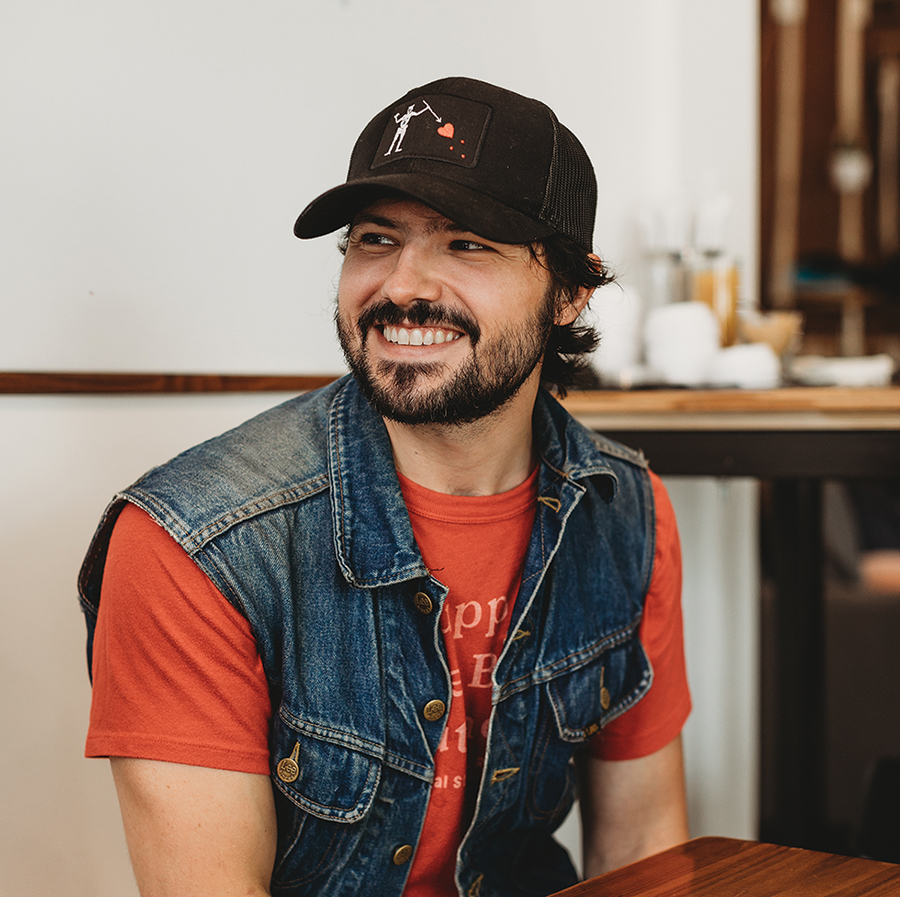
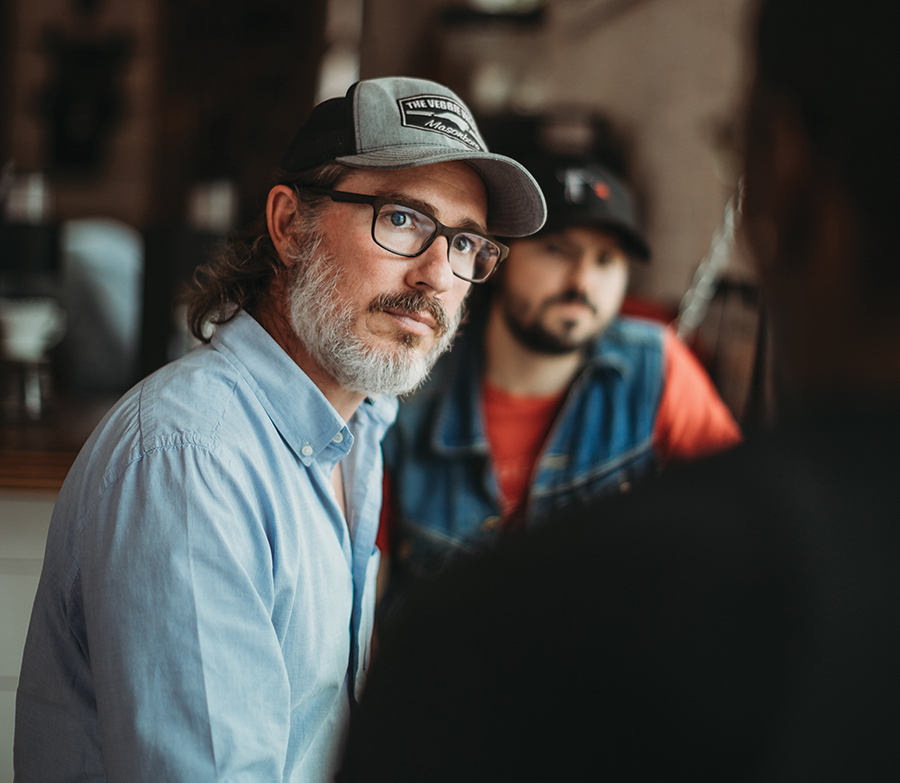
Bespoke Coffee and Dry Goods at the corner of Princess and 2nd streets in downtown Wilmington seemed like a good place to meet my friends and fellow writers Jason Mott and Taylor Brown for several reasons. First, the place is absolutely gorgeous. Huge windows pour light into a high-ceilinged space that is grounded by checkered tile, hardwood floors and countless succulent plants that lend soft pops of natural color to the industrial furnishings. Second, Bespoke’s coffee is just as outstanding as the curated list of local beers they have on tap. Finally, I knew Taylor would already be there, just as he is every afternoon.

I find Taylor at his spot near the register, sitting at the window that looks out on 2nd. When I say “his spot” I really mean it; a small gold plaque on the counter reads This space is reserved for Taylor “The Bodyguard” Brown.

“I spend hours writing here every afternoon,” he says when I ask him to tell me the story of the plaque. “When they first opened, I would stay until closing at 7:00 p.m., and then I would walk out with the staff.” He smiles, looks down at his open laptop where it sits just below the plaque. “They started calling me the bodyguard.”

I have known Taylor since an advanced reader’s copy of his debut novel, Fallen Land, found its way to me in the months leading up to its publication. The novel, which was released in 2016, was a huge success, and it was followed by the novels The River of Kings in 2017 and Gods of Howl Mountain in 2018. He has just recently returned from a long book tour that had him crisscrossing the country.

“How are you feeling after all that travel?” I ask.

“It gave me mono,” he says.

I laugh.

“No, seriously,” he says. “I went to the doctor last week.”

Jason walks in the door while we are talking. Like Taylor, he has just arrived home from a long book tour himself. We all shake hands, and Jason asks how we are doing.

“Book tour gave Taylor mono,” I say.

“I almost died on book tour, too,” Jason says.

I gesture toward the bar.

“Let’s get some drinks.”

We get our drinks — iced coffee for Taylor, water for Jason, and an IPA from Wilmington Brewing Company for me — and grab a table just inside the front door.

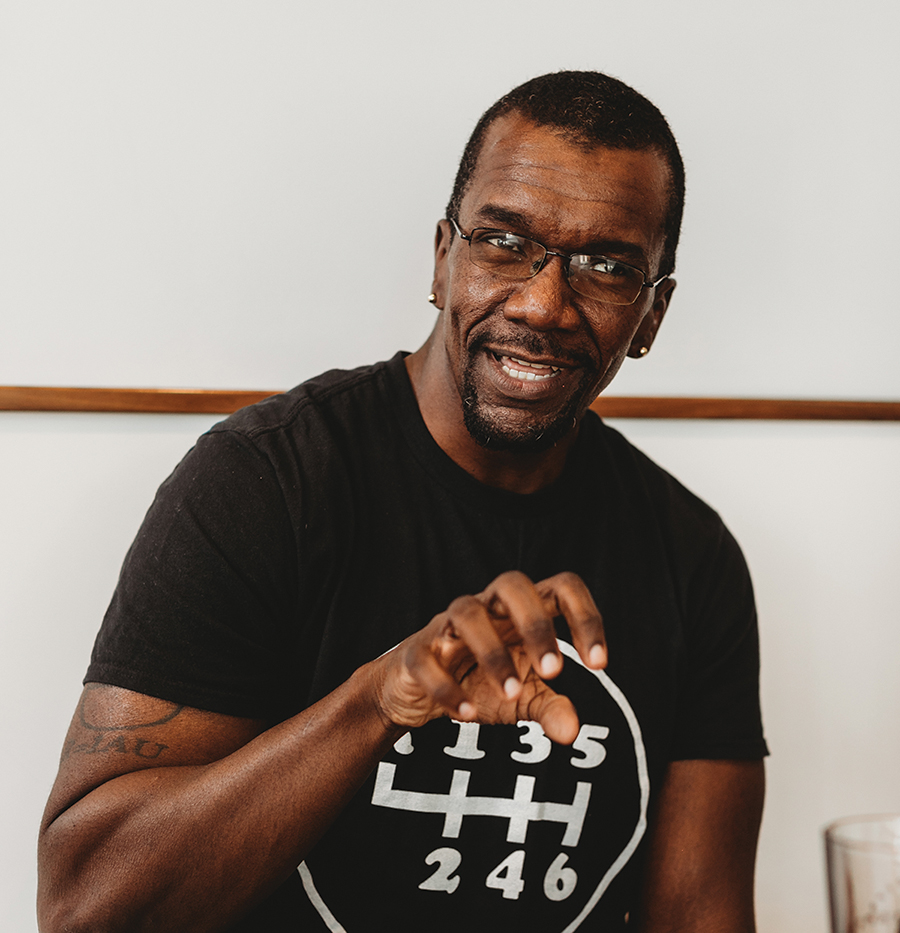
I have known Jason since my parents introduced me to him in 2013, when his first novel, The Returned, was released. The book was optioned and produced as a television show for ABC before it was even published, and my mom watched it and loved it, and then she and my dad went to one of Jason’s book signings. She fell for him because of his books, and my dad fell for him because of his cars. To say that Jason Mott is a car enthusiast is an understatement. He buys them, repairs them, modifies them, and races them. My dad had spent much of his young life doing the same. Finally, a writer both my mother and father could support.

Jason’s second novel, The Wonder of All Things, was released in 2014, and his novel The Crossing was released this spring. I ask him to expound upon his near-death experience on book tour.

“Hospitality driver,” he says. “He almost mowed down someone crossing the street in Seattle. He slammed on the brakes, and I thought I was going through the windshield. He told me he hadn’t seen the guy because he’d been about to pass out.”

“What did you do?” Taylor asks.

“Well, I was starving, and I figured if he was about to pass out, then he might need food. We stopped at Burger King and ate dinner before heading to the bookstore.”

“The glamour of book tour,” I say.

Our conversation quickly turns to surprising, horrifying and hilarious things that can happen when you are on book tour alone, staying in bad hotels, catching red-eye flights, and always feeling like you are supposed to be somewhere else.

“I’m actually working on a novel right now about a writer who goes on a book tour where insane things happen,” Jason says. “I wrote it as a screenplay, and the folks out in Hollywood said it may get more interest if it’s a book first.”

“I’ll read it,” I said.

“I’ll read it and blurb it,” Taylor said.

We tell more stories, finish our drinks, and then stand to leave. As someone who drives a toy-littered Subaru Outback with two car seats in the back, I watch Jason leave and try to imagine what kind of car he will be climbing into. Taylor heads back to his seat where his laptop still rests below his plaque.

“How late will you stay?” I ask.

“They close at 6:00 p.m. now,” Taylor says. “They felt bad for running me out of here an hour early, so they gave me a key to lock up.”

“Are you serious?” I ask.

He smiles and holds up a brass key on his key ring.

I say good-bye and step out into the heat. As I settle into my car and turn on the A/C, I imagine Taylor a few hours from now, closing down his laptop, turning off the lights at Bespoke Coffee and Dry Goods and locking the door behind him, glad to be home.  PS

Wiley Cash lives in Wilmington with his wife and their two daughters. His latest novel, The Last Ballad, is available wherever books are sold.

Soul Soothing

A place and a person to remember

By Tom Bryant

You are not dead until there
isn’t a crumb of memory left
anywhere in the world.

— John D. MacDonald,
The Empty Copper Sea

There is a place hanging on a mountainside right off the Blue Ridge Parkway where a person can rest his soul. The place is known as the Sourwood Inn. It’s a lot more than the common definition of a bed and breakfast. There are 12 bedrooms situated in a classic mountain lodge, overlooking a beautiful, almost mystic valley. The lovely inn was built for rest, relaxation and, as I mentioned, restoring the soul.

It had been a sad, gray, melancholy time. A good friend had suddenly keeled over and was gone before the EMS could arrive. A cousin I hadn’t seen in years passed away with heart trouble. And my mother, 99 years old and still with the grace and fortitude of a Southern lady, passed away quietly after a small stay in the hospital and an even shorter visit to hospice. It was as if she didn’t want to inconvenience the family with a long, drawn out, sad time of dying. She was that kind of lady, always thinking of others.

My sister’s call about Mom came late one evening. It had been a typical Sandhills summer day, hot with a high humidity that sent folks searching for air-conditioning. I had waited until late in the afternoon to beat the heat and do some much needed yard work. With that finished, I sat back in the sunroom enjoying a cold beer. My cellphone was still in my pocket, and I answered its persistent, buzzing ring.

“Tommy.”

“Hey, Bonnie, how’re things on the farm?” My sister had been Mother’s caregiver, and they lived in the old plantation house that was built in 1830.

“Not good. Mom’s in the hospital. She fell this morning and is not doing well. I’m on my way back over there to talk to the doctor now.”

“OK. Linda and I will come on down as soon as I clean up a little.”

“No, don’t come now. Wait until I find out from the doc what’s going on. This could be it, Tommy. Mama looks terrible.”

After a short stay in the hospital, Mom was moved to hospice. It was exactly as we feared. She was ready, after all her years, to give up the fight.

Linda and I made it to the hospice building a little after 11 the next morning and entered the room to see Mom.

“Hey, Mom, it’s Tommy. I love you.” Mother was past communicating with anyone. She was in the bed, eyes closed, breathing hard. I couldn’t take it and went back out in the hall.

In just a few minutes, Harriet, my cousin, an excellent nurse who had been observing the efforts of the hospice nurses, came out behind me and said, “Tommy, your mother is gone.”

My other sister, Billie, standing next to me, said, “It’s as if she was waiting for you.”

The rest of the week was a blur. Folks from the old Mizpah Church did a wonderful job with Mom’s funeral. The pastor, an easy-going, caring young man, presented the service just as Mom had wanted, and members of the church put together an afternoon meal for the family.

Mother was laid to rest beside my dad, who died almost 50 years ago. They were finally reunited.

On the drive home, Tom, our son, was dozing in the passenger’s seat, and Linda was in the back seat.

“It was great for Art, Bryan and Sandy and Bob to drive all that way,” she said. Bob and Sandy live nearby in Southern Pines, and we don’t see them often enough. Art lives in Albemarle and is part of our duck-hunting crew; and Bryan, another hunting buddy, drove down from Burlington.

“Yep, remember what Mom always said, good friends are gold.” I was quiet as we motored toward home, thinking about her and all her wise sayings and how she would be missed.

“Babe,” I said. “We really need to get away for a while. What if we go up to the mountains and stay at the Sourwood for a few days? We could kick back, read and maybe ride into Asheville for a bit.”

“That’s a wonderful idea. I’ll call them right now and see if they have a room available.”

We were in luck. Susan, the young lady who runs the inn, said that our favorite room was available and we were welcome. The room that we have stayed in several times is located on the second floor and has screened French doors leading to a small balcony overlooking the valley and mountain ridges beyond.

After a four-hour ride out of the sweltering heat of the Piedmont, we breathed a sigh of relief when we finally saw the mountain ranges to the west. We reached the Parkway; then it was just a short distance to Elk Mountain Road and the little one-lane, firebreak-wide driveway to the inn.

After we had unloaded and settled in our room, Linda went down to the great room and brought back homemade cookies and lemonade. I, on the other hand, decided to kick back on the balcony with three fingers of good Scotch I had been saving for a special occasion. The sun was beginning to set and a smoky gray mist was rising out of the valley.

Linda had put together a little picnic supper knowing that the inn would not be serving dinner that Wednesday evening, and we didn’t want to ride into Asheville after our five-hour trek across the state. We ate out on the balcony and watched as the sun set behind the inn and darkness crept over the valley. Linda went inside to read, and I watched the shadows and listened as nocturnal wildlife started calling and moving about the woods. After a while I went in, picked up the book I was reading and got ready for bed. I left the doors to the outside open, only latching the screens.

In the middle of the night, I was suddenly awakened. It was as if something or some noise had jolted me from my deep sleep. Groggily, I sat on the side of the bed, trying not to wake Linda, and heard the culprits that had roused me from my slumber. It was a pair of barred owls. They were evidently having a dispute over territorial rights and were arguing like a couple of Southern lawyers. I eased out to the balcony to listen.

The dark sky, full of stars, looked as if it had been sprinkled with diamonds, and the Milky Way seemed to be hovering right over the inn. I watched and listened as the owls moved down the ridge toward the valley, and I thought about Mother and a conversation we had before she became so conflicted with dementia.

“Tommy, don’t you be so upset when I leave this Earth. I’ve had a good life and I’m ready.”

“Mom, you’re going to be here for a lot more years,” I replied.

“No, son, I’m not. And listen to me. My death is not going to be an ending. It’s a new beginning. Think of it as if I’m just heading out on a big adventure and will see you again some day. I won’t see you anytime soon, though, because you have a lot of living yet to do in this world.”

I listened as the sounds of the owls faintly drifted up from the valley, and then they were silent. A meteor streaked across the northern sky. I stood and stretched so hard I could hear my tendons creak. It was as if a heavy weight fell from my shoulders, and I silently went back into the room and to bed.

I dreamed about meteors and stars and Mother.  PS

Tom Bryant, a Southern Pines resident, is a lifelong outdoorsman and PineStraw’s Sporting Life columnist.

The Back Deck

Where there’s enough for everyone

By Renee Phile

The green, grassy yard is a triangular shape, lots of plants: basil, rosemary, pansies, and other flowers that look cool, but I don’t know their names. Bird feeders — the whimsical ones — are scattered in the yard. The hoi polloi squirrels eat peanuts from kitchen pans on picnic tables. The birds chirp, the highway beside the house roars softly, the wind tingles against my skin. It’s a cool September morning in Nags Head, and I can smell the ocean. My best friend’s grandma reminds me of my own. Delicate but not breakable. I’m sitting right beside her on the back deck. Just the two of us. I hear a buzz. A bee. Then a hummingbird. I see trees full of birds I can’t identify any more than I know the flowers. I hear a car honk. A door shut. She is reading her devotional book, The Upper Room, and I remember my Gram reading the same book. She reads her Bible at the same time, the books balanced in her lap. Flips pages in her Bible. Points her finger along the page like a palm reader tracing the heart line. Reads. Flips more pages. Reads. Rubs her worn, delicate hands together. Flips more pages. Reads. Rubs her wrist. Peers down at a verse. Reads it to herself. The words almost loud enough for someone to hear. Sips her coffee. I sip my own and continue to write in a notebook. A blue jay hops close to me. She looks up. Throws it a peanut. “Uh, oh,” she says as another one swoops down, snatches it, and flies into a tree. She throws a second peanut for the first blue jay, the one that got pushed to the back of the line, but the one in the tree flies down again, and there is a little scuffle. Bird stuff. “There’s enough for everyone!” she laughs. I laugh too.  “This house was built in 1990, and we bought it in 1998,” she explains. I nod. “We have been here ever since.” I nod. She tells me about the house. Two stories. She tells me about her children. Two live close by, they can smell the ocean. One lives on the other side of the world.  She tells me about her husband, who passed away this year. He was a wonderful man. She lays her hand flat on the page of the book. There are doves on the roof of the house, looking like a conference is taking place. Bird stuff. I wonder what they are talking about up there. “The blackbirds eat up everything!” she says as she throws a peanut to a squirrel. It hops up to the deck and devours the nut. She reads, and I write. I breathe in the ocean air. I never want to lose this. Instead I will store it away and come back to it whenever I need it. The blue jay swoops down again, greedy.  PS

Renee Phile loves being a teacher, even if it doesn’t show at certain moments.

Gifts from the Sea

Add a powerhouse of nutrients

By Karen Frye

Walking along the shoreline in the northernmost part of Maine and into Canada at low tide, you will find beautiful sea vegetables on the rocks. Edible seaweed grows in an area of the ocean’s edge called the intertidal zone, a fertile area where the land’s organic mineral matter meets the ocean’s mix of water and sunlight.

Originating in Japan, the macrobiotic diet promotes the use of sea vegetables for improving health and includes them in many recipes. The Vikings carried dried seaweed on their voyages for sustenance.  Early New England whalers chewed on seaweed for its high vitamin C content to keep scurvy away. The Japanese incorporated sea vegetables in their diet regularly and used them in shrines and ceremonies.

Adding edible seaweed to your food will bathe your cells with a powerhouse of nutrients. Seaweed pioneer Evelyn McConnaughey has collected references from around the world of seaweed being used in the treatment of goiter and other thyroid problems, kidney ailments, ulcers, obesity, high cholesterol, hardening of the arteries and hypoglycemia. Traditional Oriental medicine has always promoted the use of seaweed to lower the risk of heart disease. High in potassium and low in sodium, it reduces the risk of high blood pressure and stroke.

Some of the sea vegetables found easily are:

— Alaria: perfect in soups, loaded with calcium and vitamin A.

— Arame: mild flavor, soak for a few minutes and add to salads or stir-frys.

— Dulse: a reddish-purple seaweed that can be enjoyed as a snack out of the bag, or added to sandwiches, salads and soups.

— Kelp: the all purpose sea veggie, it comes in shakers to sprinkle over food (an alternative to salt); exceptionally high in all minerals, especially calcium, potassium and magnesium.

— Kombu: usually found in strips, you can tenderize (by soaking in water for a few minutes) before use; excellent to add to soups, stocks and beans; very high in iodine.

— Wakame: a very mild taste, cooks quickly; traditionally used for miso soup. 

— Nori: if you’ve eaten sushi, you’ve eaten nori; it has a mild, nutty taste, use it for wraps, or crumble it over foods; the highest protein content of the sea veggies with significant amounts of the B vitamins.

Here is an easy soup recipe that is delicious and can get you on your way to making sea vegetables a part of your life.

Basic Miso Soup

6 cups water or vegetable stock

1 medium carrot, sliced diagonally

1 3-inch piece of wakame or kombu

2 scallions, thinly sliced diagonally

3-4 tablespoons miso paste (found in the refrigerated section)

Bring water or stock to a simmer, add carrots and cook until tender.  Soak the seaweed in cold water while carrots cook, then drain.  When carrots are tender, add the seaweed to the stock and simmer for a minute. Add the scallions and simmer for another minute. Remove from the heat.  Dissolve miso in some of the broth and return to pot.  Allow to steep briefly before serving. You can remove the seaweed because all the nutrients are now in the soup. You can add other vegetables like celery, onion and ginger. Sprinkle with fresh chopped parsley before serving.

Many health care professionals promote following a plant-based diet.  Don’t hesitate to include the sea vegetables as well. You’ll be glad you did.  PS

Karen Frye is the owner and founder of Natures Own and teaches yoga at the Bikram Yoga Studio.

Home, Revisited

The place where old voices linger

By Deborah Salomon

Thomas Wolfe was wrong. You can go home again, virtually, at least. Beware: The journey may be enlightening or sad, affirming or bittersweet.

I have lived under 12 roofs — apartments, duplexes, condos, houses — in 80 years. Each represented a life sequence although, at the time, you only think about the stairs, stoves and bathtubs. Google makes homecoming easier because should the property be for sale, chances are the real estate agent will post a slide show.

I discovered this 10 years ago, after moving back to Asheville, where I lived as a teen in a house my parents occupied almost 40 years. The first buyer renovated and flipped it after my mother moved to a senior residence. It was for sale again. After poring over the photos I asked the agent for a walk-through, which I anticipated, naively, would be like a mother-child reunion.

This house in a very ordinary neighborhood was constructed entirely of stone in 1947 by a builder, for his own family. Poor guy knew more about materials than layout. A hopeless kitchen, tiny dining room, oversize living room, two main-floor bedrooms, two more upstairs plus two vaguely art deco black-and-white tiled bathrooms. The house was empty, with gleaming original hardwood throughout and ridiculously ornate crown moldings added later. Wall colors — bright and hard, unlike the soft green and rose of the ’50s — smacked of too much makeup on an aging beauty. I cringed seeing the mantel painted, ugh, black. Without drapes the huge picture window was a gaping wound in the living room wall.

Once inside the heavy front door, voices long ago absorbed by the walls came seeping out: my mother’s voice, complaining about the cramped kitchen, now gleaming stainless, more like a hospital OR than a place to simmer beef stew. Gone was the wall separating it from the tiny dining room. I heard my father insisting that because the house was made of stone we didn’t need window air conditioners. He deemed “cross ventilation” sufficient.  So we suffered.

The basement became his castle, housing a workshop where he made and fixed everything. I had forgotten the tiny, windowless basement bathroom, my introduction to segregation. The African-American man who did “heavy cleaning” for my mother insisted on using that bathroom to change from the clothes he wore to work at the V.A. hospital. Leroy ate his sandwich in the basement, too, although we invited him to eat with us. I always took him a cold Coke, in a bottle.

The massive oak which dominated the backyard — gone, replaced by a fire pit and meditation garden, whatever that is. The flagstone patio added under the critical eye of my grandfather, a retired brick mason, had been roofed over — now “an Italianate veranda.”  I could almost hear Granddaddy shuffling along the back hall, where the carpet runners (with a hideous “carved” pattern) had been removed, lest he trip and fall.

At the top of the stairs was a sewing closet. My mother rarely fired up the Singer but my father, in search of a project, had built slanted shelves fitted with little spindles, to hold thread spools. How was the Realtor to know?  “Custom carpentry,” she called them.

The upstairs was mine (an only child’s perk) until I left for university. Then it became an apartment with kitchen, sitting room, bath and bedroom but no separate entrance. That lasted one tenant, a cranky old lady who was either too hot or too cold. I peeked into the storage room under the eaves which had a window facing the street — and shuddered. My mother insisted I go on a blind date with the son of a college classmate. From that window I watched him get out of the car and approach the front door. In an absolute panic, I ran downstairs, told my mother no way, dashed into the bathroom and locked the door.

Now, for the last time, I looked through the window and laughed, a laugh that echoed through empty rooms painted garish colors.

A lot transpired in that house. My grandfather died in the back bedroom. I graduated from high school, college and married from there. I brought my three wiggly kids who made a terrible mess. When my daughter was at Duke she sometimes appeared for the weekend, unannounced, with her big dog and a boyfriend. I watched the furniture and household goods carried away at the tag sale — all except my father’s tools, which I gave to Leroy, who had admired them for 30 years of basement lunch breaks.

Why pretend? Angst outweighed nostalgia as I walked through the empty, pristine rooms. Mine was not a storybook youth. But it was my youth. Beginning in 1953, this youth played out in my father’s pride, something the sixth son of a desperately poor immigrant family never dreamed of owning — a solid, attractive, comfortable home.  And now, except for the spool spindles and a few glass doorknobs, that house had been washed clean of his presence.

I found an apartment and two more houses online but have no desire to follow up. Because, I learned, only the house remains, not the home.

So maybe Thomas Wolfe was right, after all.  PS

Deborah Salomon is a staff writer for PineStraw and The Pilot. She may be reached at debsalomon@nc.rr.com.