All Bottled Up

Poor man’s stained glass comes of age

By Susan McCrimmon  •  Photographs by Laura Gingerich

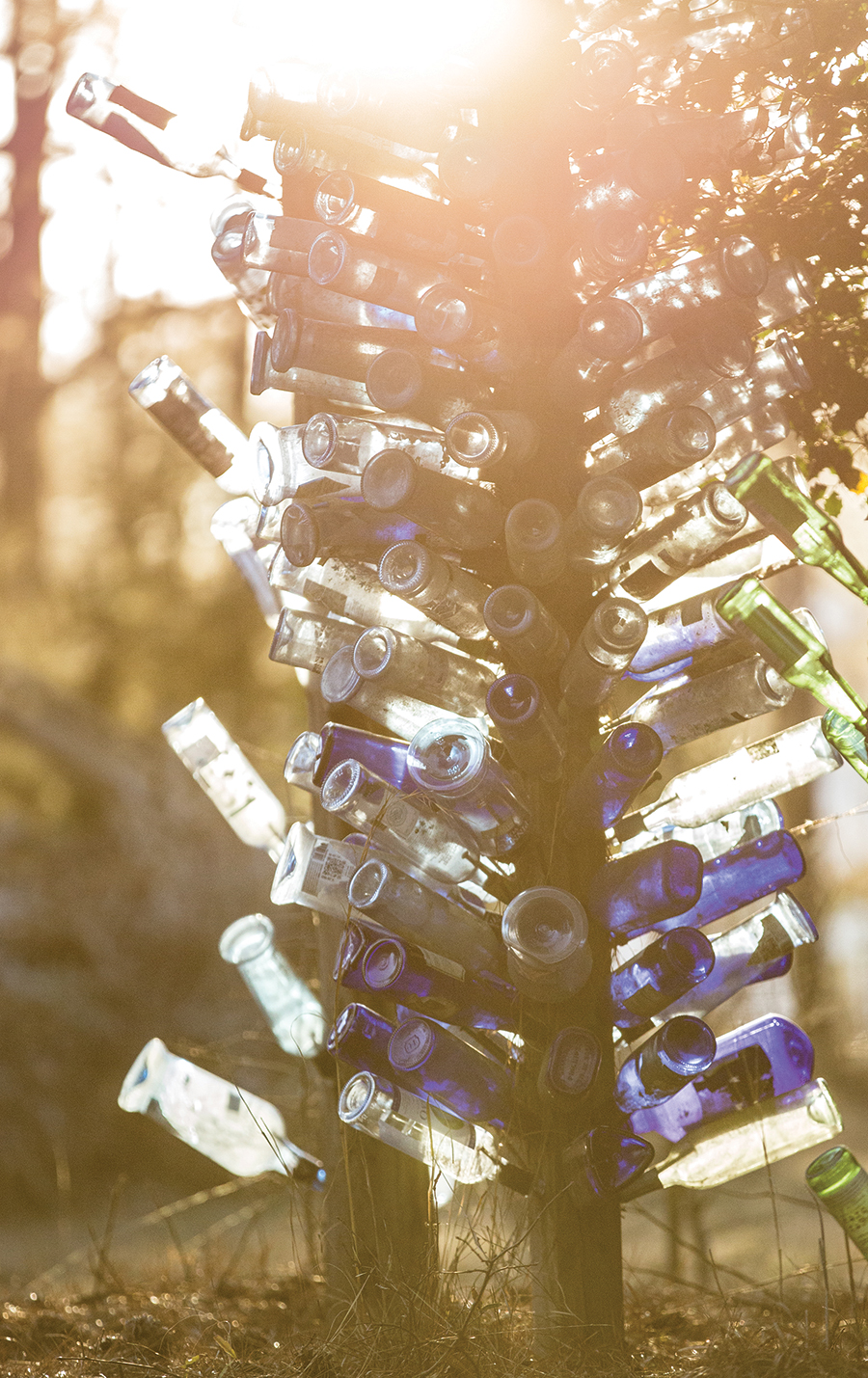
Are they trash recycled as art? Does your heart soar when one is spotted tucked back into some shrubbery? Does your nose wrinkle with distaste at the gaudy display? Love ’em or hate ’em, glass containers emptied of their various and sundry contents — liquid medicines, soft drinks, vinegar, beer, syrups, hard liquor — all have been transformed into an art form, the Pietà of salvage, the bottle tree.

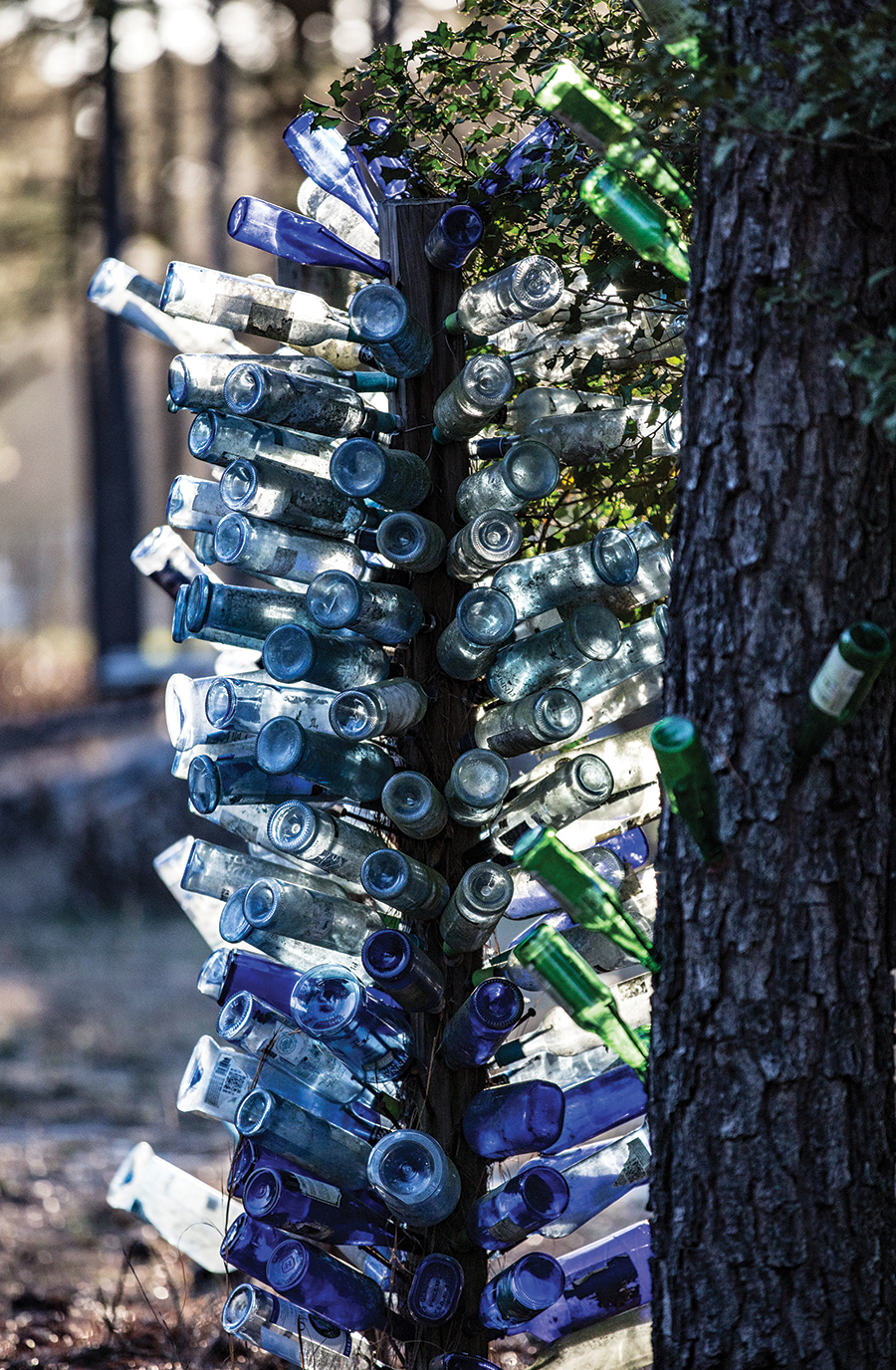
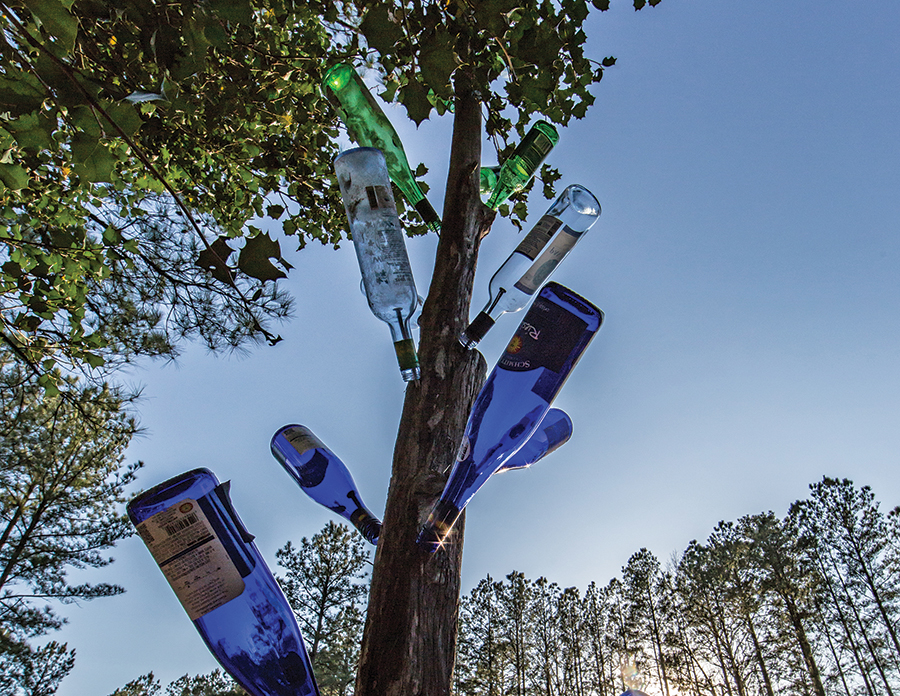
A splash of color in the corner of the garden or a note of whimsy as the garden’s focal point, there is no denying a bottle tree’s impact. There are no formulas, no blueprints, no set rules governing construction or design. Bottle trees are limited only by one’s imagination, creativity or pocketbook. The “poor man’s stained glass” can be constructed from a variety of materials. The most current manifestation can be purchased and installed in short order. Metal “trees” made from rebar or similar material are placed in the desired location and the chosen bottles are inverted onto the tree “limbs” to complete the look. Easy peasy. The more traditional bottle trees take a little more effort. If one is lucky, a  dead cedar tree or crape myrtle, in the right location, works great. Cedars and crape myrtles are traditionally associated with bottle trees, although anything with good limb structure will work. Just trim the limbs as needed and place saved bottles as your artistic muse dictates.

Otherwise, a strategically positioned post or tree trunk may be your best option. Some people drill holes and pound wooden dowels at an angle into the post or tree trunk to support the bottles. I prefer to hammer in 20-penny nails. Relatively inexpensive, they can be easily moved for creative effect. To finish, simply add the collected bottles. They can be a wide variety of shapes and colors or just one specific type or one specific color. The possibilities are endless.

Bottle trees have spiritual, cultural and aesthetic significance in history and garden design. Glass was first discovered in northern Africa about 3500 B.C. Glass bottles appeared in Egypt and Mesopotamia around 1600 B.C. It’s possible that the Arabic folk tale of the genie in Aladdin’s lamp is the first instance of bottles being used to capture spirits, pre-dating the common conception of bottle trees originating in the Congo during the ninth century where empty glass bottles were placed around entryways in order to ensnare evil spirits which then would be destroyed by sunshine. Wind blowing across the bottles was the sound of spirits trapped inside moaning to be released. At the same time in the Congo, tree altars were erected to honor dead relatives. Plates attached to trees or sticks would be placed around the gravesite as a memorial. The plates were thought to resemble mushrooms. The  Congolese word for mushroom was similar to their word for love. See a mushroom . . . think of love. Earth from the gravesite would be placed in bottles and they would be hung by the neck from low limbs of a tree. These bottles would emit a tinkling sound in a breeze, possibly the beginning of wind chimes. The two concepts began  to merge into the bottle tree.

The color of choice for bottle trees has predominantly been cobalt blue. Cobalt blue is universally accepted for relaxing and calming the spirit and has historically been associated with spirits, ghosts and haints. Blue bottles have been found on shipwrecks from the Minoans dating as far back as 2700 B.C. The most widespread means of adding blue color to glass was using the element cobalt, thus the name. The term cobalt is Greek in origin by way of medieval Germany. When smelting silver, the cobalt metal embedded in the silver ore could interfere with the process and cause respiratory issues. As early as 1335, “Kobald” referred to gnomes or spirits afflicting the silver miners. The association stuck. The word for troublesome spirits became associated with the main way of getting blue color into glass that was then used in bottle trees to capture evil spirits. Cobalt blue was the preferred color of Voodoo tradition. This color of the sky and water was a crossroads of heaven and Earth, the living and the dead, and creative and destructive spirits. 

The esteemed Southern writer Eudora Welty believed that place is what makes a story appear real, because with place come associations, customs and feelings. In the short story “Livvie” she writes:

“Out front was a clean dirt yard with every vestige of grass patiently uprooted and the ground scarred in deep whorls from the strike of Livvie’s broom. Rose bushes with tiny blood-red roses blooming every month grew in threes on either side of the steps. On one side was a peach tree, on the other a pomegranate. 

“Then coming around up the path from the deep cut of the Natchez Trace below was a line of bare crape-myrtle trees with every branch of them ending in a colored bottle, green or blue. 

“There was no word that fell from Solomon’s lips to say what they were for, but Livvie knew that there could be a spell put in trees, and she was familiar from the time she was born with the way bottle trees kept evil spirits from coming into the house — by luring them inside the colored bottles, where they cannot get out again. 

“Solomon had made the bottle trees with his own hands over the nine years, in labor amounting to about a tree a year, and without a sign that he had any uneasiness in his heart, for he took as much pride in his precautions against spirits coming in the house as he took in the house, and sometimes in the sun the bottle trees looked prettier than the house did . . . ”

My first two bottle trees came about due to my mother’s illness. She was a died-in-the-wool Southern iced tea drinker. Every day. If there wasn’t a pitcher of tea already in the fridge, it was being brewed on the stove. One of the manifestations of her illness was that it altered my mother’s drinking habits. She no longer wanted tea but began to drink Coke. Not any Coke, mind you, but it had to be the ones in the 6-ounce bottles. We bought them by the case. I began to store the small greenish bottles with the distinctive red labels. When I thought enough had been gathered, I dug a hole near a large camellia bush, beat in the nails, and erected this rather odd memorial to my mother. During the many months of her illness, almost every evening was passed with friends and family murmuring words of support while sitting on Mom’s screened-in porch. At times, alcohol was the crutch used to help numb the pain. My second bottle tree was born as a memorial to those evenings. The current count is six . . . and growing. 

Regardless of your color choice, be it blue, green, brown, clear, red or any array of color choices for your garden addition, remember its long tradition of keeping bad things away. No one can feel bad from something that brings one such joy.  PS
Susan McCrimmon is a noted science geek, Suduko and crossword addict and is rumored to be besotted by words…and bottle trees.

Golden Night

A pop-up meal blossoms on a spring evening

By Casey Suglia     Photographs by John Gessner

5:45 p.m.

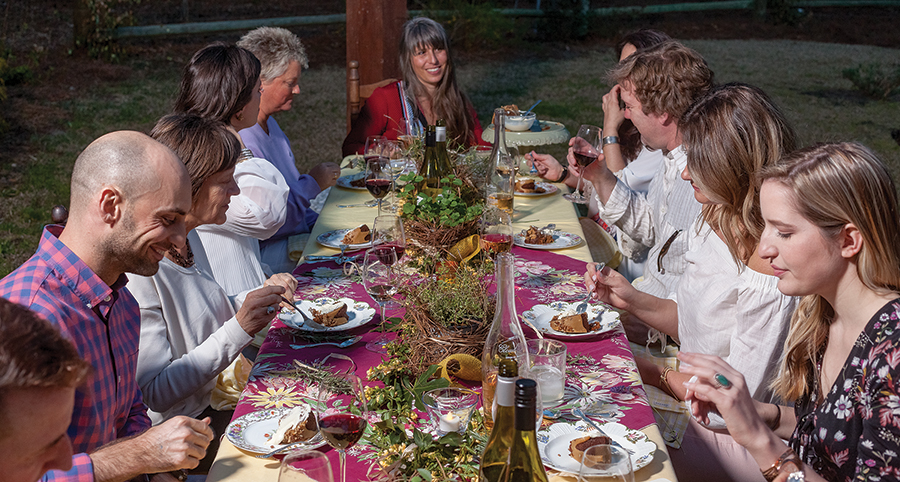
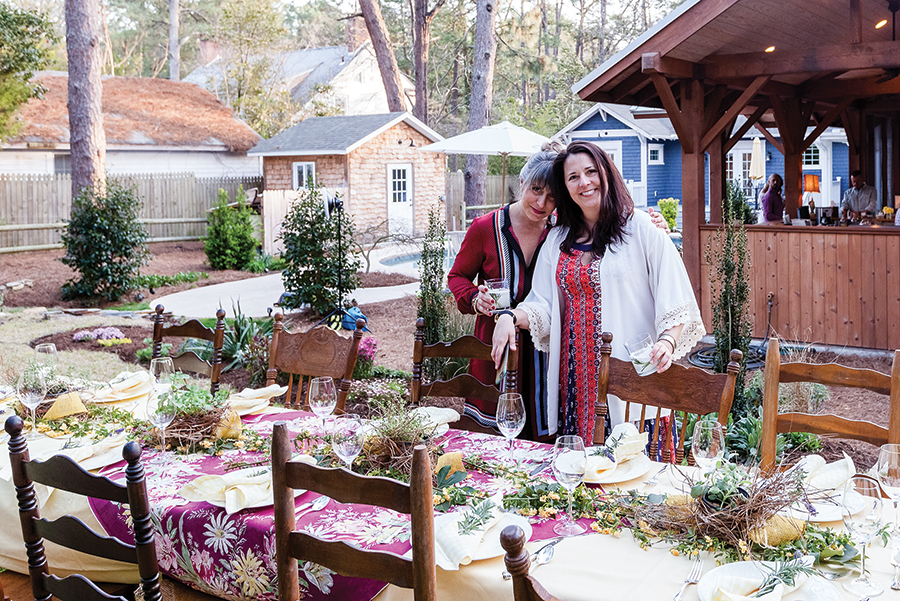
An outdoor fireplace crackles as a dozen guests mingle at the home of Jeff Kelly and Scott Harris. Tony Cross, of Reverie Cocktails, mixes a drink specifically designed for the night, the “Ágætis byrjun” — Icelandic for a good beginning. It’s a combination of Grüner Veltliner, a dry white wine from Austria, and Conniption Gin, a North Carolina-made “Navy strength” gin far more potent than your average bottle. Cold-pressed organic pineapple juice made at Nature’s Own, and smoked rosemary simple syrup, handmade by Cross himself, combine for a savory and sweet cocktail. Cross smacks the rosemary garnish to release the herb’s essence.

“The cocktail is local, as always,” he says. “It’s seasonal and springlike.”

The outdoor kitchen and bar of the home, located just blocks away from Broad Street in Southern Pines, serves as the perfect place for entertaining. “We host small dinner parties out here all time,” Harris says. But tonight is different. A mixture of people — some strangers, others friends for years — gather for a seasonal pop-up dinner created by Southern Whey’s Angela Sanchez and Chris Abbey, and Jen Curtis of Chef Warren’s.

“This was the brainchild of Jen and me,” Sanchez says. “It was a way for us to do something outside of the box and express our creativity away from our day jobs.”

6:15 p.m.

Sanchez sets out a tray of fresh, seasonal produce and cheese from Southern Whey — some local like Paradox Farm’s Cheese Louise spread. “The dinners all have different vibes or themes,” Sanchez says. “But our meals always have a local emphasis.” As the days lengthen and nights shorten, spring is the perfect time to match people and food. New blooms, new friendships, new beginnings.

6:30 p.m.

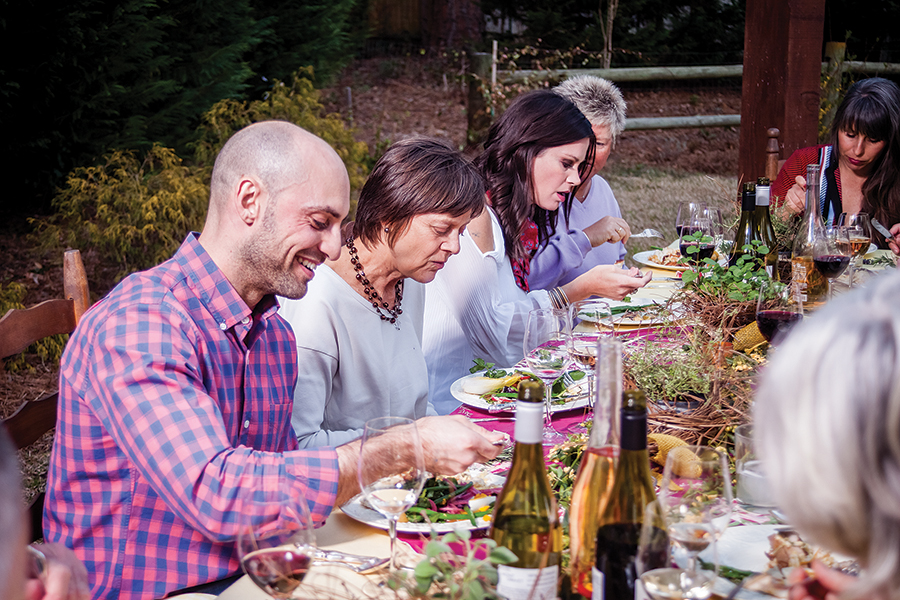
In the kitchen, Curtis plates the meal — a mix of local ingredients with fresh flavors hinting at the start of the season. The night’s menu is North Carolina pork belly served on a bed of locally grown grits from Anson Mills. A niçoise salad with North Carolina speckled trout, pickled okra and Amanda Curtis’ locally grown Heirloom Eggs.

“The meal is based on the coming of spring,” Curtis says. “There’s a Southern influence. We’re all transient here. Some of us have Northern roots, but we embrace the culture. Every tradition is identifiable, especially in food.”

“The meals are made so they’re easy to pass and share,” Sanchez says. “Guests are encouraged to sit wherever they want and make new friends.”

“People being together and sharing food always leads to something else,” Curtis adds.

7:00 p.m.

The guests gather around the table and talk about what’s new on Netflix, the wavering weather and the changing landscape of Southern Pines, as the sun sets behind them.

“The great thing about this backyard is that it feels like an oasis, but it also feels like we’re in Southern Pines,” Harris says. “It’s our own secluded space. We created our own environment here.”

Christin Daubert, a librarian, has attended all of Curtis’ and Sanchez’s pop-up meals, yet is constantly surprised by the place she and her husband, Justin, have called home for three years.

“I love this tiny little town,” Daubert says. “Every day I meet new people.”

7:20 p.m.

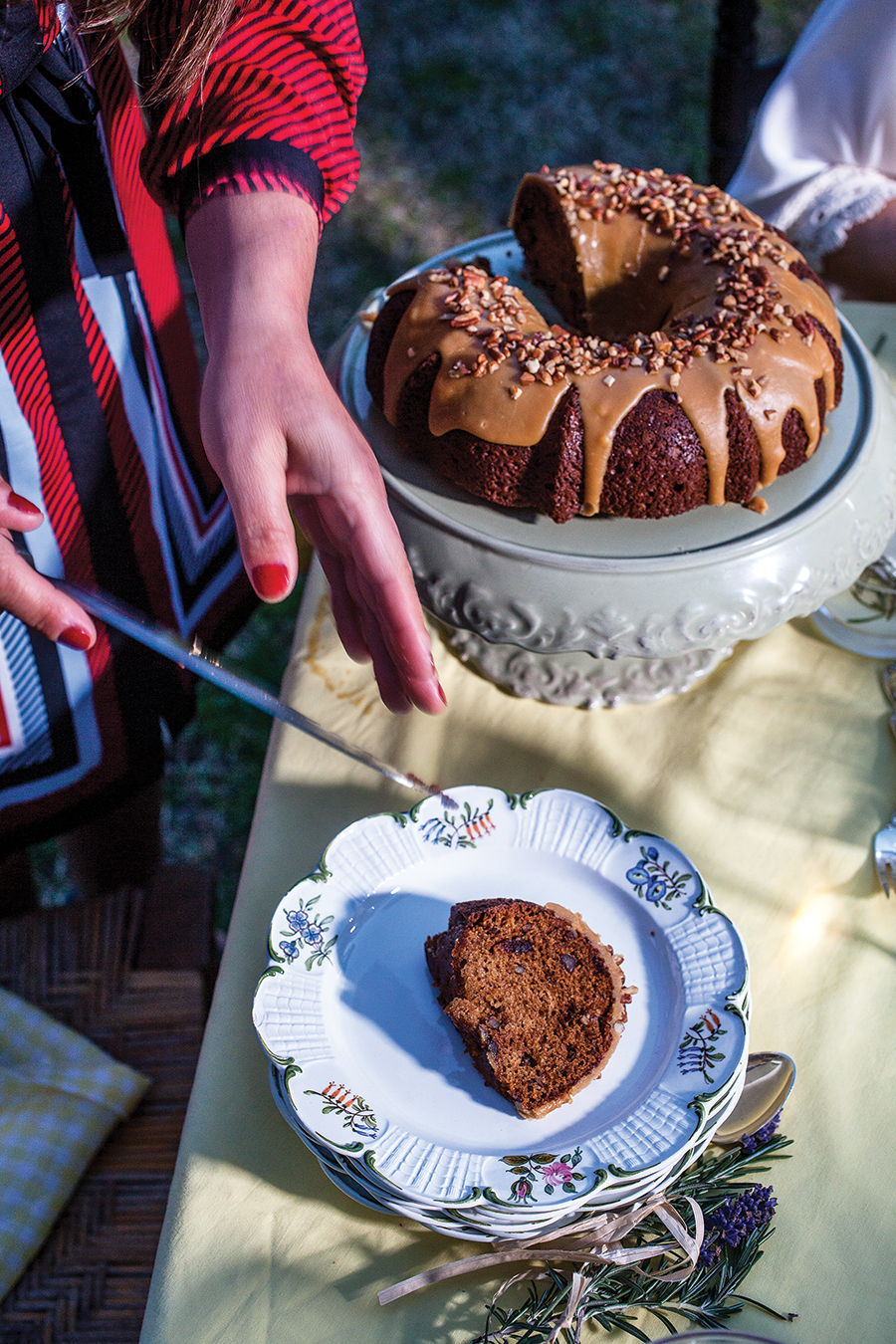
Dusk settles in and the cake — made with applesauce, rye flower, and dates with a pecan glaze — is served. Kelly and Harris’ yellow Labs, Lil’ Bit and Izzy, join the party for dessert, sneaking a bite of cake from some new friends of their own.

8:00 p.m.

The chill of the spring evening sets in the air, a reminder that the warm weather is still weeks away. The night feels young. The guests stand in front of the cracking outdoor fireplace, sip wine, and chat as if they’re new old friends.

“Spring is about renewal, change. We shed the past, move forward, and do that tonight with wine, conversation, and good food,” Sanchez says.   PS

Menu For A Southern Spring Night

Niçoise Salad with a Southern Twist –

Watercress, Belgian Endive,
Confit New Potatoes, Spring Radish,
Pickled Red Onion, Pickled Okra, Haricot Vert, Asparagus, Heirloom Eggs Soft Boiled Eggs and Smoked Speckled Trout
Citrus and Whole Grain Mustard Vinaigrette

*

NC Heritage Breed Ossabaw Pork Belly –

Star Anise, Juniper, Fenugreek and
Kombu Braised Pork Belly with
Anson Mills White Corn Grits,
Pork Braising Jus & Napa Cabbage,
Citrus and Mint Melee

*

Applesauce Cake –

Applesauce, Carolina Ground Rye Flour, 
Medjool Dates, Pecans with
Sorghum Caramel and
Marscapone Cheese whipped
with Local Honey

Longleaf Majesty

The roots of a massive ecosystem

By Bill Fields     Photographs by Brady Beck

For those who understand the longleaf pine, lose sleep over its well-being and know of its former ubiquity in the southeastern United States, there is a yearning to have witnessed the old landscape vastly different from today.

“Guys fantasize about a lot of things,” says Jesse Wimberley, outreach coordinator for the nonprofit Sandhills Area Land Trust, “but you’re talking to a guy who literally fantasizes about wanting to have seen that forest. I think we missed out on one of the greatest things that this country ever had — that endless longleaf forest that went on for miles and miles and miles.”

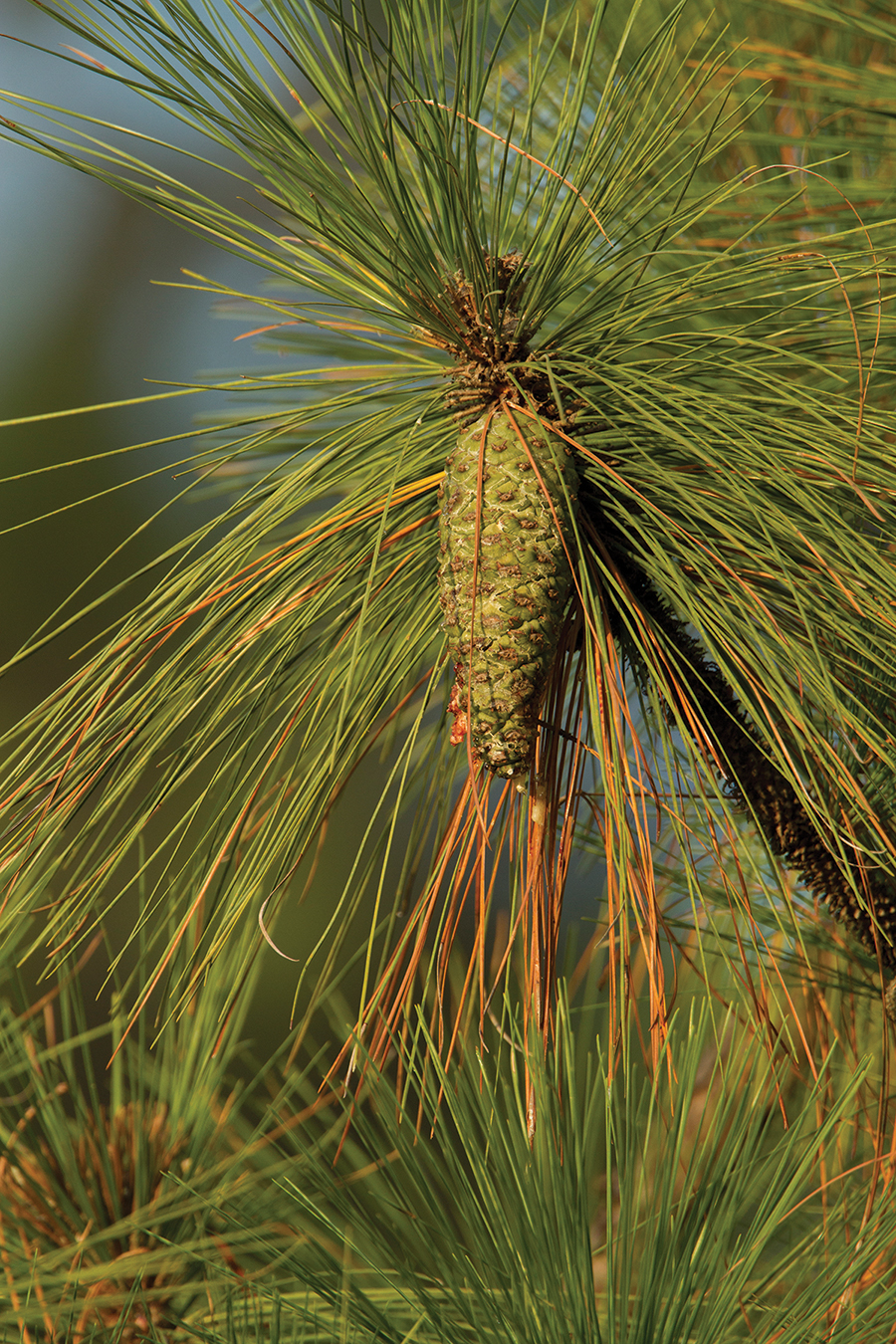
An Aberdeen native, 1976 Pinecrest High School graduate and fourth-generation longleaf farmer, Wimberley calls the 92 million acres of longleaf that once existed from Virginia south to Florida and west to Texas “the greatest ecosystem that ever existed in the United States.” It is hard to argue with him, especially in the Sandhills, where the species is the area’s long-needled fingerprint, the remnant that offers an inkling of what stood centuries earlier.

“They talked about being able to ride for days and days and never getting out of the piney woods,” says Robert Abernathy, president of the Longleaf Alliance, an education and advocacy organization started in 1995. “You can get a taste of that in Weymouth Woods and on the Walthour-Moss property. You can get out in the middle of it, and if you don’t listen to the traffic, you can get an idea of what the forest looked like 200 years ago.”

There are accounts of what that experience would have been like, from William Bartram’s writings near the end of the 18th century to Basil Hall’s book Travels in North America, in the Years 1827 and 28.

“For five hundred miles, at the least, we travelled, in different parts of the South, over a country of this description, almost every where consisting of sand, feebly held together by a short wiry grass, shaded by the endless forest,” Hall, a native of Edinburgh, Scotland, wrote. “I don’t know exactly what was the cause, but it was a long time before I got quite tired of the scenery of these pine barrens. There was something, I thought, very graceful in the millions upon millions of tall and slender columns, growing up in solitude, not crowded upon one another, but gradually appearing to come closer and closer, till they formed a compact mass, beyond which nothing was to be seen.”

Traveling out through longleaf from Raleigh in 1853, a correspondent for The New York Times described “a soft winter’s day, when the evergreens filled the air with a balsamic odor, and the green light came quivering through them, and the foot fell silently upon the elastic carpet that had spread, deluding one with all the feelings of Spring.”

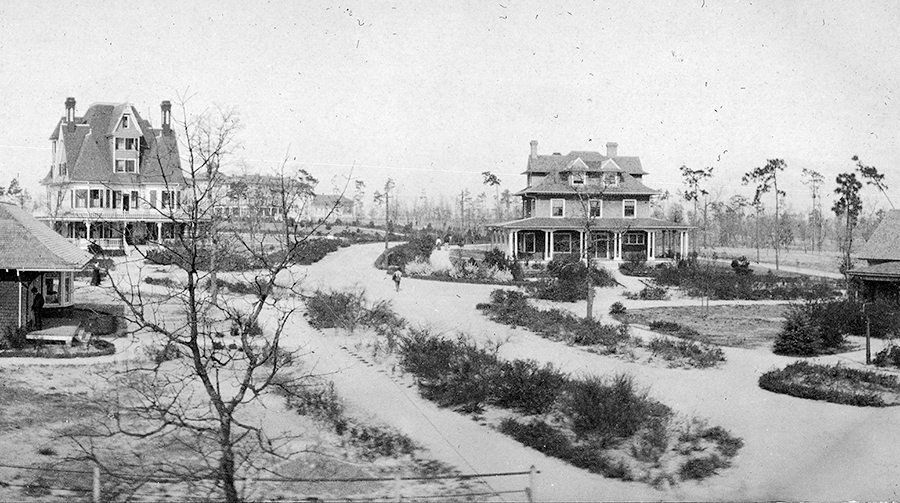
As John Patrick and James Walker Tufts arrived at the tail end of the 19th century in what became Southern Pines and Pinehurst, amid the detritus of a landscape savaged for timber and turpentine, it was the lung-clearing, life-affirming air among the remaining longleaf that gave the founders a reason to settle. On the early laps of the 21st century, as hastening development intrudes even on second-growth Sandhills longleaf, claiming them for shopping centers and tract homes, their scent and sight become something to savor ever more. Even what you hear, standing among longleaf “through which the wind roves with a sound no poet can capture,” as Hamlet native Tom Wicker wrote in 1975.

Given that only 4.7 million acres of longleaf pine forests stand today, 5 percent of its original geographic range — which was roughly the size of California — it would at first glance seem there isn’t much to cheer about. But things have gotten better since 1995 when a Journal of Forestry article titled “Requiem or Renaissance?” noted losses had reduced remaining longleaf forests to fewer than 3 million acres, a far more dramatic shrinkage than that suffered by the Amazon rainforest.

“It is progress, especially since we stopped the decline of the system itself,” says Dan Ryan of The Nature Conservancy, a longleaf specialist based in North Carolina. “It was on a horrific trajectory for a couple of hundred years. The fact that it’s actually increasing is phenomenal. But the ability to increase acreage is extremely resource-intensive because essentially there has to be protection over the land, and the habitat of the land needs to be managed for the longleaf pine. A lot of money is involved in turning that number around.”

When conservationists talk about restoring Pinus palustris, they are referring to much more than saving a small stand of the Sandhills’ signature tree, say, in the median of Midland Road — not that they wouldn’t want to do that, too. Naturalist John Muir wrote of his 1868 journey through the Southern piney woods that he “sauntered in delightful freedom.”

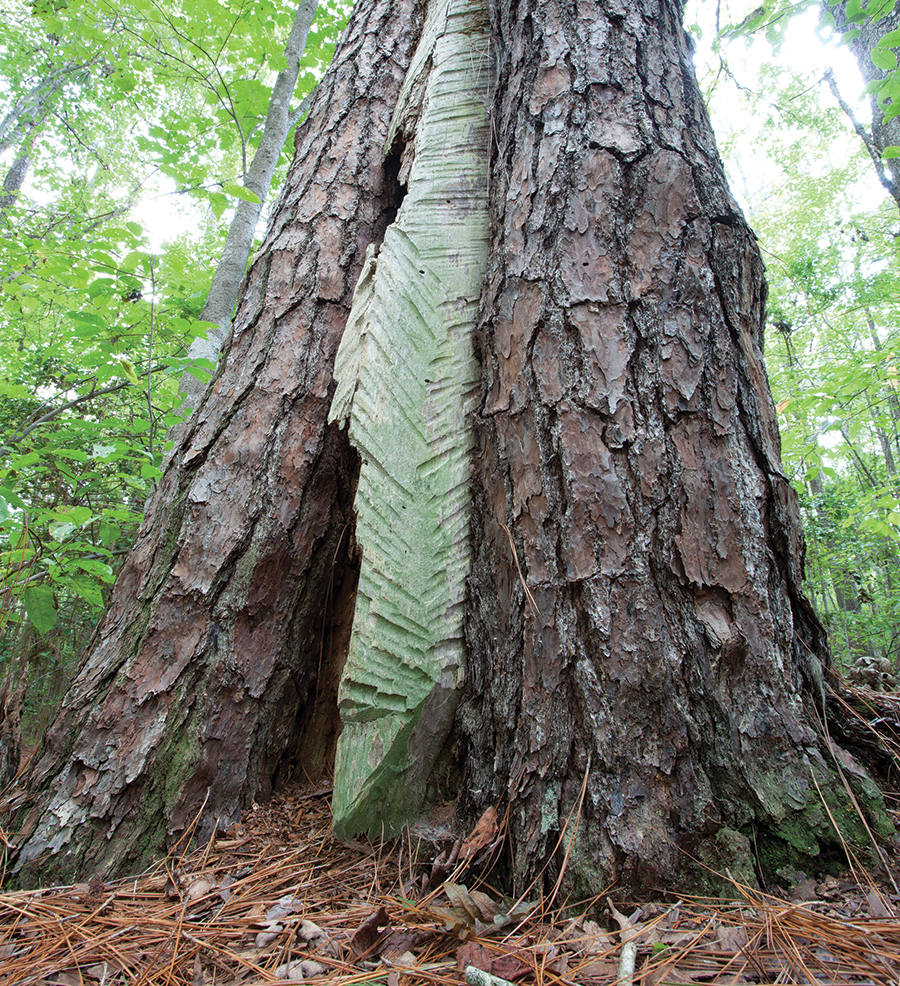
Muir’s experience was possible because of the essential character of a longleaf ecosystem, in which mature trees 70 to 120 feet tall (height primarily depends on the quality of the soil) tend to be void of low-hanging branches. The open canopy allows sunlight to reach the sandy forest floor, which in its natural state, thanks to periodic fire, is alive with grasses, wildflowers and wildlife.

“I like to tell people it’s the opposite of the rainforest,” says Nancy Williamson, park ranger at Weymouth Woods Sandhills Nature Preserve. “In the rainforest, it’s so dark on the forest floor there isn’t a lot of diversity on the floor. It’s the different kinds of trees and the things that are going on in them. With longleaf, the diversity is in the open understory.” Abernathy adds, “If you have the right plants, you have the animals, a whole suite of species.”

With the red-cockaded woodpecker — an endangered species that uses the trunk of a living longleaf for a nesting habitat — at home high above, the unique understory can be a haven for a host of other birds and mammals (approximately 30 species of each, including quail and fox squirrels) characteristic to a longleaf ecosystem. Beyond the birds and mammals is a diverse population, particularly in the Sandhills, of reptiles and amphibians. Abernathy cites as one of his favorites the legless glass lizard, which evades predators by dropping off part of its tail. “All these really cool animals most people don’t know about live in the longleaf ecosystem,” Abernathy says.

The many plants include wire grass, morning glory, blackberry, pawpaw, low-bush blueberry, orange-fringed orchids, dwarf iris, golden aster and bird’s foot violet. Writing in 1791, Bartram described “a forest of the great long-leaved pine, the earth covered with grass, interspersed with an infinite variety of herbaceous plants . . . ”

Generations of Americans grew up hearing from Smokey Bear about the dangers of forest fires. But well before the popular mascot was created in 1944, longleaf environments — and the living creatures and vegetation within that depend on fire to survive — were victims of this philosophy as surely as they were of the ax and the turpentine box.

“A lot of the fear of burning came out of the Northeast, where there were primarily hardwoods, which have a thinner bark than pines do,” Abernathy says. “They came and saw Southerners burning their trees and said, ‘Are you crazy?’”

As Helen G. Huttenhauer details in the history of her hometown, Young Southern Pines, James Boyd’s longleaf-rich property suffered a terrible fire after being misguided by federal forest officials to clear thin strips on his land for fire defense rather than regularly singeing the forest with prescribed burns that locals knew to be the correct approach. “Woods are going to burn,” Wimberley says. “Either we burn them or they are going to burn on their own.”

In the spring of 1909 a spark from a passing locomotive started a small brush fire that moved up Vermont Avenue to Weymouth. “The wind rose and carried sparks and the sparks fell on wire grass and started new fires,” Huttenhauer writes. “The firefighters stood transfixed. Suddenly, a vast wave of flame surged high over the tree tops and, borne by the wind, in seconds outdistanced the ground fire . . . A goodly portion of Boyd timberland lay in smoking ruins.”

Another scary fire started in Pinebluff in the spring of 1963, destroying homes and 3,000 acres as it moved toward Pinehurst, its flames traveling through the forest canopy and spreading 10 miles in less than four hours, according to an Associated Press report.

Longleaf withstands routine fires well, one of the reasons it came to dominate the Southeastern landscape, primarily because of its thick and tough bark described by author Bill Finch in Longleaf, Far as the Eye Can See “as layered as a Greek pastry.” Lawrence S. Earley, whose 2004 book Looking for Longleaf: The Fall and Rise of an American Forest provides a definitive look at the tree’s past and present, noted its formidable barrier.

“As a fire licks the bark of a tree, the temperature on the surface can rise to 1,600 degrees Fahrenheit,” Earley writes. “At a temperature of 140 degrees Fahrenheit, the cambium of a tree is killed. Thus bark can be considered the Maginot Line of a tree’s fire defenses.”

Combined with an unusually strong taproot, longleaf’s fire resistance contributes to its longevity. Although far from being the longest-living tree — a Great Basin bristlecone pine in the White Mountains of California is 5,066 years old, and giant sequoia have been verified at a few thousand years old — a longleaf’s lifespan can exceed more than 500 years. That’s about twice as long, for example, as live oak, pecan or American elm.

The oldest recorded living longleaf, situated off Den Road on the Boyd tract in Weymouth Woods, dates to 1548, its age determined a decade ago by a UNC Greensboro graduate student, Jason Ortegren, and his geography professor, Paul Knapp, who cored it for a historical climate study. That makes it 469 years old, having come to life 59 years before the founding of Jamestown, 228 years before the Declaration of Independence, 317 years before the end of the Civil War and 431 years before the state park acquired the 105-acre Boyd tract populated by old-growth longleaf James Boyd saved from the jaws of commerce when he bought his estate. The ancient pine is approximately 75 feet tall and 2 feet in diameter, its bark bulging in places like the arthritic knuckles of a senior citizen.

“The Boyd tract was never timbered and is mostly old-growth,” Williamson says. “A lot of the trees there are probably 400 years old. There could be older trees — we definitely have ones that are larger than the one that was measured. It may be even be a little bit older than 469 because when longleaf start out they’re in a grass stage for a couple of years. Whatever its exact age, every time we get a storm, we get nervous. Hurricane Matthew last fall made us hold our breath a little bit.”

Most of the longleaf that emerged in the 16th century were harvested long ago. The species was used for naval stores, goods for building and maintaining ships, from wood to various products made from the sap. Turpentine distillation accelerated prior to 1840, and later in the 19th century the advent of railroad lines and steam-powered sawmills led to the decimation of much of the virgin longleaf forest over a 50-year period following the Civil War. By 1955 only about one-eighth of the original longleaf forest was left. With longleaf being abandoned for faster-growing loblolly pine by many logging concerns — loblolly yields saw timber in 40 to 50 years versus 50 to 70 for longleaf — the longleaf acreage had decreased to about 4 million in 1985.

There was no secret why mature longleaf — dense, strong and pest-resistant because of its high resin content and slow growth — was so desirable. “It’s impervious to just about anything,” says Bennett Rose, a retired forester in Southern Pines. “A termite would break his beak trying to get through that stuff.”

Before techniques were invented to propel the modern steel industry in the second half of the 19th century, longleaf was the most valuable construction material. “Everybody in the wood business says the longleaf pine was the best wood the Lord ever made,” antique pine dealer Pat Fontenot told The New York Times in 2015. “If it wouldn’t have been for the longleaf pine tree, we wouldn’t have been able to do the Industrial Revolution.”

Much of the old-growth longleaf, centuries old, went north, for buildings and bridges (including underwater support for the base of the Brooklyn Bridge, built in 1883). Reclaimed longleaf has become a hot business in recent years as architects seek to use it for a vintage look. Bill Gingerich, owner of Timber Services, Inc., in Carthage, specializes in longleaf lumber and flooring. He buys old buildings and salvages the wood and also cuts down trees on private land that have to come out for construction.

Not long ago Gingerich bought big longleaf timbers that came from a building in rural North Carolina and was amazed when he studied the wood, suspecting it could 600 years old. “The growth rings on some of the beams are like pieces of paper,” he says. “It’s crazy old.”

But the longleaf that he cuts down doesn’t have to be quite that old. “We’ve learned that in order for longleaf to have good heart, which is what we make our flooring out of, it needs to be at least 80 years old,” Gingerich says. “We’re still finding those type trees and even older ones. We’ve seen some that were 150, 160 years old. Heart pine that old makes a beautiful floor. But an 80-year-old tree can be just as beautiful as an old-growth one.”

Longleaf advocates, who have an ambitious goal of increasing the longleaf environment to 8 million acres by 2025, spend their time educating and arm-twisting as they try to increase longleaf’s presence on private property. “We’ve done a good job restoring it on public lands,” Wimberley says. “Now the effort is on restoring it on private lands. Sixty percent of the potential longleaf restoration is on private land.” That potential could have economic as well as environmental effects.

“Rural eastern North Carolina has been devastated by the loss of tobacco and manufacturing,” Wimberley says. “It’s heartbreaking to see how hollowed out some of these towns are. We believe longleaf could be a game-changer that helps a landowner retain his land and see a profit from growing longleaf.”

It can be a tough sell, given the slower growth of longleaf compared to loblolly and the longer time frame before timber can be harvested. The distinctive, long needles and their landscaping popularity has turned pine straw into a financial winner, with property owners getting $100 to $200 an acre annually once trees start yielding straw at about a dozen years old. Yet that proposition is not without environmental trade-offs.

“Straw can be a lucrative thing in a place like the Sandhills,” says Ryan Bollinger, who works in Southern Pines for the Longleaf Alliance. “But if you rake really hard, you’re essentially doing commercial timber with longleaf pines, you’re basically creating an ecological desert under your longleaf when there is no understory. When you rake too hard for a number of years, then there is no food for the critters, and the rare plants and things get pushed out.”

Bollinger likes to preach “rake, rest, burn” to landowners, urging them not to rake every year. Or, if someone has a large property, a portion of it can be used for pine straw and the rest left undisturbed other than for prescribed burns.

“Landowners who are growing longleaf aren’t trying to make the most money possible on their property,” Abernathy says. “They want an income. But they want to ride their horses through that property. They want to hunt quail and deer. They want the look.”

They want a version of what a “magnificent grove of stately pines” brought to William Bartram more than two centuries ago, “a pleasing effect, rousing the faculties of the mind, awakening the imagination by its sublimity, and arresting every active inquisitive idea, by the variety of the scenery and the solemn symphony of the steady Western breezes, playing incessantly, rising and falling through the thick and wavy foliage.”  PS

Longleaf Pine Celebrations

The Party for the Pine, an annual celebration for the oldest longleaf pine, will take place on Earth Day, April 22, from 10 a.m. to 3 p.m. Festivities begin in the meadow behind the Weymouth Center, 555 E. Connecticut Avenue, Southern Pines. It’s sponsored by Weymouth Woods-Sandhills Nature Preserve, Sandhills Area Land Trust, the Arts Council of Moore County, the Sunrise Theater and is funded in part by the Renewable Resources Extension Act. Haw River-based singer-songwriter and guitarist Bill West will kick off the music, followed by Cousin Amy Deluxe Old Time String Band taking the stage at 11 a.m. Band members Amy McDonald, David McDonald, Steven Hedgpeth, Rob Shanana and Allen Ashdown transport the audience back in time with their Appalachian fiddle dance music. Abigail Dowd will be joined by Michael Gaffney and Jason Duff at 1:30 p.m. Gaffney, who grew up in the Sandhills, was a fixture in the Asheville music scene for over 35 years. There will also be a guided hike to the oldest tree, a falconry presentation by Hawk Manor Falconry, a birthday celebration and a live prescribed burn.

The movie Siren of the Round Timber Tract, by Brady Beck and Ray Owen, will debut at 5:30 p.m. at the Sunrise Theater, 250 NW Broad Street, Southern Pines. Admission is free and doors open at 5 p.m. The film is a dramatic work telling the story of the Round Timber tract, the most ancient part of Weymouth Woods Preserve. The saving of this section of forest effectively launched longleaf pine conservation throughout the Southeast. The film will be preceded by guest speaker Janisse Ray, writer, activist and naturalist who has authored six books, including her memoir, Ecology of a Cracker Childhood. She was a 2015 inductee into the Georgia Writers Hall of Fame. 

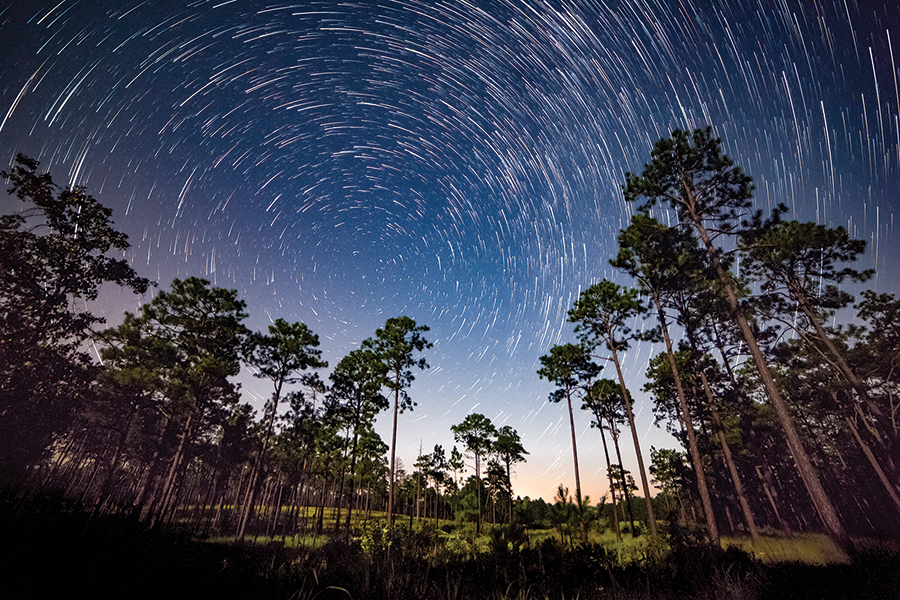
A Star Party, the fifth annual event and part of the N.C. Science Festival, takes place the evening of April 22. Bring blankets and lawn chairs and meet at the parking lot of the Weymouth Center at 555 E. Connecticut Ave. Activities, prepared by the statewide organizer, typically include stargazing, locating common constellations, a small telescope for viewing planets or the moon and kid-friendly crafts.  PS

A Natural Petition

When cats go to Heaven

they rearrange the order.

First, who made God, God?

Who decided angels didn’t

need fur, tails and whiskers?

Consider tail as a talking point.

Consider tail as a tour guide.

Consider tail conversational mapping.

But whiskers — ah, they let you

nuzzle a nuzzle. Soft, sexy.

Whiskers are out there

antennae catching vibes.

Whiskers are words

translated into touch.

Fur. . . the grandest of all.

One is always dressed for any

occasion.  Every occasion.

Tuxedo, calico, Bengal, leopard,

Persian. Fur is what the world

would wear if it could.

— Ruth Moose

Man on the Move

A brain tumor ended one career but gave birth to an even more extraordinary life of service

By Jim Moriarty     Photographs by John Gessner

Sometimes great events are measured in centimeters. A couple of them turned up 13 years ago.

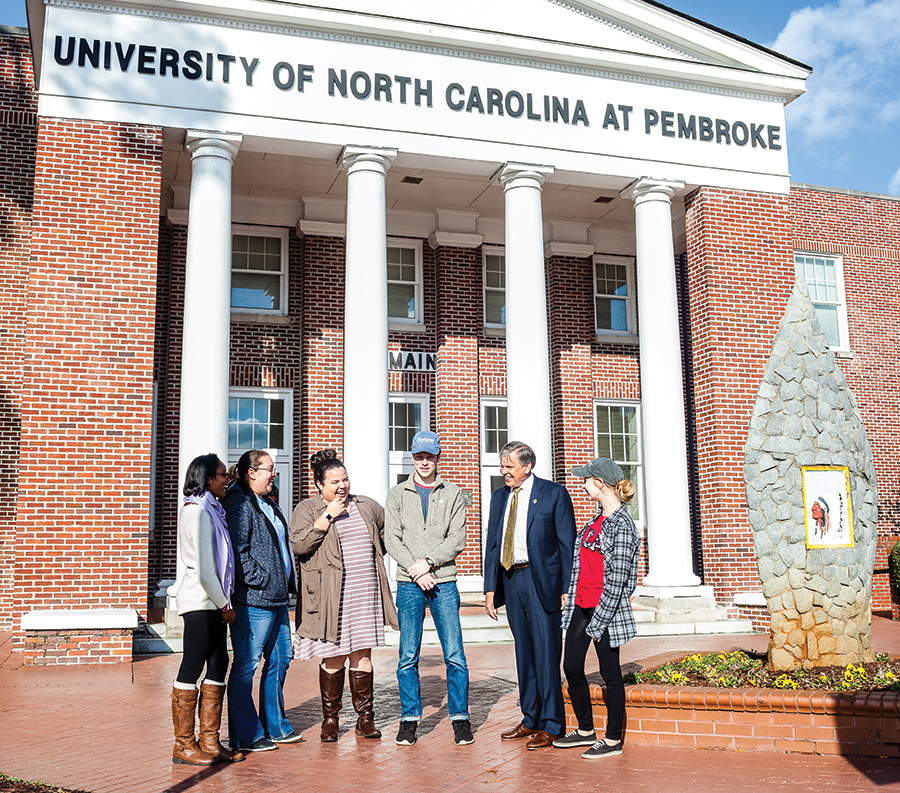
Dr. Robin Cummings, who is now the chancellor at the University of North Carolina at Pembroke, was on his rounds, looking in on patients at FirstHealth Moore Regional Hospital. It was an early winter evening, full darkness by 7 o’clock. He had performed two heart bypass surgeries that day. Walking alongside his colleague and friend Dr. Carl Berk, an ear-nose-and-throat surgeon, he mentioned he was having trouble hearing in one of his ears. Dr. Berk asked him a couple of questions. They diverted to radiology, where Cummings had an MRI. It revealed a two-centimeter acoustic neuroma located roughly where the brain stem meets the brain.

“It was a benign tumor, which is good,” says Cummings. “Most brain tumors are not.” Surgery was performed successfully a few weeks later. His hearing was preserved to a large degree, though even that has waned in the intervening years. But the surgery also affected his fine motor skills. Cummings knew that would happen before the doctors in Raleigh made the first incision. “Where it was located, you could not have put it  in a more key place in my body to affect my livelihood,” says Cummings. After the surgery he tried to hold an instrument and focus. “My hand would shake. So, I said, ‘I’m not going back.’ I quit. I retired early.”

Sort of.

It wasn’t just a livelihood Cummings lost that day. That’s the dispassionate, the clinical word for it. What he’d lost was a life. An all-consuming occupation, his mission, something he’d trained for from the moment he saw a beating heart in a chest, something he practiced with consummate skill. Something that defined who he was had been taken from him by the very capriciousness of life he dealt with every day he put on surgeon’s scrubs.

“It was like going through a divorce, going through a death,” says Cummings. After he retired, he and his wife, Rebecca, would join friends for an evening and he discovered he had nothing to talk about. “I really couldn’t carry on a conversation,” says Cummings. “No exaggeration.” Normal things, the gritty stuff of day-to-day, had eluded him. Turned out, the skill set of the highly skilled was also highly limited.

“It really was about six months of going through some depression,” he says. “I remember sitting in our kitchen one day and Rebecca wasn’t there and I was just, I was screaming and shaking my hands. I don’t understand this. Why can’t I operate? Why did this happen? God-why-did-you-do-this kind of thing.”

His self-prescribed therapy was to move. Just move. Do something. And he hasn’t stopped since. It led him to the hospital’s board of trustees; to being the director of Community Care of the Sandhills; to manage North Carolina’s Office of Rural Health and Community Care; to oversee the state’s Medicaid program, delivering health care to 1.8 million people with a budget of $14 billion; and, ultimately, back home, back to Pembroke, back to Robeson County, back to the place where it all began.

Dr. John Dempsey, the president of Sandhills Community College, is a longtime acquaintance of both the Cummings. “I wrote my master’s thesis on the subject of power in the works of Ernest Hemingway,” says Dempsey. “Most of Hemingway’s characters are people who have lost one power, had it replaced by another and were far the better for the experience. And, I think in truth, that’s Robin’s situation as well. As he lost one ability, he gained others.”

Cummings grew up on a 25-acre farm in Robeson County’s Union Chapel Community, roughly three miles from the chancellor’s house on the campus of UNC Pembroke, where he now lives. His father, Simeon, was a Methodist minister. His mother, Maude, and the couple’s nine children — Robin is the second youngest — worked the farm to keep the electricity on.

“Tobacco. Corn. Cotton. Soybeans. And cucumbers. Later on, we got into cucumbers,” says Cummings. “I’ve picked cucumbers, man, I’ll tell you. If you want to work hard, pick cucumbers.”

Or tobacco.

“Sunday Dad would preach — Sunday morning, Sunday night. Then Monday was our day to put in tobacco,” says Cummings. Snapping leaves off the stalks by hand, working from the sand lugs, the dirty, heavy bottom leaves, up on each successive Monday. Beginning as soon as it was light enough to see, getting wet from the feet up with the morning dew, then from the head down with the sweat of the afternoon sun. Their allotment was 1.5 acres. “Usually you had about six croppings,” he says. “We would get up at 4:30 on Monday morning, go to the barn, unload the barn — it’s been curing for the past week — put it in the pack house and then by 6:00, 6:30 we go to the field crop and do our acre and a half.”

Cummings’ mother graded the tobacco in the pack house, A for the golden leaves, then B and C. “She would put those in different piles and we would wrap each pile in a big sheet,” says Cummings. “One of the worst whippings I ever got was when I was jumping on the Grade A tobacco.”

When Cummings was in the 8th grade at Pembroke Middle School, he met a little 7th grader, Rebecca, who lived in the Harpers Ferry community. Both are members of the Lumbee Tribe. Rebecca’s mother worked in Converse’s Chuck Taylor plant; her father drove long haul trucks from one end of the country to the other. “She grabbed on and wouldn’t let go,” Cummings says, laughing. Now they have have four grown children of their own.

Simeon Cummings, the minister at what would become the largest American Indian church east of the Mississippi, Prospect United Methodist, was also a member of the first four-year graduating class at Pembroke, getting his degree after returning from World War II where he served — of all things — as a medic. Education was a family value. Robin Cummings went to UNC-Chapel Hill and graduated with a degree in zoology but knew he wanted to go to medical school. He took a year off when he and Rebecca were married. They also bought a car. He still has the bill of sale.

“It was a Chrysler LeBaron,” Cummings says. “My dad gave me a Toyota Celica to get through school, which broke down all the time. I took that Toyota Celica, and went down to the Lumberton Chrysler place. I didn’t know what I was doing. The salesman played me like a yo-yo. He pointed out this brown LeBaron. ‘I bet you want that car right there. Here’s the sticker price, son. That’s what it costs.’ I remember laying in bed that night and Rebecca says, ‘What are you thinking about?’ I said, ‘I can’t believe we just borrowed $4,000.’ To me, that was the beginning of our life.”

Cummings spent that year working in a dye factory, second shift, at something nudging minimum wage. “It was my first exposure to factory kind of work. What I saw that really upset me was the way the upper level people treated the folks down on the floor. I’m not talking about a racial thing. We’re up here, you’re down there. It really was caste kind of thinking. That second shift, it helped me fill out those applications and get into medical school, boy. Don’t waste time.”

The Cummings farm, most of those 25 acres, is still in the family, but the only part Robin owns is a memory. Financing for medical school came from multiple sources — loans, scholarships, what have you — but one of the pieces came from his father, the minister with the four-year degree. In the original movie The Magnificent Seven, the Mexican villagers tell Yul Brynner they’ve collected everything of value in their town in order to hire him and he replies, “I’ve been offered a lot for my work, but never everything.” One weekend back from school, in the home place on Union Chapel Road, his father handed him a check, small in the grand scheme of things but everything in other ways. “My dad took my part (of the farm) that he was going to give me and sold it to one of my other brothers to give me money to go to medical school,” says Cummings. “He was so proud.”

From Robeson County to Chapel Hill to Duke to operating rooms in Moore County to another one in Raleigh, where instead of giving the care he was receiving it, Cummings found himself back in Raleigh again, only this time finding a way to help 1.8 million people.

“My two years in Raleigh prepared me so well for this job,” Cummings says of his position leading UNC Pembroke. “When I went into work as Medicaid director it wasn’t what fire do I need to take care of today, it was what fire is burning hottest that will burn me up if I don’t take care of it today. Anyway, it prepared me. I dealt with bureaucracy. I dealt with politicians. I dealt with a big organization. I tell people it was a Harvard grad school education for two years, hands-on, trial-by-fire kind of stuff.”

Lacking a background as an academic administrator, Cummings was an unconventional pick to be Pembroke’s chancellor. Turns out convention isn’t as vital as leadership. It isn’t a matter of where UNC Pembroke was as much as where he wanted to take it.

“UNC Pembroke was a teachers’ college when it started. We added a school of business. We have a fairly strong arts and sciences school now. Nursing has come on. How do we retool ourselves for the future? What are the degrees that UNC Pembroke should be focusing on? How does this university serve this region? Here’s this great, wonderful university, yet we’re located in the poorest county in the poorest part of the state and we’ve been here 129 years. That doesn’t make sense, folks. This is this region’s university. Look at Buies Creek. Take Campbell University out of there and what would it be? Imagine if we could put that kind of machine here in southeast North Carolina. We would change the dynamics of this region in an incredibly good way.”

The university has developed a dual degree program with the North Carolina State University College of Engineering. The recently passed educational bond has earmarked $23 million for a state-of-the-art school of business. The building will actually cost $36 million, but Cummings views the fundraising challenge as another opportunity. They hope to break ground next year. They’ve created a program in collaboration with the NC State School of Veterinary Medicine, one of the hardest post-graduate programs to access in the nation.

“The honest truth is, of all the things we are for our institutions,” says Dempsey, “probably foremost among them is cheerleader. I think Robin is a great cheerleader for UNCP. He understands the political process because he worked in Raleigh. He does understand, I think, what it means to deal with very strong personalities. He is nominally in charge but just as the real work at the hospital is done by the doctors and nurses, the real work at the university is done by the professors and counselors. He is learning that you lead these institutions by cajoling rather than by declaring. Not ever to underestimate the importance of a cardiac surgeon, but the hearts and minds that Robin is touching now at UNC Pembroke are certainly equal to those that he touched in his career as a surgeon. I couldn’t be more impressed. He’s always upbeat. He’s always looking to the future.”

And still on the move.  PS

Jim Moriarty is senior editor of PineStraw and can be reached at
jjmpinestraw@gmail.com.

Almanac

It was one of those March days when the sun shines hot and the wind blows cold: when it is summer in the light, and winter in the shade. –Charles Dickens, Great Expectations

Worms on the March

March is here and the world begins to soften. Some six feet underground, the earthworms are thawing, and when their first castings reappear in the dormant garden, so, too, will the robin. You’ll hear his mirthful, rhythmic song on an otherwise ordinary morning, pastel light filtering through the kitchen window where the sleeping cat stretches out his toes and, slowly, unfurls.

Cheerily, cheer-up, cheer-up, cheerily, cheer-up.

In other words: Spring has arrived.

All at once you notice flowering crocus, catkins dangling from delicate branches, colorful weeds dotting sepia toned landscapes. You watch the robin trot across the lawn, chest puffed like a popinjay as he pinballs from worm to fat, delicious worm. Soon he will gather twigs, feathers and grasses to build his nest.

Cheerily, cheer-up, cheer-up, cheerily, cheer-up.

As the kettle whistles from the stovetop, the aroma of freshly ground coffee warming the sunny room, a smile animates your face with soft lines.

Spring has arrived, you think.

And the world stirs back to life.

The Goddess Returns

The Full Worm Moon and Daylight Saving Time both happen on Sunday, March 12.  Because maple sap begins to flow in March, Native Americans deemed this month’s full moon the Sap Moon. You won’t want to miss it. And while you may miss that hour of sleep after turning the clocks forward, the longer days will make up for it in no time — especially when the field crickets start sweet-talking you into porch-sitting past supper.

Although the lusty robin may have announced the arrival of spring weeks ago, Monday, March 20, officially marks the vernal equinox. Greek myth tells that Demeter, goddess of harvest and fertility, celebrates the six-month return of her beautiful daughter, Persephone (goddess of the Underworld), by making the earth lush and fruitful once again. 

International Day of Forests and World Poetry Day fall on Tuesday, March 21 — a day after the start of spring. Celebrate with a poem by your favorite naturalist, and if you’re feeling inspired, try reading a few lines to a favorite stand of oak, maple or pine. 

In the spirit of Saint Patrick’s Day (Friday, March 17), why not spread white or red clover seed across bare patches of the lawn? One benefit of this flowering, drought-resistant legume is that it attracts pollinators and other insects that prey on garden pests. Plus, if you find a four-leaf clover — supposedly there’s one for every 10 thousand with three leaves — it’s said to bring you good luck. Give the shamrock to a friend and your fortune will double.

According to National Geographic, one of the “Top 7 Must-See Sky Events for 2017” will occur on March 29. On this Wednesday evening, Mercury, Mars, and a thin crescent moon will form a stunning celestial triangle in the western sky, with Mercury shining at its brightest to the right of the moon and Mars glowing above them.

Each leaf,

each blade of grass

vies for attention.

Even weeds

carry tiny blossoms

to astonish us. –Marianne Poloskey, “Sunday in Spring”

 Bald Facts about Daffodils

The daffodil — also known as jonquil, Narcissus and “Lent Lily” — is the birth flower of March. Synonymous with spring, this cheerful yellow flower is a symbol of rebirth and good fortune. And a little-known fact: Medieval Arabs used daffodil juice as a cure for baldness.  PS

Gold Rush

Deep in the Sandhills, a lingering legacy of dreams

By Bill Fields

On a January morning that would soon warm up so that a sweater was plenty for a hike in the woods, I was off to look for gold — or at least look for a place where men used to look for gold.

My guide, Donnie Reeves, who has studied and explored Montgomery County’s gold heritage for more than three decades, led me in his pickup to a pull-in for the Uwharrie National Forest north of Troy. At the urging of his father he had wanted to seek his fortune in Alaska but never made the long trip. Instead, after becoming fascinated with the story of gold much closer to his native Alamance County, he made a much shorter journey.

“I lived in an old school bus for two years — me, my wife and children,” Reeves says.  “My mother and daddy bought themselves a school bus and they came right behind me. We lived in that bus for two years and prospected when we could. We loved the area and never left.”

As I parked my rental car next to Reeves’ truck a few miles from his current home down the road from an old Methodist Church, I was not only excited about my forthcoming tour of the site of the former Russell Gold Mine, but also thinking about how my roots intersected with North Carolina’s 19th century gold rush, which predated California’s and was the exclusive supplier of domestic gold for the United States Mint from 1804 to 1828.

Many people were drawn to the Carolina slate belt, a series of rocks 25 to 70 miles wide extending from the South Carolina to Virginia borders for the potential riches — or more realistically, a job — in the 1800s. Lockey Arnold Henderson, my great-grandfather, who was born in 1818, left Chatham County on horseback as a young farmer. He headed for the Montgomery County village of Eldorado, the Old North State’s twist on El Dorado, the mythical “Lost City of Gold” in South America. (Locals pronounce a “long a” in the one-word version.) In the Uwharries, great-grandpa found work in the gold mines, settled and had a large family, including my grandfather, B.L. Henderson, who was born March 28, 1861, less than a month before the Civil War began.

“The first gold mining in North Carolina may have been by the Indians in Cherokee County before white settlers arrived,” P. Albert Carpenter III wrote in a 1993 North Carolina Geological Survey. Carpenter also notes reports that explorer Hernando de Soto attempted to mine gold in 1540 near Murphy, N.C. There were accounts of mines operating in Gaston and Mecklenburg counties before the Revolutionary War, and of the U.S. Mint receiving gold from North Carolina as early as 1793, according to Carpenter.

The frequently cited and “first authenticated discovery of gold” in North Carolina — and the U.S. — according to the state report, occurred in 1799 by a boy fishing in a Cabarrus County stream. But three years went by before the child’s father, John Reed, a German immigrant farmer, took the yellow, 17-pound nugget that had been used as a doorstop to a second jeweler for evaluation. Swindled by the jeweler, who paid him only $3.50, Reed eventually figured out the scam and reportedly received approximately $3,000 for Conrad Reed’s find. Reed’s Little Meadow Creek, where the first nugget came from, turned out to hold more gold and the rush had begun.

Capitalizing on the proximity of the valuable mineral, the Charlotte mint opened in 1837, producing $1, $2.50 and $5 gold coins — issuing more than $5 million worth — until it closed at the outset of the Civil War. During the 19th century, gold was discovered in a third of North Carolina’s 100 counties, with 345 mines open at one point according to state records, although other sources place the number at more than 600 during the peak years when gold mining trailed only farming as North Carolina’s biggest industry.

“Hundreds weren’t listed because they were really Mom and Pop operations,” says Reeves. “Farmers would operate them during the wintertime when they didn’t have crops to work.”

Montgomery County and Moore County each had about 20 mines, the former more of a hotbed of activity. Most of the Moore County mines were located north of Highway 24/27 southwest of Robbins. A “Gold Region” post office existed in that area from 1844 to 1866, then was renamed “Carters Mills,” for one of the mines, and operated until 1932. A “Gold Region No. 2” was open from 1877 to 1879.

A 1903 advertisement in the Pinehurst Outlook for “real estate and hunting grounds” offered by R.L. Burns of Carthage noted “fine farm, trucking peach, grape and berry lands . . . Also GOLD property.”

Moore County’s gold caught the eye of inventor Thomas Edison when he visited North Carolina in 1890. “(He) is in Moore county on a prospecting tour,” The Evening Visitor of Raleigh reported on June 25. “He is said to have taken options on large bodies of lands, rich in gold. Mr. Edison will soon form a syndicate of English capitalists and commence work, and the purchaser contemplates turning the water through it for gold-washing purposes.”

A “Gold Mine Pit” is even denoted 1 mile northeast of the Village Green on an 1897 map of Pinehurst and vicinity — likely a “prospect” where a tiny bit of gold was discovered. “They probably found a little bit of gold when they dug down but there wasn’t enough to keep digging,” Reeves says. “There are thousands of those places. More than likely, that’s what happened there.”

There were no such false starts at the Russell Mine. By the middle of the 19th  century it was the biggest gold mine in Montgomery County and the subject for a detailed 1853 report from the Perseverance Mining Company projecting millions in revenue over the course of a 60-year lease on the 40 acres of mineral land.

“More than likely your great-grandfather worked in this mine,” Reeves says as we walk into the national forest and see the first sign of the Russell operation, an old 100-foot shaft with bars installed at its entrance to keep out the curious. “There were homes and shacks where the workers lived. Hundreds of people lived here. There was a general store and a hotel across the street. Forty-some miners worked on a shift, and they’d run 24 hours.”

Some gold extraction was done through placer mining, a process in which miners washed eroded ores of rocks containing gold with pans, rockers and sluices (a grated rectangular box). The other type of deposit was found underground and in open pits dug by the miners in the form of gold veins often embedded in quartz. The largest excavation on the Russell property was “The Big Cut,” a pit 300 feet long, 150 feet wide and 60 feet deep.

The ore was crushed by 190-pound “stamps” that fell the height of a man or more, pounding the gold into a fine substance. The equipment allowed a mine to process 20 to 50 tons of material daily instead of just a few tons.

“You could feel the ground shake a half mile from here because of the many stamp mills,” Reeves says, a jarring observation on such a peaceful winter day. “You could hear it miles away.”

We walk farther into the forest and encounter “The Big Cut,” now cluttered with trees and other vegetation that make it seem smaller than its working dimensions. Miners would earn less than a dollar a day for their dirty, exhausting labor. Some miners went west when gold was found in California in 1849. Many of the mines closed as they became less profitable. Most closed down for the duration of the Civil War with the exception of the Silver Hill Mine in Davidson County, which produced ammunition for the Confederate Army. Some of the bullets were not only lead but included gold and silver because wartime wouldn’t allow for a costly and lengthy separation process.

“Lot of the Yankees who came down here had gold pans strapped to their saddles. They thought they were going to come in here and get rich,” Reeves says.

Following the Civil War there was a revival in North Carolina gold mining that continued, with intermittent lulls, into the first quarter of the 20th century.

“This portion of Montgomery County is a vast gold bed,” a correspondent for The Weekly Observer in Raleigh reported in 1878 while visiting the Swift Island mine. “Many pieces of gold weighing from one to two and three pounds have been found. We saw the hole in the ground from which two pieces were taken that weighed exactly a pound and a quarter each, each piece looking just like a frog.”

Thirty years later, the Asheboro Courier noted: “Bud Morgan found a valuable nugget of gold weighing 20 ounces near Eldorado.”

The Coggins Mine, a mile northeast of Eldorado on the road to New Hope, operated off and on from 1882 to 1934 as one of the busiest in the area. It was the scene of tragedy on Jan. 15, 1914 when three miners, eager to leave work on payday, hopped into the ore bucket for the 350-foot ride to the surface instead of climbing a ladder.

“They wanted to beat everybody else out of the mine,” Reeves says. “When it got to the top, the bucket hung on a ledge and flipped over and they fell to their deaths.”

Lizzie Sanders, wife of one of the three men, Walter Sanders, was in her home at the time. “The whistle at the mine started blowing,” Lizzie recalled decades later in an interview with the Montgomery County Historical Society. “Sometimes, they’d just give it a puff or two. But this time it just kept on and on.” Presently Lizzie found out how serious the accident was, fainting upon hearing the news.

According to the N.C. Geological Survey, total gold production in the state is approximately 1.1 million ounces, worth an estimated $25 million at historical prices. At current prices of $1,230 an ounce, it would be worth $1.24 billion.

“In the 1980s and ’90s I worked for a number of gold mining companies that came in here and investigated, trying to see if any of the old mines were worth mining,” Reeves says. “We did rock samples, but it would be too expensive to mine. We know there is over 20,000 ounces in the ground, but those companies were looking for a million-dollar deposit.”

Scores of people come to Montgomery County annually to pan and sluice for gold. Reeves has spent a lot of his time educating the recreational panners how to do it. While we were talking in his kitchen, Reeves gave me a small water-filled vial containing about a dozen small flakes and a nugget the news of which wouldn’t make the newspaper. This gold came from a nearby creek.

“When it gets to the size of the biggest one in there and you drop it in your gold pan and it you hear it go ‘clunk,’” he says, “it’s a nugget.” My gold is only worth a few dollars but he warns me not the shake the vial. “That gold is heavy enough to knock the bottom out,” he says, providing another example why so many went through so much for so long in pursuit of the element.

After our trek to the former Russell property, I had one other request of Reeves. There was another mine site in the Eldorado area I wanted to see.

We arrive at a 21st century general store and ask the owner if she can contact the owner of an adjacent parcel of land. A call is made and permission is granted. In a few minutes we’re maneuvering through trees and dead leaves about 100 yards east of Highway 109.

“There it is,” Reeves says, when we come to a clearing and a water-filled hole of about 10-by-10 feet. “That’s the Henderson Mine.”

My middle name, possibly some of my relatives.

Nearly a century ago, it had been a working shaft of 40 or 50 feet deep. Now, there was the reflection of the blue sky on the accumulated water. The way the light was hitting the old mine, there was a bit of a golden hue on the surface. I took a few photographs and began walking toward the car.

“Just a hole now,” Reeves said.

This mine was history, maybe even some of my own.  PS

Horse Heaven

Sliding comfortably into its horse country surroundings an interior decor of memorabilia harkens to an equestrian heyday

By Deborah Salomon     Photographs by John Gessner

Heirlooms often grace Southern homes: Grandpa’s desk, Auntie’s slipper chair. “We started from scratch. Our furniture’s from Pottery Barn,” says Chrissie Walsh Doubleday, granddaughter of legendary equine trainer Mickey Walsh, founder of Stoneybrook Steeplechase.

“I put it together,” adds husband Peter Doubleday, internationally known horse show manager/announcer and, by the way, descendant of Abner Doubleday, the apocryphal inventor of baseball.

Yet, beyond a standard sectional sofa and some-assembly-required tables and chairs, Doubleday House at Little Squire, the Doubleday’s Adirondak-style lodge, is a veritable bulletin board chronicling two fascinating lives: photos, posters, paintings, stuffed animals, ribbons, figurines, saddle pads, books, awards and, marching atop the kitchen cabinets, 100 beer bottles with interesting labels.

Peter nods an affirmative: “I drank every one.”

Fifty plants, bathed in light from oversized bare windows, provide a greenhouse effect. One precious photo shows Mickey Walsh riding pony Little Squire, sans saddle or bridle. Dominating another wall is a painting of Walsh (who died in 1993) by local artist Dani Devins; this was returned to the family after being auctioned off at hunt balls.

What some brand as clutter, Chrissie calls history.

Chrissie belongs to the land surrounding their home. She grew up in a log house within sight, later lived in a nearby cabin. Her father’s veterinary office was yards away. She, her four siblings and 29 cousins knew every rock, rail and puddle in the compound. Beyond the equestrian life, Chrissie taught chemistry and coached track and field for 28 years at Pinecrest High School.

Peter, from snowy Syracuse, New York, lived down the road when he met Chrissie at a Christmas party. “I knew of the family, of course. They were famous . . .” he says. In 2005, soon after they married, her parents sold them five of their 17 acres for a house. Subsequently, they purchased another five and added a small barn.

Neither had any architectural experience, which didn’t stop Peter from scrawling a plan on a napkin at O’Donnell’s Pub. They liked the work of Southern Pines architectural/interior designer Denis McCullough who translated the napkin into a home unlike neighboring showplaces.

Little Squire defies labels.

Chrissie: “I wanted (the interior) to be a semi-circle and the outside to blend with the trees.” This meant angled interior walls which give the rooms irregular but interesting shapes.

Peter: “I saw a picture of a house with cedar siding, hunter green and blood red trim, like houses in Lake Placid.” The clapboards and shingles also reminded him of “cottages” in the exclusive Hamptons, where he announces events.

Multiple roof pitches and a cupola topped by the weathervane from Stoneybrook complete the rustic appearance. The Irish flag honors immigrants Mickey and Kitty Walsh who arrived in America in the 1920s — and in Southern Pines in 1939.

Chrissie was adamant about layout. “I wanted everything in one room.” That living room-dining room-kitchen-bar with wood-burning fireplace stretches nearly 50 feet facing outward to the terrace, paddock and barn. A long refectory table fills up fast at Thanksgiving and Christmas, since Chrissie’s sister and niece also maintain houses on the property. From the open kitchen in a far corner, the cook stays part of the action. Black granite countertops are covered not with cooking paraphernalia but photos of “good people,” Chrissie says. “We wanted pictures and themes everywhere to reflect horses and racing.” Peter’s artifacts contribute the broadcasting dimension, which include the 1996 Olympic Games in Atlanta. “Peter’s a collector. He just kept putting stuff up and I said  . . . whatever.”

guest suite with separate entrance at one end of this panoramic great room offers privacy. Adjacent to it, a combination “entertainment” room and office. Peter loves music; a wall of CDs covers every genre but classical. “Vinyl’s coming back,” he says, pointing to long-play albums. The opposite wall of shelves displays Chrissie’s books and in the middle, a throne-sized red leather chair and ottoman. On hot afternoons, after barn chores Chrissie retreats here to read. The master suite with small terrace and second wood-burning fireplace — Chrissie’s lifelong dream — occupies the opposite wing.

Their outdoor environments include a small screened porch on the front and a larger one between the house and the patio which, by spring, is filled with flowers and often with guests. The Doubledays have no trouble fitting 100 friends and colleagues inside and out. “Our guests feel at home as soon as they open the door,” Peter says. They especially enjoy the DIY bar with tall vinyl-topped bar stools and well-stocked shelves.

A small pool built long before the house cools hot and dusty riders.

Nothing formal, everything practical and intensely personal. Floors throughout are low maintenance tile brightened with area rugs. Wide, handsomely framed doorways ease the flow from wing to wing. A coffered ceiling buffers noise. No palette unites the décor, although every hue found in nature appears here.

Chrissie got her wish: from a distance, the house melts into the woods.

A piece of Chrissie’s heart beats faster in the small barn, shelter to Guac, a retired racer with a speckled coat called flea-bitten gray. Surprisingly, “I’ve ridden all my life but this is the first horse I’ve ever owned. He’s taught me a lot in the saddle and on the ground,” she says. “They test you. I’m supposed to be the boss but we’re still working on that.” Chrissie feeds, grooms, rides and cares for him — and Burrito, his adorable donkey companion — herself. She’s in the barn by 7 a.m., takes a break around noon, out again at 4 p.m. and to “check on things” before bed.

These are happy hours. “I spent a lot of time with my parents before they died,” she recalls. “Afterwards, things sort of fell apart, family-wise. I needed something to fill the void.”

The Doubledays’ luxury is not in antiques or professional-grade kitchen appliances but in living a continuity. “It’s just the two of us; we didn’t need a monster house,” says Peter, although as arranged, the 2700 square feet appear larger. Its location allows the couple to bike into downtown for First Fridays or a pub evening. But mostly they like to stay put. Peter, who travels many months a year, answers to homebody.

“I need a crowbar to get Chrissie out,” he says.

She responds: “I’m just very proud to still own this family property,” which honors her parents and grandparents. “They worked hard to create the farm, and Stoneybrook. It’s the only home either of us has ever built . . .”

And, Peter concludes, “We plan to stay here forever.”  PS

Hawk

Driving to work, I spotted

the red-tailed hawk perched on the stop sign

at the corner of Courtland & Adams.

Surveying the suburban yards

for his next meal, he looked in my direction,

then turned away, disinterested. 

I lowered my eyes to check the time

and when I looked up again he was gone,

leaving me alone in the warm comfort of my car,

delighted by what I’d seen,

desperate for his return.

—Steve Cushman

What’s in a Name?

That which we call a daffodil by any other name still ushers in spring

By Ross Howell Jr.

Despite the cold, when March came to the mountains the boy I once was felt there might again be spring. After a snowy season feeding cattle with their rumps — and mine — bowed against bitter winds, I walked along split-rail fences, melting drifts limning muddy pastures.

The earth was warming with spring, and on sunny afternoons groundhogs nosed from their dens, groggy with winter sleep. I hunted them with my uncle’s pump-action .22.

One afternoon I came upon a sight that filled me with wonder. A neat row of daffodils nodded in the sun at the edge of a wood. Their yellow blossoms were all that remained of what had once been a homestead. I watched them as they danced with the breeze. Their faces were hopeful. I imagined a mother planting them for her family, a thin border next to a log house, long since vanished.

Back then, I didn’t call them “daffodils.” Among my kin, they were known as “jonquils.” In fact, I don’t remember hearing the word daffodil until my senior year of high school, in Mrs. Humphries’s English class, when we read the William Wordsworth poem, “I Wandered Lonely as a Cloud.”

I raised my hand, wanting desperately to impress
Mrs. Humphries. She was a recent Radford College graduate, and quite attractive.

“Yes, Ross?”

“Those flowers sound like jonquils to me,” I said.

“In England, they’re more commonly referred to as daffodils. From the Latin asphodilus, The English ‘daffodil’ is probably adapted from the Dutch, ‘da asphodel,’”
Mrs. Humphries said.

I was crestfallen.

“Why everybody knows that,” my nemesis,
Verna Belcher, hissed from the desk behind me.

A quick poll of my Greensboro neighbors — my “scientific” question was, “When you were growing up, what did you call the yellow flower that bloomed first in spring?”— yielded mostly “jonquil,” though “daffodil” was an occasional response, and even “buttercup.”

It’s complicated.

“In some parts of the country any yellow daffodil is called a jonquil, usually incorrectly,” writes the American Daffodil Society, employing what I expect is their euphemism for the rural South. “As a rule, but not always, jonquil species and hybrids are characterized by several yellow flowers, a strong scent and rounded foliage.”

Now that plant sounds like what I think of as narcissus. So when I say “jonquil,” I should be saying “narcissus”? It’s not that easy.

“The term narcissus (Narcissus sp.) refers to a genus of bulbs that includes hundreds of species and literally tens of thousands of cultivars!” writes gardener Julie Day. “The Narcissus genus includes daffodils, jonquils and paperwhites, among many others, so when in doubt, this is the term to use.”

Just to confuse me further, Day adds this statement: “However, when someone says ‘narcissus,’ they’re usually referring to the miniature white holiday blooms of Narcissus tazetta papyraceous, known as paperwhites.”

Now I have paperwhites in my garden, too. But I call them “paperwhites.” So am I to understand that the flowers I called “jonquils” as a boy I should’ve called “daffodils,” and some of the bloomers I have in my garden now, the ones with the small trumpets, rounded leaves and scent, the ones I’d thought were narcissus, are in fact jonquils?

Not necessarily. Julie Day goes on to say that “daffodil” is “the official common name” for any plant in the genus Narcissus.

“So, if the plant is considered a Narcissus, it is also considered a daffodil,” Day writes. “However, most people use the term ‘daffodil’ when referring to the large, trumpet-shaped flowers of the Narcissus pseudonarcissus. These are those big, showy, familiar bulbs that bloom in spring that we all know and love.”

Got that?

But what about Mrs. Humphries? And the asphodels? Turns out they’re a different genus altogether. But some of their blossoms sure look a lot like jonquils. I mean, narcissus. Oh, you know what I mean.

And what about buttercups?

Things sure were simpler when I was a boy in the mountains hunting groundhogs.  PS

Ross Howell Jr. was rewarded for dividing and replanting bulbs this fall with a display of daffodils that brightened even the most confused and gloomy of March days.