Boys to Men

Coming of age in Troop 48

By David Claude Bailey     Illustration by Romey Petite

“Don’t pat the pancakes!”

The voice comes to my 11-year-old ears as if through gauze, muffled but clearly insistent.

I’m hunkering in front of a campfire, dodging the smoke that seems to chase me no matter where I drag the massive cast-iron frying pan in which half-a-dozen pancakes sizzle and pop. 

I’m delirious from having spent the night doing what Boy Scouts do on camping trips, swilling soft drinks, telling stories, and feeding our faces and the fire until 2 or 3 in the morning. Once I hit the sack, I’m dealing with a caffeine buzz only achievable in the 1950s before they took the good stuff out of soft drinks, not to mention the two quarts of Double Cola pooling in my bladder. And am I the only one who hears a raccoon raiding the unwashed pots and pans? I get up as soon as I see the slightest glimmer of dawn because I never really did go to sleep and because I’m cold and hungry and someone’s making a fire.

“Bailey. Don’t pat the pancakes.”

It’s our scoutmaster, John Samuels. I could spend a few lines describing his long rangy gait and his penetrating blue eyes below his beetling, sandy eyebrows or his infectious smile that we all want to trigger. But it’s easier just to conjure up John Wayne, whom, to my impressionable eyes, he resembled in every possible way.

I shift yet again away from the smoke, huffing and puffing as I drag the black mass of smoking cast-iron behind me. “Patting them makes them fall so that they’re flat,” Mr. Samuels says, a twinkle in his eye to blunt the bite of his criticism. I stop the spatula a quarter inch from a flapjack, obedient to his command, as yet another finger of smoke finds its way into my stinging nostrils and bleary eyeballs.

Troop 48 was the best thing that ever happened to me, except maybe getting a bike for Christmas when I was 8. The bike freed me from the half-a-mile range of my mother’s booming voice to wander the back alleys of Reidsville with a gang of three, scrounging stuff like an old washing-machine motor that we lugged home and played with until smoke and flames summoned a neighbor.

But it was Boy Scouts that truly liberated me from my Pennsylvania Dutch mother, who was loving, to be sure, but who had a maddening way of insisting there was a right and wrong way to do everything — and there was never any doubt which hers was. She never resisted watching as I tied my shoes — and letting me know that I was still doing it the wrong way.

Nothing beat spending a weekend with boys my age, semi-supervised by a former Merchant Marine turned repo man who, on occasion, packed what looked to me like a huge, black pistol. (I later learned it was a .22-caliber Colt Woodsman.) Like most good teachers, Mr. Samuels liked to fix things. In his case, boys who needed just a bit of guidance and attention at a crucial point in their lives — and at an age, I might add, that didn’t make them particularly appealing to their fathers or anyone else.

I’ll speak for myself. My dad did his best considering that his role model was a father who had nine children and acres of corn and tobacco that had to be tended so that the aforementioned children and wife wouldn’t starve. Plus, during the ’50s, children in my neck of the woods mostly raised themselves without the benefit of Dr. Spock or any helicoptering. Dads, at the prompting of mothers who read magazine articles on that new phenomenon called parenting, occasionally tossed a baseball with their sons or played golf with them (mine never did) or took them fishing and hunting (on rare occasions when other men weren’t available). But most kids were turned loose, along with the dogs, in the morning, and were only noticed if they didn’t come home for supper at night.

Mr. Samuels, who had no children of his own (but a stunning wife who sometimes accompanied him on camping trips), took an interest in whether you knew how to handle a knife or an axe and would show you how to retain your fingers and toes doing so. He’d watch you try to put up a tent and coach you on how to do it in less than an hour. He taught us gun safety, knowing that the subject was, in fact, as serious as death — and your reading this might very well be a tribute to his tutelage.

At 11 and 12, boys are between boyhood and manhood, some still believing in Santa Claus while noticing that they’re growing hair where there didn’t used to be any. On the way to becoming men, boys need mentors. Mr. Samuels took an interest in each and every one of us, even a geeky, one-eyed clumsy mother’s son like myself. I realize now that he liked seeing us grow into men and wanted us to share the values he held dear, which is what Scouting is all about, despite recent revelations and its detractors.

But Troop 48 was not your run-of-the-mill Scout troop. We were a resourceful and mischievous lot who had a reputation throughout the council (and Reidsville) for being wild and crazy. Guilty as charged. Troop 48 viewed jamborees in the same way that some aboriginal tribes regard others occupying open range, a good excuse for a raiding party. Initiations, I’m ashamed to report, could sometimes be described as medieval in their ingenuity. And consider that my best friend taught First Aid to Fritz Klenner, the protagonist in Bitter Blood.

The Chinese invented gunpowder. Troop 48 re-invented the gun. Since South Carolina and Myrtle Beach were only several hours away, any boy who’d recently paid a visit to either one brought fireworks on camping trips. Mr. Samuels never blinked an eye as long as we didn’t disturb his sleep or lose a digit. Armed with hundreds of firecrackers, some clever troop member figured out how to take a firecracker and an acorn and turn a harmless tent pole into a weapon of minimal destruction. 

Doubtless thinking that any one of us could throw an acorn a lot harder than the improvised gun could shoot it, Mr. Samuels just shook his head and warned us not to put out anyone’s eye, especially mine. I found the protective glasses my mother insisted that I wear at all times — and actually put them on — and soon we were facing off in Dodge City–style showdowns with shooters, each with his own personal fuse lighter. In the end, someone came up with the idea of replacing the acorn with something a little higher caliber, explosively speaking. This, in turn, required a series of precision actions on the part of fuse lighters that remains highly classified, Troop 48-eyes (or eye)-only information to this day. When the required calculations were just right, the projectile would explode as it flew through the air. When the fuse-lighter’s timing was even slightly off, the tent pole ended up looking like a peeled banana, which Mr. Samuels noticed, thus putting an end to our gunplay.

And here I was in charge of pancakes after telling Mr. Samuels that my mom let me cook breakfast now and again, and his having eaten one of them and saying it was pretty good, if a little flat from my patting it . . . when I saw stars and smoke and flames all at the same time as John Samuels planted his size 12 boot against my backside, kicking me head-first into the fire as I patted, surely, my 20th pancake of the day. In good time, he hove me up like a puppy out of a well, holding and shaking me by the front of my untucked shirt and twisting his head slightly and smiling like a jackdaw. “Didn’t I tell you not to pat the pancakes,” he asked quite reasonably.

I allowed as how he did and how I wouldn’t do it again. He deposited me back in front of the fire after kicking it back into shape and putting the pan back in front of me again, buffing the dirt off the spatula on his pants.

I have never, ever patted a pancake again — or idolized anyone as much since. PS

David Claude Bailey, who went on to attain the rank of Eagle, is trustworthy, loyal, helpful, courteous, kind, obedient, cheerful, thrifty, brave and clean but rarely reverent.

Living la Vie en Rose

Designer brings Paree to Pinehurst

By Deborah Salomon    Photographs by John Gessner

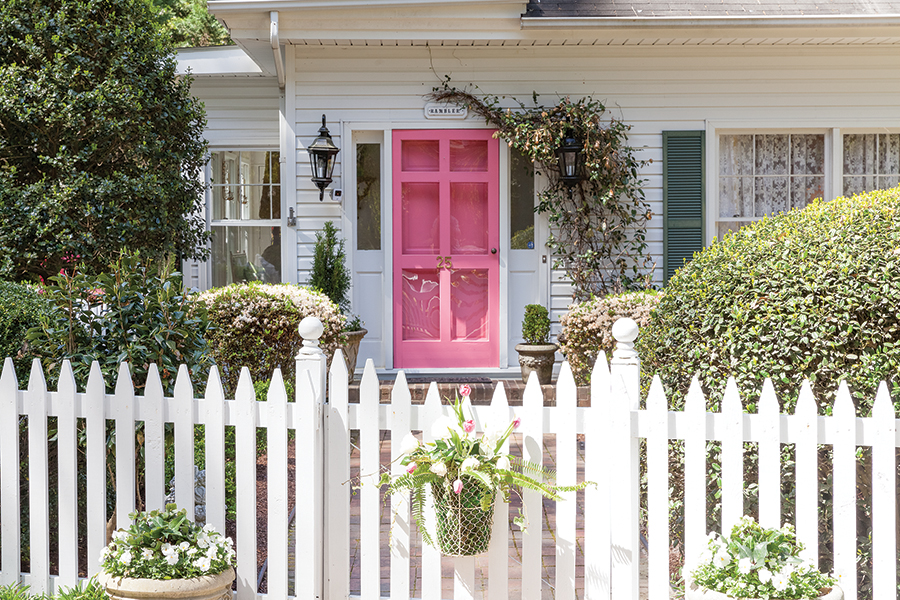
Don’t judge a book by its cover, but do heed what a front door says about a house. Especially if the door is bubble gum pink.

Why?

“Because I like it,” Cathy Carlisle says.

Those four words explain what sets Rambler Cottage apart from retreats built in Pinehurst in the early 1900s for golfing snowbirds. One by one, these white clapboard “cottages” have become showplaces for family heirlooms, antique-barn finds, High Point upholstery, built-in bookcases, plantation shutters, heart of pine floors, Capel rugs, miles of moldings, magazine kitchens and spa bathrooms built around claw-foot tubs.

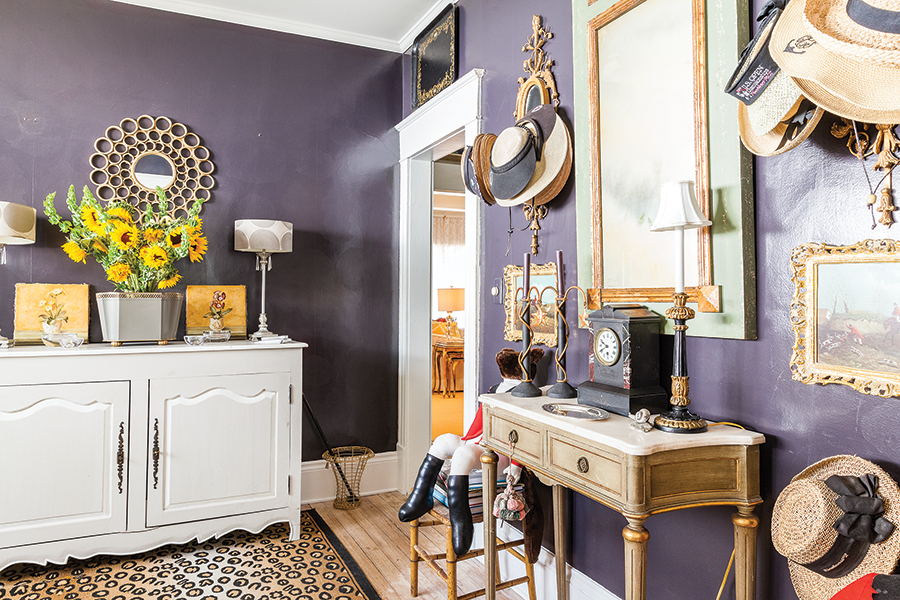
Instead, Cathy, an American Society of Interior Design member, has indulged her love for formality, à la française.

“I got that in Paris,” she says, pointing to a handsome 19th century breakfront — and lots else. The trips were for stocking her shop in Rocky Mount, where the Carlisles lived (in a home built like a European villa) before relocating to Pinehurst full time in 2000. Cathy’s romance with formality began during childhood, when dinner was served in the dining room, with silverware and linens. This era worshipped Givenchy, Dior, Catherine Deneuve, Chanel, Jack and Jackie in Paris.  “By the time I was 7 I knew I wanted French (things),” Cathy says. “My mother took us to museums and plays, places where we wore white gloves.” When working for a client, “I have to make them happy. This is to make me happy.”

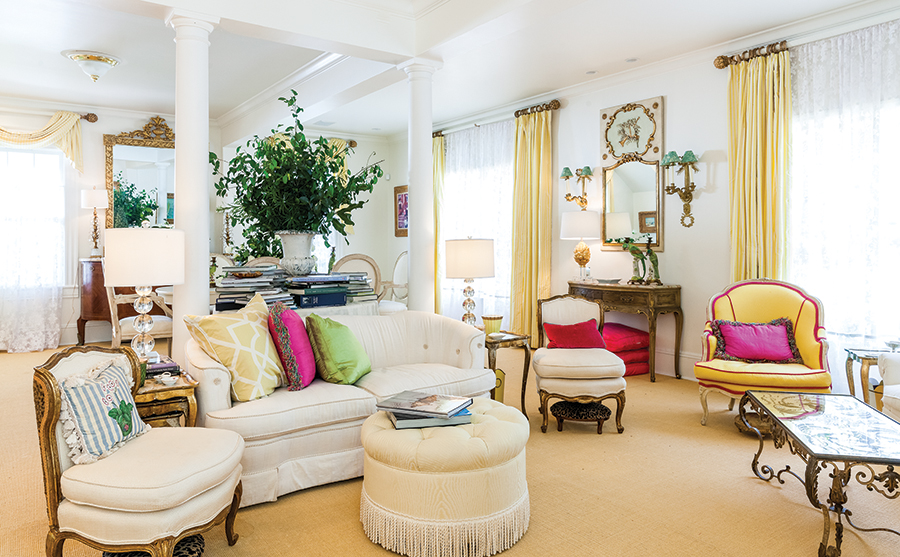
Cathy interprets French décor not as rustic Provençal, but with carved chairs, pastel fabrics, lace demi-drapes, fanciful chandeliers and sconces, gilded mirrors and frames for her own paintings, described as abstract impressionist, adorning what appears to be an average-size cottage from the exterior, but extends in many directions.

In fact, legend has it that Donald Ross dubbed the house “Rambler” because it rambles on and on.

As does its story.

The three-quarter-acre plot where Rambler stands was purchased in 1910, likely from the Tufts family, by Warren Manning, a landscape architect employed by Frederick Law Olmsted. Manning was tasked with the first village plantings, according to documents at the Tufts Archives. But he never developed the land, instead selling it to F.W. Von Cannon, cashier of the new Bank of Pinehurst, who built the cottage in 1915. Publications describe it as having a gabled roof, front shed dormer and screened porch, later enclosed as part of the entranceway. The cottage was classified as year-round occupancy, which meant multiple fireplaces and a full kitchen.

The original floor plan has all but disappeared into renovations accomplished by half a dozen owners, resulting in a warren of small sitting rooms which Cathy furnished with settees, benches, mini bureaux, fanciful objets d’art and books cantilevered, not piled or stacked, on tables.

But given her penchant, why Pinehurst, not francophone New Orleans?

Sam Carlisle, an attorney/mediator/arbiter, was attending a seminar at the Carolina Hotel. “No matter where Cathy is she looks at houses,” Sam says. Fatefully, she picked up a sales brochure describing Rambler. “I have to see this house before we leave,” she told Sam. They rode by in the pouring rain, with no intention of moving anywhere for 20 years. Coincidentally, a few days later Sam’s law partner proposed the two couples buy a condo in Pinehurst, to share. “I told him, well, Cathy already found this cute house …”

Cathy and condo have little but their first letter in common. “I could never be happy in anything modern,” she says.

They returned on a Sunday, bought Rambler as a vacation property the following Thursday. The house had been updated in the ’70s and looked it — which provided Cathy the thrill of the chase.

Sam had doubts: “The only way you’ll make that house French is to rename it Rom-blay.”

How wrong he was.

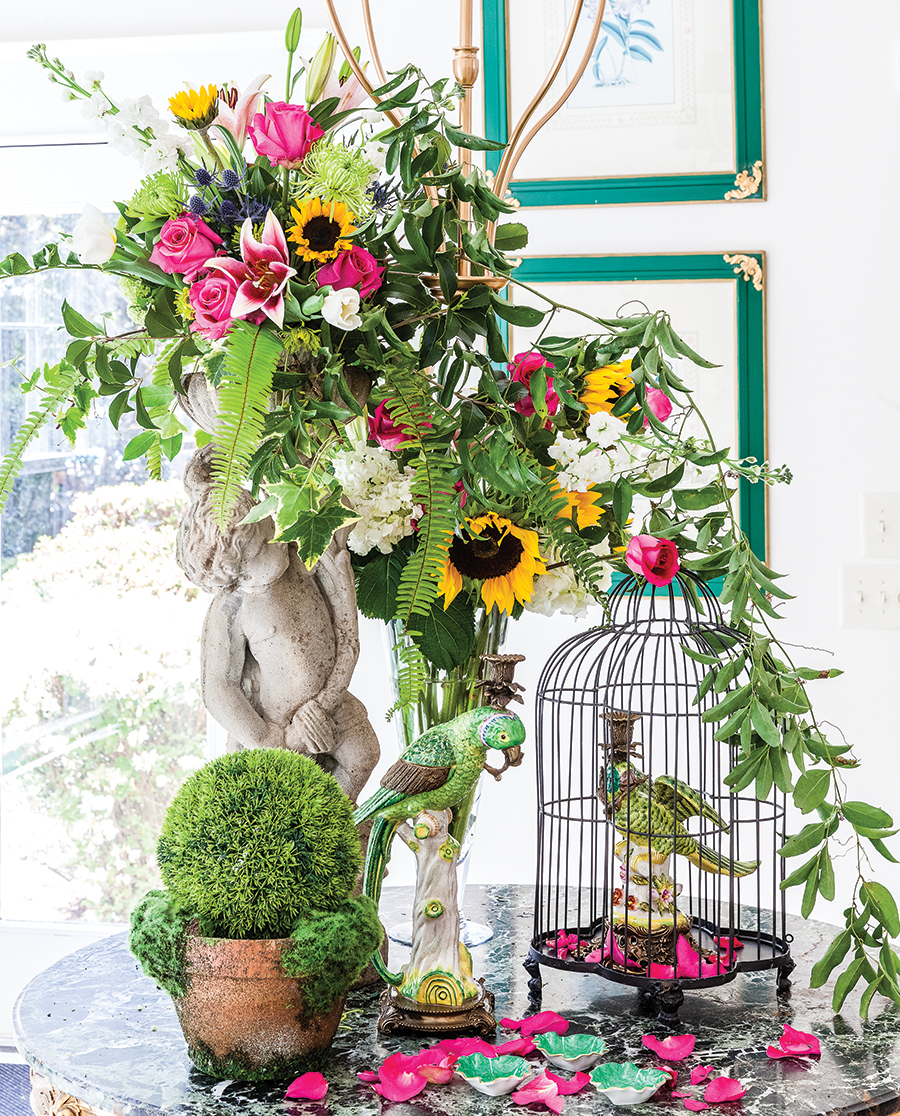
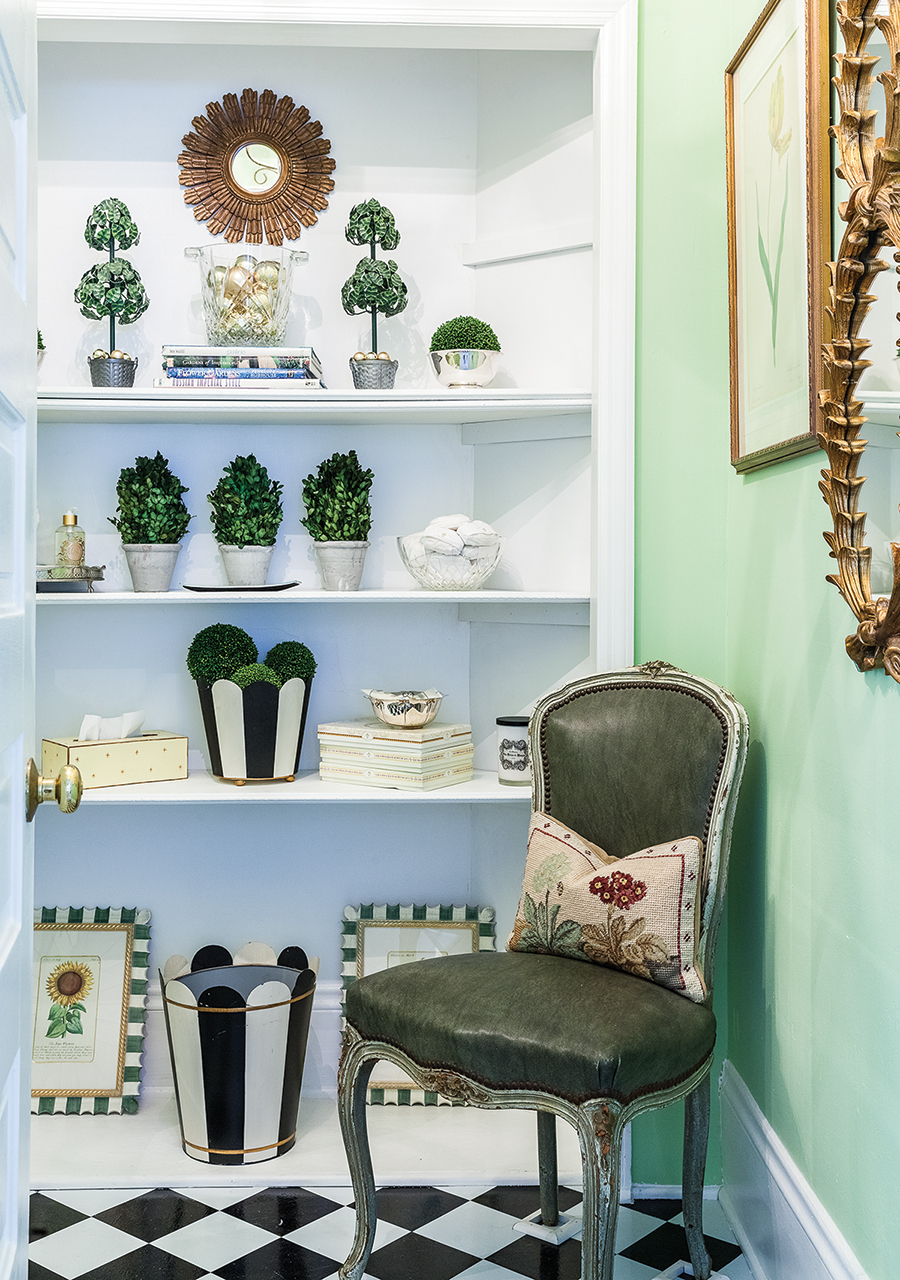
Cathy began by creating a vestibule with a hot pink bench (matches the front door) opening into a foyer “to introduce my house.” The foyer’s formality sets the tone, which contrasts sharply to the picket-fence-and-shutters street view. Its flooring: classic black and white tiles, while a green marble-topped round table from a Paris flea market stands in the center as it would in a European townhouse or an antebellum Southern mansion. Spiral topiary rises from pots here and everywhere. Exit right, into the high-ceilinged salon, another surprise, since it appears to have double fireplaces a few yards apart, although one is in the dining room, separated from the salon only by columns and a half wall.

“Cathy was always going to have a fussy parlor,” Sam says. She chose to place ornate French furnishings, tiny footstools and curvy-legged tables on wall-to-wall sisal carpeting (“I like a mix”) instead of polished hardwood or Oriental rugs, which she “doesn’t like.”

She does like mirrors: An architectural installation covers a wall in the foyer and others, ornately gilded and framed, reflect living and dining rooms.

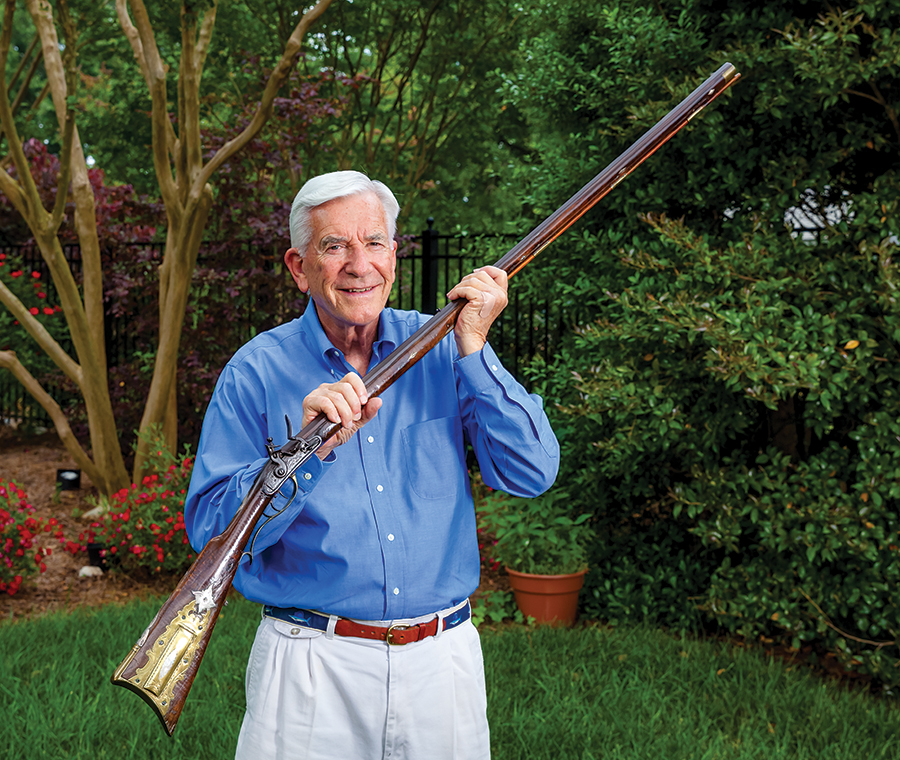
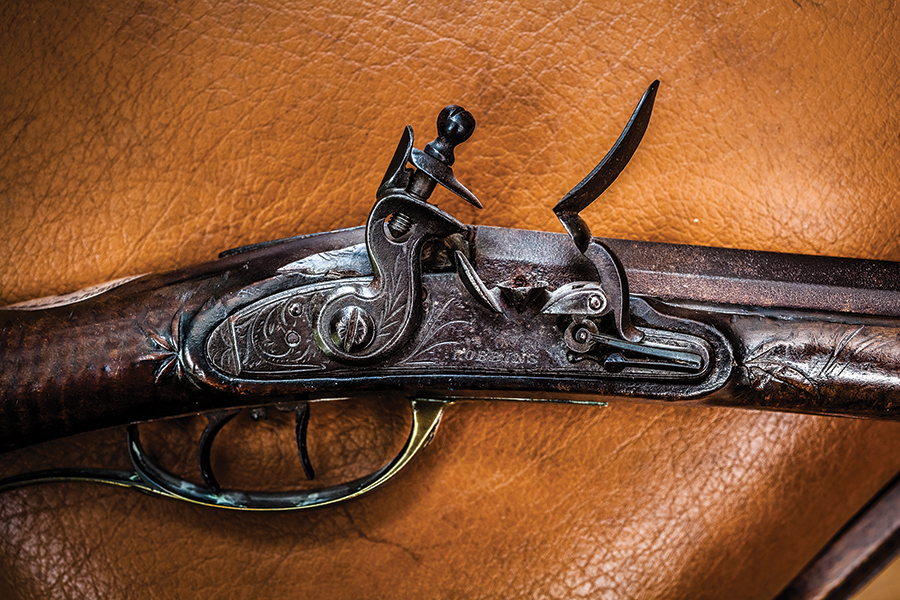
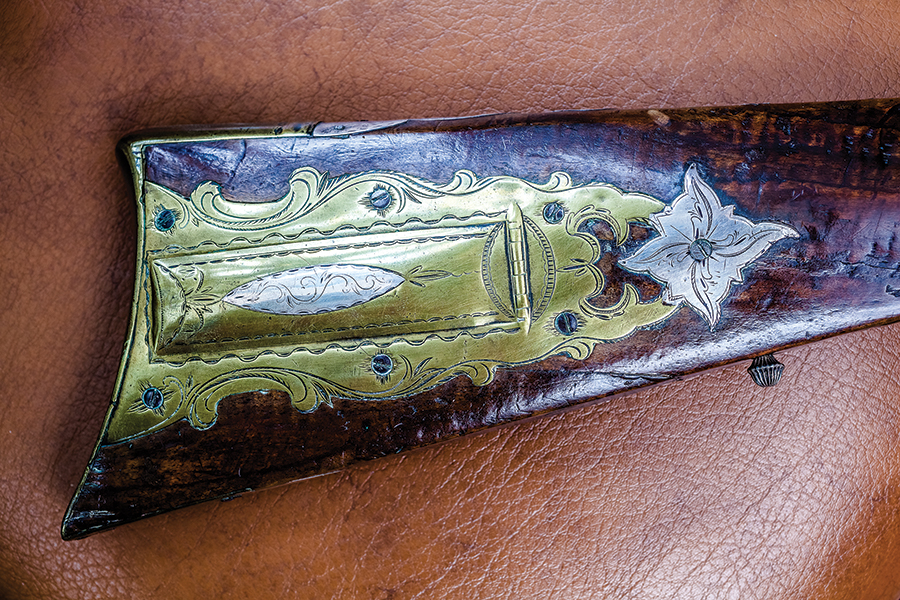
A second exit from the vestibule reveals another surprise. This room, probably the original master bedroom, is totally Sam’s. The floors, sanded and whitewashed pine. The upholstery, Scotch plaid; and on the walls — painted a striking brownish-black, with a hint of aubergine — hang 11 shotguns belonging to his ancestors as well a collection of antique maps, most of eastern North Carolina and all identifying Tarboro, where Sam and Cathy grew up and became high school sweethearts. “This one from 1775 is of North and South Carolina during the Revolutionary War. George Washington had a copy,” Sam explains proudly.

Europeans do not overemphasize kitchens. Cathy’s, mostly black and white with lemon walls, is both functional and a good backdrop for her collection of green Majolica pottery.

Surprises continue. Up a narrow flight of stairs typical in Pinehurst cottages, the fabrics, painted white floors and woven area rugs are pure Martha’s Vineyard B&B except for the original paneled floor-to-ceiling sleeping porch, which made summer nights almost bearable.

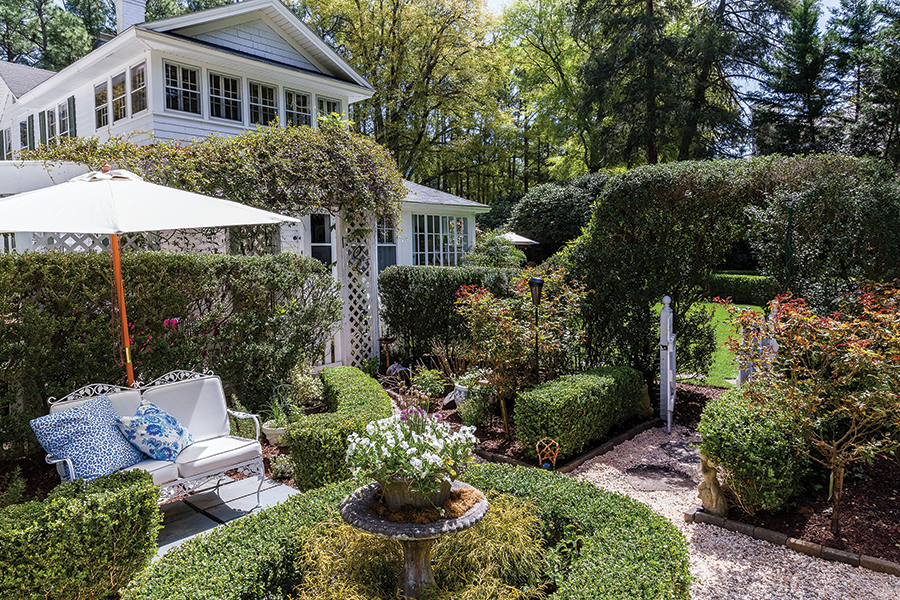
What Cathy does emphasize is her garden — actually a series of “secret gardens” grouped, with seating, for relaxing and conversing, all designed by Cathy in 1994, when she razed the area and began anew. Along one side, neatly trimmed shrubs form ellipses with focus plantings in the center.

Why the unusual forms?

“Because I like it,” Cathy repeats. “I find them pleasing to the eye.”

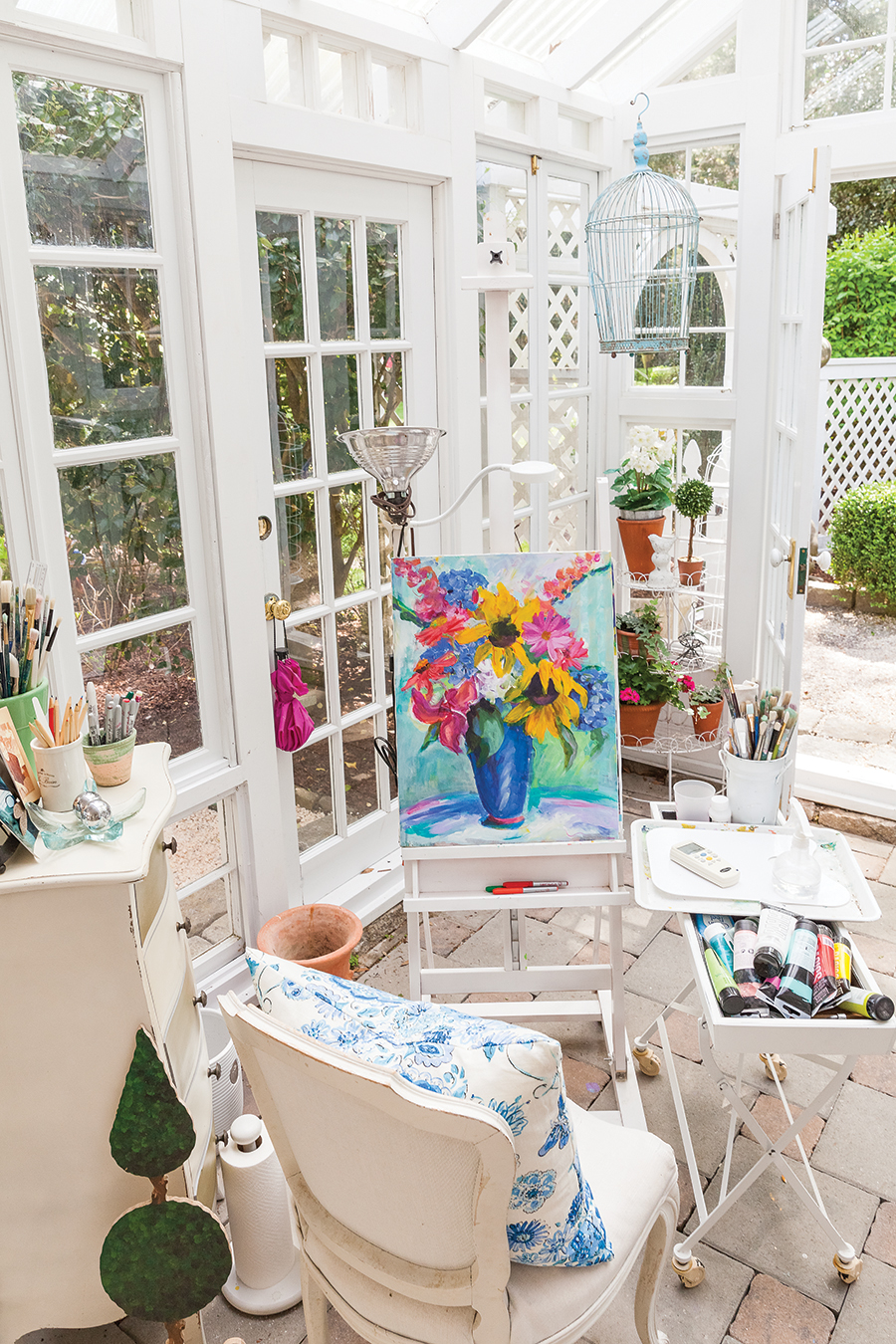
The final surprise, so very Cathy, so very French, is her garden studio, contrived from a single-car garage, of no use since its driveway lost access to the alley. Here, she employs blue and white for country French freshness. Here, flooded by sunshine from skylights and paned windows, Cathy paints, designs, reads and plans. Those plans include a shocker: The Carlisles will soon move to a more formal historic house in the village on which Cathy will, once again, imprint her style.

Why?

Certainly not because they need more space, or a better location. “Just because I love old houses,” she says.  PS

Almanac

By Ash Alder

I perhaps owe having become a painter to flowers. – Claude Monet

May is a month of magic. A single flower is proof. But the Earth spills fragrant blossoms with the fervor of a child in a spring wedding, hands dipping into that shaky wicker basket until the aisle resembles a sea of brush strokes — a Monet painting come to life.

May is a month of abundance. Plump strawberries. Rhubarb pie. Tomato vines winding up rustic garden trellises.

On May 1, an ancient fire festival called Beltane celebrates this fertile season with feasts and rituals. Midway between the spring equinox and summer solstice, Beltane was traditionally a celebration of light that marked the beginning of summer, a Gaelic May Day festival during which cattle were led between two sacred fires, the smoke from which was said to purify and shield the herd from disease before they were driven into open pasture. Villagers and couples danced round and leapt over the flames to cleanse their souls and invoke fertility and good fortune.

May is a month of flowers. In her book of essays and meditations inspired by a retreat to Florida’s Captiva Island in the early 1950s, Anne Morrow Lindbergh mused that “arranging a bowl of flowers in the morning can give a sense of quiet in a crowded day — like writing a poem or saying a prayer.”

Mother’s Day falls on Sunday, May 14, two days after the full Flower Moon. Gift her wildflowers. A sprig of dogwood. Irises from the garden. Gather them in the early light and feel the magic of May pulsing within them.

Spring in a Bottle

Remember picking your first dandelion? How it yellowed your clothes and fingers? How its tiny florets rendered it the most perfect specimen you’d ever seen? Before you knew it as weed or edible, dandelion was faithful companion. You wove it into wildflower crowns, you gathered them for Mother, and gasped when you found one gone to seed. Even as a child, you somehow knew that dandies spread like laughter. For that, you were grateful.

In the spirit of that playful inner child, harvest a basketful of dandelions on a warm May evening. Make wine. Pop off the blossoms. Soak them in citrus juices. Boil with ginger and clove. Bottle the sweetness of spring to enjoy all year.

Dandelion wine recipes are nearly as easy to find as the star ingredient. Just be sure to harvest from someplace free of pesticides. And when the blossoms stain your fingers, don’t be surprised by a sudden impulse to turn a cartwheel or somersault across the lawn.

Weeds are flowers too, once you get to know them.— A. A. Milne

The May Bush

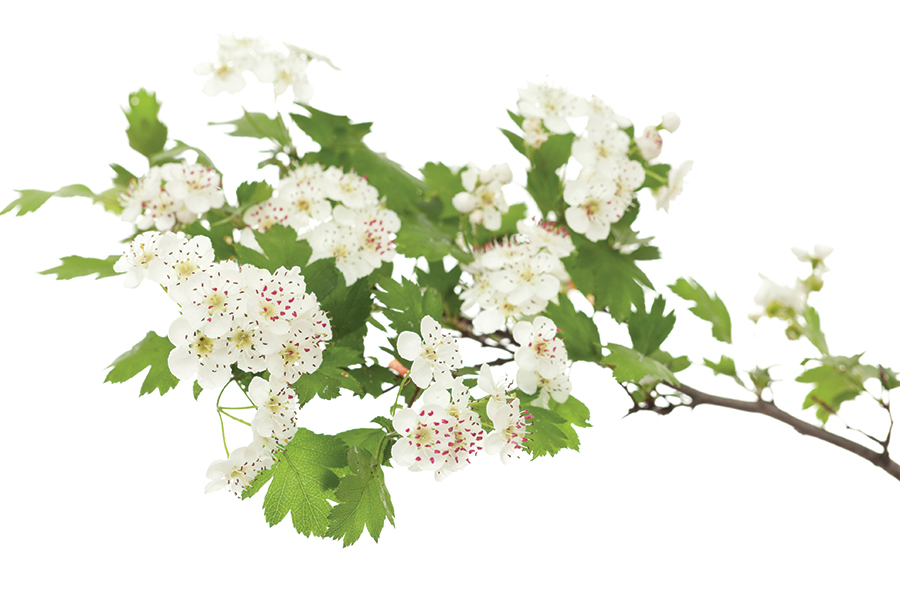
The first maypoles were made of hawthorn, a mystical tree whose pale blossoms represent hope and supreme happiness. Also called thornapple, hawberry and May bush, the ancient Celts believed this magical tree could heal a broken heart. If you stumble upon a wild hawthorn, especially one growing among ash and oak, legend has it you have found a portal to the faerie realm.

The Celts sure love their nature spirits. According to Celtic tree astrology, those born from May 13 – June 9 draw wisdom from the sacred hawthorn. Creative and charismatic, hawthorn types are often found performing for a crowd. They’re most compatible with ash (Feb. 18 – March 17) and rowan signs (January 21 – Feb. 17).

And wouldn’t you know it? The hawthorn is one of two birth flowers of May, the other being lily of the valley — less fabled but far more fragrant.

The Happy House

A young family appreciates the old and enjoys the new

By Deborah Salomon    Photographs by John Gessner

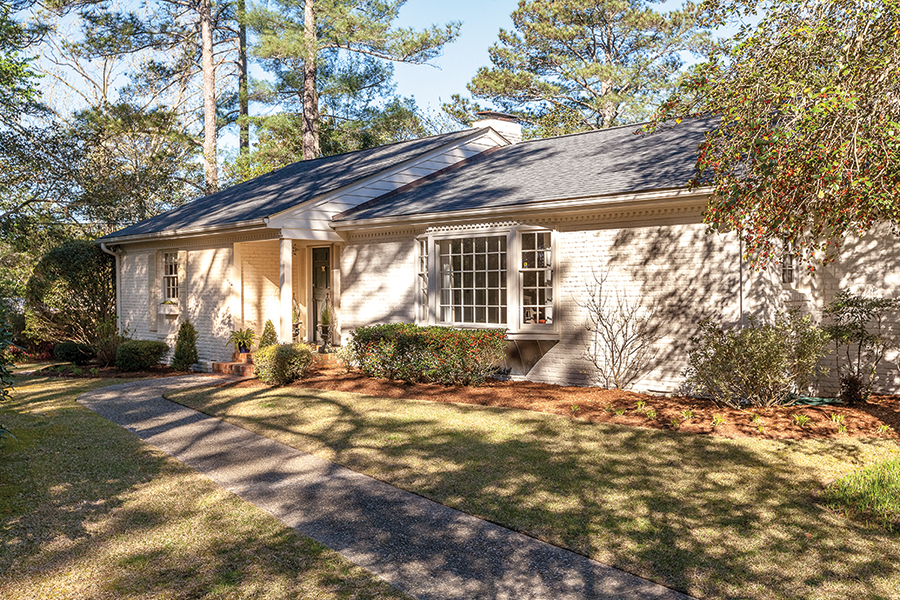
In the 1940s, with the world deep in World War II, Walt Disney created Happy Valley as a Technicolor backdrop for animated films. Here, the sun forever shone, flowers bloomed, birds chirped, bunnies hopped and all was well — a remarkable resemblance to the grounds surrounding the home of Dr. Ed (dentist) and Ginger (interior designer) Monroe. Tucked out of sight on a forested Weymouth lane, the brick ranch rooted in the ’60s but now painted vanilla practically glows.

Rosie, a black Lab puppy, wiggles greetings but does not bark. The manicured grass is brilliant early-spring green, the swimming pool crystal azure and the azaleas — some from Pinehurst’s famous Clarendon Gardens — a dozen shades of pink.

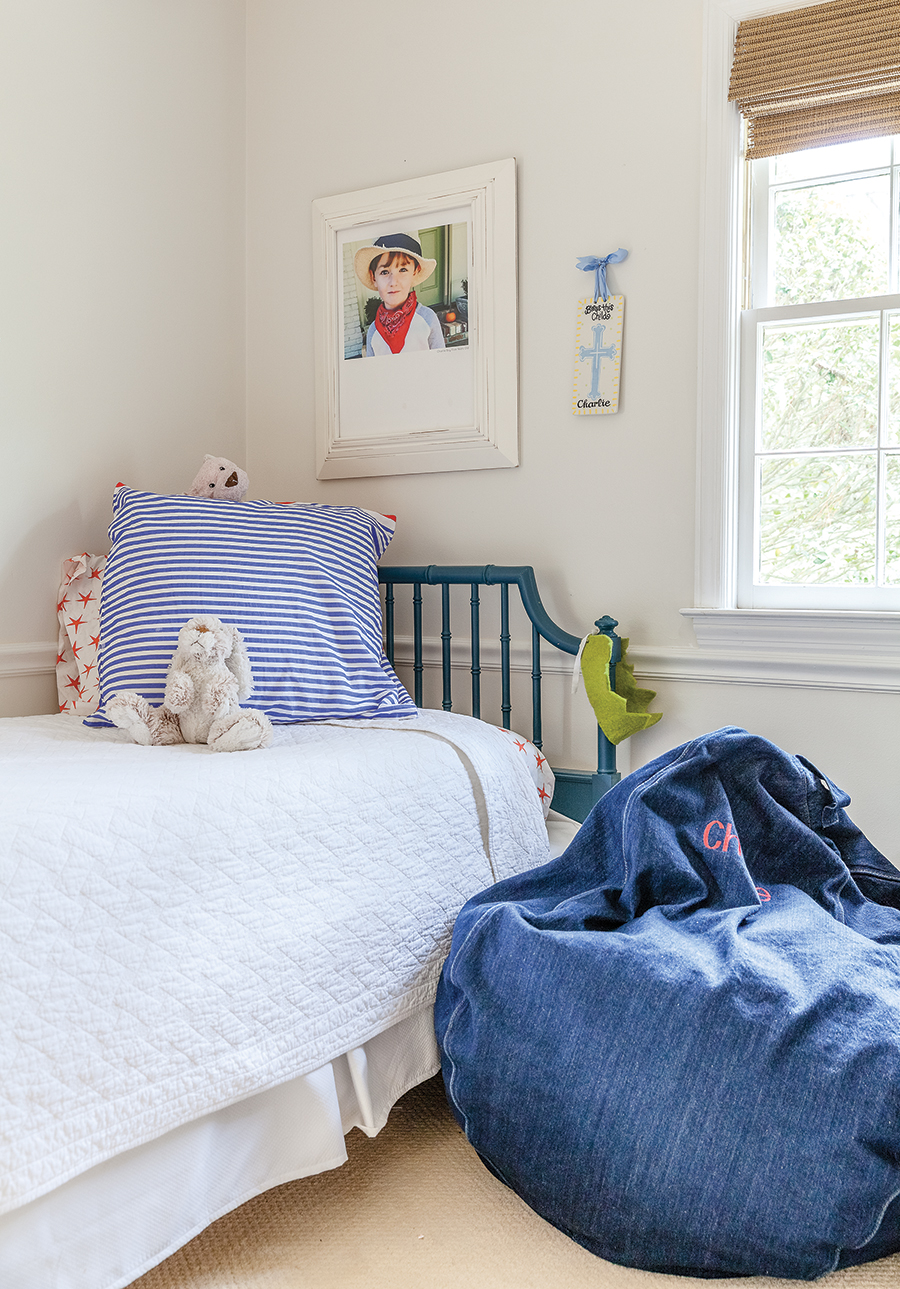
Inside, 9-year-old Janie plays the piano and guitar while 5-year-old twins Charlie and Hunter construct Lego vehicles. Almost every evening the family gathers around the dining room table for dinner and conversation.

“It’s our time to regroup,” Ginger says.

This scene — quintessential feng shui — fulfills a note Ed wrote to their Realtor, when acquisition of the property seemed uncertain. He promised to “fill the house with love and laughter.”

The story of this acquisition matches the results.

“We sold our first house when Janie was 4 and I was 7 1/2 months pregnant with the twins,” Ginger begins. “We hadn’t expected to sell it in one day so we had no place to go.”

Not a pretty predicament.

“Then our Realtor called. ‘I think we found a house, but it’s not on the market yet.’” Ginger walked up and down the driveway, enchanted by the rhododendrons in bloom, hardly noticing the house. “I called Ed. His parents came and looked. I was so afraid we would lose it because somebody else was bidding.”

They made an offer which, with the help of Ed’s letter, was accepted.

Ed grew up with three brothers in a ranch house in West End, where his family has lived for 100 years. “We wanted this neighborhood; the house has a great layout for little ones.” Now, Ginger, in advanced pregnancy, faced moving into space which needed freshening and moderate renovations. “We moved in on June 4; the twins were born on July 30,” Ginger says. “By then, the work was 90 percent complete.”

She remembers feeding the babies while the range hood was being installed.

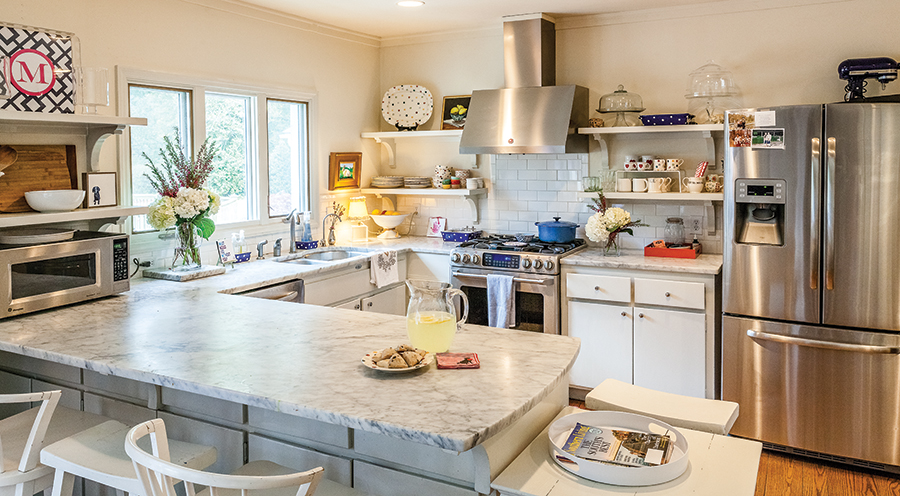
In truth, before Ginger-the-designer waved her wand, the brick ranch built in 1963 was — inside and out — quite ordinary except for an odd floorplan. Imagine, no living room. Instead, the U-shaped kitchen extended to a pine-paneled “family room” with vaulted ceiling, sliding glass doors and fireplace surrounded by built-in bookshelves. Guests could view whatever transpired in the kitchen — a preview of “great rooms” popular in the ’90s. No breakfast room, either, although the long counter has bar stools and a small multi-use table is pushed against one wall. Also missing, a master suite with spa bath/dressing room. Instead, a mother-in-law wing was added by the second owner, creating an L for Janie’s room, an office, laundry room, two children’s play areas and a guest bedroom exiting to the terrace.

Even a moat filled with alligators could not spoil this location.

Here stood the Highland Inn, which burned in the 1950s. “We still find old bricks and pottery in the ground,” Ginger says.

Weymouth, once an enclave of imposing residences built as winter homes for wealthy Northerners, is slowly recycling to younger families. On a nice day, moms in Spandex push jogging strollers along the narrow, winding streets. Historic “cottages” of the 1920s sport glamour kitchens and entertainment centers. Smaller gems like the Monroes’ are screened by pine groves.

Ginger (from Winston-Salem) and Ed (a Moore Countian) met in Charlotte, in 2004. She was familiar with the Pinehurst resort but knew little of Southern Pines. “For a small town it has such history and beauty,” which she compares to the charm of Winston’s historic residential districts. Ed wanted to establish a solo practice, easier in a familiar location. They purchased a house with tiny yard in Weymouth; after five years, given their growing family, relocating became a priority.

The Monroes are only the third owners of the house built by John Valentine, who occupied it until the 1980s. The pool is original — Ginger and Ed added a handsome wood fence — but the second owners built the L-wing. Ginger could either convert this space into a master suite or redo the kitchen. She chose the latter but opted to keep and paint the dark cabinets, replace wall-and-ceiling-mounted ones with simple shelves, enlarge a small window, push out the dividing counter, and install new countertops and appliances.

Flooring was already satiny hardwood.

The absence of a formal living room didn’t bother them at all. “The outside is our living room,” Ginger says. She brightened the dark floors, ceiling and built-ins with white-patterned rugs and white washable shabby-chic slipcovers on chairs, which stand up to three kids and a dog. A Seth Thomas clock, circa 1855, belonging to Ed’s great-grandfather, dominates the mantel, while his grandmother’s “secretary” desk anchors a corner.

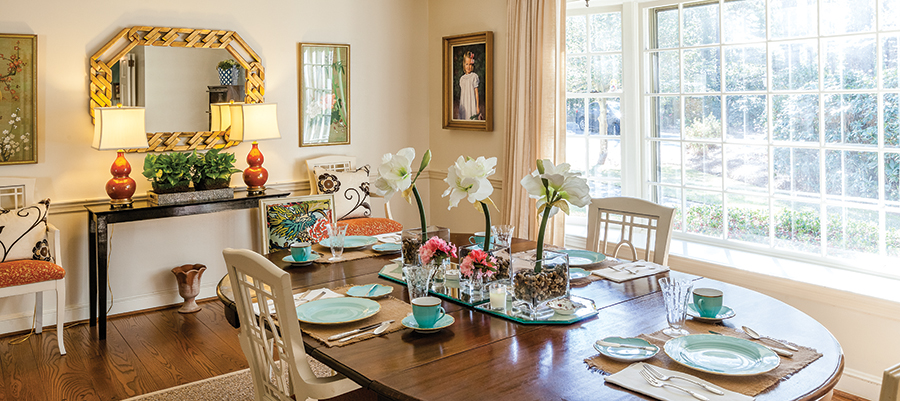
Ginger loves fabrics — pillows are her trademark — using them for bursts of color everywhere, turquoise against burnt orange, bright navy awning stripes, deep money-green toile, faintly Asian reds and pink. Her showplace is the oversized dining room flooded with light from a bay window with window seat, a charming ’60s holdover. These vibrant colors, reflecting a year Ginger spent in Spain, play off her turquoise china displayed in an antique breakfront, also painted vanilla, from a consignment shop. They picked up the dining table at a yard sale.

One exception: an elegant crystal chandelier in the Paris Fern motif illuminating the front hallway.

Otherwise, Ginger admits, “We went furniture shopping at our parents’ houses.”

Somehow, this 3,000-square-foot house seems full without being cluttered. “I’m a minimalist,” Ginger continues. “Paint is the easiest and least expensive way to transform a room.”

Landscapes by local artists, family photographs and portraits line the walls, including one of the children dashing into the ocean by Ginger herself. Miraculously, she has embraced the passé architecture and décor of the ’60s, adapting it to the needs of a young family instead of moving walls. The children have ample play areas, including a room with a floor-to-ceiling world map and a raised playhouse overlooking the pool. The gracefully landscaped yard, nearly an acre, is fenced so Rosie can romp off energy. The wide veranda works well for summer entertaining. Ginger added shutters and window boxes for cottage charm. A detached double garage — what a bonus.

Ed is pleased with the result. “I kinda go along with what my bride likes,” especially since she included Woody, his cowboy mannequin floor lamp.

“The most important thing is how the house makes you feel, a warm, welcoming place,” Ginger concludes. Someday, she might replace the sliding glass with French doors, perhaps alter the footprint by extending the L, or build a proper master suite. But for now, “This is a loved house,” she says, where all is bright, all is practical, all is well and, as promised, all is happy.  PS

Fox Tails

A fresh pair of eyes sees a theme

Story and Illustrations by Romey Petite

After the pines, it was the first thing I noticed. They’re everywhere you go.

Foxes.

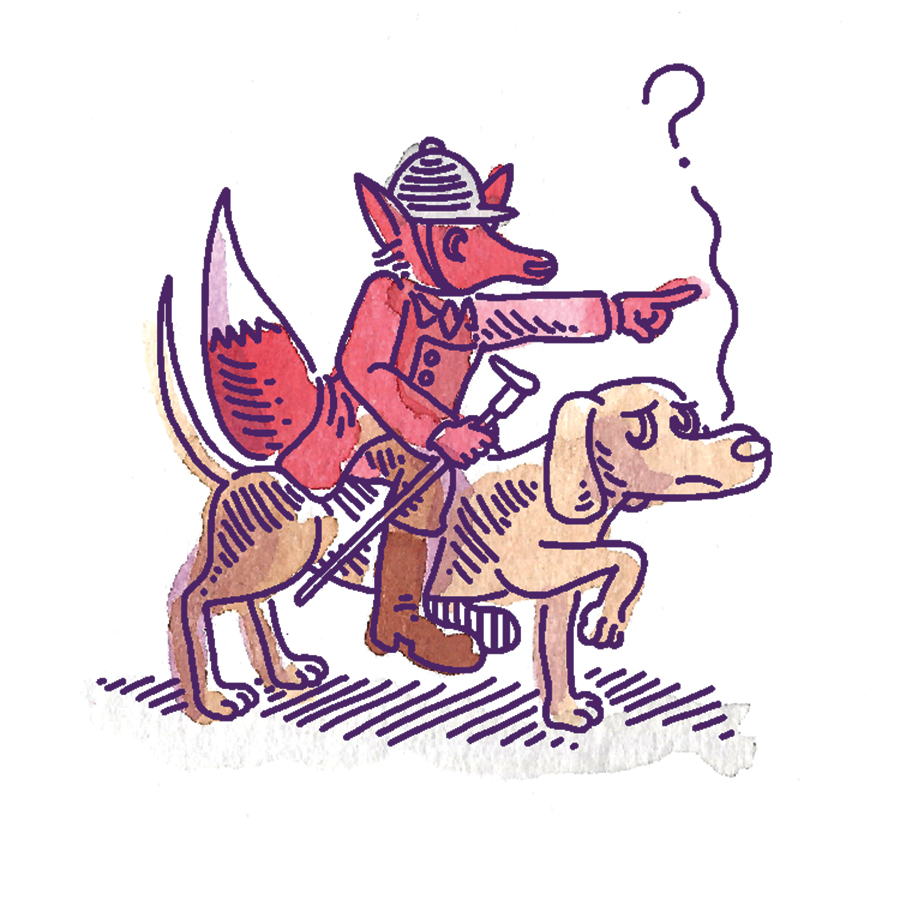
You find them on signs, mailboxes and in murals. I’ve seen them in shops, too, just like the auspicious calico bobtail figurines found in Japanese restaurants. Even one particularly amusing hood ornament featured a fox in a wolf-in-sheep’s clothing scenario. He was dressed as a hunter, complete with riding hat, sitting astride the back of a hound, giving chase, seemingly to himself. The hound was quite confused.

You can find the word “fox” fossilized in the names of the street signs and subdivisions from Fox Hollow, to Foxfire Road, and Fox Creek.

For a stranger, it’s a bit surreal.

In the short while I’ve been here, a little over seven months, I’ve had as many nature sightings as tourists see fleur-de-lis in my native New Orleans. I’m a city boy — give me time. The novelty will wear off.

In the late summer, I was taken with the evening sounds of a neighboring catbird, one that trilled each day in the hour or so between 4 and 5 o’clock.

One winter morning, on my stroll to work, I found the lawns and pines crowded with robins. I removed my headphones to take in the soundtrack on Massachusetts Avenue.

From the comfort of my girlfriend’s family’s dining room, I glimpsed a rabbit going about its business. Its ears were darting around in the direction of the glass window as if the little creature could hear us. I was sure of this: He knew we were there, but he could not see us.

I’ve stumbled on the telltale signs of a beaver’s handiwork at the reservoir — a downed tree and woodchips — while turtles bobbed like apples just beneath the surface and waterfowl glided along.

I’ve counted two crows mobbing a Cooper’s hawk. I remember thinking of something I’d read about crows — that they are very wise with a terrific memory capable of recalling anyone, human or otherwise, that do them a bad turn. That hawk would do well not to show himself again.

And yet, not a real fox to be found. Not yet.

In time, I’ve accepted foxes as a kind of Sandhills totem. But why? I kept looking for an explanation. Or a story.

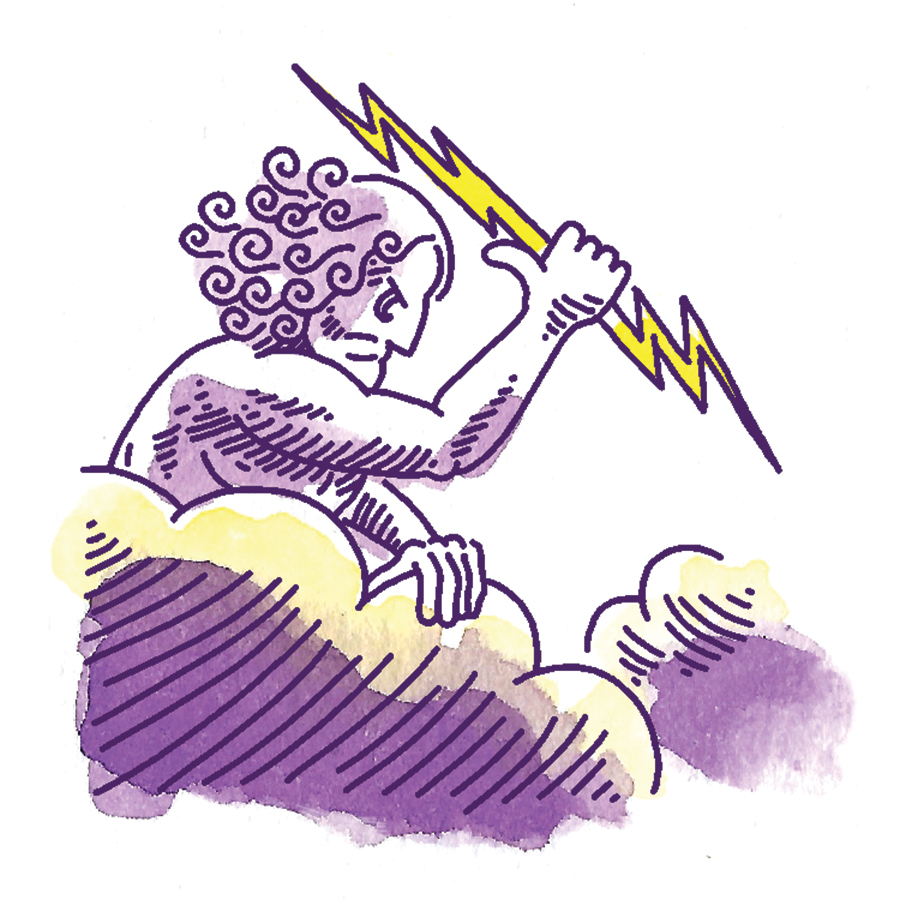
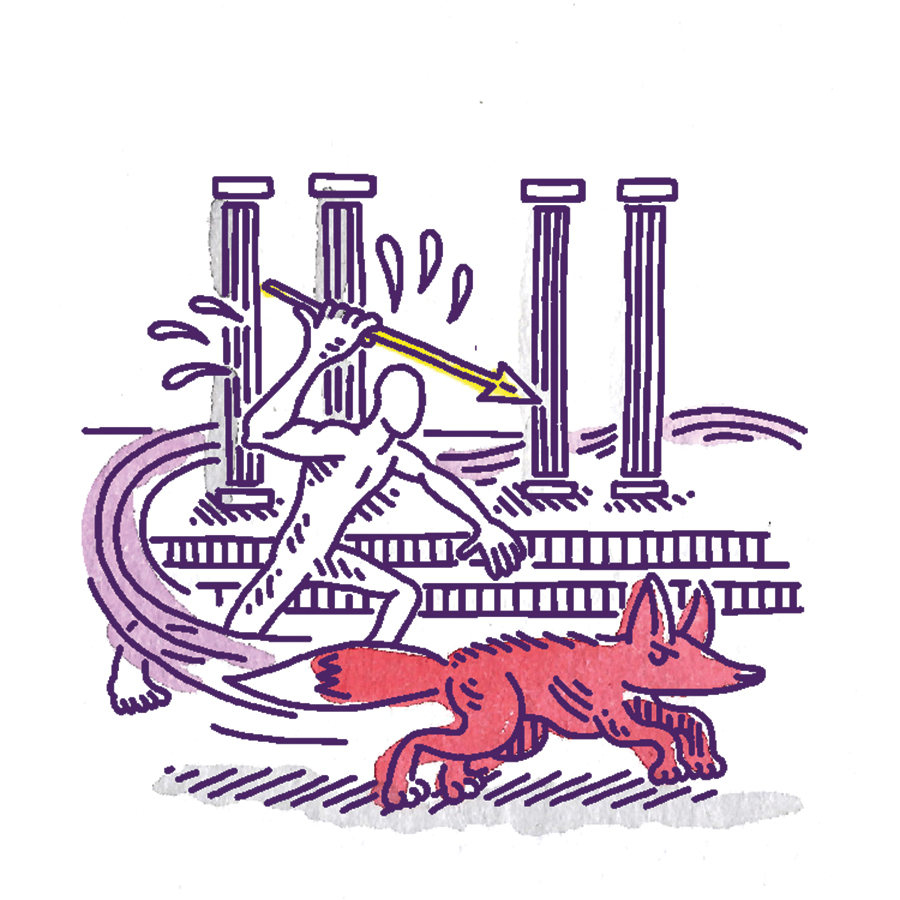
There is an ancient Greek myth of a fox sent by the gods to punish Thebes, the city where Oedipus became king. She devoured chickens, sheep and children. No one was safe. People hid in their homes from the blur of a beast that left a whirlwind in her wake. So terrifying was this vixen and so elusive she could neither be caught nor felled. Not even, at first, by the mightiest of generals, Amphitryon.

Had this place harbored such history?

Not exactly.

If you visited New Orleans, you’d notice our recurring symbols. We flaunt them. From the trundling streetcars, to the uncanny carnival masks, to the cheap plastic beads hanging from the oak trees intermingled with Spanish moss, to the ubiquitous symbol of the Bourbon Dynasty — adopted by the Creole colonials for their own purposes.

Perhaps it’s in my blood, but as an expatriate from a city that celebrates its ties to France (and mainland Europe), there was nothing more unfamiliar to me than the spiritual fervor in the air during the annual Blessing of the Hounds. Particularly the men in red coats — sorry, hunting pink — on horseback.

I grew up with stories of Br’er Rabbit. They gave me an affinity for tricksters, the characters that foxes often embody in folktales. Naturally, I couldn’t help feeling for the poor fox in this predicament — chased, cornered. I was comforted beforehand by an assurance from a hobbyist foxhunter that these days the hounds mostly chase coyote. Ah. Coyote — a trickster of yet another mythos.

Strangers tend to notice the things locals no longer see. So, what became of the vixen-vexed town of Thebes and its tormentor, the fox?

At first, Amphitryon cursed his luck. He knew he’d been given an impossible task. He would grow old and die before he’d manage to catch that fox on his own. So the wise general decided he wouldn’t waste his time. There were more important battles to be fought and won.

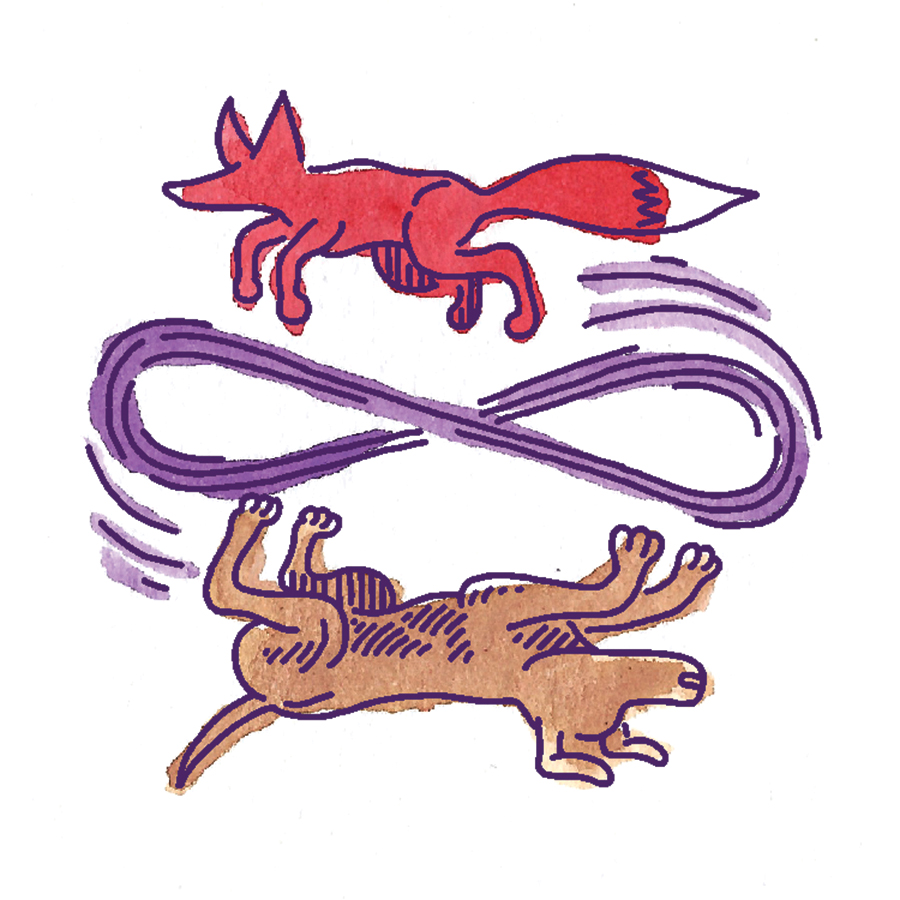
A special hound was bred and summoned, a hound worthy of this task, one who would give chase for as long as it would take. Laelaps was his name, and he was let loose to bark, snarl, and spring at the heels of the fox.

This tireless thief was chased by the relentless pursuer until, once again, the gods intervened, offering mercy to mortals. Zeus placed both monsters in the sky forming Canis Major (the hound) and Canis Minor (the fox).

It is hard to leave New Orleans. It spoils you with good food, with good music, with a culture not found anywhere else in America. Sold to the United States by Napoleon who needed money to fight the British, it’s a European city on this side of the pond, with African and Caribbean cultures mixed into the gumbo crockpot.

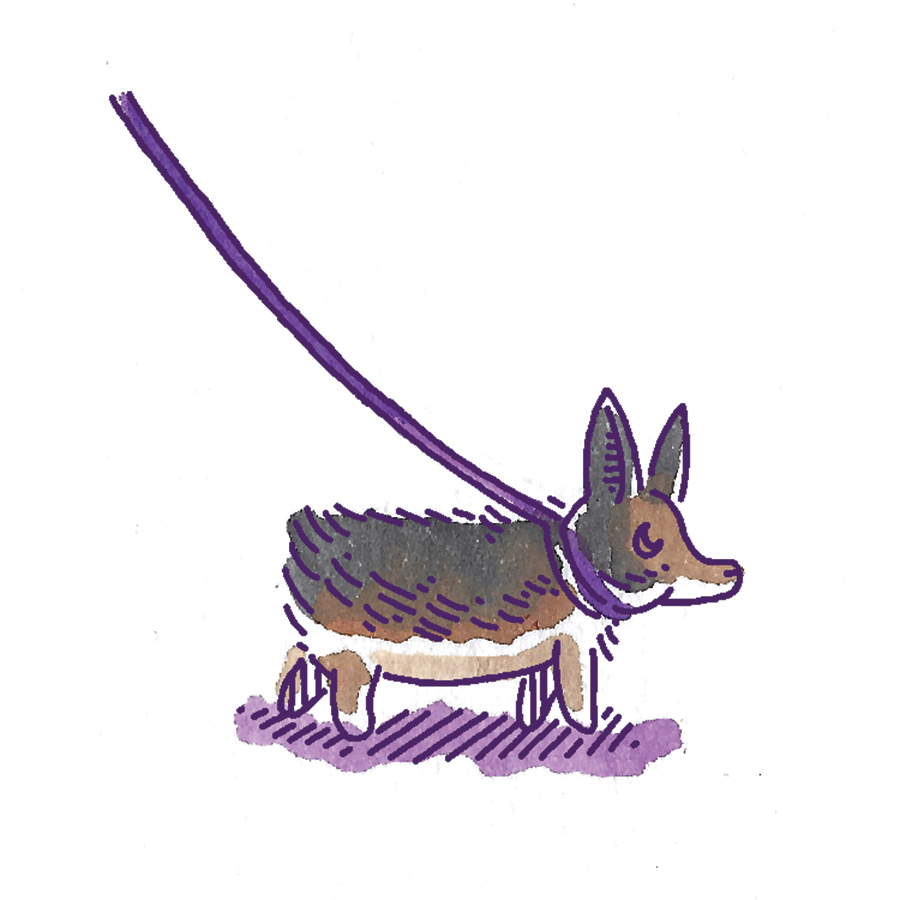
Some nights, walking a fox-eared Corgi, I look up as the stars give chase to one another in the sky. Through the pines, and far from the city lights, I can see the constellations considerably better from here. PS

Romey Petite is a writer and illustrator, a recent New Orleans transplant and a contributor to our Bookshelf column. He can be contacted at romeypetite@gmail.com

Golf’s Quiet Man

How the Sandhills jump-started the Hall of Fame career of Julius Boros

By Bill Case    Photographs from the Tufts Archives

It was a great perk for a bean counter who relished playing golf. Instead of enduring the foul weather months in Hartford, Connecticut, running numbers for the trucking company that employed him as its accountant, Julius Boros got to spend much of that time in 1948 on a golf course in North Carolina’s Sandhills. It wasn’t wholly a lark. There was a bit of daily bookkeeping to do at Southern Pines Country Club, which his boss and frequent golf partner, Mike Sherman, had purchased from the town of Southern Pines two years before. But once that chore was accomplished, Sherman encouraged Boros to play all the golf he wanted.

When Boros asked permission to lay off work the first week of November to compete in a big tournament on Pinehurst’s famed No. 2 course, Sherman happily agreed. At the time, the North and South Open was, if not a major championship, one of the big ones. It seemed unlikely that the amateur Boros, scarcely known outside his home state, would make much of a showing, but cutting his teeth against players like Sam Snead would presumably provide a learning experience if nothing else.

On the Sunday prior to the North and South, Frank “Pop” Cosgrove and wife Maisie, the lessee-operators of the Mid Pines Inn and Golf Club, scheduled a one-day pro-am event on its Donald Ross-designed course. Many North and South entrants, including Snead and Johnny Palmer, signed up figuring that the outing (not to mention the money) would serve as a good tune-up for the main event. Boros wrangled an invite, too.

The Cosgroves’ 20-year-old daughter, Ann “Buttons” Cosgrove — her father thought her cute as one — had assumed responsibility for organizing the event. Buttons, an excellent player herself, invited 30 other equally accomplished female amateurs to play along with the male stars. One of the young women was three-time Ohio Amateur champion Peggy Kirk (Bell), who often palled around with Buttons and her two sisters, Jean and Louise. Peggy spent so much time at Mid Pines it seemed like she owned the place. Later, of course, she did.

Boros, 28 years old and single, attracted the attention of the effervescent Buttons when he worked his way around Mid Pines error-free and carded the day’s low round of 67. With the likes of Snead in the field, Buttons had not contemplated that an amateur would wind up as the day’s medalist. After scurrying about, she produced a spare golf bag from the pro shop to award to the amused accountant.

Boros’ showing at Mid Pines was a perfect springboard two days later at the North and South. Playing quickly, always without practice swings, escaping bunkers using a Spalding 9-iron rather than a conventional sand wedge, Boros’ stellar 68 gave him the first round lead. Only bogeys at the 10th and 17th in the final round prevented him from matching Toney Penna’s winning score of three under par 285. The unheralded amateur’s stunning runner-up finish, tying the great Snead, brought him national attention. One scribe, noting Boros’ husky build and jet-black hair, likened his appearance to boxing great Jack Dempsey, a sport Boros enjoyed as a youth. He had the hands of a powerful puncher to prove it, with fingers as thick as smoked sausages, but a grip as gentle as a tea party.

One of six children of immigrant Hungarian parents, Boros grew up adjacent to the 10th hole of Fairfield, Connecticut’s, Greenfield Hill Country Club. Hopping the fence with his brothers, Lance and Frank, to sneak in some unauthorized golf, the young Boros learned to play fast, developing his trademark rhythmic tempo. When he confided to his parents he wanted to play golf for a living, his Old World father scoffed, “Learn to use your brain, not your back.” After high school, Boros went to work for the Aluminum Company of America and, at the start of World War II, became a medic in the Army Air Corps. He joked that he “fought the war as a laboratory technician” in Biloxi, Mississippi, mostly golfing with the top brass.

After his discharge in 1945, Boros studied accounting for a year at Bridgeport Junior College, then met Sherman, who took him under his wing. As Sherman’s young protégé, Boros directed the employees and handled the financial matters of his boss’s far-flung enterprises. “I had become a businessman, almost overnight,” Boros marveled. Despite his wondrous showing in his first North and South Open, Boros wasn’t yet ready to give up his day job. He was, however, fully prepared to stay in touch with Buttons. Peggy Kirk Bell once recalled that, “Jay (one of Boros’ many nicknames that included Big Jules, Big Julie, Bear and Moose) was a very quiet man, very shy, he said very little. But Buttons was crazy about him. She’d say, ‘Let’s go over to Southern Pines Country Club and see Jay.’”

Both Buttons and Boros acquitted themselves well on the golf course in 1949. Buttons won an important invitational event in Charlotte, and Boros led all qualifiers for the U.S. Amateur, ultimately reaching the quarterfinals, earning him an invitation to the 1950 Masters tournament. In November 1949, Boros returned to Pinehurst No. 2 for the North and South. He finished 17th despite not having his best stuff, a signal to Boros he could prosper in the pro ranks.

Boros gave conflicting accounts of what finally prompted him to turn pro. He told one reporter he pulled the trigger after viewing a driving snowstorm outside his Hartford office window. He also wrote that the encouragement from a few friends at a tournament was all he needed. But Peggy Bell claimed it was Buttons who did the pushing, even asking Snead to convince him. There may well be truth to all three versions. In any event, Boros turned pro on Dec. 15, 1949.

Several Hartford friends interested in backing Boros financially suggested he have Tommy Armour, recognized as golf’s pre-eminent instructor, take a look at his swing. Boros reluctantly agreed. It didn’t go well. Armour’s suggested modifications resulted in repeated shanks by his distressed, self-taught pupil, and Boros declined to return for a second session, spending the next couple of weeks unlearning Armour’s advice.

An arcane rule requiring a six-month waiting period before newly minted pros could accept prize money in tour events meant Boros had time on his hands. He and Buttons competed together in a mixed event at Dubsdread in Orlando, Florida, in March. After that, the Pinehurst Outlook reported that Cosgrove and a Mid Pines friend, Mae Murray, were motoring to Georgia to play in the Titleholders Championship, a major women’s tournament at the Augusta Country Club. According to the Outlook, they were not alone. “The two girls were accompanied by Julius Boros, who recently turned pro. He plans to sharpen his game at the Augusta National course for the forthcoming Masters tournament.” On May 15, 1950, Boros and Buttons were married in Southern Pines’ St. Anthony’s Catholic Church in a double ceremony with Buttons’ sister, Louise, and her new husband, William Weldon.

Boros played a bit part in the legend of Ben Hogan’s comeback in the 1950 U.S. Open at Merion Golf Club. Firing a sensational 68 in the first round, Boros led after 45 holes but finished the third round with a lackluster 77, ruining his chances. Though overtaken by history, his T-9 finish was a remarkable achievement for a first-timer. Two weeks later, Buttons stormed through her preliminary matches and into the final of the Massachusetts Women’s Amateur against another Mid Pines golfing cohort, Ruth Woodward. With her husband rooting her on, Mrs. Boros sprung the upset, winning 2 and 1.

At the end of the PGA’s six-month waiting period, Boros hit the tour in earnest, buttressed in part by steady paychecks coming in from Mid Pines when the Cosgroves put their son-in-law on the payroll as an assistant to tour mainstay, Johnny Bulla. By year end, Bulla had moved on and Boros became the club’s head professional, though his consistent tour earnings meant he never would spend much time behind the pro shop counter. Eventually, younger brother Ernie and nephew, Jimmy Boros, performed that role.

Early in 1951 Buttons learned she was pregnant. Boros acquitted himself well again in the U.S. Open, this time at devilishly difficult Oakland Hills, a course that winner Ben Hogan labeled a “monster.” Boros was the lone competitor not to shoot a round over 74 and his T-4 finish raised the eyebrows of those who wondered if his play at Merion had been a one-off.

With the baby due in September, Buttons assured her husband she was doing fine and that he should play in the Empire State Open instead of pacing the floor of a maternity ward. Things weren’t fine. When Boros heard there were complications, he raced to St. Elizabeth’s Hospital in Boston. Buttons had suffered a cerebral hemorrhage while giving birth to a healthy son, Jay Nicholas (Nick) Boros, and died the following day.

His wife’s death, “really shook him up,” says Boros’ brother, Ernie. But Julius kept his pain to himself. Two-time major champion Doug Ford traveled with Boros countless hours, coast to coast, during the ’50s. Quiet as a church mouse anyway, Ford says Boros never spoke to him about losing Buttons, nor did Boros mention it in any of several books. Nick, now in his mid-60s, says his father never discussed the death of his mother.

If Boros was to continue on tour, he needed to find caregivers for his newborn son. Pop and Maisie Cosgrove offered to help raise the boy. Nick would rotate with his grandparents between the Cosgrove homes in North Carolina and Massachusetts for the next three years. Following a two month hiatus after the loss of his wife, Boros played a home game in Pinehurst at the North and South Open. Showing little rust, he finished six shots behind Tommy Bolt in the event’s final edition.

While he continued to be a solid money winner, there were skeptics who wondered whether Boros, with his laconic mien and idiosyncratic swing, had the right stuff to win. His goal for the 1952 U.S. Open at Northwood Club in sweltering Dallas was simple — four rounds of par golf. Midway through, he was two shots over his mark but just four behind George Fazio and Hogan, seeking his third consecutive U.S. Open crown. Many assumed Connecticut native Boros would fade in the oppressive 98-degree heat of Saturday’s 36-hole final. Instead, it was the Texan Hogan who wilted. Boros’ morning round of 68 put him in front at level par. He was three shots clear when he reached Northbrook’s par-3 12th hole but he found the bunker, failed to get out with his second and ambled away unhappily with a devastating double-bogey. “I could see the deep concern on the face of my brother Ernie who was walking silently with me,” wrote Boros. But, playing with the demeanor of a man nonchalantly swinging at dandelions, he negotiated the last six holes in even par, to win the U.S. Open by four over Porky Oliver. His first tour victory had come in America’s national championship. Hogan remarked at the trophy presentation that the former accountant’s play struck him as “magical.”

Hogan wasn’t alone. When Doug Ford, now 94, was recently asked whether he had been surprised he replied, “I was. But he wasn’t. He was a very confident player.” Besides, says Ford, “he did it with my clubs.” Wilson Sporting Goods had been courting Ford to join its elite staff of players and sent him a set of its clubs. When he failed to come to terms with the company, Ford re-gifted the sticks to his buddy. Ultimately, it was Boros who signed on, becoming a valued member of the Wilson staff.

Later that summer Boros added another title in the World Championship of Golf at Tam O’ Shanter just outside Chicago. The $25,000 winner’s purse was many-fold the largest on the PGA Tour. His successes resulted in a small brouhaha. The PGA had another mysterious rule preventing its members from entering the PGA Championship until they had served a five-year apprenticeship. Desperate to have the Open champion in its field, PGA officials announced that Boros could play even though he was considered an “apprentice” member. A few of his peers complained of favoritism. When he learned of the objections, Boros declined the opportunity to compete, opting to preserve collegiality. “I’d rather wait my regular turn,” he said. “I want all the PGA members to be my friends.” He would have to settle for being the leading money winner and the 1952 Player of the Year.

The Cosgroves hosted a big bash celebration in Boros’ honor, including a 54-hole tournament at Mid Pines. At the banquet afterward, Snead spun country yarns and heaped high praise on “Moose.” Pinehurst’s Richard Tufts paid tribute to the other North Carolinians who’d had banner years: Harvie Ward won the British Amateur; Dick Chapman the French Amateur; and Johnny Palmer the Canadian Open. If Boros, who abhorred
public speaking more than four-putting, spoke at all, it was not noted in the newspaper.

In 1953, the Cosgroves and Boros entered into a real estate partnership that resulted in Warren “Bullet” Bell and wife Peggy becoming owners of the Pine Needles golf course, across Midland Road from Mid Pines. The Cosgroves and Boros pooled $30,000 and the Bells $20,000 to purchase the deteriorated facility from the Catholic diocese. Two years later, the Cosgroves, looking to raise sufficient cash to buy Mid Pines, which had come on the market, negotiated the sale of their share in Pine Needles to the Bells. Boros, though not a participant in the purchase of Mid Pines, agreed to liquidate his Pine Needles interest also. Despite doubling his investment in just two years, Boros later expressed regrets. Noting the Bells’ success, he often remarked to Nick, “I never should have sold my share of Pine Needles.”

A year later, Boros met the woman who would become his second wife, Armen Boyle, a blonde flight attendant and the daughter of a Bayside, New York, club pro. Extroverted, gregarious and funny, she and Boros eloped to Aiken, South Carolina, after a whirlwind three-date courtship. Boros’ choice for a honeymoon may have left a little to be desired. “Can you believe it?” Armen says, laughing. “We went to Mid Pines.”

They settled in Florida with 3-year-old Nick in tow. While Boros continued his association with Mid Pines, he spent most of his time off the tour with his family in Fort Lauderdale, where the lakes and nearby Everglades provided ample opportunity to indulge his passion for fishing.

The family expanded quickly. Over a 10-year period, Armen gave birth to six children: Joy, Julius, Jr., Gary, Gay, Guy, and Jody. Including Nick, there were seven young Boros mouths to feed. Boros’ second triumph in the World Championship of Golf in 1955 brought home an unheard of $50,000. Exhibitions for the champion arranged by the tournament’s promoter extraordinaire, George May, paid an additional $50,000. Boros’ successes allowed Armen to pack up the kids in the family station wagon to spend parts of each summer following their father on tour.

Nick recalls those family travels fondly. By the time he entered his teens, he had become a good junior golfer, often showing up on the practice green alongside the pros. Arnold Palmer would putt for quarters against the young Boros. Getting the line on various putts before The King’s arrival, Nick won his share. “How much did we win today?” his father would ask. All the children developed into excellent golfers though their father rarely provided instruction. Nick would occasionally ask for help but his father, a firm believer in finding one’s own way, customarily responded, “Keep swinging. You’ll figure it out.”

After turning 40, Boros’ career appeared on the wane. The Big Three — Arnold Palmer, Gary Player and Jack Nicklaus — weren’t leaving much space in the winner’s circle in the early ’60s. Boros was shut out for nearly three years. His putting, never great, had fallen off. But sometimes help comes from unexpected sources. In a May, 1963 pro-am at Pompano Beach, two amateur partners noticed Boros abruptly picking up his putter and moving his body during the stroke. He resorted to a more compact motion and a widened stance and, suddenly, everything clicked.

In May, he bested Gary Player by four shots to win the Colonial National Invitational. Three weeks later he won the Buick Open. Boros arrived for the U.S. Open at The Country Club in Brookline, Massachusetts, flush with confidence. Consistently high winds made scoring exceptionally difficult. Boros joked that, “most of the cards looked like they had been turned in for the 1913 National Open.” No player either equaled or broke the par of 71 in the final two rounds. With his revitalized putting, Boros salvaged more pars than most and finished 72 holes tied with Arnold Palmer and Jacky Cupit with scores of 293.

In Monday’s 18-hole playoff, buoyed by several wonderful wedge recoveries, Boros took command with a 33 on the front nine. His final round of 70 beat Cupit by three and Palmer by six. “Poker-faced, laconic, a bit on the dour side, he is an efficient rather than an arresting golfer,” wrote Herbert Warren Wind in The New Yorker, “but his colleagues have long respected the smooth, relaxed tempo of his swing and his penchant for being at his best in the big, rich tournaments.” At age 43, Boros had become the oldest player to win the Open, and for the second time he would be named Player of the Year.

Television and Arnold Palmer had transformed pro golf into a hot commodity and, with his victory, Boros found himself in high demand. His Dean Martin-like relaxed approach charmed the golfing public. The fact that he liked to fish just as much as golf added to his laid-back persona. Though so detesting public speaking that he repeatedly turned down the captaincy of America’s Ryder Cup team, Boros was comfortable enough in front of a camera to host a television show. Outdoors with Liberty Mutual ran for 28 episodes showcasing Boros fishing all over the world. Nick remembers his father finagling a special permit to fish along Alligator Alley while it was under construction. Boros took full advantage. “You just about caught a bass with every cast,” Nick says. “Dad would bring home barrels of fish and stock the lakes around home.”

After his second victory in the National Open, Boros continued to win assorted tour events, including three victories in 1967. When he arrived in San Antonio for the 1968 PGA Championship at Pecan Valley Golf Club, the steaming heat was reminiscent of the ’52 U.S. Open in Dallas. Staving off Palmer’s charge, Boros won the championship with the same 281 score he had shot at Northwood 16 years earlier. Now 48, he assumed the mantle of oldest major champion in golf history — a status he still holds. To ward off the heat, Boros donned a structured baseball-style hat bearing the Amana logo. Soon the Cedar Rapids, Iowa, company began offering tour pros $50 per tournament to wear Amana hats, and many did. Unwittingly, Boros had sparked revolutions in style and advertising, and he maintained a close relationship with Amana and its founder and president, George Foerstner, the rest of his life.

In 1972, Pop and Maisie Cosgrove, now well into their ’70s, sold Mid Pines to Quality Inns. When the Cosgroves left, Boros did too. He affiliated with Aventura Country Club (later Turnberry Isle Miami Resort), which was close to his home in Fort Lauderdale. Though he was aging, Julius was forever eager to play. “It would be pouring down rain and we would be getting ready to close,” recalls Nick, who worked in Aventura’s pro shop. “Dad would call and tell us to stay open; that he was going to come hit balls. He never lost his love of the game.”

Though his best golf was finally behind him, the 53-year-old Boros made one last run for a third U.S. Open victory in 1973 at Oakmont, tying for the lead after three rounds but blown away by Johnny Miller’s 63 on Sunday. He considered the performance one of his greatest achievements. “Boros has put on quite a bit of weight and now pads down the fairways at a sort of ursine lope, but age has not affected the lovely tempo of his swing or his almost disdainful calmness under pressure,” wrote Wind. His T-4 finish was his 11th top 10 in the U.S. Open. Ford’s explanation was simple. “Powerful and straight driving,” he says. “And Jay was a great long iron player.” When asked whether he was going to retire altogether, Boros replied with one of golf’s great one-liners. “What would I retire to?” he asked. “I already fish and play golf for a living.”

By the mid-’70s, Boros was spending most of his time in Fort Lauderdale with Armen and the children. With the help of his Amana connections, Boros sent several of his children to the University of Iowa. Nick, Julius, Jr., and Guy all played golf for the Hawkeyes. Nick and Guy became professionals along with their brother, Gary. Guy relished traveling the tour with his dad. “We’d be in the locker room and Lee Trevino would start to tell an off-color joke,” laughs Guy. “Dad would stop him and say, ‘Lee, please, my son is here.’ Lee would say ‘Oh, sorry Moose,’ then go right on with the story. I loved it.”

Guy was good enough to become a respected tour player. When he won the 1996 Vancouver Open, the family joined a select few father-son duos to have won on the PGA Tour. Guy acknowledges it has not always been easy to follow in the footsteps of his dad’s Hall of Fame career. “People think that because my father was so great, I have some sort of built-in advantage. But when I am on the tee, I still have to hit the shot.”

By 1979, Julius had vanished from the tour but he never seemed to lose the knack of seizing the moment. He agreed to partner in a team event with Roberto De Vicenzo in something called The Legends of Golf, the lone televised event for senior players. Boros and De Vicenzo tied Art Wall and Tommy Bolt. The ensuing playoff featured a spectacular birdie fest by both sides until the Boros-De Vicenzo team finally prevailed on the sixth extra hole. Viewer reaction to the fireworks was overwhelming. The memorable playoff was the catalyst that launched what’s now called the Champions Tour. The victory in the Legends was Boros’ last important golfing accomplishment, a fitting farewell to competition.

During the 1980s, Boros’ physical condition slowly deteriorated. Even after the incomparable swing had finally gone out of rhythm, Boros still treasured being on the course. He would drive his golf cart unhurriedly out on the Coral Ridge Country Club to savor the day. His favorite spot to park was under a willow tree near the 16th hole. He would silently, but smilingly, wave at the golfers as they went by. It’s the spot where Julius was found on May 28, 1994, after he had peacefully passed away. Quiet and unhurried.  PS

A Proper Pour

Where art meets industry, in a world of gritty timelessness

By Jim Moriarty   •   Photographs by Laura Gingerich

Dressed like Marty McFly paying a nocturnal visit on his adolescent father in Back to the Future, Brian Brown and Jackson Jennings shuffle along in their silver coats and hoods with plastic face shields, carrying 270 pounds of molten bronze as if it was the industrial version of Cleopatra’s golden litter. As they tip the glowing bucket, orange metal flows like lava into the gray-white ceramic casts wired in place in a steel pan on the cement floor. This is how Ronald Reagan got to the Capitol rotunda.

Carolina Bronze Sculpture, hidden down a gravel drive past Maple Springs Baptist Church on the other side of I-73 from Seagrove’s famous potteries, may be the foremost artists’ foundry in the eastern United States. Certainly it’s the one most often used by Chas Fagan, the Charlotte artist whose statue of Reagan resides in the people’s house in Washington, D.C.

The foundry is the life’s work of Ed Walker, 62, a quiet, unassuming man with a quick smile and a knack for noodling on an industrial scale. Walker is a sculptor, too. His “Firefighter Memorial” in Wilmington, North Carolina, incorporating a piece of I-beam from the South Tower of the World Trade Center, was completed in 2013, and he hopes to have the recently announced Richard Petty Tribute Park with multiple sculptures completed in time to celebrate Petty’s 80th birthday on July 2. One of Walker’s large abstracts is on its way to Charleston, South Carolina, on loan for a year’s exhibition.

“Ed’s a rare combination of a complete artist’s eye mixed with an absolute engineer’s brain,” says Fagan. “He’s the kind of guy who can solve any problem — and every project has a list of them. Nothing fazes him.”

Take Fagan’s sculpture “The Spirit of Mecklenburg,” a bronze of Captain James Jack on horseback, the centerpiece of a fountain in Uptown Charlotte. “The design was not easy,” says Fagan of the 1 1/2 life-size bronze. “I had the thing leaning and he’s at full speed so the horse’s feet are not on the ground exactly. Engineers had to be involved, at least two of them, maybe three. We’re all standing around this big clay horse and a question popped up on something pretty important. Everyone pipes in, pipes in, pipes in. Eventually Ed offers his opinion in his normal, subdued, quiet manner. Then the discussion goes on and on and on, the whole day. Magically, everything circled around all the way back to exactly what Ed had said. I just smiled.”

Walker grew up in Burlington, living in the same house — three down from the city park — until he graduated from Walter M. Williams High School and went to East Carolina University. His father, Raleigh, was a WWII veteran who developed a hair-cutting sideline to his motor pool duties in the 5th Army Air Corps. “There was a picture he showed me of this barbershop tent, and Dwight Eisenhower and Winston Churchill were standing out in front of it. They’d just gotten a shave and a haircut by him, and he was on the edge of the photo.” The same shears kept Ed’s head trimmed, too.

Walker was drafted by art early on. He turned pro when he was in first grade. “Back then kids didn’t have money, at least not in my neighborhood,” he says. “My mom and dad (Lillie and Raleigh, who both worked in the textile mills) thought that ice cream was something you get on Friday for being good all week.” Others got it more frequently. Walker started drawing characters taken from classroom stories using crayons on brown paper hand towels, then trading them for ice cream money. Goldilocks. The Three Bears. Not exactly “Perseus with the Head of Medusa” but, heck, it was just first grade. Soon, he was coming home with more money than he left with in the morning. “My mom questioned me about it. The next day I had to go to the principal’s office and was told that under no circumstances could I be selling something on school grounds.”

Sculpture reared its head at ECU. “I took my first sculpture appreciation class with Bob Edmisten. Had my first little bronze casting from that class. They pushed everybody to explore. You could use or do anything. I fell in love with that. Started learning how to weld and cast and carve, the kind of range of things you could do.” In addition to getting a Bachelor of Fine Arts, Walker met his wife, Melissa, another art major, also from Burlington.

“We knew each other in high school,” says Melissa.

“She was in the good student end,” says Ed. “I was in the back with all the problem people.” The old art building at ECU was near the student center. She was going out. He was going in. They were pushing on the same door in different directions. By their senior year they were married.

The first stop after graduation was Grand Forks, North Dakota. If you’ve been to North Dakota, you know there are months and months of harsh winter followed by, say, Tuesday, which is followed by more winter. The University of North Dakota was interested in setting up an art foundry and offered a full stipend to the person who could do it. Walker had helped Edmiston put together the one at ECU’s then-new Jenkins Fine Arts Center. The professor recommended the student. North Dakota sent the Walkers a telegram — your grandfather’s instant messaging. Be here in two weeks. They were.

“They had a new building and a bunch of equipment in crates,” says Walker. “Figure it out. Set it up.” Walker’s art history professor at UND was Jackie McElroy, better known today by the pseudonym Nora Barker, a writer of cozy mysteries, who reinforced his belief that you could figure out how to do just about anything if you wanted to badly enough. It became a recurring theme.

Chased out of North Dakota with a master’s degree and a case of frostbite, the Walkers found themselves back in North Carolina trying to land teaching jobs. After traveling to a conference, essentially a job fair, in New Orleans, Ed and a friend, Barry Bailey, made a pact. If they didn’t have jobs in a year, they’d move to New Orleans. They didn’t and they did.

The Walkers arrived on July 3rd, dead broke. They slept on the floor of the apartment of a friend of their friend, Barry. “We had no job to go to, no food, no money,” says Walker. The next day at a Fourth of July block party, he picked up some carpentry work building a Catholic church. It lasted the rest of the steamy Louisiana summer. The couple attended art openings, went to galleries, met people. Walker got a gig as a bartender at a private party thrown by a local sculptor, Lin Emery. “At the end of the thing, she gave us a tour of her home and her studio,” says Walker. A creator of high-end kinetic sculptures, Emery mentioned she’d just lost her fabricator and was swamped with jobs that needed doing. “Do you know anybody who knows how to weld aluminum?” she asked. “Well, I can,” said Walker. He’d never done it before.

With a weekend to learn how to TIG (tungsten inert gas) weld, a professor friend introduced him to a guy in the maintenance department at Loyola University who offered to help. Walker showed up for work on Monday. “I did not confide to her that I lied my way into the job until about eight months later,” he says. He worked in Emery’s studio until — with Emery’s help — he was able to mix and match enough bits and pieces of teaching jobs to laissez les bon temps rouler. Part time at Loyola. Part time at Delgado Community College. Part time at Louisiana State University in Baton Rouge. Part time at Tulane University. Then, finally, a full-time job teaching sculpture at Tulane. “I had eight students,” Walker says of his first year. “In five years it went from eight students to 101 and eight sculpture majors.” But, as it turned out, Walker was more interested in sculpture than Tulane was.

The Walkers had purchased a single shotgun house with 12-foot ceilings built in 1876 in the Ninth Ward, east of the French Quarter, two blocks from the Industrial Canal that would fail when Hurricane Katrina hit in 2005. Ed created his own little foundry in the side yard. When he wasn’t tenured by Tulane in ’87, his little foundry became his business, initially casting bronze pieces for his students who suddenly had no place to complete their projects. By the fall of ’89, Melissa and their children, Sage and Nathan, moved back to North Carolina when Melissa got a job teaching art in Randolph County. Ed followed six months later. He fired up the foundry again in a building on North Fayetteville Street in Asheboro. In ’94 they bought 55 acres outside of Seagrove with a mobile home on the back corner. Carolina Bronze had a permanent place to live, one that they’re expanding to include what is, essentially, an outdoor gallery for large sculpture. It already has nearly 20 pieces in it, only a few of which are Walker’s. “We’re just getting going on it,” he says. “It’s not just to look at sculpture but to shop for it. It’s going to be a community park, too.”

Since moving to its current location in ’95, the foundry has produced works of art for hundreds of sculptors, the best known of whom is probably Fagan. “He is a person I know will be in the history books one day,” says Walker. “He’s done so many notable people.”

Fagan shares Walker’s penchant for figuring things out. He’s a 1988 graduate of Yale who majored in, of all things, Soviet studies. He took a couple of painting classes while he was in New Haven, and it turned out he had the one thing you can neither invent nor hide, talent. He says his work at the moment is mostly historical in nature. “I’m looking at a life-size seated James Madison. He’s in a 4-foot by 7-foot canvas,” says Fagan. While that commission was private, he had previously been hired by the White House Historical Association to paint all 45 U.S. Presidents. He did the portrait of Mother Teresa that was mounted on a mural and displayed during her sainthood canonization by Pope Francis. His sculptures include the Bush presidents, George H.W. and George W., shown together, and George H.W. alone; several versions of Reagan for Washington, D.C., London and Reagan National Airport; Ronald and Nancy Reagan for his presidential library; Saint John Paul II for the shrine in Washington, D.C.; and Neil Armstrong for Purdue University. The piece currently being produced at Carolina Bronze is a sculpture of Bob McNair, the owner of the NFL’s Houston Texans.

Fagan’s start in sculpture was, in its way, as unusual as studying Russia to master oil painting. While he was at the White House working on Barbara Bush’s portrait, he was asked if he could do a sculpture of George H.W., too. Sure, he said. Fagan had never done one before. Now the path to many of his finished pieces passes through Carolina Bronze.

“In this place I think we created a really nice marriage of modern technology and old school techniques that have been around for thousands of years,” says Walker.

Once a sculpture is approved and the project is on, an artist like Fagan will deliver a clay maquette, roughly a 2-foot version of the piece, to Walker. “From that Ed would determine how difficult it would be to make,” says Fagan. “I’m sure in his mind he’s planning out every major chess move along the way, because they are chess moves.”

David Hagan, a sculptor himself who works mostly in granite and marble, will produce a 360 degree scan of the piece, a process that takes about a day. That digital information is fed into a machine that cuts pieces of industrial foam to be assembled into a rough version of the sculpture at its eventual scale. “It’s at that point that I come in with clay and sculpt away,” says Fagan. “You’re at your final size and it’s a fairly close version of what you had, which may or may not be a good thing. What looks so great at a small scale may end up being not so great. You can have awful proportion things wrong. The foam that’s used is a wonderful structural foam that you can slice with a blade. For me, you can sculpt that stuff.” The eventual layer of clay on the foam varies according to the artist’s desire.

Several intermediate steps eventually yield a wax version of the sculpture, except in pieces. “For the artist, you gotta go back in and play with that piece — or the piece of your piece — the head or a hand or an arm or something,” says Fagan. “They’re all designed or cut based on where Ed, foreseeing the chess moves, figured out what’s going to pour and how. The maximum size of the mold is dictated by the maximum size of the pour. Those are your limitations, so you have to break up the piece into those portions.”

Solid bars of wax, sprues, are added to the wax pieces to allow for the passage of molten bronze and the escape of gases. A wax funnel is put in place. Everything is covered in what becomes a hard ceramic coating. That’s heated to around 1,100 degrees. The wax melts away. Brown, who has a Bachelor of Fine Arts degree from UNCG and whose own bronze sculpture of a mother ocelot and kittens will go on display at the North Carolina Zoo this year, slags the impurities off the top of the molten bronze. It’s poured at roughly 2,100 degrees. “I found that I enjoyed the more physical aspect of working with sculpture as opposed to doing drawings or paintings,” says Brown.

After everything has cooled and the ceramic is broken away, the pieces need to be welded together to reform the full sculpture. “The weld marks on the metal, you have to fake to look like clay,” says Fagan. The artist oversees that, as well. “The bronze shrinks but not always at the exact same percentage. There are always adjustments.” The last step is applying the patina, one of a variety of chemical surface coatings, done at Carolina Bronze by Neil King. Different patinas are chosen for different reasons: if the piece is to be displayed in the elements; if it will be touched frequently; and so on. “For someone like the artist who is very visual, it’s hard to imagine what the end result is going to be when you see the process. It will just look completely different in the middle than it will at the end. It’s an absolute art,” says Fagan. When it’s finished, no one knows the structural strengths and weaknesses of the sculpture better than Walker. They crate it like swaddling an infant, put it in traction, and then ship it off.

In a digital world where so many things seem to have the lifespan of magician’s flash paper, a foundry is a world of gritty timelessness. “Because we do a lot of historical things here,” says Walker, “we get to make permanent snapshots of points in time.” At the end of the day, whether they’ve poured brass bases for miniaturized busts of Gen.George Marshall or pieces of a torso for a presidential library, the kiln and furnace go cold. Like any other small factory, the doors are locked and everyone goes home. Except for Walker. These are the hours he gets to spend alone shaping a bas relief of Richard Petty’s greatest hits. As George McFly said to Marty when his first novel, A Match Made in Space, arrived, “Like I’ve always told you, you put your mind to it, you can accomplish anything.”  PS

Jim Moriarty is senior editor of PineStraw and can be reached at jjmpinestraw@gmail.com.
Cave Men

A full wine rack is

Saturday mornings,

The first day of vacation,

A just-waxed car.

It is a promise of future good dinners,

of future celebrations,

of a future.

A full wine rack murmurs:

Don’t worry.

There’s plenty.

You’re safe.

— Joseph Mills

from Angels, Thieves, and Winemakers

A Mystic Reincarnation

Letting a house speak for itself

By Deborah Salomon   •   Photographs by John Gessner and from The Tufts Archives

If only the walls could talk.

We can.

We walls surround a house now surrounded by others that once stood alone in an infant village with muddy roads and big dreams — a village which, as founder James Tufts wrote, “would attract only a refined and intelligent class of people.” Our double-decker wraparound porches were meant for sitting and watching . . . very little, at the start. Today, the world strolls by. Music and aromas fill the air. Porch chairs are occupied by progeny hungry for history.

We walls, some plaster, formerly white, now sport a rainbow of blues: blue and grey and grey-blue and teal and almost turquoise; some of us old walls remain covered in grasscloth, also painted blue. No amount of scraping, stain or polish disguises our heart pine floorboards — although carpets and rugs of all sizes, shapes, colors and provenance draw attention to their antiquity with this exception: Flooring in the back hallway comes from a longleaf pine felled recently by lightning on Pinehurst No. 2.

Our exterior shingles, once white also, are a misty gray reminiscent of haze over the Mystic River, which flowed near the Tufts residence in Massachusetts. Nobody knows why the door blazes burnt orange.

James Tufts built our Mystic in 1899 for his son Leonard who, after his father’s death in 1902, moved his growing family to Pinehurst and took over resort operations. What a mansion it was — 14 rooms, vaguely Queen Anne, designed by the same Boston architects as the Carolina Hotel. The Pinehurst Outlook described Mystic as “having steam heat, throughout with electric lights, a large steel range and cold storage for preservation of meats and vegetables.” The second floor bathroom was “fitted with the latest improvements such as sanitary plumbing, a porcelain bath tub and one set of bowls.” Also: Antique oak furniture and “rich Brussels carpets.” The Outlook further commented: “Nothing has been left to be desired. Mystic Cottage has a home-like appearance notably lacking in homes located in other winter resorts.”

Palm Beach, perhaps?

After Tufts moved across the street to Mistletoe Cottage in 1913, we were occupied by, among others, Mr. and Mrs. Robert Hunter, of Berkeley, California. Mr. Hunter, described as a cranky socialist and writer, took issue with Tufts over heating bills. “You charge the extreme limit for every service you render to the people of Pinehurst. You have driven away a large number of people . . .”

But not the lady ghost, rumored to be a lovelorn poet.

Nevertheless, the resort continued to grow, to prosper, and we continued to adapt. Our walls were reconfigured into apartments, offices, a bank branch and finally, Brenda Lyne’s home décor business. Lyne installed an elevator which, though convenient, seems anachronistic to us.

Then, in 2013, not without contention, Mystic was rezoned residential and sold to Richard Moore, CEO of First Bank, and his wife, Noel — definitely “intelligent and of refined tastes.”

The walls fall silent as another voice emerges.

“I fell in love the first time I went through (Mystic Cottage) when it was still a store,” Moore says. First Bank was moving headquarters from Troy to Southern Pines. He needed a place to stay during the week. He was also a Wake Forest history major, who had rebirthed Ashburn Hall, a 19th century meeting venue near Oxford.

But, the ever-practical walls query, why live on a busy village corner instead of a quiet cul-de-sac?

“I wouldn’t have picked downtown except for this house. I was happy to put money into a landmark that would be connected to First Bank,” Moore answers.

Banker-turned-rehabilitator Moore accomplished the redesign sans architect, quite the feat considering the scope of his plans.

“There’s practically nothing original on the inside — two fireplaces, one door,” also a darling wood-paneled dormered nest on the third floor, presumably the maid’s quarters. “I tried to be creative in where we put the bathrooms,” he adds, recalling the Tuftses and their three children had one and the Moores desired six.

Or is it seven?

No matter. Their vanities — repurposed antique bureaus — make the loos as elegant as the parlors.

What Moore accomplished was a maze of sitting areas (“so everyone could have their own space”), bedrooms (none vast), recreation (billiard room, TV nooks) and a kitchen, which, in an era of culinary ballrooms, illustrates restraint. “There was no kitchen; I just took a guess.” From the coffered ceiling — which Moore devised as a “strong statement” — to the painted cabinets and breakfast room with round table and pub chairs, Moore has created a contemporary kitchen shadowing the bygone.

Just imagine, in a renovation costing many zeros, no Sub-Zero!

“I went with Sears,” Moore says.

The walls’ primary purpose, aside from loquaciousness and connecting miles of moldings, is backdropping an art collection that would wow even persnickety James Tufts. Furnishings, none heirlooms, blend in; upholstery has been kept neutral lest patterns detract from paintings. Art of multiple spectra is the Moores’ passion, if not trademark. Above the living room fireplace hangs, of all things, an original Marilyn Monroe by Andy Warhol.

“When my wife walked through the house she said, ‘You need Marilyn there.’ So she bought one for me.” Even walls that stare at nothing else have trouble describing gilt-framed English landscapes by Duncan Cameron and American masterpieces by Impressionist/Expressionist Jane Peterson, also Dale Nichols, in the style of Grant Wood. Yes, that is pop artist Roy Lichtenstein, also, and a Toulouse-Lautrec print, but the enlarged photos were taken by the Moores’ son, William, when he worked for the United Nations.

Times, they have a-changed. Our chatty walls must learn a new script. Or amend the old one. Because once again, Mystic Cottage hosts a family of substance and taste, who appreciate both history and now-time. Other cottages may crowd its perimeter, but the interior still boasts “the latest improvements,” more likely zoned AC and Wi-Fi than electric lights. Of an evening, Richard Moore watches the world James Tufts sought to attract go by from a porch where Leonard’s children played on rainy days.

Whither the ghost? She hasn’t been seen for years. Just as well. Marilyn might scare her to death.   PS

Southern Pines Home & Garden Tour

Mystic Cottage and five other premier area homes will be on display at the 69th annual Southern Pines Home & Garden Tour, from 10 a.m. to 4 p.m. on April 8. For the first time, the tour will take place on Saturday. Also included, the public gardens at Weymouth, Campbell House and Sandhills Horticultural Gardens. An exhibit of original watercolor landscapes will be on display at Campbell House. Tickets are $20 until April 5 at Campbell House and The Country Bookshop in Southern Pines, and The Woman’s Exchange in Pinehurst, or at www.southernpinesgardenclub.com. Day of tour, tickets may be purchased for $25 at the houses. Profits from garden club events fund scholarships and beautification projects.
 

Almanac

April Flowers

Daisy and sweet pea are this month’s birth flowers. The first is a symbol of innocence and purity, while the latter represents blissful pleasure. If you wish to brighten someone’s day, a simple bouquet of fern and daisies will speak volumes. A gift of fragrant sweet pea, on the other hand, is best reserved for a sweet goodbye.

Every spring is the only spring — a perpetual astonishment. — Ellis Peters

April Love Song

If ever there were a more delicious poem than April, perhaps only the bluebird would know it. Or the nectar-drunk duskywing. Or the glossy black rat snake, so entranced by the color of the robin’s egg that he swallows the pastel vessel whole.

April is here. Sow the beets and the broccoli. Plant the beans and the cukes. Harvest the tender green shoots of asparagus.

Welcome the rain. Let it kiss you, mused Harlem jazz poet Langston Hughes. Listen to its “sleep-song” on your roof at night.

Earth Day falls on Saturday, April 22. This month, gift the Earth a poem of love. Plant a tree in the garden. Buy local produce. Organize a community cleanup. And when the Earth sings, listen.   

Let the rain kiss you.

Let the rain beat upon your head with silver liquid drops.

Let the rain sing you a lullaby.

The rain makes still pools on the sidewalk.

The rain makes running pools in the gutter.

The rain plays a little sleep-song on our roof at night —

And I love the rain.

— Langston Hughes, “April Rain Song”

Must-See Moon

According to National Geographic, one of the “Top 7 Must-See Sky Events for 2017” will occur on Monday, April 10. On this dreamy spring night, just moments after sunset, Jupiter and the near-full Pink Moon will rise together in the eastern sky like forbidden lovers.

The Old Farmer’s Almanac speculates that a full moon in April brings frost. While it’s not actually pink, Algonquin tribes likely named this month’s full moon for the wild ground phlox that blooms with the arrival of spring. Also called the Sprouting Grass, Fish and Egg Moon, if the full Pink Moon rises pale on April 11, bet your folklore-loving bippy it will rain.

A Few Delicious Words

Henry James once mused that “summer afternoon” were perhaps the “two most beautiful words in the English language.”

“Easter brunch” make a
lovely pair.

Ditto “asparagus frittata.”

So if you find yourself playing host on Sunday, April 16, and life gives you fresh asparagus spears, steam until tender then add them to your favorite egg dish.

The Medicine Chest

Want to try your hand at an herb garden? Start now. Since most herbs thrive in full or filtered sun, carve out a cozy outdoor space with optimal light and drainage. Then, allow yourself to dream. Conjure up visions of lush beds with tidy labels, dark opal basil tangled with pineapple sage, aromatic bundles of herbs hanging upside down inside the coolest rooms of the house. Whether it’s medieval apothecary or fresh pesto that you’re craving, April is here to help make manifest your fantasy.
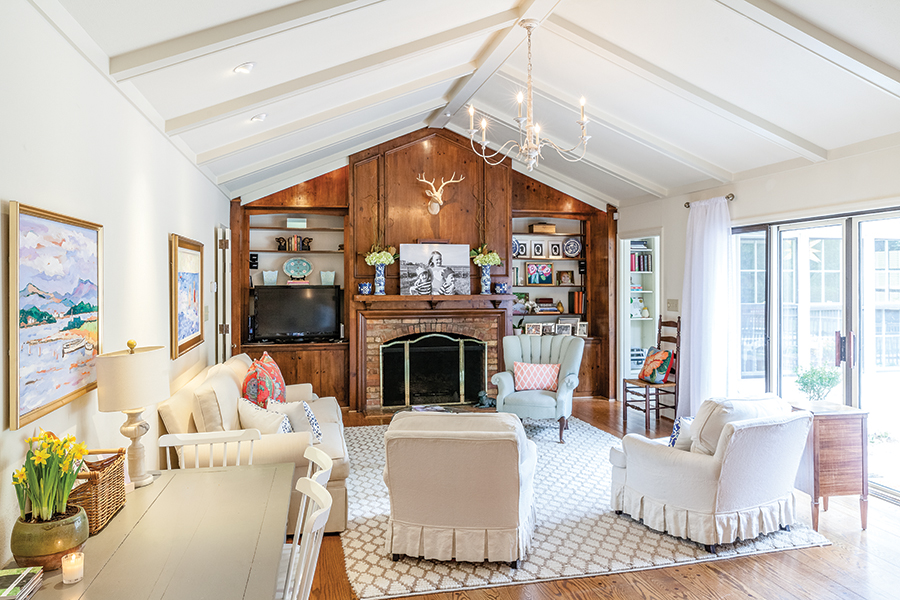

Here’s what to plant this month. Cue “Scarborough Fair” for reference.

Parsley – Rich in cancer-fighting compounds.

Sage – Digestive aid.

Rosemary – Improves memory.

Thyme – Antiseptic and anti-fungal properties.  PS