Almanac

By Ash Alder

The flowers of late winter and early spring occupy places in our hearts well out of proportion to their size.

– Gertrude S. Wister


February morning . . .

The coffee is freshly ground, and you hold in your hands the last grapefruit from the bushel. Remember how your grandma used to eat them? And how, when the birds started singing, she would visit the camellias, maybe cut one for the green vase on the windowsill?

Suddenly you feel like dancing.

Sliding in your socks across the cold kitchen floor, sweet memories flicker like the warm crackling of vinyl.

You put on the coffee. Slice the grapefruit. Reach for the sugar bowl.

In the cupboard, on the highest shelf, you notice the little green vase. The birds are singing, and you are waltzing to the windowsill.

Won’t be long, now, until the camellia flowers.

The waltz of winter is one of the simple pleasures.   

Sweet as Pie   

The last full moon rose on Jan. 31; the next rises March 1. No full snow moon this month, but the new moon falls on Feb. 15, the day after Cupid strikes. Cold as it’s been this winter, perhaps we can call it the new snow moon. And if the god of the great wintry winds gifts us with more of it, you’ll want to have the (coconut/almond) milk and honey on hand for snow cream.

Friday, Feb. 16, marks the celebration of the Chinese New Year. Cue the paper lanterns. This lunar New Year is a time to clean house and create space for good luck to arrive. In the spirit of the Earth Dog, a little advice from man’s best friend: Be happy; be loyal; live from the heart.

National Cherry Pie Day is celebrated on Feb. 20. Although the old chestnut about George Washington and the cherry tree is a myth, it’s true that cherries were one of the president’s favorite foods. Chill some to sweeten a romantic evening, or if you feel inspired to bake pie, make a date of it. 

Calling in a sacred partner? A Japanese love spell suggests tying a single strand of hair to a blossoming cherry tree. No lie.   

Roses & Rutabaga

Red roses say I love you, but nothing says our love is eternal like the whole fragrant bush. February is generally a good month to plant roses. And if you’re already playing round in the garden, consider popping a few early rutabagas into the ground. Also known as the swede, this root vegetable is believed to prevent premature aging, improve eyesight and, because it’s loaded with vitamin C (one cup contains 32 milligrams), it’s an excellent immune system booster. Maple-glaze them. Roast them with brown butter. Or if you’re craving savory, they, too, make good pie.

Tree Wisdom

The ancient Celts looked to the trees for knowledge and wisdom. According to Celtic tree astrology, those born from Jan. 21 – Feb. 17 associate with the rowan (mountain ash), a tree whose wood has long been used for spindles and spinning wheels. Rowans are the philosophers of the zodiac. They are visionaries, eccentrics, and like Aquarians, are often perceived as cool or aloof. But that’s just because they’re busy dreaming up a whole new world. Rowan people are most compatible with ivy (Sept. 30–Oct. 27) and hawthorn (May 13–June 9) signs. In the Ogham, a sacred Druidic alphabet, the symbol of the rowan represents insight, protection and blessings.


Every gardener knows that under the cloak of winter lies a miracle. . .

a seed waiting to sprout, a bulb opening to the light, a bud straining to unfurl.

And the anticipation nurtures our dream. – Barbara Winkler

Our Katharine

Intrepid and fearless, the widow of James Boyd became the unflinching voice of the Sandhills

By Bill Case


In the depths of the Vietnam War, Washington Post owner-publisher Katharine Graham agonized over her decision in 1971 to print the Pentagon Papers. The top-secret Department of Defense study leaked to both the Post and The New York Times established that multiple administrations had misled Congress and the American people regarding the government’s conduct of that war. The Post and Mrs. Graham were threatened with potentially dire consequences if they elected to publish the damning document. Mindful of the threat government retribution could pose to a free press, Graham persisted. Steven Spielberg’s movie about that decision, The Post, starring Meryl Streep and Tom Hanks, will be shown at the Sunrise Theater in February, sponsored by The Pilot.

At the time she made her fateful Pentagon Papers decision, Katharine Graham was in her eighth year as the Post’s publisher, having succeeded her talented but troubled husband, Phil Graham, who took his own life in 1963. Though management of the Post was a role Katharine Graham never imagined she would fill, she served that paper with distinction for 29 years and presided over its growth into a media giant.

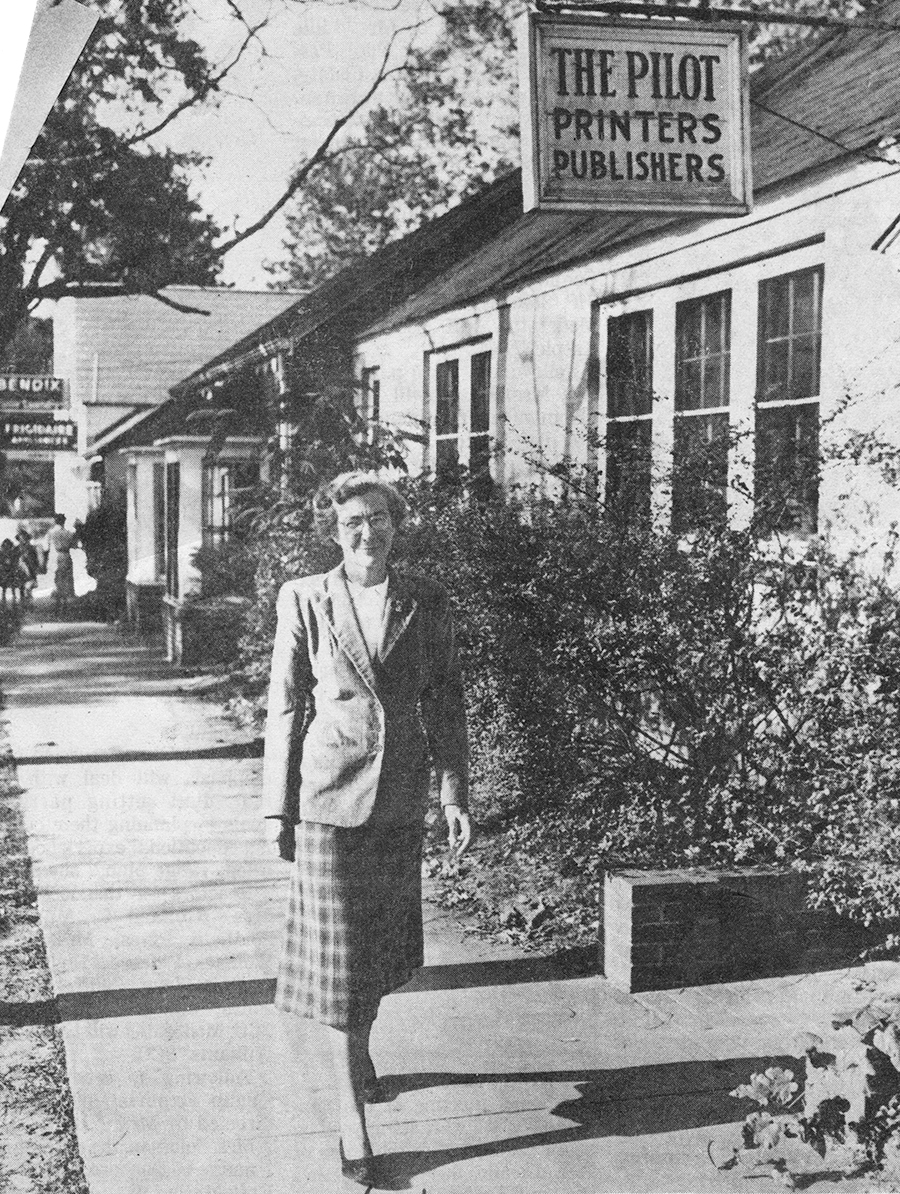
Graham’s ascendancy to the Post’s leadership due to her husband’s demise mirrors, writ large, the experience of another Katharine — Southern Pines’ own Katharine Boyd. In February 1944, her husband of 27 years, 55-year-old James Boyd, The Pilot’s editor and publisher, suffered a fatal cerebral hemorrhage. His death presented a daunting challenge for the patrician daughter of New York tycoon (and Grover Cleveland’s secretary of war) Daniel Lamont.

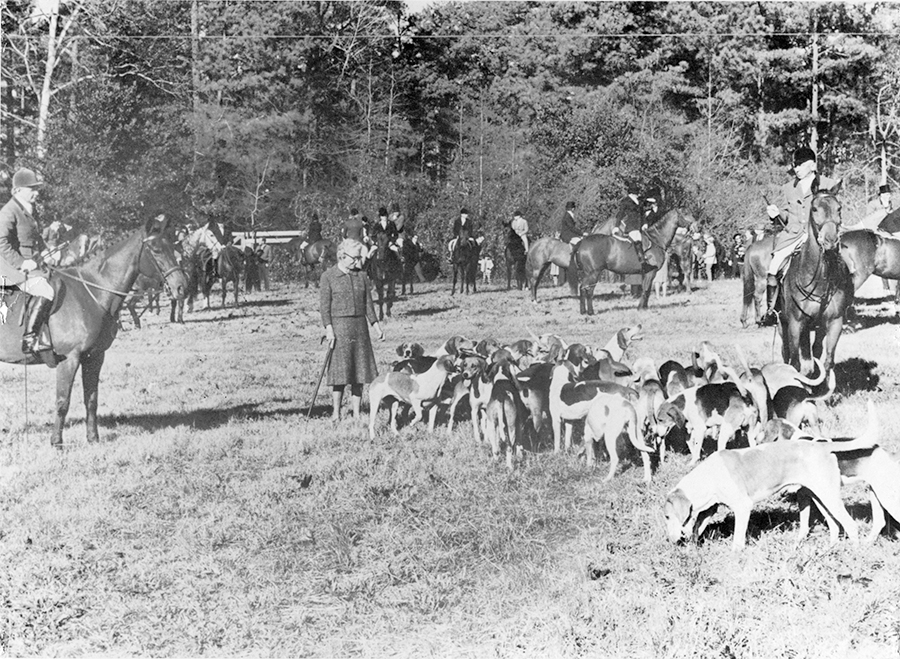
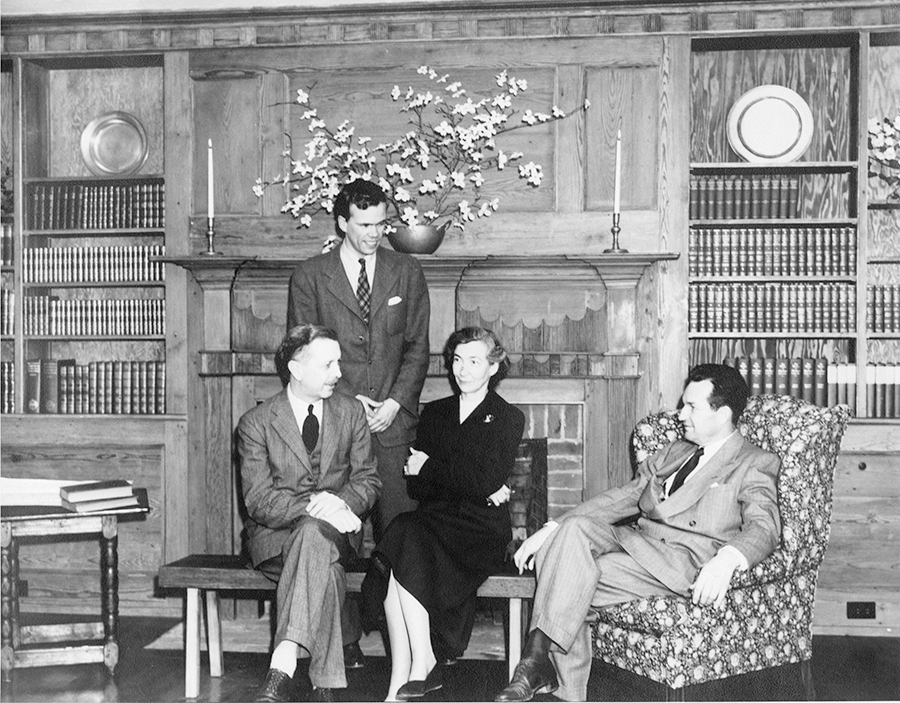
Prior to James Boyd’s death, Katharine’s primary activities in Southern Pines had involved raising the couple’s three children, riding to the hounds, gardening, and entertaining James’ literary friends like F. Scott Fitzgerald, Sherwood Anderson, Thomas Wolfe, Paul Green and Maxwell Perkins at the couple’s home, Weymouth, built by the Boyds in 1922. Her previous writing experience had “consisted of doing editorials one year for the Sandhills Daily News, a small sheet whose fiercely Republican subscribers eventually got fed up with my writing and I was politely fired,” as she later put it. She did, however, have one advantage. Since her husband suffered from writer’s cramp, Katharine often took down his dictation of novels, stories and poems. “My real training in writing was gained through the experience of watching my husband work; learning something of his respect for words and feeling for style. Any facility I . . . acquired is due to him.”

And James Boyd’s style was a first-rate exemplar. During his heyday of 1925 until his death, few could better him, having practically invented the historical novel. His first book, Drums, published when Boyd was 37, became a best-seller and was lauded by reviewers at the time as perhaps the finest novel written about the American Revolution. Boyd authored four other historical novels and numerous short stories for literary magazines. After acquiring The Pilot in 1940, he wrote prodigiously for the paper.

In one respect at least, Katharine Boyd’s new responsibilities at her small-town newspaper were more all-encompassing than those of Katharine Graham at the Washington Post. Boyd now served in the dual roles of publisher and editor, personally contributing columns and editorials to the weekly. She took over writing her deceased husband’s popular “Grains of Sand” column. At first, Katharine could not bear to remove James’ identification as the paper’s publisher from the masthead. Only after the passage of several months did she start listing “Mrs. James Boyd” as publisher. It took another year before the masthead was changed to identify the publisher as “Katharine Boyd.”

New to newspaper work, Katharine adjusted to its unceasing deadlines and the unfamiliar jargon. In her “Grains of Sand” column in 1968 she wrote that the paper’s business manager, Dan Ray, would periodically come to her office with questions that would “send scaredy-cat shivers” down her back. One such inquiry during her first days at The Pilot occurred when Ray asked her, “We’re all set; you got the jumps?”

Katharine indignantly and furiously shouted back, “Of course I’ve got the jumps! I’ve had them ever since I took this job. Talk about jumps — I do nothing but shake.”

Ray guffawed in response, “Are you crazy? Why the ‘jumps’ are the continuations onto other pages.”

Katharine had been on the job for only a few months when she intrepidly waded into turbulent waters with a controversial editorial castigating the Republican Party’s bigwigs after its 1944 convention. The staunch Democrat railed against the GOP’s leaders. “They want to swing America into the role of big business which they themselves personify,” she wrote, thundering on that their leaders’ “imperialistic tendencies, coupled with the propaganda constantly fed our people by the Republican-supported press, are straws in an evil wind.”

There followed a blizzard of protests from readers who were aghast that their local paper was dipping its toes into the thicket of national politics. It was pointedly noted by one reader that the previous editor had confined his political editorials mostly to local issues. Another letter writer argued, “We can get all the politics we need from the BIG CITY DAILIES. Can’t we have our nice home paper free at least from the partisan brand?”

But Katharine Boyd refused to back down. “The policy of The Pilot has not changed,” she responded. “It has always stood for what it considered best in the community and in the nation. It has supported no political party over another except as one or another stood for things, which The Pilot believed. It has tried to represent fairly the great issues of the times and to take a stand on what it considered the right side of those issues. It is the hope of the present editorial board that it may always continue to do so.”

That early brouhaha aside, Boyd learned to love the daily hum of newspaper life. One of the paper’s longtime staffers, Mary Evelyn de Nissoff, reflected that “(I)t was a familiar sight to find her (Katharine) seated on a high stool or standing hunched over the proof-reading desk, her nose pressed against the galleys she held in hands badly crippled by arthritis, proofs of editorials she had written or stories someone else had written. She wanted to know, even though she had another editor or two or three, what was going into her paper.”

Katharine later recalled her biggest thrill on the job came when the newsboys got their papers and rushed to hawk them. “The number of boys — 12 to 20 — stand ready to go as the big moment approaches,” she wrote. “ First the shop people do a football charge, plunging through the crowd with enormous piles of papers in their arms, each pile to go to one of the various stands around town. Then the great moment is here and each boy picks up his pile and off they go, on the run! They swarm out the big high door at the back, run like antelopes around the corner, whooping. They take a deep breath and start to shout ‘PILOT!’”

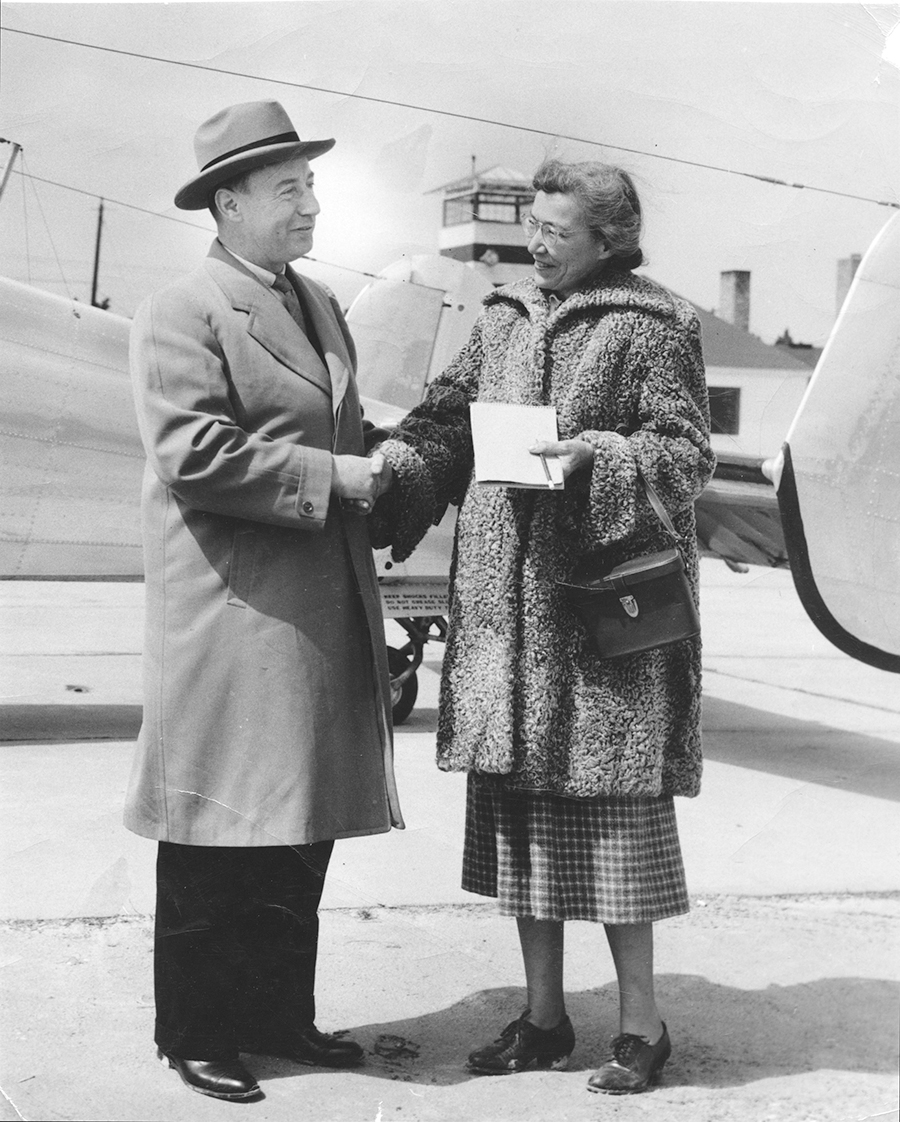
She also reveled in expressing herself journalistically. Katharine’s first-person accounts of her tours to Scotland and Egypt graced the paper’s pages. Her musings in “Grains of Sand” won awards. She leaped at the chance to travel by train with fellow Democrat Adlai Stevenson during the final swing of his ill-fated 1952 presidential campaign. She filed daily reports of the campaign’s doings with The Pilot. Coincidentally, Katharine Graham later dated Stevenson after her husband’s death. Graham revealed in her autobiography Personal History that Stevenson collapsed and died in 1965 shortly after spending “at least an hour” in her London bedroom, and leaving behind his tie and glasses.

Like Mrs. Graham, Katharine Boyd could not, or would not, sidestep the major controversies of her day. After Southern legislators crafted a document known as the “Southern Manifesto,” urging defiance of the Supreme Court’s landmark Brown v. Board of Education school desegregation decision in 1954, Boyd unhesitatingly condemned the Manifesto, believing that adherence to it would only lead to lack of respect for the rule of law. She applauded the brave decision of local congressman Harold Cooley not to sign it. The Pilot’s editorial page stated, “The sooner the South accepts the fact that the Supreme Court’s decision is lawful under our Constitutional system of long standing, the sooner we will see the current rising tide of emotionalism subside and the sooner we can get on with the work of finding peaceful and reasonable ways of meeting the problems presented by the segregation ruling.”

She became incensed when Birmingham’s police chief turned the hoses and dogs on civil rights marchers. An angry Katharine excoriated Alabama’s governor with this invective: “In refusing to treat the marchers as human beings and as citizens, in encouraging the brutality of the police and the mob spirit of that mountain area, Governor Wallace and those behind him are playing with a fire whose fuel is from the same source that fed the fires of Dachau.”

Mrs. Boyd even criticized North Carolina’s legendary senator Sam Ervin, whom she felt had not done enough to afford access to the ballot for African-American voters. “Senator Ervin knows as well as anyone else that thousands of American citizens are being denied the right to register and vote by unfair, so-called literacy tests, intimidation and subterfuge of one sort or another. Yet here he is using every stratagem to defeat a simple, workable, and fair law to eliminate a situation that is nothing less than a national disgrace.”

Similarly, in expressing her contempt for legislators’ claims that they were simply complying with the wishes of their constituents by opposing federal intervention in the registration of voters, Boyd remarked that these representatives “never seem to consider that Negroes are their constituents too.”

Katharine exhorted local businesses to hire African-Americans and pay them well. She combined practical and moral arguments to make her pitch. “Aside from the economic benefits certain to accrue to any community or area or state which uses its full human potential well, there is a moral issue which can no longer be denied: ‘to give men and women their best chance in life.’ Can any goal be more American than that?”

While the paper flourished during Katharine Boyd’s tenure declining health would force her to sell The Pilot in 1968 to veteran newspaperman Sam Ragan, although she did stay on for a time as a contributor. Ragan, who came to know and admire Mrs. Boyd, later summed her up this way: “Katharine Boyd was both tender and tough-minded in her views and outlook. She was gentle, generous, and gracious, but she could be equally strong against sham and hypocrisy.” Mary Evelyn de Nissoff remembered Boyd as being shy but nonetheless gregarious. “She liked her friends around her, sometimes in masses, as they gathered for her Christmas ‘sings’ in her big, hospitable home, Weymouth, and sometimes, one or two at a time.”

While Katharine Boyd enjoyed an outstanding career at The Pilot, her achievements as its editor and publisher are dwarfed by her acts of philanthropy that continue to enrich the lives of residents of Southern Pines, Moore County and North Carolina. Her unflagging contributions of time and treasure to charitable institutions such as Moore Memorial Hospital, St. Andrews Presbyterian College, Sandhills Community College, the Southern Pines Library, the North Carolina School of the Arts, the North Carolina Symphony, Penick Village and the American Ballet Theatre are unparalleled. Her deeding of 400 acres of wooded land to the State of North Carolina in 1963 for establishment of the Weymouth Woods-Sandhills Nature Preserve provided a permanent refuge for wildlife and a lasting benefit for our environment.

Katharine died in 1974. Her bequest of Weymouth and its surrounding 200 acres for charitable purposes led to the establishment of the Weymouth Center, which supports North Carolina’s writers and recognizes their literary achievements, thereby serving as a lasting tribute to the legacy of both James and Katharine Boyd.

Her friend Jane McPhaul remembers her as a person who provided “advanced leadership” to civic causes despite never having held elective office. Noting her qualities of fearless independence and leadership, McPhaul has always considered Boyd a wonderful role model for women. She recalls her as a person who “stood on her own two feet” in a time when society often expected women to take a backseat.

While their times in charge of their respective newspapers did overlap from 1963 to 1968, it is doubtful that Katharine Boyd and Katharine Graham ever met, though they had much in common. Borne of prominent families, they each leaned in the direction of the Democratic Party, Katherine Boyd more emphatically so. Both relished entertaining friends, including numerous national figures. And despite the enormous disparity in circulation of the two newspapers for which they labored, the two Katharines shared a similar philosophy regarding how papers, of all sizes, should be run. It is a philosophy celebrated in Spielberg’s upcoming movie and captured in the pithy Sam Ragan quote still carried on the editorial page of every edition of The Pilot:

A long time ago, a wise old editor said,
the function of a newspaper
Is “to print the news and raise hell.”
I haven’t been able to improve upon that definition.

-Sam Ragan, Editor and Publisher, 1968-1996   PS

Pinehurst resident Bill Case is PineStraw’s history man. He can be reached at Bill.Case@thompsonhine.com.

Born to Sing

How Three Tenors inspired Lucas Meachem to find his voice and opera stardom

By Deborah Salomon


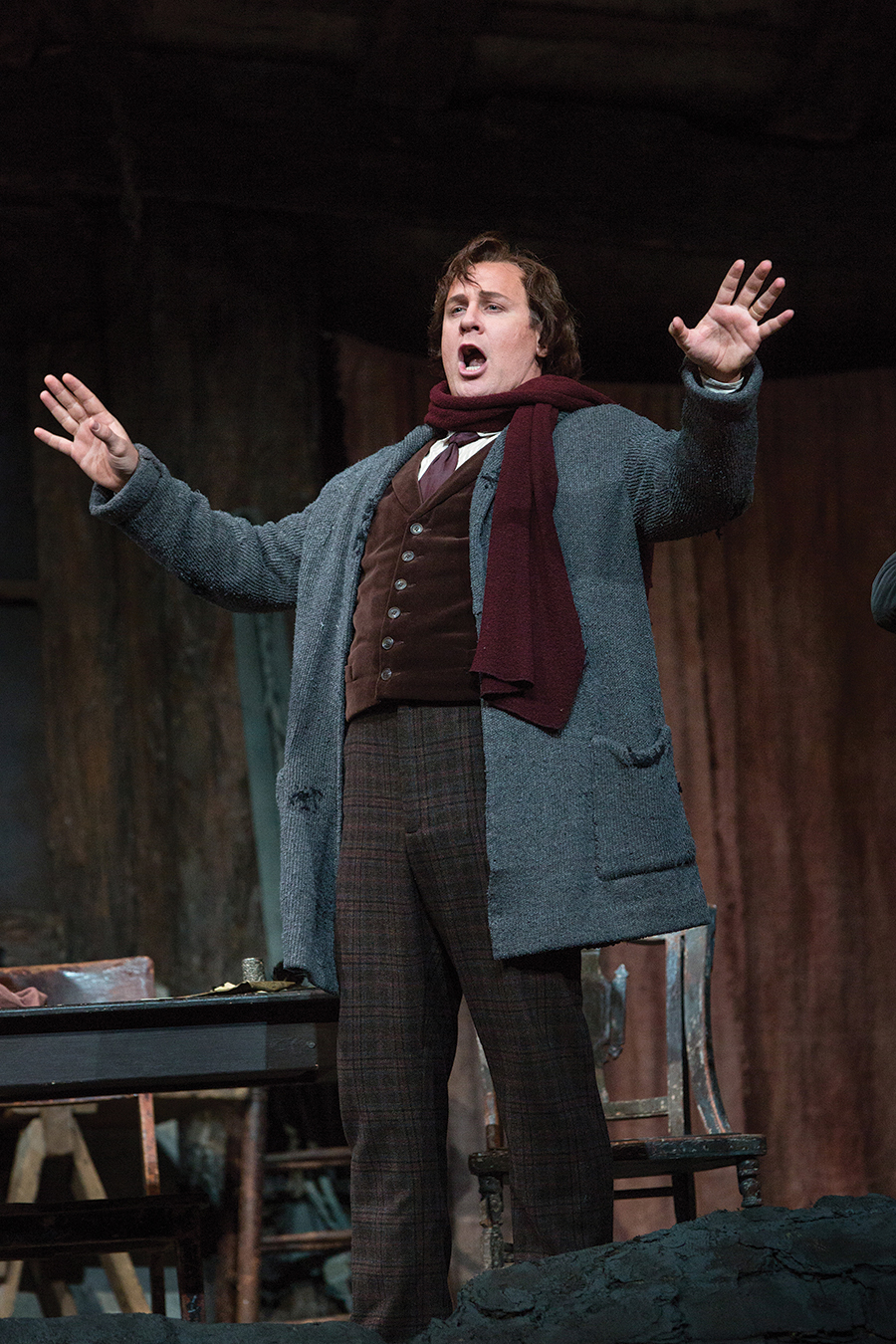
Lucas Meachem sings lead roles at the Metropolitan Opera.

Lucas Meachem struts the stage at the Paris Opera, San Francisco Opera, Los Angeles Opera, British Royal Opera, Hollywood Bowl, as well as premier concert halls throughout the U.S., Europe and Asia.

Lucas Meachem belted out the national anthem at Los Angeles Clippers and New York Rangers hockey games.

Lucas Meachem took home a Grammy in 2016.

Lucas Meachem has been dubbed “opera rock star!” by music critics.

Lucas Meachem, 6 feet 4 inches, is a rugged, blue-eyed, ebullient, earthy 39-year-old — a fan of karaoke and Elvis, an attentive son and tenderhearted clown, as comfortable in T-shirt as tux.

Yet the former Whispering Pines resident, Union Pines Student Council president and football/basketball/soccer standout remains virtually unknown to Tar Heel audiences. Lucas had never performed locally until a recital at the Sunrise Theater, in September. No press, no home-state hero status.

“Yeah . . . I wondered about that,” he says.

Blame opera, not exactly a kingmaker like America’s Got Talent or The Voice.

Opera! Its Golden Age peaked early in the 20th century, when ladies in tiaras and men in capes occupied boxes at the old Metropolitan Opera House in Manhattan. Then, opera was as much a social as musical event. Plump divas and temperamental tenors performed the classics by Verdi, Puccini, Wagner, Bizet, Strauss and Mozart. As high society waned, so did the opera scene. English librettos, supratitles and modern dress versions attracted a boutique audience who identify with ripped younger singers. Porgy & Bess, Evita, Les Miserables and smash hit Hamilton proved the success of opera by another name.

Moot, for Lucas, who grew up on Led Zeppelin, The Who and Boyz II Men. At Union Pines he was athletic and popular but not Mr. Cool.

“I was always the friend, never the boyfriend. I had acne.”

He also had a barrel chest to support that booming voice. Lucas sang everywhere — in the house, mowing the lawn, in the church choir and school chorus where he caught the attention of choral director Anita Alpenfels:

“He gathered such joy from music.” It’s an example, she says, of how public schools should tap into talent. She promoted the 15-year-old to advanced chorus, advised his mother to seek private instruction. Following his career, Anita noticed, “Lucas has remained grounded, not self-serving or full of ego. He has made an intimidating art form approachable.”

Despite Opera Carolina (Charlotte), Opera North Carolina (Raleigh) and UNC School of the Arts A.J. Fletcher Opera Institute (Winston-Salem), opera wannabes don’t proliferate in the land of basketball and NASCAR. Early on, singing — especially classical music — didn’t seem a likely career. As a young teen Lucas worked part time installing pool liners. “I wanted to be a landscape artist like my stepfather (Vince Zucchino).” Or perhaps an architect, like his father, who lives in California. He even started a business with his grandfather’s old riding mower. Then, for his 16th birthday, Lucas received a 4-track recording device. “I’d lock myself in my room for the whole weekend.” Not recording arias, safe to say. “But I knew who the Three Tenors (Luciano Pavarotti, Plácido Domingo, José Carreras) were from their tape.”

Lucas attended Appalachian State — “the cheapest college I could afford” — where he studied vocal performance and music education, also discovering that “chicks dig karaoke,” which he mastered easily. The singing part of college was great, the studying, not so. In 1998, he and a buddy scraped together enough money for a Three Tenors concert in Charlotte. “We stayed at a Motel 6,” Lucas recalls. “Our seats sucked, but everything else was really impressive.”

And, just maybe, possible.

Soon after, Lucas ditched his drawl (“Nobody could understand me.”) and left App State for a summer program at Ohio Light Opera, a company specializing in repertory, which meant learning several parts — a trial by fire for most novices, less for Lucas, who has a “magic memory” that absorbs and retains music in a flash. There, he dated a harp player who was studying at the prestigious Eastman School of Music in upstate New York. When summer ended, Lucas visited her. His harpist, duly impressed, arranged for an audition. “At first the guy didn’t look at me. Then I opened my mouth and he sat up like, ‘Oh, my God.’”

Lucas went home, packed his stuff and returned on a full scholarship, still never having witnessed the performance of a proper opera from out front. “The first one I actually saw was one I performed in.”

Sounds almost like a plot in progress.

Lucas was recruited by the Yale School of Music, another stellar institution. “First they offered me a half scholarship. I told them I was poor and that I didn’t want student loans. We negotiated.”

Guess who won.

“I’m not good at the school part. I just wanted to get jobs singing.” Rather than complete a degree, Lucas followed his father’s advice: Do whatever gives you chills.

When invited to join the San Francisco Opera as a prestigious Adler Fellow, Lucas jumped.

The yellow brick road was fast approaching Oz.

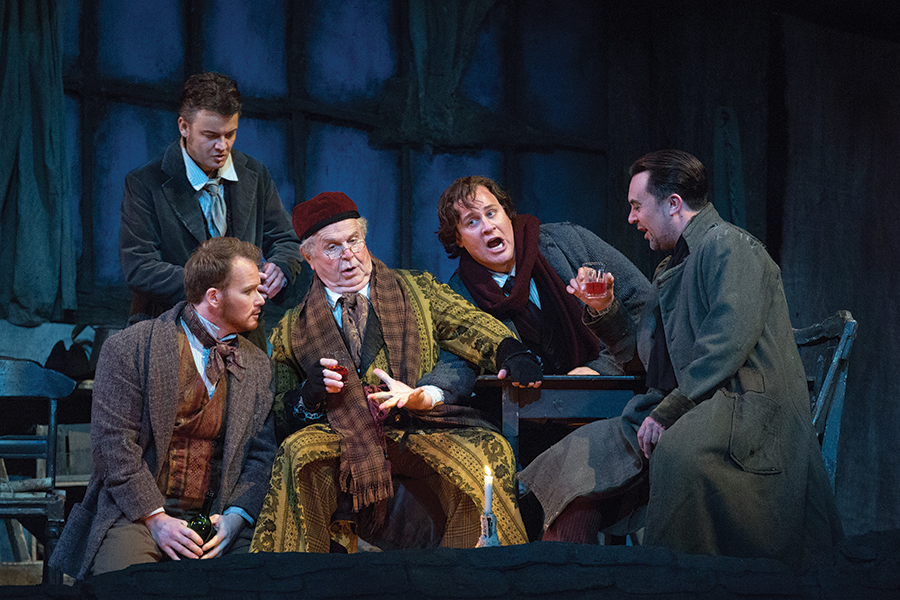
Inside the rehearsal costume of Bohemian artist Marcello in Puccini’s La Bohème are sewn labels bearing names of famous baritones who have sung the role at the Met. Add Meachem to that list. “My goal was to sing at the Met by the time I was 30,” he says, with a wicked grin. Lucas made it in 2008, at 29, as a nobleman in War and Peace, a five-hour marathon sung in Russian. His reaction to stepping onto that famous stage: “Awe and joy.” Now, he is a regular; in 2015 he sang a leading role in Pagliacci for “The Met: Live in HD” seen on 2,000 movie screens worldwide, including the Sunrise. “These simulcasts allow more people to experience the excitement of the Met’s high quality performances . . . an easy, affordable method of checking out a new art form,” a Met blurb reasons.

New, indeed, meaning instead of a stationary frontal view the camera moves around and up close, exposing facial expressions, agility and acting ability — Meachem fortes, all. Jitters aren’t a problem. “I have this burning desire to be onstage, to sing. I just love it.”

However, tenors are usually the glamour boys and baritones the sidekicks or villains.

The baritone may survive but rarely gets the girl.

Not in this opera.

Enter, smiling, Irina Nedelcu-Erickson, born in Minnesota of Romanian refugee parents — petite, dark-haired, exotic, with flashing eyes and a million-dollar smile. When she settles at the piano, optics disappear. Like Lucas, music is her lifeblood. After piano lessons in Minneapolis, Irina’s parents sent the 15-year-old back to Romania for two years of serious instruction. Her education continued with noted teachers at universities in the U.S. and elsewhere. She became a soloist, an accompanist and voice coach. Irina and Lucas crossed paths in 2013 when he showed up a week late for rehearsal, yet “all confident.”

“From that first night I knew he was the one,” Irina says. “He was a natural. He had an energy — very intellectual and smart, but funny and cool and handsome, passionate and unpredictable. I was floored. I deleted every guy in my phone.”

Lucas explains over sushi that he had just gotten out of a relationship.

Irina became his accompanist, traveling the recital circuit, seeing the world from first-class accommodations while enjoying his teddy bearish joie de vivre.

They married in July 2016, in Wilmington, N.C., celebrated their first anniversary by hitting 10 European countries in 10 weeks — from Greece to Albania, Hungary to Spain — combining gigs with sightseeing.

“Lucas learned Romanian just so he could talk to my grandmother,” Irina says.

What a life.

The supportive wife helps. But first, every opera star needs . . . Mom. Susan Zucchino, a longtime speech pathologist at STARS Charter School, oozes pride speaking of her firstborn. “Lucas was always singing, from the time he was 3 or 4,” she recalls. Maybe earlier: “I came out of the womb singing,” is his recollection. By the time he turned 12, Lucas and his two little sisters put on plays with costumes and props. “He was always easygoing, never went through a snarly phase — a good boy, kind and considerate, stood up for kids not in the group,” Susan says. The family listened to classical music but never opera. Now, Susan speaks confidently about roles and plots, venues and singers. She has attended music festivals and, overcome with emotion, applauded Lucas at the Met.

“I did all I could to support him while he was in North Carolina,” she says. “But don’t forget, I was working and taking care of three younger children.”

Lucas didn’t forget. He flew her to Paris and Rome for performances, Susan’s first trips abroad. “He had an apartment in Toulouse; he took me to the market — the cheese folks greeted us, they knew him already.”

But really, how many grown men squire Mommy to karaoke bars in Paris? Or, for that matter, how many sons get a private after-hours tour of the Louvre, where “I had Mona Lisa all to myself.”

Modern-day stars, be they opera or otherwise, must cultivate a fan base. An autograph scrawled on a concert program doesn’t suffice. Groupies demand an offstage presence, online. Not hard for Lucas, as pictured in dreamy promotional stills.

Wanna watch him, from underwater, dive into the seas (catch that tat) off Albania and Malta? Eat a banana? Treat a cold? Emerge from his dressing room shower? Sing all four parts of Carol of the Bells? Wanna see his precious pooch Teemo (who stays with Irina’s family) board a plane in Chicago? Have a beer and flop on the bed in their new Minneapolis condo? Shop for a designer gown in Bucharest with Irina? Speaking of clothes, notice that Lucas prefers orange swimsuits, baseball caps and silver gray down jackets with mufflers round his golden throat.

Don’t miss how he turned vegan and lost 50 pounds. “Lentil soup and ratatouille for dinner,” Irina smiles.

These juicy details and reams more texturize his image on his website, Baritone Blog, Facebook, Instagram, Twitter. Then, absorb his philosophy, poetically expounded, on life, love, everything in between, including, “It’s never over until you say it’s over.”

Far from over for this baritone whose voice has not fully matured. “We plan four years in advance,” Irina says. “When Lucas’ voice gets bigger he will venture into Verdi — maybe 10 years before Rigoletto.” The title role in this tragic tale of the hunchback court jester who loses his daughter to a scoundrel is considered the pinnacle of the baritone repertoire. And if he manages to pull it off at the Met.

Through a life packed with acclaim and applause, long-stemmed roses and Moet, Lucas, along with James Taylor, keeps a bit of “Carolina on my mind.”

“The second I get off the plane in N.C. I feel it . . . there’s a palpable energy here. I love the smell of the pine trees” that surround Mom’s ranch-style house across from a lake in Whispering Pines. His travel schedule does not allow many trips South, which made the Sunrise gig arranged through the Arts Council of Moore County Classical Concert Series momentous. Lucas played to a full house, including many familiar faces who got a shout out from the stage. Ever the showman, their soccer goalie wore pink socks and patent leather shoes — hardly noticed when Irina appeared to accompany him wearing a clingy black lace gown. The program included Aaron Copland, German lieder, some Gershwin, a ballad from South Pacific and “Me” from Beauty and the Beast. His encore, dreamy Elvis: “I Can’t Help Falling in Love With You.”

Before leaving, our hometown hero gave a master class at Union Pines. “He was so good at connecting with the students,” Anita Alpenfels says. “He gave them and the teachers a pep talk about staying focused and setting goals,” lessons that apply beyond opera.

Of course there have been regrets, disappointments, tense moments — like falling off the back of the stage in Madrid, without the conductor noticing. Or botching a first audition at the Met because of a cold. Playing Figaro, his favorite role, in The Barber of Seville with various opera companies requires finesse, since directors and co-stars bring different interpretations. Hopscotching time zones 9 or 10 months a year takes its toll; flights are delayed, tempers flare. “When everybody else is being mean, I’m nice.”

Unlike the baritone-role stereotype, Lucas isn’t a brooder. Rather, he is an upbeat philosopher and entertainer of the highest echelon who, thank goodness, doesn’t take himself too seriously. Offstage, anyway.

For now, his goals are to stay booked, keep traveling, but with a bit more bye time. Baritones age into their roles better than tenors. And he’s not yet 40.

“Even though I’ve sung at every major opera house in the world, I think every day there’s so much I haven’t accomplished. There are roles inside me that I have yet to sing.” And, despite admitting, “There’s nothing I love more than singing with my wife at the piano,” he allows, “I’m still chasing a dream.”  PS

Saturday, February 24 THE MET OPERA: LIVE IN HD. 12:30–3:25 p.m. La Boheme. Franco Zeffirelli’s classic production features an exciting young cast. This opera about starving artists falling in love in 1830s Paris is said to be the most popular opera in the world. Cost: $27. Sunrise Theater, 250 NW Broad St., Southern Pines. Info: (910) 692-8501 or sunrisetheater.com

André of Ellerbe

A giant of a man in a small town

By Bill Fields

On a mild December morning at Dixie Burger in Ellerbe, North Carolina, several customers of a certain age at a corner table are remembering someone who once sat among them, shooting the breeze and drinking coffee.

“Was grand marshal at the racetrack and lifted a girl on each arm like it was nothing.”

“Used to be booths in here, but he wouldn’t fit.”

“Ate 12 chickens in one day.”

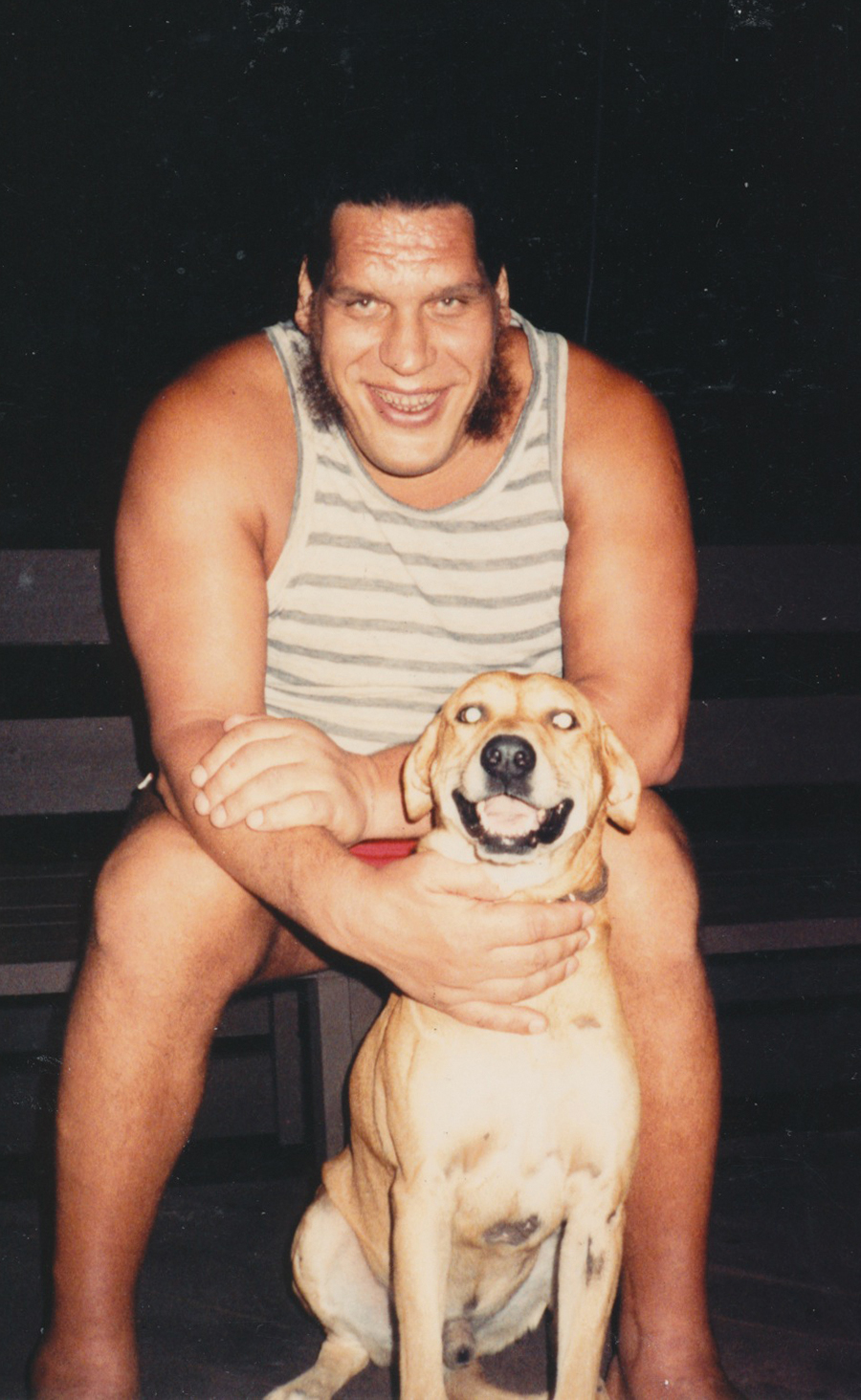
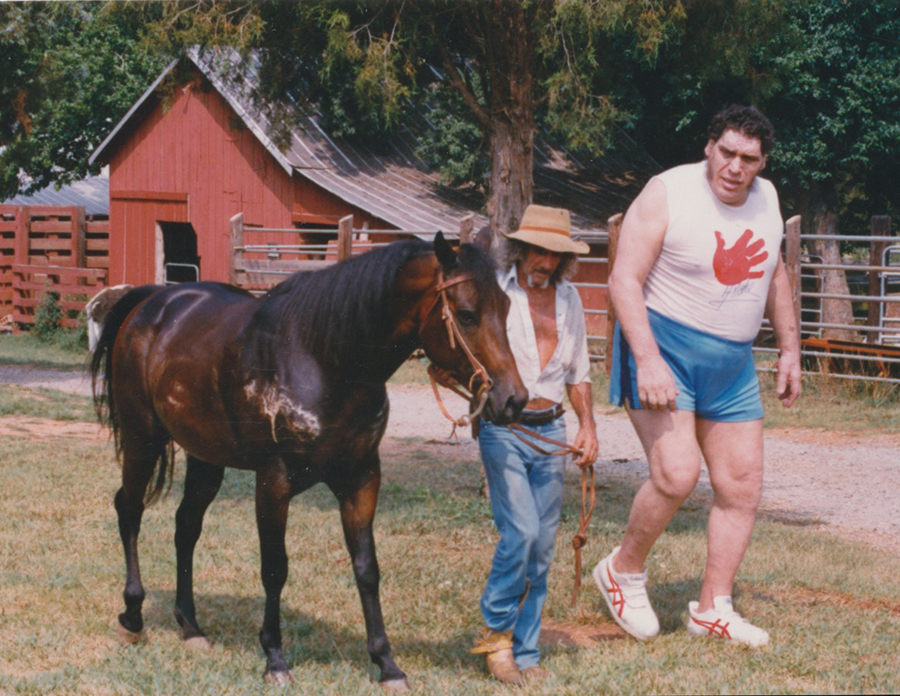
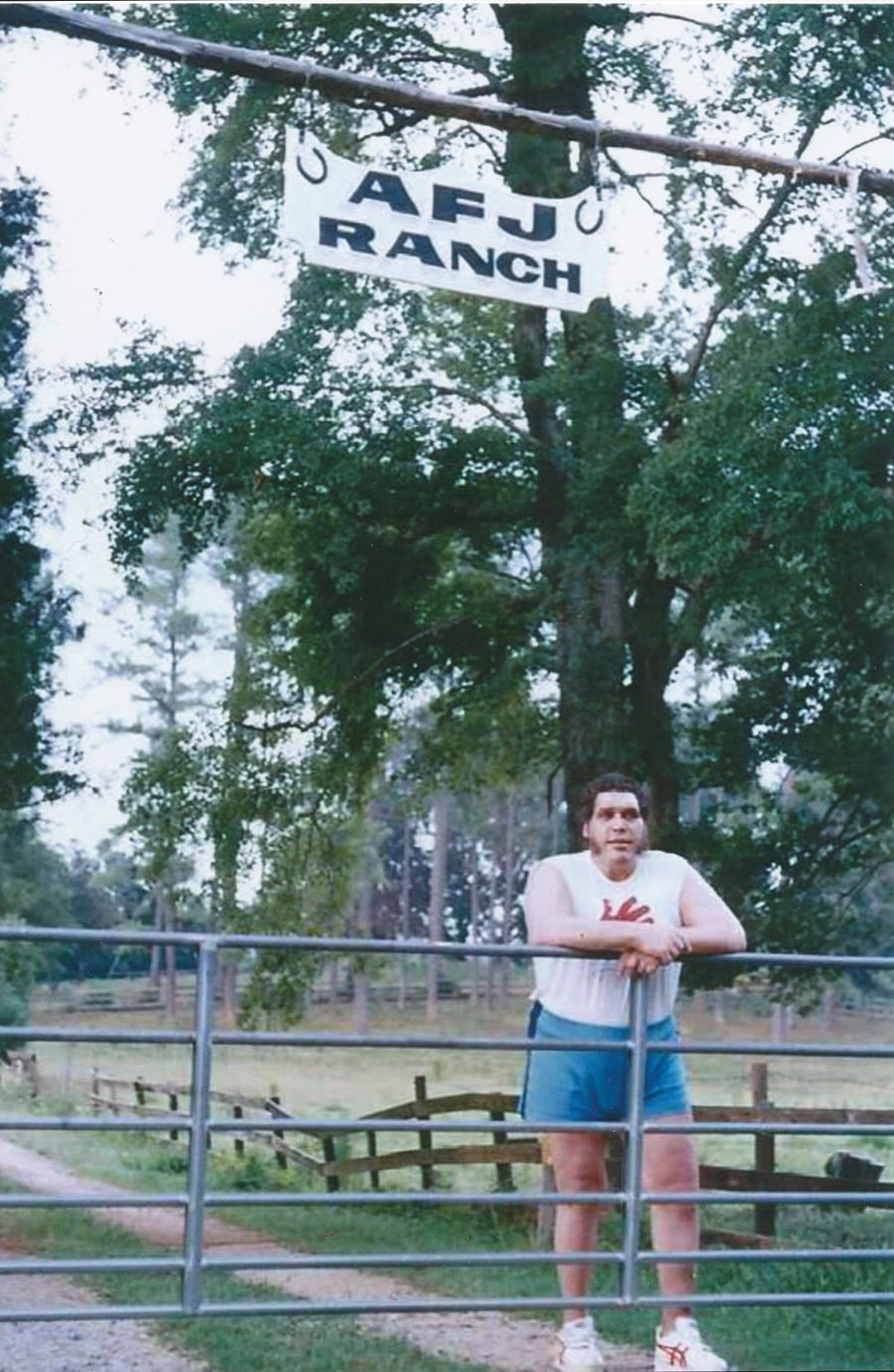
When he wasn’t wrestling, making a movie or otherwise being André the Giant, the man sometimes called the “Eighth Wonder of the World” lived in Ellerbe for more than a dozen years. He enjoyed his time in the Richmond County town of about 1,000 people and loved to kill part of a day at the short-order restaurant, whose tall hamburger sign is the most visible landmark on Main Street.

“André could sit there and talk to people,” says Jackie McAuley, who was a close friend. She, along with her first husband, Frenchy Bernard, a former pro wrestling referee, managed André’s home and cattle ranch on Highway 73. “They treated him just like anybody else they would have seen in town. It wasn’t, ‘Oh, can I have your autograph?’ He was just an average person when he was home in Ellerbe.”

Notwithstanding the mannerly small-town treatment André René Roussimoff received, he was as close to being an average person as Ellerbe is to the Eiffel Tower. André the Giant — who died Jan. 27, 1993, at age 46 — was one of the most recognizable individuals of the 20th century. He was a genuine giant who emerged from the obscurity of his family’s farm in rural France, carrying armoires on his back up three flights as a Paris furniture mover, to become an iconic professional wrestler who drew large crowds around the globe and gained even wider fame playing Fezzik, the rhyme-loving giant in the 1987 romantic-adventure-comedy film The Princess Bride.

Standing 7 feet 4 inches — although there were skeptics who contended the wrestling hype machine bumped up his height so that he could be billed as the world’s tallest man — and weighing 520 pounds when he passed away of congestive heart failure, Roussimoff had acromegaly, a disorder that causes the pituitary gland to produce too much growth hormone in adulthood, resulting in unusual bone growth, including in the hands, feet and face.

His acromegaly was never treated, André refusing medical help when his condition was diagnosed, first during a visit to Japan in the early 1970s and again about a decade later at Duke University Hospital. Doctors there saved his life after fluid built up around his heart and wanted to operate on the pituitary gland to correct his acromegaly, but André, whose paternal grandfather also was outsized, wouldn’t agree to the procedure. “He said, ‘That’s how God made me,’ and he wasn’t going to change,” McAuley says.

To be around André once was to never forget his unique size.

His neck was 2 feet in circumference. It was nearly a foot around his wrist. A silver dollar could pass through one of his rings. In an exhibit devoted to André the Giant at The Rankin Museum of American Heritage in Ellerbe, a pair of his size 26 wrestling boots are on display. “Occasionally I could buy him T-shirts,” says McAuley, “if I could find 5 XL.” The Giant’s clothes were mostly custom tailored in Montreal or Japan to accommodate his 71-inch chest. Nellie Parsons, who ran Pate’s Cleaners in Ellerbe for 30 years, created custom hangers to accommodate the extraordinary width of his dress shirts.

In 1983-84, Burke Schnedl was a pilot for a charter service at what then was called Rockingham-Hamlet Airport and flew André to wrestling matches in cities throughout the Carolinas and Virginia — Greenville, Fayetteville, Richmond — in a twin-engine Cessna 402.

“We had to take out a seat in the back so he could get in,” Schnedl recalls. “The doorway is not that big, and he would have to turn kind of sideways. It had a bench seat on the side. André sat there and used a seat-belt extender to cover a space where two people normally would sit. He was just a lot of guy. When you shook his hand, it was like putting a single finger in a normal-sized person’s hand.”

By the time André was 12 years old, he already stood 6-foot-2 and weighed about 230 pounds, too large for the bus that transported schoolchildren in his village of Molien, 40 miles outside Paris. The playwright Samuel Beckett, who lived nearby in a cottage that Boris Roussimoff, André’s father, helped him construct, filled the void by driving André in his truck.

Before long André, the middle of Boris and wife Mariann’s five children, had outgrown not only vehicles but the sleepy landscape he saw as an impasse stopping his ambition to be famous. Boris Roussimoff didn’t understand, and at 14 André quit school, left home and set out on his own.

“His father told him he would be back soon working on the farm, and André had something to prove,” says Chris Owens, a repository of André the Giant knowledge who authors a Fan Club page on Facebook and has been intrigued by Roussimoff since he was a boy in the Midwest and saw him wrestle televised matches. “He didn’t want to stay in rural France. To me, he was always a guy going after his dream who became a classic success story.”

As a teenager in Paris, André’s preferred game was rugby, although he also got immense pleasure from pranking friends by rearranging their parked small cars while they were dining or drinking. He got 7 or 8 inches taller and gained nearly a hundred pounds before he turned 21, impressing professional wrestlers who noticed him training in a gym. They introduced him to their game, taught him some moves, and by the mid-1960s André René Roussimoff was getting paid to perform as Jean Ferre, Géant Ferré, The Butcher Roussimoff and Monster Eiffel Tower — and he was loving all of it.

“Many men were afraid to go in the ring with him, especially after he reached his 20s, because he was so large and strong,” André’s first manager, Frank Valois, told Sports Illustrated in 1981. “For all his height and weight, he could run and jump and do moves that made seasoned wrestlers fearful. Not so much fearful that he would hurt them with malice, but that he might hurt them with exuberance. He was incroyable.”

Promoters sent him to Great Britain, Germany, Australia, Africa and eventually Japan, a country where he first wrestled as Monster Roussimoff and would have some of his most avid fans the whole of his career. He began to be billed as André the Giant in 1973 by Vince McMahon Sr., founder of the World Wide Wrestling Federation, who discouraged André from being very active in the ring — even though his body at that point still allowed it — and to play up the fact that he was an immovable mountain of a man. “He was taught to wrestle as a giant,” says Owens. “He had a limited set of moves, and his matches generally were kept fairly short.”

Under McMahon, André made a large six-figure annual income and became the most famous professional wrestler in the world who traveled the majority of each year for two decades, his luggage belying his size. “He carried an unbelievably small bag for his wrestling gear,” says McAuley. “I don’t know how he packed as much as he did in that small bag. But if he was packing up at a motel and something didn’t fit, he would leave it behind. There were things left all over, I’m sure. I hope the maids discovered what they had.”

André was a creature of habit on the road because there was enough ducking and crunching just getting around that he didn’t like improvising unnecessarily. “If you gave me the name of the town he was in,” says McAuley, “I could tell you what hotel he stayed at, what restaurant he ate at and what bar he went to, and pretty much be right every time. There was security that came with the habit. He knew his size and where he could fit and couldn’t fit. If he had been going to a certain motel for 10 years and everyone else started going to a fancier place, he’d go to his usual one.”

Wherever André the Giant went, he amazed people with how much he could eat or drink if he was in the mood.

There are stories of his ordering every entrée on a menu, as McAuley witnessed one summer day in Montreal in the mid-1980s as she and Frenchy dined with André and several others. “We were at a small Italian place,” McAuley recalls. “André was in a good mood. He told the waiter he would like one of everything. The waiter said, ‘Seriously?’ Frenchy said, ‘Seriously.’”

Pro wrestler Don Heaton told the Los Angeles Times after the Giant’s death. “Everything came in twos,” he said. “Two lobsters, two chickens, two steaks . . . ”

There were nights of 100 beers, 75 shots, or seven bottles of wine lest any course of a special meal feel lonely.

“I can report with confidence that his capacity for alcohol is extraordinary,” Terry Todd wrote in his classic in-depth 1981 Sports Illustrated profile of Roussimoff. “During the week or so I was with him, his average daily consumption was a case or so of beer; a total of two bottles of wine, generally French, with his meals; six or eight shots of brandy, usually Courvoisier or Napoléon, though sometimes Calvados; half a dozen standard mixed drinks, such as bloody Marys or screwdrivers; and the odd glass of Pernod.”

Actor Cary Elwes recounted the making of The Princess Bride in his book As You Wish. He recalled going out barhopping with André in New York City after the movie’s premiere. The Giant’s beverage of choice that evening, as it sometimes was when they were filming in England, was what André called “the American,” a combination of many hard spirits.

“The beverage came, as expected, in a forty-ounce pitcher, the contents of which disappeared in a single gulp,” Elwes wrote. “And then came another. And they kept coming while I gingerly sipped my beer. We talked about work and movies, about his farm in North Carolina where he raised horses, his relatives back in France, and of course, about life. André was a man unlike any other — truly one of a kind.”

This unique character ended up living in Richmond County after coming with French-Canadian Adolfo Bresciano, who was billed as Dino Bravo in the ring, to visit Bravo’s stepdaughter in the late-1970s. She and her husband owned farm property in Ellerbe. André bought a nearby home, a three-story structure. The Bernards moved from Florida in the summer of 1980.

“We lived there and took care of things,” McAuley says. “If Andre needed something, Frenchy or I would get it. He just had the house for several years, with some cows and horses. Then the property down the road came up for sale, so we bought the ranch. Then he worked on getting the wooded property in the middle. André was in a bar in England once talking to a pilot who had Texas longhorns back home. So Andre decided we should have Texas longhorns, too.”

Some believed that Andre’s residence must have been built for his colossal frame, but it wasn’t. “Nothing could be further from the truth,” says McAuley. “The stairs were narrow. It was three floors. He didn’t care to have a house that was adapted to him because his life was in the real world. You’re not going to raise the light or the ceiling fan, because they’re not going to run into it. It becomes second nature. We really only did two things: We raised the shower faucet, so the water would hit him on the top of the head instead of the middle of the back, and we ordered him a large chair.”

André would often sit in his chair with McAuley’s miniature dachshunds tucked by each tree trunk of a leg. He loved riding an all-terrain vehicle around his property. In the summers, André favored gym shorts, sometimes with a T-shirt, sometimes not. He was an expert cribbage player, owing to his good math mind and so many hours playing before wrestling matches. He didn’t venture far from his property when he was home, but loved his iced coffee at Dixie Burger, weekend meals at Little Bo Club in Rockingham, cookouts at neighbors’ homes, and checking in the hardware or feed stores.

McAuley says she never heard her friend talk about any regrets, that he never second-guessed anything in his life. “I have had good fortune,” André told Todd in 1981, “and I am grateful for my life. If I were to die tomorrow, I know I have eaten more good food, drunk more beer and fine wine, had more friends and seen more of the world than most men ever will.”

In addition to the scary episode of fluid buildup around his heart in 1983, he began to have other health problems during his years in Ellerbe. André had neck and back issues and surgeries, and he sustained a broken ankle in a 1981 match, wrestling on it for days until the pain became too much. To accommodate his size, the largest cast ever prepared at Boston’s Beth Israel Hospital was utilized.

An opportunity to be in The Princess Bride came along at a good time, since wrestling was becoming increasingly difficult because of André’s deteriorating body. “He could feel his wrestling career closing down,” McAuley says. “He had been so agile when he was younger. It was tough to watch him wrestle near the end of his life because of how hard it was for him to get around.”

André had acted before — including portraying “Bigfoot” in a two-part episode of The Six Million Dollar Man — but he loved being part of the months-long production of The Princess Bride as Fezzik. “Doing Princess Bride gave him the most happiness,” says McAuley. “He’d call home and talk about all the silly tricks he was pulling, especially the week or so that Billy Crystal was there.” Around the set, as in his adopted hometown in North Carolina, André impressed with his disposition despite his acute pain.

“You could tell he was in tremendous pain, but would never complain about it,” actress Robin Wright remembered in As You Wish. “You could see it in his face when he would try to stand up from a seated position. But he was just the most gentle giant. So incredibly sweet.”

André never tired of watching The Princess Bride, but some of his friends did. “He drove the wrestlers crazy,” McAuley says. “Over in Japan, on a bus from the hotel to the matches, the boys would wait quietly until eventually he’d pull out the tape and say, ‘Let’s watch my movie again.’ They’d say, ‘Please boss. Not again.’ But they’d watch.”

The same year that The Princess Bride came out, André the Giant was headliner at WrestleMania III, where he was body-slammed and defeated by nemesis Hulk Hogan in front of a record crowd of 93,173 at the Pontiac Silverdome. He wrestled the last of his 1,996 matches (a record of 1,427-388-181) on Dec. 4, 1992 in Tokyo, his physical condition worsening. “His walking was compromised,” Owens says. “His posture had changed. He constantly needed something to hold on to or somebody to help him keep his balance.”

André’s last Christmas in Ellerbe was much different than the joyous first one a dozen years earlier. “He was just not himself,” McAuley says. “His color didn’t look good. I remember standing next to him and patting his stomach, which (had gotten larger). It didn’t dawn on me then that the first time that happened was ’83.”

In January 1993 André flew to France to be with his dying father. He stayed over after his dad’s death to be with his mother for her birthday on Jan. 24. On the 27th, André enjoyed a full day with boyhood friends from Molien. A driver was scheduled to pick him up at the Paris hotel where he was staying at 8 o’clock the next morning.

André didn’t pay attention to clocks, seldom wore a watch, and rarely was late. But he was not there to meet his driver, and he didn’t answer the phone in his room.

“The chain was on the door but they could see André in bed,” McAuley says. “The sheet was perfectly neat around him. He must have died as soon as he laid down, because André was one, when he woke up in the morning, the linen would be all shuffled around and when I would go to make his bed, I’d basically have to start over because the sheets would be in all different directions.”

The Roussimoffs were told André’s body was too big to be handled by any local crematoriums. A custom casket was constructed, and McAuley flew to France with her sister to accompany the body back to the United States so that André’s desire to be cremated, set forth in his will, could be carried out. Before returning, she visited Molien to meet André’s mother — “She was shorter than me and just adorable” — and siblings.

McAuley brought photo albums, pictures of “girls André knew” and his daughter, Robin Christensen Roussimoff, born in 1979, with whom he had little contact — a handful of visits and regular holiday phone calls. McAuley flew to the Seattle area once hoping to make André’s wish of a visit by his daughter to his North Carolina home a reality, but Robin, a young girl intimidated by the thought of a long trip to an unfamiliar place, declined.

André was returned to the land he had come to know so well on Feb. 24, 1993. Big-time wrestlers and small-town residents alike attended the ranch service, and after folks had spoken their remarks and paid their respects, Frenchy Bernard got on a horse with a saddlebag containing Andre’s ashes.

In death as in life André Roussimoff was larger than most. His remains weighed 17 pounds after cremation, nearly three times more than a usual adult male. They were spread in silence so different from the mayhem of the arenas and gyms where he had worked, finding their place, just like the man had.  PS

Story Of A House

Starting Over

Living the “love thy neighbors” life

By Deborah Salomon

Photographs by John Gessner


Fresh. Stylish. Practical. Now.

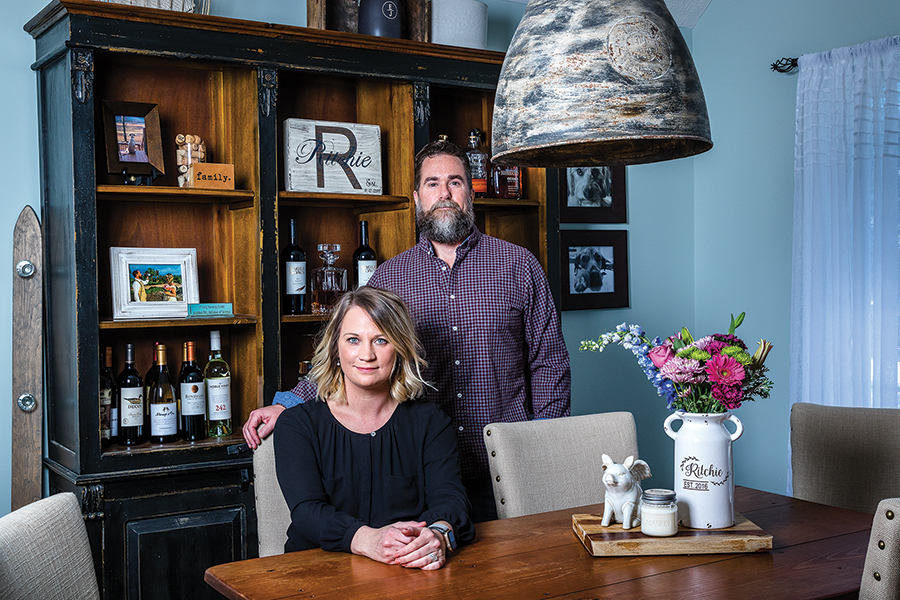
When newlyweds Jennifer and Eric Ritchie renovated and furnished a charmingly unremarkable home on a Pinehurst No. 6 cul-de-sac, they brought absolutely nothing from their previous marriages or homes: no furniture, no memorabilia.

“Not a dish, not even a towel,” Jennifer says. “We know where everything came from and it’s ours.”

They did bring plenty of ideas and the experience Jennifer gained as a Realtor specializing in military relocations. They weren’t planning to occupy the house for long; it would be a buy-and-flip investment. But as the project progressed they fell in love not only with the house but also the neighbors.

“That’s why we stayed,” she explains. Socializing began the day they moved in, when two children arrived bearing cake. Since then, life is a never-ending block party, with holidays celebrated communally. “We visit our families beforehand so we can be here.” Gates were inserted into fences enabling rescue pups Max and Molly to romp with next-door dogs. Their yard became activity central when, to an in-ground pool (raised to 4 1/2 feet uniform depth, for safety) the Ritchies added a stone fireplace beyond the spacious deck. “It’s cinder block and stone, not a kit,” Eric announces proudly. If a ball game is on, no problem. Each outdoor area has a TV. Professional mosquito spraying and two patio heaters encourage year-round comfort.

“We love to entertain,” Jennifer says. More likely 30 friends and colleagues for a barbecue than intimate dinners although with this couple’s enthusiasm, anything goes.

Both Jenn and Eric have military connections. Her father was Army, Eric is a Navy veteran who served in Desert Storm. Neither brings a homestead imprint. She grew up on several bases, including Fort Bragg, and in Ohio. Eric describes his boyhood home in Albemarle as a plain N.C. ranch with dark paneling and a pool. Eric works with tactical communications equipment for the military. Jenn’s experience in real estate honed her eye. This house was on the market for only a day before they grabbed it for over asking price. She could see beyond pink and gold bathrooms and a wet bar in the living room. This house, built in 1996 was in good shape, well-located and priced attractively. The layout suited them: a master bedroom wing with a second bedroom for a joint office, since they both work from home. A guest bedroom on the opposite side for visiting family, including Eric’s 23-year-old son. They removed a Jacuzzi tub from the master bathroom to make room for an oversize shower and installed a floor resembling distressed planks. White paneled kitchen cabinets were retained, granite countertops and a tile backsplash added. Now the room pops, even without the customary Wolf stove and SubZero refrigerator.


A breakfast nook overlooking the pool became a sitting room. Jenn chose pale neutrals — dusty sea green and sandy beige for the walls, to set off darker brown furnishings.

Crown moldings? Jenn shakes her head.


At just under 2,000 square feet spaciousness is created by light streaming through tall paned windows with eyebrow arches.

“Our (previous) house was much bigger but we didn’t need all that space,” Jenn says.

An hour after the closing, workmen were pulling up carpet to install a charcoal grayish engineered wood flooring that not only sets the contemporary tone but is practical with dogs and a pool.

The entire renovation took only 28 days.

So far, so good. Now add personality from a couple unfettered by convention: After planning a wedding at the Fair Barn Jenn and Eric decided to run away to Hawaii and marry on the beach, minus family and friends — which explains the string of numbers and symbols painted on a narrow board hanging from the dining room wall.


“We collect co-ordinates from everywhere we go; these are from Hawaii, where we got married,” Jenn explains. Another strip represents their Pinehurst home.

As for overall motif, the Ritchies chose farmhouse — a popular genre promoted by online furnishing sites — which means angular lines, simple materials, peeling paint and rough, distressed woods. Over the dining room table hangs a light fixture resembling a weathered tulip-shaped metal bucket of mysterious origin.


“I didn’t want it to look like anyone else’s” Eric says.The kitchen pantry door — once half of a French pair — was cut down to fit, with defects left intact. Their king-sized bed

employs a larger door as headboard. Jennifer painted the living room coffee table turquoise and Eric fashioned office shelf supports from plumbing pipe.

“I show Eric what I see on Pinterest and he does it.”


Because everything is new or freshly rejuvenated — and purchased in a swoop — the appearance could be a Crate & Barrel, Wayfair or Pottery Barn layout. Heavens, no. “Everything’s local,” Jennifer says — some new, some repurposed, many unique pieces from décor shops in Aberdeen where they shopped together on weekends. Growlers (“our ‘thing’”) collected from North Carolina breweries and travels march across a kitchen soffit shelf.

Which leaves the couple’s final stamp — framed signage, slogans, sayings and messages hanging from walls, embroidered on pillows, everywhere. Some are large, in bold print, like ANTIQUES over the guest room sleigh bed. Others are site-appropriate: Happiness is Homemade, in the kitchen. Laundry, over the utility room. Flea Market, Best Day Ever, Eric and Jenn 9-2-16 (wedding) and, sweetly, All You Need is Love. American flag representations appear more than once. Photos of pottery and elephants remind them of a recent trip to Thailand. A giant “R” stands by the front door.

Might this be the only home in Pinehurst fielding but one antique — a plain oak sideboard in the dining room, from Eric’s great-aunt?

This summer they will tackle the exterior . . . maybe a new front door. Jenn wants to paint the brick and put up cedar shutters. She will add shrubs to the crape myrtle and white birch on the half-acre lot.


Obviously, the Tufts family did not build enough Old Town “cottages” to satisfy today’s affluent retiree/renovators. Neither did architect Aymar Embry design sufficient pied-à®-terre in Weymouth to accommodate history buffs. Therefore the great majority of people, many military-connected, who settle in the area need something else. Eric and Jennifer Ritchie found it on a tiny cul-de-sac in a large development of houses priced moderate to more. Their finished product, perfectly “staged,” would sell in a flash, at a substantial profit. Nothing doing.

“If it weren’t for the friendship with neighbors, we wouldn’t still be here,” Eric says.

“We all help each other,” Jenn adds. “You can’t replace that.”  PS


Portrait of the Artist’s Home

A place where nothing matches but everything belongs

By Deborah Salomon     Photographs by John Gessner

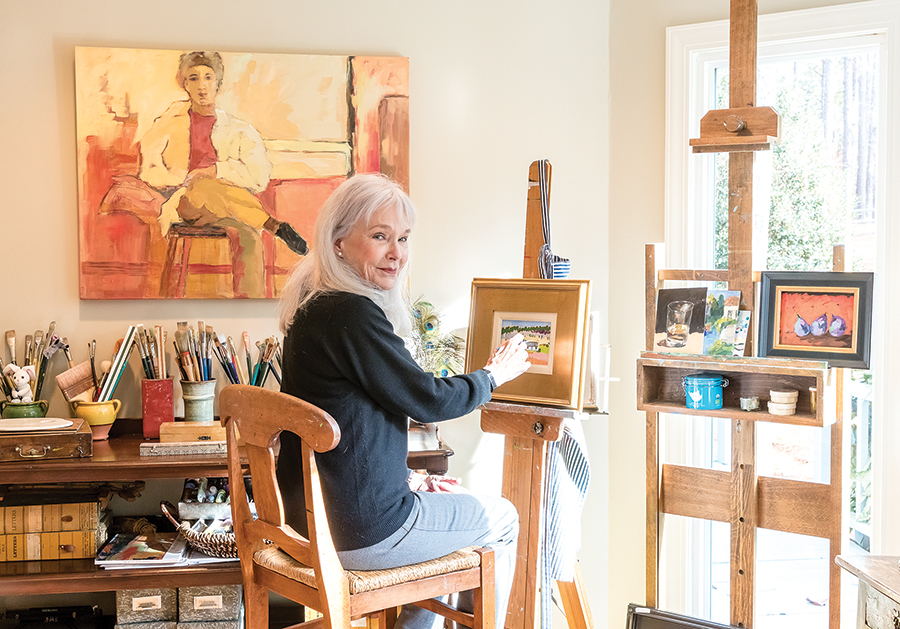
There’s something about Jessie Mackay’s house . . .

Outside, distressed bricks melt into the wooded 2-acre lot rather than jumping out onto the road that winds through Country Club of North Carolina.

Its contents — fewer heirlooms than souvenirs of a life well-traveled — begin their story in the soaring front hall, where hats hang on a coat tree:

“I wore the pith helmet when we rode horseback across Malawi into Zambia,” Jessie begins. Beneath the hats stand boots; Wellingtons speak of her life on a farm in the Cotswolds. On a campaign chest are arranged antique watch faces and a pipe picked up in France, a carved box from Hong Kong and cavalry spurs used by an ancestor. In the corner, a weathered Old Glory leans beside a Union Jack, affirming her dual citizenship. Although fascinating, these artifacts pale beside the paintings — everywhere: her own, those of friends, family members and fellow artists. Some, like a vibrant purple abstract by an Ecuadorian painter positioned on the upstairs gallery wall, attracted her purely for its color.

Jessie grew up in Westport, Connecticut, bordering Manhattan art and culture. She recalls attending a Van Gogh exhibit at the Guggenheim every day, “until (the staff) didn’t want to charge me admission.” Her British parents were casual painters. Jessie might have felt an inclination but, instead, followed a career in consultant management, which included measuring behaviors and results to enhance the workplace environment.

Well, Gauguin sailed with the merchant marines and Cézanne studied law.

Jessie dabbled a bit in high school. “After getting married I wanted something on the walls.” Her first inspiration came watching laborers in a British steel mill, admiring their physicality. The result, hanging in the living room, recalls grim early 20th century factory scenes immortalized by American artist Thomas Hart Benton.

Otherwise, Jessie identifies with Fauvism (think Matisse, its practitioner), defined, in part, as color existing as an independent element — intense blobs of it, rather than within finely drawn lines. “I felt painting was an outlet, a meditative thing,” she says. Not until early middle age did she make art her career. Her first show in Atlanta sold out. Her debut at Campbell House Galleries in Southern Pines moved 13 paintings, more than double the average.

Life, marriages, careers, activism took Jessie to various houses in many countries. In 2008 she was alone in Pinehurst, looking to downsize. Her first impression of the CCNC saltbox built in 1982: “Brick, ugly roof, sad, a mess inside.” Yet its bones and cross-hall two-story layout reminded her of New England while her design skills promised improvement. She and builder Buddy Tunstall made plans. First, the exterior. The painter had never done peeling brick, so they tried the obvious: spray with white paint, follow immediately with a pressure washing. Jessie recalls how the workmen laughed.

But it worked. So did the bright yellow door, the circular drive and informal landscaping. Back acreage, fenced for Jessie’s Jack Russell terriers, appears delightfully wild in the weak winter sun.

Inside, carpet was replaced by hardwood. Bathrooms needed remodeling — one in charming green toile wallpaper with graceful bureau-turned-washstand — but the three upstairs bedrooms remained intact.

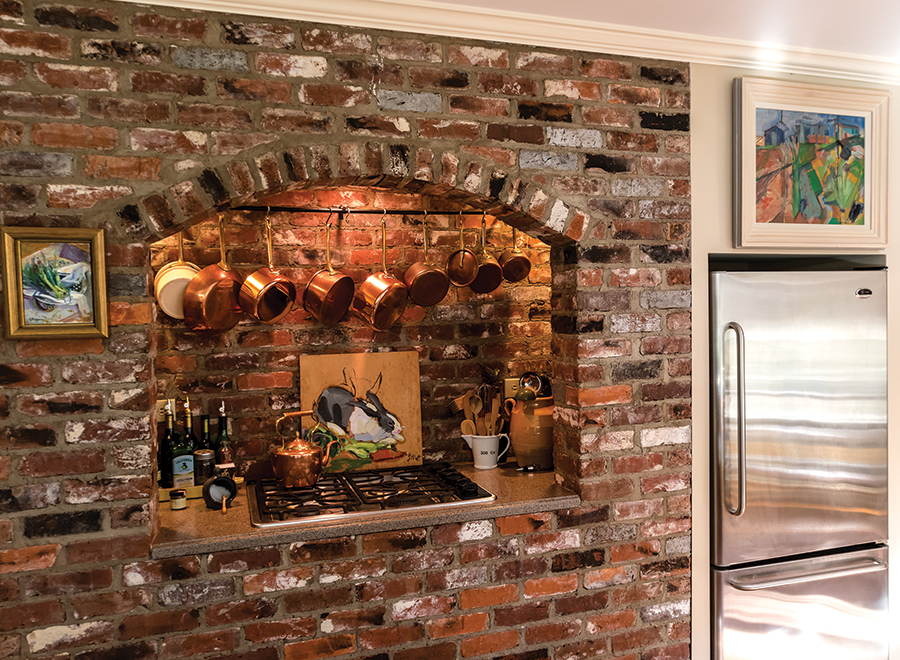
Not so the main floor. Jessie decided to tear out several small rooms spanning the rear, including a dated kitchen, install an extra support beam and repurpose the space as her studio (with bay window), a long galley kitchen and small den with wood-burning fireplace. This was accomplished without dividers. The kitchen is beyond startling, since a guest walking through might not realize its purpose. On one side, an oven, a single-width refrigerator and cooktop niche are embedded in a brick wall. A polished harvest table used as both work island and seating is positioned down the middle with cabinets, drawers, sink, another bay window crowded with plants on the opposite side.

In the spring, a dogwood tree blooms just outside the bay.

“It reminds me of Europe — a lot of stuff, a lot going on,” Jessie explains. The brick provides a textured background for paintings, including the portrait of a friend dominating the south-facing studio with two easels, paints, brushes, stool and a portable typewriter. Locating her workspace adjoining the kitchen made sense. “I didn’t want to allocate a bedroom for a studio.”

Her office and laundry room line the hallway leading to the garage with doors not visible from the front.

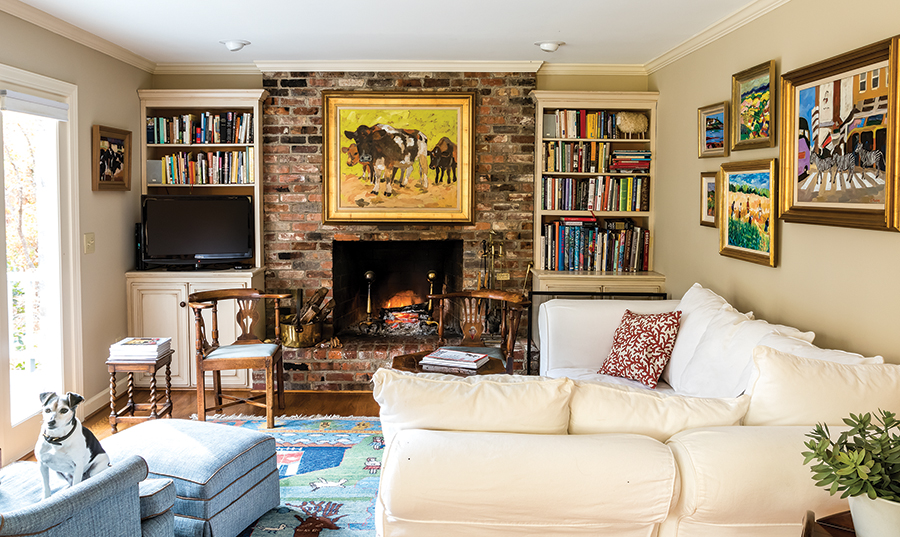
Jesse misses her dogs, cats, horses and other creatures from what she called The Farm of Content Animals, since none of the ducks, chickens, geese, lambs or cows entered the food chain. Bovine portraits hang over the den fireplace, flanked by English corner chairs with leather seats and open sides to accommodate the sabers worn by officers.

Jessie courts a lived-in look. “Everything (these days) seems so contrived — a blanket draped just so over the couch,” she says, and points to a woolly throw in disarray on her own. “The dogs made that pile,” before falling asleep on it.

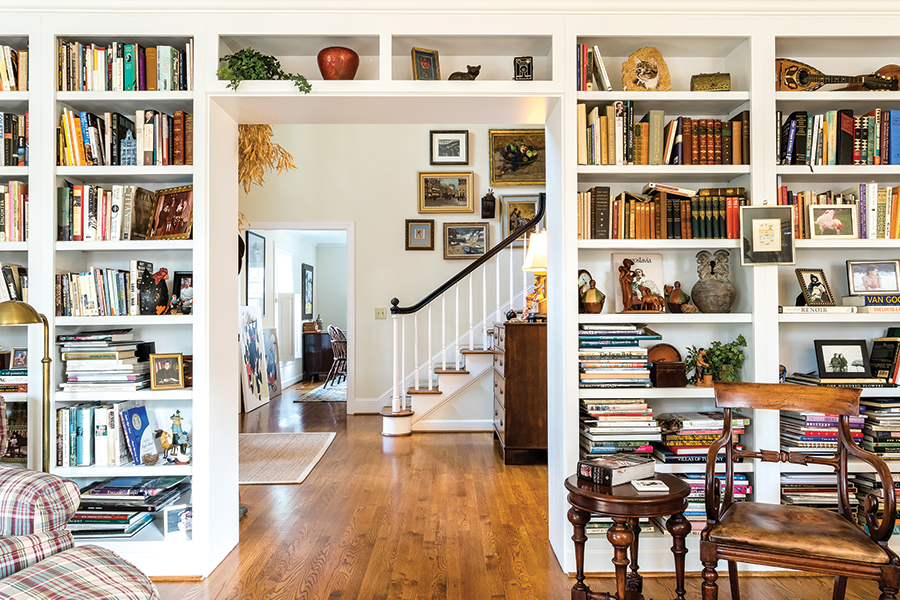
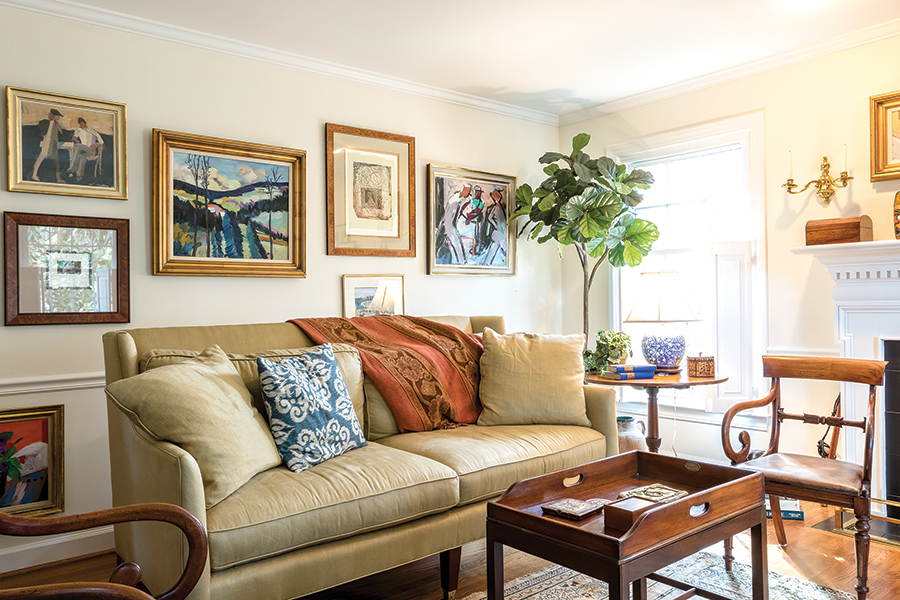
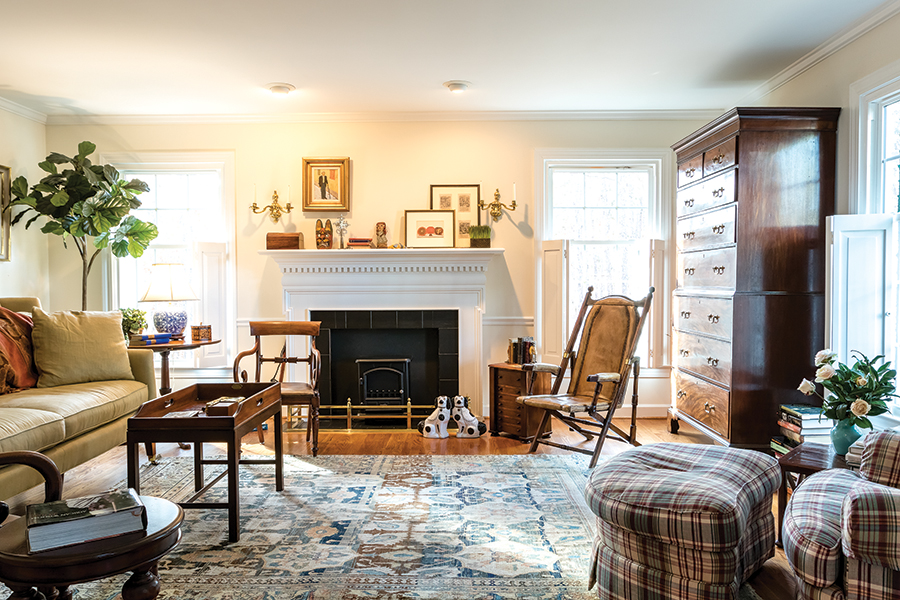
Jessie found the small living room both appealing and functional — especially after constructing bookcases across an entire wall. Half shutters on low-set windows continue the New England effect, although furnishings speak faraway tongues. The unusual high-backed sofa in Jessie’s favorite khaki is from a fine North Carolina manufacturer, but her leather-seated folding campaign chair (for easy transportation) experienced far-away battles. Facing it a plaid armchair with ottoman channels the ’60s. Each artifact on the mantel tells a story, each painting reveals a connection. Conversation never lags here.

“I wanted my dining room table to be wide enough,” Jessie says, to accommodate her stepsons and grandchildren. She chose one from Ireland, of yew wood, surrounded by Windsor chairs. Paintings lean against the wall, for decoration or perhaps awaiting a buyer.

Rugs throughout are, predictably, well-worn Orientals in subdued hues except for the den, where sheep gambol across a pastel background, to offset a shabby-chic white sofa.

Jessie admits to using the house as a supplemental gallery. “The problem for artists is that people don’t have wallspace any more,” she says. Her walls, painted gradations of white and framed by crown moldings, are covered but not saturated. Arrangements change as paintings sell. Emotional attachments don’t hinder business as with some artists: “There’s no sense of loss. Paintings are like children; when they’re 18, it’s time to go.”

Sometimes she follows them. Each year, Jessie returns to Tanzania, where she and friend Tally Bandy have established empowerment programs where women earn enough by raising pigs and goats to educate their children. To this endeavor they have added solar kits made in North Carolina, which enable the women to establish charging stations for lights and mobile phones. A few paintings reflect the African project.

So much life, in a moderate living space. “When I have a party we’re like puppies in a box,” the artist smiles. An elegant box, yet comfortable, inviting, with several areas to sit and chat, walls hung with oils and acrylics of varying shapes, moods, styles and expressions — even double entendre as with zebras crossing a busy thoroughfare.

Indeed, there’s something about Jessie Mackay’s house . . .

That something is Jessie Mackay.  PS

Poem

About Magic

A quantum taste of joy

hidden in a top hat

The wisdom of love

up your sleeve

Tell me your story as

you rise wingless

above the stage

Let me make you believe

in the vast unbelievable

Wave your wand and

marry our kindness

Clapping we shout “encore!”

— Ry Southard

From Eagle Springs to Antarctica

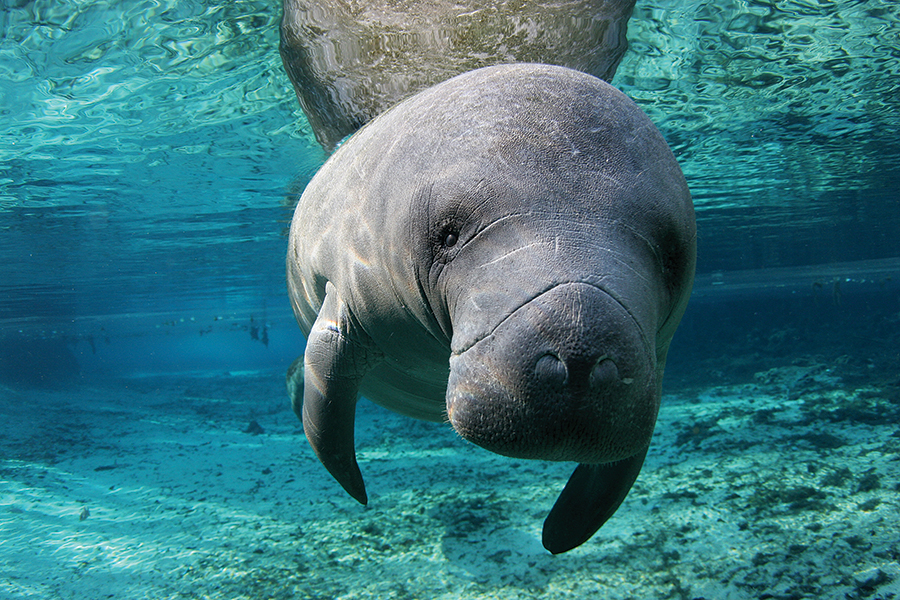
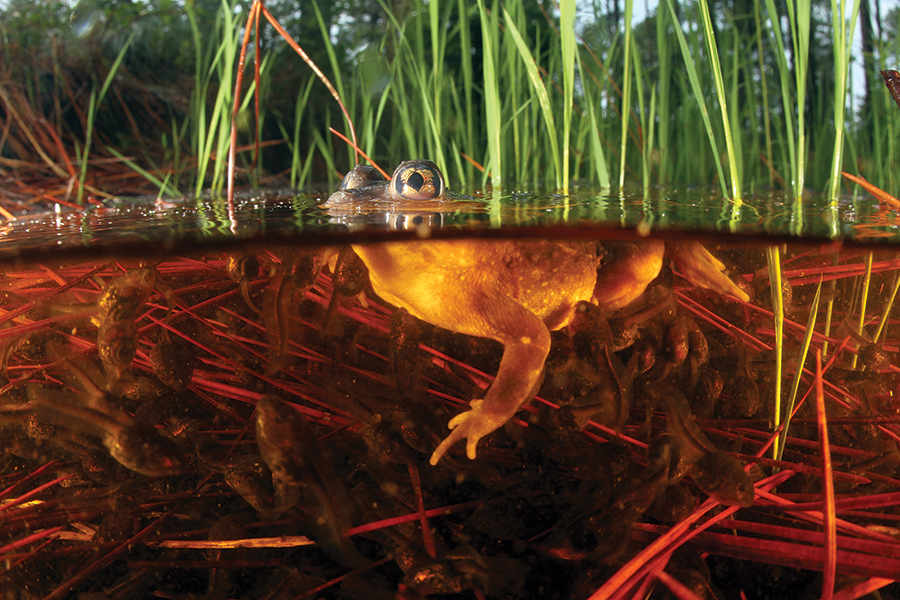
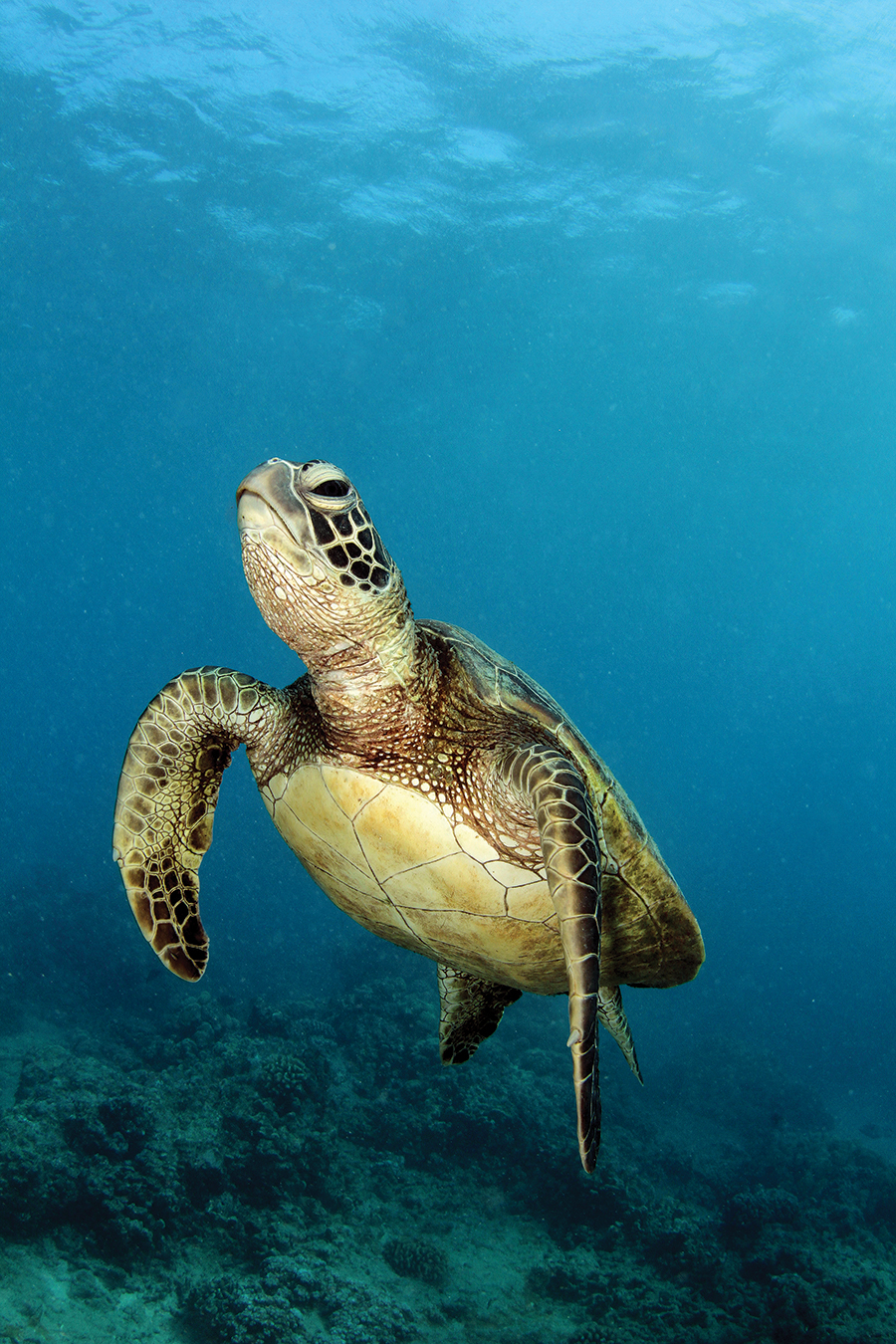
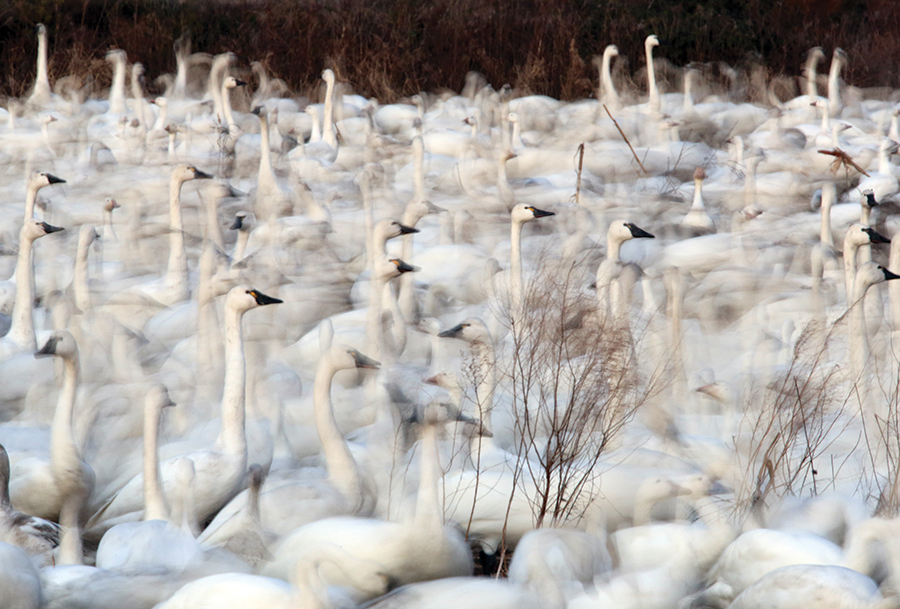
Todd Pusser’s magical photos are a portrait of our wild and endangered world

By Jim Moriarty • Photographs by Todd Pusser

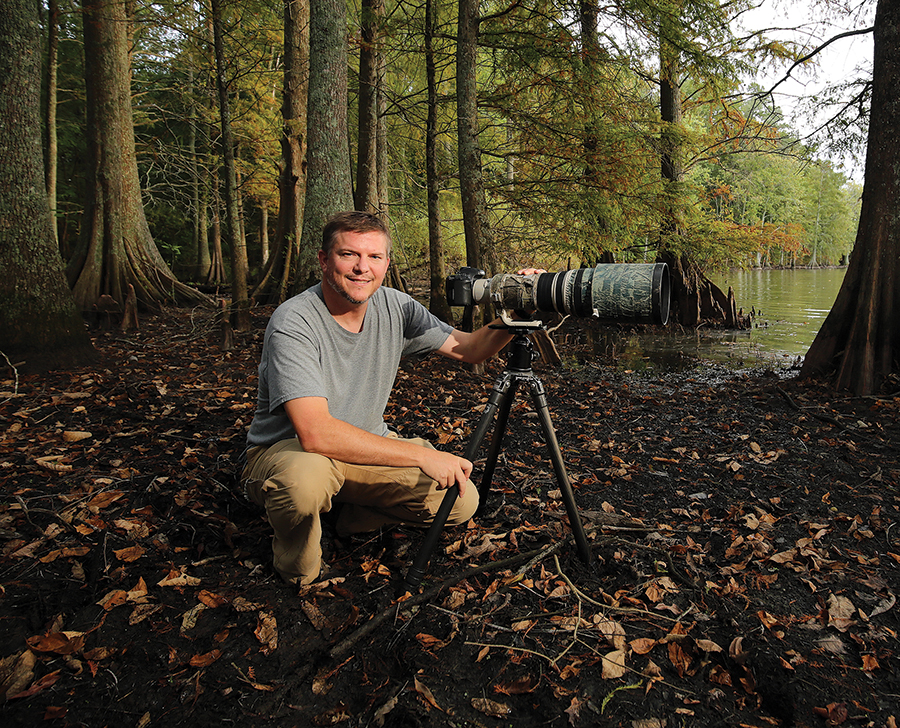
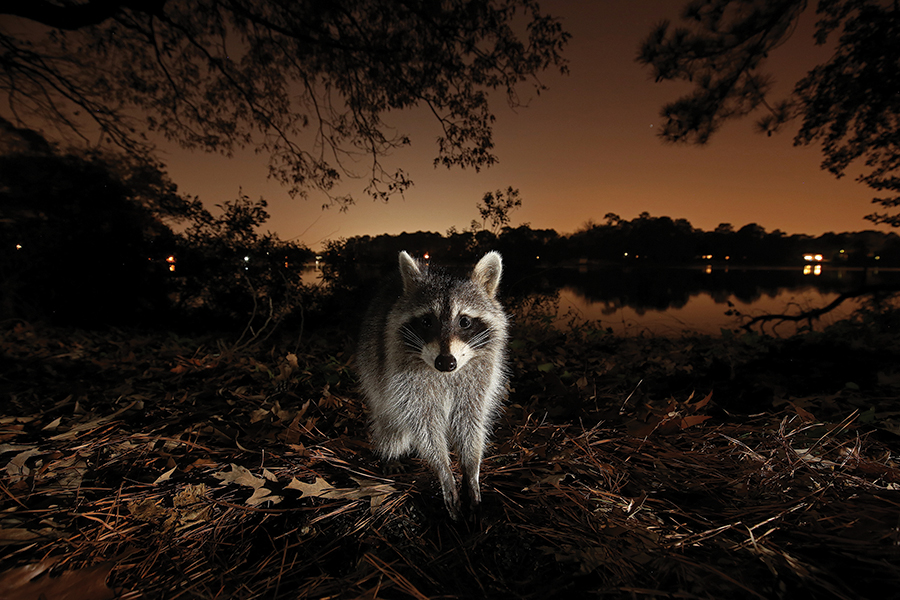
If you’re going to photograph something as low as a snake’s belly in a wagon rut, you have to get right down there with it so it’s no surprise to find Todd Pusser stretched out on his stomach somewhere in the Sonoran Desert, nose-to-nose with a snake at sun up. That may not be your idea of a good time but, to him, it’s hog — or maybe Gila monster — heaven. At its best, photography isn’t about pushing a button, it’s about pulling on heartstrings, even if the subject is a bit cold-blooded.

One of the 44-year-old Pusser’s exploring buddies is Gary Williamson, a 73-year-old retired Virginia state park ranger. “I love the way he would compose his shots,” says Williamson. “We’d see a snake stretched out and, if it was late in the day and there was a pretty sunset starting to form, he would lay right down with the sunset in the background and the snake in the foreground, whether it was a harmless snake or a venomous snake. Instead of just a close-up, he’ll have the habitat in the background. He has one of a scarlet kingsnake in burned pinewoods in South Carolina. It shows the burned ground and the tall longleaf pines and a beautiful scarlet kingsnake on a charred log. To me, those kind of photographs are far superior to just a close-up of an animal. Todd’s pictures really tell a story.”

That story begins with a paper and pencil and a bucket of glue. With their closest neighbor a mile away, the adopted son of Larry and Dayle Pusser, had a black lab named Midnight and hours to spend in the woods around their Flowers Road home in Eagle Springs. “I was always the kid flipping logs, looking for frogs or snakes. I made notes of everything I saw. I’d see a red-tailed hawk and I’d make a note of what time I saw the hawk. I was taking field notes at eight, nine years old,” he says. “I wanted to document it. I think that’s how I got into photography. I just wanted to be able to remember it.”

The glue was Larry’s Carpets in West End, the family business. “My dad was a carpet man. It was a family-run business. Mom handled the paperwork and dad did all the physical labor. He worked non-stop until he got the job done. It wasn’t 9-to-5. He’d be there at 6 a.m. and it might be midnight before he got finished. Everybody knew my father. Probably 80 percent of the homes in Pinehurst, he’s done. He had the contract for the Pinehurst Hotel, the Country Club. He did all the carpet there in the ’80s.”

And Todd could have qualified for membership in the hod carriers’ union. “Mostly I was the guy who brought the tools in. He didn’t trust me to lay carpet. Occasionally, he’d let me put pad or glue down. Or a patch. I was patching artificial grass and I laid my finger open and dad was, ‘Just stick it in the bucket of glue and keep working. And don’t get blood on the carpet.’” Todd laughs. “I think he wanted me to inherit the business, but the work was just too hard.”

Sharks seemed easier. Go figure.

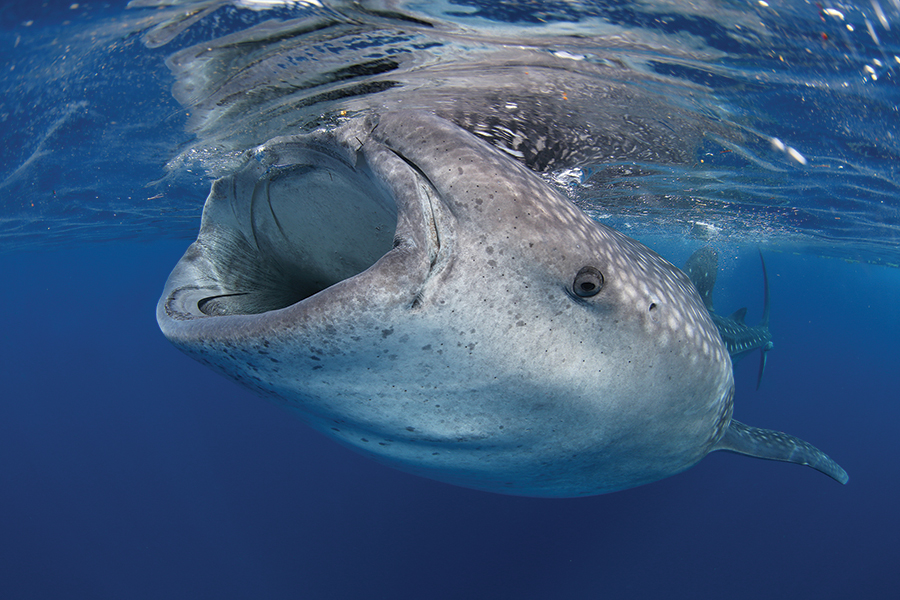
“The Undersea World of Jacques Cousteau is what really got me interested in the world’s oceans,” says Pusser. He went to the University of North Carolina-Chapel Hill, stuck his nose into pharmacy, got it bloodied by organic chemistry, and decided being a deck hand on the Calypso (or a facsimile thereof) was preferable to filling prescriptions anywhere on dry land. When he wasn’t putting on his great pumpkin display — an Eagle Springs Halloween tradition that attracted thousands and raised money for the Cameron Boys Home — he started taking summer classes in Morehead City, majored in biology, minored in marine science and specialized in pestering whale biologists at the Smithsonian Institution in the Pacific Northwest. “Three days after graduating I was on a research vessel (the Oregon II) in the Gulf of Mexico doing contract work for the government on a marine mammal survey looking for whales and dolphins,” he says. “I started seeing things like sperm whales. I saw killer whales in the Gulf of Mexico. No one really had any idea killer whales were there at the time. All kinds of dolphins. I was a contract worker for a lab in Mississippi and then I was doing contracts for labs in San Diego and Seattle and Miami. I was going all over the place doing these marine mammal surveys. That’s kind of how I got into the field.” All the time he was taking pictures.

“I was getting photos of animals that had never really been photographed in the wild before, a lot of weird dolphin species,” he says. Other groups began hiring him, including the International Whaling Commission out of the United Kingdom. It was doing surveys in the Antarctic. Pusser figured, hey, why not?

“I’ve made eight trips down there now,” he says. On the first trip for the IWC, he was surveying minke whales. That led to a position as a lecturer for a high-end tour company out of Seattle, defunct after the tourism business fell off a cliff post 9/11, called Society Expeditions. “I was lecturing on their ships taking small groups of people to remote areas of the world. We did this in the Arctic and the Antarctic, the Russian Arctic and the Bearing Sea. Obviously the photo opportunities were incredible,” he says, particularly the Antarctic. “There’s 150,000 penguins, King penguins, that stretch as far as the eye can see. Totally unafraid of people. They never had predators. It’s pretty amazing to be next to those birds.”

Pusser honed his photographic skills the hard way, “trial and error, mostly error,” he says. He mastered his craft in the pre-digital, home-run-or-pop-foul days of 35mm slide film. “I never took any kind of photography class,” he says. “I would study photographers I admired. At the time there was a guy who worked for National Geographic named Flip Nicklin. He was their whale photographer and I really liked his work. And there was another guy named Franz Lanting who was doing a lot of work in jungles and using flash with his photography, which was unheard of with nature photography at the time. It almost had kind of a studio feel to his photos. I really tried to emulate that with my work. I come from a biological background where you studied the behavior of animals and I think that helps with your photography because you’re able to anticipate action or know what an animal is going to do to really kind of capture the personality of the animals, not just a quick snapshot.”

Of course the switch from film to digital was inevitable and, in some cases, desirable. “I was not an easy convert,” says Pusser. “The main reason I started switching to digital was for underwater. Let’s say you’re in the Bahamas and you’re interacting with spotted dolphins — I used to do trips down there almost every year — you have 36 images on your roll of film. You’re there and you’re taking pictures and you hear that last frame and the film rewind in your camera. Get back to the boat. Get out of the water. Dry off. Open the back of your housing. Pop the camera. Pop the film canister out. Reload. You have 30 minutes invested in doing that. By then the behavior you’re trying to photograph is over. Now I stick a 64-gigabyte or 128-gig card in a camera and I’m under water all day. You miss fewer shots.”

So, about those sharks. “One of my favorite shark dives is actually off the coast of North Carolina,” says Pusser. “There are a lot of wrecks off the coast and there’s a species of shark that aggregates there called a sand tiger shark. These are big sharks, 8-10 feet long. They have really large teeth that stick out of their mouths. They’re not afraid of divers. If you sit real still they’ll come right up to you. They’re great subjects to photograph.” How close does he get? “As close as I can,” he says. “If they’re bumping my lens, I’m happy.”

The subject doesn’t have to be a shark or a blue whale to pique Pusser’s interest. “I do tend to try to photograph the more obscure animals that get ignored by other wildlife photographers,” he says. In 2006 he was part of an international team doing a survey on China’s Yangtze River trying to locate an endangered dolphin. The species had been in the river for millions of years but its population had been reduced to a handful by the river’s constant cargo ship traffic and a billion people trying to eke out an existence on its banks — often employing fishing methods lethal to the dolphin. “It was a monotypic genus, meaning it was the only member of that genus. There was nothing else like it anywhere on the planet,” he says. “We spent nearly two months going back and forth on the Yangtze River looking for this dolphin. We declared it extinct in 2006. First dolphin to go extinct at human hand.”

Pusser returned last November from a similar five-week trip to Mexico surveying an endangered porpoise, the vaquita, that’s being killed as by-catch in the northern Sea of Cortez where the Colorado River flows into the Gulf of Baja. “It was kind of a Hail Mary effort by a group out of California to bring them into captivity and breed them,” he says. “There’s a fish, totoaba (a type of croaker), that gets to be like 250 pounds. The fishermen there catch this fish using gill nets and take the swim bladder. Then they send this bladder to China for medicinal purposes. The bladder sells for more than cocaine. So the vaquita, they’re mammals. They swim into a net, get tangled up and drown. The government says you can’t set a gill net but they can come out in an evening, set a net and buy a pick-up truck with a fish bladder. I first did a survey there in ’97, again in 2008 and again in 2015. In 2015 there were like 50 left.” Pusser puts the number closer to 30 now.

“The project managed to capture an adult female but unfortunately she died. The stress of captivity was just too much for her,” says Pusser. “This was a huge blow for the conservation community. I fear the vaquita will soon be added to the long and ever-growing list of species humans have wiped off the planet.”

His camera and his curiosity have taken Pusser to over 30 countries and into every one of the world’s oceans. “Initially, I was only photographing aquatic subjects sharks, whales, dolphins,” he says. “I’d come back here (North Carolina) between projects. I never explored the state, outside of the Sandhills, when I was a kid or a teenager. So, I started networking.

One of the people who entered his orbit was Jeff Beane, the collection manager for herpetology at the North Carolina Museum of Natural Sciences, who became one of Pusser’s closest friends. “He opened my eyes to a lot of things I ignored as a kid. So now I spend a lot of my time documenting biodiversity and conservation issues across the state,” says Pusser who lives in Virginia Beach, Virginia now but remains a regular contributor of both photographs and stories to Wildlife in North Carolina magazine. “We have incredible biodiversity for a temperate region. We have the highest mountains east of the Mississippi; we have a lot of rivers; we have natural lakes; we have the ocean which has the Gulf Stream and the Labrador Current; we’re on a major migration route.”

And, as it turns out, he’s just as enthralled with crawfish, chubs or squirrels as blue whales.

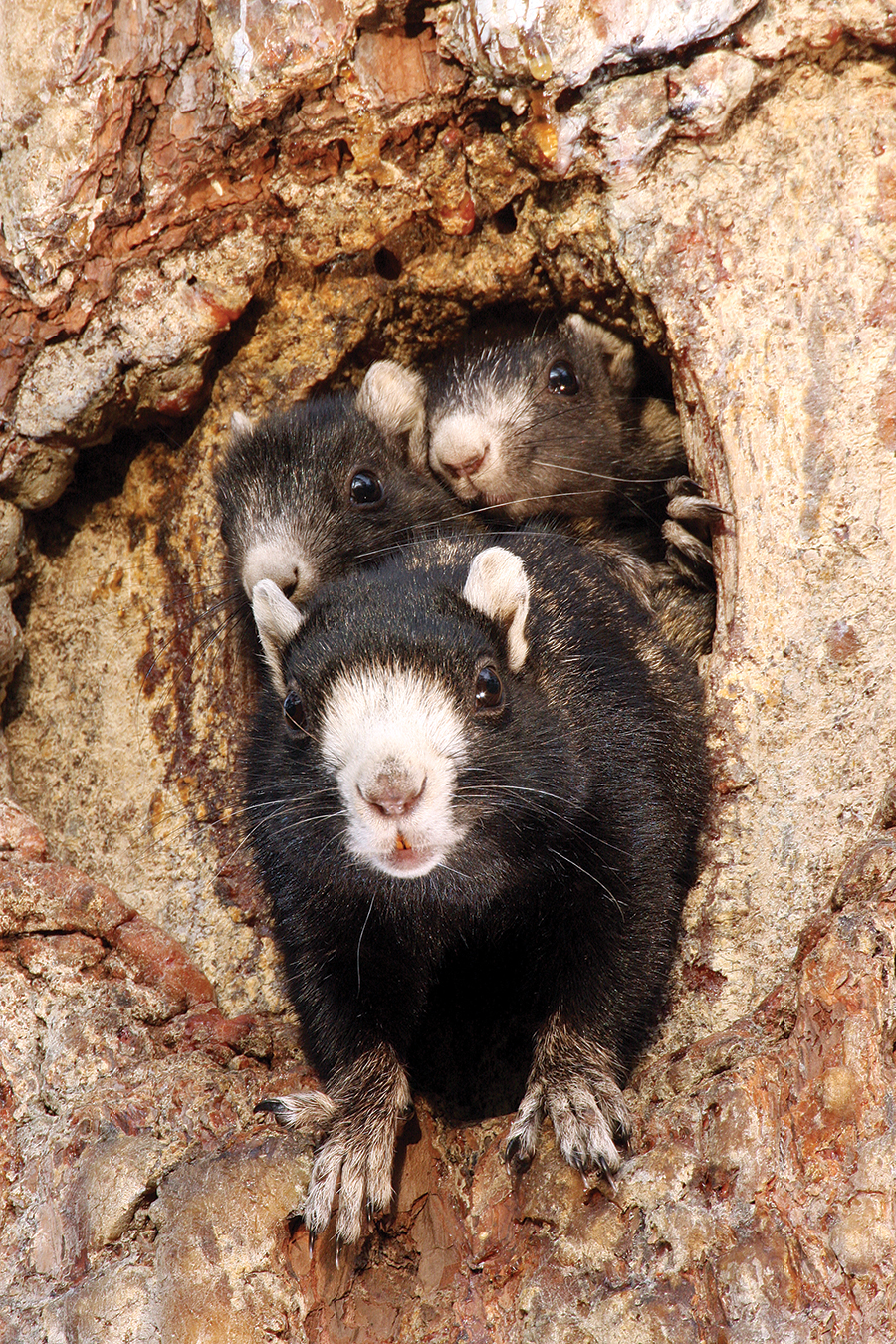
“Fox squirrels are probably Todd’s favorite mammal and for years he had never gotten satisfactory photos of one,” says Beane. It wasn’t for a lack of trying. Anytime Pusser saw a fox squirrel, he chased it. “Once he ran through the woods after one in a suit and tie and another time he ran after one in his underwear,” says Beane.

The latter happened when Pusser, in the field with Beane, was trying to photograph an undescribed salamander endemic to the Sandhills and slipped down a muddy creek embankment, sinking in up to his waist. After removing his wet jeans, he saw the squirrel. “I used to say he was always either too overdressed or too underdressed to get good fox squirrel photos,” Beane says — a condition that has since been remedied.

One of Pusser’s writing and photographic projects is scheduled to run as a three-part series in future issues of Wildlife in North Carolina. “There’s this really interesting fish behavior I found out about a few years go and I’ve been trying to document because it’s spectacular,” says Pusser. “In the spring we have two or three species, what are called chubs, that build these nests. If you’ve ever been fly fishing in the mountains, you walk through any creek or stream, you’ll see these mounds of rocks when the water is low. You’ll think maybe people are doing it but these fish, the males, build these nests. They’ll entice a female. They spawn over the nest. They aerate the eggs. They move the rocks around and they guard the nest. But what’s interesting is you have all these minnows and at the right time of year, they light up. Neon yellows, florescent colors. It’s like a corral reef. People don’t associate tropical reef color with a cold mountain stream.”

Another one of his passions, picked up from Williamson, is champion trees. “Each state has state champions and they might qualify for a national champion,” says Pusser. “The world’s largest longleaf pine, up until this past year, was on Highway 220 between Candor and Asheboro. It was over 12 feet in circumference and 150 feet high. It snapped during a strong thunderstorm. Now the largest longleaf is somewhere I think in Alabama or Mississippi.” The village of Pinehurst has a Darlington Oak that might be a state champion. “Come outside the Drum and Quill, turn left and you go to the next left,” says Pusser. “It was growing there probably before Pinehurst was created.”

Williamson and Pusser track down champion trees together. “One tree I showed him was a hollow yellow poplar and it’s a national champion,” says Williamson. “I got inside it and he handed me a couple of strobe lights to put on either side to give the interior a little bit of light.”

Shining a little bit of light is Pusser’s specialty. “You don’t have to save the world, just try to get people to appreciate what’s in their backyard,” he says.

It’s a message he enjoys spreading. “There’s a lot of joy in seeing something yourself,” says Beane, “but when you can show it to somebody else who appreciates it, that’s really special.”

And there’s photographic evidence, to boot. PS

For more information visit Todd Pusser’s website at: https://toddpusser.photoshelter.com/

Jim Moriarty is senior editor of PineStraw and can be reached at jjmpinestraw@gmail.com.

Queen of the Air

Amelia Earhart, George Putnam and their high-flying love affair

By Bill Case

They called it an autogiro. This unusual flying machine was something of a hybrid between an airplane and a helicopter. Like an airplane, it possessed wings and a propeller. But the wings were so stubby, they seemed a design afterthought. While resembling a helicopter with its horizontal rotary blades whirling atop, the aircraft was powered differently. It did not fly very fast — typically 80 miles per hour — and held only enough fuel to safely fly two hours at a stretch. But, flown by a proficient pilot, it could take off and land in an area no bigger than a suburban back yard. Before November 11, 1931, it is doubtful anyone in Moore County had observed, in flight, an aircraft requiring virtually no runway for its operation. That was one reason why on an Armistice Day mid-afternoon, well over 1000 people flocked to the dirt and grass airstrip known as Knollwood Field (now Moore County Airport) to hail the arrival of an autogiro.

Despite its novelty, such a sighting wouldn’t ordinarily have created such a stir that stores and schools in Pinehurst, Southern Pines, and Aberdeen would close. The pilot flying the aircraft was the one causing most of the hubbub — 34-year-old Amelia Earhart, one of the most famous women in America.

It had already been a long Armistice Day for the slender Kansas native. At daybreak, she had flown out of Charlotte, piloting her ungainly aircraft two hours east before setting down in a field five miles north of Fayetteville. Wearing the leather jacket, scarf, jodhpurs, and boots she typically donned in the air, Earhart was whisked by a welcoming committee into Fayetteville’s downtown by open car. There she was feted by thousands of adoring citizens who cheered the waving pilot as she slowly passed by.

At the conclusion of the parade, the soft-spoken but confident Earhart addressed an all-ears crowd at Fayetteville’s Market House, even putting in a good word for the Beech-Nut Packing Company’s chewing gum. George P. Putnam, a promotional genius who was newly wedded to Amelia, had arranged for Beech-Nut to sponsor her three 1931 hopscotching autogiro tours. The company’s emblem was prominently emblazoned on the fuselage. All the fuss in Fayetteville had put her behind schedule as the throng at Knollwood Field waited impatiently to catch sight of Earhart’s “flying windmill” on the horizon.

This was the famous aviator’s first visit to Moore County, though her husband was no stranger to the Sandhills. Dorothy Binney Putnam, George’s ex-wife, had spent considerable time here. In fact, until Earhart’s recent marriage to Putnam, she and Dorothy had enjoyed a close friendship, sharing among many things their mutual love of the outdoors. Elegant and statuesque, Dorothy’s affection for the wilderness had been kindled during family vacations near Carthage where in 1901, her father Edwin Binney, the founder and inventor of Crayola Crayons, had purchased a 1,300-acre plantation deep in the pine forest. The property featured a rambling antebellum plantation house with a second floor balcony that provided a magnificent view of the home’s surroundings. The spread was called “Binneywood.” It is uncertain why Connecticut-based Edwin selected Carthage for a vacation home though it probably had something to do with the proximity of the North Carolina mining operations that supplied raw materials for Crayola.

Dorothy Putnam had regaled Earhart with tales of the wonderful times she and her two sisters had enjoyed at Binneywood. Dorothy’s diary entry during the 1908 Christmas season at Binneywood describes an eventful and festive holiday atmosphere: “Up at dawn to go wild turkey hunting. Home at nine, then chopped trees, then quail hunting-good luck. Made fudge and sipped chocolate by fire.”

Despite the estate’s remoteness and their status as seasonal residents, Edwin Binney, known as Bub, and his wife became integral members of the Carthage community. They farmed, planted a peach orchard, reactivated the estate’s milling operation, and hosted country dances at Binneywood featuring rousing strains of banjoes and fiddles.
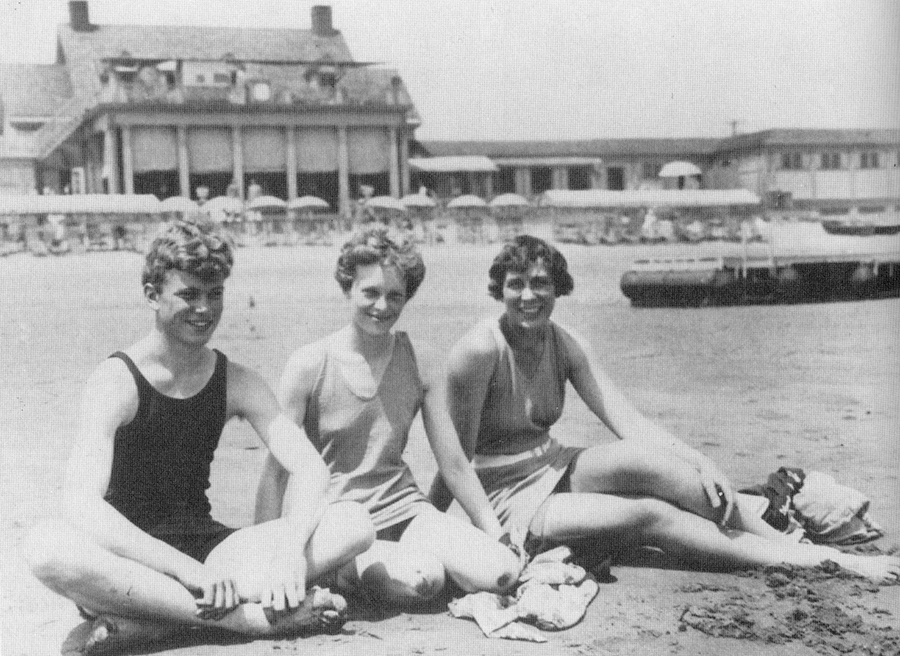
A particularly splendid event happened at the old plantation during the Christmastime of 1910 when Dorothy, a Wellesley grad, and George Putnam, whom she had met during a two-month western camping trip, announced their engagement. They married the following October. The newly wedded couple spent an extended honeymoon in Central America. Like Earhart, the two adventurers reveled in experiencing exotic and unfamiliar surroundings. The trip inspired Putnam to author his first book, The Southland of North America, with his new wife eagerly collaborating.

Then 24, Putnam had not yet joined the family’s renowned publishing concern, G.P. Putnam’s Sons, deciding instead to publish and edit the Bend Bulletin, a newspaper in faraway Bend, Oregon. It was an ideal place for the Putnams to begin their married life, indulging their penchant for the outdoors with horseback rides and camping trips into the recesses of the Cascade Mountains. Putnam proved to be an independent newspaperman and an advocate for progress by penning editorials urging that women be afforded the vote. He was even elected the town’s mayor. Dorothy also became a force in Bend’s civic life, raising funds for causes ranging from the Red Cross to fighting cancer. A tireless advocate for women’s suffrage, in 1912 she became the second female (after the governor’s wife) to vote in Oregon.

The Putnams’ first child, David Binney Putnam, was born in 1913. Soon thereafter, they moved to Salem, Oregon’s capital, where he took a post as secretary to the state’s governor while still retaining his position as the Bulletin’s publisher. During World War I, Putnam enlisted in the army which resulted in the couple’s moving to Washington, D.C. After his father died, Putnam decided to join the family business and they relocated to Rye, New York where Dorothy bore a second son, George, Jr. (“Junie”) in 1921.

Ensconced with G.P. Putnam’s Sons, George’s career skyrocketed as he became the company’s go-to spokesman. He was increasingly away on an unceasing quest to unearth new stories. Longing for adventures of her own, Dorothy seized the opportunity to travel with son David on a 10-week oceanographic expedition to the South Seas of the Pacific in 1925. She reveled in her role as a scientist on the voyage while 12-year-old David recorded a narrative of his experiences that Putnam published under the title David Goes Voyaging. The book was a surprising hit.

The elder Putnam embarked on his own expedition to Greenland in 1926. “I practiced what I published,” he wrote. David tagged along with his father. The expedition proved a success and provided the fodder for the young teenager’s second book, David Goes to Greenland. A second father-son expedition to Baffin Island followed in 1927 resulting in David’s third book. When he got back, Putnam immersed himself in bagging the rights to Lindbergh’s story for G.P. Putnam’s Sons.

Home in Rye, Dorothy stayed socially active, entertaining explorers such as Admiral Richard Byrd. Will Rogers said that one “couldn’t snare an invitation [to Dorothy’s parties] unless you had conquered some uncharted territory.” But she was restless and bristling at being the one generally left behind to tend the home fires. With all the time apart, the couple increasingly led separate lives and the ties of their union began to unravel.

Still vibrant at age 38, Dorothy yearned for passion in her life. She found it in 1927 in the person of George Weymouth (“GW” in Dorothy’s diary), a handsome and polished sophomore at Yale who had been tapped to tutor David at home. Though guilt-ridden by her infidelity, Dorothy nevertheless thought it unjust that men usually got a pass. “Why is it there are so many men who consider love outside the bonds of matrimony the privilege of the male only?” she asked in her diary. When Dorothy discovered evidence that her husband was also having an affair, she penned that his dalliance lightened “my sense of fidelity.” Dorothy’s affair with GW was in bloom at the time Amelia Earhart came into the Putnams’ lives.

Earhart’s unlikely emergence occurred in 1928 in the wake of Charles Lindbergh’s historic flight. An American heiress, Amy Phipps Guest, made it known she was personally bankrolling the first flight across the Atlantic with a woman onboard. Guest acquired a Fokker plane and rechristened it the “Friendship.” Then she set about finding the right female to make the journey.

When George Putnam got wind of Guest’s quest, he offered to take charge of the search. If Putnam could position himself as the one to choose the candidate, his publishing company would have the inside track on the woman’s story. Having already enjoyed remarkable success promoting non-fiction first-person adventures, including Byrd’s Skyward and obtaining the rights to Lingbergh’s story, the gambit was right up Putnam’s alley.

Earhart was a natural candidate. She had learned to fly in 1921 while living in Los Angeles. She was particularly attracted to the challenge of achieving aviation “firsts.” Two years after her first flying lesson, Amelia established a new high altitude mark. She’d also flown in air shows. In 1923 the young pilot became the first woman granted a certificate by the aeronautics branch of the Department of Commerce, the precursor of the Federal Aviation Administration. After moving to Boston in 1928, Earhart joined the local chapter of the National Aeronautic Association. When George Putnam summoned her to New York in May 1928 for the most important interview of her life, she was leaving behind a job that had nothing whatsoever to do with flying. She was employed as a social worker at Boston’s Denison House.

The attraction was nearly instantaneous. “Before I had talked to him for very long I was conscious of the brilliant mind and keen insight of the man,” wrote Earhart. Putnam knew Earhart would be perfect for the “Friendship” flight. Not merely a proficient pilot, she was a promoter’s dream. Slender, with short curly blond hair, she was attractive in a tomboyish yet feminine way. Another bonus was the young woman’s uncanny resemblance to Lindbergh —not just physically, but also because of her direct but soft-spoken manner. Soon the announcement came that Earhart had been chosen. Delayed two weeks by poor weather, the venture’s participants, chief pilot Bill Stultz, co-pilot Slim Gordon, Earhart, and Putnam were forced to hole up in Boston’s Copley Plaza Hotel to wait out the storm.
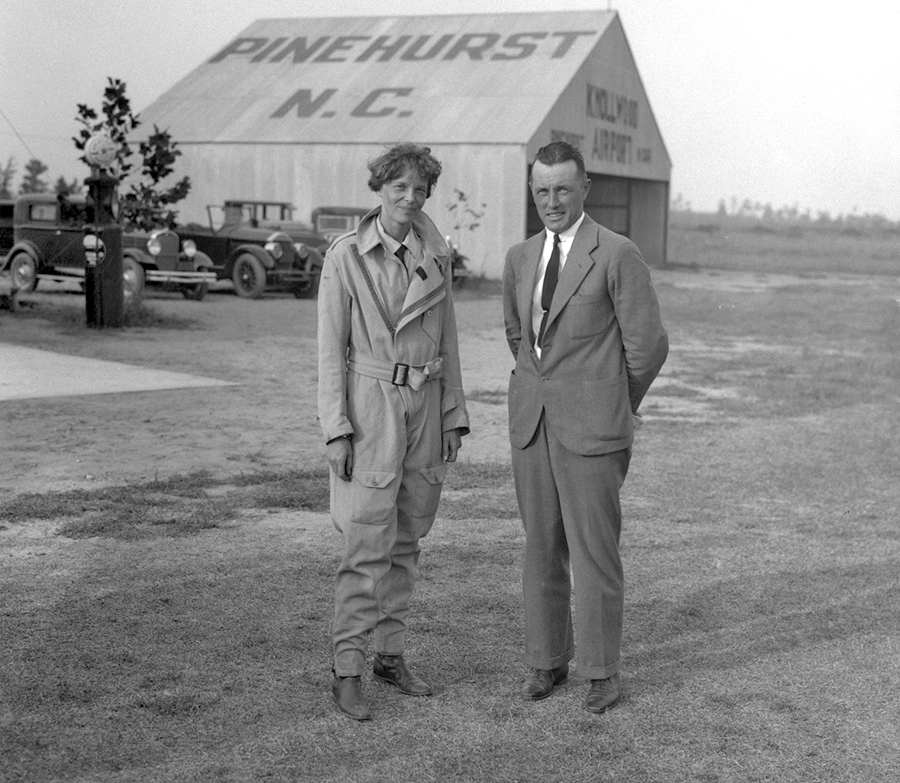
Putnam asked his wife to join the group. He figured Dorothy’s adventurous, free-spirited personality would make her a conversational match with Amelia. His assessment proved correct. The two chatted like schoolgirls concerning their shared interests in theatre, literature, fishing, and horseback riding. Finally the weather cleared and the “Friendship” was aloft. The flight turned out to be most challenging. An engine kept cutting out and the crew lost their radio connection. “Friendship” was blown off course, and even before land was sighted the engines began sputtering as they ran short of gasoline. Though Bill Stultz thought he was landing in Cornwall, it was actually Wales, but the plane and crew had arrived safely.

Though she had been little more than a passenger, the flight catapulted Earhart into stardom. It was the beginning of a life loaded with personal appearances, parades, and speeches. After celebratory tours, first in England and then America, she holed up in Rye at the Putnam home adjacent to the posh Apawamis Club’s golf course. Under George’s direction, she commenced writing the book that would be called 20 Hrs., 40 min.: Our Flight in the Friendship.

Aviation’s budding superstar found time for fun in Rye. She and Dorothy shopped, swam, and attended upscale social occasions. It was Dorothy, not George, to whom Amelia dedicated 20 Hrs., 40 min. In her book Whistled Like a Bird — The Untold Story of Dorothy Putnam, George Putnam, and Amelia Earhart,” Sally Putnam Chapman, Dorothy and George’s granddaughter, wrote, “had it not been for my grandparents, Amelia would not have moved in the circles she did.” Dorothy introduced Amelia “to a glittering array of celebrities, artists, adventurers, and socialites.” With her newfound celebrity and the success of her book came financial rewards. It became abundantly clear that Earhart would never return to her previous life at Denison House.

Her relationship with George Putnam was also deepening. Within a month of Earhart’s arrival in Rye, an entry in Dorothy’s diary notes, “George is absorbed in Amelia and admires and likes her. Maybe he’s in love with her.” Eventually, she became convinced that her husband and the flier were “a couple.” Putnam certainly was smitten. His later writings indicate he considered Amelia the epitome of chic. Reminiscing after her death, he wrote, “I think she really did not realize that often she was very lovely to look at.” He gushed about, “her beautifully tailored gabardine slacks,” and “the tapering loveliness of her hands [that] was almost unbelievable.” Apparently Vanity Fair agreed. The magazine shot a fashion spread of Earhart that hit the newsstands in 1932.

Dorothy terminated her ongoing affair with GW in August 1928, although the two remained friendly. Nevertheless, her diary entries do not suggest she yearned to be reconciled with a husband she no longer loved. She broached the subject of divorce and, though George made an attempt to patch things up, that effort seemed halfhearted since he remained in constant contact with Amelia.

By June of 1929, after discovering another affair with Frank Upton, a flier and war hero, Putnam informed his wife that he too wished the marriage to end. Despite the fact that Earhart’s relationship with Putnam had become an open secret, Amelia invited Dorothy to accompany her in July as the first female passengers to fly coast-to-coast in a Transcontinental Air Transport commercial airplane. Pleased to be included as part of an aviation first, Dorothy accepted. She and her husband’s lover remained cordial during their trip. A week later they were together in the Galapagos Islands on a deep-sea dive. That excursion marked the end of their social time together though both women thereafter invariably professed respect and admiration for one another.

After nearly getting cold feet, Dorothy obtained a Reno divorce from George on December 19, 1929. She remarked that day in her diary, “How scared and empty I feel!” She sought to remake her life with her two children and Upton, her new husband, in Fort Pierce, Florida where her father had invested in local real estate. She purged her sadness by building a Spanish-style home on an 80-acre tropical wilderness.

At the time, Earhart told a friend that she was fond of Dorothy and considered the divorce “a shame.” But her primary focus was on bolstering her status as America’s foremost female aviator. She cemented that position with her vagabond solo round-trip transcontinental flight in 1929. Putnam kept her busy at each stop, scheduling lectures, personal appearances, and newspaper interviews. Earhart also started an organization comprised solely of women in aviation which became known as the “Ninety Nines.”

After resigning from the family business and joining another publishing company, George Putnam turned his attention to relentlessly pursuing marriage with Earhart. Reluctant to forego her independence, she turned him down at least twice. In February 1931, Earhart finally accepted his proposal, but with conditions. She wrote to him, “On our life together, I want you to understand I shall not hold you to any medieval code of faithfulness to me nor shall I consider myself so bound to you . . . I must extract a cruel promise, and that is you will let me go in a year if we find no happiness together (and this for me too).” Putnam accepted her terms. Some believe that her mention of an open marriage (as well as a suspected subsequent affair with Gene Vidal, Gore’s father) signaled that the couple’s union was more of a business arrangement than a true romance. But David Putnam later observed, “In the privacy of their home, they [his father and stepmother] were lovingly demonstrative.”

Earhart’s forceful establishment of the marriage’s terms undercut the impression of some that Putnam was the puppet master in the relationship. George himself later acknowledged that often Amelia held the upper hand, writing that she was “endowed with a will of her own, [and] no phase of her life ever modified it, least of all marriage.”

In any event, the newlyweds’ fledgling marriage was off to a good start as Amelia and her autogiro made their way into Moore County airspace. Tightly squeezed into the open cockpit of her Pitcairn PCA-2, Earhart peered through her goggles attempting to locate the airfield. As it was a pet peeve of the aviatrix that many of the new airports sprouting up like spring dandelions lacked identifying signage, Earhart was pleased to spot the word “PINEHURST” displayed in giant letters on the roof of Knollwood Field’s hanger.

The gathered onlookers, including the mayor and commissioners of Southern Pines, representatives of Pinehurst, and Mrs. W.C. Arkell, wife of the Beech-Nut Packing Company vice-president, watched as she flawlessly executed her landing. Perhaps the person most gratified by Earhart’s appearance was the manager of the airport, Lloyd Yost. A celebrated pilot himself, just nine days before, he had instituted shuttle flights from Knollwood Field to Raleigh, boasting that the new shuttle cut travel time from New York to Pinehurst down to six hours. In his wildest imagination, he could never have conjured up better publicity for showcasing the service than having the world famous Earhart drop in. Yost personally greeted his fellow pilot and made certain he was photographed alongside her.

Earhart apologized for keeping everyone waiting and cheerfully set about signing autographs. She did not linger long. Her stop at Knollwood was primarily for refueling with no time allotted for parades or lengthy speeches. Within a half hour she was airborne again. Amelia made good her return to Charlotte and would be back in the air the next morning destined for Spartanburg where thousands more would greet her.
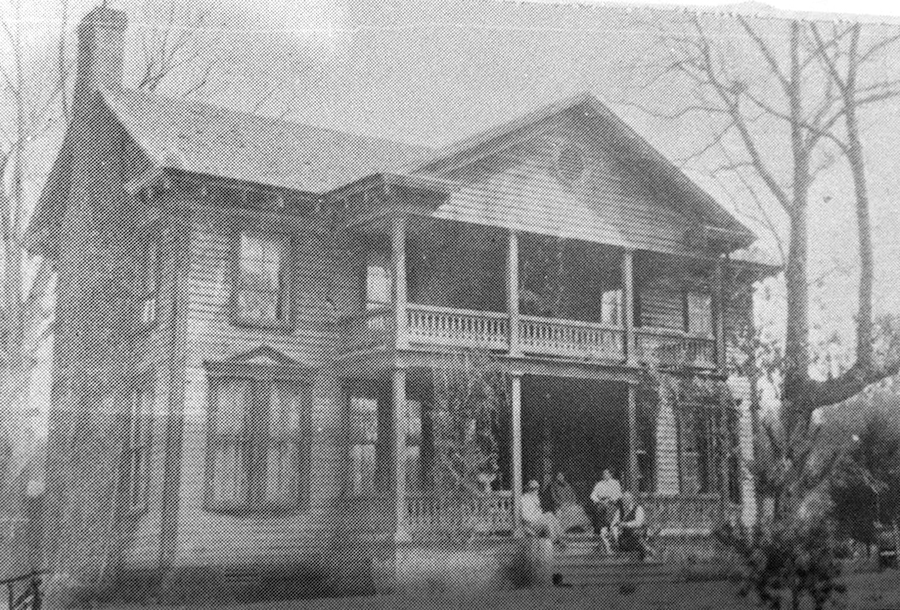
Not one to rest on her laurels, in May of 1932, Earhart emulated Lindbergh’s triumph by becoming the first woman to make a solo flight across the Atlantic. The wind blew against her the entire way and, running low of fuel, she was forced to abandon her planned destination of Paris, landing instead in the field of a nonplussed Irish farmer. Though Amelia’s star had never waned since her “Friendship” flight, her solo trip across the ocean propelled “The Queen of the Air” into a still higher galaxy.

A busy 1933 summer beckoned, what with an upcoming meeting with Eleanor Roosevelt and a transcontinental air race, so George Putnam and his new wife, Amelia, decided to take some time for themselves. The Sandhills drew them back in March when they holidayed together in Pinehurst at the Carolina Hotel. The stay was presumably coupled with a visit to George’s mother who had taken the Schaumberg House on New York Avenue in Southern Pines for the season.

One consequence of the Earhart-Putnam marriage was that George’s two sons, David and George, Jr., developed a mutual affinity with Amelia. In Whistled Like a Bird, Chapman writes, “When the boys visited, she [Amelia] made sure to set aside time for horseback riding, sailing, picnicking, and swimming.” And the Putnam boys happily returned the affection their stepmother demonstrated toward them.

Other notable flights followed for Amelia, but they paled in comparison to the imposing 29,000-mile round-the-world flight she started planning in 1936. After one jettisoned attempt, she tried another in June 1937 with mechanic Fred Noonan aboard her Electra aircraft. George, David, and his new wife Nilla saw Amelia off from Miami. After completing 22,000 miles of the journey, Earhart and Noonan spent the final layover of their lives in New Guinea. During the next leg to the Howland Islands, radio contact was lost with the airplane, and Earhart and Noonan were never heard from again. A two-week U.S. Navy search over 360,000 square miles found no trace of them. Putnam refused to give up hope, desperately enlisting psychics for assistance, all to no avail. Amelia was declared legally dead in 1939.

A devastated Putnam wrote an homage to his wife entitled “The Sound of Wings.” He remarried in 1939 to his third wife Jean Marie Consigny, but it only lasted five years. He would marry one more time, to Margaret Havilland. Despite his advanced age, Putnam served in World War II in an intelligence unit. Thereafter, he and Margaret operated a resort in Indian Wells, California prior to Putnam’s passing away in 1950 at age 62. His sons, David and George, Jr., led productive lives. David flew B-29’s in World War II and enjoyed a flourishing real estate development career in Fort Pierce before dying at age 79. George, Jr. served in the Navy during the war, and survived the torpedoing of his ship. He owned construction and citrus businesses in Florida, and lived until 2013.

A decade after the engagement of George Putnam to his daughter, Dorothy, Edwin Binney and his family shifted their attentions from North Carolina to Florida, and the creator of Binneywood sold it in 1920. The plantation house burned to the ground thereafter. By Way Farms now operates an equestrian-related facility on the site.

Dorothy would successfully remake her life in Fort Pierce, involving herself in organizations related to women’s rights, aviation, gardening, and conservation. She relished the serenity of her tropical home and orange grove, which she named “Immokolee.” But her marital life was anything but serene. Upton suffered from a serious drinking problem resulting in a rapid end to that union. A third marriage also failed. She finally found contentment in her fourth marriage with Lew Palmer, the orange grove’s manager. She died at age 93 in 1982, but not before sharing with granddaughter, Sally Chapman, the diary of her turbulent but fascinating life. Sally now resides at the cherished Immokolee. She too has a Moore County connection as she is the wife of John Chapman, son of Pinehurst golf great Dick Chapman.

The exceedingly remote possibility that Earhart somehow survived a crash and lived on in the South Pacific is just one of the more recent theories that have kept the lost pilot frozen in time in our minds. Captured in smiling black and white photographs and newsreels, she remains the tousle-haired, rail-slim, modest but fiercely independent heroine who flew over the pine trees into Knollwood Field 86 years ago. PS

Pinehurst resident Bill Case is PineStraw’s history man. He can be reached at Bill.Case@thompsonhine.com.

Almanac

It is deep January. The sky is hard. The stalks are firmly rooted in ice.    Wallace Stevens, “No Possum, No Sop, No Taters”

Begin Again

Perhaps it’s true that the best narratives are cyclical, taking the reader on a figurative journey that ultimately leads them back where they started, yet, through some alchemical reaction, altogether transformed. Like the fool’s journey, or the legendary ouroboros eating its own tail.

Which brings us back to January.

Outside, a pair of cardinals flits between the naked branches of a dogwood and the ornate rim of the pedestal birdbath. You think of the piebald gypsy cat who used to visit, how he would balance on the ledge to take a drink. Months have passed since you’ve seen him, but that drifter has charm. You’re sure he’s napping in some cozy sunroom, patiently waiting for the catkins and crocus, for the cheerily, cheer-up, cheer-up, cheerily return of the robin. The warmth of your own smile stretches across your face, and in this moment, all is well. 

On this first day of January, you imagine the New Year unfolding perfectly. Steam curls from your tea mug as an amalgam of flavors perfumes the air.

Cinnamon bark, licorice, ginger and marshmallow root . . .

Giving yourself permission to luxuriate, you reach for a favorite book of poems. “To read a poem in January is as lovely as to go for a walk in June,” said German author Jean Paul. You turn to a dog-eared page, can almost smell the honeysuckle and wild rose. You’ve read this poem many times, yet, like you, it is brand-new.

Blue Moon with Honey

Henry David Thoreau could wax poetic on “That grand old poem called Winter.” Perhaps it’s not the easiest season to weather, but from darkness comes light. Behold phloxes and hellebores, snowdrops and winter-blooming iris, and on Wednesday, Jan. 3, until the wee hours of Thursday, Jan. 4: the Quadrantids meteor shower. 

Named for Quadrans Muralis, a defunct constellation once found between the constellations of Boötes and Draco, near the tail of Ursa Major, the Quadrantids is one of the strongest meteor showers of the year. Although a just-full moon may compromise viewing conditions, you won’t want to miss a chance to see this celestial event.

Twelfth Night (Jan. 5), the eve of Epiphany, marks the end of the Christmas season and commemorates the arrival of the Magi who honored the Infant Jesus with gifts of gold, frankincense and myrrh. Seeking a hangover cure following this night of merrymaking and reverie? Ginger tea. And don’t be shy with the honey dipper. The natural sugar will help your body burn off what’s left of the wassail.   

January’s blue moon falls on the last day of the month. Reflect upon the ways you let your own light shine on this rare and energetically powerful night. Like attracts like. What are you calling in for 2018?

To Your Health!

Traditionally served in a large wooden bowl adorned with holly and ivy, wassail is a hot alcoholic cider that spells celebration. Many recipes call for port, sherry and fresh-baked apples, but here’s a simple (un-spiked) version for you. Start now and wrap your hands around a mug of hot wassail within the hour. Serves four.

Ingredients

2 cups apple cider

1 cup orange juice

Juice of one lemon

2 cinnamon sticks

6 cloves

1/4 teaspoon ground ginger

1/4 teaspoon ground nutmeg

Instructions

Combine all ingredients in a large pan.

Bring to simmer over medium-low heat. 

Reduce heat. Continue simmering for 45 minutes. 

Ladle into mugs and enjoy.

There are two seasonal diversions that can ease the bite of any winter. One is the January thaw. The other is the seed catalogues.  — Hal Borland