The Creators of N.C.

Cultivating Community

Caroline Stephenson steps out from behind the camera

By Wiley Cash    Photographs by Mallory Cash

According to filmmaker Caroline Stephenson, “It’s all about storytelling.” She should know. She was born and raised in rural Murfreesboro, North Carolina, where she grew up surrounded by stories and storytellers. Despite the rich culture around her, as a young person, Stephenson believed that real art could only be found outside Hertford County. Her father, a retired professor and writer, and her late mother, an architectural historian, regularly traveled with the family to places like Norfolk, Virginia, Washington, D.C., and metropolitan New York, where they would visit museums and view films in art house theatres.

“That made a big impression,” says Stephenson, especially the films. “I wanted to do that.”

The restlessness that Stephenson felt as a coming-of-age artist in rural eastern North Carolina manifested itself not only in her desire to create, but also in an all-too-familiar angst-driven urge to leave home. Like so many young people who think opportunity and adventure are waiting somewhere else, Stephenson says that she “couldn’t wait to get out of there.”

First, she spent two years at St. Mary’s School in Raleigh, and then two years at Boston University before transferring to Columbia College Chicago, where she received her Bachelor of Arts in film. Soon, she was living in Los Angeles, beginning a career that would carry her to places like Prague, Vienna, Athens and Budapest, working as an assistant director on sets for films and television shows like Empire, House and, currently, Tom Clancy’s Jack Ryan.
After marrying fellow filmmaker Jochen Kunstler and having two children, Stephenson felt a call to home. She and her young family moved back to Murfreesboro in 2010, where Stephenson came to terms with Hertford County’s rich cultural heritage as well as its incredible challenges. The county is 60 percent Black, and historical inequities in everything from education to home ownership serve to compound a poverty rate of 22 percent, much higher than the state average. The county’s struggles have also resulted in a dogged spirit of determination that immediately inspired Stephenson and her family to dedicate themselves to supporting the community.

“I’m driven by the incredible people where I’m from,” Stephenson says. “They created beauty, and above all they persevered and were proud.”

To tell the stories of the people of her region, Stephenson stepped behind the camera and relied on the talents that had taken her around the world. She made documentary films about Rosenwald Schools, which educated rural Black children during segregation, as well as a documentary about women who work in chicken processing plants in eastern North Carolina. Other documentaries and screenplays are in the works, all of them highlighting challenges that have either been overcome or are still being faced. 

Like any successful director looking for the best angles and working to make a production as seamless as possible, Stephenson is most comfortable being off camera, outside the glare of the lights.

“I like to be behind the scenes,” she says. “I want other people to shine.”

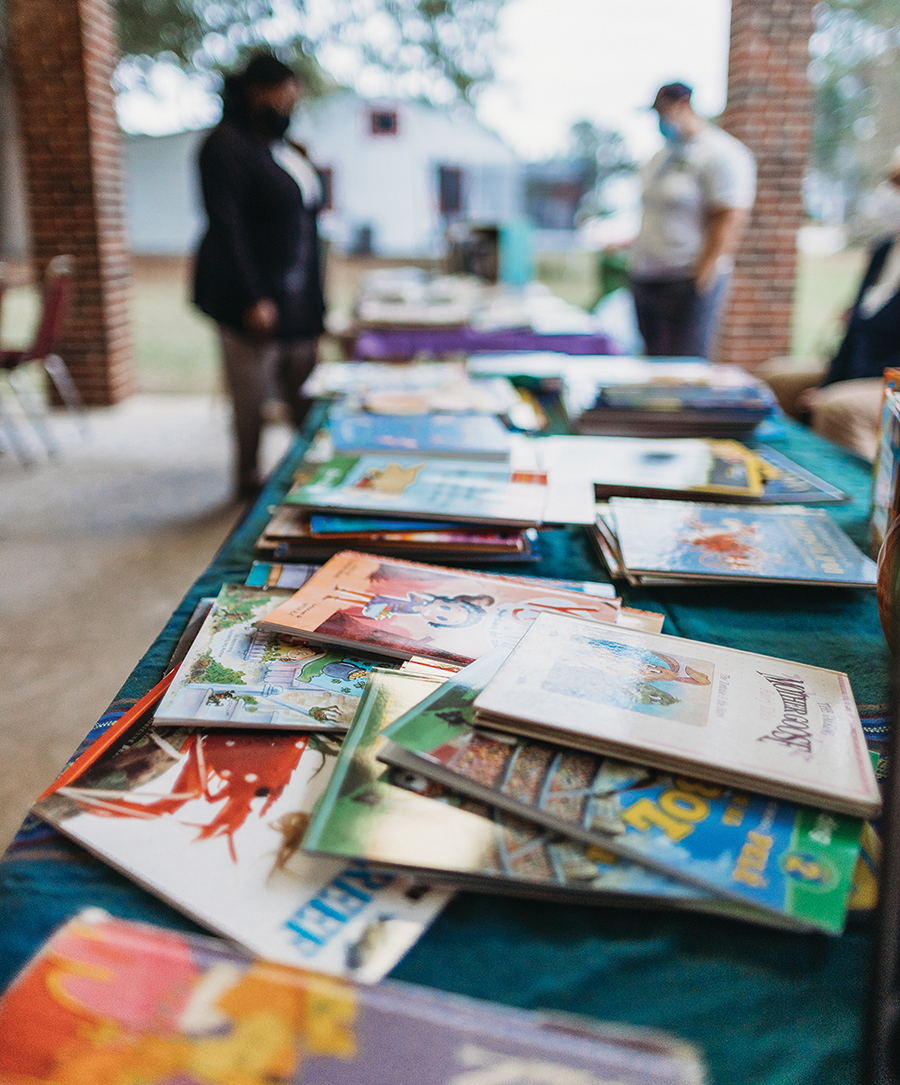
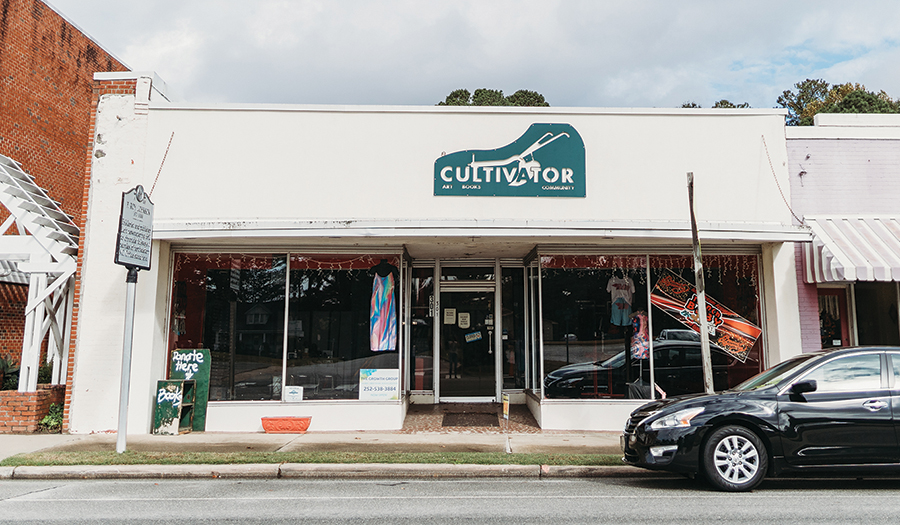
She also wants to make connections between the people and the organizations of Hertford County so they can support one another. In 2016, Stephenson opened Cultivator, an independent bookstore that quickly became a community hub. “We also sold local art and pottery, screened movies, held meetings and educational workshops,” she says. The store was the only bookstore within an hour’s drive in any direction but, as is the case with so many independent bookstores, it was tough to make ends meet. The pandemic made the venture even more difficult, and Cultivator closed its doors in April 2020, but the books — most of which were either donated or left behind after Stephenson’s mother, a voracious reader and book collector, passed away in 2014 — remained.

Stephenson quickly realized that not having a storefront did not have to stop the work of Cultivator, and so she converted her minivan into a bookmobile. “It’s just a folding table, personal protective equipment, and boxes and boxes of free books,” she says. “But we now serve more people than we served with the bookstore.”

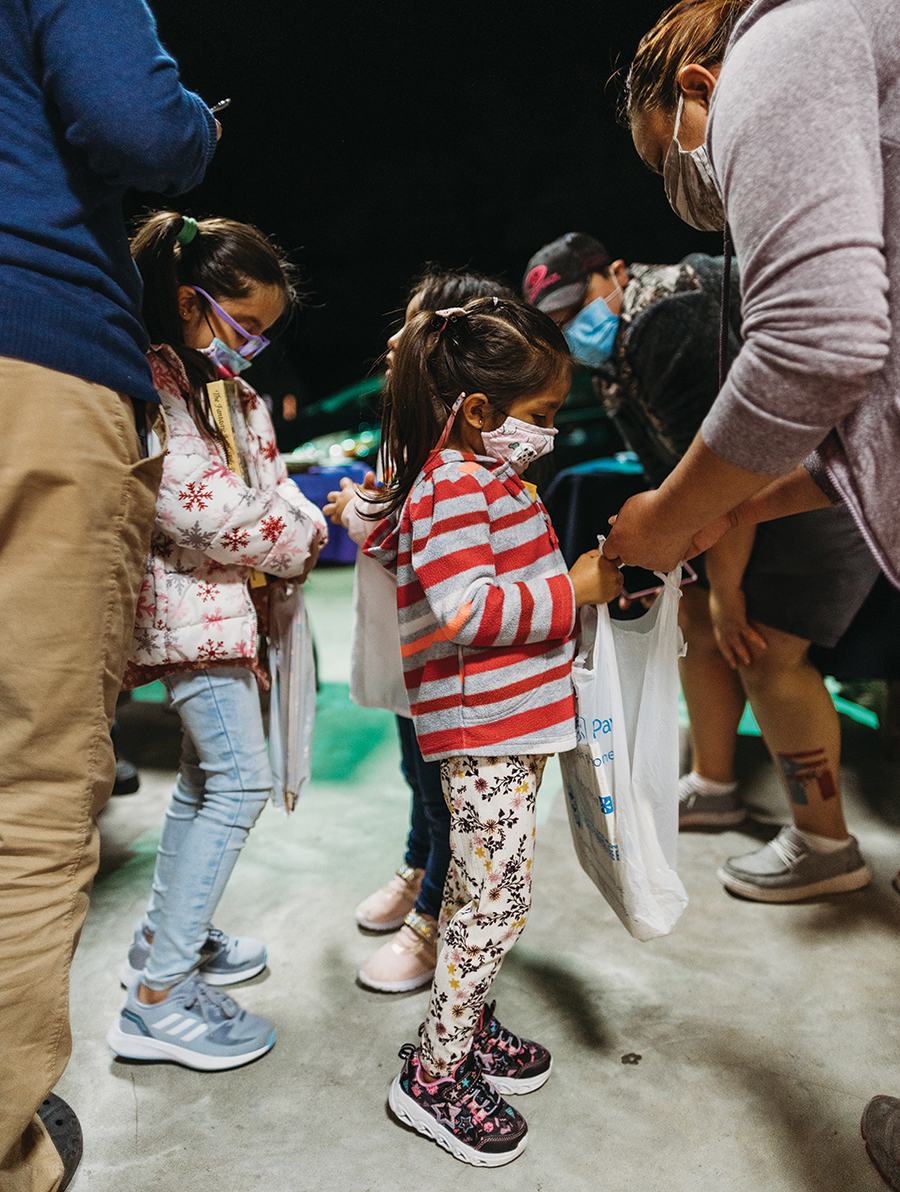
The Cultivator bookmobile regularly sets up in front of libraries, grocery stores, big box stores and churches. Sitting behind a table in the parking lot of Murfreesboro United Methodist Church one chilly night in late October, a volunteer named Christina is handing out books at the church-sponsored monthly bilingual dinner. Young children, many of them Spanish speakers, tote armfuls of children’s books, some written in Spanish. When Stephenson’s name comes up, Christina, who has been a volunteer for 10 years, pauses.

“Caroline is who inspired me to get involved in the community,” she says. “She does for others.”

Andrew Brown owns a family farm with his daughter, Sharonda, and has partnered with Cultivator to address food insecurity in the community. Sharonda is the evening’s featured speaker. The family has also been the subject of one of Stephenson’s documentaries.

“Caroline got things going when she came back home,” Brown says. “You need someone like her to bring people together.”

Inside the church’s fellowship hall, tostadas and accompanying fixings are being placed on long serving tables as a line of hungry diners forms. A woman named Alejandra announces that dinner is ready. Pastor Jason Villegas greets everyone, moving quickly between English and Spanish.
“I met Alejandra at an ESL (English as Second Language) class at Cultivator,” Pastor Villegas says. When Alejandra joined Villegas’ congregation, she encouraged him to preach in Spanish to reach more people in the community. The community dinners began not long after.

When Pastor Villegas says the blessing, he prays first in English, then translates it to Spanish.

“Thank you that we have connection and unity here,” he says. He keeps his eyes closed, but he lifts his hands as if gesturing toward the people around him. “And thank you to Caroline Stephenson for bringing so many of us together.”

Of course, Stephenson is not there to hear this prayer or witness her community’s gratitude. She is overseas on a film set, operating where she is most comfortable, behind the scenes. PS

Wiley Cash is the Alumni Author-in-Residence at the University of North Carolina-Asheville. His new novel, When Ghosts Come Home, is available wherever books are sold.

Pleasures of Life Dept.

Reconsidering a White Christmas

Perfection isn’t what it’s cracked up to be

By Tom Allen

The chances of a white Christmas in the Sandhills of North Carolina are slim to none. Even if a few flurries put folks in the holiday spirit, the National Weather Service defines a white Christmas as having at least 1 inch of snow on the ground the morning of December 25. But a couple of inches on December 22 that hang around for a few cold days would make the cut, right? Liturgically speaking, Christmastide is 12 days, so more days equals a greater probability, correct?

Dreaming of a white Christmas, where the treetops glisten? Bing crooned the iconic song, first heard in Irving Berlin’s classic, Holiday Inn, then later in the eponymous motion picture. It continues to be the bestselling Christmas song of all time.

The concept is lovely, but when it actually happens, the dream, more often than not around here, becomes a nightmare — wind, cold, ice, cars off the road, and sundry other unpleasantries. In our part of the world the three French hens wouldn’t have electricity.

Aside from a couple of Christmas day dustings, I’ve only experienced one white Christmas, in Louisville, Kentucky, the winter of 1990. One front after another brought several inches of snow, starting the first week of December, continuing, almost weekly, for the next three months. Snow and a couple of ice storms kept the frozen stuff on the ground until early March.

Western Kentucky is well-equipped for these seasons, unlike the more temperate parts of the South, where a couple of inches brings life to a standstill. Roads and parking lots stayed pretty clear. Even the apartment complex where I lived kept the sidewalks and entryways clean. But dirty, piled-up snow, gray mush and salty slush made for a depressing winter. And even with salt trucks and snowblowers, I often found myself waddling on an icy sidewalk or gingerly taking baby steps, hoping not to fall, which I did on a few occasions, bruising my ego more than other bodily parts.

On Christmas Eve 1990, my then-fiancée, Beverly, and I headed out to a service at the church we attended. The night was cold, raw, with just enough flurries to slow driving. Inside, the setting was beautiful, traditional, candles and crèche, and “Silent Night” to wrap things up. Heading out to my car after the service I noticed a grey Buick sedan had skidded on an icy patch into the front door panel on the passenger side of my red Toyota. Before I could yell, “Hey, hold on,” the car was gone. The dent was minor; I’d like to believe the chap driving the grey Buick had no idea he bumped my car. After all, it was Christmas — peace on Earth, goodwill to men, even the ones who dent your red Toyota. My instinct was to run, to catch the fella’s attention, to wish him a “Merry Christmas” before I pointed out we needed to talk. But another patch of ice brought me down, making me wonder just how merry and bright this Christmas would be.

As I recall, other than the dent — which I never got repaired — and a sore backside, it was a pretty good holiday. Oddly, the fact that our Christmas was white mattered little. I’ll take a chilly morning, clear roads, whatever family is gathered, and a snuggle with my dog. Because the perfect Christmas, like the perfect marriage or kids or job or church, really doesn’t exist.

So, consider letting go of that perfect holiday. Substituting canned biscuits for yeast rolls that failed to rise isn’t the end of the world. What if the recycled Dollar Tree bag you had to use because you forgot that pretty roll of paper had someone else’s name on it? Don’t sweat it. Kids wiggly at Christmas Eve services? Baby starts crying during “Silent Night”? What better night to hear an infant cry?

The probability of a white Christmas here is low. Chances of a 70-degree day are the same as a 40-degree day. So be thankful for whatever’s on your table — and the people around it. Be civil. Be kind. Be glad.

Just watch out for that guy in a grey Buick sedan.  PS

Tom Allen is minister of education at First Baptist Church, Southern Pines.

The Omnivorous Reader

Hell of a Read

A dizzying journey of the imagination

By Anne Blythe

The adage that you can’t judge a book by its cover is not one that works for the fourth novel written by Jason Mott, a writer and poet who lives in southeastern North Carolina. The title of Mott’s latest work of fiction, Hell of a Book, is in large, bold capital letters at the top of a black and yellow cover. Go ahead, judge it.

It truly is a hell of a book, one that explores racism, police violence and being Black in America.

It’s a novel — and a mystery, too — about a novelist with a vivid imagination. It’s difficult to know what’s real and what the writer is imagining. It’s also challenging to see how the main characters are connected, until the very end. Even then, there’s no certainty as to whether they’re truly bound in anything other than the novelist’s mind.

Mott pulls readers through a difficult and sometimes overwhelming conversation about “The Altogether Factual, Wholly Bona Fide Story of a Big Dreams, Hard Luck, American-Made Mad Kid” — his subtitle — with madcap humor, painfully poignant prose and a show-me-don’t-tell-me contemplative style.

The protagonist is a Black fiction writer on a dizzying book promotion tour, an unnamed bestselling writer who is breathlessly whisked through a blur of airports, hotels and cities by a quirky cast of drivers, and a profit-driven agent.

We first meet him at 3 a.m. in the hallway of a Midwestern hotel, where he’s naked, locked out of his room and being chased by an angry husband who has caught the author with his wife. He runs after him, flailing at him with a large coat hanger.

As the protagonist is about to be caught, the elevator doors open, and he escapes into a new scene with his savior of the moment, an elderly woman bringing home groceries in the wee hours of the morning.

“She’s eighty if she ever danced a jig,” Mott writes, showing his voice that delights throughout the novel.

As the naked novelist and blue-haired woman watch the hotel floors counted off in the elevator, Mott introduces readers to a sobering reality that becomes a central theme as the writer moves through his chaotic, alcohol-infused tour. Another Black male has been shot and killed by police, but Mott doesn’t give him a name. The old woman asks the novelist a question:

“Did you hear about that boy?”

“Which boy?”

“The one on TV.” She shakes her head and her blue hair sways gently like the hair of some sea nymph who’s seen the tides rise and fall one too many times. “Terrible, terrible.”

The novelist tries initially to go on with his celebrity life without fleshing out his feelings about “the boy.” He tries to push the latest outrage blaring on TVs and pulling Black Lives Matter advocates into the streets with signs and chants into that place deep inside himself where injustices stew without boiling over.

This time, though, the world is outraged, and the protagonist can’t tune out the calls to stop the madness or the cries to confront centuries of oppression and brutality.

The morning after the naked ride in the elevator, we meet The Kid, a mysterious but thought-provoking boy who might, or might not, be a figment of the author’s imagination. He looks to be about 10 years old, “impossibly dark-skinned,” and might, or might not, represent the all too many Black children lost to police violence.

We also get to know Soot, another Black boy in rural North Carolina, whose father tries to teach the power of invisibility, picking up on a theme in Ralph Ellison’s Invisible Man about not wanting to be seen by oppressors. We’re left to wonder how these boys are connected to the protagonist.

Early on, it becomes clear that the touring novelist has what he describes as “a condition,” an unnamed affliction through which he can blend an imaginary world with reality. His storytelling style, almost a stream of consciousness, can be disorienting but riveting, mind-numbing but thought-provoking.

On one trip from an airport to a book event, The Kid appears in the backseat of a limousine. He’s fully aware that the driver up front can’t see him, and he’s ready to test the author’s assertion that he’s just a character made up in his mind.

“Why am I not real?” The Kid laughs.

“Because I have a condition,” the protagonist says. “I see things. People too. They say it’s some sort of escape valve for pressure on the mind, probably caused by some sort of trauma. But I don’t go in on that. I haven’t had any type of trauma in my life . . . Nothing worthy of a Lifetime network movie or anything like that.”

Trauma eventually takes readers from the misadventures of the book tour to the dirt roads of Bolton, the hometown of Soot — and Mott as well, raising yet another conundrum. Is Mott’s Hell of a Book really a novel, or is it more fact than fiction about a Black novelist from the South?

“Nestled in the sweaty armpit of Carolina swampland, surrounded by gum trees, and pines, and cedar, and oak, and wild grapevines, the town of Bolton is the land that time forgot,” he writes. “The main exports of Bolton are lumber and black manual labor. The wood comes from the forests and swamplands — all of which are owned by the local paper mill — and the labor comes from the town’s seven-hundred-odd residents. I wish I could tell you that there’s something more than those two chief exports that comes out of Bolton, but there’s nothing else. Bolton isn’t a town that gives, but neither is it a town that takes. It’s the type of place that keeps to itself. It’s self-sustaining, the way the past always is.”

The past and the present need to confront, and reckon with, what generations of Black Americans have endured.

“Down in this part of the world, we got it all: fifty-four Confederate flags planted along the Interstate, statues put up by the daughters of the Confederacy, plantations where you can have wedding pictures taken of the way things used to be, we got lynchings, riots, bombings, shrimp and grits, and even muscadine grapes,” the novelist writes.

“Yeah, the South is America’s longest-running crime scene. Don’t let anybody tell you otherwise. But the thing is, if you’re born into a meat grinder, you grow up around the gears, so eventually you don’t even see them anymore. You just see the beauty of the sausage. Maybe that’s why, in spite of everything I know about it, I’ve always loved the South.”

It’s also the place where the protagonist, The Kid and Soot converge — without fully solving the air of mystery that surrounds them throughout the book. The enigmatic threads Mott so adroitly weaves together become more tightly stitched toward the end. Hell of a Book will make you think while also entertaining you on a helluva journey.

“Laugh all you want,” the protagonist writes as he and The Kid come to the end of the journey, “but I think learning to love yourself in a country where you’re told that you’re a plague on the economy, that you’re nothing but a prisoner in the making, that your life can be taken away from you at any moment and there’s nothing you can do about it — learning to love yourself in the middle of all that? Hell, that’s a goddamn miracle.”  PS

Anne Blythe has been a reporter in North Carolina for more than three decades covering city halls, higher education, the courts, crime, hurricanes, ice storms, droughts, floods, college sports, health care and many wonderful characters who make this state such an interesting place.

Out of the Blue

All Aboard

A ticket to ride the memory train

By Deborah Salomon

I parked on Pennsylvania Avenue, gathered my stuff and walked toward The Pilot office for a staff meeting. I work mostly from home but enjoy seeing everybody, checking the grapevine at least once a week.

Just before opening the door, I heard the shrill whistle, clanging bell and thunderous approach of a train, not much more than 50 yards away.

Just like an old movie, the present fades away and I am, once again, a little girl waiting with her mother on the platform of the original Pennsylvania Station in Manhattan, ready to board The Southerner which would take us to my grandparents’ house in Greensboro. The sensory experience practically knocked me over: sounds, smell, emotions all at once, as though a compartment (the right word) in my brain had burst open, spilling forth contents, remarkably intact.

Because this is about brains, not trains.

Nevertheless . . . trains were part of my childhood. I rode a subway to school and traveled to Greensboro several times a year by rail. After supper on warm nights, Granddaddy would walk me over to the tracks parallel to Lee Street to watch the freight trains rumble by. I waved at the engineer. He waved back.

But it was the overnight trips from Penn Station to Greensboro’s imposing Southern Railway Depot that are etched above the eyebrows.

Before boarding, we would “grab a bite” at a coffee shop (always an egg salad sandwich, for me) then proceed to the platform bathed in enough steam to hide a furtive Ingrid Bergman. The conductor really did shout “All aboard!” to hurry passengers onto coach and Pullman (sleeper) cars. An hour or so into the trip, near Philadelphia, porters would commence “making up” berths in upper and lower compartments.

The porters! They were the essence of rail travel, posters for institutional segregation/racism. Most had white hair under their caps. All were kind and deferential. Unlike rather stern conductors, they smiled, made me feel safe. Watching them assemble upper and lower bunks concealed by heavy canvas curtains was like watching a child play Transformers. I can smell the ironed cotton sheets, feel the scratchy wool blankets, see the pillows covered in striped ticking.

Then the Pullman car went dark.

I peeked out. How strange to see strangers padding up and down the aisle in robes and slippers.

Once under the covers (I got the window side) after my mother fell asleep, I squeezed a metal gadget that unlocked the heavy shade and watched the landscape speed by.

Clickety-clack, clickety-clack . . . lullaby of the wheels.

We woke early, dressed (nobody traveled sloppy back then) and made our way to the dining car for breakfast. Glorious! Outrageously expensive orange juice, scrambled eggs, biscuits and jam served by waiters wearing white gloves, who called me “Missy.”

Out the windows, Virginia and then North Carolina looked so much greener than New York. I saw cows grazing.

The air felt warm and fresh as we disembarked. Granddaddy was waiting in his ’36 Dodge, which emitted an odor that made me car sick. I can smell it, right this minute, and still feel woozy.

There’s so much more. When I was about 8 my mother sent me on ahead, alone. By then, the route required changing trains in Washington, at midnight. Always an adventurous child, I was thrilled. My mother pinned a note on my jacket, instructed the conductor, gave the porter a whole dollar to look after me, although little was required.

By then, I knew the ropes.

This was soon after World War II; trains were filled with happy young soldiers headed home. The ones in my car “adopted” the lone little girl, taught me a card game, gave me Hershey bars. Unthinkable, now, which makes the memory even more precious.

But this is about the brain, right, not the train?

My last train ride was in Switzerland, in 1996. Here, I learned the hard way that if departure is scheduled for 10:32 that means 10:32, not 10:33. However, a few days before this memory eruption, I spoke to a couple who still ride Amtrak from Southern Pines to Penn Station, for a lark. Sure, it takes 12 hours but no driving to RDU, parking, weather delays, baggage issues, cramped seats, getting a cab ($50) or bus to midtown Manhattan. You can walk around, maybe recline. I must have been ruminating on this when Amtrak blasted across Pennsylvania Avenue unlocking a trainload of memories — audible, olfactory, visual — which like ghosts at midnight on Halloween, must slither back into that compartment in my frontal cortex, forever.   PS

Deborah Salomon is a writer for PineStraw and The Pilot. She may be reached at debsalomon@nc.rr.com.

PinePitch

North Pole Heads South

There will be a Christmas Adventure for children 12 and under, including pics with Santa and a candy hunt, from 5:30 p.m. to 7 p.m. on Wednesday, Dec. 1, at the Recreation Center Gym, 160 Memorial Park Court, in Southern Pines. For more information call (910) 692-7376. Also on Dec. 1, the North Pole Experience comes to the National Athletic Village, 201 Air Tool Drive, in Southern Pines, with activities, music, sleigh rides and more. The experience continues on Dec. 4, 10 and 11; all times are from 5:30 p.m. to 9 p.m. For further information go to www.nationalathleticvillage.com.

Even Santa Loves a Parade

The Christmas Parade in downtown Southern Pines will be from 11 a.m. to 12:30 p.m. on Saturday, Dec. 4. Rumor has it Santa will be kickin’ it in the Pines. Hard to imagine any more information would be required but, if you just need someone to talk to, you can call (910) 692-7376.

Let Out the Cummerbund

The Women of Weymouth kick off the holidays with a gala at the Boyd House on Saturday, Dec. 4, at the Weymouth Center for Arts & Humanities, 555 E. Connecticut Ave., Southern Pines. There will be an open bar, hors d’oeuvres, a buffet dinner catered by Elliott’s on Linden, music and dancing. Black tie is optional. The cost is $90 for members and $110 for non-members. For information call (910) 692-6261 or visit www.weymouthcenter.org.

Music to Our Ears

The Moore Philharmonic Orchestra will perform its 17th annual Holiday Concert at the Bradshaw Performing Arts Center, Owens Auditorium, 3395 Airport Road, Pinehurst, on Saturday, Dec. 4, from 7 p.m. to 9 p.m. Admission is free. For more information go to www.mporchestra.com. At 4 p.m. on Sunday, Dec. 5, the Sandhills Community College Music Department will present its holiday concert, also at Owens Auditorium. Admission is free and open to the public. For further information call (910) 695-3828. And, on Sunday, Dec. 12, the Moore County Choral Society will have its annual holiday concert with conductor Anne Dorsey, also at Owens Auditorium. For additional information go to www.moorecountychoralsociety.org.

Attack of the Sugar Plum Fairies

Watch the Bolshoi Ballet perform Tchaikovsky’s holiday classic The Nutcracker in high def at the Sunrise Theater, 250 N.W. Broad St. in Southern Pines, on Sunday, Dec. 19, at 12:55 p.m. For more information go to www.sunrisetheater.com.

Don’t Look Now, But Here Comes 2022

Bring the whole family to downtown Southern Pines to ring in the New Year before Grandpa’s bedtime on Friday, Dec. 31. The pine cone drops at 8 p.m. but before that there will be live music, carnival games, face painting and more. For additional information call (910) 692-7376.

The Naturalist

Snow Days

North Carolina’s greatest wildlife spectacle

Story and Photographs by Todd Pusser

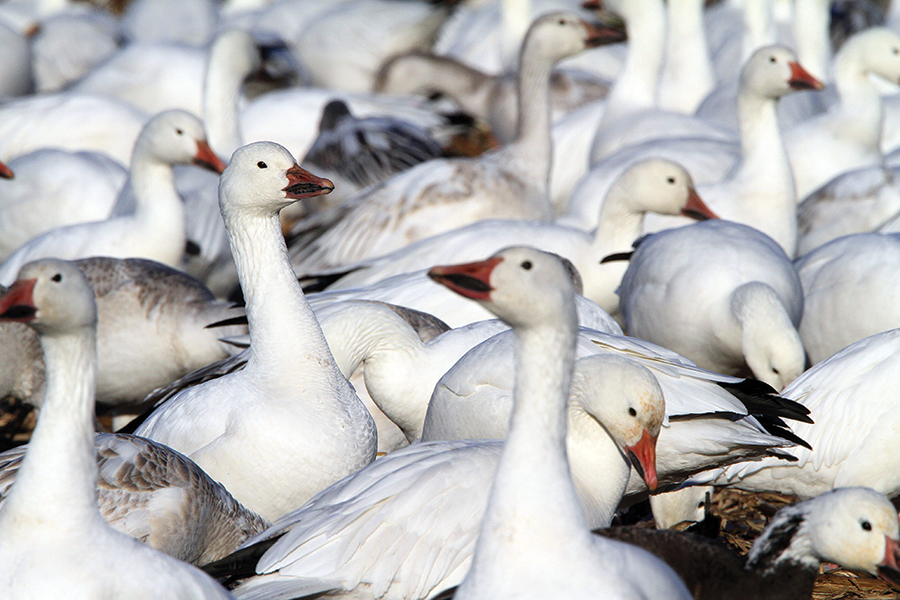
They appear like clockwork each November, arriving by the tens of thousands from their breeding grounds in the far north of Alaska and Canada, settling in for the winter in scattered locations across northeastern North Carolina, many in federal wildlife refuges created, in large part, for them and their kin. Possessing stark white feathers, weights of more than 5 pounds, and wings that stretch over 28 inches from tip to tip, snow geese are among our state’s most spectacular waterfowl. Aesthetics aside, what makes snow geese so remarkable is their tendency to form enormous flocks on their wintering grounds.

Containing as many as 40,000 individual birds, these cacophonous flocks provide the state’s greatest wildlife spectacle and can be seen in many of our coastal wildlife refuges such as MacKay Island, Pea Island and Lake Mattamuskeet. However, the largest flocks tend to aggregate in the vast fields and lakes of Pocosin Lakes National Wildlife Refuge in rural Tyrell County, which is exactly where I found myself one winter’s day.

I had timed my arrival for late afternoon, just as the sun was starting to dip in the bright blue western sky. Experience had taught me that the geese spend much of the day roosting in the shallow waters of the refuge’s Pungo Lake, only to leave in unison in early evening to forage in nearby agricultural fields.

Turning down a refuge dirt road, a northern harrier, a large, white-tailed hawk, arched gracefully above a hedgerow that bordered a shallow irrigation ditch, its long wings barely flapping in the gentle breeze as it attentively searched the grasses for an unsuspecting rodent or bird. Up ahead in the road, a pair of white-tailed deer ambled into an immense field of corn, their brown bodies quietly disappearing among the golden stalks.

Rounding a sharp bend in the road, I slow my car. Stretched out to my right, in a recently plowed field, are hundreds of tundra swans, their large white bodies aglow in the late afternoon light. Like the snow geese I have come to see, they, too, are recent migrants from the far North.

Both the geese and swans are attracted to this area for the immense wetlands surrounded by fields of corn and soybeans, crops that provide a high-energy food resource that sustains the gregarious flocks through the long winter days. The refuge allows local farmers to plant crops on its lands as part of a cooperative farming program. Instead of paying the refuge rent, farmers are encouraged to leave a portion of their crop in the field for the migratory waterfowl.

I put my car in park, roll down my window and turn off the engine. Pointing a long telephoto lens in the swans’ direction, I frame a small group standing at attention, carefully monitoring a predatory red-tailed hawk flying above the tree line at the far end of the field. Suddenly, I hear them, the roar of thousands of wings launching simultaneously from the surface of nearby Pungo Lake nearly a half-mile away. Despite the distance, the booming voices of the snow geese echo through the trees and across the vast expanse of the soybean field.

Before long, immense V-shaped lines of geese approach, high up in the sky from the east, and begin to circle above the tundra swans. Great swirling currents of snow-white wings, all beating in unison, descend, tornado-like, to the ground just a hundred yards from my parked car. Their synchronous movements are provocative. No other waterfowl are as gregarious, and I marvel at how the large birds fly so skillfully in such large aggregations. At no time do I see two birds so much as brush wing tips.

The geese snowstorm lasts for a full 20 minutes, and the open, plowed field, once a drab brown landscape of crop stubble, morphs into an enormous living white carpet full of frenetic energy. The noise is deafening.

There are few spots on the planet where one can witness such a gathering of animals, and it is remarkable to think that a spectacle such as this occurs so close to home. Even more astounding, I have this phenomenon all to myself. Nary another car is in sight.

As the sun dips toward the western horizon, late afternoon light washes over the flock, casting a golden hue over the sea of white feathers. The incessant chorus continues as the geese, mixed among the taller tundra swans, eagerly gobble mouthfuls of nourishment, pausing occasionally to crane their necks upward looking around for potential predators.

After nearly an hour, the dark silhouette of a flapping eagle appears just over the tree line along the far corner of the field. The entire flock instantly takes notice and, for just a split second, their honking and cackling stops. Then, blastoff! Thousands of birds launch simultaneously in a furious explosion of flapping wings.

The flock rises into the early evening sky in a white shimmering wave and circles back toward the lake, leaving nothing but a few scattered feathers strewn across an empty field, and silence. PS

Naturalist and photographer Todd Pusser works to document the extraordinary diversity of life both near and far. His images can be found at www.ToddPusser.com.

Character Study

Tuned In to the Generations

Gary Brown’s musical legacy

By Jenna Biter

Mount the steps to The Carolina Hotel, walk the lobby to the dining room, and sit down to a fine breakfast under crystal chandeliers. Five mornings out of seven, Gary Brown Jr. will be in the corner tinkling the keys of the shiny baby grand just like his grandfather Robert L. Murphy did for 30 years before him.

Veterans of the hotel staff, and even some guests, watched Brown grow up playing music. At first it was strictly after school. He debuted alongside his grandfather and uncle, Rev. Dr. Paul Murphy, when he was only 14 years old. “My grandfather or uncle would be on the piano. Sometimes my uncle would be on the upright bass or the saxophone, and I would be on the drums,” says Brown. “That makes me the third generation.” He flashes a smile.

Eventually he shared his grandfather’s breakfast gig, penciled into the schedule more and more often, especially after he graduated from Pinecrest High School in 2007. Grandfather was preparing grandson to continue the family’s legacy. “I wanted to,” Brown says. “It was never forced on me.”

In 2022 he’ll have been at it for 19 years. It’s a legacy that spans more than music. Gary’s father, Gary Brown Sr., has been working as a chef at the resort for 42 years, cooking now at Fairwoods on 7.

From a rocking chair on the wide, wraparound porch outside the hotel’s dining room, Brown motions to the grounds. “To be in this atmosphere, you definitely have to make sure you are professional,” he says. When he was a teenager, Brown remembers being nervous that patrons would approach him to chat while he played. “I asked my grandfather, ‘What if somebody comes up to me?’” His grandfather explained it was a part of the job, part of being an entertainer, not just background noise.

Nearly two decades later, Brown’s fingers scale the black and white keys on autopilot while he small-talks with guests. He raises his eyebrows and affectionately impersonates their wide-eyed awe, “‘Woooo, you’re not even looking at your hands!’”

For Brown, playing the piano is like blinking — he can focus on the action but doesn’t have to. “I’ve literally been so tired that I could rest and play the piano,” he says. “One time, I almost fell off.” He drops his head, slumps to one side in imitation. “You know, how your body drops off? I nodded off, but it’s weird because my fingers kept playing.” He folds into laughter, remembering the waitstaff’s amusement at his expense.

Brown can read sheet music but usually plays without it. “I gauge the crowd, see who’s there, see who’s into it,” he says. He’ll sprinkle in pop songs for younger guests. “I love music. I like hymns. I like jazz. I like regular music that people hear on the radio. Either way I put my own touch to it.”

He’s been playing — well, trying to play — the piano since before he can remember. As a toddler, he would crawl to the piano and pull himself onto the bench to hammer at the keys. Then, in the second grade, he entered an art contest with the assignment to draw what you want to be when you grow up. His picture depicted the adult Gary seated at a baby grand. “I didn’t know how to draw hair, so I just drew a mohawk,” he says, running a hand over his tightly cropped haircut.

Even without the mohawk, his elementary artwork was prescient. “I not only play piano, I tune pianos,” he says. “And my grandfather tuned pianos, and my uncle tunes pianos.”

His Uncle Paul also plays at the resort at least once a week, as he has for the past 37 years. And his mother, the daughter of Robert and Paul’s sister, Cathy Murphy, is a piano technician, able to regulate and repair pianos.

The family’s musical legacy began when Robert opened Murphy’s Music Center, a piano store, in Aberdeen in 1972, at the time one of the few Blacks to own a Sandhills business. He shuttered the store in 1980 because of the recession, but his misfortune had an upside.

During the economic downturn, Murphy couldn’t afford to pay tuners to maintain the pianos he had in stock, so he learned to tune the instruments himself. That led to a new business, Murphy’s Music Service. When he started playing at the resort in 1982, the combination launched the family’s musical arc.

“My grandfather taught me how to tune by ear first,” Brown says. “Then, after I learned to tune by ear, he allowed me to use a device as an aid. If the device is broken, you still need to be able to tune the piano.”

He dives into a masterclass on the process. “For most of the keys on the piano, there are three strings,” he says. “I use the felt to mute the left and right string, so then it only exposes the middle string.” Brown describes the tedious process with hand motions as if a piano were in front of him. With only the middle string exposed, he sets the note before individually tuning the right and left strings until all three are in tune.

“That’s pretty much what I do all the way down the whole piano, and the piano has over 260 knobs and tuning pins I have to turn,” he says. “A lot of times, I go through it twice.”

Patience was the first skill Brown learned from his grandfather. “I used to look at him and say, ‘What is he doing?’ I’m like, ‘He’ll never get done doing that.’”

But wisdom comes from experience. “You just focus on one string at a time,” he says. He points to a decorative retaining wall on the grounds, “It’s like somebody building that brick wall right there
. . . one brick at a time.”

At first, Brown learned the tuning trade in his grandfather’s shop. When his grandfather decided he was ready, Brown accompanied him to tune in customers’ homes. Then he graduated to tuning pianos solo with only pickup and drop-off by Grandpa.

When his grandfather was diagnosed with cancer, Brown stepped up. “He was tuning the piano, and I was right beside him. But he didn’t have enough strength to do it. So, I said, ‘I got it, Grandpa, I got it,’” Brown says. “Then he’d hand me the tuning hammer, and I’d tune the piano.” When Murphy’s condition worsened and he had home hospice, Brown would service pianos and bring checks back to his grandfather until he passed away in 2012.

Nearly a decade later, Brown still shows up for his grandfather’s clientele. He helps to support Murphy’s Music Service, run by his grandmother, Thomasina, but also has his own tuning business, Murphy and Brown’s Moving Music. “Call either or, and I’ll still show up,” Brown says and cracks a smile.

After Robert Murphy died, Brown was upset he didn’t play the piano for his grandfather while he was in hospice care, so he added a third, compassionate, leg to his business. “It just opened my eyes to the opportunity. You know, since you didn’t do it for your grandfather, you can do it for other people.

“I’m the last person they hear before they pass away,” he says with sober gratitude. “A lot of family members are mourning, don’t know what to say, don’t know what to do. Then when I come with the music, the music fills the gaps.”

Sometimes Brown brings his sons, Gary Brown III and Jayce, just shy of their ninth and fifth birthdays respectively, with him when he plays for hospice patients, so they can witness the gift that music can be.

Like their dad, the boys gravitated toward the piano as toddlers. “I would see them going to the piano and doing the same exact thing I did,” he says. But like Murphy didn’t force the piano on his grandson, Brown doesn’t force it on yet another generation. “A lot of people that come up to me, they say they used to take lessons when they were young, but they don’t play anymore. Maybe they had a strict teacher, or they just didn’t practice when they were supposed to,” he says. “But when they hear me play, they say they wish they would have kept playing.” Brown knows the next generation will get there on its own, if that’s where it wants to go.

“My grandpa always told me, ‘If you find something you love to do, you never work a day in your life.’ That’s why I learned how to play and I learned how to tune,” he says. “I love it.”  PS

Jenna Biter is a writer, entrepreneur, and military wife in the Sandhills. She can be reached at jennabiter@protonmail.com. Contact Brown for any of his piano services by calling him at (910) 315-1362 or emailing him at garybrown1362@gmail.com.

Southwords

O Christmas Tree

Poor, rusted Christmas tree

By Ruth Moose

When water is up to your waist, the last thing you think about is Christmas. And certainly not Christmas trees. You rescue what you can at hand. You bless sump pumps and those who make them. Same goes for wet vacuums. You are amazed that sofas can swim, but armchairs cannot. And you cry over books. Thousands of pages, sodden wads of pages, glued together, their backs forever warped and bucked in humps and waves. How heavy they are as you cart them to the curb. How wasted their lives.

Hurricane Florence got all the publicity, but the hurricane after got us. In Albemarle, our usually sunny (and the site of my artist husband’s studio) daylight basement ended up with nearly 3 feet of water. At least it was clear, cold and clean water, but still a frightening sight. Here were my husband’s sketches and paintings, art books, art supplies and frames. His working easels and drawing board, paints and brushes. It’s a sickening feeling to pull open a drawer of paint tubes and water pours out. Not to mention a lifetime collection of art books with glorious color reproductions of paintings he’d used for study and inspiration. In other sections of the basement he also had a woodworking shop furnished with years of accumulated equipment and tools.

Then there was the household part of the basement with the water heater, furnace and 35-year-old food freezer, all standing in water. Plus various assorted items we’d stored over the years. Never had water, four sump pumps going simultaneously, receded so slowly. You can only haul furniture out to dry, watch the skies and wait. Pray. And when the water is gone, you wet vac and wet vac and wet vac. You hear the roar of the motor in your sleep.

Then you begin to dry out sketches and wipe off oil paintings and cry over lost watercolors who went to meet their medium. You open cabinet doors, and drawers and water pours out.

Somewhere in the flood I heard my librarian aunt’s voice when she said, more than once, she never trusted basements. Neither did she like attics. “Basements are too wet,” she said, “and attics are too dry.” At least I thought what we had stored in the attic was dry and better dry any day than wet, wet and wetter.

But, miracle of miracles, after the water went, the air conditioner came back on, the water heater began to purr and the ancient food freezer hummed its heart out. So I emptied and cleaned it and began all over again. Thirty-five years old, hauled through four complete household moves, the freezer kept going and going and going. Gave one heart and hope.

In all that water and wetness, nobody thought about the Christmas tree until months later. We were too busy mopping and drying out and saving what could be saved. When it came time to do the tree, we remember what had been in some of those sodden boxes in the basement. That artificial tree I’d argued and fought against and finally been persuaded (for ecological reasons) to tolerate. Not accept. All our married life my husband and I had fought the real vs. artificial Christmas tree fight. And for years I’d won. Real was a cedar tree that permeated the whole house with the smell of Christmas. No artificial tree had ever come close to that. For years we’d had the advantage of family land to tromp as a family, choose and cut a tree. We never found the perfect tree. Just ones that could be trimmed or branches spliced to suffice. It didn’t matter, as long as they were real. All Christmas trees when trimmed and lighted are beautiful.

When family lands were no longer available, I had no choice but an artificial tree. Somehow the picture of my husband assembling those branches that still look and feel — to me — like giant green bottle brushes, never matched the one in my memory of tramping through the woods on a winter Sunday, kids and dog ahead, ax and saw in hand, to bring home bundled and tied atop the station wagon, this year’s Christmas tree.

Thankfully, the tree ornaments and decorations were in the attic. The tree itself had been stored in boxes too big to go through the crawl space and had to go to the basement. The basement flooded. So we had dry ornaments and a rusty tree. We dried out the branches, shook the rust out, stuck them back into a shape that still looked like a pyramid of green bottle brushes and said, “Merry Christmas to all and to all a working sump pump.”  PS

Ruth Moose taught creative writing at the University of North Carolina-Chapel Hill for 15 years and tacked on 10 more at Chatham County Community College.

In the Spirit

Ho, Ho, Ho

And a bottle of your choosing

By Tony Cross

This time of year, the pains of my job are real: I’m forced to order many different spirits, ranging from industry standards to eclectic, and sample them — just so I can give you a recommendation for the holidays. What a drag.

If you’re stuck in the gift-giving department this year, I have you covered. I’ve picked five different spirits that may be foreign to you, or the recipient of your choosing. Please keep in mind that I ordered these online. If you’d like to do the same, I suggest doing it sooner rather than later. While I’m at it, I’d also like to suggest grabbing a bottle from one of North Carolina’s many distilleries. We’re fortunate to have some great hooch from the folks over at TOPO, Sutler’s and InStill Distillery, just to name a few.

Chateau de Montifaud VSOP Petite Champagne Cognac

If you are buying for someone who enjoys Rémy Martin, or even just enjoys their spirits neat (Scotch whisky or bourbon whiskey, for example), then I bring you this elegant cognac. The Montifaud estate and the Vallet family have been producing cognac for six generations spanning more than 150 years. Their cognac is aged for one year in new casks and then several more in French Limousine oak. With some depth and notes of pear and apricot, it’s great on its own, or even in cocktails.

Angel’s Envy Finished Rye

This whiskey has been seen in our local ABC stores, but only once in a blue moon, so act fast. You may be familiar with Angel’s Envy bourbon. I confess, while it’s pretty popular, it has never been one of my favorites. This rye, on the other hand, is a showstopper. I had my first taste last year right when the leaves were turning color and hitting the ground. I remember thinking how it tastes like fall. The folks over at AE start with a 95 percent rye mash bill, aging it in charred white oak barrels. Then, they transfer the whiskey into rum casks — adding a sweetness to the rye, balancing the spiciness with notes of toasted oak, caramel and nuttiness. This whiskey is an ideal gift for any bourbon or rye fan.

Clairin le Rocher

This style of rum from Haiti got my attention at first sip. If you’re in the market for a gift for anyone with an affinity for rum, look no further. I’ve enjoyed the different bottles of clairin over ice, or as a Ti’ Punch. Per the website’s tasting notes on this particular bottle: “Le Rocher is a distillery at a higher elevation, creating their Clairin in the style of Jamaican single pot still by boiling wild sugar cane juice into syrup.” This rum is a little funky (in a good way) and there are notes of butterscotch and bananas. There are other clairins on the market, too, and any of them would be a great addition to that special someone’s home bar.

The Kyoto Distillery Ki No Tea, Green Tea Flavored Gin

The team over at Kyoto Distillery only makes gin, and that dedication shows. Though this may seem like a boutique buy to some, the flavor of the gin is uncanny — I have never tasted a gin so clean and balanced, with different notes of green tea to boot. It’s described this way on the website: “Ki No Tea is a product created in collaboration with tea-grower and blender, Hori-Shichimeien, founded in the Meiji era in 1879 and based in the famous Uji region to the south of Kyoto city. A number of super-premium Uji teas have been specially selected to form the heart of Ki No Tea. Tencha and gyokuro provide intense aromas and depth of flavour with a wonderful sweetness that occurs naturally in the distillation of these superior teas. These teas are blended carefully with a secret botanical recipe used only in Ki No Tea.” Tencha is the tea used for matcha, and gyokuro (which means, “Jade dew”) is very rich and robust. Bottom line: this gin is outstanding on its own, and I cannot think of a gin that could go toe-to-toe with Ki No Tea without needing a modifier. If anything, buy this for a martini lover.

123 Organic Tequila Reposado (Dos)

Buy this for yourself. Founder and tequilero David Ravandi’s attention to detail with his line at 123 Organic Tequila is unparalleled. From its certified organic source (the agave is grown on USDA and EU certified organic estates without synthetic pesticides, fertilizers, and herbicides) to the sustainability of its packaging (100 percent recycled glass; the label is printed on recycled paper; the labeling is made from vegetable-based inks), 123 Organic Tequila Reposado captures the finest expression of 100 percent organic blue agave. I’ve had their anejo “Tres,” and, now, their “Dos” reposado. Only distilling twice, this agave has notes of lemon and, on the palate, you’re treated to salted caramel and a touch of vanilla but not in an overpowering, vanilla-bomb way. This agave is great on its own, but man, oh man, it is my personal favorite for margaritas.   PS

Tony Cross is a bartender (well, ex-bartender) who runs cocktail catering company Reverie Cocktails in Southern Pines.

Good Natured

The Power of Patience

Stay calm and carry on

By Karen Frye

The last month of the year can be a whirlwind of events and gatherings. For many, it can increase stress levels and seriously undermine the season. One way to navigate the holidays with fewer difficulties lies in the virtue of patience. While patience may sometimes be more of a goal than a reality, it is absolutely worth the effort to adopt this behavior and practice it when the occasion presents itself. How we handle challenges can make all the difference in the outcome.

Impatience is an everyday part of life. I can get very impatient with traffic backups or waiting too long in a line — convinced for strange karmic reasons that I’ve picked the “slow” one. There is a simple technique in these situations that can change the perspective and make the experience not quite so bad. I’ll take a few deep inhales through my nose and slowly exhale through my nose. Using this deep breathing technique can slow the heart rate and relax the mind in a relatively short time. 

One of the most challenging situations to test your patience is confrontation. It can come at you from nowhere. You can be having the best of days, and suddenly you find yourself engaged in an unpleasant conversation. It could be a personal attack about something you’ve done, a rant about an accident, or just a simple misunderstanding. As one person berates the other, things can get totally out of control and wind up in an adrenaline-pumping shouting match.

There’s a very simple solution. Before you even respond, stop and be silent. Take the time to be patient before you say anything to escalate a situation. Just listen. Within those moments of quiet you can take stock of the circumstances and handle your response in a peaceful, kind and gentle way. It can change the outcome.

The will to calmly wait gives us the opportunity to become more compassionate people. This is the season of love and joy. Practice patience and you will find many benefits: definitely more happiness and less stress.  PS

Karen Frye is the owner and founder of Nature’s Own and teaches yoga at the Bikram Yoga Studio.