Story of a House

Life on Blue Ribbon Lane

Where practicality and taste meet

By Deborah Salomon     Photographs by John Gessner & Laura L. Gingerich

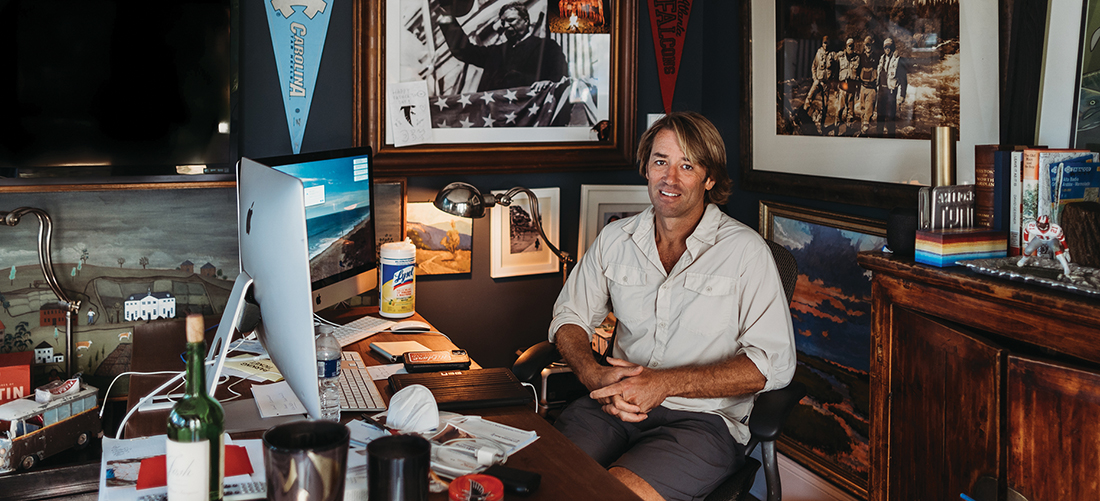
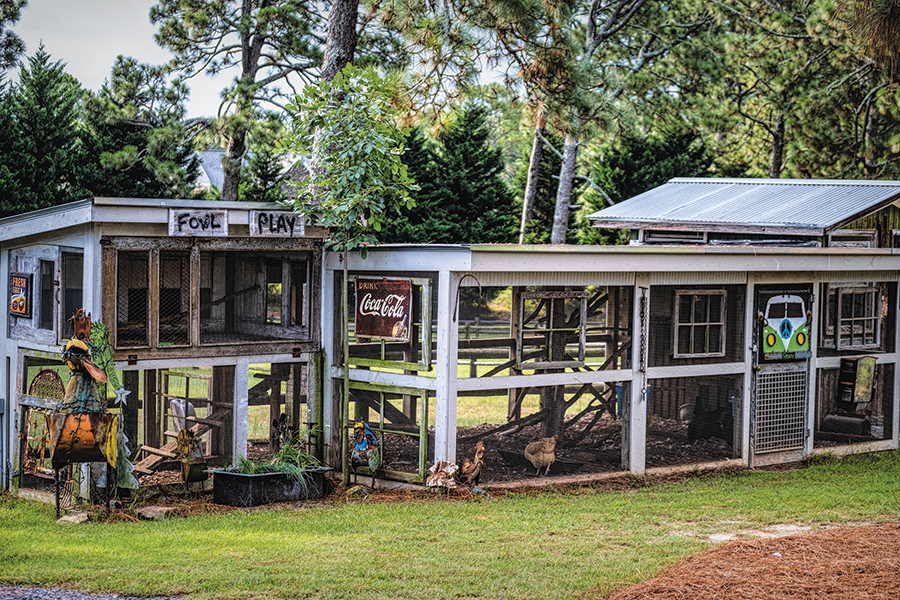
Reading a house is like reading a palm. The footprint, as well as the décor, describe its occupants. This applies to Sapphire Farm, where two horses, a donkey, three dogs and a flock of chickens share a spectacular homestead with youthful retirees — an equestrienne and an environmentalist — deep in Southern Pines horse country.

This installation was conceived by Lynn and Buck McGugan to fulfill specific requirements. His, that the house be low maintenance. Hers, “I wanted to stand at the kitchen sink and look across at my horses in their stalls.”

Lynn is the sole caretaker of her animals, mostly rescues. Their bond is strong.

Buck doesn’t ride but he does play golf. Moore County offers both, at a high level.

Beauty may be in the eye of the beholder, but at Sapphire Farm — named for the birthstone of the McGugans’ son, Robert — practicality runs gut-deep. Buck, a financier with an architectural background, speaks with pride of the geothermal heating and cooling systems backed up by two generators. This includes the saltwater pool, with an unusual earth-hued liner. “The dark color holds the heat, giving us a longer swimming season,” Buck says.
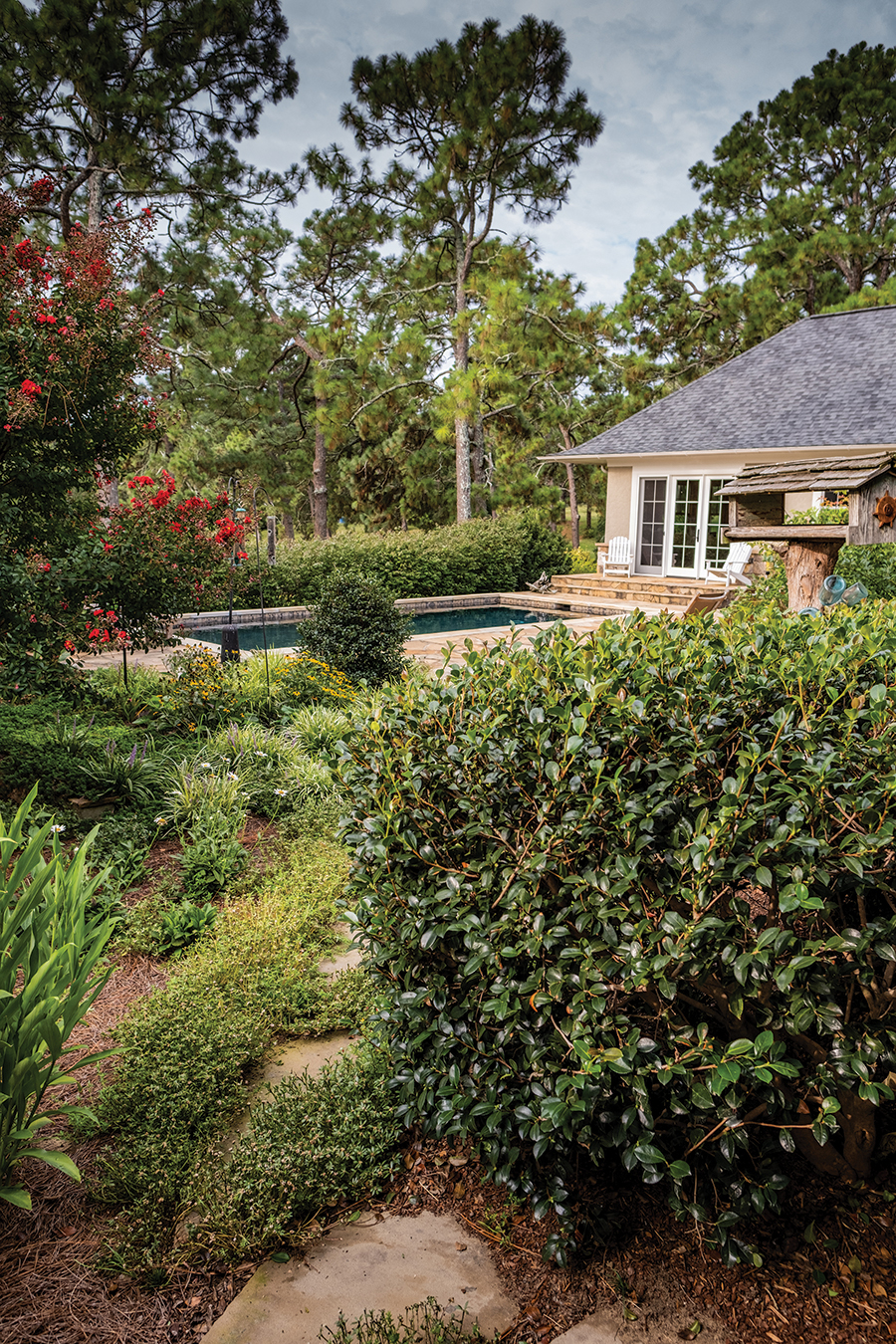
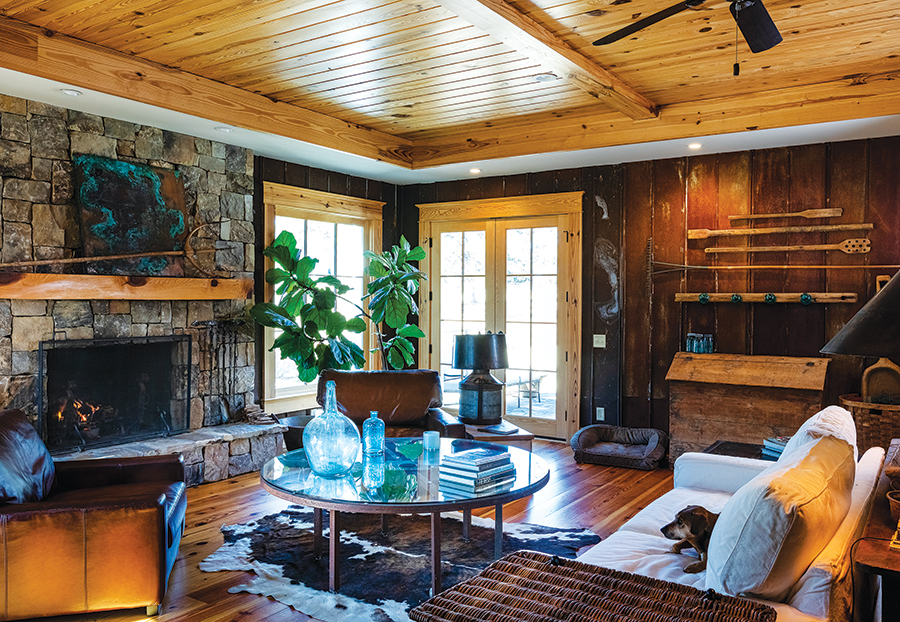
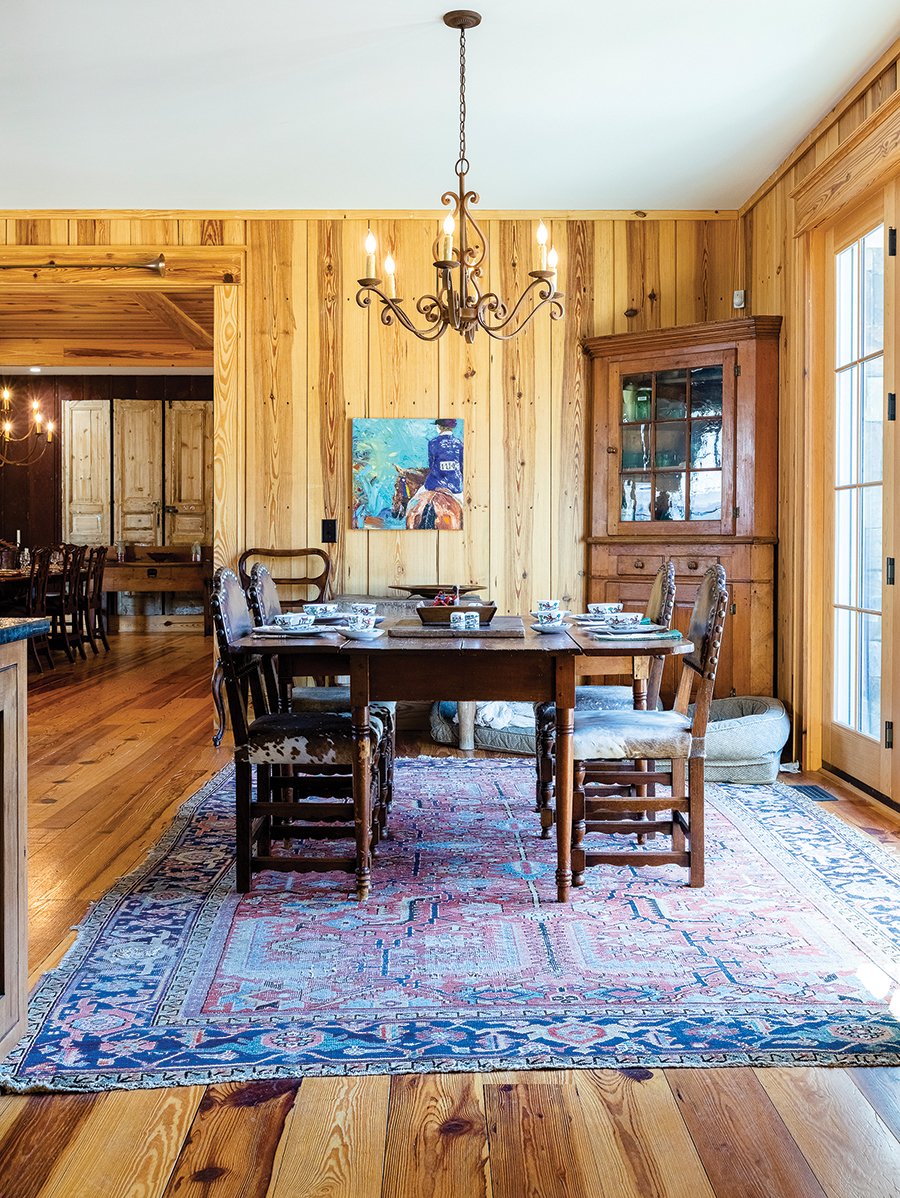
The barn is sited for maximum breezes and minimum flies. Plantings attract birds and butterflies. Inside, tinted windows (no shades, blinds or drapes) reflect heat. Buck’s pride extends to building materials — no wood on the exterior, only Tennessee fieldstone, concrete shingles and stucco with embedded pigment that never needs painting. On the inside, locally sourced wide-board knotty pine covers floors and walls throughout, extending to a tray ceiling in the combo living-dining room.


Lynn and Buck met while employed by Xerox in the 1980s. Ten years ago, they were living in a Chicago suburb with Lynn’s horse, Butter, boarded off-site. Enough with severe winters already. “We were looking for a retirement place for horses and golf,” Lynn says. She accompanied Buck to a golf tournament in Pinehurst. “A friend had a place here. I rode with her on the (Walthour-Moss) foundation.”

Lynn did not expect the extent or beauty of the land or the depth of the equestrian community. “I cried the whole time.”

Finding open acreage adjacent to the foundation seemed beyond serendipity. “I saw the hunt leaving and said, ‘Where do I sign?’” Lynn remembers. They had built and renovated houses before, one dated 1889.

The couple worked with an architect for a year. The house would be U-shaped around a courtyard. One section (and the barn) with a tiny second-floor apartment was completed first. They lived there during construction of the remainder, total time three years, with Buck keeping a close watch.

Afterward, that apartment, plus another topping off the opposite end, serve as guest quarters for their son and others, since the core of this 5,000-square-foot residence has a master suite, but no other bedrooms.

Walk through the front door . . . and gasp. The foyer, rising nearly 30 feet, is a confluence of angles pointing upward to a glass-topped cupola, which allows sunbeams to stream through. Buck compares the foyer to the Pinehurst rotary, with branches going off in different directions. Except the rotary isn’t wood-paneled from ceiling to floor and furnished in farmhouse mode — a preview of what lies ahead, including fixtures that resemble gaslights and antiques of varied provenance.

“Everything has a story,” Lynn says, directing attention to photographs she has taken of tumbledown cabins, which comprise much of the wall décor. Even the frames are her handiwork, many found in unlikely places, attached to something else.

Gasp again at the living-dining room, for its scope. If the elongated medieval refectory table — a showpiece from Wright, an old and revered Carolina furniture company — and few upholstered pieces were removed, the space could double as a ballroom accommodating a dozen couples. Or hold 150 at Lynn’s famous brunch before and after the Blessing of the Hounds on Thanksgiving morning. Its walls beg touching. What could this material be?
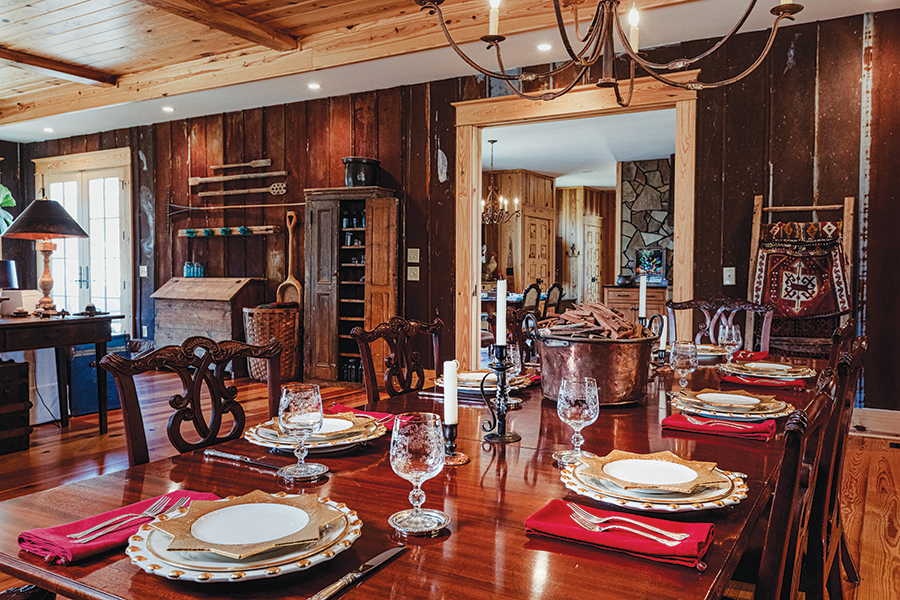
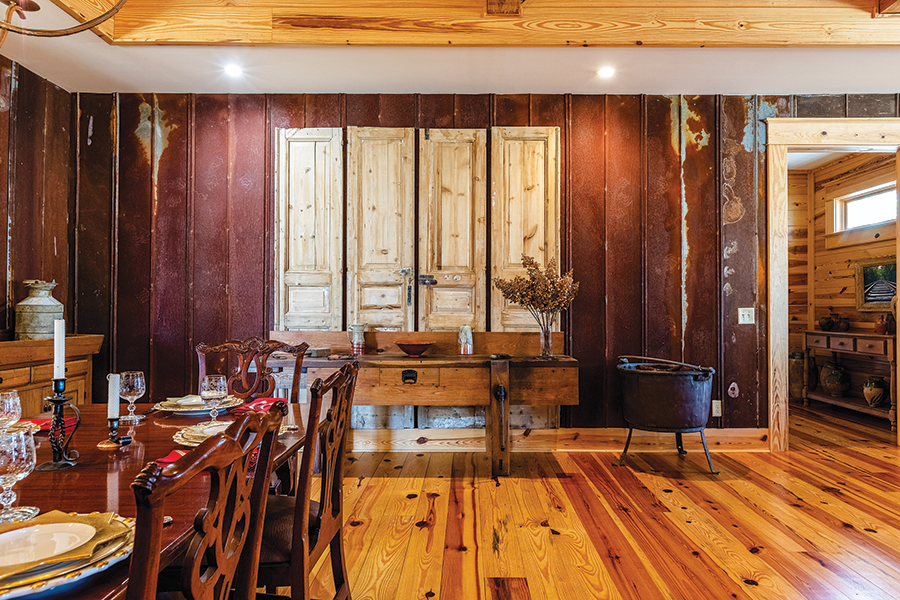


Peter Dowd, the McGugans’ builder, was tearing tin roofing off an old cotton plantation. The long panels, mottled with rust, were destined for the scrapyard. In them, Lynn saw texture. “I washed every one and removed the rusty nails,” which were reused to attach panels to the walls, since new nails would scream anachronism.

Elsewhere, beams were contrived from carpet rolls found when the Gulistan plant was torn down. A weathered barn door is attached to a wall, while farm implements rest on a workbench. Across from it stands a battered feed bin. By coincidence, Lynn’s initials are carved into the top. Beside the wood-burning stone fireplace, a gigantic fiddle-leaf fig plant suits the room’s proportions. Seagrove pottery is represented throughout.

In the nearby powder room an old pie safe with tin top has been made into a vanity, with a worn metal baking pan as a bowl.

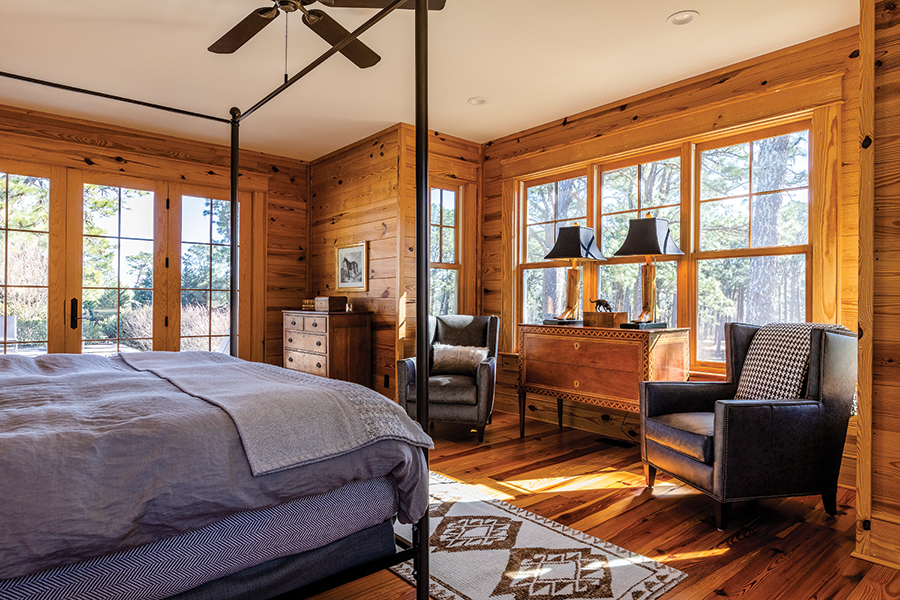
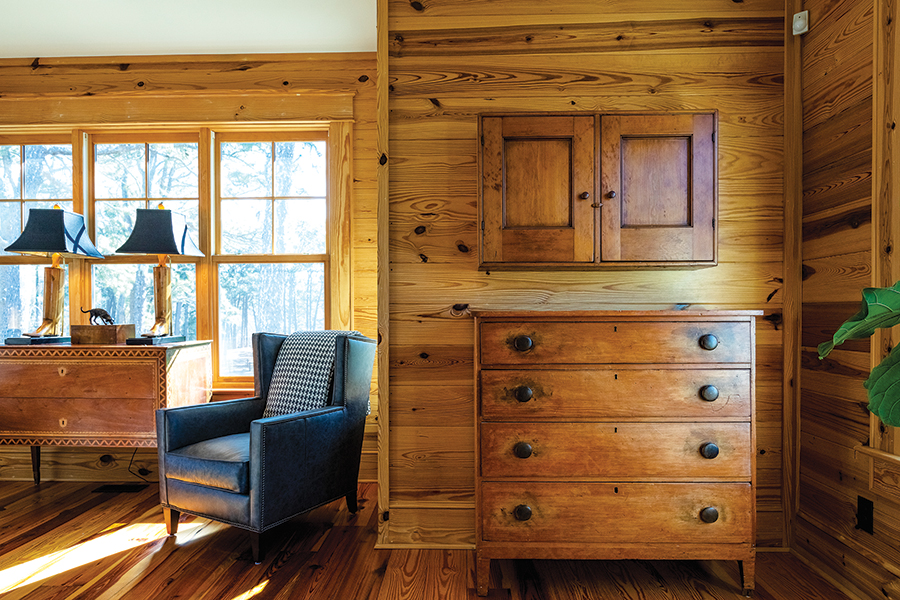
Colors, no surprise, reflect the earth and its foliage. Furnishings, although spare, are not confined to one period. In the master suite, an Italian blanket chest with woven wood detail might be 400 years old — a wedding gift to Lynn’s great-grandparents. But the bed is a contemporary four-poster. Buck’s forward thinking extends to this suite surrounded on three sides by windows. The bathroom shower is wheelchair-accessible, with the tiled floor sloping toward the drain.
 

Lynn required an office for her photo library, also a tack room for equipment, riding apparel and ribbons. The house has two laundry rooms, one for people clothes, the other for horse-related washables. Her kitchen reflects training at a Swiss culinary school. It is vast, encompassing a family dining space, a worktable-island with outlets and shelves. Countertops are soapstone, cupboards rise to the ceiling, and wide, deep drawers contain more implements than an upscale kitchen boutique. These carpenter-made maple cupboards have been “distressed” by pounding with a horse bit. Lynn personalized the custom-made copper range hood by splotching it with vinegar and acid. Her appliances, however, are standard KitchenAid, and she bakes with an inexpensive hand mixer.

.

Where are the ovens? “In the butler’s pantry, to keep the kitchen from heating up,” Lynn says. Here also is her pet appliance: a Scotsman brand under-the-counter maker of ice pellets, not cubes. “I built this kitchen around it.”

What’s missing? “We don’t watch TV,” Lynn says. “Too much bad news.” One is mounted in a screened porch; another in the guest apartment, none in the house proper.

The result: a home crafted as much for expression as shelter; spacious yet borderline bare, which makes each table, cabinet, painting and rug pop. A home that accommodates dogs and horses, welcomes guests who speak riding and putting — then cool off in a pool resembling a pond. An interior where Mother Nature plays drama queen with wood, stone and other natural materials. Nothing frilly or fluffy. No pastels or brights, except in the garden. Everything planned, engineered, durable, agreed upon by both parties, with no thought of norms or resale. 

“This is our last house,” pronounces its chatelaine. “I plan to die here . . . happy.”  PS

Birdwatch

Cleanup on Aisle 2

The vulture’s role in the ecosystem

By Susan Campbell

Vultures: All of us have seen them. Maybe it’s been passing a group feasting on a recently killed animal by the side of the road. Or, more likely, you have spotted an individual soaring overhead on long, outstretched wings. These odd looking birds are too often misunderstood and even disliked — for nothing more than their appearance. In actuality, they are fascinating creatures that perform a vital role in the ecosystem: They are Mother Nature’s cleanup crew.

Often referred to generically as “buzzards,” vultures are part of a family of birds found worldwide with dozens of species, including South American condors. Here in North Carolina, we have both turkey and black vultures year-round. Individuals from farther north significantly boost flock numbers in the cooler months. These large black scavengers lack feathers on their heads: likely an adaptation to feeding almost exclusively on carcasses. Turkey vultures are the more common species from the mountains to the coast. Soaring in a dihedral (v-shaped profile) on long wings with silver linings, they have red heads and long tails for steering.

Black vultures, however, have gray heads and white patches on the under-wing as well as somewhat shorter wings and tails. As a result, they soar with a flatter profile and fly with snappier wing beats. This species has really expanded across the Piedmont in recent years, perhaps due to development, increased road building and the inevitable roadkill that results.

The winter brings vultures together in what can be impressive roosting aggregations that are known as “wakes.” These groups can build to 100 or more individuals of both species that will roost close together in a particular spot: night after night during the season. Late in the day, they will gather in mature trees with larger branches capable of holding significant weight. It is easy to spot them on tall snags or sitting side by side on communication towers. Given the human tendency toward neatness, there are fewer and fewer dead trees for the birds to utilize — so they have been forced to use manmade perches. They may choose rooftops and this can, believe it or not, include people’s houses.

It is not obvious as to why they choose the locations that they do each winter. Given the ease at which they roam in search of food, proximity of their next meal seems rarely a concern. They are capable of gliding and soaring many miles each day. No doubt they require a location with a substrate that warms readily in the morning sun to provide the updrafts they require to reach cruising altitude. Vultures do need a perch that is open enough to allow them to spread their wings on takeoff. This is likely why they are found roosting in more open environments.

For those living near a vulture roost site, be aware that the birds seldom use the same location for more than one season. This could be for reasons of cleanliness or to perhaps reduce the chances of predation — but we really do not know. Also, do not expect that the wake will persist beyond early spring. The group will break up and head off to their breeding grounds by late February or early March. Using prevailing southerly breezes, they will be carried back north in short order.

Although we do have small numbers of breeding vultures in the Piedmont and Sandhills of North Carolina, they are widely dispersed and are quite secretive during the nesting season. Unless they are on the wing, sniffing out (yes, they use their noses more than their eyes) their next meal, they may go completely overlooked.  PS

Susan Campbell would love to receive your wildlife sightings and photos. She can be contacted at susan@ncaves.com.

PinePitch

Drawing by Addyson Hennessy (Grade 5), Aberdeen Elementary School

Chip Off the Old Masters

The annual Young People’s Fine Arts Festival at the Campbell House Galleries, 482 E. Connecticut Ave., Southern Pines, opens at 5 p.m. on Friday, March 4, highlighting the artwork of students in grades K-8 in Moore County’s public, private, charter and home schools. The art will be judged and awards given at a special reception and award ceremony. For more information call (910) 692-2787 or go to www.mooreart.org

Call me Crazy

The Sandhills Repertory Theatre presents Always . . . Patsy Cline, a tribute to the legendary country singer who died tragically in a plane crash at the age of 30. The show is based on a true story about Cline’s friendship with a fan from Houston named Louise Seger. Filled with down-home humor and classic tunes, opening night is March 4 at 7:30 p.m. at the Bradshaw Performing Arts Center, 3395 Airport Road, Pinehurst. Additional shows are March 5 and 6 at 2 p.m.
For more information go to wwwticketmesandhills.com or www.sandhillsrep.org.

The Ultimate Tutu

The Bolshoi Ballet streams its way onto the stage of the Sunrise Theater, 250 N.W. Broad Street, Southern Pines, on Sunday, March 6, with its performance of Swan Lake, Pyotr Ilyich Tchaikovsky’s iconic ballet — panned when it debuted in March of 1877 — about a princess turned into a swan by an evil sorcerer. Sounds can’t-miss to us. For more information call (910) 692-3611 or visit www.sunrisetheater.com.

Finger Lickin’ Good

Order a tasty springtime meal and support the Given Memorial Library at the same time on Tuesday, March 22. Elliott’s on Linden will be doing all the cooking for you. Given to Go ticket sales begin March 7 and close March 18. Dinner can be picked up at the library, 150 Cherokee Road, Pinehurst, between 5:30 p.m. and 6:30 p.m. The cost is $24 per meal. For info call (910) 295-3642 or email giventufts@gmail.com.

Jazzing up the Great Room

Trombonist and composer Ryan Keberle has performed with Maria Schneider and Wynton Marsalis; with Beyoncé, Justin Timberlake, and Alicia Keys; with Pedro Giraudo and Ivan Lins. He’s even played in the house band for Saturday Night Live. On Wednesday, March 9, Keberle and his progressive modern jazz band Catharsis will be in the great room at Weymouth at 7 p.m. Doors open at 6. For more information and tickets go to www.weymouthcenter.org.

Walk This Way

The village of Pinehurst will hold its annual St. Patrick’s Day Parade on March 12 at 11 a.m., in or around Tufts Memorial Park, 1 Village Green Drive, Pinehurst. So, OK, it’s not actually St. Patrick’s Day, but it is a weekend, and the ACC basketball tournament finals won’t start for a while, and there will be festive parade entries and plenty of Irish cheer, so why not get a jump on the celebration? For additional information go to www.vopnc.org/events.

Dig This

If you’re in the over 55 set, dress in your favorite green thumb outfit and celebrate St. Patrick’s Day on Thursday, March 17, by touring some of Moore County’s most beautiful gardens from 11 a.m. to 1 p.m. Bring your own transportation and munchies for a post-tour picnic at the Sandhills Horticultural Gardens, 3395 Airport Road, Pinehurst. For more information call (910) 692-7376.

Someone’s Idea of Fun

FirstHealth Fitness of Pinehurst will host a free 5K Fun Run on Saturday, March 26, along the greenway trails. This is a timed event with staggered starts in small groups to maintain social distancing. Of course, if you really want to socially distance yourself, just go very, very slowly. For more information and registration call (910) 715-1800.

Nobody Expects the Spanish Inquisition!

For the first time, the Metropolitan Opera presents the original five-act French version of Giuseppe Verdi’s epic opera Don Carlos, the tale of doomed love among the royals, set against the backdrop of — you guessed it — the Spanish Inquisition. The performance streams at 12 noon on Saturday, March 26, at the Sunrise Theater, 250 N.W. Broad St., Southern Pines. For additional information call (910) 692-3611 or go to www.sunrisetheater.com.

Jazz on the Grass

Shana Tucker and ChamberSoul will be performing outdoors at a jazz brunch on Sunday, March 27, from 11:30 a.m. to 2 p.m. at the Weymouth Center for the Arts and Humanities, 555 E. Connecticut Ave., Southern Pines. For more information visit www.weymouthcenter.org.


Bookshelf

March Books

FICTION

The Great Passion, by James Runcie

In 1727, Stefan Silbermann is a grief-stricken 13-year-old, struggling with the death of his mother and his removal to a school in distant Leipzig. Despite his father’s insistence that he try not to think of his mother too much, Stefan is haunted by her absence, and to make matters worse, he’s bullied by his new classmates. But when the school’s cantor, Johann Sebastian Bach, takes notice of his new pupil’s beautiful singing voice, Stefan’s life is permanently changed. A meditation on grief and music, The Great Passion is an imaginative tour de force.

How Strange a Season, by Megan Mayhew Bergman

With flawless intuition and depth, Bergman presents an unforgettable story collection featuring women seeking self, identity, independence and control of their circumstances. Each page crackles with life: A recently separated woman fills a huge terrarium with endangered flowers to establish a small world only she can control in an attempt to heal her broken heart; a competitive swimmer negotiates over which days she will fulfill her wifely duties, and which days she will keep for herself; a peach farmer wonders if her orchard will survive a drought; and, generations of a family in South Carolina struggle with fidelity and their cruel past, some clinging to old ways and others painfully carving new paths. Bergman’s provocative prose asks the questions: What are we leaving behind for our descendants to hold, and what price will they pay for our mistakes?

Sunflowers Beneath the Snow, by Teri M. Brown

When Ivanna opens the door to uniformed officers, her tranquil life is torn to pieces, leaving behind a broken woman who must learn to endure cold, starvation and the memories of a man who died in the act of betrayal. Using her thrift, ingenuity and a bit of luck, she finds a way to survive in Soviet Ukraine, along with her daughter, Yevtsye. The question remains: Will she be strong enough to withstand her daughter’s deceit and the eventual downfall of the nation she has devoted her life to?

NONFICTION

The Other Dr. Gilmer: Two Men, a Murder, and an Unlikely Fight for Justice, by Benjamin Gilmer

In a powerful true story expanding on one of the most popular This American Life episodes of all time, a rural physician learns that a former doctor at his clinic committed a shocking crime, leading him to uncover an undiagnosed mental health crisis in our broken prison system. When family physician Dr. Benjamin Gilmer began working at the Cane Creek clinic in rural North Carolina, he was following in the footsteps of a man with the same last name. His predecessor, Dr. Vince Gilmer, was beloved by his patients and community — right up until the shocking moment when he strangled his ailing father and then returned to the clinic for a regular day of work.

Poor Richard’s Women: Deborah Read Franklin and the Other Women Behind the Founding Father, by Nancy Rubin Stuart

In a vivid portrait of the women who loved, nurtured and defended the thrifty inventor-statesman of the American Revolution, Poor Richard’s Women reveals the long-neglected voices of the women behind Benjamin Franklin, America’s famous scientist and Founding Father who loved and lost during his lifelong struggle between passion and prudence. What emerges from Stuart’s pen is a colorful and poignant portrait of women in the age of revolution.

CHILDREN’S BOOKS

The Ogress and the Orphans, by Kelly Barnhill

It’s difficult to be kind in an unkind place, but being a good neighbor means you may have to do the difficult thing sometimes. The Newbery Award-winning Barnhill has written another literary masterpiece destined to become a classic for discerning readers both young and old. (Ages 10-14.)

Pretty Perfect Kitty-Corn,
by Shannon Hale

True friends are as precious as the last cookie, but as Unicorn finds out, you don’t have to be perfect to be the perfect friend. Hale and illustrator LeUyen Pham have teamed up for another fun, rhyming Kitty-Corn tale that guarantees giggles. (Ages 4-7.) Meet the author and illustrator at The Country Bookshop, Wednesday, March 9, at 4 p.m.

Snail’s Ark, by Irene Latham

Kangaroos, zebras, lions, elephants — we all know they came on the ark two-by-two, but what about the snails? As it turns out, when the weather turns rough and the creek begins to rise, snails stick together. (Ages 3-6.)

A Grandma’s Magic, by Charlotte Offsay

When a baby is born, a magical thing happens: A grandma is born too, and she is instantly granted so many magical powers. Celebrate grandma magic with this oh-so-cute homage to the one who loves us best in the world. (Ages 3-6 and 45-98.)

Swim, Duck, Swim!, by Jennifer Harney

In the pond, not everything always goes as planned. When it’s duck No. 3’s turn to swim . . . she improvises. A cute take on being yourself and doing your best, this adorable title is perfect for Easter or any time young readers are struggling to fit in. (Ages 2-5.)  PS

Compiled by Kimberly Daniels Taws and Angie Tally.

The Creators of N.C.

The Lost Treasure of Home

Jonas Pate and his runaway hit Outer Banks

By Wiley Cash

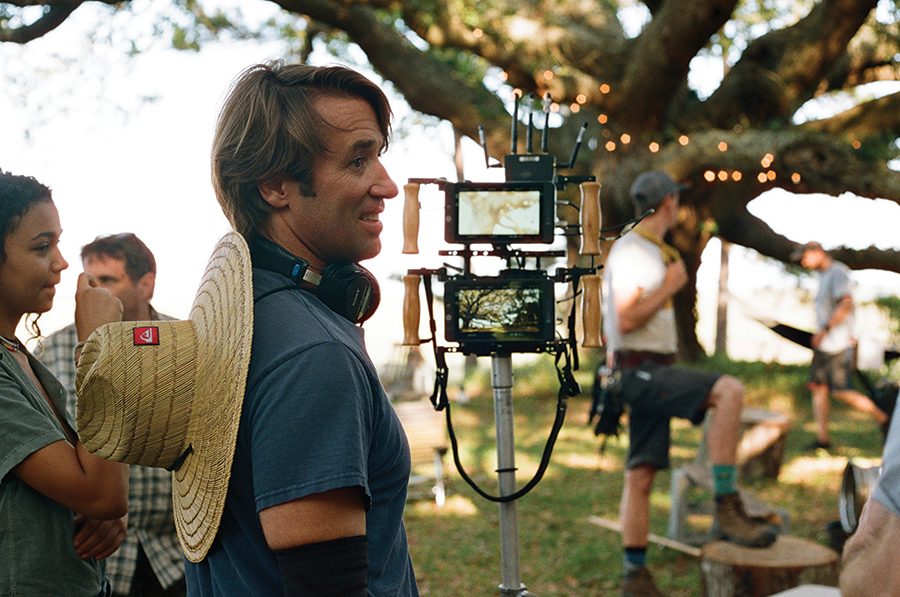
While there is plenty of mystery in the breakout Netflix smash hit Outer Banks — everything from a father lost at sea to a legendary treasure — the mystery that director and co-creator Jonas Pate seems most intent on exploring is the age-old mystery of what divides people along class lines. It worked for Shakespeare with his Montagues and Capulets, and 370 or so years later it worked again for Bernstein’s and Sondheim’s Jets and Sharks. Pate’s rival groups are similarly aged, sun-kissed teenagers living and partying along North Carolina’s Outer Banks, where a group of working class kids known as the “Pogues” continually find themselves marginalized and dismissed by the “Kooks,” who are the children of wealthy residents and seasonal tourists. Fists and hearts certainly fly, but despite the show’s use of cliffhangers and action-packed sequences, at its core Outer Banks investigates the emotional and experiential threads that pull some of us together across class lines while invisible barriers push others of us apart.

According to Pate, the divide between the haves and the have nots is “the oldest story in the world. It cuts across everything,” which he believes explains the show’s broad appeal.

Broad indeed. In the late spring of 2020, just as the people of the world were settling into the pandemic and the realization that they did not want to see or hear another word about Tiger King and Joe Exotic, Outer Banks debuted in mid-April and quickly became one of Netflix’s most watched shows of the year. The following summer, the show’s second season hit No. 1 on the Nielsen report. The success seemed immediate, and the show’s slick production quality made it all appear as easy and relaxed as a day on the water, but Jonas Pate and his twin brother, Josh, with whom he created Outer Banks along with Shannon Burke, had spent their whole lives preparing for this moment.

The Pate brothers grew up in Raeford, North Carolina, where their father served as a judge and their grandfather owned a local pharmacy. “It was amazing,” Jonas says. “It was like Mayberry. I’d ride my bike to the pharmacy and get a Cherry Coke and a slaw dog, and then I’d visit my dad at the courthouse. My stepmom was head of parks and recreation, so I’d go over there and help ref T-ball games.”

We are sitting on the second-story porch of the home he shares with his wife, Jennifer, and their two teenage children in Wilmington, just across the water from Wrightsville Beach. The January morning is unseasonably warm and sunny, and Jonas is dressed as if he just stepped off the set of Outer Banks, not as its director but as one of its stars. (How handsome is Jonas Pate? A few days later, our 5-year-old daughter will walk past Mallory’s computer while she is editing photos of Jonas. She will stop in her tracks and ask, “Who is that?”)

Jonas’ surfer appeal is not surprising considering that while he primarily grew up in Raeford and attended high school there, he spent his summers with his mother along the barrier islands near Charleston. “Outer Banks is an amalgam of different high school environments and things that we went through,” he says. “It helped create the mythical environment of Outer Banks where we kind of knew what it was like to live feral in a small town with haves and have-nots. Kiawah and James Island were like that. It was poor kids and rich kids, and they would get into fights. And Raeford is still very rural.”

Rural, yes, but Jonas and Josh still found plenty to keep them busy. If they were not exploring the marshes and waterways off the coast of Charleston, then they were shooting homemade movies back in Raeford, where they made films of Robin Hood and Hercules and edited them by using two VHS machines. He laughs at the memory of it. “The cuts were terrible and fuzzy,” he says, “and all the special effects and sound were awful.” But he admits that something felt and still feels magical about it. He had always loved film, especially those by Steven Spielberg and Frank Capra, saying that he has “always been drawn to filmmakers who are a little sweeter and have a little more heart.”

After college, the brothers found that they still had the desire to make films, but they did not know how to break into the industry. “We didn’t know anyone in the film business,” he says. “We didn’t know anything.”

The brothers moved to New York and worked to immerse themselves in the city’s film culture. While interning at the Angelika Film Center, Josh met Peter Glatzer, who was a fundraiser for the Independent Feature Project. They talked about screenwriting, and the Pate brothers soon had a script that Glatzer was interested in producing. Their first film, The Grave, was shot in eastern North Carolina, and while it did not receive a theatrical release and went straight to video after premiering on HBO, the Pate brothers had their collective foot in the door. In 1997, they made another North Carolina-shot film with Glatzer, The Deceiver, that starred Tim Roth and Renée Zellweger, and it found a larger audience after debuting at the Venice Film Festival and being distributed by MGM. The brothers headed for Los Angeles.

Once there, Jonas found himself “taking jobs just to pay the bills” and “getting further and further away from what I actually wanted to do.” One bright spot of his time in LA was meeting his wife, Jennifer, who also worked in the industry as a casting agent. Not long after they met, Jennifer started her own agency, and Jonas went to her for assistance in casting his first television show, Good vs. Evil, in 1999. From there he went on to direct and produce a number of television shows, including the NBC shows Deception and Prime Suspect and ABC’s Blood and Oil. In 2005, the Pate brothers partnered again and returned to North Carolina, where they filmed a single season of the television show Surface, which they co-created. After having kids, Jonas and Jennifer decided to move back to North Carolina in time for their son and daughter to attend high school. Jonas suddenly found himself on the other side of the country from the industry he had devoted his life to for the past 20 years.

But then something magical happened. Jonas understood two things: First, he needed to create something that could be shot on the coast so he could stay close to home. Second, he would draw from his own experiences to make it real. “When I pulled from my own life instead of the movies I’d seen, it all came together,” he says. “You get to the universal by being super specific.”

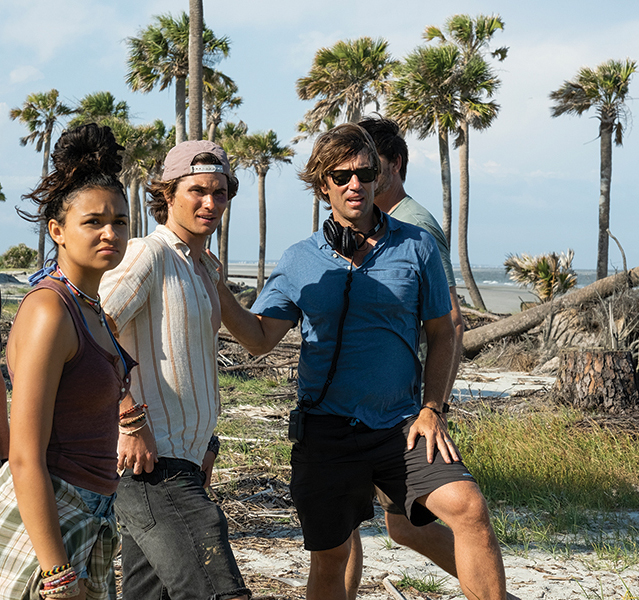
One big challenge that Jonas and his team encountered was casting the show’s young stars. “We auditioned maybe 500 or 600 kids, and we really had to try to find kids who’d been outside and lived in the outdoors.” Not surprisingly, given the Pate brothers’ personal ties to the show’s geography, nearly every star they cast was from the South, except for one who hailed from Alaska. “Growing up outside, being around boats,” Jonas says, “it’s hard to fake that stuff, and it’s hard to make it look real if it’s not.”

I turn off the recorder and Mallory packs up her photography gear, and we say our goodbyes to Jonas. He is leaving soon for another production set. We share a number of mutual friends in Wilmington with him and Jennifer, and we talk about getting together for dinner once he returns.

Mallory and I are alone in the driveway when I realize that I have locked the keys in our car. To say that I was embarrassed — and, let’s be honest, panicked — would be an understatement. Mallory pulled out her phone and began searching for a locksmith. I have a flip phone, so I just stood there, weighing the two most logical options: breaking the window with one of Jonas’ landscaping rocks or just leaving the car and walking home, denying it was ever ours.

I cannot help thinking that if I were John B., the star of Outer Banks and leader of the Pogues, played by Chase Stokes, I would sneak into a neighbor’s garage and hotwire their car, drive home, procure a backup set of keys, and return for Mallory while passing under the investigating deputy’s nose. Or, if I were Topper, the leader of the Kooks, played by Austin North, I would bang on Jonas’ door and use his phone to call my father’s car service. But I am neither of these characters. I’m just me, so I apologize again to Mallory, and we wait for the locksmith together.  PS

Wiley Cash is the Alumni Author-in-Residence at the University of North Carolina Asheville. His new novel, When Ghosts Come Home, is available wherever books are sold.

The Kitchen Garden

Pot ’o Green

Light up your early spring

By Jan Leitschuh

What’s prettier than a pot of pansies, satisfies our primal March longing for St. Paddy’s Day green, and is edible too?

’Tis the leafy stuff! Frilly, lacy, colored, savoyed or freckled greens.

It’s the cusp of spring. Sure, and isn’t it time you scratched that grand gardening itch and treated yourself to a salad greens planter?

Granted, “prettier than pansies” is a wee stretch, but pansies won’t shake off their winter doldrums and hit their glory days until later in the month. Don’t we just need some fierce vernal cheerfulness? Cheaper than a bouquet of flowers, a greens tub or planter can light up your springtime front-step pots or window boxes.

Most spring greens such as spinach, various cheerfully hi-colored lettuces, kale, arugula, candy-stemmed chards, collards and more — herbs such as parsley or mint, even broccoli, onions or cauliflower — are moving onto the shelves of local plant vendors. Available in 4- or 6-packs, the greens are well-started and offer instant gratification and useful design elements.

Those of you with a patch of good ground can skip all the container folderal and save some money by buying a seed packet or two. Till up the spot, add lots of compost (or well-aged manure — most greens are heavy feeders) and sprinkle your seeds. Pat them into the soil with the flat of your hand and keep lightly watered if the rains don’t fall.

You should have greens o’plenty in your cutting garden in April. May the rows rise up to meet ye!

However, not everyone is blessed with that grand patch of good ground, and why should you miss out on one of the oldest rites of spring? Mix lots of mature compost into the soil of your planting vessel. A premixed potting soil with fertilizer included will surely bring the luck of the Irish.

As long as it has good drainage and holds an adequate amount of soil, the container doesn’t much matter, does it?

Humble or classy? You can spark up a fancy glazed ceramic pot for the front step, populate a wooden window box, stuff a whisky barrel half, hide a lined laundry basket among some small shrubs, or just use some larger black plastic planting pots.

Just mind the three aspects of good container design: thriller, filler and spiller.

Your thriller element will offer some height and an upright element to catch the eye, won’t it now? Pick a tall, strong-leaved and substantial plant such as dark green dinosaur kale to anchor your salad pot or planter. A twig framework anchored in the middle might support springtime’s garden candy, edible-podded sugar snap peas.

Another vertical option might be a tall trio of rainbow Swiss chard, with its candy-colored stalks. Romaine or certain young collard plants might work, if you can find them. Onion and garlic greens give a similar upright effect.

The middle layer, or “filler,” is your workhorse. Stuff in plants of nutritious spinach, lettuce and spicy arugula. So many pretty lettuces to choose from! Pinch off a few leaves to fill out your salad or green smoothie.

Another option — add in the different textures of herbs that favor spring temperatures. Dark green parsley is a perfect companion, handsome set against the frilly lime greens and burgundies of lettuces, and useful in cooking. Mints and cilantro also do well in the spring before the days heat up.

The “spiller” layer that softens the pot edges and drapes over the side will be a little harder to find for a springtime pot. Perennial herbs such as thyme droop nicely but are barely leafing out. Edible flowers like nasturtiums might work. You could deploy a small pot of ivy for its draping effect, and let it grow in situ for your summer pot creation.

When the temperatures heat up, greens tend to go gagging about the place and turn bitter, switching from the vegetative to the reproductive stage. Diehard gardeners might permit this and save the seeds (or allow for a less-reliable self-sowing). The small yellow flowers on stalks have their own delicate beauty.

But it’s perfectly fine if you pull out the spent greens and toss them on the compost heap. Then plant yourself a summer tomato, a bell pepper — or go full floral for your summer display. Until then, sláinte!  PS

Jan Leitschuh is a local gardener, avid eater of fresh produce and co-founder of Sandhills Farm to Table.

Poem

What The Moon Knows

She knows shadow, how to

slip behind clouds. She’s perfected

the art of disappearing. She knows

how to empty herself into the sky,

whisper light into darkness.

She knows the power of silence,

how to keep secrets, even as men

leave footprints in the dust, try to claim her.

Waxing and waning, she summons

the tides. Whole and holy symbol,

she remains perfect truth, tranquility.

Friend and muse, she knows the hearts

of lovers and lunatics. She knows 

she is not the only one that fills the sky,

but the sky is her only home.

  Pat Riviere-Seel

Pat Riviere-Seel is the author of When There Were Horses

Hometown

The Boys of Spring

Toting dreams of breaking par

By Bill Fields

We were a mostly scrawny bunch dressed in sharp collars and loud pants, convinced that with a bit more practice and little more luck, we could be the next Tom Watson. This ignored the fact that most of us on the Pinecrest Patriots boys golf team during the mid-1970s considered breaking 80 an excellent day, but there was no point in letting the facts get in the way of our dreams.

By this time of year, the season would have begun after a couple of weeks of practice. Cool weather wasn’t a problem. If one of those cheap nylon jackets didn’t do the trick, there was always orlon or velour on reserve. My first match during my sophomore year, on March 3, 1975, happened to coincide with my parents’ anniversary. That evening Dad splurged on dinner for the three of us at Cecil’s in the Town and Country Shopping Center. The steak was better than my score, 84.

Pinehurst No. 1 was our home course for practice and matches, and I came to know it well over those years of preparation and competition. I even prepared a rudimentary yardage book in a First Union pocket calendar. There was the fear of the O.B. fence to the right of the opening fairway and the fun of trying to bag an early birdie on the reachable par-5 fourth. In those years No. 1 concluded with a short par-3. Everyone who had finished would gather around the green, a rare gallery that made the 8- or 9-iron shot harder — and the walk to the parking lot longer if you botched it and bogeyed.

Despite my familiarity with the course, the best I shot there — or anywhere else during prep play — was 72 during a match senior year as the team combined for a four-man total of 292, a school record at that point in Pinecrest’s young history. Although we were proud Patriots that particular Monday afternoon, more recent generations would scoff at our scores. Pinecrest’s young men and women have won multiple state titles in recent years, becoming the powerhouse you would have thought prep golfers in a golf-rich area would have been all along.

We made it to the state tournament once, in 1975, which in those years was played at Finley Golf Course in Chapel Hill. Shooting an opening round 89 was bad enough, but that evening, while we were horsing around outside after eating, I got stung by a wasp over my left eye. By morning, it was swollen partly shut, which didn’t help my cause. It is never a good sign when you don’t have enough fingers to signal how many over par you are to a teammate in an adjacent fairway. I played terribly on the front nine, shooting 52.

But the eye started to get better as I made the turn, and I vowed to turn things around to avoid complete embarrassment. Somehow, I did, making three birdies, three pars and three bogeys to shoot an even-par 36 and break 90. If that 16-stroke improvement between front and back isn’t a state record, it must be in the neighborhood.

Golf was not a priority at the school. The football team got a sit-down pre-game meal of steak and potatoes at Russell’s before its Friday night game. Our golf coach stopped the station wagon or van at McDonald’s as we traveled to an away match. As for staying hydrated during a round, we hoped there was a functioning water fountain somewhere on the course.

Two of the courses we played in conference matches — Arabia in Hoke County and Richmond Pines in Rockingham — closed years ago. Others remain, such as Scotch Meadows in Laurinburg and Pinecrest Country Club in Lumberton. Quail Ridge, in Sanford, home to the sectional tournament my sophomore and junior years, is still around. So is the Sanford Municipal Golf Course, site of the sectional in May 1977 during my senior year.

The good form that I’d shown earlier that season was gone by the time we arrived in Lee County trying to advance to the state tourney. I was not going to be the next Tom Watson after all. Our fourth-best score that day as the team successfully advanced was an 85, so I was north of that. I believe I shot 89, or it could have been even higher. My high school golf career ended not with a whimper but to the sound of constant beeping from machinery at the nearby brick company. If the trucks were in reverse, so was my game, at just the wrong time.  PS

Southern Pines native Bill Fields, who writes about golf and other things, moved north in 1986 but hasn’t lost his accent.

The Creators of N.C.

Red Clay and Jewels

Jaki Shelton Green captures the beauty and cruelty of humanity

By Wiley Cash    Photographs by Mallory Cash

To read the work of North Carolina Poet Laureate Jaki Shelton Green is to know exactly where her inspiration comes from; it comes from the red clay of Orange County, North Carolina, where a little girl leaves footprints in the dirt as she follows her grandmother down to the water’s edge, fishing pole in hand; it comes from the silence of held breath as parents hide their children beneath the pews of a darkened church while the Ku Klux Klan encircles the building; it comes from the peace and grandeur of a community-owned cemetery on a warm winter day when the past, present and future stretch out on a continuum that can be seen and felt. You can open almost any page in Jaki’s numerous collections of poetry and plant your feet firmly on that same red clay, witness the suffocating fear of racial terror, and feel the healing energy of the dead as they gather around you.

I’ve known Jaki for years, mostly as a fellow writer at various festivals across the state. I’ve also hosted her for my own literary events when I needed the kind of in-person power that only a writer like Jaki can bring. To witness her read her poetry is akin to witnessing a god touching down on Earth to opine on the beauty and brutality of humanity. But I had never visited Jaki’s home, nor had I ever joined her on her native soil in Orange County.

When my family and I pulled into the driveway of the neatly kept ranch home where Jaki lives with her husband, Abdul, she immediately opened the door to her writing room and welcomed us with a wide smile. Inside, morning light poured through the windows on the east side of the room. In the center sat a long table where Jaki’s laptop was open as if she’d just paused in her work. Books were stacked throughout the room, not as if they were being stored, but as if they were being read, the reader having taken a break here to pick up another volume there. Art adorned the space: paintings, framed jewelry, sculpture, photographs.

I smiled as my eyes took in the room.

“Jaki, this is exactly where I thought you’d live,” I said.

“You should’ve seen it when I bought it,” she said. “I think it had been condemned, but this was the house I wanted. My family begged me not to buy it.”

It was nearly impossible to believe that this place so clearly suffused with peaceful, creative energy had ever been absent of life, but perhaps that speaks to the regenerative power of Jaki’s spirit.

“Years ago, I bought this house just before Thanksgiving,” she said, “and then I got to work on it. By the holidays I was ready to host our family Christmas party.”

Jaki took a seat at her writing table while my wife, Mallory, unpacked her photography gear. I followed my daughters into the living room, where Abdul set down a small cradle full of handmade dolls for our daughters to play with. He and Jaki have a 3-year-old granddaughter, and they are used to having small children underfoot. Later, as Abdul prepared breakfast for Jaki’s 105-year-old mother, who lives with the couple, he patiently listened as my first-grader shared with him the moment-by-moment intricacies of her school day while my kindergartner crawled on the kitchen floor, answering only to the name “Princess Kitty.”

“How did you and Jaki meet?” I asked him.

He smiled. “I was working in a furniture store, and Jaki came in. It didn’t seem like anyone else was interested in helping her, so I asked her what she was looking for. She said, ‘I don’t need help, brother. I know how to look for furniture.’”

He finally got Jaki to share that she was in the market for a fainting couch, and that only made him more interested in her. “I found out she was a poet,” he said, “and I went to the bookstore and bought some of her books, and then . . . ” He smiled and shrugged as if nothing more needed to be said.

Throughout the house, framed photographs of family members lined the walls, some of them recent pictures of grandchildren, others weathered black and white portrayals of family members who have been gone for decades. Jaki’s voice drifted into the living room, and I could hear that she was talking about her daughter Imani, who passed away from cancer in 2009 at the age of 38. I never met Imani, and I only know her through Jaki’s heartrending poem “I Want to Undie You,” but as I looked at the photographs throughout the house, I wondered if I was seeing photos of Imani at the same moment her mother was evoking her name. Jaki, as if sensing my search, called to me from her writing room.

“Do you want to go out to our family’s cemetery where Imani is buried?” Jaki asked.

“Of course,” I said, sensing that we were being invited into a sacred space. “Will it be OK if I ask you some questions out there?”

“That’s probably the best place for it,” she said.

We left Abdul behind to serve breakfast to his mother-in-law, and Jaki climbed into the passenger’s seat while Mallory squeezed between the girls and their car seats in the back. Jaki turned and looked at them. “So, you girls like jewels?” They nodded, and she opened her hand and dropped gorgeous, polished rocks into theirs.

The private cemetery where Jaki’s ancestors and other community members are buried sits just a mile or so up the road. Forests bordered the cleared land on both sides, and across the gravel road a crane stacked felled trees in a lumber yard, the low rumble of its engine edging through the air.

Jaki and I sat down on a bench that had been placed by Imani’s headstone by Jaki’s two surviving children. Jaki looked at the markers around her, the names on them so familiar that she didn’t even have to read them to know who rests there.

“I will never forget standing out here when my father was being buried, and my mom looked at Sherman (Jaki’s first husband) and me and said, ‘It’s all right, because y’all are going to have a baby next year.’ And we did.”

Jaki grew up in a close-knit community called Efland less than 7 miles away, where two A.M.E. churches anchored the community. Her family members were active at Gaines Chapel A.M.E., and it was there that Jaki was first encouraged to write by her grandmother, even though she wanted to be a scientist or an oceanographer.

“I was fascinated by the stories around me,” Jaki said, “especially what was happening on Sunday morning. As a child I would sit there and make up stories about people, and my grandmother gave me little notebooks to write in. I was very nosy, but I’ve come to understand that writers should be nosy. We should be nosy about everything.”

According to Jaki, she was not only nosy about the people in her congregation, she was nosy about the world around her, constantly asking questions like, “Where does the rain really come from?” and, “What makes dark dark?” You can see the questions in her poetry. In “I Wanted to Ask the Trees,” about the trauma of lynching in Black communities, she writes:

I wanted to ask the trees. do you remember. were you there. did you shudder. did your skin cry out against the skin of my great uncle’s skin.

“I want to tell stories of the South that are being erased and forgotten while reminding people that what’s nostalgic for some Southern writers is absolutely terror for others,” Jaki said. “White people talk about hound dogs in one context, but when we think about hound dogs we think about full moons and lynchings. When people talk about coon dogs, the coon was us.”

When I asked Jaki why she left the South as a young person, she made clear how complicated her exodus was for her and her family. She was kicked out of public school in Orange County for organizing and participating in a walkout after Black students demanded equity during school desegregation. Before readmitting her, the board of education insisted that she sign an affidavit promising that she would not participate in or encourage any acts of civil disobedience. Her parents, themselves active in political and social issues, saw the board’s demand as an infringement on their daughter’s rights. She was readmitted, but being branded a troublemaker made life harder than she deserved.

After being offered an academic scholarship to a Quaker boarding school called George School in Bucks County, Pennsylvania, Jaki headed north. For the first time in her life she was living outside the South and away from her family, surrounded by young people from all over the world, from different backgrounds and classes. “It took me leaving to really look back and see the entire landscape,” she said.

Although she’d written poetry from an early age, leaving home and encountering the work of Amiri Baraka, Sonia Sanchez and Nikki Giovanni made clear to Jaki the urgency of putting herself and her people on the page. Though away from home, she understood that life continued on in rural Orange County, the cycles of birth and death and political upheaval and cultural change never ceasing.

“If we don’t tell ourselves who we are, then someone else will tell us who we are,” she said.

Jaki and her first husband returned to the South after starting a family because they wanted their three young children to know their great-grandparents, to experience their wisdom and love, to know the place that had forged the lives of their ancestors.

Sitting in the cemetery where so many of those ancestors and Jaki’s daughter have been laid to rest, Jaki is clear-eyed about the journey that saw her exiled from public school in Orange County to visiting public schools across the state as North Carolina’s first Black Poet Laureate.

“There’s nothing magical about how I’ve arrived at this place,” she said. “It’s called working hard. It’s called having determination about what you want, and really knowing who you are.”

The little girl who wanted to be an oceanographer became a writer instead, still asking questions about the world around her, still investigating it, continuing to draft poetic reports on the place she has always called home, the landscape where inspiration takes root and ideas are born, nurtured, and recorded.

Wiley Cash is the Alumni Author-in-Residence at the University of North Carolina Asheville. His new novel, When Ghosts Come Home, is available wherever books are sold.