From Grit to Glory

Success comes home to Bonnie McPeake

By Deborah Salomon   •   Photographs by John Gessner


The lady is tall, dressed in elegant sportswear, with an exquisite complexion, sweet smile and soft Southern voice. She is known locally and nationally for achievements in the hotel industry. She drives a sporty Mercedes and lives in an urban-chic double-decker apartment overlooking the historic West Pennsylvania Avenue block which she owns — from Hotel Belvedere to Siblings Consignment. Otherwise a hard-edged businesswoman, she melts talking about her six grandchildren.

The ballad of Bonnie McPeake commences in West Virginia, where her parents and their 11 children crowded into a two-bedroom, one-bathroom (in the basement) house on a dirt road. “I’m the daughter of a coal miner and the wife of a coal miner,” she says in a voice tinged with pride and humility. Circumstances improved when her husband, Sam, was promoted to mine foreman. They were able to buy a house which, as it happened, financed their ticket out when, in 1982, Bonnie, Sam and their two small children migrated to Durham. Money from selling that house enabled them to purchase half ownership in a dingy motel, where the family lived in one room. “We slept on a bunk bed, Sam and I on the bottom, the kids on the top,” Bonnie recalls. Eventually they demolished “El Roach-O” and built a four-story hotel.

Business was good. They were ambitious. A guest told them about Pinehurst Motor Lodge, a likely fixer-upper on U.S. 1. They bought it and moved in 1990 to a three-bedroom ranch near Pine Needles.

“I think back on those years — we worked so hard all we thought about was survival . . .  but we were happy,” Bonnie says, wistfully.

Happy but not content, as least not residentially. Along the way, Bonnie had become a Realtor. Perhaps she wanted to wipe out the West Virginia two-in-a-bed image. “I’ve always had a long-term vision. I’m not afraid of dollar signs. All you really need is common sense.”

The vision changed when Sam suffered a stroke. “He wanted to be in the (Pinehurst) village,” Bonnie says. She bought a house that had been divided into three apartments, restored and renovated it, lived there for a while, then sold the now-desirable property. Sam still preferred the village: “There was this house behind us built in the 1880s that was vacant, with water damage and termites, but my son saw possibilities, so we bought it.” Bonnie and her son/business partner Sammy were learning the value of historic buildings. She then purchased the Pennsylvania Avenue property with the plan to rent the ground floor, now Wolcott’s, and create an apartment for them upstairs. “I said I’d put in a lift and an elevator but couldn’t convince Sam.”

Sam died in 2011, leaving Bonnie alone in their Pinehurst home.  “I’m a businessperson. I look at the bottom line. When I see a six-bedroom four-bathroom house I see dollar signs going out the door.”

So out the door she went — a successful young widow with ideas. She would fall back on plans to live over Wolcott’s in a veritable bird’s nest embraced by trees.

Although 160 West Pennsylvania Ave. looks like a residence, it was built in 1890 as Powell Furniture and Undertakers’ housing with a furniture showroom, casket storage and funeral director John Powell’s office — “vital commercial components of a growing health resort town,” according to information provided by the Moore County Historical Association.  However, citizens complained that “Powell’s open wagon rumbling down the streets with a casket (occupied) in full view set nerves a-jangling.”

The premises became Salem Dress Shop and, later, as Bonnie recalls, a lamp business.

But even after the Wolcott renovation the top two floors remained a shambles.

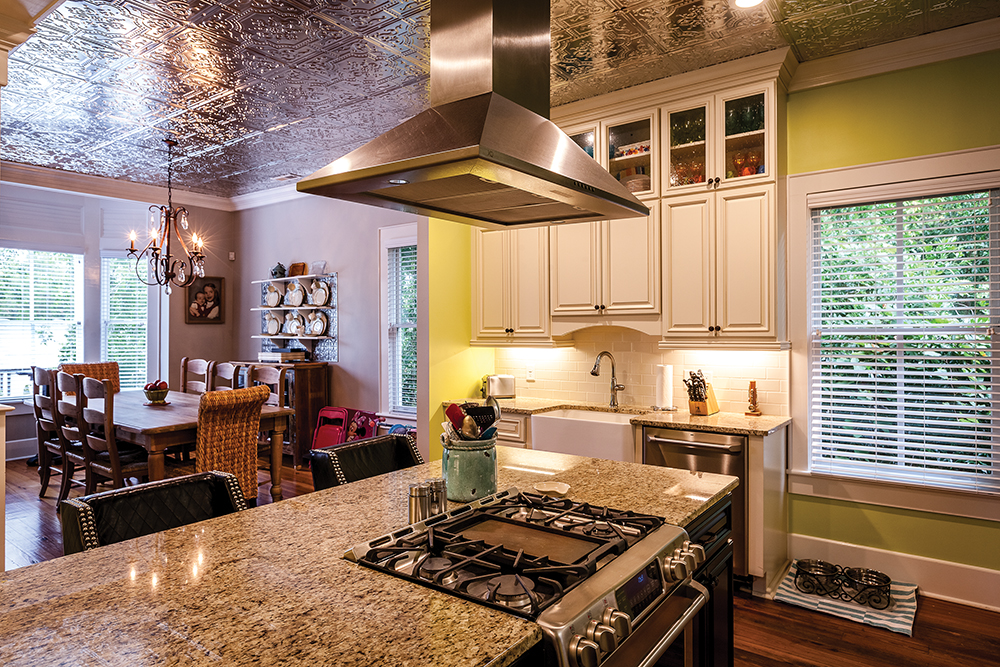
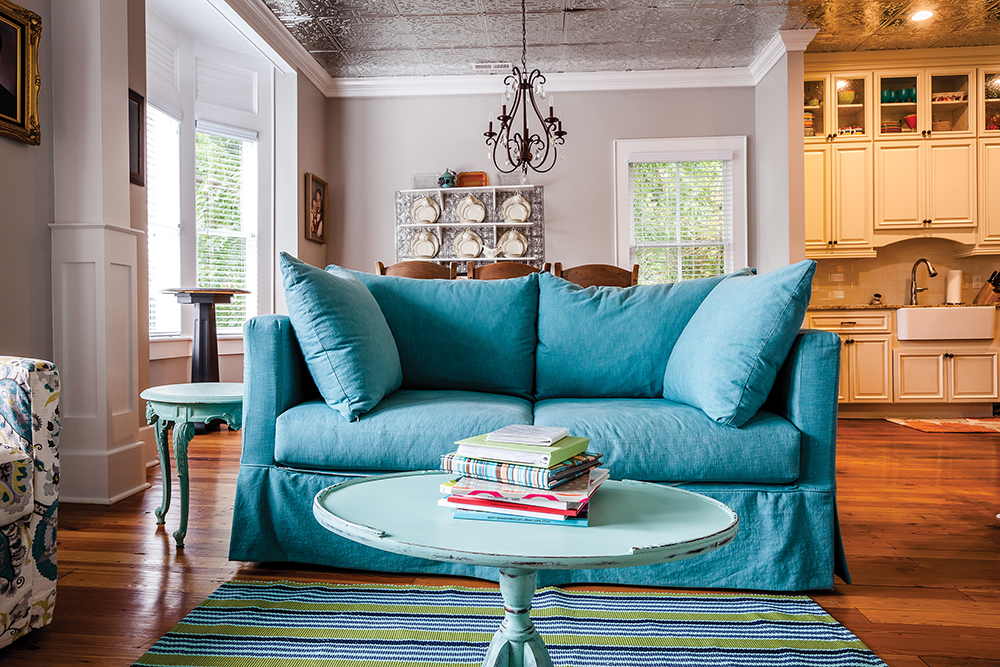
Bonnie rolls her eyes: “Everything had to be torn out. We had to install beams (to keep the third floor from falling).” This gave her the opportunity to create a lifestyle-friendly design yet “like it would have been,” with wide, plain woodwork, simple panel doors and high ceilings, some clad in unpainted tin. She did leave the original heart pine floors, although a 4-inch slope necessitated propping the downwind legs of her massive refectory table on blocks.

Once completed a whiff of antiquity lingered while everything else shouted “Now.”

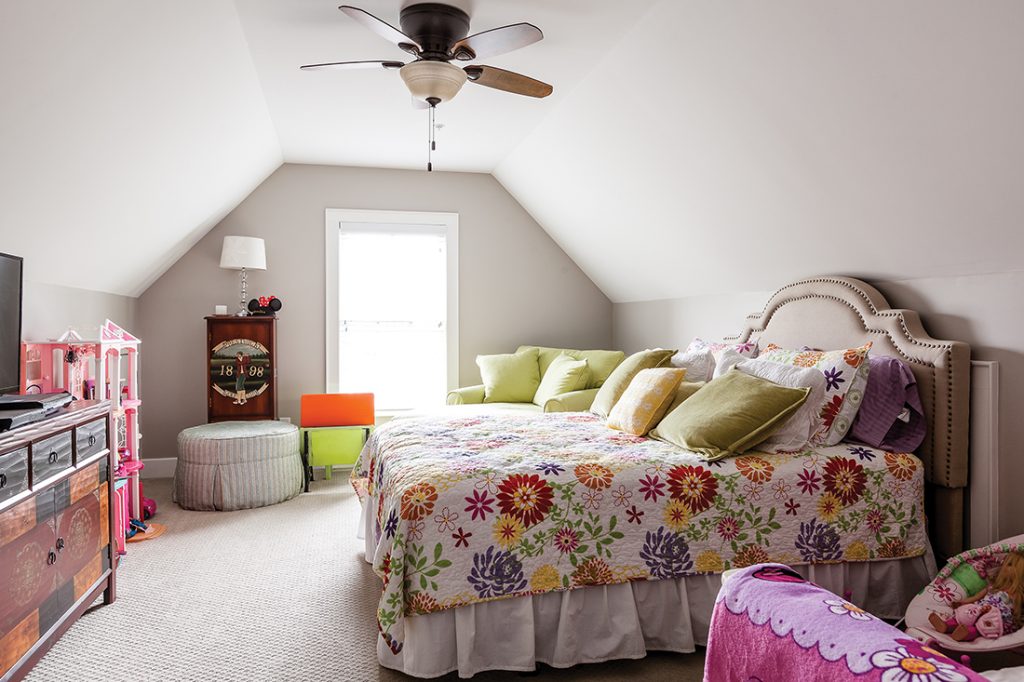
Bonnie gravitates to bright colors in zingy combinations, especially lime green (on walls and a double-wide chaise) and turquoise (living room love seats). Area rugs are summery, splashy patterns. Add hot pink and violet to the third floor suite devoted to her three young granddaughters, who love staying downtown with “Mee-Maw.”

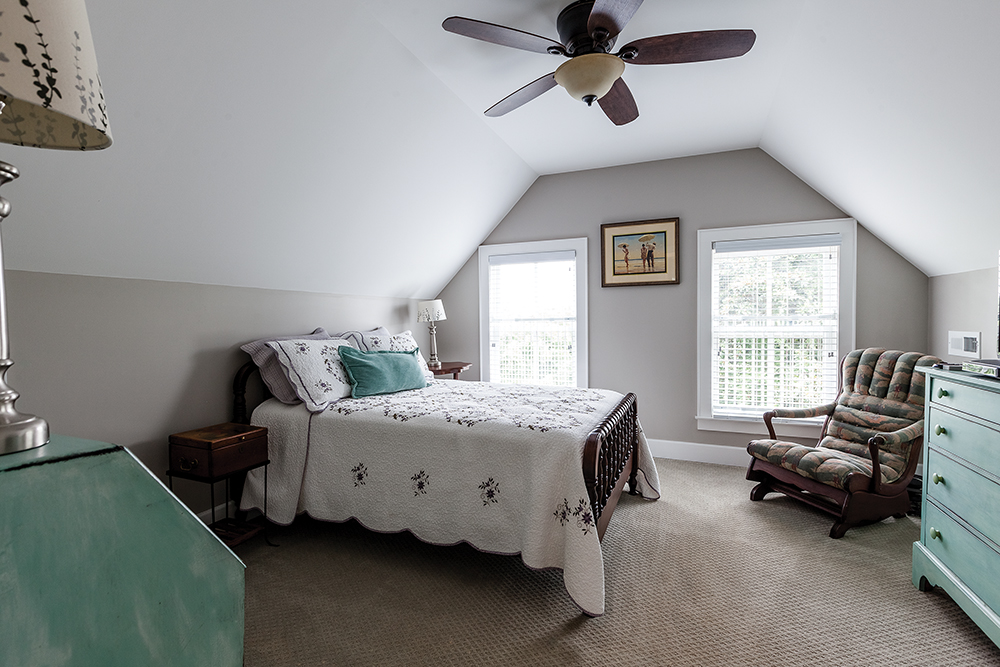
“We walk to the park and eat at the Ice Cream Parlor,” Bonnie says. She credits daughter Christa Gilder for décor advice including paintings, some by local artists, that continue her palette. Christa, given carte blanche, says, “My mother is very picky, but she trusts me. We like the same things.” Bonnie has perfected painting interesting old furniture with turquoise chalk enamel, then “distressing” the finish for a mod look.

“I was tired of antiques, from the houses in Pinehurst,” Bonnie says, although she chose a dark wood for the kitchen island to contrast with vanilla cabinetry — also a dark sleigh bed and case pieces in the master bedroom, which has soothing gray walls heightened by her signature turquoise in the bathroom.

Bonnie’s floor plan also surprises. A flight of 29 wide, steep steps inside the front door, 31 in a newly constructed back entrance lead directly into the kitchen, with the master suite a few steps beyond. Visitors must pass through the kitchen to reach the dining area, which flows into the living room with bay windows and original Juliet balcony. Bonnie sits there rarely, preferring the spacious terrace created by installing a roof over Wolcott’s screened porch. Leafy branches shield it from street view and noise. Here, she grills burgers while the grandbabies play in a sandbox.

Space beneath the staircase to the third floor has been fitted out as pantry and laundry.

“I have everything I need,” in only 1,500 square feet, Bonnie says.

That third floor is a paradise for her little princesses. Bonnie painted a school desk she found in the attic bright colors and refinished a rocker. The girls have bikes, a doll house, a giant bathroom and beds enough for sleepovers. From Mee-Maw’s home base they can smell the pizza, hear the trains and music, watch the parades, skip to the library, farmers’ market and playground.

McPeake’s project (which won a Southern Pines beautification award) implements trends that began in large cities and have finally reached small-town downtowns: urban renewal/redevelopment that concentrates people and services, reducing transportation time and costs. Her office is a 60 second walk from her home. The practice of “living over the store” has been glamorized by the owners of Casino Guitars on Broad Street. New-construction lofts, duplexes and townhouses suit retirees as well as young families. And people with the means and desire to repurpose classic buildings ensure their future.

Every ballad has a refrain. Bonnie’s might be “Keep movin’.”

“I don’t sit still,” she says. “I’m always doing something. I was up till midnight spraying a light fixture.” In fact, Bonnie suggests that getting there was more than half the fun; in business, rising from a West Virginia mining town to corporate headquarters and, likewise, from a crumbling casket showroom to a vibrant townie pad.

“I can still see what it looked like,” Bonnie says, scanning the results. “The exciting part is remembering how bad it was . . .  and look at it now.”  PS

The Road Less Traveled

Uncle Bert, The Armless Elocutionist

By Scott Sheffield

Albert Livingston Stevens was technically my great-great-uncle. But to me, he was simply Uncle Bert. From the first time I could remember family gatherings for Thanksgiving or Christmas, Uncle Bert and his wife, my Aunt Mabel, were there. I remember every Christmas, they would give me two silver dollars in a small white box with a cotton lining. For the entire time I knew Uncle Bert and Aunt Mabel, they lived in Southern Pines, and when I addressed my thank you notes to them, I always thought, as a boy growing up in plain old northern Virginia, how wonderful a place called Southern Pines must be.

Uncle Bert was already 72 years old when I was born, and by the time I first really noticed him — at the age of 4 or 5 — he was the oldest person I had ever seen. I didn’t quite know what to make of him. He had a wild shock of white hair on top of his head, large brown spots on his face and leathery cheeks etched by deep, wavy lines. But it wasn’t his face or his hair that fascinated me. It was something else.

I never remember seeing Uncle Bert dressed in any attire less formal than a coat and tie, and usually a suit. His appearance in those suits was different from any of the other men in the family who were similarly attired. The right sleeve of his jacket never clothed an arm or revealed a hand. The cuff was always neatly tucked into the waist pocket. A stiff, unmoving black glove extended from the left cuff of his jacket. The glove concealed a wooden prosthetic hand, no doubt state-of-the-art for the 1950s, but it was both scary and intriguing to me at the same time.

Albert, or “Bertie,” as he was known in his younger days, was born on May 15, 1874, lost his father at the age of 5 and was completely orphaned at the age of 10, shuffled from one relative to another. At 14, Bertie landed a job, his first, in the wire and cable department of the Edison Machine Works in his hometown of Schenectady, New York. He liked the job and especially enjoyed those occasions when he would see Thomas Edison who, I later discovered, he described as “a kindly man about whom clung an aura of fame.”

Only weeks into his new job, walking home from work on the New York Central tracks, a common path used by the plant’s workers, he was struck from behind by a locomotive. He fell with his arms outstretched, and as the engine passed over him, it severed his right arm at the shoulder and his left just below the elbow. Miraculously, he survived. Damage to his right shoulder was so severe that it was just sewn up and left to heal. However, his left arm was a different story. Because the engine’s wheels had struck it below the elbow, the doctors were eventually able to fit him with an artificial arm and hand. Instead of having to be fed, he learned how to feed himself. He likewise learned to perform much of his daily routine without assistance, with the obvious exception of tasks like buttoning a shirt or tying his shoes.

Uncle Bert had no intention of leading a homebound life. Funds were raised through civic organizations to pay his hospital bills and fit him with his artificial limb. He continued his education, emphasizing music, and eventually studied at Claverack College, an institution that closed in 1902 but was once attended by Martin Van Buren, the eighth president of the United States. After visiting a brother in Tennessee, Uncle Bert decided to go into “show business,” forming his own vaudeville troupe. Among our family’s memorabilia is a copy of one of the posters advertising the 1896-97 season of the Albert L. Stevens Big Five, on which he is billed as “The Armless Elocutionist, Vocalist, Clog and Jig Dancer.”  In addition to the poster, we have a pair of Uncle Bert’s tap shoes. Other members of the troupe were billed as “Acrobats, Contortionists, Tumblers, High Kickers and Masters of Strength.” Another was described as “Virginia’s Great Violin, Guitar and Banjo Soloist.” Still another performed “Gags, Sidewalk Talk, Songs and Dances” as the “Witty Irish Character.” They traveled at first by horse and buggy and later with a wagon and team. It was a show date that brought him to North Carolina for the first time.

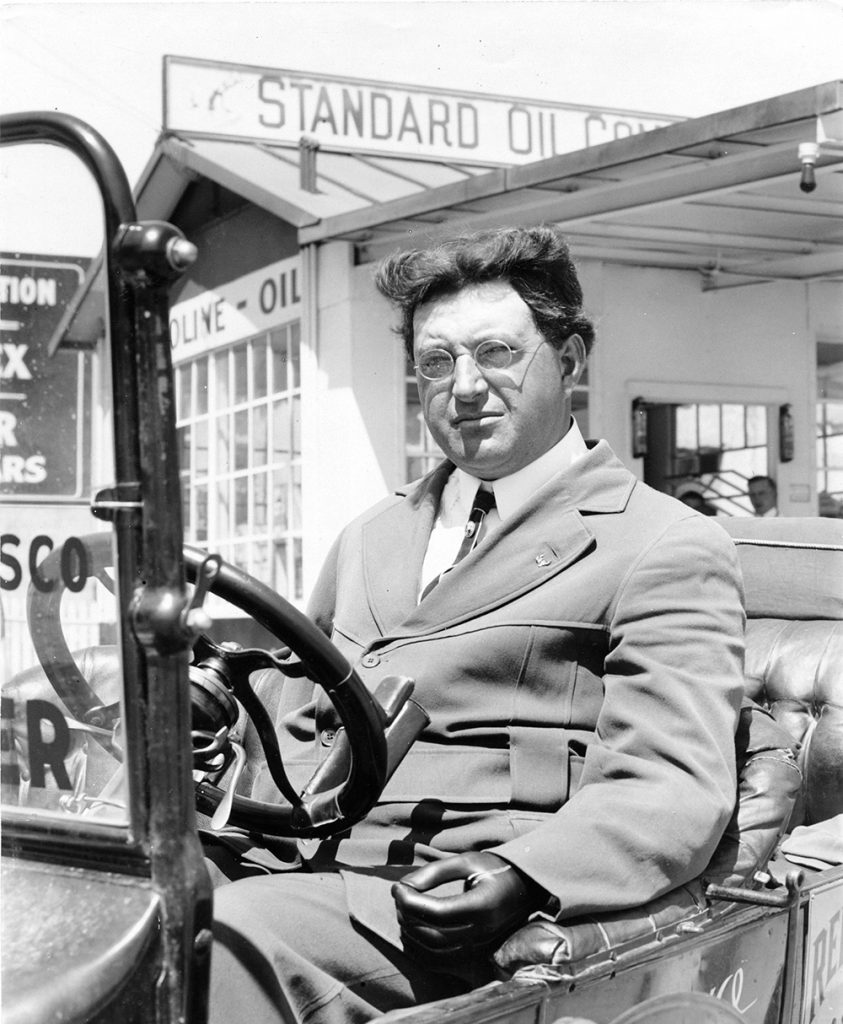
He returned to Schenectady in 1901, where the Edison Company had a job waiting for him. Next, he took a turn at selling, which again brought him to North Carolina, then back to Schenectady, where he started a newsroom business. After he and Aunt Mabel married in 1905, employing a strategy of leasing, then buying, as finances would allow, he gradually became his own version of Conrad Hilton, owning five hotels and apartment houses, including The Livingston, The Myderse, Bachelors Hall, The Seneca and Hotel Foster. He served at least one term as the Fourth Ward supervisor, elected on the Citizens Party ticket. In 1914, he began driving his own automobile, a modified Model T Ford. From April 11 to Dec. 1, he put over 10,000 miles on his new car, including a trip to Washington, D.C. The following year he and Aunt Mable, accompanied by another couple, set out on a transcontinental trip to the Panama-Pacific Exposition in San Francisco.

“For a long time I thought I could have a car fixed so I could handle it,” he was quoted as saying in the March 1915 issue of Ford Times. “But all my friends, and especially my wife, were very much opposed to my trying to drive. They predicted all kinds of accidents if I ever attempted such a thing.

“I had the emergency brake lever changed so I can operate it with my foot. I have a foot accelerator to feed the gas; electric lights which I turn on or off with my foot; an electric horn which I blow by pushing a button with the side of my knee; spark lever bent so I can advance or retard the spark with my knee; and I crank the engine with my foot. I have a steel U-shaped attachment which clamps on the side of the steering wheel. I place my arm in that and steer very easily. I drive just as steadily and well as most people with two hands and arms, and I think a great deal better than some.”

I had heard the story about how Uncle Bert had outfitted a car to accommodate his disabilities and the trip to California many times, each retelling evoking no less awe than the last. While the actual route of the trip is unknown, a little research led me to believe that the most likely one began on the National Old Trail Road. The newest “highway” of the day was The Lincoln Highway from New York to San Francisco, but the Aug. 21, 1915 Wichita Beacon Journal  (accounts of Uncle Bert’s journey popped up in stories ranging from Salt Lake City to Atlanta to Detroit) mentioned him passing through that city on his way west, putting him on the Old Trail. From Kansas he likely took the Leavenworth and Pike’s Peak Express or the Butterfield Overland to Denver where he could join up with the Lincoln Highway to reach San Francisco. In an Aug. 15, 1915 story from the Los Angeles Tribune he identifies The Lincoln as his route west. “When he told his friends that he was going to take his machine across the continent and traverse the mountains and the deserts, they laughed at him,” the L.A. Tribune went on to say.

From San Francisco he went south to Los Angeles and San Diego, then east on the old Santa Fe Trail to eventually rejoin the Old Trail. A driver traversing any of these roads would normally encounter roadbeds fabricated of dirt, sand and gravel, only occasionally finding a stretch of macadam. Oddly enough there was a section from Wheeling, West Virginia, to Columbus, Ohio, that consisted of brick. However, there was also a stretch through the Rocky Mountains that was devoid of any paving material other than what occurred naturally. An official road guide, published a year after Uncle Bert’s trip, described a journey on The Lincoln Highway as “something of a sporting proposition.” Camping equipment was recommended west of Omaha, Nebraska. Add the fact that filling stations were few and far between and a coast-to-coast trip in those days was a daunting undertaking, its completion simply amazing, especially for a driver without arms.

To fund this project, Uncle Bert apparently solicited sponsors, automotive-related companies such as Kelly-Springfield tires and Red Crown gasoline, for the car was emblazoned front to back with decals. Camping out and — as Uncle Bert suggested in one story — selling postal cards also helped defray the cost. Captions on the back of one of the surviving photos identifies it has having had been taken at Universal City, then a new location for the nascent film industry. Why he stopped there is as unknown as the route, but it may have been that during his vaudeville days, he met or associated with some show folk who went on to appear in movies, and he was simply renewing acquaintances.

This was all part of family history, and so, unfortunately, was what happened at the height of his success. It was at the end of the Roaring 20s and optimism in the country was at an all-time high. Then, the stock market crashed and along with it the national economy. The resulting Great Depression saw billions of dollars in wealth and income evaporate literally overnight. Uncle Bert’s fortunes were no different. He lost everything, all his holdings, except for a resort on Schroon Lake in the Adirondacks, which he had given to Aunt Mabel as a birthday gift. With this property, he began a new upward climb, gradually adding more cottages and a store to the resort.


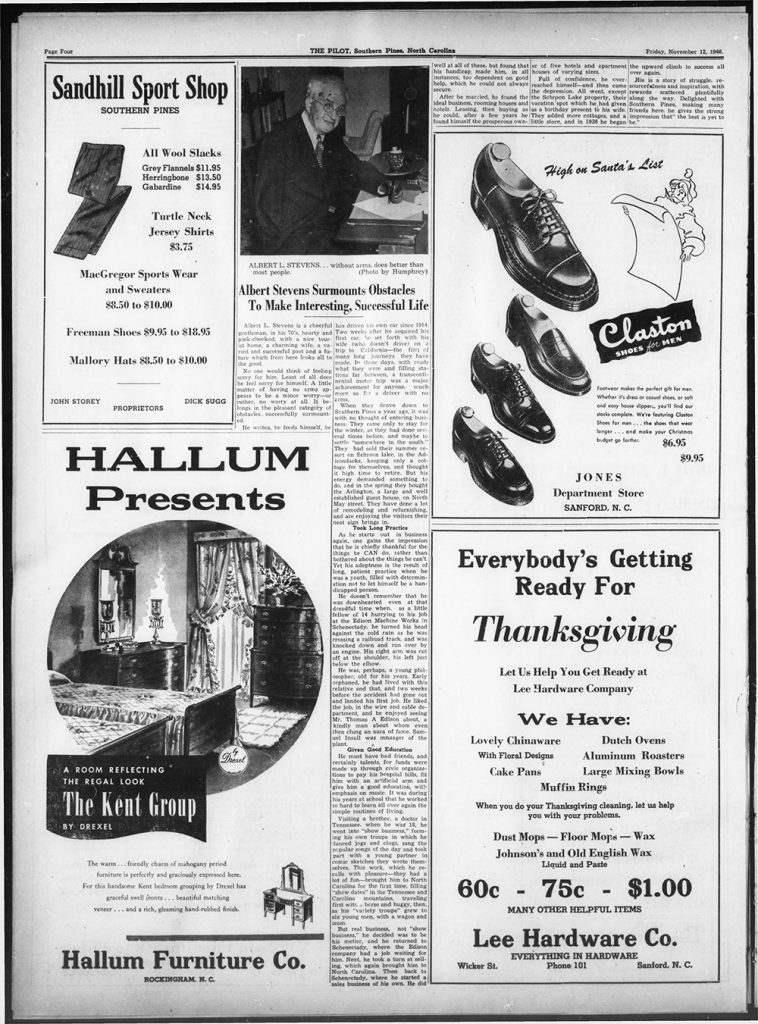
little over a year ago, going through a box of family memorabilia with my brother, Steve, in Florida, we discovered a photostat of an article clipped from an old newspaper, The Pilot. Much of the information in it was familiar to us, but some was new. At the time, I’d lived in Pinehurst for 12 years. That such a story would appear was unsurprising, since he and Mabel lived in Southern Pines in their later years. The article, however, was incomplete, ending in mid-sentence. There was no byline and no date.  My only hint as to the age of the story was that the accompanying picture showed him as I remembered him when I was very young and mentioned that he was in his 70s.

Since my uncle had been born in 1874, the article must have appeared in the paper between 1944 and 1954. The volumes of those years were archived at the Southern Pines Library. The bindings were in various stages of decay, but all the years I was interested in were there. From the portion of the article that I already had, it was apparent the author’s interest in Uncle Bert was his recent decision to buy the Arlington, described in the article as “a large and well established guest house on North May Street.” The building at 440 N. May is there today.

I decided to begin my search for the original article with the year I was born, 1946. I didn’t find it there, nor was it in 1947. Reading articles from 70 years ago, the news of the day and the news makers, the ads and the entertainment notices, provided a whole new appreciation for this place and those times. Near the end of the 1948 volume, I saw it. I was initially surprised and relieved that the page containing the article was there at all because not every page was. The condition was much better than the copy my photostat apparently came from. The date of the article was Nov. 12, 1948.

During their years in New York, the article relates, Uncle Bert and Aunt Mabel had wintered in the Sandhills many times, and it was only with that thought in mind that they returned here again that year. However, they had sold their resort in New York and Uncle Bert had decided that after his long and eventful career, it was time to retire, with an eye toward settling someplace in the South. “When they drove down to Southern Pines a year ago, it was with no thought of entering business,” says the story. But apparently, Uncle Bert didn’t have it in him to fully retire. They bought the guesthouse and settled here.

The article, detailing his life, concludes, “His is a story of struggle, resourcefulness and inspiration with rewards scattered plentifully along the way. Delighted with Southern Pines, making many friends here, he gives the strong impression that ‘the best is yet to be.’”

After 56 years of marriage, Aunt Mabel died in 1961. Following a couple of years at St. Joseph of the Pines, Uncle Bert passed away at the ripe old age of 89. He lies in Mount Hope Cemetery in the town he loved so much.  PS

Scott Sheffield moved to the Sandhills from Northern Virginia in 2004. He is retired from the federal government, where he served as director of the headquarters contracting office for the U.S. Department of Energy in Washington, D.C.

Taking on the Giants

Pinehurst amateur Dick Chapman more than held his own against golf’s professional greats 

By Bill Case
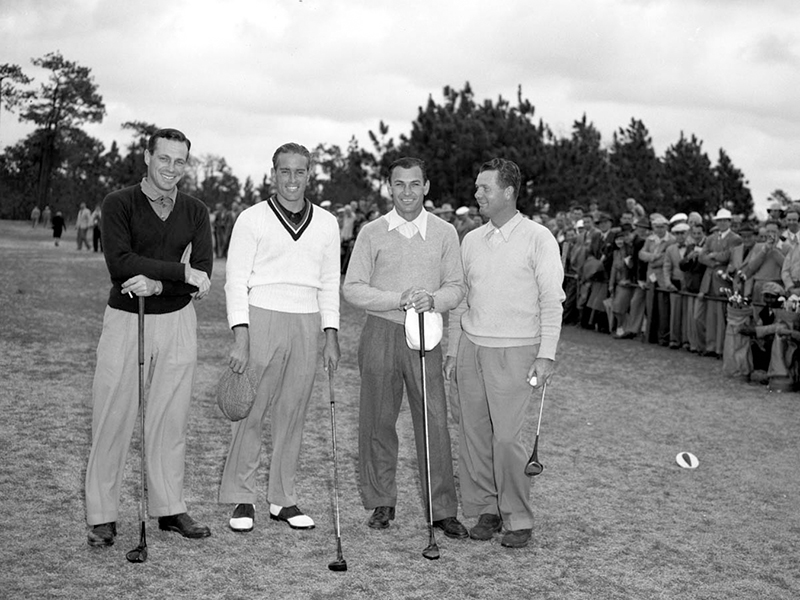
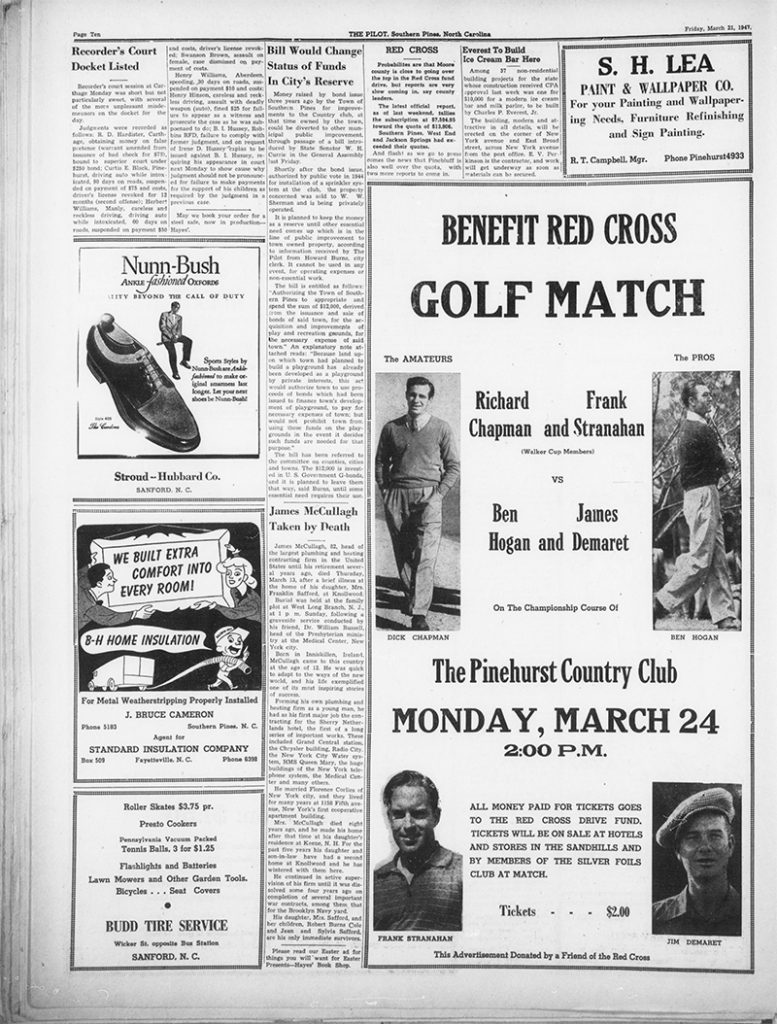
Left to right: Dick Chapman, Frank Stranahan, Ben Hogan and Jimmy Demaret


In the first quarter of 1946, young Pinehurst attorney Leland McKeithen confronted a dilemma. The Pinehurst chapter of the Red Cross stood $2,500 short of raising the $7,000 necessary to satisfy the goal for its annual fundraising drive. As chapter president, McKeithen pondered ways of reducing the shortfall. Aware that most community residents and visitors shared a love of all things golf, he considered the prospect of bringing top players to Pinehurst to play an exhibition match at the area’s nonpareil course — Pinehurst No. 2.

But, given Pinehurst’s North and South Open and Amateur tournaments, there were already ample opportunities for Sandhills golf aficionados to observe the game’s best in action. McKeithen needed an angle that would encourage the locals to reach into their pockets. He came up with a version of the David and Goliath theme: Match two top professionals, playing as a team, against two amateurs. Sure, the pros would be heavy favorites, but there were notable amateurs around who on a given day could give the pros a battle.
For a total of $500 contributed by a generous Pinehurst donor, two of golf’s greatest, Jimmy Demaret and the legendary Sam Snead, agreed to partner in the Red Cross exhibition. Though better known for his colorful personality and a wardrobe that ranged in hue from canary yellow to powder blue, Texan Demaret also possessed fabulous shotmaking skills, having captured the 1940 Masters. Snead’s Hall of Fame career was skyrocketing. “Slammin’ Sam” would win six times in ’46, including the Open Championship at St. Andrews. 

The amateurs chosen to oppose the Snead-Demaret juggernaut were Frank Stranahan, 23, and Pinehurst resident Dick Chapman, 35. Both came from privileged backgrounds. Chapman’s father made a fortune as a partner in a Wall Street brokerage firm. His mother also came from wealth, derived from her father, Clarence Geist, whose profitable investments began in utilities but included ownership of the Boca Raton Hotel & Club and the Seaview resort in New Jersey. Stranahan’s father owned the Champion Spark Plug Company in Toledo, Ohio. Both players could afford to compete internationally as amateurs, free of worry they would run out of cash.

In an era when the leading golfers were reluctant to lift anything heavier than a cocktail glass, the muscular Stranahan was a conspicuous exception. A devoted powerlifter, the sometimes-arrogant Frank would chuckle when panting bellhops struggled to lift his luggage loaded down with concealed weights. Quirks aside, Stranahan could play. Fresh from victory in Pinehurst’s North and South Amateur, he certainly qualified as a candidate for the country’s best amateur.

So did Chapman. Having won a slew of important pre-war titles including the New York, Connecticut, and French Amateurs, Chapman became a nationally prominent player after he routed his opponent in the finals of the 1940 U.S. Amateur at his home course, Winged Foot Golf Club. Recently discharged from wartime service as a major in the Army Air Corps, Chapman was poised to resume his pursuit of championship victories.

A Greenwich, Connecticut, native, Chapman had recently acquired a residence in Pinehurst. A month before the exhibition, he along with wife, Eloise, son, Dixie, and daughter Joy, moved into an opulent frame home in the area of McCaskill Road referred to as Millionaire’s Row. Chapman’s roots in the town dated back to his earliest days. His parents were respected members of the town’s Cottage Colony, and he had visited Pinehurst with the family for decades. John Chapman, himself a winner of a national seniors competition, introduced his son to the game, and had Dick competing in Pinehurst Country Club junior tournaments by age 9. Infatuated with golf, Chapman practiced diligently, developing  a classic rhythmic swing. Soon he was taking on all comers in Pinehurst and Connecticut, and also as a player on the Williams College golf team. Encouraged by his game’s rapid maturation, Dick began entering Pinehurst’s prestigious North and South Amateur, held annually on the No. 2 course. Chapman nearly won the event in 1934 at age 22, losing the final match to the perennial champion, his former Pinehurst junior opponent, George Dunlap Jr.
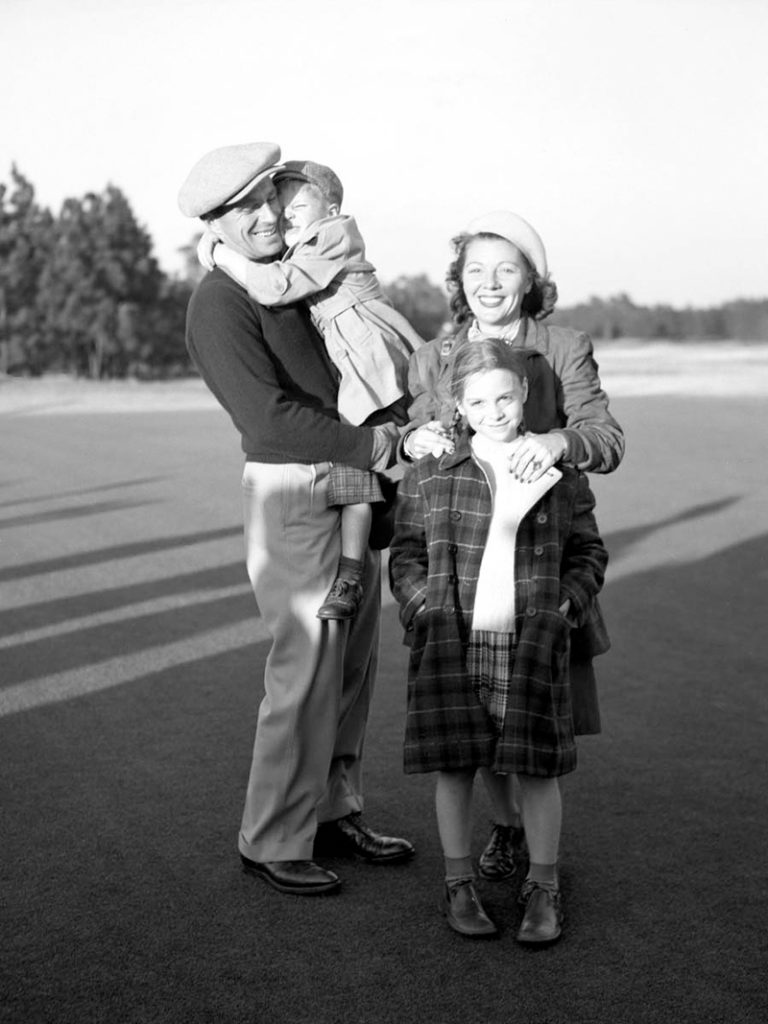


Dick Chapman with son Dixie, wife Eloise and daughter Joy


Thus, many of the 725 spectators who paid a dollar to attend the Red Cross exhibition had known Chapman for years and were pulling for their stylish, debonair friend and his chiseled partner to somehow stage an upset over the Snead-Demaret combo. With all four players well-versed in the nuances of the exhibition’s four-ball format (a match in which two players post their lowest scoring ball on each hole against the lowest scoring ball of two other players), the gallery anticipated a riveting contest. As usual, Demaret stretched the fashion envelope, sporting an outlandishly oversized tam atop his head. Chapman appeared in old-school attire, donning a beautifully tailored V-neck sweater and tie.

It appeared the pros might make short work of the amateurs after Demaret holed a birdie putt on the par-3 sixth to put his team 2 up. But the Chapman-Stranahan team clawed back one of the holes on the seventh. The yelp of a dog on the eighth caused straw-hatted Snead to misfire on a key shot, and the match was all square. After quaffing a pint of milk at the refreshment stand, Chapman struck a brilliant iron shot which left his ball snugly hole-side on the par-3 ninth. His birdie nosed his team in front for the first time.

On the par-5 10th, Snead was presented with an opportunity to even the match, but an animal’s noise again disrupted the Slammer’s concentration. A horse on the adjacent bridle path neighed during Sam’s stroke, and his short putt went awry. After Snead narrowly missed a par putt on the 12th, the amateurs suddenly found themselves 2 up. That was how the match stood until the par-3 15th, where Snead finally caught a break. His birdie putt to win the hole hovered on the lip for over 20 seconds before dropping in. But Chapman and Stranahan still clung to their 1 up lead as the four players arrived at the par-3 17th. After another fine iron, Chapman applied the dagger, calmly draining a curving 20-foot birdie. When Snead failed to convert his birdie, he and Demaret were closed out by the amateurs 2 and 1.

After the match, Dick and Eloise, hosted a cocktail party at their home, which they now called Winter Haven. In addition to Messrs. Demaret, Snead and Stranahan, several other golf notables attended, including PGA Tour manager Fred Corcoran, Golf World founder and editor Bob Harlow, and tour player Toney Penna. Nobody relished a good party attended by entertaining guests more than bon vivant Chapman. It was later said of this personable patrician that he “was like a character out of The Great Gatsby, handsome, charming, wealthy . . . a man who knew his way around a golf course or a cruise ship, or a cocktail party on the lawn of a manor.”

The Red Cross viewed the match a success and scheduled another amateurs vs. pros exhibition on No. 2 for March ’47. In order to maximize revenue, the admission ticket was bumped to $2. Pinehurst, Inc. fronted the pros’ stipends. Chapman and Stranahan again teamed up as the amateur duo but this time they would be facing a team that was arguably the best ever — the incomparable Ben Hogan and his Texas cohort Demaret. They were certainly an odd couple. The poker faced, chain-smoking Hogan hardly uttered a word during play, while the colorful Demaret sunnily wisecracked with the gallery. No player in history spent more time on the range than Bantam Ben. By contrast, the naturally talented Demaret seldom hit balls and could reliably be found at a nightclub after posting his score. But when paired with Hogan in team competitions, Demaret shelved the hijinks. Hogan remarked that when Demaret “played with me, there was no fooling around.” Their disparate approaches  somehow blended  into a yin and yang that made Hogan and Demaret nearly unbeatable in the team competitions prevalent during the 1940s. They had already won six four-ball tournaments together and would later team to win two Ryder Cup matches.

The likelihood of the Chapman-Stranahan team replicating their success in the ’46 Red Cross match against such peerless opponents was further diminished by the fact that Demaret was enjoying his greatest season. He would carry off his second Masters title in April and ultimately emerge as 1947’s leading money winner.  And Hogan, too, was on a roll. After years battling unwelcome hooks which would crop up under pressure and wreck opportunities to win, Ben suddenly became the best ball-striker on the planet. Gone were the devastating hooks.  In their place were exquisitely controlled power fades. The wiry Texan  had apparently solved golf’s eternal puzzle. Everyone in golf speculated what the “Hogan Secret” might be, but he declined to reveal any clues other than to say he had “dug it out of the dirt.”
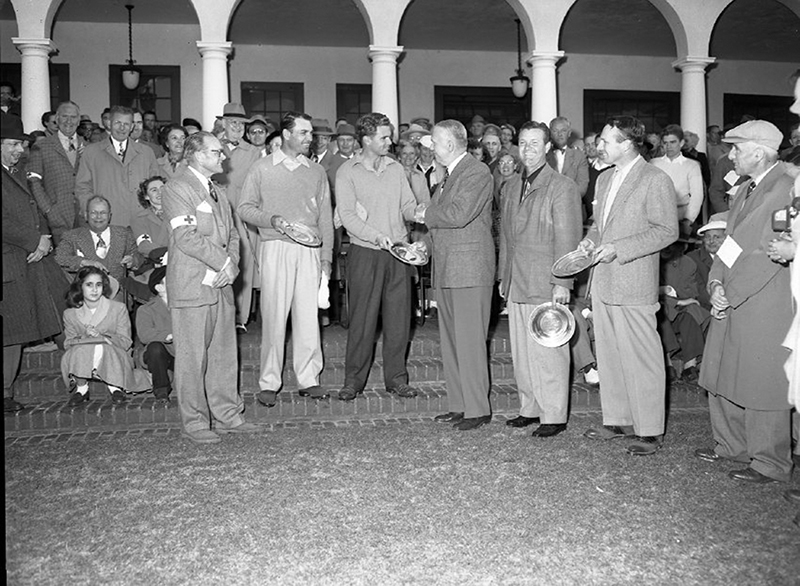
Gen. George C. Marshall congratulates the players of the 1950 match


Chapman and Stranahan possessed no home course advantage over Hogan, whose breakthrough victory had come on No. 2 in the 1940 North and South Open — an event that he won again in ’42 and ’46. Hogan appreciated No. 2’s premium on ball-striking and course management, skills he possessed in abundance.

On a cool March Monday afternoon, Hogan and his wife, Valerie, motored over to the resort from their lodgings at Southern Pines’ Belvedere Hotel.  At the first tee, he was greeted with resounding  applause from 800 enthralled onlookers who jockeyed for a good vantage point to watch the players strike their opening drives. The Chapman-Stranahan team got off to a promising start, going 1 up after both Hogan and Demaret  bogeyed the first hole. But the lead was gone when Demaret drained a tying birdie on the third. The remainder of the front nine featured a marvelous exhibition of shotmaking with neither team gaining an advantage. Chapman in particular was knocking the flags down with his irons. He came within an eyelash of holing his approach on the seventh. But Hogan topped Chapman’s birdie with his own. Finally on the long 10th, the amateurs forged ahead after  Chapman holed a 25-footer for a birdie four. The amateurs built their lead to two holes after both Texans pushed tee shots right at the uphill 13th and failed  to salvage pars.

It appeared  the pros would fall 3 down on the 14th after Stranahan’s second shot nestled within 10 feet of the hole. But Demaret turned the tables, holing a curling 35-footer. After Stranahan missed his tying effort, the pros had trimmed the lead to a single hole. Both sides birdied the 16th after Chapman narrowly missed a putt for eagle following his glorious wood shot onto the well-protected green. On the par-3 17th, Chapman must have encountered a sense of déjà vu while addressing his birdie putt to close out Hogan and Demaret. He had made a similar putt on this very green to beat Snead and Demaret  in the ’46 exhibition. He ended  this match in the same spectacular fashion by stroking his winning  putt straight into the cup. Chapman’s personal score of 69  bested both Hogan and Demaret.

Over cocktails at the post-match shindig hosted at Winter Haven by the Chapmans, Hogan uncharacteristically took Dick aside and imparted advice on the amateur’s swing, “particularly in regard to the position of the left shoulder in making full strokes.” Hogan offered tips to fellow competitors about as often as he hit loose shots, but it seems he felt a kinship toward Chapman as both men shared a nearly messianic desire to perfect  their golf swings. Notwithstanding this camaraderie, Hogan did not go so far as to confide to his all-ears friend his mysterious “secret.”

Another tandem of stars challenged  Chapman and Stranahan in the March 1948 exhibition — Johnny Palmer and Bobby Locke. Palmer, a good old boy from nearby Badin, N.C., had beaten the field in the 1947 Western Open, then considered a major tournament. He would win on tour seven times and play on the Ryder Cup team in ’49, the year he finished in the top eight of the Masters, U.S. Open and the PGA Championship.

Locke was in the midst of an incredible 32-month span in which he would win 11 PGA tour events. The South African became the first non-British foreigner to distinguish himself on the circuit, and many of the American  pros deeply resented his success. It did not help Locke’s likeability that he marched in rather stately fashion to his own drummer. He looked and played in a manner different from other players. Dressed at least 15 years out of fashion in plus fours, white dress shirt and tie, his jowly appearance made him appear far older than his age of 30. He played at a maddeningly slow pace, hooking every shot, including the unerring putts he rapped with an ancient hickory-shafted blade. Bobby Locke would subsequently win four Open Championships.

But the Palmer-Locke team could not compare with the draw of Hogan and Demaret, and the admission price was accordingly cut back to one dollar. Those who paid their way were treated to an exciting nip-and-tuck affair. Thanks to Palmer’s sterling play, the amateurs were unable to gain the upper hand, and there would be no three-peat for Chapman and Stranahan. Chapman did come within 4 inches of a hole-in-one on the sixth hole, and Stranahan, needing to hole a 25-foot putt on the 17th to extend the match, managed to do so. But when the 18th was halved in pars, the professionals took the match 1 up.

Perhaps disappointed with the decreased revenue from the series, the Red Cross elected not to hold the professionals vs. amateurs match in 1949. But Demaret did stop by Pinehurst to bunk  in at the Chapmans’ place in mid-April. Friends Jimmy and Dick shared more than their golf talent. Both were accomplished nightclub singers. Chapman had sung at a hotspot in New York and “crooned lilting songs” during a wintertime gig in 1939 at Pinehurst’s long-gone Club Chalfonte. Owner Karl Andrews then marveled, “Dick is playing golf as well as he sings and you know that’s good.” Now, pleasantly immersed in Pinehurst life, Chapman mostly confined his vocal performances to solos in The Village Chapel’s choir.

Hoping for a reprise of the blockbuster match of ’47, the Red Cross lured Hogan and Demaret back to Pinehurst for another exhibition in 1950. But this time, Chapman would have a different amateur partner — Harvie Ward. The charismatic 23-year-old Tarboro, N.C., native burst onto the national scene after his  sensational victory on No. 2 at the 1948 North and South Amateur. A raucous band of fraternity brothers and fawning co-eds from the University of North Carolina motored down from Chapel Hill to root him on, and they carried the beaming Harvie off the 18th green after he vanquished Frank Stranahan. Harvie followed up that triumph by winning the NCAA individual title in ’49, and would later win the 1952 British Amateur, as well as back-to-back U.S. Amateurs in 1955 and ’56.

Mostly recovered from the horrific crash with a Greyhound bus that nearly cost him his life the previous year, Hogan’s game was rounding into form. He and Demaret would post memorable campaigns in 1950 with Demaret winning his third Masters, and Hogan being named Player of the Year after his historic U.S. Open playoff win at Merion Golf Club. Smarting a bit from their stunning ’47 exhibition loss, both stars (particularly Hogan, who hated losing to amateurs) were eager to turn the tables on Chapman and his new partner. This time the pro team played superbly right out of the gate. A pair of Hogan deuces on the ninth and 15th left the amateurs reeling 2 down. It appeared that Chapman and Ward would be closed out on the long 16th, but Ward “scrambled from trap to roadbed” to halve the hole and keep the match alive.

After nailing his rifle-shot iron to the 17th green, Hogan was sure of his par and certain victory. The amateurs were down to their last bullet — a 60-foot putt by Chapman to extend the match. As Chapman addressed his ball, a sparrow suddenly perched directly on his line to the cup. His concentration broken, Dick stepped aside until the bird flew away. After he took his stance a second time, the bird repositioned itself on the line and, according to the Pinehurst Outlook, ”went into a feathery sort of buck-and-wing.” The exasperated Chapman was forced to back off his putt again. Finally, the sparrow exited for good and Dick rapped his desperation putt. Just then, the fates intervened. A gust of wind blew a dead leaf into the ball, ever slightly redirecting its path right into the hole. Chapman’s electrifying stroke sent the match to the 18th, where  he confronted another last-gasp birdie putt, a 15-footer from the fringe. Chapman holed this one too, and the amateurs implausibly salvaged a halved match.

Gen. George Marshall, national president of the Red Cross, and a seasonal Pinehurst resident, personally congratulated the players on their performances. Marshall presented  mementos to mark the occasion. Though no golfer himself, the architect of Allied victory in World War II and the Marshall Plan that rebuilt war-ravaged Europe often enjoyed attending competitions held at No. 2.

Eight-year-old Dixie Chapman was home when Ben Hogan stopped by the traditional post-match party at Winter Haven. The youngster was thrilled when Mr. Hogan ordered him to grab a club and meet him in the backyard. After observing Dixie’s form, Hogan told father Dick, “His swing’s perfect. Don’t change a thing.” Then, with a conspiratorial air, Ben spirited Dick away from the rest of the guests into the den. After locking the door, Hogan spotted a Bible and removed it from the bookshelf. With a solemnity suggestive of an initiation into a secret society, Hogan exacted from Chapman a promise, sworn on the holy text, that he would tell no one what was about to be revealed. It was the mysterious Hogan Secret. Maybe, given that Hogan later explained to Life magazine that his discovery involved a complicated combination of weakening the grip, pronating the left wrist, cupping it at the top of the swing, and then supinating it on the downswing, it was really several secrets. Others claim Hogan never divulged the true secret or, as Snead believed, there was no secret at all. 

Whatever the case, it appears Hogan’s revelation didn’t satisfy Chapman’s quest for golfing perfection. Something of a mad scientist, he was forever experimenting with new ways to strike a golf ball. Dixie remembers his dad would return from the course exulting, “I’ve got it!” only to move on to some new theory the next day. Chapman’s interest in the swing led him to author numerous magazine articles and a book entitled Golf as I Play It. His study of the game was not confined to its mechanics. He devised a new type of competition, primarily geared to mixed couples, in which each of the partners hit tee shots, and then hit each other’s ball. The best of the  second shots was then selected by the team with that  ball played alternately until holed. “Chapman” competitions (also called “Pinehurst”) are still held most everywhere golf is played.

There was one more Red Cross benefit match played in April 1952 that featured a new professional team. The Red Cross landed boyish Jack Burke, Jr., who had played in the Ryder Cup held at Pinehurst in ’51, and the tempestuous Tommy Bolt, the winner of the final North and South Open, also held in ’51. Burke’s banner year would come in 1956 when he won both the Masters and PGA.  Bolt held his famous temper in check just enough during the 1958 U.S. Open to win his only major. Chapman, having further burnished his stature by winning the 1951 British Amateur, arrived at the exhibition with a new partner in tow — Hobart Manley, Jr., the 1951 North and South Amateur champion. Buoyed by Manley’s twin deuces on holes six and 15 and his scorching-hot putter, the amateurs edged Bolt and Burke 1 up. It was the only one of the five exhibitions in which Chapman’s play was overshadowed by his partner.

Chapman would continue to play great championship golf for another 15 years. He was a member of his third winning Walker Cup team in 1953. He continued to add to his collection of international victories and would compete in 19 Masters tournaments, an amateur record. Dick and Dixie, who today lives at the Country Club of North Carolina, made for a great team in father-son competitions, winning several, including a tournament held near the family’s summer quarters at Oyster Harbors on Cape Cod. Both father and son qualified for the 1958 U.S. Amateur. But Dick’s most treasured golfing achievement occurred that same year on No. 2 where, after over two decades of falling short, he finally won the North and South Amateur at age 47.

Dick enjoyed competing in all sorts of Pinehurst events. Like his father before him, participating in the Tin Whistles’ club championships (he won eight of them)  and he relished pairing with Eloise in  mixed “Chapman” competitions. Eloise died in 1966 and Chapman subsequently married Anne McKee. After a stroke in 1970, Dick’s golf was limited. He died in California in 1978.

Chapman was inducted into the Carolinas Golf Association Hall of Fame in 1986. He is the only player to have  been crowned amateur champion of the United States, Great Britain, France, Canada and Italy, a record bolstered by his remarkable performances in the Red Cross exhibitions. He won three, tied one, and lost one in five team matches against golf’s greatest. Of the seven players Chapman’s teams competed against in the series, all but Johnny Palmer are enshrined in the World Golf Hall of Fame. Collectively, his adversaries won 26 major championships (Hogan and Snead alone accounted for 16) and 199 tournaments on the PGA Tour.

When Dick Chapman passed away, Time eulogized him as the “amateur Ben Hogan.” It is likely Ben considered it a personal compliment to be compared to his genial Pinehurst friend whose intense dedication to golf matched  Hogan’s own.  PS

Pinehurst resident Bill Case is PineStraw’s history man. He can be reached at Bill.Case@thompsonhine.com.

Golftown Journal

Golf at The Gap

A pure mountain journey


By Lee Pace

Imagine the journey from
Pinehurst to Roaring Gap in the 1920s — 150 miles of two-lane roads west to Candor, north to Asheboro and Winston-Salem, then up Highway 21 into Alleghany County, the last 5 miles replete with steep grades and sharp turns. In the early 1930s, considerable private funds were spent planting rose bushes along the road, ergo the appellation “Road of Roses,” and an early ad for Roaring Gap described the 16-mile passage from Elkin as a “picturesque four-hour drive.”

“My grandfather, my grandmother and their six children all loved going to Roaring Gap once their house was built in the 1920s,” says Jim Gray, a Roaring Gap member into the third generation and native of Winston-Salem. “They would get on a train in Winston-Salem and go west to Elkin, where they spent the night. Then it was up the mountain by horse and buggy — taking a full day. Of course there were cars then, but no decent road up the mountain.”

Today the entrance to the summer residential colony is decidedly understated — a right turn off Highway 21 onto Roaring Gap Drive. I’ve been there twice in my life and both times had to make a U-turn at the gas station half a mile farther north. From there it’s another twisting, winding avenue past the 67-acre Lake Louise on the left and through the deep rhododendrons and oaks until the Donald Ross-designed golf course reveals itself to the left, with the sweeping double fairway of 15 and 16 and the wispy brown grasses on the edges.

“We like to say, ‘If you go downhill, you’ve gone too far,’ referring to the fact there’s no sign to alert you to the entrance,” says director of golf Bill Glenn, who with his late father, Bailey Glenn, has run the golf operation since 1956. “I love how you get a glance at the lake, and then as 15 and 16 come into view for the first sight of golf, it’s like seeing the lights in Vegas. It makes you ready to play.”

Roaring Gap is a direct offspring of Pinehurst, with Leonard Tufts, son of Pinehurst founder James Tufts, partnering in the mid-1920s with the Chatham family of Elkin and several Winston-Salem business magnates with last names like Reynolds, Hanes and Gray to give the winter-oriented Sandhills resort a sister destination for the warm-weather months.

Of course Tufts tapped Ross, who’d conceived and built four golf courses at Pinehurst by 1919, to design the course on a tabletop stretch of 1,200 acres perched at 3,700 feet above sea level. For inspiration for a hotel, Tufts borrowed from George Washington’s Mount Vernon home and constructed the three-story, 65-room Graystone Inn. The community had been named decades earlier for the speed with which the winds whipped through the mountains, and the hotel for the native Blue Ridge masonry used for the exterior.

“What Pinehurst typifies as a winter resort, Roaring Gap will represent in the summer field,” one early newspaper account said. Another added the club was created “to continue the delightful obligations of entertainment for a six months period when Pinehurst relinquishes it in May.” Yet another proclaimed that “Everyone knows the popularity of the Pinehurst hotels, and with Mr. Tufts at the head of this one, makes it a success to start with.”

The golf course and inn opened in 1926, and the layout (measuring just under 6,000 yards at the outset) was billed as “the aristocrat of courses.” The Pinehurst connections were many, from Carolina Hotel manager E.G. Fitzgerald running the Graystone in the summer and Ross’ assistants in Pinehurst, among them Alex Innis, Palmer Maples and Ellis Maples, directing the golf operations at various junctures. There’s even a street named Chinquapin at Roaring Gap, just as there is in the village of Pinehurst.

The Tufts were hustling in the late 1920s, business quite sporty during heady economic times and their Sandhills tentacles expanding to Southern Pines in 1921 with Mid Pines and 1928 with Pine Needles. All of those ventures as well as Roaring Gap took smack downs during the 1930s, though, rendering the original mountain vision null and void in 1932, when Tufts forfeited his interests in the club.

“This ‘Pinehurst legacy’ has gone largely unheralded,” says Roaring Gap member and historian Dunlop White III. “Even today, many Roaring Gap regulars are unfamiliar with the story. I think the fact that the club was formed at the height of Pinehurst’s golden era has always served as the foundation of Roaring Gap’s enduring appeal.”

That endearment remains strong today, for one reason the quality of the vintage Ross design, enhanced with a 2012-14 restoration project directed by White and golf architect Kris Spence, and another the club’s total lack of pretention. The quaint clubhouse from 1939 remains intact, with a modest grill that used to serve Bailey Glenn’s tomato sandwiches — “With peeled tomatoes, that was a detail he insisted on,” says son Bill — and today is proud of its cheeseburger tradition. 

“It’s absolutely my favorite place to go and play golf,” says Spence, who began his relationship with the club in the early 2000s. “It’s so laid back and comfortable and relaxed. You go in one screen door and out the other, and right there you’re on the 18th green. The ambience is one-of-a-kind.”

The visuals are unsurpassed, from the view up the fourth fairway to the stately old inn in the background, and from the 17th green, perched on a ledge and looking east toward Pilot Mountain 25 miles away.

The topography requires golfers to plan not only the flight of their shots, but the roll as well. Several fairways are so severely canted that a ball landing on the high side can often roll into the rough on the low side, 40 yards away. The seventh and 11th are par 5s with such dramatic land forms and difficult greens that Ross designed them sans bunkers.

And the greens demand razor-sharp touch and execution, some pins tucked into hillocks in a corner, others rendered nearly inaccessible from the high side. Spence found rounded, “pancake shaped” putting surfaces when he first toured the course, the borders having crept in over time. He and his construction crews peeled the surfaces away, dug below and found the remnants and dimensions of Ross’ original greens. Those have been restored as well as bunkers that got buried or lost their shape. Spence also found several hundred more yards, expanding the course to nearly 6,500 from the black tees.

“I watch people play it year after year, and they always come in and say they’d like another crack at it,” Glenn says. “They think they should have scored better than they did. That’s a pretty magical thing for a golf course to have.”

“Roaring Gap has a great and authentic set of Ross greens, in my opinion,” says Spence. “That whole golf course was laying there, but it was buried under that buildup of many, many years. The wind whipped through there — hence the name ‘Roaring Gap’ — and it blew sand and soil around and the course lost its definition.”

Fortunately in 2017, you can get from the Sandhills to Roaring Gap along some pretty smooth and expansive roads. But it’s still slow going the last 6 miles, making the anticipation all the more intense. PS

Lee Pace has been the golf columnist for PineStraw since 2008 and has recently created a new blog about some of the Carolinas’ top walking golf courses, Roaring Gap among them. Learn more at www.randomgolfwalks.com.

Sporting Life

Silver Pride

Airstreams have gone mainstream


By Tom Bryant

Joel Kilby is exactly the All-American, clean-cut individual I would expect to be managing the Out-of-Doors-Mart, just off Interstate 40 in Colfax, a mile or so from the Piedmont Triad International Airport. His is one of the oldest Airstream dealers in the country. I was in his office on a whim recently, talking to him about his operation and Airstream travel trailers in general.

“Our business is actually one of the leading RV dealerships on the East Coast and, as a matter of fact, we’ve been selling and servicing Airstreams longer than any dealership in the world.”

That got my attention. We were in Joel’s office, and like any busy executive in the country today, his phone was ringing and computers were beeping. It seemed that a lot of business was going on that required his time.

“In the world?” I questioned.

“Yep, Airstreams have become popular all over the world — Japan, France, all of Europe. It seems that everybody wants to own what has become an icon in the travel trailer industry.”

The Out-of-Doors-Mart is truly a family affair. Grady Kilby, Joel’s father, who turns 86 in November, started working with the existing company in 1962. Later, he and a partner bought the operation and brought it to where it is today.

Joel said, “Dad comes in three or four times a week. He’s what I call my watchdog.”

“When did you get started with the company?” I asked.

“I was just a youngster and would work after school and weekends washing trailers and cleaning up. Anything my dad would let me do. I graduated from UNC Wilmington in ’92 and came to work full time after that.”

Joel and his wife, Alyson, have two daughters, who are now in college. “The business is really a family affair. Speaking of that, you’re going to have to talk to Ben, our parts guy. He’s almost family.”

At that point, we took a break so Joel could send off an email, and I walked over to see Ben Goslen, the parts manager. He has been with the company for 33 years and is a fixture in the business. He has the “aw shucks” personality of the actor Jimmy Stewart, and I could tell he was proud of the part he has played in the company’s success.

“We have one of the best and most fully stocked Airstream parts departments in the country. If we don’t have it, we can get it in a day or two.” I told him it was a pleasure seeing someone who really liked his job.

“After 33 years, I’d better,” he replied, laughing.

I went back over to Joel’s office to finish our conversation before getting a photo of the three: Joel, Grady and Ben. “You’ve got quite a number of Airstreams on the lot,” I said as I pulled up a chair in front of his desk.

“That has become something of a problem,” he replied. “Not our Airstreams, but getting more. They’re producing them in Ohio as fast as they can and can’t make enough because the demand is so strong. When the big recession hit back in ’07, Airstream had only 189 employees. Today, there are over 800 workers at the plant in Jackson Center (Ohio), working as hard as they can. Something else has changed since you bought your little Bambi. The demographics of Airstream buyers have turned around dramatically. Once it was mostly older, retired folks or people trading up who would buy a unit, but now over 50 percent of our customers are first time buyers and are relatively young.”

I’ve been an Airstream fan for many years, having been first introduced to the travel trailer in the 1950s, when my grandfather bought a small one to use as a base camp when he fished in Florida. He parked it on land he owned on the St. Johns River, and he and my grandmother lived in it during the colder months. When the winters, even that far south in Florida, got too frosty for him, he pulled up stakes and towed the Airstream farther south to Everglades City. Again, it was home for him as he fished Chokoloskee Bay and the Ten Thousand Islands.

Later, Granddad bought a big 32-foot Airstream and parked it semi-permanently on his land on the St. Johns. He added a front screen porch and outbuildings with storage for boats and fishing gear. All of this was good for early in the winter months, but he still had the little Airstream to use in the Everglades when it turned colder.

Those early days when I would camp with him on his fishing expeditions reinforced my desire to someday own an Airstream; and the year I retired from my day job, Linda and I drove up to the Out-of-Doors-Mart, looked at a spanking brand new Bambi and bought it.

The folks at the shop did everything to get us hooked up and rolling. I dealt with Jason, a super salesman and, of course, the ever-present Grady overlooked the sale. It was a pleasurable experience. Our first major trip in the Bambi was from Southern Pines to Alaska. It took us two months up and down the Alaska Highway, and we drove over 11,000 miles with only one punctured tire on our towing vehicle. The trip was a real testament to the reliability of the Airstream.

Joel and I rounded up Grady and Ben for a photo outside the building in front of a new Airstream for sale.

Grady, always the salesman, said, “I remember you. Aren’t you that newspaper guy from Southport?”

“No, Grady. I’m from Southern Pines.” I replied.

“Oh yeah, I remember, got the little Bambi. You ready for a new one?”

“It would be like getting rid of one of the family,” I said.

We went out to the front of the building, where I made my photo, said goodbye, then walked past a big new Airstream on my way to the car, where Linda, my bride, was waiting.

“You know,” I said to her as I fired up the Cruiser, ready to leave. “That big new one sitting right there would look great in our backyard.”

“Only if we can keep the Bambi,” she replied, smiling.  PS

Tom Bryant, a Southern Pines resident, is a lifelong outdoorsman and PineStraw’s Sporting Life columnist.

Birdwatch

Fast and Furious

In spite of its name, the nimble American redstart usually appears as a flash of orange


By Susan Campbell

What’s in a name? For one, misleading descriptors, especially where bird names are concerned. Take, for instance, the American redstart. Although it is indeed found in the Americas, it is hardly red. Nor is it related to redstarts found in other places across the globe. The adult male is mostly black with splashes of orange on its breast, wings and tail. Females and young birds have corresponding yellow patches but are a more muted olive and gray. Both males and females blend in well against the foliage of the hardwoods they frequent in spite of their striking plumage, it can be quite tricky to spot the males. Their rapid movement, as they flit to and fro after insects, certainly adds to the challenge.

American redstarts have an unusual strategy for finding food. These tiny insectivores display what appears to be nervous fanning of their tail and wings. But the flash of color is apparently an effective means of startling prey, which they will then swiftly lunge at and consume with incredible speed and precision.

Redstarts are common migrants through the Piedmont and Sandhills of our state. The rare redstart that breeds in North Carolina can be found as early as the first week of August. Migrants on their long way to Central America will still be trickling through in late October. 

You can spot them clustering in small groups or mixed with migrant vireos, tanagers or other species of warblers. As with so many of our songbirds that winter in the tropics, these birds follow the southern coast of the United States down into Mexico in the fall. However, come spring, they head out and cross the Gulf of Mexico on their journey back north. They need to almost double their weight to survive the trip. Twelve or more hours of nonstop flying over open water is certainly a grueling test. Although they may alight briefly on ships or oil rigs along the way, it is a long haul.

Interestingly, some American redstarts breed as far south as in the bottomlands of the Sandhills. But they are more likely to be found in open woodlands north of the clay line. In the United States, they prefer larger wooded tracts, which are increasingly harder to find. So it is no surprise that the bulk of pairs nest well to the north nowadays, across much of Canada. Another noteworthy detail: Some males of this species are polygamous, which means a lot of extra work since they may fly as much as a quarter mile between families during spring and early summer.

This species is one of a handful in which males do not attain adult plumage until the end of their second summer. Although they do sing prolifically their first spring, it is unlikely they will succeed at attracting a mate until they acquire the distinctive black and orange feathers of maturity.

So should you hear a high, squeaky chip note or catch sight of a tiny flash of color high in the trees this fall, take a closer look. It just might be an American redstart.   PS

Susan would love to receive your wildlife observations and photographs at susan@ncaves.com.

Mom, Inc.

Paper Tiger

A most uncommon household appliance


By Renee Phile

I hadn’t seen her for a few days, which was weird, since she has been a constant in my life ever since my (now) ex-husband surprised me with her for my birthday 10 or so years ago. Yes, I know that this type of gift may be more functional than fun, but it (she) worked for me. Sometimes, she and I would visit multiple locations in a single day. I confess, there were other times I neglected her, but never for long now that the black hairs from my 65-pound Rottweiler form clumps in the corners of every room in the house.

On this particular day, though, I could hear her, which was strange.  She was gurgling from my 8-year-old Kevin’s room.

“Bev! Where are you?”

“Life sucks, Renee.” She seemed despondent.

“Bev, that doesn’t sound like you. Besides, life is supposed to suck. That’s what you do. It’s who you are.”

“You don’t need me.”

“What the hell, Bev? I always need you! Didn’t I empty you out three times last Saturday? All that dog hair. And remember those Legos?” We both grimaced.

“You used to use me every day.”

“I still use you a lot and you know it. The boys aren’t as messy as they used to be, and Bailey isn’t shedding as much since the weather is cooling off. Plus I’m taking her to get those de-shedding baths, remember?”

“I just don’t feel well, Renee. Not at all. I don’t feel like myself anymore.”

“I’m sorry, Bev. I do need you, though, and you know it. You’ve always been there for me.” I searched for the right thing to say. “I thought you would appreciate a break here and there.”

“You shoved me in Kevin’s room last week and left me there.”

“I didn’t mean anything by that. I have just been a little lax these days. I will work on that. Promise.” It’s not you, it’s me.

We talked about her and me over the years. Us. She’s been my right hand girl at five different houses in the past 10 years. While others her age have passed on, she hasn’t stopped moving. She’s so strong and I had taken her for granted. I thought she was feeling better, when she coughed another gurgled cough.

“Bev, you don’t sound good. What the . . . ”

“Help me, Renee!”

I mashed down her “off” button but it wouldn’t work. I unplugged her. She groaned and nearly passed out.

I opened her up as I had done thousands of times over the years, and other than some dirt and dog hair, the usuals, I saw nothing that would be causing her such distress.

“Further down.” Her voice was weak, almost a whisper.

“Hold on, Bev, hold on.”

I reached down into her and my hand skimmed over a crumpled paper. I pulled gently, and the paper ripped, but I pulled it out in three parts.  I pieced together some of the words. “Welcome to the third grade. I am glad to be teaching your child this year . . . ”

Oh great, so here is where that paper went. He needed it signed yesterday and we couldn’t find it.”  It was nearly unrecognizable.

“There’s more,” she coughed.

I moved my hand around some more and felt something else.

“Stay still. I’ve almost got it.”

I pulled out one . . . two . . . three . . . four . . . five . . . six . . . seven Reese’s Peanut Butter Cup wrappers. A record.

“How did these get in here?”

“The younger one . . . he . . . did this.”

“Kevin? When was this?”

“Yesterday.”

“Why didn’t you tell me?”

“I didn’t think I would feel this bad, Renee. And I didn’t want him to get in trouble. He’s kind of cute.”

“Well, you just ate seven Reese’s cup wrappers and a ‘welcome back to school’ form, Bev. That’s not good for anyone.” I pulled something else out of her. Another wrapper.

“Make that eight.”  PS

Renee Phile loves being a mom, even if it doesn’t show at certain moments.

Out of the Blue

Walking the Line

Cafeterias evoke mixed feelings


By Deborah Salomon

I was standing in line at Aldi when the man behind me held out a box of frozen White Castle burgers and said, “I can’t believe that these taste the same as when I was growing up on Long Island.”

How did he figure I’d know what he was talking about?

My instant response: “My mother wouldn’t let me eat hamburgers out. But do you remember Chock Full o’Nuts (luncheonette chain) frankfurters with the fancy mustard?” Those she allowed, probably because they weren’t called hot dogs.

After writing about food for 30-plus years I can attest to its deep, sometimes bittersweet impression on our psyches. Mine go beyond New York bagels and Carolina biscuits. The location holds sway: cafeterias, especially the S&W in Asheville, and many Horn & Hardart Automats in Manhattan. I’ve seen grown men cry at the mention. 

Besides, cafeterias taught people-watching, a skill that has served me well.

In the line of duty I have eaten at four-star restaurants in the U.S. and abroad. What, I don’t remember. But if I could resurrect anything it would be baked beans, liverwurst on rye, scallops, Harvard beets, chicken a la king and huckleberry pie from the Automat, especially the one across from Radio City Music Hall, the one with the hot chestnuts vendor outside the glass front.

Second best, S&W of the 1950s, a bastion of Southern manners and cuisine. The Asheville location, famous for Art Deco architecture, eventually made the National Register of Historic Places. I knew it well, since my mother shirked cooking. She’d use any excuse to hit the S&W — also because she loved pie, especially pecan, but never baked and couldn’t bring herself to buy a whole one. However, with it right there, flanked by lemon meringue and apple . . .

At breakfast, John Grisham attorneys and wheeler-dealers let busboys carry their trays upstairs to “reserved” balcony tables, soon engulfed in Lucky Strike smoke. They tipped 50 cents instead of the customary quarter. Smiling women traybearers —  “Hi honey, how’re you doin’ today?” — wore starched yellow uniforms with hankies fanned out like flowers growing from their pockets.

I shudder, then blush to recall that these polite, cheerful employees were the only African-Americans visible.

Round family tables filled fast on “maids’ night out” Wednesdays.

The best part was seeing the food arranged on steam tables, under bright lights, which made it glisten. What you saw was what you got. Customers slid trays along a shelf made from chrome pipes. Cutlery came wrapped in cloth napkins. First the salads (mostly tossed and gelled), then the meats, the vegetables, desserts, cornbread, biscuits and tea over crushed ice. Breaded fish and Salisbury steak never tasted so good. Creamy mashed potatoes, fluffy rice, stewed tomatoes and okra, shiny beans, fried chicken, carved roast beef (for special occasions), limp greens preceded achingly sweet caramel layer cake.

True, you had to stand in line, so little old ladies wearing flowered cotton dresses and sometimes hats arrived “before the rush.”  Nobody wanted to sit at tables along the line where standees stared down hungrily.

Then, everything changed: fast food, pizza, all-you-can-eat buffets, “family restaurant” chains. The Asheville S&W closed in 1974 to reopen as an uppity steak house, which faded fast. Other locations operated until the mid-1990s.

I’ve tried J&S in Asheville, K&W in Chapel Hill. The fish is tasty, the cornbread hot and authentic, the desserts tempting. But there’s a microwave to warm things up and hot sauce in the condiments rack. Old folks still arrive early, “to avoid the rush.” Most succumb to dessert. The modus may be intact but, sad to say, the esprit is gone.

When Mellow Mushroom closed on U.S. 15-501 I imagined a K&W —  great idea given the demographics. On second thought, probably not. Some institutions cannot be resurrected. Better they survive only as aromatic memories.

I still appreciate a sum-of-its-parts cafeteria meal. Nothing fancy, just plain Southern food typical of an era when restaurants advertised “home cookin’” because home cooking was the gold standard. When folks ate dinner at noon. When country-fried steak meant smothered in cream gravy and nobody ate kale raw. When every table had an ashtray and desserts weren’t shared.

When cholesterol was for spelling bees and doctors advertised Camels. Gone forever. But once in a while, I sure could use a sliver of pecan pie.  PS

Deborah Salomon is a staff writer for PineStraw and The Pilot. She may be reached at debsalomon@nc.rr.com.

The kitchen garden

Strawberry Fields October

Getting a jump on your shortcake

By Jan Leitschuh

Strawberries? Now? The first fruit to ripen . . . in spring?

Yes, even though our seasonal taste buds are turning toward crisp fall apples, your local farmers are busy planting strawberries right now through mid-October.  Come next April, they will be enjoying the fabulous, juicy, shortcake-making sweetness of the tender Sandhills strawberry —  hardly a cousin to those sturdy but bland California strawberries, bred for shipping great distances rather than for taste.

Of course, come spring you can buy their berries at local farm stands, markets and co-op boxes, and I hope you do — who ever gets enough strawberries in spring?

But you, passionate kitchen gardener, lover of the soil and connoisseur of the freshest homegrown tastes, can do the same as your local farmers. The strawberry is one of the easiest fruits to grow. And like your fellow producers, now is the best time to put a patch in your garden.

In September, your local strawberry growers prepped their soil, throwing up raised rows that were then covered with plastic. The strawberry plugs they buy get planted in holes punched through the plastic at regular intervals. This keeps the weeds down and makes for a very clean bed for You-Pick operations. 

“We’ll go until about mid-October with the planting,” says Steve McNeill, a Lemon Springs farmer who not only plants several acres of strawberries for fresh production but runs a strawberry nursery. He is one of four N.C. farmers growing “tips,” or runners rooted in plug trays for sale to other large-scale producers.  After planting, the plastic-covered rows are then watered and fertilized — “fertigated” in the lexicon — through special drip tape under the plastic.

But the home gardener, with no need to bet the farm on a crop, can pull this off much more simply. Commercial growers tear out their strawberry beds each year and plant anew each fall to prevent disease. “One disease can mess you up for the season,” says McNeil, ruefully.  “For the farmer, it’s a high-risk crop.”

Home gardeners need not tear out their beds until year three or four, nor do they need plastic and drip tape. You can consider your original berry plant purchase an investment in the future. You can let them run.

The kitchen gardener, pursuing ease of culture and ambrosial taste, may do better going with a “matted row” system. That is where the original plants go right into the garden bed (no plastic) and are allowed to “set” the “runners” the mother plants make after their first spring. These runners will form new strawberry crowns for the following year. Along with the original plants, these new free plants continue to increase your harvests. Indeed, 25 original plants, allowed to run and fill out, can produce up to 25 quarts of ripe, juicy berries for the happy gardener, and do it for a couple of years. At supermarket prices, that’s a good payback on your investment.

You can buy your plants online, shipped as bare-root plants, or perhaps luck into a farmer with some extra plugs. Friends often trade extra plants, but that can spread disease if the patch is infected. Home gardeners also want June bearers — save the ever-bearing varieties for Northern gardens.

While local farmers are planting varieties like Chandler, Camarosa and Sweet Charlie, specially adapted for plasticulture, home gardeners aiming for a matted row might try Atlas, Earliglow, Titan, Tribute, Apollo and Earlibelle. The early-bearing Sweet Charlie would also work in a matted row.

Have a sunny, weed-free area of the garden, accessible to the hose? A raised bed? That’s your potential patch. Strawberries love a sandy loam with a good amount of organic matter. A strawberry plant loves good drainage, and that is what the Sandhills possess in spades. New plants are happiest when evenly moist — not too soggy, but not extended dry periods that let these shallow-rooted plants wither. 

Till in some well-rotted manure, near-composted straw, old sawdust or decaying, chopped leaves to improve the organic part of your sand. Mix in a little slow-release organic fertilizer or 10-10-10 to help your young plants get a jump start, and of course, adjust pH according to your soil test — you did test, didn’t you? (Soil test kits are available from the N.C. Cooperative Extension in Carthage.) Chances are, you need a little lime, so toss some in when tilling. A 5.8 to 6.2 pH is ideal for peak production.

One farmer I know waters his plants with a little well-diluted epsom salts from time to time. Apparently, the magnesium therein makes for the sweetest-tasting berries. You could also include Sul-Po-Mag in your prep and tillage for not only magnesium but also essential potassium and sulfur.  

When your plugs or bare root plants come, give them a good soaking so they are well-equipped for the rigors of transplanting. If they are moldy, take pictures and call the company at once for replacements.

Cut a stick about 18 inches to use as a marker for spacing. Plant the crowns at the soil line, no deeper. The crown is the place where the top and the roots come together, and you don’t want to bury it.  Water in well, and then keep the soil evenly moist but not soggy.

You’ll see your new plants leaf out nicely and grow. Then, wham, a cold snap will seem to kill them off. Never fear, your plants may look dead, but they are just near-dormant, slowing down on top while continuing to strengthen underground. Keep them well-watered during dry spells.

I like to drift some chopped leaves lightly over my beds after the first frosts have knocked back growth. Crape myrtle and maple leaves are my favorites. I don’t know if it helps in the winter, but it does offer a little weed-suppressing mulch and adds to the soil’s organic matter. Don’t smother them, just a light drift.

Come spring, flowers can pop as early as February here if the weather is unseasonably warm. Last winter, farmers were picking a few strawberries in a warm December /January. It is probably best to pick off the earliest blossoms. This saves the young plant’s energy, and the earliest berries, if they survive the cold, are not the best. 

In mid-April to early May, depending on what variety you chose, your efforts should, literally, bear fruit.  Don’t fertilize while they are fruiting. Too much nitrogen will make soft, mushy berries and too much leaf growth at the expense of a crop. 

You may want to keep picking off blossoms to further boost the future crop, letting the energy go toward strengthening the original plant and letting it put out runners, a drain on a plant’s resources. After all, this first year you’re establishing a multi-year planting, unlike our farmers. But if you’re like me, you’ll eventually let some first-year berries come to fruition, because, well . . . strawberries.

Birds may peck a few, but at our house deer are the worst. Same goes for producer McNeill: “Deer are a problem. They will eat the plant in the winter.” He uses an electric fence to deter Bambi’s strawberry depredations.

About June, your original plants will start sending out runners to make daughter plants. Feel free to engineer these, directing the daughter to likely bare spots in your bed. Continue the even moisture throughout the summer, and you will be rewarded with an even better second harvest the following spring. Stress times will be the hot, dry July/August time periods, so a little attention to watering them can increase your flower buds, and thus fruit, for next spring.

Your matted row can grow into a third year, but you may want to renovate it, removing plants to about a 6-inch spacing. Some folks till all but a 12-18 inch strip in the middle, letting the bed fill out again. Others mow the bed, setting the blades high at 4 inches. Fertilize at this point, brush the fertilizer off the leaves with a broom, and then water deeply.

Keep your bed going as long as you can, three years, four years. Weed control will probably be the deciding factor. When you notice your patch losing vigor, it’s time to tear it up and start a new one in another area of the garden. 

Besides being delicious, strawberries are among the healthiest of fruits. Ten berries offer 130 percent of your daily vitamin C requirement. A whole cup of berries contains only 55 calories. In addition to their abundant vitamin C, strawberries also offer thiamine, riboflavin, niacin, pantothenic acid, vitamin B6, folate, vitamin B12, vitamin A and vitamin E.

So, enjoy your cinnamon-spiced apple pies, your ginger-apple-butternut soups. Just spare a thought for the spring right now to cultivate your very own strawberry field — if not forever, at least for a few years.  PS

Jan Leitschuh is a local gardener, avid eater of fresh produce and co-founder of the Sandhills Farm to Table Cooperative.

In The Spirit

Zombie

Quick history on a walking dead classic

By Tony Cross

In my selfish quest to explore the myriad rums out there — drink the myriad rums out there — I’ve actually figured out a way to tie it into October with a brief history lesson on the Zombie cocktail and its original 1934 recipe. There have been many different specs for this drink, and many bartenders (myself included) have built and served it incorrectly. That’s all changed now, thanks to one man, and his never-ending search for the earliest recipe.

I first read about Jeff “Beachbum” Berry years ago when my newfound love for rum began. His recipes were in Imbibe magazine, and I’d seen his name pop up in references from other bartenders across the U.S. Berry graduated from UCLA film school but, after minimal success, found himself committing full time to bartending and uncovering lost recipes from the early to mid-1900s. He’s opened a bar, Latitude 29 in New Orleans, and written a handful of books with extensive coverage on beach drinks. And if that’s not enough to make you break out in a hula, he recently developed an app for your phone, Total Tiki, that makes cocktailing easier, especially when you’re on the fly.

Berry’s search for the authentic, original Zombie recipe began with the man responsible for its creation, Ernest Raymond Beaumont-Gantt, otherwise known as Donn Beach. In 1934, Beach opened up Don the Beachcomber’s in Hollywood. The tiki craze began. All of Beach’s creations were the real deal: fresh juices, intricate syrups, and different rums. Fifty-plus years later, Berry was having quite the time hunting down the Zombie ingredients. Apparently, Beach kept his creations a close secret, and it seemed next to impossible for Berry to unearth the original specs.

Beachbumberry.com recalls:

“In 1994 the Beachbum began a quest to track down Donn’s original Zombie recipe. Ten years and several blind alleys later, he was still none the wiser. But then the gods finally took pity on him. In 2005 their messenger, in the form of Jennifer Santiago, appeared with the drink recipe notebook that her father, Dick, had kept in a shirt pocket during his 15 years at Don The Beachcomber’s. Several of the notebook’s recipes had been reworked, renamed, or cut altogether from the Beachcomber’s menu by 1940 — proving that Dick’s notebook dated from the 1930s, possibly 1937, the year he was hired. Which meant that the notebook’s Zombie could very well be the original 1934 version.

“O cruel Fate! But there, on the last page of the notebook, scribbled in Dick’s own hand, was a recipe for New Don’s Mix: two parts grapefruit juice to one part . . . Spices #4″? Another code name!

“Bowed but not broken, the Bum asked Mike Buhen of the venerable Tiki-Ti bar if he’d ever heard of Spices #4. Since Mike’s dad, Ray, was one of the original Beachcomber’s bartenders in 1934, if anyone knew, Mike would. ‘Ray would go to the Astra Company out in Inglewood to pick up #2 and #4,’ Mike told the Bum. ‘A chemist would open a safe, take out the ingredients, and twirl some knobs in a big mixing machine, filling up a case while Ray waited. Then they’d close up the secret stuff in the safe. Ray took the bottles — marked only #2 and #4 — back to Don The Beachcomber’s.’ All well and good, but what did #4 taste like? ‘I have no idea,’ Mike shrugged. ‘Astra was owned by a guy named John Lancaster, who died of cancer in the ‘60s. The company’s long-gone.’

“And so the original Zombie Punch recipe sat, Sphinx-like, the solution to its riddle so close we could almost, well, taste it. Months went by. A year went by. And then the Bum made the acquaintance of a veteran Tiki bartender named Bob Esmino. Did he know what #4 was? ‘Oh, sure, from John’s old company,’ chuckled Bob, who hadn’t thought about the stuff in 40 years. ‘It was a cinnamon syrup.’”

Berry used to say that he’d never serve his guests more than two of his prized prescriptions at a time. That’s marketing at its finest, true or not. Though there’s more than one way to create this cocktail (Total Tiki has six different recipes that range from the 1930s to 2007), I’ll leave you with the original. You’ll see that a few of these rums are hard to obtain here in Moore County. May I suggest ordering online? As for glassware, there’s always cocktailkingdom.com. More recently, I stumbled upon a shop in Oregon that creates unique and beautiful tiki mugs: munktiki.com. The Zombie is a high-test treat; imbibe responsibly, and be even more careful if you’re playing host. Playing babysitter shouldn’t have to be a prereq in your party syllabus. 

Zombie

1 1/2 ounces Gold Puerto Rican Rum (I use Bacardi 8, flavors of tropical fruit and spice)

1 1/2 ounces Gold or Dark Jamaican Rum (I use my trusty Smith & Cross. That being said, Smith & Cross is Navy Strength, clocking in with a 57 percent ABV. I use 1/2 ounce. Otherwise, I’d use Appleton Estate Reserve.)

1 ounce Lemon Hart 151-proof Demerara Rum (distilled in Guyana, this big boy is a must-have ingredient for this cocktail; flavors of vanilla, caramel, and dried fruits)

1/2 ounce Falernum (a syrupy, very low-proof liqueur with flavors of clove, lime,and almond)

3/4 ounce fresh lime juice

1/2 ounce Don’s Mix (two parts white grapefruit juice and one part cinnamon syrup*)

1 teaspoon grenadine (Rose’s Grenadine is not grenadine, it’s corn syrup — Google it)

6 drops pernod or absinthe (I opt for the latter)

1 dash Angostura Bitters

3/4 cup crushed ice

*Cinnamon syrup: Create a simple syrup (equal parts water and sugar) and add 10 ounces of syrup to a blender along with 8 grams of cinnamon sticks. Blend on high for 20 seconds. Pour into a container, sealing it, and leaving in the fridge over night. The next day, fine-strain out bits of cinnamon. Keep refrigerated.

Blend all ingredients for 3-5 seconds. Pour into a tall glass (again, very cool Zombie chimney glasses that Berry created are available online), and add ice if needed. Garnish with mint. Put on a “Cramps” record, and go to town.  PS

Tony Cross is a bartender who runs cocktail catering company Reverie Cocktails in Southern Pines.