Natural Repellent

Keeping the bugs at bay

By Karen Frye

Mosquitoes, gnats, flies and chiggers are just a few of the biting insects we have to live with in the summer. They can be very annoying if you are outside gardening, by the pool or walking in the woods. Whatever pastime you enjoy outdoors, you are probably being eaten alive by biting insects.

The good news is you have options to keep these bugs off your body.

DEET is the most commonly used repellent. It was developed for the military during World War II and is the longest-lasting repellent available. However, it does have its drawbacks. It has a distinctive odor, and to avoid side effects, should be used only as recommended.

Natural repellents can be a useful alternative. Most are made from essential oils. These oils have strong odors that are offensive to most insects. Some essentials are more effective than others.

The Centers for Disease Control recognizes the oils of lemon and eucalyptus to be more effective than most other plant-based oils, with a similar effectiveness to DEET. There are many natural insect repellents on the market, with various combinations of oils to create a potent overall effect against bugs.

You can also make your own repellent that can be just as effective, and maybe save you money, too. Clove, citronella, lemon-eucalyptus and neem oils are among the most potent. Choose one of these as your primary active ingredient. Add another oil or two from the list to enhance the potency. Other oils that help repel insects are eucalyptus, cinnamon, rosemary, lavender, cedar, peppermint, geranium and thyme.

Essential oils can be used directly on the skin if you are putting a dab or two on spot areas. When applied liberally on their own, they can irritate the skin, so for widespread coverage, it’s best to mix them into a carrier oil to safely get it into the skin. Coconut oil is a perfect carrier, and it provides a reasonable level of protection against insects on its own. Another good thing about coconut oil is that it has a neutralizing effect on bug bites and stings. Even if you are bitten, the toxic or irritating effects are greatly reduced, and the itchy welts are barely noticeable.

Here’s an easy-to-make bug repellent: 144 drops of one or two of the oils on the list. Mix with 1/4 cup coconut oil. Store away from heat or light.

Rub the oil onto the exposed skin (avoiding your eyes). You may need to apply frequently if swimming, exercising heavily, or if you sweat a lot. If you are bitten, apply the pure coconut oil on the bite to soothe the itch and speed healing.

One more thing that helps keep insects off your skin is the B complex vitamins. You can find them all in one capsule, or you can add nutritional yeast to your diet (easy to add to soups, smoothies or juices). It has a nice, cheesy flavor and is delicious on popcorn. The B complex also helps fight fatigue, an added benefit to the supplement.

Now you can enjoy being outdoors without the annoying bugs ruining your good time.  PS

Karen Frye is the owner and founder of Natures Own and teaches yoga at the Bikram Yoga Studio.

Letting Go

Until then, hang on to dear, sweet life

By Jim Dodson

On a glorious end-of-spring afternoon, my friend Keith Bowman took me to see his farm, 15 miles southeast of town, a forested  tract of land to which he has devoted the last 35 years so as to turn it into a peaceable kingdom for people who love nature.

We met when I wrote about Keith and three college buddies who’ve attended every Masters Tournament together since 1960, a friendship still going strong 60 years later. During our conversations about Augusta National, Keith let on that he once took a sprig of the famous Augusta azaleas hoping to root and grow the same plant here in North Carolina on his farm where he and a cousin cultivated more than 600 azaleas and rhododendron.

When he learned I was an addicted gardener, he invited me to ride out someday and see his “garden that’s gone a little wild.”

Before that, however, was the matter of an old tree.

“There it is,” he said, pulling to the side on a quiet lane that turned off the Company Mill Road. “What do you think of that?”

The tree was an ancient poplar, rising from a small forested vale below the road bed, massive and very mystical-looking, knotted and gnarly as a giant’s index finger rising to a deep blue sky, at least 13 feet or so in circumference. The monster looked like something out of a children’s story, the home of a Druid king or hermit wizard.

“One day when I was about 13, my father brought me here to see this tree and told me how his grandfather hid in it to avoid being conscripted by the Confederate army.” On his next birthday, Keith Bowman will be 85. “The tree was probably close to 100 years old back then.”

“What amazes me is how it has survived everything from rough weather to changes here in the countryside,” said Keith. “Its top was sheared off long ago but it’s still putting out limbs and leaves. It just won’t let go, comes back year after year.”

Keith’s farm, which is named Ironwood and sits near the village of Climax, was pretty amazing in its own right. Though there are fields he leases to neighbors for raising crops, most of the 120-acre property is covered by a gorgeous forest of hardwoods. There is a handsome unpainted farmhouse and a large barn well off the road, both of which suffered significant damage from the great ice storm of 2014, when large trees toppled onto their roofs.  Other trees fell onto the spectacular octagonal gazebo built by Keith and his late father, Ross, beside the acre-and-a-half pond Keith had built at the heart of his earthly paradise.

The gazebo and pond were designed for swimming and fishing. The structure features hand-cut wooden shingles from the mountains and is bunkered by the aforementioned red and white azaleas.

“Because of the ice storms, the place doesn’t look as nice as it used to,” Keith needlessly apologized. “But this has certainly been a source of a lot of joy to me, friends and neighbors,” he allowed as we walked through the woods to see the remains of a large nursery where rhododendron and large azaleas were returning to a wild state. 

In the farm’s glory days, Keith invited school groups and neighbors from nearby Climax to use the property for “a getaway in nature,” and once threw a party for neighbors from the crossroads with barbecue and a bluegrass band.

Ironwood visitors fished, had picnics, hiked and swam. There is even a fancy paneled outhouse with a cathedral roof, skylight, electric lights, running water and a chandelier.  “It’s kind of the Cadillac of outhouses,” Keith joked.

Across the pond, he installed an orchard with 81 fruit trees and a large grape arbor of Concord, scuppernong and muscadine varieties. “For years I had so much fruit I couldn’t give it away,” he told me as we strolled around the pond.

It was late in the day and the surrounding woods were stirring with life, full of birdsong. The light was almost ethereal, the serenity complete in the seclusion of Keith Bowman’s Peaceable Kingdom.   

“You wouldn’t believe all the wildlife around us,” he was moved to say as we walked, pausing to marvel as a trio of honking Canada geese zoomed over the pond and our heads, heading north with spring. “That’s why it means so much to me to keep this place the way it is — to pass it along to someone who will properly care for it and allow others to use it for relaxation and spiritual renewal.”

As a kid, Keith dreamed of becoming a test pilot, and nearly achieved that dream by training as a fighter pilot during the Cold War. After that he worked as an engineer on the Nike missile for Western Electric in Burlington. A long career with the Small Business Administration followed — he was in charge of both Carolinas for a time — introducing him to good friends he keeps up with this day. For a decade he performed with a traveling gospel group. Though he never married  (“a couple of near-misses,” he says with a wistful laugh, “that just didn’t work out”) he has enjoyed a full life of faith and friendship, belonging to several different churches.

It’s the uncertain fate of Ironwood that chews at him. Since the death of a neighbor who did most of the heavy maintenance work on the property, Keith can’t possibly keep up with all that needs to be done.

“I don’t have any relations left to give it to,” he admitted, as we started back to his car. “That’s a problem I think a lot of older Americans face these days. As we get older out in the country, younger folks aren’t replacing us. They want to live in the city. You can’t blame them. But connections will be lost.”

For this reason, Keith has spent decades photographing nature and creating documents to show what was done, filling several meticulously organized scrapbooks.

When I suggested that he might consider giving the farm to a local church for a retreat or youth camp, given his strong connections to local congregations, he smiled and shook his head. “I know people who have done just that. Most churches would sell the property for other purposes.”

On the drive back to town, he showed me the historic Tabernacle Methodist Church where generations of his family are buried. The interior of the church was a handmade gem. Keith has photographed all of its stained glass windows.

“I think about a line I heard from the film Life of Pi,” he mused as we drove back into town. “All of life seems to be about letting go of things you love. Truthfully, I’m the worst person in the world at letting things go,” he said with a laugh. “But you’ve got to eventually let it go. I know that.”

Keith and his personal nature preserve were still on my mind a few days later when I phoned my friend Joe who is an experienced forester who helps people just like Keith figure out what to do with their land when the time arrives to let it go. Joe, as I knew he would, agreed to give his perspective and advice.

I even looked up the quote from Life of Pi, which goes, “I suppose in the end, the whole of life becomes an act of letting go, but what always hurts the most is not taking a moment to say goodbye.”

Keith, at least, is taking his own sweet time to say goodbye. 

Out in my half-finished Japanese garden, meanwhile, which has shown great improvement over the course of a cool and rainy spring, I couldn’t help but think about the things of this world I treasure but will someday have to let go.

As it happened, I was planting a pair of Red Slipper azaleas and a Christmas fern mixed with the ashes of the three well-loved golden retrievers that brought our family incalculable joy over the years. My garden will be the final resting places for dear old Amos, Bailey and Riley the Rooster, as we called him — and, with a little luck, perhaps the head gardener as well.

A rusted iron sign that stood forever in the peonies of my late mother’s garden read: Dig in the soil, delve in the soul. No place better than one’s garden to do that. Thomas Jefferson always made lists that he kept in his back pocket, especially when in his garden.

Keith and his farm were still on my mind, and I couldn’t help but make my own mental list of the people and things of this world I shall someday have to let go.

Naturally, my adorable wife and four great kids top the list — though with luck they’ll have to let go of me first.

As I dug, my simple list grew: my dog Mulligan, old friends, golf with buddies, quiet time in my garden, a house that finally feels like home, early church, arboretums, old hymns, my wife’s caramel cake, histories and spy novels, birds at the feeder, the glory of spring, the spice of autumn, the silence of snowy nights, film scores, dawn walks, rainy Sundays, supper on the porch, the blue of dusk, garden catalogs, my new rubber boots, my old guitar, blue limericks, roses in June, freshly baked bread, driving back roads, all of Scotland, half of England, the poems of Billy Collins and Mary Oliver, and a few other things I shall surely miss and think of later.

Leave it to Mary Oliver to offer the best advice to Keith and me and others like us.

“To live in this world,” she said, “you must be able to do three things. To love what is mortal and hold it against your bones knowing your own life depends on it; and then, when the time comes to let it go, to let it go.”  PS

Contact Editor Jim Dodson at jim@thepilot.com.

Poem

A Thoughtful Response

Quick answers are not planned

Not as rich as one wants

But with the time needed

We give back so much more

One man asks his girl

Do you love me?

She reflects, breathes deeply, and raises an eyebrow

Then, exhaling, she responds with a smile

The air between them froze

Complicated relationships

Deserve more

But often we find answers in the curl of a lip

The angle of an eyebrow

The chisel of a chin

The finer movements in our face

Often speak without words

— Murray Dunlap

Birds of Paradise

Exploring a hidden Carolina Bay

Photographs by Laura L. Gingerich

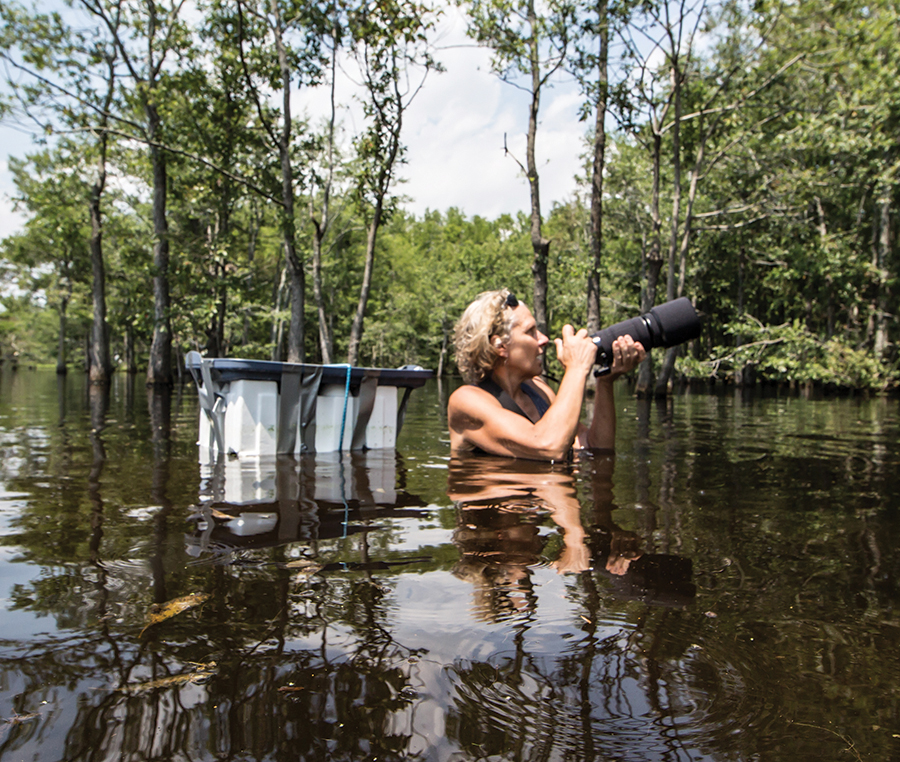
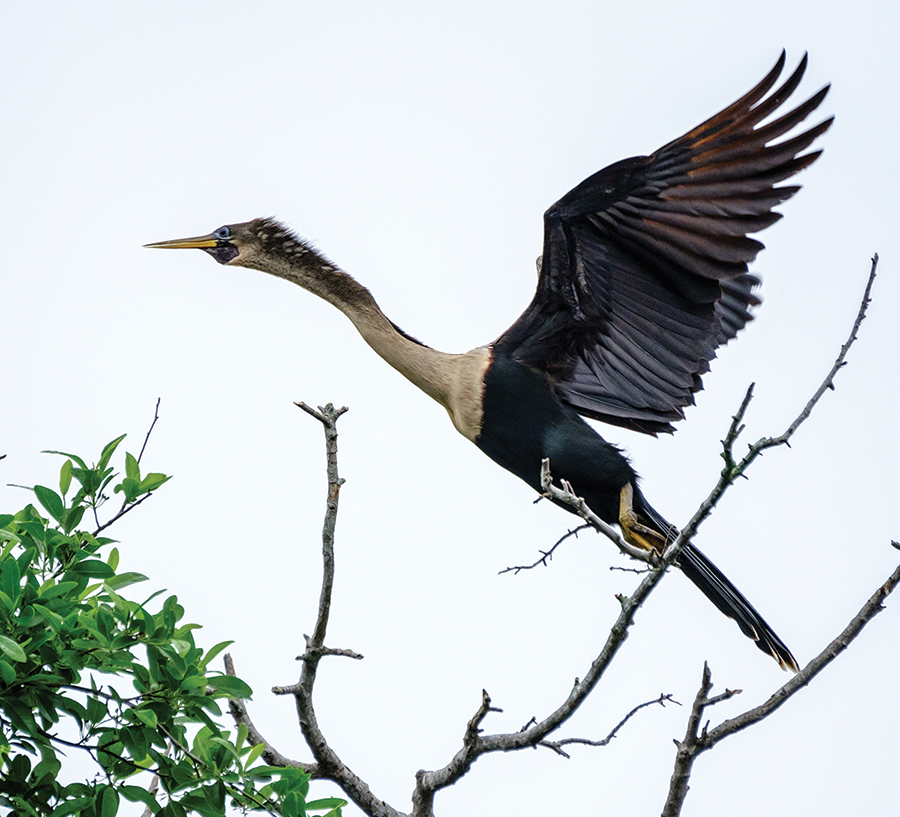
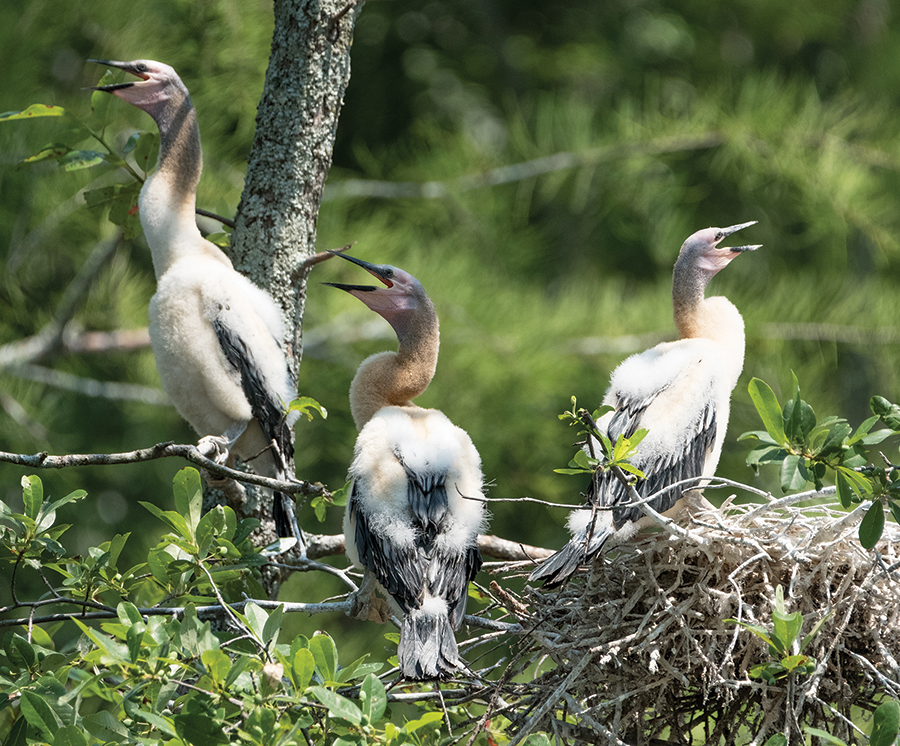
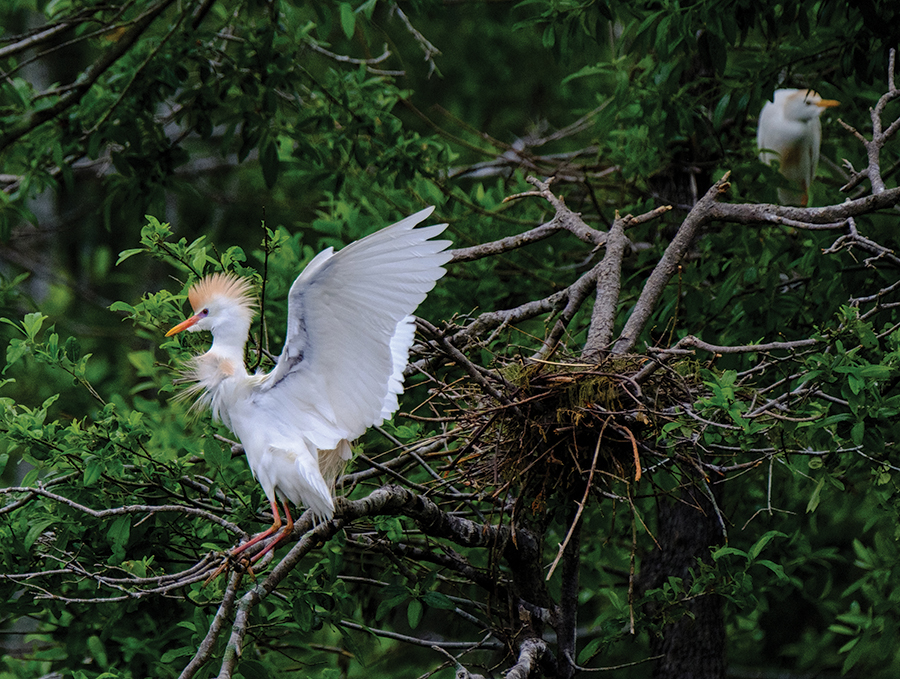
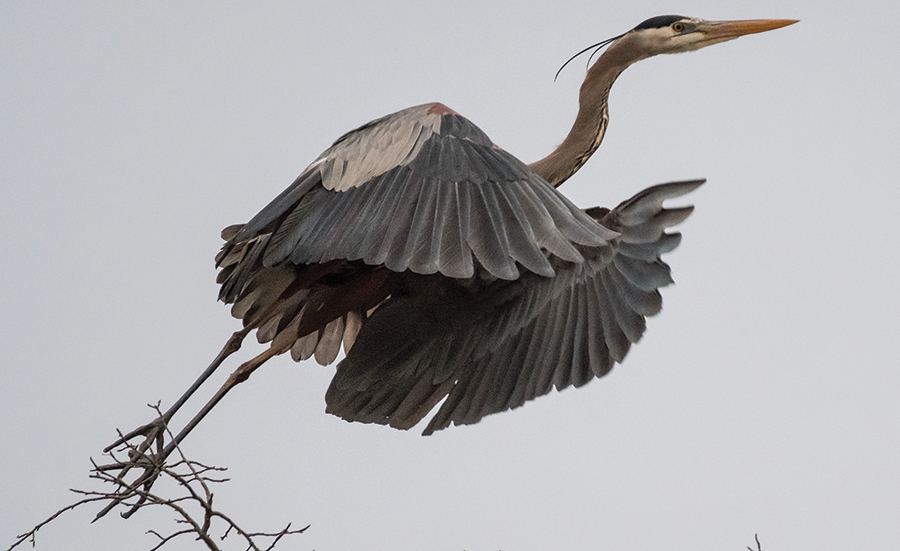
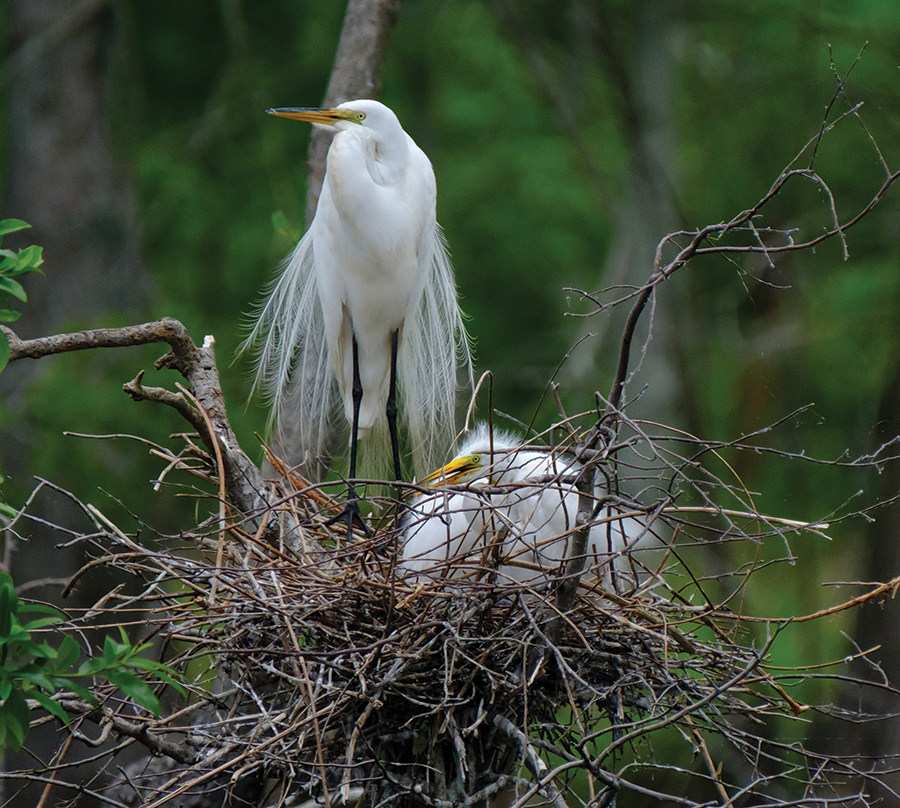
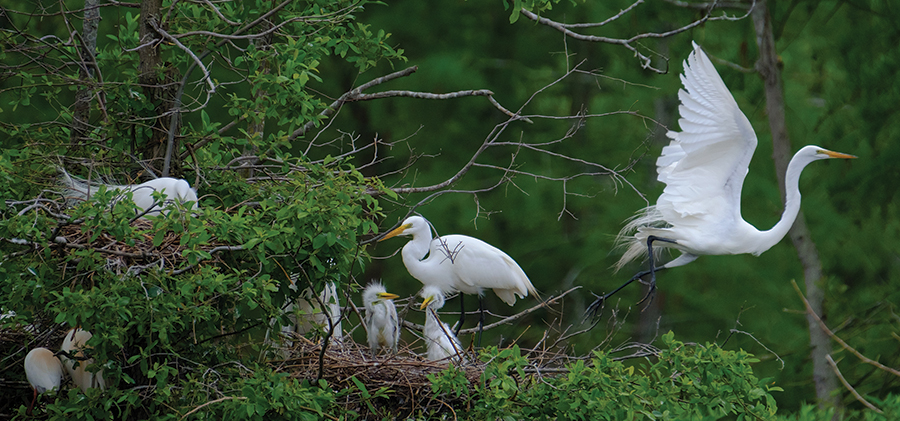
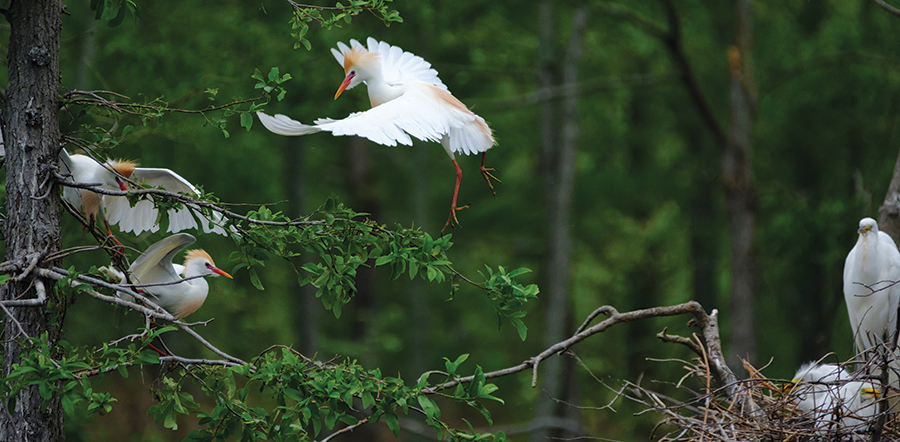
Carefully holding her camera above the surface of the water, Laura Gingerich waded into the forest swamp up to her armpits. Her feet sank into the slippery rot and muck on the bottom. Like quicksand, the more she moved, the more the ground swallowed her legs, nearly reaching her knees. Beyond a stand of cypress, she saw a clearing. By then the water was touching her chin. Turning a corner, they appeared in front of her. It was a robust, diverse community of birds, a breeding spot for snowy egret, great egret, great blue heron, green heron, cormorant and anhinga. Awe replaced trepidation. In the months that followed, Gingerich used a jon boat, a kayak and a canoe to return over and over again to the swamp, gathering photographs of this rare inland rookery in Robeson County.

“It’s one of the clay-based Carolina Bays,” says Jeff Marcus of the Nature Conservancy. “Carolina Bays are these unique geological features, rare isolated wetlands that occur primarily in the coastal plain of North and South Carolina. They’re all elliptical in shape and all kind of oriented to the northwest and southeast. It’s been a hotly debated topic as to what the origins of these things are. People have speculated everything from meteor impacts to dinosaur or whale wallows. The most prevalent theory is that it has more to do with the wind and wave actions when the Coastal Plain was a shallow sea.”

This bay, like many others, is protected by the Nature Conservancy. “What makes this site interesting is that most of those birds primarily are kind of coastal breeders. They’re found in the greatest abundance right at the coast, nesting on barrier islands, so it is somewhat unusual to have a large rookery so far inland,” says Marcus. “It’s great to get people more interested and aware and excited about all the natural history we have right in our own backyard. We don’t always appreciate what a special and unique place it is to live where we do.”

Anyone interested in visiting a site like the rookery in Robeson County or in becoming a member of the Nature Conservancy can call the Sandhills field office at (910) 246-0300.

Triumphant Return

Frazier is back with a new historical novel that reads like poetry

By D.G. Martin

Charles Frazier’s blockbuster first novel, Cold Mountain, marked its 20th anniversary last year. It won the National Book Award in 1997 and became a popular and Academy Award-winning film starring Nicole Kidman, Jude Law and Renée Zellweger. From Cold Mountain and the books that followed, Thirteen Moons and Nightwoods, Frazier gained recognition as North Carolina’s most admired writer of literary fiction since Thomas Wolfe.

Frazier’s many fans celebrated the April release of his latest novel, Varina, based on the life of Confederate President Jefferson Davis’ wife. But, because his most recent previous novel, Nightwoods, had come out in 2011, they wondered why he had made them wait so long. The simple answer: Frazier refuses to work fast. Every word of every chapter of every one of his four books was reviewed, rewritten, replaced and restored by him to make the final product just right. It’s that process that makes Varina a book so full of rich and lovely prose it could pass for poetry. And well worth the wait.

Because Varina is historical fiction, Frazier faced a challenge similar to the one Wiley Cash encountered in his recent book, The Last Ballad. Writing about a real person — textile union activist Ella May Wiggins in Cash’s case or Varina Davis in Frazier’s book — limits an author’s freedom to create and imagine without limits. The facts of history set firm and solid boundaries.

On the other hand, those real historical facts provide the framework within which Cash and Frazier, both, have succeeded in developing interesting and believable characters. Varina takes us back to the 1800s and the Civil War, a period it shares with Cold Mountain and Thirteen Moons. The central character of the new book is Varina Howell Davis, until now an obscure Civil War footnote. Frazier refers to her as “V.”

He builds V’s story around an unusual fact. While living in Richmond as first lady of the Confederacy, she took in a young mixed race boy she called Jimmie. She raised him alongside her own children. At the end of the Civil War, Union troops took 6-year-old Jimmie away from V, and she never learned what happened to him.

Frazier begins his story 40 years later at a resort-spa-hotel-hospital in Saratoga Springs, New York, where V is residing. James Blake, a light-skinned, middle-aged African-American, has read about Jimmie. His memories are very dim, but he begins to think he might be that same Jimmie and sets out to visit V at Saratoga Springs.
When Blake calls on V at the hotel, she is suspicious, having been the victim of various con artists who attempted to exploit her fame. But something clicks. “She works at remembrance, looks harder at Blake’s broad forehead, brown skin, curling hair graying at the temples. She tries to cast back four decades to the war.”

Blake visits V for several Sundays, and Frazier builds his story on the growing friendship and the memories they share. During the course of Blake’s visits, V remembers her teenage years in Natchez, Mississippi; her courtship and marriage to Davis; life on his plantation while Davis is often away in military service or politics; living in Washington as wife of a U.S. senator and Cabinet official; being the first lady of the Confederacy; and her post-Civil War life when she becomes friends with the widow of Ulysses Grant and writes a column for a New York newspaper.

These are important subplots, but the book’s most compelling action develops in V’s flight from Richmond when it falls to Union troops at the end of the Civil War. In the book’s second chapter, V and Blake begin to recall their journey southward. As V prepares to leave Richmond on the train, Davis tells her she would be coming back soon because “General Lee would find a way.” But Lee does not find a way this time.

V’s family, including Jimmie, servants and Confederate officials, travel to Charlotte, where an angry mob confronts them at the rail station. Evading the mob there, they “traveled southwest down springtime Carolina roads, red mud and pale leaves on poplar trees only big as the tip of your little finger, a green haze at the tree line. They fled like a band of Gypsies — a ragged little caravan of saddle horses and wagons with hay and horse feed and a sort of kitchen wagon and another for baggage. Two leftover battlefield ambulances for those not a-saddle. The band comprised a white woman, a black woman, five children, and a dwindling supply of white men — which V called Noah’s animals, because as soon as they realized the war was truly lost, they began departing two by two.”

Their goal is escape to Florida and then Havana.

Supplies have shrunk and their money has become worthless. Rumors circulate that their caravan has a hoard of gold from the Confederate treasury and that there will be a big reward for their capture.

Frazier writes, “In delusion, bounty hunters surely rode hard behind faces, dark in the shadows of deep hat brims, daylight striking nothing but jawbones and chin grizzle, dirty necks, and once-white shirt collars banded with extrusions of their own amber grease.”

Like Inman’s trek toward home in Cold Mountain, V and her companions confront adventure and terror at almost every stop.

In Georgia, low on food and soaking wet, the group finds refuge in a seemingly deserted plantation house. As they settle in, two or three families of formerly enslaved people appear, accompanied by the son of their former owner, Elgin, a “white boy, who grew less beard than the fuzz on a mullein leaf.”

Elgin sasses and threatens two former Confederate naval cadets, Bristol and Ryland, who are accompanying V’s group. He blames them for losing the war.

Ryland responds in kind, “You’ve not ever worn a uniform or killed anybody, and you’re not going to start now. Have you even had your first drink of liquor?”

Ryland and Bristol laugh when the boy reaches into his pants and pulls out a Derringer pistol and points it at Ryland.

“And then Elgin twitched a finger, almost a nervous impulse, and an awful instant of time later, Ryland was gone for good.”

Frazier writes that Ryland had been transformed in a matter of seconds “to being a dead pile of meat and bones and gristle without a spark. Three or four swings of the pendulum and he was all gone.”

Instantly Bristol guns down Elgin. Before moving on, V’s group and the former slaves bury Elgin and Ryland, two more unnecessary casualties in a war that simply would not end.

With V’s group back on the road, we know their attempt to escape is doomed to failure. But Frazier’s dazzling descriptions give us hope, hope that is quickly dashed when Federal troops capture V and take Jimmie away from her.

Readers who loved Frazier’s luscious language and compelling characters in his earlier books will agree that Varina was worth the long wait.

But what are they to make of V, her husband, and the Confederate heroes who are bit players in the new book?

Perhaps Frazier leaves a clue with the final words, as James Blake remembers what V says to him on one of their visits at Saratoga Springs.

“When the time is remote enough nobody amounts to much.”  PS

D.G. Martin hosts North Carolina Bookwatch, which airs Sundays at 11 a.m. and Thursdays at 5 p.m. on UNC-TV.

TOPO’s Whiskey and Rum

New releases from one of North Carolina’s most inventive distilleries

By Tony Cross

Four years ago, I was in my final couple of hours of wrapping up a Saturday night behind the bar. It was busy and I was slinging drinks and carrying on the type of banter that goes with the territory. Usually after 8 p.m. on a weekend night, most of my guests were relaxed enough to tolerate, maybe even laugh at, my antics. In between the chaos, two gentlemen took seats at the bar. After greeting them, I turned around to grab a bottle of rye and make a drink. “Do you guys carry TOPO spirits?” one of them asked. It had to have been some sort of divine intervention, because my first thought was, “Yeah, but you’re the only person to ask for it.” TOPO vodka was the first local spirit I carried, and I was a little disappointed that guests weren’t flocking to support a local distillery. Another way of putting it is: My feelings got hurt when guests didn’t like what I did. But instead of talking first and thinking later, I said, “Actually, yeah, we carry their vodka. It’s good stuff.” Good job, Tony. Not being a smart-ass paid off for once. I had just met the owners of Top of the Hill Distillery, Scott Maitland and Esteban McMahan.

Since that night, I’ve formed a relationship with TOPO’s spirit guide, McMahan. No one in North Carolina’s distillery game seems busier than him. If you follow TOPO on Instagram (handle: topoorganicspirits), then you know exactly what I mean. If I had to guess, I’d say that he’s doing three to four events a week across the state. The guy is everywhere. And thanks to McMahan’s work ethic, I was able to debut my carbonated cocktails on draught to a ton of people when he asked me to bartend with him at Stoneybrook two years ago. Since then, we’ve collaborated a few times and he always makes a point to let me know when he’s in Moore County. The last time I saw McMahan was in March, when he was finishing up an event at the Carolina Horse Park and wanted to link up so he could turn me on to TOPO’s new whiskey. After having a drink and catching up, he gifted me a bottle of their organic Spiced Rum and Reserve Carolina Straight Wheat Whiskey.

I first got a taste of TOPO’s Spiced Rum last fall during Pepperfest in Carrboro. McMahan had invited my friend and co-worker, Carter, and me to come out and use pepper-infused TOPO vodka with our Reverie strawberry-ginger beer. We had a blast, and our cocktail even took first place. While we were there, we got to see the TOPO crew unveil their newest spirit, the Spiced Rum. A few months prior to Pepperfest, the guys over at the distillery were still tweaking the rum. They’d given me a taste at the time, and it wasn’t bad. When I got to try it at Pepperfest, it was clear they had gotten it just right. On the nose, there’s vanilla, orange, and the slightest whiff of banana. On the palate, orange and vanilla are still present, but I can also taste spices — cinnamon is definitely there, clove is subtle, and allspice seems to round it out. McMahan says their rum is “N.C.’s only USDA Certified Organic rum. It is distilled from organic evaporated cane juice and molasses, and spiced with organic fruit and spices. Unlike most spiced rums, it is not heavily sweetened post-distillation, nor are there artificial colors and flavors.” Heck, the rum was even awarded a bronze medal at the American Distilling Institute Competition this year. I would suspect that rum purists might not go crazy about it, but I think it’s fun to play around with, and goes well in a variety of mixed drinks. You can definitely go the Dark n’ Stormy route, or you can fiddle around with something like I did below:

Kind of Blue

2 ounces TOPO Spiced Rum

3/4 ounce pineapple juice

1/2 ounce lime juice

1/4 ounce simple syrup (2:1)

2 ounces Reverie Ginger Beer

Take all ingredients (sans ginger beer) and pour into a cocktail shaker with ice. Shake like hell, and then pour two ounces of ginger beer into the shaker. Dump everything into a rocks glass. Garnish with fresh grated nutmeg (using a microplane).

As much as I like to stay busy, I can do lazy, too. Case in point: that bottle of TOPO’s Reserve Carolina Straight Wheat Whiskey. I didn’t want to open it until I could take a picture of it for this issue’s column. I’ve had this bottle staring at me from my kitchen counter since March. All I had to do was take a picture of it. Well, I did. Tonight. And I opened it. Tonight. One of my friends has been telling me how good this whiskey is. I’ll be hearing “I told you so” sometime later this week.

I asked McMahan about TOPO’s new whiskey, and he had this to say: “The TOPO Organic Reserve Carolina Straight Wheat Whiskey is N.C.’s first and only locally sourced straight whiskey. It is distilled from a 100 percent wheat mash bill of USDA Certified Organic soft red winter wheat from the Jack H. Winslow Farms in Scotland Neck, N.C. It is distilled below 80 percent ABV, barrel aged in #3 char new American oak barrels two to four years at no more than 125 proof, and then it’s non chill-filtered.” I know, he forgot to tell me how smooth this whiskey is. Congratulations are in order, too. McMahan was just notified that TOPO placed gold in the San Francisco Spirits Competition. No drink recipe for this one, folks. If you must, an old-fashioned. I’ll take mine neat with half an ice cube. Cheers!   PS

Tony Cross is a bartender who runs cocktail catering company Reverie Cocktails in Southern Pines.

Summer Simmer

The heat’s on in June but the stars say, “Cool it!”

By Astrid Stellanova

Star Children, I do relate to all the mischief you are in right this hot minute with Summer Solstice approaching on the 21st. We’re all hot and bothered. I’m a hopeless romantic, too. June is named after Juno, the Roman goddess of marriage. Let. That. Sink. In. If I was to finally tie the knot with Beau, I’d have more pink, tulle, icing and frou-frou going on than Shelby’s wedding in Steel Magnolias. I would also hand out Pepto-Bismol as a wedding favor, because shortening and sugar are a plural food group in my world, and happiness or heartache still bring stomach ache.

Pepto-Bismol solves at least one of the problems. You’re welcome. I’m dispensing a few more warnings that just about all of y’all in Star Land need to heed. And why not follow the (free) counsel of older and wiser Astrid? – Ad Astra

Gemini (May 21–June 20)

Honey, you got an itch to be bewitched. And when you say I do, remember it’s durn difficult to find the undo button. Most folks just settle for a do-over before they have been done over. You have lost your mind because somebody has been wooing and undoing you. Your powers to charm and bewilder can strike in the same sentence. If you see a greener pasture, we know your M.O. You will be over the fence and bolted before the one you loved and left has even figured it out. The sensible thing would be to just hit the pause button. But Sugar, sensible is not in your wheelhouse.

Cancer (June 21–July 22)

You cannot hear thunder. What got into you, Sugar? Let me just say, Karma honked the horn at you and you just sashayed right on past. You cannot outrun your destiny. Take two minutes to read that again. There is a real need for you to own what happened, and make amends.

Leo (July 23–Aug. 22)

My Lord! Somebody steered you wrong, but you decided that somebody knew more than everybody else. That friend could be a serial killer and you would still think they would go for your bail. This is going to hurt, this cliff dive, because you convinced yourself the very one driving you over cared about you. Let the healing begin.

Virgo (August 23–Sept. 22)

This is your life. And this month is like spending 24 hours in a Vegas casino and winning a cup of quarters. Yes, Sugar, it does beat losing. But not by much. Go get you some sunshine, rehydrate, then have a square meal and recover your senses. 

Libra (Sept. 23–Oct. 22)

It’s a recurring theme: You need to escape, and your bag is packed with your best clean underwear with good elastic. Answer this: Are you running from love, or towards it, Honey? When you recover from itchy feet, you may find nothing that scary is chasing you.

Scorpio (October 23–November 21)

Where is your sense of self-preservation? Is this love or is it suicide? You and your beloved are like planets circling the same sun but on a collision course. You don’t have to treat love like nuclear fusion. Love doesn’t have to destroy you to excite you.

Sagittarius (November 22–December 21)

Be like my dog Woodrow and hit the woof. Howl! Holler! You have tamped down all your emotions and now it is time to let them out! You are not dead yet, despite all your attempts to give that impression.

Capricorn (December 22–January 19)

If you loved yourself as much as you love your pocketbook, you wouldn’t let yourself go just because a no-good somebody broke your little heart. Time to splash out on some new duds, a haircut and some Crest teeth strips. Then, love, grin and bear it. 

Aquarius (January 20–February 18)

How far are you going to take this bad mood of yours? I will tell you that orange sure ain’t your color and it sure ain’t the new black. If you kill/maim/sabotage somebody in a jealous rage, the only thing you will have discovered is your own personal hell.

Pisces (February 19–March 20)

By the time word of your adventure traveled back, and it traveled fast, there was nobody who could look you straight in the eye and not think: Lordamercy! So you blew your inheritance on something like a big trip to Dollywood. It ain’t nobody’s business but yours. Live on the memories, Sweet Thing.

Aries (March 21–April 19)

I’d like to introduce you to your future. But I won’t. It ain’t in my power to tell you what will happen if you take the steps you’ve been contemplating. It’s extreme, even for you, Sugar. For the love of Pepto-Bismol, don’t run over a small child just trying to get ahead when you will anyhow.

Taurus (April 20–May 20)

Lord help us. There is not enough sunscreen in the world to keep you from SPFing this thing up. You know what I mean. You have got one powerful opportunity, and all you need to do is exercise just a smidge of caution. But that ain’t happening unless somebody bodily restrains you. PS

For years, Astrid Stellanova owned and operated Curl Up and Dye Beauty Salon in the boondocks of North Carolina until arthritic fingers and her popular astrological readings provoked a new career path.

The Deer Departed

At least, that’s the plan

By Jan Leitschuh

I have chronicled the ravages of Southern white-tailed deer here at Cottage Garden Farm, as well as the myriad methods used to discourage our cloven-hoofed neighbors from ravaging not only the vegetable garden but stripping out the tasty pansies, roses, zinnias, daylilies, sunflowers, hostas and more.

Last summer, it got so bad I actually considered giving up growing vegetables. The magnitude of that discouragement still stings. Vegetable gardening is something I’ve done since childhood when my parents, retaining a Victory Garden habit from the war years, taught me the pleasures of coaxing edible life from the soil. I can imagine few more graceful pursuits than the quiet peace of growing fresh, clean, delicious food.

But after following the call of spring last year, the largest horde of deer yet swooped in and savaged the entire garden. Before, it might be a ripe fruit taken here, an okra plant nipped there. Now, healthy cucumber, squash, sugar snap pea, pepper and tomato plants were taken to the ground. Laid waste. Little but rosemary was left standing.

I may have a solution. Call me hopeful, more hopeful than I have felt in years, thanks to a tip from a fellow plant enthusiast from Greensboro, garden educator Ellen Ashley.

You can’t blame the deer. They only do what deer do — smell out a good thing and eat it. With the efforts we have made to sweeten and enrich the garden’s soil, one could almost take it as a backhanded compliment. The deer equivalent of the cereal commercial: “Mikey likes it!”

We tried an electric fence wire. Nope, over they hopped. We hung the wire with little peanut butter-smeared foil “tags,” hoping to tempt the deer to lick them, and training them to stay away because of the mild electrical unpleasantness. For a variety of reasons, that didn’t work either (plus it was difficult to keep the wires from grounding out). The vegetables fattened happily on their parent plants, and just when you’d think “one more day to perfect ripeness,” the keen-nosed deer would make the same assessment, whisking in and making off with the season’s first tomato, flattening the okra or decimating the green bean patch — and ignoring the peanut butter.

Scent is key. Some studies have estimated that the white-tail deer’s ability to smell is about 10,000 times stronger than a human’s. In a deer, more brainpower is dedicated to analyzing odors than any other brain function. They have a secondary odor detector in the roof of their mouth. A buck can smell a doe over a mile away.

For deer, smell is the information highway, and a dinner menu.

Many anti-deer strategies try to use their sense of smell against them. I have tied pungent soaps in little hosiery bags around the garden — we should have bought stock in Irish Spring that year. Nope. I clipped the dog and sprinkled his winter fluff about the perimeter. No luck, although area bird nests that year had fluffy, soft, blond golden retriever linings. (The dog himself was useless, camping at night at the foot of our bed.) No dice with human hair collected from a hairdresser, either.

I casually suggested to my husband that he make his way to the perimeter of our secluded garden to kind of mark his territory in a sort of Y chromosome wilding activity. He was not amenable, noting that the toilet was much closer and less likely to get him arrested for indecent exposure.

Last year, taking a cue from Karyn Richardson of Eagles Nest Berry Farm, I invested in a tall, see-through plastic netting that blended nicely into the background. Deer can jump seven feet, so a fence must be high. Karyn has surrounded her blueberry acres with this fence and high poles, and from a distance, one can hardly see it. She did find the deer were sneaking underneath the fence, so she pinned the bottom.

I did the same, using bamboo poles to extend our stakes. The fence took tremendous effort to erect, was costly, a pain to weed-eat around and move wheelbarrows through, but what price peace in the garden?

It should have worked. Yet in the morning, there would be multiple deer inside our small garden and I’d lose my mind. In carelessly leaping out, the deer would tear down a whole netting wall. And the garden mess they left behind was heartbreaking. This winter we took the fence down completely. The deer were just too accustomed to visiting our flavorful patch. Was this the end of my love affair with garden veggies?

For years I had been protecting choice plants like pansies and hydrangeas with an expensive store-bought deer repellent spray. It did work — rather well, actually — but was too expensive to justify for a whole garden, even for a few fresh beans or young zucchini.

Which is why I sat up in my chair when Ashley spoke at Weymouth this April, at a public lecture sponsored by The Garden Club of the Sandhills, and declared she had a sure-fire deer repellent. “This will work! And I’ve tried everything!”

Ashley teaches regular gardening classes throughout the Triad on a number of topics like shade garden planting, cutting gardens, rock gardening, pruning, pest control, edible gardening, and more. It must have been fate that brought her to the Sandhills, and me to her lecture.

She noted that commercial sprays are effective and convenient if you only have a few plants in need of protection. “But they are expensive,” she said. “And I had 10 acres. And when you drove in, you’d see eight or nine deer on the driveway.”

Ashley’s challenge was to protect thousands of plants in more than nine different gardens, including woodland gardens, a “tropical garden,” a conifer garden, a rock garden, a cutting garden and an edible garden filled with fruit trees, berries, vegetables and herbs. “I used many things that were the solution,” she said.

Like me, she tried strategies like pungent soap in bags and human hair. She also tried mothballs, and 2-foot stakes with saturated cotton balls positioned every 15 feet around the garden. “It all worked until it didn’t.” 

She experimented with fox urine, also expensive. “You drip it around your garden and nothing is supposed to come near it. Including you. It was so nasty you never wanted to come near your garden.”

The commercial products “Deer Fence” and “I Must Garden” did work, but were still too expensive. “I noticed the common ingredient in these products was egg,” she said. “I added egg to my sprayer, but it kept gumming up the nozzle. So I separated the egg from the yolk, and just used the yolk. It worked beautifully.”

Ashley advised that the gardener should keep tabs on new growth. “The deer have such sensitive noses, they will know exactly which leaves you have not sprayed,” she said. “They will eat the five inches on top you have not sprayed. And if you don’t spray everything, they’ll just turn from their favorite to their second- or third-favorite plants.”

So I’ve taken the leap of faith. Yesterday, I mixed up a batch for a simple, inexpensive 1-gallon sprayer. I beat the egg yolk and peppermint oil together in a bowl with a bit of water and, innovating, added a small squirt of dish soap to help with the emulsifying and sticking. It did not smell bad at all, thanks to the peppermint.

I installed my tomato, squash, cukes, okra, eggplant, beans and pepper plants, and then liberally sprayed the still-surviving lilies, hostas, cosmos and pansies. Because, I must garden. 

Ellen Ashley’s Deer Repellent Recipe

Whip 3 egg yolks with 2 teaspoons of peppermint oil. Beat that into a gallon of water, and spray onto vulnerable plants. “It may smell funky to you, though it does seem to work while the eggs are fairly fresh,” says Ashley. “The stuff doesn’t go bad, it’s already bad. The longer it sits, the more pungent it becomes. I spray it when I’m about to go inside for the night. By the end of the next day you can hardly smell it.” Spray more frequently in spring, or after a hard rain.  PS

For lectures or courses, contact Ashley via her website http://www.learntogarden.net, or email ellen@learntogarden.net.

Jan Leitschuh is a local gardener, avid eater of fresh produce and co-founder of the Sandhills Farm to Table Cooperative.

Whitaker & Lee Lagioia

WHITAKER & LEE LAGIOIA

Photographer: Pinehurst Photography Wedding Planner: Vision Events Wedding & Event Planning

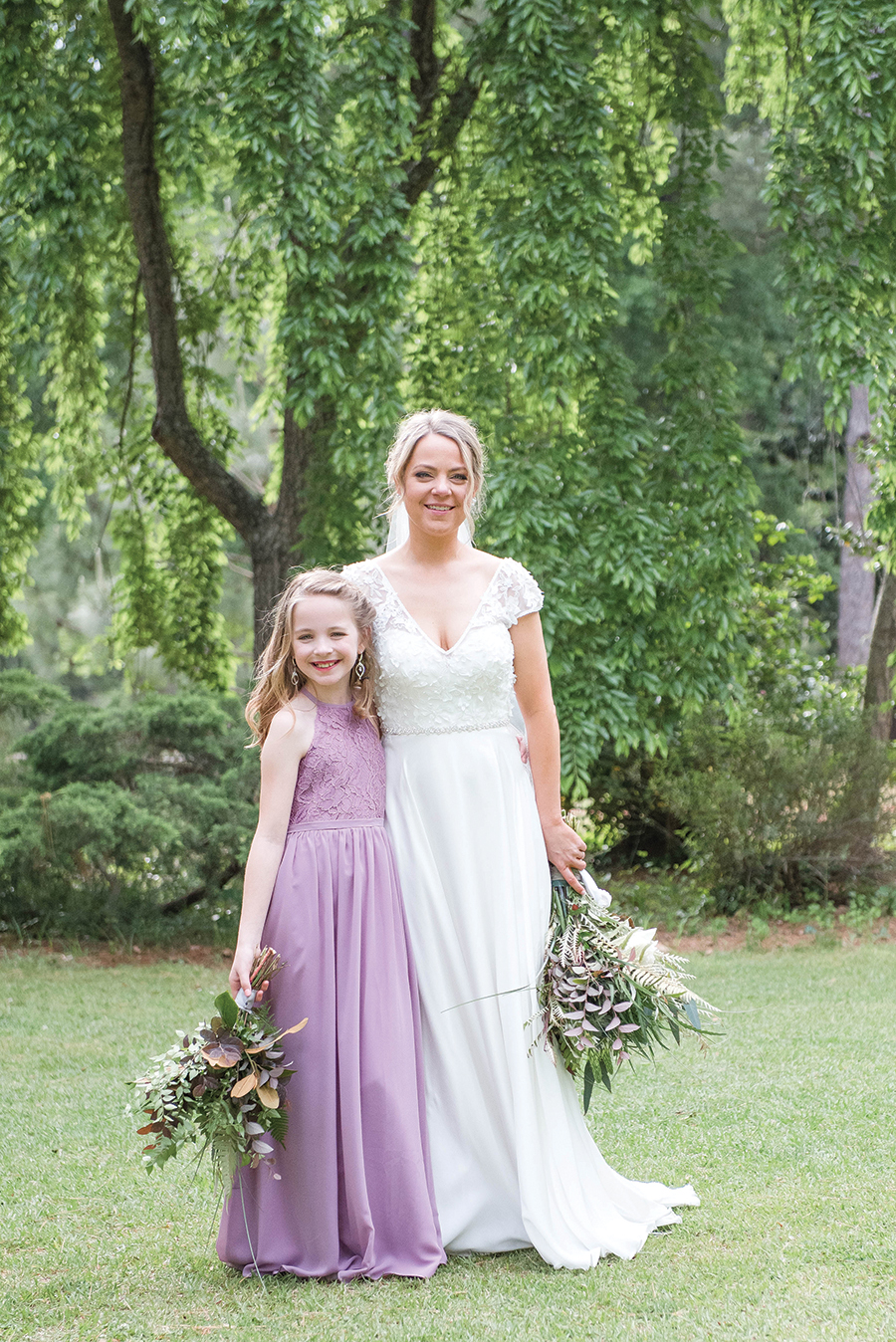
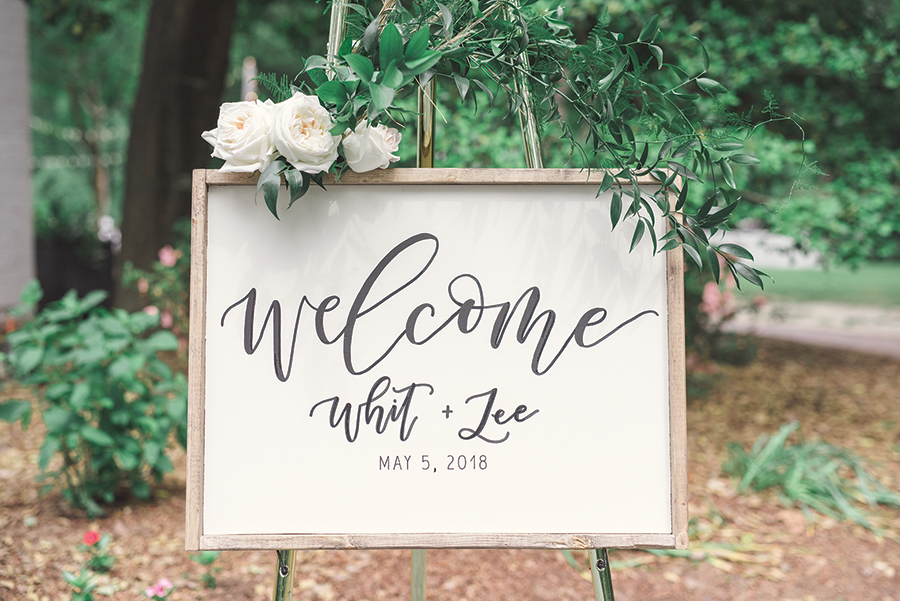
After saying yes to Lee’s proposal (facilitated by the couple’s dog, Tilly), this busy professional would have been perfectly happy tying the knot at a courthouse near her Washington, D.C.-area home. Thanks to some convincing by her mom and step-dad, who frequently vacation in the area, Whitaker agreed to a rustic, low-key garden wedding at a venue far more down-to-earth than its big-city counterparts. Little details, like on-theme cupcakes, were secured from afar with the help of an expert planner. At the reception, a DJ spun hits from the ’80s and ’90s, and the power couple turned their focus from sales and finance to turning up on the dance floor.

Ceremony & Reception: Weymouth Center for the Arts & Humanities Dress: Ladies of Lineage Boutique Bridesmaids: Lulu’s Groomsmen: JoS. A. Bank | Flowers: Specialties Floral and Events Hair & Makeup: Retro Salon Cupcakes: C Cups Cupcakery | Catering: White Rabbit Catering | Rentals: Party Reflections and Ward Productions | Entertainment: All Events DJs | Calligraphy: Company52 | Transportation: Kirk Tours & Limousines

Jennifer & Matt Curtis

JENNIFER & MATT CURTIS

Photographer: Sayer Photography Wedding Planner: Maggie’s Farm

These frequent fliers are often galavanting across the globe for work or play, but enjoy the comfort of their love nest in Raleigh. It was fitting, then, that Matt would propose on the couple’s front porch — with a wine bought at a Parisian cellar, no less. They enjoyed a rustic, whimsical garden-themed wedding at Emmanuel Episcopal Church in Jennifer’s hometown of Southern Pines, and moved the party outside for the reception at the Weymouth Center. Guests closed out the night in a clear tent beneath the stars, as the band played a soundtrack to the couple’s next great adventure.

Ceremony: Emmanuel Episcopal Church Reception: Weymouth Center for the Arts & Humanities | Dress: Liancarlo Shoes: Badgley Mischka Bridesmaids: Monique Lhuillier Flowers: Maggie’s Farm Hair & Makeup: Brittani Baca | Cake: The Bakehouse | Catering: Elliott’s on Linden | Rentals: Ward Productions | Entertainment: The Adrian Duke Project | Cocktails: Reverie Cocktails