Focus on Food

Focus on Food

Pancakes à la Einkorn

Welcome to the world of ancient grains

Story and Photograph by Rose Shewey

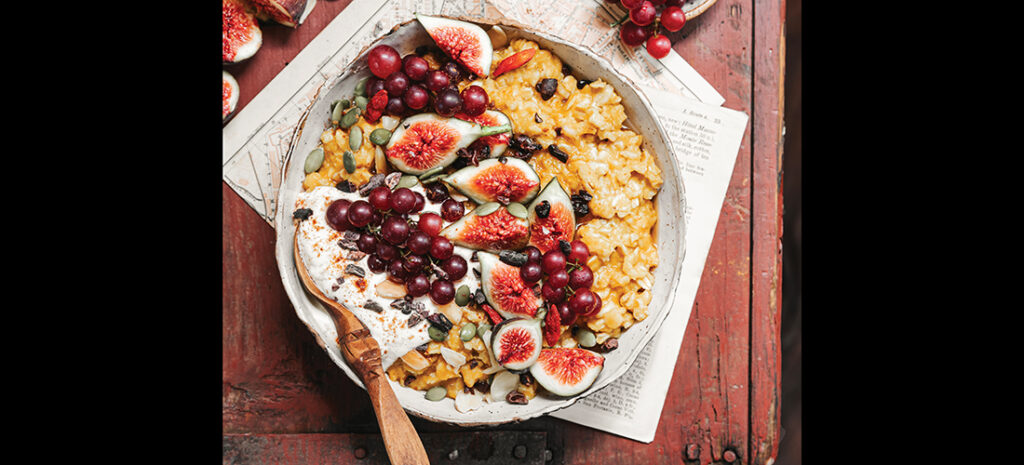
Crêpes, the slender, graceful cousin of the pudgy, all-American pancake, used to be the unrivaled god in my Olympus of all things batter-fried. With a culinary frame of reference of an expat and, well, a tad bit of ignorance, I had a lingering prejudice against pancakes for a long time. Put yourself in my shoes. Aside from the fact that a pancake seems to be just ordinary cake posing as a breakfast food, to the untrained eye, they appear a bit clumsy (if not to say uninspired). If you haven’t had the satisfaction of tasting properly prepared, made-from-scratch pancakes (I had the misfortune to be introduced to pancakes from a box mix), it’s not totally unreasonable to be skeptical of the legitimacy of this cake-like meal. Unjustly so, as lovingly home-crafted pancakes, artfully stacked and creatively topped, are a revelation in all their pillowy, puffed-up goodness. Though I have only recently begun to incorporate pancakes into our brunch routine — I still find them a bit heavy for breakfast — what absolutely sold me is making them with einkorn flour.

Einkorn wheat is an ancient grain believed to be the oldest and purest food around. Unlike modern grains, einkorn was never hybridized and contains fewer anti-nutrients, such as gluten. Folks who have a mild gluten sensitivity are often able to consume einkorn because of its gluten profile, which differs in quality from modern gluten.

While you can substitute einkorn for all-purpose flour, I found it best to start out following dedicated recipes to get a feel for this unique flour. Einkorn pancakes are an easy, fail-proof introduction to the world of ancient grains. It adds a nutty flavor and aids in keeping pancakes as fluffy as they need to be. Watch out crêpes, pancakes are on the rise! Pun intended.


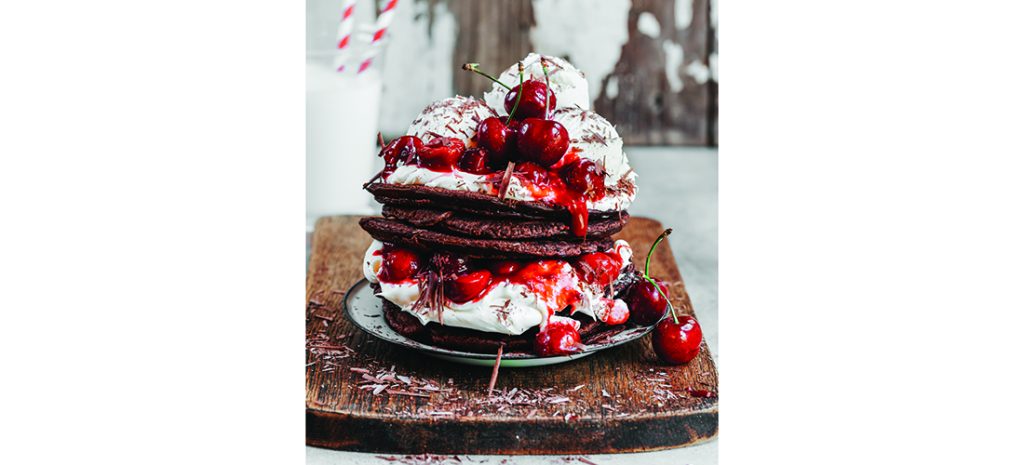
Chocolate Einkorn Pancakes with Cherry Sauce

(Makes 4-6 pancakes)

Cherry Sauce

1 tablespoon arrowroot powder

1/4 cup water

1 pound fresh or frozen pitted cherries

4 – 6 tablespoons sweetener, such as honey, maple syrup or granulated sugar, to taste

1 tablespoon freshly squeezed lemon juice

In a small bowl, whisk together the arrowroot powder and the water to create a slurry. Set aside. Add cherries, sugar (start with less sweetener and add more later, if desired) and lemon juice to a large pot and bring to a boil. Add the slurry while stirring continuously and simmer until the sauce thickens; for a bright red sauce, take off the heat now or keep simmering for 5-7 minutes for a more homogenous, cooked-through cherry sauce.


Einkorn Pancakes

1 1/2 cups all-purpose einkorn flour

3 tablespoons cacao powder

1 teaspoon baking powder

1/4 teaspoon salt

1 cup buttermilk or full-fat milk

1 teaspoon vanilla extract

2 eggs

1 tablespoon melted butter

2 tablespoons honey

Combine all dry ingredients in a large bowl and mix well. Add the remaining ingredients to a separate bowl and mix with a hand mixer until frothy. Add the dry mixture to the liquid mixture and stir until the batter is smooth. Allow batter to rest for a few minutes, as einkorn is slow to absorb liquid. Heat a skillet over medium heat, add desired amount of batter (about 1/4 cup) and cook on one side until the edges look done and the center bubbles up, then flip for a brief moment to finish cooking. Serve right away with toppings of your choice.   PS

German native Rose Shewey is a food stylist and food photographer. To see more of her work visit her website, suessholz.com.


Focus on Food

Focus on Food

Hearts of Stone

A sweet and savory summer flatbread

Story and Photograph by Rose Shewey

We no longer want to be just rich. We want to be eco-rich. It may be a generational thing or perhaps it is the zeitgeist, but either way, forget the townhouse with the smart fridge in your up-and-coming neighborhood. Give us an apple orchard with flower meadows on a spring-fed creek and we’ll consider ourselves wealthy. With peach vendors popping up like beach umbrellas and hot tub-sized crates of watermelon lining the produce aisles of every store this time of year, even if you’re not lucky enough to have the acreage (or the time) for a garden of your own, it’s impossible not to see the beauty and richness Mother Nature is affording us, particularly in the stone fruit department.

Cherries were my first love; I grew up with a cherry tree in my parents’ courtyard, and year after year it grew heaps of the most aromatic, crimson-colored cherries. Apricots and plums would grow lavishly in our cool temperate fields, but the climate in my home pastures didn’t allow for peaches. What once was an exotic fruit to me, lumped in with kiwis and mangoes on the market shelves, is now a cherished local harvest, thanks to the sandy soil of this region.

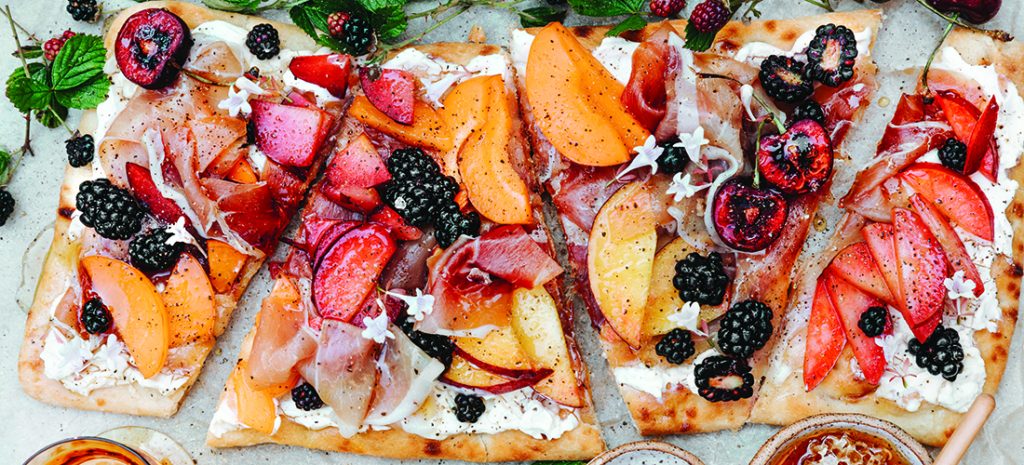
Let’s put the traditional grilled stone fruit and cobbler business on the back burner and try out a more hearty, wholesome meal idea. This sweet and savory flatbread comes together in no time, and cooking is completely optional — that is, if you use a store bought (or pre-made) base, otherwise it will just take minutes to make your own delicious flatbread. You can make this ahead of time or when you need it; topping options and combinations are limitless, and the end result has always been, without fail, a beautiful reflection of summer’s bounty.


Easy Skillet Flatbread

(Makes 4 medium size flatbreads)

2 cups all-purpose flour

1 1/2 teaspoons baking powder

1 teaspoon fine sea salt

1 1/2 tablespoons olive oil

1 teaspoon sweetener, such as honey or granulated sugar

3/4 cup cold water

Combine all ingredients in a bowl and knead for 3-5 minutes, until smooth. If the dough is too sticky, add extra flour; if the dough is too dry, add water, one teaspoon at a time. Divide into four equal parts and roll out to desired shape (about 1/4-inch thick). Heat a large skillet over medium/high heat. Add heat-stable oil (e.g., avocado oil) to the pan and, once heated, add rolled-out dough and cook for about 2 minutes on each side. Reduce heat slightly once you flip the bread, repeat with all remaining portions.


Whipped Goat Cheese

8 ounces goat cheese

3 ounces cream cheese

2 cloves garlic

1 tablespoon olive oil

3/4 teaspoon salt

1 teaspoon lemon zest

2-3 teaspoon fresh herbs, chopped, such as chives or thyme (optional)

Remove goat cheese and cream cheese from the refrigerator about 30 minutes before preparing this dish. Add all ingredients, except for the fresh herbs, if using, to a food processor and blend until creamy. If the texture is still crumbly after blending for 1-2 minutes, add more olive oil, one teaspoon at a time. Fold in fresh herbs and refrigerate up to 3 days.


Toppings

2-3 pieces of sliced stone fruit per person (such as peaches, apricots or plums)

Prosciutto slices

Blackberries

Honey

To assemble, spread whipped goat cheese generously on your flatbread, arrange sliced stone fruit, prosciutto and berries to your liking, drizzle with honey and serve.  PS

German native Rose Shewey is a food stylist and food photographer. To see more of her work visit her website, suessholz.com.

Focus on Food

Focus on Food

Red, White and Scoop

Homemade ice cream with natural dyes

Story and Photograph by Rose Shewey

America, my sweet home away from home. Thirteen years ago in August, you literally took my breath away when I immigrated via Orlando International Airport and, exiting through the sliding doors of Terminal A, was swallowed up by a thick cloud of heat and humidity that momentarily stopped me in my tracks.

While I have yet to adapt to the climate in the Southeast — a mild day in April resembles an average Central European midsummer day — I have reached expert level in managing sweltering summer heat and refining cool-down techniques. If migrating north between the months of June and October is not an option, the least one can do to survive these long, hot summers is get a season pass for the pool and eat lots, and I mean lots and lots, of ice cream.

In honor and celebration of The Star-Spangled Banner, I am shining the spotlight on food dyes and I’ll let that cat right out of the bag — you do not have to use artificial dyes to achieve stunningly vibrant, saturated colors, in ice cream or any other foods. There are a couple of all-natural brands on the market that produce gorgeous vegetable dyes that will knock your socks off. But do not fret, I have also had great success with some fantastic home-dye options.

Red

Powdered raspberries or strawberries will not just give your creation a beautiful blush color (or light red if you use large quantities), but also add an attractive flavor to your food. Red beet powder (not juice) is a decent colorant, and surprisingly, does not impart the quintessential earthy root vegetable flavor. It does, however, turn slightly more magenta than red, in my experience.

Blue

My favorite blue coloring agent is blue butterfly pea flower. This powder turns into a pastel blue with lavender undertones, but it depends on what you color and how much you use. Blue spirulina is another reliable and potent dyeing agent for a vivid blue color.

Advising on the exact measures is tricky when it comes to natural food dyes. The outcome depends on so many factors, such as the pH level of the food you are dyeing and the freshness of your colorant, to name just two. It takes some experimenting but it is so rewarding to draw from Mother Nature to refine home-crafted treats.

All romantic notions and sweet childhood memories aside, making ice cream is cold, hard science. With commercial ice cream as the gold standard in terms of texture and viscosity, homemade ice cream tends to disappoint (think large, grainy ice crystals), but by understanding the ideal ratio of the basic components of ice cream, as well as inviting all-natural texture boosters into your kitchen, the perfect hand-crafted scoop is well within reach.


Blank Canvas ’n’ Ice Cream

(Makes 1 quart ice cream)

(A basic dairy and egg-free ice cream recipe that can be adapted to any flavor)

4 cups dairy-free milk (see notes)

1/4 cup sweetener (e.g., granulated sugar or honey)

1 teaspoon agar flakes

2 teaspoons tapioca starch

1/2 cup smooth nut butter (e.g., almond butter or coconut manna)

Pinch of salt

1 teaspoon vanilla extract (optional)

In a medium skillet, bring the milk to a boil, whisk in sugar and agar flakes, and simmer for 8-10 minutes. Stir frequently to completely dissolve agar flakes. Meanwhile, prepare a tapioca starch slurry: In a small cup, combine tapioca starch with about 1 tablespoon of cold water and mix well. Turn off heat and whisk tapioca starch slurry into the milk, allowing the residual heat to cook the starch. For best results, add your ice cream base to a blender together with your nut butter, salt and vanilla extract and, if desired, food dye, and process until smooth. However, you can also mix in the remaining ingredients by hand. Allow the mixture to completely cool off in the fridge, pour into your ice cream maker and churn according to the manufacturer’s directions.

Notes

This recipe was tested with both homemade nut milk (almond milk and cashew milk) and store-bought nut milk with zero additives (no added gums or emulsifiers).

For a bright white ice cream base, use white granulated sugar or a light-colored honey and coconut manna (coconut butter).  PS

German native Rose Shewey is a food stylist and food photographer. To see more of her work visit her website, suessholz.com.
Focus on Food

Focus on Food

I Dream of Falafel

Iconic street food from the Levant

Story and Photograph by Rose Shewey

Do you know what North Carolina and North Africa have in common? We’re on the same latitude. Consider that for a moment! If you’re looking out onto the Atlantic Ocean in North Carolina you’re on par with Morocco. When inquisitive friends and family from overseas ask about the climate in our part of the world, I typically tell them that we may as well be in Casablanca. You know, if Casablanca was muggy.

I was so fortunate to visit North Africa and parts of the Levant in my younger years. I had just turned 18 and set up shop at the Costa del Sol in Spain for the summer. I vividly remember the day I was lounging at the beach in sunny Marbella; it was a particularly clear day, not a cloud in sight and the morning haze had just dissipated. As I gazed across the azure tinted Mediterranean sea, I saw her. I saw Africa and she was calling my name. Within less than 24 hours, I was on a ferry crossing over from Gibraltar, Spain to Tangier, Morocco. I was unaccompanied with little more than a small backpack, clutching on to my passport, ready to set foot on African soil.

North Africa is hands-down one of the most exotic and colorful places I have visited. While I have many rich memories of this trip, traversing the northern tip of Africa all the way from Morocco to transcontinental Egypt, what stands out the most is the allure of the Arab and Mediterranean cuisine, particularly the many different renditions of falafel I tried. No, I didn’t make it to Israel, the alleged home of the falafel where, rumor has it, you cannot turn around without ending up in the queue of a falafel shop. However, despite its popularity in Israel, most agree that falafel probably originated in Egypt. In fact, if you happen to go to a McDonald’s in Cairo, you’ll find McFalafel on the menu, bizarre as it may seem.

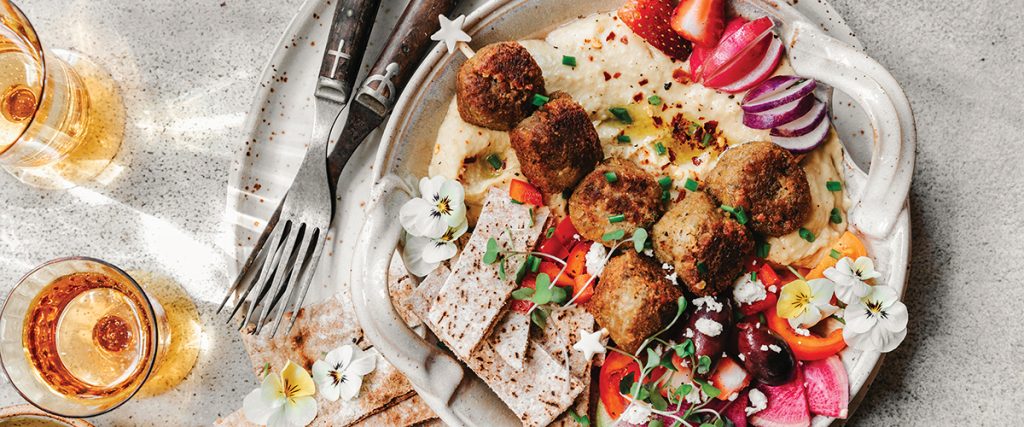
There are many reasons to love falafel. The most obvious is that these golden-baked, crispy balls drizzled with tahini sauce and stuffed into a fluffy pita or served as part of a meze are bursting with flavor. Falafel are also a fabulous gateway to a more plant-based life-style; with their meatball-esque texture, they leave little to be desired. June 12 marks the annual international falafel day, but why wait; there is no wrong time to enjoy the world’s oldest (and perhaps healthiest) fast food. 

Falafel

(Makes about 20 balls)

Ingredients:

1 1/4 cups dried chickpeas, soaked overnight

1/2 cup onion, finely chopped

4 garlic cloves, crushed

1/2 cup flat-leaf parsley, finely chopped

1/2 cup cilantro, finely chopped

1/4 teaspoon cayenne pepper

1 teaspoon ground cumin

1 teaspoon salt

1/2 teaspoon cardamom

1/4 teaspoon black pepper

2 tablespoons chickpea flour

1/2 teaspoon baking soda

Avocado oil for frying (optional)

Drain the chickpeas and add them to a food processor along with the onions, garlic, parsley and cilantro. If you have a small food processor, mix in batches; pulse each batch for about 30 seconds until the ingredients are finely chopped and hold together well. Once processed, add the spices, chickpea flour and baking soda and mix by hand; if the mixture feels too dry, add 1-2 tablespoons of water. Cover and refrigerate the mixture for at least 1 hour before processing.

Using your hands or an ice cream scoop, form balls or patties (about 1 tablespoon of mixture per ball).

You can now deep-fry or bake your falafels. To deep-fry, add about 4 inches of oil to a heavy-bottomed pot and heat the oil to 350°F. Cook falafels in batches, for about 3-4 minutes until they are golden brown. Transfer to a paper-towel lined plate and serve immediately.

To bake the falafel, pre-heat the oven to 425°F. Place the falafel on a baking sheet lined with parchment paper, brush the top of your falafel with oil and bake for 25 minutes. Flip falafel halfway through baking. Serve right away.  PS

German native Rose Shewey is a food stylist and food photographer. To see more of her work visit her website, suessholz.com.

Focus on Food

Focus on Food

Mama Don’t Bake

A simple cheese-less cheesecake

Story and Photograph by Rose Shewey

I talk about diet and nutrition as much as I talk about politics and the weather. Practically never.

To be honest, diet-talk is a regular snoozefest, in my book. But aside from lacking entertainment value, arguing diet- and nutrition-related issues is a no-win undertaking. Having self-studied nutrition for over a decade, I have come to understand that opinions, as well as science, vary tremendously on the subject and — as anybody who survived the great margarine craze knows — change fundamentally from time to time. Throw in body image and weight loss issues, and you’re in for some potentially awkward discussions. No thanks.

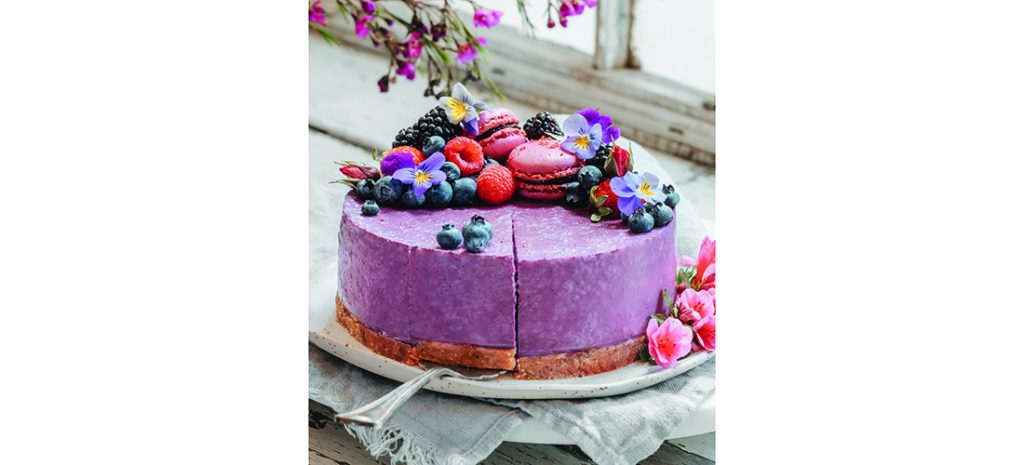
Still, despite all the controversies, can we agree that nutrient-dense foods are an excellent choice? I wouldn’t do this cheesecake any justice if I didn’t touch on the fabulously valuable ingredients this recipe calls for. I am talking about chia seeds, dates, almonds and cashew yogurt, as well as blackberries and even agar. For most health-minded chefs, particularly in the plant-based kitchen, there is something incredibly satisfying about adapting and healthifying conventional recipes. Substituting less nutritious ingredients with nutrient-rich, minimally processed foods to create a dish that looks, tastes and feels like the original is uniquely rewarding.

Take cheesecake, for example. To be clear, there is nothing wrong with regular cheesecake. I’ll be the first to grab a slice off the dessert buffet, but if I can have something of equal quality made with more wholesome ingredients, I will choose the more nourishing version every time.

So, does this cheese-less cheesecake taste like, well, cheesecake? It does. The yogurt gives it that tangy flavor, the texture is creamy and lush but firm enough to maintain its shape beautifully. On a scale of New York-style cheesecake to thick custard, this falls somewhere in the middle. And the proverbial cherry on top? This is a no-bake cake.


No-Bake Blackberry Chia Cheesecake

Crust

90 grams (8-10) dates, pitted

100 grams  (1 cup) ground almonds, blanched

1 teaspoon vanilla extract

Pinch of salt

Cake

340 grams (12 ounces) yogurt — I used store-bought cashew yogurt

55 grams (5 tablespoons) chia seeds

70 grams (about 1/4 cup) maple syrup, or more, to taste

1 can (400 milliliters) unsweetened, full fat coconut milk

3 tablespoons agar flakes (not powder)

300 grams (2 cups) blackberries, fresh or defrosted

Soak dates in boiling water for 10-15 minutes. Line the bottom of a 6-inch springform pan with parchment paper. Drain dates and squeeze out any excess water. Place all ingredients for the crust into a food processor and blend. Scrape down sides frequently while blending until you have a sticky, slightly coarse paste. Press the crust evenly into the bottom of the springform and set aside.

Mix yogurt with chia seeds and maple syrup and refrigerate. Stir the mixture occasionally to maintain an even texture. Pour coconut milk into a small saucepan, add agar flakes and bring to a boil. Reduce heat and simmer for about 6-8 minutes (or according to package instructions), stirring frequently. Meanwhile, add berries to a high speed blender and puree. Transfer berries to a large bowl and add coconut agar mixture, whisk to combine, then quickly incorporate the chia yogurt. Taste for sweetness; you may want to add more maple syrup if you like sweeter cakes, and promptly pour cheesecake mixture into the springform. Transfer cheesecake to the refrigerator and allow to set and chill for at least 3 hours, ideally overnight. Serve with fresh fruit or coconut cream.  PS

German native Rose Shewey is a food stylist and food photographer. To see more of her work visit her website, suessholz.com.
Focus on Food

Focus on Food

Mademoiselle Brioche

A sweet bread for Easter

Story and Photograph by Rose Shewey

If “brioche” conjures up images of burger buns, and little else, have you even lived yet?

Sure, brioche can be a party girl. She makes fabulous burger and sandwich bread, no doubt, but that’s just scratching the surface of what brioche is capable of. Yes, she can be your flip-flop-wearing, tank top-sporting drinking buddy, but if you ever had chocolate-glazed diplomats, you know she can also be your sophisticated wedding date in a lacy dress with kitten heels.

Or, as I am about to show you, brioche can effortlessly turn into your folksy, linen-trousered best friend with dangling earrings, one that is always full of surprises. Brioche is truly multifaceted but rarely ordinary.

For those of you who don’t geek out over baked goods, allow me to explain: Brioche is a delicate, buttery yeast bread (technically, it is a Viennoiserie), similar to everyday yeast breads, but picture a downy cloud made of fine-spun cotton and you have yourself some epic brioche. It also happens to be one of the easier bread recipes to make — if you own some sort of kneading gadget, which I do not.

I stubbornly hand-knead my dough. Nothing is quite as meditative and grounding as using your bare hands to make bread; feeling the texture transform between your fingers from powdery, gooey and slippery to a satisfyingly malleable shape. Making dough is the grown-up equivalent of a toddler’s sensory bin, if ever I have seen one. Bonus points if your dough later doubles in size, which it hopefully will, and you have passed the halfway mark to a feathery brioche, whichever shape or form you decide to process it into.

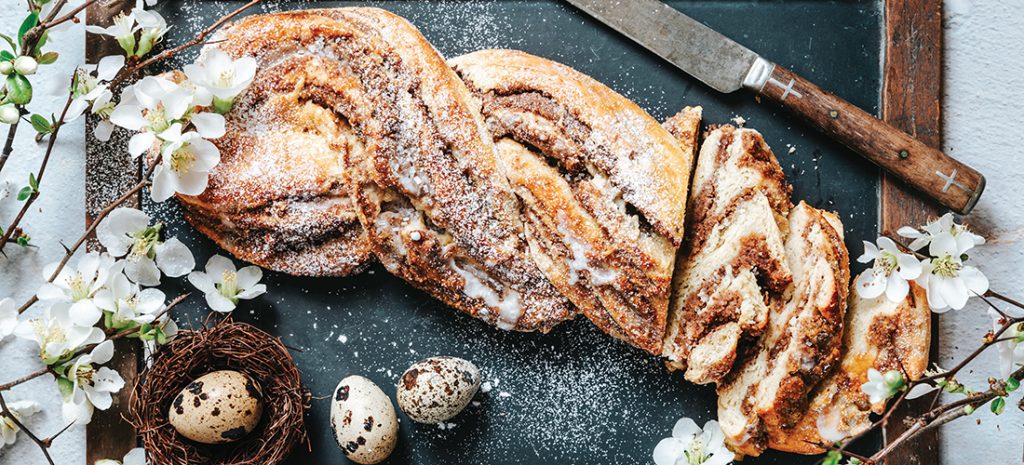
With Easter, or Ostara, on the horizon — you know, that time of the year that marks the awakening of the earth and colors the land in lovely shades of pastel — many cultures celebrate with the tradition of braided yeast bread. The interpretation of its symbolism is wide-ranging and differs significantly, depending on the Kulturkreis. For me, it’s simply a family tradition that brings back memories of my grandma’s kitchen; the sweet perfume of freshly scraped vanilla beans, the earthy scent of fermenting yeast and us kids sticking our fingers into the sugar-lemon glaze bowl, which ultimately got us banished from the room. We didn’t call it brioche then; I didn’t connect the dots until later on, when I went on my own baking journey, and of all the things brioche can be, the Easter braid will forever be my favorite.


Mocha Hazelnut Brioche Braid

(Makes 1 braided loaf)

(Basic dough recipe adapted from
Bouchon Bakery)

For the dough:

270 grams all-purpose flour

6 grams instant yeast

30 grams granulated sugar

7 grams salt

130 grams eggs (roughly 3 medium sized eggs)

45 grams milk

120 grams unsalted butter, cut into 1/2 inch cubes

For the filling:

150 grams finely ground hazelnuts

30 grams sugar

30 grams chocolate spread

5 grams cinnamon

50 grams grated apple

60 grams brewed coffee

8 grams freshly squeezed lemon juice

Place flour and yeast in a large mixing bowl and whisk to combine. Add remaining ingredients except for the butter and mix for 5 minutes by hand, or with the help of a stand mixer with dough hook. Continue kneading for 30 minutes while slowly adding in small chunks of butter. Fully incorporate each chunk of butter before you add the next. The dough will be slightly sticky at this point; remove it from the bowl (use a scraper if needed) and place it on a lightly floured surface. Pat, stretch and fold the dough, then place it back in the bowl, cover and allow to rest for 1 hour at room temperature. Repeat the pat, stretch and fold before moving the dough to the refrigerator and chilling overnight.

Combine all ingredients for the mocha hazelnut filling and set aside. Take the dough out of the fridge and set on a lightly floured surface. Roll out the dough to form a rectangle (about 30×45 centimeters) and cover evenly with the mocha hazelnut filling. Roll up the dough tightly lengthwise, then cut it in half lengthwise and entwine both strings to form a braid. Move your braid to a baking sheet and allow to rest at room temperature for 30-45 minutes. Preheat oven to 325F, apply egg wash, if desired, and bake for 30-35 minutes or until braid turns a light golden color. .  PS

German native Rose Shewey is a food stylist and food photographer. To see more of her work visit her website, suessholz.com.

Focus on Food

Focus on Food

The Best of Both Worlds

Poke takes the mainland

Story and Photograph by Rose Shewey

If you are on the periphery of pop culture, you will likely miss a number of trends, hypes and hashtags. I am fine with the general concept of it. In fact, I am quite comfortable in my state of pop-apathy, unruffled by much of the noise and excitement of mainstream culture. However, it also means I occasionally miss out on something of value. In terms of food, I wish I had paid attention about five years ago when poke bowls rose to fame and conquered the mainland.

Not only was I snoozing on this tasty development but, without giving it much thought, I assumed that poke bowls were of Japanese origin. In my defense, as a native to Central Europe, far removed from any island living, what was I to think of a dish served with sushi rice, raw fish, chopsticks and pickled ginger? (Unsurprisingly, the mainland rendition of poke differs significantly from authentic island poke, but I’ll get to that in a minute). If you, like myself, were off by about 4,000 miles and didn’t know poke is a traditional Hawaiian dish, you’re in good company. I have since learned that, unless you are greeted at the door by aloha signs and grass skirt-wearing waiters, not many people seem to know (or care) where poke comes from as long as it tastes good. And I can get on board with this.

A purist at heart, I’m torn when it comes to straying from tradition; talk about (con)fusion cooking. If the heart of the matter is preserved — which is highly subjective, of course — I’m generally in favor of mixing things up, but please make it an homage to the original, or call it something else. Original Hawaiian poke’s roots go back to when the first Polynesians came to the island. Supposedly, Captain James Cook was served poke during a visit to Hawaii in the late 18th century. Poke literally means “to slice, cut crosswise into pieces.” What is typically served as a simple snack on the island morphed into a wholesome meal on the continent.

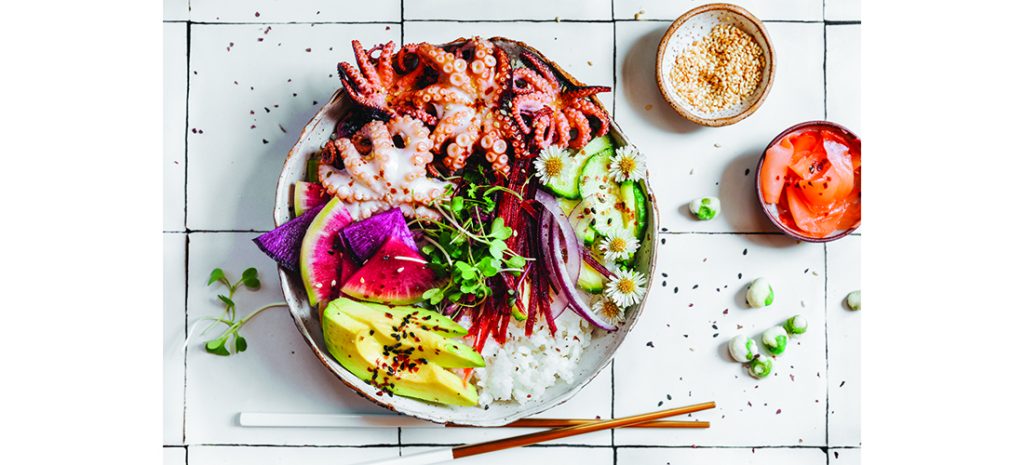
To honor tradition as well as to indulge in the playful bowl-culture of our time, making octopus “tako” poke gets you the best of both worlds, without too much of a compromise. Unless you drown your poke in spicy mayo, then you cannot be helped. Octopus, alongside tuna, is one of the classically used poke ingredients; you can do as the islanders do and eat it raw, without sides, or serve it hipsterville-style on a bed of rice with seaweed and avocado. Either way is scrumptious and definitely picture-worthy.


Tako Poke Bowl  (Serves 2)

For the bowl

12-16 ounces baby octopus, cooked

3 cups sushi rice, cooked

For the relish

1 medium-size tomato, diced

3 tablespoons shoyu (can substitute soy sauce or tamari)

1 tablespoon sesame oil

1 teaspoon grated ginger

1/2 teaspoon crushed red pepper flakes

1/4 cup chopped green onions

1 tablespoon rice vinegar

1 teaspoon honey

Additional optional toppings: sliced avocado, cucumbers and radishes, sprouts, toasted sesame seeds, julienned carrots, roe, pickled ginger, seaweed flakes or salad.

Cut octopus into bite-sized pieces. In a small bowl, combine ingredients for the relish and mix well. Add octopus, stir once more to combine, cover and chill before serving. To serve, add sushi rice to a bowl, top with tako (octopus) poke and add additional ingredients of your choice.  PS

German native Rose Shewey is a food stylist and food photographer. To see more of her work visit her website, suessholz.com.

Focus on Food

Golftown Journal

Cutting Corners

A quicker way to homemade croissants

Story and Photograph by Rose Shewey

The ink on my freshly issued driver’s license hadn’t dried yet when four of my friends and I piled into my newly acquired VW Polo to pop across the border for a casual breakfast in France. A swift hour-and-a-half later, we sat in the courtyard of a little boulangerie in Wissembourg, France, sipping café au lait while enjoying freshly baked, oven-warm butter croissants.

Ah, such sweet memories. These trips were a weekend ritual for many years with an ever-changing cast of friends, and while I no longer drink milk coffees (espresso macchiato all the way), I am still, some 25 years later, utterly obsessed with flaky, buttery croissants.

Fortunately, the Sandhills have ramped up their offering of artisan croissants, I’m happy to report. But not all croissants are created equal, and truly authentically crafted ones sell out faster than you can get out of your pajamas to drive across town to snag a few. So, what’s a girl with a passion for properly laminated butter croissants to do? Make your own, of course. But therein lies the rub.

If you read any recipe for traditional butter croissants, you could easily be led to believe that making these pastries is simple. Time consuming, perhaps, but simple. Make a dough, fold in butter, refrigerate, bake, done. Well, I am here to tell you that a decent amount of practice goes into making croissants (for the casual baker, that is), and every single mistake will affect the end result. Many years back (when cupcakes were the height of sophistication for me), my first batch leaked copious amounts of butter in the oven, and the croissants came out oily and sad looking.

While I have dramatically improved my baking skills, why invest two or even three days of your life when you can have the same delicate, honeycomb-structured butter croissants in just a few hours with a simplified method?

Necessity is the mother of invention. With a toddler taking up most of my time, I searched, tried and failed, and searched some more until I found the perfect shortcut to making perfect croissants. In a nutshell, you can make delicious croissants with one easy alteration: Instead of laminating repeatedly (folding butter into the dough), you spread butter in between layers of dough, which miraculously gives you the same flaky, pull-apart texture of the time-honored but decidedly more tedious method. The best part is, nobody will know you cut corners. Unless you tell.


Easy Butter Croissants  

(Yields 10 croissants / Imperial measures are approximate)

Basic Dough

500 grams (4 cups) all-purpose flour or T65 (preferred)

50 grams (1/4 cup) sugar

1 egg

5 grams (1.8 teaspoons) active dry yeast

20 grams (1.5 tablespoons) butter

10 grams (1.75 teaspoons) salt

210 milliliters (0.8 cups) water 

Butter Layers

225 grams (8 ounces) butter


Place all ingredients for the dough into a large bowl and knead until a ball forms and no longer sticks to the side of the bowl. Allow the dough to rest in a warm place until it doubles in size; about 1-2 hours.

Place dough on a lightly floured surface, shape into a log and cut into 10 pieces. Roll out the first piece to a rectangle, approximately 8×10 inches, and cover with a generous amount of butter. Roll out another piece of dough, set on top of your first dough-butter layer and repeat, alternating dough and butter to create a dough stack, ending with a layer of dough. Refrigerate the dough stack until fully chilled, about 2 hours.

Roll out dough into a large rectangle, about 10×20 inches. Cut dough in a zig-zag pattern to create 10 triangles and, starting with the base of the triangle, roll into croissant. Tuck the tip under so the croissants won’t come undone while baking. Refrigerate once more for at least 1-2 hours (or overnight), then allow to rise at room temperature for 1-2 additional hours before baking.

Preheat oven to 400F, apply egg wash if desired and bake for 20-22 minutes.  PS

German native Rose Shewey is a food stylist and food photographer. To see more of her work visit her website, suessholz.com.

Focus on Food

Focus on Food

You, Me, Après-Ski

The art of smørrebrød

Story and Photograph by Rose Shewey

From St. Moritz to Sugar Mountain, after-ski traditions are as varied as the topography of the mountains themselves. You might find yourself in a tavern with sticky floors, communal tables and craft brews on tap, or you might lounge on a secluded sun deck draped in a wool blanket, overlooking picturesque hillsides. Whatever your situation, one thing is for sure: After a day’s vigorous outdoor activity in the frosty cold, you will be in the market for some serious chow. Move over, moringa smoothies and açaí bowls, this is a job for pickled herring, Alpine fries, potato rösti, cheese fondue and goulash soup.

Or, for the culinary adventurous and fellow Scandiphiles, wander off the beaten path and explore the rich and colorful world of smørrebrød. The possibilities are endless, but let’s start with the basics: Take a slice of freshly baked rye bread, spread butter on it and layer with smoked, pickled or fresh meat or fish, then balance out flavors and textures with spreads, cheese, herbs, veggies or fruit.

Smørrebrød literally translates from Danish to “butter bread.” It is always open-faced and iconic in all of Scandinavia and many parts of Europe, and for good reason. While other European countries have similar traditions (Germans love their “Brotzeit”), there is something rather intriguing about the Danish version of it.

There are some rules to observe (or deliberately ignore), but hands-down, the most important one is: Smørrebrød needs to be appealing to the eye, even sexy. It’s an art form and, at its best, it draws you in with appetizing compositions of fresh (or freshly preserved) ingredients, a mixture of colors and carefully curated garnishes. In Denmark, entire restaurants have dedicated themselves to creating the most enticing open-faced sandwiches with artisan ingredients. For an authentic experience, eat with a fork and a knife and never, under the penalty of public ridicule, fold your smørrebrød to eat as a sandwich.

Bizarre, but true: In Denmark, you can become a “smørrebrødsjomfru” — literally, a “butter bread maiden,” which is a recognized three-year apprenticeship and qualifies you to work in respected restaurants as a smørrebrød chef. While this culinary heritage became less popular sometime during the second half of the 20th century, it is now experiencing a renaissance, and not just in Denmark. More often these days, you will find smørrebrød on the menu of après-ski locations around Europe as a nourishing, wholesome meal option. While this delicacy is a year-round offering, it has special appeal during the winter months, particularly to those who like to eat in-season as it is an excellent reason to raid your root cellar for all things smoked and pickled.


Rollmops, Egg and Beet Smørrebrød   (Serves 2)

3/4 cup pickled red beets, drained

1/2 cup sour cream

1-2 tablespoons prepared horseradish, or to taste

2 slices rye bread

A handful leafy greens (e.g., arugula)

2 rollmops (pickled or salted herring)

2 boiled eggs, halved or sliced

1 small apple, sliced

2 tablespoons capers

Red onion, thinly sliced

Chives or sprouts for garnish

Combine red beets, sour cream and horseradish in a food processor and blend until you have a smooth cream. Spread a generous layer of red beet cream on the slices of bread, add leafy greens, rollmops, eggs, apple slices, capers and onions and arrange to your liking. Sprinkle with chives and serve right away.   PS

German native Rose Shewey is a food stylist and food photographer. To see more of her work visit her website, suessholz.com.
Focus on Food

Aw, Shucks!

Oysters for breakfast

Story and Photographs by Rose Shewey

If you think oysters are for people in pink polo shirts with designer haircuts, chances are you have not attended an oyster roast in the South. Not only were these mollusks considered poor man’s food at varying times throughout history, oyster roasts have been a celebrated low country tradition in many Southern states for folks of all walks of life.

Which begs the question: Raw or cooked? How do you prefer your oysters? According to M.F.K. Fisher, one of the original food writers of our time, oyster-eaters can be divided into three camps: There are the oyster enthusiasts who will eat oysters any which way as long as mollusks are on the menu; there are the purists who will eat oysters raw and raw only; and lastly, there are those who will eat oysters cooked and no other way.

As for me, I like my bivalves raw as much as I like them cooked but will happily pass on oysters altogether if it’s summertime. As far as I am concerned, oysters are classic cold-weather fare even though the old adage that warns against eating oysters in months without an “r” no longer holds true. Despite good arguments that support safe and tasty oyster feasts year-round, I stand with tradition on this one.

“Oysters are the usual opening to a winter breakfast . . . indeed they are indispensable,” wrote Grimod de la Reynière in the Almanach des Gourmands in 1803. OK, oysters for breakfast might be pushing it a little, but I believe Reynière had it right nonetheless.

Consider this: Oysters are incredibly nutritious with unbelievable amounts of zinc — a trace mineral that will help your body fend off cold season maladies. Winter really does seem to be the perfect time to indulge in oysters.

As a “northern light” who grew up on the same latitude as Montreal, Canada (just a few thousand miles to the east), I cannot in good conscience say that North Carolina is cold during the month of November. However, having attended several Thanksgiving oyster roasts, I am definitely in favor of busting out the old oyster knife and doing some shucking this time of year. Besides, millions of French cannot be wrong — France boasts record sales of fresh oysters from late fall until the new year, every year. So, enjoy plump, briny and succulent oysters whenever you want, but celebrate them during the chilly holiday season.

Raw Oysters with Orange Fig Mignonette      (Makes 4-6 appetizers)

1/4 cup freshly squeezed orange juice

1/4 cup red wine vinegar

1/4 teaspoon salt

1/4 teaspoon ground pepper

2-3 fresh, ripe figs, peeled and minced

2 shallots, minced

2 teaspoon minced chives

1 teaspoon dried red chili flakes

24 freshly shucked oysters

Add orange juice, vinegar, salt and pepper in a small bowl and whisk to combine. Stir in figs, shallots, chives and chili flakes, and drizzle mignonette over oysters.   PS

German native Rose Shewey is a food stylist and food photographer. To see more of her work visit her website at suessholz.com.