A Tradition of Culture

A TRADITION OF CULTURE

A Tradition of Culture

The many lives of Campbell House

By Ray Owen   •   Photographs by John Gessner

Surviving through myriad incarnations, Southern Pines’ Campbell House is one of the region’s most significant landmarks, owing its existence to the Boyd family. Once part of their Weymouth estate, for more than 100 years it has been a center of culture, informing, influencing and enhancing civic life.

It is an outstanding example of a Country Place-era estate created over time by a remarkable series of individuals who began settling in the region around the turn of the 20th century. The fledgling Sandhills resorts were rising from the dusty remains of a former turpentine and lumber industry outpost. The backdrop for this transformation was the greater social movement of the day, a reaction to the cultural upheavals brought about by industrialization and urbanization. The Sandhills fit perfectly within the country life paradigm, appealing to America’s growing fascination with vernacular culture and native folk.

The lives of Campbell House comprise four significant periods: first the home of James Maclin Brodnax, then expanded into the original James Boyd House with additions from local Colonial houses; next moved and enlarged at its present location by Jackson Boyd; later the home of General Motors heir Maj. William Durant Campbell; and now a municipal property, home to Southern Pines Recreation & Parks Department and the Arts Council of Moore County.
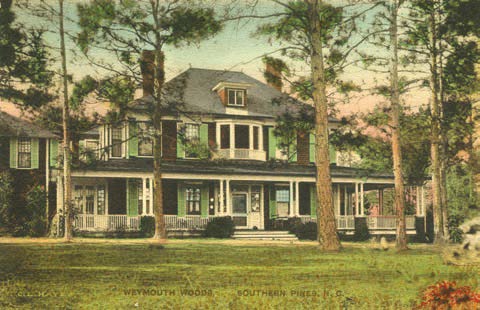
The house’s first period opens with James Boyd’s 1904 purchase of a sizable portion of land on the eastern ridge above downtown Southern Pines. Within months, the matter of building a residence was altered by the death of his kinsman, James Brodnax, who had built a two-story Colonial Revival-style home for himself on the property. James Boyd, grandfather of writer James Boyd and his brother Jackson, enlarged the Brodnax House into an imposing mansion, incorporating building elements dating from the late 18th and early 19th centuries. The Brodnax-Boyd House was located 100 feet in front of present-day Weymouth Center.

In 1921, the Brodnax-Boyd House was separated into two blocks and both moved by mule teams across Connecticut Avenue, where they became the core of two new residences. One part was refitted as a residence for Jackson Boyd (Jack) and his family, and it remained their home, following major rebuilding in 1936 after a fire. Another part of the Brodnax-Boyd House is now the dwelling standing at 435 E. New Hampshire Ave.

Jack and his brother, writer James Boyd, founded the Moore County Hounds in the winter of 1914. They saw this aristocratic sport in democratic terms and felt that it should belong to the town. Proper dress or not, anyone who wished to hunt was invited to come along, so huntsmen in formal attire rode with farmers on horses more accustomed to plowing than jumping fences.

As a captain in the Marines, Jack was in charge of canine training at Camp Lejeune. Being from blueblood hunt country, he was a trainer, breeder, master of 70 foxhounds. Jack taught his war dogs to march in cadence, heel on regular intervals, and perform ordered drills. More training prepared them for track and attack missions and watch duty. His division’s canine records included letters of commendation, citations and a discharge certificate. In many instances, a formal photograph of the dog was included upon promotion of the dog to sergeant.

Jack’s eldest son, John Boyd, was killed in action at Guadalcanal, and the local VFW post is named for him. Those who knew Jack Boyd say that his son’s death was a severe blow and he left  Southern Pines shortly after the war.

In 1946, Major W.D. Campbell purchased the Jackson Boyd House and he made extensive changes, facing the unpretentious frame structure with ballast-brick from Charleston, South Carolina. The same brick was used in the formal landscaping and walled garden at the rear of the house. In 1966 the Campbell family gave their property to the town, asking that it be used for the cultural and social enrichment of the community.

Evidence of history can be found throughout the building, with a striking contrast between the formal entrance and the informality of the large pine-clad room on the east wing. This room, known today as the Brown Gallery, encompasses the most visible remains of Brodnax-Boyd House with its circa 1820s mantel and beaded hand-planed paneling.

In Jackson Boyd’s time the main staircase rose at the back of the foyer, but the Campbells reconfigured it to rise at the front, opening up the back wall with glass doors. The foyer and former dining room, now the White Gallery, remain unchanged from the late 1940s with marble-chip terrazzo flooring, marble staircase and decorative wrought-iron railing. A medallion graces the entry hall floor. Inscribed in Greek, it depicts an African antelope bagged by Maj. Campbell for the Museum of Natural History in New York.

The Campbells and their daughter, Margot, were active in many civic and community affairs. Mrs. Campbell was one of the founders of the Southern Pines Garden Club. Maj. Campbell’s interests included the Red Cross, Boy Scouts and model trains and he built the Train House to house his collection. An Eagle Scout in his boyhood, Campbell became a leader in the national and international movement, an activity that eventually called the family away from their home in the pines. Born in Flint, Michigan, Maj. Campbell was the grandson of William Crapo Durant, the co-founder of General Motors and Chevrolet, and the founder of Frigidaire. Campbell graduated from Princeton University in 1929 and initially pursued a career in banking. During World War II, he was a battery commander and retired from Fort Bragg in 1946 as a major. He became involved in Scouting as an adult at the suggestion of its British founder, Robert Baden-Powell. His travels convinced him that Scouting could do much for young people and he took a special interest in furthering the organization in developing countries with programs tailored to local needs. That philosophy and his personal commitment saw a doubling of the Scouts’ membership in the 1970s and 1980s, chiefly in the Third World. A philanthropist, Maj. Campbell was also on the executive committee of the Mystic Seaport Museum and a director of the National Audubon Society.

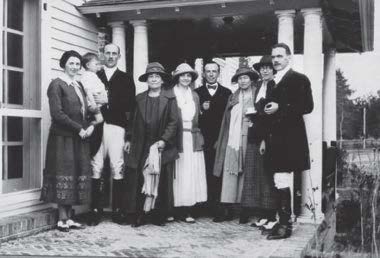
When the Campbells gifted the property to the town, a board of directors was appointed, bylaws were established, an on-site director was hired, and a vigorous program developed to put the property to use. The Southern Pines Information Center was installed in the main house, and the Stoneybrook Racing Association moved into its west wing office.

The Boy Scouts were among the early organizations at Campbell House, along with offices for the Humane Society of Moore County and Moore County Historical Association. In the late 1960s, a small golf museum was set up in the former dining room, and this collection was later turned over to the World Golf Hall of Fame.
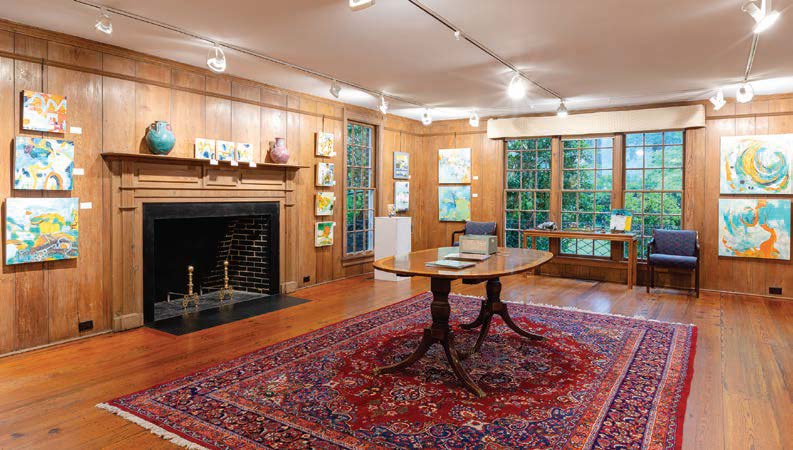
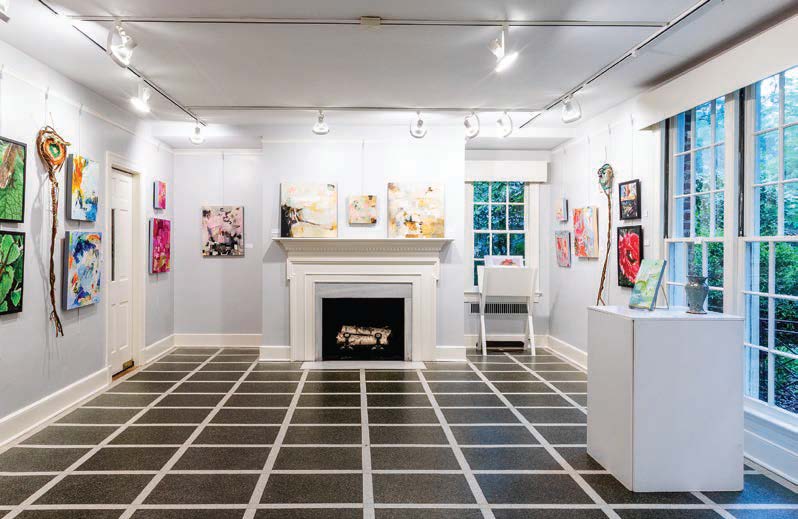
In 1972, Southern Pines established a year-round recreation and parks department centered on the property. This program is now the biggest user of the site with its offices on the second floor of the main house. The first floor is the headquarters of the Arts Council of Moore County, where they maintain two galleries that display the work of different artists every month and a sales gallery that showcases the work of regional artists.

Thousands of visitors have enjoyed Campbell House, hundreds of volunteers have given time and energy to the fulfillment of its purpose, and a small, dedicated group has taken personal responsibility for its success.

Moss gathers on the ancient lawn as azaleas bloom late against fading bricks. Across the lot, live oaks keep the view — if they could speak, what stories would they tell, wide spreading boughs, nothing missed in their branches. Some say the house is haunted and at twilight the apparition of a woman drifts across the stairs, a lingering reminder of lives that have come before.

Andre of Ellerbe

ANDRE OF ELLERBE

Andre of Ellerbe

A giant of a man in a small town

By Bill Fields

In a mild December morning at Dixie Burger in Ellerbe, North Carolina, several customers of a certain age at a corner table are remembering someone who once sat among them, shooting the breeze and drinking coffee.

“Was grand marshal at the racetrack and lifted a girl on each arm like it was nothing.”

“Used to be booths in here, but he wouldn’t fit.”

“Ate 12 chickens in one day.”

When he wasn’t wrestling, making a movie or otherwise being André the Giant, the man sometimes called the “Eighth Wonder of the World” lived in Ellerbe for more than a dozen years. He enjoyed his time in the Richmond County town of about 1,000 people and loved to kill part of a day at the short-order restaurant, whose tall hamburger sign is the most visible landmark on Main Street.

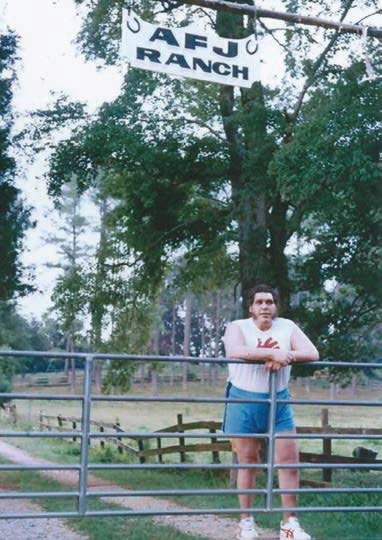
“André could sit there and talk to people,” says Jackie McAuley, who was a close friend. She, along with her first husband, Frenchy Bernard, a former pro wrestling referee, managed André’s home and cattle ranch on Highway 73. “They treated him just like anybody else they would have seen in town. It wasn’t, ‘Oh, can I have your autograph?’ He was just an average person when he was home in Ellerbe.”

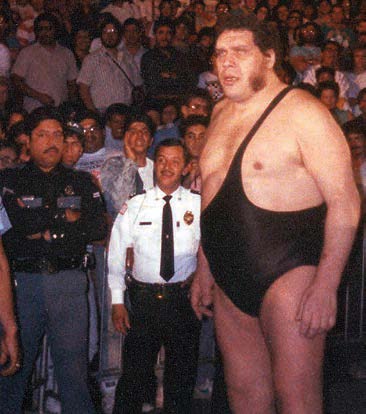
Notwithstanding the mannerly small-town treatment André René Roussimoff received, he was as close to being an average person as Ellerbe is to the Eiffel Tower. André the Giant — who died Jan. 27, 1993, at age 46 — was one of the most recognizable individuals of the 20th century. He was a genuine giant who emerged from the obscurity of his family’s farm in rural France, carrying armoires on his back up three flights as a Paris furniture mover, to become an iconic professional wrestler who drew large crowds around the globe and gained even wider fame playing Fezzik, the rhyme-loving giant in the 1987 romantic-adventure-comedy film The Princess Bride.

Standing 7 feet 4 inches — although there were skeptics who contended the wrestling hype machine bumped up his height so that he could be billed as the world’s tallest man — and weighing 520 pounds when he passed away of congestive heart failure, Roussimoff had acromegaly, a disorder that causes the pituitary gland to produce too much growth hormone in adulthood, resulting in unusual bone growth, including in the hands, feet and face.

His acromegaly was never treated, André refusing medical help when his condition was diagnosed, first during a visit to Japan in the early 1970s and again about a decade later at Duke University Hospital. Doctors there saved his life after fluid built up around his heart and wanted to operate on the pituitary gland to correct his acromegaly, but André, whose paternal grandfather also was outsized, wouldn’t agree to the procedure. “He said, ‘That’s how God made me,’ and he wasn’t going to change,” McAuley says.

To be around André once was to never forget his unique size.

His neck was 2 feet in circumference. It was nearly a foot around his wrist. A silver dollar could pass through one of his rings. In an exhibit devoted to André the Giant at The Rankin Museum of American Heritage in Ellerbe, a pair of his size 26 wrestling boots are on display. “Occasionally I could buy him T-shirts,” says McAuley, “if I could find 5 XL.” The Giant’s clothes were mostly custom tailored in Montreal or Japan to accommodate his 71-inch chest. Nellie Parsons, who ran Pate’s Cleaners in Ellerbe for 30 years, created custom hangers to accommodate the extraordinary width of his dress shirts.

In 1983-84, Burke Schnedl was a pilot for a charter service at what then was called Rockingham-Hamlet Airport and flew André to wrestling matches in cities throughout the Carolinas and Virginia — Greenville, Fayetteville, Richmond — in a twin-engine Cessna 402.

“We had to take out a seat in the back so he could get in,” Schnedl recalls. “The doorway is not that big, and he would have to turn kind of sideways. It had a bench seat on the side. André sat there and used a seat-belt extender to cover a space where two people normally would sit. He was just a lot of guy. When you shook his hand, it was like putting a single finger in a normal-sized person’s hand.”

By the time André was 12 years old, he already stood 6-foot-2 and weighed about 230 pounds, too large for the bus that transported schoolchildren in his village of Molien, 40 miles outside Paris. The playwright Samuel Beckett, who lived nearby in a cottage that Boris Roussimoff, André’s father, helped him construct, filled the void by driving André in his truck.

Before long André, the middle of Boris and wife Mariann’s five children, had outgrown not only vehicles but the sleepy landscape he saw as an impasse stopping his ambition to be famous. Boris Roussimoff didn’t understand, and at 14 André quit school, left home and set out on his own.

“His father told him he would be back soon working on the farm, and André had something to prove,” says Chris Owens, a repository of André the Giant knowledge who authors a Fan Club page on Facebook and has been intrigued by Roussimoff since he was a boy in the Midwest and saw him wrestle televised matches. “He didn’t want to stay in rural France. To me, he was always a guy going after his dream who became a classic success story.”

As a teenager in Paris, André’s preferred game was rugby, although he also got immense pleasure from pranking friends by rearranging their parked small cars while they were dining or drinking. He got 7 or 8 inches taller and gained nearly a hundred pounds before he turned 21, impressing professional wrestlers who noticed him training in a gym. They introduced him to their game, taught him some moves, and by the mid-1960s André René Roussimoff was getting paid to perform as Jean Ferre, Géant Ferré, The Butcher Roussimoff and Monster Eiffel Tower — and he was loving all of it.

“Many men were afraid to go in the ring with him, especially after he reached his 20s, because he was so large and strong,” André’s first manager, Frank Valois, told Sports Illustrated in 1981. “For all his height and weight, he could run and jump and do moves that made seasoned wrestlers fearful. Not so much fearful that he would hurt them with malice, but that he might hurt them with exuberance. He was incroyable.”

Promoters sent him to Great Britain, Germany, Australia, Africa and eventually Japan, a country where he first wrestled as Monster Roussimoff and would have some of his most avid fans the whole of his career. He began to be billed as André the Giant in 1973 by Vince McMahon Sr., founder of the World Wide Wrestling Federation, who discouraged André from being very active in the ring — even though his body at that point still allowed it — and to play up the fact that he was an immovable mountain of a man. “He was taught to wrestle as a giant,” says Owens. “He had a limited set of moves, and his matches generally were kept fairly short.”

Under McMahon, André made a large six-figure annual income and became the most famous professional wrestler in the world who traveled the majority of each year for two decades, his luggage belying his size. “He carried an unbelievably small bag for his wrestling gear,” says McAuley. “I don’t know how he packed as much as he did in that small bag. But if he was packing up at a motel and something didn’t fit, he would leave it behind. There were things left all over, I’m sure. I hope the maids discovered what they had.”

André was a creature of habit on the road because there was enough ducking and crunching just getting around that he didn’t like improvising unnecessarily. “If you gave me the name of the town he was in,” says McAuley, “I could tell you what hotel he stayed at, what restaurant he ate at and what bar he went to, and pretty much be right every time. There was security that came with the habit. He knew his size and where he could fit and couldn’t fit. If he had been going to a certain motel for 10 years and everyone else started going to a fancier place, he’d go to his usual one.”

Wherever André the Giant went, he amazed people with how much he could eat or drink if he was in the mood.

There are stories of his ordering every entrée on a menu, as McAuley witnessed one summer day in Montreal in the mid-1980s as she and Frenchy dined with André and several others. “We were at a small Italian place,” McAuley recalls. “André was in a good mood. He told the waiter he would like one of everything. The waiter said, ‘Seriously?’ Frenchy said, ‘Seriously.’”

Pro wrestler Don Heaton told the Los Angeles Times after the Giant’s death. “Everything came in twos,” he said. “Two lobsters, two chickens, two steaks . . . ”

There were nights of 100 beers, 75 shots, or seven bottles of wine lest any course of a special meal feel lonely.

“I can report with confidence that his capacity for alcohol is extraordinary,” Terry Todd wrote in his classic in-depth 1981 Sports Illustrated profile of Roussimoff. “During the week or so I was with him, his average daily consumption was a case or so of beer; a total of two bottles of wine, generally French, with his meals; six or eight shots of brandy, usually Courvoisier or Napoléon, though sometimes Calvados; half a dozen standard mixed drinks, such as bloody Marys or screwdrivers; and the odd glass of Pernod.”

Actor Cary Elwes recounted the making of The Princess Bride in his book As You Wish. He recalled going out barhopping with André in New York City after the movie’s premiere. The Giant’s beverage of choice that evening, as it sometimes was when they were filming in England, was what André called “the American,” a combination of many hard spirits.

“The beverage came, as expected, in a forty-ounce pitcher, the contents of which disappeared in a single gulp,” Elwes wrote. “And then came another. And they kept coming while I gingerly sipped my beer. We talked about work and movies, about his farm in North Carolina where he raised horses, his relatives back in France, and of course, about life. André was a man unlike any other — truly one of a kind.”

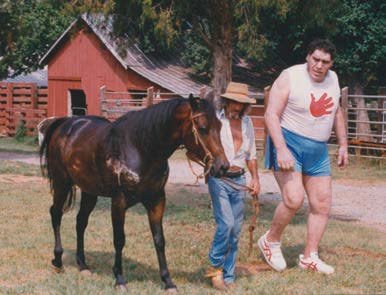
This unique character ended up living in Richmond County after coming with French-Canadian Adolfo Bresciano, who was billed as Dino Bravo in the ring, to visit Bravo’s stepdaughter in the late-1970s. She and her husband owned farm property in Ellerbe. André bought a nearby home, a three-story structure. The Bernards moved from Florida in the summer of 1980.

“We lived there and took care of things,” McAuley says. “If Andre needed something, Frenchy or I would get it. He just had the house for several years, with some cows and horses. Then the property down the road came up for sale, so we bought the ranch. Then he worked on getting the wooded property in the middle. André was in a bar in England once talking to a pilot who had Texas longhorns back home. So Andre decided we should have Texas longhorns, too.”

Some believed that Andre’s residence must have been built for his colossal frame, but it wasn’t. “Nothing could be further from the truth,” says McAuley. “The stairs were narrow. It was three floors. He didn’t care to have a house that was adapted to him because his life was in the real world. You’re not going to raise the light or the ceiling fan, because they’re not going to run into it. It becomes second nature. We really only did two things: We raised the shower faucet, so the water would hit him on the top of the head instead of the middle of the back, and we ordered him a large chair.”

André would often sit in his chair with McAuley’s miniature dachshunds tucked by each tree trunk of a leg. He loved riding an all-terrain vehicle around his property. In the summers, André favored gym shorts, sometimes with a T-shirt, sometimes not. He was an expert cribbage player, owing to his good math mind and so many hours playing before wrestling matches. He didn’t venture far from his property when he was home, but loved his iced coffee at Dixie Burger, weekend meals at Little Bo Club in Rockingham, cookouts at neighbors’ homes, and checking in the hardware or feed stores.

McAuley says she never heard her friend talk about any regrets, that he never second-guessed anything in his life. “I have had good fortune,” André told Todd in 1981, “and I am grateful for my life. If I were to die tomorrow, I know I have eaten more good food, drunk more beer and fine wine, had more friends and seen more of the world than most men ever will.”

In addition to the scary episode of fluid buildup around his heart in 1983, he began to have other health problems during his years in Ellerbe. André had neck and back issues and surgeries, and he sustained a broken ankle in a 1981 match, wrestling on it for days until the pain became too much. To accommodate his size, the largest cast ever prepared at Boston’s Beth Israel Hospital was utilized.

An opportunity to be in The Princess Bride came along at a good time, since wrestling was becoming increasingly difficult because of André’s deteriorating body. “He could feel his wrestling career closing down,” McAuley says. “He had been so agile when he was younger. It was tough to watch him wrestle near the end of his life because of how hard it was for him to get around.”

André had acted before — including portraying “Bigfoot” in a two-part episode of The Six Million Dollar Man — but he loved being part of the months-long production of The Princess Bride as Fezzik. “Doing Princess Bride gave him the most happiness,” says McAuley. “He’d call home and talk about all the silly tricks he was pulling, especially the week or so that Billy Crystal was there.” Around the set, as in his adopted hometown in North Carolina, André impressed with his disposition despite his acute pain.

“You could tell he was in tremendous pain, but would never complain about it,” actress Robin Wright remembered in As You Wish. “You could see it in his face when he would try to stand up from a seated position. But he was just the most gentle giant. So incredibly sweet.”

André never tired of watching The Princess Bride, but some of his friends did. “He drove the wrestlers crazy,” McAuley says. “Over in Japan, on a bus from the hotel to the matches, the boys would wait quietly until eventually he’d pull out the tape and say, ‘Let’s watch my movie again.’ They’d say, ‘Please boss. Not again.’ But they’d watch.”

The same year that The Princess Bride came out, André the Giant was headliner at WrestleMania III, where he was body-slammed and defeated by nemesis Hulk Hogan in front of a record crowd of 93,173 at the Pontiac Silverdome. He wrestled the last of his 1,996 matches (a record of 1,427-388-181) on Dec. 4, 1992 in Tokyo, his physical condition worsening. “His walking was compromised,” Owens says. “His posture had changed. He constantly needed something to hold on to or somebody to help him keep his balance.”

André’s last Christmas in Ellerbe was much different than the joyous first one a dozen years earlier. “He was just not himself,” McAuley says. “His color didn’t look good. I remember standing next to him and patting his stomach, which (had gotten larger). It didn’t dawn on me then that the first time that happened was ’83.”

In January 1993 André flew to France to be with his dying father. He stayed over after his dad’s death to be with his mother for her birthday on Jan. 24. On the 27th, André enjoyed a full day with boyhood friends from Molien. A driver was scheduled to pick him up at the Paris hotel where he was staying at 8 o’clock the next morning.

André didn’t pay attention to clocks, seldom wore a watch, and rarely was late. But he was not there to meet his driver, and he didn’t answer the phone in his room.

“The chain was on the door but they could see André in bed,” McAuley says. “The sheet was perfectly neat around him. He must have died as soon as he laid down, because André was one, when he woke up in the morning, the linen would be all shuffled around and when I would go to make his bed, I’d basically have to start over because the sheets would be in all different directions.”

The Roussimoffs were told André’s body was too big to be handled by any local crematoriums. A custom casket was constructed, and McAuley flew to France with her sister to accompany the body back to the United States so that André’s desire to be cremated, set forth in his will, could be carried out. Before returning, she visited Molien to meet André’s mother — “She was shorter than me and just adorable” — and siblings.

McAuley brought photo albums, pictures of “girls André knew” and his daughter, Robin Christensen Roussimoff, born in 1979, with whom he had little contact — a handful of visits and regular holiday phone calls. McAuley flew to the Seattle area once hoping to make André’s wish of a visit by his daughter to his North Carolina home a reality, but Robin, a young girl intimidated by the thought of a long trip to an unfamiliar place, declined.

André was returned to the land he had come to know so well on Feb. 24, 1993. Big-time wrestlers and small-town residents alike attended the ranch service, and after folks had spoken their remarks and paid their respects, Frenchy Bernard got on a horse with a saddlebag containing Andre’s ashes.

In death as in life André Roussimoff was larger than most. His remains weighed 17 pounds after cremation, nearly three times more than a usual adult male. They were spread in silence so different from the mayhem of the arenas and gyms where he had worked, finding their place, just like the man had.

Retiring In Style

RETIRING IN STYLE

Retiring In Style

Designing on a clean slate

By Deborah Salomon 

Photographs by John Gessner

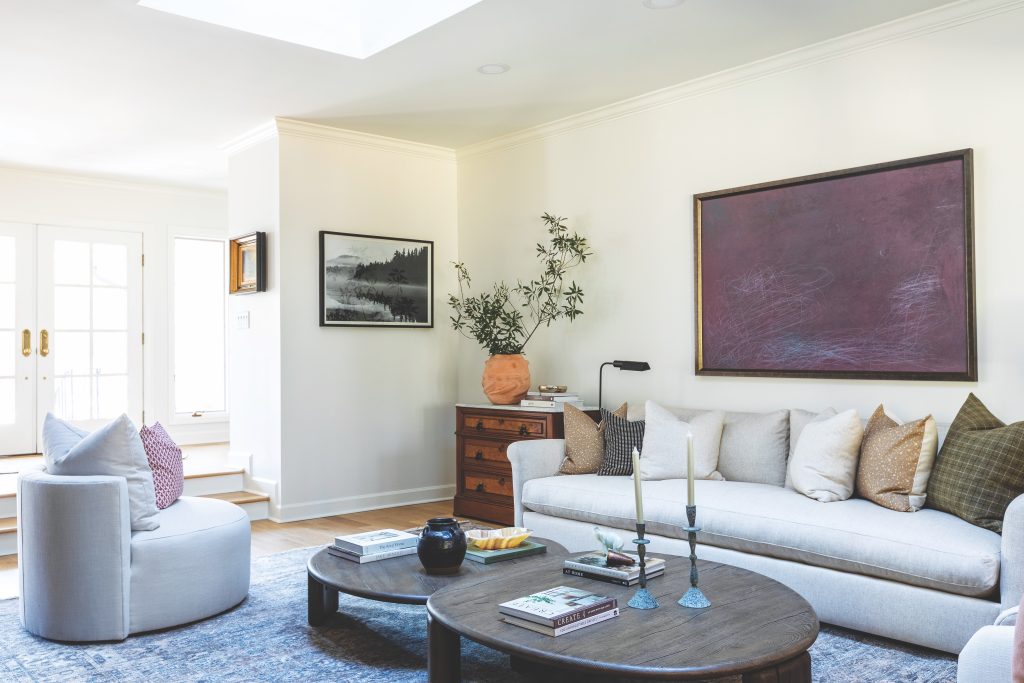
The Browns’ favorite décor color does not appear on any rainbow. Instead, Frank and Becky Brown chose a sandy French vanilla with flecks of oatmeal and cocoa throughout their uber-contemporary retirement residence that answers to simply stunning. Here, the old is missing but not missed. With the exception of a grandmother’s desk furnishings, fixtures, objets and art are new, selected for this space by Becky on the advice of Pinehurst interior designer Angela Budd.

“We had traveled, moved around so much (for Frank Brown’s career in beverage distribution management) that we decided to give everything away and start fresh,” Becky says.

No way could she manage such a task from Colorado, their final post. Budd, in consultation with the Browns, created a subtle, sophisticated environment based on a color softer than white, easier to live with than primaries. Even the 4-inch oak floorboards throughout reflect this hue.

All new, soup to nuts, minimum legwork, professional advice, what a lark! Frank calls the finished product “calm,” while running his hand over a rich chocolate brown coffee table of the fashionable “stacked” genre.

“I love this table,” he says with a smile.

The then Florida-based Browns had friends from Raleigh who, after golfing in Pinehurst, decided to move here. Frank and Becky visited, fell in love with the area and chose the Country Club of North Carolina for retirement. Downsizing wasn’t their goal. They required something one-story on a spacious lot partially fenced for their dogs — a house that didn’t need a structural overhaul or floorplan rearrangement. What they found was 3,400 square feet, built in 1986 on 1.6 acres. It was so right they purchased it from photos, boots on the ground unnecessary.

Next, Becky needed an interior designer who could translate generalities into sofas, chairs, tables and a kitchen that blends sophistication with practicality. “I had never worked with a designer before,” she says, let alone making decisions influencing what she calls their “forever-type house.”

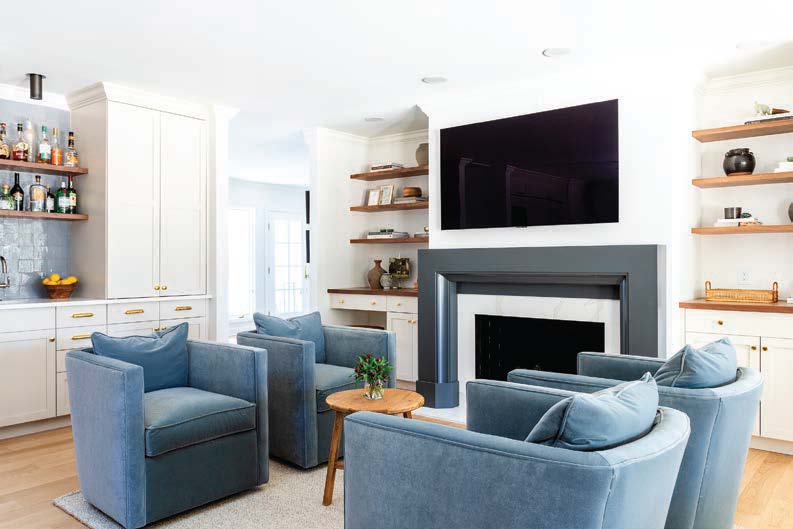
Budd, of Angela Douglas Interiors, was recommended by a previous client. The responsibility of starting fresh was not new to her, nor was the “clean, soothing, calming” mandate. These were active, young retirees. Angela and Becky shopped high-end High Point furniture vendors for the most comfortable, thickly upholstered pieces. A 120-inch sofa anchors the more formal of the home’s two sitting areas, separated by a double-sided fireplace wall with framed flat screens and built-in shelves. The tables in two dining areas — one closer to the kitchen — have graceful curved tops. One expands seating by replacing chairs with a banquette, useful during visits from their two children and four grandchildren.

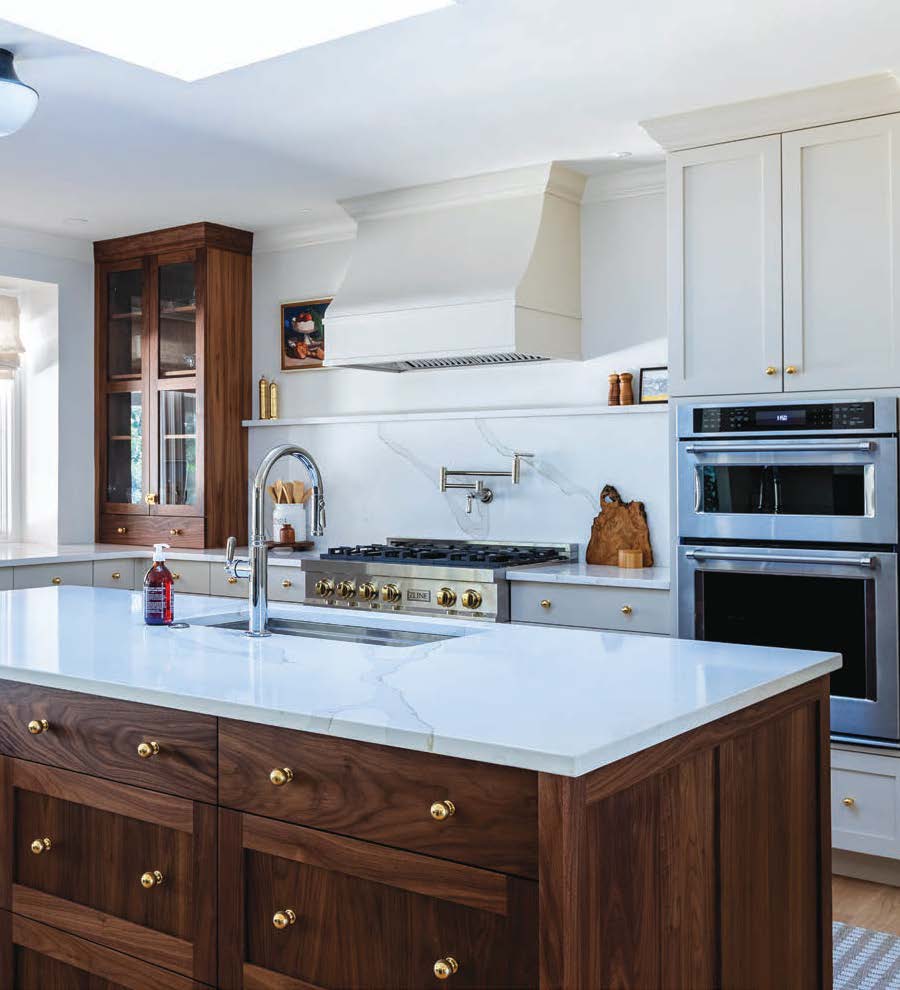
Charcoal and paler grays punctuate sandy neutrals in the seating areas, where Frank and Becky relax after supper. Every so often, particularly in chairs, Scandinavian modern shapes popular in the 1950s reappear. The kitchen itself, with island, concealed refrigerator with black interior, wine cooler, Zline luxury range and coffee bar has only drawers, no under-counter cabinets. In contrast, tall walnut backlit cabinets displaying the Browns’ wedding china and crystal rise from the countertop. Shiny gold ping pong ball-sized drawer pulls provide pops of color throughout.

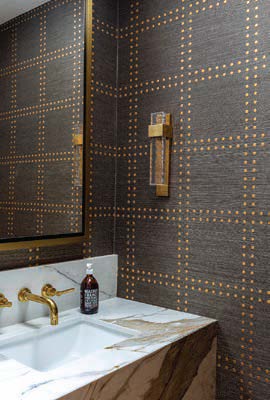
Much thought was given to making spaces flow into one another, including two living/dining screened verandas. With entertaining in mind, Budd created a talk-of-the-town powder room. Squares on a deep brown grasscloth wallpaper are outlined by hundreds of hand-applied metallic rivets. Unusual brass sink fixtures, sconces and a narrow, towering skylight make every visit memorable.

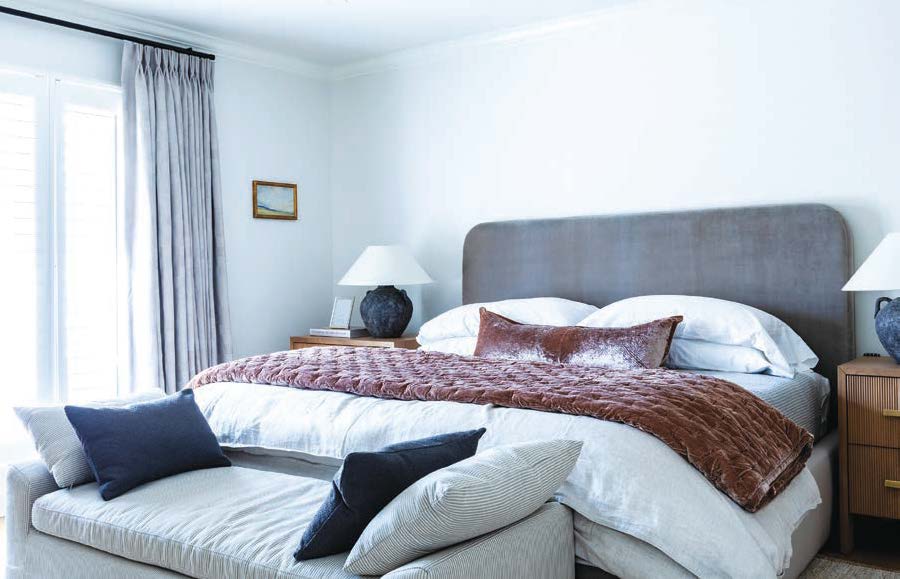
As in the kitchen, built-in storage units dominate an entire wall of the master suite, where an upholstered rectangular headboard illustrates the softened geometrics visible throughout, including a low upholstered bench at the end of the bed, similar to Victorian slipper chairs, where ladies sat while lacing up their tall shoes.

Bedrooms on the guest end of the longitudinal layout will be finished with bunk beds for the grandchildren. An office has been mentioned, as has a sauna. No pool required — the CCNC clubhouse is a few minutes away.

Budd also helped choose the art, from framed black and white photos to several abstract canvases. Frank, who grew up sharing an 880-square foot one-bathroom apartment in St. Louis with his parents and three siblings, smiles and shakes his head at the painting over the living room sofa.

The Browns purchased the house in March 2024 while posted in Colorado. They were able to use the bedrooms a few months later, when Becky and Angela visited showrooms, discussed colors and details. The renovation/furnishing was completed in February 2025. For The Reveal, always emotional, Budd illuminated lamps and fixtures, put flowers on the tables, food in the fridge, wine in the cooler. The coffee bar was stocked. Linens covered the beds, and towels hung in the bathrooms.

Thrilled doesn’t even come close to what Becky Brown felt during the unveiling. She still plans to buy new pots and pans, dishes, glassware and cutlery. Small adjustments are inevitable. “But I always dreamed of living in a home that reflects who I am.”

And now, thanks to serendipity, professional advice, resources and friends who blazed the trail to Pinehurst, she does.

The Perfect Match

THE PERFECT MATCH

The Perfect Match

Rory McIlroy and the Quail Hollow Club

By Ron Green Jr.   •   Photograph by Mogie Adamchik

It has been 15 years since that electric Sunday afternoon at Quail Hollow Club when Rory McIlroy formally introduced himself to the American golf society.

McIlroy was still two days shy of his 21st birthday, and he was one hour removed from having played a round for the ages. Not only had McIlroy won the Quail Hollow Championship for his first PGA Tour victory, he had done so by shooting a closing 10-under par 62 that crackled with a Zeus-like thunder.

By finishing with six consecutive threes on his scorecard, the last one a 40-foot birdie putt that had McIlroy punching the air as his curls danced around the edges of his cap, the game’s new star had arrived trailing sparks.

In the quiet of the Quail Hollow locker room after a Champagne toast with members, McIlroy stood between two rows of lockers, talking to his parents on the phone, the impending magnitude of his performance still settling over everyone.

The Earth was moving.

Television commentator David Feherty, a native of Northern Ireland like McIlroy, had walked the finishing stretch with the winner and said as he left the 18th green, “That’s the most impressive thing I’ve seen in a very, very long time.”

So it began, at least here in the United States, a golf story midway through its second decade that is painted in primary colors and piercing emotions.

This month McIlroy returns to Quail Hollow Club, where he is a member, and where he has won the annual PGA Tour event four times. This visit is different. Oh, so different. It’s the year’s second major, the PGA Championship, being played at a spot McIlroy has more than once called “one of my favorite places on Earth.” And now he’s got a green jacket hanging in his closet after winning the Masters in a sudden-death playoff over Justin Rose, ending a nearly 11 year drought since his last major championship victory and making him just the sixth player to complete the career Grand Slam, joining Gene Sarazen, Jack Nicklaus, Gary Player, Ben Hogan and Tiger Woods.

Fourteen years after losing a 4-stroke lead in the final round of the Masters, McIlroy’s victory sent him to his knees sobbing in relief and resonating throughout the golf world.

“It’s the best day of my golfing life,” said McIlroy, who had too much practice explaining his near-miss losses in major championships. “I’m very proud of myself. I’m proud of never giving up. I’m proud of how I kept coming back and dusting myself off and not letting the disappointments really get to me. Talking about that eternal optimist again. Yeah, very proud.”

When asked late last year if he knew where the 2025 PGA Championship would be played, McIlroy answered, “Quail Hollow Club in Charlotte, North Carolina, and I cannot wait.”

Such is the tie that binds McIlroy to Charlotte — and, by extension, North Carolina — though his last competitive start in the Tar Heel State ended with one of the most emotionally devastating losses in his career, his runner-up finish to Bryson DeChambeau in the 2024 U.S. Open at Pinehurst No. 2.

“It was a great day until it wasn’t,” McIlroy would say later.

McIlroy led by two strokes with five holes remaining and left brokenhearted, haunted by short misses on the 16th and 18th greens when it appeared he would end a decade-long drought in the majors. Instead, McIlroy drove away alone and silent and, while DeChambeau celebrated his victory, there was a bittersweetness in the summer air at Pinehurst that McIlroy, so beloved and so close, had been denied again.

As Tiger Woods stepped back and Phil Mickelson stepped away, McIlroy has grown into, arguably, golf’s biggest star. Part of it is the majesty of his skills, a mesmerizing blend of power and panache. Another part, the one that may define McIlroy, is the charismatic connection that has been forged in the fire of soaring successes and aching disappointments.

McIlroy has won 29 PGA Tour events, including five major championships and two Players Championships, and there are still questions about the ones that got away. He is judged against an almost impossibly high bar, one he set for himself with his own brilliance, and it comes with an emotional attachment from his fans that runs deeper than anyone else in the game.

McIlroy is charismatic, vulnerable, magnetic, thoughtful, battle scarred, curious, sharing and generous. Fans don’t just watch McIlroy play, they sign on for the ride, investing in him because he has so often returned that investment, whether with his thank-yous, his outspokenness or his natural charm.

Think of McIlroy and a library of images comes forward.

There he is hugging his father, Gerry, after his 8-stroke victory in the 2011 U.S. Open at Congressional Country Club, barely two months removed from his final round collapse at the Masters.

A year later, laying his head back and letting the ocean breeze blow across him, he walked the final hole of another 8-stroke victory at the 2012 PGA Championship at Kiawah Island.

Then, in a sweet and touching moment, handing the Claret Jug to his mother, Rosie, after winning the 2014 Open Championship at Royal Liverpool.

There he is hoisting the FedEx Cup trophy in 2016 and 2019 and again in 2022.

Side by side, there’s McIlroy in tears after a gutting performance in a Ryder Cup loss at Whistling Straits in 2021, and another of him showering his European teammates in Champagne after wins in 2018 and 2023.

Walking stoically up the 18th fairway at the Old Course in 2022 after failing to make a birdie in the final round of the Open Championship, knowing he had the Claret Jug in his grasp again until he didn’t.

Had any of us been there to see it, there was McIlroy alone in New York City after his U.S. Open loss at Pinehurst, quietly walking The High Line for what he called a reset, “finding the joy in the small things in life.”

And now, having shed the awesome burden of time, there he is finding tears and joy, kneeling on the 18th green at Augusta National.

As golf has been torn apart by the battle between the PGA Tour and LIV Golf in recent years, McIlroy has often been at the nexus of the fiery debate about what is right and wrong, good and bad, possible and unacceptable. He wanted to be part of the solution, understanding that the PGA Tour’s money-heavy response to LIV Golf’s excesses benefited him as much as anyone. McIlroy was sharply critical of LIV’s approach, and his press conferences often became touchstones for how the establishment (meaning the PGA Tour) viewed what was happening.

Gradually, McIlroy tempered his stance, and while he vowed his lifetime allegiance to the PGA Tour, he sought harmony even as his role in the behind the scenes discussions diminished. His goal, it seemed, was to find the greater good, and he said as much.

“I have always said I will answer questions honestly. I don’t want to change that about myself. I think people appreciate that about me,” McIlroy said.

The day after McIlroy won the 2010 Wachovia Championship, I walked into the Charlotte Observer office, and more than one person asked who the kid was who won the golf tournament on Sunday.

“Probably the next great one,” I told them, not because I have a particular eye for talent, but seeing McIlroy in that moment pulled back the curtain on the future. “One of these days, you will remember he won his first one at Quail Hollow.”

With the return of the PGA Championship — it was played there in 2017 — the inevitable question arises: Can Rory still win majors in bunches, as he did to close out the 2014 season? Perhaps for an answer he can look to Sarazen, the first golfer to complete the career slam before there even was such a thing — when Sarazen won the Masters in 1935 the tournament was little more than an infant. McIlroy allowed nearly 11 years to roll past between major titles. Sarazen won three majors in 1922-23 and suffered a nine-year drought until he won four more from 1932-35, the last coming in Augusta. Can the newest member of the career Grand Slam club equal the fortunes of the first?

Here we are, 15 years after McIlroy’s first triumph in America. There are flecks of gray in his hair, but the boyishness remains, tempered only slightly by the years and the demands.

After winning his second Players Championship in March, McIlroy was asked if he still connects with his inner child when he wins.

That familiar smile crossed his face.

“Ten-year old Rory would think this is really, really cool,” he said.

He’s not the only one.

Guitar Hero

GUITAR HERO

Guitar Hero

Chasing the quintessential American instrument

By Stephen E. Smith

Photographs by John Gessner

You can go almost anywhere, and there’ll be a (insert your favorite personal expletive here) with a guitar,” a curmudgeonly crony once told me.

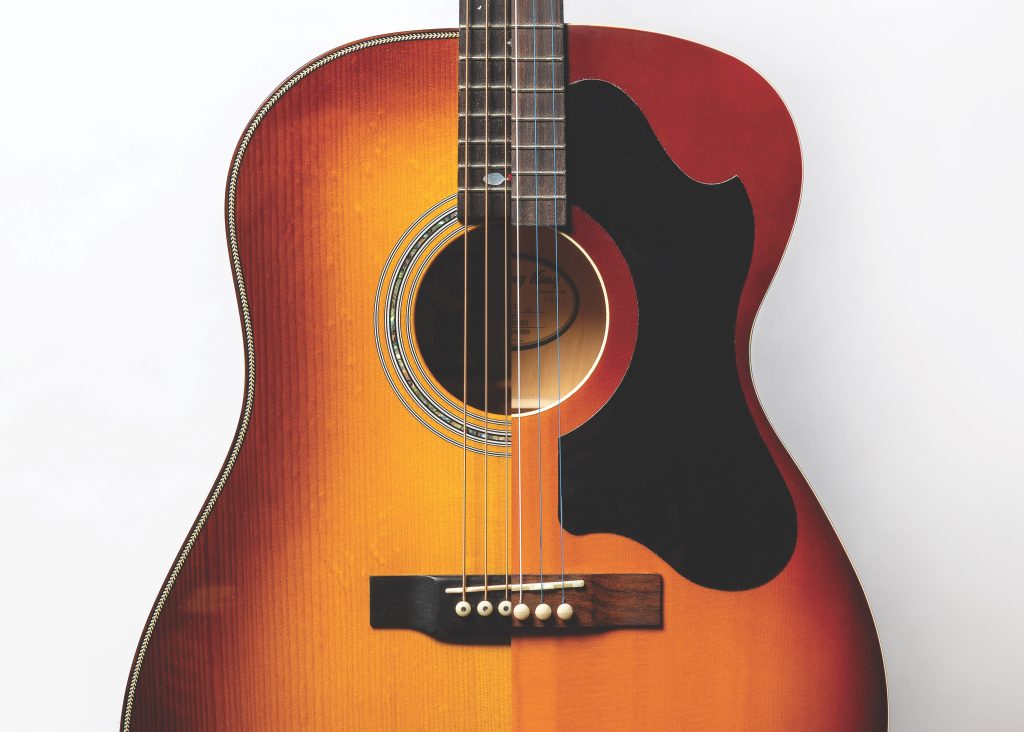
I suspect he was talking about me. I’ve been toting around an acoustic guitar — in my car mostly — since I squandered $20 on a 6-string that beckoned to me from a pawnshop window when I was 14. The Kingston Trio strummed guitars, the girls swooned, and I had to have that Kay archtop with the bowed neck. No other instrument would do. (When was the last time you heard a testosterone-besotted teenager quip, “I just happen to have my tuba with me”?) At 17, I could flat pick the intro to The Animals’ “House of the Rising Sun” and bang out the first few chords of The Troggs’ “Wild Thing.” What more did I need to know?

If Americans have a national instrument, it’s the guitar, be it electric or acoustic or a combination of the two. According to Statista Research Department, 3.3 million guitars were sold last year in the United States. Any way you figure it, that’s a lot of exotic tonewood, bone, plastic, steel, glue, tortoiseshell and abalone. And that doesn’t account for the necessary accouterments — picks, strings, amps, mics, pedals, wires of every possible description, cases, straps, capos, gig bags, tuners, etc. Guitars constitute an in-your-face, above-ground market that flourishes on the internet via eBay and Reverb and lives in every city and settlement with a population of more than one. It’s a miracle that every kid in America isn’t busking on the curb.

In your lifetime, you’ll probably buy a guitar, or you know someone who will. With millions of options available, making an intelligent choice can be time-consuming and expensive — and ultimately disappointing. If you buy the wrong instrument — one that’s difficult to play and sounds crappy — the novice picker may become disillusioned and never fully realize the fulfillment music can bring into his or her life.

The guitar market is inundated with defective, cheap, and poorly constructed used instruments that are available for a pittance, while at the other extreme, you can make the investment of a lifetime if you stumble upon a one-of-a-kind gem. Kurt Cobain’s Martin 1959 D-18E acoustic recently sold for $6 million, and Bob Dylan’s 1964 Fender Stratocaster — the one that antagonized the crowd at the 1965 Newport Folk Festival — is a steal at a million bucks. Mark Twain’s 1835 2 1/2-17 Martin, which cost $10 new, is valued at over $15 million.

Used, worn-out instruments flood online auctions. Many of these are catalog guitars sold from 1920 through the mid-’60s. They have the virtue of being American-made, but they were ordered through Sears (Supertone/Silvertone), Montgomery Ward (Airline), or a myriad of more obscure distributors, and were often delivered in unplayable condition with a string height and tension that would suck blood straight out of your fingertips. Even if you lucked into a medium-grade and high-end used guitar, the truth is simple: Guitars wear out. The necks warp, the soundboards crack, the tuners fall apart, and the bridges pull up. They can be repaired, but the services of a capable luthier don’t come cheap, and you can spend more money restoring an old guitar than you will pay for a new, more playable model.

So where do you start the quest for that 6-string soulmate? If possible, borrow a guitar. Get a feel for the instrument. Learn a couple of chords. Sing a simple song. If you decide to purchase an instrument, don’t go online and click on the first thing that strikes your fancy. There’s no telling what will arrive in the mail. How a guitar looks on a computer screen and how it sounds and feels when you’re caressing the strings are very different things.

Or you might begin by watching Daniel Putkowski’s 2023 documentary Heirloom: Guitar, snippets of which were filmed in Southern Pines and feature Greensboro luthier Bob Rigaud. The doc is a simple primer for the unschooled. Putkowski begins with an ingenious admission: “I’ve been trying for 20 years to figure out what makes the guitar so popular in American music and across the world.”

Rigaud, who has crafted boutique instruments for Graham Nash, John Hiatt and David Crosby, believes the guitar is spiritual: “The guitar is probably the easiest instrument to play — of course it’s one of the hardest to master. . . It’s spiritual, and it speaks to people in their own lives — love, loss, all subjects.” The professionally produced documentary traces the acoustic guitar’s evolution from a parlor instrument into the most popular music-maker in the world. Segments are supplemented by clips of Bryan Sutton, David Grier, Florence Dore and others explicating their love of the instrument and include step-by-step visuals of a luthier building a custom boutique guitar from scratch. Heirloom: Guitar is available on YouTube and is a good introduction for anyone who is considering a purchase.

We’re fortunate to live at a propitious moment in the evolution of the guitar. CNC (computer numerical control) machines improved construction and playability, and if the guitar is made by a reputable American company — Martin, Gibson, Collings, Taylor, etc. — it’s likely to be a superior instrument. And there are hundreds of American luthiers — too many to mention here — who build custom guitars of the highest quality, although these models are likely to be pricy.

Among imported guitars (“offshore” is the popular euphemism) constructed in China, Indonesia, Japan, etc., deals are to be had. American players generally look down on these foreign models, but the Chinese have been producing acceptable instruments for the last 30 years, and Japan’s Takamine, Alvarez and Yamaha are welcome on any stage or in any song circle. After all, musicians in the Orient were playing stringed instruments long before the Vikings set foot in Vinland. It’s all right to be a guitar snob, but it’s unnecessary — and unbecoming.

Online guitar retailers abound. Musicians Friend, Cream City Music, Sweetwater, Chicago Music Exchange and other music companies will allow you to purchase an instrument and return it in new condition for a full refund if you don’t like what you hear. But the best and easiest place to start your search is your local music store. (There are chain guitar stores you can frequent if you can endure the bone-jarring racket of 10 customers playing White Stripes’ “The Hardest Button to Button” with their amps maxed out.) But a quiet, comfortable atmosphere where you can handle the instrument and hear what’s played beneath your hands is the way to go. A guitar must feel right as well as sound right.

Southern Pines has had its share of cliquish musical haunts. The Pinedene Jazz Center, which was featured on WRAL’s Tarheel Traveler many years ago, comes immediately to mind. The hole-in-the-wall establishment on U.S. 1 South flourished as a gas station selling Black Diamond Strings until it morphed into a music store that eventually succumbed to changing times and a shift in ownership.

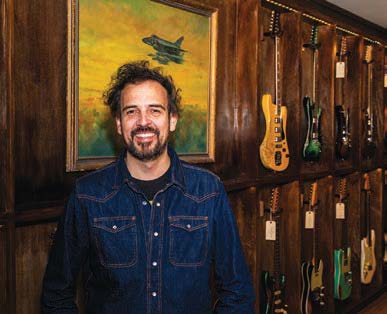
The more substantial Casino Guitars (www.casinoguitars.com), which now anchors, along with The Country Bookshop and The Ice Cream Parlor, downtown Southern Pines, carries an impressive array of guitars, many of them high-end instruments that proprietor Baxter Clement ships worldwide. Casino has grown into one of the premier guitar stores in the Southeast. The service is excellent; the crew is knowledgeable. Clement, a music graduate from Vanderbilt University, thoroughly knows his stuff, and he truly loves guitars. He has a solid business plan. He knows that customers in the market for a guitar need to feel and hear the instrument. They need to hold it in their hands and sense that sudden bond: Ah, yes, this is the one!

“When a customer comes in the front door, we try to make them feel at ease,” Clement says. “They can take their time and browse and find an instrument they feel a connection to. Our job is to help the customer find a guitar that speaks to them.”

As for the price range of his stock, he’s philosophical. “Every guitar gets you to the same place, like a car moving from A to B,” he says. “A quality guitar will just get you there faster. And, too, customers should keep in mind that many of the cheaper guitars are produced by workers who aren’t paid a fair wage. In some cases, they’re built by prison labor who work in unsafe conditions without masks or eye protection.”

How much should you pay for a new or used guitar? Is there a decisive difference between a high-end and a cheapo-cheapo model? Nothing is absolute. If you do your research, listen to a trusted expert and, as Aristotle reminds us, trust your eyes and ears — “The Eyes are the organs of temptation, and the Ears are the organs of instruction” — you have a very good chance of purchasing a quality, playable instrument that will bring you years of satisfaction.

To determine how low-end guitars have improved in recent years, I ordered the cheapest playable new guitar I could find online. Recording King is a brand name conjured up by Gibson during the Great Depression. The guitars produced under the label were more lightly constructed and cost less than the typical Gibson. The Recording King moniker was eventually sold to a Chinese outfit that produces models at varying prices and quality. For $100, I purchased a Recording King from the “Dirty-30s” series, which boasts surprisingly impressive specs — a spruce top, nickel tuning machines, Whitewood (whatever that is) back and sides, mahogany neck, bone saddle and nut — all good stuff.

I toted the Recording King and my 2012 Signature John Sebastian Martin D Slope Shoulder, which boasts the specs of the very best of American guitars (there’s one for sale online for $15,500), to a gathering of the Weymouth Song Circle, which meets on the last Tuesday of every month, to allow the experts to weigh value and quality. And they did.

The Recording King sounds, well, good enough. It is surprisingly playable out of the box. It’s bright and responsive and holds its own with other guitars when fingerpicked or strummed. Except for minor finishing details (the fret ends are like septic spikes), the Recording King would have held its own in the 1950s and ’60s folk era.

But when we played the Martin DSS, trained ears held sway. The Martin was by far the more desirable guitar. Everyone wanted to pick a few tunes on the DSS while the Recording King sat slumped, neglected, in the corner. It’s a viable guitar, fun to play when accompanying others, but the superior Martin demanded the attention of experienced pickers. Which begs the question: Is one Martin guitar worth 155 Recording Kings? Whatever the answer, this much is certain: The serious player should experience long-term satisfaction with his or her purchase. You don’t want to outgrow your new guitar in the first month of ownership or be discouraged by its inadequacies.

Everyone should have a little music in his or her life, if only to escape the electronic morass we’re forced to inhabit. When you hold an acoustic guitar in your hands, it’s just you and the instrument. For better or worse, it reflects what you feel and believe — and who you are. It also connects with others, and there’s a strong sense of community among guitar players, whatever their skill level. And Lord knows, genuine connection is what we need more than ever.
Even casual music lovers appreciate the sense of camaraderie that guitars convey. I recall a summer afternoon 40 years ago when I was driving into Austin, Texas, to visit my singer-songwriter brother. I had my radio tuned to a local station that was broadcasting live coverage of a gathering of 500 guitarists on the grounds of the State Capitol. At precisely high noon, they all played “Wild Thing” — raucous head-pounding A, D, E, D, A, D, E chords blasting through the transistors in perfect generational unison.

Oh, how I longed to be among them!

A Touch of Zen

A TOUCH OF ZEN

A Touch of Zen

Mid-century elegance for two

By Deborah Salomon 

Photographs by John Gessner

Architectural styles can take a while to develop a following. Like bouillabaisse and paella, their ingredients are myriad, complex. They can age like fine wine.

Apply these guidelines to mid-century modern, made popular by a coterie of forward-thinking architects — some associated with N.C. State, others espousing Japanese concepts — who left their mark on central and eastern North Carolina beginning roughly in the 1950s.

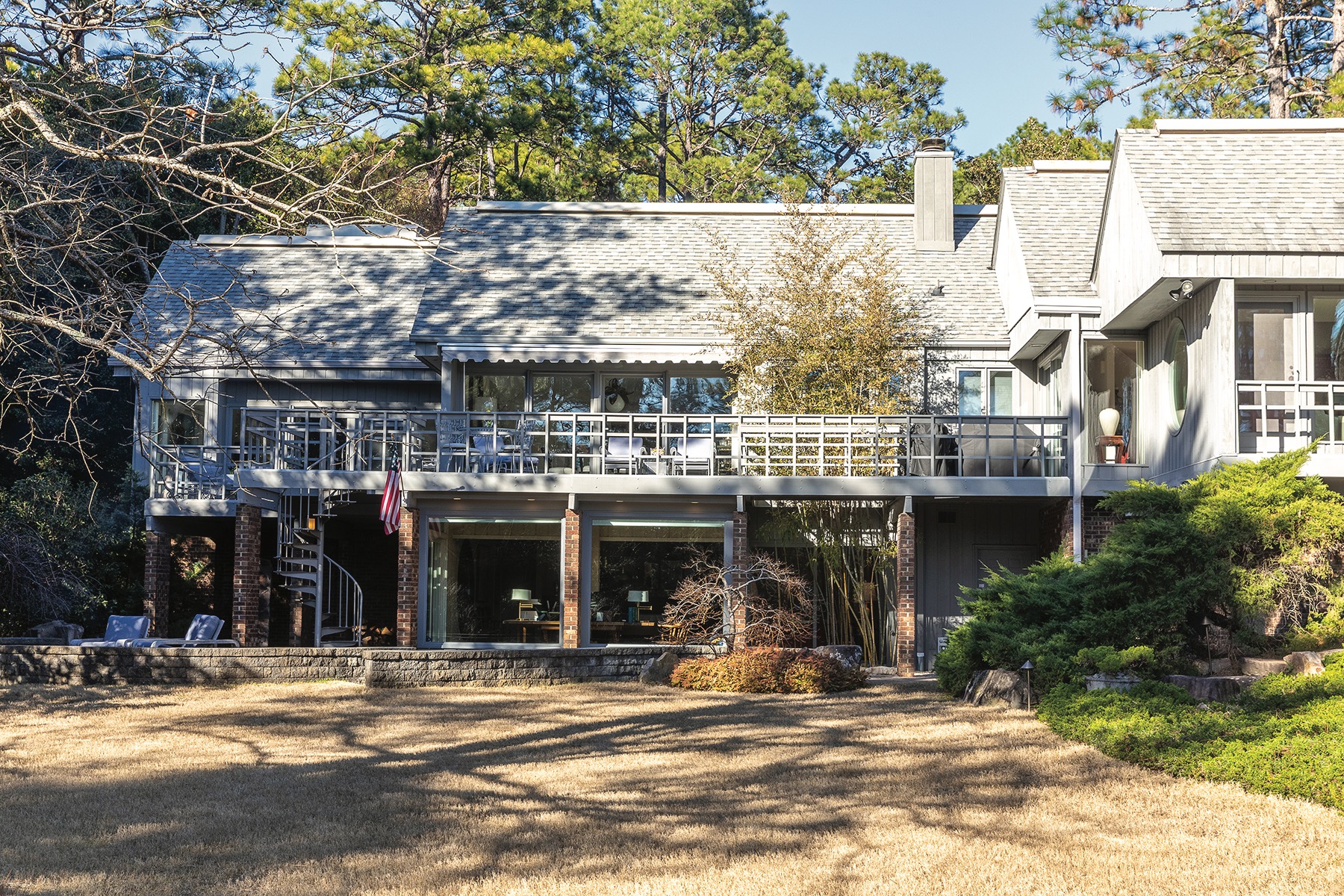
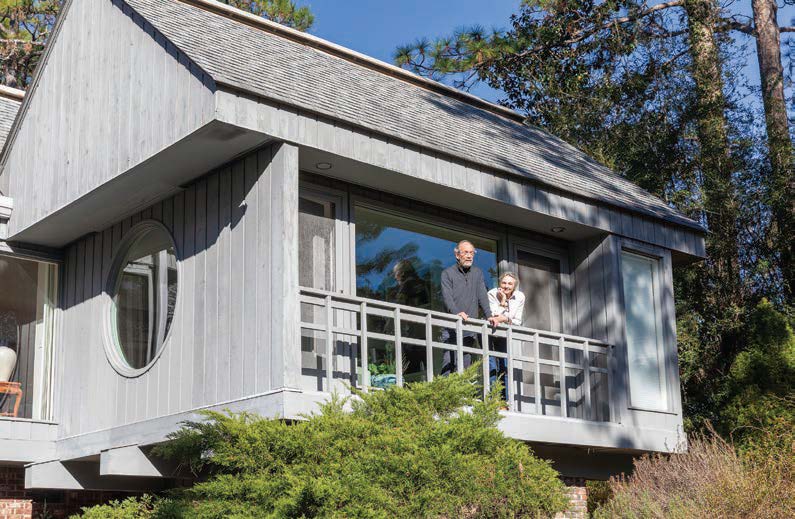
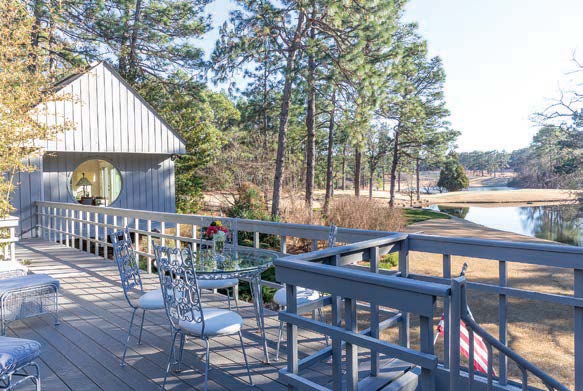
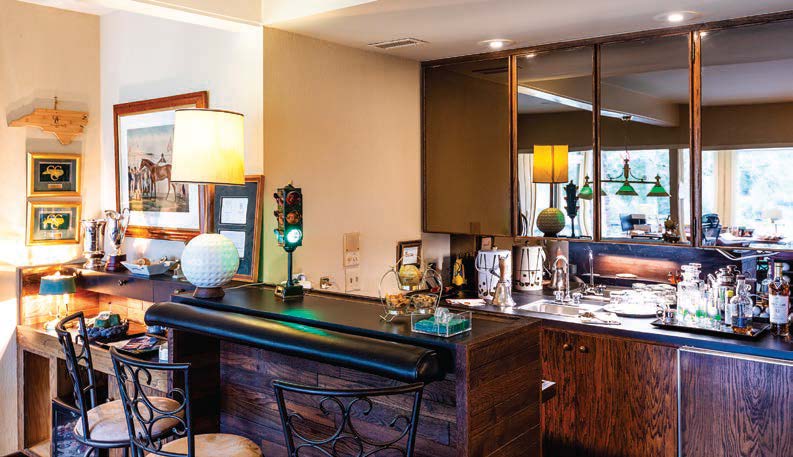
Then, for a stunning rendering, stroll through the mid-century modernesque home of Richard and Molly Rohde on the Southern Pines Garden Club’s Home & Garden Tour on Saturday, April 5. Notice the ways, some subtle, that the Rohde residence differs from neighbors at the Country Club of North Carolina — a pebbled area at the entrance; jumbo glass wall inserts; five strategically placed mini-gardens, one walled and sunken; and a wraparound Juliet balcony. All are born of Richard’s landscape design prowess, as is the giant golf ball atop a stump pedestal at the front walkway that was carved from a tree that grew on that very spot.

The house was built in 1980. The Rohdes have lived there for 10 years. “We are a blended family,” Molly explains, totaling seven children and 13 grandchildren. They keep a townhouse in Raleigh and a house at Topsail Beach, where the gang gathers May to October. Molly calls it their “happy place.”

Richard grew up in a stucco in Miami before moving to Winston-Salem; Molly in an interesting mountaintop residence in New York State. While living in Raleigh Richard enjoyed golf excursions to Pinehurst enough to suggest a grown-up retreat that he could combine with his office.

“The architecture, the sightings, the dogwood and azaleas in bloom — we decided on the spot and made an offer,” they recall. Another appeal: The house was designed by Hayes-Howell and Associates, the pre-eminent modernist architects of the era, who left significant marks on Moore County.

Richard planned whatever adjustments and additions that were required. The walk-out basement “playroom” with “wet bar” (in previous parlance) became his office. His desk was formerly a trestle table. He added a terrace with a firepit and an extended Juliet balcony ending in a metal circular staircase. Beyond, artistically arranged boulders define gardens where a sea of daffodils bloomed in late February.

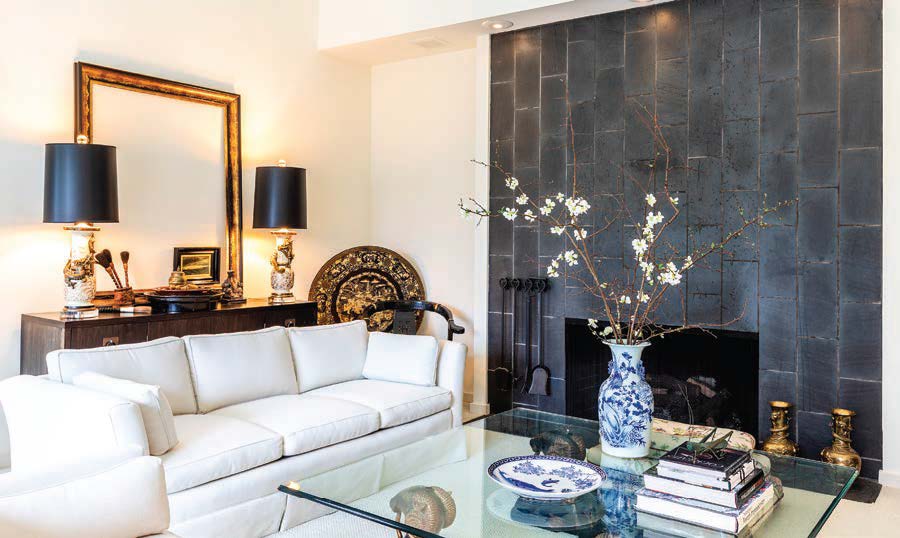
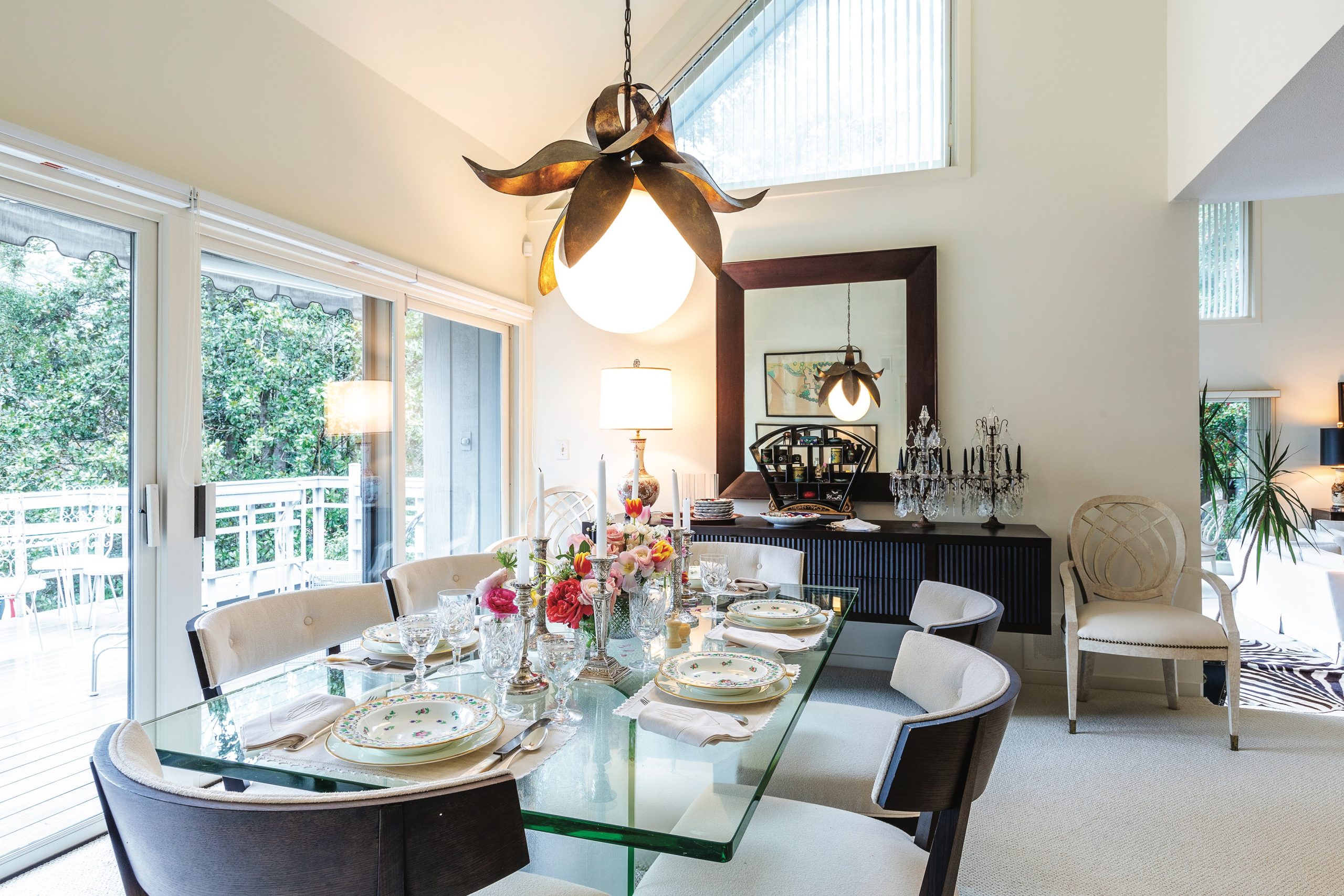
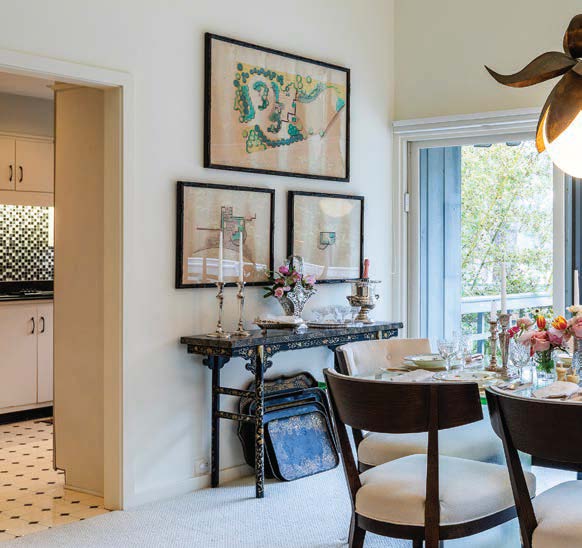
The diversity of landscaping makes the pie-shaped 1-acre lot sloping toward the lake appear larger. Although the house layout is longitudinal with two wings — totaling 3,250 square feet — nothing suggests a single-story 1950s ranch. Enter the front door, step into a foyer flooded with light, and gasp at the dining room, directly opposite, with line-of-sight to the lake. Black and soft milky white dominate here. The black lacquer sideboard, which came with the house, is covered in Asian motif carvings. The table with a thick plate glass top, also a holdover, picks up sunbeams. Petals on a low-hanging light fixture suggest a lotus flower. Framed architectural renderings of the house, a testament to its provenance, hang on a side wall. Wallpaper adds texture in neutral, solid colors, no patterns.

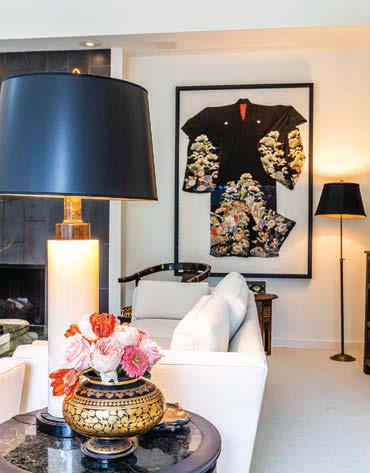
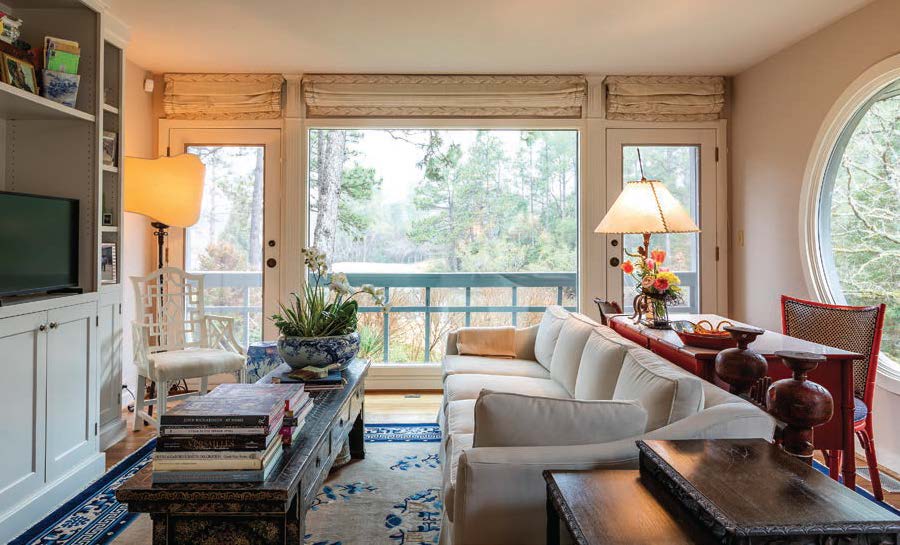
Off to the right is the living room with an 18-foot ceiling, white carpet, white upholstery, a high triangular window, and a plate glass coffee table. In a corner surrounded by windows and glass doors stands a round glass-topped table where Molly and Richard take meals. Near the fireplace hangs an exquisitely embroidered framed kimono, once part of Molly’s wardrobe.

So far, elegant, very adult, perfect for entertaining.

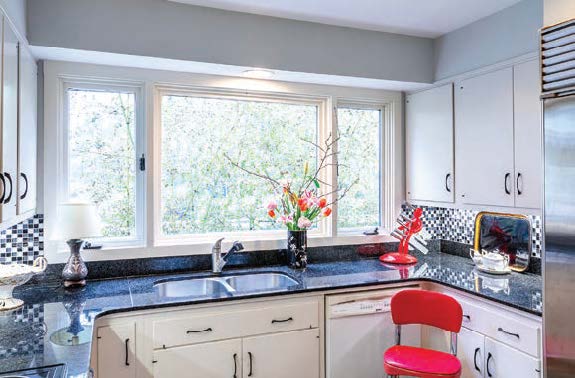
The kitchen rates a giggle from Molly. Judged against today’s extravaganzas, it is modest yet stylish with black and white floor and tile backsplash, simple cupboards and pulls designed by the original architects, perfectly adequate for preparing meals for two, Molly notes.

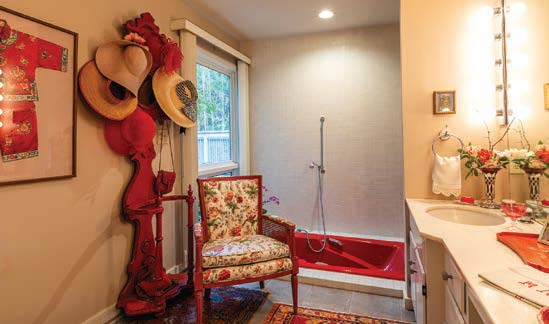
The bedroom wing stretches off the foyer, the length of its hallway emphasized by a seemingly endless row of Chinese screen panels. Where they end the master suite opens into a large sitting room, doubling as Molly’s office, with built-in bookcases, TV, sofa and door onto the balcony. The highlight in her bathroom is a sunken Jacuzzi whirlpool tub in a deep red enamel, inspiring Molly to paint a fanciful hall tree for hanging towels. Richard’s bathroom: sedate black tiles.

Molly continued the Asian theme in jewel-toned fabrics and figurine lamp bases, some from her daughter’s boutique, Union Camp Collective, in Raleigh. She also framed a child’s kimono, worn by her daughter.

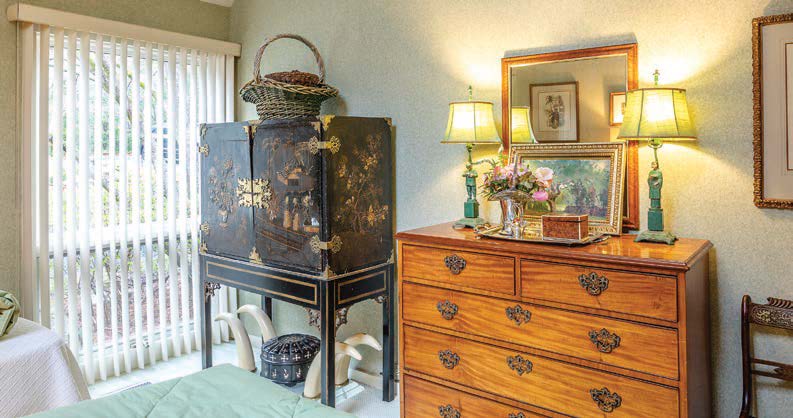
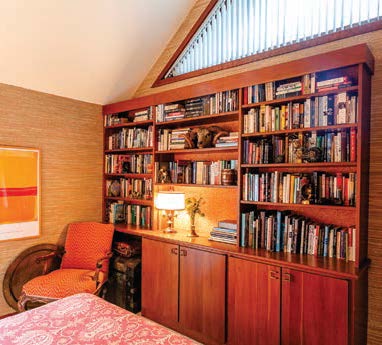
Molly and Richard, both longtime collectors, have curated and combined their possessions in the master suite and two guest bedrooms, one with a second set of built-ins filled with books. The result: a blended family, combined furnishings, historic Carolina architecture, a whiff of the exotic, and a home office overlooking the golf course. Richard recalls his first impression of life at CCNC: “I came through the gates and thought, whew, this is relaxing, another world.”

Lucky Richard. Fortunate Molly. In semi-retirement they found Zen.

Glorious Restoration

GLORIOUS RESTORATION

Glorious Restoration

A Reynolda landmark is reborn

By Ross Howell Jr.   •   Photographs By Amy Freeman

Have you ever seen this?” asks Bari Helms. “I found it in some boxes.”

Helms is the director of the archives and library at Reynolda House Museum of American Art, the storied estate that is now part of Wake Forest University in Winston-Salem. She slides the rendering toward Phil Archer, the deputy director at Reynolda, the family mansion that houses a permanent collection of three centuries of American art and sculpture.

Archer shakes his head, touching a finger to the edge of the drawing.

“I don’t think so. Not with those perpendicular wings. A little too Versailles for Katharine, isn’t it?” Archer asks. He and Helms exchange knowing smiles.

Helms produces a letter from that same “Katharine” to Lord and Burnham, the premier builder of glasshouses in America during the mid-19th and early 20th century, dated May 27, 1912. In it, she details what she wants her estate’s conservatory to include — a palm room, a “good-sized” grapery, a tomato section, a large vegetable section, a propagating room and a “nice workroom.”

When Lord and Burnham responded with their plans and perspectives, and their quote for $7,147, Katharine wrote back that it was too much money. The greenhouse additions in the rendering were removed.

“In all her correspondence, you get a sense of how direct, hands-on and detail-oriented Katharine was,” Helms says.

In December 1912, Katharine wrote another letter to Lord and Burnham, complaining that the workers they’d promised had not yet arrived on-site. In January 1913, she wrote again, noting that parts of the conservatory were not being built to her specifications.

“Katharine was very polite about it,” Helms says, “but insisted that she was making Lord and Burnham aware of the issue so they would fix it.”

No doubt they did.

Katharine was, of course, Katharine Reynolds, the irresistible force behind Reynolda, completed in 1917. Backed by the tobacco empire of her husband, R.J., Katharine began to purchase tracts of land near Winston-Salem, eventually acquiring more than 1,000 acres, each parcel deeded in her name alone. Her idea was a Progressive one — to create a self-sufficient estate that included a country house, a farm utilizing the latest in technology and agricultural practices, a dairy, recreational facilities and a school.

The conservatory — located very near what is now Reynolda Village — was an integral part of Katharine’s design. October 2024 marked the end of its restoration, a yearlong project made possible by a gift from longtime Reynolda supporters Malcolm and Patricia Brown.

Born in Mount Airy in 1880, Katharine Smith Reynolds was a daughter of America’s Gilded Age and a wife in the Progressive Era of the industrialized New South. In the period photographs at Reynolda, she’s the young woman in the gorgeous outfits who doesn’t seem to be looking at the camera, but, rather, directly into your soul. To this day, her spirit and determination inform every aspect of Reynolda.

Leaving her home in Mount Airy in 1897 to attend the State Normal and Industrial School — now UNCG — she later withdrew because of a typhoid epidemic and finished her studies at Sullins College in Bristol, Virginia. In 1902, Katharine joined the R.J. Reynolds Tobacco Company in Winston-Salem, where she served as personal secretary to the owner, R.J., a distant cousin who was 30 years her senior. In 1905, Katharine and R.J. married.

Between 1906 and 1911, Katharine gave birth to four children — at grave personal risk, according to her physicians, since she had been plagued with heart problems that started in childhood. By all accounts, the Reynolds marriage was a happy one, and R.J. was confident in his young wife’s abilities, often consulting her on business matters.

“Katherine wanted the estate to look and feel like an old English hamlet,” Archer says. “Burying utilities was high-tech for Katharine’s time, but that’s what she wanted.”

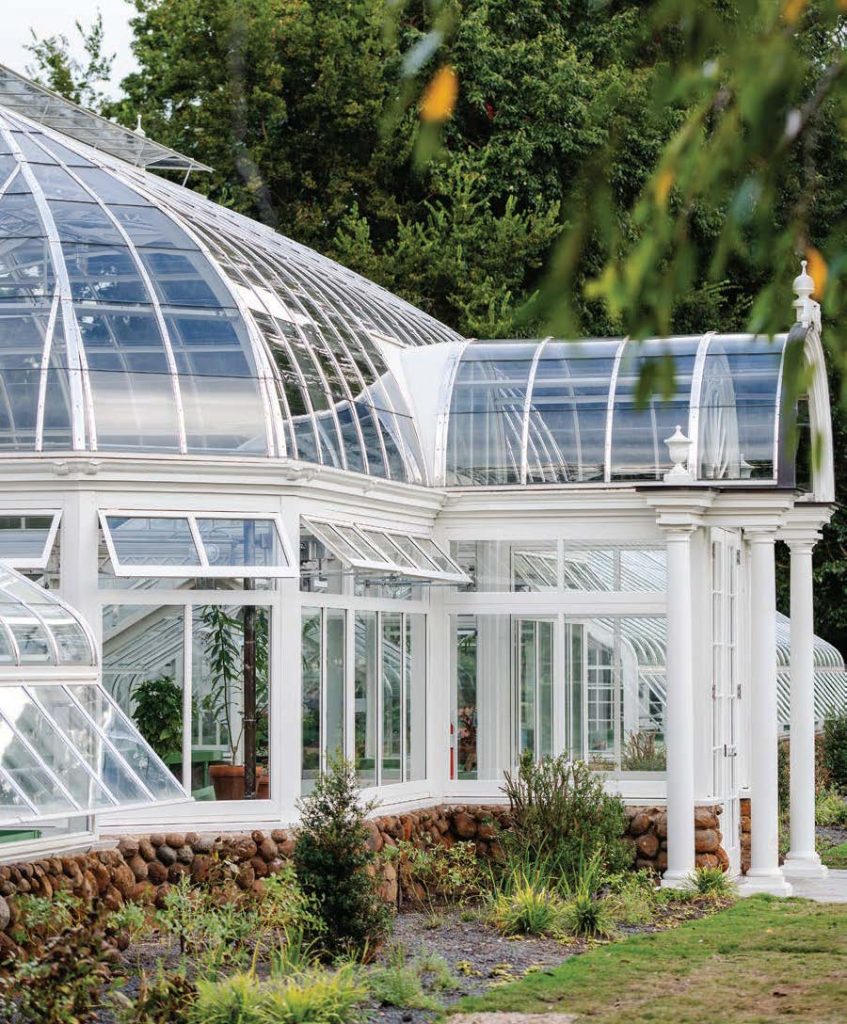
The conservatory restoration project, which would become the Brown Family Conservatory and Reynolda Welcome Center, was led by Jon Roethling, the director of Reynolda’s gardens. The work was done by Cincinnati-based Rough Brothers (pronounced rauh), a subsidiary of Prospiant.

“Rough Brothers had access to actual Lord and Burnham plans and molds,” Roethling says. So, for the Reynolda restoration, the company could use templates on hand, extruding aluminum pieces to match the originals.

The tinted glass needed for the restoration was made by another company. It’s so specialized, the company only manufactures it twice a year, delaying completion by months. The wait was worth it, however, since the unsightly aluminum shutters added to the palm house and greenhouses in a previous renovation could be removed. Moreover, the manufacturer had the equipment to produce curved glass. This meant that the elegant shape of the original architecture — supplanted by the use of flat glass panes in a previous renovation — could be restored.

“When I walk into the palm house now, the architecture just sings,” Roethling says.

There were the additional challenges of heating and ventilation — critical to a conservatory. “We stayed with the original concept of radiant heat,” Roethling explains, “though the new system is very sophisticated.”

Ventilation was a trickier issue, since the conservatory is vented throughout — foundations, walls and roof. From the time the conservatory was built until this restoration, these many vents had to be cranked open or shut by hand.

“You have to strike this balance of having architecture that reflects 1913, but also having the convenience and efficiency of systems that are modern day,” Roethling says. “Knowing Katharine, one of the most progressive women of her time, I was sure there was no way she would want us to be hand-cranking vents in this day and age, so we made the jump to automated.”

The new system automatically responds to wind flow, wind speed and precipitation, adjusting ventilation as needed. Changes can also be made remotely, using Wi-Fi. Once, when Roethling noticed a thunderstorm developing, he went to the conservatory to see how the new system would respond.

“As the wind rose and the storm started rolling through, I watched the vents immediately close a bit,” he says. “When the wind grew stronger, the vents shut completely, protecting the greenhouses.”

End-to-end, the central structure of the conservatory and the greenhouses flanking it extends more than 300 feet. Sod has been laid the entire length, creating a walking path for visitors. Between the edge of the sod and the foundations of the greenhouses are planting beds, about 8 feet wide, filled with peonies.

“The problem,” says Roethling, “is once the peonies bloomed out, that was pretty much it, visually. I needed someone who could do something amazing.”

Roethling reached out to Jenks Farmer, a plantsman in Columbia, S.C., who served as director of Riverbanks Botanical Garden in West Columbia and was the founding horticulturist of Moore Farms Botanical Gardens in Lake City. Farmer created a design for the peony beds incorporating other perennials that provide visual interest throughout the growing season.

“Jenks is great,” Roethling says. “He loves balancing history with what’s relevant today.”

In the conservatory proper, each bay has a different theme. “This first bay is in the spirit of an orangerie, which represents the birth of greenhouses,” says Roethling. Much like the original 17th-century orangeries in England and throughout Europe, the bay also features olive trees and other fruiting plants, and will be used to illustrate a narrative history of the development of greenhouse structures over the centuries.

The next bay is an arid greenhouse, featuring the five Mediterranean climates of the world — Southern California, the Mediterranean Basin, South Australia, South Africa’s Cape area and central Chile.“This is a fun thing to educate kids,” Roethling says. “To explore with them how the plant palette changes, how the plants adapt.”

The central palm house is elegant in its features with sealing wax palms with their deep red canes, and tall Bismarck palms with their silver fronds, all in large containers. Visitors can compare the broad texture of a palm frond to, say, the fine texture of a fern. “There’s a lot of texture — greens, whites and silvers,” Roethling says.

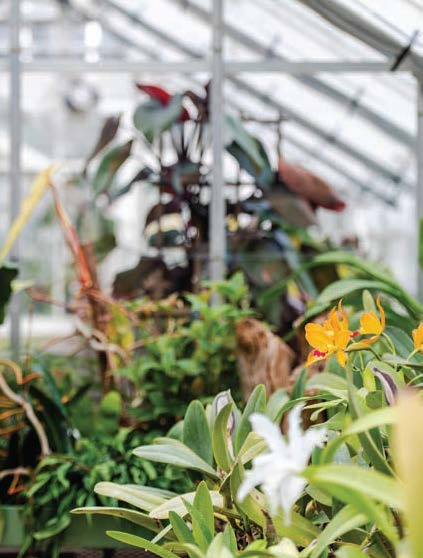
The next greenhouse bay features bromeliads, orchids and other flora that thrive in the tropics. It’s all about color — abundant, dramatic color. “In here, I want to have freaky things that visitors walk up to and ask, ‘What is that?’” says Roethling with a broad smile.

The final bay serves as a holding house for resting orchids, organized by types, with interpretative signage.“Even though the orchids won’t be in bloom there,” Roethling says, “that greenhouse will still be beautiful and educational.”

Just as Katharine would have expected.

Stormy Seas

STORMY SEAS

Judson Theatre Company presents The Caine Mutiny Court-Martial

by Jim Moriarty

Herman Wouk, the author of both the novel The Caine Mutiny and the play The Caine Mutiny Court-Martial, took great pains to let his audience know that nothing that happened aboard the fictional ship the USS Caine occurred in the very real campaigns he experienced during his World War II service in the Pacific Theater. A note to the play says, “The Caine Mutiny Court-Martial is purely imaginary. No ship named U.S.S. Caine ever existed. The records show no instance of a U.S. Navy captain relieved at sea under Articles 184-186. The fictitious figure of the deposed captain was derived from a study of psychoneurotic case histories, and is not a portrait of a real military person or a type; this statement is made because of the existing tendency to seek lampoons of living people in imaginary stories. The author served under two captains of the regular Navy aboard destroyer-minesweepers, both of whom were decorated for valor.”

The Judson Theatre Company will bring Wouk’s courtroom drama, informed by his service aboard the USS Zane and USS Southard, to life in five performances starring John Wesley Shipp and David A. Gregory, beginning Thursday, April 24, and running through Sunday, April 27, in BPAC’s Owens Auditorium, 3395 Airport Road, Pinehurst. The novel, published in 1951 in a wave of post-war literature that included books like Norman Mailer’s The Naked and the Dead, earned Wouk a Pulitzer Prize. The play debuted on Broadway in January 1954, directed by Charles Laughton. That June the movie The Caine Mutiny was released, gaining seven Oscar nominations, including one for best actor for Humphrey Bogart’s riveting performance as Lt. Com. Philip Francis Queeg.

The play is performed in two acts, organized simply with the first act as the prosecution and the second the defense. “If you think about the film and even the book, they both literalize what happened on the ship,” says Judson Theatre’s executive producer, Morgan Sills. “With the play, the audience gets to piece together what happened on the ship from what they glean from all the different testimony they hear. In the end, the audience has a job to do, to decide what they believe is the real story. And that’s theatrically interesting. It can change from night to night the way that live performances change from night to night and books and films do not.”

Shipp, who returns to Judson Theatre after playing the role Juror No. 8 in its 2016 production of 12 Angry Men — Henry Fonda’s part in the 1957 movie — takes the part of Queeg, the ship’s commander relieved of duty during a vicious storm by Lt. Stephen Maryk. He’s played by Jacob Pressley, whose Judson summer theater festival credits include Gutenberg! The Musical, The Last Five Years and They’re Playing Our Song. Maryk’s defense counsel is Lt. Barney Greenwald, played by Gregory. Coincidentally, Fonda played Greenwald in the original Broadway production.

Though tasked with defending Maryk, Greenwald has no particular fondness for his client. On the other hand, he knows that in order to perform his sworn duty to zealously represent him, he will have to cross-examine Queeg in the most brutal manner, a prospect that gives Greenwald no pleasure. At its dramatic height Greenwald and Queeg go head-to-head. And it’s there that Judson’s production of The Caine Mutiny Court-Martial benefits from the long working relationship between Shipp and Gregory.

In his role as Eddie Ford on One Life to Live, Shipp — whose credits and awards (including two Emmys) over a 38-year acting career are too numerous to mention —  was frequently at loggerheads with Gregory, who played his son, Robert, on the daytime drama. “I was the abusive father and he was my oldest son, Bobby Ford,” says Shipp. “I had three sons and I treated them all differently. Bobby was the one who would push back. We had a great time. It’s just one more reason I’m so excited to get on stage going head-to-head with this man because I know how talented he is, how resourceful he is. The thing I love about David is he brings his A game all the time. I feel like we challenged each other.”

Moving at the speed of a soap opera, between scenes Shipp and Gregory would occasionally swap their character’s lines if they thought it deepened the connection. “We have a shorthand with each other, working 15-16 years ago on the soap where we would have to clash,” says Gregory. “We know what that territory is, but we haven’t experienced it with this play and these words.”

One Life to Live isn’t their only collaboration. Gregory wrote a scripted podcast, Powder Burns, about a blind sheriff in the Old West. It premiered on Apple Podcasts in 2015 with Shipp in the role of the sheriff. Critically acclaimed, it earned Gregory a Voice Arts Award in 2017. They’ve also worked together on a two-person play Gregory wrote about Jimmy Stewart and Henry Fonda called Hank & Jim Build a Plane, which Shipp and Gregory performed in a workshop in New Orleans in 2018, the last time they appeared on stage together. As opposed to their One Life to Live personas, Hank & Jim is about two men, famous for their shared model airplane hobby, who are at odds with one another over pretty much everything else — including a woman — and who won’t, or can’t, challenge one another. In something of a metaphor for our time, it’s about what Hank and Jim, sharing the same tiny garage space, can’t say to one another. “It may have been Jimmy Stewart’s daughter who said the interesting thing you’ve done is that you’ve taken two men of very few words and written what they would have said to each other if they could have,” says Shipp.

Finding the right words won’t be the problem in The Caine Mutiny Court-Martial. “Plays like this get done so often because they’re very, very good,” says Gregory. “The author has meticulously made this as perfect as possible. We just get to add on top of that. It’s a blast.”

Shipp sees only one real drawback: “My only complaint is that it’s too short.” 

Be Our Guest

BE OUR GUEST

Be Our Guest

Creating the perfect guest bedroom Madcap Cottage style

By Jason Oliver Nixon and John Loecke   •   Photograph by Bert VanderVeen

There’s truly an art to hosting guests. To making a visitor feel supremely welcome without having to kowtow to their every whim and whimsy.

John and I love entertaining in all its forms, and we really raise our game when it comes to hosting houseguests at our High Point home, the House of Bedlam. Think The Ritz Paris by way of North Carolina, but cozier, softer, and a lot more fun. Dining room disco, anyone? We just had an international guest arrive from London, and we wanted her stay to be as comfortable and memorable as we could make it. Quite simply, we want every one of our houseguests to feel like they’re at home and leave them wanting for nothing. A good mattress and a clean room are a given, but we are all about the small touches, the personal ones that focus on our guests’ comfort.

That said, we are very clear about our “deliverables.” This isn’t a restaurant. We aren’t the maids. Yes, please strip the bed when you depart. We will have coffee and English muffins ready every morning; we don’t make eggs. And a gift or dinner out on the town is always welcome.

Here are a few tried-and-true recipes for the ultimate guest bedroom from your friends at Madcap Cottage . . .

— We love to put flowers next to the bed. Flowers truly make the room feel fresh, alive and cared for. You know your guests well, so think about their favorite blooms and adorn the nightstand with that particular blossom. At this time of year, what is more cheerful than a simple vase abundant with daffodils? A great stack of books is always welcome, too.

— Place either a bottle of water next to the bed or fill a glass decanter with water and accompany it with a lovely crystal glass.

— Email a week before to ask your guests’ must-haves or food preferences. Oat milk, almond milk, gluten-free bread? The Madcaps have you covered. Our recent guest wasn’t fussy but she is a chocoholic. We had some of our Hammond’s chocolate bars on standby for her, so she could try some Southern sweet treats.

— Add lovely toiletries pillaged from a hotel to your guest bathroom. Save the Hermès for really good friends or treat them to some of your favorite toiletry brands. We love to leave our guests with some of our French lavender bath bombs from the Old Whaling Company to help them relax and unwind during their stay.

— Have a plug-in outlet with USB port easily visible and plugged in near the bed. When they’ve retired for the evening after a long journey, the last thing a guest needs is to be crawling around on the floor trying to find an accessible plug.

— Good towels, well fluffed. The bigger and bouncier, the better.

— Extra toilet paper in a basket atop the toilet. Be kind and save your guests the indignity of having to request more TP.

— A soft rug next to the bed. We have small accent rugs next to every bed in our house. Besides the fact that they make the room cozier and look more layered, they make getting out of bed that much easier when you’ve got a soft landing to look forward to.

So there you have it. That’s how we host a house guest, the Madcap way.

Enjoy!