No Day at the Beach

NO DAY AT THE BEACH

No Day at the Beach

George Washington’s 1791 Southern Tour

By Warren L. Bingham

As the hero of the American Revolution and a man of action, George Washington knew his presence mattered. Shortly after becoming president, he planned to visit all 13 states, “to see and be seen” while promoting the new Constitution and the federal government.

By 1791 Washington had made trips to the Middle and Northern states. That spring he would conduct the Southern Tour, traveling to Virginia, the Carolinas and Georgia. Except for brief visits in the 1760s as a landowner in North Carolina’s Great Dismal Swamp, Washington had never been south of Yorktown.

The Southern Tour was the most challenging of Washington’s journeys. The president would leave from the nation’s temporary capital, Philadelphia, and be away over three months to reach the farthest points in South Carolina and Georgia. Roads were bad. Crossing water was often an adventure. Inns were few and far between, and the standard unreliable. Horses required proper provisions. Bad weather, clouds of dust and even highway robbery loomed as threats — though one supposes the prospect of holding up Washington and his traveling party would have required an extraordinarily witless band of criminals.

Nonetheless, the 59-year-old Washington and eight traveling companions embarked on the Southern Tour on the first day of spring of 1791. Cabinet members Thomas Jefferson and Henry Knox escorted the entourage from Philadelphia to Delaware. Washington left a detailed itinerary with Vice President Adams and his cabinet members if they sought to get mail or messages to him.

Washington was paid a whopper of a salary as the first president, $25,000, but he covered his own expenses for his residence, office and presidential duties, including travel. He paid his household staff and secretaries from his earnings.

The presidential entourage included seven servants from his Philadelphia home, two of them enslaved men on loan from Mount Vernon. William Jackson, a longtime secretary of Washington’s, served as top aide on the trip. Jackson, an officer during the Revolution and a Charlestonian, was young and single, making him ideal to take along on the journey. The trip was considered too arduous for a lady, so first lady Martha Washington remained at home, even though she was a veteran of some wartime camps.

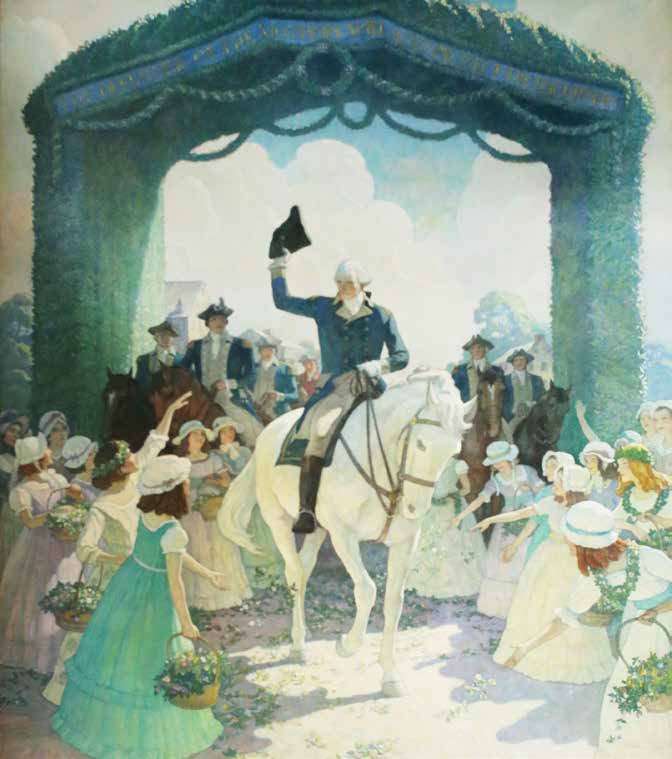
Transportation included the president’s own cream-colored coach and four, a baggage wagon pulled by two horses, and a few extra saddle horses. Washington’s personal mount, Prescott, a tall white parade horse, made the trip. Quite aware of looking presidential, Washington, who stood 6 feet, 2 inches tall, made a dashing impression riding high in Prescott’s saddle. Folklore suggests that a greyhound named Cornwallis accompanied the travelers, but alas, the presence of the hound is likely a myth.

Washington was a planner, and he immersed himself in the journey’s details. He consulted with his secretaries and gentlemen travelers to understand the roads and inns of the South. The president decided to go south along the fall line and the Coastal Plain and to make the return north through the Piedmont, the higher land between the Lowcountry and the mountains. He charted a route that gave him a good feel for the region, though he specifically wanted to visit Charleston, South Carolina, then the fourth-largest city in the country and a place of influence and affluence. Georgia’s two notable places were Savannah and Augusta, so he was going no farther south than those towns. Atlanta didn’t yet exist.
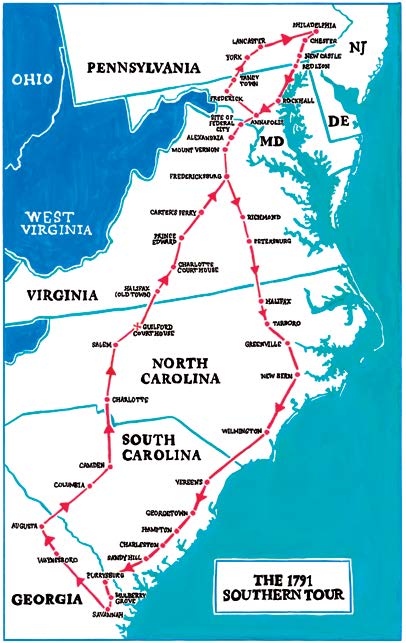
The trip from Philadelphia to North Carolina was a memorable one. The travelers endured near-calamities while crossing both the Chesapeake Bay near Annapolis and the Occoquan River in Virginia. Stops in Fredericksburg, Richmond and Petersburg went well, however, and represented Washington’s typical reception. The president was feted by dinners, dances and cannon salutes. Upon his arrival, parades ensued, church bells rang and choirs sang. Eighteenth century drinking was impressive and many toasts were offered — usually 13 (one for each state, of course) with a few more thrown in for good measure.

Hosts dressed up in their finest clothes, and women wore sashes adorned with words of tribute such as “Long Live Washington!” Some towns were lit up with torches, candles and bonfires, a prospect that would have alarmed any self-respecting fire marshal, had such public safety civil servants existed then.

Elected officials, Masons, ministers and veterans of the Revolution were received by the president. He sometimes attended church services and occasionally had the luxury of riding Prescott around town simply to see who he might see.

Traveling between the larger towns wasn’t easy. Local militias often escorted the president, stirring up a choking dust. The inns along the road were often “indifferent,” a term Washington used to politely describe barely acceptable accommodations for man and beast.

On Saturday, April 16, 1791, nearly four weeks after leaving Philadelphia, wind, rain and lightning filled the air as the president and his party made their way into North Carolina. Washington wrote:

The uncomfortableness of it, for Men and Horses, would have induced me to put up; but the only inn short of Hallifax having no stables in wch. the horses could be comfortable & no rooms or beds which appeared tolerable, & every thing else having a dirty appearance, I was compelled to keep on to Hallifax.

At the end of this stormy day, Washington crossed the Roanoke River, arriving in Halifax around six in the evening for his first true taste of North Carolina. Any visit Washington had previously made to the Great Dismal Swamp hardly counts — it’s like saying you’ve been to Dallas after changing planes at DFW.

It’s not certain where Washington lodged during his two-night visit to Halifax, but it was probably Eagle Tavern. As much as practicable, he refused private lodging during his presidential journeys, either paying his way or agreeing to stay in community-provided accommodation. At times during the Southern Tour, however, there simply wasn’t a suitable public place available. Of course, the horses had to be properly cared for and fed — and some public houses weren’t even reliable enough for that.

Halifax was home to several notable North Carolinians, among them, Congressman John Baptist Ashe, future Gov. William R. Davie, and Willie Jones, who had led North Carolina’s opposition to the Constitution and was no fan of the federal government. Indeed, Jones suggested he would receive Washington as a great man — but not as president of the United States.

Though Washington was greeted politely and treated respectably in Halifax, there’s no doubt that the presence of Jones tempered the enthusiasm. After all, Washington was in town for only two days, but the locals had to live with Jones long after the president was gone.

Samuel Johnston, an Edenton lawyer and the squire of Hayes Plantation, wrote in a late-May letter to James Iredell that “the reception of the president in Halifax was not such that we could wish tho in every other part of the country he was treated with proper attention.” In 2011 — with the specter of Jones long dead and buried — Halifax commemorated the Southern Tour on Historic Halifax Day.

When he reached Tarboro, Washington was impressed by the bridge — a rarity in 1791 — over the Tar River. Apparently, the number of cannon in Tarboro was in agreement with the number of bridges. Washington wrote, “We were received at this place by as good a salute as could be given with one piece of artillery.” Reading Blount, a veteran of the Revolution and a member of the state’s prominent Blount family, led the president’s entertainment.

Washington made his way from Tarboro to Greenville along roads that no longer exist, but his route probably tracked near today’s Route 33. In Greenville, the president, ever a farmer, was pleased to learn about local crops, including tobacco, and was intrigued by tar-making and its commercial value. Nonetheless, Washington wrote that Greenville was a trifling place. Greenvillians shouldn’t fret; the president would say the same thing about Charlotte.

After a night near present-day Ayden, during which Washington worried about the horses going uncovered without stables, the travelers passed near Fort Barnwell en route to New Bern. Likely edging out Wilmington as the largest town in North Carolina in 1791, New Bern turned out smartly for Washington. Mounted militia and town leaders met the president’s party several miles outside town to act as escort. The city provided a new but never occupied home for the president’s stay, the John Wright Stanly home, which still stands and is part of today’s Tryon Palace complex.

On his second night in town, Washington was entertained at a gala at Tryon Palace, and his dance card was full. In recent years, a yellow gown worn that evening by Mrs. Ferebe Guion was shown and evaluated on PBS’ “Antiques Roadshow.” The dress, value unknown, remains in the hands of Guion descendants.

In an age of slow and unreliable mail, Isaac Guion, Ferebe’s husband, took advantage of the presidential traveling party and their Southern passage to send a letter to a friend in Georgia via the president. Imagine the conversation. “Uh, Mr. President, as long as you’re going . . .” I suspect William Jackson, the secretary, handled it, but indeed the letter was carried to Georgia and ultimately delivered.

In the 1940s, A.B. Andrews Jr., a Raleigh lawyer and history buff, came across the letter, acquired it, and presented it to the town of New Bern. It’s kept in the archives in the Kellenberger Room, a wonderful collection of local, regional and state history and genealogy at the New Bern-Craven County Public Library. With all these ties to the Southern Tour, New Bern held major commemorations of Washington’s visit in 1891 and again in 2015.

A cannon salute roared as Washington left New Bern, and the presidential party traveled through Jones County, a namesake of Halifax’s Willie Jones. Longtime Pollocksville mayor and avocational historian Jay Bender wonders why Washington stayed so far inland as he went south from New Bern. The old King’s Highway, the post road that went from Boston to Charleston, came through New Bern and tracked more directly to Wilmington. The reason might have been lodging and services for man and horse, since Shine’s Tavern in Jones County, where Washington put up for the night, enjoyed a good reputation.

The travelers arrived at the coast, a few miles from Topsail Beach, on Saturday, April 23. By late afternoon they linked up with present-day Holly Ridge and the King’s Highway, today’s U.S. 17. Washington lodged at Sage’s Inn, one of the establishments he labeled as “indifferent,” though another traveler of the era described the proprietor, Robert Sage, as a “fine jolly Englishman.”

On Easter Sunday, the presidential party followed the King’s Highway toward Wilmington, resting in Hampstead. Some claim that Hampstead takes its name from Washington requesting ham instead of oysters for his breakfast that morning. There is a large live oak hard by U.S. 17 in Hampstead that supposedly is where the travelers rested. A local DAR chapter has kept the tree marked as the Washington Oak for a century or more.

At some point on Easter, Washington wrote a long diary entry in which he observed that the land between New Bern and Wilmington was the most barren country he ever beheld. The travelers had gone through a vast longleaf pine savanna, and Washington had never seen anything like it.

While Washington attended church services several times during the Southern Tour, he made no mention of Easter or attending a service in Wilmington. The Port City’s streets were lined with people to catch sight of America’s hero as Washington was led to his lodgings, a home on Front Street provided by the widow Quince, who gave up her home for the president while she stayed with family elsewhere in town.

Historian Chris Fonvielle, an emeritus professor at UNC Wilmington, says that Wilmington entertained Washington lavishly, and that it was evident that the president “enjoyed the attention from the ladies and drinking with the gentlemen.” Indeed, Washington’s diary indicates there were 62 ladies at the ball. Fonvielle confirms that Washington spent time at two taverns, Dorsey’s and Jocelyn’s. Tavern keeper Lawrence Dorsey famously told the president, “Don’t drink the water!”

Washington’s party continued south on Tuesday the 26th with several stops in Brunswick County. The president met with Benjamin Smith of Belvidere Plantation. Smith was prominent in many ways, a future governor and large landholder, and an officer under Washington’s watch at some point during the Revolution. Southport was originally named Smithville in Benjamin Smith’s honor as he donated the land for the town. Bald Head Island is still known to some as Smith Island, as its original owner was Benjamin Smith’s grandfather, Thomas Smith.

After a night at Russ’ Tavern, about 25 miles south of Wilmington, the travelers stopped at William Gause’s Tavern on the mainland side of what’s now Ocean Isle Beach. Local lore says that the group took breakfast there and went for a swim in the swash, waters that are now the Intracoastal Waterway. The story goes that the president hung his clothes to dry in a large live oak by Gause’s that still stands. Washington crossed into South Carolina early on the afternoon of April 27.

The president continued his travels through South Carolina and Georgia and returned north to North Carolina in late May with stops in Charlotte, present-day Concord, Salisbury, Old Salem and Guilford Courthouse. Washington moved fast on the northbound return. His departures were often at four and five a.m. after one-night stays. In Charlotte, the president was hosted by Thomas Polk, a former officer during the Revolution and the great-uncle of future president James K. Polk. Washington lodged at Cook’s Inn on the corner of Trade and Church Streets where reportedly he left behind his powder box — not gunpowder but powder for body and hair.

Washington enjoyed two nights in Old Salem. Though he planned to spend only one evening, the president agreed to spend another day upon learning that North Carolina governor Alexander Martin was on the way to meet him but wouldn’t arrive until the next day. The president was impressed by the Moravians’ “small but neat village” and their ingenuity, having devised a clever water distribution system.

Before the creation of Greensboro, the county seat of Guilford was Guilford Courthouse, the site of a significant battle of the Revolution just 10 years earlier. Throughout the Southern Tour, Washington enjoyed seeing the battlegrounds that he had long read about. This was no different. “I examined the ground on which the action between Generals Greene and Lord Cornwallis commenced,” wrote Washington.

His last stop in North Carolina was an overnight stay with Dudley Gatewood in Caswell County, just south of the Virginia line. Gatewood’s home was disassembled and moved to Hillsborough during the 1970s, where it was reassembled and served many years as a Mexican restaurant. Sadly, the home gradually fell into disrepair and was torn down in 2024.

The travelers continued north through Virginia, spending time at Mount Vernon and in Georgetown, Maryland, where the president met with area residents to make plans and arrangements to create the new federal capital on the Potomac. Washington celebrated July 4 in Lancaster, Pennsylvania, and the travelers arrived back in Philadelphia on July 6. Church bells pealed to honor his return. The odometer had turned nearly 1,900 miles and Washington noted that he had gained flesh while the horses had lost it.

America’s first president never again went south of Virginia, but his visit to North Carolina and the South in 1791 was a great success. The Stanly House in New Bern and Salem Tavern in Old Salem are the only extant places where the first president slept, but the legacy is alive and well. The journey was a remarkable physical feat, and politically, Washington’s presence among the citizens and leaders of the nascent United States created considerable good will and acceptance of the new federal government, helping to cement the legacy of 1776. 

All the Right Moves

ALL THE RIGHT MOVES

All the Right Moves

When downsizing is the perfect choice

By Deborah Salomon  
Photographs by John Gessner

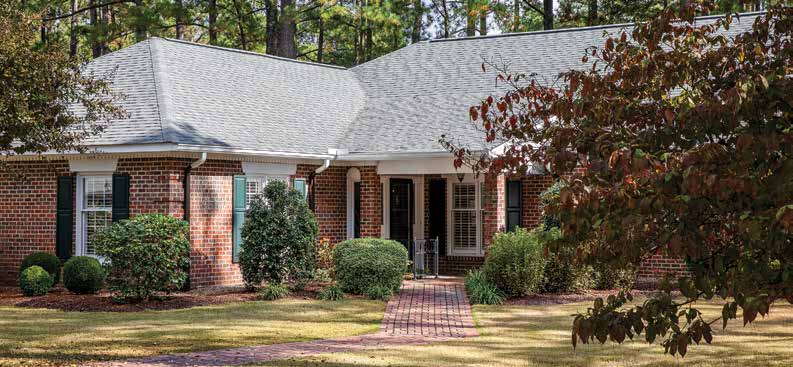
Residential downsizing for senior couples can be a challenge. Cherished possessions may be dispersed, gardens and neighbors left behind. Creating a rewarding life with curated furnishings, new fabrics and colors requires time, expertise, motivation and energy. That calls for a Cynthia Birdsall. “I ran the renewal. I was the architect, general contractor, interior designer,” says Cynthia of the Birdsalls’ move from Dunross, a 9,000 square foot, six bedroom, 10 bathroom, three-story castle with workshops and outbuildings built for Donald Ross in Knollwood, into a 4,500 square foot single-story two-bedroom 1970s “ranch” in an over-55 development. Finding that size house on one floor took two years.

The Birdsalls maintain an active social life. “We weren’t ready for assisted living. We still wanted a neighborhood,’’ says Cynthia. She hired the painter, the cabinetmakers and electrician. “The guys trusted me.” Bruce Birdsall’s health and mobility was an impetus for change. Cynthia’s renovation not only included friendly doorsills but space suitable for resident caregivers, if needed in the future for either of them. During the transition the couple moved into an apartment for two years. Furnishings that could not be used were stored.

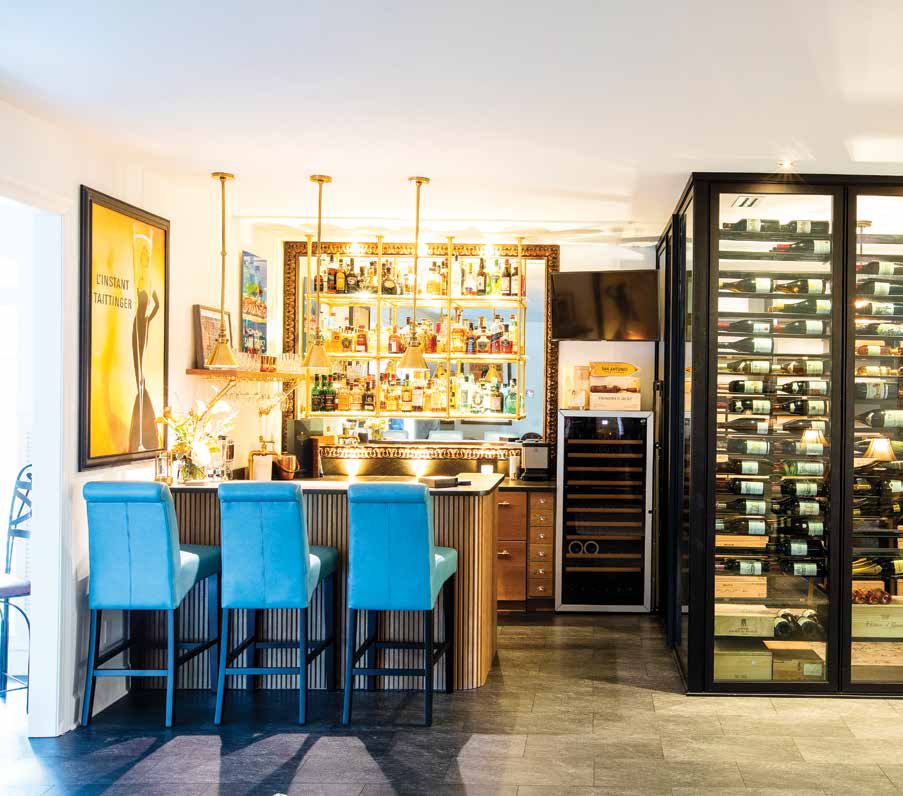
Two bathrooms were gutted. “We had to take out a wall to build a shower in one,” Cynthia says. While designing space for their new lifestyle, Cynthia did not ignore their enthusiasms. “I’m all about wine,” she says. Several temperature-regulated “wine rooms” store and display her collection. Bruce has a coffee station, stockpiles single malt Scotch and keeps a stable of vintage cars and motorbikes. The couple entertains, thus the bar with refrigeration, icemaker and tools to suit a professional bartender. Against an exterior wall they added an adorable, enclosed garden with a wrought iron gate and a variety of surfaces including grass, concrete, pebbles and water where two elderly miniature French bulldogs hang out, weather permitting.

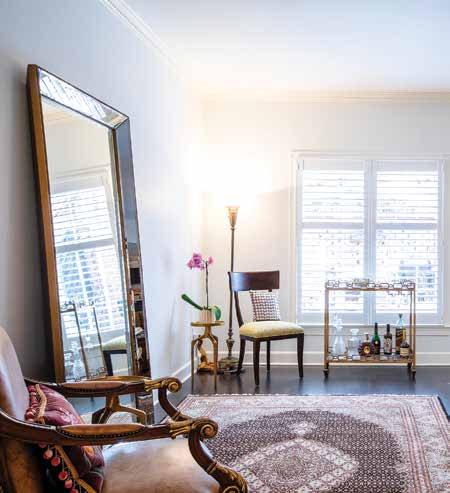
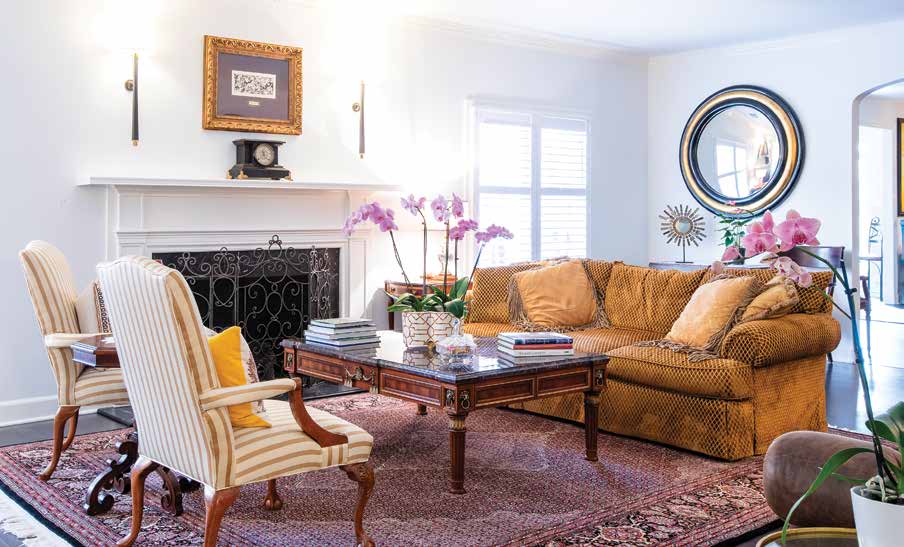
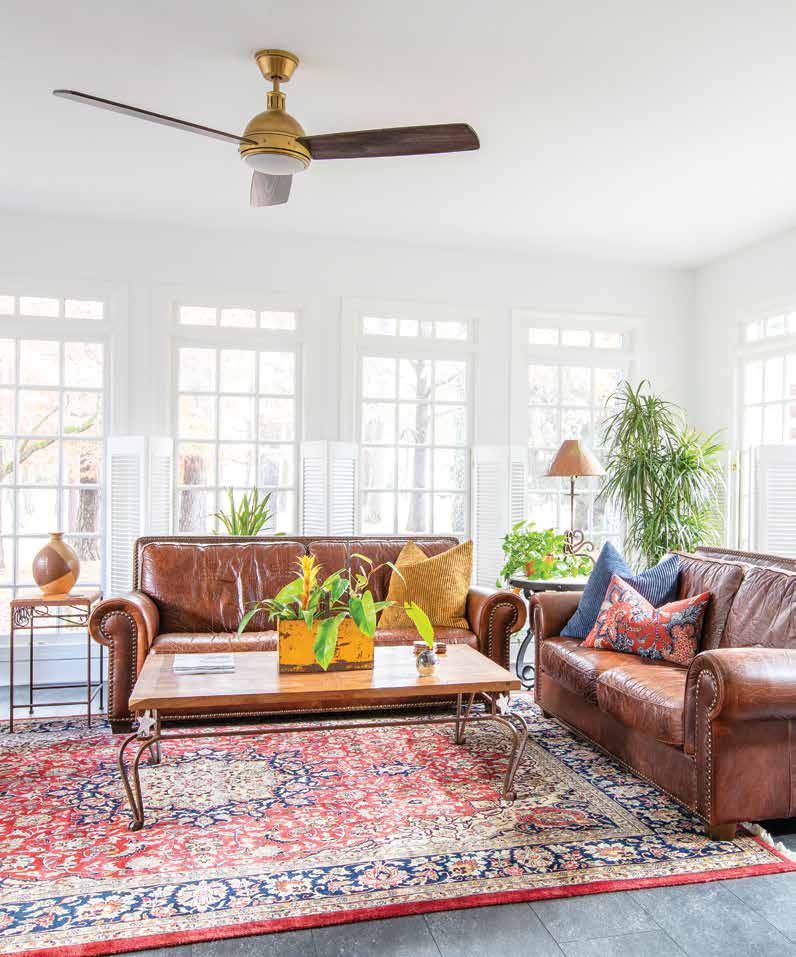
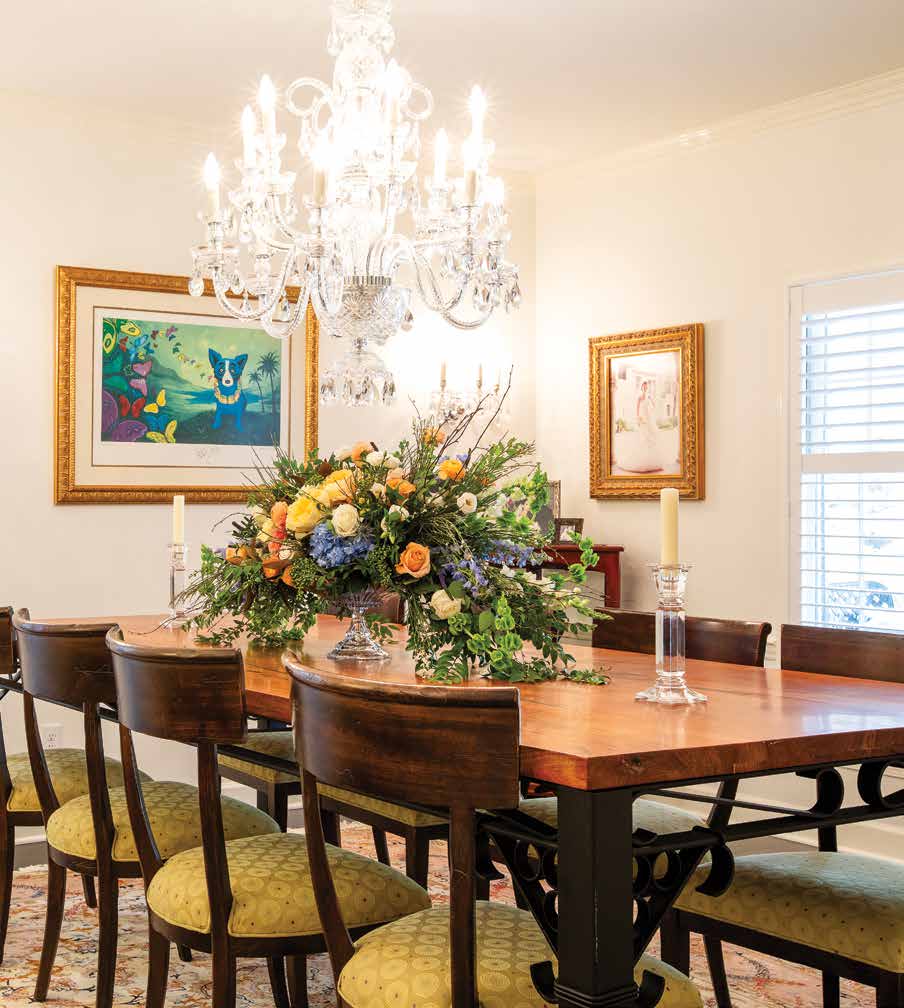
Frequent guests may remember leather-upholstered chairs and a stretch sofa that survived the move from Dunross. Cynthia is a seventh-generation Texan comfortable with fur, skins and leather, which appear throughout. In contrast, over the simple, 12-seat dining room table — made from a single mesquite tree — hangs an ornate, sparkling chandelier. More Paris than Dallas. She doesn’t assign a period or style to her furnishings. “It’s just what I’ve collected over many years because I love it.”

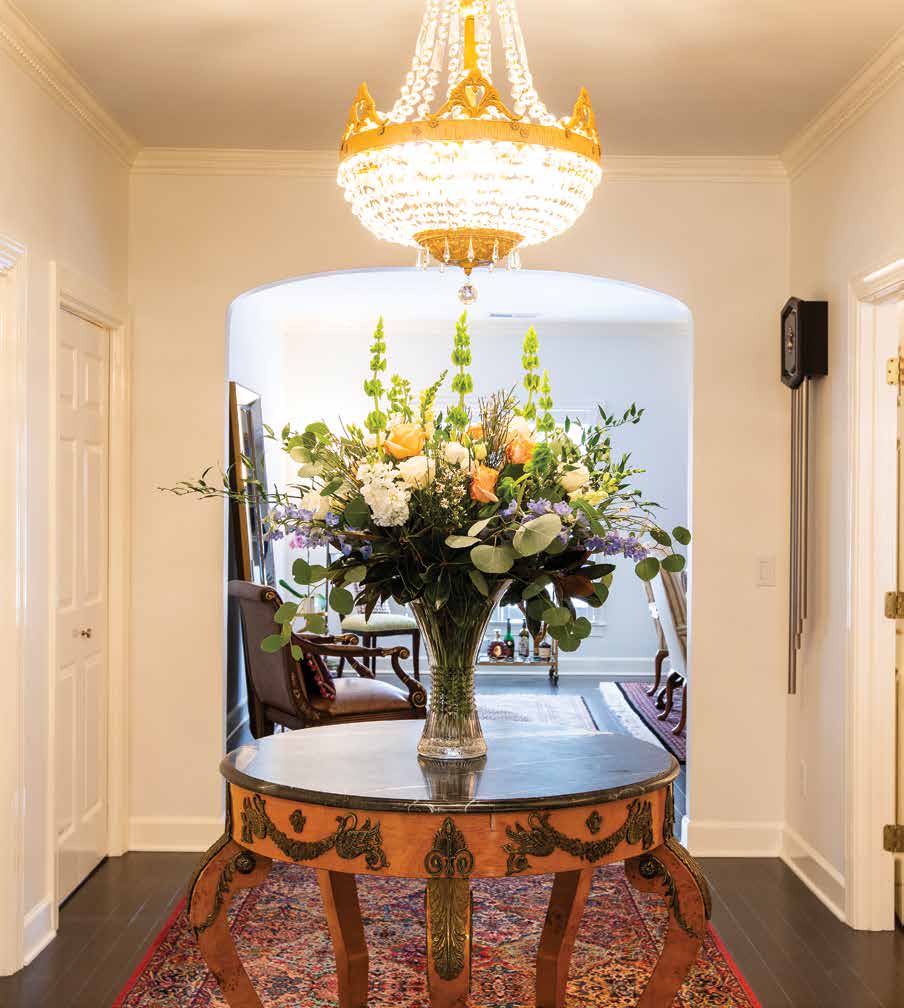
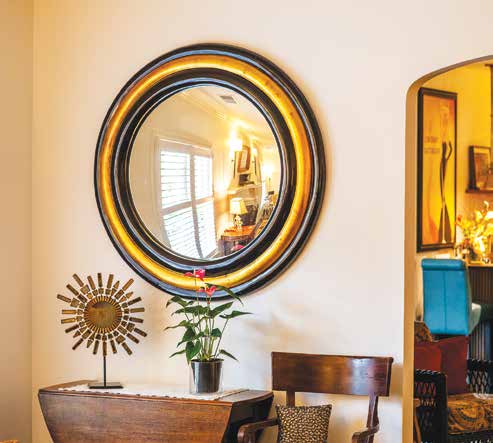
Cynthia chose an interesting black-coffee hue for the engineered flooring, an ideal background for light-colored area rugs. The sparsely furnished two-part living room and oversized Carolina room illustrate a concept originating in the foyer: space as a décor element. The foyer contains only a table. But what a table it is.

“We wanted our guests to have room to move around,’’ Cynthia explains.

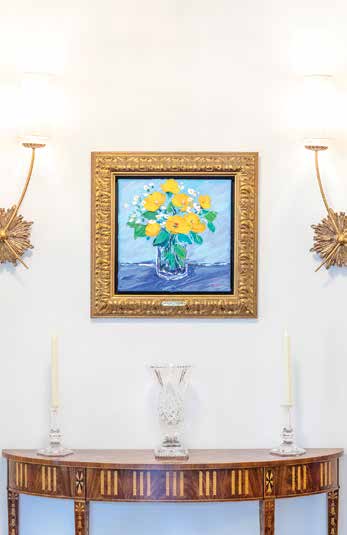
Walls are a soft vanilla throughout. Woodwork, including crown moldings, is finished in light-reflecting semi-gloss. Paintings hang singly rather than in groups, creating drama. Windows are shaded by white venetian blinds, never drapes.

This absence of “stuff” conveys calm, something uber-active Cynthia seeks and appreciates.

Exceptions exist, particularly in the kitchen, where Cynthia had some wall cabinets removed to create a pantry and transformed the island base into shelves for her cookbook collection. A quartz countertop splattered in bright blue adds pop. Meal prep becomes happy time.

“When we cook for the family (with children and grandchildren) we cook as a group, and dance around,” she says.

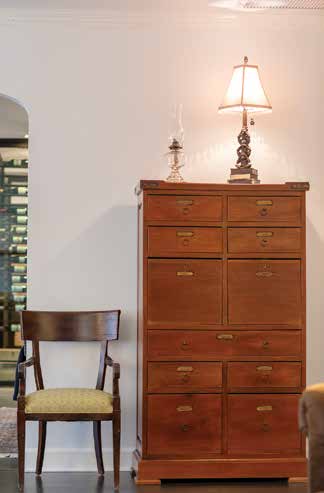
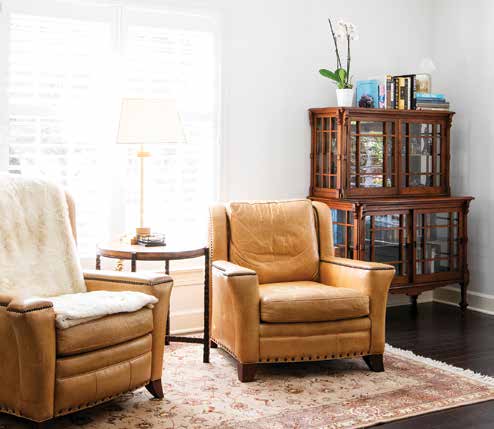
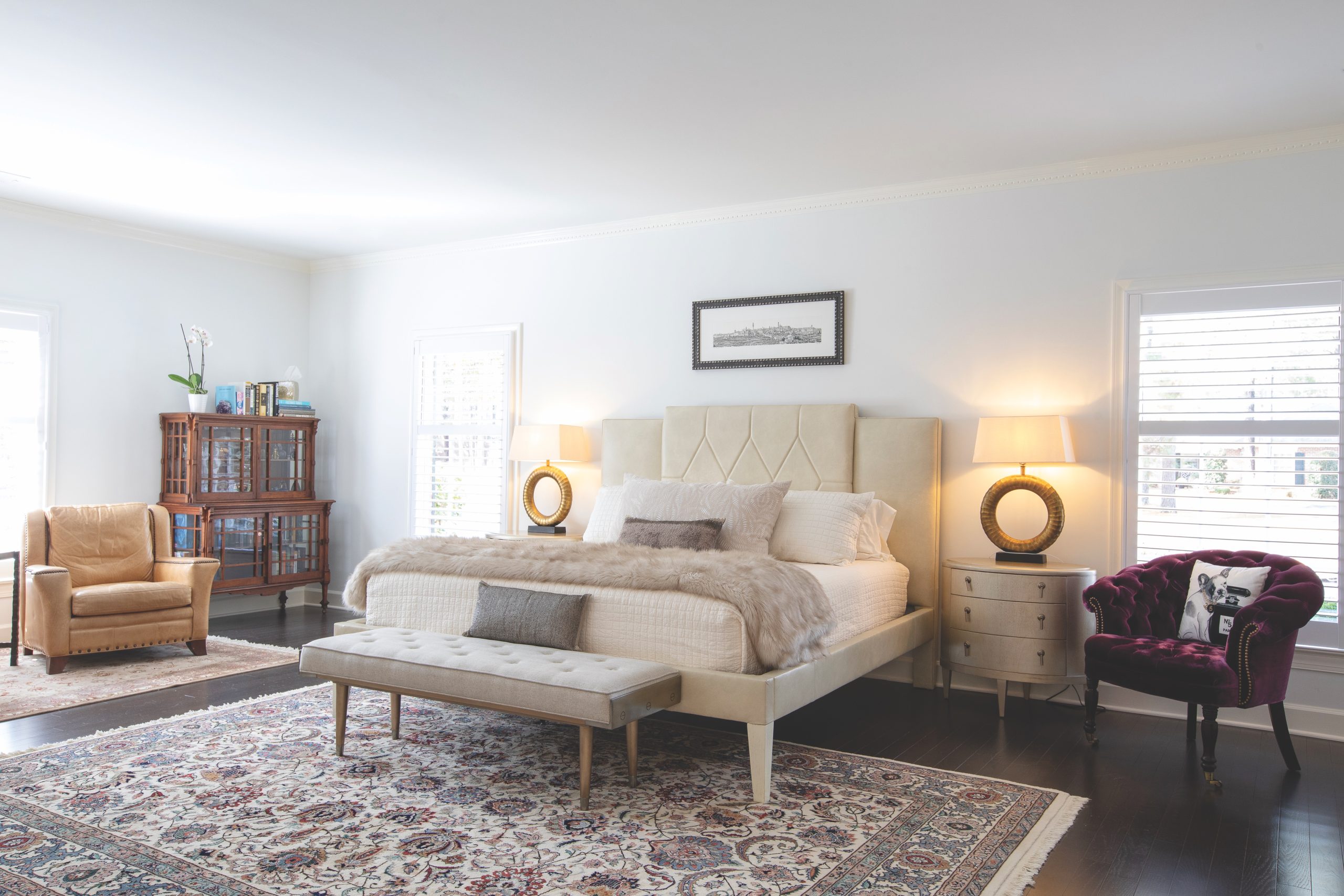
Perhaps the most interesting space is the master suite with seating area, an impressive 18-foot-by-28 foot corner room furnished in custom-made pieces designed by Cynthia. Their shapes suggest frill-free Scandinavian modes popular in the early 1950s. In contrast, the showstopper is a cabinet from Bruce’s family that contains Cynthia’s perfume bottle collection.

The AARP reports that downsizing can have both positive and negative effects on seniors. A survey found that 75 percent of Americans ages 50 and over have a strong preference for staying in their longtime family home. The Birdsalls have had other homes and lived at Dunross only a few years, lessening the emotional attachment to any one place. Their upscale downsize happened under favorable conditions with enviable results: familiar neighborhood, same friends, comfortable furnishings, safe environment. They even have worked out sleeping arrangements for visiting children and grandchildren since the house has only two bedrooms — option one: rent the Pinehurst church that is now a residence.

Downsizing wears many faces, from worry to acceptance and relief. This face, thank goodness, is smiling. “This was the right decision for us,” Cynthia says. 

Poem January 2026

POEM

The Other Side of the Mirror

“Let’s pretend the glass has got all soft like gauze . . .
And certainly the glass was beginning to melt away,
just like a bright silvery mist.”

    — Lewis Caroll, Through the Looking Glass


There’s always a reason I’d rather stay home,

as I brush my hair, gaze into my reflection, sit

before the dresser where I combed my curls

as a girl, forever getting ready for the life

that hadn’t arrived yet. Mirrors remained

unfazed, as I exchanged one image for another,

changed my hairstyles and hats, traced fingers

along a scar, abandoned myself for imperfections.

I have come close to escaping into another world,

always about to leave or about to live, my eyes

child-like, clear as glass, considering what time

it must be . . . to keep from disappearing

into my own unbreakable stare.

— Linda Annas Ferguson

The Winter Blues

THE WINTER BLUES

The Winter Blues

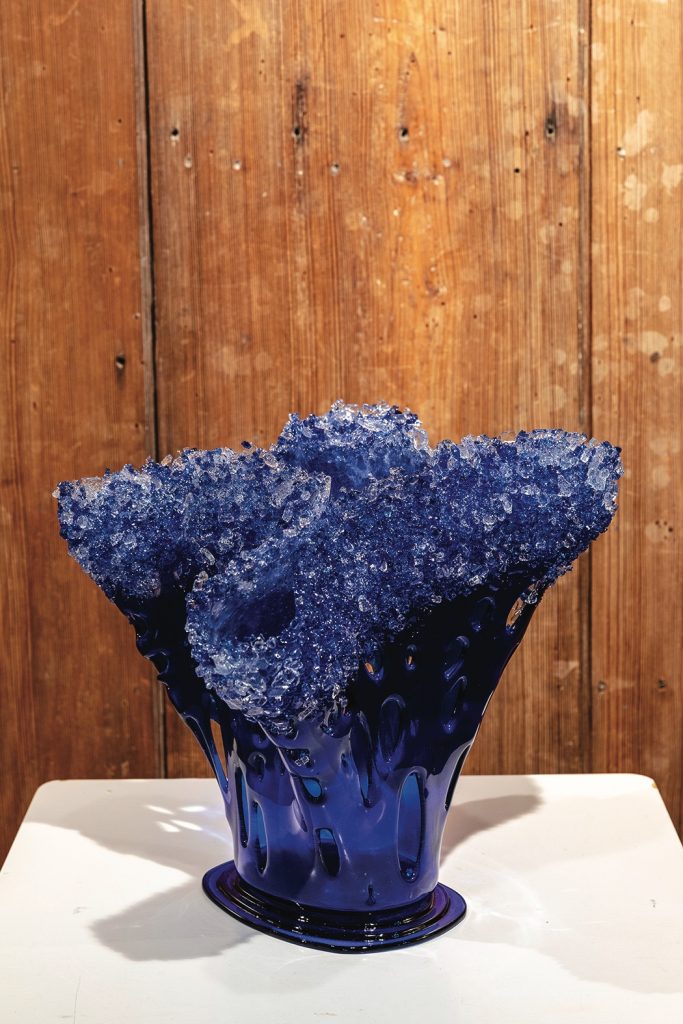
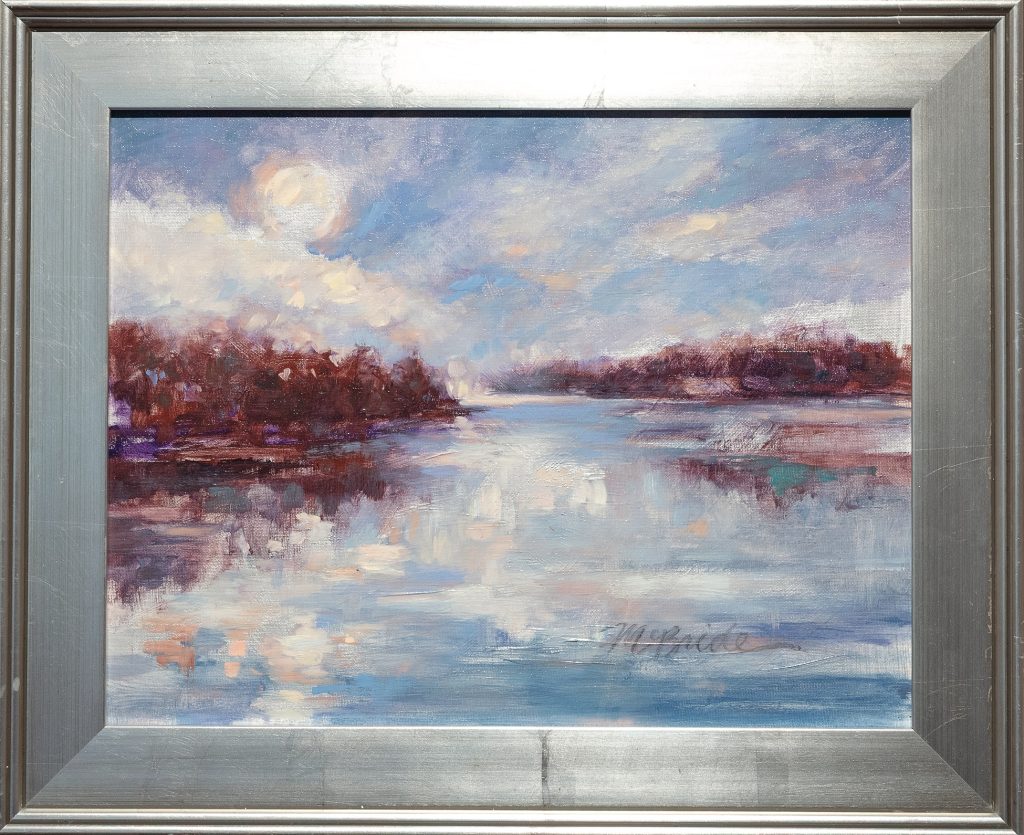
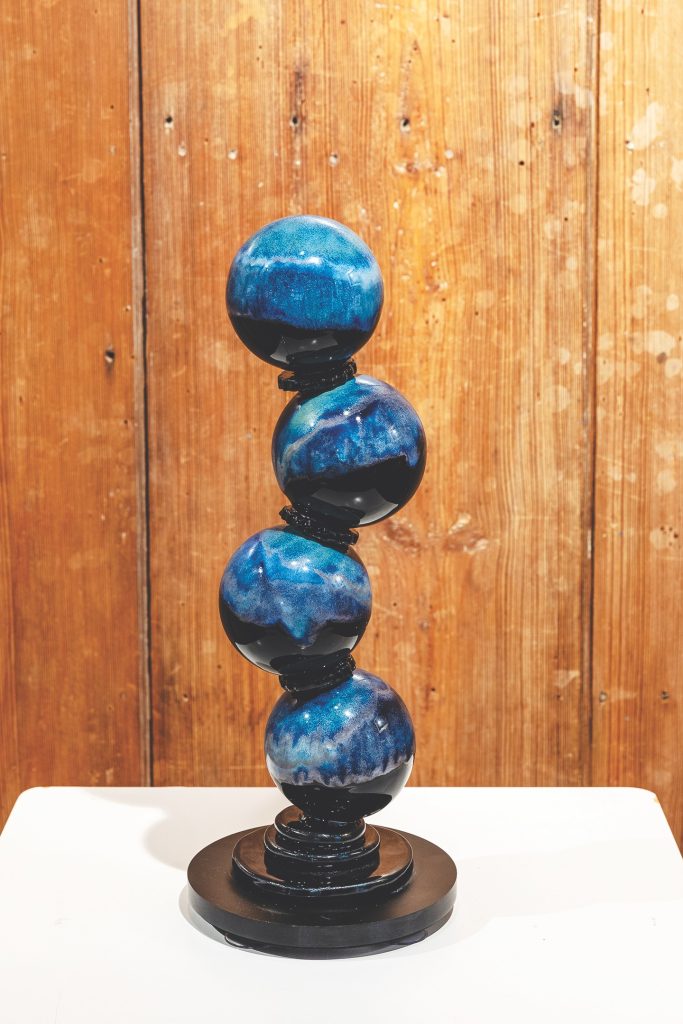
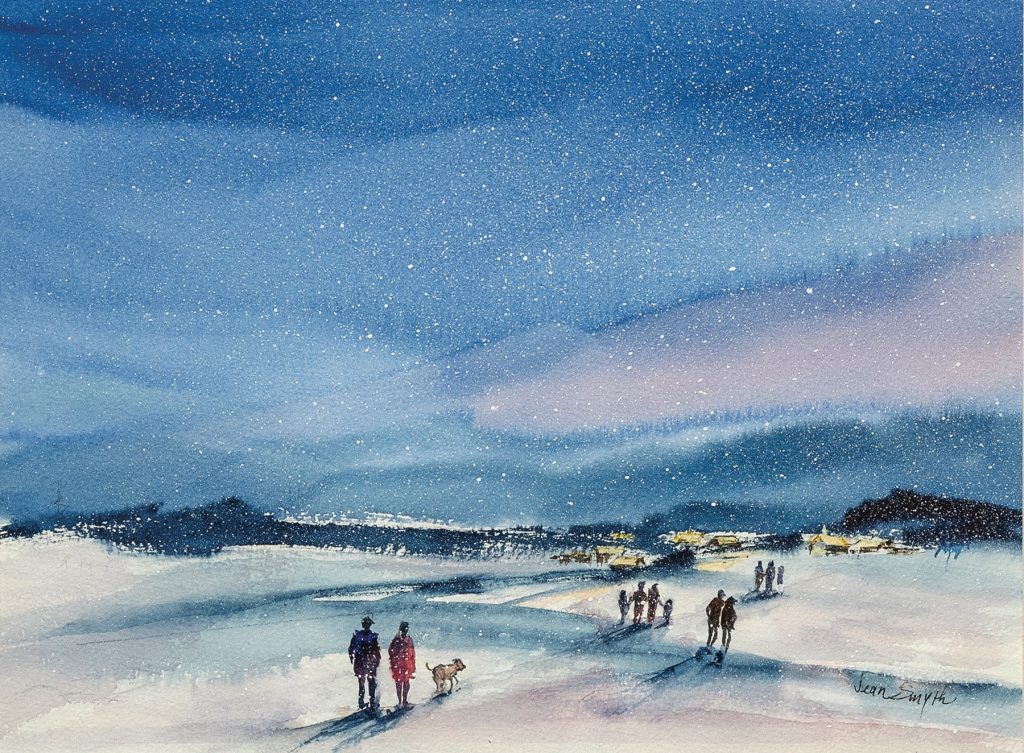
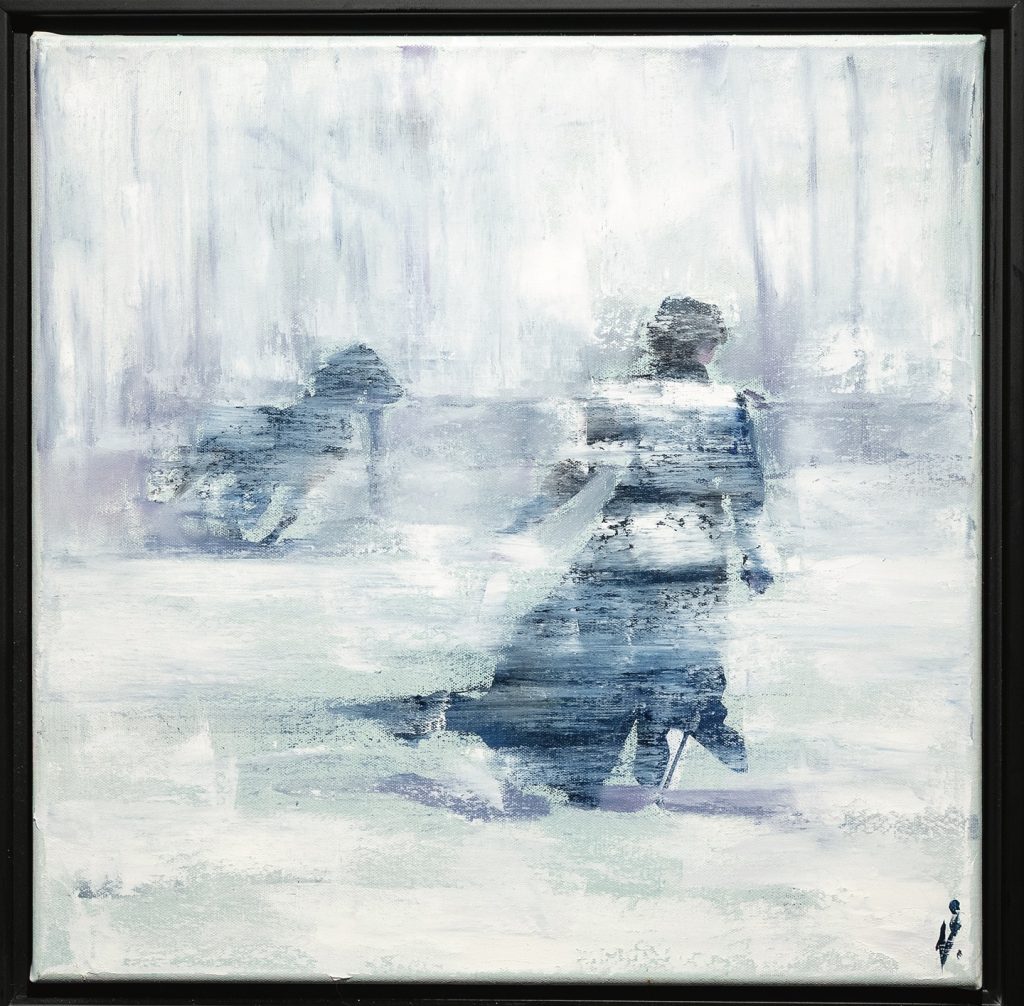
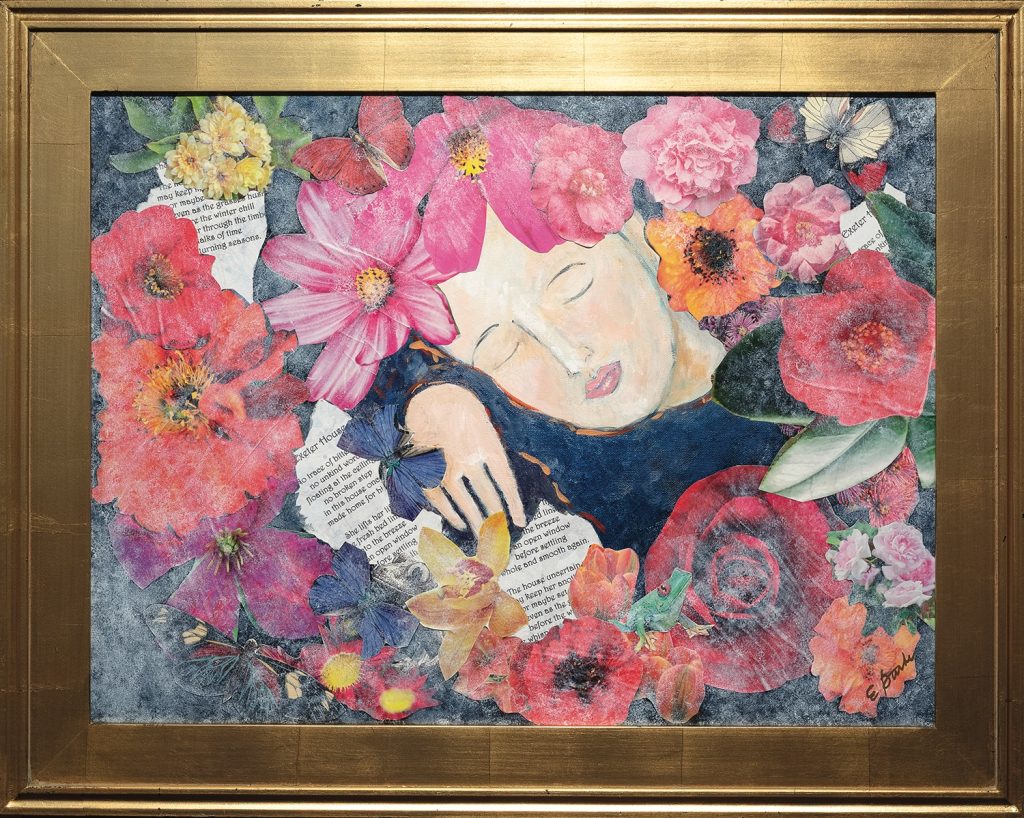
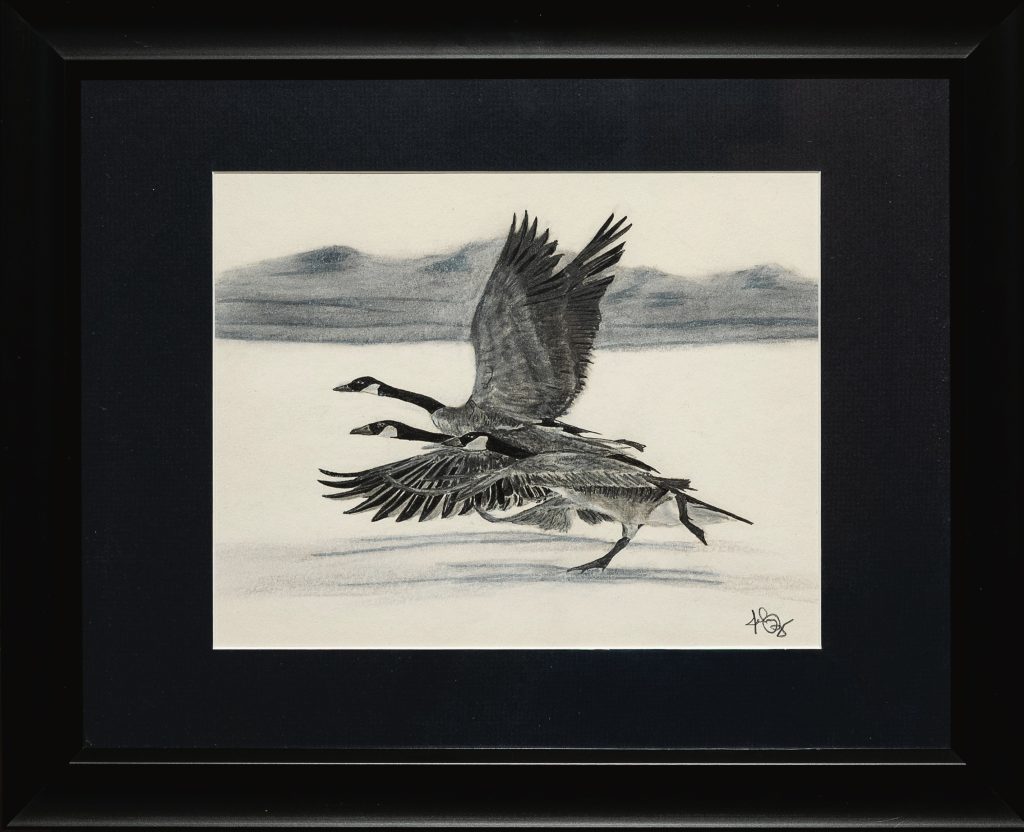
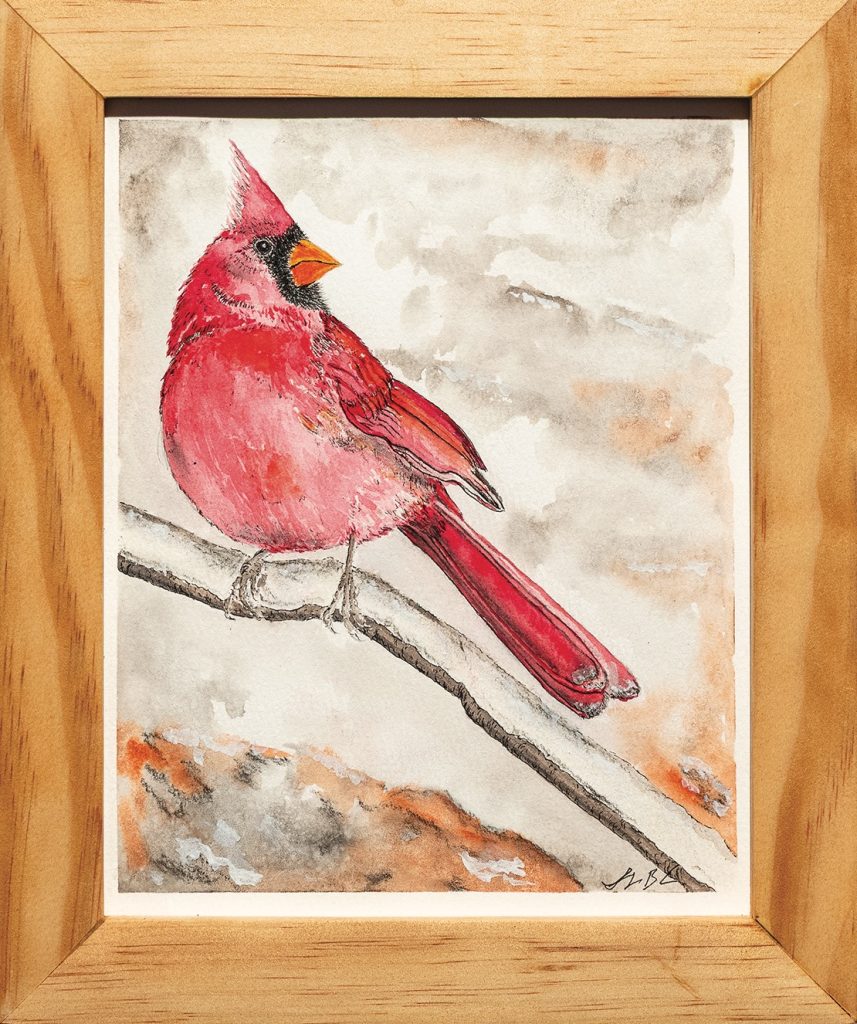
There’s no better time to have the blues than in winter, and the Arts Council of Moore County seconds that emotion with its exhibit “The Winter Blues.” The artworks in the juried show can be viewed at the Campbell House Galleries, 482 E. Connecticut Ave. in Southern Pines, beginning the 9th of January. In total 122 pieces were submitted by 74 artists in media ranging from paintings and glass to ceramics and fiber, and of that number, 95 works by 64 artists were accepted for the show. The art was judged by the ACMC Visual Arts Committee comprised of Kate Curtin, Katherine MacRae, Stuart Fulghum, Paula Montgomery and Nanette Zeller. The pieces will remain on display at the Campbell House until February 11.

We Could Dream This Night Away, Caitlin Gironda
Winter Branches, Leslie Bailey
Deep Blue Ice, Janet Borchardt
Silver Sky, Pat McBride
Northern Lights Totem, Laura Harris
Frosty Night, Jean Smyth
Out of the Blue, Nancy Crossett
The Horse Trainer, Vanessa Grebe
Snow Gums Ablaze, Samantha Stouffer
Icy Blues, Pam Griner
My Winter Dreams Were of The Summer Garden, Ellen Burke
Winter Birch, Jill Hunt
Winding Down, Alicia Crownover
Slovakia in Winter, Mariangela Rinaldi
Winter Calm, Bobbie Britt
Left Bank of Creek Feeding into the Potomac, Susan Beveridge
Waiting, Jordan Baker
Breakfast on Snow, Beth Roy
Winter Birches, Jude Winkley
Taking Flight, John Regan
Winter Cardinal, Shawn Bourdon
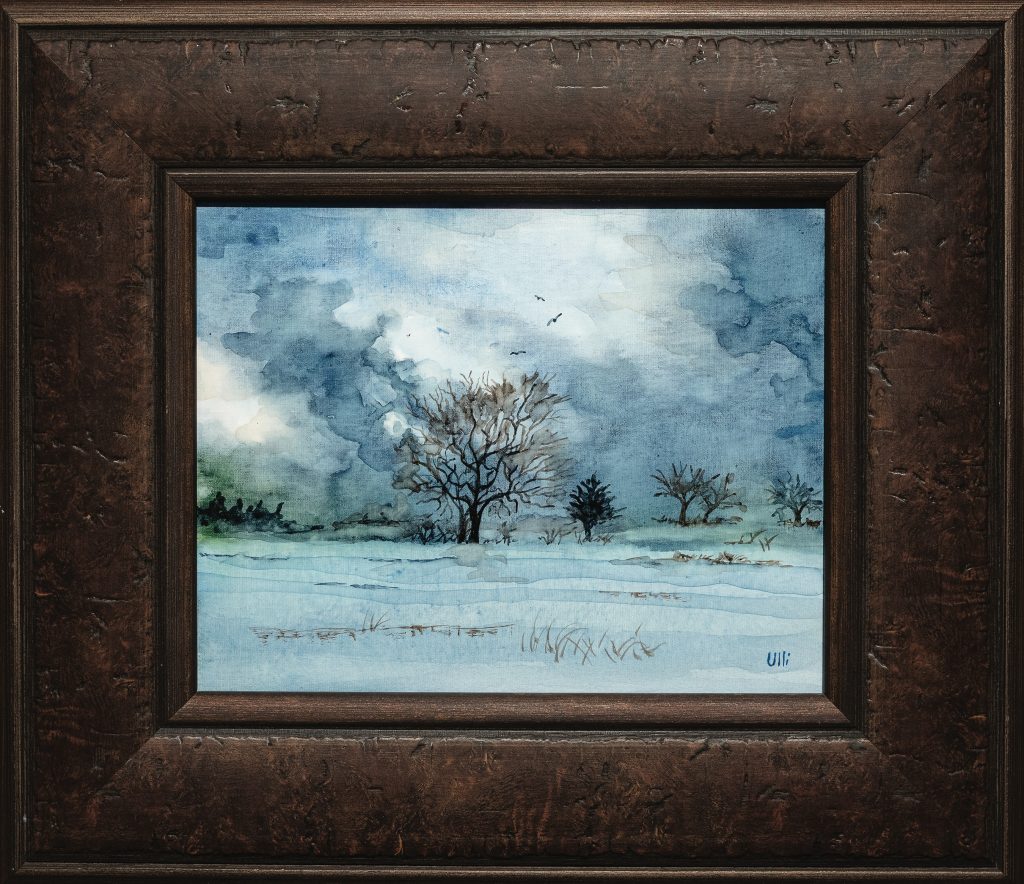
Stormy Weather, Ulli Misegades
Winter Dragon Fly, Dian Moore
Dashing Through the Snow, Susan DeYoung

The Art of Making Merry

THE ART OF MAKING MERRY

The Art of Making Merry

A special feel for Christmas

By Deborah Salomon

Photographs by John Gessner

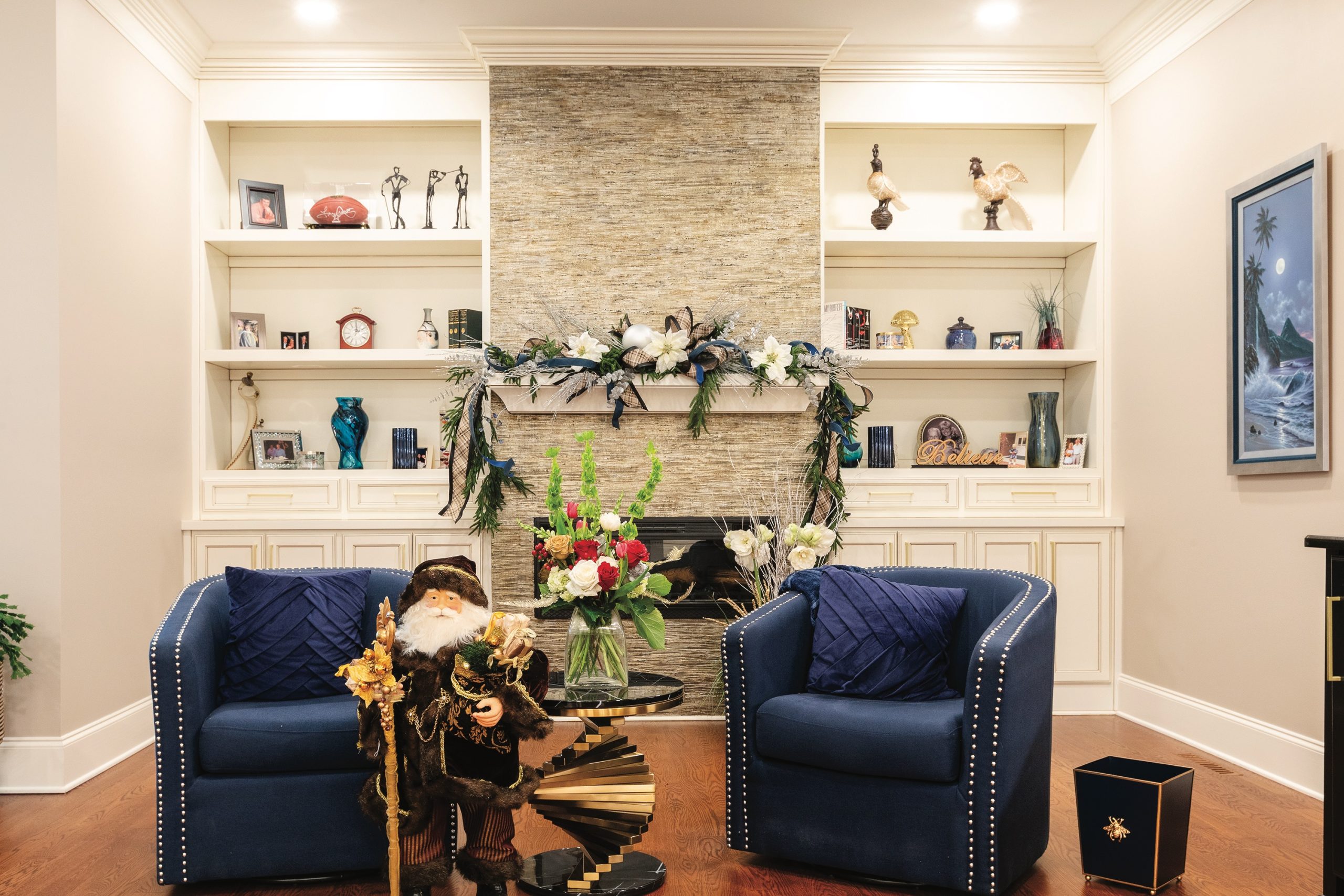
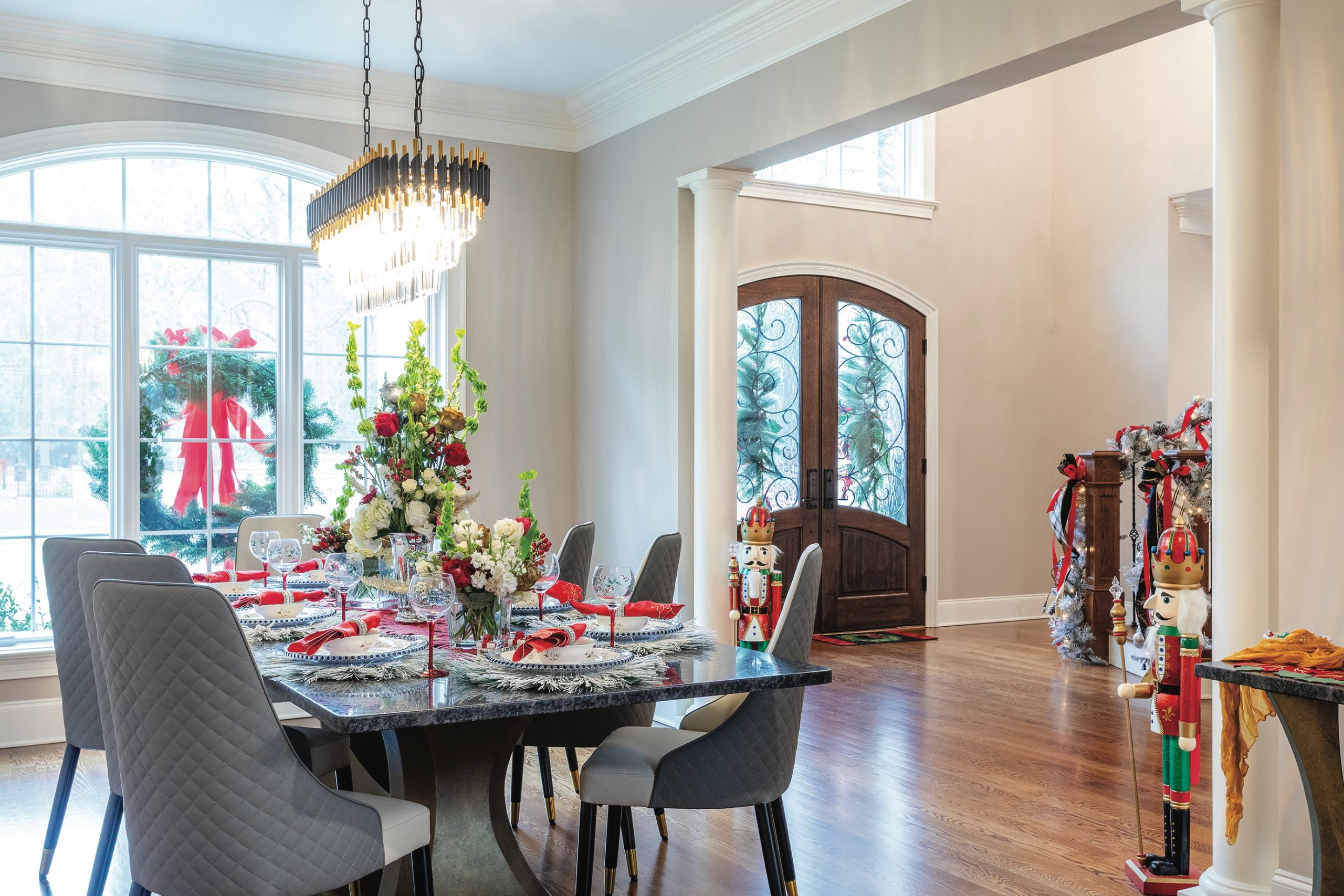
‘Tis said that on a crisp, clear December night the lights on Evon and Jerry Jordan’s showplace home are visible from the International Space Station — hyperbole until viewed with roof lines draped in tiny white lights and a lineup of trees across the façade.

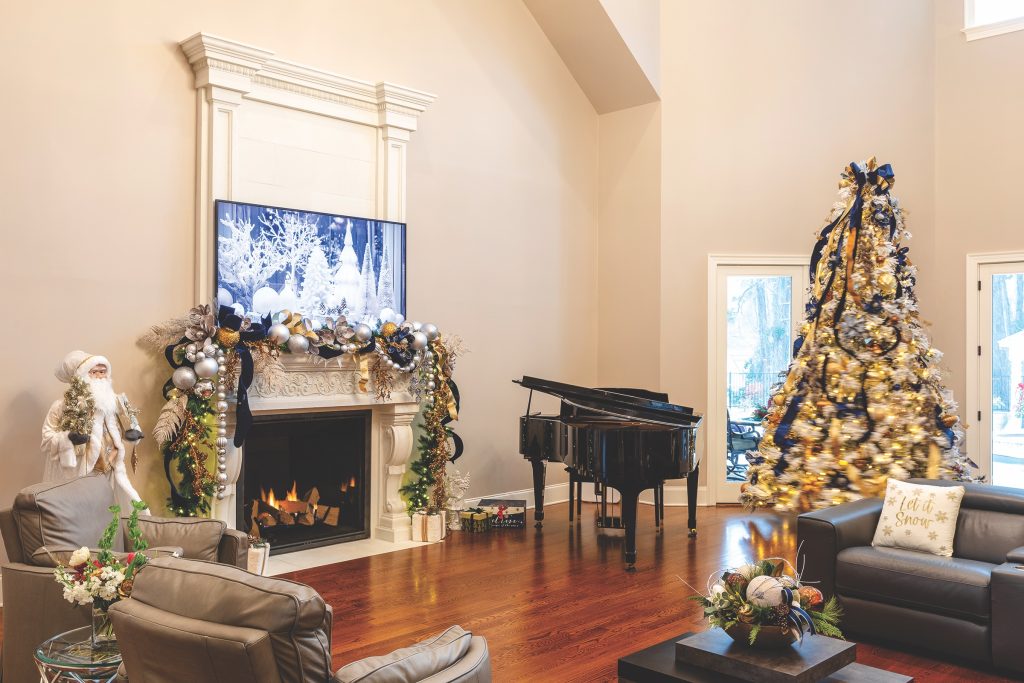
Christmas is a full-time job for the Jordans and their helpers. Half a dozen indoor trees plus those outside — the largest overlooking the pool — illustrate how these great-grandparents make an art of making merry.

The dozen trees or maybe more

Are decorated tip to floor 

With ornaments from every child

Rambunctious, meek and mild.

“Evon’s always had a special feel for Christmas,” Jerry says. “She’s decorated ever since I’ve known her.”

Such a show demands an audience: “I’m one of eight kids,” Evon says. That adds up to more cousins, in-laws, nieces, nephews than a five-legged dog has toes. Forty, to be exact, who visit regularly.

Some tree themes and colors change from year to year, but the Jordans aren’t into silver and royal blue Picasso-esque ornaments.

Holiday greenery

Adds to the scenery

But the dominant color

Just has to be red,

Including the coverlet spread on a bed.

The 10-foot tree rising beside a graceful hallway staircase illustrates another Christmas décor principle: Too much is never enough.

Baubles and bangles

Ribbons in bows,

Tinsel, poinsettias

Rows upon rows . . .

At parties guests usually gravitate to the kitchen, right? The Jordans’ has a marble-topped island the size of Manhattan.

Their kitchen is white as a Christmas Eve snow,

Here’s where for cookies Santa surely will go.

Except last year brought a buffet surprise —

Exotic yummies from the land of the Thais.

Beauty, love — all of the above — and a creche complete the Jordans’ holiday scene because, as Jerry says, “That’s what Christmas is all about.”

Cup o’ Joy

CUP O' JOY

Cup o' Joy

Served hot, with a side of sweet

By Jenna Biter   •   Photographs by Tim Sayer

Welcome Old Man Winter’s cold, dark days and nights the delicious way by sipping hot drinks and nibbling tasty treats in the great indoors. We asked eight local coffee and bake shops to warm our souls with piping-hot drinks and seasonal sweets from their winter menus. They delivered like Santa on Christmas morning.

Agora Bakery + Café

15 Chinquapin Road, Pinehurst

Red and green. Ribbons and wrapping. Tinsel and tree lights. This holiday season, Agora is celebrating with another classically Christmas pairing: booze and eggnog. Co-owner Ginny Tran baked up a bourbon hot chocolate twist on the café’s quintessential, two-bite-size macaron. Front of house lead, Ali Yap, concocted a silky-smooth eggnog latte to wash the crunchy confection down.

Buggy Town Coffee

201 S. McNeill Street, Carthage

Just like that, owners Darryl and Meg Russell are celebrating a decade of Buggy Town Coffee. It’s another December, and the café’s festive favorites have reappeared on its winter menu. Enjoy a practically plate-size molasses ginger cookie finished with crystallized ginger bits. For optimal levels of cheer, dunk chunks into a steaming hot mug of velvety eggnog latte. Dip, sip, repeat.

Crossroads Coffee Co.

133 Main Street, Vass

Sing your way to Crossroads for a Christmas carol in a cup. Owners Kasi Caddell and Mollie Jolly (also celebrating 10 years in business) are striking the harp and joining the chorus with the return of their beloved Fala Latte, a holiday harmony of gingerbread and maple. Warning: Consumption could result in decking the halls and spontaneous caroling. Between singing and sips, enjoy the nostalgic taste of a Little Debbie Christmas Tree Cake reimagined as a cake pop.

Amor Ciego Coffee Co.

175 W. Pennsylvania Ave., Southern Pines

Carolina Holguin Leal likes to bring flavors from her native Colombia to her customers at Amor Ciego. This winter, she’s baking milhojas, Spanish for “a thousand leaves” and aptly named for the dessert’s layers and layers of puff pastry. Leal’s take on the Latin American favorite with French roots features a pastry cream filling, a smooth and glossy smear of caramel-like arequipe and a coconut flake garnish. She’s pairing the dessert with a naughty-and-nice returner, the spiced bourbon latte.

DeLucia’s Bake Shop

4245 Seven Lakes Plaza B, West End

A Yule log was a select piece of timber burned in the hearth on the winter solstice, the longest night of the year. With its scratch-made chocolate sponge cake, mascarpone whipped cream filling, chocolate ganache topping and sugared rosemary and cranberry garnishes, DeLucia’s dessert-ified Yule logs can keep your sweet tooth satisfied all season long. Slice off a sliver and enjoy it with a chestnut praline latte.

The Fox Brew Coffeehouse

2145 Foxfire Road, Suite 11, Foxfire Village

The Fox Brew is celebrating its first Christmas in business. Owner and operator Denna Schreiner is marking the occasion with a whole lot of gingerbread, minus the cumbersome house-making. Cut into a hot and fresh gingerbread waffle drizzled with a cream cheese glaze. Continue the festive fun with a Gingerbread Man latte, featuring notes of hazelnut, vanilla and of course, gingerbread.

Maisonette

290 S.W. Broad Street, Southern Pines

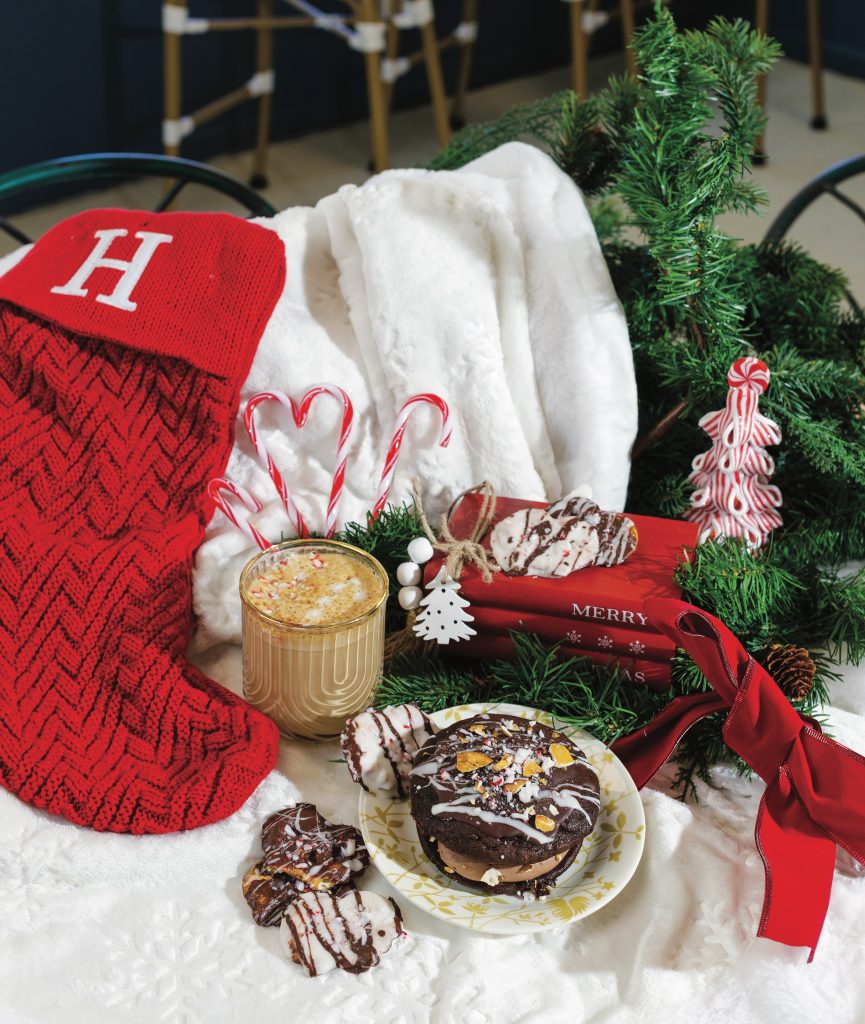
Maisonette is making your holiday season merry and minty. Sip on a Salty Snowflake Latte, a back-by-popular-demand oat milk drink inspired by those classic white chocolate-covered peppermint pretzels. To go with the drink, head chef Monica Bryan created a Whoopie Pie from cakey chocolate cookies and a white chocolate and peppermint buttercream filling. A little salty, a little sweet, a lot of yum.

Pine Scone Cafe

116 Brucewood Road, Southern Pines

905 Linden Road, Pinehurst

At Pine Scone, the Grinch steals more than just Christmas; he runs away with the month of December. Owner, operator and recipe creator Rae Anne Kinney and her coffee-slinging crew are back serving No. 1 seasonal best-seller, the Grinch scone, a triangle of crumbly baked goodness, featuring crème de menthe, white chocolate and candy canes. Double down on mint and pair it with a peppermint mocha (white or dark chocolate, take your pick) with crushed candy canes sprinkled on top.

Poem December 2025

POEM

A Christmas Night

It was a cold night

And there was ice on the road,

Our car started to slide

As it moved up the small hill,

And the headlights caught the old man

In a thin jacket

Pushing a cart filled with sticks.

There were some bundles and a package

Piled on top, and the old man

Grinned and waved at us

As he pushed the cart

Into the yard of the little house

Where a single light shone.

The tires gripped the road

And we drove on into the darkness,

But suddenly it was warm.

Season of Giving

SEASON OF GIVING

Season of Giving

By Lara Sierra   •   Photographs by John Gessner

The spirit of giving, celebrating all the good in this world, is never felt more profoundly than during the holidays. We’re fortunate to have a plethora of charitable organizations — far too numerous to mention here — that embody this spirit every month, every day, of the year. They thrive because of the dedicated and willing volunteers who selflessly share their compassion and talents.

Each of the volunteers featured here was quick to insist that they were just one of many who donate precious time to help others. To us, they represent a veritable legion of the kindhearted. They spoke about their pride, not in awards or accolades, but in the work itself and the satisfaction and enjoyment they gain from it — the person who says a quiet thank you; a beautiful, thriving garden; the look on an animal’s face going home with its forever family; the bond fostered between a human and a horse. Without fail, they talked about the relationships they built. Their service delivers a simple message: A life of giving is the best present of all.

Habitat for Humanity
Sandra Thomas

When Thomas was no longer working full time, “I just couldn’t sit around at home,” she says. She saw an advertisement for a volunteer orientation at Habitat for Humanity of the NC Sandhills. Ten years and 5,000 hours later, she’s going to have a street named after her in a development in Aberdeen. “Habitat’s goal is to get people into affordable housing,” she says. The pathway to homeownership often involves sweat equity, contributing to building someone else’s home. Thomas works full shifts three times a week — and any other time she can get there. “I have so much gratitude to the people who donate goods and the people who buy, which is how we raise money. Habitat is up there with my commitment to church and my commitment to God,” she says.

On days when she’s not volunteering, Thomas likes to visit the latest Habitat project. “The new development has eight to 10 houses with a circular drive,” she says with obvious pride. “The camaraderie with the people around here is special. Building houses isn’t getting any cheaper. We try to keep our prices reasonable, but it’s hard. My hope is that people can always be kind, always be thoughtful.”

Sunrise Theater
Leigh Bozich

When Bozich inherited a house and moved to Moore County from Florida, she was a stranger in a strange land. A big movie fan, that feeling didn’t last long once she became involved with the Sunrise Theater. “It gave me access to the community,” Bozich says. “I’ll work concessions, in the box office or as an usher. You get to see everyone in town. Really, it gave me a connection, which is kind of what I needed. And I got to see movies that I wouldn’t normally be able to see at the big movie theaters.”

Another coveted role is sitting on the film committee. “Working out what films people want to see isn’t always easy. We bring diverse films and diverse programming that sometimes are harder to find. I personally tend to seek out socially conscious things. Sometimes you just kind of throw it out there and see if they come.” Leigh has an obvious passion for her subject matter, but what is it that keeps her coming back? “I get that connection with our community,” she says. “And I get to share my love of film with others.”

Prancing Horse Center for Therapeutic Horsemanship
Barbara Brazer

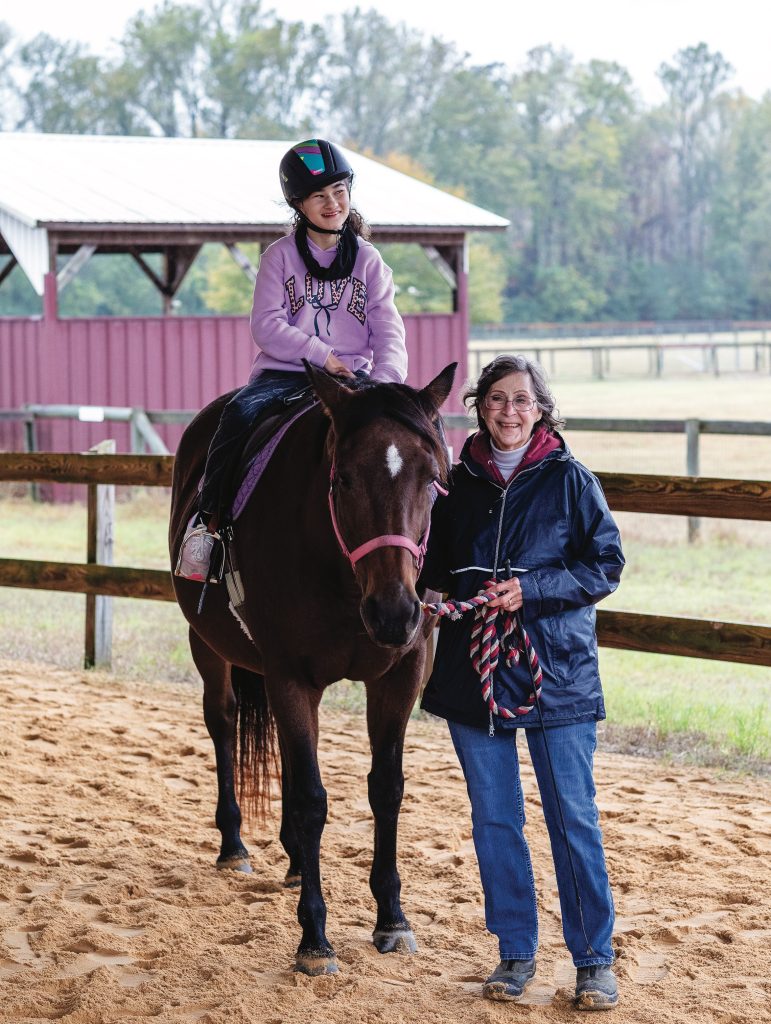
The Prancing Horse Center for Therapeutic Horsemanship is a refuge of calm amid its 15 horses, two goats, a cat, and a part-time dog. “We are a therapeutic horse facility,” says Brazer. “Horses have a very good intuitive aura about them, and they can bond to people with all kinds of issues — physical, autistic, mental, cognitive, stress-related and so on. But we’ve expanded a lot from just horse riding lessons. We wanted to do more. For example, we had a group of all wheelchair users. They came out and brushed the horses, fed them treats and just spent time bonding with them.”

Prancing Horse now includes a military veteran’s program. “The veterans don’t necessarily ride but do a lot of that groundwork, brushing and so on, just generally interacting and getting that emotional regulation that helps with anxiety and PTSD. Some people immediately bond with a horse, and it’s lovely to watch. Just being around the animals gives people benefits.” As for the goats? “Well, really, they just provide comic relief,” Brazer says.

She began volunteering at Prancing Horse shortly after moving to Moore County. “It brings people so much joy, especially the kids,” she says. “Some start off absolutely terrified, and usually by the end they don’t want to get off the horse. Personally, seeing their faces light up is what gives me the benefit.”

Moore Free & Charitable Clinic
Shirley Baldwin

Baldwin, a retired nurse, has been volunteering at the Moore Free Clinic for 17 of the 20 years of its existence. “I started as a triage nurse and now I do education for diabetes, high blood pressure, nutrition, that sort of thing,” she says. “The reality is there are a lot of individuals who cannot afford their health care. Because really, if you had to choose between health insurance or putting food on the table, what would you do? We give fantastic quality primary care for people who can’t afford to see a doctor otherwise.”

Supported entirely by donations and volunteers, the clinic offers a wide range of services. “This, in essence, is a doctor’s office,” says Baldwin. “We now have a dental clinic. A gynecologist comes in and volunteers. We have an optometrist and someone who’ll be coming in to do physical therapy. We have medication in our pharmacy. It runs the whole gamut.”

It’s more than the impressive range of care that drew her to the clinic. “I enjoy this. I don’t plan on retiring until they kick me out because I get the satisfaction of helping those who can’t help themselves,” says Baldwin. “A former patient just came in and said, ‘I’ve gotten off track and I need to see you.’ Or someone might just say, ‘Thank you for listening.’ And that’s a million-dollar payment to me.”

Weymouth Center for the Arts & Humanities Dirt Gardeners
Lucy Meldrum

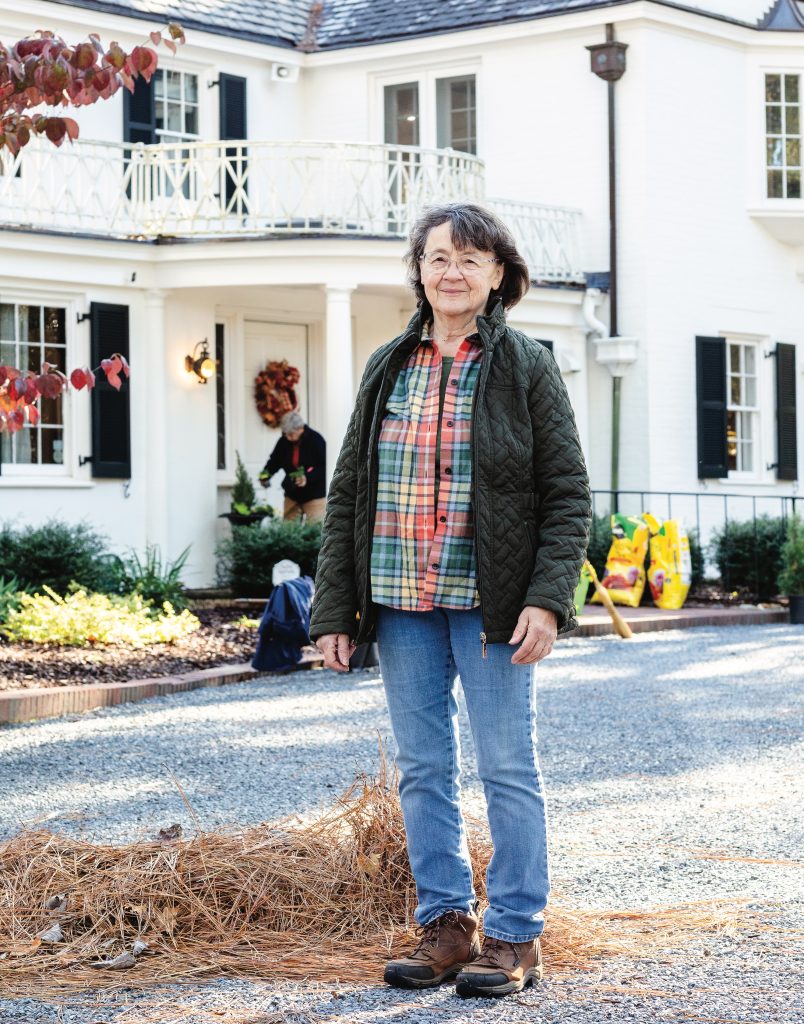
“I was a vegetable gardener in New Jersey, but it’s hard to grow vegetables down here,” says Meldrum. “Everyone thinks they know gardening until they move here!” She’s gotten her gardening fix helping to maintain the grounds surrounding the Boyd House, the elegant home of the Weymouth Center for the Arts & Humanities. The work of keeping the estate looking as cared for as it did in the days of Katharine and James Boyd falls to the group known as the Dirt Gardeners. “I’ve been volunteering for around 13 years,” says Meldrum. “The work we do is your usual garden maintenance. We clean up the front, put in plants and do a lot of weeding.” They also propagate plants for the annual plant sale fundraiser.

Spending so much time with the land, Meldrum notices the intricate changes that increasingly affect how things grow. “Everything is growing late this year,” she says. Projects and plantings go hand in hand. She points to a pathway the Dirt Gardeners are putting in for children. “There’s always something that people can do even if they don’t know much about gardening,” she says. “Soon enough everyone enjoys working with the plants — seeing them grow, making a place thrive.”

Sandhills/ Moore Coalition for Human Care
Donna Blasingame

“This place has been a lifeline for me,” Blasingame says over the hubbub of trucks, volunteers and customers queued up outside the Coalition for Human Care. Customers are asking if the doors can be opened early; tables are being moved to make way for suitcases; trucks are waiting to park and unload. All the while, Blasingame carefully weaves her way around the site, answering questions, repricing items and checking in on her fellow volunteers. “We are affiliated with 70 churches, so we are always busy, and every penny stays in Moore County,” she says.

The Coalition has four stores, each selling different wares, from home goods to electricals, budget buys to a slightly more expensive boutique. They even sell wedding dresses. One store is called Miss Hallie’s House, named for the woman who donated her house to the Coalition in her will. “We are very blessed with donations,” Blasingame says, “but we still need people to support us because in order for the coalition to work we need volunteers. We are so busy.”

Blasingame’s husband passed away two years ago. “I’m among very supportive people. That’s why this place has been such a lifeline,” she says. In a back room of one of the stores, volunteers celebrate a birthday with doughnuts and friendly chitchat. Before long, they are all up, sorting, pricing, moving and doing their bit.

Moore Humane Society
Karen Kocher

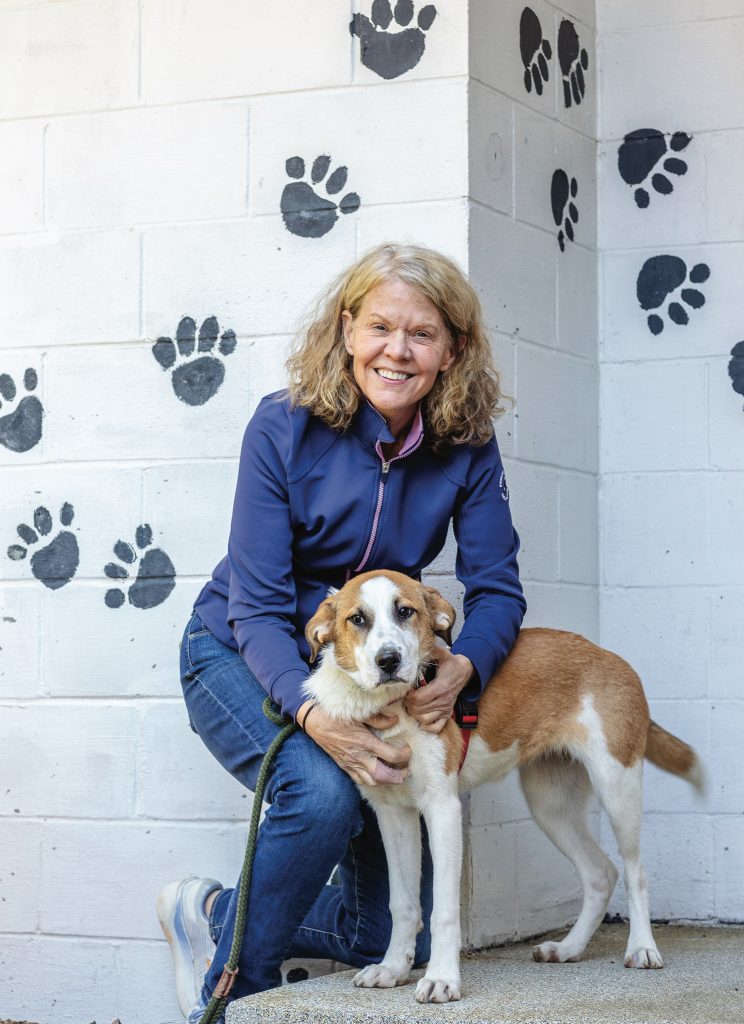
“I started volunteering after I was at a friend’s house and a farmer brought in a crate of six puppies,” Kocher says. “We took them over to the shelter and I realized that’s just a day in the life of a volunteer — in comes someone who needs help with the animals, and in come people who adopt them. I thought, what a joyous place, so I signed up straight away.”

The Moore Humane Society, a no-kill shelter, quickly became the place where she invested her time. That connection has lasted nine years. “What amazes me about volunteering there is discovering how many people truly love animals enough to give up their own time to care for them,” she says. “There are people who’ve donated hundreds and hundreds of hours. To see the love that these people have for animals that are not their own is special. So I’ve found my people, the people who really feel that every animal deserves an awesome life. I’m so incredibly grateful to be able to see the little look on the face of an animal when they get the leash put on to go to their new home. Seeing the delight of the animals and their owners.”

And what does the society need from the community? “Everything we get is from donations, and every little bit counts. So if people feel compelled to donate funding or unused food, beds, leads and so on, they can drop it off. And of course, we also need volunteers. We could always use the help.”

Sam

SAM

Sam

A kid’s Christmas with an all-time great

By Bill Case

I was 17 and in my senior year at Hudson High School, in the Ohio town of the same name, when I was informed by my parents, Bea and Weldon Case, that we would be spending the 1965 holiday season in Boca Raton, Florida, where they had recently bought an oceanside condominium. I harbored mixed feelings about leaving my hometown during Christmas break — I would miss hanging out with my friends and, for me, the snow blanketing northeastern Ohio reflected the spirit of the holidays better than palm trees.

But there was an undeniable plus to a Christmas vacation in Florida. My folks were members at the Boca Raton Hotel & Club and they assured me I could play golf there. I loved golf and had developed a decent game, sporadically breaking 80; good enough to start on Hudson’s golf team the previous spring. With the ’66 season fast approaching, a few rounds in the sun would give my game a boost.

I started playing golf when I was 8, mostly with my mother, who demonstrated considerable patience with my beginner’s futility. Improvement was agonizingly slow. When I was 10, I finally broke 60 for nine holes, carding a 59. Prior to this personal breakthrough, the legendary Sam Snead had posted a 59 of his own at the age of 46 in the Sam Snead Festival at The Greenbrier where The Slammer served as head professional. As the first sub-60 round shot in a professional event, Snead’s achievement had caused a big buzz in golf circles. Though my score was for only nine holes, our respective 59s created a sort of bond between Sam and me, if only in my imagination.

As a result, Snead became one of my favorites. Mesmerized by the rhythm of his swing, I sought him out in Ohio tournaments like Akron’s American Golf Classic and the Cleveland Open. The year before our Boca vacation, I followed Sam’s group at a practice round during the Thunderbird Classic in Rye, New York. Playing with the seven-time major champion were three young pros I’d never heard of. I knew from reading Snead’s autobiography, The Education of a Golfer, that he was more than happy to take on all comers provided there was money on the line and the wagers to his liking. The chapter titled “Hawks, Vultures, and Pigeons: Gambling Golf” revealed his betting tips. The grousing I overheard at the Thunderbird from his playing partners (i.e., pigeons) confirmed that Sam, per usual, was cleaning up.

On the eve of my first round of golf on our Florida vacation Dad said to me, “There’s a good chance you’ll see Sam Snead tomorrow. You know, he’s Boca Raton’s pro during the winter.” The prospect of encountering Sam, perhaps even meeting him, jumpstarted an adrenaline rush.

I would be going to the course as a single, at least on that day. Mom was finalizing Christmas preparations and Dad was needed on a business call, immersed as he was in expanding the business of Mid-Continent Telephone Corporation, a holding company he and his three brothers founded in 1960. His duties as Mid-Continent’s president left little time for golf, but like many corporate executives, Dad did enjoy playing in pro-ams. He drew several of the game’s greatest as his partners, including Jack Nicklaus, Gary Player, Julius Boros and Tom Watson, twice. On these occasions, Dad, sporting a 14 handicap and a unique golf swing, generally worked his way around the course without embarrassing himself. He attacked the ball with a ferocious fire-and-fall-backward lunge that left observers scratching their heads. Prior to his second game with Watson, Tom greeted him this way: “I’m sorry, sir. I’ve forgotten your name. But I’ll never forget that swing!”

Dad did find time to drive me over to the club in the morning. He told me to take a caddie and handed me $10 to pay the man. I considered this rather extravagant since I generally received just $6 for a double-bag loop at Hudson’s Lake Forest Country Club, but it was Dad’s money, so fine. When I arrived on the putting green at the Boca Hotel’s course, I met my caddie, Jack, a rawboned, wizened smoker probably four times my age. “It’ll be slow out there since you’re a single,” he cautioned me. “And the group in front of us is a fivesome.” A fivesome! That seemed peculiar for a posh resort. “Won’t they let us play through?” I asked.

Following a prolonged drag on the vanishing stub of a Marlboro, Jack shook his head. “Not likely. It’s Mr. Snead’s group.”

It was then that I peered over my shoulder and saw Sam Snead in his signature coconut straw hat, rolling a few putts. “Well,” I thought, “I’m in no hurry, and I’ll get to see Sam hit plenty of shots.”

And that’s what happened for the first two holes. But while waiting at the third tee for Snead’s group to clear the fairway, I saw him, roughly 250 yards away, misfire on his second shot. He angrily launched his club high into the air toward the green. It seemed eons before the whirly-birding iron fell back to Earth — a remarkable, but troubling, sight. The great man seemed in a foul mood. Perhaps Sam was on the losing end that day.

When Jack and I mounted the tee of the sixth hole, a 185-yard par-3, I saw Sam off to the side of the green with his hands on his hips, shaking his head impatiently. His body language left no doubt he was exasperated. I gathered his displeasure stemmed from the inability of a player in his group to escape a greenside bunker.

As I took all this in, the agitated Snead turned in my direction, raised his arm, and waved at me to hit up. An electric shock coursed through my body at the prospect of playing through the immortal Slammer and his fivesome. My hands shook so much it was a struggle to tee up my ball.

Somehow, I steadied enough to strike the shot solidly with my 4-wood. The exhilaration I felt watching the ball fly onto the green and spin to a stop 20 feet from the pin was overwhelming. This tee ball, struck 60 years ago, remains the single most memorable shot of my golfing life. My spikes barely touched the ground as I galloped off the tee toward the green. And even the wheezing Jack found a renewed spring in his step.

At the green, I thanked Snead and his playing partners profusely for their courtesy. But Sam, still miffed, did not react. No “nice shot,” no “take your time,” nothing, except his glowering demeanor. Was it something I’d done? Had I appeared impatient in waiting to play? Anxious to exit Snead’s presence and without lining up, I lagged my putt to a foot of the hole and tapped in. Jack and I double-timed it to the seventh tee as I hyperventilated.

When Dad picked me up after the round, I told him about the sixth hole in vivid detail. “Isn’t it great you got to see one of the greatest golfers of all time, Samuel Jackson Snead?” he said and smiled. “And isn’t it great you rose to the occasion by hitting a good shot? The only thing better would be playing head-to-head with Sam.” I appreciated Dad’s praise, but this “head-to-head” stuff seemed odd.

Christmas morning arrived two days later. I had asked my folks for a Ben Hogan “Sure-Out” model sand wedge (golfers of my vintage will recall its huge flange). The “Sure-Out” had been the difference maker for Julius Boros in his victory at the 1963 U.S. Open. To my delight, the coveted wedge, adorned with a bow around its mammoth flange, was my final present.

Or so I thought. That was when Mom, with a mischievous glint in her eye, said, “Oh, Weldon, don’t we have another small gift for Bill?”

“Almost forgot, but it’s right here,” Dad reached into the pocket of his robe, pulled out an envelope and handed it over. I assumed that inside was a check, maybe for as much as $25.  But instead I found a note in Dad’s handwriting. It read, “You have a tee-time tomorrow at 9:40 a.m. at the Boca Raton Hotel & Club. Your playing partner is Samuel Jackson Snead.”

I was thrilled, stunned, grateful, humbled and over-the-moon. A round with Sam Snead was the most incredible present a young aspiring golfer could imagine. During his epic career, Snead would win 82 PGA tour events, tied decades later by Tiger Woods for the most all-time. He had been triumphant in every important tournament except the U.S. Open where, to his frustration, bizarre occurrences had torpedoed several near victories. His name belongs among the greatest of all time with Jack Nicklaus, Woods, Bobby Jones and his contemporaries Ben Hogan and Byron Nelson, both of whom, like Sam, were born in 1912.

My initial elation was followed by a second wave of worry, intimidation and even dread. Aside from the 4-wood shot, my recent exposure to the Slammer had not been particularly agreeable. If I played like a dog, like the poor soul who couldn’t escape the bunker two days before, would Sam treat me with disdain?  He’d certainly been frosty enough on the sixth green.

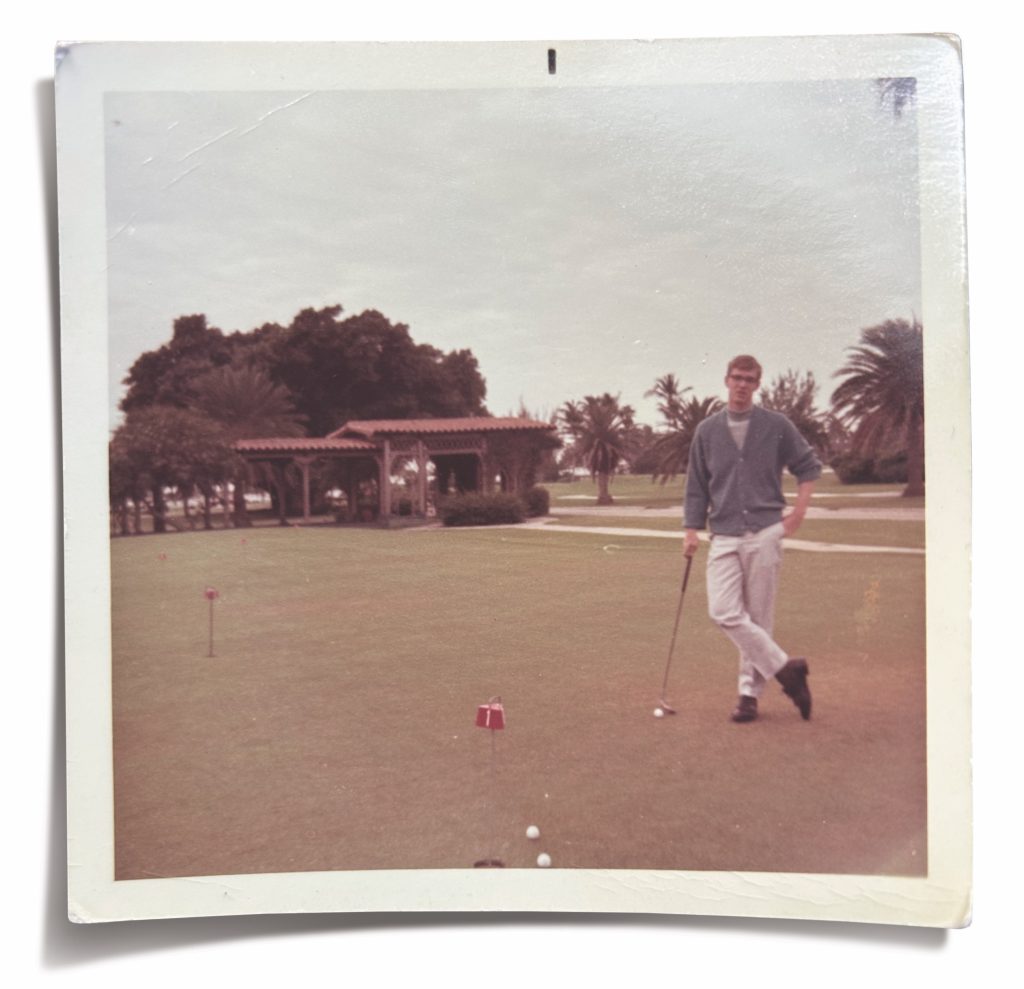
After a fitful night’s sleep. Dad drove me over to the club the next morning. Instead of dropping me off, he parked the car and escorted me to the putting green, where he snapped my picture, a lanky 160-pounder on a 6-foot-1 inch frame. At the appointed time, Dad and I entered the pro shop, where we met Sam. He couldn’t have been friendlier.

“Nice to meet you,” he greeted us in his smooth Virginia mountain drawl. “Bill, I hear you play on your high school team. That’s great. It’ll be just the two of us; we’ll have a good game. And just call me Sam.”

Out to his golf cart we went. Before we teed off, Dad took another photograph, this time of Sam and me. I confess, I’ve lost track of it but I well recall a broadly smiling Snead, nattily attired in red slacks, navy blue alpaca sweater and the ever-present straw hat sitting beside me, who was clearly starstruck.

Boca’s course was jammed, and I envisioned a protracted five-hour round. But when Sam and his familiar straw hat came into the view of players in the group ahead, they invariably waved him through. It was as if the Red Sea parted for us as we sped through foursome after foursome. Since Snead graciously allowed me to hit first off each tee, the golfers in our wake may have concluded I was winning our friendly match. Far from it.

Playing from the regular white tees, Sam nonchalantly made par or birdie on every hole. I was doing OK, mostly avoiding serious trouble. Then I made an unforced error by cutting things too close in laying up short of a stream crossing the fairway. After my ball toppled over the edge and into the water, Sam pithily observed, “If you’re going to lay up, lay up.” Over the years, I have often repeated his advice to players making the same mistake — and I let them know who gave it to me.

Sam was pleasant, but he tended to let me take the lead in our communications. And I felt some pressure to fill the airspace. I had one advantage making conversation — I had read The Education of a Golfer. I asked Sam questions about how he went about fashioning a club from a swamp maple tree limb during his youth. I asked about a boxing match he fought during his teens. And, of course, I fished for details about that incredible 59. The round, it turned out, could have been one shot better since Sam had missed a 2-foot putt.

Then I delved into the betting chapter of the book. Sam quickly warmed to this subject, regaling me with colorful anecdotes about how sharks he encountered tried to fix bets to their advantage. One sought additional strokes by claiming he had recently arrived in Florida from the North and hadn’t touched a golf club all winter. Actually, the hustler had been playing in the Sunshine State for weeks, even trying to conceal his tan from Snead by whitening his hands and face with corn plaster. Sam countered by carefully feeling the man’s calluses when shaking his hand. “When those calluses are thick, that tells you the man’s been playing plenty,” he said.

At one point on the front nine, Sam struck a shot he considered not up to his standard. He muttered, “I just can’t play my best unless I got a bet going.” I responded rather cheekily, “Well, I am sorry, Sam, that I won’t get to see you at your best.” Silence from the Slammer. To my surprise, I was hitting my drives within 20-25 yards of Sam’s. Since he was then 53, I figured he must be losing yardage off the tee. Wondering how much, I began posing a question with, “Now, when you were at your peak . . . ”

As the words left my mouth, I knew this was a misstep. Even assuming his peak was behind him, Snead wasn’t about to acknowledge it. Besides, Sam was still playing great golf in 1965. He finished 24th on the PGA tour money list (there was no Senior or Champions tour available in ’65) despite playing in only 15 events. Snead had won his seventh Greensboro Open earlier in the spring, making him the oldest (52) to have won a PGA Tour event. The record still stands 60 years later.

In a feeble effort to erase my faux pas, I uttered something inane along the lines of, “Not that you aren’t still at your peak.” I forget what was said next but do recall a distinct, if brief, lull in our conversation. If Sam was annoyed by my babbling, he didn’t show it, and our amiable dialogue resumed. It is telling that on the hole following my misbegotten inquiry, Sam let out the shaft and outdrove me by 75 yards.

Dad was waiting for us as we finished on the 18th, done in 2 hours and 45 minutes. After holing out and shaking hands (Snead, quite bald, never removed his hat in these situations), Dad asked Sam how things went.

“Well, your son did just fine,” he offered. “Shot 82 and kept the ball in play — just one double bogey and that was from a mental mistake (the bonehead lay-up). I believe he learned a lesson from that. He should keep on playing.” I absorbed another lesson from the round: Think before you speak.

Sam shot 66 and didn’t seem to be doing anything special. He holed one long putt and birdied the par 5s, but otherwise his round appeared relatively routine. Had I the temerity to bet him, I would have become one of Sam’s countless “pigeons.”

I don’t know for sure the amount Snead charged for the round. I think it was around $150. An old pro friend of mine believes that figure is too low, but an aged article I unearthed in the Sports Illustrated archives reported that in 1959, Snead charged $50 per round and $25 for each additional player. I can only imagine what a superstar like Sam would charge today.

Regardless of the cost, playing with Snead was priceless. There are still times when I have failed to do as Sam counseled — lay-up shots still occasionally roll into the water. But I’ve faithfully followed his advice to keep playing. After all, golf is the game of a lifetime. And my life was enhanced by that unexpected 1965 Christmas present.

The Art of N.C. Wyeth

THE ART OF N.C. WYETH

The Art of N.C. Wyeth

How did his illustrations for Drums get here?

By Bill Case

It was 1927 and, for Southern Pines author James Boyd, life was coming at him fast — albeit in a good way. His first novel, Drums, published two years earlier, had flown off bookstore shelves. To meet the unanticipated demand, publisher Charles Scribner’s Sons had reprinted the novel three times in the first month following its release. Forty thousand copies of the surprise bestseller were sold in five months.

Boyd’s tale, set mostly in North Carolina, was also earning critical acclaim. A New York Post reviewer declared Drums “the best novel written about the American Revolution.” Fellow author (and Boyd confidante) Struthers Burt heaped more extravagant praise, calling his friend’s work, “by far the best . . . American historical novel ever written.”

Buoyed by his surprise hit, Boyd authored a second historical novel for Scribner’s — this one with a Civil War backdrop. The book, titled Marching On, released in the first quarter of 1927, was going gangbusters too. Early sales were bettering those of Drums. On the heels of this latest tour de force, Scribner’s inked a deal for a third novel.

While Boyd’s association with his publisher was financially profitable, it was proving more time-consuming than he preferred, expressing frustration when production demands precluded his engagement in his favored rural pastimes, like foxhunting. The author grumbled to an interviewer, “My brother looks after my money for me; my wife looks after my kids and the house; now if I could get you (the interviewer) to do my writing for me, I could look after my dogs myself and fox hunt during the winter. Seems to me that would be an ideal arrangement for everybody concerned.”

In the fall of 1927, Boyd’s renowned editor, Max Perkins, pitched a new project designed to create a fresh wave of sales — and the author would barely need to lift a finger! Scribner’s wanted to produce a new, lushly illustrated edition of Drums. Boyd would need to make some minor text changes, but the bulk of the creative work would involve the artistic depiction of passages from the novel.

This was not a new concept for Scribner’s. The publisher first featured color illustrations in children’s books in 1904. Well-received, Scribner’s began color illustrating full-length novels, aiming primarily at the juvenile trade. An early one was Treasure Island, published in 1911. A landmark hit, Robert Louis Stevenson’s swashbuckling yarn became the first in a series labeled “Scribner’s Illustrated Classics.”

Subsequent books in the series like Kidnapped, Rip Van Winkle and The Last of the Mohicans told stories of high adventure. The authors of those classics, Stevenson, Washington Irving and James Fenimore Cooper, respectively, rank among the greatest American writers. The fact that Boyd was joining these legends underscored his arrival on the literary scene.

The choice of Drums for the series represented a departure for Scribner’s. While the book contains battle episodes and other dramatic moments, its subject matter was aimed at mature readers. In Drums, intractable political conflicts and social class barriers bedevil the young protagonist, Johnny Fraser. Editor Max Perkins minimized any perceived switch in Scribner’s targeted audience, writing, “Most of the best books in the world are read both by children and adults. This is a characteristic of a great book, that it is both juvenile and adult, and that is what assures it a long life.”

The primary conflict in Drums occurs in the lead-up to the war, when Johnny Fraser is coming of age in the backwoods of North Carolina, and Americans are bitterly divided on the issue of independence. Johnny’s father, Squire Fraser, sees both sides; while acknowledging that taxation without representation is anti-democratic, he is convinced no good will come from revolution. He remains a Loyalist, and Johnny follows his father’s lead.

Squire Fraser seeks to keep his son out of the growing tumult by sending him to Edenton to receive a gentleman’s education, but after war breaks out in Massachusetts, the revolt impacts Edenton, too. The British collector of the port there, Captain Tennant, is forced by a jeering mob to leave the colony. Johnny, a wavering Loyalist, receives his own share of harassment and also departs Edenton. Squire Fraser, still protecting his son, arranges for Johnny’s passage to England, where the young man obtains a clerical position at an import firm in London.

It’s then that Johnny crosses paths with American naval hero John Paul Jones, the “Father of the American Navy.” Jones persuades Johnny to join his ship’s crew. Whether his decision is premised on a newfound fervor for independence or the urging of the charismatic Jones is for the reader to discern.

Johnny is wounded in battle aboard Jones’ ship, the Bonhomme Richard. He returns to North Carolina and rejoins his parents in the backwoods of Little River. Fully invested now in the cause of independence, Johnny joins the militia and is wounded again. The book concludes with the battered Johnny Fraser sitting on his front porch, watching Nathanael Greene’s victorious army march by. As the soldiers are nearly out of sight, he staggers down to the fence and raises his stiff arm in salute to the last man of Greene’s rear guard, far off in the distance.

Scribner’s assigned the artwork for the new edition of Drums to the man unquestionably regarded as the finest illustrator in America, Newell Convers Wyeth, age 45. N.C. Wyeth painted the bulk of the artwork contained in the Scribner’s classics series, beginning with Treasure Island. During his unparalleled career Wyeth also illustrated hundreds of scenes for magazine stories, especially those published by Scribner’s Magazine and the Saturday Evening Post.

Wyeth was raised in Needham, Massachusetts, where his father made a decent living dealing in hay, grain and straw. His mother, an immigrant from Switzerland, was chronically homesick for her place of birth, and her depressed state was an ongoing drain on the family. Nonetheless, N.C. maintained a close relationship with his mother, and after he left Needham, the two corresponded with one another almost daily.

Wyeth displayed immense artistic ability during his teenage years, attending the Howard Pyle School of Art in Wilmington, Delaware. Pyle was then the country’s leading illustrator and quickly recognized Wyeth’s talent, advising his prodigy to submit illustrations to magazines. One of his first compositions was for The Saturday Evening Post — a cowboy astride a bucking bronco that appeared on the Post’s cover the week of Feb. 21, 1903. It was a promising start, and with magazines catering to public thirst for Western-themed stories, Wyeth received multiple commissions.

Pyle believed Wyeth’s cowboy illustrations would gain authenticity if he experienced Western life for himself, so in October 1904, N.C. journeyed west and found employment at a ranch. On Oct. 6, he wrote his mother: “I did my first work of the cowpuncher . . . Elroy and I went out and rounded up about 300 head of cattle, including calves. We started at 7:30 a.m. and were in the saddle continually until 5:15 that afternoon.”

Wyeth remained out west until December. The sojourn led to an explosion in commissions, and Wyeth’s subsequent Western illustrations demonstrated an increased grit and realism gained from his personal experience. With his career off and running, he received offers from magazines at the rate of two or three a week, and demand for his illustrations never slowed. Yet, he often disparaged this genre of painting as unserious, purely commercial and barely art. Though painting illustrations brought him fame and prosperity, Wyeth groused that it prevented him from being “able to paint a picture, and that is as far from the realms of illustration as black is from white.”

Churning out illustrations, however, earned enough to support a burgeoning family. He married Carol Bockius in 1906, and they had five children. Several of his offspring would become talented artists in their own right,  most notably, celebrated mid-century painter Andrew Wyeth. In 1908, N.C. moved the family to bucolic Chadds Ford, Pennsylvania, in the Brandywine Valley, 10 miles from Wilmington, Delaware. He had become smitten with the community’s horse-drawn surroundings during Pyle’s summer school sessions.

Wyeth relished life in Chadds Ford. Its warm meadows and rolling hills provided an idyllic environment for his work. Author David Michaelis described the painter’s peripatetic labors in his biography, N.C. Wyeth: “He had no time to waste. He divided his days, pushing himself to do more than one person could. In the mornings he made studies in the open fields around Chadds Ford. After lunch he cranked out pictures for Scribner’s and The Saturday Evening Post, then returned to the open air in the late afternoon. As the evenings lengthened in May, he remained in the fields and on the riverbanks, sketching, often through supper.”

The hard work paid off. Wyeth’s Scribner’s Illustrated Classics paintings received increasing acclaim. His depictions stood out because they appealed to all the senses. Michaelis wrote, “Wyeth’s illustrations make the viewer not only see and feel but also hear. We hear the clatter of dishes and goblets breaking during a fight, coins falling on heaps, sand squeaking under the feet of the stretcher bearers.”

Illustrator John Lechner added, “Unlike previous illustrators, who designed their compositions neatly on the page, Wyeth’s paintings leapt right out of the book, with a vibrancy and power that made you feel the passion and pain of their subjects.”

An assignment from Scribner’s to illustrate a classic novel required production of 17 individual paintings. Fourteen of them, each depicting a scene from the book, would be sprinkled throughout the text. The cover, title page and end page would also feature illustrations. Scribner’s art director, Joseph Chapin, allowed Wyeth carte blanche freedom in choosing scenes.

Lechner observed the subtlety within N.C.’s selections: “Wyeth was very sensitive to the author’s words, and his philosophy was to avoid depicting scenes that the author describes in detail (what was the point?) and instead illuminate smaller moments that are only briefly mentioned, in order to enhance the story. The resulting illustrations are neither trivial nor superfluous but help develop the characters and advance the story.”

Wyeth used canvases for the classics series that were 47 inches tall and 38 inches wide. For final publication, Scribner’s engravers would reduce the size to 6 1/2 inches by 5 1/4 inches. Wyeth was billing Scribner’s approximately $5,000 for a set of paintings around the time the publisher retained him to illustrate Drums.

Wyeth always read the novel he was illustrating. We know he liked Drums because of a letter he wrote to his father, who apparently did not share his enthusiasm. Recognizing his father was accustomed to stories involving the confrontation of a perfect hero with a perfect villain, N.C. asserted that real life was not like that, claiming modern literature, and Drums in particular, provided more realistic, and thus more interesting, portrayals of human nature. The imperfect Johnny Fraser, according to Wyeth, was “like most of us,” a “fundamentally worthy sensitive person,” yet “vacillating and a victim of influence and circumstances.”

His western trip taught Wyeth that the essence of a scene is best captured by exploring the area where the action occurs, so plans were made for him to visit Edenton. Who initiated the trip is unclear, but Boyd — who had previously visited Wyeth in Chadds Ford — did send Wyeth a telegram inviting him to visit Weymouth on his way to Edenton.

Wyeth responded on Dec. 3, 1927. “I have carefully completed the next to last study of Drums and am now prepared to absorb the material I need from you, Little River Country, and Edenton.” Wyeth planned to arrive at Weymouth on Wednesday, presumably Dec. 7.

The next recorded contact between the author and artist took place later in December when Wyeth wrote Boyd from Edenton extending his “warmest thanks to you and Mrs. Boyd for your kindnesses.” He expressed further gratitude to Boyd “for the use of your motor,” and the “careful but not dull driving of Calvin.” Wyeth’s word pictures were nearly as lush as his illustrations. “For the last two hours, lying by the open window, I have listened to the night sounds of this little town and have contrasted those Johnny Fraser heard so often, and by doing so have enjoyed revealments which, for moments of time, become very poignant and moving,” he wrote. “Dimly bulking against the glow of the moon on the water I can see the angular shapes of three warehouses. There they stand as Johnny Fraser saw them! This afternoon was spent wandering in and about these relics of 1770. My heart went out to them, because you, Boyd, have made them live for me.”

Wowed by N.C.’s eloquence, Boyd responds, “It is an injustice of nature that a man who can paint like you should also be able to write like that . . . I might be obliged to ask myself why I am in the business at all.” Boyd is also struck by the fact that Wyeth’s sentiments present a perfect echo of his own. “Two people are seldom so as one on anything in life,” Boyd writes. “And when that thing happens as with us to be a common enterprise, the coincidence is so far-fetched as to excite a wonder in my mystical Scots nature, only exceeded by my hard-headed Scotch-Irish nature that there must be a catch somewhere.”

There is no hint in their correspondence that James Boyd accompanied Wyeth on his coastal wanderings, but a humorous anecdote in the Jan. 10, 1931 Pinehurst Outlook suggests otherwise, claiming that Wyeth was seeking models for two boys in the story, and that he and Boyd toured the Cape Fear area together in search of suitable subjects. “Stopping at a country school near Wilmington, they looked through the windows and saw in a corner two boys who served Mr. Wyeth’s purpose very well. He and the author, to get a closer view, stooped down and looked through the keyhole. ‘Just the type,’ said the artist, and the author agreed. The schoolteacher, unfortunately, overheard the conversation and opened the door to investigate, and both Mr. Boyd and Mr. Wyeth fell in.”

After the new year, Wyeth began work on his Drums illustrations. In addition to the set of 17 paintings, he agreed to render a number of pen drawings for the new edition. On Jan. 5, 1928, he reported to Boyd on his progress or lack of same. “I am not taking easily to this medium for it is years since I have handled it,” he wrote. “Have done about twenty which I destroyed this morning and feel better for it.”

Wyeth’s message expressed agonized frustration concerning his work, startling when coming from the greatest illustrator alive. “How I do yearn for the technical ability to put down in color and pattern the things that are almost tearing my insides out,” he wrote.

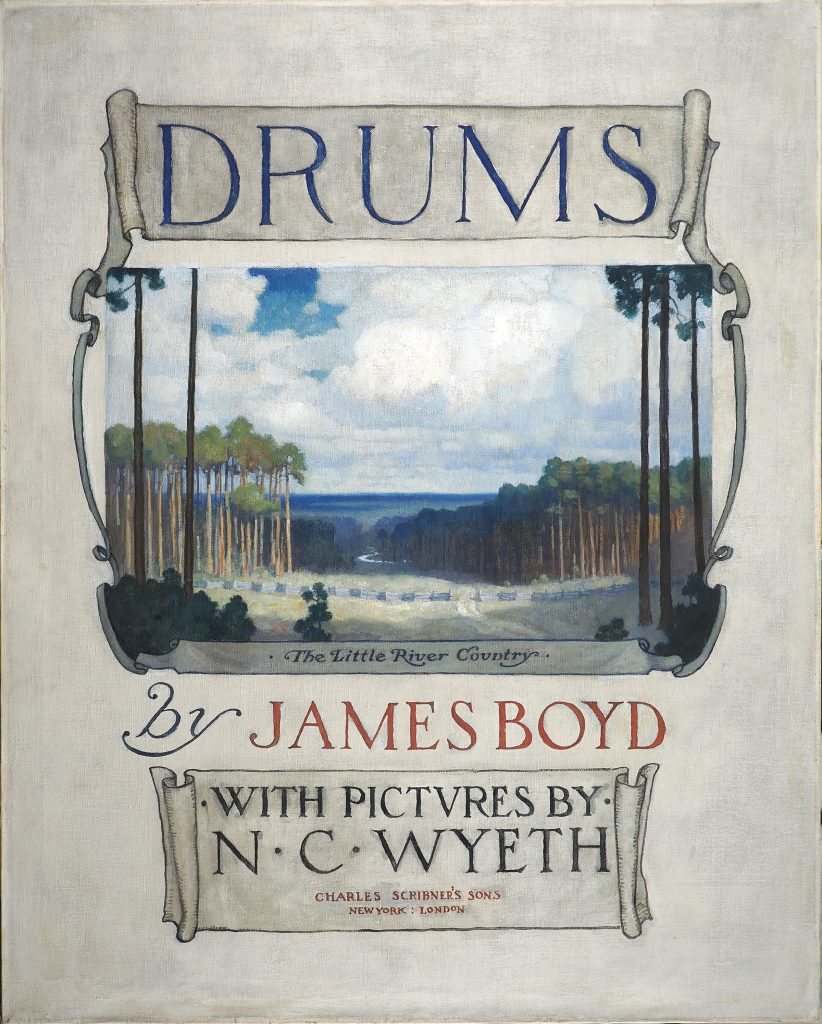
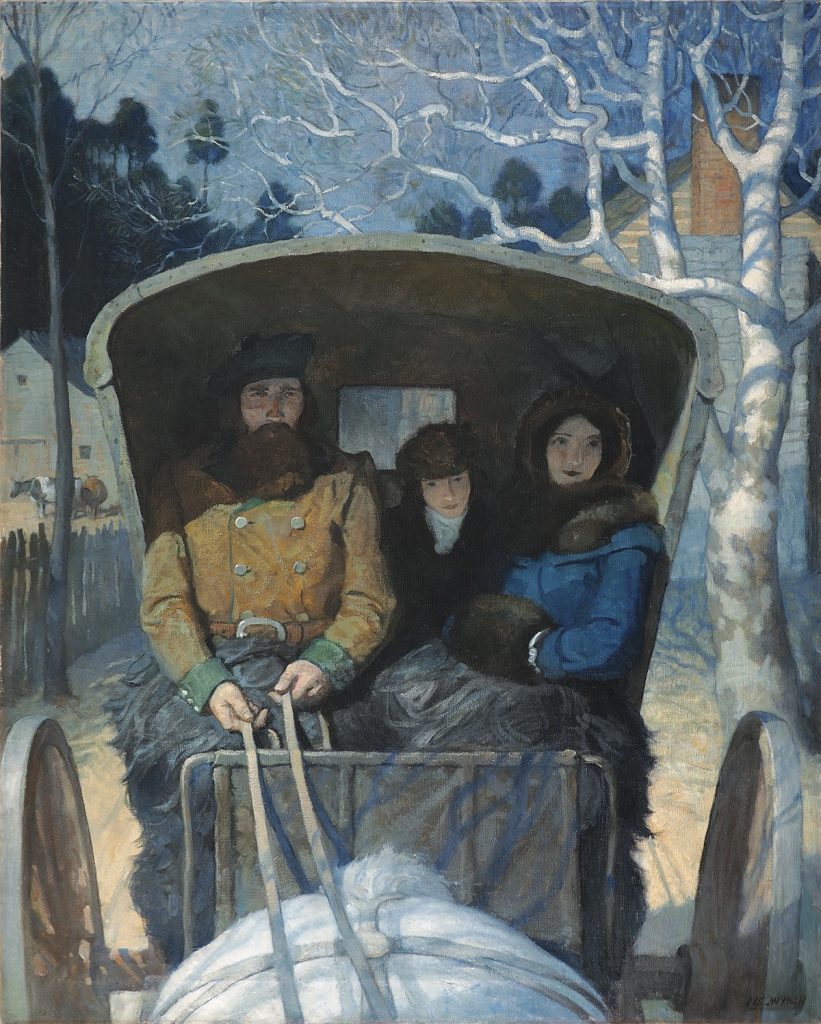
The 17 illustrations for Drums included several of high drama like “The Fight at the Foretop” aboard the Bonhomme Richard; “The Horse Race” (which Johnny won); “Johnny’s Defeat at the Dock,” when he was treated roughly in Edenton; and “Captain Tennant,” where the British official cooly confronts the crowd demanding his departure. Others like “The Fraser Family,” depicting young Johnny and his parents riding their old chaise to church; and “The Mother of John Paul Jones” lack drama, but help the reader visualize the characters. The Drums title page illustration includes a pastoral landscape, supposedly portraying the Little River Country, though it actually came from a Chadds Ford area view.

Though their effusive correspondence suggests an exceedingly collegial friendship, there is no record of further dealings between Boyd and Wyeth following the 1928 publication of the Illustrated Classics edition of Drums, which sold exceedingly well. It’s hard to imagine, however, that they didn’t see one another during the Yuletide stay of Wyeth and his wife, Carol, at Southern Pines’ Highland Pines Inn in 1931 (reported by The Outlook on Dec. 19 of that year). There is no mention there or elsewhere, that the Boyds and Wyeths saw one another. By contrast, Boyd’s hobnobs in Southern Pines with other revered men of the arts like F. Scott Fitzgerald, Thomas Wolfe and John Galsworthy were copiously reported. It’s puzzling.

Even if they did not meet during that visit, the two men presumably had further contact because Boyd wound up acquiring three of the 17 canvases Wyeth painted for Drums: the “Title Page” illustration; “The Fraser Family” painting; and “Captain Tennant.” Those canvases are currently on display at the Weymouth Center for the Arts & Humanities as part of its Celebration of Drums. This year marks the centennial of the novel’s initial publication. The Wyeth paintings are on loan from the town of Southern Pines, which now owns them.

But what were the circumstances of Boyd’s acquisition of the illustrations? When did he take possession of them? Was it possible he got them from Scribner’s instead of Wyeth? Did Boyd purchase the paintings, or were they a gift?

The earliest mention referencing Boyd’s ownership of the illustrations came from a Dec. 7, 1939 Outlook blurb. It read: “Above the fireplace in the Southern Pines Library are two of the original N.C. Wyeth illustrations used in depicting scenes in Mr. James Boyd’s book, Drums. These interesting illustrations, on display through the courtesy of Mr. Boyd, add much color and charm to the reading room of the library.” (The library was then located on Connecticut Avenue and operated independently by the Southern Pines Library Association.)

Michaelis’ biography makes it clear that Boyd obtained the paintings from Wyeth. During N.C.’s early work for Scribner’s, he was squeamish about speaking up for himself, and the publisher kept most of his paintings. Over time, however, he became more forceful in negotiations with the publisher. By 1920, Scribner’s was returning all of Wyeth’s canvases to the artist. A check of Scribner’s archival records confirmed the company sent the Drums illustrations back to Wyeth.

Whether the artist sold or gifted the illustrations to Boyd is a more complicated issue. The fact that Wyeth had previously sent a picture of one illustration to Boyd “thinking it might interest you,” seemed the sort of thing a seller might say to kick off negotiations. But a scouring of Boyd’s personal papers at the University of North Carolina’s Wilson Library revealed no support for this theory. Carrie Hays, administrative coordinator for the town of Southern Pines, compiled background information concerning the paintings, but nothing relates to how Boyd obtained them from Wyeth.

N.C.’s great-granddaughter, Victoria Wyeth, speaks regularly concerning her legendary family’s legacy. (She was featured in Ray Owen’s October 2018 PineStraw article “America’s First Family of Art.”) While Victoria had no information concerning her great-grandfather’s disposition of the paintings, she graciously put me in touch with folks who did at the Brandywine Museum of Art in Chadds Ford.

The museum includes Wyeth’s studio and holds a treasure trove of his paintings along with records of their provenance. Amanda Burdan, the senior curator of the museum, provided valuable, though not conclusive, insight on the issue. “It is most likely that he (Wyeth) sold those three paintings to (Boyd) directly,” she said. “He did occasionally gift paintings, but it tended to be for special occasions like weddings of friends.” Burdan said that “several of the Drums illustrations stayed with the Wyeth family until well after N.C. died in 1945.”

Burdan and her assistant, Lillian Kinney, took a look at Wyeth’s tax records in hopes they might reveal income from sales of illustrations to third parties. There was some, but the records were inconclusive — another rabbit hole.

Sandy Gernhart is the archivist for the Weymouth Center, which houses many Boyd documents. She found a 2005 Weymouth inventory binder that indicates Wyeth gifted the illustrations to Boyd. According to Gernhart — and prior Weymouth Center historian Dotty Starling — it has through the years been “known” at Weymouth that the illustrations came to Boyd by way of a gift from Wyeth. Both women concede there is no documentation, aside from the non-contemporaneous inventory binder, that backs up this lore.

Nonetheless, the apparent closeness of the two kindred spirits during their time together and the generous hospitality exhibited by the Boyds to Wyeth provide strong circumstantial evidence supporting the likelihood of Wyeth’s tendering such a generous gift.

How did the town of Southern Pines eventually obtain ownership of the illustrations? After World War II, the town constructed a new edifice on Broad Street that would house the library — now the home of the town’s utilities office. Soon thereafter, the library came under the town’s umbrella. A wing was added to the structure in 1948 that was dedicated to the memory of James Boyd, who had passed away in 1944. Katharine Boyd contributed a number of historic artifacts to be displayed in the James Boyd Room, including a desk purportedly used by Lincoln while he was in Congress, an autograph collection, several pieces of early American furniture, and the Wyeth illustrations.

Katharine Boyd’s 1969 will (she died in 1974) mentions nothing about the paintings, so presumably she considered them already donated to the town, perhaps when the James Boyd Room was opened in ’48. But if so, the gift, like other dealings in this account, appears to have been accomplished without written record.

The town is permitting the Weymouth Center to display the illustrations throughout most of 2026. As of now, it’s unclear where Wyeth’s illustrations will be housed once they are returned to the town.

Wherever they wind up, security will be paramount. There is no hiding the fact the canvases are valuable. N.C. Wyeth illustrations frequently sell at six figures. The highest amount paid to date is $5.99 million for his Portrait of a Farmer at a Sotheby’s auction in 2018. Wyeth, who belittled the merits and value of his own illustrations, would undoubtedly be gobsmacked at such stupefying prices.

Wyeth died in 1945, one year after Boyd, at the age of 62. His demise was both tragic and mystifying. While driving near Chadds Ford, Wyeth’s car stopped on the track at a railroad crossing. An onrushing train crashed into his auto, killing him and his 3-year-old grandchild. Why Wyeth was stopped on the track remains an unknown.

While a bit of mystery lingers regarding the Wyeth-Boyd relationship and the three illustrations, there is none concerning Wyeth’s artistic greatness. Though in the grand sweep of time the regard given to the works of Boyd and Wyeth may have traveled in different directions, their association, while brief, made for a memorable collaboration.