Good Natured

The Season of Love

One day is just the beginning

By Karen Frye

We think of love as we celebrate Valentine’s Day on the 14th but, hopefully, we focus on it the other 364 days as well, creating a lifestyle for ourselves. Start your day with feelings of love and spread it everywhere with everyone. End your day with gratitude for all the love you’ve received. Tune in to these feelings and reap the incredible benefits it brings to your life.

We are born into the world with immense love. This force within us can be nourished and grow more powerful with practice. Life can be challenging, but its lessons can be opportunities to use our hearts to find a way through obstacles and grow stronger. When we understand that love can resolve so many of the confrontations and challenges life brings, we become more loving, even in the most difficult times.

Each morning before you get out of bed, connect to your heart center. Be grateful that your heart is beating and sending feelings of compassion, empathy and love to every cell in your body. Open yourself to the good things happening to you. Sharing the love you feel with others will open their hearts as well. We must embrace, and even love, those who have hurt us.

Love has the power to change many things. It can end anger, strife, resentment and emotional pain. Everything improves with practicing love, but the person who benefits the most is you. What footprint will you leave on this world? Walk the path of love. Uplift others. You will be happier, healthier and more content with your life, and the world will be a better place.  PS

Karen Frye is the owner and founder of Nature’s Own and teaches yoga at the Bikram
Yoga Studio.

Hometown

One Degree of Separation

And other brushes with greatness

By Bill Fields

The first celebrities I saw in the flesh weighed about 2,000 pounds apiece.

They were the Budweiser Clydesdales, parading down Broad Street in Southern Pines in the 1960s, and they didn’t yield to the left if they didn’t want to. To a 60-pound kid, a one-ton horse seemed as big as a brontosaurus.

My celebrity encounters veered from the equine over the years, but star sightings outside the golf world — on which I’ve reported for four decades — have been few and far between.

Sadly, Meryl Streep never looked forward to commuting on a train to Grand Central Terminal with me as she did as Molly to Robert De Niro’s Frank in Falling in Love. I did get a hello from Massachusetts governor and presidential candidate Michael Dukakis on a 1988 flight to Boston. Friendly, lots of hair, not a lot of height. In a long check-in line at LaGuardia Airport, Chris Farley, in sunglasses and a hoodie, nodded in my direction when we made eye contact. On a flight to London, Robin Givens, sans Mike Tyson, sat a few rows away.

It wasn’t unusual for folks to see Paul Newman out and about in Connecticut. I walked past him once on a sidewalk in Westport, and his eyes were as blue as you thought they were.

Covering a PGA Tour Champions event at Pebble Beach, I needed a few minutes from Bernhard Langer for an interview after his round, which concluded on the ninth hole a long way from the Lodge. Langer asked me to join him in the shuttle van so we could talk during the short ride back to civilization. Clint Eastwood, who had played in Langer’s group, was in the front passenger seat, and seeing an interloper clamber into the vehicle didn’t make his day.

“You can take the next one,” Eastwood said to me.

“Bernhard told me to come with him,” I replied.

“It’s OK, Clint,” Langer interjected.

Eastwood still seemed peeved when we reached the clubhouse. His demeanor to a stranger was much different from that of another Hollywood A-lister, Jack Lemmon, with whom I had crossed paths at a golf tournament at Pebble Beach years earlier. Lemmon was walking his standard poodle across a parking lot and offered a smile and a friendly hello.

Lemmon was a fixture each winter on the Monterey Peninsula, where he tried in vain to make the amateur cut and play on Sunday in the AT&T Pebble Beach Pro-Am, the old Bing Crosby Pro-Am. I didn’t expect to see Glenn Frey of the Eagles under the big live oak at Augusta National Golf Club on Masters Wednesday in 1997. But Frey loved golf and was there, in a white caddie jumpsuit, to loop for pal Brad Faxon in the Par-3 Contest. I lament having not seen the Eagles in concert during the band’s heyday, but I got to meet Frey and shake his hand that day.

Two iconic figures in sports and entertainment, John Madden and Betty White, passed away within a couple of days of each other near the end of 2021. Tributes focused not only on how much they accomplished during their respective careers but how well they treated people throughout their long lives. I never met either icon — saw Madden dining in a California restaurant once — but the coverage made me think of the time I met one of my childhood baseball heroes, Brooks Robinson.

Back in the late 1980s, I knew the former Baltimore Orioles third baseman was going to be playing in a celebrity golf event in Florida that I was covering. Once on-site, a lot of people were paying attention to the former New York Jets receiver Don Maynard, a Texan who was teeing it up in shorts and spiked cowboy boots. I prioritized finding the baseball Hall of Famer who had worn No. 5 and won 16 Gold Glove Awards.

If Robinson had grown tired of grown men asking him to sign a baseball while hearing about how he inspired them to play the hot corner in Little League, he sure didn’t show it. He was gracious and genuine, and as he signed the brand-new Rawlings baseball I’d brought along, I was 29 going on 12.   PS

Southern Pines native Bill Fields, who writes about golf and other things, moved north in 1986 but hasn’t lost his accent.

Bookshelf

February Books

FICTION

Carolina Built, by Kianna Alexander

Based on the life of real estate magnate Josephine N. Leary, Carolina Built tells the story of a woman born into slavery who gained her freedom at the age of 9 and succeeds in building a real estate empire in Edenton, North Carolina. Striving to create a legacy for her two daughters, Josephine teaches herself to be a businesswoman, to manage her finances, and to make smart investments. But with each passing year, it grows more and more difficult to juggle work and family obligations. Alexander brings Leary to life in her page-turning book of historical fiction as Josephine becomes a wife, landowner, business partner and visionary.

Love and Saffron, by Kim Fay

This witty and tender novel follows two women in 1960s America as they discover that food really does connect us all, and that friendship and laughter are the best medicine. When 27-year-old Joan Bergstrom sends a fan letter — and a gift of saffron — to 59-year-old Imogen Fortier, a life-changing friendship begins. Joan lives in Los Angeles and is just starting out as a food writer. Imogen lives on Camano Island outside Seattle, writing a monthly column for a Pacific Northwest magazine. While she can hunt elk and dig for clams, she’s never tasted fresh garlic. The two women bond through their letters, building a closeness that sustains them through the Cuban Missile Crisis, the assassination of President John F. Kennedy, and the unexpected events in their own lives. Told in three parts, this tender and honest book is a reminder that we are never finished growing, changing and loving.

The Christie Affair, by Nina de Gramont

“A long time ago, in another country, I nearly killed a woman . . . ” So begins The Christie Affair, a stunning new novel that reimagines the unexplained 11-day disappearance of Agatha Christie that captivated the world. The story is narrated by Miss Nan O’Dea, a fictional character based on a real person who infiltrated the wealthy, rarified world of author Christie and her husband, Archie — a world of London townhomes, country houses, shooting parties and tennis matches. First, she became part of their world, and then she became Archie’s mistress. What did it have to do with the mysterious 11 days that Agatha Christie went missing? The answer takes you back in time, to Ireland, to a young girl in love, to a time before The Great War, to a star-crossed couple destined to be together until war and their shameful secrets tore them apart.

Black Cake, by Charmaine Wilkerson

In this moving debut novel, two estranged siblings must set aside their differences to deal with their mother’s death and her hidden past — a journey of discovery that takes them from the Caribbean to London to California, beginning and ending with her famous black cake. Eleanor Bennett passes away in present-day California, leaving behind a puzzling inheritance for her two children, Byron and Benny: a traditional Caribbean black cake — made from a family recipe — and a voice recording. In her message, Eleanor shares a tumultuous story about a headstrong young swimmer who escapes her island home under suspicion of murder. The heartbreaking journey that unfolds challenges everything the siblings thought they knew about their family, the secrets their mother held back, and the mystery of a long-lost child.

CHILDREN’S BOOKS

Love You By Heart, by Peter H. Reynolds

Triumphs, joys, fumbles, falls, when you truly love someone, you love all of them. The perfect little gem for Valentine’s Day, or any day, because when you love someone, you love them warts and all. (All ages.)

Bob Ross, Peapod the Squirrel, and the Happy Accident, by Robb Pearlman

Mistakes are just happy accidents when Bob Ross and Peapod are in the art studio. Celebrate art! Creativity! Fun! This little book encourages young artists to go with the flow. (Ages 4-7.)

Smooch!: A Celebration of the Enduring Power of Love, by Karen Kilpatrick

Whether you’re in the pool, the tub, or get licked by your furry friend, nothing can wipe away the kiss of someone who loves you. For family members who cannot be together this Valentine’s Day, this adorable title is the perfect way to say, “I love you.” (Ages 3-6.)

Bold Words from Black Women: Inspiration and Truths from 50 Leaders Who Helped Shape Our World, by Dr. Tamara Pizzoli

From Alice Walker to Zora Neale Hurston, this stunning collection features quotes and portraits of 50 amazing Black women. An absolute must-have for young readers. (Age 6 to adult.)  PS

Compiled by Kimberly Daniels Taws and Angie Tally.

Crossroads

Moonshine Murder

The legacy of the Big Swamp meltdown

By Lisa Weiss

Every family has its secrets. Sometimes they’re taken to the grave or held close to the heart for safekeeping. And sometimes, as was the case for my family, the secret — Granddaddy landing in the gas chamber at Central Prison — made an indelible mark on the soul of a skinny 8-year-old boy who would later become my daddy.

Granddaddy Palmer was a so-called tobacco farmer from North Carolina, although he had never plowed a field that Daddy could remember. Instead, he let his son (my daddy) ride shotgun in the old Ford pickup while he delivered homemade whiskey to the locals. Palmer and his uncle by marriage, George Allen, were two of the biggest bootleggers in the county, and the two of them fought for bragging rights to the Big Swamp distillery business. Uncle George owned the 15-by-15-foot store at the intersection of Seventh Street and Singletary Church Road in Robeson County, so he had a natural distribution point for his product. But Palmer had the most prized asset: a reliable and abundant supply of sugar. In fact, he had 3,300 pounds of it in the backwoods of the Big Swamp, which ensured a constant flow of his moonshine mash.

Sugar during this time was rationed due to the war. Palmer’s secret stash, which in his mind was his patent, always kept him one step ahead of Uncle George. When he refused again and again to reveal his sugar source, Uncle George’s greed got the better of him, and he snitched to the local sheriff, spilling the location of Palmer’s stills. Naturally, festering contempt came stomping out of the backwoods. And with a loaded shotgun.

Walking a mile to Uncle George’s house that morning did not tamp Palmer’s temper, but rather gave rise to it. When he stormed into Uncle George’s house, George leapt from the breakfast table and fled out back, screaming for his wife to get his gun. Not intending to kill anyone — although he surely wanted to make his point — Palmer fired several shots between the siding of the barn where Uncle George went to hide. 

Daddy and his siblings had scattered that morning when they witnessed their own father’s rage and their mother’s pleading. Crouched low and staring bug-eyed at the edge of the cotton field where a split in the path led either to the swamp or Uncle George’s, they waited. It did not take long. The sound of gunshots, paired with the frenzied resolve on Palmer’s face when he returned, kept them as silent as Uncle George’s barn.

Palmer rummaged through the house with a burlap sack as he prepared his getaway into the Big Swamp. He called for Blackeye, the family bulldog, who had a black ring the size of a hickory nut around his left eye, marking his reputation as a fighter. Palmer had paid $5 for him as a pup but when someone later offered $100 for him, he didn’t consider it. He loved that dog.

And so, with his dog, a quilt, a cast-iron skillet and a 5-gallon demijohn of moonshine, Palmer set out into the dark swamp to ride out the manhunt. As the minutes turned to hours, and then days, a sense of self-satisfaction and pride grew. Man and dog survived the elements. But while the moonshine soothed Palmer’s soul, Blackeye grew weary. Over the years, that dog had fought off rowdy strays, snarled at drunkards — would have done anything to protect his master. But Blackeye did not growl, budge or even nudge Palmer as six men in uniform approached them through the dark muck. Like most things in a swamp, the dregs rise up or their stench gives them away. The dog sighed. Granddaddy went to jail.

Uncle George had been carted off to the hospital in the back of a pickup truck. Gunshot wounds to the shoulder, leg and lower abdomen complicated by pneumonia sealed his fate. Following a two-day trial, Grandaddy Palmer was charged with first-degree murder and sentenced to the gas chamber. Some folks tasted sweet revenge, while others puckered from the sourness of it all.

When facing certain death, some men become remorseful and discover a sense of purpose. During the eight months it took Palmer to walk the green mile, he learned a little French, sought out the forgiveness of God and his family, and wrote letters . . . lots of letters. His conversion story was covered widely by the local and regional press. His letters were published and used in sermons across North Carolina and Virginia. He was fighting for his soul while his lawyer fought for his life. Despite his remorse, including a petition signed by all but two of the jurors, he was denied an appeal by the State Supreme Court. Daddy used to say, “I don’t think he hated to die as much as he hated to see what he had caused.”

On Feb. 19, 1943, a farmer turned bootlegger walked into the gas chamber at 10:01 a.m. in Raleigh, North Carolina. He smiled and nodded to the sheriff. His arms and legs were strapped to the wooden chair with a high back, a brown leather mask adjusted over his face. Any hopes and dreams were sealed in the airtight chamber.

I can’t say they thrived, but all six of his children survived to tell — or not — their own stories of Palmer. The tragic tale became family lore. Creased, worn letters and press clippings from this born-again inmate passed down from generation to generation. Stories and memories of Palmer fell into the crevices of time, aged and somewhat forgotten; yet, they had the power to expose a gnawing urge to seek out “the unarmed truth and unconditional love”* desperately craved by a family, and particularly, by a fatherless 8-year-old boy, tender and sweet, despite the lack of sugar in his life.  PS

*From Dr. Martin Luther King Jr.’s 1964 Nobel Prize acceptance speech

A North Carolina native, Lisa Weiss is an interior designer and artist. She and her husband, Richard, live in the Charlotte area. Charles Meares, her father, served 41 years in the North Carolina Department of Corrections and was superintendent of the Gaston Correctional Center. He was twice the recipient of the Order of the Long Leaf Pine, granted by the office of Gov. Jim Hunt and again by the office of Gov. James Holshouser.

The Omnivorous Reader

Mastering the Monsters

A sci-fi novel for our surreal world

By Anne Blythe

If the past couple of years have proven anything, it’s to expect the unexpected.

We’ve battled a virus that has shown its ability to morph and shape-shift. Some people accepted it as real. Others chose not to believe.

The world imagined by Cadwell Turnbull, a creative writing professor at N.C. State University, in his latest work of fiction, No Gods, No Monsters, gives us a similar choice.

There are monsters, gods and humans living together and living apart throughout his book. They force readers to reconsider what is real and what is not, to look at others with a sense that they might be more like you than different — or more different than you know.

Introduced as the first in a trilogy, No Gods, No Monsters opens with a professor sitting at a restaurant in Cameron Village in Raleigh, saying goodbye to his friend Tanya, and his academic life. As Tanya sits across from him, he tells her he has decided to leave his job and go home to St. Thomas in the Virgin Islands (Turnbull’s childhood home), where the professor has unresolved issues over the death of his brother.

Initially, we don’t know the professor’s name or how he’s connected to the characters in the pages ahead. He drops in and out of chapters, sometimes interjecting a jarring and puzzling voice, leaving readers to wonder who he really is and how the many storylines that Turnbull is juggling will come together.

Along the way, we meet a wild variety of characters: bookstore workers who can turn into werewolves; a character named Dragon (a child who can sprout wings and fly); a senator from the Virgin Islands who can become a dog; an invisible sibling; a witch; and more. It’s not until the very end that we can see the novel’s worlds merging. Even then, much remains unanswered, leaving readers to wonder what the next book in the trilogy has in store.

“I’m going to tell you a story,” the narrator says. “And like so many stories, it begins with a body.”

That body belongs to Lincoln, a naked Black man, dead in the street, shot by police.

Laina, Lincoln’s sister, picks up the storytelling. We learn from her that Lincoln had been hooked on drugs and living on the streets, estranged from his family.

At first, it might seem as if this will be another story about an unarmed Black man being shot by police. While that theme pulses through the book, we quickly find out that this story is going to be different.

Suppressed bodycam footage surfaces, and with its release comes a tale of monsters, werewolves and gods on Earth and beyond.

Initially, Laina is in disbelief as she watches the bodycam footage of her brother’s shooting. It’s dark at first, difficult to make anything out. Then she hears the cop say, “I see it. It’s big.”

Then she sees the creature, too. It’s doglike, she says, but “bigger than doglike.” It snarls at the cop and he fires his gun. His target falls to the ground.

As residents from the houses along the street come out to see the aftermath of the shooting, the creature the cop saw lunging at him has become simply a naked man, left slain between two cars.

“I don’t understand,” the cop says.

The bodycam shows that Laina’s brother, at least for a moment, was a werewolf. Turnbull calls that moment “the Fracture.” It’s the instant when someone’s world opens to the realization that monsters are among them. Some people take notice. Others look away.

“Most people outgrew true belief in monsters by adulthood, but even adults knew not to go outside at night during a power outage, go past a certain house or respond to whispers in the dark,” the senator from St. Thomas tells us after we meet her in the Virgin Islands. “Monsters existed in the liminal space of half-belief and practical superstition. Even folks who claimed not to believe in God knew not to tempt devils. Superstition allowed a certain kind of freedom, allowed a certain kind of power.”

The arc of the story can be disjointed at times, adding a touch of mystery, as readers go on a spellbinding journey from North Carolina to Massachusetts to the U.S. Virgin Islands and places in between.

The characters are good and evil, lovable and at times abominable. We see humans transform into werewolves as they shed their clothes and go on four-legged runs in the woods, chasing squirrels and other small critters. We meet a woman who drinks the blood of her sister and can pull her skin off and on. Others lead mundane lives while battling monsters of their own.

Many of these characters eventually come together at a monster march, depicted as a kind of otherworldly Black Lives Matter rally when a large crowd marches through the Boston streets after Lincoln’s death, chanting, “No gods, no monsters!”

By using the sci-fi genre, Turnbull tempts his readers to explore tough and touchy topics such as drug addiction, police shootings, societal divisions and the monsters that can be created when neither side explores the motivation of the other.

Laina introduces us to Ridley, her asexual, transgender, anarchist husband who moved from Harrisonburg, Virginia, where his parents still live, to Massachusetts to open a co-op bookstore. We meet Rebecca, Laina’s girlfriend, who knew Lincoln, and Sarah, her housemate. Both Rebecca and Sarah have the ability to transform into sturdy-legged werewolves.

Throughout Turnbull’s book, we end up wondering whether monsters are people or people are monsters.

“You think monsters are dangerous? Or you think people who believe in them are? Which one? Both?” Sarah asks Ridley after he tells her he might not go to the monster march in Boston because he’s worried about the potential for violence.

“People need to be protected, too,” Ridley tells Sarah.

The book tugs and pulls its characters through inner wars as they deal with a fractured world around them and their own splintered lives. At one point, Ridley sees the Earth open up below a circle of glowing red ants while on a retreat at a collective peanut farm in Virginia. He tumbles into an abyss with monsters so jarring that he stays mum about his experience. What are the consequences of speaking out or the cost of staying silent?

Turnbull’s complex story takes readers across the surface of the Earth and into the many dimensions of the mind as his characters carom through a multitude of societies — some secret from long ago, some modern and seemingly ordinary but very destructive.

Even for people not typically drawn to sci-fi or fantasy novels, settling in with this story is well worth it.  PS

Anne Blythe has been a reporter in North Carolina for more than three decades. She has covered city halls, higher education, the courts, crime, hurricanes, ice storms, droughts, floods, college sports, health care and many wonderful characters who make this state such an interesting place.

The Creators of N.C.

Salt of the Earth

Building a business together

By Wiley Cash    Photographs by Mallory Cash

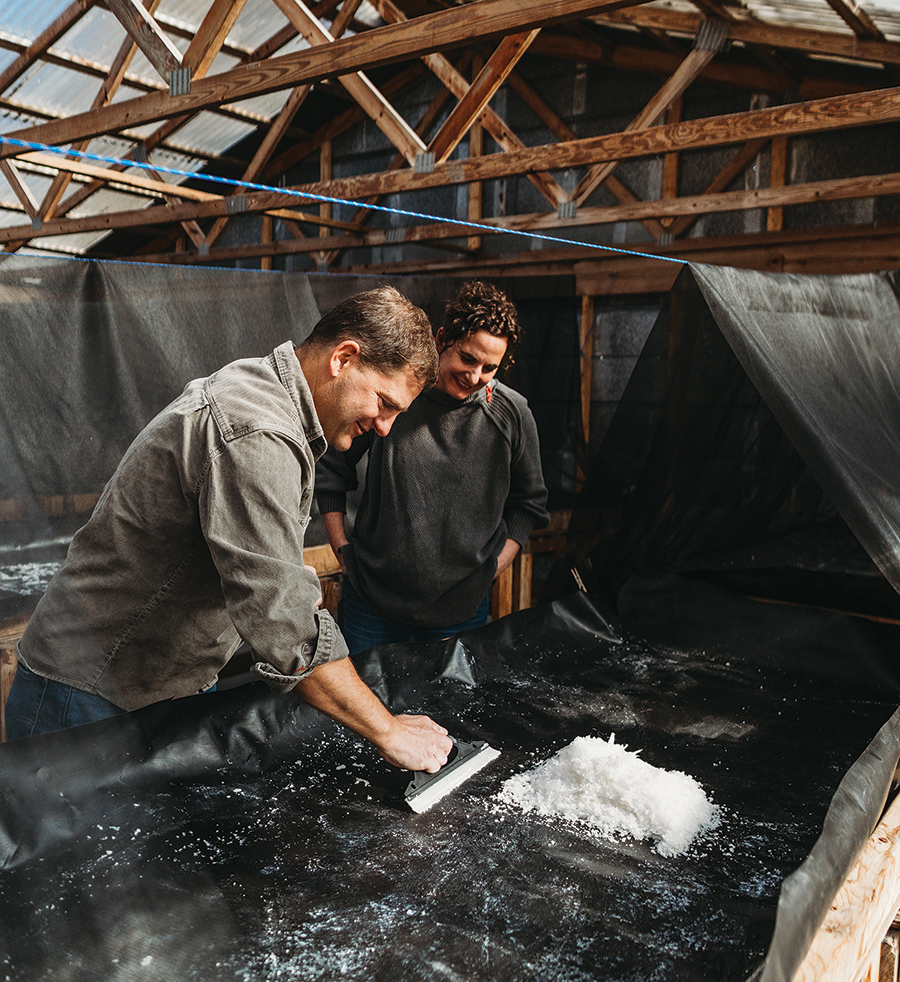
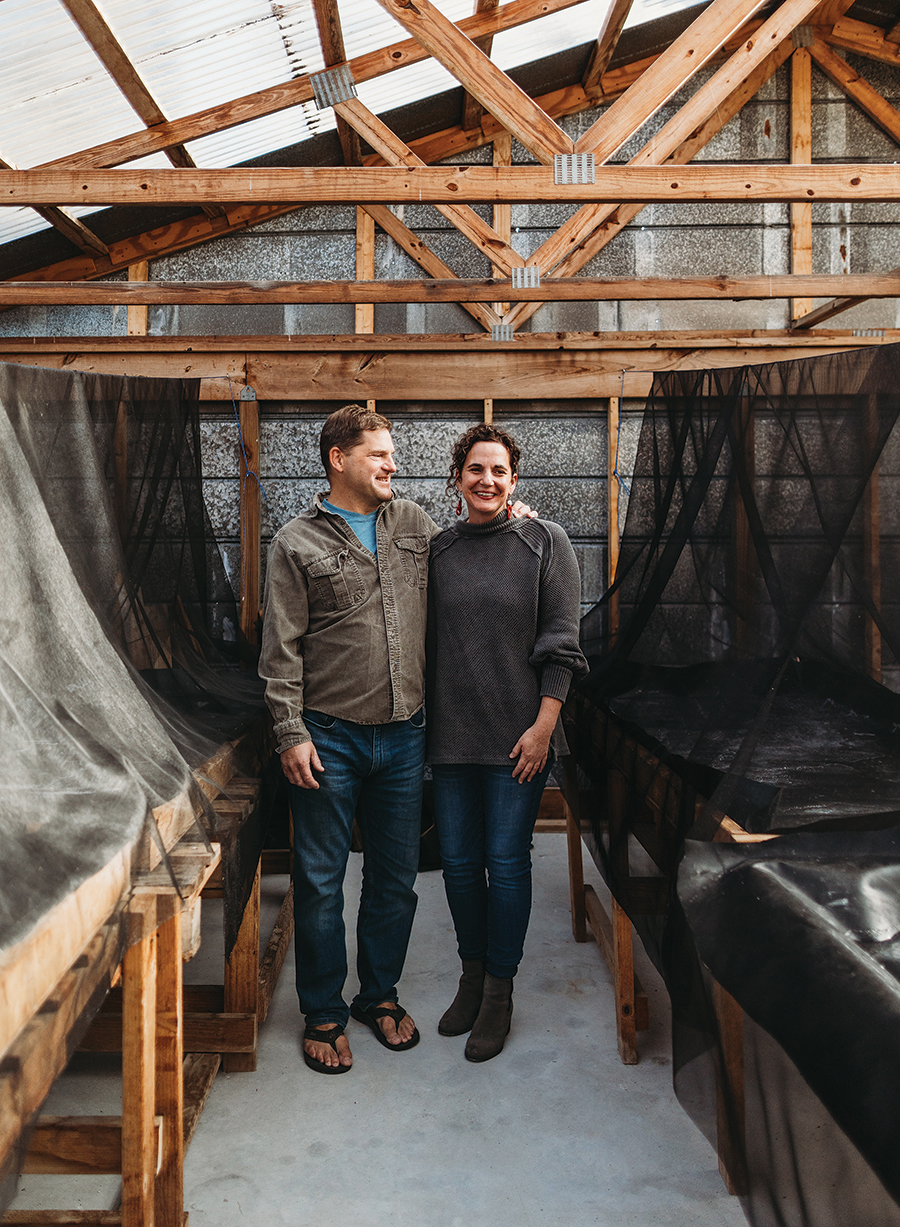
The interior of the building is warm and smells like the ocean. The walls and ceiling are constructed of white corrugated plastic sheets, all of them glowing beneath the bright noonday sun. Nets hang from the ceiling above tables that hold large wooden trays, their bottoms lined with thick, restaurant-grade plastic.

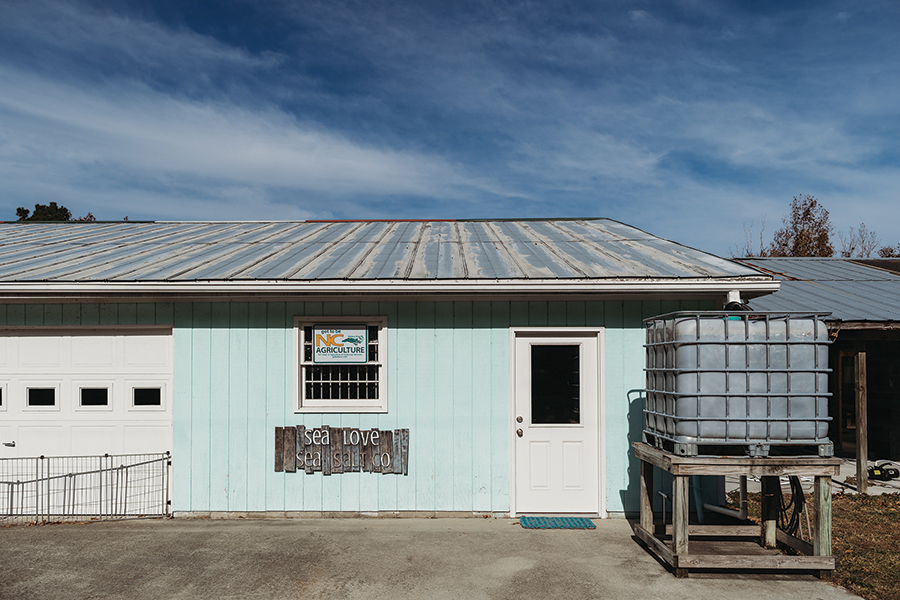
Jason Zombron looks down into one of the trays of white crystals that seem to have arranged themselves in haphazard patterns. If you stare long enough, it appears that the ocean is in each tray, dozens of tides frozen in time, doing their best to return to their previous form. After all, just a few days ago, this salt was floating somewhere in the Atlantic, but now it has made its way here to a piece of land in Burgaw, North Carolina, where Jason and his wife, Jeanette Philips, own and operate Sea Love Sea Salt.

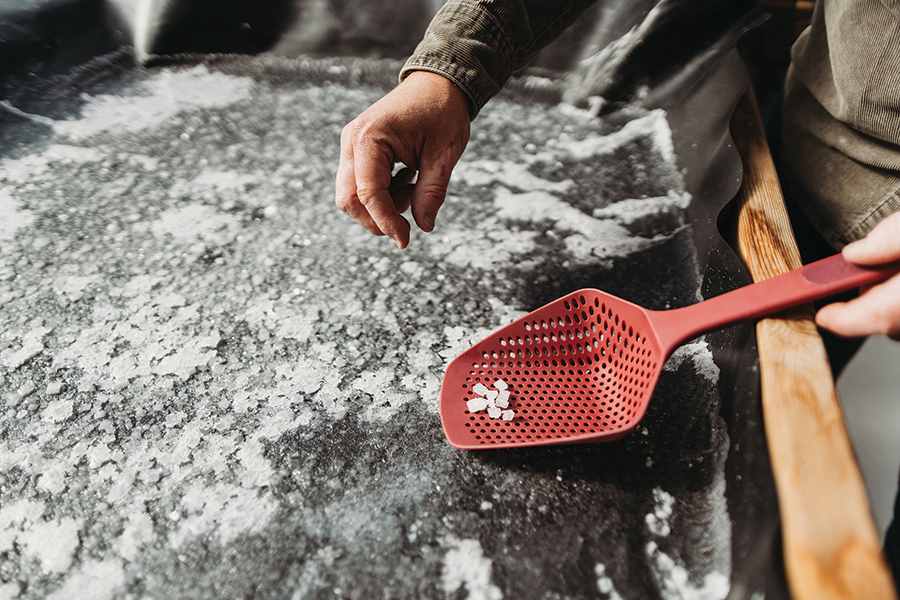
Jason picks up a small shovel and scoops up a load of crystals, which have hardened into countless geometric shapes, from squares to pyramids. Jeanette stands nearby. “I never get tired of this,” she says, her voice quiet as if she’s whispering a prayer. “Every time I witness it happen, it takes my breath away. It sits here with the sun and the heat until it’s ready to be harvested. We’re not doing anything to make this happen.”

While heat and evaporation are the final steps in creating salt, Jeanette and Jason actually do a lot to make it happen before it gets to that point. The venture begins in Wrightsville Beach, where, in a process and at a location that Jason and Jeanette are wisely hesitant to disclose, water is extracted from the ocean and pumped into a 275-gallon tank on the back of a trailer. From there, the water is transported to rural Burgaw and the 3-acre farm that Jason and Jeanette own. The water is then pumped from the trailer to a second tank, where gravity takes over and the real work begins. Jason and Jeanette fill tray after tray with water, kinking the hose to stop the flow while arranging the full trays on tables throughout the salt house. The trays will sit in the heat however long it takes for the water to evaporate, leaving nothing but the salt behind.

The labor can be taxing, and that’s before the harvesting and the blending of salt with other ingredients even begins, but Jeanette and Jason delight in the work. After all, the chance to spend as much time together as possible is what led them to step into the business of making salt.

“Whatever business we set out on, it had to get us together,” Jason says. “That was the most important thing.”

“It feels great because we’re passionate about this,” Jeanette adds. “And it’s the first time we’ve gotten to do something creative together.”

The two met on a blind date in Asheville. At the time, Jeanette was working in public health, and Jason was in sales for an outdoor provisions company. They both traveled a lot, and they wanted to spend more time together. Jeanette’s sister lived in Seattle, and so the young couple set their wagons west. They made a life in the Northwest, forging successful careers and raising two young children, and they soon realized that they were both interested in food, the growing of it, the preparing of it, and, of course, the eating of it. They also began experimenting with various ways of using different kinds of salts in their cooking.

While they loved living in the Northwest, they began to feel hemmed in by their careers and schedules and missed the sense of community they’d felt in the South. Jeanette was born and raised in Decatur, Georgia, and Jason just outside of Washington, D.C.

“We wanted to live close to the water,” Jason says. When they moved to Wilmington a couple of years ago, they began to look for a shared business opportunity they could devote themselves to. They learned that Amanda Jacobs, the founder of Sea Love Sea Salt, was looking to sell her growing business. When they met with Amanda, Jeanette brought along a salt recipe she had developed back in Seattle. While there were other suitors who wanted to purchase the business, “No one else brought Amanda a salt,” Jeanette says.

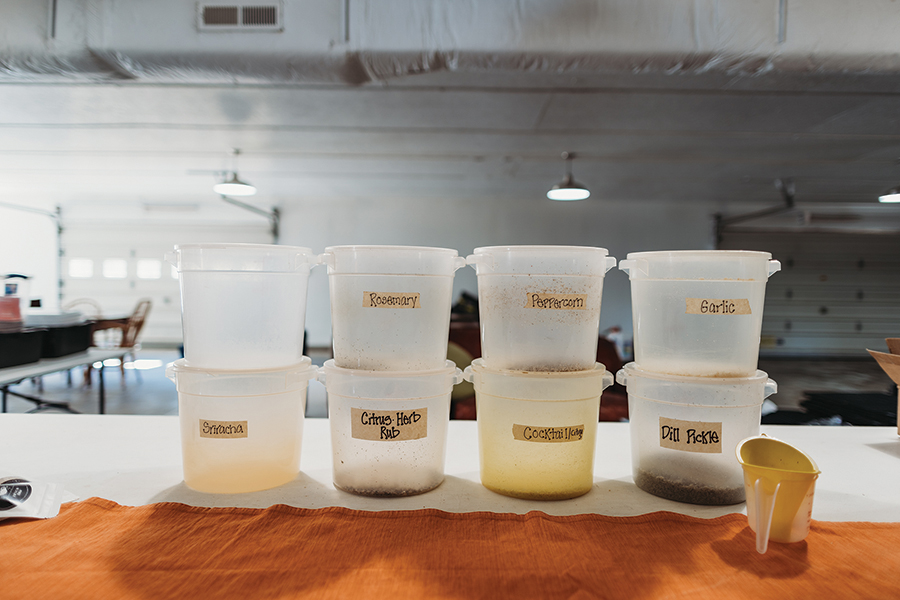
Since purchasing the company, Jeanette and Jason have worked to develop new salts to add to a lineup that already includes citrus, Sriracha, rosemary, dill pickle and others. Two flavors they brought with them from their experiences in Seattle are herb and fennel, and they regularly test various salts at local farmers   markets in Wilmington, tracking the responses of their customers. They also have a thriving connection with numerous local restaurants and breweries, most of whom pride themselves on sourcing local products, as do Jason and Jeanette. Almost all their salts are flavored with North Carolina-grown produce. 

Aside from developing new salts, Jeanette and Jason are planning to develop the land where the business sits. While it contains the salt house and a warehouse, they are building a hoop house to double their capacity — important during the winter, when the time it takes for water to evaporate goes from 10 days in the summer to as long as three weeks in the colder months, when days are shorter. They are planning to host farm-to-table meals featuring local chefs and artists, and are thinking of other creative ways to invite the community to this wooded, quiet piece of land.

Jason pours scoops of salt into fine mesh bags that he hangs from the ceiling, salt that could have begun on the other side of the world, now suspended from the rafters in rural North Carolina.

“People come here for the ocean,” he says. “This is giving them the chance to taste it.” PS

Wiley Cash is the Alumni Author-in-Residence at the University of North Carolina-Asheville. His new novel, When Ghosts Come Home, is available wherever books are sold.

PinePitch

Monument to Freedom

In 2021 ground was broken for the North Carolina Freedom Park in downtown Raleigh. Marsha Warren will speak on “Freedom Park: The Inspiring Story of How a Monument to Freedom is Built while Confederate Statures are Coming Down” on Sunday, Jan. 16, at the Weymouth Center for the Arts and Humanities, 555 E. Connecticut Ave., Southern Pines. Cost is $15 for Weymouth members and $20 for non-members. This is part one of a three-part lecture series. For more information go to www.weymouthcenter.org.

Swing Your Partner

The Carolina Pines Dance Club trips the light fantastic with swing, line, ballroom, shag and Latin dancing on Saturday, Jan. 15, at the National Athletic Village, 201 Air Tool Dr., Southern Pines. Lessons are available at 6:30 p.m.  The dancing goes until 9:30 p.m. Beginners, old hands, couples and singles are all welcome. Cost is $15. For information call (724) 816-1170. 

Tap Into This

The Sandhills Repertory Theatre presents “Jerry Herman on Broadway,” with amazing tap dancing — including a medley of hits from Hello, Dolly! and much more — at the Bradshaw Performing Arts Center, 3395 Airport Road, Pinehurst. Show dates are Jan. 9 at 2 p.m. and 6:30 p.m., and Jan. 10 at 1 p.m. Tickets are $35 for regular seating ($45 at the door) and $75 for VIP lounge seats. Students under 12 admitted free. For information and tickets go to www.ticketmeshandhills or www.sandhillsreporg.

Bluegrass Bonanza

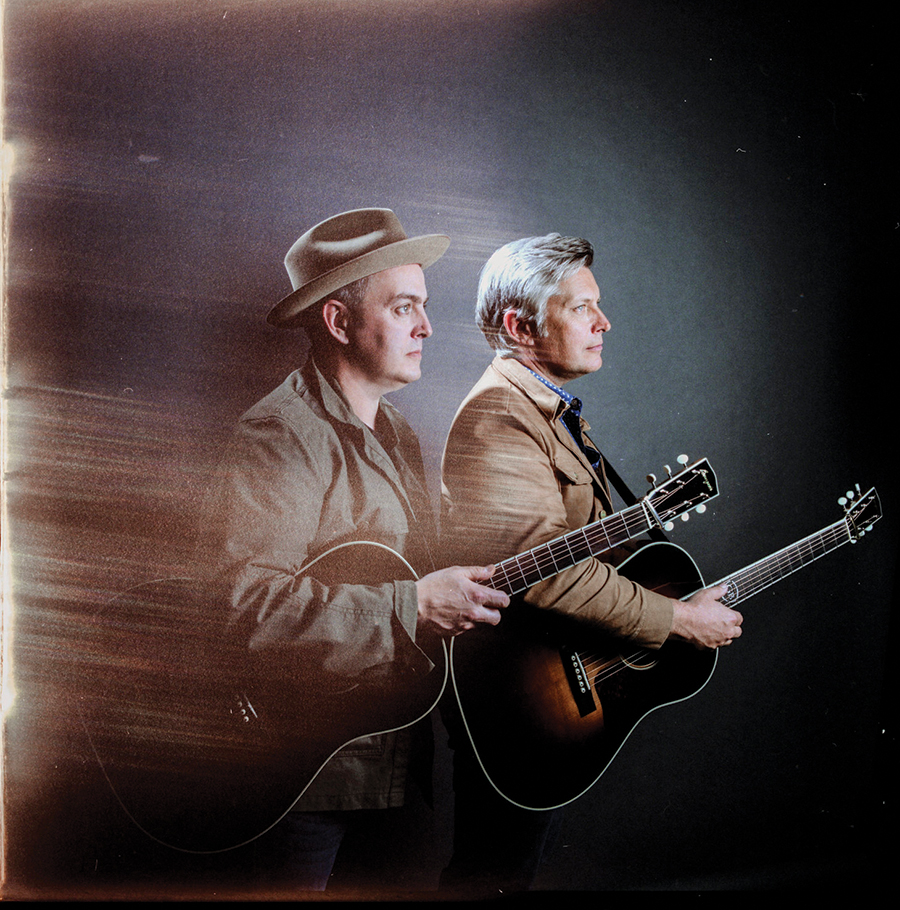
The Gibson Brothers, Leigh and Eric, perform with special guest Vickie Vaughn at 6:46 p.m. on Sunday, Jan. 2, at the Bradshaw Performing Arts Center, Owens Auditorium, 3395 Airport Road, Pinehurst. The brothers were named Entertainers of the Year by the International Bluegrass Music Association in 2012 and 2013. Tickets are $40-$45 and available at www.ticketmesandhills.com.

Warm Up Those Pipes

You can fight off the cold weather with a red-hot aria or two at the beginning and at the end of the month. The Sunrise Theater, 250 N.W. Broad St. in Southern Pines, will show the Met Opera performances of Cinderella at 1 p.m. on Saturday, Jan. 1, and Rigoletto at 1 p.m. on Saturday, Jan. 29. For more information visit www.sunrisetheater.com.

Southwords

Brrrrrrrrrr!

Freezing? Get used to it.

By Kate Smith

“Did you lose a bet?”

It was a little old lady out walking her dog. I’m in my bikini, wringing water out of my hair on the edge of a Whispering Pines lake. High on endorphins, I just laugh. “It’s good for me,” I say.

I’m not naturally hot-blooded. I don’t have the selkie genes — named for the seal folk of Norse mythology — we hear about in people who survive hours in glacial water. And I don’t have a high concentration of that metabolic unicorn, brown adipose tissue. In fact, I have a 97-degree average body temperature, am borderline anemic, and I hate the cold. But I’m trying to change that.

It started back in September. On gut instinct, I bought a used 9-foot longboard and taught myself how to surf. It was meditative medicine and nothing has kept me out of the water since. I don’t mind the rashes, skinned legs from wipeouts in broken seashells, sinuses raw with salt water, or bruises on my ribs. I’m not afraid of sharks, even after seeing one a few feet away on my second day in the water, and I’m not fazed by jellyfish stings or colliding with fishing lines. But as soon as winter hit, the cold has given me a run for my money.

I have Raynaud’s, an autoimmune condition that constricts the tiny blood vessels to my fingers and toes, making them go white and numb from cold exposure as insignificant as the produce aisle in the grocery store. Despite a full wetsuit with hood, gloves and boots, they still go numb, and it doesn’t take long before my dexterity nosedives, and then so do I. A lot.

Add to that the darkness of winter, and despite my best intentions, I’ve found myself huddled in my house for entire weekends, fatigued by the gloom and too cold to surf, the thing that helps the most. I hate the cold. But, really, I’m trying to change that.

I heard about this guy named Wim Hof. He climbed Mount Kilimanjaro in shorts and ran a half marathon above the Arctic Circle barefoot. I figured if this normal dude can train his body to thrive in the Arctic, I can certainly figure it out here in the South for the sake of getting back on my surfboard.

According to Wim, the process of cold adaptation is pretty simple. Do it, safely, until it doesn’t suck so much. The first time I waded into a cold lake, the water felt like razor blades. I dipped under, and came up with my heart pounding, muscles aching, and a little dizzy and disorientated. But when I got back to shore, the blood surged through my body, warming me completely, and brought with it a drug-like euphoria. So, I did it again. And every day since, it’s gotten easier. It’s still cold, but it’s not as painful, and it doesn’t take my breath away. In fact, it makes me feel almost invincible.

Turns out, that’s a normal reaction for cold-water swimmers. It’s evidence of something called cross adaptation. When your body adapts to the physical stressor of cold (or heat, or big changes in oxygen or pressure), you become more capable, physically and psychologically, to handle stressors outside your control. What doesn’t kill you really does make you stronger, and it might even bliss you out. Along with strengthening your immune system, cardiovascular system and metabolism, cold water adaptation floods your body with stress-relieving hormones. When you emerge from ice-cold water, your brain thinks you almost died, and it’s rewarding you for staying alive by making you feel positively giddy.

Swimming in cold lake water did indeed help my body rise to the physical challenge of winter surfing. Soon, I was back at it, albeit sporting one of the warmest wetsuits on the market. But cold water helped me rise to the challenge of my internal winter, too. Every time I surface from beneath and I see spring a little closer ahead, I get a shot of courage and hope.

If Mother Nature can’t stop me, nothing can.  PS

Kate Smith is the clinical herbalist and holistic health coach of Made Whole Herbs.

Hometown

The Suds Chronicles

When a cold one comes in downright handy

By Bill Fields

Some people abstain from alcohol during January, but I don’t think I will be one of them this year.

After getting a COVID-19 breakthrough infection in November and isolating at home for 10 days, one of my first stops upon recovering was for a beer in the tap room of my local — and excellent — craft brewery, Aspetuck Brew Lab. Along with the comfort of seeing familiar faces was the welcome taste of my favorite, Turbidity Lucidity, an American IPA.

The brewery says of TuLu that “this citrusy smooth, crushable IPA is capped off with a double dose of dry-hops and Simcoe and Mosaic lupulin power. Citrus-forward and crisp.” I just know that I like it.

The pleasure of that pint, the first I’d had in two weeks or so because I got sick, started me thinking about my beer life. It started with a sly (or so I thought) sampling of my father’s stash. I was 12, and Dad was in the hospital for a few days. While Mom visited him one evening, I built up the nerve to open one of the Budweisers on the bottom shelf of the refrigerator. So bitter and unappealing was the taste, I doubt if I consumed 2 ounces of the lager. I poured out the rest and put the empty in the outside trash can. I figured Dad wouldn’t notice there were now four cans in the fridge instead of five.

“I see you’ve been into my beer,” he said upon coming home.

“Didn’t like it,” I replied.

That would change in the ensuing years. I wasn’t much of an underage drinker — Dad being a police officer probably had something to do with that — but sure wouldn’t refuse an occasional beer from a friend when we left the Castle of Dreams disco on Tuesday teen night.

Upon turning 18 in 1977, a couple of friends and I were happy-hour regulars on Fridays at 21 Club on West New Hampshire Avenue in downtown Southern Pines. A cool, dimly lit place on a hot summer evening with $1.50 pitchers of Bud to pour into frosted mugs just about defined high living at that point in our lives.

Quantity trumped quality when it came to beer consumption during college in Chapel Hill, whether at Troll’s, Harrison’s or He’s Not Here. Only the place with the great name has survived the decades, but I’ll always remember a Friday afternoon journalism “class” at Harrison’s with the visiting journalist Tom Wicker. The North Carolina native, UNC graduate and New York Timesman held court for three Heinekens and lots of stories before excusing himself to attend another engagement.

I painfully had (way) more than three beers on a Saturday evening in 1985 in Cincinnati, prior to photographing the final round of the LPGA Championship the next day. Nancy Lopez won the tournament by a whopping eight strokes. My victory was making it through the hot afternoon despite a lethal hangover. It was a valuable lesson for the rest of my years on the golf tournament photography trail: all things in moderation, particularly on Saturday night.

I’ve had beers in the den of Curtis Strange, the first person I knew to have a keg in his home (being on the Michelob staff had its advantages, and there was no doubt he believed in the product). I drank a Rolling Rock on Arnold Palmer’s jet and went to a chicken-and-beer place (it’s a thing) with my South Korean hosts on a business trip there. Working at the Tokyo Olympics last year, our activities were restricted because of the pandemic. Fortunately, there was a 7-Eleven in our hotel complex that wasn’t off limits. A 7-Eleven in Japan is stocked with many items, including different kinds of beer, which wasn’t a bad thing to have on hand while watching Olympic rowing or table tennis at night on the Japanese channels.

That Yebisu tasted much better than the Budweiser I had 50 years earlier.  PS

Southern Pines native Bill Fields, who writes about golf and other things, moved north in 1986 but hasn’t lost his accent.


Photograph by Bill Fields