From the Archives

FROM THE ARCHIVES

The March King

By Audrey Moriarty

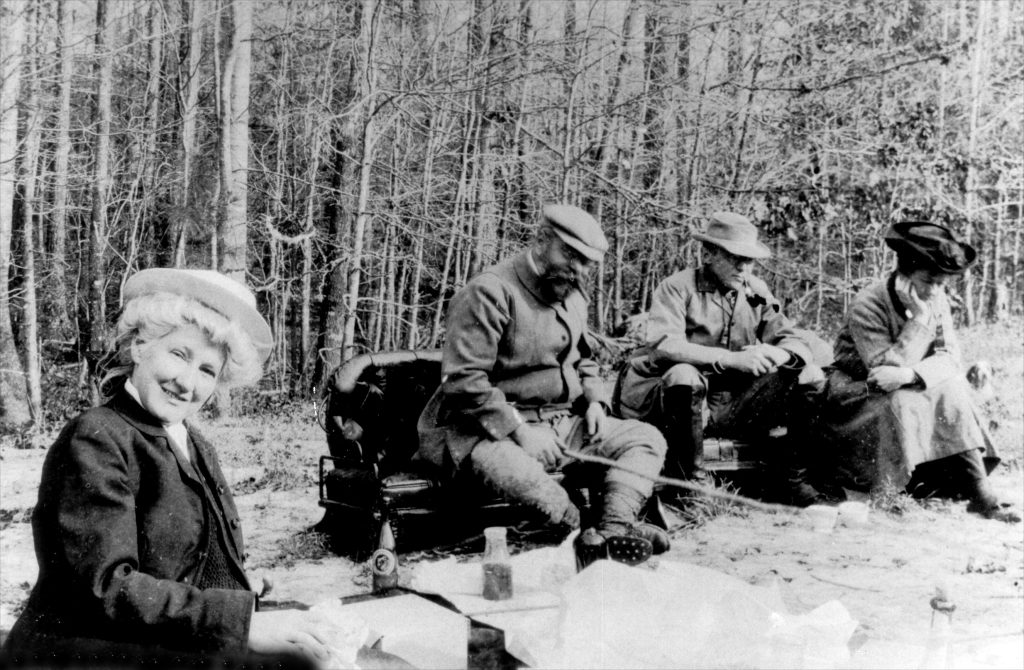
John Philip Sousa, recognized throughout the world as the March King, was a frequent visitor to Pinehurst and his friend Leonard Tufts. The composer of America’s beloved military marches was not, however, coming for the golf. In an early attempt at the game up North, an eyewitness report described Sousa’s numerous lost balls, two broken windows, the need for more than one forecaddie (he called them “Hook” and “Slice”) to keep track of his wildly errant shots, and “driving through two estimable ladies who happened to be playing on a neighboring fairway.” He was quoted as saying that he “would play golf once he was too old for any other physical activity.”

The 17th director of the U.S. Marine Band — and the first to record it on a phonograph — Sousa was the composer of “Stars and Stripes Forever,” “Semper Fidelis,” “The Liberty Bell” (oddly, the theme song for Monty Python’s Flying Circus) and over 130 other known marches. He came to Pinehurst for something far different than golf: He wanted to shoot trap at the Pinehurst Gun Club.

Sousa began shooting in 1906 and would become part owner of a 2,000-acre preserve near the village, though he considered the killing of animals for sport “wicked.” When an English minister read that Sousa had bagged a “number of pigeons,” he wrote a letter to him asking that he repent from the “murderous practice.” Sousa responded by sending a number of broken clay targets and suggesting that the minister broil them before eating.

When in Pinehurst, he and his wife, Jane, stayed at the Holly Inn, where they were well-liked. The Pinehurst Outlook described him as having a genial personality, a keen appreciation of humor and a natural gift for storytelling.

Sousa loved trap shooting and believed that “like love, trapshooting levels all ranks.” In 1919 he was the top shooter of the three-man Navy team in an Army vs. Navy competition in Pinehurst. He is in the Trap Shooting Hall of Fame, with a registered 35,000 targets. Sousa said, “ . . . that just about the sweetest music to me is when I call ‘pull,’ the old gun barks, and the referee, in perfect key, announces, ‘Dead.’”

Sousa’s last visit to Pinehurst was in1929. Three years later, on March 5, 1932, he conducted “Stars and Stripes Forever” while rehearsing for a concert in Reading, Pennsylvania, and died early the next morning at the age of 77. 

Omnivorous Reader

OMNIVOROUS READER

The Theft That Wasn’t

The tale of the lost and found Picasso

By Anne Blythe

Most of us have heard that old cliché “Kids say the darnedest things,” but few of us could imagine getting the kind of phone call that Whitcomb Mercer Rummel Sr. received in March 1969 from his eldest child. There was nothing cliché or cutesy about it.

“Hey, Dad, I accidentally stole a Picasso,” Bill Rummel said to his father nearly 57 years ago. What happened afterward is a bit of creative skullduggery that has been concealed in the annals of one family’s history far longer than one of the key participants would have liked.

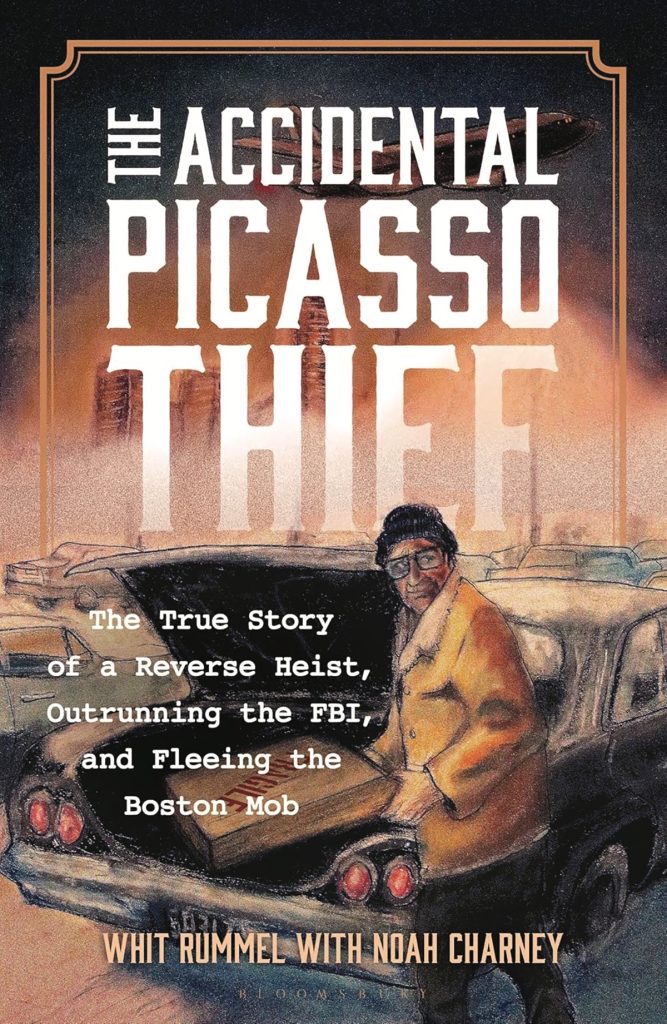
Whit Rummel Jr., a filmmaker who lives in Chapel Hill, and Noah Charney, an American art historian and fiction writer based in Slovenia, have written The Accidental Picasso Thief: The True Story of a Reverse Heist, Outrunning the FBI and Fleeing the Boston Mob to share that story with the rest of the world.

Disclosure: I have known Whit Rummel, the author, for many years, relishing in his stories and adventures. Although I’ve heard bits and pieces of this story before, this is the first time I’ve been able to soak it all in.

As Whit Rummel, the only surviving member of the trio that pulled off the so-called “reverse heist” writes, the book — part memoir, part true crime — “is the story of one of the oddest art crimes in American history.”

It’s a tale Rummel has wanted to share in full for decades but couldn’t — for reasons ranging from fear of the famous mobster Whitey Bulger, to respect for a brother’s wishes and a dogged hunt for the location of the painting. In June 2023 The New York Times ran a story titled “Hey Dad, Can You Help Me Return the Picasso I Stole?” but Rummel had more to say.

It begins in 1969. Whit Sr. was an empty-nester with his wife in Waterville, Maine. He was the owner of a popular restaurant near Interstate 95 and an ice cream store with in-house creamery serving up unique and enticing flavors like Icky Orgy.

Bill Rummel was in his mid-20s at the time, working as a forklift operator at Logan Airport in Boston moving crates around the world for Emery Air Freight. A historic snowstorm hit the East Coast, leaving chaos in its wake. As flights were delayed and diverted, Bill loaded several flats into the trunk of his car from pesky “orphan” piles clogging up the outbound area. Wrapped up in one of those flats was a Pablo Picasso original, Portrait of a Woman and a Musketeer, that was en route from Paris to a gallery owner in Milwaukee.

Unlike his younger brother, Whitcomb Mercer Jr., Bill wasn’t particularly interested nor appreciative of art and didn’t realize a valuable painting was in his possession. When he found out what he’d inadvertently done, he called his brother, a passionate art lover, who was at Tulane University at the time. After several phone calls, Bill and Whit decided it was time to call their dad, a man they called “the fixer.”

Whit Sr. and his wife, Ann, had moved to Maine in the ’50s and raised their sons there. The boys had a mischievous streak in them, perhaps inherited from a father who relished taking them on “wild goose chases.”

Whit and Bill, now in young adulthood, needed their father’s guidance. What should they do with the stolen Picasso? This was no wild goose chase. They had heard the FBI was on the hunt for the painting. To make matters worse, rumor was that Whitey Bulger’s notorious Winter Hill Gang also was searching for it, threatening anyone trying to move in on their airport turf.

“Our father, after all, was the grand fixer. The one guy who’d always been there for us, pulling us out of whatever kind of jam we’d found ourselves in (and there had been many),” Whit writes. Their dad reeled off several options. One was keep the painting, bury it under the floor of the Waterville restaurant and uncover it some years later, feigning shock and surprise. The other option? “He said maybe there was a way to return it. Without letting anybody know who took it,” Bill told his brother.

That’s the option they chose. Whit Jr. got instructions from his dad. “I want you to write a brief note to accompany the return of the painting,” his dad said. “Nothing long or complex. Just a few mysterious sentences to put them off the track of someone like Bill.”

To this day, Whit chuckles at the note he composed with intentional “grammatical quirks.”

PLEASE ACCEPT THIS TO
REPLACE IN PART SOME OF THE PAINTINGS REMOVED FROM MUSEUMS ACROSS THE COUNTRY. —  ROBBIN’ HOOD.

Whit Sr. and Bill would don costumes, fake mustaches and fedoras, get in a Chevy Impala and set off to return the Picasso at the Boston Museum of Fine Arts. An unexpected sighting of an employee near the loading dock upset their plans, but eventually the painting made it to the museum. A blurb announcing its return was in the news, and the Rummels went on with their lives, though their dad would die suddenly just a few years later, in 1972.

As the years went by Whit wanted to make a movie about the unwitting theft, but his brother wanted it to remain a secret, though Bill did do an interview about the incident with This American Life that never aired. He passed away in 2015.

There are some differences in the version Bill told then and what Whit remembers from their phone calls when his brother first told him he had “a friggin’ Picasso.” In the book, Whit shares both versions of how his brother recounted coming into possession of the crate. Though Whit never accuses his brother of knowingly taking the painting, he acknowledges there could be doubts about his intentions.

The book details the surviving Rummel brother’s search for the painting now and his hope to one day have his picture taken in front of it with his son, another Whit Rummel, and a nephew who shares their name, too. If that were to happen, the three — named for “the fixer” — would be “smiling proudly and loudly now, because our story has finally been told.”

For anybody who cares about art, the creation of it, and the quirkiness that makes families special, it’s a story worth telling, reading and even telling again.

Bookshelf

BOOKSHELF

February Books

FICTION

This Is Not About Us, by Allegra Goodman

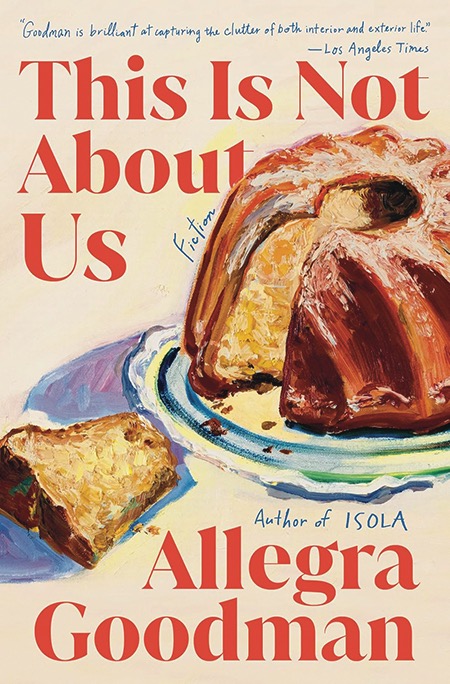
Was this just a brief skirmish, or the beginning of a 30-year feud? In the Rubinstein family, it could go either way. When their beloved older sister passes away, Sylvia and Helen Rubinstein are unmoored. A misunderstanding about apple cake turns into decades of stubborn silence. Busy with their own lives — divorces, dating, career setbacks, college applications, bat mitzvahs and ballet recitals — their children do not want to get involved. As for their grandchildren? Impossible. Sharply observed and laced with humor, This Is Not About Us is a story of growing up and growing old, the weight of parental expectations, and the complex connection between sisters.

Family Drama, by Rebecca Fallon

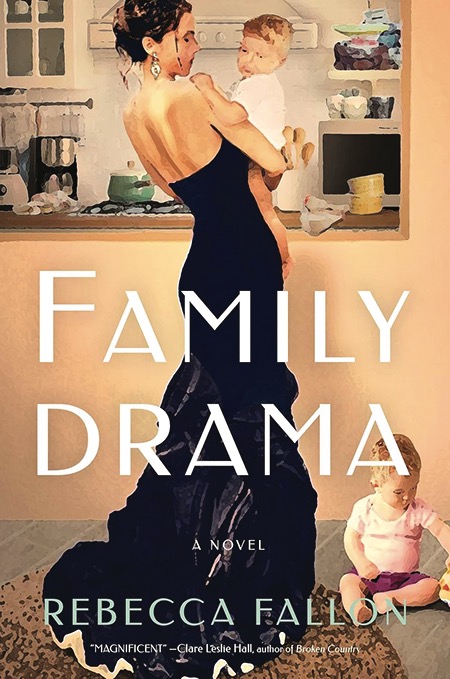
It’s 1997, and snow is blanketing a New England beach. Two befuddled 7-year-olds watch as their mother’s body is tipped overboard from a crumbling boat. A Viking funeral, followed by a raucous wake. A sendoff fit for a soap opera star: Susan Bliss. Fifteen years earlier, Susan is a blazing, beautiful young woman, passionate about her art. It’s impossible not to fall in love with her, and so Alcott, a practical professor, does— hopelessly. And so begins the love story of Susan’s two-paneled life: an unconventional, jetlag-filled arrangement that takes her back and forth between her life in New England as a wife and mother to young twins, to the bright lights of Los Angeles, where she becomes the beloved star of a daytime soap. In the present, Susan’s twins grow up in the shadow of her all-consuming absence. Sebastian, a sensitive artist, cleaves to her memory, fascinated with the artifacts of her starry past. Viola, resentful of her mother’s torn allegiances, distances herself from the memories of her. But when Viola runs into her mother’s old co-star Orson Grey — now a renowned Hollywood star — she finds herself falling deeply in love with him and begins to put together the pieces of a mother she never really knew.

NONFICTION

The Powerful Primate: How Controlling Energy Enabled
Us to Build Civilization,
by Roland Ennos

From our bipedal ancestors wielding simple tools to modern humans mastering complex machinery, Ennos takes us on a gripping journey through the evolution of human dominance. Learn the fascinating history of how humans have progressively harnessed energy from sources such as wood, animals, water, wind, sun, fossil fuels and even atomic nuclei to fuel our rise as the most powerful species on Earth. Our ancestors’ ability to hit harder, throw farther and cut deeper than any other animal laid the groundwork for the development of agriculture, industry, and ultimately, modern civilization. Yet, this power has come at a cost: Environmental degradation and societal challenges have arisen from our relentless pursuit of energy and technological advancement. There is hope, however: The same engineering skills that have brought us here can pave the way for a more sustainable future.

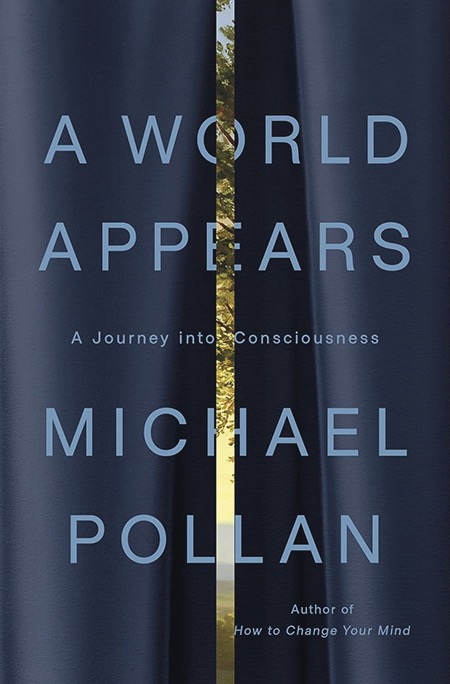
A World Appears: A Journey into Consciousness,
by Michael Pollan

The fact that we have subjective experience of the world remains one of nature’s greatest mysteries. How is it that our mental operations are accompanied by feelings, thoughts and a sense of self? In A World Appears, Pollan traces the unmapped continent that is consciousness, bringing radically different perspectives — scientific, philosophical, literary, spiritual and psychedelic — to see what each can teach us about this central fact of life. When neuroscientists began studying consciousness in the early 1990s, they sought to explain how and why three pounds of spongy gray matter could generate a subjective point of view — assuming that the brain is the source of our perceived reality. Pollan takes us to the cutting edge of the field, where scientists are entertaining more radical (and less materialist) theories of consciousness. In a dazzling exploration of consciousness, he discovers a world far deeper and stranger than our everyday reality.

CHILDREN'S BOOKS

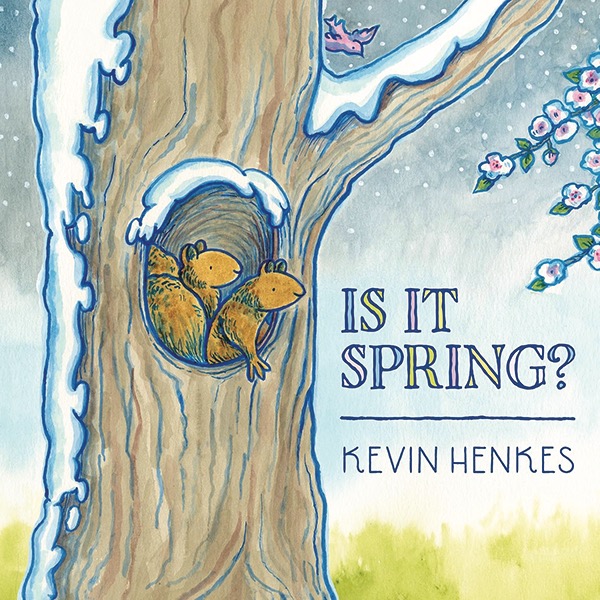
Is It Spring?,
by Kevin Henkes

A masterful and classic picture book that combines an evocative call-and-response text with delicate and lovely illustrations, readers will be left assured that the sun — and spring — will always come again. (Ages 4-8.)

The Lions’ Run, by Sara Pennypacker

Petit éclair. That’s what the other boys at the orphanage call Lucas DuBois. As tired of his cowardly reputation as he’s tired of the war and the Nazi occupation of his French village, Lucas longs to show how brave he can be. He gets the chance when he saves a litter of kittens and brings them to an abandoned stable. Lucas begins to realize they are not the only ones in the village with secrets. Emboldened by the unlikely heroes all around him, Lucas is forced to decide how much he is willing to risk making the most courageous rescue of all. (Ages 8-12.)

The Rare Bird, by Elisha Cooper

The imagination of one housecat takes him to unexpected adventures as he dreams of spreading his wings as a “Rare Bird.” A Rare Bird can do anything! Fly fast through the forest, or splash in the bird baths, or meet animals from faraway lands . . . Readers will fall head over heels for this extraordinary tale of dreaming, the power of imagination, and the freedom of creativity. (Ages 4-8.)

Poem February 2026

POEM

February 2026

Past Life

On the night you read my cards, 

you told me the spiraling moth

was my dead grandfather but you did not 

tell me we’d be lovers, had been lovers 

since the first sound waves collided 

on the ocean floor. 


Now I know why I felt like crying

when you traced the lines across my palm.

Why you looked away when the fire hissed.

If you’d kissed me, I would have kissed back. 


When I left the dead moth for you 

in the morning, paper wings outstretched

like a faerie scroll across the Three of Swords, 

I did not know I was seeing my future, 

spiraling toward your light until the end.

          — Ashley Walshe

Vinegar Valentines

VINEGAR VALENTINES

Vinegar Valentines

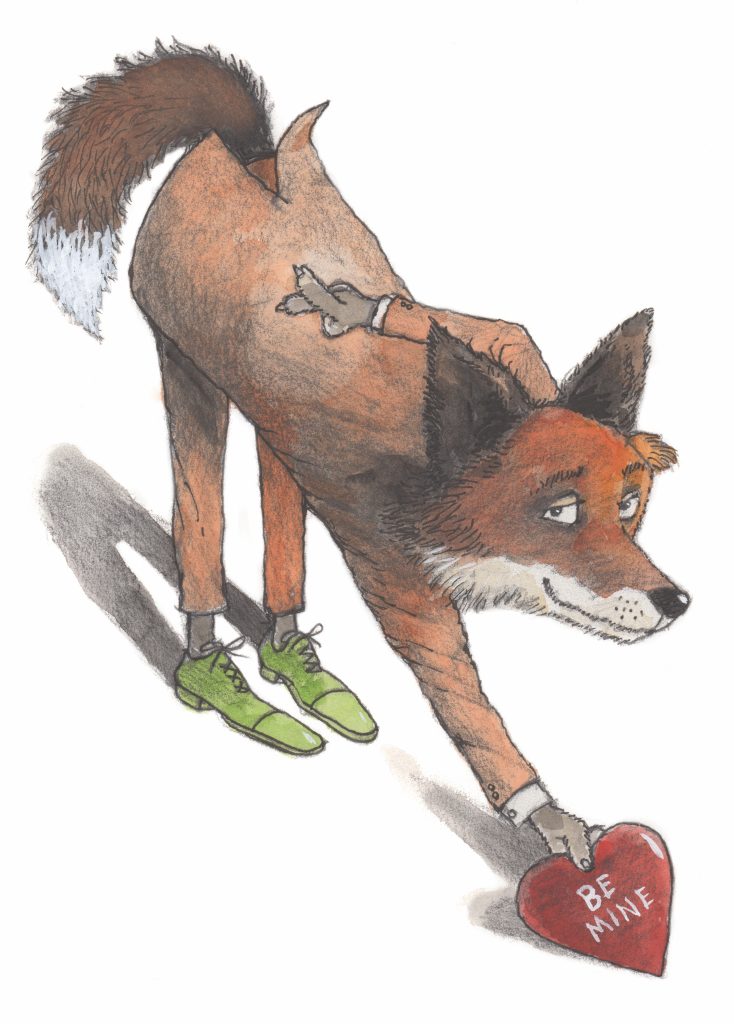
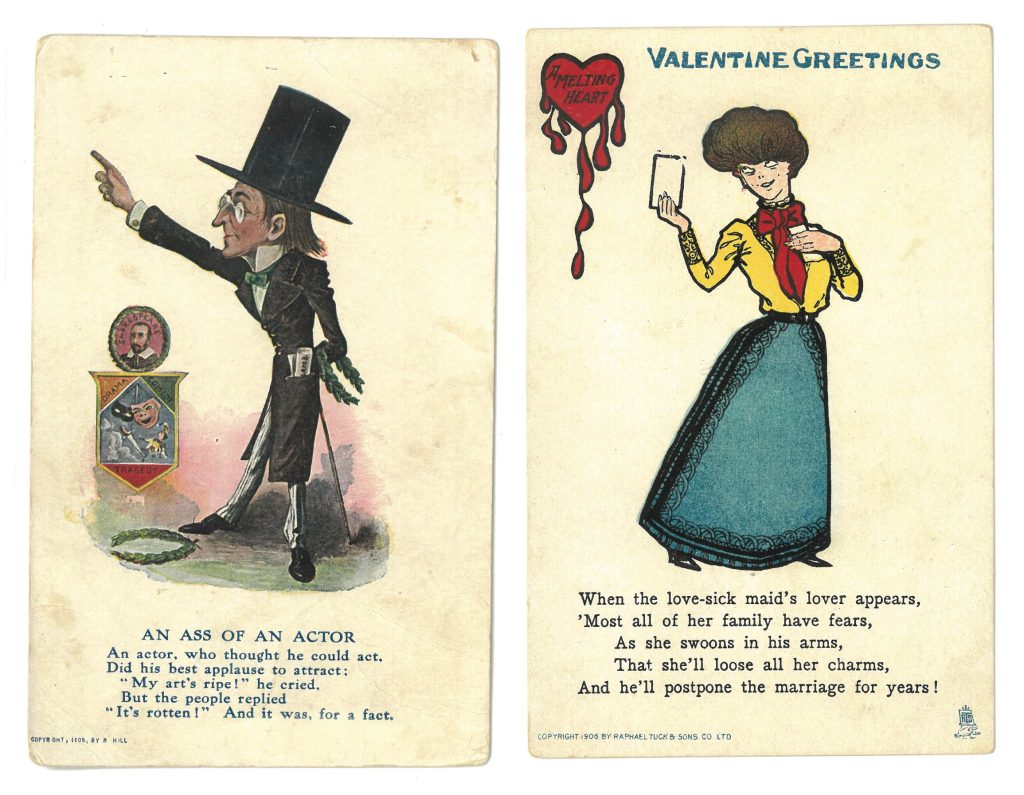
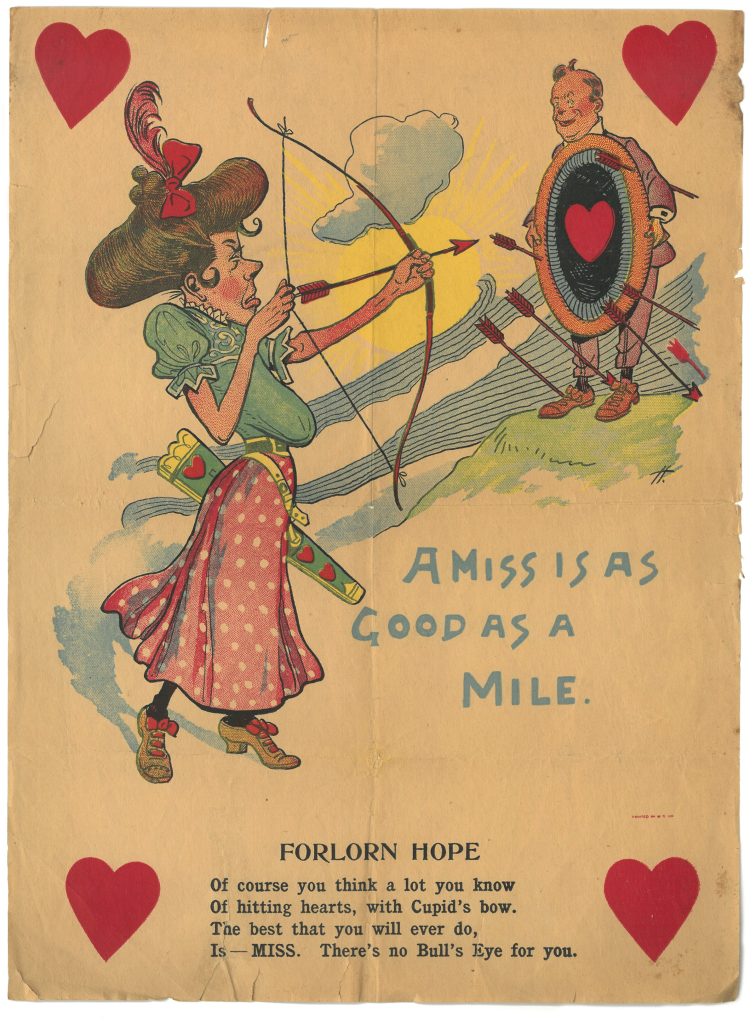
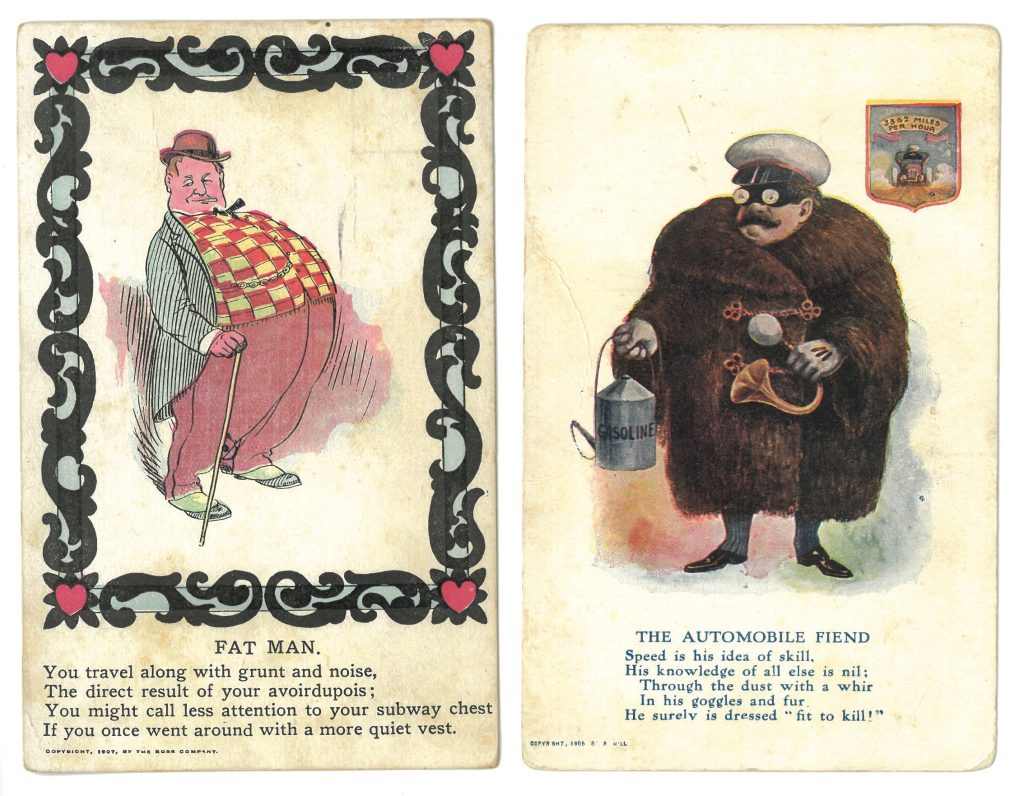
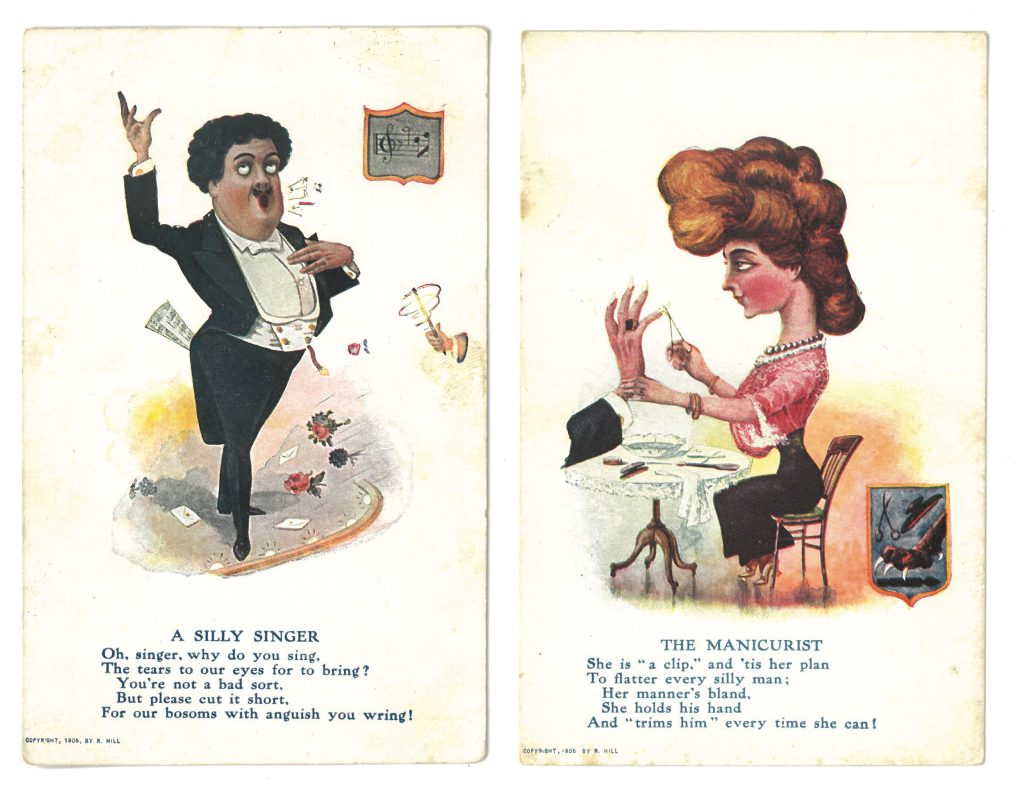
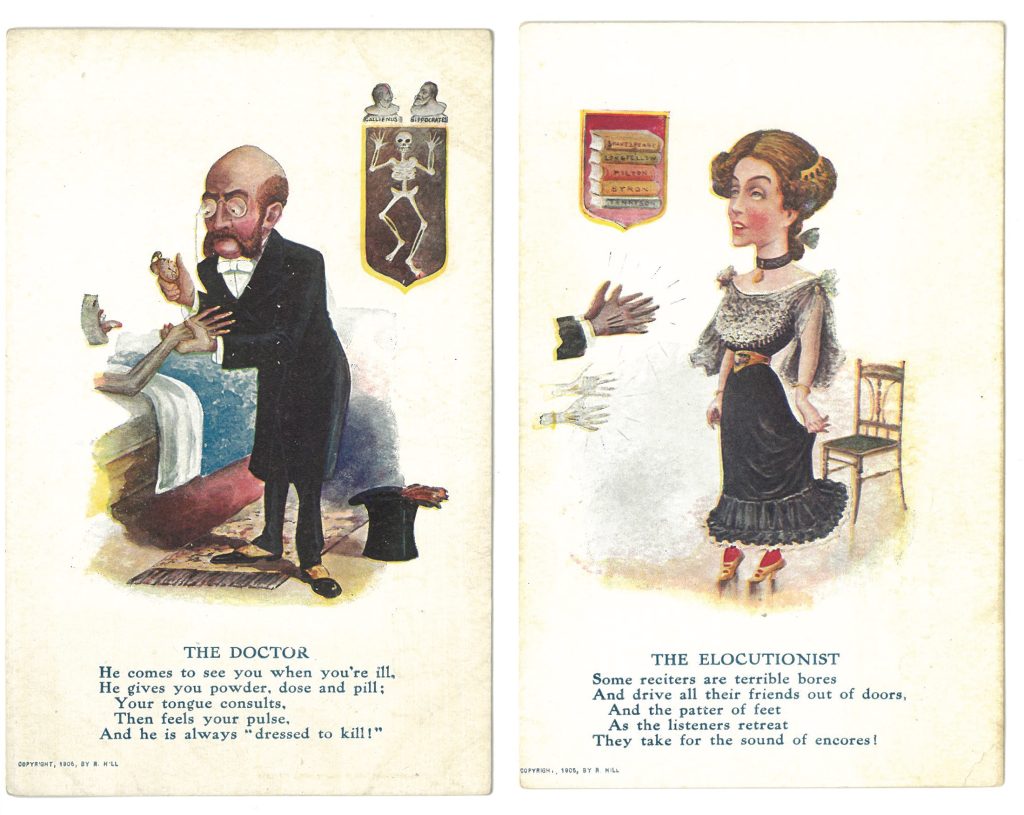
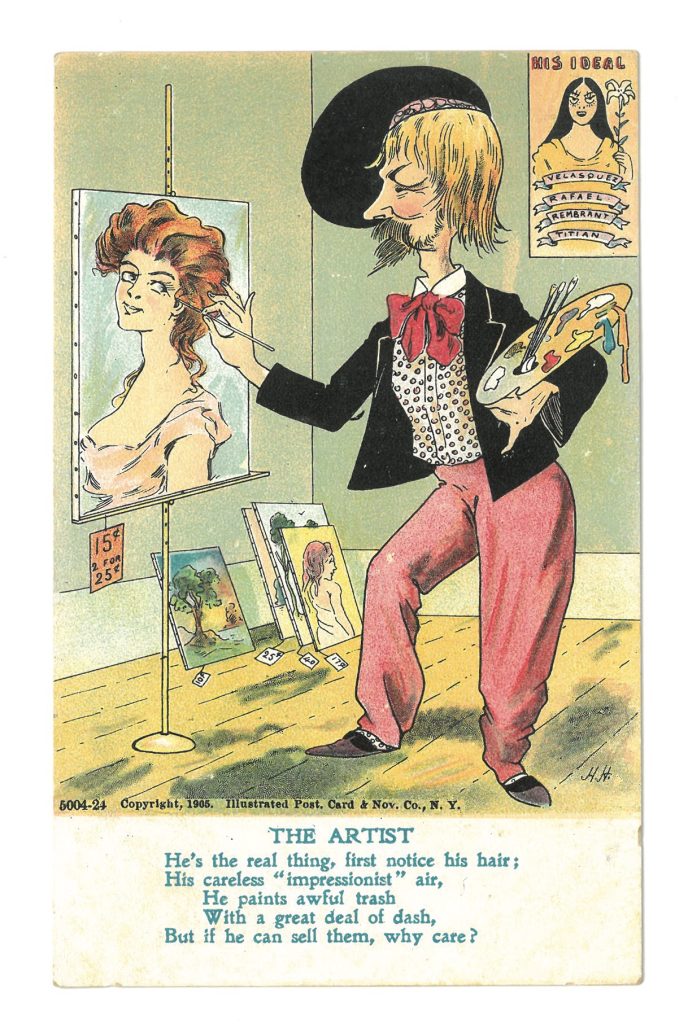
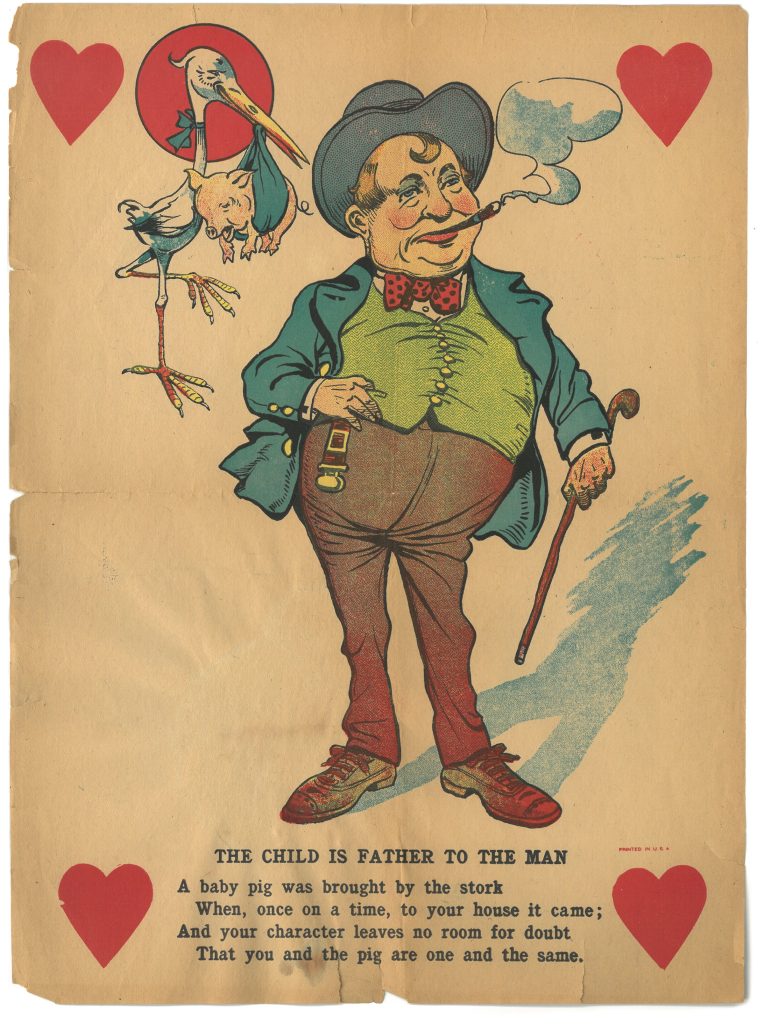
When matters of the heart are in decline There’s sure to be a warning sign. The postman rings twice In your fool’s paradise Delivering your vinegar valentine.

Illustration by Harry Blair

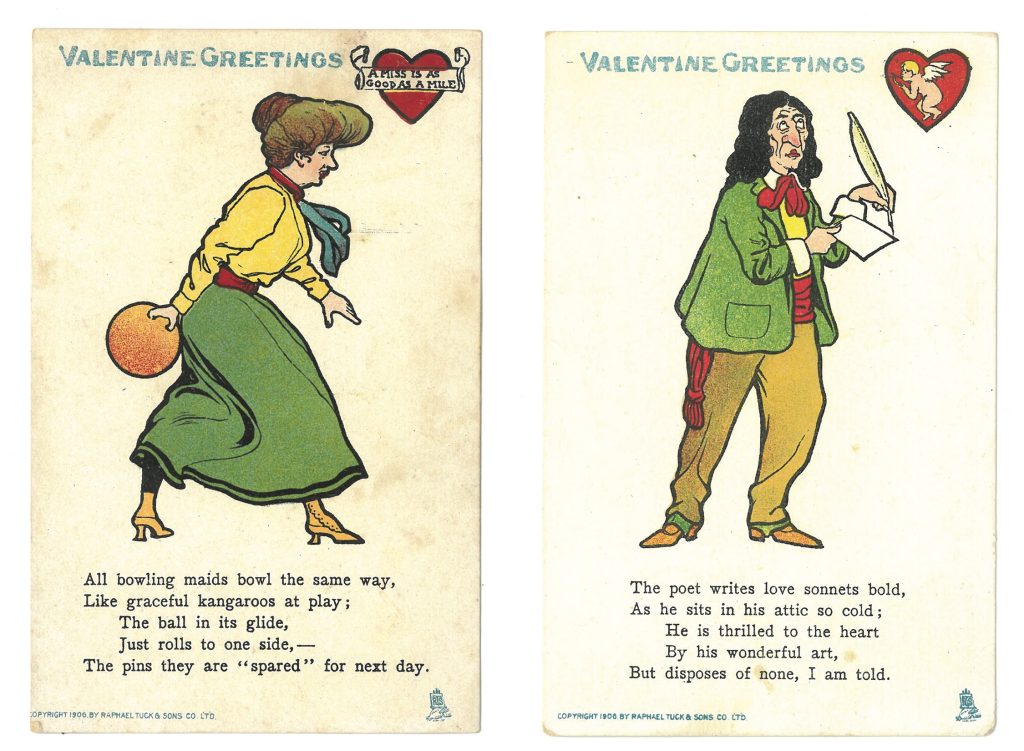
Is there an easier holiday to lampoon than Valentine’s Day? We’re betting the answer is “No.” As proof, here is a collection of “Vinegar Valentines.” The cynical, sarcastic cards began to appear in the middle to late 1800s. By the turn of the century cartoonists were creating their own lines. Most of the cards reproduced here — with the exception of our contemporary “Postman” — were published in the early 1900s.

PinePitch January 2026

PINEPITCH

January 2026

Between the Covers

Enjoy a trio of January book talks beginning at noon on Thursday, Jan. 8 when Jack Kelly discusses his book Tom Paine’s War: The Words That Rallied a Nation and the Founder for Our Time virtually with Kimberly Daniels Taws at The Country Bookshop, 140 N.W. Broad Street, Southern Pines. Then, at 6 p.m. on Wednesday, Jan. 14, Ford S. Worthy will talk about his book In Search of a Boy Named Chester, also at The Country Bookshop. Last, but certainly not least, Donna Everhart will engage in a discussion about her book Women of a Promiscuous Nature, in the Boyd House at the Weymouth Center for the Arts & Humanities, 555 E. Connecticut Ave., Southern Pines. For information and tickets for all three events go to www.ticketmesandhills.com.

A World of Magic

Erikson Herz knew from the age of 12 that magic was his calling, but the journey is about more than just tricks and illusions — it’s about connecting with people through wonder and imagination. You can catch his act at BPAC’s Owens Auditorium, 3395 Airport Road, Pinehurst, at 7 p.m. on Friday, Jan. 30. For information and tickets go to www.ticketmesandhills.com.

It’s Baaack!

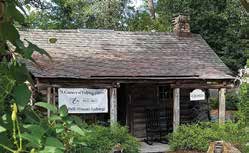
OK, maybe it’s still winter, but the Sandhills Woman’s Exchange will warm things up when it reopens for the spring season beginning on Wednesday, Jan. 28. The gift shop hours are from 10 a.m. to 3 p.m., and the cabin café will be serve up lunch from 11 a.m. to 2 p.m. For information go to www.sandhillswe.org.

Send in the Symphony

The North Carolina Symphony will perform A Little Night Music on Thursday, Jan 29, at 7:30 p.m., in BPAC’s Owens Auditorium, 3395 Airport Road, Pinehurst. The Stephen Sondheim musical, originally performed on Broadway in 1973, includes the popular song “Send in the Clowns,” written for Glynis Johns. For more information go to www.ticketmesandhills.com.

Strawberry Fields Forever

“Yesterday and Today: The Interactive Beatles Experience” returns to BPAC’s Owens Auditorium, 3395 Airport Road, Pinehurst, beginning at 7 p.m. on Friday, Jan. 16. The band, anchored by brothers Billy, Matthew and Ryan McGuigan, performs as themselves and leave the song choices completely up to the audience. The set list is created as the show happens, and the songs make up the narrative for the evening. Every show is different, every show proves that The Beatles’ music truly is the soundtrack to our lives. For tickets and information go to www.ticketmesandhills.com.

Ruth Pauley Lecture Series

The always thought-provoking Ruth Paul Lecture Series continues with Dr. Deigo Bohórquez, an associate professor of medicine and neurobiology at Duke University, delivering a presentation on “The Gut-Brain Connection and Neuropods” on Tuesday, Jan. 20 at 7 p.m. in BPAC’s Owens Auditorium, 3395 Airport Road, Pinehurst. A pioneer and leader in the field of gut-brain biology, Bohórquez focuses on how the brain perceives what the gut feels, how food in the intestine is sensed by the body, and how a sensory signal from a nutrient is transformed into an electrical signal that alters behavior. In 2025, he was awarded the Presidential Early Career Award for Scientists and Engineers from President Joe Biden, the highest honor bestowed by the United States government on outstanding early-career scientists and engineers. For tickets and information go to www.ticketmesandhills.com.

We’re Not in Kansas Anymore

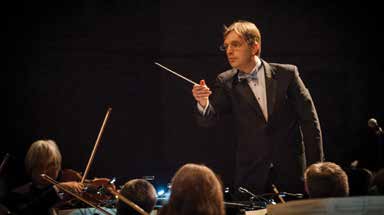
Experience a world where film and music become one when The Carolina Philharmonic, under the direction of Maestro David Michael Wolff,  performs the iconic Wizard of Oz soundtrack live-to-picture in two performances — at 3 p.m. and 7:30 p.m. — on Saturday, Jan. 24, in BPAC’s Owens Auditorium, 3395 Airport Road, Pinehurst. For further information go to www.carolinaphil.org. or call (910) 6897-0287.

Reelin’ in the Years

Get swept up in a night of smooth rock at 7 p.m. on Friday, Jan. 23, when Dirty Logic, the Steely Dan tribute band known for its impeccable musicianship and faithful recreations of the Donald Fagen and Walter Becker jazzy grooves, lush harmonies and razor-sharp lyrics, takes the stage at the Sunrise Theater, 250 N.W. Broad St., Southern Pines.  Tickets are as affordable as $39 to get through the door, up to $139 for the VIP, dinner, drinks and premier seating treatment. For more information and tickets go to www.sunrisetheater.com.

Meet the Met

The Met has assembled a world-beating quartet of stars for the demanding principal roles in Vincenzo Bellini’s 1835 opera I Puritani on Saturday, Jan. 10, at 1 p.m. at the Sunrise Theater, 250 N.W. Broad St. Southern Pines. Soprano Lisette Oropesa and tenor Lawrence Brownlee are Elvira and Arturo, brought together by love and torn apart by the political rifts of the English Civil War. Baritone Artur Ruciński plays Riccardo, betrothed to Elvira against her will, and bass-baritone Christian Van Horn portrays Elvira’s sympathetic uncle, Giorgio. For info and tickets go to www.sunrisetheater.com.

Bird Man

BIRD MAN

Bird Man

On a mission to help save a species

By Jenna Biter

Photographs by John Gessner & Todd Pusser

“Ive always been interested in birds,” Dr. Joseph H. Carter III says, as matter-of-fact as his graying hair and beard.

The ecologist looks out from a pair of rimless glasses. He’s reclined in a dark leather chair with a knee propped up on a dark wooden desk opposite a fireplace framed by white tiles painted with mallards and other birds. A stuffed-animal opossum stares down from a shelf. Volumes including Saving Species on Private Lands and Manual of the Vascular Flora of the Carolinas line the wall behind him. “I started my life list of birds when I was 13.”

A birder’s “life list” is precisely what you’d think. It’s a running total of all the species they’ve spotted and identified. Carter has tallied 300 and some. “It’s really not that many,” he says. Most of the birds on his list are local to North Carolina, the place where his interest took flight.

Amassing an eyepopping number — say, a thousand or more — hasn’t been Carter’s life mission. That was reserved for one species in particular, the red-cockaded woodpecker.

After earning a degree in biology from the University of North Carolina at Wilmington and graduate degrees from North Carolina State, Carter launched his environmental consulting firm, Dr. J.H. Carter III & Associates, in 1976, when he was 26 years old. His first contract was with the North Carolina Department of Transportation consulting on the four-laning of U.S. 421 north of Wilmington.

It was in the Sandhills, where he grew up, that Carter’s devotion to the once-endangered (now-threatened) red-cockaded woodpecker transformed into one of the largest, longest-running research studies of any one species. The Sandhills Ecological Institute, a nonprofit organization Carter founded in 1998, helps run the study and is located next to his consulting firm on Midland Road.

Carter spent his boyhood in Southern Pines distracted by the flash of feathers. “I’d be watching out the windows at school,” he says. “Every day I wrote down every bird I saw, even if it was a starling or whatever.”

After school let out, Carter continued his birdwatching exploits at home. He’d walk into the family house on the “Little Nine” — the Southern Pines Golf Club’s now fallow nine holes — and right back out with binoculars dangling from his neck, disappearing into the woods bubbling with creeks and swamps in the swaths of nature the golf course didn’t occupy.

“My first pair of binoculars were my dad’s. He was in the Navy in World War II and brought his nautical binoculars back. They were about this . . . ” Carter says, measuring a great distance between his hands, “and weighed about seven or eight pounds. I probably did permanent damage to my neck wearing those things.”

Carter began banding birds when he was out of school with mononucleosis. “I got a banding permit from the federal government and just dove in,” says Carter. In the ’60s, it wasn’t difficult to acquire a permit for yard banding. Today, a citizen scientist needs to be involved with a research project to tag birds.

Carter set up a system of feeders and super-fine “mist nets.” Attracted by the food, the birds would fly into the nets, safely and temporarily captive. Carter took measurements, weighed the birds, distinguished the sex if he could, banded them and turned them loose. “I banded everything that came to the feeders,” he says. “Every day it was sunup to sundown — band, band, band, band.”

That winter Carter tagged more than 300 evening grosbeaks, 400 pine siskins and 900 purple finches traveling from Canada in a winter finch invasion. After he recovered from his illness, his hobby remained. He zigzagged across the Sandhills banding with his birder-mentor, a woman named Mary Wintyen. After getting his driver’s license, his territory expanded: Drowning Creek, Little River, the local lakes.

“I was going to the lakes looking at the waterfowl,” Carter says. “Other kids were doing teenage stuff. I was out there crawling around in the woods, trying to find neat things. I kept up with snakes and salamanders and all that stuff.”

But neither snakes nor salamanders — not even waterfowl, northern finches or other birds — would weave through Carter’s life like the red-cockaded woodpecker, a species he saw for the first time in September 1963 near the 12th green of the golf club.

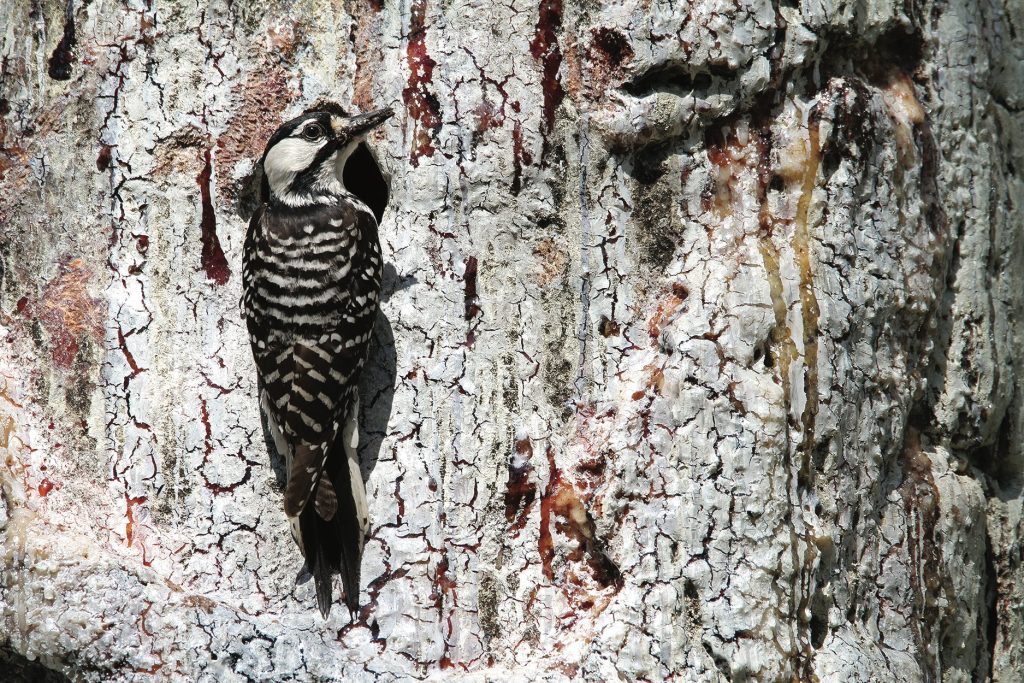
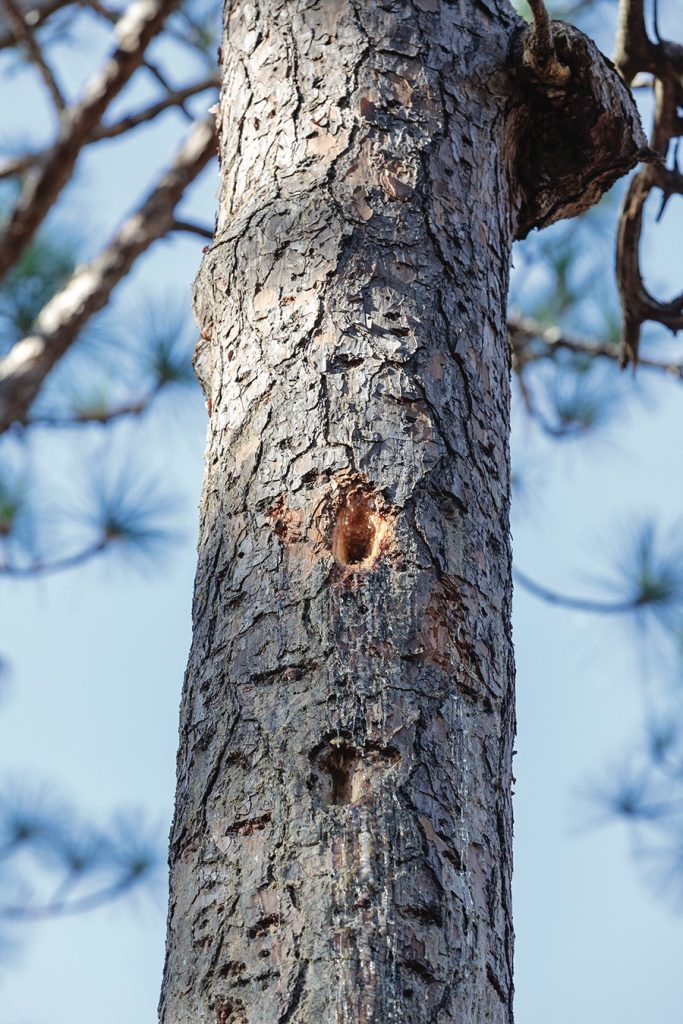
Red-cockadeds are smallish woodpeckers, slightly longer than a new No. 2 pencil from eraser to the blunt end. The birds are almost entirely black and white, but the males wear a cockade, a tuft of red feathers on each side of its head, that gives them their name. Native to forests across the southeastern United States, their homes of choice are old longleaf pines, where they’ll peck themselves cozy cavities in which to roost and nest.

“After they make a cavity, they dress up the tree, and the tree gets a reddish appearance. Then they peck what we call resin wells in the tree,” Carter explains. “Because the tree’s alive, it bleeds resin, and it eventually turns the tree white. We call them candlesticks in the forest.”

If the sap has dulled to a dirty, yellowish gray, the red-cockaded woodpeckers have vacated long ago. Carter remembers seeing abandoned cavities while crisscrossing Moore County with Wintyen. “You’d see them on the golf courses. You’d see them on the side of the road,” he says. Birds were still active but their numbers seemed to be declining, and Carter was curious.

“I’ve been interested in the red-cockaded woodpecker since I was 15. That was when the first paper I co-authored was published in our Carolina Bird Club journal, the Chat,” says Carter. He and Wintyen wrote the paper for the bulletin in 1965. They described the cavities they’d seen. Where they were. What they were like. Only one nest, possibly two, was active, and Carter didn’t know the cause of the species’ decline. At the time, it wasn’t clear.

“One thing just built on another and the woodpecker got listed as an endangered species,” he says.

Congress protected the bird under the Endangered Species Act of 1973. It was around then that Carter graduated from UNCW and applied to NC State for his master’s degree. Initially rejected, he decided to plead his case in person and pitch his plan for a sweeping study of a the red-cockaded woodpecker. “Survey everything, tag all the trees, catch all the birds, band all the birds, and then just track what was going on to answer some of these questions: Why are the birds decreasing? How many are there? All the basic demographic questions you need to answer,” Carter says, outlining the elephant-size task.

The secretary for the head of the Zoology Department was out, but Carter could see that the head of the department himself — Dr. David E. Davis — was in his office, seated just around the corner. “He spoke, like, six languages. He could lecture in Russian. He’s way, way up there,” Carter says. “I asked if I could talk to him and he said yes. I sat down. I didn’t know I was supposed to be scared of this guy. He listened, thanked me and sent me on my way.”

Later Carter got a phone call from an ornithologist he knew at NC State. So long as he could finish his master’s in a year, he was in. He began surveying Southern Pines, Pinehurst, McCain, the northern part of the Sandhills Game Lands and the western part of Fort Bragg. “It was getting a population estimate as well as being able to characterize the habitats they were in. You know, how old were the pines? How dense were the pines? How much of a midstory, scrub oaks and whatever?” Carter says. “So I did all that and then I graduated with my master’s degree.”

Banding the birds would have to wait until a sprawling study was funded. “We started banding in ’79,” Carter says. The grant secured money for red-cockaded woodpecker research across 400 square miles of the Sandhills. Originally the study lived at NC State. Eventually it moved to the Sandhills Ecological Institute, which was founded and runs — with the help of Carter — to study and preserve the longleaf pine ecosystem.

Through decades of bands-on-birds, boots-in-field research, scientists could finally answer the whys behind the red-cockadeds decline, a mystery that long ago grabbed the attention of a self-admitted obsessive teen. Loss of habitat was one factor: Across the centuries, tens of millions of acres of longleaf pine had been logged. Moreover, the policy of total fire suppression, adopted in the 20th century, was harming the biodiversity of the still-standing longleaf forests.

In retrospect, Carter knew something was off since the time he was just a curious kid exploring the woods with his dad’s old binoculars. There were no birds to see where turkey oaks and vines and shrubs crowded a pine forest’s midstory. But the aha moment didn’t come until years later when Carter surveyed Fort Bragg’s blast sites, where fire was the way of things. “All of a sudden, you can see to the horizon. There is no midstory,” Carter says, a touch of awe warming his gravelly voice.

There were woodpeckers all over the place. There were songbirds all over the place. To Carter, it was like discovering Atlantis. “You can’t have a longleaf pine forest without frequent, low-intensity fire, and its cycle and its nutrients.”

By the end of the ’80s, the red-cockaded woodpecker population had leveled, and there was potential for an uptick. Sometime around then, Dr. Jeffrey Walters, who had been involved with cockaded research since early days, secured funding to determine whether drilling artificial cavities into trees could boost the woodpecker’s numbers. As it turned out, it could, and Carter’s firm still drills artificial cavities today. You can even spot one of his company’s nests on Pinehurst’s No. 2 golf course.

Thanks to conservation efforts, the red-cockaded woodpecker was downgraded from federally endangered to threatened in October 2024. There are now an estimated 7,800 active clusters across 11 states in the Southeast — up from an all-time low of roughly 1,500 in the early ’70s when the Endangered Species Act became law.

As a threatened species, red-cockaded woodpeckers are still protected by the act. According to Carter, they are a “conservation-reliant species,” and their numbers will drop if management ceases.

Carter pushes back from his office desk. His cast of characters watch attentively from their fireplace tiles and shelf as he prepares to leave. “It’s a labor of — I hate to say labor of love, that sounds tacky as hell,” Carter says, “but it takes people who are willing to basically dedicate their lives to projects like this. Whether they’re studying elephants or bacteria or whatever, it takes folks like that. We’ve all benefited from each other and the sacrifices that we were willing to make to keep these things going.” 

Simple Life

SIMPLE LIFE

My Own Soulful Green Books

Food for the journey ahead

By Jim Dodson

I’m often asked by readers where I find my ideas to write about each month.

“It’s simple,” I reply. “Life.” Hence the title of this column.

It helps, however, that I also have what I call my “Green Books.” Not the historic Green Book that served as a guide to safe places for accommodations and food for traveling African Americans in the mid-1900s South.

Mine are something very personal: four leather journals, several with cracked bindings from age, that I began half a century ago. In their pages, I’ve recorded memorable quotes, funny observations and the wisdom of others who graciously provided food for the journey ahead.

Today, four such books anchor my writing desk and library shelves, crammed full of helpful words — some famous, others anonymous, comical, spiritual or plain common sense — a resource I turn to when life seems out of whack, or I simply need a shot of humor or optimism to face the moment. 

A new year strikes me as the perfect time to share some of my all-time favorites.

“I fear the day that technology will surpass our human interaction. The world, as a result, will have a generation of idiots.” – Albert Einstein

OK. Had to put this one out first because I’m a confirmed Luddite who writes his books with an ink pen and can only function on a computer with proper adult supervision, meaning my wife, Wendy, a techno-whiz. Recently heard a “Super” AI “expert” warn that “living authors” will eventually be a thing of the past. That’s a world I don’t wish to live in.   

“I knew when I met you an adventure was going to happen.” – from Winnie-the-Pooh by A.A. Milne

This gem hung with an illustration of Pooh, Piglet and Eeyore on my childhood bedroom wall. Stop and think for a moment about the amazing people you didn’t know until they unexpectedly, perhaps miraculously, stepped into your life — and a new adventure began.

“Tell me, what is it you plan to do with your wild and precious life?” – From “The Summer Day” by Mary Oliver

This timeless poetic question hung on a banner over my daughter Maggie’s beautiful autumn wedding three years ago at her childhood summer camp in Maine. It’s one we all must invariably answer, even late in life. Especially late in life.

“I went to the woods because I wished to live deliberately, to front only the essential facts of life, and see if I could not learn what it had to teach, and not, when I came to die, discover that I had not lived.” – from Walden: or Life in the Woods by Henry David Thoreau, poet, naturalist, Transcendental rock star.

I discovered — and memorized — this stanza in Miss Emily Dickenson’s English Lit class in 1970 (by the way, her real name). So moved by it, I vowed to someday retreat to the northern woods. Looking back, I think it partially explains why I built my house on a forested hilltop in Maine. That gold-and-green woodland enchanted my children and their papa, a would-be transcendentalist who has learned more from the solitude of the forest than in any city on Earth.

“There will be a time when you think everything is finished. That will be the beginning.” – Louis L’Amour, Western novelist

Useful advice for those of us anxious about the fate of American democracy.

“Solvitur ambulando.” Translation: It is solved by walking.
St. Augustine

Amazing what a good walk around the block or hike through the woods can do to calm the mind, work out a solution or simply remind one how life’s ever-changing landscape can clear away the cobwebs.

“Stop looking at yourself and begin looking into yourself. Life is an inside job.”

Someone once said this to me, but I can’t remember who. I sometimes remind myself of this when I’m shaving in the morning and see myself in the mirror, often followed by a second observation: I thought getting older would take more time.

“If something is lost, quit searching for it. It will find its way back to you.”

Sage advice passed along from a longtime golf pal’s mama. I’ve found it works splendidly with misplaced car keys, eyeglasses, wallets, (most) golf balls and missing Christmas candy. Not so much with politics or old romances.

“The meal is the essential act of life. It is the habitual ceremony, the long record of marriage, the school for behavior, the prelude to love. Among all peoples and in all times, every significant event in life — be it wedding, triumph, or birth — is marked by a meal or the sharing of food and drink. The meal is the emblem of civilization.” – James and Kay Salter, from Life Is Meals: A Food Lover’s Book of Days

A well-loved book in our household, one every food lover should own, a gloriously entertaining volume chock full of quirky, fun and extraordinary gems about the origins and traditions of food, drink and fellowship at the table.

“In an age of speed, I began to think, nothing could be more invigorating than going slow. In an age of distraction, nothing could feel more luxurious than paying attention. And, in an age of constant motion, nothing is more urgent than sitting still.” – from The Art of Stillness: Adventures in Going Nowhere by Pico Iyer

This note from this wise little book pretty much summarizes my personal ambition for 2026 — to go slower, to pay closer attention, to sit still as often as possible.

“Modern American society is marked by a high degree of mobility, a decline in voluntary civic activities, and an emphasis on rights (i.e. what others owe me). The result is rootlessness and detachment from family and friends. Higher crime rates, chiefly among youth, show a strong statistical correlation with lack of self-control. And moral disputes are often marked by dogmatism, the inability or unwillingness to see the moral force behind another point of view. In response, the possibilities for improvement include (1) reinvigorating our civic associations, (2) developing and inculcating self-control, and (3) demanding higher levels of mutual respect and tolerance in the way we speak to and treat one another.” – from Civility & Community by Brian Schrag

May you all have a safe and much more civil New Year. I leave you with one of my favorite wisdoms from my books:

“Do not be afraid, for I am with you. From wherever you come, I will lead you home.” – Isaiah 43:5

Crossroads

CROSSROADS

The Pink Ballerina Room

A taste of independence

By LuEllen Huntley

I am the new girl, a late enrollment. My parents and I are ushered into an expansive office with heavy drapes for an interview. They sit in the back on a plush couch, me up front in a straight-back chair across a hefty desk from the assistant headmistress, a smallish woman with thick oval glasses. She begins, “What have you read, Miss Huntley?”

I stare at her owlish face and freeze, incapable of telling her about our smalltown library a half block from my house. Ever since fourth grade I’d been allowed to walk there on my own and stay as long as I liked. The two librarians, Ms. Shep and her sister, allowed me access to all the rooms, even the attic that housed the Civil War archive, where they let me wander among the armed and uniformed manikins. Other days I pore over articles and discover Seventeen in the magazine alcove. Somehow I pass the interview. I tell my parents goodbye.

Most of the dorm rooms are doubles but, because I’m late, I’m assigned the single the other girls call “the pink ballerina room.” It’s a small room down a cornered hallway with an exterior window ledge almost large enough to crawl onto. I’m happy to have ballerinas dancing on the walls in pink tutus and toe shoes, reminding me of the program in third grade when I wore a ballet costume borrowed from a girlfriend. In the short tulle skirt, a sequined top and matching tiara, I played a wood fairy and learned a poem by heart. My mother pin-curled my hair the night before the performance, and I got to wear lipstick.

I play my music in the ballerina room, a collection of 45’s that includes Motown, The Doors, Johnny Rivers, The Beatles, James Taylor, Bread, The Guess Who and Carole King. Some of the other girls ask to borrow them. Weeks after moving in, one classmate in particular keeps dropping by. She’s the first person I know who wears round John Lennon glasses, setting off naturally curly hair, a sly grin and quirky laugh. I find out she’s a cartoon artist.

She starts chatting about her roommate, making it sound like I’m missing out. She says if I want a roommate, she has the best; and I can trade places with her, move to a double on a main hall. This way, she promises me, I’d have a roommate. I won’t be alone anymore. I fall for it and we swap, privacy for friendship. But the thought of the pink ballerina room never fully goes away. Like time alone in the town library, I enjoy solitude, the space to think. The girl with the John Lennon glasses finagled this gift for herself.

But I do like having a fun-loving roommate. After dinner we hold “dance-outs” in our room to my 45’s. It becomes the place to be, the place where 16-year-old ballerinas truly come to life, in the bargain of a lifetime. And I say this now because the new girl then did not know when she landed the private room tucked down the small hallway, off to itself, it was just the sort of place that fit the person she would become. The way of the universe was to give her a smalltown library and a few weeks in the pink ballerina room as a taste of independence. Each left its imprint.