














Defending the identity of Pinehurst
By Lee Pace
Feature Photo: John May, James Van Camp and Bruce Cunningham
At 83 years of age, Jim Van Camp rises every morning, puts on a dress shirt and necktie, and goes to work in one of the oldest buildings in the village of Pinehurst. He takes the elevator to the third floor of the Theatre Building, which opened in 1923 and for decades was the hot spot for evening entertainment. Now his law firm leases an office complex at the top of the hexagonal structure conceived in the fertile mind of architect Aymar Embury II, and Van Camp settles in each morning with three other attorneys and seven paralegals at his disposal, not to mention a black Lab named Tweed and a Löwchen named Mr. Pringle.
“At my age, I should be retired, but I don’t know what the hell I’d do,” Van Camp says. “I’m not a big gardener, I don’t like mowing grass, I’m not married so I don’t have a bunch of honey-do lists. I like getting up in the morning and knowing I have something to do.
“I love the practice of law. I love the challenge. I love helping someone save time, save money, save their lives if we’re talking a capital case.”
Or in one very special case, save a town, a golf course and a way of life.
Pinehurst existed for 75 years beginning in 1895 as a “benevolent dictatorship” under the auspices of the founding Tufts family. The specter of needing to make major capital improvements and potential inheritance taxes for the generations after patriarch James W. Tufts prompted the family in the late 1960s to look to sell the resort, five golf courses and an entire town with commercial buildings, a police and fire department and all the infrastructure, and thousands of acres of undeveloped land.
The buyer in December 1970 was the Diamondhead Corporation, which was founded by Maxton native Malcom McLean, a former truck driver who made a fortune in the 1950s and ’60s creating a new industry — the container shipping business. Diamondhead had resort and residential development operations in Mississippi, Alabama and Georgia, and moved quickly into Pinehurst, bringing bulldozers and carpenters by the dozens.
“Diamondhead sold dirt, that’s what they did,” Van Camp says. “They bought 8,000 acres. Their plan was to sell the dirt, make a profit and get out. There was no municipal government back then, no restrictions on them at all.”
Diamondhead built condos within 15 feet of some of the fairways of the No. 3 and No. 5 courses on the west side of N.C. 5, some of them octagonal-shaped units derided then as now as looking like little spaceships. The company was encroaching on Marshall Park, a circular preserve in the middle of the village named in honor of Gen. George Marshall, who lived in Pinehurst following World War II. And it had plans to build condos in a triangle of pine forest between the first, 17th and 18th holes of No. 2, and to erect more commercial structures along the fourth fairway.
A Pinehurst Country Club member and resident named Stuart Paine said enough. He formed a group called “Concerned Citizens of Pinehurst” and looked for a lawyer to challenge Diamondhead’s aggressiveness in court.
That’s where Van Camp, 32 at the time and a partner in the law firm of Seawell, Pollock, Fullenwider, Van Camp and Robbins, entered the picture.
“I have no idea why Stuart hired me,” Van Camp says. “I had had some successes at trial, but I was young. I’m not sure he didn’t talk to other people, and they said, ‘Forget it.’ He was probably working down his list. He said, ‘I have $10,000. What can you do?’”
Van Camp and a team that included attorneys John May and Bruce Cunningham, each of them 26 and one year out of law school, set off over the next year to build a case, which was tried in Moore County Superior Court in Carthage in September 1973.
“The sense of the case was there was a culture here, an environment that was unique,” Van Camp reflects today. “Pinehurst has always been unique. No. 2 was part of that culture. As a matter of fact, it was one of the reasons there was a culture. To destroy that element of the culture would have destroyed the culture and the environment of the village. I did not have a lot of case law, but the argument sounded good.”
Among the exhibits Van Camp produced were aerial photos of the development around the No. 3 and No. 5 courses, and photographs capturing the history and ambience of a village designed by Fredrick Law Olmsted, the “father of American landscape architecture.” Van Camp was heartened that the judge, the Honorable A. Pilston Godwin, was a strict traditionalist, a man who chided attorneys if they were not dressed properly and could accurately ascertain by hearing a man’s surname if his ancestors were from England or Scotland.
“I really tried to sell the ambience of this place,” Van Camp says. “That was my argument. ‘Your honor, this just can’t happen. We need your help. This is what you’re being asked to destroy.’ The judge bought into it. He told their lawyers, ‘You better meet with Mr. Van Camp, because you’re not going to like my ruling.’”
Van Camp and the defendant’s attorneys worked out a settlement that prevented Diamondhead from building any structure along No. 2 with the exception of the already planned World Golf Hall of Fame headquarters, which would sit to the east side of the course’s fourth green and fifth tee and open in the fall of 1974. In addition, Diamondhead could not build more than 11 condominiums per acre on land adjoining a golf course; could not build any dwelling within 30 feet of a golf course; and could never use Marshall Park for any purpose beyond recreation.
Imagine the ramifications had No. 2 been blasphemed with goofy condos and 1970s-style commercial structures. Could that look have infected the village itself? Where would it have stopped? What would have been left when Diamondhead eventually lost the club and the resort to the banks in 1982? Would there have been enough for a resurrection project of a “fallen angel,” to use the words of Robert Dedman Sr., who bought Pinehurst in 1984 and revived it with the help of son Robert Jr. into the golfing colossus that will host its fourth U.S. Open Championship in June?
We’ll never know. But you want the odds?
“There’s no telling what this place would look like,” Van Camp says. “It was a time and place, and something tragic was going to happen. We had the right cause from Stuart, some smart young attorneys in John and Bruce, we had the right judge. I was just the mouthpiece at the hearings. And it worked. It kept what was important about this place. The whole character of this town would have changed.”
With that, Jim Van Camp turns back to his legal pad and briefs, rubs Mr. Pringle’s head and plows through his afternoon. Outside the Village Theatre, the carillon in The Village Chapel peals out as it does at the top of every hour. It’s just another beautiful day in Pinehurst. PS
Author Lee Pace chronicled Payne Stewart’s magical week in 1999 in his book The Spirit of Pinehurst, published in 2004.


Change at the old country hideout
By Tom Bryant
It was one of those early spring Sundays when the weather was doing its North Carolina thing, frosty in the morning, heading toward summer by sundown. Dogwoods were almost clear of their blooms, and the leaves on the hardwoods were about as full and green as they can be in what my grandma used to call God’s time.
I was still kinda out of sorts, tired of nursing along a knee replacement and ready for a road trip but knowing that it was still too early to hook up the little Airstream and head to the beach. I can take house arrest for a short time, but after a while I begin to get a little restless. Just ask my bride and caretaker, Linda. She jokingly said, “Why don’t you go somewhere, sit in the sun, find some of your good buddies to talk to?”
There. I had as good an excuse as I’ve had in a while to set forth on a little adventure. But where to go? Slim’s Store, if it’s still there, would be something I could handle, decrepit knee and all. The problem was I hadn’t visited my old country hangout in a couple of years, and it might not be the same as it used to be.
Located in the north central part of the state, Slim’s Store was almost a household name among the folks in that part of the country who are partial to the outdoors. Hunters, fishermen, campers or farmers, everyone was welcome at Slim’s.
Slim’s grandfather built the store in the early part of the last century, and it almost immediately became a huge success. Like stores at that time all over the country, it was a meeting place, a place to see what your neighbors were up to, and the place to buy the goods you needed around the homestead. Everything was there from a barrel of tenpenny nails to a pair of boots or coveralls. If it wasn’t in the store, you probably didn’t need it. It was also where local farmers could sell their goods, like H.J. Johnson’s Angus steaks and roasts, and fresh corn and collards from Aunt Mary’s garden. These amazing country stores came along way before the A&P or the city hardware store appeared downtown.
Eventually Slim’s grandfather passed away, and the store declined. It sat in disrepair for years until Slim made his fortune out West and decided to revive the business. He did it, as he put it, so all his “reprobate” friends would have a place to go.
It was more like a hobby than a place to make money, although I later found out that it did break even. More importantly, it did give his friends a place to go and be recognized, a place where everybody knows your name.
It became a proper store with everything that an enterprise of its day had. There were barrels of hardware stuff from nails to door hinges. Overalls, jeans and work shirts hung from racks toward the back of the open space. On the right as you entered were the counter and cash register. The glass-fronted counter displayed all the knickknacks, everything from pocket knives to reading glasses. On top of the counter were big gallon jars of pickled eggs, sausages and pigs’ feet, a gourmet’s delight.
A good example of the stock in the store was the white rubber boots, the kind coastal commercial fishermen wear. Slim had four or five pairs lining the top shelf behind the counter. We were a couple hundred miles from the coast, and when I asked Slim why in the world he stocked something he probably would never sell, he replied, “You never know when a fishery worker might show up and need a pair of boots.”
Nothing stays the same, though, and when Slim went on to join his grandfather at that Heaven’s gate store that never needs restocking, we regulars of the old country emporium were afraid we had outlived a favorite way of life. But thankfully, along came Bubba.
Bubba and Slim had a lot in common. They both had a lot of money. Slim made the store a hobby. Bubba, who bought the store from Slim’s cousin Leroy, who had inherited it and didn’t have a clue what to do with it, kept it going because he said, “I like the people, my favorite rocking chair, and the coffee. As far as I’m concerned that’s enough to be successful.” Leroy stayed on as manager.
That afternoon I gave Leroy a call at the store to alert him that I might pay him a visit and to see if he could round up some of the other regulars.
Leroy has never been very loquacious on the phone, so I was ready for a one-way conversation. “Hello,” he answered on the second ring. That alone was a surprise. Usually the phone will ring off the hook before someone, usually a customer, answers.
“Hey, Leroy. It’s Tom Bryant. How you doing?”
“OK, I guess.”
“I’m thinking on riding up your way this Friday and hoped you could call a few of the old-timers and we could have sort of a reunion.”
“Mr. Tom, I’ll try, but most of the old customers are dead or maybe dying.” If nothing else, Leroy always cut to the chase.
“How about Bubba? Is he back from Costa Rica yet?” Bubba had been saltwater fly-fishing in Central America.
“No, sir. I think he’s supposed to come back any day now. I do remember he said before he left that he wanted to talk to you.”
“Leroy, what’s the matter? You don’t sound like your usual cheerful self,” I said jokingly.
“Naw sir, things are pretty much a mess around the old ’stablishment. You’ll see when you get here.”
“Now you got me worried. I’ll see you Friday. Try and round up a few of the live ones.”
“Yessir.” He hung up leaving me wondering what was going on in Leroy’s environs. Friday couldn’t come soon enough.
About mid-week, before I was to head out to the old store, Bubba called. I could tell by his clipped conversation that he was in a disgruntled mood. It seems that a problem had developed with one of his businesses, and he had to make a fast trip to New York.
“Bryant, Leroy said you were coming up here Friday. Do me a favor. Check out things and when I get back from New York, we’ll get together up here with the girls for a steak dinner and talk about what you saw. I don’t know if I’m going to keep the place open.”
“OK, Bubba.” I had a thought that perhaps the ancient business wasn’t long for this world. We hung up after a short conversation with Bubba lambasting everything from the state of the dollar to the mess with foreign imports of every kind.
I told Linda about the conversation and she said Bubba was probably just tired from all his travels. “Yep,” I said, “but you know what? When I go up there this Friday, I’m gonna buy me a pair of those vintage white fishing boots and eat a pickled egg and maybe a pig’s foot while I still can. It’d make Slim proud.”PS
Tom Bryant, a Southern Pines resident, is a lifelong outdoorsman and PineStraw’s Sporting Life columnist.


Even if they’re not J. Alfred Prufrock, May is a busy month for authors at The Country Bookshop, 140 N.W. Broad St. in Southern Pines. Cheryl L. Mason, Stephen E. Smith, Mary Kay Andrews, Max Braillier, Tommy Tomlinson, Kristen Harmel and Mesha Maren will all be discussing and signing their books. For specific dates, times and titles go to www.ticketmesandhills.com or visit www.thecountrybookshop.biz.

Do yourself, and your community, a favor by attending the one-night only performance of seven-time Grammy Award nominee Nnenna Freelon for a concert benefiting the Southern Pines Land & Housing Trust on Friday, May 17 at 7 p.m. at the West Southern Pines Center, 1250 W. New York Ave., Southern Pines. The incredible jazz vocalist recently starred in the show “Georgia on My Mind: Celebrating the Music of Ray Charles.” She has toured with Charles, performed at the White House, and appeared with talents like Ellis Marsalis, Al Jarreau, George Benson, Earl Klugh and others. For tickets and information go to weblink.donorperfect.com/nnenna. (Photograph by Samantha Everette)

The Village Heritage Foundation hosts its Spring Garden Party on Tuesday, May 7, from 4 p.m. to 6 p.m. at the Timmel Pavilion, 105 Rassie Wicker Drive, in the Village Arboretum in Pinehurst. There will be wine, hors d’oeuvres and refreshments. Guests will receive updates on the Woodland Garden design, one of the earliest developments in the park, and the dedication of the new Jim and Elizabeth Fisher Gathering Place. Tickets are $30. In the event of rain, the location will move to the Fair Barn. For further information go to www.ticketmesandhills.com.
A floral arrangement donated for the 2023 Spring Garden Party

The Women of Weymouth will hold their annual happy hour on Wednesday, May 15, beginning at 5:30 p.m. on the Boyd House grounds at the Weymouth Center for the Arts & Humanities, 555 E. Connecticut Ave., Southern Pines. There will be appetizers and desserts by Scott’s Table, a wine bar, a wine tasting by Standing Room Only, music by Sam Thomas, raffles and more. Tickets are $55 for members, $60 for non-members. If you’re still thirsty the Farm Fresh Spring Wine Walk on Saturday, May 18, in the village of Pinehurst features 12 boutique locations offering spring wine and tapas. Tickets are $45 and start times are 3:30, 4:30 or 5:30 p.m. For info and tickets got to www.eventbrite.com.

Release your inner Wookie at The Tyson Sinclair, 105 McReynolds St., Carthage, the planetary location for a “May the Force Be With You” costume party beginning at 6 p.m. on — what else? — Saturday, May the Fourth. There will be food, drinks and games. All you Lukes and Leias must be 21 or over to attend. That shouldn’t be a problem since Star Wars premiered 47 years ago. For more information go to www.ticketmesandhills.com.

Come one, come all on May 3 to the first First Friday of 2024 to enjoy the music of The Wilson Springs Hotel, a Virginia-based band with a honky-tonk, folk rock sound, on Sunrise Square next to the theater at 250 N.W. Broad St., Southern Pines. We know y’all remember the drill — bring blankets, lawn chairs, dancing shoes, flowers for your hair and kids, but leave Cujo at home. Beverages are meant to be purchased, not smuggled. For additional info go to firstfridaysouthernpines.com, www.sunrisetheater.com or call (910) 420-2549.

Maestro David Michael Wolff and the Carolina Philharmonic will be joined by the husband and wife duo of Josh Young and Emily Padgett-Young in a performance of “Broadway Brilliance: A Symphony Pops Spectacular” on Saturday, May 18, at 7:30 p.m. at BPAC’s Owen’s Auditorium, 3395 Airport Road, Pinehurst. Tickets range from $10 (students) to $60 (VIP). For more information call (910) 687-0287 or go to www.carolinaphil.org.

There will be six live performances of Neil Simon’s The Odd Couple (Female Version) beginning Friday, May 10, and concluding on Sunday, May 19, at the Sunrise Theater, 250 N.W. Broad St., Southern Pines. For information on show times call (910) 420-2549 or visit www.sunrisetheater.com.

Sometimes it just comes naturally
By Emilee Phillips
Golf and I go way back. My earliest memory of a golf ball was at my uncle’s wedding. It was held at a country club somewhere in Iowa. I assume it was flat and kind of cornfieldy. I was 4 and given the honor of being one of the flower girls.
During the rehearsal dinner, we were in one of the many swanky dining rooms in a confusing maze of swanky rooms that I’m still not sure were all dedicated exclusively to our party. Nonetheless, little ol’ me scouted out the place. After all, there were three flower girls, surely they didn’t need all of us.
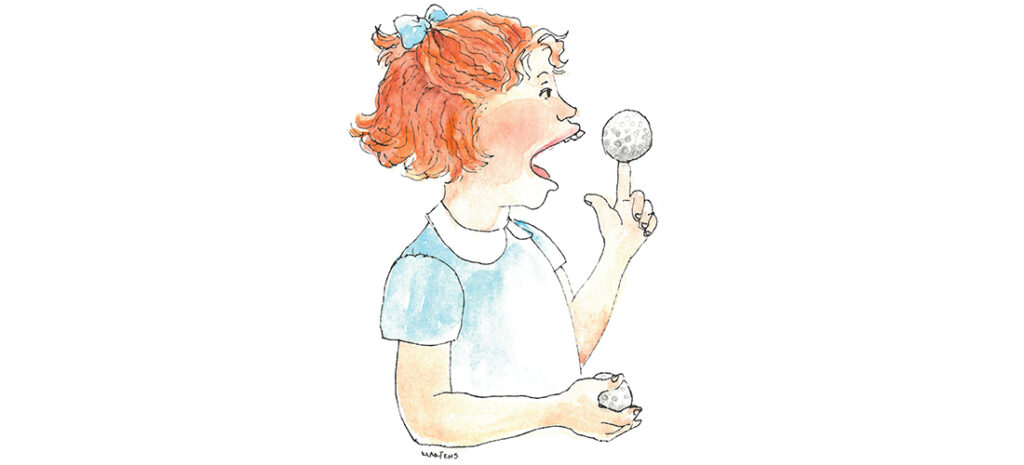
Central to the decorating theme, there were golf balls on every table — but not just any golf balls. These were regulation-sized, pure white chocolate golf balls. There was one at each place setting in the room.
I’m not sure if someone suggested the idea, as kids do, or if I arrived at it all on my own, but I decided to lick one. Having once discovered the delectable goodness — of which there seemed to be an unlimited quantity — I made it my mission to taste as many as I could.
Seeing teeth marks sunken into a golf ball may be something out of the fever dream of a high handicapper, but to my young eyes, the sight of my teeth carving a smooth path out of the dimpled outer shell was mesmerizing.
The trance was broken when my mother ripped a golf ball, a mere shell of its former self, out of my hand. By that point it was too late. I don’t know how many I had already bitten into, but I can tell you I know what it’s like to overindulge at the 19th hole. My “hangover” may have been sugar induced, but my head felt it all the same.
Looking out on the golf course the next day, I naturally associated feeling like garbage with the little white balls people seemed to take such delight in striking. Fists clenched, I said to myself, So that’s why they hit them so hard. And, yes, I still hate white chocolate.
My next run-in with a golf course wasn’t until high school, when I moved to Pinehurst. Like Starbucks in Manhattan, there seemed to be a golf course on every corner.
While I still don’t know much about golf, I am learning. I know that there are 18 holes in a standard game of golf, and that the term “birdie” has nothing to do with fingers. Peak season in North Carolina is spring and fall, presumably because it’s not too hot or too humid. I’m also told that the tiny craters on a golf ball serve more than an aesthetic purpose and actually have aerodynamic properties to make the balls travel faster or farther, or whatever, through the air.
I’m aware that being on a golf course is like being in a theater after the curtain has gone up. One should be mostly quiet and mostly respectful of those trying to focus on the task at hand. I’ll likely never understand what goes into a perfect swing. But I know it’s supposed to be repetitive, like eating every bit of chocolate in sight. PS
Emilee Phillips is PineStraw’s director of social media and digital content.


Even unconditional love has its conditions
By Jim Dodson
Wives, does your husband suffer from RRBS, also known as Recurring Refrigerator Blindness Syndrome?
The symptoms are relatively easy to diagnose. Your husband is making himself the first locally-grown tomato sandwich of the season and opens the refrigerator in search of Duke’s Mayonnaise. He scans the refrigerator shelves for three full minutes, increasingly agitated as he shifts jars of pickles, and containers of mystery meat and cottage cheese hither and yon.
Finally, after shifting the contents of the entire refrigerator around and even checking the vegetable and meat bins for the missing mayonnaise, he straightens up and loudly declares one of two things:
“This is ridiculous! I know we have mayonnaise! I saw it in here yesterday!”
Or, alternatively, with a wail of wounded resignation, “Honey, where’s the G#%@* mayonnaise? You said you just bought a brand-new jar this week. Someone must have taken it!”
Commonly, what happens next is the victim’s wife calmly appears, opens the refrigerator, and, within seconds, presents the aggrieved spouse with a fresh new jar of Duke’s Mayonnaise. Turns out, the mayonnaise was partially hidden behind a carton of orange juice last used by said victim, apparently in plain view only to the average female person.
If you live in my house, this happens on an almost daily basis.
Yes, I suffer from Recurring Refrigerator Blindness Syndrome.
But I am not alone.
There are untold millions of us out here who suffer instantaneous blindness whenever we open the refrigerator in search of condiments, cold pizza, leftover mac-and-cheese or the last piece of chocolate meringue pie.
Moreover, according to the National Association of Endangered Domestic Tranquility, refrigerator blindness isn’t the only condition that strikes the average married American male, placing undue stress on relations with wives, visiting mothers-in-laws and elderly aunts.
Tranquility experts cite a commonly related condition known as DAS or Dishwasher Avoidance Syndrome that afflicts an estimated 87 percent of men married an average of 10 years or more. DAS is defined as a chronic inability to correctly load and unload (much less operate) a German-built dishwasher without proper supervision by someone familiar with the machine’s standard operating procedures, typically a married person of the female persuasion.
Sufferers generally avoid this normal everyday household task by poorly hand-washing dirty dishes and used glassware whenever the domestic partner is out of the house, not only resulting in suspiciously spotted dishware, but unnecessary use of precious water. A related inability to operate the average clothes washing machine and reach into a clogged garbage disposal have also been documented in some cases.
In addition, studies conducted on the average suburban American male reveal at least two other common stress-inducing habits that take place outside of the home.
The first is LGLP or Lost Grocery List Phenomenon, generally affecting mature to elderly husbands who volunteer to go to the store for their wives with a list of a dozen essential items and return hours later with chips, salsa, three or more frozen pizzas, a six-pack of craft beer, the wrong dishwasher liquid, a set of half-price blinking Christmas lights, four Tahitian patio sconces, a tub of rainbow sherbet, Dale Earnhardt Jr.’s Guide to Home Auto Repair (sixth edition) and only four of the 12 items on the original list, which was somehow lost in transit to the store. An unsupervised return to the store is sometimes undertaken with a revised shopping list safety pinned to the sufferer’s sweater.
Finally, there is the all-too-common domestic problem of UHIC, better known as Unfinished Home Improvement Complex, an affliction in which various do-it-yourself home projects have been sitting idle, unfinished or simply forgotten since the first Obama administration. This includes, but is not limited to, half-tiled bathroom walls; toilets that don’t properly flush; mountains of pricey hardwood mulch left in the backyard so long they’re sprouting young trees; doors that never quite close; suspicious sounds beneath the house; the broken doorbells; half-installed home security systems; and driveway sinkholes.
Curiously, in the interest of saving time and money, the typical victim of UHIC routinely stalks the aisles of Lowe’s or Home Depot, dreaming up ambitious new home improvement projects that will make home life easier but don’t stand a chance of ever being completed.
Yes, wives, you know these conditions all too well.
Sadly, there’s no known cure for any of these domestic maladies just yet. But there is hope in the form of a newly created self-help grassroots organization called Building Better Husbands, designed to afford hard-working wives like you the opportunity to network and share creative ideas on how to make their homes happier places and spouses more thoughtful and responsive. Look for chapters forming in your neighborhood soon. BYOB (or two).
A final word to my fellow sufferers.
This Mother’s Day, fellas, let’s give the little lady of the house a break by picking up the slack on normal domestic duties, finishing those pesky home projects, even reading the appliance operating instructions and learning to go to the grocery store only once without a list pinned to your golf shirt.
Meantime, it’s probably best to avoid calling your wife “the little lady” or, for that matter, never ever asking me to put my hand in a clogged garbage disposal.
Some old habits die hard, I guess. PS
Jim Dodson can be reached at jwdauthor@gmail.com.


Scrub your face with a vengeance.
Brush your teeth till your gums bleed.
Comb your hair into a pompadour, braid it
into cornrows, buzz cut a flattop with side skirts,
spit-paste that cowlick to your forehead.
That’s how it begins, this becoming who you aren’t.
A twitch or tic or two you may inherit, but the face
in the mirror you recognized only once
before you’re beguiled by the frailties of those who
precede you — your wayward Aunt Amelia,
the lying politician, tongue flickering through his false
teeth, the long-legged temptress slyly sipping a latté
at the corner coffee shop, your scapegrace
one-eyed Uncle Bill — all of them competing
for your attention, all of them wanting you to become
who they believed they were going to be.
Between intention and action, take a deep breath
and welcome the moment you become who you aren’t.
Slap on Uncle Bill’s black eye patch,
stuff those willful curls under Aunt Amelia’s cloche,
pluck your eyebrows, rouge your cheeks, bleach
those teeth whiter than light: then stare deep into
the reflection behind the mirror: who you’ve become
will trouble you, even if you shut your eyes.
— Stephen E. Smith
Stephen E. Smith is a retired professor and the author of seven books of poetry and prose. His memoir The Year We Danced is being released this month by Apprentice House Press.


FICTION
Rednecks, by Taylor Brown
Brimming with the high-stakes drama of America’s West Virginia mine wars of 1920-21, Rednecks tells a powerful story of rebellion against oppression. In a land where the coal companies use violence and intimidation to keep miners from organizing, “Doc Moo” Muhanna, a Lebanese-American doctor (inspired by the author’s great-grandfather), toils amid the blood and injustice of the mining camps. When Frank Hugham, a Black World War I veteran and coal miner, takes dramatic steps to lead a miners’ revolt with a band of fellow veterans, Doc Moo risks his life and career to treat sick and wounded miners, while Frank’s grandmother, Beulah, fights her own battle to save her home and grandson. The real-life, fiery Mother Jones, an Irish-born labor organizer once known as “The Most Dangerous Woman in America,” struggles to maintain the ear of the miners amid the tide of rebellion, while the sharp-shooting police chief, Smilin’ Sid Hatfield, dares to stand up to the “gun thugs” of the coal companies. Rednecks is a propulsive, character-driven tale that’s both a century old and blisteringly contemporary.
Summers at the Saint, by Mary Kay Andrews
Everyone refers to the hotel St. Cecelia as “The Saint.” Traci Eddings was one of those outsiders whose family wasn’t rich enough or connected enough to vacation there, but she could work there. One fateful summer she did — and married the boss’ son. Now, she’s the widowed owner of the hotel, determined to see it returned to its glory days, even as staff shortages and financial troubles threaten to ruin it. Enlisting a motley crew of recently hired summer help, including the daughter of her estranged best friend, Traci has one summer season to turn it around. New information about a long-ago drowning at the hotel threatens to come to light, and the tragic death of one of their own brings her to the brink of despair. She has her back against the pink-painted wall of her beloved institution, and it will take all the wits and guts she has to see wrongs put right, to see guilty parties put in their place, and maybe even to find a new romance along the way.
The Hazelbourne Ladies Motorcycle and Flying Club, by Helen Simonson
It is the summer of 1919, and Constance Haverhill is without prospects. Now that all the men have returned from the front, she has been asked to give up her cottage and her job at the estate she helped run during the war. While she looks for a position as a bookkeeper or governess, she’s sent as a lady’s companion to an old family friend who is convalescing at a seaside hotel. Despite having only weeks to find a permanent home, Constance is swept up in the social whirl of Hazelbourne-on-Sea after she rescues the local baronet’s daughter, Poppy Wirrall, from a social faux pas. Poppy wears trousers, operates a taxi and delivery service to employ local women, and runs a ladies’ motorcycle club (to which she plans to add flying lessons). She and her friends enthusiastically welcome Constance into their circle. And then there is Harris, Poppy’s recalcitrant but handsome brother, a fighter pilot wounded in battle, who warms in Constance’s presence. As the country prepares to celebrate its hard-won peace, Constance and the women of the club are forced to confront the fact that the freedoms they gained during the war are being revoked.
NONFICTION
The Light Eaters: How the Unseen World of Plant Intelligence Offers a New Understanding of Life on Earth, by Zoë Schlanger
It takes tremendous biological creativity to be a plant. To survive and thrive while rooted in a single spot, plants have adapted ingenious methods of survival. In recent years, scientists have learned about their ability to communicate, recognize their kin and behave socially, hear sounds, morph their bodies to blend into their surroundings, store useful memories that inform their life cycle, and trick animals into behaving to their benefit — to name just a few remarkable talents. In this eye-opening and informative look at the ecosystem we live in, The Light Eaters is a deep immersion into the drama of green life, and the complexity of this wild and awe-inspiring world that challenges our very understanding of agency and consciousness.
CHILDREN’S BOOKS
Ahoy! by Sophie Blackall
Throw the phones in the surf and the interrupters into the brig. Then join the Captain and the Kid for a wild adventure on the high seas (well, the living room) in this rollicking romp from a Caldecott Medalist-winning author that celebrates family, fun and together time. (Ages 3-6.)
If You Want to Ride a Horse, by Amy Novesky
Step on up. Hold the reins firmly, but loosely; settle in the saddle, spine to spine; and breathe. Because . . . if you want to ride a horse, you have to be willing to fly. This lovely picture book anthem is a must for horse lovers everywhere. (Ages 4-7.)
A Rose, a Bridge and a Wild Black Horse, by Charlotte Zolotow
Spare and stunning, this reimagined classic highlights the depths of a daughter’s love for her mother. Racing the fastest cars, building the biggest castle, finding the perfect rose — they’re all symbols of honor — but taming the wildest horse and then leaving it to keep Mom company, that’s real daughter love! A Mother’s Day delight. (Ages 3-7.)
Greenwild: The World Behind the Door, by Pari Thomson
Going green gets a whole new meaning in this botanical fantasy where a stray cat, a missing mother and a dandelion paperweight are Daisy Thistledown’s ticket into a world of green magic . . . even without a grassport. Perfect for fans of Morrigan Crow, Keeper of Lost Cities or The Marvellers. (Ages 9-13.) PS
Compiled by Kimberly Daniels Taws and Angie Tally.


A year on the journey to adulthood
By Jim Moriarty
My freshman year in college was nothing like the one Stephen E. Smith writes about in his memoir The Year We Danced. And yet it was exactly the same.
For any memoir to rise above the level of that dusty old book sitting on the mantel in your grandchildren’s house, it has to reach a level of universality — no easy feat — and The Year We Danced does it without breaking a sweat. Except on the dance floor, that is.
Written with a touch of humor and a bit of heartache by one of North Carolina’s finest poets, Smith’s tale of his freshman year at, then, Elon College in 1965-66 is sweet without being sentimental, poignant without being preachy. While simultaneously being tethered to and free from his family back in Maryland, and with the escalating war in Vietnam a kind of constant buzz in the background, The Year We Danced is nothing less than the launchpad of a life, a survey course in Adult 101 — complete with its own soundtrack. Along the way we’re introduced to an endlessly entertaining cast of characters, drawn by Smith in distinctive, rich detail.
Smith’s father, the boxing coach at the U.S. Naval Academy, had taken control of his son’s college admission process in March and delivered the results in June like an uppercut:
“We were devouring Mrs. Paul’s fish sticks and oven-baked frozen French fries smothered in Hunt’s ketchup, our standard Wednesday evening fare, when he stared at me across the dinner table and stated matter-of-factly, ‘You’re going to North Carolina in the fall.’
“I froze in mid-bite, a flaky chunk of trans-fat-engrossed fish stick balanced on my fork. ‘I am?’
“‘Yeah, you’re going to Elon College,’ he continued. ‘It’s far enough away that you won’t be running home every fifteen minutes.’”
We are introduced to Grandma Drager, who “never forgave her wayward first husband and never passed up a chance to deliver a sermon on the evils of drink,” who travels 350 miles by bus to hand-deliver to a young man about to venture forth into the world a baffling bit of wisdom in six words, memorable only in their towering insignificance — “Promise me you’ll wear tennis shoes.”
Once at Elon, where Smith’s father delivers both him and the message that he doesn’t expect his son to make it through the first semester, Stephen meets his roommate, Carl, who has arranged his shoes in the closet alphabetically by brand and has a pricy collection of 30 or 40 bottles of men’s cologne in parade formation on top of his dresser. “Unfortunately, Carl was the loquacious sort. He was going to sign up for physics and run for class president in addition to majoring in German. Then he started in on his personal life. I had no choice but to lie there in the dark and listen to him brag about his girlfriend, who was a freshman at a college in Virginia, and how they were going to get married before the year was out, a notion that struck me as utterly demented.”
As it turns out, it becomes clear rather quickly that Carl could have benefited from one, or several, of Grandma Drager’s exhortations on demon rum. “In the time we shared room 218, Carl never once exchanged his sheets for clean ones, and the pile of dirty laundry on his desk had spilled onto the floor beside his bed and included many of the garments he’d so neatly arranged in the closet on the first day of orientation. He’d sold off most of his bottles of cologne for beer money, and, as nearly as I could determine, he’d quit going to class altogether.”
On the plus side, Carl became the subject of an essay written by Smith for the spine-chilling professor of English 111, Tully Reed. Smith picked a subject he knew and wrote the hell out of it. When the “The Making of a Derelict,” with copy as clean as anything that ever ran in The New Yorker, gained nothing better than a C– (the highest grade in the class), Smith screwed up the courage to find Tully in his office and ask the fearsome man why.
“‘It’s not A or B work,’ he said, shaking his head, ‘not for a college freshman.’ He handed me my essay, took a drag on his Lucky Strike and returned to slinging red ink.”
Smith’s dance partner, and surely one of the first honest loves of his life, is Blondie, an upperclassman (they weren’t gender neutral in 1965), who can power drink a PBR and dance until curfew, if not dawn. At their favored club, the Castaways, she takes flight. “As I watched, the simple truth dawned on me: We might be at a club where there was only one acceptable dance step, but if Blondie didn’t want to dance the Shag, she didn’t have to. She was beautiful, unique, and she didn’t give a damn about attracting undue attention. She wasn’t there to prove herself to anyone; she was there to have a good time, and she intended to do just that.”
Also unique, and on the other end of the spectrum from the fearsome Tully, was another English professor, Manly Wade Wellman, a prolific author who would eventually call the Sandhills home, just as Smith would and does. “Wellman was barrel-chested and wide-shouldered, his graying hair combed back from his broad forehead. His round, open face was accentuated with heavy eyebrows and a prominent nose below which was cultivated a tweedy, slightly skewed Clark Gable mustache. What was immediately appreciable was the peculiar way in which his eyes reflected light. The very tops of his dark irises flickered, suggesting an inner illumination. . . . If Wellman was insistent, he was also endearing. I was immediately convinced that this guy had a sincere interest in who I was and what I thought. He wanted to know about my latest writing project as if it were of immense concern to the literary community. ‘What are you working on?’ he asked.”
In a few short months, Smith had met both the carrot and the stick.
In the end, Blondie moves on. As all of our Blondies do. Then Smith gets the news that a boyhood friend has been killed in combat. “The spring of ’66 was early in the war, and although the weekly casualties were the highest since our involvement in Vietnam, I doubted anyone at Elon could name a friend who’d died in that distant war. I kept the news to myself.”
But not the sense of helplessness and futility. “I reviewed the times Barrie and I had spent together, my memory sliding from one image to another in no particular sequence — the hours playing hide-and-seek on dusky evenings in the little town of Easton, Maryland, the summer days I visited with him in Salisbury, where we skipped stones from the banks of the Wicomico. But what I remembered most vividly was a summer afternoon in 1957 — we were both eleven — when Barrie and I were singing our favorite top ten rock ‘n’ roll songs and I mentioned that I was fond of a country song, ‘The Tennessee Waltz.’ ‘I can teach you how to play it on the piano,’ he said, and then he sat down at the family’s upright Baldwin and with uncharacteristic purposefulness showed me how to pick out the melody on the white keys. It was a good moment to hold in memory, affirmative and focused, his casual smile, his fingers walking along the ivories.”
Smith’s memoir, to be released this month by Apprentice House Press, is packed full of good moments. If you know someone who is going to be a college freshman — or if you were ever young once yourself — this trip down memory lane is well worth taking. PS
Jim Moriarty is the Editor of PineStraw and can be reached at jjmpinestraw@gmail.com.

By Tony Cross
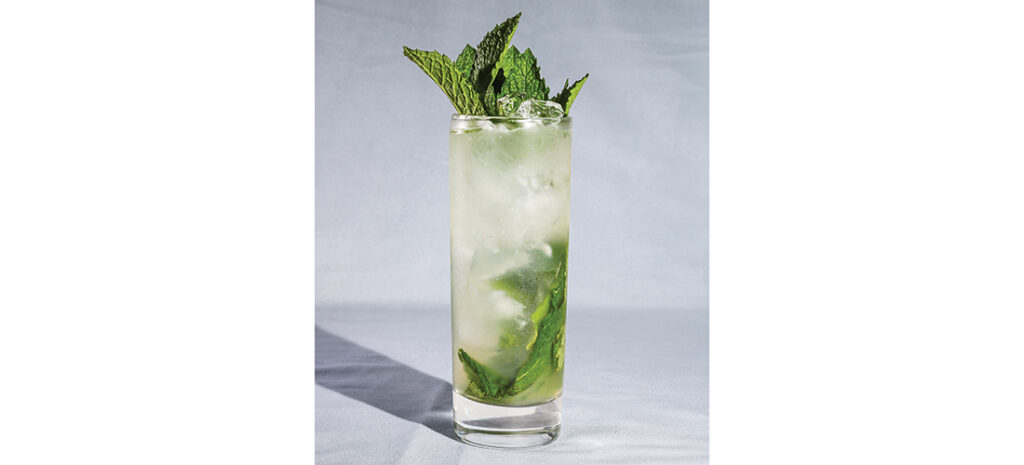
Its origin dates to the early 1900s, and its recipe was first printed in the 1920s. I’ve found various sources that have differing opinions on which bar and what bartender had the first recipe, but many agree that the mojito we all now love and cherish was the drink famously served at Sloppy Joe’s in Havana, Cuba.
There are different ways to attack the execution of this cocktail — some bartenders prefer to build this drink in the glass that they are serving it in, while others employ tins to shake the mint, lime, sugar and rum. I’ve practiced both methods, and I prefer the former. No matter which one you choose, one thing should not be overlooked: Do not annihilate your mint.
Specifications
3/4 ounce fresh lime juice
1/2 ounce rich simple syrup (or 1 tablespoon organic cane sugar)
8-12 mint leaves
2 ounces white rum
2-3 ounces club soda
4 drops salt solution (optional)
Mint sprig for garnish
Combine lime juice, syrup or sugar and mint leaves in a Collins glass. Gently press and twist to express mint oils. (If you’re using cane sugar, you can mix with lime juice before adding mint to dissolve. Bartender and author Garret Richard has a great hack: Use a milk frother — it’s perfect.) Add rum and cracked ice. Gently stir. Top with more cracked or crushed ice and garnish with mint sprig. PS
Tony Cross owns and operates Reverie Cocktails, a cocktail delivery service that delivers kegged cocktails for businesses to pour on tap — but once a bartender, always a bartender.
We use cookies to improve your experience on our site. By using our site, you consent to cookies.
Manage your cookie preferences below:
Essential cookies enable basic functions and are necessary for the proper function of the website.
Statistics cookies collect information anonymously. This information helps us understand how visitors use our website.
Google Analytics is a powerful tool that tracks and analyzes website traffic for informed marketing decisions.
Service URL: policies.google.com (opens in a new window)
SourceBuster is used by WooCommerce for order attribution based on user source.