Almanac

By Ash Alder

It happens in October. The morning is charged with autumnal magic, and ancient memories of the circus awaken in our bones.

A yellow spider descends from the porch rafter like an aerial silk dancer, and a crow pivots round on the wrought iron rail between the fence pickets. In the garden, feathery muhly grass whispers a simple incantation, and winter squash and warty goblins embody the weird and the wonderful. The world is a carnival of texture and color, and spirited creatures remind us of stilt walkers and acrobats and mystical sideshows.

The spider ascends.

Inside, red and golden spirals fall away with each smooth crank of the apple peeler, and the dog-eared pages of the family cookbook mark applesauce; apple dumplings, crisp and tart; great aunt Linda’s brown butter apple loaf.

The crow caws madly in the garden, calls us back to the front porch, where sunlight dances in the spider’s web. She’s spun a message: You, too, are the magician.

The Stinking Rose

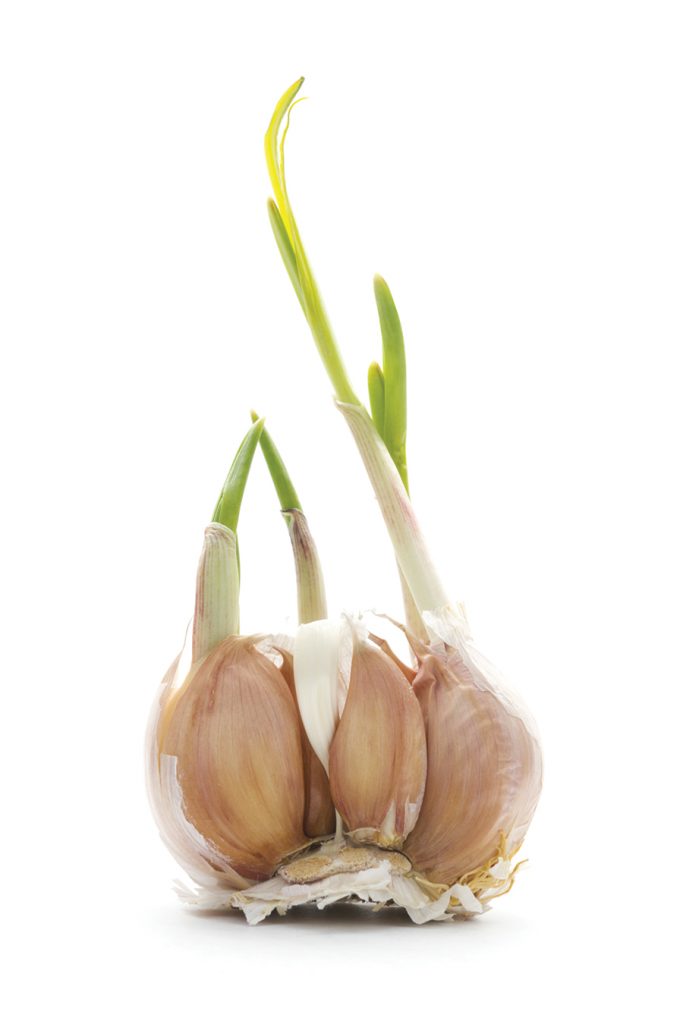
In ancient Greece, brides carried bouquets of garlic in lieu of flowers. In ancient Egypt, it was fed those who built the Great Pyramids. In addition to warding off vampires and evil spirits, garlic does wonders for sautéed turnip, beet and mustard greens. Break bulbs into cloves and plant them before the first hard freeze. Although it won’t be ready for harvest until next June, growing your own garlic means you’ll be well equipped for cold (and collard) season next fall. And wedding season, of course.

The sweet calm sunshine of October, now

Warms the low spot; upon its grassy mold

The purple oak-leaf falls; the birchen bough

Drops its bright spoil like arrow-heads of gold.

–William Cullen Bryant


Brain Candy & Ivy People

In the spirit of Halloween, tricks and treats:

• Weighing in at over 2,600 pounds, the largest pumpkin ever measured was grown by a farmer named Mathias Wellemijns, who wheeled the monster from his home in Belgium to the Giant Pumpkin European Championship in Germany last year to take top prize.   

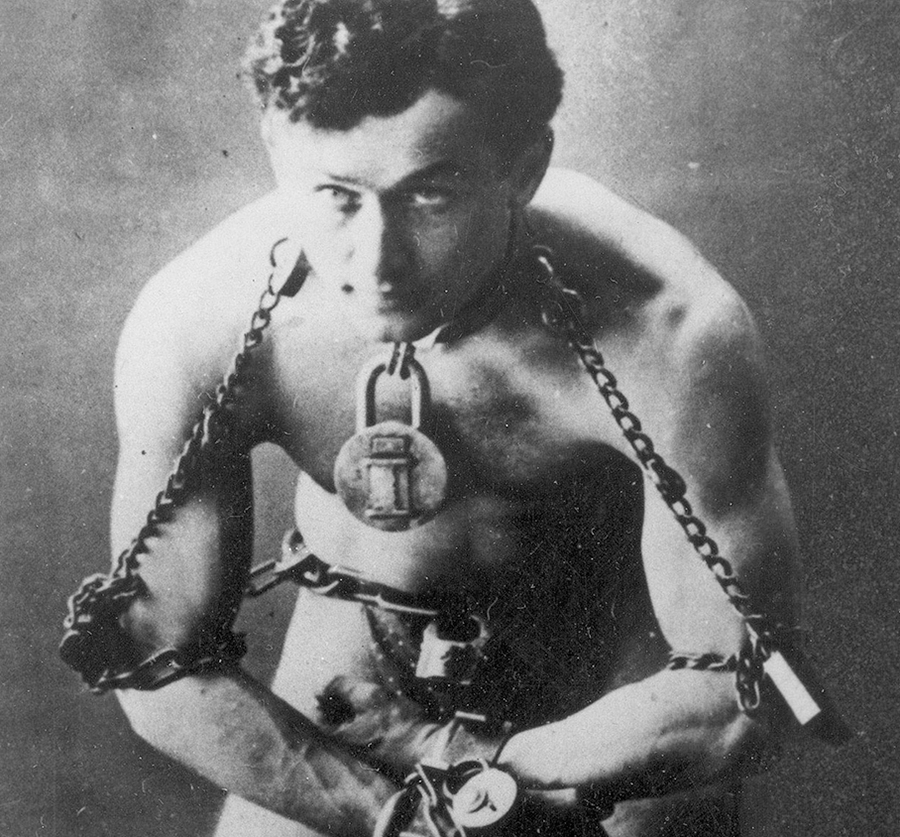
• Master illusionist Harry Houdini, one of the greatest magicians who ever lived, mysteriously died on Halloween night in 1926. Among his first tricks: picking the lock on his mother’s cupboard to retrieve her fresh-baked apple pies.

• Egyptian farmers swaddled wooden figures with nets to create the first “scarecrows” in recorded history. Only they weren’t scarecrows, per se. They were used to keep quail from the wheat fields along the Nile River.

• During the pre-Halloween celebration of Samhain, a Gaelic festival that marks the end of harvest season, bonfires were lit to ensure the return of the sun. Druid priests offered bones of cattle to the flames. “Bone fire” became “bonfire.”

• The Full Hunters Moon rises just after sunset on Thursday, October 5 — a prelude to Mad Hatter’s Day on Friday, October 6. “Why is a raven like a writing desk?” Ponder this and other riddles over tea in the garden — top hat optional.

• The ancient Celts looked to the trees for knowledge and wisdom. According to Celtic tree astrology, those born from September 30 – October 27 associate with ivy, an evergreen vine is known for its ability to cling and bind. Ivy people are charming and charismatic, but their compassion, fierce loyalty to others and ability to flourish against all odds is what sets them apart from other signs of the zodiac. Ivy people are most attracted to ash (February 19–March 17) and oak (June 10–July 7) signs.


There is no season when such pleasant and sunny spots may be lighted on, and produce so pleasant an effect on the feelings, as now in October.

–Nathaniel Hawthorne


From Grit to Glory

Success comes home to Bonnie McPeake

By Deborah Salomon   •   Photographs by John Gessner


The lady is tall, dressed in elegant sportswear, with an exquisite complexion, sweet smile and soft Southern voice. She is known locally and nationally for achievements in the hotel industry. She drives a sporty Mercedes and lives in an urban-chic double-decker apartment overlooking the historic West Pennsylvania Avenue block which she owns — from Hotel Belvedere to Siblings Consignment. Otherwise a hard-edged businesswoman, she melts talking about her six grandchildren.

The ballad of Bonnie McPeake commences in West Virginia, where her parents and their 11 children crowded into a two-bedroom, one-bathroom (in the basement) house on a dirt road. “I’m the daughter of a coal miner and the wife of a coal miner,” she says in a voice tinged with pride and humility. Circumstances improved when her husband, Sam, was promoted to mine foreman. They were able to buy a house which, as it happened, financed their ticket out when, in 1982, Bonnie, Sam and their two small children migrated to Durham. Money from selling that house enabled them to purchase half ownership in a dingy motel, where the family lived in one room. “We slept on a bunk bed, Sam and I on the bottom, the kids on the top,” Bonnie recalls. Eventually they demolished “El Roach-O” and built a four-story hotel.

Business was good. They were ambitious. A guest told them about Pinehurst Motor Lodge, a likely fixer-upper on U.S. 1. They bought it and moved in 1990 to a three-bedroom ranch near Pine Needles.

“I think back on those years — we worked so hard all we thought about was survival . . .  but we were happy,” Bonnie says, wistfully.

Happy but not content, as least not residentially. Along the way, Bonnie had become a Realtor. Perhaps she wanted to wipe out the West Virginia two-in-a-bed image. “I’ve always had a long-term vision. I’m not afraid of dollar signs. All you really need is common sense.”

The vision changed when Sam suffered a stroke. “He wanted to be in the (Pinehurst) village,” Bonnie says. She bought a house that had been divided into three apartments, restored and renovated it, lived there for a while, then sold the now-desirable property. Sam still preferred the village: “There was this house behind us built in the 1880s that was vacant, with water damage and termites, but my son saw possibilities, so we bought it.” Bonnie and her son/business partner Sammy were learning the value of historic buildings. She then purchased the Pennsylvania Avenue property with the plan to rent the ground floor, now Wolcott’s, and create an apartment for them upstairs. “I said I’d put in a lift and an elevator but couldn’t convince Sam.”

Sam died in 2011, leaving Bonnie alone in their Pinehurst home.  “I’m a businessperson. I look at the bottom line. When I see a six-bedroom four-bathroom house I see dollar signs going out the door.”

So out the door she went — a successful young widow with ideas. She would fall back on plans to live over Wolcott’s in a veritable bird’s nest embraced by trees.

Although 160 West Pennsylvania Ave. looks like a residence, it was built in 1890 as Powell Furniture and Undertakers’ housing with a furniture showroom, casket storage and funeral director John Powell’s office — “vital commercial components of a growing health resort town,” according to information provided by the Moore County Historical Association.  However, citizens complained that “Powell’s open wagon rumbling down the streets with a casket (occupied) in full view set nerves a-jangling.”

The premises became Salem Dress Shop and, later, as Bonnie recalls, a lamp business.

But even after the Wolcott renovation the top two floors remained a shambles.

Bonnie rolls her eyes: “Everything had to be torn out. We had to install beams (to keep the third floor from falling).” This gave her the opportunity to create a lifestyle-friendly design yet “like it would have been,” with wide, plain woodwork, simple panel doors and high ceilings, some clad in unpainted tin. She did leave the original heart pine floors, although a 4-inch slope necessitated propping the downwind legs of her massive refectory table on blocks.

Once completed a whiff of antiquity lingered while everything else shouted “Now.”

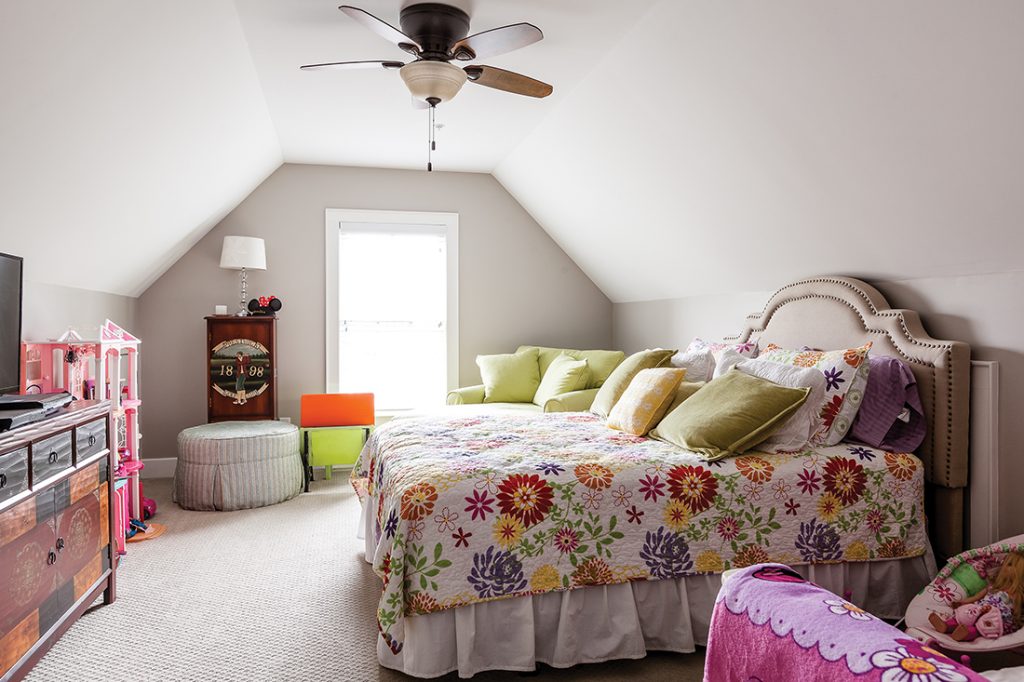
Bonnie gravitates to bright colors in zingy combinations, especially lime green (on walls and a double-wide chaise) and turquoise (living room love seats). Area rugs are summery, splashy patterns. Add hot pink and violet to the third floor suite devoted to her three young granddaughters, who love staying downtown with “Mee-Maw.”

“We walk to the park and eat at the Ice Cream Parlor,” Bonnie says. She credits daughter Christa Gilder for décor advice including paintings, some by local artists, that continue her palette. Christa, given carte blanche, says, “My mother is very picky, but she trusts me. We like the same things.” Bonnie has perfected painting interesting old furniture with turquoise chalk enamel, then “distressing” the finish for a mod look.

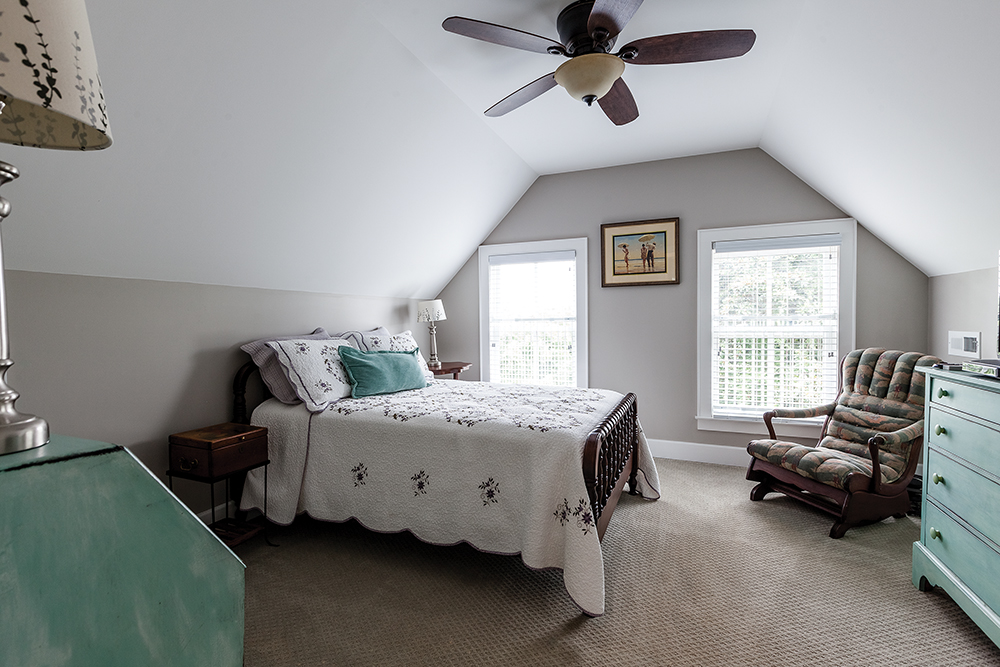
“I was tired of antiques, from the houses in Pinehurst,” Bonnie says, although she chose a dark wood for the kitchen island to contrast with vanilla cabinetry — also a dark sleigh bed and case pieces in the master bedroom, which has soothing gray walls heightened by her signature turquoise in the bathroom.

Bonnie’s floor plan also surprises. A flight of 29 wide, steep steps inside the front door, 31 in a newly constructed back entrance lead directly into the kitchen, with the master suite a few steps beyond. Visitors must pass through the kitchen to reach the dining area, which flows into the living room with bay windows and original Juliet balcony. Bonnie sits there rarely, preferring the spacious terrace created by installing a roof over Wolcott’s screened porch. Leafy branches shield it from street view and noise. Here, she grills burgers while the grandbabies play in a sandbox.

Space beneath the staircase to the third floor has been fitted out as pantry and laundry.

“I have everything I need,” in only 1,500 square feet, Bonnie says.

That third floor is a paradise for her little princesses. Bonnie painted a school desk she found in the attic bright colors and refinished a rocker. The girls have bikes, a doll house, a giant bathroom and beds enough for sleepovers. From Mee-Maw’s home base they can smell the pizza, hear the trains and music, watch the parades, skip to the library, farmers’ market and playground.

McPeake’s project (which won a Southern Pines beautification award) implements trends that began in large cities and have finally reached small-town downtowns: urban renewal/redevelopment that concentrates people and services, reducing transportation time and costs. Her office is a 60 second walk from her home. The practice of “living over the store” has been glamorized by the owners of Casino Guitars on Broad Street. New-construction lofts, duplexes and townhouses suit retirees as well as young families. And people with the means and desire to repurpose classic buildings ensure their future.

Every ballad has a refrain. Bonnie’s might be “Keep movin’.”

“I don’t sit still,” she says. “I’m always doing something. I was up till midnight spraying a light fixture.” In fact, Bonnie suggests that getting there was more than half the fun; in business, rising from a West Virginia mining town to corporate headquarters and, likewise, from a crumbling casket showroom to a vibrant townie pad.

“I can still see what it looked like,” Bonnie says, scanning the results. “The exciting part is remembering how bad it was . . .  and look at it now.”  PS

The Road Less Traveled

Uncle Bert, The Armless Elocutionist

By Scott Sheffield

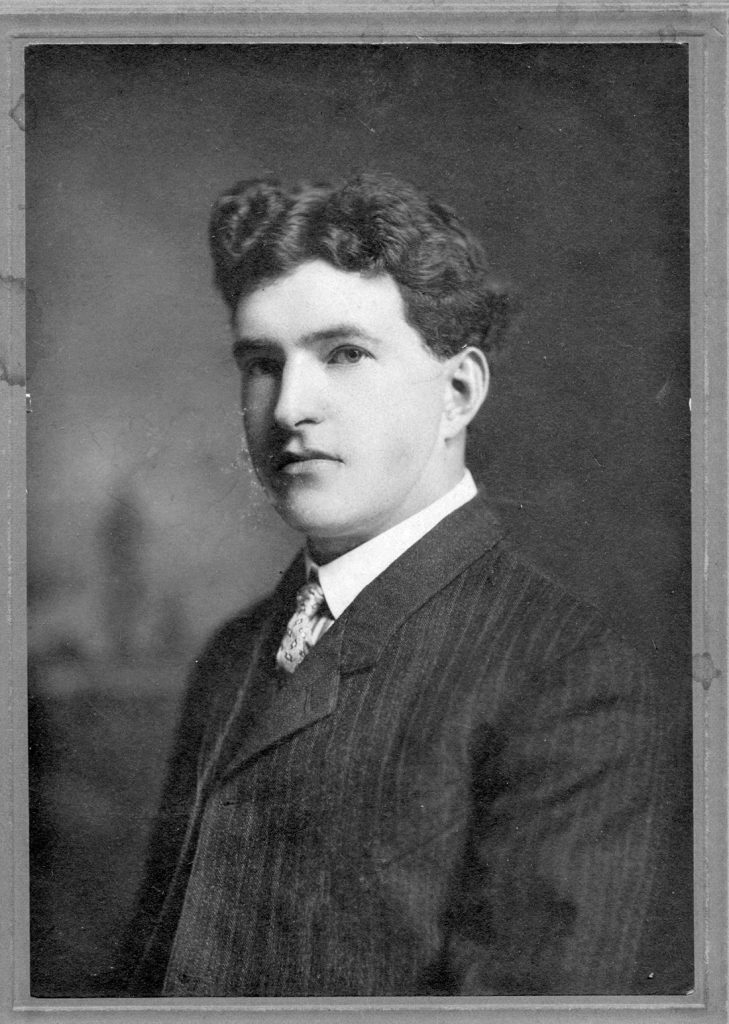
Albert Livingston Stevens was technically my great-great-uncle. But to me, he was simply Uncle Bert. From the first time I could remember family gatherings for Thanksgiving or Christmas, Uncle Bert and his wife, my Aunt Mabel, were there. I remember every Christmas, they would give me two silver dollars in a small white box with a cotton lining. For the entire time I knew Uncle Bert and Aunt Mabel, they lived in Southern Pines, and when I addressed my thank you notes to them, I always thought, as a boy growing up in plain old northern Virginia, how wonderful a place called Southern Pines must be.

Uncle Bert was already 72 years old when I was born, and by the time I first really noticed him — at the age of 4 or 5 — he was the oldest person I had ever seen. I didn’t quite know what to make of him. He had a wild shock of white hair on top of his head, large brown spots on his face and leathery cheeks etched by deep, wavy lines. But it wasn’t his face or his hair that fascinated me. It was something else.

I never remember seeing Uncle Bert dressed in any attire less formal than a coat and tie, and usually a suit. His appearance in those suits was different from any of the other men in the family who were similarly attired. The right sleeve of his jacket never clothed an arm or revealed a hand. The cuff was always neatly tucked into the waist pocket. A stiff, unmoving black glove extended from the left cuff of his jacket. The glove concealed a wooden prosthetic hand, no doubt state-of-the-art for the 1950s, but it was both scary and intriguing to me at the same time.

Albert, or “Bertie,” as he was known in his younger days, was born on May 15, 1874, lost his father at the age of 5 and was completely orphaned at the age of 10, shuffled from one relative to another. At 14, Bertie landed a job, his first, in the wire and cable department of the Edison Machine Works in his hometown of Schenectady, New York. He liked the job and especially enjoyed those occasions when he would see Thomas Edison who, I later discovered, he described as “a kindly man about whom clung an aura of fame.”

Only weeks into his new job, walking home from work on the New York Central tracks, a common path used by the plant’s workers, he was struck from behind by a locomotive. He fell with his arms outstretched, and as the engine passed over him, it severed his right arm at the shoulder and his left just below the elbow. Miraculously, he survived. Damage to his right shoulder was so severe that it was just sewn up and left to heal. However, his left arm was a different story. Because the engine’s wheels had struck it below the elbow, the doctors were eventually able to fit him with an artificial arm and hand. Instead of having to be fed, he learned how to feed himself. He likewise learned to perform much of his daily routine without assistance, with the obvious exception of tasks like buttoning a shirt or tying his shoes.

Uncle Bert had no intention of leading a homebound life. Funds were raised through civic organizations to pay his hospital bills and fit him with his artificial limb. He continued his education, emphasizing music, and eventually studied at Claverack College, an institution that closed in 1902 but was once attended by Martin Van Buren, the eighth president of the United States. After visiting a brother in Tennessee, Uncle Bert decided to go into “show business,” forming his own vaudeville troupe. Among our family’s memorabilia is a copy of one of the posters advertising the 1896-97 season of the Albert L. Stevens Big Five, on which he is billed as “The Armless Elocutionist, Vocalist, Clog and Jig Dancer.”  In addition to the poster, we have a pair of Uncle Bert’s tap shoes. Other members of the troupe were billed as “Acrobats, Contortionists, Tumblers, High Kickers and Masters of Strength.” Another was described as “Virginia’s Great Violin, Guitar and Banjo Soloist.” Still another performed “Gags, Sidewalk Talk, Songs and Dances” as the “Witty Irish Character.” They traveled at first by horse and buggy and later with a wagon and team. It was a show date that brought him to North Carolina for the first time.

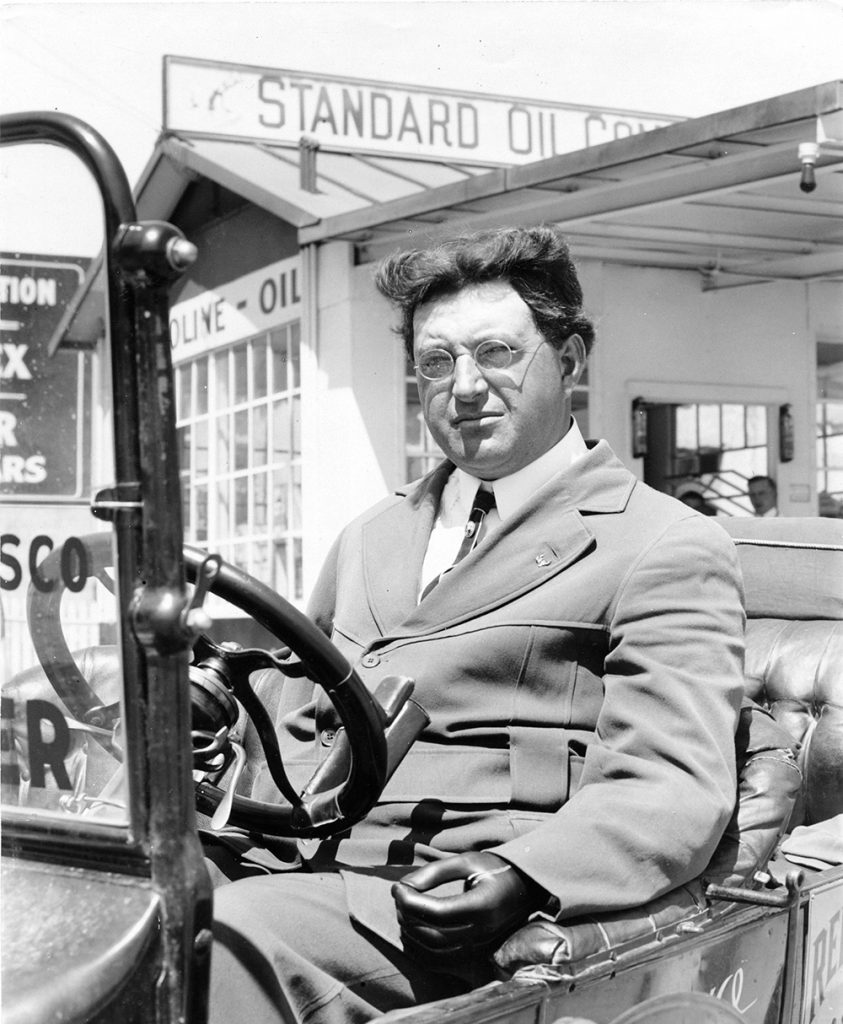
He returned to Schenectady in 1901, where the Edison Company had a job waiting for him. Next, he took a turn at selling, which again brought him to North Carolina, then back to Schenectady, where he started a newsroom business. After he and Aunt Mabel married in 1905, employing a strategy of leasing, then buying, as finances would allow, he gradually became his own version of Conrad Hilton, owning five hotels and apartment houses, including The Livingston, The Myderse, Bachelors Hall, The Seneca and Hotel Foster. He served at least one term as the Fourth Ward supervisor, elected on the Citizens Party ticket. In 1914, he began driving his own automobile, a modified Model T Ford. From April 11 to Dec. 1, he put over 10,000 miles on his new car, including a trip to Washington, D.C. The following year he and Aunt Mable, accompanied by another couple, set out on a transcontinental trip to the Panama-Pacific Exposition in San Francisco.

“For a long time I thought I could have a car fixed so I could handle it,” he was quoted as saying in the March 1915 issue of Ford Times. “But all my friends, and especially my wife, were very much opposed to my trying to drive. They predicted all kinds of accidents if I ever attempted such a thing.

“I had the emergency brake lever changed so I can operate it with my foot. I have a foot accelerator to feed the gas; electric lights which I turn on or off with my foot; an electric horn which I blow by pushing a button with the side of my knee; spark lever bent so I can advance or retard the spark with my knee; and I crank the engine with my foot. I have a steel U-shaped attachment which clamps on the side of the steering wheel. I place my arm in that and steer very easily. I drive just as steadily and well as most people with two hands and arms, and I think a great deal better than some.”

I had heard the story about how Uncle Bert had outfitted a car to accommodate his disabilities and the trip to California many times, each retelling evoking no less awe than the last. While the actual route of the trip is unknown, a little research led me to believe that the most likely one began on the National Old Trail Road. The newest “highway” of the day was The Lincoln Highway from New York to San Francisco, but the Aug. 21, 1915 Wichita Beacon Journal  (accounts of Uncle Bert’s journey popped up in stories ranging from Salt Lake City to Atlanta to Detroit) mentioned him passing through that city on his way west, putting him on the Old Trail. From Kansas he likely took the Leavenworth and Pike’s Peak Express or the Butterfield Overland to Denver where he could join up with the Lincoln Highway to reach San Francisco. In an Aug. 15, 1915 story from the Los Angeles Tribune he identifies The Lincoln as his route west. “When he told his friends that he was going to take his machine across the continent and traverse the mountains and the deserts, they laughed at him,” the L.A. Tribune went on to say.

From San Francisco he went south to Los Angeles and San Diego, then east on the old Santa Fe Trail to eventually rejoin the Old Trail. A driver traversing any of these roads would normally encounter roadbeds fabricated of dirt, sand and gravel, only occasionally finding a stretch of macadam. Oddly enough there was a section from Wheeling, West Virginia, to Columbus, Ohio, that consisted of brick. However, there was also a stretch through the Rocky Mountains that was devoid of any paving material other than what occurred naturally. An official road guide, published a year after Uncle Bert’s trip, described a journey on The Lincoln Highway as “something of a sporting proposition.” Camping equipment was recommended west of Omaha, Nebraska. Add the fact that filling stations were few and far between and a coast-to-coast trip in those days was a daunting undertaking, its completion simply amazing, especially for a driver without arms.

To fund this project, Uncle Bert apparently solicited sponsors, automotive-related companies such as Kelly-Springfield tires and Red Crown gasoline, for the car was emblazoned front to back with decals. Camping out and — as Uncle Bert suggested in one story — selling postal cards also helped defray the cost. Captions on the back of one of the surviving photos identifies it has having had been taken at Universal City, then a new location for the nascent film industry. Why he stopped there is as unknown as the route, but it may have been that during his vaudeville days, he met or associated with some show folk who went on to appear in movies, and he was simply renewing acquaintances.

This was all part of family history, and so, unfortunately, was what happened at the height of his success. It was at the end of the Roaring 20s and optimism in the country was at an all-time high. Then, the stock market crashed and along with it the national economy. The resulting Great Depression saw billions of dollars in wealth and income evaporate literally overnight. Uncle Bert’s fortunes were no different. He lost everything, all his holdings, except for a resort on Schroon Lake in the Adirondacks, which he had given to Aunt Mabel as a birthday gift. With this property, he began a new upward climb, gradually adding more cottages and a store to the resort.


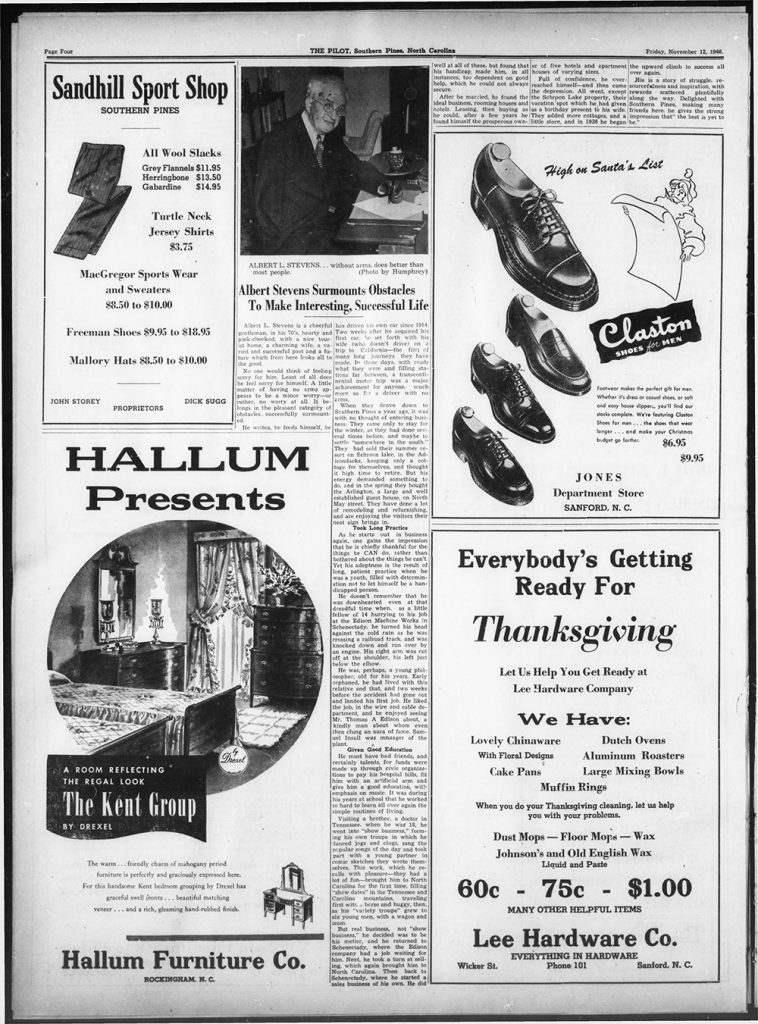
little over a year ago, going through a box of family memorabilia with my brother, Steve, in Florida, we discovered a photostat of an article clipped from an old newspaper, The Pilot. Much of the information in it was familiar to us, but some was new. At the time, I’d lived in Pinehurst for 12 years. That such a story would appear was unsurprising, since he and Mabel lived in Southern Pines in their later years. The article, however, was incomplete, ending in mid-sentence. There was no byline and no date.  My only hint as to the age of the story was that the accompanying picture showed him as I remembered him when I was very young and mentioned that he was in his 70s.

Since my uncle had been born in 1874, the article must have appeared in the paper between 1944 and 1954. The volumes of those years were archived at the Southern Pines Library. The bindings were in various stages of decay, but all the years I was interested in were there. From the portion of the article that I already had, it was apparent the author’s interest in Uncle Bert was his recent decision to buy the Arlington, described in the article as “a large and well established guest house on North May Street.” The building at 440 N. May is there today.

I decided to begin my search for the original article with the year I was born, 1946. I didn’t find it there, nor was it in 1947. Reading articles from 70 years ago, the news of the day and the news makers, the ads and the entertainment notices, provided a whole new appreciation for this place and those times. Near the end of the 1948 volume, I saw it. I was initially surprised and relieved that the page containing the article was there at all because not every page was. The condition was much better than the copy my photostat apparently came from. The date of the article was Nov. 12, 1948.

During their years in New York, the article relates, Uncle Bert and Aunt Mabel had wintered in the Sandhills many times, and it was only with that thought in mind that they returned here again that year. However, they had sold their resort in New York and Uncle Bert had decided that after his long and eventful career, it was time to retire, with an eye toward settling someplace in the South. “When they drove down to Southern Pines a year ago, it was with no thought of entering business,” says the story. But apparently, Uncle Bert didn’t have it in him to fully retire. They bought the guesthouse and settled here.

The article, detailing his life, concludes, “His is a story of struggle, resourcefulness and inspiration with rewards scattered plentifully along the way. Delighted with Southern Pines, making many friends here, he gives the strong impression that ‘the best is yet to be.’”

After 56 years of marriage, Aunt Mabel died in 1961. Following a couple of years at St. Joseph of the Pines, Uncle Bert passed away at the ripe old age of 89. He lies in Mount Hope Cemetery in the town he loved so much.  PS

Scott Sheffield moved to the Sandhills from Northern Virginia in 2004. He is retired from the federal government, where he served as director of the headquarters contracting office for the U.S. Department of Energy in Washington, D.C.

Taking on the Giants

Pinehurst amateur Dick Chapman more than held his own against golf’s professional greats 

By Bill Case
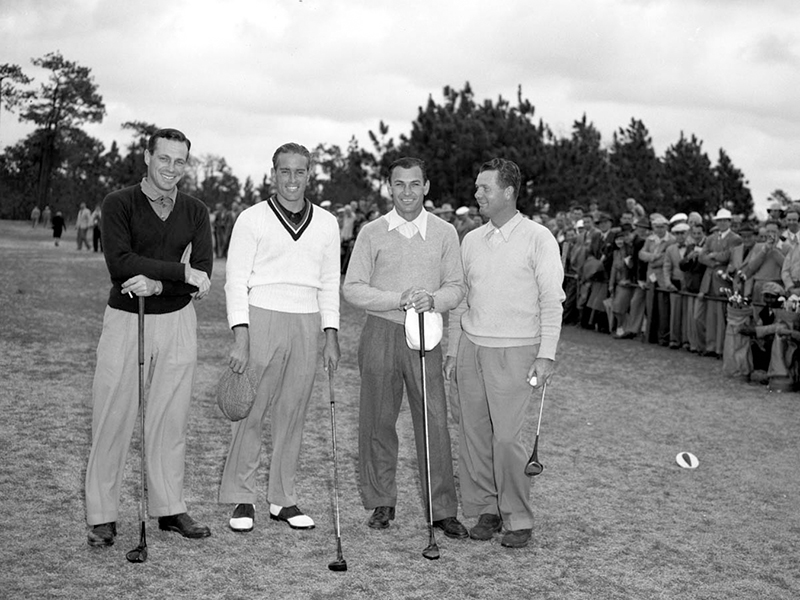
Left to right: Dick Chapman, Frank Stranahan, Ben Hogan and Jimmy Demaret


In the first quarter of 1946, young Pinehurst attorney Leland McKeithen confronted a dilemma. The Pinehurst chapter of the Red Cross stood $2,500 short of raising the $7,000 necessary to satisfy the goal for its annual fundraising drive. As chapter president, McKeithen pondered ways of reducing the shortfall. Aware that most community residents and visitors shared a love of all things golf, he considered the prospect of bringing top players to Pinehurst to play an exhibition match at the area’s nonpareil course — Pinehurst No. 2.

But, given Pinehurst’s North and South Open and Amateur tournaments, there were already ample opportunities for Sandhills golf aficionados to observe the game’s best in action. McKeithen needed an angle that would encourage the locals to reach into their pockets. He came up with a version of the David and Goliath theme: Match two top professionals, playing as a team, against two amateurs. Sure, the pros would be heavy favorites, but there were notable amateurs around who on a given day could give the pros a battle.
For a total of $500 contributed by a generous Pinehurst donor, two of golf’s greatest, Jimmy Demaret and the legendary Sam Snead, agreed to partner in the Red Cross exhibition. Though better known for his colorful personality and a wardrobe that ranged in hue from canary yellow to powder blue, Texan Demaret also possessed fabulous shotmaking skills, having captured the 1940 Masters. Snead’s Hall of Fame career was skyrocketing. “Slammin’ Sam” would win six times in ’46, including the Open Championship at St. Andrews. 

The amateurs chosen to oppose the Snead-Demaret juggernaut were Frank Stranahan, 23, and Pinehurst resident Dick Chapman, 35. Both came from privileged backgrounds. Chapman’s father made a fortune as a partner in a Wall Street brokerage firm. His mother also came from wealth, derived from her father, Clarence Geist, whose profitable investments began in utilities but included ownership of the Boca Raton Hotel & Club and the Seaview resort in New Jersey. Stranahan’s father owned the Champion Spark Plug Company in Toledo, Ohio. Both players could afford to compete internationally as amateurs, free of worry they would run out of cash.

In an era when the leading golfers were reluctant to lift anything heavier than a cocktail glass, the muscular Stranahan was a conspicuous exception. A devoted powerlifter, the sometimes-arrogant Frank would chuckle when panting bellhops struggled to lift his luggage loaded down with concealed weights. Quirks aside, Stranahan could play. Fresh from victory in Pinehurst’s North and South Amateur, he certainly qualified as a candidate for the country’s best amateur.

So did Chapman. Having won a slew of important pre-war titles including the New York, Connecticut, and French Amateurs, Chapman became a nationally prominent player after he routed his opponent in the finals of the 1940 U.S. Amateur at his home course, Winged Foot Golf Club. Recently discharged from wartime service as a major in the Army Air Corps, Chapman was poised to resume his pursuit of championship victories.

A Greenwich, Connecticut, native, Chapman had recently acquired a residence in Pinehurst. A month before the exhibition, he along with wife, Eloise, son, Dixie, and daughter Joy, moved into an opulent frame home in the area of McCaskill Road referred to as Millionaire’s Row. Chapman’s roots in the town dated back to his earliest days. His parents were respected members of the town’s Cottage Colony, and he had visited Pinehurst with the family for decades. John Chapman, himself a winner of a national seniors competition, introduced his son to the game, and had Dick competing in Pinehurst Country Club junior tournaments by age 9. Infatuated with golf, Chapman practiced diligently, developing  a classic rhythmic swing. Soon he was taking on all comers in Pinehurst and Connecticut, and also as a player on the Williams College golf team. Encouraged by his game’s rapid maturation, Dick began entering Pinehurst’s prestigious North and South Amateur, held annually on the No. 2 course. Chapman nearly won the event in 1934 at age 22, losing the final match to the perennial champion, his former Pinehurst junior opponent, George Dunlap Jr.
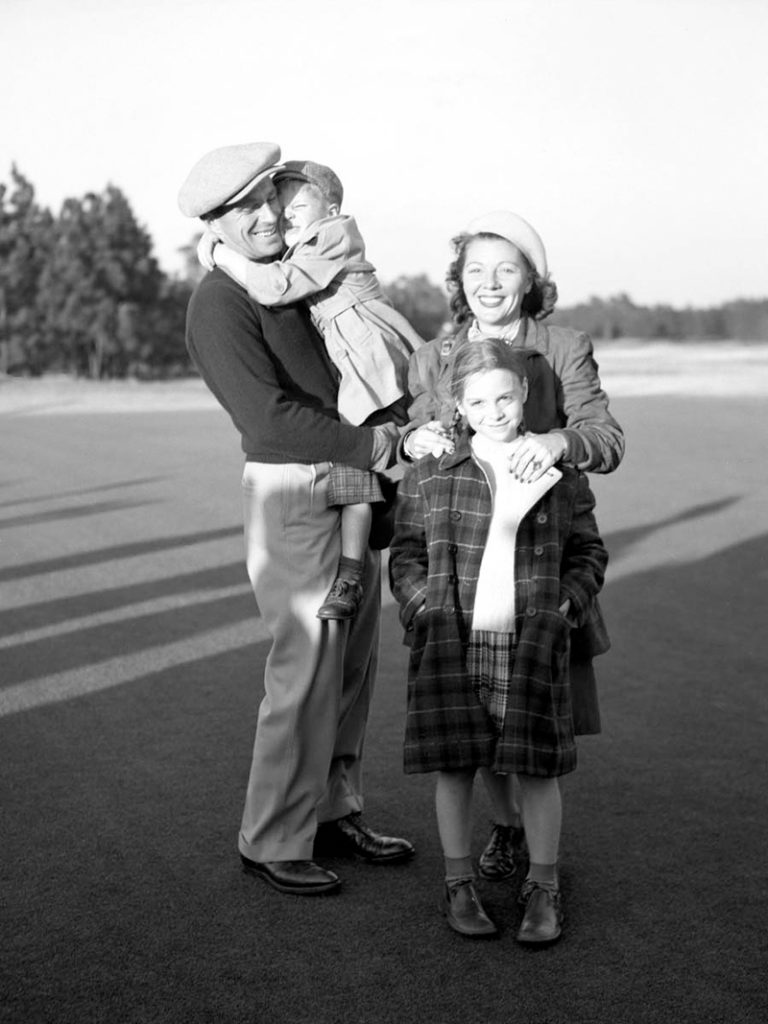


Dick Chapman with son Dixie, wife Eloise and daughter Joy


Thus, many of the 725 spectators who paid a dollar to attend the Red Cross exhibition had known Chapman for years and were pulling for their stylish, debonair friend and his chiseled partner to somehow stage an upset over the Snead-Demaret combo. With all four players well-versed in the nuances of the exhibition’s four-ball format (a match in which two players post their lowest scoring ball on each hole against the lowest scoring ball of two other players), the gallery anticipated a riveting contest. As usual, Demaret stretched the fashion envelope, sporting an outlandishly oversized tam atop his head. Chapman appeared in old-school attire, donning a beautifully tailored V-neck sweater and tie.

It appeared the pros might make short work of the amateurs after Demaret holed a birdie putt on the par-3 sixth to put his team 2 up. But the Chapman-Stranahan team clawed back one of the holes on the seventh. The yelp of a dog on the eighth caused straw-hatted Snead to misfire on a key shot, and the match was all square. After quaffing a pint of milk at the refreshment stand, Chapman struck a brilliant iron shot which left his ball snugly hole-side on the par-3 ninth. His birdie nosed his team in front for the first time.

On the par-5 10th, Snead was presented with an opportunity to even the match, but an animal’s noise again disrupted the Slammer’s concentration. A horse on the adjacent bridle path neighed during Sam’s stroke, and his short putt went awry. After Snead narrowly missed a par putt on the 12th, the amateurs suddenly found themselves 2 up. That was how the match stood until the par-3 15th, where Snead finally caught a break. His birdie putt to win the hole hovered on the lip for over 20 seconds before dropping in. But Chapman and Stranahan still clung to their 1 up lead as the four players arrived at the par-3 17th. After another fine iron, Chapman applied the dagger, calmly draining a curving 20-foot birdie. When Snead failed to convert his birdie, he and Demaret were closed out by the amateurs 2 and 1.

After the match, Dick and Eloise, hosted a cocktail party at their home, which they now called Winter Haven. In addition to Messrs. Demaret, Snead and Stranahan, several other golf notables attended, including PGA Tour manager Fred Corcoran, Golf World founder and editor Bob Harlow, and tour player Toney Penna. Nobody relished a good party attended by entertaining guests more than bon vivant Chapman. It was later said of this personable patrician that he “was like a character out of The Great Gatsby, handsome, charming, wealthy . . . a man who knew his way around a golf course or a cruise ship, or a cocktail party on the lawn of a manor.”

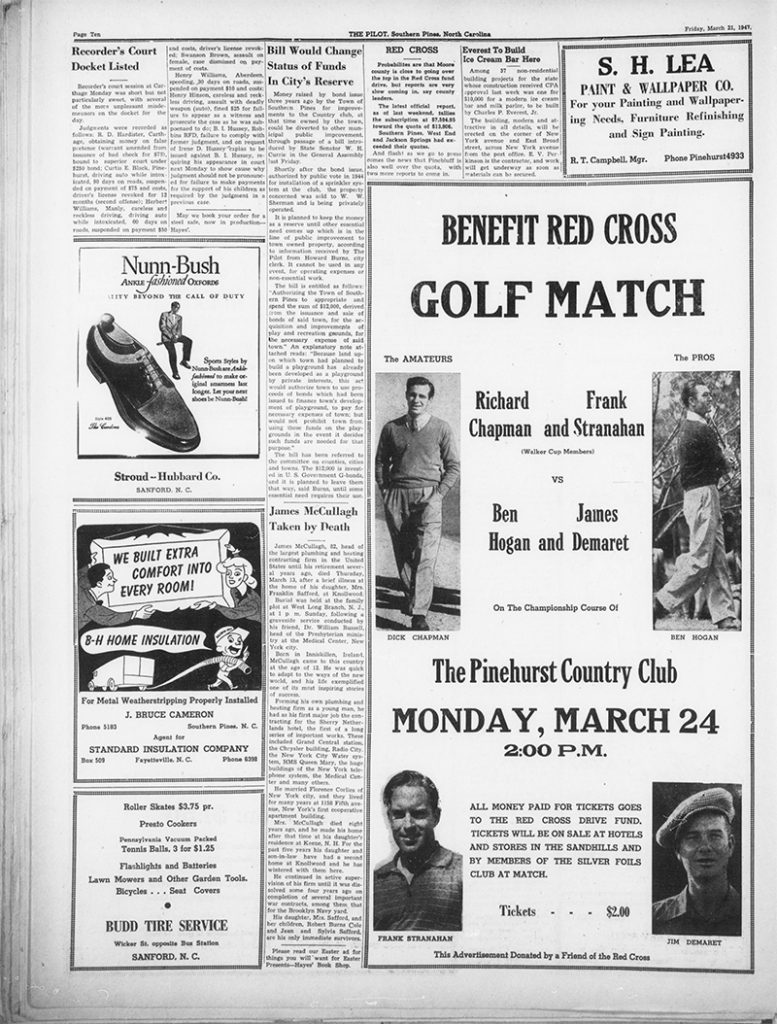
The Red Cross viewed the match a success and scheduled another amateurs vs. pros exhibition on No. 2 for March ’47. In order to maximize revenue, the admission ticket was bumped to $2. Pinehurst, Inc. fronted the pros’ stipends. Chapman and Stranahan again teamed up as the amateur duo but this time they would be facing a team that was arguably the best ever — the incomparable Ben Hogan and his Texas cohort Demaret. They were certainly an odd couple. The poker faced, chain-smoking Hogan hardly uttered a word during play, while the colorful Demaret sunnily wisecracked with the gallery. No player in history spent more time on the range than Bantam Ben. By contrast, the naturally talented Demaret seldom hit balls and could reliably be found at a nightclub after posting his score. But when paired with Hogan in team competitions, Demaret shelved the hijinks. Hogan remarked that when Demaret “played with me, there was no fooling around.” Their disparate approaches  somehow blended  into a yin and yang that made Hogan and Demaret nearly unbeatable in the team competitions prevalent during the 1940s. They had already won six four-ball tournaments together and would later team to win two Ryder Cup matches.

The likelihood of the Chapman-Stranahan team replicating their success in the ’46 Red Cross match against such peerless opponents was further diminished by the fact that Demaret was enjoying his greatest season. He would carry off his second Masters title in April and ultimately emerge as 1947’s leading money winner.  And Hogan, too, was on a roll. After years battling unwelcome hooks which would crop up under pressure and wreck opportunities to win, Ben suddenly became the best ball-striker on the planet. Gone were the devastating hooks.  In their place were exquisitely controlled power fades. The wiry Texan  had apparently solved golf’s eternal puzzle. Everyone in golf speculated what the “Hogan Secret” might be, but he declined to reveal any clues other than to say he had “dug it out of the dirt.”
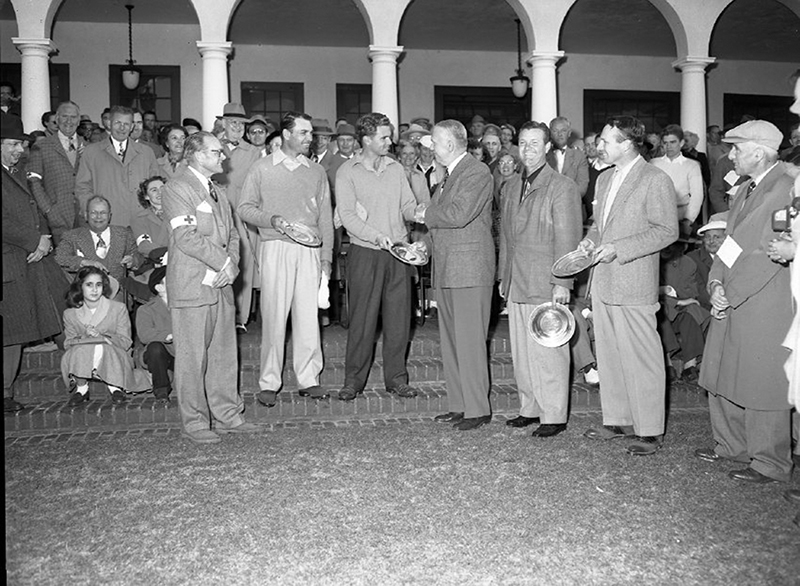
Gen. George C. Marshall congratulates the players of the 1950 match


Chapman and Stranahan possessed no home course advantage over Hogan, whose breakthrough victory had come on No. 2 in the 1940 North and South Open — an event that he won again in ’42 and ’46. Hogan appreciated No. 2’s premium on ball-striking and course management, skills he possessed in abundance.

On a cool March Monday afternoon, Hogan and his wife, Valerie, motored over to the resort from their lodgings at Southern Pines’ Belvedere Hotel.  At the first tee, he was greeted with resounding  applause from 800 enthralled onlookers who jockeyed for a good vantage point to watch the players strike their opening drives. The Chapman-Stranahan team got off to a promising start, going 1 up after both Hogan and Demaret  bogeyed the first hole. But the lead was gone when Demaret drained a tying birdie on the third. The remainder of the front nine featured a marvelous exhibition of shotmaking with neither team gaining an advantage. Chapman in particular was knocking the flags down with his irons. He came within an eyelash of holing his approach on the seventh. But Hogan topped Chapman’s birdie with his own. Finally on the long 10th, the amateurs forged ahead after  Chapman holed a 25-footer for a birdie four. The amateurs built their lead to two holes after both Texans pushed tee shots right at the uphill 13th and failed  to salvage pars.

It appeared  the pros would fall 3 down on the 14th after Stranahan’s second shot nestled within 10 feet of the hole. But Demaret turned the tables, holing a curling 35-footer. After Stranahan missed his tying effort, the pros had trimmed the lead to a single hole. Both sides birdied the 16th after Chapman narrowly missed a putt for eagle following his glorious wood shot onto the well-protected green. On the par-3 17th, Chapman must have encountered a sense of déjà vu while addressing his birdie putt to close out Hogan and Demaret. He had made a similar putt on this very green to beat Snead and Demaret  in the ’46 exhibition. He ended  this match in the same spectacular fashion by stroking his winning  putt straight into the cup. Chapman’s personal score of 69  bested both Hogan and Demaret.

Over cocktails at the post-match shindig hosted at Winter Haven by the Chapmans, Hogan uncharacteristically took Dick aside and imparted advice on the amateur’s swing, “particularly in regard to the position of the left shoulder in making full strokes.” Hogan offered tips to fellow competitors about as often as he hit loose shots, but it seems he felt a kinship toward Chapman as both men shared a nearly messianic desire to perfect  their golf swings. Notwithstanding this camaraderie, Hogan did not go so far as to confide to his all-ears friend his mysterious “secret.”

Another tandem of stars challenged  Chapman and Stranahan in the March 1948 exhibition — Johnny Palmer and Bobby Locke. Palmer, a good old boy from nearby Badin, N.C., had beaten the field in the 1947 Western Open, then considered a major tournament. He would win on tour seven times and play on the Ryder Cup team in ’49, the year he finished in the top eight of the Masters, U.S. Open and the PGA Championship.

Locke was in the midst of an incredible 32-month span in which he would win 11 PGA tour events. The South African became the first non-British foreigner to distinguish himself on the circuit, and many of the American  pros deeply resented his success. It did not help Locke’s likeability that he marched in rather stately fashion to his own drummer. He looked and played in a manner different from other players. Dressed at least 15 years out of fashion in plus fours, white dress shirt and tie, his jowly appearance made him appear far older than his age of 30. He played at a maddeningly slow pace, hooking every shot, including the unerring putts he rapped with an ancient hickory-shafted blade. Bobby Locke would subsequently win four Open Championships.

But the Palmer-Locke team could not compare with the draw of Hogan and Demaret, and the admission price was accordingly cut back to one dollar. Those who paid their way were treated to an exciting nip-and-tuck affair. Thanks to Palmer’s sterling play, the amateurs were unable to gain the upper hand, and there would be no three-peat for Chapman and Stranahan. Chapman did come within 4 inches of a hole-in-one on the sixth hole, and Stranahan, needing to hole a 25-foot putt on the 17th to extend the match, managed to do so. But when the 18th was halved in pars, the professionals took the match 1 up.

Perhaps disappointed with the decreased revenue from the series, the Red Cross elected not to hold the professionals vs. amateurs match in 1949. But Demaret did stop by Pinehurst to bunk  in at the Chapmans’ place in mid-April. Friends Jimmy and Dick shared more than their golf talent. Both were accomplished nightclub singers. Chapman had sung at a hotspot in New York and “crooned lilting songs” during a wintertime gig in 1939 at Pinehurst’s long-gone Club Chalfonte. Owner Karl Andrews then marveled, “Dick is playing golf as well as he sings and you know that’s good.” Now, pleasantly immersed in Pinehurst life, Chapman mostly confined his vocal performances to solos in The Village Chapel’s choir.

Hoping for a reprise of the blockbuster match of ’47, the Red Cross lured Hogan and Demaret back to Pinehurst for another exhibition in 1950. But this time, Chapman would have a different amateur partner — Harvie Ward. The charismatic 23-year-old Tarboro, N.C., native burst onto the national scene after his  sensational victory on No. 2 at the 1948 North and South Amateur. A raucous band of fraternity brothers and fawning co-eds from the University of North Carolina motored down from Chapel Hill to root him on, and they carried the beaming Harvie off the 18th green after he vanquished Frank Stranahan. Harvie followed up that triumph by winning the NCAA individual title in ’49, and would later win the 1952 British Amateur, as well as back-to-back U.S. Amateurs in 1955 and ’56.

Mostly recovered from the horrific crash with a Greyhound bus that nearly cost him his life the previous year, Hogan’s game was rounding into form. He and Demaret would post memorable campaigns in 1950 with Demaret winning his third Masters, and Hogan being named Player of the Year after his historic U.S. Open playoff win at Merion Golf Club. Smarting a bit from their stunning ’47 exhibition loss, both stars (particularly Hogan, who hated losing to amateurs) were eager to turn the tables on Chapman and his new partner. This time the pro team played superbly right out of the gate. A pair of Hogan deuces on the ninth and 15th left the amateurs reeling 2 down. It appeared that Chapman and Ward would be closed out on the long 16th, but Ward “scrambled from trap to roadbed” to halve the hole and keep the match alive.

After nailing his rifle-shot iron to the 17th green, Hogan was sure of his par and certain victory. The amateurs were down to their last bullet — a 60-foot putt by Chapman to extend the match. As Chapman addressed his ball, a sparrow suddenly perched directly on his line to the cup. His concentration broken, Dick stepped aside until the bird flew away. After he took his stance a second time, the bird repositioned itself on the line and, according to the Pinehurst Outlook, ”went into a feathery sort of buck-and-wing.” The exasperated Chapman was forced to back off his putt again. Finally, the sparrow exited for good and Dick rapped his desperation putt. Just then, the fates intervened. A gust of wind blew a dead leaf into the ball, ever slightly redirecting its path right into the hole. Chapman’s electrifying stroke sent the match to the 18th, where  he confronted another last-gasp birdie putt, a 15-footer from the fringe. Chapman holed this one too, and the amateurs implausibly salvaged a halved match.

Gen. George Marshall, national president of the Red Cross, and a seasonal Pinehurst resident, personally congratulated the players on their performances. Marshall presented  mementos to mark the occasion. Though no golfer himself, the architect of Allied victory in World War II and the Marshall Plan that rebuilt war-ravaged Europe often enjoyed attending competitions held at No. 2.

Eight-year-old Dixie Chapman was home when Ben Hogan stopped by the traditional post-match party at Winter Haven. The youngster was thrilled when Mr. Hogan ordered him to grab a club and meet him in the backyard. After observing Dixie’s form, Hogan told father Dick, “His swing’s perfect. Don’t change a thing.” Then, with a conspiratorial air, Ben spirited Dick away from the rest of the guests into the den. After locking the door, Hogan spotted a Bible and removed it from the bookshelf. With a solemnity suggestive of an initiation into a secret society, Hogan exacted from Chapman a promise, sworn on the holy text, that he would tell no one what was about to be revealed. It was the mysterious Hogan Secret. Maybe, given that Hogan later explained to Life magazine that his discovery involved a complicated combination of weakening the grip, pronating the left wrist, cupping it at the top of the swing, and then supinating it on the downswing, it was really several secrets. Others claim Hogan never divulged the true secret or, as Snead believed, there was no secret at all. 

Whatever the case, it appears Hogan’s revelation didn’t satisfy Chapman’s quest for golfing perfection. Something of a mad scientist, he was forever experimenting with new ways to strike a golf ball. Dixie remembers his dad would return from the course exulting, “I’ve got it!” only to move on to some new theory the next day. Chapman’s interest in the swing led him to author numerous magazine articles and a book entitled Golf as I Play It. His study of the game was not confined to its mechanics. He devised a new type of competition, primarily geared to mixed couples, in which each of the partners hit tee shots, and then hit each other’s ball. The best of the  second shots was then selected by the team with that  ball played alternately until holed. “Chapman” competitions (also called “Pinehurst”) are still held most everywhere golf is played.

There was one more Red Cross benefit match played in April 1952 that featured a new professional team. The Red Cross landed boyish Jack Burke, Jr., who had played in the Ryder Cup held at Pinehurst in ’51, and the tempestuous Tommy Bolt, the winner of the final North and South Open, also held in ’51. Burke’s banner year would come in 1956 when he won both the Masters and PGA.  Bolt held his famous temper in check just enough during the 1958 U.S. Open to win his only major. Chapman, having further burnished his stature by winning the 1951 British Amateur, arrived at the exhibition with a new partner in tow — Hobart Manley, Jr., the 1951 North and South Amateur champion. Buoyed by Manley’s twin deuces on holes six and 15 and his scorching-hot putter, the amateurs edged Bolt and Burke 1 up. It was the only one of the five exhibitions in which Chapman’s play was overshadowed by his partner.

Chapman would continue to play great championship golf for another 15 years. He was a member of his third winning Walker Cup team in 1953. He continued to add to his collection of international victories and would compete in 19 Masters tournaments, an amateur record. Dick and Dixie, who today lives at the Country Club of North Carolina, made for a great team in father-son competitions, winning several, including a tournament held near the family’s summer quarters at Oyster Harbors on Cape Cod. Both father and son qualified for the 1958 U.S. Amateur. But Dick’s most treasured golfing achievement occurred that same year on No. 2 where, after over two decades of falling short, he finally won the North and South Amateur at age 47.

Dick enjoyed competing in all sorts of Pinehurst events. Like his father before him, participating in the Tin Whistles’ club championships (he won eight of them)  and he relished pairing with Eloise in  mixed “Chapman” competitions. Eloise died in 1966 and Chapman subsequently married Anne McKee. After a stroke in 1970, Dick’s golf was limited. He died in California in 1978.

Chapman was inducted into the Carolinas Golf Association Hall of Fame in 1986. He is the only player to have  been crowned amateur champion of the United States, Great Britain, France, Canada and Italy, a record bolstered by his remarkable performances in the Red Cross exhibitions. He won three, tied one, and lost one in five team matches against golf’s greatest. Of the seven players Chapman’s teams competed against in the series, all but Johnny Palmer are enshrined in the World Golf Hall of Fame. Collectively, his adversaries won 26 major championships (Hogan and Snead alone accounted for 16) and 199 tournaments on the PGA Tour.

When Dick Chapman passed away, Time eulogized him as the “amateur Ben Hogan.” It is likely Ben considered it a personal compliment to be compared to his genial Pinehurst friend whose intense dedication to golf matched  Hogan’s own.  PS

Pinehurst resident Bill Case is PineStraw’s history man. He can be reached at Bill.Case@thompsonhine.com.

A Living Canvas

A Living Canvas

Exploring the artistry, history, aesthetics, and personal stories behind the tattoos

By Ray Owen     Photographs by Tim Sayer

Tattoos have been a part of American culture since the mid-1800s and in other parts of the world for centuries. Body art has been a symbol of rebellion and taboo, making it a misunderstood medium. More and more, tattoos are becoming mainstream, from fashion accessories — for both men and women — to poignant personal statements. Beyond the skin, tattoos are personal marks for remembrance, unique mementos on a human canvas. No matter the motivation, the talent required to render a quality tattoo is undeniable. From September 1st to the 29th, the Arts Council of Moore County is presenting a special exhibition showcasing the artistry, history, and stories of tattoos.

Emily Boles

Emily does not have a sentimental story about why her back is covered in ink. Truth is, she simply loves the style. Inspiration for the designs came from visiting Alaska several years ago, and she started picking up new “tats” without any master plan. Emily chooses only to tattoo her back, because she can easily cover it for work. It’s like a second identity, from the young, professional woman she is in her everyday life.


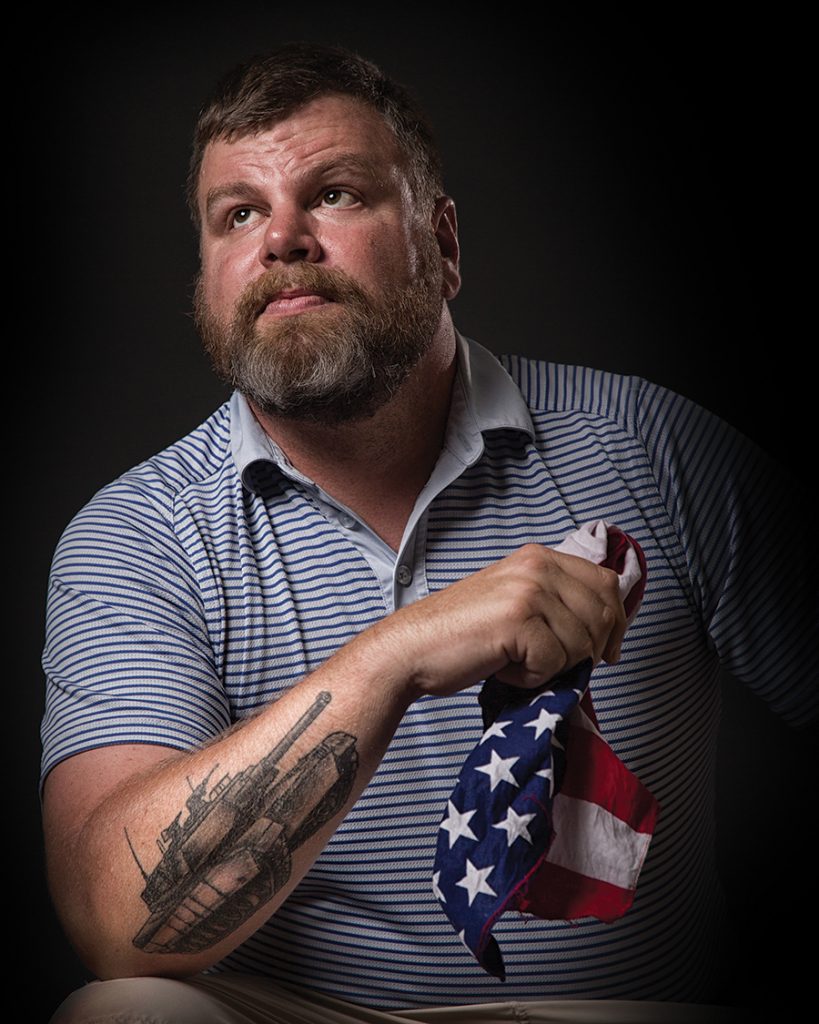
Franklin Oldham, Sgt. U.S. Army (Ret.)

From 2000-2007, Franklin served in the Army as a crewman on an M1A1 battle tank. He loaded tanks and drove, shot and commanded them. Deployed to Iraq in 2004-2005, it was a tank that protected him and his platoon from numerous small arms fire, several land mines, a few RPG attacks, snipers, and a car bomb. He would not be alive today without that tank.


Marcus & Sara Boswell, and Leo

Marcus and Sara Boswell have matching tattoos, a combination of their family crests — Boswell and Humphrey. The phrase underneath the tattoo is French. Loosely translated, it means “If you don’t risk, you don’t gain.” It’s the idea they took into marriage, that love is a risk taken for a lifetime of adventure.


Jenny Moree

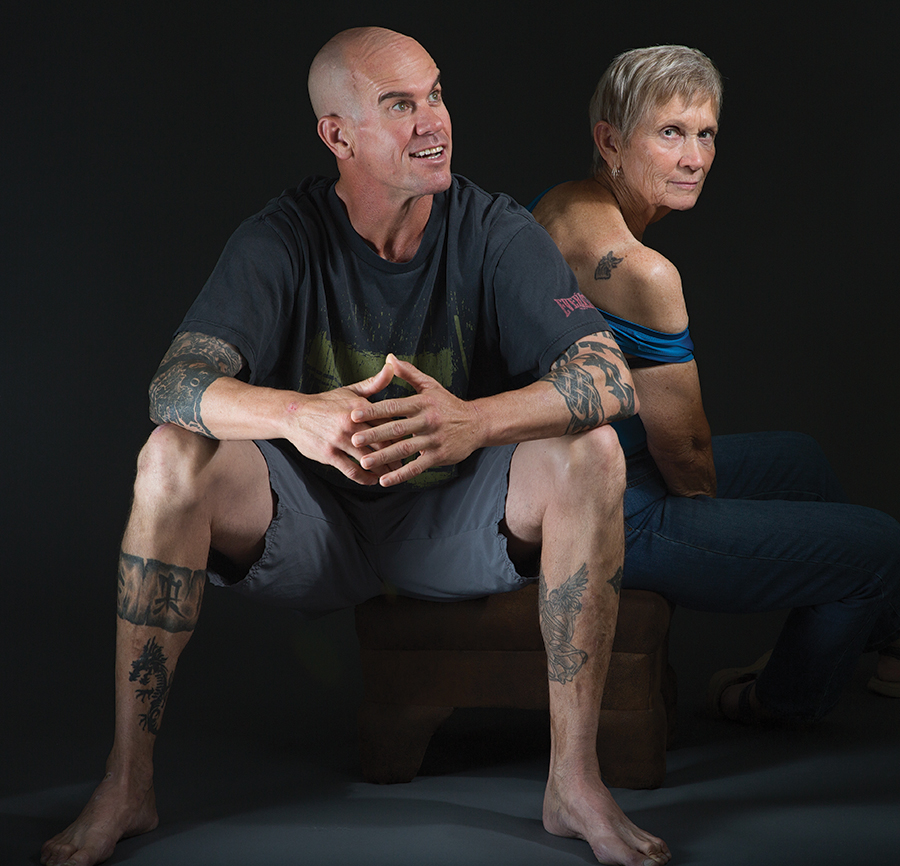
Jenny has many tattoo stories, like her mother’s handwriting or a guitar, microphone, and Fender amplifier because she loves music. Her favorite tattoo is of an angel wing, a tribute to someone whose life she saved when she came upon an automobile accident. Jenny ran to the car and comforted a woman who survived the wreck, helping the rescue crew pull the car off of her. She’s now Jenny’s best friend, and the tattoo commemorates the miracle of their meeting.


Hannah Gibson

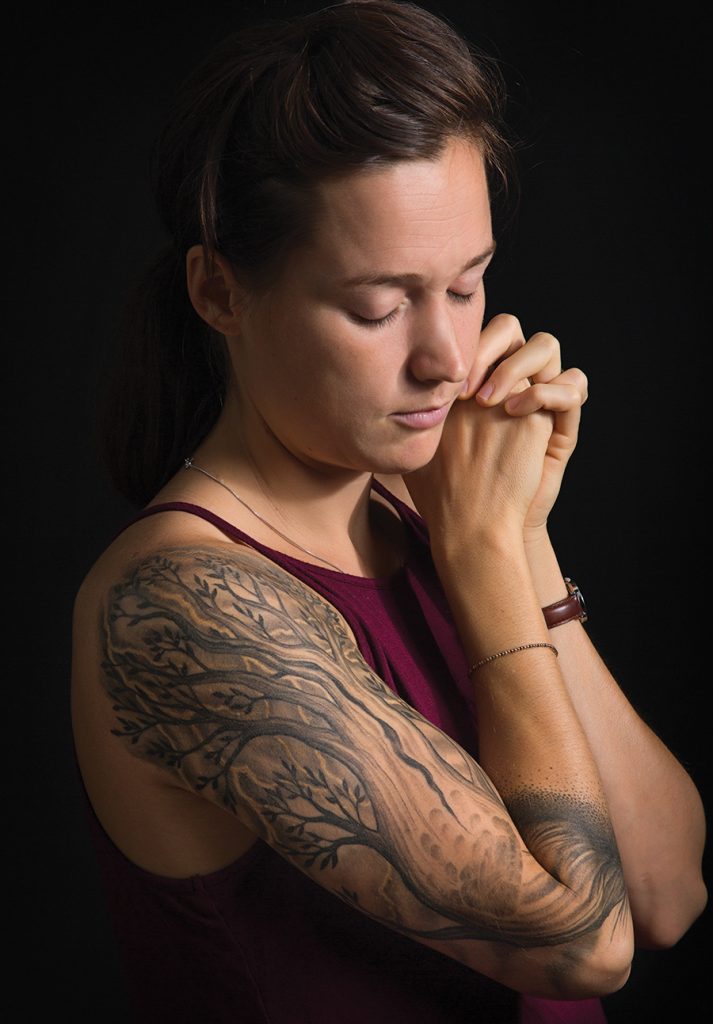
Scars come in many sizes. Hannah’s tattoo is a memorial to her son, Gideon. The most jarring part for her is knowing that he’s gone. No one sees him on her hip at the farmers’ market and asks how old he is, or what his name is, or tickles his toes and comments on how tall he is. The tree Gideon was buried under was struck by lightning the week after he was laid to rest. The tattoo tells the story, a family tree — alive. It allows Hannah to continue sharing Gideon in this life with so many strangers who are now friends.


Rick  & Adele Buytenhuys

In 2005, Rick Buytenhuys made a decision to go to Iraq as a private contractor, after serving six years in the Marine Corps. His mother, Adele, knew that his life would be in danger, but she always believed he’d be protected. Before he left for Iraq, Rick and Adele decided to get matching tattoos of a guardian angel. According to Rick, “many a night, I slept with my hand on my shoulder, that angel on my mother’s back and on mine, too.”

The “Art of the Tattoo: A Living Canvas” featuring intimate portraits of tattooed individuals by local photographer Tim Sayer of Sayer Photography, curated by Valhalla Tattoo & Gallery, is being presented by the Arts Council of Moore County. Opening Reception: Sept. 1, 2017, 6-8 p.m. Food Trucks on-site. Exhibition dates are September 1-29. The show is free and open to the public at Campbell House Galleries, 482 E. Connecticut Ave., Southern Pines, NC 28387. For additional information visit www.MooreArt.org.

Ray Owen is a local historian, who works for the Arts Council of Moore County

Enter, Stage Left

Enter, Stage Left

Morgan Sills brings a bit of Broadway to town

By Jim Moriarty

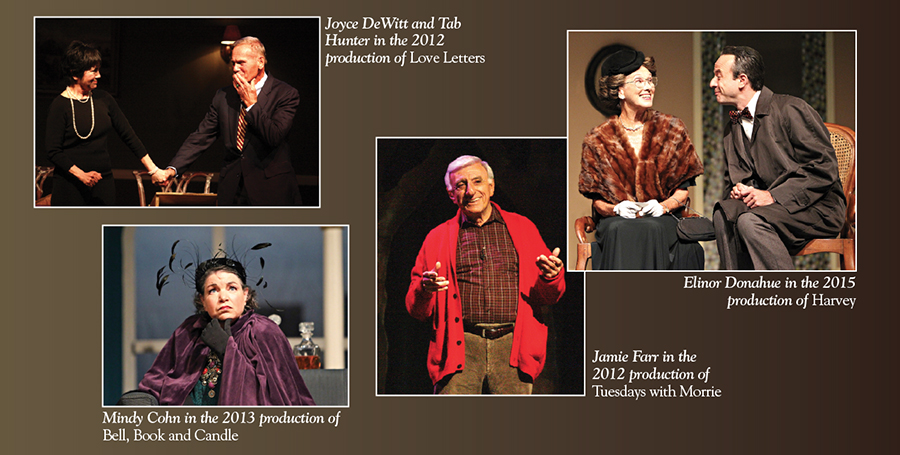
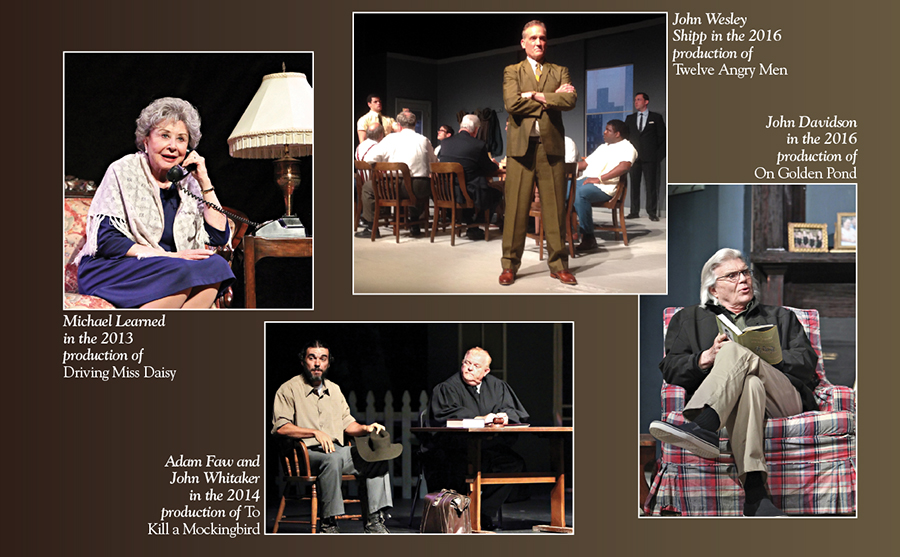
Morgan Sills and his father, Milton, back their 15-year-old blue Dodge Dakota truck up to the Judson Theatre Company storage unit and fill the bed with the driftwood of a stage production — the pine board flats, the weights, the stage braces — that transform a New England cottage in On Golden Pond into a jury room for Twelve Angry Men or a mysterious mansion off England’s Devonshire coast in And Then There Were None. Hauling sets around Manhattan is not part of the job description when Sills produces a play in New York, where he lives. You might say this is off, off, off Broadway and the curtain goes up twice a year. The next time will be Oct. 19-22 when the flats are reassembled in Owens Auditorium at Sandhills Community College as an aging actor’s apartment in The Sunshine Boys. One of the leads will be played by Robert Wuhl, known, among other things, for his HBO show Arliss and for delivering the Gettysburg Address of pitching mound speeches in Bull Durham when he ad-libbed some candlesticks. The other Sunshine Boy will be played by Don Most who was Ralph Malph on Happy Days and, more recently, Rusty Pillsbury (Emma’s dad) on Glee.

When Sills and his business partner, Daniel Haley, decided to start a theater company, they searched locations across the country before settling on Sills’ hometown for their excellent adventure. “He and I both toured all over, so we’d seen a lot of places,” says Haley. “We laid out a list of criteria that the place needed to meet and Pinehurst fit. It was a bonus that Morgan was from there, so we had some community ties to begin with.”

Coming up with a name was a bit trickier. You might say they got it out of a phone book. “It’s one of the most spirited discussions that Daniel and I have ever had,” says Sills. “We tossed around all kinds of things. We looked at paint samples for colorful words. We went down cardinal, dogwood, scuppernong, all the North Carolina things. Then I found a list of the old telephone exchanges in Manhattan. At the time Daniel was living on 52nd Street and I was living in my apartment on 48th Street and we were both in the Judson exchange.” Simple as dialing “M” for murder.

What isn’t quite so simple is bringing New York-level acting and producing to the Sandhills on a biannual basis. Sills studied at New York’s Commercial Theater Institute and his productions include Of Mice and Men starring James Franco and Chris O’Dowd on Broadway; the New York off-Broadway production of Shear Madness, a show that has surpassed 600 performances; and Tennessee Williams’ The Two-Character Play with Amanda Plummer and Brad Dourif. Haley has directed multiple off-Broadway plays at York Theatre Co. and recently spent a good portion of his summer at the Texas Shakespeare Festival, choreographing Much Ado About Nothing and directing and choreographing The Marvelous Wonderettes. He has directed all but one of Judson’s productions. Both Sills and Haley began their careers as performers. “Between the two of us there really wasn’t a job in the theater that we hadn’t done at a professional level,” says Sills.

Theater is art but it’s business, too. “We were very careful. We managed to get started and operate to this day for a very low cost, from very careful producing,” says Sills. “We try to put the dollars on the stage.” It’s the calling card of Judson Theatre Company. Getting established actors from New York or California to agree to spend 2 1/2 weeks in the comparative wilderness of North Carolina is neither cheap nor easy, but Sills has managed it for six seasons.

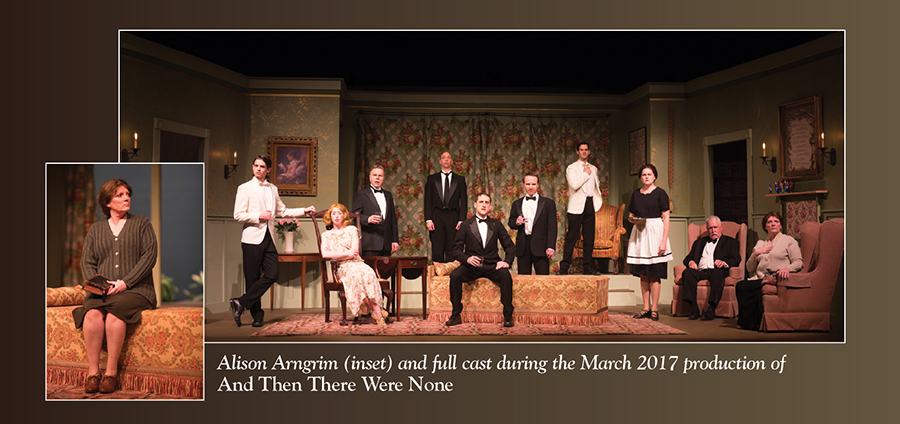
There’s a template. Alison Arngrim, best known for her character Nellie Oleson in Little House On The Prairie and her one-woman show Confessions of a Prairie Bitch, played her part in it during the March production of And Then There Were None. “They’ve got a formula. They know what plays well in their market. They’ve done surveys and focus groups,” she says. “Then they bring in a celebrity that they all know, not randomly selected celebrities, but someone you might have seen in another production so you know they have acting chops.” Then Sills and Haley surround them with other actors they’ve auditioned, mostly from New York. The result is a good experience for the actors on the stage and the people in the seats.

“I cannot say enough nice things about Morgan and the whole production. I really loved being there,” says Arngrim. “I started selling Morgan on my friends, that’s how much I liked it. I’ve been telling everyone like, if you’re considering doing it, get your ass down there. It was just amazing. It was a massive amount of rehearsal. They weren’t fooling around. They work you like a dog. They make sure it’s done right.”

Part of the work is a deep dive into the community. By the second season, Judson began using high school students for stage crew. That morphed into internships and integration with high school English classes, supported by modest fundraising initiatives. “We dipped a toe in the water previously, but we really took a big step with Twelve Angry Men,” says Sills. “We did a school show in the morning for between 600 and 650 10th-graders who were studying civics at all three public high schools from all ethnic and economic demographics. We raised enough funds to buy the book. There’s a beautiful Penguin edition with an introduction by David Mamet. So, they attended the show for free, they had the book that they read ahead of time and the script for classroom study. We had a professional study guide written. After the show there was a curated question and answer so they could talk with the actors. After that John Wesley Shipp, dear John, just sort of jumped off stage and walked into the audience, took pictures and all that because they watch The Flash. He’s a superhero. That’s something that hasn’t happened in Moore County.”

The outreach carried over to And Then There Were None. “We did an extra show for students,” says Arngrim. “They were given a copy of Agatha Christie’s book and they had a whole study plan. Then they came and saw the show and they had a Q&A and I thought, what a thing to do. During the course of the show Morgan and Daniel had people going out and speaking at the local schools. I’m thinking, why isn’t everyone doing this?”

The school involvement will be somewhat different with The Sunshine Boys. “I want to be really honest about the educational connection,” says Sills. “We don’t want to try to connect it spuriously. We are a professional theater in service to the community. So, John Davidson (On Golden Pond) might show up with his guitar at the Rotary meeting. But it’s more than just ‘come to the show.’ For The Sunshine Boys I think the educational performance is probably going to be just the theater kids. In the spring of 2018 it’s going to be The Miracle Worker, and that will be a big thing for the students. As the arts face all these challenges in the schools we’re part of the solution.”

It’s in Sills’ blood. His mother, Elaine, and father, Milton, each worked in the public school system for 37 years. She taught music for 36 of them; he taught for 10 years and spent 27 in administration. If the education gene is powerful, so is the showbiz one. Milton Sills saw The Teahouse of the August Moon at the Pinehurst Theater building when it was still a theater. “It was a great place. You had sort of a semicircle stage setting and a balcony upstairs. It was a very fine theater for the time,” Milton says. On one trip to New York he saw Louis Armstrong and Pearl Bailey in Hello, Dolly! “One of the things that happened in the show that was fascinating was Pearl was dancing and her corset came undone and she just backed up to the curtain and this hand reached out and pinned her up and she never missed a kick.” When Sills got old enough to join his parents on New York excursions, they saw shows like Cats, The Full Monty and A Streetcar Named Desire. On one trip he and his father took in nine Broadway shows in eight days. Sills graduated from Pinecrest High School in 1990, double-majored in English and Theater at Wake Forest University and then headed off to find the footlights.

“I moved in with somebody that I had done summer stock with. Three of us in a one-bedroom apartment. There were two twin beds in the actual bedroom and I stayed on the pullout sofa for a year and a half. My rent was $200 a month, but I was in New York,” says Sills. “You become an adult and you start to realize that your life is following a non-traditional path and you make your peace with that. When my father realized that I’m 6-foot-2 and he didn’t have a basketball player on his hands, he came down to what was then Sandhills Little Theater and would be in shows with me. We were in Inherit the Wind and The Skin of Our Teeth.”

Wuhl and The Sunshine Boys fit the Judson Theatre Company template perfectly. Wuhl’s acclaimed HBO documentary on the facts and myths of American history, Assume the Position with Mr. Wuhl, and Most’s recurring appearances on Glee will make them a hit with the high school crowd, while Neil Simon will work his magic on the older folks. “This is our second Neil Simon play. If you look at anything I’ve ever touched, it’s just valid on the page. The old saying ‘If it ain’t on the page, it ain’t on the stage’ is really true,” says Sills. “It fits because we do beloved classic plays but it’s also important that the audience knows they’re going to have a good time. Laughter is so important. The Sunshine Boys is about the friendships that define our lives, about how we choose to age. It’s about changes in show business, about whatever business you’re in, how important it is to stay with the times. It’s like a buddy movie. As divided as the world may look, all kinds of people can come to The Sunshine Boys and enjoy it together. All kinds of people in terms of who they are and what they believe, they come to the show and they laugh and we’re all friends and that’s important.”

After each show, the cast has the unusual custom of coming to the lobby to mingle with the audience. It has become part of the gig. The only drama in the Judson Theatre Company is on the stage, never behind it. These are working pros. During rehearsal Sills times the show while he edits the program. Haley takes notes on blocking, or maybe the delivery of a line, on a folded 8-by 10-sheet of paper. Someone drops a line and curses at the stumble. The stage manager yells “blackout” and “lights up” as the scenes change. They’re a troupe going about their craft.

For Sills, forming Judson Theatre Company did more than just give back to the community where he grew up; it’s an investment in the one he’ll return to. “I’m going to retire here,” he says, “and I want to make sure there’s a theater when I do.”

Jim Moriarty is senior editor of PineStraw and can be reached at jjmpinestraw@gmail.com.
Almanac

For man, autumn is a time of harvest, of gathering together. For nature, it is a time of sowing, of scattering abroad. — Edwin Way Teale

Soft thuds of September apples tap at the windows of ancient memories.

This is how it always goes. Long before the leaves turn golden-orange-scarlet-purple, we feel the subtle yet sudden arrival of fall. We can smell it in the air. Even our skin has memorized this electric instant.

We open the kitchen window.

Inside, chrysanthemums in mason jars and herbs in tidy bundles, hung to dry. Outside, a murmuration of swallows flashes across the whispy-clouded horizon, confirming what we already know: Autumn is here. This moment of recognition is embedded in our bones. 

Among the harvest — winter squash and lettuce greens — Rome Beauties call for homemade pie. Brilliant red spirals of skin fall away with each smooth crank of the apple peeler, spelling out a sacred message on the countertop. We flash back to grade school, remember twisting the stems of our lunchtime apple to see whom we might marry. 

Soon, the trees will be naked as the apples on the cutting block. We cut them into perfect slices, toss them in brown sugar, cinnamon and nutmeg. Autumn’s first breeze filters through the open window — a dear, bright-eyed friend returning home with stories and souvenirs.

Harvest Season

September apples call to mind Pomona, Roman goddess and virgin wood nymph depicted as keeper of the orchards and fruit trees. The harvest she effortlessly carries in her arms reminds us of the sweet abundance of this most prolific season.

According to the Old Farmer’s Almanac, one of the best days for harvesting this month is with the new moon on Sept. 1. The full moon rises on Saturday, Sept. 16, which also happens to be International “Eat an Apple Day.”  Lakota tribes associated this moon as the time when the “plums are scarlet.” For the Omaha, it rose “when the deer paw the Earth.” 

On Friday, Sept. 22, the sun enters Libra (the Scales) on the autumnal equinox. We look to nature and our gardens to remind us of our own need for balance and harmony. Day and night will exist for approximately the same length of time. Literally and figuratively, now is time to reap what we have sown.

The Feast of the Archangels is a minor Christian festival observed on Friday, Sept. 29. Also called Michaelmas, this celebration honors the angelic warrior who protects against darkness.

As autumn days grow shorter, we acknowledge the dance between lightness and dark.

Crock-Pot Apple Butter

Ingredients

6 pounds apples (variety)

1 1/2 cups sugar

2 teaspoons cinnamon

1/4 teaspoon ground cloves

1/4 teaspoon nutmeg

Preparation

1. Peel, core and slice apples.

2. Combine apples, sugar and spices in a Crock-Pot; cover and cook on high for one hour.

3. Remove lid, and cook on low, stirring occasionally, until apple butter reaches a spreadable consistency and is dark brown in color. Cook time will vary, depending on the types of apples you use.

4. Transfer apple butter to hot, sterilized jars.

The milkweed pods are breaking,

And the bits of silken down

Float off upon the autumn breeze

Across the meadows brown.

— Cecil Cavendish, The Milkweed

Banish the Beige

Banish the Beige

Madcap guys write the must-have design book of the season

By Jason Oliver Nixon & John Loecke   •   Photographs by John Bessler & Jay Wilde

It takes exactly one year to craft a design book such as Prints Charming: Create Absolutely Beautiful Interiors with Prints & Patterns. We began this amazing project in the spring of 2016 and wrapped up the writing, endless photo shoots, and editing in the spring of 2017. And that was after months of writing a proposal, reworking the proposal with our book agent, and shopping the book around to prospective publishing houses in New York.

Each of the chapters in this book is a space — a home or apartment — that we, the Madcap Cottage gents, designed, so the book’s photo shoots had us hopping between interiors that we had crafted in New York City, Iowa, Florida, upstate New York, and our hometown of High Point, North Carolina. And then it was back to NYC. We live in North Carolina, but we are lucky enough to work all over the world, from New Orleans to London, the Hamptons, and our own backyard, High Point’s historic Emerywood neighborhood.

We were inspired to pen this colorful tome not because we harbored illusions of crafting a New York Times bestseller, but rather because folks like you, our clients, have always found pattern a tad perplexing. 

At Madcap Cottage, we believe decorating should be fun, and never grim and glum. It should be an adventure — one whose end result is rooms that burst with personality and that put a smile upon your face the moment you step through the front door. And the key to crafting this décor-driven bliss is patterns, friends, patterns. Forget white walls and neutral furnishings. It’s time to dream big and transform your home with the wonders of pattern! So let’s go; this E-ticket ride is ready to roll.

For ease of use, Prints Charming is divided by pattern-themed chapters instead of, say, by rooms, so if you think you have an affinity for “Pattern is Romantic,” you can start there and hop between “Pattern is Sophisticated,” “Modern,” “Timeless,” “Masculine,” and so many more. Pattern is not granny, and it’s definitely not going anywhere but up.

What follows is a sneak peek to entice you to embrace the myriad pleasures of prints and pattern in your own home. And once you are hooked on living a more colorful life, as are we, you can purchase the book (Abrams, $35), at The Country Bookshop in the heart of Southern Pines. We will be there on November 14 at 5 p.m. for a book signing, and hope to see you.

Life is short. Why dream in beige?

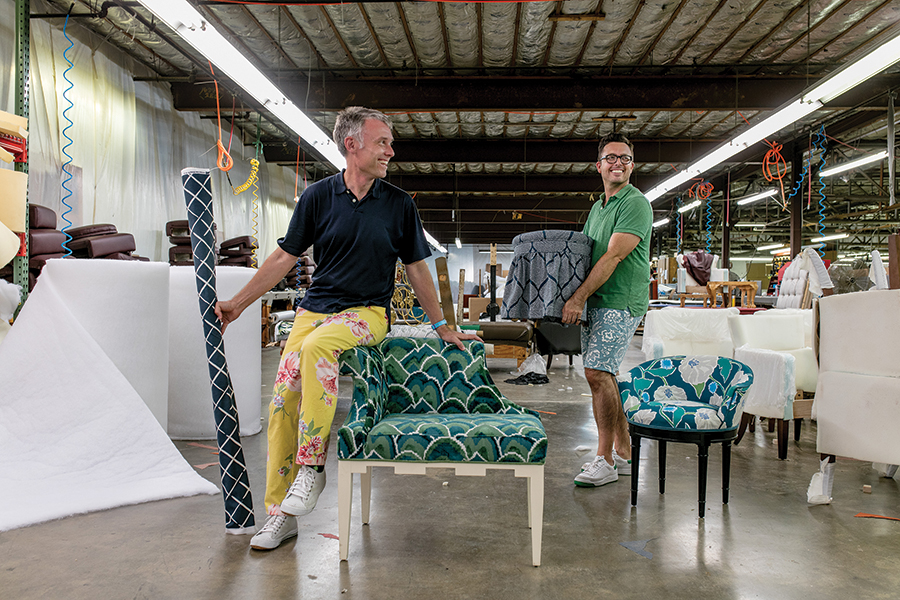
Here we are in our upholstery workroom in High Point, the furniture capital of the world. That’s John Loecke on the left and Jason Oliver Nixon on the right. Almost all of the fabrics featured in the book — including those upon the cover — are from our Madcap Cottage for Robert Allen @Home collection, available at fine retailers from coast to coast (please visit madcapcottage.com to find a retailer near you). Retail? Yes! We believe that good design should be available to all and not just to the interior design trade. By the by, John’s pants and Jason’s shorts are crafted from Madcap Cottage collection fabrics, too.


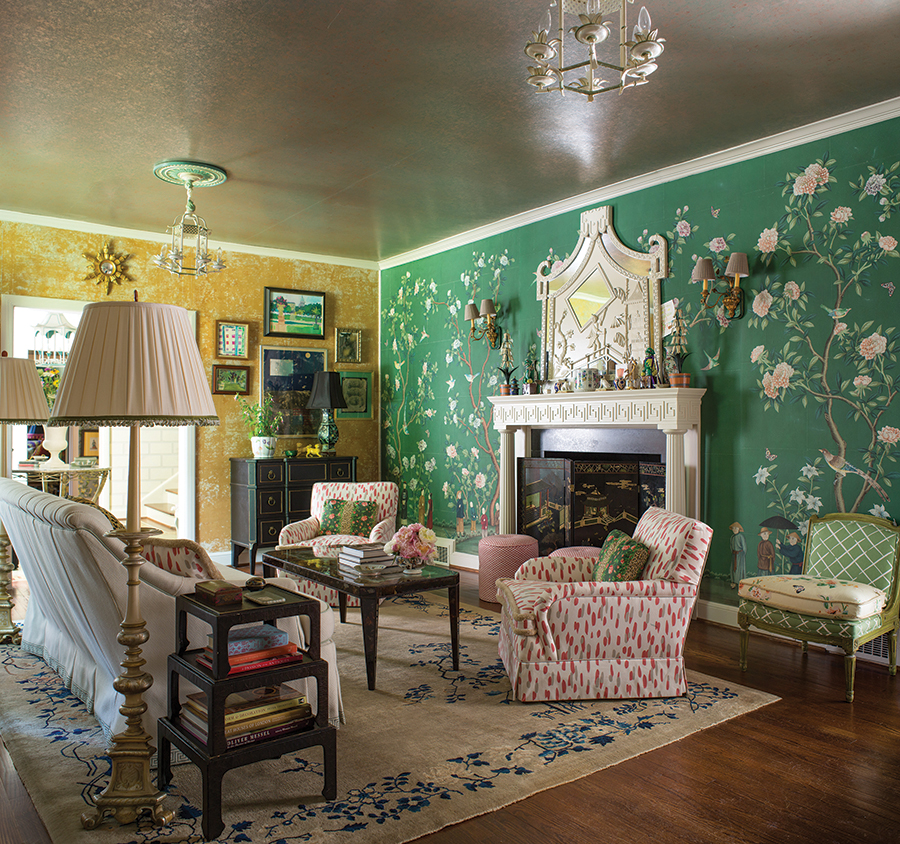
The living room of our 1930s-era, Regency-style House of Bedlam home, the centerpiece of the chapter entitled “Pattern is Sophisticated.” An antique Chinese rug pairs with a custom scenic wallpaper from Gracie Studio and brings a timeless storyline to life. Black furnishings add just the right amount of neutral to allow the room’s patterns to really sing. Green and coral are the hues that predominate in the space and connect the dots between the various patterns. The armchairs are covered in the Madcap Cottage for Robert Allen @Home pattern Mill Reef, inspired by the fabled club in Antigua that was once home to American heiress Bunny Mellon. Note that all of the furnishings in the room are vintage or antique: Look to the past to move the needle forward.


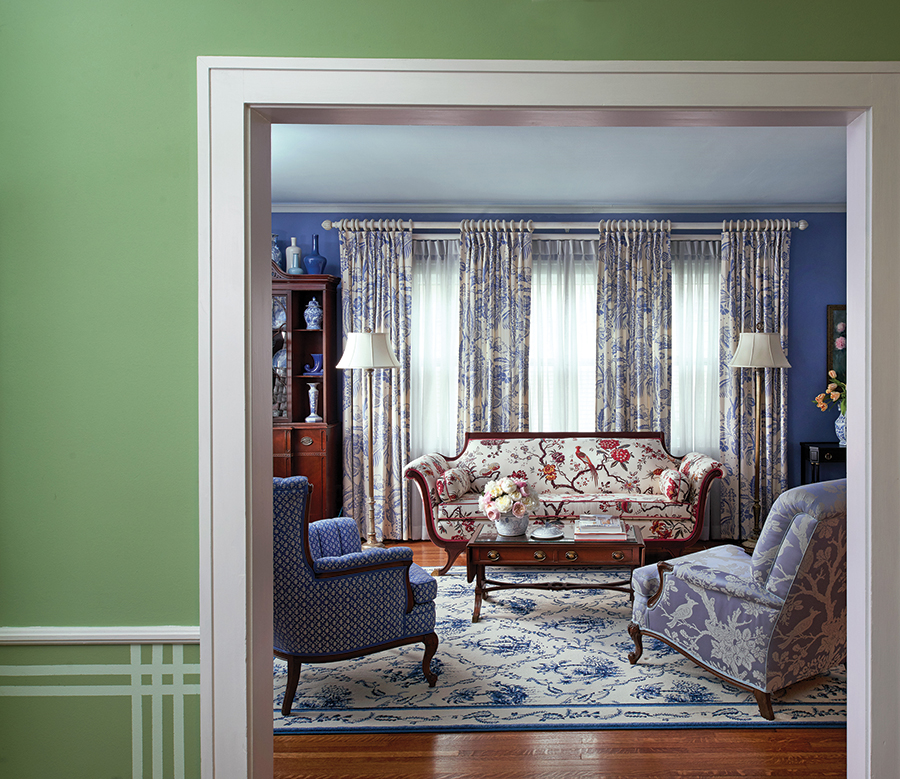
In the chapter “Pattern is Timeless,” a classic blue-and-white living room that we designed in Des Moines, Iowa takes center stage. The Duncan Phyfe-style sofa — an inherited heirloom — is the perfect, punchy focal point for the room. The sofa’s tree-of-life-patterned chintz is a design classic with origins tracing to the China trade in the early 1700s. Tonal blue-and-white motifs round out the look and play off the flora and fauna elements in the chintz. The vine-and-floral-bouquet pattern in the rug echoes the blue-and-white pottery collection that fills the room’s shelves.
 

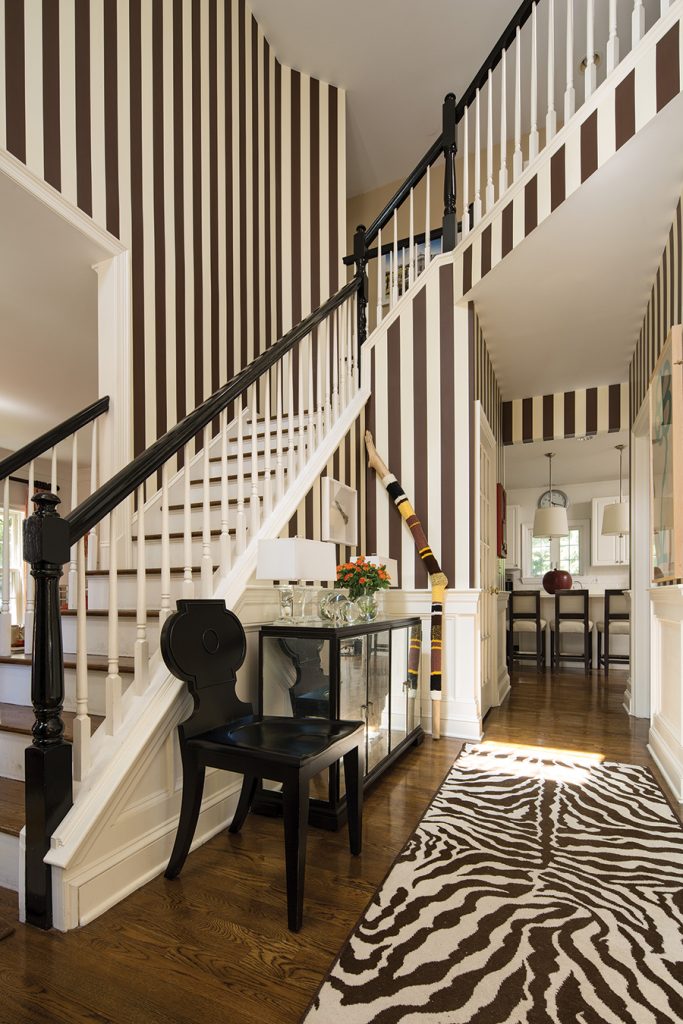
We gave a suburban home in New York’s Westchester County a contemporary spin thanks to a spirited dash of prints and pattern, as profiled in the chapter “Pattern is Modern.” Here, the home’s entry — once a white box with zero personality — looks smashing thanks to striped wallpaper that helps mask the foyer’s many odd angles while adding heaps of drama. The zebra rug lends an organic element to the room. In a room, you do not want to make everything too perfect or too linear, as that will have less impact. Talk about a grand entrance, all thanks to a little stripe tease.


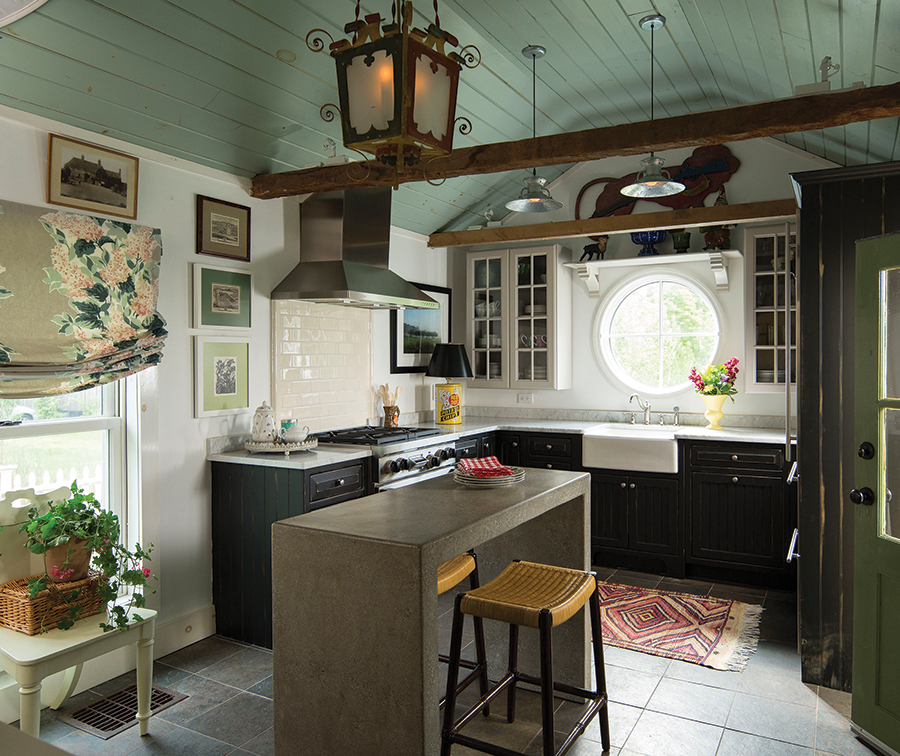
In the same “Pattern is Romantic” cottage, the kitchen shines with a mix of textured finishes in a limited color palette of blacks, grays, and pale blue. Natural materials such as slate, marble, and wood, tell a textured and well-worn pattern story. The room’s tongue-and-groove ceiling and chunky chiseled wood beams add visual interest on high. Although new, the finish on the custom cabinets was intentionally distressed to give the room a sense of history. The Roman shades in our Windy Corner fabric pattern are from the Madcap Cottage collection for Smith + Noble, the window treatments catalogue and e-tailer.


An Art Deco-styled living room springs to life in the chapter “Pattern is Masculine.” Think clubby, chic, and sophisticated abstract patterns, moody colors, and deco-styled chinoiserie in a small apartment on Manhattan’s East Side. Takeaway: Stumped on how to embrace pattern? Create a storyline for your home, and turn to pattern to make that dream a reality. Throwback 1930s Shanghai and a nod to the Bund in the East Thirties of NYC, why not!


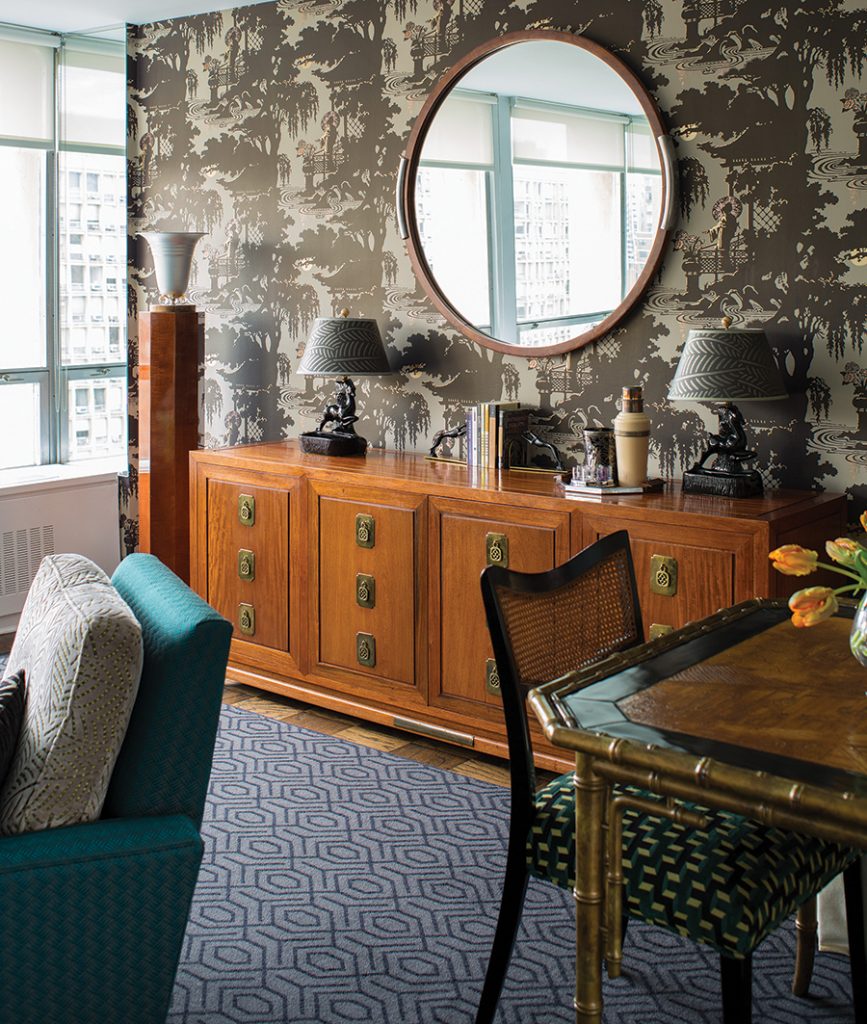
Another view of the clubby living room in the chapter “Pattern is Masculine.” To give the light-filled apartment moody atmosphere, we covered one wall with a glamorous Asian-inspired wallpaper. The wall was just the starting point. Note how we carried the chinoiserie vibe throughout the room, from the Chinese-style brass pulls on the serving cabinet to the vintage gilded and lacquered faux bamboo dining table. Be sure to bring a storyline to fruition: You can dip a toe in the water, but if you want the complete pattern effect, go full force by bringing fabric and accessories into the mix.  PS

High Point’s John Loecke and Jason Oliver Nixon invite you to dive into the accessible, affordable magic that is prints and patterns.


Poem

DON’T WALK FAST

Rock … fallen leaves … soil.

At first just listen … after a mile

or so sound will distill in your body.

Find rhythm … keep that pace …

then slowly refocus mind & ear

so as to attend the measured silence

between boot swing & boot fall.

There’s the music … call it that.

It was not here before you came

won’t be here when you’re gone.

The spaces pulse … connecting links

making sound complete & movement whole.

Do not avoid the steeper slopes.

Against grade the intervals will

widen & deepen so that you

will hear the lovely up-

curving arc of trail.

  —George Ellison


Painting by Elizabeth Ellison

The Weymouth Center for the Arts & Humanities presents The Wilderness Poet, George Ellison, and his wife, Elizabeth Ellison, renowned visual artist and illustrator of her husband’s works. A reading and art exhibit are in the Great Room at Weymouth on Sunday, Sept. 10, at 4 p.m., $10 for members and $15 for non-members. A reception will follow.

Story of a House: Rose Cottage

Rose Cottage

James Tufts’ first foray into vacation homebuilding, once again a showplace

By Deborah Salomon   •   Photographs by John Gessner

rose is a rose is a rose . . . 

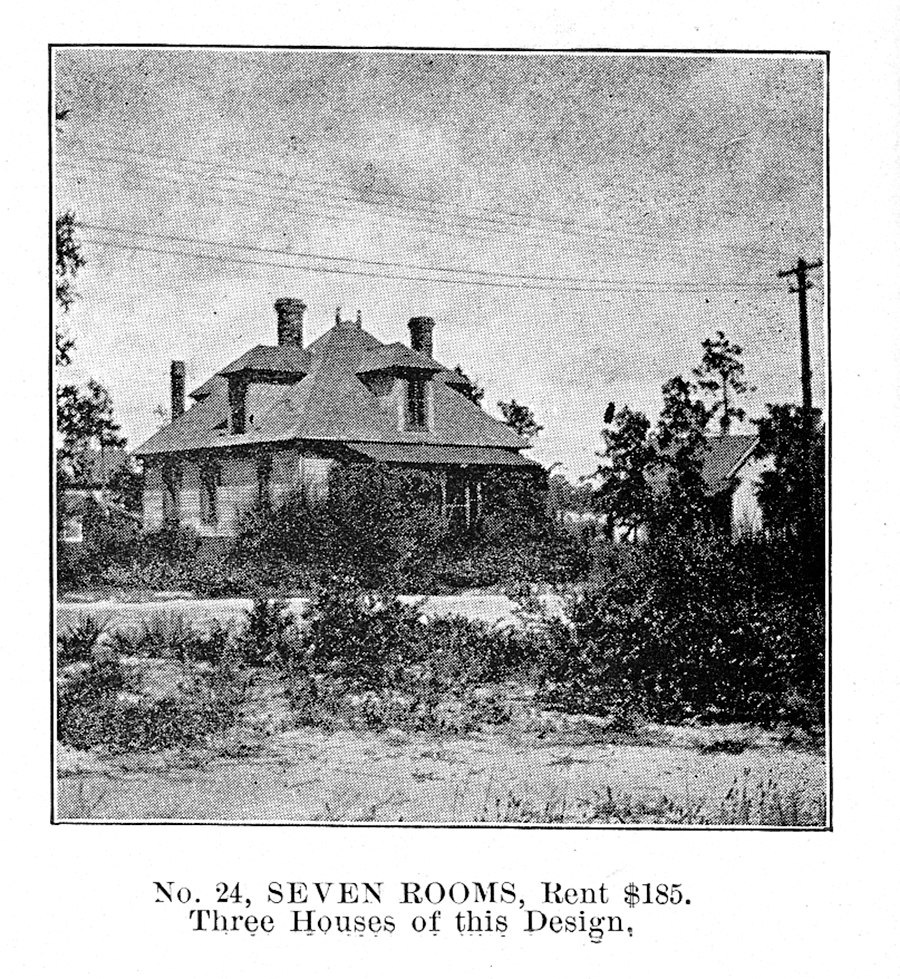
However, Rose Cottage looks and lives very differently than when it was built by James Tufts in 1895 — among the first of about a dozen. This house, intended as a rental, then sold in 1905 for $1,050, had few neighbors and a clear view to the Carolina Hotel and nascent Pinehurst village. Its tight floor plan, consisting of seven rooms, a small sun porch, and one bathroom, begged expansion accomplished by subsequent owners over the next three decades, culminating, circa 1940, with the colorful Razook family. F.R. Razook, a Lebanese immigrant, and his wife Rose had established a haute couture ladies’ boutique in Blowing Rock, N.C. They followed the money to Pinehurst, Palm Beach, Manhattan and Greenwich. While the Great Depression wiped out some clientele Razook’s thrived on survivors. Gen. George Marshall’s wife (with a home in Pinehurst) reportedly purchased the gown she wore to Queen Elizabeth II’s coronation from Mme. Razook.

However, by the 1960s, this rose had faded. The younger Razooks came down for holidays only. Modernization stalled after 1940. Gorgeous heart pine floors slumbered beneath ratty broadloom. Critters overran the attic. The layout had been chopped into a warren of small rooms of indefinite purpose. The kitchen was a period piece and the bathrooms . . .

***

Lisa and Bill Case — retired lawyers who married in 2008 — weren’t looking to rebirth a landmark. They knew what such projects entailed after living in the German Village section of Columbus, Ohio, a revitalized neighborhood on the National Register of Historic Places. Bill first visited Pinehurst with his father, on a business trip in 1964. He brought Lisa, a new golfer, with increasing frequency, telling her during a Thanksgiving jaunt, “You have to play No. 2.”

Slowly, as retirement took shape, Pinehurst looked promising — not only for golf. “We were footloose, could go anywhere, but we kept coming back here,” Lisa says. They liked the climate and population potpourri. However, this time Lisa wanted a sleek modern residence, “No curlicues, easy to keep clean.” A Realtor gave them the tour; they passed Rose Cottage without going inside. Yet the charm of the old place caused them to ask for a walk-through.

They returned to discover the house a mess, old and tired from not being occupied. But quality materials, location and antiquity left an impression.

“Bill’s eyes were like saucers,” Lisa recalls.

Options were discussed and decisions were made during the 8-hour drive back to Columbus.

“As long as you give me rooms for guests and a kitchen that I love . . . ” Lisa said, having recently remodeled hers. “We could see ourselves living here.”

They took the leap in 2013 with a lowball offer. Their Columbus house sold in a day. Down they came with one dog and two cats, hired a designer and builder, rented a condo for the duration.

Bill: “I thought we’d gut the bathrooms and kitchen and do the rest later,” which, as it happened, was like being a little bit pregnant. Their builder wisely advised a “one fell swoop” plan, to avoid tearing the place apart twice.

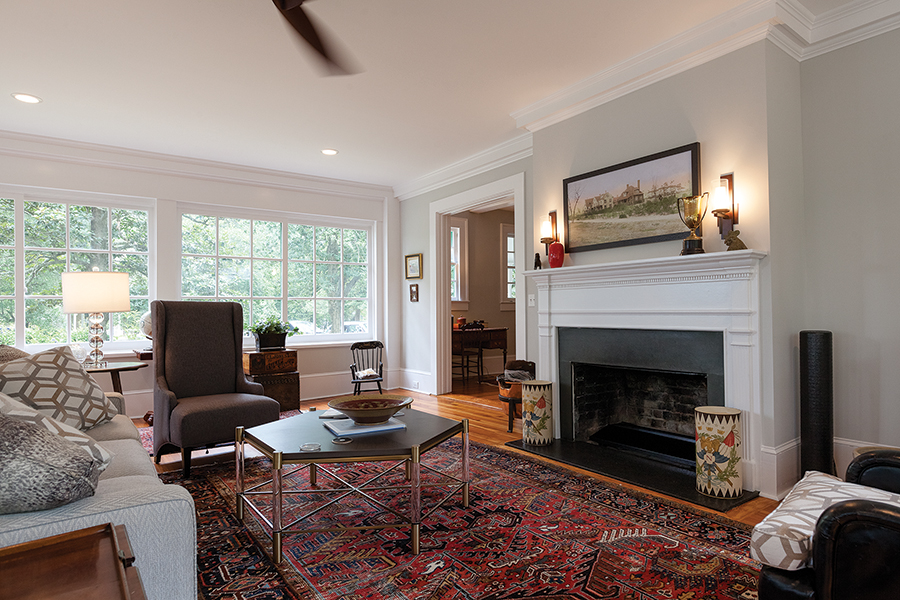
And tear it apart they did, moving interior walls, combining cubbies, creating spacious bathrooms and storage, opening up the staircase with a transom and handsome banisters all without altering the footprint.

***

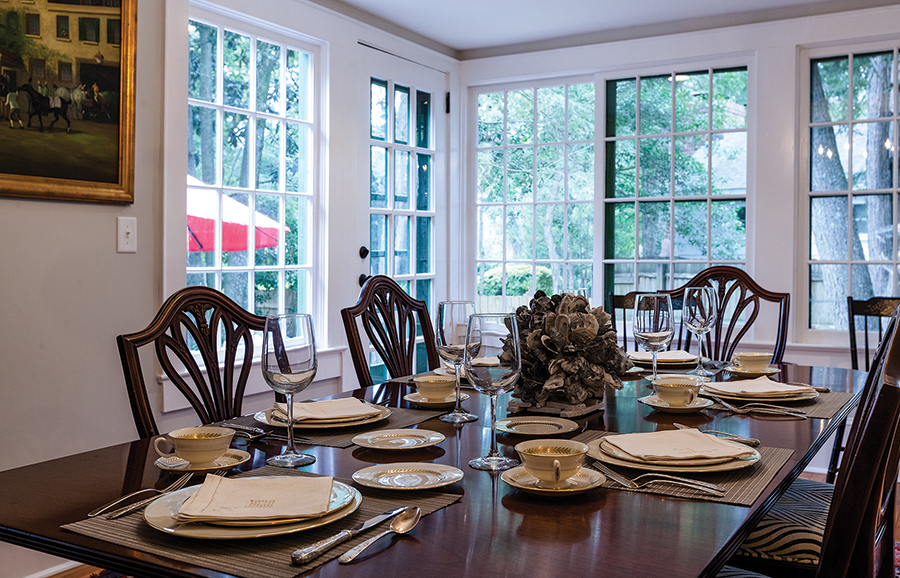
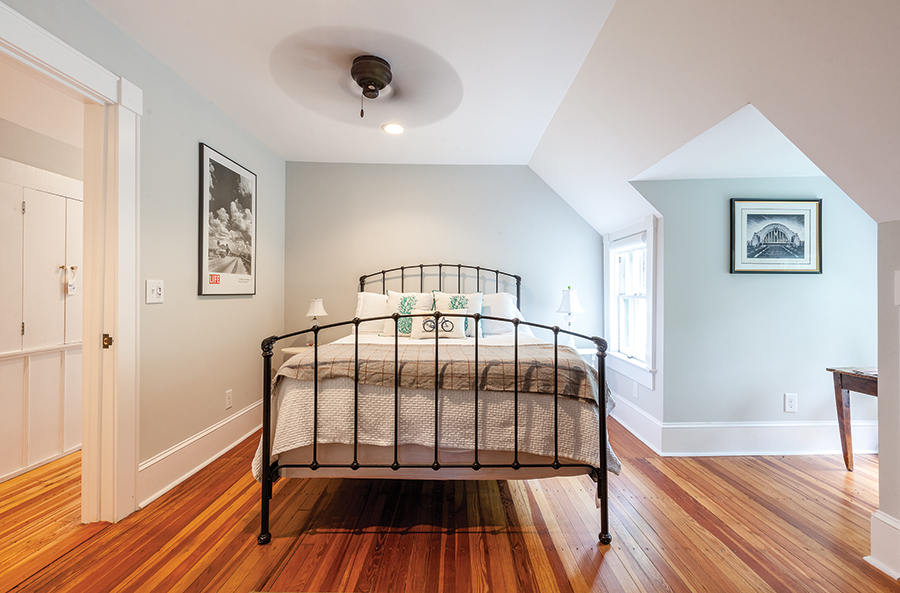
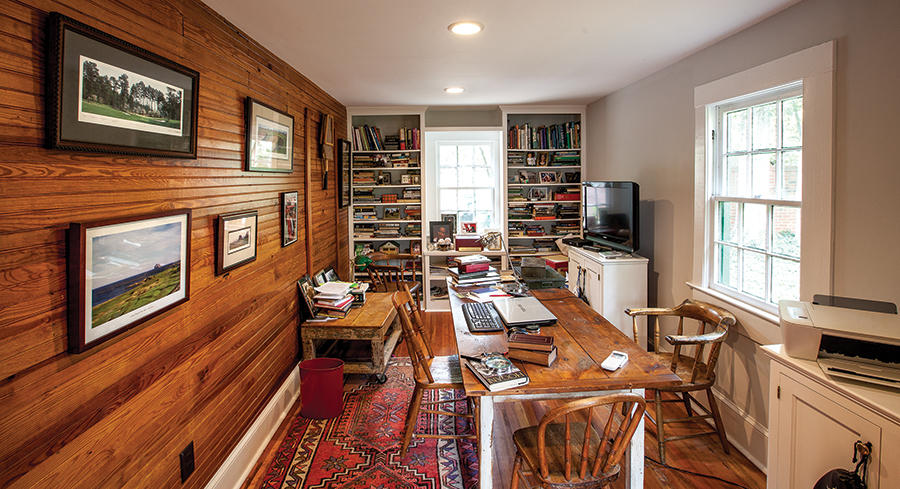
The result begs questions, reveals surprises. What purpose, the room just inside the front door? Larger than a foyer — likely a parlor before the enormous solarium was added. To the immediate left, the dining room with an off-center fireplace could have been a ground floor bedroom for grandma, as was common in houses of that era; formal dining rooms weren’t required since the first Pinehurst cottagers ate communally. Windows at the end of the dining room suggest a small sun porch. Ceiling beams, now painted white, could be original or an addition. Then, in a bay window area connecting dining room to kitchen, the Cases created a conversation nook/butler’s pantry/bar.

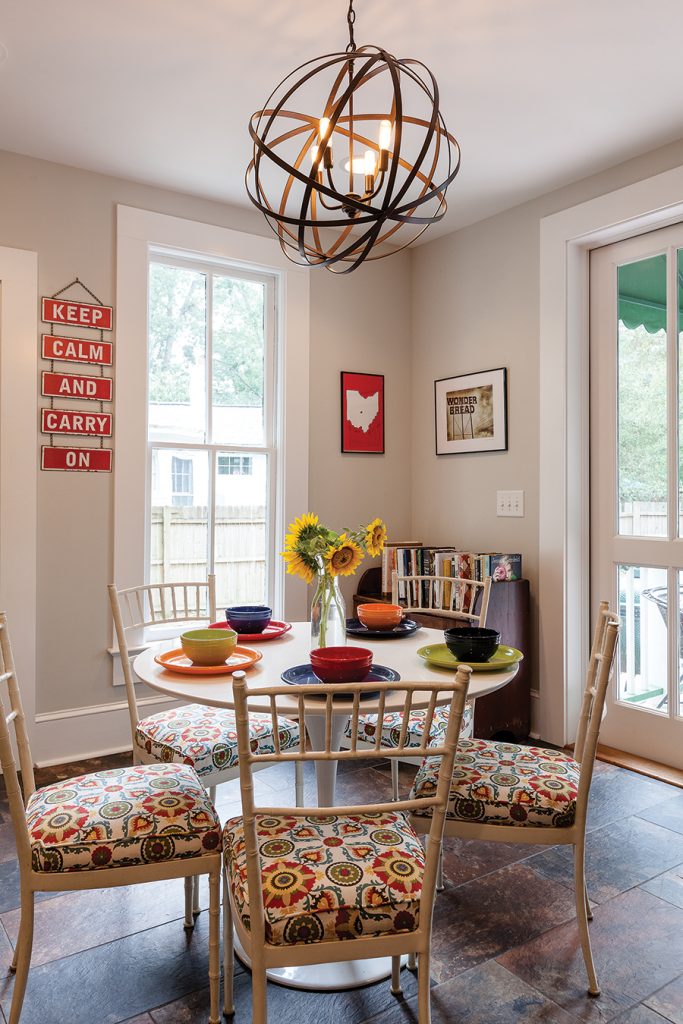
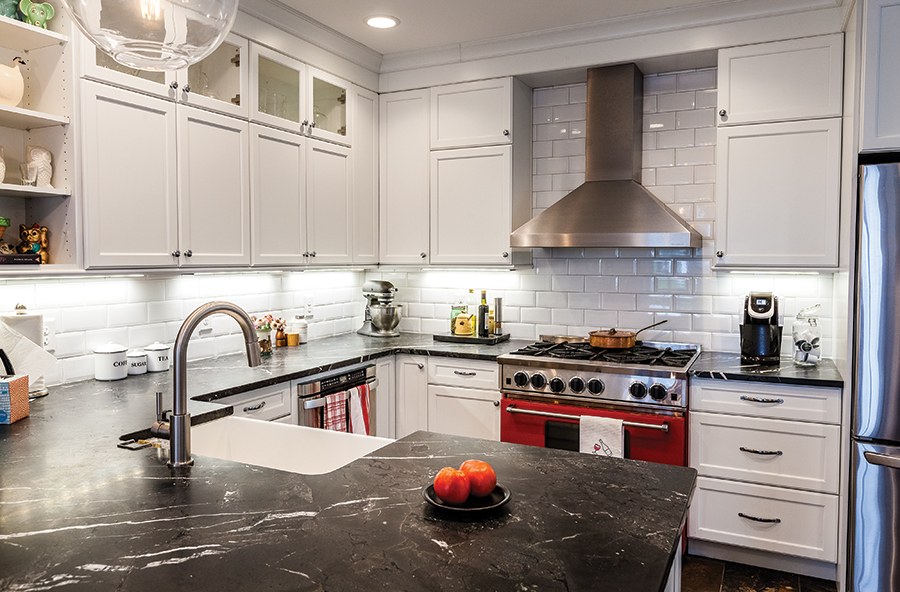
As stipulated, much attention went into Lisa’s kitchen. “We splurged on the soapstone counters,” she admits. They are black, the walls throughout a soft, soothing grey, the cabinets white. Color pop comes from her unusual red gas range and dishes in a variety of bright primaries. French doors open onto a brick patio, which they added.

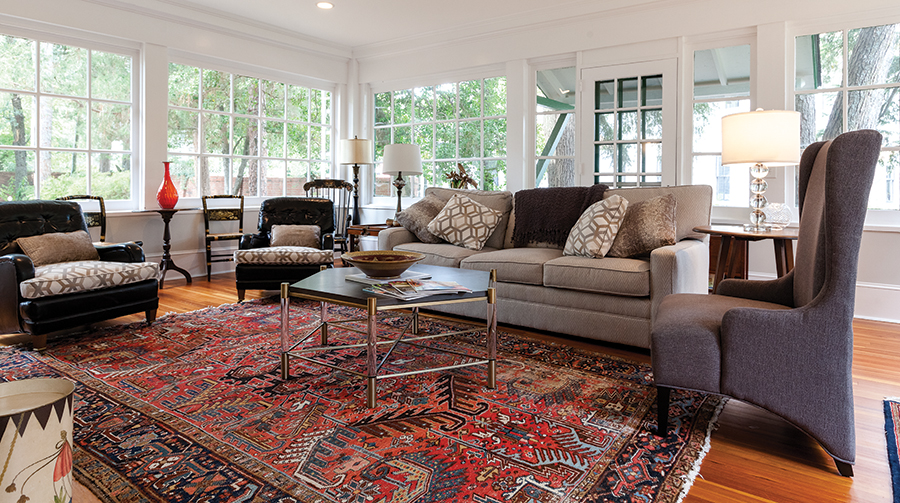
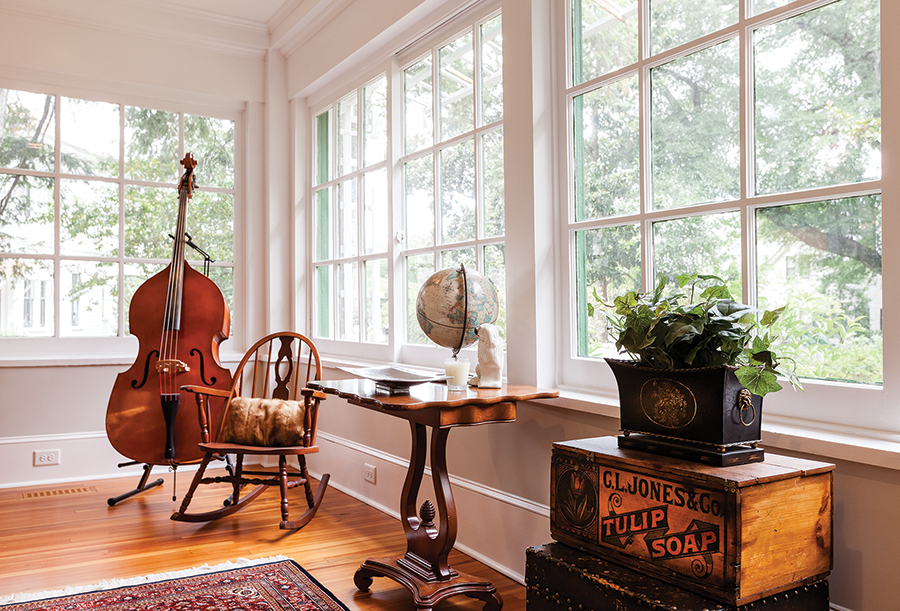
The real main floor knockout, however, is that 30×20 foot solarium, a veritable fishbowl with three complete window walls not covered by shutters, shades or drapes. Here, the Razooks held high society soirees. Now, Bill’s stringed bass fills a corner, silent but decorative.

“People look in  . . . we wave to them,” Lisa says. 

Upstairs a narrow hallway, sloping from age, leads to three bedrooms with niches and windows set low on the mansard walls, creating a treehouse effect.  Nobody knows why the Juliet balcony off the master bedroom lacks a door. Obviously, it wasn’t planned for sitting.  “We crawl out the window and decorate it for Christmas and July 4th,” Lisa says.

Ever the conservationists, Bill and Lisa created sliding pantry doors from original hinged, moved the porcelain kitchen sink into the laundry room, made free-standing cabinets from removed built-ins and salvaged old knobs for pegs. Since no clawfoot bathtub survived, Lisa chose a reproduction.

Because all but one room is moderately sized, the house doesn’t feel like 3000 square feet, “But we use every inch,” Lisa says.

Across the garden, a former carriage house/garage has become Bill’s man cave, repository of baseballs and books, where he researches and writes. Bill appreciates history and its icons: he owns a mint-condition 1954 Mercury used in the Johnny Cash film bio Walk the Line. A Waring blender with glass canister has been converted to a lamp. And on the walls hang a continuation of golf course art, both paintings and photos, appearing throughout Rose Cottage. “We marshaled at St. Andrews in 2015,” Lisa says proudly. Other wall décor includes their “happy place” beach in Scotland, archival photos and documents relating to Rose Cottage, personal mementos, and a Columbus landmark — the Wonder Bread factory sign.

The couple’s furnishings — his, hers and theirs — stretch the eclectic concept. An heirloom sideboard looms over the dining room like a frigate. A round English-manor hall table centers that mysterious front parlor. On the mantel stands a trophy dated 1941, won by Bill’s mother at the (prophetically) National Rose Show. Lisa found fertile hunting grounds in Moore County consignment shops — everything from an ornate French chateau desk reproduction and carved settee to tables and chairs with contemporary Scandinavian lines. When pushed to feature a color, as in the master bedroom, Lisa chose “cat’s eye” green, a pale avocado evocative of bygone days.

“Doing the outside is my next project,” says Lisa, who completed a Master Gardeners’ course. As yet, neat plantings neither overwhelm nor detract from the house itself. Lisa is learning what grows well in this warmer climate. “I’m thinking about a pollinator garden, but so far, it’s a work in progress.”

All in all, Lisa and Bill have adapted the prototype Pinehurst cottage to active retiree living: original wide baseboards and doorframes meet recessed lighting. Long halls become gallery space. The black-and-white magazine kitchen co-exists with a Welsh cupboard. An exterior painted the white and money-green, popular mid-20th century, gives no hint of what lies within.

Bill and Lisa are pleased. “We’ve learned ‘porching’  . . .  sitting outside with a bourbon at four in the afternoon, watching the world go by,” says Lisa. “Our neighbors are wonderful. This house has good vibes.”

With one ghostly exception: “I was lying in bed and Bill was watching TV. I swear I heard somebody standing by the bed. She whispered, ‘This is my house.’”

To which Lisa rightfully replied, “Oh no, this is MY house now.”