Poem

Four Egrets at the Reservoir

Four great egrets,

the wands of their

slender necks waving,

wade through tall

reeds and tranquil

water to the sound

of a kingfisher’s

call. The tops of

surrounding trees

are lit from above,

and the ground below

them, shadowed.

All is serene, from

the gander swimming

in circles to water

striders, skating

across the reservoir’s

still surface. In

summer, lilies

bloom and multiply,

their petals a delicate

shade of pink. But

the wedding-veil-

white of the egrets’

feathers is stark

in early spring,

against umber,

sienna, and olive,

and the evening air,

cool and weightless

here, where egrets

come and go — like

darkness and the light.

— Terri Kirby Erickson

When New is Old Again

Living Good in This Hood

By Deborah Salomon   •   Photographs by John Koob Gessner

What’s going on here?

A row of compact houses set close together, no two alike, channeling the 1940s yet looking brand new. Mr. Rogers’ Neighborhood? June Cleaver’s home sweet home? The MGM backlot?

Maybe The Twilight Zone?

No driveways, just a free-standing single-car garage accessed by a back alley. Some brick, some siding. Lots of covered front porches with tapered columns. But, once inside, Beaver’s mom would flip: granite countertops in open kitchens, mini-spa bathrooms, two-zone AC, recessed lighting, gas fireplaces, vaulted ceilings, porthole windows, gleaming hardwood floors.

These aren’t condos or golf pied-à-terres, although a low monthly fee covering landscaping and maintenance enables residents to lock-and-leave. Military mommies jog behind three-wheeled strollers. Retirees ride bikes. Children splash in the pool adjacent to the community room and terrace, with built-in barbecue grills. Friendly dogs, potted geraniums and picket fences complete the picture.

The Cottages on May is a concept development whose concept follows trends identified as new urbanism or urban redevelopment: living near downtown where services are within walking or bike range and neighbors within waving distance. Nobody narrates it better than Tim Venjohn, a South Dakotan who discovered Southern Pines while stationed at Fort Bragg. Now a Realtor working with designer Travis Greene of Legacy Home Construction, his explanation rings true:

“Ten years ago, everybody was building modern houses — but Southern Pines is a bunch of old cottages. We decided to design houses to fit the neighborhood, to look 80 years old like the houses on either side.” While such a cottage was under construction, Tim got a call confirming their success. “Somebody asked about that old house we were ‘remodeling.’”

After building about 20 cottages in the historic district bordering Weymouth why not reproduce an entire neighborhood?

Sounds good, if a bit risky.

The tract on May Street seemed perfect; its depth allowed walking trails that connect with downtown residential streets. Its location attracted Fort Bragg commuters. Some architecture reproduced existing one and two-story houses of an earlier era. Others featured a chimney, built for esthetic purposes only, and open rafter tails.

“We really had fun doing this,” Venjohn says. “It was a culmination of an idea.”

Small(ish) houses on modest lots, creative floor plans, quality materials and finishing don’t come cheap. However, Legacy had no trouble finding buyers for both spec houses and larger ones built-to-order — if the buyer prefers.

Which these homeowners did.

***

Although a lifelong horsewoman, as evidenced by her equine art, Beth Busichio’s cottage, done primarily in crisp navy and white, appears nautical: “Clean and classic,” says the graphic designer experienced in staging houses for sale.

Beth, while living in Florida, heard about Southern Pines horse country, came for a visit and fell in love. “But I didn’t want a (gated) golf course community.” Instead, the youthful grandmother looked for “the feel of a town, a place with low maintenance and young neighbors.” She didn’t need a horse farm but wanted something close to the boarding barn she visits daily.

Beth found, but lost, a suitable house further south on May Street, also being developed by Legacy, which is how she learned of the new cottages.

Because hers was built to order, “I did a lot of tweaking.” The coffered ceilings, a hallway picture rail, beadboard, a mantle in the kitchen, vaulted ceiling and living room fireplace walled over to accommodate an entertainment unit give an illusion of a space larger than 1,800 sq. ft. The rough-hewn barn door separating living area from the bedrooms adds “earthiness,” and is solid enough to be soundproof.

The parking area was adapted for a horse trailer. Other spaces were designed around Beth’s furniture, much of it painted white, or shaggy-chic upholstery. Together, they are a page from Wayfair, her favorite source. She chose louvers for the windows, reminiscent of jalousies popular in Florida. Throw pillows, her décor insignia, are everywhere.

Porthole windows in the master bedroom, which she admits is a little tight, mean morewall space for paintings and family photos.

Beth wanted a corner lot to accommodate a wraparound porch, with fireplace. Here, she sits with Panda, her fluffy Australian sheep dog, and watches neighborhood action.

“I love-love-love this house,” Beth says enthusiastically. “It has such a fresh, light feeling.”

***

Ashley Holderfield is also a designer with a black and white fluffy puppy who lives at The Cottages on May. There, the comparison ends. She and husband Casey Holderfield now occupy a second neo-classic cottage built by Legacy. Their first house was on East Maine St. in the desirable Southern Pines district above the tracks. Its floorplan and giant porch were similar to Beth Busichio’s but in dark woods with earthy brown and forest greens. But in 2016, after only a few years and one baby, the cottage seemed small.

“I loved living downtown but I wanted more of a yard,” Ashley says.

“We looked in Pinehurst but loved Southern Pines where you can walk or bike downtown,” Casey adds.

They already knew Tim and Travis — and decided to investigate the high end of the concept.

What sold them was the lot bordering a pasture with open spaces beyond, a forever view. Here, they conceived what Ashley calls a modern two-story farmhouse with circular driveway, a Juliet balcony and industrial décor carried out in white, grey, black.

At 2,600 sq. ft. the unusual layout accommodates the family, which besides 4-year-old Evie, now includes 10-month-old Willow.

“Notice that there aren’t any edges” on furniture or surfaces — a safety measure — Casey points out. Almost all the furniture and fabrics are new, in gradations of that industrial gray palette, including tufted sofas and a round leather ottoman replacing a coffee table. Notice, too, that the enormous white quartz island separating the stark white kitchen with ceramic tile backsplash laid in a “subway” pattern would never be found in a mid-20th century Carolina farmhouse. Nor would the metallic gold and silver fixtures. Certainly not the horizontal cable wiring replacing balusters on the stairway. Or the front door paneled in rain glass which admits light but distorts the view.

“Ashley has these ideas in her head . . . ” Casey says.

Separate dining rooms are phasing out, they noticed. Instead, a small corner of the open kitchen accommodates an oval hardwood table found at Habitat and painted white.

Farmhouse or not, the uncluttered visuals are not only stunning, but suited to a young family seeking togetherness in open spaces.

Equally iconoclastic is the layout with master suite and enormous bathroom with walk-in (no door) shower on the main floor. Toys are confined to an upstairs playroom, near the children’s bedrooms, with an office nook where Ashley can work with one eye on them. Throughout, white walls backdrop modern art by Ashley’s classmate, Lindsey Lindquist.

The Holderfields have chosen to use their heated, air-conditioned carriage house for fitness equipment and storage. The covered back gallery running the width of the house has a wood-burning fireplace and, over it, a wall-mounted TV. Evie can feed somebody else’s horses through the fence.

Ashley wanted a modern farmhouse that fit the equestrian landscape.

Casey didn’t want anything that looked brand new.

Both sought unobstructed views in a quasi-rural neighborhood close to downtown.

This was a one-in-a-million find, they agree.

The Holderfield home may not conform exactly to Legacy’s cottages-of-yesteryear concept but, with all satisfied, nobody’s looking this gift horse in the mouth.  PS

Champions Galore

Donna Andrews, the Sandhills’ only resident winner of a professional major championship, tees it up in the U.S. Senior Women’s Open

By Bill Case   •   Photographs by John Koob Gessner

A quarter century has gone by since Laura Davies and Donna Andrews battled head-to-head for a major championship title in the final round of the Nabisco Dinah Shore in Rancho Mirage, California. As the two came to the 18th tee that day, Davies, who was on the cusp of a juggernaut ’94 season in which she would win eight times on five different tours, appeared fully in command. She’d taken a one-stroke lead on the 17th and with only Mission Hills Country Club’s par-5 18th remaining, the Englishwoman — one of the most powerful drivers in the history of women’s golf — seemed in control.

Davies elected to play it safe, but the strategy began backfiring when her blocked 4-iron off the tee found the right rough. Her recovery stayed in the thick grass and her third failed to clear the crest of the green, leaving her 60 feet from the hole. Meanwhile, Andrews was on offense. She hit two perfect 3-woods followed by a 6-iron third that covered the pin the whole way, settling 12 feet behind the cup. Davies three-putted, opening the door for a two-shot swing.

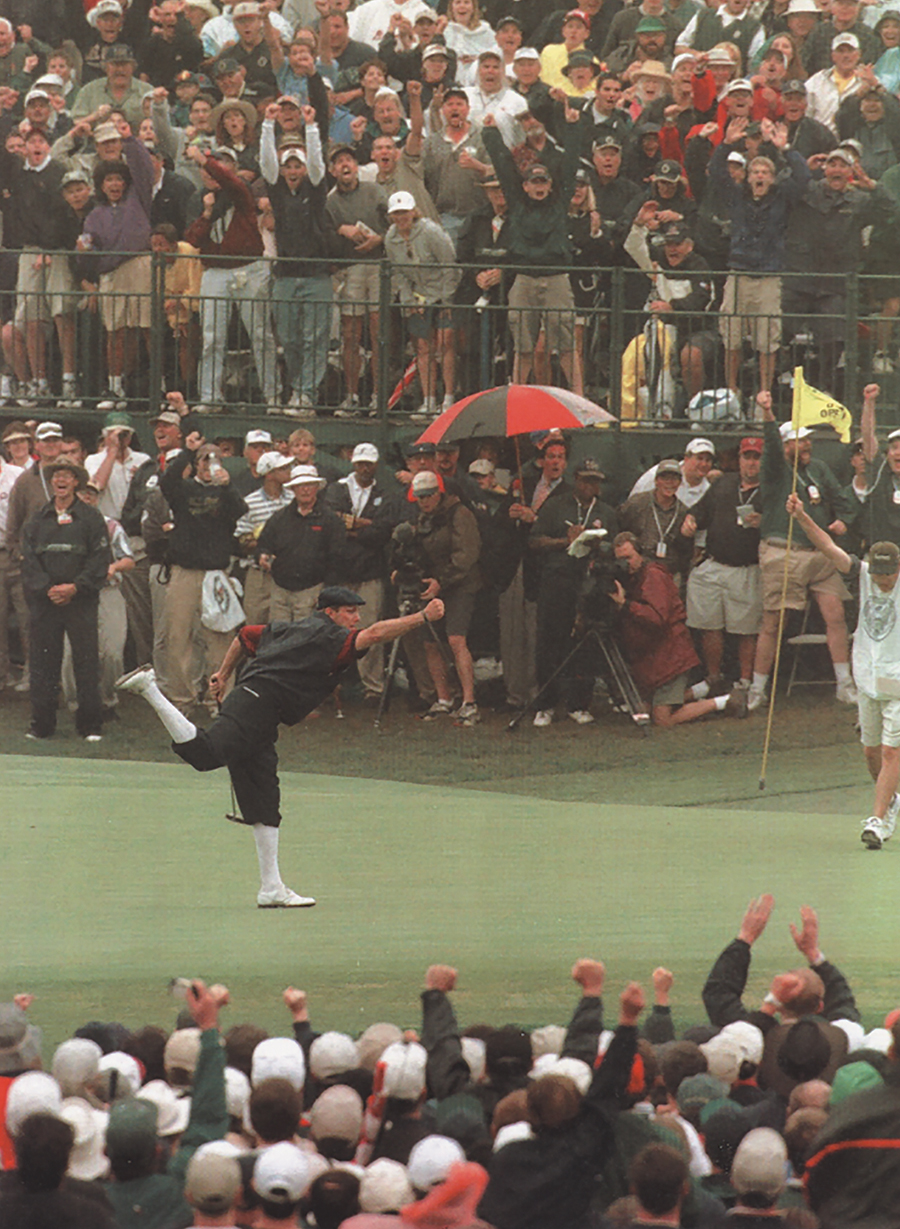
“I told my caddie that there was no way I was going to leave a putt for my first major short,” recalls Andrews. She didn’t, drilling it in the heart. Andrews celebrated with a leap into Poppie’s Pond, becoming the first champion not named Amy Alcott (who took the dive in ’88 and again in ’91) to take the plunge. It has been an annual tradition followed by the championship’s winner ever since.

Twenty-five years later, Dame Laura Davies, a member of the World Golf Hall of Fame and owner of 85 worldwide victories, including four major championships, still plays competitively. She comes into the U.S. Women’s Senior Open at Pine Needles Lodge & Golf Club May 16-19 as the defending champion, having won the inaugural championship last year at Chicago Golf Club by a stunning 10 shots. Depending on how you want to score Harvie Ward’s U.S. Amateur titles and Peggy Kirk Bell’s Titleholders crown, Andrews stands alongside Julius Boros as one of the few major champions to call the Sandhills home. She, however, comes into the Senior Open championship with a slightly different schedule.

Andrews rises at 5:30 a.m. for her half-hour workout; feeds the horses at 6 a.m.; makes lunch for her two children, seventh grader Connor and third grader Sarah, and drives them to school at 7:15 a.m.; gives golf lessons at Pine Needles, where she is the lead teaching instructor, from 8:30 a.m. to 2:30 p.m., sometimes later; picks up the kids and heads home for farm chores and dinner with husband, James Tepatti. Oh, let’s not forget coaching the kids’ sports teams and selling houses for MLV Properties, a real estate agency where Tepatti is also an agent. Everyone needs to be somewhere. Some people seem to be everywhere.

Players like Davies and last year’s Senior Open runner-up Julie Inkster — who, at age 53, challenged the leaders in the U.S. Women’s Open on Pinehurst’s No. 2 course in 2014 — still regularly play tournament golf and are likely to have an upper hand over those, like Andrews, who don’t. After a stellar 15-year LPGA career that included six victories, highlighted by the ’94 Dinah Shore, Andrews retired from competitive golf in 2005. While she relishes her busy life, it leaves little time to get her own golf game in shape for a major competition, even one on her home course. “In the past, I might have had an edge reading putts but the contours of some greens were changed in the recent restoration,” says Andrews. “I’m still figuring them out.”

A native of Lynchburg, Virginia, Andrews came from a golfing family. Her father, Barclay Andrews, was a finalist in the 1961 Virginia Amateur, and both her brothers played the game at a high level. In Andrew’s mind, her involvement in other sports was critical in her development as a golfer. She played baseball, basketball, tennis and swam competitively. “Participating in other sports made me a better athlete,” she says. “I know it improved my hand-eye coordination which is essential for golf.” It’s a breadth of experience that she’d recommend to any young golfer who wants to compete at a high level.

Andrew’s self-described “math brain” enabled her to focus on, understand, and practice good swing mechanics. “I got that from my dad,” she says of the former nuclear engineer who was so good at fixing things that “we never had a repairman in the house.” Donna developed an elegant swing with a relaxed and unrushed tempo. “Whenever I try to speed up, I get into trouble,” she says.

In high school, Andrews easily made the boys’ golf team, slotting in as E.C. Glass High’s number one or two player. Her teammates enjoyed needling opponents saying, “We got a girl who’s going to kick your butt.” She took home trophies for winning Virginia girls’ statewide championships in ’83 and ’84, and captured the 1984 North and South Junior Girls Championship in Pinehurst.

College coaches salivated over the prospect of recruiting Andrews. She chose the University of North Carolina (where she played alongside the current president of the PGA of America, Suzy Whaley) because she was interested in obtaining a “four year business degree from a great school — in case I needed a job.”

Andrews was second-team All-American her senior year, finishing third in the NCAA Championship. She continued winning Virginia Women’s Amateurs (five altogether), all held at match play over the Homestead’s Cascades course. Combined with her two junior titles, Andrews reeled off seven straight Virginia state championships from 1983 to 1989. Pinehurst was the site of the most prestigious victory of her amateur career when she defeated three-time U.S. Women’s Amateur champion Anne Quast Sander in the final of the 1988 Women’s North and South. By then, she had become familiar with Sandhills golf where she and her UNC teammates often came to practice. Andrews became friendly with Pinehurst’s Director of Golf, Don Padgett, Sr., and even worked at the resort in the summer.

Relying on a personal nest egg to finance her travels, Andrews turned professional in 1990 and played consistently enough to lead in the points race for rookie-of-the-year honors over Japan’s Hiromi Kobayashi with one event remaining. What happened next still rankles. “The final points event was a tournament held in Japan,” recalls Andrews. “The organizers invited Hiromi, but not me.” Kobayashi did just enough to nose ahead of Andrews to win the award.

In ’92, Andrews made a spirited run at the U.S. Open over treacherous Oakmont Country Club, leading early and ultimately finishing third. She would break into the winner’s circle the next year at the Ping-Cellular One LPGA Championship, finish ninth on the money list and tie with Helen Alfredsson for second in the U.S. Women’s Open at Crooked Stick in Carmel, Indiana, one shot behind winner Lauri Mertens. Golf Digest named Andrews the LPGA’s most improved player.

In ’94, Andrews won three tournaments and finished fifth in earnings, the highlight being the Dinah Shore — a victory that confirmed to the 26-year-old that she really “belonged.” Having climbed near the pinnacle of women’s professional golf, she possessed the wherewithal to pursue another passion, purchasing a horse farm just outside Southern Pines where she bred Hanoverians. She suffered the first in a string of physical setbacks when back pain led to surgery in ’96. Once she was pain-free, she won again the following year. A sixth victory in 1998 coupled with several other high finishes placed Donna third in the money race, and she was a member of the USA’s victorious Solheim Cup team with a 2-2-0 record.

Not long after she regained her form, injuries struck again. A fall from a horse in June 1999 caused a serious dislocation of her right shoulder and Andrews missed two months of competition. When she returned, she wasn’t the same player. She endured months of physical therapy before she could swing the club freely. Regaining some semblance of form in 2001, Andrews carded the lowest round of her career, a sizzling 62, in the second round of Tulsa’s Williams Championship, though it may well have been a shot lower. Her tap-in putt for 61 went in, but Andrews was concerned she might have struck the ball twice in the process. The television replay revealed no discernible evidence of a double-hit but, uncomfortable with the official’s ruling of no violation, she imposed the penalty on herself, and signed for a 62. She finished the tournament one shot behind the winner. Named to the LPGA Player Executive Committee, she served two years as president and, in another career offshoot, did periodic announcing gigs for ESPN at LPGA events.

Andrews reinjured her shoulder in 2004 after getting in the middle of a real, honest-to-God dogfight. She began referring to herself as “Donna Rehab.” Though she managed four top tens, another shoulder dislocation in ’05 sidelined the 38-year-old for good. It was then that Peggy Kirk Bell offered Andrews a full-time instructional position at Pine Needles. “God hit me over the head,” she says. “Here’s your way out.” Informed in part by her own work with renowned instructors Davis Love, Jr. and Jack Lumpkin, Andrews’ easy manner and uncomplicated, to-the-point instructional style resonated with her students. In the same breath, she made another major life change, marrying boyfriend Tepatti, a transplanted Alabaman and successful developer. The couple had their first child two years later.

The family atmosphere at Pine Needles, fostered by Warren and Peggy Kirk Bell, proved a natural fit. In her mind, the string of injuries left no lingering scars of what might have been. Things are as they were meant to be. “I feel I was brought to Pine Needles to continue the women’s golf tradition,” she asserts. “I love this family and this place.”

When the USGA announced in 2015 that it would be holding the first Senior Women’s Open in 2018, Executive Director Mike Davis acknowledged that the event was long overdue. “Let’s call it The ‘About Time’ Senior Women’s Open,” he said. In 2016, the LPGA informed its members that it would be holding its own senior women’s major in 2017 — the Senior LPGA Championship at French Lick, Indiana. The chance to play for two major titles was certainly welcome news for the women, but it truly became a dream come true when the purses were announced — $600,000 for the LPGA Championship and $1 million for the Open — dwarfing anything that existed before.

So there will be plenty more than pride to play for when the pros descend on Pine Needles. But don’t expect the women to be grim and stone-faced about it all. Most will relish the chance to reunite with the contemporaries of their tour days. That includes Andrews who cherishes her many friendships with fellow pros. It’ll be more than merely a social occasion for the Pine Needles teaching pro, too. With shoulders healed, Andrews hopes to improve on the finishes in her three prior senior majors — tying for 20th in the 2017 Senior LPGA Championship and missing cuts in that championship and the Senior Open last year.

Like so many of the players in the Women’s Senior Open, Andrews doesn’t lack for accolades. She’s been inducted into the Virginia Sports Hall of Fame, the Virginia Golf Hall of Fame, and the North Carolina Sports Hall of Fame. In June, Boonsboro Country Club, where she first learned golf, will host the Donna Andrews Invitational, a top-level amateur event for females.

Pine Needles has played host to three U.S. Women’s Opens in 1996, 2001, and 2007, and will host the championship again in 2022. The familiarity of the venue makes this a homecoming of sorts for several players. Stars who played in ’96 and are expected in this year’s Senior Open field include Inkster, Betsy King, Pat Bradley, Hollis Stacy, Beth Daniel, Patty Sheehan, Meg Mallon, JoAnne Carner, Jan Stephenson, and, of course, Davies. The championship promises to be especially fan-friendly. “We will only rope tees and greens,” says Matt Sawicki, the Director of Women’s and Senior Open Championships. ”It makes the event unique and allows an up-close and personal experience for spectators to walk the fairways with the legends of the game.”

Last year, the indomitable 79-year-old JoAnne Carner, winner of eight USGA championships, lit the tournament candle when she stepped on the first tee, flipped her cigarette on the ground and hit the first ball ever in a United States Women’s Senior Open Championship. It’s Pine Needles’ turn to grow the tradition with a little help from its teaching pro.  PS

Pinehurst resident Bill Case is PineStraw’s history man. He can be reached at Bill.Case@thompsonhine.com.

Upstairs, Downstairs

The annual migration of the back of the house

By Bill Case     Photographs from the Tufts Archives

After learning in 1895 that James Walker Tufts had concocted a grandiose scheme to build a model New England-style village and health resort in the denuded Sandhills of southern Moore County, most of the area’s denizens derided the wealthy Massachusetts native as an idealistic and foolhardy dreamer. Tufts was far from crazy.

If Pinehurst was to host guests from the North, suitable accommodations — and staffing for them — had to be made available, and fast. The Holly Inn opened on December 31, 1895, just five months after the start of its construction. Twenty guests bunked in that New Year’s Eve night. The Holly represented the initial jewel in Pinehurst’s array of lodgings, accommodating up to 200 guests with all the modern conveniences, including orchestra and billiard rooms. Not long after, Tufts opened an array of smaller hotels, all of which thrived: the Magnolia Inn; The Berkshire (long demolished but once located on Magnolia Road just south of the Magnolia Inn), housing 100 guests; and The Harvard (in the structure that currently houses the Old Sport Gallery), holding 75 guests.

Many New England hotel managers were eager to avail themselves of gainful employment during the months from November until May, when their inns were shuttered. Tufts sifted through this talent pool to hire his innkeepers. J. H. Atwood, proprietor of a hotel in Weirs Beach, New Hampshire, became the Holly Inn’s first manager. He was succeeded two years later by Allen Treadway, mastermind of the Red Lion Inn in Stockbridge, Massachusetts. F. M. Kimball, proprietor of the Eagle Inn in Orwell, Vermont, happily assumed the reins at The Berkshire. Kimball’s clerk, R.H. Butterworth, worked summers at the Hobbs Inn in Wolfboro, New Hampshire. J.L. Pottle headed the Magnolia, traveling south each winter from Jefferson, New Hampshire, where he operated the Highland House.

These managers encouraged their staffs to join them during the winter, and many did. After Tufts negotiated discounted fares from the railroads and steamship companies, droves of Northeastern bellmen, maids and cooks began descending on Pinehurst in late autumn like falling leaves. Since Tufts’ clientele likewise hailed from New England, Pinehurst advertising stressed the employees’ Northern connections. One newspaper ad touted the Holly’s “Unsurpassed Cuisine, with Table Service by carefully selected New England girls.” The Magnolia advertised that its “cooking will be done by one of the best of Northern cooks.”

An 1899 Pinehurst Outlook article described the home away from home atmosphere Tufts established this way: “The guests, being made up so largely of New England people, are sociable to a degree that makes one feel quite at home after a day or two here, and although there are some 200 over in the Holly Inn, they seem to be almost of one family.” This idyllic atmosphere bonded these early guests with Pinehurst, and many would establish a family tradition of annual pilgrimages.

The success of the hotels motivated Tufts in 1898 to build a far grander one — the Carolina Hotel. Completed in 1900, the magnificent four-story structure emerged as the largest frame hotel in North Carolina. Painted yellow with white trim, the hotel featured 250 guest rooms accommodating 400 guests. According to early advertising, the hotel boasted “every modern comfort and convenience, including elevator, telephone in every room, sun room, steam heat night and day, electric lights, and water from the celebrated Pinehurst Spring, and a perfect sanitary system of sewage and plumbing.”

Tufts chose Harry Priest, proprietor from June to October of the Hotel Preston in Beach Bluff, Massachusetts, to run The Carolina and also serve as the general hotel manager for all of the various Pinehurst lodgings. Throughout 1900, Priest labored on the massive task of recruiting seasonal staff from his own Hotel Preston and other New England lodgings. He enticed them with the prospect of free lodging and board in the hotel’s three story dormitory wing, which Tufts had attached to the rear of the hotel. Fully staffed, Priest welcomed The Carolina’s first guests on January 1, 1901.

By 1910, H.W. Priest had switched his summer employment to the Hotel Wentworth (now Wentworth by the Sea) in Portsmouth, New Hampshire. Several of the Wentworth’s key staff followed Priest to Pinehurst for winter jobs at The Carolina, including head bellman Jack Mulcahy, and headwaiter Jimmy Mahar. They in turn encouraged co-workers to shuttle between the two hotels, people like Hungarian immigrant Sam Lacks, who at the age of 32 first appeared on The Carolina’s payroll as a pastry assistant in 1908.

While engaged in his summer employment at The Wentworth, Lacks became smitten with co-worker Emma Lyons, a chambermaid and waitress who was born in New Brunswick. The couple married in 1911. Their union would produce two sons — Sam Jr., in 1913, and Stanley, in 1916. Sam Lacks Sr. would work at The Carolina for four decades, rising to a prestigious and lucrative position as the hotel’s doorman before retiring in 1947. In 2002, Sam’s younger son, Stanley (who himself worked several years at The Carolina prior to a distinguished banking career), authored papers, now housed in Pinehurst’s Tufts Archives, concerning his family and Carolina hotel operations during the first half of the 20th century. Stanley’s writings give a vivid picture of the nomadic lives and challenges of hotel workers of that long-ago time.

In the early days, “most migrating workers had several things in common: they were white, Christian, unmarried, and of Irish or English descent. They were capable of reading, writing, and doing arithmetic, but few had completed high school . . . The women had long hair and the men were clean-shaven,” writes Stanley Lacks. At the time most younger female employees “considered hotel work as a transition period prior to marriage and children.” Emma Lacks left her employment at The Carolina prior to the birth of her first child. She would return as the “newsstand lady” after her two boys graduated from high school. Stanley indicated that the majority of workers were Irish Catholics, including the aforementioned supervisors Mulcahy and Mahar. Church services for employees were held in their common area — “Help’s Hall” — until the Sacred Heart Catholic Church was erected in 1921, a chip shot distance from the hotel.

Before departing south for Pinehurst, workers stopped by the headquarters of the Boston Uniform Company to be fitted for their job attire. Waitresses were issued yellow garb to wear while serving breakfast and lunch, and crisp white uniforms for dinner. Bellmen were provided single-breasted navy blue uniforms of the same serge material that adorned U.S. naval officers. The head bellman and doorman (Sam Lacks) “wore double-breasted models with two gold stripes on the sleeves.” The uniforms and personal dress items were shoehorned into the workers’ suitcases and leather valises in preparation for the journey.

Until highway driving became less harrowing than a moon shot, there were only two feasible means for Hotel Wentworth employees to make their way to Pinehurst for the winter season. The excursion could be taken exclusively by rail, but the most popular method (and the one preferred by the Lacks family) involved boarding a Merchants & Minors steamship that would depart South Boston’s harbor about two hours before sunset. Upward of 100 hotel workers, most known to one another, would be aboard. Stanley Lacks recalls that “if the ship left Boston on Monday evening, it arrived in Portsmouth, Va., on Wednesday morning.” The disembarking passengers then boarded a Seaboard Line train that chugged them into Southern Pines in the evening.

The Lacks family did not attempt to travel the distance by automobile until 1927. Even then, road conditions outside cities and towns were generally deplorable. Stanley Lacks recalls it took seven days for the family to drive to Pinehurst. “Not a day passed we did not have to stop and patch an inner tube or find a small stream to get water for the radiator,” he would ruefully reflect. “We had to take a ferry across two or three rivers and forded several small streams with water up to the hubcaps . . . We had to avoid running out of gas because filling stations were few and far between.”

The employee dormitory (the “Help’s Quarters”) housed married couples, pairs of single men and pairs of single women on three floors. Men’s and women’s toilets and bathing facilities were located on each floor. All rooms were windowed, equipped with sinks, and large enough to accommodate two people, though department heads and a few others were afforded private rooms.

Some hotel jobs mandated continuous coverage from early in the morning until late at night, thus requiring two shifts of workers. Stanley wrote that in this situation, “one shift worked a long day (7 a.m. to noon and 6 p.m. to closing) while the other shift worked a short day (noon to 6 p.m.), with alternating long and short days. By assigning two staff members working opposite shifts to a room, each could get some private time.”

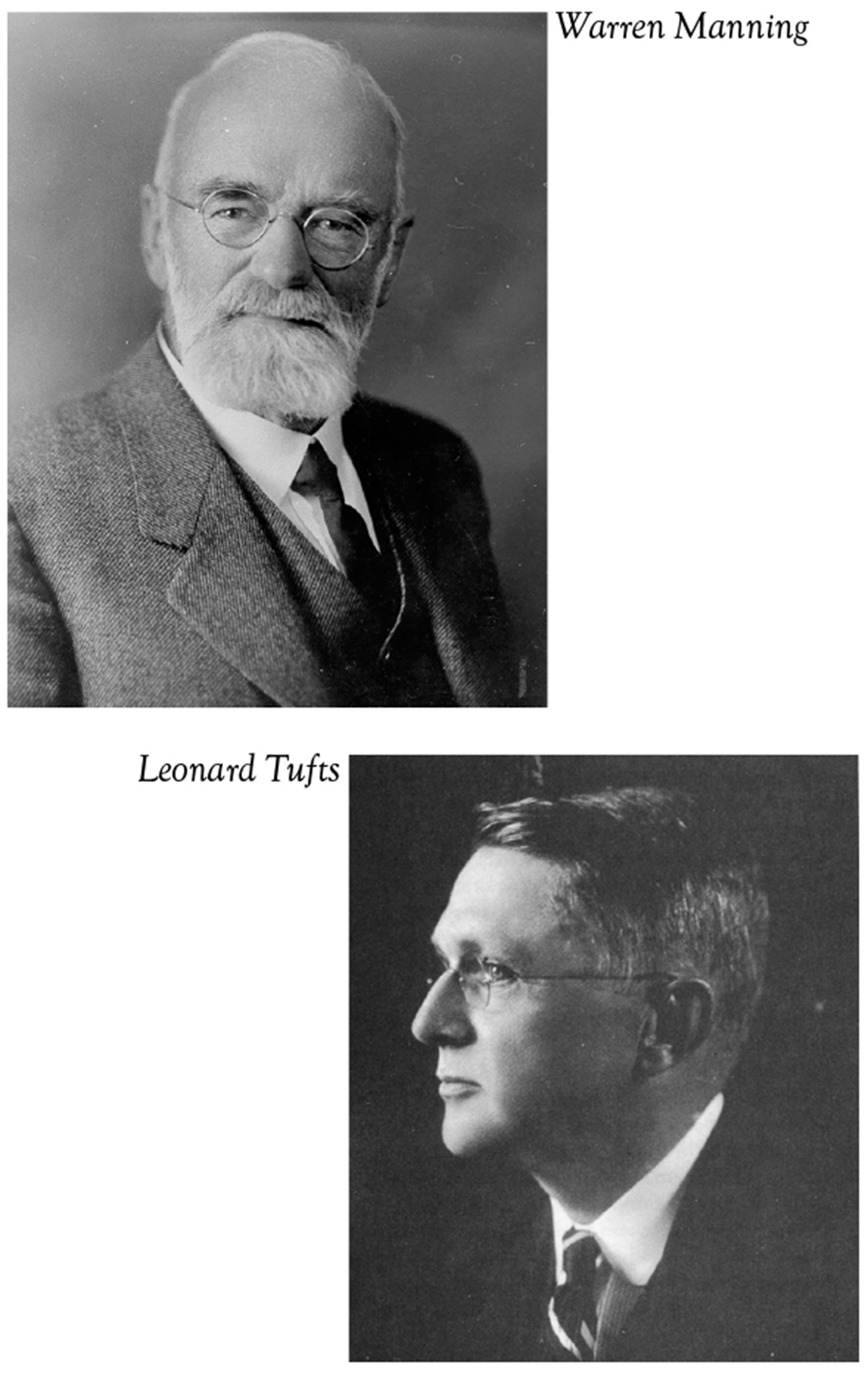
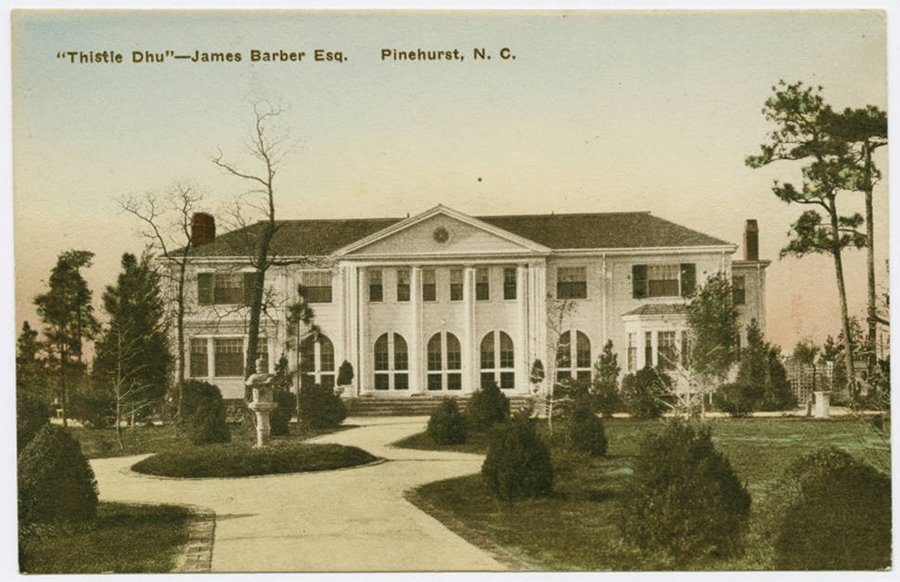
Following the death of his father, Leonard Tufts would construct other houses for employee lodging. The Lacks family resided several seasons at Thistle Cottage, a four-apartment dwelling on Community Road. “Little Sure Shot” Annie Oakley, who taught riflery at the Gun Club, occupied an adjoining unit.

With seven-day workweeks, there would seem to have been little time for workers to form, let alone act upon, attractions with one another while employed at the hotels. Indeed, Stanley wrote that romantic courting was mostly “an off-season practice” occurring during the vacation periods between the workers’ Northern and Southern hotel assignments. Perhaps that was so, but one suspects people in love generally find ways of spending time with one another.

The employees used three separate dining areas at the hotel. The jobs performed by the workers determined their dining locations. The manager and his wife, the hosts and hostesses sat at a large table in the corner of the cavernous main dining room, provided they were properly attired (coat and tie, etc.). Other higher-up staff, like the “department heads, doormen, desk clerks, switchboard operators, newsstand manager, musicians, waitress captains, porter” ate with full waitress service at the Side Hall, located between the main dining room and the kitchen. Help’s Hall (referred to as “The Zoo”) served as the eating area for the remaining employees. The Zoo also provided a central place for employee meetings and get-togethers. An adjacent small store sold Old Gold cigarettes, candy and miscellaneous items. According to Stanley Lacks, some workers never left the grounds of the hotel until heading north in the spring.

The workforce generally reached Pinehurst at least a week before the hotel opened. The early arrival provided “time to get the house ready. The women cleaned and polished while the men painted. Every fall they painted everything in sight: floors, walls, ceilings, porches, and some of the furniture,” wrote Lacks. The hotel booked conventions at the beginning of each season. Management viewed the convention traffic as a “dress rehearsal” opportunity in which employees could “demonstrate competence in his or her type of work,” prior to “encountering the more critical guests.”

And staff members were made to understand that when the blue-blooded social season guests arrived for their month’s stay, they expected service of the highest standard. The employees of Sam Lacks’ era labored in a hotel environment far more formal than that of The Carolina today. The male guests dressed for dinner in dark suits with ties, and their ladies were invariably clothed in colorful evening dresses. The upper crust, Stanley Lacks recalls, would “congregate in the lobby in overstuffed upholstered chairs. Demitasse was poured from a large silver urn by the hotel’s hostess and served in fine china,” while the hotel’s paid orchestra provided soothing musical accompaniment.

This formality led to certain employee positions having greater prestige than would be the case today. One was the “coat room lady,” the post held by Freda Marks. Lacks recollects that Marks “was an important person toward making hotel guests feel at home. She sat on a chair outside the entrance to the dining room and everyone had to pass her going in and out.” Freda took charge of the mink, ermine and sable coats of Cottage Colony females who came for dinner, and shared town gossip with them, practices conducive to substantial gratuities.

Stanley Lacks worked at The Carolina for several years in the 1940s assisting his father as a doorman. He remembers receiving a salary of $8 a week. “But I did not receive that money weekly; it was a book-entry in the Pinehurst, Inc. records,” he recalled. “The company gave me a check at the end of the season for the total amount due. If I had worked a total of 32 weeks, I received a check for $256.” Since he received free room and board and gratuities, Stanley saw the job as more profitable than his succeeding employment with the Federal Reserve Bank in which he received $2,500 annually. Hotel workers not receiving gratuities were paid higher salaries.

It’s doubtful anyone working at the hotel, including the manager, received more in compensation than Sam Lacks collected in tips. When Sam was first promoted to the job of doorman in 1910, his duties mostly involved greeting guests and helping them out of their carriages. But with the advent of motion pictures, Lacks’ standing in the galaxy of employees skyrocketed because it was he who controlled the guests’ access to movie tickets at the popular Pinehurst Theatre. Demand for tickets often exceeded supply, and those that Sam favored with the treasured ducats expressed their gratitude by showering him with silver and paper currency. Stanley Lacks wrote that the “tips came so fast he did not have a chance to see what he received before it went into his pocket.” Sam told his children to never divulge any information about this blizzard of cash. “It was a family secret,” says Stanley. Rather than deposit the accumulated gratuities in a Pinehurst institution, Lacks banked in Southern Pines, where he was relatively unknown. Perhaps out of jealousy that the doorman seemed to be taking home more than they were, the hotel’s managers over the years considered restricting Lacks’ compensation to a fixed amount, but it never came to pass. Stanley Lacks wrote, “Selling the theatre tickets helped my family get through the years of economic depression. It also put my brother and me through Duke University.”

Sam Lacks’ success in receiving this largess was enhanced by his colorful and winning personality. According to The Pilot, he befriended everyone he met, including “members of the European nobility, a former president, several senators, and businessmen and sportsmen of national prominence.” He was also thought to “exercise a mysterious control over the weather,” an ability which he never bothered to deny.

It may have concerned the Tufts family that Pinehurst, Inc., did not own or control the Northern hotels where The Carolina’s manager and employees worked during the summer. There was always a possibility that a manager could resign from The Carolina, go to work for another Southern establishment, and take his employees with him. To guard against this and also provide year-around employment for his workforce, Leonard’s son Richard Tufts entered into a contract in 1931 for Pinehurst, Inc., to manage the Berkshire Hunt & Country Club in Lenox, Massachusetts. Richard shipped The Carolina’s then manager Ed Fitzgerald and his workforce (including Sam Lacks) to Lenox for the summer. In subsequent years, Pinehurst, Inc., owned the Marshall House in York Harbor, Maine, which served as another summer base for The Carolina’s migrating employees.

Pinehurst’s status as a premier winter resort took a hit after World War II when Florida became a more attractive destination due to increasing ease of air travel and newly air-conditioned hotel rooms. Moreover, the old-line guests who customarily stayed in Pinehurst for a month were steadily fading away from the scene. A new generation of Pinehurst, Inc. managers, led by Jim Harrington and William Sledge, maintained that the resulting decline in revenue necessitated a revised business model featuring an increased emphasis on attracting conventions and catering to groups of visiting golfers. Harrington, now 91, also remembers telling Richard Tufts that Pinehurst could no longer afford to have its assets lie dormant five months of the year, and that the company needed to move toward year-round operation.

Finally, in 1961, Harrington persuaded the shareholders to approve the building of a swimming pool and installation of air-conditioning at the Holly Inn. For the first time, a Pinehurst resort property was available for lodging throughout the year. In the mid-1960s, further improvements were underway at The Carolina to enhance convention traffic. Sledge headed the construction project to build the Carolina Ballroom. Air conditioning of The Carolina’s rooms was completed in 1969, but Richard, and those in agreement with him, could never bring themselves to pull the trigger authorizing year-round operation. Ongoing disagreements between shareholders regarding a host of issues led to the sale of Pinehurst, Inc., in 1970 to industrialist Malcolm McLean. Under the “Diamondhead” umbrella, McLean opened The Carolina to full time operation in 1971. With employees now expected to live near the hotel all year, Diamondhead saw no need to keep the Help’s Quarters. The old dormitory wing was razed and the Marshall House was sold.

Ceiling fans and steamer trunks were a thing of the past. It was the end of an era.  PS

Pinehurst resident Bill Case is PineStraw’s history man. He can be reached at Bill.Case@thompsonhine.com.
Poem

The Heaven of Lost Umbrellas

They have to be somewhere;

those ribbed and fabric

servants who have held

off storms so grandly, quietly,

and with such solemn

unassuming elegance.

They come to us

in colors but mostly

that ubiquitous black.

Plaid, polka dots, birds,

butterflies, Monet’s

water lilies . . . he must

be laughing at the irony.

Van Gogh’s sunflowers,

one grand, glorious sun

of yellow.  We have

monograms, advertisements,

golf ones big enough

to cover a room

of golfers . . . except

it never rains on a golf

course. Nor in this

way out of the way

heaven of lost things.

Here umbrellas lie

folded in resting pose.

They hold their own

handles, their work

for the moment

completed. Yet

they wait to be

unfurled

and walked

wherever

they need to go.

— Ruth Moose

Return of the Birds

John James Audubon on exhibit again

By Jim Moriarty

It is such a small space to hold the passion of a lifetime.

In a corner on Level B of the North Carolina Museum of Art, John James Audubon’s four bound volumes of The Birds of America are back on exhibit, joined by instructive videos and an immersive wilderness experience. There are roughly 200 extant copies of the so-called double-elephant folio version, comprised of 435 hand-colored, life-size prints. North Carolina’s copy — minus two pages that were added later — was acquired in 1846 from Joseph Green Cogswell, a book dealer in New York, as part of a larger purchase by North Carolina’s then-governor, William Alexander Graham, who was intent on expanding the state’s library. It was transferred from the N.C. State Library to the museum in 1974. The last time the four volumes, each enclosed in its own specially constructed case, were on exhibit was July of 2016.

The engravings will be shown one page per volume — so, naturally, four at a time — for three months before changing them in the open-ended exhibit. The four on exhibit now include a wild turkey looking back as it crosses a Louisiana canebrake — the first plate produced in the project that consumed near the entirety of Audubon’s life. “The hand-coloring is light sensitive so we don’t want to expose it too long,” says John W. Coffey, the museum’s deputy director for Collections and Research. “People approach any art exhibit with different expectations. You have people that just stumble into the exhibition and, hopefully, they’re engaged by the story of Audubon. And then there are people who are bird lovers. There are lots of those who venerate Audubon as a naturalist. There are people who just like fine art. What Audubon created were not just accurate renditions of the birds of America but also quite beautiful compositions. They held their own as works of art in their own right.”

John James Audubon was born Jean Rabin, the “backstairs” child of the sea captain Jean Audubon and a French chambermaid, Jeanne Rabin, on Audubon’s sugar plantation in Les Cayes, Saint-Domingue. The child’s mother passed away from an infection mere months after the boy’s birth. The sea captain had his son and the boy’s half-sister (the daughter of a second mistress) transported to his home in Nantes, France, in advance of the revolution that engulfed Saint-Domingue, eventually establishing the Republic of Haiti. His lineage a closely held secret to preserve his inheritance, the boy grew up in Nantes as Jacques Fougère Audubon during the Vendéan counterrevolution and the terror that accompanied it.

“Losing his mother in infancy, separated from whoever mothered him afterward on Saint-Domingue when he was shipped off to France at six, just months ahead of a bloody revolution, enduring dreadful days as a young boy in Nantes when Carrier [Jean-Baptiste Carrier] was emptying the prisons with slaughter and his family feared for its life, was a full burden of trauma for a child,” writes Pulitzer Prize-winning Audubon biographer Richard Rhodes. “In maturity Audubon would expunge the stigma and the trauma from his family story by relocating his birth to Louisiana and to ‘a lady of Spanish extraction . . . as beautiful as she was wealthy’ when he knew full well that he was the bastard son of the chambermaid Jeanne Rabin.” And, if in the fullness of time, he found his résumé in need of further padding, Audubon would sometimes claim to have studied under Jacques-Louis David, Napoleon Bonaparte’s favorite neoclassicist painter.

Sent to America by his father to avoid conscription into Napoleon’s army, Jacques Fougère Audubon became John James Audubon on his transatlantic journey, settling on his father’s Pennsylvania farm, Mill Grove. “He had begun drawing birds in France,” writes Rhodes. “Now, ‘prompted by an innate desire to acquire a thorough knowledge of the birds of this happy country, I formed the resolution, immediately on my landing, to spend, if not all my time in that study, at least all that portion generally called leisure, and to draw each individual of its natural size and coloring.’ This is retrospect, of course, but it catches the eighteen-year-old’s excitement and bravado.”

Audubon cut a dashing figure. The wife of a physician friend would describe the 30-something ornithologist and painter this way: “Audubon was one of the handsomest men I ever saw. In person he was tall and slender, his blue eyes were an eagle’s in brightness, his teeth were white and even, his hair a beautiful chestnut brown, very glossy and curly. His bearing was courteous and refined, simple and unassuming. Added to these personal advantages he was a natural sportsman and natural artist.”

While at Mill Grove, Audubon met his wife, Lucy Bakewell. He would begin a career as a merchant, floating down the Ohio River to Louisville and Henderson, Kentucky, and eventual bankruptcy. It was in Louisville that Audubon met Alexander Wilson, who was selling subscriptions (the method of the day to finance costly reproductions) to his own book, American Ornithology, but Audubon’s work was already vastly superior to Wilson’s.

Like any artist, Audubon’s style matured. One of the earliest innovations was the creation of his “board,” allowing him to pose the birds he killed — alas, it wasn’t as though he could hire them as models; besides, some made excellent eating — in the positions he observed in life. By May of 1812, he was drawing birds in flight. “Unlike birds posed on branches or standing on the ground, birds in flight required foreshortening to create the illusion of depth across the span of their wings or down the length of their bodies,” writes Rhodes. “Since Audubon’s limited formal art training had not progressed to foreshortening, he had to learn that complicated technique on his own by trial and error.”

Another breakthrough came when he added color chalk. “I resorted to a piece that matched the tint intended for the part, applied the pigment, rubbed the place with a cork stump and at once produced the desired effect!” he wrote. Then, in 1821 and ’22, he revamped his style again. “He already knew the traditional French medium of pastel very well; he had been perfecting it since he was a young man. Now he added to his repertoire a crystal-clear watercolor technique, the ability to use gouache effectively, and an extraordinary varied use of the pencil, together with the talent for combining all of these graphic means to render a single bird,” writes art critic Theodore E. Stebbins, Jr. “No one in America equaled him for graphic inventiveness until Winslow Homer some sixty years later; as for European parallels, one can only think of the great English watercolorists, both contemporaries of Audubon: J.M.W. Turner and Samuel Palmer.” The original watercolors for The Birds of America are in the collection of the New-York Historical Society and rarely seen because of their sensitivity to light.

Having run financially aground in the Panic of 1819, Audubon journeyed to New Orleans to collect a debt from Samuel Bowen that involved the ownership of a steamboat. Things didn’t go well. Bowen had already given the boat over to settle debts of his own. One thing led to another and Bowen attacked Audubon. As it turned out, he brought a cudgel to a knife fight, and Audubon stabbed him with his dagger. Later, appearing in front of Judge Henry P. Broadnax, Audubon defended himself before the court and was acquitted by reason of self-defense. “Mr. Audubon,” the judge added, “you committed a serious offense — an exceedingly serious offense, sir — in failing to kill the damned rascal.”

Having lost everything in Henderson, Audubon turned to portrait painting to make a living. Then, envisioning himself as “a one-man ornithological expeditionary force,” as Rhodes put it, he went back down the Mississippi, returning to New Orleans in 1821 with his assistant, Joseph Mason (one of several assistants who painted the backgrounds in Audubon’s works). His commercial portraits included the nude of a woman, Mrs. André, a mysterious client requiring his absolute discretion and to whom he referred as “The Fair Incognito” in his diaries. Eventually, he was joined in New Orleans by his wife, Lucy, living at what is now 505 Dauphine Street. Audubon was producing his ornithological paintings at a dizzying pace. After New Orleans it was up to Natchez, Mississippi, then Louisville and Philadelphia and Pittsburgh and on and on. His sources of income weren’t confined to portraits. He taught dancing, drawing, even fencing.

Knowing that obtaining engravings of the number and quality necessary to produce The Birds of America could only be done in Europe, Audubon sailed from New Orleans on the Delos on May 18th, 1826. The ship was carrying 924 bales of cotton and a seasick John James Audubon with more than 300 drawings in tin-lined wooden portfolios.

An American backwoodsman with crates full of art proved a topic of considerable novelty in an Old World keen for knowledge of the new one. Audubon was well received. The first engraver to take on his project was William Lizars in Edinburgh. Lizars did approximately 10 engravings before a strike by his colorists forced Audubon to turn to Robert Havell Sr. and his son in London.

“Robert Havell Jr. was a more painstaking engraver than William Lizars and his father supervised the London colorers perhaps more carefully but there was a qualitative difference between the technologies Lizars and the Havells used to make Audubon’s colored plates,” writes Rhodes. “The Havells used a process known as aquatint, which allowed them to print shadows and shadings in a range from light gray to black, leaving the colorists only the more limited task of applying a uniform wash of color over the aquatinted area: the shading made the color appear darker.” Havell retouched the early Lizars plates, something that’s noted in the lower right-hand corner of the wild turkey engraving currently on view. While even the Havells had their ups and downs satisfying Audubon’s very specific instructions and expectations, it proved a match made in artistic heaven.

The last plate of The Birds of America was completed in June of 1838. Audubon was 53. His estimate of the project’s cost, monies he raised himself, was “$115,640 — in today’s dollars, about $2,141,000,” reckons Rhodes. He began work on the octavo edition (a smaller and, hence, more profitable version) two years later. Audubon would suffer a stroke in 1848, and begin slipping into dementia. “His vivid personality faded into vacancy,” says Rhodes. He passed away in January of 1851.

“What’s beautiful about Audubon is that these birds are so dynamic and alive, it feels like they’re almost jumping out of the page,” says Silvia Fantoni, the director of Audience Engagement and Public Programs who put together the immersive exhibit comprised of 19 of Audubon’s birds in varied habitats over a 24 hour period. “That’s what we wanted to do. I find his work fascinating, how driven he was by this project. It’s always interesting to see when an artist has this kind of obsession and vision and dedicated his life to do that. That’s why we still celebrate him almost 200 years later.”  PS

Grand Illusions

By Laura A. W. Phillips

Decorative interior painting provided homeowners, especially during the 19th century, with a wide range of options for embellishing their houses. By employing an “ornamental painter”or perhaps giving free rein to a talented family member, a homeowner could endow a single room or an entire house with a lively and fashionable character. Decorative interior painting enlivens houses and other buildings throughout North Carolina, from the Coastal Plain through the Piedmont to the mountains. Hundreds of examples have been recorded, but these likely represent only a fraction of what once existed or, in some cases, still exists but remains undiscovered. The clientele for decorative painting spanned a broad range of economic levels. As might be expected, some clients were wealthy landowners and entrepreneurs who occupied large and impressive houses. At the same time, a surprising number were middling farmers who lived in modest vernacular dwellings. Thus, decorative painting was commissioned both by those who could afford fancy wallpapers and expensive woods and marbles and by those of lesser means who could acquire the services of a traveling painter in exchange for not much more than room and board. What all these clients had in common was that they found decorative painting to be a desirable way to adorn their homes.

North Carolina houses present a full range of decorative painting types, including freehand, wood-grained, marbled, smoked, stone-blocked, stenciled, tromp l-oeil, and scenic painting. Nearly half of the known houses with decorative painting display more than one type, as is true of the examples cited previously. In some, the painting program carries throughout the house, while in others, it is confined to a single, semi-public room, usually the parlor. A popular combination was to have doors wood-grained and mantels and baseboards marbled, which provided a luxurious though subtle and restrained character to the formal rooms. The most outstanding multiple types combined in a well-thought-out, comprehensive scheme. Painting often bore characteristics in common with architectural and furniture styles of the period in which it was created, including the Federal, Greek Revival, and late Victorian. And whatever the period, painters executed their work in a range of expressions, from the sophisticated academic work of highly trained painters to the sometimes bizarre examples of painting by artists with more limited technical skills and powerful imaginations.  PS

Excerpted from the new book Grand Illusions: Historic Decorative Interior Painting in North Carolina, by Laura A. W. Phillips. Distributed by the University of North Carolina Press

Almanac

April is a procession of wonder.

Flowering redbud. Rising asparagus. Row after row of tulips and daffodils.

When the earliest strawberries arrive, childhood memories of roadside stands and pick-your-own patches follow. The first time your grandma took you strawberry picking, you’d never seen berries so plump or vivid. Two, three, four buckets later, you’re back in the car, eyes twinkling, belly full of fruit made sweeter because you picked it.

Easter conjures memories of Sunday hats and wicker baskets, and a grade-school field trip to a house down the street from the church. There, a classmate’s yard is dotted with dozens of colorful eggs — some painted, some plastic, all filled with candy — but all hearts are set on the coveted silver one, a super-sized treasure found in the low branches of a climbing tree when the sun hits the foil just right.

Maybe next year.

Or perhaps the true magic is discovering what you aren’t trying to find, like the robin’s nest in one of the hanging baskets.

In my early 20s (read, coin laundry days), on a visit home for Easter, my folks planted a basketful of plastic eggs in the backyard, each one filled with quarters.

Sometimes the great surprise is the wonder that grows with age.

Scope It Out

According to National Geographic, one of the top sky-watching events of the year will occur on Tuesday, April 23. On this dreamy spring morning, at dawn, watch as the waning gibbous moon approaches brilliant Jupiter as if they were forbidden lovers. Use binoculars if you’ve got them.

The Last Frost 

The Old Farmer’s Almanac speculates that a full moon in April brings frost. Cue the Full Pink Moon on Good Friday, April 19.  While it’s not actually pink, Algonquin tribes likely named this month’s full moon for the wild ground phlox that blooms with the arrival of spring.

Consider it a signal that it’s time to plan your summer garden.

Plant now, and enjoy fresh tomatoes and cukes right off the vine.

Devilish Alternative

My younger brother has single-handedly cleared a tray of deviled eggs at more than one Easter supper. That’s why I was particularly stunned when he told me that he was adapting a vegan diet. No more deviled eggs? Well, not exactly. But when he told me about Thug Kitchen, a vegan cookbook peppered with language that would make our granny’s draw drop, I understood. Inside: a recipe for deviled chick-pea bites. Although we can’t print that here without heavy-handed edits, check out this equally scrumptious vegan recipe from Whole Foods Market: tender roasted baby potatoes topped with spicy yolk-free filling. Brother approved.

Deviled Potatoes

Ingredients:

12 baby potatoes (about 1 1/4 pounds)

2 teaspoons extra-virgin olive oil

1/2 cup vegan mayonnaise

1/3 cup drained silken tofu

1 tablespoon Dijon mustard

1 teaspoon sweet paprika

1 teaspoon turmeric

1/2 teaspoon coarse sea salt

1/4 teaspoon ground black pepper

Method:

Preheat the oven to 350°F. Line a baking sheet with parchment paper.

Cut each potato in half crosswise. In a large bowl, toss potatoes with oil and place cut-side down on the prepared baking sheet. Roast until tender when pierced with a knife, about 30 minutes. Let cool.

Using a melon baller, scoop out center of each potato half. Combine potato flesh, mayonnaise, tofu, mustard, paprika, turmeric, salt and pepper in a food processor and pulse just until smooth. Scoop filling into potato halves. Refrigerate for at least 30 minutes (and up to 2 days) before serving.

(Want to take this deviled egg alternative to the next level? Sprinkle with finely chopped fresh parsley before serving.)

If Spring came but once in a century, instead of once a year, or burst forth with the sound of an earthquake, and not in silence, what wonder and expectation there would be in all hearts to behold the miraculous change!  — Henry Wadsworth Longfellow

The House That Golf Built

The Dedman family transforms a historic home

By Deborah Salomon   •   Photographs by John Koob Gessner

Wow.

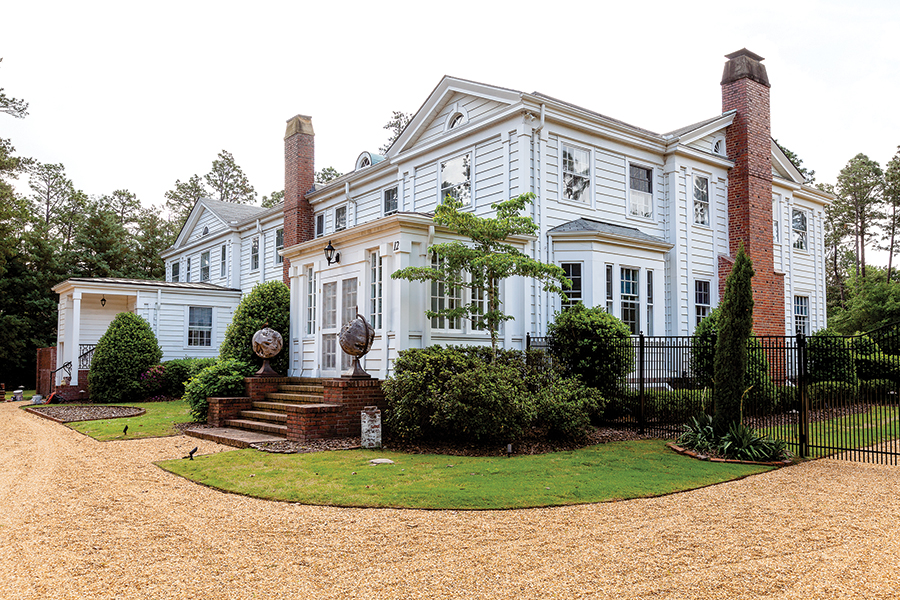
The adjective pool runs dry just inside the front door of Fownes Cottage, which, at 7,000-plus square feet on a triple lot, has been a Pinehurst village landmark since 1914.

At first, the exclamation is one of surprise, since the house presents an optical conundrum. Streetside, the windswept cedar shingles on the longitudinal frontage suggests the New England coast. Then, past a low brick wall, brilliant green manicured winter grass, shrubs and patio suggest more. Yet not even that hint prepares the visitor for a first look: comfortable formality expressed in misty turquoise, cloudy white, and blue shading from Wedgwood to royal and bright navy.

Blue, blue, blue, chosen for its soothing qualities, repeated in custom carpets, luxurious drapes and floral upholstery . . .
a surfeit of perfection.

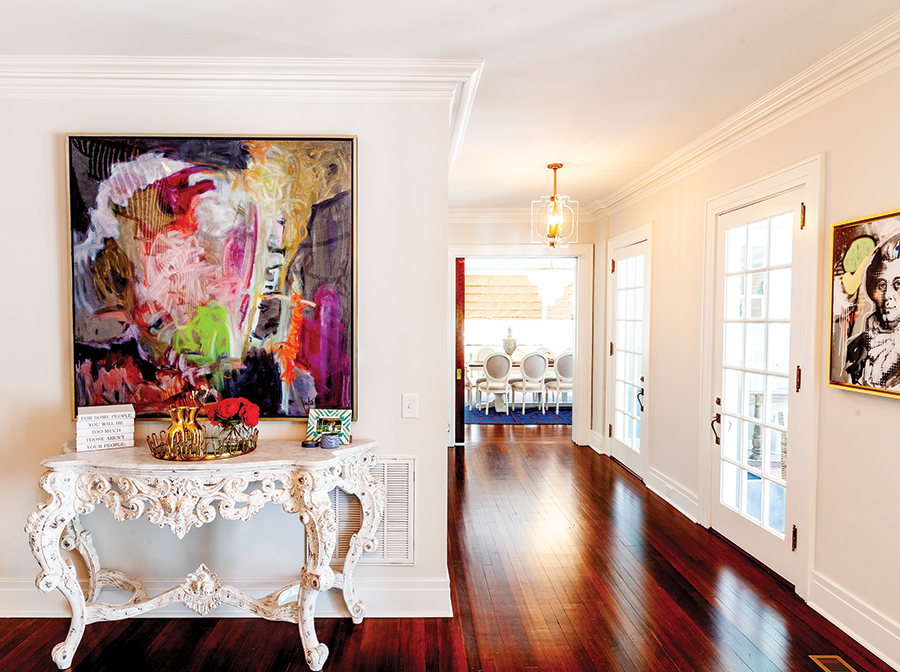
Stand in the foyer, face the staircase and turn clockwise. The most unusual greeting area has a low table and tufted banquettes. Next, a living room that stretches a mile to the family-gaming-sun room with bar; a dining salon seating 12 with elbow room aplenty. Stop there to admire the wallpaper — a diorama of greenish blue foliage and oversized birds, from the historic Gracie Chinoiserie collection. This space earns the kind of massive chandelier often seen crammed into smaller rooms. Floorboards, some original, are stained and polished strips of pine and oak. The kitchen seems odd at first, well equipped but smallish — at least the part glimpsed from the dining room. However, behind closed doors are a preparation area and butler’s pantry used by the resort chefs who prepare fine cuisine for guests and business meetings.
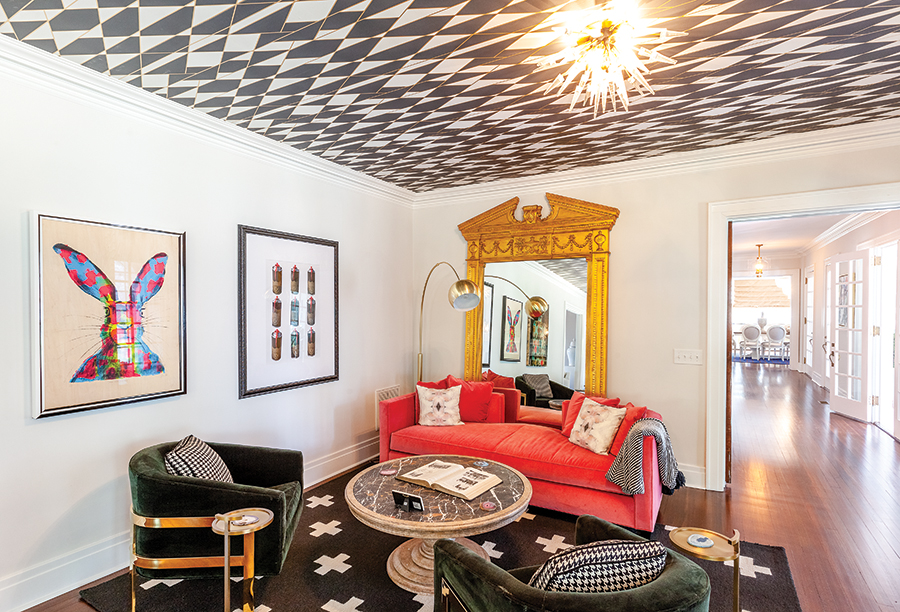
Fownes Cottage is both a satellite home for the family of Bob Dedman Jr., owner of Pinehurst Resort, and lodging for his guests. Golf memorabilia is everywhere, yet integrated into the formal décor. Dedman’s favorite example lines an upstairs hallway: framed pastels of the 18 holes on No. 2 by noted artist Jane E. Hixon, a Pinehurst resident. Elsewhere, trophies, photos, autographs, a scorecard signed by Donald Ross — even a battered golf bag belonging to Fownes himself. Less formal, the attic has been transformed into a girly dorm with berth beds for the teenage Dedman daughters.

In truth, like a cream-filled French pastry, its richness is better appreciated in small bites, interspersed with history.

By 1914 word of Pinehurst had reached the right ears. What started as a health resort was becoming a wealth resort, thanks to the golf links James Walker Tufts provided for exercise. Rich merchants, bankers and industrialists from Pennsylvania and points north recognized its attributes (climate, rail transportation, accommodations) as a winter destination. The homes Tufts built for long-term guests were soon joined by larger “cottages,” a misnomer unless the occupant’s primary residence is Versailles. During Prohibition, alcoholic beverages were rumored to be available. But for Henry Clay Fownes of Pittsburgh, golf was the main event.

Heaven knows, he could afford it.

Born in Pittsburgh in 1856, Fownes, with his brother, William, made a fortune in iron and manufacturing furnaces. Carnegie Steel bought them out in 1896, leaving H.C. rich, with plenty of time for other pursuits. The Fownes family had frequented Pinehurst since the early 1900s when its streets were muddy and vegetation scruffy. Now, he could build a suitable retreat described in contemporaneous accounts as a “villa” with cove ceilings, a hipped roof and dormers, seven bedrooms, multiple bathrooms and, later, a four-bay garage with a three-bedroom apartment over it. The Pinehurst Outlook of 1915 called the cottage “the real thing, costing $25,000 — a lot of money.” The florid description continues: “…a vast, rambling house, livable and inviting of some 20 rooms, with sunshine, fresh air, God’s glorious open (sic) everywhere.”

Fownes became a hands-on homeowner. Despite his wealth, in 1926 he wrote a letter complaining about a plumbing bill for valves, and a water bill for keeping the garden alive during summer months when the house was unoccupied.

Fownes’ previous project, in 1903, was developing and presiding over the world-famous Oakmont Country Club in Pittsburgh, designated as a National Historic Landmark. Its longitudinal shingled clubhouse foreshadows his Pinehurst retreat.

H.C. and wife Mary had one child, William, (named for H.C.’s brother), who kept the house after his father’s death in 1935. Parts of the interior were destroyed by fire in the late 1920s. The Dedmans are only the third owners.

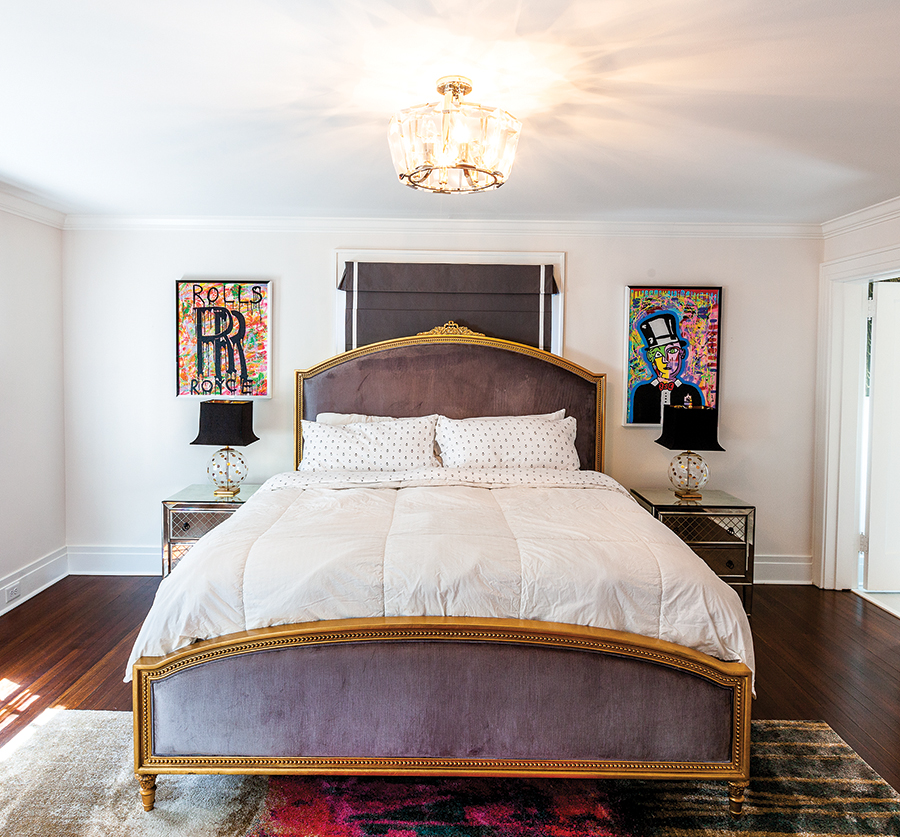
The Dedman family of Dallas is also legendary in the world of golf resorts (ClubCorp), philanthropy, education and other endeavors. As owner of Pinehurst Resort, with the 2014 U.S. Open Championship approaching, Dedman wanted a residence here. “It was the opportunity to have a historic house and a sense of place to entertain in a more intimate setting,” he says.  “I looked at land at No. 8 but wanted something closer to the campus, where I could walk to the village and get a coffee at The Roast Office.” He decided on Fownes Cottage in 2013, which meant only a year to renovate. “We wanted a gracious, historical house, more like a home than a hotel,” furnished in antiques, but with every bell, every whistle, every fireplace and background music selection controlled remotely. This meant rearranging seven bedrooms into four suites (and an office), each with a bathroom and sitting area, creating the attic dorm and adding niceties like an upstairs coffee kitchenette with paneled refrigerator, as well as replacing all the systems and enhancing the landscaping — a huge undertaking. Most visible, therefore of prime importance, were furnishings and décor implemented by Dallas interior designer Mark Clay, fresh off 20 years with Ralph Lauren in New York.

Clay had designed interiors for Dedman family homes in Vail and the Virginia mountains, as well as their new home in Dallas. “I know what they love,” he says.

This time, Clay translated that love into an English manor rooted in local history. “It was important to Mr. Dedman that the house show respect for Pinehurst.”  At Dedman’s suggestion he scoured Moore County for photographs and magazine covers to surround with silvery frames, which complemented the pervading blue. Clay commissioned rugs in particular hues and patterns, including a wide 55-foot hallway runner, which were woven to order in Turkey. Seagrove pottery in a rainbow of blues was also created for the cottage.

“Mr. Dedman bought the dining room table,” but the antique Waterford crystal chandelier over it came from the couple’s first house, “something of sentimental value,” Clay adds.

Instead of hiding TVs in armoires, Clay found less massive antique linen press cupboards to retrofit, since the bedrooms, including the master suite, are moderately sized. Other case pieces, all in mahogany and dark woods, were shipped from the Dedman estate in Dallas or sourced in Raleigh.

Details complete this portrait of style and elegance.  Since some doors already had glass knobs, Clay replaced others with cut crystal — smooth and heavy to the touch.  Windows throughout are covered with shades fashioned from natural grass that, while admitting light, provide privacy without drawing the heavy drapes.

Clay was instructed to furnish the above-garage apartment with pieces of equal mode and quality as the cottage, lest overflow guests feel slighted.

Some of Clay’s decisions resulted from research. He insisted that the stairway arising from the foyer have natural wood handrails and painted balusters, because that’s how it was done. Besides, that staircase — perfect for a bride — may someday appear in family photos. This thought has not escaped Bob Dedman’s practical side:

“I told my daughters there’s a church across the street. We could have the reception here . . . a destination wedding. It would be so convenient.”

In the meantime, Fownes joins Mystic Cottage (village home of Fownes’ friend Leonard Tufts, built in 1899), Dornoch Cottage (built by Donald Ross in 1924) and half a dozen others representing an era when golf, and Pinehurst, were attracting, in James Walker Tufts’ words, “A refined and intelligent class of people.” People with the interest and means to build, and now renew these homes.

The circle is complete.  PS

The Collectors

Harry Houdini, Thomas Jefferson, George Lucas and Ernest Hemingway collected books. Nicole Kidman collects coins. Demi Moore favors porcelain dolls. Tom Hanks loves old typewriters. Passion comes in all shapes and sizes. It’s not about stuff. It’s about the chase

By Will Harris

Photograph by Tim Sayer

Tony Rothwell

Tony Rothwell was 14 years old when he first encountered the work of British caricaturist James Gillray in the pages of a history textbook, and was captivated by the artistic talent and political depth of the work.

“I didn’t realize how interested I was in the graphic arts, but I thought this was so wonderfully graphic and so clever, I made my own copy of it,” Rothwell says.

The print Rothwell copied was Gillray’s “The Plumb-pudding in danger,” a caricature that still appears in history books. It’s an 1805 editorial cartoon of Napoleon Bonaparte and British Prime Minister William Pitt dividing a plumb-pudding globe into metaphorical spheres of influence — a comment on the world leaders’ appetite for dominance. “Fast forward and I’m now in London, 21 or 22 years old in my first job, and it was used as an advertisement for a show of Gillray prints,” Rothwell says. “I decided that I would turn London upside down and see how many would fall out, and they started falling. In those days, they weren’t that expensive. I was lucky I got in early before anybody was seriously collecting them.”

Gillray is credited with creating and popularizing the political cartoon as a genre, and the influence of his work was felt throughout Europe. He directed his sharp wit at both political parties (depending on who was commissioning him), but Napoleon, in particular, was a focus of his derision.

Rothwell has at least 150 Gillray prints and sketches. Although he has works by the caricaturist’s contemporaries as well, Rothwell is particularly impressed with Gillray’s political wit, breadth of knowledge and raw artistic talent.

“Gillray really was the first true political caricaturist. He invented it,” Rothwell says.

Gillray lived in a turbulent and exciting time, ripe for political discourse and caricature. Britain and France were competing for influence on the world stage. King George III and Napoleon Bonaparte lent themselves to the hyperbolized visual renderings that Gillray made so popular. It was also a time when the conventional methods of consuming news left something to be desired. Gillray saw an opportunity to put his artistic skills to commercial use, and opened a shop to sell his prints.

“Newspapers were all black and white and didn’t have any pictures at all, so this is how the wealthy could entertain themselves,” Rothwell says. “It was giving them news, and it was also giving them a laugh. At the same time, it was scaring pompous people, bringing them down a notch or two.”

Gillray’s influence extended to the upper reaches of the ruling political class. “He was being read by the House of Commons, by the royal family — people who had money and influence,” Rothwell says.

There’s no true modern equivalent to Gillray’s prints. They resemble today’s political cartoons but are packed with subtle cultural symbols, allusions to Greek and Roman mythology and detailed historical context. Because Gillray’s well-heeled audience was also well educated, he was able to elevate his imagery and symbolism.
“I’m in awe of the man really, still today. I think he’s incredible. He has set the table for so many caricaturists since,” says Rothwell. Expanding his collection has gotten easier with the advent of the internet. “In the early days it was all footwork but now, eBay walks a million miles for you every day. You make time for what you love”

Photograph by Tim Sayer

Rick Smith 

A self-described “pretty serious book collector,” Rick Smith has been afflicted with a passion for books since he was a child. “I fell in love with the tactile nature of books, how well they were bound and how colorful they were, the thickness and the weight,” Smith says.

This childhood curiosity gradually developed into a full-blown obsession. Today Smith’s library contains around 1,200 books with hundreds of signed copies. Three books in the collection are autographed by former U.S. presidents: George W. Bush, George H.W. Bush and Harry Truman.

Smith’s passion transformed his life in every respect, and his home is a testament to it. “My wife, Susie, said there’s room for two of us in this house but probably not for your books,’’ Smith says. He redesigned the garage of their lakeside cottage into a cozy personal library, complete with a rolling library ladder. A stained-glass lamp illuminates a massive worktable made from knotty alder wood.

Smith is particularly fond of his books related to his father’s (Richard H. Smith Sr.) service in the Navy during the Second World War. “One of the things I began to wonder about was how my father’s life was transformed by his, albeit brief, time in the service as a very young man,” Smith says. “I think he was inspired by that, and so I decided there are probably threads in this that need to come out.”

Smith’s father was a seaman first class on the aircraft carrier USS Bennington and the plane captain (crew chief) assigned to a one of the ship’s TBM Avengers — aircraft originally designed as torpedo bombers. His job was to ensure the bomber under his purview was combat ready.

In 2003 James Bradley published his best-seller Flyboys. It details the harrowing 1942 air raid of Chichi Jima by TBM Avengers. Among the pilots was 19-year-old George H.W. Bush.

Smith’s father felt a special connection to the former president through their shared experience with the TBM Avengers, so Smith bought a signed copy of Flyboys as a gift. Smith’s father brought the book to annual reunions for veterans who served on the USS Bennington, and began to collect signatures.

“They would sign them with their rank at the time, the raids they were on, and when they served,” Smith says. “And one day when he was 79, he said to me: ‘One of the signatures that I’d really like to have in this book is the president’s signature.’ And I thought, good luck with that.

“But I had a conversation with a friend and we got an entrée to send the book to Houston, and the president signed it,” Smith says. “And all of a sudden the whole notion of getting serious about collecting and deciding what to collect became important.”

Around the same time, Smith’s father gave him a diary he’d kept while aboard the carrier. “One of the threads I started to pull from this diary was first-person accounts,” Smith says. “First-person accounts for historians are gold.”

Smith refined his search to World War II and its leaders. “I’m sort of focused, but in a lot of ways it’s about the chase,” he says. “So, it’s a passion for the subject matter; it’s a passion for the physical book; it’s a passion for the search and the chase.” And there’s comfort to be found in the written histories of great world leaders.

“I think it’s so important to know our history; it helps a lot of stuff make sense, he says.” “That’s my homily for today: Read some history. It’ll help you be a better citizen, help you make better judgments, and help you sleep at night.”


Photograph by John Koob Gessner

Mitch Capel

Mitch Capel, the alter ego of Gran’daddy Junebug, has been an impactful presence in the Sandhills for decades. Capel’s unique delivery of stories and poems — some passed down through his family, others the recited works of his favorite poet, Paul Laurence Dunbar — has enabled him to touch the lives of countless young people.

A Moore County native, Capel immersed himself in North Carolina’s artistic community throughout his storytelling career and formed close relationships with several influential artists native to the state. He and his wife, Pat, have created a collection of paintings featuring artists like Ernie Barnes, Bill Pinkney and Willie Nash.

Capel is hard-pressed to pick a favorite. “They’re like children; I don’t know. If I had to pick one it’d be my wife’s work, of course. It’d be that one with the buttons,” Capel says, referring to a portrait hanging above the fireplace in his study. In it Capel is wearing his storytelling garb, an outfit smattered by colorful buttons he has collected over the years.

Hundreds of paintings adorn the walls of the Capels’ home, including several of Pat’s alongside others by Barnes and Pinkney. “My wife and I gravitate toward Ernie Barnes,” Capel says. “He’s an amazing artist. Grew up in what was called ‘The Bottom’ in Durham.”

Barnes attended North Carolina Central University, where he played football and majored in art. He played football professionally for five years before shifting his focus entirely to art. His 1970 painting The Sugar Shack was featured in the opening sequence of the Good Times television show, and was also used by Marvin Gaye as an album cover for his 1976 album, I Want You.

“I liked Ernie Barnes’ work in the beginning because of Marvin Gaye’s album cover,” Capel says. “Album covers were our artwork at the time.”

Pinkney is another artist featured prominently in the Capels’ collection. He discovered Pinkney while performing at an alternative school in Fayetteville. After seeing his work hanging in the principal’s office, he knew he had to meet him.

“I mean, he was so talented; what he did was amazing with the paintbrush, and it came so easy for him,” Capel says.

Pinkney is best known for his painting of Julian Abele, the architect who designed Duke University’s Chapel. The work currently hangs in the University’s Gothic Reading Room.

A Bill Pinkney piece titled Marbles is especially meaningful to Capel.

“I had just unpacked this board game Mancala, and I’m on the floor and I’ve got these in my hand, and I flashed back to when I was a kid playing marbles. And the phone rings and it’s Bill: ‘Mitch, I just finished this painting, you’re gonna love it, it’s called Marbles.’ I dropped everything I was doing and went over there and I bought that piece,” Capel says.

“Yeah, it’s been a wonderful journey for me.”


Photograph by Lisa Gessner

John Koob Gessner

“In this day and age, it’s like everyone wants everything right away,” says John Koob Gessner, who thinks his collection of vinyl records represents a simpler, more intentional period of musical enjoyment. “This kind of hearkens back to a time when it’s OK to slow down and enjoy something.”

Gessner grew up in a small town in New York, influenced by his parents’ musical tastes. “Oh, yes, there was a large hi-fi, not a stereo, right outside my room. At night they would play Harry Belafonte, the big bands, Glenn Miller, all that kind of stuff. And it would kind of boom through the house,” he says.

At first, acquiring records wasn’t about building a collection, it was simply the way music was enjoyed. “If you went to someone’s house, you’d bring a couple albums with you, because everyone had a hi-fi,” says Gessner. “Records were kind of how you shared music. If someone wanted to hear a song, you had to either hear it on the radio or buy the album.”

Despite MP3 downloads and music streaming, Gessner still prefers the old-school method. “People have this affinity for vinyl. It’s analog and there’s a process to it,” Gessner says. Soon enough the preferences of his parents were supplanted by his own taste. “I was listening since I was 5 or 6. As soon as I got a paper route all my money went to film and vinyl,” Gessner says of his twin pursuits of photography and records. “I’ve been collecting ever since.”

Gessner developed a close relationship with the owner of the local record store. “I would go in and they would put stuff away for me. When I had enough money, I’d go get it.” Sometimes it was as if they could read his mind, like the time he was anxious to get his hands on John Lennon’s Christmas song, pressed on a special green vinyl. “I remember coming off a bus and stading in front of the music store and looking on a rack and they were all gone, and Mr. Nagy said, ‘Ah, Mr. Gessner, I saved one out for ya.’ And I still have it.”

His collection has grown to an estimated 4,000 records, with about half on display in repurposed bookshelves in his living room. 

His musical interests created unique, career-altering opportunities. As a young photographer, Gessner shot album covers for many of the bands he listened to and saw in concert, and has kept in touch with many of them.

He continues to nourish his love for vinyl through what he calls the Vinyl Record Project. “I interview people about their experience with vinyl, and I take a portrait,” Gessner says. “They have these great wired-in memories about vinyl because you’re taking it off the rack and you’re putting it on the turntable — it’s a process.”


Photograph by John Koob Gessner

Jane and Jim Lewis

Jane and Jim Lewis are not collectors. They are self-described “accumulators.” Although they did not personally acquire the 280 unique mini liquor bottles on display in their home, they have nevertheless taken on the role as stewards of the collection.

“We’ve drug it around from place to place and displayed it, but we’ve never been collectors,” Jim says, “It’s not like we’ve been looking for them high and low for the last 50 years and we’ve worked hard and traveled the world to find them — it ain’t true.”

The mini bottles were collected by Jane’s aunt, Billie Cave, who began collecting the bottles in the late 1930s. Knowing she was passionate about collecting mini bottles, Aunt Billie’s friends acquired many of the liquor bottles as souvenirs while traveling.

“Now, back in those days her aunt didn’t travel all that much, but her friends knew about her collection and would bring her bottles,” Jim says. “People immediately assume they came off airplanes, but in fact, a lot of people got them off trains.”

While Jane and Jim shy away from the term collector, they are clearly very fond of the collection. After nearly 40 years and after each of 14 address changes, the Lewises have always unpacked the bottles for display. At their home in Pinehurst, the bottles sit on shallow shelves over a small built-in bar, a colorful centerpiece of the room, drawing the eye of visitors entering through a side door.

“The bar is here so it just made sense, and people always want to know about the bottles,” Jane says. “It’s the first thing they see.”

The bottles come in every shape and size imaginable, and the faded neon mosaic framed by the white wall is a striking mainstay of their home’s décor. A glance will not do. 

Some are easily recognizable as miniature versions of full-size liquor bottles. They tend to be more dignified and expensive Scotches, whiskeys and bourbons. Others are creative and delightfully original one-offs. Exotic liqueurs and rums seem to be the most outlandish, and the Portuguese Mobana Crème de Banana in the shape of a monkey is truly a work of art.

The bottles are all unopened, although the contents of the oldest bottles have almost completely evaporated through the ancient but intact seals. Keeping the bottles in their unopened state was no easy task in a house with two young boys. As any parent whose liquor cabinet has been raided will understand, Jane and Jim told their sons a white lie to ensure the bottles remained sealed.

“When our boys were old enough to realize what it was, we told them they were poison because they were so old,” Jane says.  “We told them: ‘Don’t you dare open one and drink it, because it will kill you!’ And you know they thought that up through college.”

The bottles have survived time, adolescent boys and a lifetime on the move. One day they’ll pass Aunt Billie’s bottles along to the next generation of stewards.


Photograph by Tim Sayer

Joe Vaughn

Joe Vaughn began collecting Native American arrowheads as a child and has indulged his passion ever since. Vaughn is the middle child in a family of five boys, and his upbringing in Northampton County, North Carolina, afforded him endless opportunities to search for the elusive artifacts.

“As kids we hunted and fished, and part of hunting and fishing is walking across fields,” Vaughn says. “We just developed an early interest in collecting a lot of old stuff, and one of the things we collected was arrowheads.”

Over the years he’s found hundreds of perfectly intact arrowheads, all from the northeastern part of North Carolina. The best examples are still sharp to the touch. Vaughn considers the most impressive item in his collection to be a Clovis point, a longer spear point with a groove running down the middle. It is one of the oldest styles found in North Carolina and dates back to around 12,000 B.C.

“It’s so rare to find these good ones, because there’s been so many plows and things stuck in the ground. It’s hard to find them anymore,” Vaughn says.

The first step in finding fertile ground for hunting arrowheads is thinking about what the landscape provided thousands of years ago. Native Americans were more likely to settle in a spot near water, animals and edible vegetation, so sandy and loamy soil and moving water are good indicators. 

“We hunted mostly on sandy fields, close to water, close to a stream, where the game is, too,” Vaughn says. “We’ve walked in thousands of fields that didn’t have anything. But when you get to one that’s got something, you know right away.”

A fruitful field may have been recently plowed and then rained on. The plowing unearths buried artifacts and the rain washes away the final layer of dirt — a lucky combination made more difficult after modern farming techniques began planting seeds with a drill.

“Normally we hunted in fields that were under cultivation. Back in the day, farmers plowed fields more often. They don’t plow them much anymore,” Vaughn says. “So, a lot of the places that we used to find arrowheads as kids are not cultivated anymore. You’re lucky if you happen to get something. Today you might go five times and find one really nice one.”

Vaughn still hunts arrowheads with his older brother, Charlie, valuing the time spent outdoors with family more than anything he could hope to find. “It’s been fun collecting these, I’ll tell you that,” Vaughn says. “Especially in the spring when the weather gets permissive, you can go out and get some exercise, enjoy the fresh air and the camaraderie.”  PS

Will Harris is serving an internship at PineStraw to complete his Business Journalism undergraduate degree from the University of North Carolina at Chapel Hill. He works locally as a carpenter, enjoys playing tennis, sailing and spending time with his dog Bear.