The Acorn and the Tree

The Acorn and the Tree

Sharing the gifts of love and life

By Jenna Biter     Photographs by Lolly  Nazario

Mothers do big things. They plan weddings and crisscross the country (sometimes the globe) to visit children and babysit grandchildren. They do small things, too, like pack lunchboxes, sort smelly laundry, and cheer from the sidelines in excited shouts or whispers. Better than anyone else, mothers navigate awkward, in-between-sized things, like bad breakups or even worse grades.

Mom often does it all without audience or recognition. Sixteen-year-olds don’t remember when she changed their diapers or cooed nighttime lullabies. Her love becomes expected. Some moms relearn calculus only to teach it. Others drive to college in the middle of the night like it’s no big deal. Above all else, moms expertly watch.

She watches, drives, coos, changes, navigates, cheers, sorts, packs and plans. At root, a mother does. Her world is a deep sea of verbs that almost always includes sharing. Mothers and children share hugs. Some share daily conversation. And then there are the lucky few — like these five mothers and their children — who share passions.


Hannah Mebane

Louisa and Walter Mebane

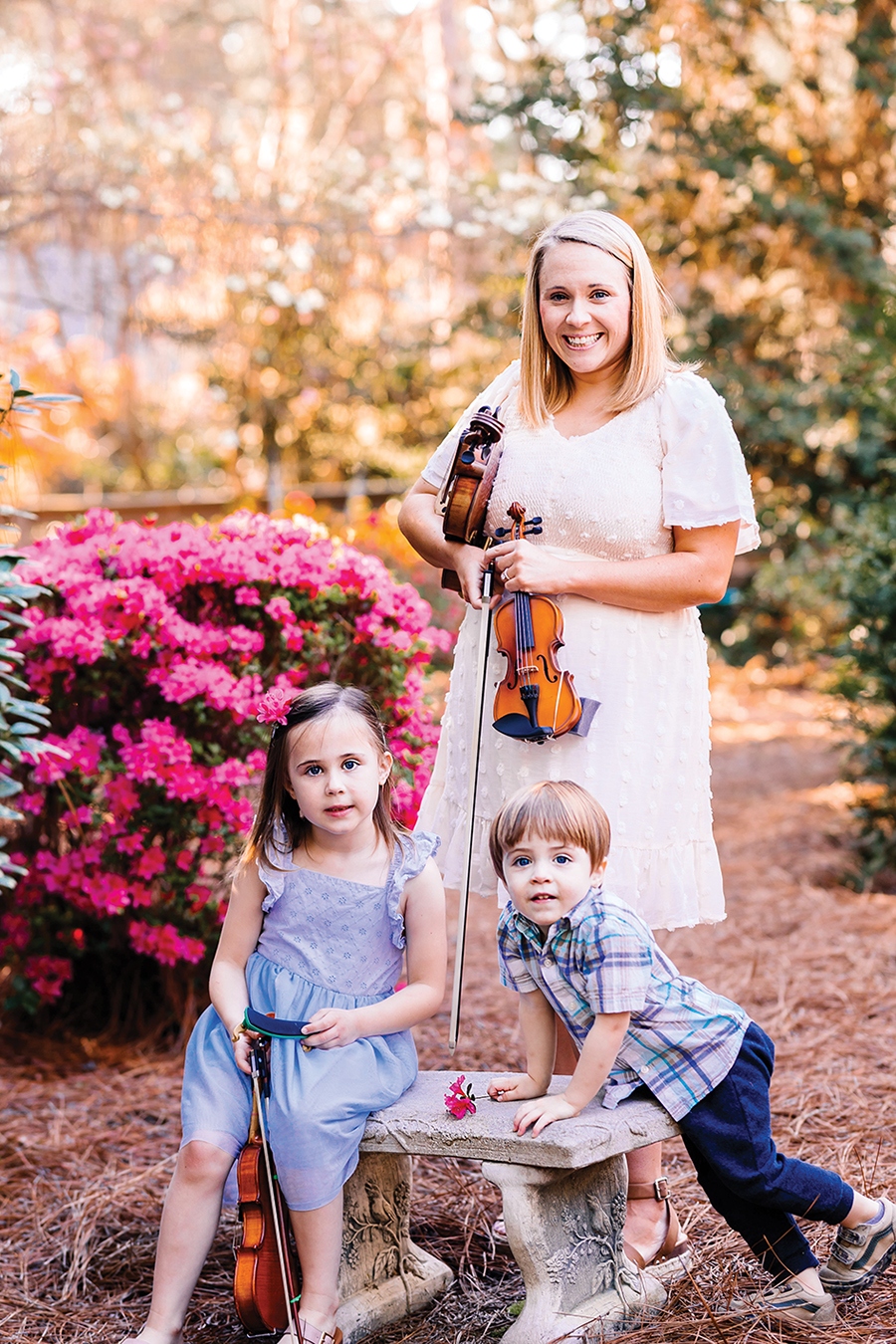
Two-and-a-half-year-old Walter takes his tot-sized violin out of its case a second time. Meanwhile, big sister Louisa asks Mom if she can add a heart-shaped sticker to her practice chart. The 6-year-old violinist just cycled through “Mississippi Stop Stop,” the first rhythm to her first song: “Twinkle, Twinkle Little Star.”

“Sure,” Hannah Mebane says.

Hannah started playing the violin at Pinehurst Elementary in fourth grade. Fast forward a few decades, and she has taught music and orchestra in Moore County for 11 years. But 2023 will be her last. Hannah has her hands full with kids, a part-time real estate gig, and plans to go from private lessons to a full-time, Suzuki-method studio. There, Hannah will be able to teach even more kids the way she teaches her own.


Pam Owens

Travis Owens

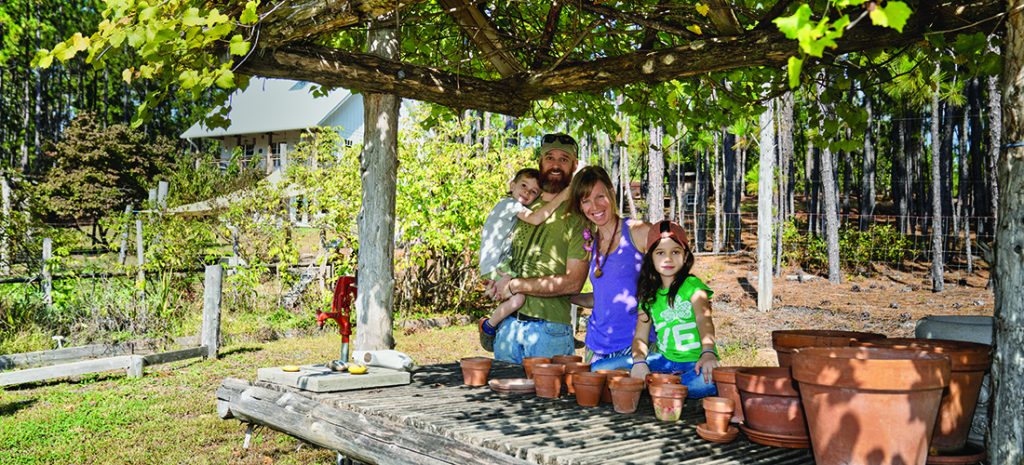
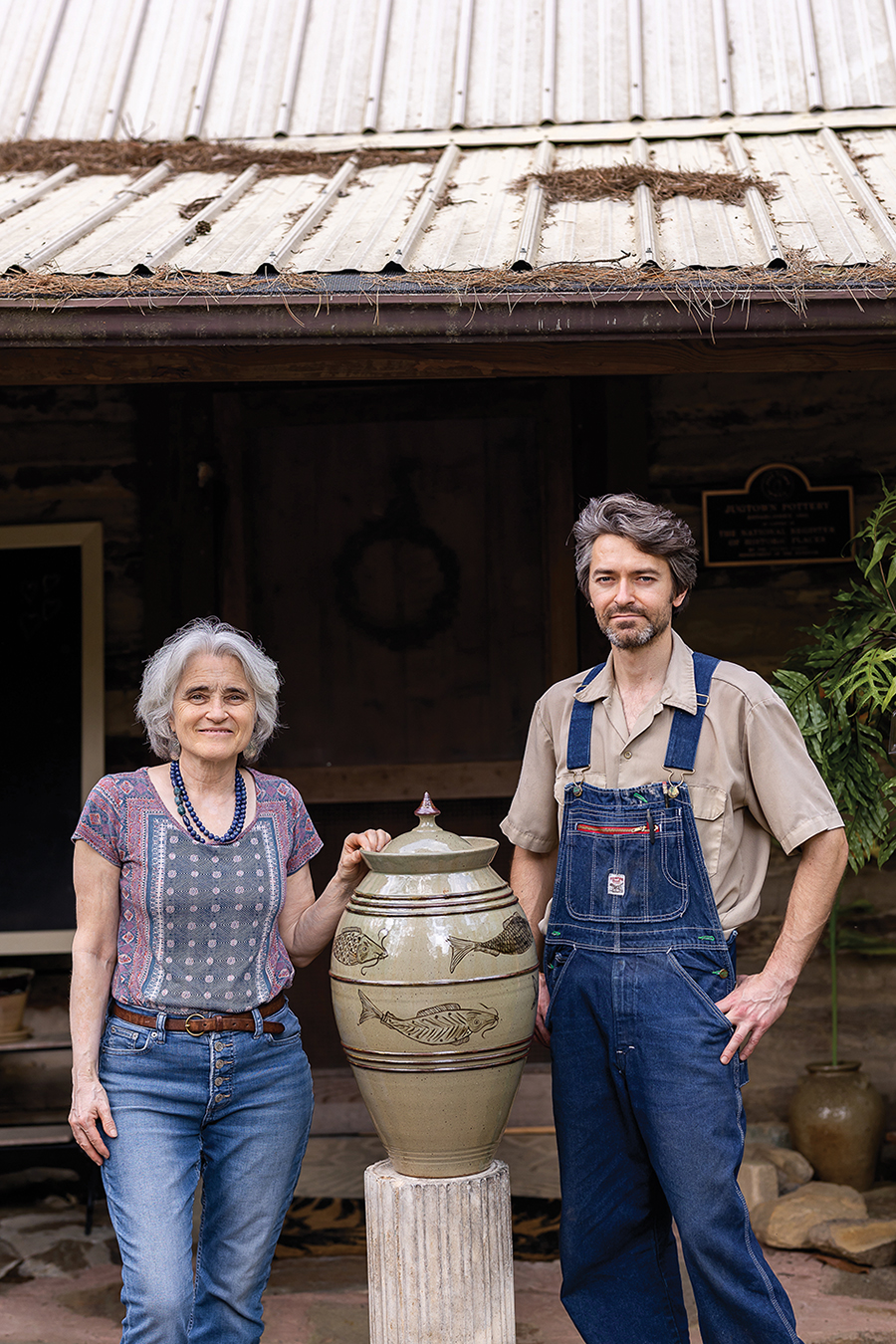
Tucked off a backroad — where wildflowers grow tall and dew perpetually clings to emerald grass — sits an old cabin that a trio of fairy godmothers should inhabit. But sprites are nowhere to be found, only sloping candlesticks, jugs with full bellies, and a family of four professional potters hard at work to keep the legacy of Jugtown Pottery alive.

Like the clay they shape with their hands, the Owenses seem to have surfaced from the North Carolina ground. Vernon practically has. Coming from a long line of Seagrove potters, he grew up just around the corner. Pam had to move a little farther. With New England pottery-making in her blood, she originally came south to apprentice with Vernon. Then she returned to marry him, and together, they passed the cumulative talent of generations on to their children, Travis and Bayle.

“I stayed, as a baby, in the room where my mother was working,” Travis says in an easy Southern drawl. “That’s my memory of being very small: being in the workshop, especially with her.”


Tracey Greene

Claire Greene

Eleven-year-old Claire Greene practices on her balance beam at home while her mom, Tracey, gives pointers. Up next, 5-year-old Caroline tries a move with instruction from Claire.

“I help train her,” the big sister gushes. “She can already do a bridge, and her cartwheel is getting a lot better.”

Like mother, like daughters.

From ages 4 to 14, Tracey participated in competitive gymnastics. The sport was her lifeline. After her mom, Pat, died from breast cancer, coaches became like second parents. For Claire, gymnastics, as well as dance, provide similar support. They have been her throughline from one military move to the next.

“I started gymnastics when I was 2,” Claire says with a broad smile. “I remember some pictures of us doing stuff together: me mocking Mom, wanting to do what she was doing.”

Then the roles reversed. Watching her daughter compete, Tracey yearned to join in and soon did. She has been tumbling every Wednesday night since an adult class started at Sandhills Gymnastics this January.


Barbara Burley

Nikki Windham

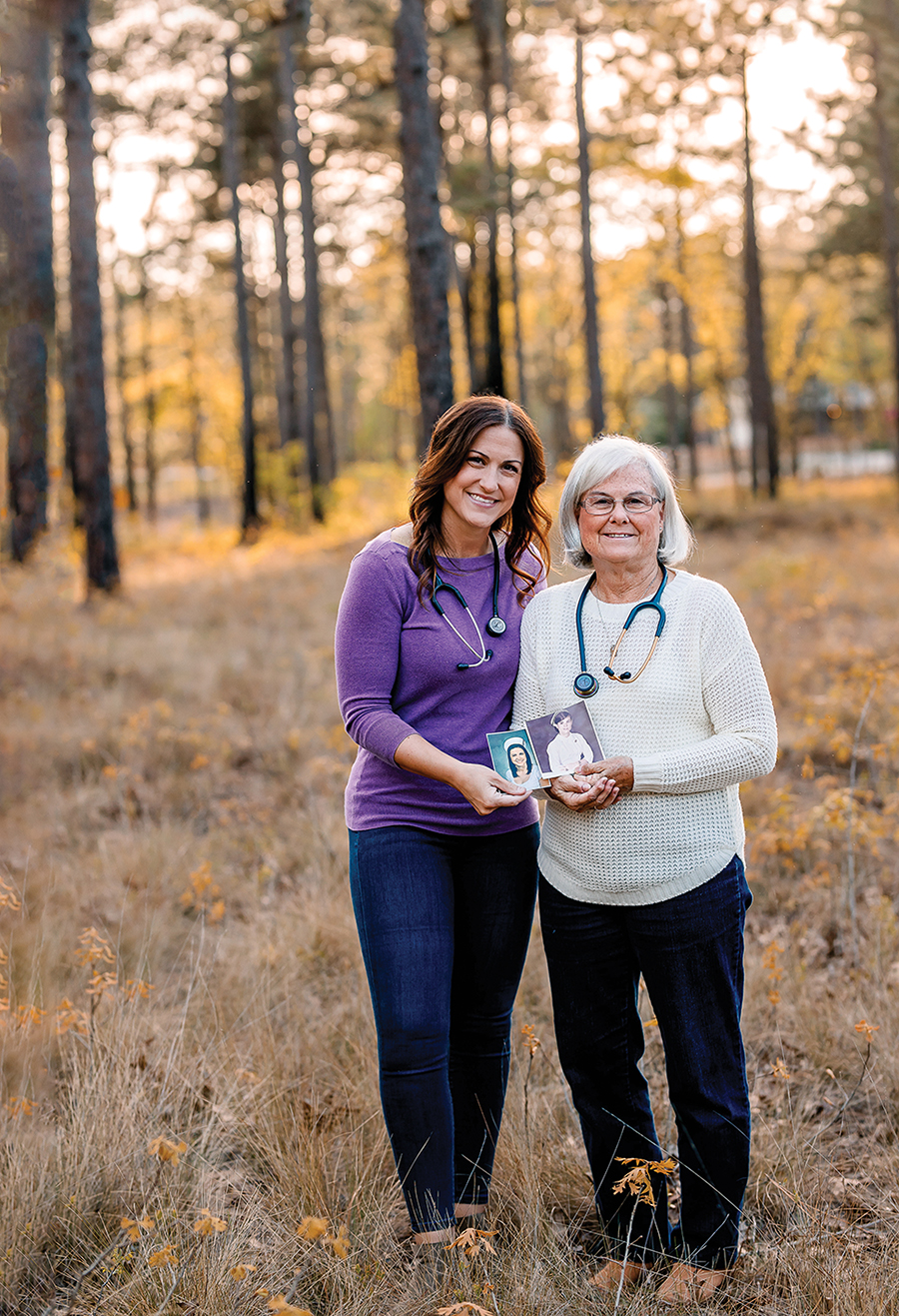
At only 14 years old, Barbara Burley sat at the hospital bedside of a sick child she would babysit. From then on, she knew that she wanted to be a nurse. She pursued a nursing degree and didn’t look back for decades. For 47 1/2 years, Barbara worked nights in the pediatric unit at Moore Regional Hospital. Her last night was New Year’s Eve 2020.

While the night shift wasn’t easy, it allowed Barbara to take her daughters, Beth and Nikki, to and from school, attend their every practice and game, and sometimes even get some sleep.

“She was always at everything. I thought her schedule was great as a kid,” Nikki says. “I didn’t realize how hard it is until I had my children and started working the night shift. You just don’t sleep.”

Nikki graduated from nursing school exactly 25 years after her mom. Thanks to Barbara’s good reputation, she got her first nursing job at Moore, where she worked in the neonatal intensive care unit. Ministering to children must run in the family. Beth also works with kids as a pediatric occupational therapist in the county. 


Christina Baker

Amara Baker

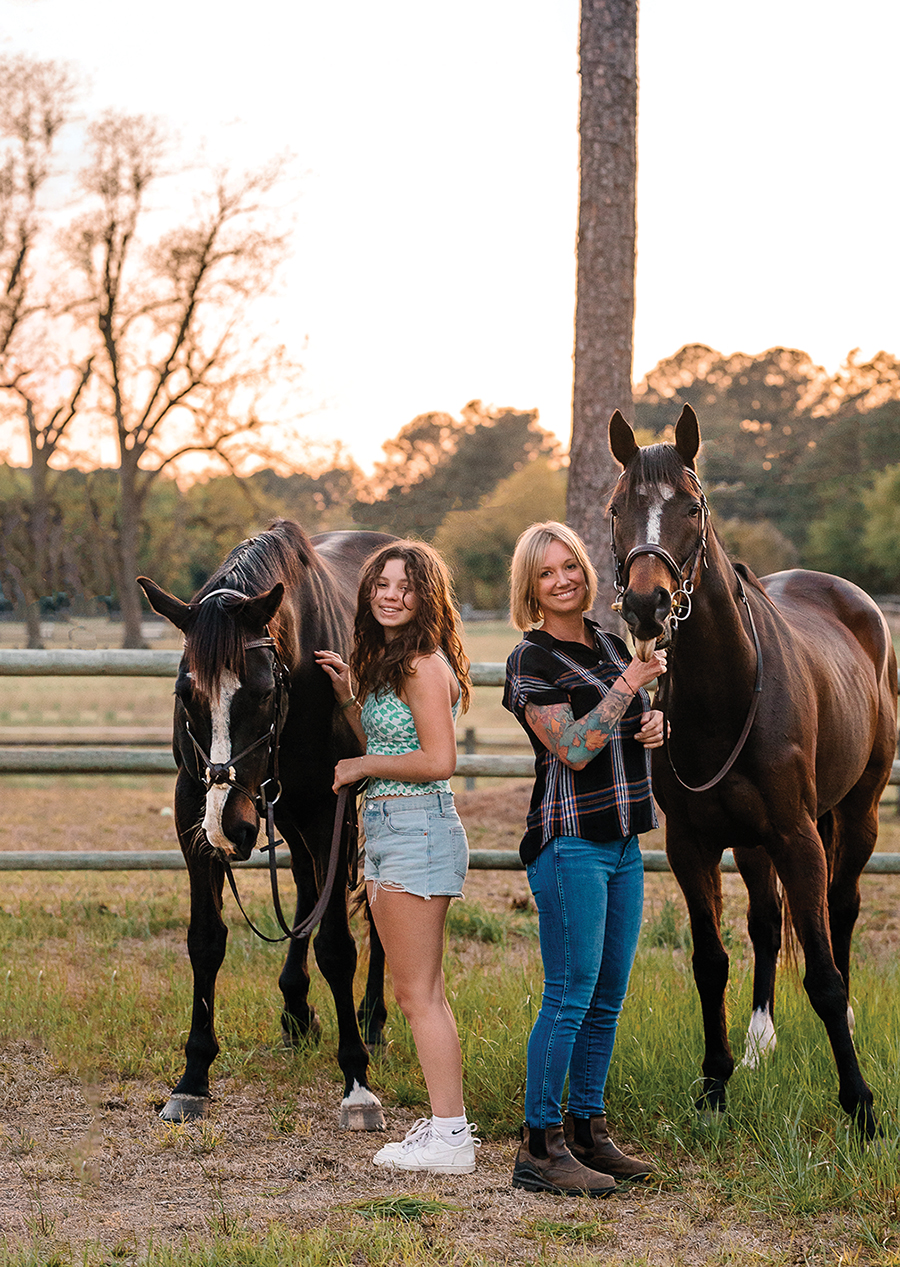
Christina Baker points past the fence. “Here comes Amara.” Back from an hour-long lesson, the teenage brunette rides toward the Baker family’s barn on a matching horse named Zeppelin. Amara dismounts, unlatches her helmet, and shelves her tack before hosing down the retired racehorse. She started riding more than a decade ago, first falling for the flat-out speed of foxhunting, and then the discipline of eventing. Inspired by her daughter, Christina decided to take the reins herself.

“Having a teenager is difficult,” Christina says. “I’m not even close to the center of Amara’s world anymore. But, as long as horses are a big part of her world, sharing that activity lets me have a special little place in it, even if it’s just for a one-hour ride.”

The Master of the Sandhills

The Master of the Sandhills

Horton Smith and his abbreviated Pinehurst employment

By Bill Case     Photographs from the Tufts Archives

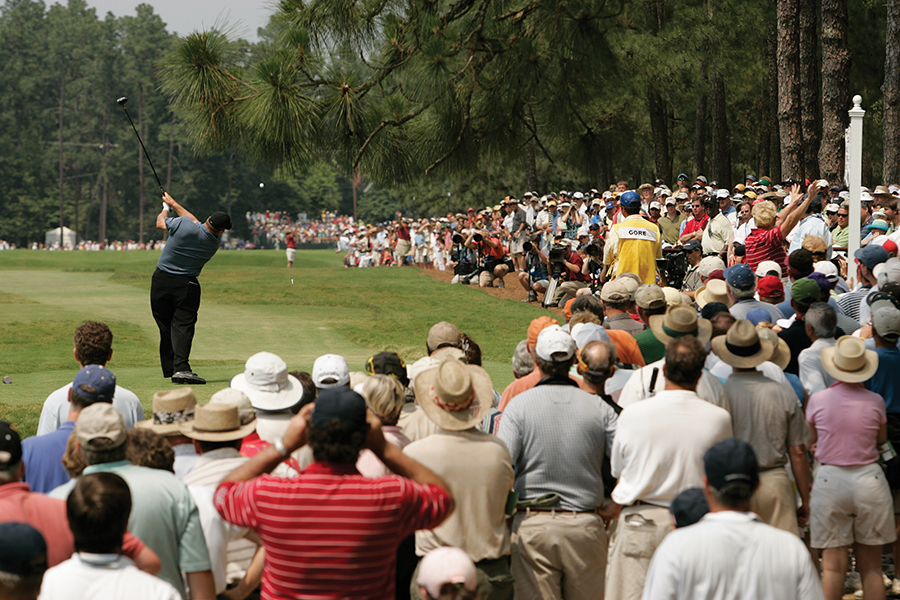
An above-the-fold headline in The Pinehurst Outlook on May 30, 1941, screamed, “HORTON SMITH SIGNS PINEHURST CONTRACT.” Smith, regarded as one of the brightest stars in professional golf’s galaxy, would soon be making his way to the Sandhills to work in a promotional capacity for the Pinehurst Country Club. He was coming in hot, having won one official and two unofficial events, all in the South, earlier that year. By accepting the position, he immediately became the highest profile employee in the club’s history with the exception of his new supervisor, Donald Ross, the club’s manager.

“There will be plenty for Horton to do here,” said the venerable Ross. “He will have what might be termed a roving assignment to aid us in making our golfing friends enjoy their visits in Pinehurst.” This meant the 33-year-old native of Joplin, Missouri, would primarily be golfing and hobnobbing with resort guests and playing occasional exhibition matches.

Smith would not be giving lessons. “That assignment,” Ross explained, “will be handled by Harold Callaway and Bert Nichols, who have been here for many years.”

Horton and his wife of three years, Barbara Bourne Smith, had committed to making Pinehurst their “permanent” home from November until May — the months the resort was then open for business. For the 1941-42 winter season the couple resided at the Carolina Hotel. In the immediate wake of their newfound affiliation, Smith would continue to play on the PGA circuit, where the man nicknamed the “Joplin Ghost” would be introduced as representing Pinehurst Country Club.

Although the article made no mention of his involvement, it is certain that Bob Harlow, the owner and editor of The Outlook, played a key role in orchestrating the relationship. A born salesman and promotor, Harlow had previously managed the PGA’s rather loosely organized “tour” and served as business agent for several top pro golfers, most notably Walter Hagen. Though busy running The Outlook, Harlow kept his hand firmly in the promotional game as the director of publicity for the Pinehurst club and resort.

Harlow and Smith first encountered one another in 1929, when Horton, only 21, won an eye-popping nine tournaments — eight PGA tour titles and the French Open — just three years after turning professional. His collection of victories that year included Pinehurst’s prestigious North and South Open, then contested on sand greens. Hagen, pro golf’s ultimate showman, took note of the young phenom’s early successes and decided he would make an ideal exhibition opponent. The Haig’s agent, Harlow, signed Smith to play 100 matches against Hagen at courses ranging from New York to Missouri and across the border in Canada.

As Marian Benton, Smith’s biographer, puts it in her book The Velvet Touch, it would be difficult to “imagine two more diverse personalities than those of the ‘golden boy’ of golf (Smith) and the ‘crown prince’ of the links (Hagen).” At 6 feet, 2 inches tall and handsome as a Hollywood leading man, the mannerly and teetotaling Smith was typecast as the quintessential All-American Boy. In contrast, Hagen played the roguish and carefree carouser, though it is believed he poured more drinks into potted plants than he consumed — at least during his playing days. Despite vast differences in style and personality, the two stars became lifelong friends, hopscotching, along with Harlow, from course to course.

After the far-flung exhibition tour, Smith continued his winning ways, gaining a reputation as the tour’s finest putter. During the 1930s, he won 20 times (two were unofficial), capturing a second North and South title in 1937 — this time on No. 2’s new grass greens. But his greatest triumphs came in Augusta, Georgia. In 1934, he won the first Masters Tournament, then known as the Augusta National Invitation Tournament. Atop the leaderboard all four rounds, Smith’s total of 284 was one stroke better than Craig Wood, who would be victimized the following year by Gene Sarazen’s “Shot Heard ‘Round the World” on the 15th hole. Smith’s lengthy birdie putt on the 17th hole of the final round proved to be the clincher.

Two years later, he won the tournament again, edging “Lighthorse Harry” Cooper — the nickname invented by Damon Runyon — when poor weather forced 36 holes on Monday. In the afternoon Smith chipped in for birdie on the 14th, then birdied the 15th and finished with two pars to win the first prize money of $1,500.

Like Harlow, Smith segued into business activities related to golf. President of his local PGA section in 1935, Smith served as an active member on an array of PGA committees. The Missouri native also arranged exhibitions for the Spalding Company’s stable of professionals that included himself, Lawson Little, Jimmy Thomson and Cooper. He rarely passed up an opportunity to promote golf. Typical was Smith’s appearance at the Sandhills Kiwanis Club six months prior to his hiring by Pinehurst Country Club. In his remarks, the two-time Masters champion urged the Pinehurst, Southern Pines, Pine Needles and Mid-Pines golfing communities to “pull together to make this the golfing center of the world.”

When Horton and wife Barbara arrived in Pinehurst early in November ’41, they made an immediate splash. Harlow saw the Smiths in the Carolina Hotel dining room and gushed that they were “the most striking couple on whom my eyes ever have feasted.” Barbara was more than just vivacious — she was heiress to Singer sewing machine money. Grandfather Fredrick Gilbert Bourne’s savvy investments and long tenure as president of the Singer Manufacturing Company had built generational wealth for the family.

Alfred Severin Bourne, Fredrick’s son and Barbara’s father, was an excellent amateur golfer. As upper-crust society often does, the Bournes moved with the seasons: summers at their 40-room estate in Washington, Connecticut; and winters in Augusta, Georgia, where Alfred became a charter member of Augusta National Golf Club and a friend of Bobby Jones.

When Augusta National was in danger of failing during the Great Depression, it was Bourne who furnished lifeline funds to keep the strapped club afloat. Barbara also became an avid golfer, good enough to have once bested the legendary Babe Didrickson. Introduced to one another during the 1936 Masters Tournament — the year of Smith’s second victory — the couple dated intermittently during the ensuing two years before marrying in 1938.


The Smiths were happy during their winter stay in Pinehurst, immersing themselves in Pinehurst golf. Barbara joined the Silver Foils — the oldest existing women’s golf society in America — and quickly made her presence felt, winning a better-ball competition when she and her partner carded a score of 72. Meanwhile, the Joplin Ghost joined the Tin Whistles, the Pinehurst Country Club’s pre-eminent men’s golfing society. His father-in-law, Alfred, had become a member of the society the previous year. As a regular dues-paying Tin Whistle, Smith was eligible to play in the society’s frequent tournaments, though he had to spot a daunting number of handicap strokes to his fellow members. In his initial competition with the society, he partnered with S.A. Strickland (grandfather of Pinehurst mayor John Strickland) to win a four-ball event. He would later set his sights on capturing one of the Tin Whistles’ major tournaments, the James Barber Memorial. Playing Course No. 2, Smith carded a brilliant 67. However, his plus-4 handicap required adjusting his net upward to 71, tying the net score of Charles Murnan, a 21-handicapper from Leesburg, Virginia.

Several days later, Smith and Murnan settled the deadlock with an 18-hole playoff over Course No. 3. On the front nine, Smith shot a sensational 32 to Murnan’s 45, making up 13 of the 25-stroke handicap differential. Smith charged home on the back with another 32 (his best-ever score on No. 3) but it wasn’t enough. Matching shots with a two-time major champion, Murnan posted a 42 on the back nine. His resulting net score of 66 beat Smith by two strokes.

In January 1942, with America now on a war footing, Smith traveled to California, where he played in the Los Angeles Open and the Bing Crosby National Pro-Am. He led the field early at L.A. before fading from contention. During his trip, Smith wired reports to Pinehurst regarding happenings on tour, and Harlow published the musings in The Outlook. “They charged $2.50 per 18 holes and $1.00 for practice for caddies at the L.A. Open,” complained Smith, a notorious penny pincher. “If my caddie starts putting better, I will trade places with him.”

In another dispatch, Smith noted that “there is surprisingly little evidence of war here,” though he acknowledged that the government’s decree prohibiting manufacture of golf balls was already being felt. “Players have been scrambling a bit for golf balls, being more careful and not using new ones for practice rounds.”

The Smiths returned to Pinehurst for the remainder of the season. Barbara completed her stay in style, capturing the first flight title (one rung below championship flight) at the Women’s North and South Amateur. Donald Ross presented the trophy to a delighted Mrs. Smith.

Despite the war, the PGA tour continued operating throughout the spring and early summer of ’42. Smith, along with other big stars like Ben Hogan, Sam Snead and Byron Nelson, competed in April’s Masters Tournament. Smith finished fifth, seven shots behind Nelson.

On Thursday, April 30, the Smiths hosted three other couples at a farewell dinner party at the Carolina Hotel. The following day they left Pinehurst and headed south to Augusta to visit her parents. The Outlook reported that while Smith planned on playing a few tournaments during the summer, he anticipated being in the Army by fall. Though it was suggested that Mrs. Smith might make Pinehurst her winter residence if Mr. Smith was in the service, there were no foreseeable circumstances likely to result in Smith’s returning to his job at Pinehurst. With all of America’s resources, including golf courses, subordinated to war needs, Pinehurst had as much use for a goodwill ambassador as it did a lamplighter.

In December 1942, Smith enlisted in the Army Air Corps, receiving his basic training at Jefferson Barracks in Missouri, then attending Officers Candidate School in Miami Beach. A fellow graduate of the school, Pinehurst friend and 1940 U.S. Amateur champion Dick Chapman, arranged for Smith’s assignment to Knollwood Field near Pinehurst, where the two-time Masters champion served as a general’s aide. He and the general didn’t get along, however, and Smith requested and received a transfer to Seymour Johnson Field in Goldsboro, North Carolina. In the role of special services officer he managed that base’s entertainment facilities, booking U.S.O. shows and managing the archery range, bowling alleys and golf range.

Barbara became pregnant in the fall of ’42 and wanted to be in Goldsboro with her husband, but Horton claimed the spartan conditions at the base weren’t suitable. She acquiesced and stayed with her parents. Though the Smiths rejoiced over the birth of their son, Alfred Bourne Smith, on June 30, 1943, Barbara resented Horton for insisting on what she considered an unnecessary separation.

After the Allies recaptured France and began the final advance to Berlin, Lt. Smith was redeployed to Paris, where he managed professional and amateur golf tournaments involving fellow professional athletes like boxer Billy Conn and golf standouts Lloyd Mangrum, Chick Harbert and his old cohort Hagen. The Outlook published a message from Smith reporting his “very interesting experience seeing much of southern Germany, France, England and Scotland and assisting in two big Army tournaments in Paris and St. Cloud.”

Smith sailed home in November 1945. Prior to his return, the unhappy Barbara had obtained a divorce in Reno, Nevada. The Smiths were far from alone in experiencing marital discord in the aftermath of the war. Breakups of G.I. marriages occurred with startling frequency. In 1946, the New York Times disclosed that one-fourth of the returning soldiers were “entangled in divorce proceedings.” 

Walter Hagen and Horton Smith

In March 1946, Smith became the golf professional at the Detroit Golf Club, succeeding Alex Ross, Donald’s brother. Immersing himself in the affairs of the club and the Michigan PGA, Smith greatly reduced his tournament schedule. By the time he turned 40 in 1948, having faded from the ranks of top touring pros, he was content with his club job and relatively unperturbed with the decline of his play.

Meanwhile, Barbara, who had relished golfing in the Sandhills, moved into a stately home in Pinehurst’s Old Town area, residing there during the cooler months with 2-year-old Alfred. Living nearly 700 miles from Pinehurst, Smith seldom visited his son. When Barbara married local Sandhills businessman John von Schlegell in 1948, it became increasingly difficult for Smith to sustain a lasting relationship with Alfred, who was ultimately adopted by von Schlegell.

Smith never remarried, confiding to his biographer Benton, “I don’t know whether I’m too lazy, too old, too tired, or afraid (to get married again), but perhaps that is why I take on so many other things.” Those other things included a three-year stint as national secretary of the PGA of America, and beginning in 1952, another three years serving as the organization’s president. In the latter capacity, Smith received credit for his diplomatic balancing of the conflicting interests of the club pros and the touring professionals.

But Smith’s presidential tenure proved far more controversial than the competing interests of the membership. Shortly after assuming the presidency of the PGA, Smith became embroiled in a dispute at the San Diego Open that would have long-lasting implications. A tournament sponsor, the San Diego County Chevrolet Dealers, invited former heavyweight boxing champion (and avid amateur golfer) Joe Louis to play in the event. The sponsor figured the presence of the popular “Brown Bomber” would hype attendance.

Louis was no slouch as a player. The beneficiary of excellent instruction from Black professionals Teddy Rhodes and Bill Spiller, the champ often scored in the mid-70s. The 39-year-old Spiller also expected to be in the tournament having survived a 36-hole qualifier.

But Smith and the PGA blocked Louis’ and Spiller’s entries, invoking the “Caucasian-only” clause in the organization’s bylaws. An irritated Louis, generally reticent in decrying racial discrimination during his long reign as champion, took a firm stand. “I want the people to know what the PGA is,” he complained. “We’ve got another Hitler to get by,” he said, referencing Smith.

In a national broadcast, radio commentator Walter Winchell added fuel to the growing conflagration, excoriating the PGA and Smith for their treatment of both Louis and Spiller. Winchell pointed out that the champ had honorably served his country during the war, but was now being branded as unqualified to wield a golf club in San Diego.

Now the target of a media firestorm largely of their own making, Smith and the PGA backpedaled, construing the “Caucasians-only” provision to apply only to professional golfers. This revised interpretation would allow Louis, an amateur, to compete. But the ruling was no help to Black pros like Spiller, still victimized by the PGA’s Catch 22 reasoning: To be eligible to play in a PGA-sanctioned event, a professional golfer had to join the PGA, but Black pros were not allowed in. Spiller remained barred from the San Diego field.

When tee times were announced for the first round at San Diego, it caught everyone’s attention that Smith and Louis would be playing together — a pairing surely suggested by Smith himself. The recent antagonists chatted amiably throughout the round. Louis surprised many onlookers by carding a respectable 76. Smith shot 73. The champ’s 82 in the second round resulted in his missing the cut by eight strokes.

But the brouhaha was far from over. The grievances of Spiller and his fellow Black pros were still unresolved. Smith hastily proposed a new rule that would allow a local tournament sponsor and host club to submit a supplemental list of players to invite to their tournament. If a sponsor and club chose to include Black pros on its list, they could compete. The PGA board adopted the policy prior to the following week’s Phoenix Open, and several African Americans, including Spiller, teed it up in the tournament. This incremental step still left Black pros in the unenviable position of needing to lobby tournament sponsors and host clubs just to have a chance to play. Moreover, many private clubs hosting tournaments had no interest in inviting Black players.

Smith publicly indicated he would seek to eliminate the “Caucasian-only” provision. But when his presidency came to an end in 1954, the discriminatory rule still remained. Smith was not alone among PGA higher-ups in slow walking its elimination. It took legal action by the California state attorney general before the PGA leadership relented and dropped the blatantly discriminatory clause in 1961. Only then did pros like Charlie Sifford experience a degree of freedom in planning their schedules, but the change came too late for aging Black golfers like Spiller and Teddy Rhodes, whose best playing years were behind them.

Unfortunately for Smith, he was no Branch Rickey — the Brooklyn Dodgers’ magnate who in 1947 defied his fellow baseball owners by elevating a Black player, Jackie Robinson, to the major leagues. Smith, even if he had wanted to, likely would have had difficulty persuading a majority of the PGA Board of Directors to drop the Caucasian-only clause. But irrespective of his mindset, Smith’s failures to act as a strong advocate for the interests of Black pros and to lay the groundwork for their eventual admission to the PGA’s ranks would significantly damage his legacy.

Pete McDaniel, who wrote for Golf World and Golf Digest for nearly 20 years and is the author of Uneven Lies: The Heroic Story of African-Americans in Golf, had this simple thought to offer: “Smith missed his chance to be a civil rights hero.”

In 1957, Smith started suffering from Hodgkin’s disease. The onset of his illness did not prevent him from working as the professional at Detroit Golf Club, where he was beloved by the membership. And, as a former Masters champion, he continued to play the tournament. In his final Masters appearance in 1962, he labored through two rounds in significant pain. A concerned Bob Jones offered him the use of a golf cart, which he declined.

Smith passed away in 1963 at the age of 55. His ex-wife and his son would likewise die young — Barbara at age 63, and Albert (who became an engineering graduate of Georgia Tech and an airline pilot) in a private plane crash at age 38.

In 1961, Smith received the Ben Hogan Award, presented to a golfer who overcomes a physical handicap while continuing to contribute to the game. In 1962, he was named recipient of the United States Golf Association’s Bob Jones Award, its highest honor. Following his death, the PGA of America established the Horton Smith Award, designed to honor members rendering outstanding contributions to professional education. The Joplin Ghost was inducted into the World Golf Hall of Fame in 1990.

Thirty years later, in 2020, the Horton Smith Award was renamed the PGA Professional Development Award. PGA President Suzy Whaley explained why: “In renaming the Horton Smith Award, the PGA of America is taking ownership of a failed chapter in our history that resulted in excluding many from achieving their dreams of earning the coveted PGA member badge and advancing the game of golf.”

Sixty years after Smith’s death, the simple act of changing the name of an award would be the last ripple in the pond of those things done, and left undone, in the lifetime of a champion.  PS

Pinehurst resident Bill Case is PineStraw’s history man. He can be reached at Bill.Case@thompsonhine.com.

Julia’s Garden

Julia’s Garden

A traveling treasure of daylilies

By Claudia Watson  Photographs by Laura Gingerich


Her grandmother’s old rambling garden was dense with daylilies, irises and roses — all bought with saved-up egg money and purchased through mail order.

As a young girl, Julia Connelly visited her maternal grandparents’ farm in Calypso, in eastern North Carolina, where rural life was rich with sensations reaching every direction. She’d spend hours scrambling through the farm’s massive pecan groves and the grapery, watching the livestock, and learning to loop tobacco. But none of that compared with the delight she found in her grandmother’s garden.

“I’d cut flowers for her kitchen table,” she says, looking into the distance. “She taught me how to separate the daylily and iris clumps, and we’d plant them where she wanted them. I’d have dirt under my nails for days.”

Gardening became a constant thread in Julia’s life, and daylilies followed her. She attended Peace College and later graduated from the University of Georgia with a degree in art and interior design. While working as a designer in High Point for Burlington Industries, she met Dan Connelly, a financial executive working in Greensboro for Westinghouse Credit Corporation. They enjoyed a long courtship, but when the company offered Dan a quick transfer to Orlando, they decided to marry and move — all within a month.

“I finally gave up trying to work,” she says of the frequent challenges of relocations, first with Westinghouse and then when Dan joined Citibank. But she didn’t give up her daylily collection — the precious cargo moved with her to their homes in Orlando, Pittsburgh, Atlanta and then, California.

“I dug every clump and boxed them up for the moving truck when we moved to California,” she recalls. “I amassed quite a collection.”

Soon, Dan’s career with Citibank took the family, with three babies, overseas. Korea was the first of 27 consecutive years of international postings, including Indonesia, Russia, Kazakhstan and Africa.

“We always had a garden because Dan knew that was really important to me. They were gardens with lots of grass for the dogs and kids to play,” Julia says. “Our family always had a great house because he made sure of it.”

Her overseas gardens were as diverse as the locations. Their home in Jakarta was set under the dense shade of tropical heat-loving clove, mango and rambutan (Nephelium lappaceum) trees. There, a family of civets, native to the tropics, took up residence in the ceiling of their home, undoubtedly enjoying the proximity to food, including the fruit and seeds in the garden, and snakes and lizards.

Russia offered a dacha for a year in the exurbs of Moscow, which sparked Julia’s impetuous style. “It was a fun garden and raw dirt, and I took it from top to bottom in one year,” she says, savoring the accomplishment. “It was fun to research what plants would live there.”

Later they moved to an apartment overlooking Patriarch’s Ponds, a welcoming patch of green surrounded by a wide footpath and benches in central Moscow. “I missed my garden there, but I walked that park every day with the dog,” she says.

Then onto landlocked Kazakhstan, where its ancient mountains were the source of rich soil. With an arid climate, the location offered an ideal environment for planting irises and roses, and a yard full of fragrant lilacs.

    .

Their compound in Nairobi, Kenya, had massive old trees, including travelers palms (Ravenala madagascariensis) spreading their large fan-like leaves; and fruit-bearing guavas and mangos that attracted monkeys. “Despite the best intention of our security patrols and their dogs, a troop of monkeys would jump from the trees onto our roof and keep everybody crazy,” Julia laughs.

Of all the locations, Nairobi became her favorite. “The flowers were beautiful. We had lily of the Nile (Agapanthus africanus), showy bromeliads, lots of colorful orchids, and the indigenous bird of paradise (Strelitzia),” she says. “I loved growing the huge sexy staghorn ferns (Paltycerium bifurcatum) that I’d tie up in the trees. They were amazing.”

While still living in Moscow, the Connellys were determined to find a place to provide American roots for their children. So they purchased land and a large cabin at the top of a mountain near Deep Gap, not far from Boone, North Carolina, accessible only by a winding rough logging road.

“It was so remote and so beautiful,” recalls Julia. “I was excited to finally have my own garden. But deer were everywhere. They had the forest to eat but ate my garden. Little did I know. So I adapted and didn’t have a garden.”

The quiet country life, beautiful scenery and laid-back lifestyle made their mountain place a respite through their many years on the move. Then, in 2015, they began searching for a home in Pinehurst. They drove up a short asphalt access road to a house in the Country Club of North Carolina. “You couldn’t see the house from the street or the access road; it was heavily landscaped and overgrown,” she says. “But when we drove up to the entry, saw the house and those massive willow oaks, we both stopped and looked at each other.”

Forever home.

“We moved every two to three years and lived all over the world and in other people’s houses,” Julia says, looking out at the land. “This was the first place in my life, and Dan’s, because he loved it, that we called our own.”

When they settled into their home, located on 5 acres between the sixth tee and 14th green of CCNC’s Cardinal course, they wanted to rejuvenate the landscape to reclaim the beauty of the mature trees and existing azaleas, rhododendrons, camellias, cryptomeria (Cryptomeria japonica) and hollies. They hired out for tree removal, but soon realized they needed knowledgeable and regular help with the landscape. So they hired Lawrence and Elizabeth Brown to renovate the wildness that had become too much of a good a thing.

“There was a 25-year-old master plan for the grounds, and it was planted very purposefully by the previous owner. But these plants had been here from forever and long ago,” says Elizabeth, who holds a Bachelor of Science degree in horticulture and landscape design from North Carolina State University. “There was no plant maintenance to control growth, and somewhere in all those years there was a lot of random planting, particularly of invasive vines and other plant species.”

She and Lawrence, a graduate of Sandhills Community College’s horticulture program who also holds a certification in turfgrass management from the University of Massachusetts Extension, took their time carefully assessing each area of the property.

“There is so much land that it took a year and a half,” says Elizabeth. “We looked for the value that was already invested in the landscape.”

The Browns worked to rejuvenate and reshape plants rather than simply replace them. “Most areas needed restorative pruning as well as improved soil,” she says, adding that the effort took patience. “We carefully retained the large structural plants and trees, but in some cases, we edited, stripping out entire sections of overgrowth or unhealthy plants, to give us a clean canvas.”

With that action plan underway, the Connellys set a path to restore the landscape and bring it a fresh vision. But then, their forever home forever changed.

Dan was diagnosed with cancer and died in 2019.

Julia, now alone, says, “You just do what you have to do,” referring to moving forward in life. While walking through the backyard one day, she says, “I realized what I had going on in the yard was not interesting, and I decided to make it into what I wanted.”

She had always loved gardening, but also the water. “I wanted a lap pool and a place for my kids, grandkids and me to kick around for some exercise. I also wanted to give my daughter, who is handicapped, a place to enjoy with me.”

She met with Ricky Britt of Spa and Pool World in Fayetteville, who assessed the area. He recommended she enlist the assistance of Matt Ramsey, a well-known landscape architect, due to the problematic dimensions of the site.

Ramsey says of their first meeting, “She knew precisely what she wanted, but unfortunately, there were issues with setbacks on the golf course, fences, permits, and things like that. It gets involved.”

But Julia was determined, and Ramsey made it work. The extensive plan included the pool with sloped beach access to make entry more accessible, a spa, fire pit, pergola and a formal garden — all within view from the back of the home and framed by zoysia turf to give the grandchildren and dogs plenty of play space.

Then COVID hit. “It took the wind out of everything,” says Ramsey. “Between the loss of workforce, manufacturing delays and supply chain issues, it was a difficult time.”

The project took about a year and a half. Landscaper Richie Cole, the owner of Knats Creek Nursery in Jackson Springs, was tapped to construct the hardscapes. The Browns’ work continues as they plant the new beds around the pool and maintain the home’s landscape. Julia says working alongside Elizabeth each week for a couple of hours is the best part of the day. “We talk about family, work hard, and laugh a lot.”

Despite Julia herself being diagnosed with cancer late in 2021, the project continued. “She’d sit at her window watching us or go out and piddle around in her garden,” says Ramsey, also a cancer survivor. “I think having us bang on her door every day was therapeutic to her. I really admire her. She didn’t sit around feeling sorry for herself. Instead, she stayed actively involved with the project.”

It’s sunrise, and a single fluffy cloud glows red, casting a rosy-hued blush on the Connelly landscape.

Sipping her morning coffee, Julia sits on a porch swing on the covered breezeway framed by fragrant evergreen confederate jasmine (Trachelospermun jasminoides) vines. It’s a retreat that overlooks her garden, where she plays with her two dogs, Ace and Tripod, and listens to the songbirds, watching them fly tree to tree.

The breezeway garden is the showiest of the garden rooms. It offers a relaxed and tousled vibe with a canvas of brilliant yellows and oranges, pinks and reds, and blues to match the sky.

“We moved our entire life. So, this is my garden, my way, and I love it,” she says with certainty while showing me the way. With a clean bill of health, Julia is plotting changes to her spring garden and new ways to annoy the deer.

“I’m going to remove those,” she says, pointing to lifeless limelight hydrangeas munched on by the resident herd. “Those aren’t going to work here, despite my fence. I’ll find something their tastebuds don’t like.”

Here, annuals are interspersed with perennials and shrubs for continuous color throughout the growing season. Carefree daylilies, not surprisingly, have made their way back into Julia’s life. She combines the vigorous perennial with other plants rather than in separate beds.

With daylilies, Julia’s a bit like a kid in a candy store. When she sees one she likes, she’ll buy it or, in some cases, dig it out of a ditch. A self-confessed “country girl” and plant forager, she says with a wink, “It’s more fun.”

The botanical name for the daylily, Hemerocallis, means “beauty for a day.” Most daylily flowers open in the morning and die by nightfall. However, all daylilies have a rapid growth rate, including the ubiquitous tawny orange “ditch lilies” (Hemerocallis fulva).

“One of the reasons I moved inside the fence with my garden was so I could have my daylilies, but the deer found them, too, and ate all the flowers,” she says, adding that she uses a liquid deer repellent weekly, which helps. “I do love my daylilies, especially when I’m the first one to discover them.”

A good-sized daylily plant can produce hundreds of blossoms over several weeks. Its foliage appears in early spring and remains for months before the flowers bloom. After flowering, all daylily foliage goes through a tatty phase and can be trimmed by half. Soon, new leaves replace the old, conveniently filling vacancies in the garden.


Annuals and a diversity of native perennial and pollinator-friendly plants known for their exquisite colors, fragrance and hardiness fill Julia’s garden. “Look, these are huge,” she says of her zinnias.

“I love cutting and bringing them into the house every day,” she says while clipping the stem above the leaf node to encourage new flowers.

Within view of her porch swing is a bright orange flower that she says is a favorite of her hummingbirds, a blackberry lily (Belamcanda chinensis or Iris domestica). “I got the seeds from Elizabeth and scattered them,” she says. “Now I keep the pods to share seeds,” offering me a pod. Also referred to as leopard lily, blackberry lily is a perennial iris with wiry stems that may grow up to 4 feet and sprout bright orange and red-spotted flowers, hence the nickname.

An asymmetrical island bed near the breezeway is anchored by azaleas and a newly planted lilac chaste tree (Vitex angus-castus), a replacement for a faltering old Japanese maple. Fritillaries and swallowtails make arcs around the showy coneflowers, lantana, scarlet bee balm (Monarda) and zinnias, alighting, again and again to feast on the abundant nectar.

Nearby, the blue-green pool looks inviting. Still, only tiny sea turtles, mosaic tiles on the bottom of the pool, are enjoying it.

Along the curved bluestone walk adjacent to the pool is an herb garden, deemed the hottest spot in Moore County by Elizabeth due to the full sun exposure and the heat radiating from the stone. Here, a graceful teak Lutyens bench purchased decades ago in Indonesia offers a relaxing spot to watch the native bees and skippers buzz with affection over the fragrant lavender, rosemary, ornamental onion and salvia.

It’s a short stroll to the side of the home, where a dreamy allée of majestic crape myrtles (Lagerstroemia indica) provides a cooling retreat. These trees, planted 25 years ago, form a towering canopy bent low by the weight of their pink blooms. “You don’t see this often,” says Elizabeth. “They’re magnificent, especially when they’re in bloom.”

Julia’s daughter took this path in her wedding gown on the way to the home’s terrace where she was married. “You can’t imagine how beautiful that moment was for me,” says Julia, later sharing the wedding photo with me.

In the moist-to-dry woodland area of the allée, azaleas, periwinkle (Vinca minor), Lenten roses (Hellebore) and ferns co-exist with a tropical-looking Asian native plant that resembles a hosta. “Take a peek in here,” Julia says while pushing aside the broad green leaves of a Japanese sacred lily (Roheda japonica). “The fruit looks like a tiny pineapple with red berries.”

The upright vase-shaped clumps of the lily are slow-growing, making it a perfect stand-in for hostas in a shady area, and as Julia says with glee, “It’s not deer food!”

The full-sun areas of the landscape are a gardener’s paradise. The thick green carpet of zoysia grass gives character and dimension to the home, the plantings and the structures around it. Soft boxwoods, flowering camellias (Camellia sasanqua), dense spreading yews, ferns and liriope form the foundation plantings. Flanks of yaupon hollies line the poolside and golf course edge of the property, providing a background of dark green for the colorful flowers.

“We hand-tip them as needed and don’t use the hedge trimmer,” says Elizabeth. “That type of care keeps the plant healthy and gives it a much softer, natural appearance.”

The space is filled with native purple beautyberry (Callicarpa americana), red twig dogwood (Cornus sericea), redbuds, and tough beardtongue (Penstemon), which Julia lets spread in this wild area of the property. In addition, Mexican bush sage (Salvia leucantha), a shrubby perennial prized for its dense, willowy arching stems and lavender flower spikes, lights up areas closer to the access road.

“It’s what I’ve always wanted for a garden. If I see something I like, whether it’s at Walmart, a garden center or a catalog, I’ll plant it and give it a try,” she says. At that moment, I look down and see several blooming daylilies at our feet — surprisingly undiscovered by the deer — and look up to see her smile.

Daylilies are strong, adaptable, and vigorous, like Julia.

Claudia Watson is a frequent contributor to PineStraw and The Pilot and finds joy in each day, often in a garden.

The Renaissance Man

The Renaissance Man

Painting the town at a gallop

By Jenna Biter

Photographs by John Gessner

    Early morning grays glom onto Southern Pines like a dull watercolor. Around a corner, at the foot of the town, where Broad Street’s one-ways become less sure of themselves, brushstrokes of fiery orange, bronze and manganese pierce through the fog.

Applied with roller brushes and aerosol cans, the warm colors explode from a horse’s flank in the mural at Harbour Place. Beneath a soaring hawk, the stallion sprints for the edge of his 40-foot pasture but never closes the gap. Since Nick Napoletano completed the composition — before fall’s green turned winter brown — the horse has galloped for the future but stays forever in the present, immortalized on concrete block.

Last November, when Napoletano was still summoning the mural from paint cans and brushes, he would break for lunch just after noon. Abandoning the scissor lift, the 30-something artist explained his composition over a hamburger and a ginger beer. “It’s based off the first stop motion, which is a horse running,” he said, referring to Eadweard Muybridge’s 19th century version of a GIF. “And it’s playing with the idea of time.”

Between bites, and in less than a sentence, Napoletano speeds through a theory on time, connecting the dots between something like Einstein’s relativity, quantum physics, and his mural in the Sandhills.

“I am not trying to pigeonhole viewers into the experience,” he said. “Some people just want to see horses, and that’s beautiful, too.”


Back up in the air at Harbour Place, Napoletano secured a hot pink respirator over his mouth, preparing to re-enter his kaleidoscopic world. He maneuvered the scissor lift, ascending to an uncharted block. “Stairway to Heaven” blared from the portable speaker beside him.

Next. Napoletano hit the forward arrow.

“How do you turn off Zeppelin?” Steve Harbour, an owner of the plaza, yelled from below.

Napoletano pulled down his respirator. “This isn’t your show,” said the voice from above, grinning like the kid who had just scribbled on the living room wall.

Tool came on, and the artist thrummed his fingers on the lift’s handrail. His even rhythm and a well-worn tour T-shirt gave away a musical history. He’d been a drummer, playing in bands since he was 12. But later, music took a backseat to an interest in architecture.

“I really wanted to build buildings — and now I paint them.” Napoletano said. “Growing up, my grandmother owned a gallery and, as little kids, we used to fiddle around with watercolors and what have you, but I didn’t take it seriously.”


It was a high school art teacher who convinced Napoletano to create a portfolio over the summer after junior year. “I was like, ‘Well, let’s roll the dice and see if we can do this,’” Napoletano said.

While studying at the University of Hartford, barely a morning’s commute away from his hometown of Colchester, Connecticut, he collected credits in painting, design and sculpture, collaging them together into an unconventional Bachelor of Fine Arts.

With the quick chh of an offhand spray — as if he understood brevity was the key to the beauty that came from his hands — Napoletano hopped down from the lift and backpedaled to size up his colossus. “We’re going to mood-up that corner,” he said mostly to himself, motioning in a general direction before climbing back to work.

“My style has shifted, and I feel like I’m a little bit manic, and I get bored really easily,” Napoletano said, as if trying on the theory. “Not actually manic, but I have a tendency to want to see if I can do new things.

“When I lived in Italy, I was seeing all the art there and learned that Michelangelo and all these brilliant minds were really young when they were making their paintings and sculptures,” he said. A deep breath transports him in place and time, back to a young man asking a young man’s question. “I’m 19, 20 years old. If I can’t paint like them at this age, and we have more technology, then what the hell am I doing?”


In an attempt to touch the hem of the Italian masters, Napoletano asked his then-girlfriend to teach him how to paint with oils and poured money into a canvas the size of a billboard.

“And that was all the money I had,” he said with his eyebrows raised, taken aback by his naivete until he remembered he already knew the ending. “I took the painting, shipped it out to Michigan to a gallery and, within two weeks, it sold and gave me the money to start my career.”

But galleries and private collections were only a way station for Napoletano. He supersized his art, upgrading to public works large enough for the gods but meant to be viewed by the masses. With each surface, he experiments with mediums, tools and composition, an aerosol version of the 30-something artist who stared at the ceiling of a chapel in the 1500s. “So then, it was like, ‘OK, can I teach myself how to paint with spray cans?’”

Napoletano has finished dozens of murals, combining spray and exterior paints into layers, from his first commission in Athens, Georgia, to the hyperrealist portraits and bodies in motion that dance across Charlotte and Denver, to a blue eye in central Pennsylvania so big it could pierce the heavens.

“Every year or two, I get bored and frustrated and need to do something else,” Napoletano said. “I want to build this giant stained-glass piece, so I’m trying to put that out into the ether. I feel like if I’m not in the unknown, then it’s not worth it, right?”  PS

View Nick Napoletano’s artwork at napoletanoart.com.

Jenna Biter is a writer and military wife in the Sandhills. She can be reached at jennabiter@protonmail.com.

Adam’s Garden of Eatin’

Adam’s Garden of Eatin’

The dark side of delicious

By Deborah Salomon

Photographs by John Gessner


Black coffee: Sophisticated.

Black beans: Ole!

Black-eyed peas: Happy New Year, y’all.

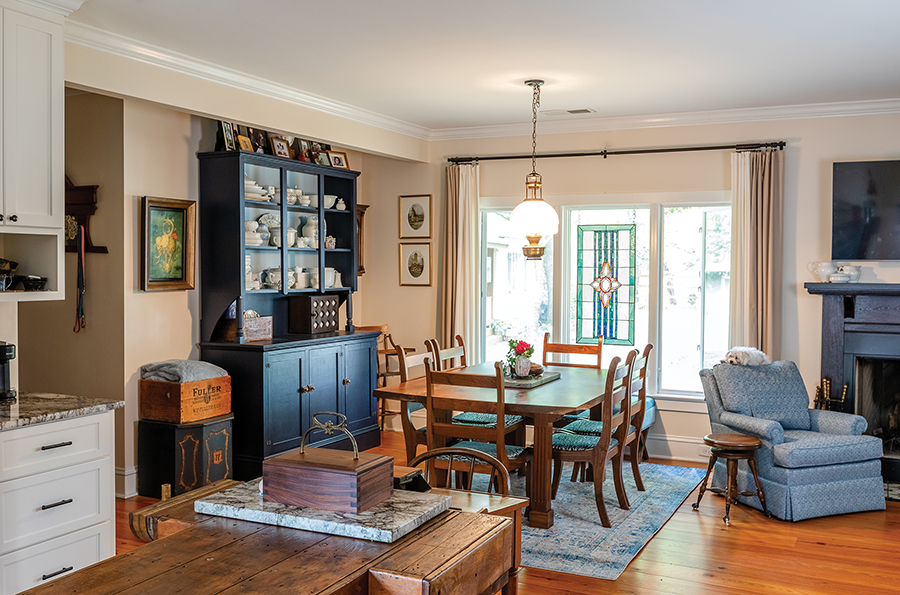
The little black dress may be a classic, but a kitchen with matte black cabinets, textured black granite countertops and black floormats? Stunning. Just what family chef Adam Wimberly wanted. His goal: “Something masculine.”

Black isn’t the only surprise at Adam and Jessica Wimberly’s home — a charming cottage in a gated golf community, its exterior belying the scope and originality within. Just inside the front door, Adam’s home office has navy blue walls and ceiling. The front hallway is sized to accommodate an ancestral European armoire, big as a British schooner, which houses a bar, Adam’s g-g-g-g-great grandfather’s sword and other military artifacts. The 280-year-old behemoth was a gift from Adam’s mother before she passed away.

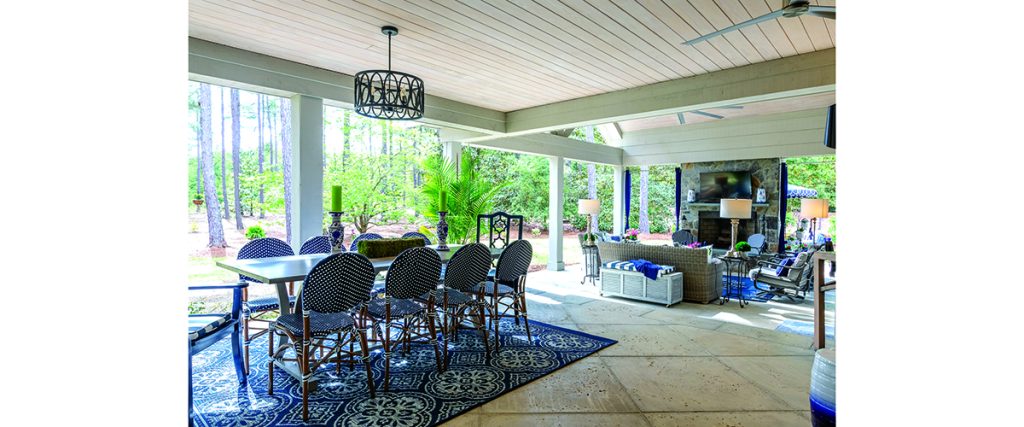
In this house the master suite opens onto the living room, with 20-foot ceilings bisected by a second-story balcony. Then, the living room opens onto a terrace where water splashes from two fountains, the larger a COVID project.


Upstairs, a guest bedroom and a home gym are above-average size. And a big, comfy home theater, circa Tony Soprano, has a sectional sofa, blackout window curtain, wall-mounted screen and professional projector, plus posters from their favorite flicks.

Besides suiting the Wimberlys’ requirements and tastes, the house and its location represent a lifestyle adjustment for the vibrant family. “We were pioneers in Seven Lakes West, lived there for 20 years in a traditional two-story across from the lake where we had a pontoon boat,” Adam says. Eventually, the boat lost its thrill.

Events had them driving to town often. Son Asher would soon attend Pinecrest High School. Time for a change, not to be confused with still-distant retirement.

Adam, a corporate headhunter for the pulp and paper business, could locate his home office anywhere. Jessica no longer taught middle school. A visit to friends at National Golf Club sparked interest. “We could see ourselves enjoying this neighborhood,” Jessica says.

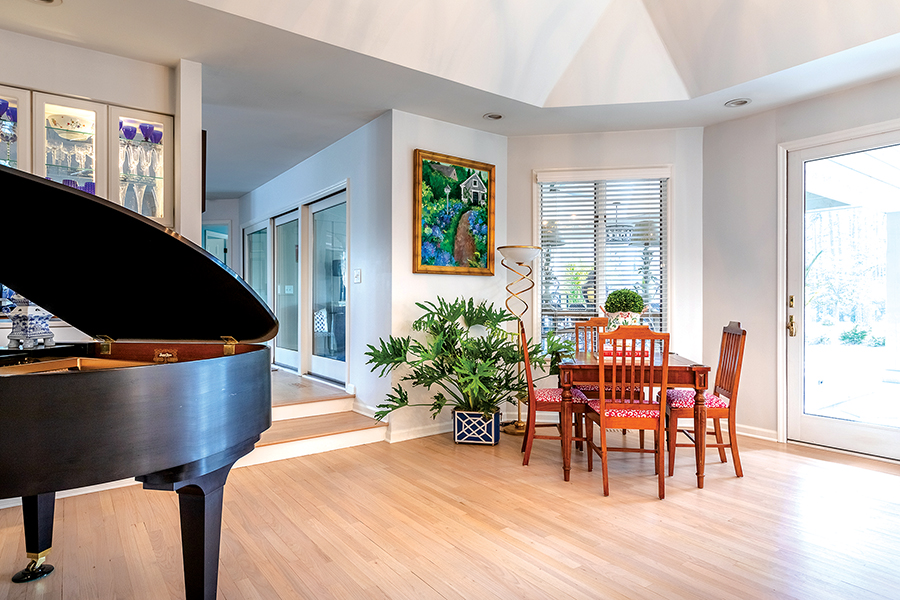
They found a house built in 2007, with yellow walls and a traditional kitchen. Jessica liked the central vacuum. Adam liked the small yard requiring minimal care. They both liked the movie room. A good omen: The house was occupied by the same family friends who had hosted their engagement party. And, its dimensions (4,000 square feet) and unusual layout provided options for displaying family artifacts with Jessica as docent, sharing the history of ancient oars and the 48-star American flag on the staircase landing.


They took the plunge, trading lake view for a fairway in 2017. Out with pastels and broadloom, in with soothing (now trendy) shades of gray, sand and beige framed by vanilla crown moldings. Informal, comfy and contemporary characterizes most furnishings, with an emphasis on dark woods, leather and other textures, including a rug woven from cowhide. Lamps and ceiling fixtures double as conversation pieces, along with a battered barn door rising from the living room mantel, representing Jessica’s Moore County farm connections. She was born here and has lived here, or nearby, practically forever.


Certain pieces, however, steal the show. The bed dominating the master suite is fashioned from inlays employing centuries-old wood. This massive piece, made to order for the Wimberlys in Italy, took a year from inception to delivery.

A round dining room table commemorates their 25th wedding anniversary. Battlefield art and family crest speak to Adam’s heritage. A bowl received as a wedding gift, later serving as baptismal font for their son, holds chocolates. A cabinet that belonged to Jessica’s grandmother contains her written canning recipes. And a milk jug speaks to the dairy farm history.

Some spaces were repurposed to suit the family’s active lifestyle. “We like to entertain,’’ Jessica says. Not just cookouts and holiday banquets. The breakfast nook became what Jessica calls a friends’ corner, with chairs around a low table for drinks and hors d’oeuvres or a coffee break. A main-floor walk-in closet, where former owners stored their Christmas tree, is now a workshop.

Systems were sufficient except for the AC. “We keep the house like a refrigerator in the summer,” Adam says.

The only major construction took place in the kitchen. Adam’s avocation surfaced young. “I was my mother’s sous-chef,” he says, before graduating to cooking shows where best-quality ingredients demand superior implements. “Some guys buy boats. I bought a kitchen.”


Adam had a design in mind — quasi-industrial with a floating island — but the black came from something he saw online. The galley kitchen footprint suited the industrial mode, but the black cabinets, black countertops and black foam floor mats begged for illumination. At one end, a tall, undressed window rises over the sink, while along the brick sidewall, three small, paned windows at ceiling height provide both light and another design element. Open shelves hold antique or interesting hand tools. Weathered wooden boxes scattered throughout accommodate larger implements. The Sub-Zero is left metallic silver. Black panels might have been overkill.

On the counter, a planter growing half a dozen herbs speaks of Adam’s culinary requirements. Over it all hangs an old-timey butcher shop sign.

As expected, his ideas were met with resistance. “But I had no Plan B,” he confesses.

Adam, glowing with pride, demonstrates how one of eight burners on his Wolf range is retrofitted for delivering maximum heat to a wok. “I’m thrilled. I wouldn’t change a thing,” he says. “This is my happy place.”

Jessica concurs: “I feel everything we need or want is in this house.”

Enter Asher, home from school. Before heading for his second-floor domain between the movie room and gym the 17-year-old greets his parents with a familiar phrase:

“What’s for dinner, Dad?”  PS

What’s in a Name?

What’s in a Name?

Cattleya Penny Kuroda and Cattleya Hawaiian Fantasy: Two Splash-Petal Enigmas

By Jason Harpster

What if your birth certificate was wrong? Yikes! You need it to get married, register for school, obtain a driver’s license or a passport. It verifies your age and citizenship. If it’s not the most important document you have sitting in your safety deposit box, it’s in the top three. But if a flower has a mistaken “birth certificate” it’s no big deal, right? This isn’t Little Shop of Horrors. It’s not like you’re going see Audrey II in line behind you at the DMV.

Just as the DMV tracks names and addresses for drivers, Kew Royal Botanical Gardens maintains the Kew World Monocot Checklist, which tracks currently accepted names for over 30,000 orchid species in the wild. The Royal Horticultural Society is the international authority for orchid hybrids and maintains the International Orchid Register that lists over 100,000 orchid hybrids with their seed and pollen parents. Orchid hybrids must be registered to be eligible for shows and awards.

In her article “Cattleya Penny Kuroda By Any Other Name,” published in the April 2014 issue of Orchids, Laura Newton details how Cattleya (C.) Penny Kuroda was originally registered with the wrong parentage. When C. Penny Kuroda was registered in 1976 by Mary Hernlund, the parents were listed as C. Summer Snow x C. guttata. Given that virtually all splash-petal cattleyas have C. intermedia var. aquinii in their background, Newton rightfully questioned where the distinct, peloric, splashed petals of C. Penny Kuroda and its progeny originated. The Royal Horticultural Society found Newton’s argument convincing and subsequently updated the registration to C. Summer Stars x C. guttata that year.

Michael Blietz, an accomplished Hawaiian orchid grower, has uncovered new evidence that shows the registration change for C. Penny Kuroda is incorrect. In his letter to the American Orchid Society in February 2022, Blietz recounts how he recently received the cross book from the Mary Hernlund nursery which shows the parents of C. Penny Kuroda as C. Summer Snow x C. guttata var. alba. Interestingly, the alba form of C. guttata was not found until the early 2000s; only C. tigrina var. alba would have been available in 1976.

After reviewing the many progeny of C. Penny Kuroda and the inventory from Hernlund’s stud book, Blietz concluded that the color, splashing and spots exhibited could only come from C. Interglossa, not C. Summer Snow or C. Summer Stars as Newton espoused. It is not a coincidence that all of the selfings and original plants from the C. Penny Kuroda were bifoliate due to the influence of C. amethystoglossa, C. intermedia, and C. tigrina which are all bifoliate species. The size of the spots and lavender color on the tips of the side lobes of the lip are in line with C. amethystoglossa and its hybrids. The size and length of the splashes on C. Penny Kuroda also match C. Interglossa since the peloric petals are mirroring the color and pattern on the lip.

Prior to the registration change of C. Penny Kuroda in 2014, C. Summer Snow had five F1 offspring with C. Penny Kuroda, by far being the most prolific with 143 F1 offspring and 837 total progeny. A closer examination of C. Summer Snow’s offspring is warranted as it appears a registration error similar to that for C. Penny Kuroda has occurred with C. Hawaiian Fantasy, another prolific splash-petal hybrid with 25 F1 offspring and 114 total progeny as of this writing.

Cattleya Penny Kuroda was registered in 1976 by Hawaiian grower Mary Hernlund while C. Hawaiian Fantasy was registered by Benjamin Kodama of Waianae, Hawaii in 1982. The parents of C. Hawaiian Fantasy are listed as C. Summer Snow x C. Wayndora, though this registration is suspect as neither parent has C. intermedia in their background. Unfortunately, Kodama passed away in 2017, which makes determining the exact parentage of C. Hawaiian Fantasy exceedingly difficult. An attempt to obtain clarification from Kodama Orchids has not been successful.

Correspondence with Roy Tokunaga from H&R Orchids, another longtime orchid grower and breeder in Oahu, in December of 2021 was especially helpful. Tokunaga confirmed that he and other older Hawaiian growers knew C. Hawaiian Fantasy had C. intermedia var. aquinii in its background, though they were unsure of the exact parentage. These hybridizers understood that the peloric form of C. intermedia var. aquinii is dominant and passed on to its progeny.

In discussing Newton’s findings regarding the correct parentage of C. Penny Kuroda and how this would relate to the lineage of C. Hawaiian Fantasy with Tokunaga and Fred Clarke, both gentlemen agreed that the current registration for C. Hawaiian Fantasy is incorrect. The question then becomes what, if anything, should be done about the incorrect registration?

Reviewing Hernlund’s cross book reveals another curious surprise: C. Hawaiian Fantasy and its reciprocal cross were made by Hernlund. Despite being registered by Kodama in 1982, it appears Hernlund made, or at least attempted to create, C. Hawaiian Fantasy as detailed by crosses No. 1247 and 1257. Blietz reached out to Ben Kodama Jr. who confirmed that his father, Benjamin Kodama Sr., received the C. Hawaiian Fantasy flasks from a grower on the Big Island. Blietz agrees that these plants had to come from Hernlund.

Although it is impossible to prove with 100 percent certainty that C. Interglossa is the correct parent of C. Penny Kuroda and C. Hawaiian Fantasy, we can conclude that the registrations for both hybrids are incorrect as C. Summer Snow does not have C. intermedia in its genetic background. It is unlikely that C. Summer Stars is in the background of either of these crosses since Stewart Orchids used alba parents to create C. Summer Stars. Considering the state of hybridizing in Hawaii during the 1970s and ’80s and the push to bring new crosses to market before they were registered, it is easy to see how these errors occurred. Given the new evidence that has come to light since 2014 when the Royal Horticultural Society revised the parentage of C. Penny Kuroda from C. Summer Snow x C. guttata to C. Summer Stars x C. guttata, the registration should be updated to C. Interglossa x C. tigrina, or, alternatively, change the C. Summer Snow parentage to unknown. Moreover, the registration for C. Hawaiian Fantasy should also be updated accordingly since the same parent was used to make C. Penny Kuroda.

Correcting the record and establishing the proper lineage helps honor the numerous contributions of Hernlund, Kodama, Tokunaga and other Hawaiian growers. Thanks to the Hernlunds’ cross journal and Ben Kodama Jr., we know that Hernlund used C. Summer Snow to make both C. Penny Kuroda and C. Hawaiian Fantasy. Blietz agrees that Hernlund’s stud plant that was labeled C. Summer Snow was mislabeled and was actually C. Interglossa. Updating the registrations of C. Penny Kuroda and C. Hawaiian Fantasy would highlight the contributions of this Hawaiian community and ensure that the knowledge they shared is not lost. Mary Hernlund passed away on April 19, 2022 at the age of 103.  PS

Jason Harpster is an accredited American Orchid Society judge and works at his family’s business, Central Security Systems. He hopes to share his collection of 2,000-plus orchids by starting a botanical garden in Southern Pines. 

The Beat Goes On

The Beat Goes On

From the Mountains to the Sea

By David Menconi


Type design by Keith Borshak


Map Illustration By Miranda Glyder


Springtime in North Carolina means college basketball madness, azaleas blooming — and the earliest days of outdoor music. Our state has a staggering array of A-list music festivals spanning numerous genres from now until fall. Here are some of what you should be making plans for.


Dreamville Festival 

Between apocalyptic weather and the coronavirus pandemic, rapper J. Cole’s Dreamville Festival has had a rocky existence in its short history. But in spite of multiple postponements, Dreamville has been a huge success, starting with 2019’s sold-out debut at downtown Raleigh’s Dorothea Dix Park that immediately established it as one of the nation’s top hip-hop festivals. Dreamville’s second edition in 2022 expanded from one day to two with an onstage lineup featuring the entire roster of Cole’s Dreamville Records label, and it also sold out. Round three returns to Dix Park the first weekend of April as another multi-day affair. It should be another big success, with Cole himself in the headline slot.

April 1 – 2, Raleigh; dreamvillefest.com


MerleFest 

Centered on the multi-style “traditional plus” music played and loved by its late, great founder, Doc Watson, MerleFest has been a tradition at Wilkes Community College since 1988. The venerable roots-music festival is a signpost event on the Americana circuit. And after the same pandemic problems that every other live-music event faced in recent years, it’s back with an impressive lineup featuring the Avett Brothers, Maren Morris, Little Feat, Tanya Tucker and more.

April 27 – 30, Wilkesboro; merlefest.org


Bear Shadow

The mountains of the far western corner of North Carolina are the setting for this springtime festival, which happens the same weekend as MerleFest. First conceived in 2021, this year’s model has a first-rate alternative-leaning lineup featuring Spoon, The Head and the Heart, Jason Isbell and Amythyst Kiah.

April 28 – 30, The Highlands Plateau; bearshadownc.com


Shakori Hills GrassRoots Festival of  Music & Dance 

Started in 2003 as a nonprofit music and dance festival, Shakori Hills takes place on a bucolic 9,000-acre spread in rural Chatham County. It’s probably the top camping festival in the greater Triangle region, with solid Americana lineups. Marty Stuart & His Fabulous Superlatives, Malian singer/guitarist Vieux Farka Touré, beach legends Chairmen of the Board and festival regulars Donna the Buffalo. There’s also a fall version of Shakori Hills, which happens every October.

May 4 – 7, Pittsboro; shakorihillsgrassroots.org


Annual Carolina Beach Music Festival

Dance to beach music with your toes in the sand at the 37th Annual Carolina Beach Music Festival on Saturday, June 3 from 11:00 a.m. to 5:00 p.m. Billed as “the biggest and only beach music festival actually held on the beach on the North Carolina coast,” three bands will be performing. Shows are accessible from the Carolina Beach Boardwalk at Cape Fear Blvd. and Carolina Beach Ave. S. For information on tickets call (910) 458-8434.

June 3, Carolina Beach


Festival for the Eno

The granddaddy of music festivals in the Triangle, Festival for the Eno dates back to 1980 and happens on the grounds of Durham’s West Point Park. Started as a fundraiser for the Eno River Association, the festival — which also offers a craft and food market — has hosted a who’s who of Americana-adjacent and roots artists including Emmylou Harris, Doc Watson and Loudon Wainwright III. Recent years have featured rising regional acts including Mipso, Rainbow Kitten Surprise and Indigo De Souza.

July 1 and 4, Durham; enofest.org


Mountain Dance and Folk Festival 

Reputedly the first event in America to be called a “folk festival,” Asheville’s Mountain Dance and Folk Festival was founded in 1928 by the folk music legend, Bascom Lamar Lunsford. It remains the longest continuously running folk festival in the country, and it’s as much about the folk dance traditions of Western North Carolina as the music.

Aug. 3 – 5, Asheville; folkheritage.org


Earl Scruggs Music Festival 

A newcomer to the North Carolina festival circuit, the Earl Scruggs Music Festival debuted last year at the Tryon International Equestrian Center in Mill Spring. As you’d expect for a festival named after the man who invented the three-finger style of bluegrass banjo, the lineup trends toward classic bluegrass and Americana.

Sept. 1-3, Mill Spring; earlscruggsmusicfest.com


John Coltrane International Jazz and Blues Festival 

Although he made his mark as an artist elsewhere, John Coltrane was born and raised in Hamlet, North Carolina. He was one of the towering figures of 20th century jazz, a key collaborator with Miles Davis, Duke Ellington and his fellow North Carolina native Thelonious Monk. The John Coltrane International Jazz and Blues Festival has been paying tribute to his legacy every Labor Day weekend since 2011 with solid lineups — 2022 featured trumpeter Chris Botti, singer Patti LaBelle and saxophonist Kirk Whalum, among others.

Sept. 2 – 3, High Point; coltranejazzfest.com


Hopscotch Music Festival

Downtown Raleigh has a well-earned reputation for doing music festivals right, and one of the events that helped pave the way is the alternative-slanted Hopscotch. Originally started in 2010 under the auspices of the Indy Week newspaper, it showed off Raleigh’s walkable grid of downtown nightclubs and outdoor stages to fantastic effect. Past headliners have included Flaming Lips, The Roots, Solange Knowles and St. Vincent. Hopscotch director Nathan Price reports that this year’s model should feature “an expanded lineup closer to pre-COVID size.” Here’s hoping.

Sept. 7 – 9, Raleigh; hopscotchmusicfest.com


North Carolina Folk Festival 

In 2015, the National Council for the Traditional Arts brought the long-running National Folk Festival (which has been around since 1934) to Greensboro for a three-year run. It was such a success that, after the national festival’s Greensboro run ended, the city opted to keep it going as the rebranded North Carolina Folk Festival. Last year’s lineup was typically eclectic, featuring everything from George Clinton’s P-Funk All-Stars to the Winston-Salem Symphony String Quartet. Expect more of the same in 2023.

Sept. 8 – 10, Greensboro; ncfolkfestival.com


World of Bluegrass 

The International Bluegrass Music Association moved its annual business convention and festival to Raleigh in 2013, where it has been a huge success. Between the convention, trade show, “Bluegrass Ramble” nightclub showcases, awards show and street festival, total attendance can top 200,000 when the weather’s good. Past headliners have included Steve Martin, Alison Krauss, Béla Fleck and just about every notable picker and singer in the genre. Year in and year out, it’s downtown Raleigh’s biggest music festival.

Sept. 26-30, Raleigh; worldofbluegrass.org


That Music Festival 

Sponsored by Raleigh’s Americana/roots radio station, That Station, 95.7-FM, That Music Festival made its debut in June 2022 at Durham Bulls Athletic Park with an all-North Carolina lineup featuring American Aquarium, Steep Canyon Rangers, Mountain Goats, Rissi Palmer and more. The sophomore edition is tentatively scheduled for October, most likely in Durham again.

October, Durham; thatstation.net/that-music-fest


Annual Bluegrass Island Music Festival 

Music lovers will be flocking to the Outer Banks, beach chairs in hand, for the 12th Annual Bluegrass Island Music Festival October 19-21 held at the Roanoke Island Festival Park overlooking miles of the pristine waters of Roanoke Sound. Buy your tickets and book your lodging well ahead of time. Acts this year include The Goodwin Brothers, Seth Mulder & Midnight Run, Rhonda Vincent & The Rage, Po’ Ramblin’ Boys, Leftover Salmon, The Kody Norris Show, Thunder & Rain, AJ Lee & Blue Summit, The Kitchen Dwellers, The Steeldrivers, Darin & Brooke Aldridge, Breaking Grass, Tim O’Brien and the incomparable Sam Bush. 

October 19-21, Manteo; bluegrassisland.com  PS

A Rude Awakening

A Rude Awakening

Bravery, blunders, and bloodshed at Monroe’s Crossroads

By Bill Case    

Art by  Martin Pate and the Fort Bragg Cultural Resource Management Program

Gen. Kilpatrick misdirects Confederate cavalry.

The arrival of dawn on March 10, 1865, became an unwelcome wake-up call for Lt. Gen. Judson Kilpatrick. Stirred from his bed by the sound of thundering hoofbeats, the Union cavalry leader, clad only in his nightshirt and drawers, rushed to the front porch of Charles Monroe’s farmhouse, 8 miles east of present-day Southern Pines on what is now the Fort Bragg — soon to be Fort Liberty — Army reservation. Having commandeered the house for his temporary headquarters, what Kilpatrick saw shocked him. Hordes of Confederate cavalry were swooping down on his sleeping encampment, slashing with sabers and firing point-blank at bleary-eyed Union troops. Thus began “The Battle of Monroe’s Crossroads.”

“In less than a minute,” Kilpatrick would later report, the Confederate horsemen “had driven back my people, and taken possession of my headquarters, captured the artillery (two cannons), and the whole command was flying before the most formidable cavalry charge I ever have witnessed.” The general’s immediate thought was, “Here is four years’ hard fighting for a major general’s commission gone up with an infernal surprise.”

Tagged with the scathing moniker “Kill-cavalry” because of a history of unnecessarily putting his troops in harm’s way, the general’s improvident failure to set pickets and safeguard his headquarters was an especially egregious omission and could well torpedo his military career. It enabled Confederate cavalry, led by Gen. Wade Hampton and subordinate generals Joseph Wheeler and Matthew Butler, to ride undetected and unopposed straight into the Union camp.

Kilpatrick’s attention may have been distracted by the presence of a woman. Depending on the historian consulted, the woman was either the beautiful Marie Boozer or a plain Yankee schoolmarm named Alice. In either case, the woman was believed to be sharing Kilpatrick’s bed at the farmhouse. The general, it seems, was caught with his pants down.

One objective of the Confederate attack was to capture Kilpatrick. A cadre of Georgia cavalry, finding a man still in his bedclothes standing on the porch of Monroe’s farmhouse, demanded to know where the Union general was. It was Kilpatrick, of course, and he quickly pointed to a figure riding off in the distance, “There he goes on that black horse!” exclaimed the general.

The Georgians turned and rode off in pursuit. Leaving either Alice or Marie behind, Kilpatrick scrambled off the porch, climbed aboard a stray horse — not his prized Arabian stallion “Spot” — and promptly hightailed it into the woods, where many of his cavalrymen had retreated. To this day, the general’s flight is disparagingly labeled “Kilpatrick’s Shirt-Tail Skedaddle.”

The Confederates had good reason to target Kilpatrick, whom they had come to despise for his part in the Union Army’s devastating blitz of the South. Six months earlier, on Sept. 2, 1864, Gen. William Tecumseh Sherman’s 60,000 Union soldiers had occupied and burned the city of Atlanta when depleted Confederate forces — commanded initially by Gen. Joseph Johnston, followed by Gen. John Bell Hood — were unable to halt the Union troops’ advance. In response, the president of the Confederacy, Jefferson Davis, installed Gen. P.G.T. Beauregard as the commander of the newly formed Department of the West, comprised of five Southern states that included Georgia, South Carolina and North Carolina.

Hampton’s scouts discover tracks to Kilpatrick’s encampment.

But with fewer than 30,000 soldiers scattered over several states, Beauregard was equally powerless to prevent Sherman’s next move, his “March to the Sea,” made during November and December, 1864. During a five-week trek from Atlanta to Savannah, Union soldiers laid waste to military installations, factories and railroads in an effort to choke off the Confederacy’s economic lifeblood. Leading the Union cavalry was Kilpatrick, whose zeal for destroying enemy property made him, according to Sherman, “just that sort of man to command my cavalry on this expedition.” The general, aware of Kilpatrick’s faults, also referred to him as “a damn fool.”

After the Union troops reached Savannah on Dec. 21, 1864, commander-in-chief Gen. Ulysses S. Grant considered having Sherman move his army north by sea to Virginia, where the two generals would combine their forces to finish off Lee in Petersburg. But Sherman had a different plan in mind. He proposed marching his men north through the Carolinas to link up with Grant. Sherman persuaded his commanding general that the maneuver would devastate resistance in both states. Grant agreed, ordering him to “make your preparations to start on your expedition without delay . . . break up the railroads in South and North Carolina, and join the armies operating against Richmond as soon as you can.”

The bulk of Sherman’s army began exiting Savannah at the end of January 1865, soon entering South Carolina. Sherman was not inclined to treat the first state to secede gently. “The whole army is burning with an insatiable desire to wreck vengeance upon South Carolina,” he would write. “I almost tremble at her fate, but feel that she deserves all that seems in store for her.”

Sherman and other Union commanders have been criticized for rebuffing the pleas of numerous former slaves seeking the army’s protection during its Southern campaign. Hungry and fearful of being recaptured (or worse) by their former masters, the liberated, but nonetheless desperate, slaves attempted to attach themselves to the Union force. But the army mostly stiff-armed them on the grounds that the Blacks need for food and supplies would drain available resources and slow the march. In one measure of retribution against the slaveholders in the Deep South, Sherman issued an edict setting aside 400,000 acres of coastal areas in South Carolina, Georgia, and Florida for freed slaves, an order later reversed by Andrew Johnson. 

Gen. Wade Hampton, commanding the cavalry supporting Lee’s army in Virginia, could not bear the thought of being absent from the upcoming fight in his home state of South Carolina. Hampton, deemed by Confederate Gen. James Longstreet the “greatest cavalry leader of our or any age,” was granted leave by Lee to return to the state along with Gen. Matthew Butler and the latter’s cavalry division.

Hampton also convinced Lee to place him in command of the Confederate cavalry in the area. This created friction between Hampton and “Fighting Joe” Wheeler, who had days before led his men to victory over Kilpatrick’s cavalry at Aiken, South Carolina. Hampton and Wheeler managed to put aside any ill feelings and established an effective working relationship, later evidenced at Monroe’s Crossroads.


Readied for the dawn attack.

In the early stages of the Carolinas Campaign, Sherman kept Beauregard and Hampton guessing where his army was heading. To confuse them, he ordered the Union left wing westward toward Augusta, Georgia, while directing his right wing to feint in the direction of Charleston. Then Sherman brought the troops back together to make a beeline to Columbia, South Carolina. The state capital was lightly defended, and Hampton had no choice but to order his troops to evacuate. On Feb. 17, Sherman’s unopposed army occupied the city.

A massive fire broke out that consumed most of Columbia’s buildings. Arguments raged regarding who caused the conflagration. Did the responsibility lie with fleeing Confederates who allegedly set fire to a storehouse of cotton bales? Or was the fire ignited by vengeful Union soldiers? Sherman pointed the finger at Hampton, who pointed his own, presumably uplifted, digit back at “Uncle Billy.”

The two adversaries exchanged hostile messages regarding the fate of Union foragers, a number of whom Sherman claimed had been murdered by Confederate soldiers after capture. He notified Hampton of his intent to respond in kind by executing a like number of Confederate prisoners. Hampton emphatically denied Sherman’s charge and upped the ante, promising that “for every soldier of mine ‘murdered’ by you, I shall have executed at once two of yours, giving in all cases preference to any officers who may be in my hands.” Both generals got each other’s message, and no further executions of foragers or other captives occurred.

The Columbia debacle accentuated fears of Confederacy higher-ups that annihilation of their cause was at hand. On Feb. 22, a desperate Gen. Lee relieved the beleaguered Beauregard and brought Gen. Johnston back to command the Department of the West. Johnston was under no illusion he could reverse the course of the war. In his memoirs, the general acknowledged that his primary object was “to obtain fair terms of peace; for the southern cause must have appeared hopeless then to all intelligent and dispassionate southern men.”

Given the Confederate Army’s vanishing manpower, achieving any terms beyond the CSA’s unconditional surrender would be a daunting undertaking. At the time Sherman crossed into North Carolina (March 3, 1865), the only Confederate infantry in Sherman’s immediate vicinity was Gen. William Hardee’s corps of 6,000 soldiers. Outnumbered 10 to 1, the most Hardee could be expected to do was shadow Sherman’s advance.

A more workable short term option for Johnston was employing his Hampton-led cavalry to dog the Federals with hit-and-run raids. As author Eric J. Wittenberg explained in his book, The Battle of Monroe’s Crossroads, the 4,000 horse soldiers of Hampton, Wheeler and Butler resisted Sherman by “hovering around the edges of the Federal column like a swarm of angry hornets ready to exact a heavy toll whenever an opportunity presented itself.”

Another dilemma for Johnston was not knowing where the Union Army would head after sacking Columbia. Sherman’s actual next destination was Fayetteville. Once there, his army could obtain supplies transported by steamboats sailing up the Cape Fear River from the coastal port of Wilmington, the latter having fallen into Federal hands in February. After destroying the arsenal at Fayetteville, Sherman intended to cross the Cape Fear and move his army to Goldsboro, North Carolina, where it would link up with Gen. John Schofield’s corps of 30,000 soldiers. Their combined force of 90,000 soldiers would then join Grant in Virginia for the final push against Lee.


The confederate charge at Monroe’s Crossroads.

A critical element of Sherman’s strategy was getting to Fayetteville before Hardee. Doing so would enable him to block or destroy the bridges across the river. Either measure would prevent Hardee’s corps and Confederate cavalry units from joining up with Braxton Bragg’s corps and other remnants of Joe Johnston’s dwindling forces.

Johnston’s strategy was basically a mirror image of Sherman’s. If Hardee reached Fayetteville ahead of the Federals, he was directed to cross the river and blow up the bridges behind him. This would frustrate, or at least delay, Sherman’s own crossing. Meanwhile, Hampton’s cavalry would hound the Union Army, inhibiting its progress.

The race would entail both Federal and Confederate forces passing through Moore County. Exhausted forces on both sides shivered as incessant, near-freezing rains with accompanying spring floods hampered their movements. Moore County was a quagmire! Kilpatrick described the grueling conditions as “the most horrible roads, swamps, and swollen streams.”

When Kilpatrick entered the county on March 7, he was several miles ahead of Sherman, who sent a message directing his cavalry leader “to deal as moderately by the North Carolinians as possible.” The general also counseled Kilpatrick to “keep up the seeming appearance of pushing after Hardee, but really keep your command well in hand, and the horses and men in the best possible order as to food and forage.”

As Kilpatrick consumed a meal of boiled sweet potatoes at the farm of Evander McLeod (near present day Pinebluff) on the evening of March 8, it had become abundantly clear that the West Point grad would be hard-pressed to avoid hostilities with the Confederate cavalry buzzing around him. Wade Hampton’s men had left McLeod’s farmstead just hours before.

The impending danger was compounded by Kilpatrick’s decision to send out scouting parties in search of alternative routes to avoid his troops’ overtaxing of the roads. As Wittenberg writes, “The farther his (4,000) men spread out . . . the more the Federals risked attack by marauding Confederate cavalrymen hovering just beyond the fringes of Kilpatrick’s column.”

At times, Kilpatrick seemed oblivious to these concerns. During the following day’s march, a Confederate prisoner, while walking alongside the carriage of “Little Kil” —he stood 5 feet, 3 inches in height — observed the general laying his head in Alice’s (or Marie’s?) lap and dangling his feet out the carriage window.

Meanwhile, at about 2 p.m. on March 9, Kilpatrick’s Third Brigade, headed by Col. George Spencer, arrived at the small hamlet of Solemn Grove, comprised of Buchan’s post office, a store, a mill and a few houses, including that of Malcolm Blue. Spencer was followed by William Way’s dismounted Fourth Brigade accompanied by 150 Confederate prisoners. Little Kil’s first and second cavalry brigades, commanded by Col. Thomas Jordan and Brig. Gen. Smith Atkins, respectively, were farther behind.

Kilpatrick’s men counterattack.

Upon receiving intelligence that Hampton’s cavalry was heading for Fayetteville, Kilpatrick concocted a scheme. He would seek to intercept the Confederate horsemen and prevent their planned rendezvous with Hardee, now certain to beat the Federals to the Cape Fear. The gambit meant blocking three different roads that Hampton and his subordinates, Wheeler and Butler, might potentially use: Morganton Road, Chicken Road to the south, and Yadkin Road to the north. Kilpatrick ordered Spencer to block the Yadkin Road. Another sortie was assigned to Way’s 400-man dismounted brigade. It marched farther east to block Morganton Road. Atkins, following behind as a rear guard, was urged to close up his brigade’s distance from Spencer and Way. The three brigades were ordered to establish camp at Monroe’s Crossroads, though circumstances would prevent Atkins from arriving there until well after hostilities commenced the following morning.

Way’s brigade reached Monroe’s Crossroads at 9 p.m. and set up camp adjacent to Charles Monroe’s farmhouse at the intersection of Morganton and Blue’s Rosin roads. Spencer’s brigade arrived soon thereafter, setting up its camp on a plateau that sloped toward a dismal swamp. Meanwhile, Jordan’s First Brigade, 3 miles distant, blocked Chicken Road. Kilpatrick’s separation of his brigades carried risk as each unit was rendered more vulnerable to attack. At the time Kilpatrick’s bugler sounded “taps” the night of March 9, there were around 1,400 Union soldiers at Monroe’s Crossroads, but had Kilpatrick played into the enemy’s hands by dividing his brigades?


Meanwhile, Confederate Gen. Butler had an unexpected prize fall into his lap. While patrolling with his division on the evening of March 9, he detected the sound of approaching hoofbeats. Butler called out, “Who goes there?”

“Fifth Kentucky,” came the response. Butler knew the 5th was a Federal unit.

He beckoned the soldiers to come forward and, without firing a shot, Butler promptly disarmed and took into custody 28 unsuspecting Kentuckians. The captives were all members of Kilpatrick’s headquarters escort company. It appeared Kilpatrick had been nearby and had narrowly avoided his own capture, hightailing it to Charles Monroe’s farmhouse. Sharing the residence with Little Kil and Alice (or Marie) were brigade leaders Spencer and Way, who bunked upstairs. Despite his close call and the distressing disappearance of the escort company, Kilpatrick inexplicably neglected to post any guards.

As a gleeful Butler regaled Hampton with the tale of his evening’s adventure, a scout rushed up to inform the generals that the tracking of hoofprints had led him to discover the union cavalry’s encampment at Monroe’s Crossroads. It appeared unguarded to the scout. Hampton, after conferring with Wheeler and Butler, sensed an opportunity to catch Kilpatrick napping (or otherwise occupied) and ordered a dawn attack.

Wheeler thought the attack would be more effective if made on foot. But Hampton overruled him. “General Wheeler,” said Hampton, “as a cavalryman I prefer making this capture mounted.” And so it was that at 5:20 a.m., the oft-wounded Hampton, astride his horse, led his cavalry’s ferocious charge into the Union camp. The 49-year-old master horseman reputedly dispatched three Union soldiers in the process.

It seemed certain Hampton was on the threshold of a glorious victory — one that could demonstrate to all that the war was not yet over. But the unforced errors were not the sole province of Kilpatrick. Several columns led by Wheeler were supposed to attack through an area that was marshy and full of thick vegetation. Wheeler thought the terrain would pose no hindrance, but he was wrong. Approximately half of Wheeler’s troops failed to make it through the muck and were late to the battlefield.

The attack caused the Union soldiers guarding the 120 Confederate prisoners to flee to the woods. Suddenly freed, the now ex-prisoners ran headlong and “frantic with joy” toward their liberators. At first, the cavalrymen thought the men sprinting toward them were retreating soldiers whose forward charge had been repulsed. The resulting confusion caused a temporary blunting of the Confederate assault. Furthermore, one of Butler’s brigades did not take part in the attack as it was ordered to escort the elated, but famished, former captives to the rear.

The newly liberated soldiers weren’t the only hungry ones. The Confederate cavalry soldiers also craved food. Many availed themselves of the opportunity to poke through the Union camp to find and consume whatever edibles they could lay their hands on. They looted belongings, scavenging shoes, blankets, saddles and mounts. The breakdown in discipline stemmed the momentum of Hampton’s onslaught and provided the Union cavalry breathing space to reform and rally. Local Civil War buff Jim Jones believes that the cavalrymen’s attention to the needs and whereabouts of their horses following the initial rush may also have added a distraction that would have been avoided had the charge occurred dismounted.

Hampton made another decision he would regret by not searching the farmhouse. Unknown to the general, Union brigade leaders Spencer and Way were still inside, hidden upstairs. Playacting by Kilpatrick’s paramour prevented the officers’ capture. Adopting the airs of a Southern belle, Alice (or Marie) greeted Hampton at the porch and assured him there were no Union officers inside her home. The chivalrous Hampton, not wanting to further trouble such a fine lady, posted a guard to keep rebel soldiers out of her hair, then bid the woman adieu. Spencer and Way remained grounded in the bedroom until the battle’s conclusion.


Lt. Stetson fires away.

Given the disarrayed and bedraggled appearance of Kilpatrick’s cavalry, it seemed next to impossible they could mount any sort of counterattack. Though they were chilled to the bone and nearly naked, most of Kilpatrick’s men had the presence of mind to grab their guns and ammo before fleeing from the camp. Jones points out that the veterans in Sherman’s army were as battletested as any in the war. “They bent at times but never broke,” says Jones.

According to Ohio horse soldier T.W. Fanning, Little Kil “cobbled together enough men to order an advance.” Then at his command, the horse soldiers “moved up the ridge, firing as they moved.” According to Fanning, the men “with one wild shout, swept down upon the rebels, who were swarming around the captured artillery and Kilpatrick’s former headquarters.” Adding impetus to Kilpatrick’s thrust were Capt. Theodore Northrup and his company of Union scouts. They had rushed to Monroe’s Crossroads upon learning of Kilpatrick’s plight.

Engaged as they were in premature celebration, it was Hampton’s cavalry now caught flatfooted. In the fog of the renewed gunfire, Lt. Ebenezer Stetson, who had been hiding from the Confederates under the farmhouse since the initial attack, surreptitiously crept to one of the cannons just 20 steps away. He loaded it with canister and fired away at the startled Confederates. Several of Hampton’s men were killed instantly. A second artillerist, believed to be Sgt. John Swartz, rushed to the second cannon and fired it to like effect. Together, they were able to inflict considerable damage until the guns were recaptured by Gen. Wheeler, largely through the ultimately fatal charge of Capt. Moses Humphrey. Swartz also died from wounds suffered in the battle.

Gen. Wheeler suddenly made his presence felt, charging into the camp and, according to a Georgian horseman, “killed several Yankees in close encounter.” He and Butler made repeated efforts to drive Kilpatrick’s men back toward the swamp, but they were met with withering gunfire courtesy of the Spencer seven-shot repeating carbines carried by an Ohio unit in the Union cavalry. Southern casualties were exacerbated because Wheeler’s and Butler’s men were packed close together due to the vagaries of the landscape. A disconsolate Butler reported that the carbines “made it so hot for the handful of us we had to retire. In fact, I lost 62 men (wounded and killed) there in about five minutes time.”

Coupled with his belief that Sherman’s infantry would soon be coming to Kilpatrick’s aid, Hampton ordered his cavalry to pull out and move on to Fayetteville. Both sides claimed victory at Monroe’s Crossroads. Kilpatrick boasted that he had driven the Confederate cavalry from the field. However, his negligent preparations would come under fire and Sherman never trusted him again. Hampton claimed his surprise attack freed prisoners and successfully stalled the Union cavalry, thus allowing Hardee to escape unscathed across the Cape Fear. But Hampton’s failure to capitalize on his initial advantage undercuts a claim of Confederate victory.

The precise number of battlefield deaths at Monroe’s Crossroads is unknown. The CSA wasn’t keeping records anymore, and Kilpatrick probably inflated the casualty figures. It would appear from accounts that a total of 150 dead is not far off. It was the last true cavalry engagement of the war.

As a result of Hardee’s escape, Joe Johnston was able to marshal 21,000 troops to battle Sherman at Bentonville on March 19. But Johnston was still outnumbered 3 to 1. As a result of heavy losses in this battle and the futility of further conflict, Johnston ultimately surrendered to Sherman. This followed Lee’s surrender to Grant at Appomattox Court House on April 9th.

Today the Monroe’s Crossroads battlefield can only be accessed by prior arrangement. Happily that’s not difficult. Jonathan Schleier, associated with Fort Bragg’s Cultural Resource Program, offered to provide a guided tour but because the penetrating boom of military munitions can still be felt there 157 years after Lt. Stetson fired a cannon at the site, Schleier had to find a date from Range Control when artillery operations would not be occurring in the area.

On a hot July morning, I met Schleier at Fort Bragg’s Ranger Station No. 2, located at the point where East Connecticut Avenue meets the post’s border. As the roadway continues into the reservation, it’s called Morganton Road, an unimproved pathway little changed since 1865. Riding in Schleier’s Ford F-150 we observed neither vehicles nor people en route to the remote battlefield. Schleier said that present day officers, as part of their training, walk the battlefield to study the tactics and maneuvers of the long-ago fight.

The Monroe farmhouse is gone, but an obelisk marks its location. The battlefield has a surprising number of monuments, all of them installed since 1990. There are combatants’ graves, including those specifically dedicated to unknown soldiers. One memorial is situated at the spot where Lt. Stetson unleashed his cannon. Schleier unfolded maps to aid in comprehending the movements of the antagonists. Walking the ridge-filled terrain and eyeing the steep incline down to the swamp it was possible to visualize the logistical challenges faced by both cavalries.

The old battlefield was eerily quiet. Not a sound to be heard. Just like it must have been before all hell broke loose at 5:20 a.m. on March 10, 1865.

To schedule a tour of the battlefield, call Jonathan Schleier at (910) 396-6680.  PS

Pinehurst resident Bill Case is PineStraw’s history man. He can be reached at Bill.Case@thompsonhine.com.

The Carriage House Rides Again

The Carriage House Rides Again

Style and originality reign in a chic pied-à-terre

By Deborah Salomon     Photographs by John Gessner


Somewhere, over the rainbow, James Walker Tufts and James Boyd can share a high five. They have found the perfect occupants for their respective villages: He plays golf. She rides. They are happily, healthfully retired, spending summers at their primary residence Up North — Ohio, that is. But when winter’s chill descends so do they, to Pinehurst, with her horse, of course.

“Such interesting people here,” says Linda Salvato.

As are they. Guy Salvato is an artist, graphic and otherwise, who worked at Manhattan’s slickest advertising agency during the Mad Men era. Most of his paintings are golf related. Linda was a consultant in health care marketing. Their primary Ohio home is a Cotswolds gatehouse, designed by an architect who traveled to the Cotswolds for inspiration.

Guy’s four sons are grown, married, with grandchildren of their own. So why not search out a pied-à-terre that pushed their respective buttons? Something quaint without being cloying, surrounded by a community of wine-sipping, cheese-nibbling, concert-going, philanthropic world citizens conversant in, well, just about everything.

No need for massive square footage — the great-grandchildren can stay elsewhere. Instead, a massive need for style and originality.

They were not aware of Pinehurst’s suitability until one of Guy’s sons discovered an international golf art seminar at Pine Needles Lodge & Golf Club.

Let’s go!

“I had been here in the ’90s but it was Linda’s first time,” Guy recalls.

While he was putt-erring around the village, Linda inquired if anybody kept horses. A drive down Young’s Road revealed the answer: “Perfect!” she exclaimed.

The “hunt” for lodging was on. Her requirements: stringent, including proximity to the village, with a historic component, maybe a juicy backstory.

You can’t get much more historic than a wood shingle Colonial Revival multi-unit residence (sounds better than “boarding” or “apartment” house) built by Old Man Tufts himself, in 1896, the same year Pinehurst was founded. The elongated structure stretched across the corner of Palmetto and Cherokee roads. Construction cost: $1,650.


A carriage house with hayloft was added about 1921. When the carriage trade declined, garage doors were installed to accommodate the family roadster. Perhaps because the property attracted more transients than blue bloods, little mention of Palmetto’s history or occupants survives in the society pages.

A subsequent owner renamed it Cloverleaf, described as being located near one of four gates in a fence meant to keep out wild pigs.

The property fell into disrepair. Neighbors (and the village appearance commission) branded it an eyesore until, according to The Pilot, the owner was cajoled into slapping on a coat of paint before the 2005 U.S. Open.

Then, in 2006, a local builder transformed the sad carriage house into two chic pieds-à-terre, adding a Palladian window to the atrium, a tiny skylight and enough moldings, paneled doors and ornate window frames with deep sills to wow a creative retired couple from Ohio.

Linda opened the door and exclaimed, “This is it!”

They snapped up Unit 10 in 2012, made some adjustments to a bathroom and moved in for the 2013 winter season.


Carriage houses, like Manhattan lofts, are rare, therefore precious. Never mind the steep flight of stairs or the modest 1,380 square footage. Concentrate, rather, on the character afforded by original mismatched pine floorboards, wall space for Guy’s golf paintings and a garden plot for this master gardener/cook. On the nights Guy doesn’t prepare an Italian original, village bistros are within walking distance.

Next came a wicked pleasure enjoyed by mature second homeowners: furnishing rooms from scratch in a breezy style dubbed “Online Eclectic,” with the exception of a rare Wells Fargo (stagecoach company, not bank) desk Linda found while strolling through the shops in Cameron.

“We both have decent design sense,” Guy notes, so no need for an interior designer. Shades of seafoam, sand, gray, vanilla and other pale neutrals flow into each other. Stylized patterns on bedroom fabrics add whimsy, while uncluttered surfaces throughout make small rooms appear larger.


Uncluttered, however, doesn’t mean empty. Or boring. Brightly painted tin cans line one wall shelf. Wood-turned bowls, dramatic examples of craft art, sit center stage on a tall dining area table seating four but folding out to accommodate eight. The kitchen is a little gem. An old-timey Pinehurst equestrian poster speaks for Linda. A golf bag anchors a corner. Guy’s stylized golf tee painting dominates a wall. That he and Andy Warhol traveled in the same New York circles is no surprise since both worked in ad illustration. Nor is Guy’s regret for not saving some of the pop artist’s discards. In 2022, one from a Marilyn Monroe series sold at auction for $195 million.
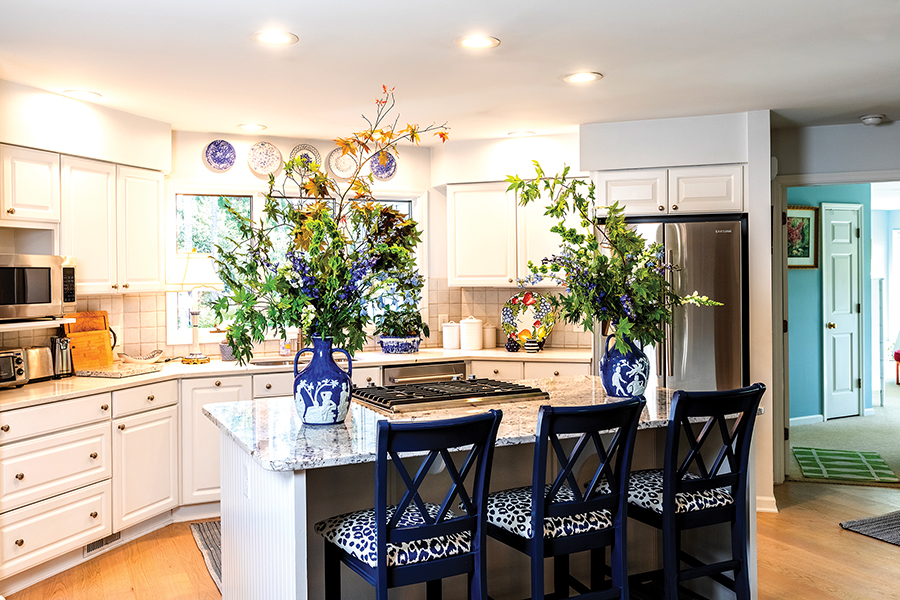
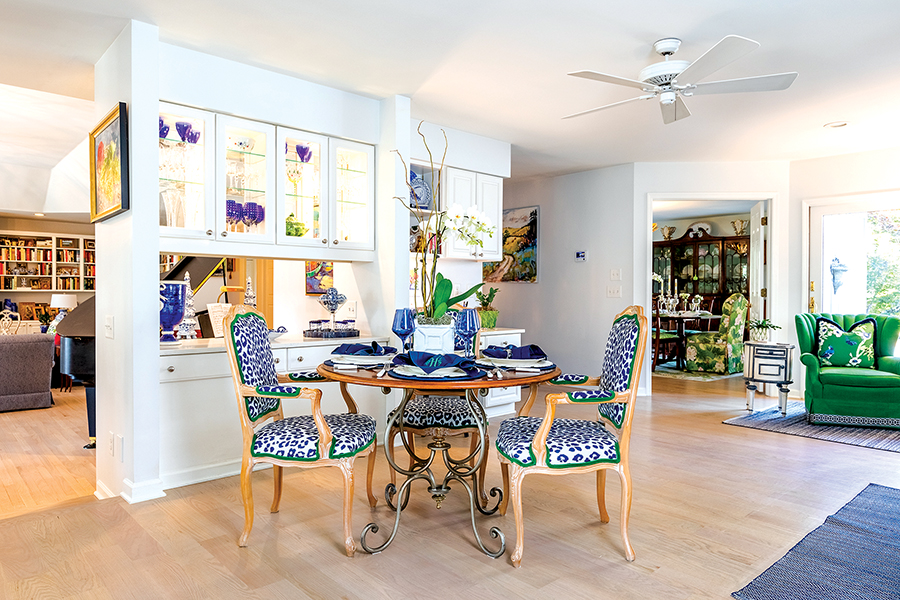
With the plantation shutters open and sun streaming from the tiny skylight, the residence with multiple ceiling pitches and lovely landscaping feels like a treehouse. To describe interior décor as hard to describe is the ultimate compliment.


The Carriage House beside Palmetto House, after a century of multiple owners and iterations, finished a win-win. The Tufts-Boyd plan worked. Old Town gained another historic reclamation. And two transplants from the Midwest — plus a retired racehorse of championship lineage — discovered nothing could be finer than to winter in Carolina.

“Being here, I feel a sense of relief,” says Linda, who rides almost daily. “I feel energized to do things I wouldn’t do up north.”

“I love doing the exterior work,” and playing golf, of course, Guy adds. “I worked hard for many years. I looked forward to something like this.”

Linda’s summation: “Two beautiful homes and everything else . . . we do have a blessed life.”  PS

King Trees

King Trees

The champions of Moore County

By Tom Lillie     Photographs by John Gessner

This and above Photograph: Turkey oak (Quercus laevis)

Moore County has what it takes to produce champions. The environment is ideal for building endurance and dominating the competition. Four individuals currently living in the Sandhills achieved state, national or world recognition without ever leaving the very spot where they took root and blossomed. They did not seek this recognition. In fact, they were discovered by local admirers and nominated for the crown.

The individuals I am referring to are trees. Three are famous for their size, and one is legendary for its age.

When it comes to size, a tree’s height, trunk circumference and crown spread are used to establish its position in arboreal prominence. The nonprofit group American Forests has the final say. A different process is used to document and recognize the oldest trees. Scientists called dendrochronologists extract a core sample with a special drill bit and count the growth rings to determine a tree’s age.

The nation’s largest turkey oak (Quercus laevis) stands at the intersection of N.C. 211 and state Road 2077 in Aberdeen. Worn and weathered, the tree is 64 feet tall with a circumference of 126 inches and a crown spread of 41 feet. Most motorists drive past the deciduous standout every day without knowing they are within sight of a titleholder, but news of plans to widen the road put the tree in the spotlight. The State Department of Transportation considered various alternatives, including rerouting the road to avoid the tree, but decided removal is the only viable option.

DOT is in the process of acquiring the necessary right of way for the project, including land occupied by the champion turkey oak. As a mitigation measure, the DOT will remove and preserve a 10-foot section of the tree for documentation and study. This champion sustained decades of automobile exhaust and inclement weather, but it will be dethroned by human progress and the chainsaw.


Left: Shumard oak (Quercus shumardii) 

Right: Florida maple (Acer barbatum) 

Our next pair of champions are about 15 miles north of the turkey oak on property near Carthage. Both trees are recognized by the North Carolina Forest Service as the largest member of their species in the state. One is a 105-foot Florida maple (Acer barbatum) with a circumference of 113 inches and a crown spread of 70 feet. The other is a Shumard oak (Quercus shumardii) that measures 142 feet tall, 237 inches in circumference, and has a 110-foot crown spread. The future of the Florida maple and Shumard oak is relatively certain, since both grow on property that is managed by the Three Rivers Land Trust.

Another Moore County tree of special note is the oldest living longleaf pine (Pinus palustris) in the world. It sprouted in 1548 and became firmly rooted in the sandy soil of what is now the Boyd Tract of Weymouth Woods Sandhills Nature Preserve in Southern Pines. During 474 years of existence, this multi-centenarian somehow managed to escape predation, disease, recurring fires, storms, the ax, the chain saw, resin gathering and growth of a nation. Its age was determined by scientists from the University of North Carolina Greensboro in 2007. Each year, the state pays special tribute to the elderly evergreen by hosting an annual birthday celebration called Party for the Pine, complete with cake, games and other activities.


Left & Right: Longleaf pine (Pinus palustris)

Last year had special meaning for the champion trees of Moore County and all native trees in North Carolina. The Department of Parks and Recreation designated 2022 the Year of the Tree. Displays and educational material recognized the importance of all trees to the natural environment. Details about champion trees can be found at https://www.americanforests.org/champion-trees/ and the North Carolina database of champion trees is posted online at https://www.ncforestservice.gov/Urban/nc_champion_big_trees_database_search.asp.  PS

Tom Lillie is a military veteran and resident of Pinehurst. He received his Ph.D. in medical entomology from the University of Florida and served 26 years as a medical entomologist in the U.S. Air Force.