STATE OF MIND
Sweet Spot
A place to watch the world
By Tommy Tomlinson
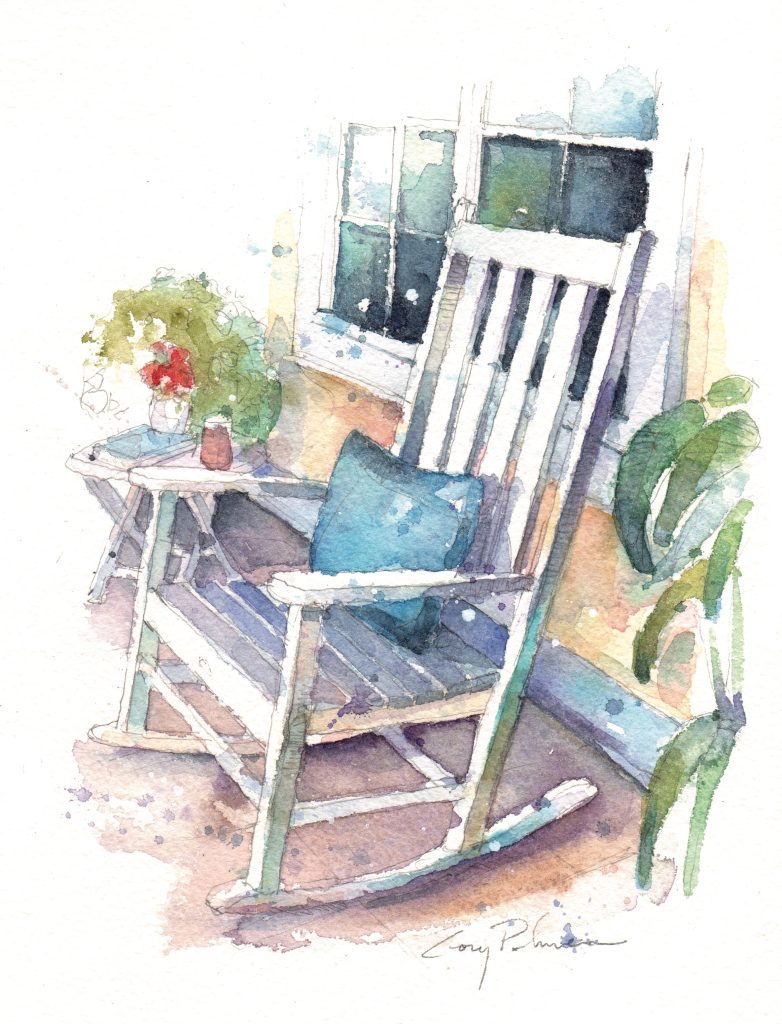
Every year I mark it on the calendar when it arrives: porch season.
This year we got a dose in the middle of February. We always get a brief false spring right around then. You know winter is coming back for another round so you get outside while you can.
It was 74 degrees one day, 83 the next, and my wife and I took to the porch in the afternoons. The porch was one of the main reasons we bought this old house. It was built in 1929, ancient in a modern city of teardowns. When we got the place the porch was half caved in — it had a big crack in the concrete, running down the middle. We got it resurfaced, and over the last 22 years, and two sets of porch furniture, we’ve spent untold thousands of hours out here.
There are some neighbors we see only when we’re on the porch. They stop by and chat on their way to get a beer down the street, or just on their evening walk. Sometimes they come to browse the books in our Little Free Library. Not long after we put the library in, a young couple with a little girl would stop by a few times a week. An older neighbor noticed, found out the girl’s name, and started leaving books in there with notes for her. Then the couple discovered that the older woman had a dog and started leaving treats for the dog. I’m not sure that couple and that woman ever met. But those little gifts meant the world to them. And to us.
A year or two ago, a waterlogged branch fell off our oak tree in a storm and knocked out the library. We had it rebuilt. You can’t let go of a thing that gives you a story like that.
The porch is our party line, our message board, the place we catch up on news and gossip. It’s where we learn who moved out and who moved in, who got sick and who’s doing better. We have watched children grow from here, and watched other neighbors age.
This winter was a hard one. We had an ice storm one weekend and 11 inches of snow the next. Other parts of the state got it even worse. We got lucky at our house — the power never went out and the pipes didn’t freeze. But man, a winter storm in the South can be lonely. We went entire days without seeing another soul. My wife is from Wisconsin and cheerfully tells stories about having to shovel the driveway every hour when they had one of their regular blizzards. Some people down here — mostly transplants — take to the snow like golden retrievers. The rest of us just hunker.
A week or so after the last snow melted, I saw the shoots of one of our daffodils poking through the dirt. And I knew porch weather was coming.
I have spent some time over the years developing a theory about why the South is believed to be, let’s say, more eccentric than other parts of the country. I call it the Crazy Aunt Theory. In colder places, if you have a crazy aunt, you can just stick her in the attic. But our summers are too hot for that. So we put our crazy aunts on the porch where they can talk to God and everybody.
The porch takes us back to those looser, closer times. You don’t have to text anybody from the porch. You don’t need to look up their socials to see what they’ve been doing. They are voice and flesh, standing right in front of you, having real conversations. Sometimes, if somebody has a few minutes, they’ll come up on the porch and actually sit with us. Crazy, right? Spending time together, in person? And we will sit there with glasses of sweet tea, or possibly bourbon, and talk about — well, maybe, nothing. Some days nothing is the best thing to talk about.
And sometimes we are silent because there is so much to see.
There’s a movie from the ’90s called Smoke that features a character named Augie who runs a little tobacco shop in Brooklyn. Every morning at 8, he takes a single photo of the street corner outside. One of the other characters thinks this is the dumbest thing he’s ever heard . . . until he looks through an album of Augie’s photos. Slowly he notices the little differences, the way the light changes, the weather, the people walking through the frame. He is deeply moved.
That’s the way I think about our porch.
In my mind, I can flip through the album and watch the magnolia on the corner bloom and fade. I can see the wrens who show up every year to build a nest under one of the eaves, making a warm space for their babies: first eggs, then hatchlings, then gone. I can see the lizards who slink out from under the house to sun themselves on the warm concrete. I can turn around the camera and see Alix sitting next to me. We who moved here in our 40s and are now in our 60s and hope to still be around in our 80s.
That second warm day in February, two bluebirds floated into the branches of the ornamental cherry tree in our front yard. Our neighborhood is full of cardinals and robins and swallows. Hawks watch over us from the tops of the trees, and owls call to one another at night. But we don’t get many bluebirds. They felt like a promise. The hard winter was coming to an end. Soon it would be porch season for real. We could live out here again — not virtually, not digitally, but through the rich and beautiful panorama of real life.