Bookshelf

BOOKSHELF

April Books

Fiction
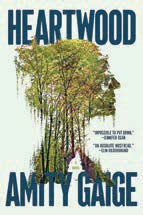
Heartwood, by Amity Gaige

In the heart of the Maine woods, an experienced Appalachian Trail hiker goes missing. She is 42-year-old Valerie Gillis, who has vanished 200 miles from her final destination. Alone in the wilderness, Valerie pours her thoughts into fractured, poetic letters to her mother as she battles the elements and struggles to keep hoping. Beverly, the determined Maine state game warden tasked with finding Valerie, leads the search on the ground. Meanwhile, Lena, a 76-year-old birdwatcher in a Connecticut retirement community, becomes an unexpected armchair detective. Roving between these compelling narratives, a puzzle emerges, intensifying the frantic search, as Valerie’s disappearance may not be accidental.

Great Big Beautiful Life, by Emily Henry

Alice Scott is an eternal optimist still dreaming of her big writing break. Hayden Anderson is a Pulitzer-prize winning human thundercloud. They’re both on balmy Little Crescent Island for the same reason: to write the biography of a woman no one has seen in years, the octogenarian who claims to be the Margaret Ives — tragic heiress, former tabloid princess, and daughter of one of the most storied and scandalous families of the 20th century. Margaret has invited them both for a one-month trial period, after which she’ll choose the person who’ll tell her story. But the problem is, Margaret is only giving each of them pieces of her story, pieces they can’t swap or put together because of an ironclad NDA and an inconvenient yearning pulsing between them every time they’re in the same room. And it’s becoming abundantly clear that their story — just like Margaret’s — could be a mystery, tragedy or love ballad . . . depending on who’s telling it.

Nonfiction

Making the Best of What’s Left: When We’re Too Old to Get the Chairs Reupholstered, by Judith Viorst

In a career that has spanned more than 50 years, Viorst has captivated readers with her bestselling children’s books and collections of poetry. Now in her 90s, she writes about life’s “Final Fifth,” those who are 80 to 100 years old. Her signature blend of humor and vulnerability infuses personal anecdotes and observations, drawing you into her world of memories and candid conversations. She discusses the afterlife (she doesn’t believe in it, but if it exists, she hopes her sister-in-law isn’t there). And she explores the late-in-life meanings of wisdom and happiness, second chances and home. With a wit that defies age, Viorst navigates the terrain between grief and levity that will resonate with those in their Final Fifth as well as anyone who has parents, relatives or friends in their 80s and beyond.

Boat Baby: A Memoir, by Vicky Nguyen

Starting in 1975, Vietnam’s “boat people” fled the Communist government and violence in their country any way they could, usually by boat across the South China Sea. Nguyen and her family were among them. Attacked at sea by pirates before reaching a refugee camp in Malaysia, her family survived on rations and waited months until they were sponsored to go to America. But deciding to leave and start a new life in a new country is only half the story; figuring out how to be American is the other. Boat Baby is about growing up in America with unconventional Vietnamese parents who didn’t always know how to bridge the cultural gaps. It’s a childhood filled with misadventures and misunderstandings. Nguyen’s parents approached life with the attitude, “Why not us?” In the face of prejudice, they taught her to be gritty and resilient, skills she used as she combatted stereotyping throughout her career, fending off the question “Aren’t you Connie Chung?” to become a leading Asian American journalist on television.

Children's Books

Frank and Bert: The One with the Missing Cookies,
by Chris Naylor-Ballesteros

Best friends don’t get much more adorable than Frank and Bert. They’ve played hide-and-seek (kind of), learned to ride a bike (with only a few uh-ohs), and now they’re going on a picnic with fingers crossed for no rain, no wasps, and no scary squirrels. A fun read-together on a springtime picnic. (Ages 3-6.)

My First Lift-the-Flap Fairy Tales,
by Ingela Arrhenius

Just what did Jack trade for those magic beans? What destruction did Goldilocks wreak upon the three bears? Find out this and much more in this retro-cool lift-the-flap collection of classic nursery rhymes that includes QR codes for read-along recordings. (Ages birth-6.)

The Cartoonists Club, by Raina Telgemeier and Scott McCloud

A graphic novel that is both a friendship story and the perfect choice for budding comics, artists, storytellers and all-around creative kids, readers of The Cartoonists Club can learn about making comics and use their creativity and imagination for their own storytelling adventures. (Ages 9-12.)
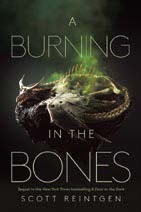
A Burning in the Bones 3,
by Scott Reintgen

Fantasy, thriller and adventure all wrapped up in one, the Waxways series is the perfect choice for tweens looking for something slightly more sophisticated. Book 1 was a survival thriller, book 2 a political chess match, and now book 3 is a plague story laced with complicated warfare that will have readers on the edge of their seats. Don’t miss this thrilling conclusion to a fabulous series. (Ages 12-16.)


Focus on Food

FOCUS ON FOOD

A Cake for Every Season

No-bake Easter sweet treats

Photograph and Story by Rose Shewey

Today, I am going to answer a question you didn’t know you had: The humble carrot cake — is it a fall treat or a spring dessert?

It’s a bit of a conundrum. With carrots being harvested both in the spring and autumn, one could argue carrot cake can be either one — a celebration of spring and fall. Case closed. However, there are those — in my experience, mainly hobby pastry chefs — determined to limit this modest delight to just one season. To me, the correct answer is, and always has been, carrot cake is an anytime cake. Spring, summer, fall or winter. It’s truly a cake that fits just about any occasion.

The much more pressing question is, come Easter, should I make carrot cake or cheesecake? Cheesecake is the quintessential spring dessert in my book. Indecision being my biggest vice, I am making both and combining them — a folksy carrot cake as the supporting act for opulent cheesecake is exactly what I want to adorn my Easter brunch array.

That’s not the whole story. I am making this entire affair a no-bake event.

If you want to serve them alone, it’s worth noting that this no-bake carrot cake makes for some scrumptious carrot cake bars, should you be short on time or if cheesecake isn’t your cup of tea. Vice versa, if carrot cake isn’t your jam, this no-bake cheesecake will happily go atop any crust of your choosing.

No-Bake Carrot Cake and Cheesecake

(Serves 6)

Carrot Cake Ingredients

1 cup coconut flakes, toasted

1 cup cashew nuts or walnuts

1 teaspoon ground cinnamon

1/4 teaspoon nutmeg

Pinch of sea salt

6-8 medjool dates, pitted and sliced

1 cup grated carrots

1/3 – 1/2 cup coconut flour, as needed

Cheesecake Ingredients

16 ounces cream cheese, room temperature

1/3 cup powdered sugar

zest of 1/2 lemon

1 tablespoon lemon juice, freshly squeezed

8 ounces heavy whipping cream

Method

To make the carrot cake base, add coconut flakes, cashews or walnuts, cinnamon, nutmeg and salt to a food processor and pulse until the nuts are crumbly. Now add in the dates and mix until you have a dough-like consistency but do not over-process — you don’t want a puree. Add in the carrots and pulse until everything is well incorporated.

Scrape out mixture into a bowl and add about half of the coconut flour and stir with a fork or spatula; if the mixture is still overly wet or sticky, work in the remainder of the coconut flower.

Line a 6-7-inch springform pan with parchment paper and press the carrot cake mixture into the bottom. Use a flat-bottom glass to achieve a smooth layer. Set aside.

To make the cheesecake, add the cream cheese to a bowl and sift in the powdered sugar. Mix with a fork until roughly incorporated, add lemon zest and juice and mix with a handheld mixer until well combined and creamy. Set aside.

In a separate bowl, whip heavy cream until soft peaks form and fold into the cream cheese mixture. Pour cheesecake mixture into the prepared springform, atop the carrot cake base, and refrigerate for at least 4 hours before serving.

PinePitch

PINEPITCH

PinePitch April 2025

Just Hanging Around

The Arts Council of Moore County opens its exhibit “Palustris: Nature’s Narrative” on Friday, April 4, from 6 p.m. to 10 p.m., at the Campbell House galleries, 482 E. Connecticut Ave., Southern Pines. The paintings will hang until April 25. If you need more info, call (910) 692-2787. Five miles away there will be an opening reception from 5 p.m. to 7 p.m. at the Artists League of the Sandhills, 129 Exchange St., Aberdeen, for the show “Light and Color: A Love Affair with the Sandhills,” featuring the work of Jennifer Walker. For additional information go to www.artistleague.org.

Jazzy Sunday

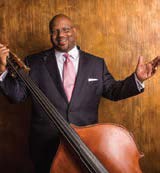
The Come Sunday Jazz Series will feature John Brown on Sunday, April 27, beginning at 2 p.m., at the Weymouth Center for the Arts & Humanities, 555 E. Connecticut Ave., Southern Pines. Bassist, composer, producer, actor and educator, Brown is a native of Fayetteville. He has performed for President and Mrs. Barack Obama and appeared with artists like Wynton, Ellis and Delfeayo Marsalis, Elvin Jones, Diahann Carroll, Rosemary Clooney, Cedar Walton and Nicholas Payton. He received a Grammy nomination for his performance and co-writing Nnenna Freelon’s 1995 Shaking Free. Brown has taught at Duke University since 2001 and is currently the director of the jazz program and professor of the practice of music. For additional information visit www.weymouthcenter.org.

Shark Week

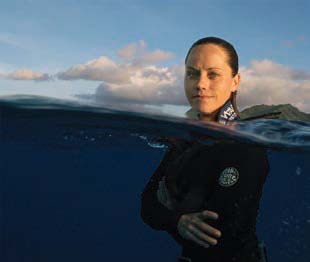
The Ruth Pauley Lecture Series will feature National Geographic Explorer and marine biologist  Dr. Jess Cramp speaking about “The Untold Story of Sharks” on Tuesday, April 29, at 7 p.m., in the Bradshaw Performing Arts Center’s Owens Auditorium, 3395 Airport Road, Pinehurst. Dr. Camp is a shark researcher specializing in conservation policy and engaging communities in ocean management. She co-championed a grass-roots campaign that resulted in formation of the Cook Islands Shark Sanctuary in 2012, an area exceeding 770,000 square miles. She is the founder and executive director of Sharks Pacific, a nonprofit organization that conducts research, outreach and advocacy throughout the Pacific Islands region. Dr. Cramp was named an AAAS If/Then Ambassador, a program created by the American Association for the Advancement of Science to bring together 125 women from different science, technology, engineering and mathematics (STEM) careers to serve as role models for middle school girls. For more information and tickets go to www.ticketmesandhills.com.

Boogie Walk & Belly Roll

Indulge your inner Myrtle Beach Ocean Drive at the Moore Area Shag Society’s monthly dance on Saturday, April 5, from 7 p.m. to 10 p.m., at Down Memory Lane, 161 Dawkins St., Aberdeen. The doors open at 6:30, and there will be a cash bar. Tickets are $30 in advance and $35 at the door. For information call (919) 345-4105.

Burnin’ Up

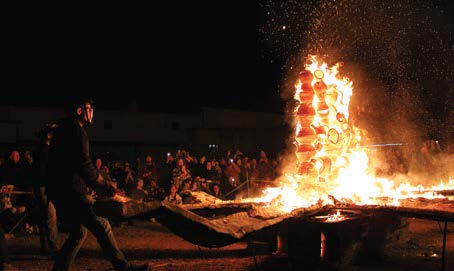
Starworks is holding a two-day celebration of the Promethean arts, starting Friday, April 4, through Saturday, April 5. We’re talking hot stuff here. The creative contribution of fire is featured in tours, workshops, demonstrations, guest artists and food trucks. Ok, so the artists and trucks aren’t actually on fire. Both days finish with live music. Friday’s slate begins at 1 p.m. and features a “Kids Draw It, We Make It” glass demonstration. The Saturday events begin at 9 a.m. The live bands pack it in at 10 p.m. both nights. Tickets are $10. Workshops are extra. Gather at the Starworks Café & Taproom, 100 Russell Dr., Star. For the full schedule and all costs visit www.StarworksNC.org/Firefest.

Spring in Your Step

Southern Pines’ annual Springfest Arts & Crafts Fair will be held April 26 from 10 a.m. to 4 p.m. Two blocks on both sides of Broad Street will be closed to accommodate the food, games, rides, music and 160 vendors offering art, jewelry, photography, woodworking and more. Kids ages 3-12 can sign up for bicycle, tricycle and electric car races in front of the Sunrise Theater. Registration begins at 10 a.m., with the races at 11. For additional info call (910) 692-7376.

Home & Garden Tour

The 77th Annual Home & Garden Tour sponsored by the Southern Pines Garden Club is Saturday, April 5 from 10 a.m. to 4 p.m. Tickets are available online prior to April 5 or in person on the day of by going to the Weymouth Center for the Arts & Humanities or to one of three locations, Birdwood Cottage or The English Cottage in Southern Pines or Twin Willows in Pinehurst. Cost is $25 in advance and $30 on tour day. The online address for tickets is https://www.tickettailor.com/events/spgc/1564777.

Dig In

Petunias, begonias, marigolds, oh my! It’s all on sale at the annual Landscape Gardening program’s spring bedding plant sale on Saturday, April 26, at the Sandhills Horticultural Gardens, 3245 Airport Road, Pinehurst. All plants are grown and cared for in greenhouses by students in preparation for the sale. Proceeds support the SCC gardening program. For more information go to www.sandhills.edu/gardenevents.

Get Your Motor Running

The 4th Annual Corvette Club Show will be on Saturday, April 19, from 11 a.m. to 3 p.m., at the Sandhills Community College Automotive Technical Center, 3395 Airport Road, Pinehurst. There will be prizes, music, food trucks, oohs and aahs. Vote for best in show. April 27 will serve as the rain date. For additional information go to www.corvettesofsandhills.com.

The Naturalist

THE NATURALIST

Birdies, Eagles and Fox Squirrels, Oh My!

High-class habitat for our largest tree squirrel

Story and Photographs by Todd Pusser

I was out of the country last June when the U.S. Open rolled into town. With limited internet access, I was unable to follow the championship’s progress. It was only when I returned home in July that I learned Bryson DeChambeau had won.

Not being on any social media platforms, I also missed some of the viral videos posted during the Open — by professional golfers and spectators alike — of the Sandhills’ unique fox squirrels. Judging by the number of stories produced by various media outlets, it seems like the visitors from out of town were not familiar with our local bushy-tailed rodents. Professional golfer Min Woo Lee’s video of a curious fox squirrel approaching his caddie in the middle of a fairway on the famed No. 2 course drew over 300,000 views and was even mentioned by Golf Digest magazine. “Hello Pinehurst. What is this animal?” Lee asks in the video. “Is it a skunk, or a raccoon, or a squirrel?”

It’s easy to understand his confusion. After all, Lee hails from Australia, a continent that is packed full of animal oddities — the platypus and the bilby (Google it, they are adorable) to name two — but has no native squirrels. Nada. Zilch. So it’s easy to imagine Lee’s initial reaction upon seeing an animal with white ears, a white nose, black face and a long bushy tail for the first time. Nearly the size of a housecat, fox squirrels are the largest tree squirrel in North America.

When the inquisitive squirrel approached Lee, he quickly held his club at arm’s length and exclaimed, “Back up brother! Back up!”

Tee it up on any of the local golf courses and chances are you will see a fox squirrel at some point during your round. They are as much a part of the Sandhills landscape as pine trees and blue skies.

Though North Carolina never has listed the species as endangered or threatened, fox squirrels have always been considered uncommon. Throughout the southeastern United States, fox squirrels are strongly associated with the longleaf pine tree. Their large body size gives them a competitive advantage over their smaller cousins, the highly adaptable grey squirrel, enabling them to rip open the large, calorie-rich pine cones of the longleaf. Vast longleaf forests once stretched from southern Virginia down to Florida and along the Gulf Coast to east Texas. Today, over 90 percent of those forests have disappeared, having been converted into everything from agricultural fields to housing developments. The resulting loss of longleaf caused severe population declines to animals that depended on that ecosystem for survival, fox squirrels included.

When I was growing up in Moore County, you would occasionally encounter a fox squirrel here or there. You might spy one sprinting across a backroad around West End or shredding a pine cone on the grounds of Sandhills Community College. We even had them visit our yard periodically in Eagle Springs. But if you really wanted to guarantee seeing one, all you had to do was head to the links.

Throughout my teenage years, my father and I played golf most weekends, wherever we could get a late afternoon tee time (he worked most weekend mornings) and the best rates. No matter where we played, Seven Lakes, Whispering Pines, Foxfire, Deercroft or Pinebluff, I would see fox squirrels. They were always the highlight of my day — well, except for the time I holed that 120-yard shot from the fairway for an eagle at Hyland Golf Club (it was Hyland Hills then), still my all-time best golfing experience. Even on our family vacations to North Myrtle Beach, I would occasionally see fox squirrels loping across golf courses with their distinctive bounding gait.

Fox squirrels are denizens of open forest canopies that are free of dense underbrush, which historically in a longleaf pine ecosystem was the result of frequent fire. Golf courses mimic those old-timey pine forests, in a roundabout way, with their park-like landscapes and abundance of food and nesting trees favored by the multi-hued squirrels. A number of scientific studies have even shown that golf courses may hold the key to survival for fox squirrels in parts of the Southeast, especially in urban areas.

As an example, I recently found myself at Innisbrook Golf Resort, just north of Tampa, Florida, visiting family and friends. The property’s four golf courses are surrounded by a sea of humanity, in the form of  never-ending strip malls, hotels and restaurants. Yet, fox squirrels were thriving in surprisingly high numbers along the manicured fairways bordered by huge pines and oaks. I even saw one sneaky squirrel steal a granola bar from the golf cart of an unsuspecting golfer who was up on the green putting for birdie.

As photography started to become an integral part of my career, one of the first subjects I set out to photograph were fox squirrels. Late Pinehurst resident and golf aficionado Parker Hall was kind enough to help my endeavors, arranging access to the Country Club of North Carolina and providing me with a golf cart to lug around my heavy gear. Over the course of two winter afternoons, I was able to greatly expand my fox squirrel portfolio. Up until that point, I had never seen so many fox squirrels in such a small area.

My last golf course fox squirrel encounter happened over the Christmas holidays. I was visiting my folks for a few days and found myself driving north along Hoffman Road near Foxfire Village. Late one morning on a straight stretch bordering one of the golf club’s fairways, a solid black fox squirrel, with bright white paws and ears, stepped out onto the asphalt. I came to a complete stop, allowing the beautiful mammal to pass safely across the highway into a patch of nearby pines. Watching its long, flowing black tail disappear into the forest, I was reminded of a life lesson instilled in me at a young age: Always be respectful of the locals.

Glorious Restoration

GLORIOUS RESTORATION

Glorious Restoration

A Reynolda landmark is reborn

By Ross Howell Jr.     Photographs By Amy Freeman

Have you ever seen this?” asks Bari Helms. “I found it in some boxes.”

Helms is the director of the archives and library at Reynolda House Museum of American Art, the storied estate that is now part of Wake Forest University in Winston-Salem. She slides the rendering toward Phil Archer, the deputy director at Reynolda, the family mansion that houses a permanent collection of three centuries of American art and sculpture.

Archer shakes his head, touching a finger to the edge of the drawing.

“I don’t think so. Not with those perpendicular wings. A little too Versailles for Katharine, isn’t it?” Archer asks. He and Helms exchange knowing smiles.

Helms produces a letter from that same “Katharine” to Lord and Burnham, the premier builder of glasshouses in America during the mid-19th and early 20th century, dated May 27, 1912. In it, she details what she wants her estate’s conservatory to include — a palm room, a “good-sized” grapery, a tomato section, a large vegetable section, a propagating room and a “nice workroom.”

When Lord and Burnham responded with their plans and perspectives, and their quote for $7,147, Katharine wrote back that it was too much money. The greenhouse additions in the rendering were removed.

“In all her correspondence, you get a sense of how direct, hands-on and detail-oriented Katharine was,” Helms says.

In December 1912, Katharine wrote another letter to Lord and Burnham, complaining that the workers they’d promised had not yet arrived on-site. In January 1913, she wrote again, noting that parts of the conservatory were not being built to her specifications.

“Katharine was very polite about it,” Helms says, “but insisted that she was making Lord and Burnham aware of the issue so they would fix it.”

No doubt they did.

Katharine was, of course, Katharine Reynolds, the irresistible force behind Reynolda, completed in 1917. Backed by the tobacco empire of her husband, R.J., Katharine began to purchase tracts of land near Winston-Salem, eventually acquiring more than 1,000 acres, each parcel deeded in her name alone. Her idea was a Progressive one — to create a self-sufficient estate that included a country house, a farm utilizing the latest in technology and agricultural practices, a dairy, recreational facilities and a school.

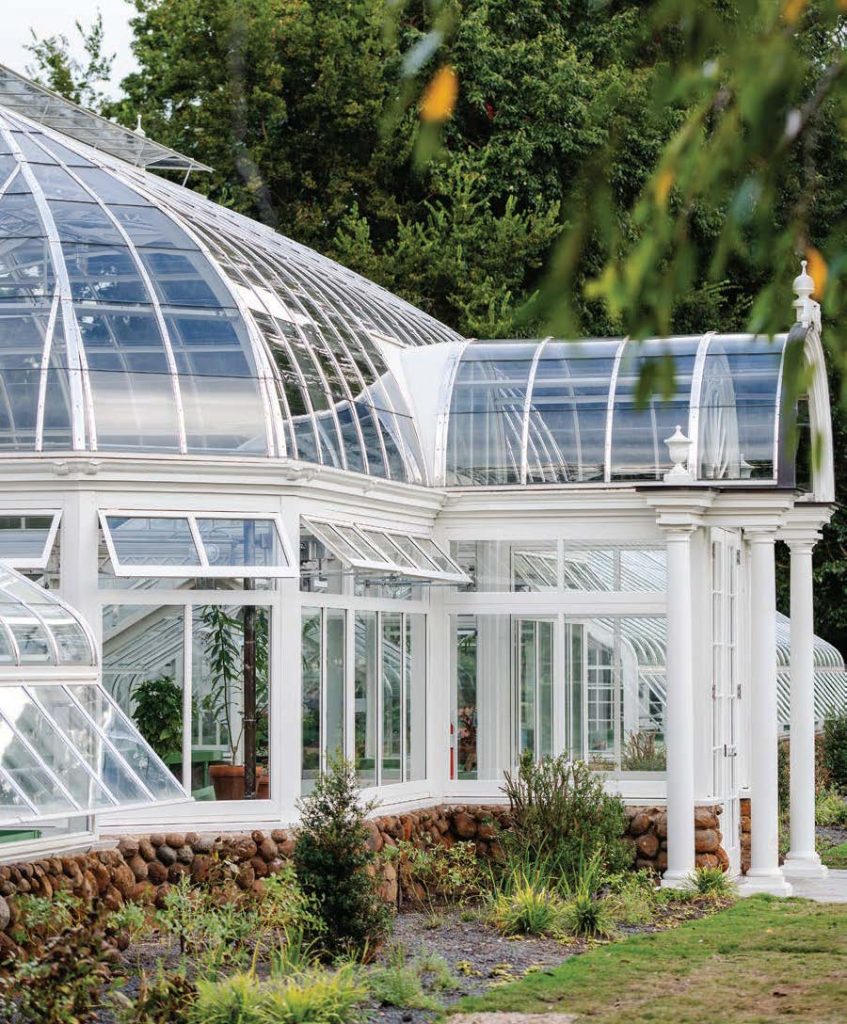
The conservatory — located very near what is now Reynolda Village — was an integral part of Katharine’s design. October 2024 marked the end of its restoration, a yearlong project made possible by a gift from longtime Reynolda supporters Malcolm and Patricia Brown.

Born in Mount Airy in 1880, Katharine Smith Reynolds was a daughter of America’s Gilded Age and a wife in the Progressive Era of the industrialized New South. In the period photographs at Reynolda, she’s the young woman in the gorgeous outfits who doesn’t seem to be looking at the camera, but, rather, directly into your soul. To this day, her spirit and determination inform every aspect of Reynolda.

Leaving her home in Mount Airy in 1897 to attend the State Normal and Industrial School — now UNCG — she later withdrew because of a typhoid epidemic and finished her studies at Sullins College in Bristol, Virginia. In 1902, Katharine joined the R.J. Reynolds Tobacco Company in Winston-Salem, where she served as personal secretary to the owner, R.J., a distant cousin who was 30 years her senior. In 1905, Katharine and R.J. married.

Between 1906 and 1911, Katharine gave birth to four children — at grave personal risk, according to her physicians, since she had been plagued with heart problems that started in childhood. By all accounts, the Reynolds marriage was a happy one, and R.J. was confident in his young wife’s abilities, often consulting her on business matters.

“Katherine wanted the estate to look and feel like an old English hamlet,” Archer says. “Burying utilities was high-tech for Katharine’s time, but that’s what she wanted.”

The conservatory restoration project, which would become the Brown Family Conservatory and Reynolda Welcome Center, was led by Jon Roethling, the director of Reynolda’s gardens. The work was done by Cincinnati-based Rough Brothers (pronounced rauh), a subsidiary of Prospiant.

“Rough Brothers had access to actual Lord and Burnham plans and molds,” Roethling says. So, for the Reynolda restoration, the company could use templates on hand, extruding aluminum pieces to match the originals.

The tinted glass needed for the restoration was made by another company. It’s so specialized, the company only manufactures it twice a year, delaying completion by months. The wait was worth it, however, since the unsightly aluminum shutters added to the palm house and greenhouses in a previous renovation could be removed. Moreover, the manufacturer had the equipment to produce curved glass. This meant that the elegant shape of the original architecture — supplanted by the use of flat glass panes in a previous renovation — could be restored.

“When I walk into the palm house now, the architecture just sings,” Roethling says.

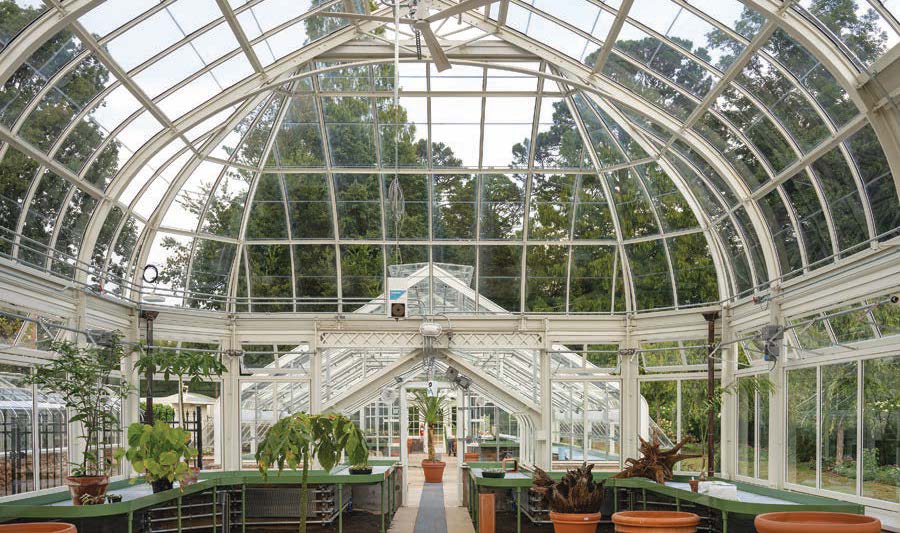
There were the additional challenges of heating and ventilation — critical to a conservatory. “We stayed with the original concept of radiant heat,” Roethling explains, “though the new system is very sophisticated.”

Ventilation was a trickier issue, since the conservatory is vented throughout — foundations, walls and roof. From the time the conservatory was built until this restoration, these many vents had to be cranked open or shut by hand.

“You have to strike this balance of having architecture that reflects 1913, but also having the convenience and efficiency of systems that are modern day,” Roethling says. “Knowing Katharine, one of the most progressive women of her time, I was sure there was no way she would want us to be hand-cranking vents in this day and age, so we made the jump to automated.”

The new system automatically responds to wind flow, wind speed and precipitation, adjusting ventilation as needed. Changes can also be made remotely, using Wi-Fi. Once, when Roethling noticed a thunderstorm developing, he went to the conservatory to see how the new system would respond.

“As the wind rose and the storm started rolling through, I watched the vents immediately close a bit,” he says. “When the wind grew stronger, the vents shut completely, protecting the greenhouses.”

End-to-end, the central structure of the conservatory and the greenhouses flanking it extends more than 300 feet. Sod has been laid the entire length, creating a walking path for visitors. Between the edge of the sod and the foundations of the greenhouses are planting beds, about 8 feet wide, filled with peonies.

“The problem,” says Roethling, “is once the peonies bloomed out, that was pretty much it, visually. I needed someone who could do something amazing.”

Roethling reached out to Jenks Farmer, a plantsman in Columbia, S.C., who served as director of Riverbanks Botanical Garden in West Columbia and was the founding horticulturist of Moore Farms Botanical Gardens in Lake City. Farmer created a design for the peony beds incorporating other perennials that provide visual interest throughout the growing season.

“Jenks is great,” Roethling says. “He loves balancing history with what’s relevant today.”

In the conservatory proper, each bay has a different theme. “This first bay is in the spirit of an orangerie, which represents the birth of greenhouses,” says Roethling. Much like the original 17th-century orangeries in England and throughout Europe, the bay also features olive trees and other fruiting plants, and will be used to illustrate a narrative history of the development of greenhouse structures over the centuries.

The next bay is an arid greenhouse, featuring the five Mediterranean climates of the world — Southern California, the Mediterranean Basin, South Australia, South Africa’s Cape area and central Chile.“This is a fun thing to educate kids,” Roethling says. “To explore with them how the plant palette changes, how the plants adapt.”

The central palm house is elegant in its features with sealing wax palms with their deep red canes, and tall Bismarck palms with their silver fronds, all in large containers. Visitors can compare the broad texture of a palm frond to, say, the fine texture of a fern. “There’s a lot of texture — greens, whites and silvers,” Roethling says.

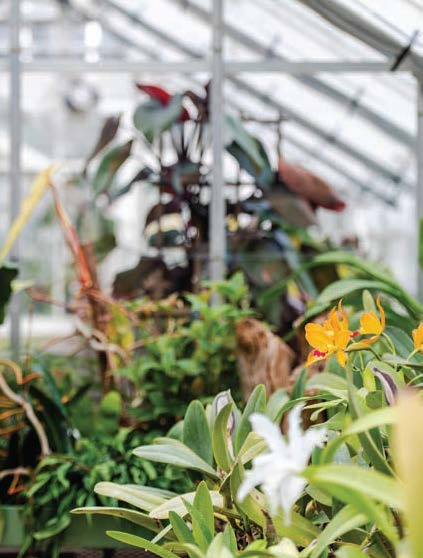
The next greenhouse bay features bromeliads, orchids and other flora that thrive in the tropics. It’s all about color — abundant, dramatic color. “In here, I want to have freaky things that visitors walk up to and ask, ‘What is that?’” says Roethling with a broad smile.

The final bay serves as a holding house for resting orchids, organized by types, with interpretative signage.“Even though the orchids won’t be in bloom there,” Roethling says, “that greenhouse will still be beautiful and educational.”

Just as Katharine would have expected.

Stormy Seas

STORMY SEAS

Judson Theatre Company presents The Caine Mutiny Court-Martial

by Jim Moriarty

Herman Wouk, the author of both the novel The Caine Mutiny and the play The Caine Mutiny Court-Martial, took great pains to let his audience know that nothing that happened aboard the fictional ship the USS Caine occurred in the very real campaigns he experienced during his World War II service in the Pacific Theater. A note to the play says, “The Caine Mutiny Court-Martial is purely imaginary. No ship named U.S.S. Caine ever existed. The records show no instance of a U.S. Navy captain relieved at sea under Articles 184-186. The fictitious figure of the deposed captain was derived from a study of psychoneurotic case histories, and is not a portrait of a real military person or a type; this statement is made because of the existing tendency to seek lampoons of living people in imaginary stories. The author served under two captains of the regular Navy aboard destroyer-minesweepers, both of whom were decorated for valor.”

The Judson Theatre Company will bring Wouk’s courtroom drama, informed by his service aboard the USS Zane and USS Southard, to life in five performances starring John Wesley Shipp and David A. Gregory, beginning Thursday, April 24, and running through Sunday, April 27, in BPAC’s Owens Auditorium, 3395 Airport Road, Pinehurst. The novel, published in 1951 in a wave of post-war literature that included books like Norman Mailer’s The Naked and the Dead, earned Wouk a Pulitzer Prize. The play debuted on Broadway in January 1954, directed by Charles Laughton. That June the movie The Caine Mutiny was released, gaining seven Oscar nominations, including one for best actor for Humphrey Bogart’s riveting performance as Lt. Com. Philip Francis Queeg.

The play is performed in two acts, organized simply with the first act as the prosecution and the second the defense. “If you think about the film and even the book, they both literalize what happened on the ship,” says Judson Theatre’s executive producer, Morgan Sills. “With the play, the audience gets to piece together what happened on the ship from what they glean from all the different testimony they hear. In the end, the audience has a job to do, to decide what they believe is the real story. And that’s theatrically interesting. It can change from night to night the way that live performances change from night to night and books and films do not.”

Shipp, who returns to Judson Theatre after playing the role Juror No. 8 in its 2016 production of 12 Angry Men — Henry Fonda’s part in the 1957 movie — takes the part of Queeg, the ship’s commander relieved of duty during a vicious storm by Lt. Stephen Maryk. He’s played by Jacob Pressley, whose Judson summer theater festival credits include Gutenberg! The Musical, The Last Five Years and They’re Playing Our Song. Maryk’s defense counsel is Lt. Barney Greenwald, played by Gregory. Coincidentally, Fonda played Greenwald in the original Broadway production.

Though tasked with defending Maryk, Greenwald has no particular fondness for his client. On the other hand, he knows that in order to perform his sworn duty to zealously represent him, he will have to cross-examine Queeg in the most brutal manner, a prospect that gives Greenwald no pleasure. At its dramatic height Greenwald and Queeg go head-to-head. And it’s there that Judson’s production of The Caine Mutiny Court-Martial benefits from the long working relationship between Shipp and Gregory.

In his role as Eddie Ford on One Life to Live, Shipp — whose credits and awards (including two Emmys) over a 38-year acting career are too numerous to mention —  was frequently at loggerheads with Gregory, who played his son, Robert, on the daytime drama. “I was the abusive father and he was my oldest son, Bobby Ford,” says Shipp. “I had three sons and I treated them all differently. Bobby was the one who would push back. We had a great time. It’s just one more reason I’m so excited to get on stage going head-to-head with this man because I know how talented he is, how resourceful he is. The thing I love about David is he brings his A game all the time. I feel like we challenged each other.”

Moving at the speed of a soap opera, between scenes Shipp and Gregory would occasionally swap their character’s lines if they thought it deepened the connection. “We have a shorthand with each other, working 15-16 years ago on the soap where we would have to clash,” says Gregory. “We know what that territory is, but we haven’t experienced it with this play and these words.”

One Life to Live isn’t their only collaboration. Gregory wrote a scripted podcast, Powder Burns, about a blind sheriff in the Old West. It premiered on Apple Podcasts in 2015 with Shipp in the role of the sheriff. Critically acclaimed, it earned Gregory a Voice Arts Award in 2017. They’ve also worked together on a two-person play Gregory wrote about Jimmy Stewart and Henry Fonda called Hank & Jim Build a Plane, which Shipp and Gregory performed in a workshop in New Orleans in 2018, the last time they appeared on stage together. As opposed to their One Life to Live personas, Hank & Jim is about two men, famous for their shared model airplane hobby, who are at odds with one another over pretty much everything else — including a woman — and who won’t, or can’t, challenge one another. In something of a metaphor for our time, it’s about what Hank and Jim, sharing the same tiny garage space, can’t say to one another. “It may have been Jimmy Stewart’s daughter who said the interesting thing you’ve done is that you’ve taken two men of very few words and written what they would have said to each other if they could have,” says Shipp.

Finding the right words won’t be the problem in The Caine Mutiny Court-Martial. “Plays like this get done so often because they’re very, very good,” says Gregory. “The author has meticulously made this as perfect as possible. We just get to add on top of that. It’s a blast.”

Shipp sees only one real drawback: “My only complaint is that it’s too short.” 

Dissecting a Cocktail

DISSECTING A COCKTAIL

The Wandering Path

Story and Photograph by Tony Cross

In the 2022-23 time frame, alcohol sales increased by 1 percent, but the sales of non-alcoholic wine, beer and liquor grew by over 32 percent. “An increasing consumer focus on moderation, health and wellness is having a positive impact on all no-alcohol sub-categories, with growth rates higher than their full-strength equivalents,” says Susie Goldspink, head of no- and low-alcohol insights at IWSR (originally known as International Wine and Spirits Record, though they now deal in beer and ready-to-drink beverages as well).

Indeed, the market is starting to get flooded with all things alcohol-free. My business operates out of a health store and, in the past couple of years, I’ve seen more brands like these than I can count.

A lot of folks, me included, take breaks from alcohol even when it’s not “dry January.” We’d like to have something to drink that makes you feel good without being high or drunk (canned THC cocktails are a whole other story). My problem with most of these RTDs (ready-to-drink) is simple: They don’t taste great; they use buzzwords for sales (e.g., ashwagandha); and they’re pricey. I haven’t had the opportunity to try tons of spirit-free liquors, but every one that I’ve tasted (besides Seedlip) has been uninspiring, to say the least.

Enter Pathfinder, a non-alcoholic spirit made from a distilled hemp-based liquid. Pathfinder has a lot going on, made from Douglas fir, orange peel, ginger, sage, wormwood, juniper, etc. On the palate, it’s similar to an amaro — think Cynar — and is perfect for cocktails. Speaking of, I found this delicious recipe, The Wandering Path, from bartender Jeffrey Morganthaler’s blog. It was created by his business partner, Benjamin Amberg, at their acclaimed bar, Pacific Standard. This sour cocktail is as easy to make as it is delicious.

Specifications

2 ounces Pathfinder

1 ounce fresh grapefruit juice

3/4 ounce fresh lemon juice

1/2 ounce simple syrup (2:1)

1/2 ounce egg white

Execution

Combine all ingredients in a shaker, add ice, shake hard until cold, and double strain into a coupe glass (a sour glass is pictured). No garnish.

Character Study

CHARACTER STUDY

A Sandhills Treasure

Leading from behind the podium

By Tony Rothwell

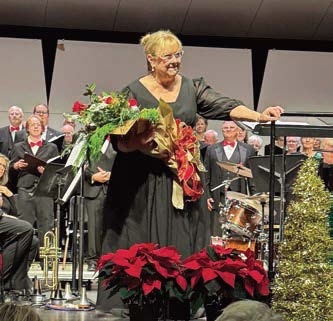
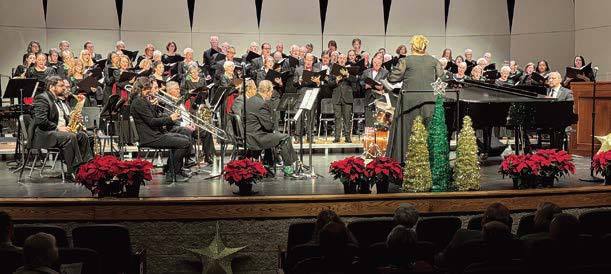
As the last note dies away, Anne Dorsey turns to face the audience. She bows, then turns back to face the chorus, sweeping a hand from one side of the stage to the other, passing on the applause to every singer and musician in the Moore County Choral Society. It’s a love affair that has lasted 22 years.

On April 27, the Moore County Choral Society will hold its 50th anniversary concert in the Robert E. Lee Auditorium at Pinecrest High School. Dorsey has wielded the baton in very nearly half of them. Befitting the occasion, the Choral Society will be joined by a professional chorus, local high school choruses, the Arc of Moore County Joyful Noise and a full orchestra.

Dorsey will have chosen a program with a careful balance between old favorites and new, or lesser-known, pieces — perhaps from a different country or in a foreign language — adding up to a memorable performance. It’s what she has done, time and time again.

To get the chorus to where it needs to be, rehearsal after rehearsal, Dorsey’s approach depends on the situation, but humor is her main weapon. She is witty, quick with words, and has an infectious smile that radiates from behind the podium. And the chorus works hard for those smiles. One place you don’t want to be is on the end of her black look. It happens when she has just told a section, or indeed the whole chorus, precisely what she is expecting — a clean cutoff at the end of a phrase or a particular vowel pronunciation — and it is not delivered. It’s a well-practiced skill she developed studying with the legendary, and fear-inducing, Dr. Lara Hoggard and the Carolina Choir at UNC-Chapel Hill.

“Choir was everything,” she says of her undergrad days. “I never missed. I was never late. I wanted to be like him.”

Born in Rockingham, Dorsey sang her first solo at the age of 3 in a recital in Ellerbe. In junior high school she sang alto, “because I could read music and hear a harmony part which helped me develop a musical ear,” she says. Inspired by the Carolina Choir, it was during her high school years in Henderson that Dorsey decided she wanted to be a school choral director. “I heard them sing and I’d never heard anything like that sound,” she says. “I wanted to be part of it and learn how to make it.” 

With a music education degree from UNC in one hand and a teaching certificate in the other, Dorsey moved to Moore County in the fall of 1977, too late to land a teaching position, but not too late to be hired by organist Paul Long at the Community Congregational Church of Southern Pines as choir director. “The ink was still wet on my diploma, and I got a job with a Juilliard genius,” says Dorsey. At roughly the same time she discovered the Moore County Choral Society, then in its infancy, and joined as a member under Dr. Armand Kitto. It was the beginning of an incredible 48-year relationship.

Dorsey did finally get that teaching job — in the Hoke County School System. Over the course of her career as an educator, she taught grades 4-12 and did children’s choir work at church and in the community. “Every grade, every class and every student taught me something — probably more than I taught them,” she says.

In the spring of 2002, Dorsey filled in for John Shannon, then the conductor of the Moore County Choral Society, and upon his resignation she was offered the job of director. She found that working with adults is both the same and different from working with young people.

“I sometimes forget who I am dealing with, but I have largely been forgiven for that,” she says with a smile. “I have certainly been stretched, and I have, in turn, tried to stretch those who sing with MCCS. No year should lack musical challenge; no season should be without something new, something difficult, something different, and also be appealing to our audiences.”

Chris Dunn, executive director of The Arts Council of Moore County and a brass trumpeter in MCCS, says, “As a musician who has played many concerts with Anne, I marvel at how nothing seems to faze her. One example was at the beginning of a concert the entire brass section missed an entrance. Anne turned to us with a stern look but continued conducting as if everything was fine. We can laugh about it now, but not then.”

Twenty-two seasons bring with them a sense of perspective. “The talented members of MCCS have brought fine choral art to the Sandhills for half a century,” says Dorsey. “The conductors — only five of them in 50 years — have been blessed with hardworking singers whose talent and passion for choral music have been freely shared year after year to bring beauty to our audiences. I believe that arts organizations enrich the communities they serve. What an honor it is to be part of one so fine.”

At the April concert, the Anne Dorsey Scholarships, now in their 36th year, will be awarded to two gifted Moore County students who intend to study music beyond their high school years, a fitting reminder of Dorsey’s roots in music education.

“I look at a piece of music like a sculptor looks at a slab of marble,” she says. “It is beautiful but it doesn’t speak. The artist must shape it, refine it, and polish it until its beauty shines and is unforgettable. My favorite job as a conductor is to dig into the tiniest details of a piece — the dynamics, phrasing, tempo, style — because therein lies the beauty.”

A beauty she has revealed for over two decades, and counting. 

Be Our Guest

BE OUR GUEST

Be Our Guest

Creating the perfect guest bedroom Madcap Cottage style

By Jason Oliver Nixon and John Loecke     Photograph by Bert VanderVeen

There’s truly an art to hosting guests. To making a visitor feel supremely welcome without having to kowtow to their every whim and whimsy.

John and I love entertaining in all its forms, and we really raise our game when it comes to hosting houseguests at our High Point home, the House of Bedlam. Think The Ritz Paris by way of North Carolina, but cozier, softer, and a lot more fun. Dining room disco, anyone? We just had an international guest arrive from London, and we wanted her stay to be as comfortable and memorable as we could make it. Quite simply, we want every one of our houseguests to feel like they’re at home and leave them wanting for nothing. A good mattress and a clean room are a given, but we are all about the small touches, the personal ones that focus on our guests’ comfort.

That said, we are very clear about our “deliverables.” This isn’t a restaurant. We aren’t the maids. Yes, please strip the bed when you depart. We will have coffee and English muffins ready every morning; we don’t make eggs. And a gift or dinner out on the town is always welcome.

Here are a few tried-and-true recipes for the ultimate guest bedroom from your friends at Madcap Cottage . . .

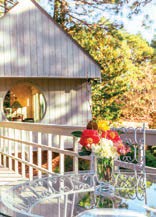
— We love to put flowers next to the bed. Flowers truly make the room feel fresh, alive and cared for. You know your guests well, so think about their favorite blooms and adorn the nightstand with that particular blossom. At this time of year, what is more cheerful than a simple vase abundant with daffodils? A great stack of books is always welcome, too.

— Place either a bottle of water next to the bed or fill a glass decanter with water and accompany it with a lovely crystal glass.

— Email a week before to ask your guests’ must-haves or food preferences. Oat milk, almond milk, gluten-free bread? The Madcaps have you covered. Our recent guest wasn’t fussy but she is a chocoholic. We had some of our Hammond’s chocolate bars on standby for her, so she could try some Southern sweet treats.

— Add lovely toiletries pillaged from a hotel to your guest bathroom. Save the Hermès for really good friends or treat them to some of your favorite toiletry brands. We love to leave our guests with some of our French lavender bath bombs from the Old Whaling Company to help them relax and unwind during their stay.

— Have a plug-in outlet with USB port easily visible and plugged in near the bed. When they’ve retired for the evening after a long journey, the last thing a guest needs is to be crawling around on the floor trying to find an accessible plug.

— Good towels, well fluffed. The bigger and bouncier, the better.

— Extra toilet paper in a basket atop the toilet. Be kind and save your guests the indignity of having to request more TP.

— A soft rug next to the bed. We have small accent rugs next to every bed in our house. Besides the fact that they make the room cozier and look more layered, they make getting out of bed that much easier when you’ve got a soft landing to look forward to.

So there you have it. That’s how we host a house guest, the Madcap way.

Enjoy!

Poem April 2025

POEM APRIL 2025

Greedy

The catbird is pecking away

at two ripe tomatoes.

I wave my hands and shout,

My tomatoes! as though 

I’d produced them

from my breasts or belly.


The catbird aerializes

on the tomato cage,

jabbing and jabbing the red fruit.

I have more on the counter

that I won’t eat before they rot,

or that I’ll give away.


It’s unseemly, this stinginess,

a memory of not-enough,

the necessity of preserving

a crop from rabbits and deer,

the otherwise marvelous

round-backed bugs, grasshoppers

flaring red underwings,


or birds like this one,

gray as a civil servant,

an actuary of ripeness,

that tilts its head to eye the fruit

and flaunts its rusty bottom

in salute.

— Valerie Nieman