State of Mind

State of Mind

Hurricane Watch

The storms that bring us together

By Tommy Tomlinson

There’s always a moment late in the fall when I wake up groggy and wonder if my hurricane bag is packed.

I don’t have a hurricane bag anymore. But I did have one for years. Part of my job when I was at the Charlotte Observer was to head out to the coast when a hurricane was coming in.

It is such a strange feeling to be the only car heading down one side of the highway when thousands are fleeing in the opposite direction.

The contents of the hurricane bag: toilet paper, of course; a portable radio; extra batteries; bottled water; food with a shelf life (peanut butter, soda crackers, canned peaches, Chef Boyardee); maps; Swiss Army knife; raincoat; bug spray; first aid kit.

We had a guide that we printed out and took with us. Get to a safe place and stay there until the hurricane moves through. Don’t drive into a puddle if you don’t know how deep it is. (A colleague of ours once drowned a rental car.) Look out for critters. Hurricanes cause floods, and floods flush all sorts of animals out into the open. I discovered that was true when I covered Hurricane Floyd back in 1999. I was somewhere outside of New Bern, driving through a neighborhood. I saw a family cleaning up their flooded house and pulled over to talk to them. Their yard was knee-deep in water. I started wading across and noticed a clump of debris floating by. As it got closer, I could see it wasn’t debris. It was a flotilla of fire ants.

I backpedaled pretty fast, considering how deep the water was.

The water is often the biggest problem when a hurricane comes through, more than the wind. One time — I think it was Hurricane Bonnie in 1998 — I checked into a hotel in Havelock as the storm rolled in from the coast. It was a mom-and-pop place, two stories tall. They gave me a second-floor room and I grumbled about it as I hauled my luggage and gear up the steps. The storm came through during the night. The next morning I went downstairs to find that every room on the first floor had flooded.

Another time — Hurricane Fran in 1996, maybe — I stayed in a room with a sliding glass door that led out onto a balcony. When the hurricane hit, that door warped and wobbled like a rubber sheet. I crouched on the far side of the bed for hours, expecting the glass to shatter. It never did. I always wondered if the folks who made those doors prepared them for something like that.

Every time a hurricane strikes, it leaves shattered lives behind. Floyd alone led to the deaths of 52 people in North Carolina and caused more than $3 billion in damage. My job as a reporter covering those storms was to tell the stories of the people who lived through them the best I could. I always tried to remember that I was one of the lucky ones. In a few days I’d be going back to my warm, dry home. The folks I was talking to may have just lost theirs.

What struck me the most about covering hurricanes is how people look out for one another. “Look for the helpers,” Mister Rogers said, and that’s never truer than after a storm. When roads are flooded, folks with canoes and johnboats get stranded people out and supplies in. When power lines are down, people empty their freezers and fire up their grills to feed the neighborhood. A storm tends to flatten the fences that separate us. When we’re wet and hungry, we’re all the same.

I have been far away and covered even bigger storms. I spent a week south of New Orleans after Hurricane Katrina, and most days I would prefer not to think about that. And of course, the storms keep coming. Hurricane Helene was two years ago, but Asheville and the surrounding mountain towns are still recovering.

Not three months after I came to work for the Observer in 1989, Hurricane Hugo came right up I-77 and slammed into Charlotte in the middle of the night. I was living just south of the border in Lancaster, South Carolina. Nobody expected the hurricane to make it that far inland. I fell asleep not sure if it was coming. I woke up to the sound of my front door being blown open. I lived in an old duplex, and the door was not quite square in the frame. I’d slam it shut and the wind would blast it open again. At some point I realized I needed something heavy to brace against it. I grabbed the old Royal typewriter my mom and dad gave me when I was 12. I jammed it against the bottom of the door and it held. I was grateful for my mom and dad, and grateful for being a writer.

For the next several hours I watched the pecan tree outside my bedroom window being bent to its limits. The wind was like a claw hammer trying to pry loose a stubborn nail.

Finally, it let go. I stepped into my front yard and saw my neighbors stumbling out of their houses. None of us said anything for a while. That’s the thing, the quiet just on the other side of a hurricane. Assessing the damage, helping the needy: That comes later. But first you’re just stunned by nature’s power, your world forever changed. PS

Tommy Tomlinson is the author of two books, The Elephant in the Room and Dogland. He was a longtime columnist for the Charlotte Observer and has written for Esquire, The Atlantic, ESPN the Magazine and many other publications. His online newsletter is called The Writing Shed. He lives in Charlotte with his wife, Alix Felsing.


Poem November 2026

Poem

Dish Towel

By erri Kirby Erickson 

One of my parents’ dish towels

hangs on the handle of our stove.

It is aqua-blue, covered with red

and yellow poppies. How many of

their dishes this towel must have

buffed, plus silverware, glasses,

cookpots and pans. For decades

Mom washed them and Dad did

the drying. But after he died, she

stood alone at their sink, letting

the water grow cold — soap suds

like glaciers slipping into the sea.

Six months a widow and she, too,

was gone, leaving a lone bowl in

the drainer, a single spoon, a fresh

dish towel draped just so on a ring.


Terri Kirby Erickson is the author of eight collections of award-winning poetry, including The Light That Follows Us Home.

The Art of Frying a Turkey

The Art of Frying a Turkey

The Art of Frying a Turkey

Be careful. Be very, very careful.

By Warren Henry Lewis

Photograph by John Gessner

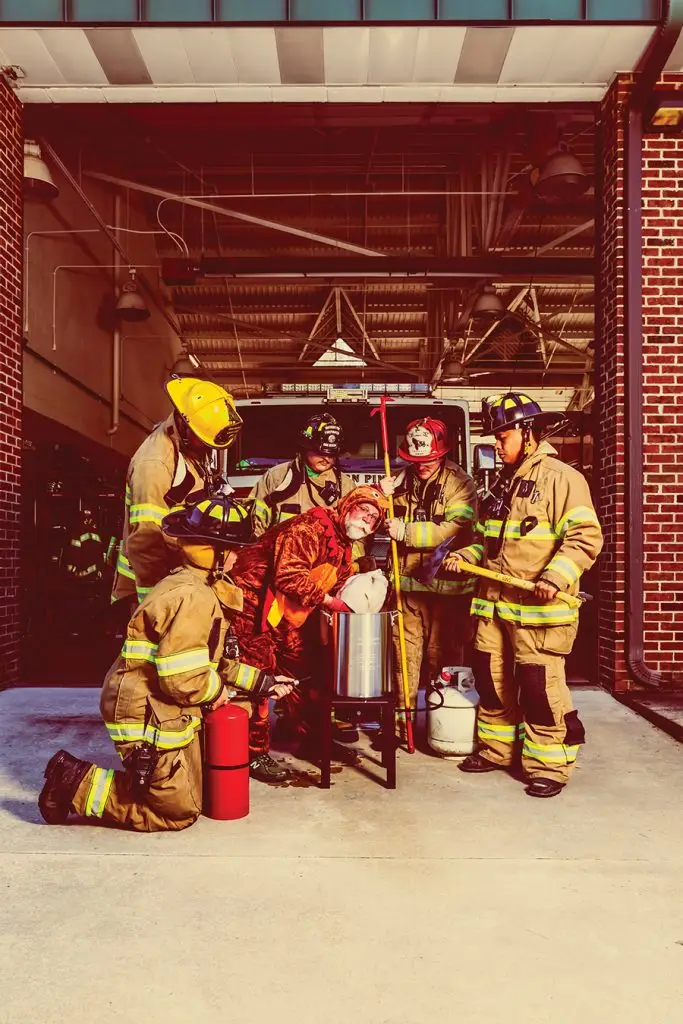
There’s a particular sound the Sandhills makes in late November: the low roar of a propane burner in a distant driveway, bringing oil up to temperature in a pot big enough to defend the castle ramparts. By the third week of the month it’s a neighborhood chorus, with cul-de-sacs across the county contributing versions of their own.

Frying a turkey has become as regionally native as barbecue, even though the technique arrived from Louisiana by way of tailgate parking lots and word of mouth. It earned its place here on merit: crisp skin, meat that stays moist, a bird that’s done in under an hour instead of half a day tying up the oven.

It also remains, by a wide margin, the most dangerous thing most people do to their food all year — worse than egg salad in the heat of summer on a picnic. The U.S. Fire Administration and the National Fire Protection Association both flag turkey fryers every autumn, and the failures follow a short, repeatable list. Get the process right and it’s no more hazardous than a grill. Skip a step and you’re explaining to your insurance adjuster why there’s a scorch mark up the side of the garage.

The oil, not the bird, is what matters most. Frying works by immersion in oil held around 350 degrees — hot enough that the exterior sets almost instantly, sealing moisture in rather than letting it render out over hours. That’s the whole appeal. It’s also the whole risk: A few gallons of oil at 350 degrees is a few gallons of oil that will ignite on contact with an open flame if it spills, and it spills for one reason more than any other — too much oil in the pot, displaced by too much turkey.

Measure your oil level before you ever turn on the burner. Set the bird in the empty pot, cover it with water until submerged, pull the turkey out, and mark the waterline — that’s your fill line. Think Archimedes and the bathtub. Dump the water, dry the pot completely, and fill to that mark with oil, no higher. Skipping this step and eyeballing it is how oil ends up on the ground, on flame, and on the side of a house.

The second potential failure is moisture. A wet or partially frozen turkey dropped into hot oil turns instantly to steam, and steam expanding inside oil doesn’t simmer — it explodes outward. This is not good. Thaw the bird completely, days in advance, and pat it dry inside and out immediately before frying. Maybe even twice. No standing water in the cavity. No ice crystals in the joints. If you’ve brined it, dry it again after — thoroughly, longer than feels necessary.

Where you fry matters as much as how. Outdoors only, on a flat surface, well clear of the house, the garage, the deck, and anything with a roofline — the NFPA’s standard is 10 feet minimum, and farther is better. Not on a wooden deck. Not under an overhang, however far it seems. Level ground keeps the pot from tipping; a fryer set up on grass or gravel that gives even slightly under the stand’s legs is a recipe for disaster.

Lower the turkey into the oil slowly, and stay at the pot the entire time it cooks — this isn’t a set-it-and-forget-it appliance. Kick back in a lawn chair but keep your eyes open. Unlike with BBQ ya’ really gotta pay attention, so maybe reconsider that second beer. It’s only an hour or so. A turkey fryer left unattended, even for the few minutes it takes to answer the door, is the single most common thread running through the incident reports. Keep kids and pets well back from the whole operation — oil that’s already hot stays hot for a long time after the flame is out.

Have a plan for what goes wrong before you need it. Grease fires don’t respond to water — water on burning oil throws flaming oil into the air, which is how a contained fire becomes an unconfined one. Keep a Class K or ABC-rated extinguisher within reach, and know that smothering — a metal lid, baking soda in quantity — works when an extinguisher doesn’t. I’m a big fan of fire blankets. We have them in our kitchen, and keep ’em in our cars as well. Keep the propane tank and hose connection away from the burner itself. Check for leaks with soapy water before lighting, not after.

Done with attention to these few points, a fried turkey is worth the trouble: skin the color of an old saddle, meat that hasn’t spent four hours drying out in a 325-degree oven. Pull it at 165 degrees in the breast, 175 in the thigh, let it rest 20 minutes under foil before anyone touches it with a knife. The Sandhills didn’t invent this method, but by the sound of more than a few driveways in late November, it’s adopted it as its own.

Basic Wet Brine for a Fryer Turkey

A brine does two things worth doing — it seasons the meat all the way through, not just the surface, and it helps the bird hold on to moisture during the fast, hot cooking a fryer puts it through. Scale this up proportionally for a bird larger than 14 pounds, and give yourself two days, one to brine, one to dry.

1 gallon water, plus more to top off

1 cup kosher salt

1/2 cup brown sugar

2 tablespoons black peppercorns

4 bay leaves

1 head garlic, halved crosswise

1 orange, quartered

A handful of fresh thyme

Instructions

Bring half the water to a simmer in a large pot with the salt, sugar, peppercorns and bay leaves. Stir until the salt and sugar dissolve completely, then remove from the heat and add the garlic, orange and thyme. Let it cool to room temperature — don’t brine with warm liquid.

Combine the cooled brine with the remaining cold water in a container large enough to hold the turkey fully submerged — a clean cooler works well for a whole bird. Add ice as needed to bring the temperature down and keep it there.

Submerge the turkey breast-side down. Weight it if it floats. Refrigerate, or keep the cooler packed with ice, for 12 – 18 hours. Longer than 24 and the texture turns spongy rather than juicy.

Lift the turkey out, discard the brine, and rinse the bird under cold water to clear off surface salt. Then — and this is the step that matters for a fryer — dry it completely, inside and out, and let it sit uncovered on a rack in the refrigerator for several hours or overnight before frying. A brined bird holds extra surface moisture, which is exactly the hazard discussed above. It has to be gone before the turkey goes anywhere near the oil.

***

I’m from the Northeast and typically November was cold enough (32-40 degrees) to leave the turkey in the brine outside. Down here, you’ll have to make gobs of space in the refrigerator.

Having sold Chef Warren’s, Warren Henry Lewis is now channeling his creativity toward writing. A knitting novella is in the works.

Warren Lewis surrounded by Southern Pines firefighters Andrew Whitaker (kneeling), L-R: Eric Adams, Brody McGraw, Logan DeBerry, Jay Lacsina