The Ladder

THE LADDER

The Ladder

Fiction and Illustration by Daniel Wallace

She kept the ladder hidden against the far side of the house, on its side, behind an array of shrubbery and a small pyramid of partially charred firewood. It was a metal ladder, and heavy, yellow and blue, and picking it up involved several challenging moves — lifting, leaning, pushing, and prying it into its sturdy inverted V. Harder now than ever but still doable. The hinges adjoining the two sides of the ladder sometimes stuck, and with her bare hands she had to thwonk them until they were perfectly straight. The meaty part of her palm had been pinched more than once during the course of this procedure; her Saran Wrap-thin skin roughly torn like a child’s scraped knee. All this happened at night, in almost complete darkness, the only light from the dim bulb in the laundry room, casting a soft, milky glow through the dusty windows onto the thorny leaves of a winterberry. Once the ladder was open she shook it, made sure the ground was level. Usually she’d have to adjust it, moving the legs this way and that a few times before it felt secure. Then she climbed, step by step, testing her balance on each flat rung, falling into a worry that made her take special care not to slip or get her slacks caught on anything. It was especially dangerous when she got to the very top, where it was written in serious, Ten Commandant letters: THIS IS NOT A STEP. Here there was a sharp metal protrusion, the final test that she had, so far, nimbly passed. She got on her knees on the step that wasn’t, and with her forearms on the shingles drug herself onto the sloping edge of the roof, turned herself around, and sat breathing. She brushed the dirt off her forearms. Another breath and she was fully there.

This is what she did for her cigarette, the only one she allowed herself, once a night every night, for almost all her adult life. She didn’t even have to hide it anymore, because there was no one here to secret it from. But it had become a part of who she was, a tradition she could not and would not and did not want to end until she couldn’t make the climb. It was necessary. It was her spot, her perch. There was no great view to be had, really, just the cross-the-street neighbors, a young couple in the modest, red-brick split-level, their lives ahead of them, as they say, as if all our lives weren’t ahead of us, some just farther along than others. Sometimes she could see them — the Shambergers? — as they moved from room to room, miniature people, busy as little ants. It was like watching a movie from a thousand feet away.

She smoked, and the smoke rose and quivered from the red and orange coal into a dreamy cloud, then off into a dreamy nothing. But most of the smoke was inside her, in her lungs and her blood. It made its way to her brain and she felt lighter, lighter. She felt like she could follow the smoke if she wanted. The cigarette didn’t last very long, never as long as she wanted it to, but always time enough to review the plot points of her life, the highlights, good and bad, the husband and the children and now the grands, the cars, the planes, the ships, the glam, and the struggle, the love, the sex, so much of it really it didn’t seem fair that one woman should have it all. So much. But every night she climbed the ladder’s rungs and sat here, here on top of the world, smoking, she wondered what it meant that out of all of it, out of every single second she remembered, this was the best, the very best, the moment she lived for, surrounded by the invisible world beneath the moon and long dead stars, sharing her own light with the dark.


Golftown Journal

GOLFTOWN JOURNAL

The U.S. Kids Catapult

A stepping stone to the top

By Lee Pace

There is a chance by the time these words hit your mailbox or coffee table that Ben Griffin of Chapel Hill will be teeing it up at Bethpage Black in the 2025 Ryder Cup. At the end of July, he was within reach of an automatic berth for the American team or being a captain’s choice by Keegan Bradley by virtue of his breakthrough year — solo victory in Fort Worth, team win in New Orleans and a total of eight Top 10 finishes, including the U.S. Open and PGA Championship.

And if not this year, another, perhaps.

Whatever success, including and beyond making a Ryder Cup team, that the 29-year-old might enjoy, he can look back to three years from 2009-11 competing in the U.S. Kids summer competitions in Pinehurst as a bedrock to his development:

2009 — Ninth place in the age 13 division.

2010 — First place in the 14 division.

2011 — First place in the 15-18 division.

“Ben had quite a run in Pinehurst,” says his dad, Cowan Griffin, who caddied for his son all three years. “It was a perfect environment to learn what competitive golf was all about. You were around class acts. The U.S. Kids produced a young man that respected his opponent, was courteous and kind, you treat each other fairly. You’re honest. It promotes just a slew of great traits for your future. That’s exactly what it did with Ben.”

More than a decade later, with his son among the elite of the PGA Tour, Cowan thinks back on that three-year run and enjoys the reflections. He chuckles at the memory of taking Ben to Pinehurst No. 6 in 2009 and having no idea that parents generally caddied for their children in U.S. Kids events. He dashed  to the Belk store in Southern Pines for shorts, sneakers and golf shirts. He remembers Ben asking — and Cowan refusing to answer — where Ben stood through 16 holes in the final round in 2010 at No. 8, then being gratified to see the boy refocus, birdie the par-5 17th and win by one. He marvels at having watched Ben’s creative recovery shots on No. 2 in collecting the older boys’ division title in 2011.

“Ben was a real gritty player, and if he got in any trouble, he could manipulate his hands and make the ball hook or cut or go straight up in the air, almost like Phil Mickelson-type hands,” Cowan says. “Anywhere he was, he had an answer. “

As the U.S. Kids Teen World Championship was hitting its 20th anniversary in Pinehurst in early August 2025, Ben Griffin was an hour away, teeing it up on the PGA Tour in the Wyndham Championship in Greensboro, shooting four rounds in the 60s and finishing in a tie for 11th. He was seventh on the money list with $8.1 million.

That’s an amazing story for someone who inhaled the game of golf until their mid-20s, chucked the dream for a year in 2020 to enter private business, and a year later came back with a new set of priorities, and a refreshed game and mindset.

“It’s been an incredible journey, but since I’ve come back to golf I’ve put my mind to being one of the top players in the game, getting into the majors, getting into contention and winning on the PGA Tour,” Griffin says. “I’ve checked a lot of those boxes now, but I have to continue to keep the pedal down.”

Griffin was a golfer from near infancy. Cowan got into golf because his father, Douglas, loved the game, and he outfitted young Ben with a set of clubs as soon as Ben could walk. He was smitten from the beginning.

“We called him ‘Little Ben’ around the club,” says Rick Brannon, the Chapel Hill Country Club head golf pro from 1983 to 2017. “I can remember him on the range at 5 years old. He had a set of hand-me-down irons that were an inch longer than standard. The golf club was bigger than Ben almost. He had a motorcycle grip early on because that was the only way he could hit those long clubs.”

The talent he wielded at Pinehurst with U.S. Kids evolved over the years. Competing for East Chapel Hill High, Griffin won two state 4-A titles. And he shot 61 in the Dogwood Amateur at Druid Hills in Atlanta.

There was never any question about where Griffin would play collegiately (both of his parents are UNC grads), and he was in the Tar Heels’ starting lineup all four spring seasons from 2015-18. After leaving college, Griffin bumped around the various “minor league” tours, traveling to Canada, Latin America and across the U.S. on the Korn Ferry Tour. Then COVID-19 hit in the spring of 2020, and the golf season on the PGA Tour and all the satellite circuits were cancelled. Griffin was in debt to his sponsors and had nowhere to play.

“I wasn’t making any money,” Griffin says. “I wasn’t able to pay my own rent without help from parents, and health insurance, whatever it might be. I was 24, 25 at the time, and I was like, it’s a point in my life where I don’t want to have to rely on my parents for anything.

“It wasn’t necessarily like I disliked golf or anything. I still loved it. I was actually getting better. I felt like I was doing some really good stuff with my coach. But financially, I was in such a big hole. I didn’t see myself digging a way out of it.”

That’s when Griffin decided he was done with professional golf. He landed a job in early 2021 as a residential mortgage loan officer with Corporate Investors Mortgage Group in Chapel Hill and began working each day at the company’s headquarters at East 54, just a couple of hundred yards from the 16th hole at Finley.

“When I stepped away from golf, I was completely done,” he says, adding he envisioned golf as being a weekend distraction and a way to help his professional career with client golf.

As the summer of 2021 wore on, he started having second thoughts. His grandfather died on July 15, and the obituary included a reference to his love of golf. Doug Griffin’s motto was “hit them long and straight.”

Soon after, Griffin was driving to work one morning and absentmindedly turned onto Finley Golf Course Road instead of into the East 54 complex.

“I wasn’t thinking that much about golf at all, but these little signs kept popping up,” Griffin says. “Reading my granddad’s quote made me realize my dreams are on the golf course. I’d lie awake in bed and say, ‘Do I need to chase this dream one more time?’”

Griffin decided that he did. He has never looked back.

Lord Abbett CEO Doug Sieg organized an investor group to underwrite Griffin’s return to traveling the tour, and that November, he shot 71-74-64-71 and tied for 29th at Korn Ferry Tour Q-School. That locked up Korn Ferry Tour membership for 2022 (no more Monday qualifying), where he finished eighth in points to get a PGA Tour card for 2023.

“It’s easy to get caught as a mini-tour golfer, stuck like, man, this is so hard, my back is against the wall,” Griffin says. “So instead of that mindset, I had a more forward-thinking mindset of I’m already one of the best players in the world. I just have to go out there and prove it.”

They’ve known of that potential around Pinehurst for more than a decade.

Birdwatch

BIRDWATCH

Surprise Sightings

The rarest of hummingbirds

By Susan Campbell

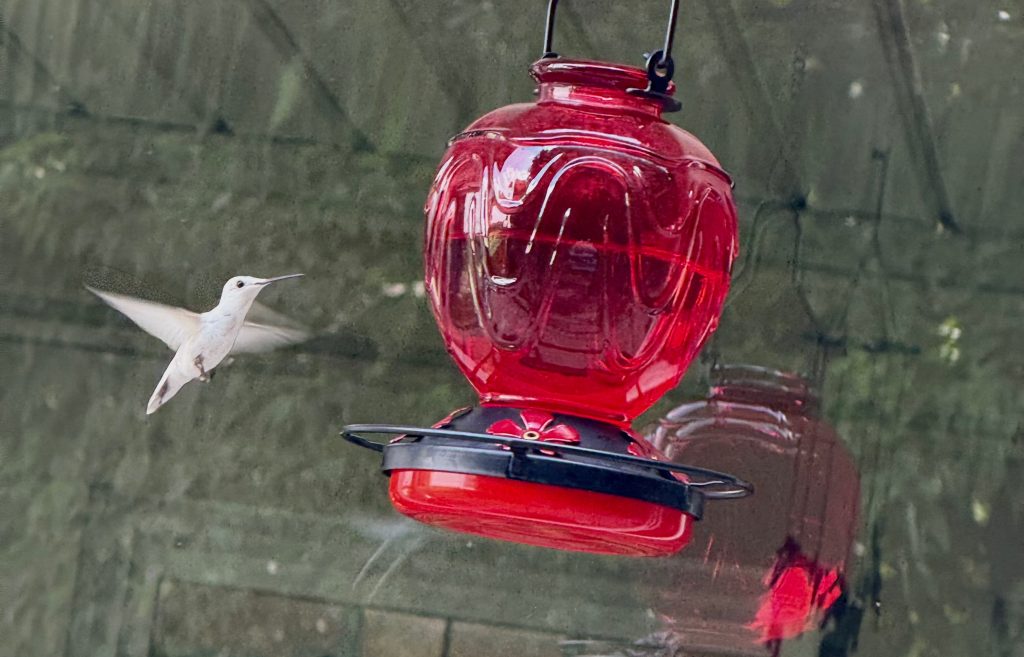
If you happen to look out the window and see a flash of white at your hummingbird feeder or flowers, you may not be imagining things. Typically, late summer is when I receive a report or two from hosts who have glimpsed a rare pale-colored hummingbird. Birds in unusual plumage tend to be noticed and, given the network of bird enthusiasts I am familiar with, reports of unusual hummingbirds find their way to my phone or computer pretty quickly.

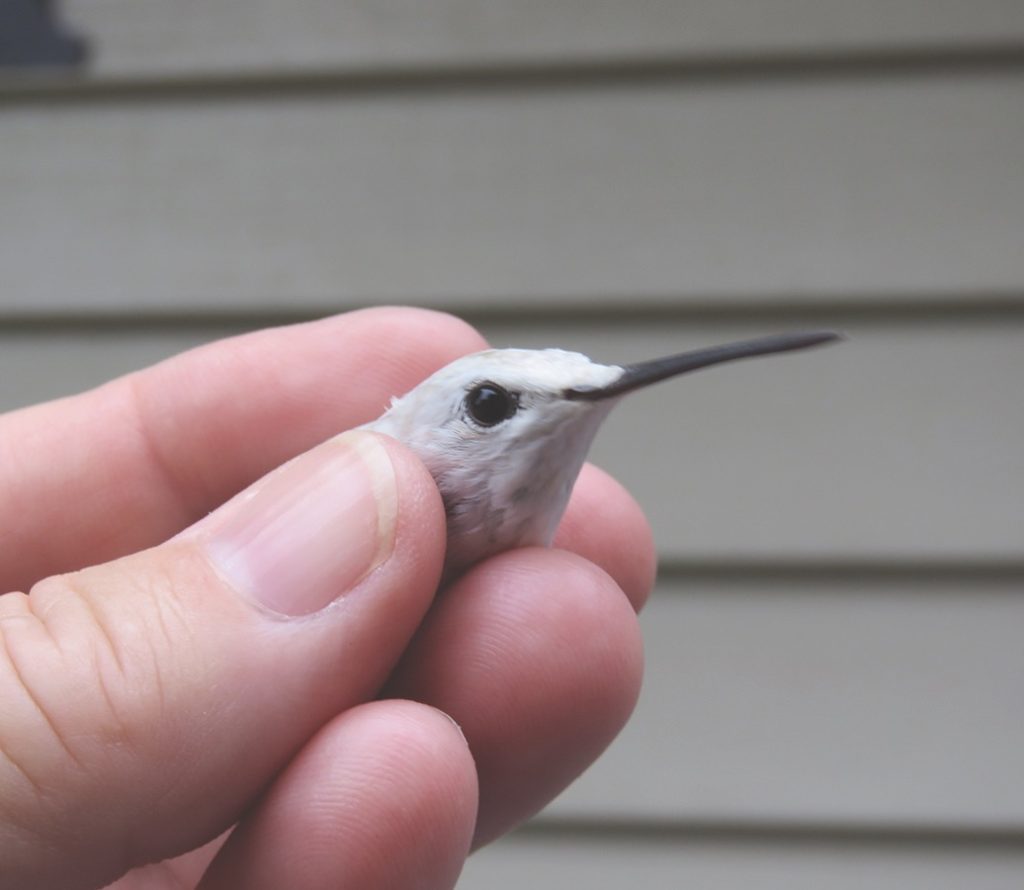
White hummingbirds include both leucistic (pale individuals) as well as true albinos (completely lacking pigment). Gray or tan hummers are more likely than full albinos. Light-colored individuals have normal, dark-colored soft parts such as dark eyes, feet and bills. Albinos, on the other hand, are very rare. These snow-white birds sport pink eyes, feet and bills, and have been documented fewer than 10 times in North Carolina. To date, only three have been banded and studied closely in our state.

It isn’t unusual for people to think they are seeing a moth rather than a hummingbird when they encounter a white individual, not realizing that these beautiful creatures are even possible. In fact, we know very little about white hummingbirds. Opportunities to study these unique individuals are few and far between. What we do know is that they tend to appear in July or August as young of the year and do not survive into their second season. White feathers are very brittle and likely cannot withstand the stress of rapid wing beats and long-distance migration. Another very curious characteristic is that all these eye-catching birds have been females. So, it’s likely that this trait is genetically sex linked.

The first white hummer I managed to band was a creamy bird in Taylortown, near Pinehurst, over 20 years ago. She was an aggressive individual that roamed the neighborhood terrorizing the other ruby-throateds. The first true albino I documented was in Apex, and that individual was even more aggressive; chasing all the other birds that made the mistake of entering her airspace. To have a chance of studying a white hummer, I must get word of it quickly before the bird heads out on fall migration. I have missed more than one by less than a day.

Just recently I heard about a white hummer in the Triangle area. Excited, I followed up and received permission to try to band the bird. She was mixed in with dozens of other hummingbirds using feeders and flowers on a rural property outside Chapel Hill. Although it took two tries, I was able to get her in-hand. This beautiful hummer was very pale, but had some gray in the tail as well as some tan marbling on the back. Her eyes, bill and feet were still the expected black color.

I hope to hear about another of these tiny marvels before all of the hummingbirds in central North Carolina have headed south. Each one is so unique.

Poem September 2025

POEM

September 2025

On the Way Home

from my father’s funeral,

a mime is performing on the corner,

laid out on the concrete like a corpse,

pulling herself up with an invisible rope

as if hope were a cliff to climb,

then levitates over a pretend chair

as if preparing to eat, drinking

an empty glass of air, her palms

bringing into being the nuanced

shape of bread to be broken.

I sit on the edge of a scrap of plywood,

a makeshift seat, perch as if on a ledge

heeding the gravity of all the unsaid.

Everything her eyes imply is about

the last meal I shared with my father.

“Do you hear me?” she hints

with her hands that have

become her voice, her frown

a phrase, a black drawn-on tear

a lost syllable, then,

as though life were something tangible,

sets up an imaginary ladder,

points to a nebulous cloud

she intends to reach, waving goodbye

as she begins to climb into the sky.

— Linda Annas Ferguson