Hometown

HOMETOWN

Aced Out

The elusive hole-in-one

By Bill Fields

Given that I played my first shots on patchy grass in our yard to empty soup cans sunken in the ground, I’ve gone on to have a full golf life. I’ve played thousands of rounds, chronicled hundreds of tournaments with a keyboard or a camera, and been privileged to spend time with dozens of golfers who shaped the sport.

But there is a gap in my golf history. I haven’t made a hole-in-one.

Of course, more talented folks play longer than I have without making an ace. The odds are against anyone: 12,500 to 1 for an average golfer, and even 2,500 to 1 for a tour pro. Those kinds of chances remind me of the “Greyhound Derby” contest at the Colonial grocery store when I was kid. Every Saturday night that we watched the races on television, our dog looked like a lock for the $1,000 winner’s prize . . . until fading like a cur in the homestretch.

An ace has been the mechanical rabbit that I can’t catch.

About the same time the dogs were disappointing us, I was becoming obsessed with the Guinness World Records book that I received one Christmas. It was chock-full of the biggest or tallest you name it. As a budding golfer, I was fascinated by the entry for longest hole-in-one: 444 yards by Robert Mitera, Oct. 7, 1965, on the 10th hole of the appropriately named Miracle Hill Golf Course in Omaha, Nebraska.

I’ve seen holes-in-one in the flesh. Two flew straight in, another rolled in like a Ben Crenshaw putt, and a fourth took a fluky hard-right bounce off a greenside mound. A scorecard, as the saying goes, doesn’t have pictures. That said, a good friend of mine is loath to claim one of his 1s, a skulled short iron that was an ugly shot by any measure until the ball skittered into the cup.

No doubt the most memorable that I’ve witnessed occurred nearly 40 years ago at a par-3 course in New Jersey. I was playing with my pal Michael Dann, with whom I’d enjoyed many games when we lived in the Sandhills. He usually beat me in those days, and I was motivated to change that when we convened at the short course on a busy Saturday afternoon. The first tee was bustling, and we had a de facto gallery when it was our turn on the 80-yard opener. I went first, snuggling a wedge only a foot from the flagstick, and crowed about it to Michael. It was going to be my day.

Then he flew his shot into the cup.

I came close as a teenager. I one-hopped an 8-iron off the pin on the first hole at Knollwood. I hit a 4-wood to 6 inches on the formidable 13th at Mid Pines Inn & Golf Club. Although I’ve had a couple of hole-outs from the fairway from a hundred yards or so, since giving Michael something to shoot at that day in New Jersey, the closest I’ve come on a par-3 tee shot is about a yardstick away.

Perhaps I’m thinking about aces because there have been some notable ones made starting last summer.

I was working on the TV production of the 2024 U.S. Senior Open when Frank Bensel Jr. made a hole-in-one on the par-3 fourth hole at Newport (R.I.) Country Club with a 6-iron. Newport is the rare layout with back-to-back par-3s. Bensel used the same club to ace the fifth hole. It was only the second time in 1,001 USGA championships that someone made two aces in a round. The only other case of consecutive holes-in-one is thought to be by John Hudson in a 1971 tournament on the British PGA circuit.

Last fall, Bryson DeChambeau went viral by trying to make an ace hitting a wedge over his house. On his 16th day of attempts, the U.S. Open champion at Pinehurst succeeded. This February at the South African Open, Dale Whitnell became the second man to make a pair of holes-in-one in one round on the DP World Tour. Three golfers have achieved the 67 million-to-1 feat on the PGA Tour, most recently Brian Harman in 2015.

I am not greedy. One would be plenty. I checked in with my friend Mike Fields of Southern Pines, a golfer good enough in his mid-60s to have shot his age twice within a week. He didn’t make his first of three aces until he was 57. I shall keep swinging.

Guitar Hero

GUITAR HERO

Guitar Hero

Chasing the quintessential American instrument

By Stephen E. Smith

Photographs by John Gessner

You can go almost anywhere, and there’ll be a (insert your favorite personal expletive here) with a guitar,” a curmudgeonly crony once told me.

I suspect he was talking about me. I’ve been toting around an acoustic guitar — in my car mostly — since I squandered $20 on a 6-string that beckoned to me from a pawnshop window when I was 14. The Kingston Trio strummed guitars, the girls swooned, and I had to have that Kay archtop with the bowed neck. No other instrument would do. (When was the last time you heard a testosterone-besotted teenager quip, “I just happen to have my tuba with me”?) At 17, I could flat pick the intro to The Animals’ “House of the Rising Sun” and bang out the first few chords of The Troggs’ “Wild Thing.” What more did I need to know?

If Americans have a national instrument, it’s the guitar, be it electric or acoustic or a combination of the two. According to Statista Research Department, 3.3 million guitars were sold last year in the United States. Any way you figure it, that’s a lot of exotic tonewood, bone, plastic, steel, glue, tortoiseshell and abalone. And that doesn’t account for the necessary accouterments — picks, strings, amps, mics, pedals, wires of every possible description, cases, straps, capos, gig bags, tuners, etc. Guitars constitute an in-your-face, above-ground market that flourishes on the internet via eBay and Reverb and lives in every city and settlement with a population of more than one. It’s a miracle that every kid in America isn’t busking on the curb.

In your lifetime, you’ll probably buy a guitar, or you know someone who will. With millions of options available, making an intelligent choice can be time-consuming and expensive — and ultimately disappointing. If you buy the wrong instrument — one that’s difficult to play and sounds crappy — the novice picker may become disillusioned and never fully realize the fulfillment music can bring into his or her life.

The guitar market is inundated with defective, cheap, and poorly constructed used instruments that are available for a pittance, while at the other extreme, you can make the investment of a lifetime if you stumble upon a one-of-a-kind gem. Kurt Cobain’s Martin 1959 D-18E acoustic recently sold for $6 million, and Bob Dylan’s 1964 Fender Stratocaster — the one that antagonized the crowd at the 1965 Newport Folk Festival — is a steal at a million bucks. Mark Twain’s 1835 2 1/2-17 Martin, which cost $10 new, is valued at over $15 million.

Used, worn-out instruments flood online auctions. Many of these are catalog guitars sold from 1920 through the mid-’60s. They have the virtue of being American-made, but they were ordered through Sears (Supertone/Silvertone), Montgomery Ward (Airline), or a myriad of more obscure distributors, and were often delivered in unplayable condition with a string height and tension that would suck blood straight out of your fingertips. Even if you lucked into a medium-grade and high-end used guitar, the truth is simple: Guitars wear out. The necks warp, the soundboards crack, the tuners fall apart, and the bridges pull up. They can be repaired, but the services of a capable luthier don’t come cheap, and you can spend more money restoring an old guitar than you will pay for a new, more playable model.

So where do you start the quest for that 6-string soulmate? If possible, borrow a guitar. Get a feel for the instrument. Learn a couple of chords. Sing a simple song. If you decide to purchase an instrument, don’t go online and click on the first thing that strikes your fancy. There’s no telling what will arrive in the mail. How a guitar looks on a computer screen and how it sounds and feels when you’re caressing the strings are very different things.

Or you might begin by watching Daniel Putkowski’s 2023 documentary Heirloom: Guitar, snippets of which were filmed in Southern Pines and feature Greensboro luthier Bob Rigaud. The doc is a simple primer for the unschooled. Putkowski begins with an ingenious admission: “I’ve been trying for 20 years to figure out what makes the guitar so popular in American music and across the world.”

Rigaud, who has crafted boutique instruments for Graham Nash, John Hiatt and David Crosby, believes the guitar is spiritual: “The guitar is probably the easiest instrument to play — of course it’s one of the hardest to master. . . It’s spiritual, and it speaks to people in their own lives — love, loss, all subjects.” The professionally produced documentary traces the acoustic guitar’s evolution from a parlor instrument into the most popular music-maker in the world. Segments are supplemented by clips of Bryan Sutton, David Grier, Florence Dore and others explicating their love of the instrument and include step-by-step visuals of a luthier building a custom boutique guitar from scratch. Heirloom: Guitar is available on YouTube and is a good introduction for anyone who is considering a purchase.

We’re fortunate to live at a propitious moment in the evolution of the guitar. CNC (computer numerical control) machines improved construction and playability, and if the guitar is made by a reputable American company — Martin, Gibson, Collings, Taylor, etc. — it’s likely to be a superior instrument. And there are hundreds of American luthiers — too many to mention here — who build custom guitars of the highest quality, although these models are likely to be pricy.

Among imported guitars (“offshore” is the popular euphemism) constructed in China, Indonesia, Japan, etc., deals are to be had. American players generally look down on these foreign models, but the Chinese have been producing acceptable instruments for the last 30 years, and Japan’s Takamine, Alvarez and Yamaha are welcome on any stage or in any song circle. After all, musicians in the Orient were playing stringed instruments long before the Vikings set foot in Vinland. It’s all right to be a guitar snob, but it’s unnecessary — and unbecoming.

Online guitar retailers abound. Musicians Friend, Cream City Music, Sweetwater, Chicago Music Exchange and other music companies will allow you to purchase an instrument and return it in new condition for a full refund if you don’t like what you hear. But the best and easiest place to start your search is your local music store. (There are chain guitar stores you can frequent if you can endure the bone-jarring racket of 10 customers playing White Stripes’ “The Hardest Button to Button” with their amps maxed out.) But a quiet, comfortable atmosphere where you can handle the instrument and hear what’s played beneath your hands is the way to go. A guitar must feel right as well as sound right.

Southern Pines has had its share of cliquish musical haunts. The Pinedene Jazz Center, which was featured on WRAL’s Tarheel Traveler many years ago, comes immediately to mind. The hole-in-the-wall establishment on U.S. 1 South flourished as a gas station selling Black Diamond Strings until it morphed into a music store that eventually succumbed to changing times and a shift in ownership.

The more substantial Casino Guitars (www.casinoguitars.com), which now anchors, along with The Country Bookshop and The Ice Cream Parlor, downtown Southern Pines, carries an impressive array of guitars, many of them high-end instruments that proprietor Baxter Clement ships worldwide. Casino has grown into one of the premier guitar stores in the Southeast. The service is excellent; the crew is knowledgeable. Clement, a music graduate from Vanderbilt University, thoroughly knows his stuff, and he truly loves guitars. He has a solid business plan. He knows that customers in the market for a guitar need to feel and hear the instrument. They need to hold it in their hands and sense that sudden bond: Ah, yes, this is the one!

“When a customer comes in the front door, we try to make them feel at ease,” Clement says. “They can take their time and browse and find an instrument they feel a connection to. Our job is to help the customer find a guitar that speaks to them.”

As for the price range of his stock, he’s philosophical. “Every guitar gets you to the same place, like a car moving from A to B,” he says. “A quality guitar will just get you there faster. And, too, customers should keep in mind that many of the cheaper guitars are produced by workers who aren’t paid a fair wage. In some cases, they’re built by prison labor who work in unsafe conditions without masks or eye protection.”

How much should you pay for a new or used guitar? Is there a decisive difference between a high-end and a cheapo-cheapo model? Nothing is absolute. If you do your research, listen to a trusted expert and, as Aristotle reminds us, trust your eyes and ears — “The Eyes are the organs of temptation, and the Ears are the organs of instruction” — you have a very good chance of purchasing a quality, playable instrument that will bring you years of satisfaction.

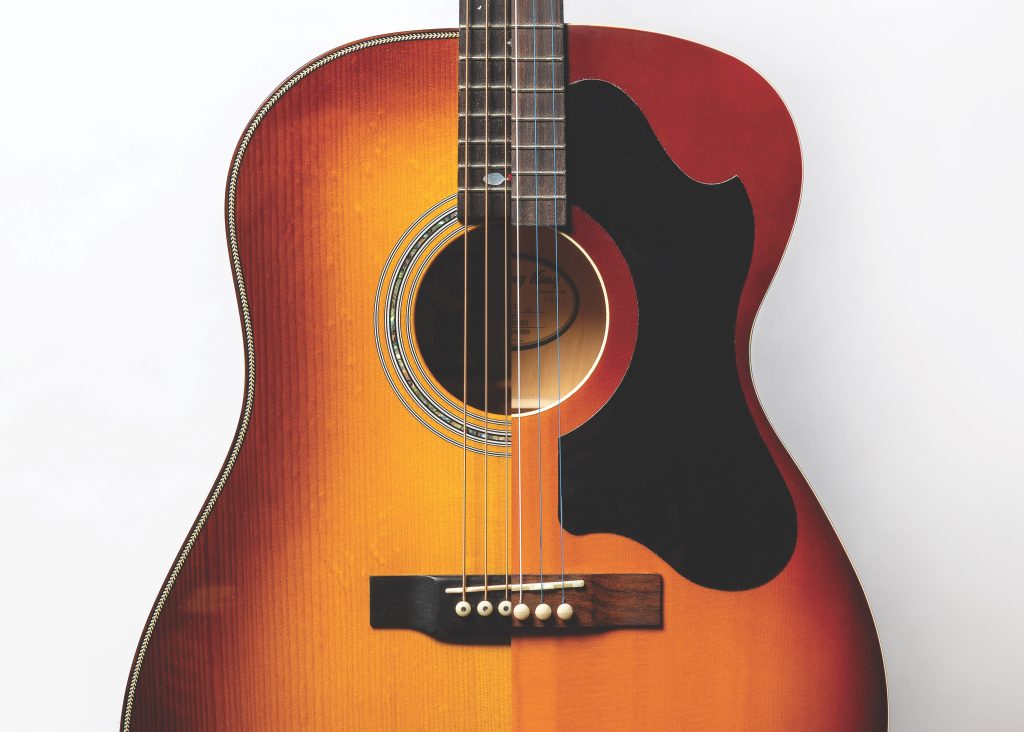
To determine how low-end guitars have improved in recent years, I ordered the cheapest playable new guitar I could find online. Recording King is a brand name conjured up by Gibson during the Great Depression. The guitars produced under the label were more lightly constructed and cost less than the typical Gibson. The Recording King moniker was eventually sold to a Chinese outfit that produces models at varying prices and quality. For $100, I purchased a Recording King from the “Dirty-30s” series, which boasts surprisingly impressive specs — a spruce top, nickel tuning machines, Whitewood (whatever that is) back and sides, mahogany neck, bone saddle and nut — all good stuff.

I toted the Recording King and my 2012 Signature John Sebastian Martin D Slope Shoulder, which boasts the specs of the very best of American guitars (there’s one for sale online for $15,500), to a gathering of the Weymouth Song Circle, which meets on the last Tuesday of every month, to allow the experts to weigh value and quality. And they did.

The Recording King sounds, well, good enough. It is surprisingly playable out of the box. It’s bright and responsive and holds its own with other guitars when fingerpicked or strummed. Except for minor finishing details (the fret ends are like septic spikes), the Recording King would have held its own in the 1950s and ’60s folk era.

But when we played the Martin DSS, trained ears held sway. The Martin was by far the more desirable guitar. Everyone wanted to pick a few tunes on the DSS while the Recording King sat slumped, neglected, in the corner. It’s a viable guitar, fun to play when accompanying others, but the superior Martin demanded the attention of experienced pickers. Which begs the question: Is one Martin guitar worth 155 Recording Kings? Whatever the answer, this much is certain: The serious player should experience long-term satisfaction with his or her purchase. You don’t want to outgrow your new guitar in the first month of ownership or be discouraged by its inadequacies.

Everyone should have a little music in his or her life, if only to escape the electronic morass we’re forced to inhabit. When you hold an acoustic guitar in your hands, it’s just you and the instrument. For better or worse, it reflects what you feel and believe — and who you are. It also connects with others, and there’s a strong sense of community among guitar players, whatever their skill level. And Lord knows, genuine connection is what we need more than ever.

Even casual music lovers appreciate the sense of camaraderie that guitars convey. I recall a summer afternoon 40 years ago when I was driving into Austin, Texas, to visit my singer-songwriter brother. I had my radio tuned to a local station that was broadcasting live coverage of a gathering of 500 guitarists on the grounds of the State Capitol. At precisely high noon, they all played “Wild Thing” — raucous head-pounding A, D, E, D, A, D, E chords blasting through the transistors in perfect generational unison.

Oh, how I longed to be among them!

Sporting Life

SPORTING LIFE

Treasured Memories

Old companions can be the best medicine

By Tom Bryant

“The storehouse of our memories is like an unused room in which lay aside the odds and ends of many treasured things.”
— Roland Clark, Gunner’s Dawn

For the last several months a debilitating illness seemed to dominate all my thinking. It felt as if it had been an interminable time since I had roamed the woods and streams hunting and fishing. The calendar that Linda, my bride, kept of assorted obligations was filled with doctor appointments. My life was centered around pills and stethoscopes.

It was a depressing time. So what to do?

“Quit whining,” I told myself. “Head to the woods. That’ll make things better, or at least improve your outlook.”

I hollered to Linda, who was in the laundry room putting on a load of wash, “Hey, Babe, I’m gonna ride down to the farm and check things out.”

It had been several months since I had been to “the farm,” as I call the old tobacco workings to which my friend Joe Rosy lets me have access. It’s a wonderful corner of the Drowning Creek swamp area, teeming with deer, doves and turkeys. Back toward the swamp, there’s a beaver dam, and wood ducks live, nest and enjoy a habitat that is hard to find in our so-called modern world.

“You be careful,” Linda responded. “Take your phone.”

“OK,” I replied. “I’ll be back a little after dark.”

I grabbed my hunting bag, a battered old Orvis pack that I’ve had forever. I keep it stuffed with items I’ve learned over the years would, in a rush, come in handy — everything from a Swiss Army knife to shotgun loads of all gauges from 28 to 12. Depending on the gun I happen to be using, I’ll not run out of ammunition.

It’s a short ride down to the farm, and I usually take a little detour through Pinebluff, where I spent many happy years growing up. The old house where we lived is still there. After my father died, Mother sold it and moved to the farm in South Carolina that’s been in the family for years.

The Pinebluff house is a little worse for wear, but every time I drive by, memories come flooding back. Ironically, on this particular day, my first in weeks out of the house, just as I got to the corner, a black dog came bursting out of the pines and ran right in front of the truck.

“Smut,” I thought for a quick second of my old canine friend. But no, this dog was more like a pointer than a retriever, just with a black coat. Smut was my first dog, a curly-coated retriever, black as the ace of spades. Dad got him for me when I was in the third grade, and he became my constant companion until I went off to college. Smut was not a champion hunting dog by any means, but he had a natural instinct that helped him overcome his lack of obedience. Not his fault, more mine and my lack of knowledge about training a working dog. Our timing was perfect, though. We were both untamed when it came to the woods, and we spent many a day and night roaming that Pinebluff area of the Sandhills looking for adventure.

When Mother protested the little pup coming to live with us, complaining that she would be the one responsible for him, my father said, “A boy and a dog should grow up together.” In looking back, I can see how she loved the impish, tiny puppy almost as much as I did.

I continued on down Pinebluff Lake Road and decided to pull into the small gravel parking lot and maybe eat a snack from my gunning bag. It was good to have an appetite again. Food hadn’t meant a lot lately. I grabbed a pack of nabs and walked to the pier of the little lake where many years before I had learned to swim.

As a youngster before the town outlawed dogs in the lake, Smut and I would swim from the pier to the dam. He was more at home in the water than I was. As a matter of fact, he roamed Pinebluff and the lake area as if it was his domain, to be enjoyed at his leisure.

It was a quiet morning, and I watched a sheriff deputy’s car roll around the near curve and head toward town, and I decided to meander on to the farm. Remembering Smut brought to mind another furry best friend that lived with me during my early years of hunting — Paddle, a little female yellow Lab. I learned more about training a dog, or more to the point, acquiring the knowledge of how to train a dog, from the best teacher, Paddle herself. She was amazing and accomplished more afield in unusual situations than any animal I’ve ever known.

I thought back to a cold morning at a beaver dam. Paddle and I hoped to catch wood ducks as they came off the roost. The beaver dam was located in a little bottom about a hundred yards down a small rise. We had scouted the area the evening before when we noticed ducks winging their way back into the swamp. We pretty much had the lay of the land the next morning when we silently drove the Bronco, lights off so as to not disturb roosting ducks, down a little dirt fire break and parked under a giant white oak tree.

Frost on the broom straw crunched underfoot as I eased through the outer rings of the swamp to the beaver dam where we would set up for the hunt. Paddle, walking at heel, was anxious to go.

The swamp turned gray with early dawn as we hunkered down awaiting the morning flight. We heard the ducks as they came off the roost, and that was about it. They had flown in the opposite direction from where we were hiding.

I decided to give it 30 more minutes before heading home and to work. Just as I stood up on the narrow edge of the beaver dam, a lone wood duck came whistling over at the edge of the range of my gun. I snapped off a shot anyway, and the duck hit its after-burner and sailed on out of sight. Paddle took off after the bird and I whistled her back to heel.

“No bird, Paddle.”

She looked up at me expectantly as if I needed a good excuse for missing the duck. “It was out of range. We’ll get the next one.”

But there wasn’t another one, and after 30 more minutes, I decided to head up the hill to the truck. Just as we stepped off the beaver dam, Paddle tore off, racing toward the edge of the swamp with me shouting and whistling to get her back.

“Now where is that crazy dog going?” I thought as I hustled in the direction she had taken, concerned that we would be delayed getting home. Just as I stepped out of the tree line bordering the swamp, here came Paddle over the rise with the wood duck in her mouth, the same wood duck that I had shot at and thought I had missed. She knew somehow that I hadn’t.

It was a great morning in the woods at the farm, and my impromptu visit to Pinebluff and remembrances of the wonderful dogs that have accompanied me through life was therapeutic. I felt as if I had another lease on the days to come.

As Dick Coleman, my good friend and hunting buddy, so eloquently put it shortly after his big, rangy black Lab, Honcho, had died, “Do dogs go to heaven? Well, if they don’t, I don’t want to go either.”