Southwords

Southwords

A Happy Discovery

The Google machine reveals all

By Tony Rothwell

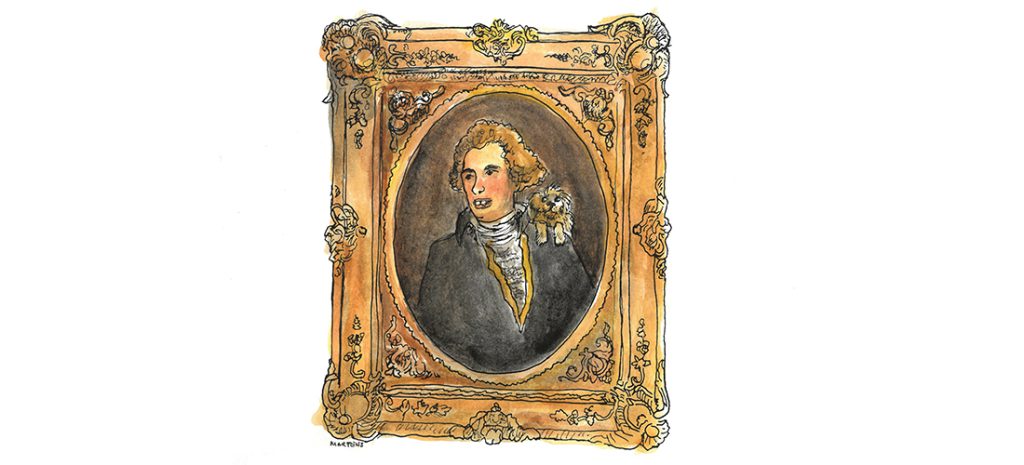
Our son Max, down from Washington, D.C., for a visit, pointed to a large portrait in a gorgeous gold frame hanging near the fireplace and asked, “Who is that anyway?” I said we had no idea, that we just liked it when we saw it in an antique show years ago and bought it. When people ask, we usually say it’s the Fifth Earl of Rothwell. With this he took out his phone, went to Google and took a picture.

“Looks like it’s William Pitt the Younger,” he said, in the blink of a facial recognition app.

“You must be joking,” I said. “Let me have a look.”

Sure enough, there was “our” portrait with the William Pitt caption, going on to detail his years, 1759-1806. The portrait was practically identical to one by George Romney, who painted many contemporary notables.

We were amazed to suddenly find ourselves in the presence of one of Britain’s most famous prime ministers. Comparing the two pictures, the facial expression of quiet confidence, the hair, the stock at the neck, the high-collared coat, yellow waistcoat and buttons were all virtually identical, but the Romney was a little more finished and showed more of the body.

This, however, did not lessen our excitement. William Pitt the Younger was so-called because his father was also named William Pitt and had been prime minister in the 1760s. The Younger became prime minister of Great Britain at the age of 24, the youngest ever to do so, before or since.

He was an outstanding administrator and surrounded himself with competent ministers. In all, he held the position for 18 years (38 percent of his life!), during which time he reformed the Tory Party, dealt with the war against Napoleon and the French, re-established trade with America after independence, and reduced the national debt. Although somewhat colorless, he was seen as a minister who was determined to cut out corruption in politics and was nicknamed “Honest Billy” by the general public. He worked extremely hard but found solace in port wine. Indeed, he became known as “a three bottle man,” but the combination of port and hard work did little for his health, and he died in office at the age of 47.

The irony of finding out who was in the painting was that for years it had been hanging over our large book of 18th century prints by the famous English caricaturist James Gillray, over 80 of which featured the self-same William Pitt. We didn’t tie them together, probably because Romney was kind to his sitter when he painted him. Pitt had a long, sharp nose which, while blunted in the portrait, was a signature feature exaggerated — as caricaturists are wont to do — in Gillray’s prints.

Was our portrait a trial run by Romney or a copy by another artist done in his style? We may never know. But the painting, still hovering over Gillray, has taken on a whole new meaning. So much for the Fifth Earl of Rothwell. Alas, we hardly knew ye.  PS

Tony Rothwell, a Brit, moved to Pinehurst in 2017, exchanging the mind-numbing traffic of Washington, D.C., for better weather and the vagaries of golf. He writes short stories, collects caricatures, sings in the Moore County Choral Society, and with his wife, Camilla, enjoys their many friends in the Sandhills.

Southwords

Southwords

Chocoholics Beware

Lemon might be gaining on you

By Ruth Moose

A chocoholic I am not. On a desserts table with lots of chocolate and other dark delights I can take or leave the chocolate stuff. I leave it for those who would kill their own mother for a bite of anything chocolate. Not me. I don’t even, forgive me friends, like Oreos. No. Never. I must be in the minority everywhere.

A friend told me that once in the ditch of despair during a diet, and dying for chocolate, she had not trusted herself to have even the least bit of chocolate of any kind in her house. Then, in sheer desperation, she climbed high and hunted deep in every corner of every cabinet and finally hidden behind rusted tins of Old Bay and boxes of baking soda, she laid her hands on a long forgotten and now dusty can of pure cocoa. She pried off the lid and dug in, eating every smidge with her bare hand then licking her fingers. That’s desperation. That, my friends, is a chocoholic!

I grew up with good Scottish people who, if it came to the last crumb on the plate, would fight over a caramel layer cake or, even better, a brown sugar pound cake with burnt sugar icing. I’ve seen it happen at church picnics and potluck dinners.

In a show of support for anything other than chocolate I once entered a cupcake contest sponsored by the Chapel Hill Historical Society. First prize, $100. I wanted to see if something, anything, could beat chocolate.

So I spent some weeks developing a lemon cupcake. Not just any old lemon cupcake but an over-the-top and knock-your-senses-to-the-moon lemon cupcake. I mixed. I baked. I tasted. I added. I subtracted. Until I finally ended up with marinating some mango and embedding it in the middle. I made a lemon icing, fluffy and tart, and in a flourish, sprinkled on shredded coconut. It even looked prize winning.

On the day of judging the downtown historic house had three rooms filled with tables full of cupcakes. Rows, double and triple deep, with cupcakes. Every kind of chocolate. It was chocolate heaven. The air felt heavy with the scent of chocolate, so heavy you could taste it when you breathed in.

I felt very small, greatly outnumbered, and wished I had never in a million years decided to take on the world of chocolate. I was a very small David in a room filled with cocoa Goliaths. Until, out in the front yard, filled with cupcake lovers who paid $10 for as many as they could eat, the judges announced their decisions. Third went, of course, to one of the many, many chocolate cupcakes. No surprise.

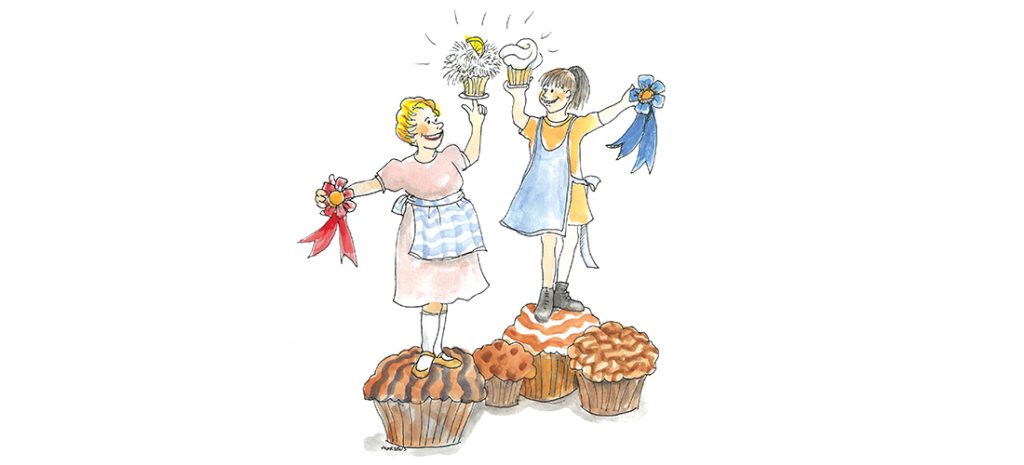
I held my breath and hugged the tiny amount of hope I still had left. Second went to . . . Shaggy Lemon Cupcakes with Marinated Mango in the Middle. Mine! I got a fancy, official award certificate and a $25 gift card from a local stationery shop. Later, one of the losers said to me out of the corner of her mouth, “Your title’s what won it.”

I didn’t care. Lemon had placed. Lemon had beaten out chocolate.

The first prize, the big prize winning cupcake — when it was announced and the 13-year-old girl went up to claim her award and get her $100 check — was a plain-Jane vanilla cupcake with plain vanilla icing. After gasping, the applause was wide and astonished. Not only had lemon beaten out chocolate, vanilla had, too. The judges praised the texture of the vanilla cupcake and, of course, the delicate but absolutely perfect flavor of vanilla.

So there you go, chocoholics. You may outnumber those of us of other persuasions, but we still sometimes win a prize or two. Sometimes.  PS

Ruth Moose taught creative writing at the University of North Carolina-Chapel Hill for 15 years and tacked on 10 more at Carolina Central Community College.

Southwords

Southwords

Eau d’Adventure

A little spritz goes a long way

By: Emilee Phillips

They say smells are the strongest links to memory. A whiff of something can transport you instantly through the years. Perfumes are like people, each complex and unique. One may sing a melancholy song but you can’t help but love her voice. Another might wrap you up in a big hug and hold you there no matter how long it’s been. A third can pull you into a hallway you haven’t dared walk down in years.

A new year is a chance to try on new versions of yourself as simply as changing your scent. You can have a signature perfume, or you can have the world at your door with the touch of an atomizer. I could smell like a girl who spends her days arranging flowers, drinking afternoon tea and wearing a pearl necklace. Or I could have a sultry scent and create mystery in the air as if, just walking past, it is possible to imagine being inside a luxurious yacht.

And I adore fragrance bottles. While many may be ornate, uniquely shaped vessels with ridiculous names on their labels, they’re my prized little possessions.

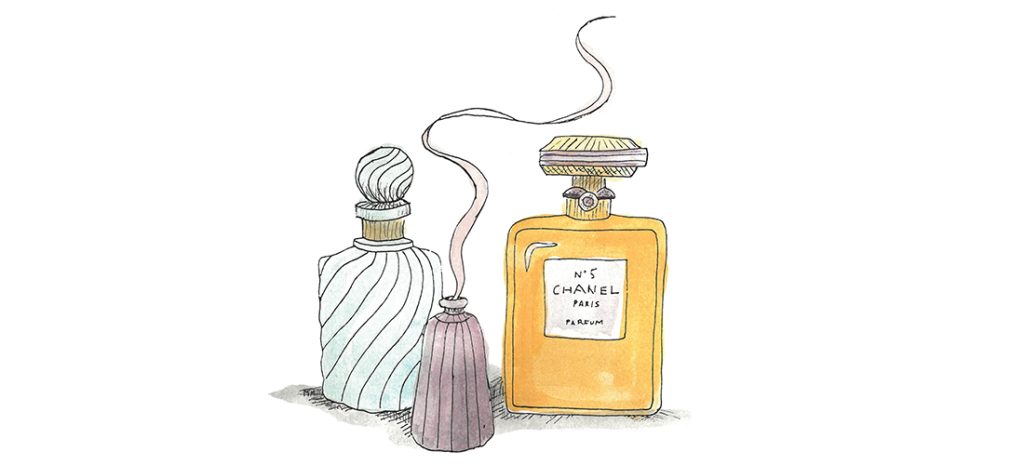
I have a round glass bottle of Chanel I got my senior year of high school. I use it sparingly, mostly on special occasions. Every pink spritz takes me back to seeing the world as an adult for the first time. Back to prom, my cap and gown, and first dates.

I have a bottle that’s yellow and cylindrical and reminds me of a trip I took to Ohio one winter, my white boots in the snow and my cousin, Maddy. We walked all around Cleveland, shivering with coffees in hand, finding unique storefronts and taking dramatic photos we dubbed “album covers.” A whiff brings us back together again.

People associate red roses with Valentine’s Day, as do I, though I prefer the look of peonies or carnations. Still, I opt for rose-scented spray on the 14th. Once, on my way out for dinner, I sprayed so much of it my coat held onto the scent deep into spring. My date rolled the car windows down, terrified, I suppose, that no automobile air freshener could ever put it right.

I secretly love walking through department stores with beauty bars and fragrance counters. The haze that hangs between the door and the shoe department is a fog bank I welcome. Even though most perfumes are overpriced and overly pungent, I enjoy over-sampling them all, sniffing test papers until my nose can no longer distinguish patchouli from pine.

I even keep a small gold metal bottle my mother bought in Paris back in the ’80s. It’s never been opened. She wanted to save it for a special occasion. Maybe one day I’ll test it out and cross my fingers that it doesn’t smell terrible. Maybe we’ll even wear it out together to create an aromatic memory all our own.  PS

Emilee Phillips is PineStraw’s director of social media and digital content.

Southwords

Southwords

The Missing Consonant

An extra letter can speak volumes

By Amberly Glitz Weber

Growing up in a military family, frequent moves ensured I never felt quite comfortable with the question “Where are you from?” But I could always tell you where my mother’s people lived. Every other winter, we traveled from wherever we were living up North to find my grandparents’ North Carolina ranch bursting into bloom, a front porch heavy with camellias as the longleaf pines stretched up into the blue.

The adventure started as soon as we touched down at the airport in Greensboro. Bringing with us an eau de oddity, my twin sister and I were both delighted and impressed that the shuttle bus played country music on the speakers, as we peeled off sweaters and coats in what, to us, was balmy summer weather.

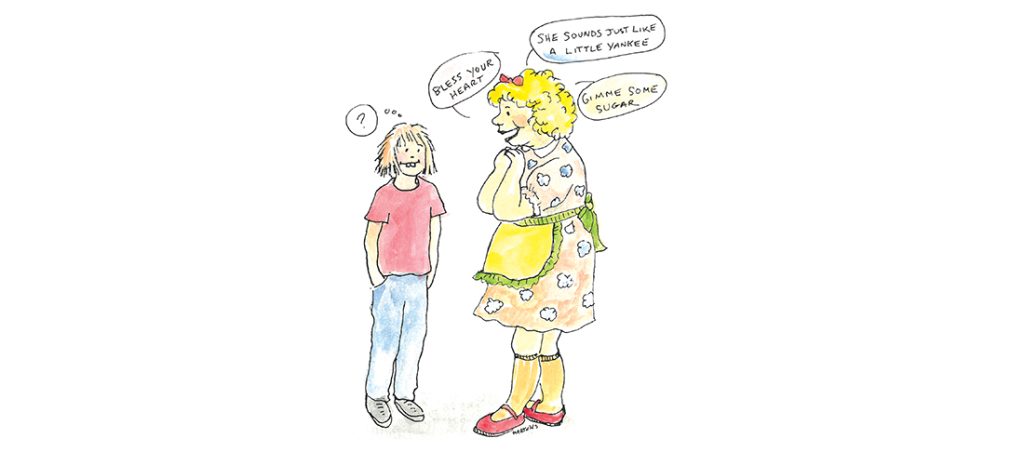
I always felt a little foreign in this vacation land. “Bless their hearts,” my aunt once said, “they sound just like little Yankees.” I remember conspiring with my sister to fake an accent in the Goody’s checkout line, just to see if we could pass. We were sure our mangled, mostly Chicagoan syllables made us stick out, blatant as — in those days — Wingate’s solo stoplight. I pity any cashier who had to endure the performance.

Our speech marked us even more than our shorts in January, so different from the magic and strange mystery of the voices we heard in Rockingham and Hamlet. Not voices with the refined husk of Tara, but a warm, earthy accent that found space for an extra “R” in water — right after the “A” — turning the syllables round and deep in my grandfather’s mouth.

Today, I’m a proud Aberdeen homeowner, and my first daughter’s birth at UNC-Chapel Hill earns her Tarheel status. Already my husband and I detect a hint of the South in her speech. Sometimes it’s so strong we think she must be putting us on — or is she? I doubt it will ever reach the height of my granddad’s drawl, his gravelly voice ever saying in my memory, “Come here an’ gimme some sugar.” It was a voice grown in Carolina, on a farm of many children and countless passing farm hands working the land.

We won’t be moving again, not for a long while. How strange to think that as they grow, my babies’ answer to the question that plagued my childhood will be “from here.” Now, on my daily commute or a mundane dash for groceries, pine trees piercing the Carolina blue sky give me a sense of holiday adventure, no matter the calendar. Here, the camellias burst into bloom in weeks where other ZIP codes are buried in snow. And, though I love this busy life and my once-little town — I find myself missing that extra “R” in water.  PS

Aberdeen resident Amberly Glitz Weber is an Army veteran and freelance writer. She’s grateful for every minute among the murmuring pines of North Carolina.

Southwords

Modern Conveniences

And the wisdom of the ages

By Ashley Memory

Newly married, the pressure to be everything — wife, fashionista, hostess extraordinaire — had never been greater. J.P. and I were just hours away from our first dinner party, and already I hated the way my trendy beaded bracelets kept lassoing me to the kitchen cabinet handles. There was a reason my grandmother Wilma never wore fancy jewelry while entertaining, but I couldn’t worry about it now. The turkey was roasting in the oven, and I had rolls to make.

“Can I do anything?” J.P. called from the living room.

The last thing I needed was interference. Better to keep him occupied with details. “Set the table!” I yelled.

As I entered the pantry for flour, a box of Wilma’s cookware caught my eye. After her death, the box had been passed to me. But, as much as I’d adored her, Wilma had always done things the hard way. Tonight I didn’t have the time to fool with old-fashioned gadgets. In fact, this box was already taking up way too much space in my pantry. Sadly, many of Wilma’s things would probably have to go.

“Forgive me, Grandma,” I whispered, “but this occasion calls for modern convenience.”

The voice I suddenly heard was loving but wary: Better be careful.

My new planetary action mixer boasted beaters that rotated on their axis just like the Earth, and a mixer head that turned the opposite way. All this with a 1.3-horsepower motor. I wasn’t sure what any of that meant, but it sounded absolutely essential.

What it meant, I learned after I innocently stuck a spatula into the bowl as the mixer ran, was that it could fling objects, e.g., that same spatula, back at my face with a force strong enough to send Elon Musk’s Starship to the planet Mars and back again. Now I was the one seeing stars.

Didn’t I warn you?

“Everything OK in there?” J.P. shouted from the living room. “Hey, there’s a new space documentary on Nova tonight. Want to watch it?”

This was the last thing I needed to hear. “Are you kidding me?” I yelled back. “We’ve got people coming over, remember?”

Head throbbing, I retreated to the pantry and grabbed Wilma’s stout wooden spoon so I could mix the ingredients by hand. Then I looked down at my previously sparkly pink sweater. It was white with flour.

I heard that little voice again. Wilma. Might I recommend an apron?

I rifled back through the box and pulled out her red-checkered apron. Hardly haute couture, but I didn’t care. Once I put away the dough to rise, it was time to grate some cheese for the potato casserole. By now I was long overdue for some magic from my new food processor.

Do you really have time for that?

Sure enough, when I saw the shredding disk, I realized I had no idea how to attach it to the motor shaft. I gave up. “So much for modern conveniences.”

It’s OK, dear. Try my handheld grater.

“How’s it going?” J.P. called out. “Anything else I can do?

“Remember that box in the pantry? Bring it in here.”

“I thought you were donating that stuff,” he said, carrying Wilma’s cookware.

Now, now. Not so fast, dear.

I jerked off my bracelets and tossed them aside. “Are you kidding? The only thing I’m giving away are these stupid bracelets.”  PS

Ashley Memory lives in southwestern Randolph County, and when she’s not blowing up the kitchen, she’s outside hollering for the dogs.

Southwords

Nekked Fighting

The ultimate element of surprise

By Beth MacDonald

Occasionally, I find myself in places where strange things happen so frequently no one bats a silky, fake eyelash at them. New York City, for example. I have never been surprised to see a citizen dressed as Superman directing traffic with ping-pong paddles. Washington, D.C., it seems, isn’t far behind.

I was in D.C. recently to visit some friends and do some work. Mason, my husband, was with me. He can’t hear well, especially when I am near him and ask him to do something. This very specific type of hearing loss is often diagnosed as “Mixed Marital Hearing Loss, Unspecified,” which means he can’t hear requests, plans, demands or the doorbell.

As with most hotel rooms that aren’t presidential suites, the bathroom is directly by the entrance door. It was 9 o’clock in the morning. The Do Not Disturb sign was hanging on the doorknob. I was showering and Mason was on the other side of the room, behind a partition that served as a wall/coffee bar. I knew he was there because he was singing. His voice is deep and buttery, so I usually enjoy his warbling; though given his hearing condition, they could probably hear him in Raleigh.

As I exited the shower, I heard the hotel room door click open. Knowing Mason was oblivious on the other side of the room, I braced myself for it. Nekked fighting. Combat Nu.

Because everything in my life is connected to some eccentric misadventure somewhere else, this one began in Arkansas, sort of. Years ago I had a boss who was from there. He was short, probably because the mosquitoes ate half of him, and his Southern drawl was so thick it could make biscuits. He started every workday with wise advice as he passed my office. One day it was this: “Nekked fighting! You’ll win!” I furrowed my brow and asked what on this glorious green Earth he was talking about. At the time it never occurred to me that this could actually come in handy.

“Think about it,” he stopped, very serious. “Someone comes at ya ready to fight. Git nekked. Then, when they stare at ya, naked and ugly, flabby and weird lookin’, you attack! You have the element of surprise. Use it to your advantage and you win!” With that, he and his cup of coffee moved on.

I kept that little nugget of wisdom in the back of my cap until that hotel door clicked open.

This is it, I thought to myself. This is the day I would become the champion of Combat Nu. It all happened in slow motion, like in The Matrix. Someone was breaking in. I turned toward the door, dripping, naked and weird looking. I came face-to-face with the danger, ready to fight. The blood-curdling scream that came out of the maid as she fled down the hallway convinced me I had won. But I wondered, is it two falls out of three? Am I a black belt, to be feared and respected?

I put on some clothes and went downstairs to inquire at the front desk if they had a moment to hear my testimony about naked fighting. The staff was so unmoved by my experience it was as if this was a common occurrence. Their only response was, “I’m sure she knocked, you just didn’t hear it.”

At that moment, I started to cry in the lobby of a lovely hotel in downtown D.C. while trying to convince the front desk staff that Combat Nu is not a matter to be engaged in lightly. They seemed blissfully unaware of the true severity of the situation.

Mason finally either got to the end of his song or he realized I was missing and came downstairs looking for me. He’s all too aware that I am a living, breathing, walking catastrophe with a certain je ne sais quoi. He put a pair of sunglasses on me, stood me against a wall, said, “Do not move.”

Then he headed over to the Starbucks in the lobby to get me a double caramel macchiato and probably a set of ping-pong paddles.  PS

Beth MacDonald is a Southern Pines suburban misadventurer, author and Combat Nu black belt.

Southwords

The Haunted Fireplace

“Do you like scary movies?”

By Emilee Phillips

I was never much into ghost stories as a little girl, but that didn’t make me immune to the heebie-jeebies when something didn’t feel quite right.

The house where I grew up was built in 1875. It’s a rambling white farmhouse in the middle of nowhere. Most of the time our home felt warm and cozy, especially when the whole family was together. It was during thunderstorms, or when I was alone, that I got scared.

The old house is the polar opposite of a modern, open floor plan. It has rooms of all different shapes and sizes, each with an atmosphere entirely its own. Every addition to the house brought with it idiosyncratic wall and floor configurations. Our house was imposing and roomy and, to a little kid like me, it felt like a mansion — not of the fancy or fairytale kind, but the big, mysterious kind.

Sometimes, it even seemed alive. 

The majority of the house was built with rough cut lumber. There are four fireplaces, two of them in working condition. The wooden mantels are all strictly utilitarian, devoid of ornate carvings or decoration. But the one in the green room is different. Very different.

I should mention that the house was often cold in the winter. We had a pair of furnaces, but their fuel efficiency may not have been up to 21st century standards. They often burned through all of the propane before the delivery truck could make it back for a refill. Or sometimes they were simply unable to ward off the chill of a high-ceilinged house. So, on the coldest nights, my family gathered in the green room around its oversized fireplace.

My brother and I used to wrestle on the worn brown carpet, rolling in front of the fire that always gave off more fumes than it seemed it should. I suppose I didn’t pay it any mind those first few years until one day I looked up at that ancient fireplace and watched the mantel ooze. My eyes got as big as saucers. It was as though I was watching a horror movie and I couldn’t look away.

The walls were bleeding.

Suddenly, every creak I heard in that old house came alive. I could imagine whispers coming from the flames. Every speck of blue dancing in the fire became a spirit showing itself to me just to see if I was paying attention.

When the fireplace was on I would tiptoe in and out of the room, keeping a wary eye on the hearth. If I was quiet, I thought, I would be safe.

It was creepy and sinister and a bit terrifying. And despite countless reassurances from my parents that a menacing otherworldly being had not inhabited that gaping hole in the wall, I wasn’t convinced.

Even now, when the fireplace in the green room is lit, amber fluid seeps from the mantel and oozes over the layers and layers of paint applied to disguise where all the previous drips have been scraped off. And, now that I’m older, I understand it’s not unheard of for old homes built of heart pine to drip resin for years, the heat triggering the flow.

Perhaps the old house isn’t haunted after all — except for the footsteps my father sometimes hears clomping up the steep wooden staircase at night. The steps, oddly enough, are carpeted.  PS

Emilee Phillips is PineStraw’s director of social media and digital content.

Southwords

Who Would Do That?

The greatest play call ever

By Jim Moriarty

It’s September and the air is thick with footballs. While there remains no doubt we are living in a deeply divided nation, I feel certain there is one thing upon which we can all agree. When the Seattle Seahawks had the ball on the New England Patriotsʼ 1-yard line, trailing 28-24 in Super Bowl XLIX, and Russell Wilson threw it instead of turning around and handing it off to Marshawn (Beast Mode) Lynch, it was the worst single play call since prehistoric man tried to bring down a woolly mammoth with a thigh bone and a piece of quartz.

I mention this not to give my offshore gambling friends, and you know who you are, hair-raising and ghastly flashbacks, but simply by way of comparison since I, in fact, witnessed the best single play call ever made in a game of football. The puntrooskie.

It was Sept. 17, 1988. I was photographing the Florida State-Clemson game and, though I don’t recall it raining during the second half that Saturday afternoon, the field was sloppy from early in the day. The visiting Seminoles were ranked No. 10 in the nation and the Tigers No. 3. With the game tied 21-21, Clemson had succeeded in bottling the Seminoles up in their own end of the field. There was just 1:30 left in the fourth quarter, and Florida State was going to have to punt the ball away on 4th and 4 from their own 21 yard line. But Bobby Bowden, the Seminoles coach, had other ideas.

I was kneeling in the back of the end zone, focusing on the punter, Tim Corlew, in the event Clemson would come after him hard trying to block the kick. The Seminoles lined up in punt formation and when the center snapped the ball, Corlew leapt high in the air as if it had sailed over his head, then turned and ran after what would turn out to be a nonexistent loose ball. I frantically searched for it through my lens. Nothing. By the time I put my camera down on the ground in front of me, I couldn’t believe my eyes.

This is what happened. The center had direct snapped the ball at a slight angle to an up back, fullback Dayne Williams, who was in normal punt formation ready to block opposing players rushing the punter. Williams, in turn, passed the ball between his legs to LeRoy Butler (who, incidentally, had a 12-year career in the NFL, played in two Super Bowls and was just inducted into the Pro Football Hall of Fame). Butler bent over with the ball tucked in his stomach, hiding it the best he could, and just kind of stood there. Williams and the rest of the Seminoles all broke to their right, essentially faking the fake punt, and the Clemson pursuit went with them, some even bumping into the guy who actually had the ball.

Afterward, Butler explained it this way: “When I looked up, nobody was there.” He took off running and was finally forced out of bounds on the Clemson 1. Florida State would kick a field goal to win 24-21.

In the interview room after the game, Bowden was, of course, asked about the play’s design. “Would you like me to show you?” he replied. Bowden got the writers to get up out of their seats, then he started rearranging their folding chairs to show them who was where and how the whole thing worked. But the truth is, it worked because no one — no one — would ever make that call in that situation. With a minute and a half left in the game? On your own 21? On a wet field? All Butler had to do was slip and they lose. Utterly ridiculous.

Beano Cook, who had been the sports information director at the University of Pittsburgh for a decade and went on to become a colorful commentator for ESPN, called it “the greatest play since My Fair Lady.”  PS

Jim Moriarty is the Editor of PineStraw and can be reached at jjmpinestraw@gmail.com.

Southwords

Ticket to Ride

Transported by a book

By Patricia M. Walker

I like to troll thrift stores for books. It’s always an adventure, and at 50 cents apiece, you can hardly go wrong. If you do, you can simply re-donate. No harm. No foul.

Occasionally you reach for a book that looks interesting and find the joke’s on you, because when you open it, you discover it’s one you donated months ago. Standing there looking at your own name and the little stamp you mark your books with, you feel strangely proprietary and a little ashamed all at the same time. Worse, it’s just possible that the book is looking back at you with an accusatory stare, as if to say, “How could you give me away? Don’t you love me anymore?”

More interesting, however, are the times you find other people’s names and marks. Or an inscription that says: “To Glenn, May this first Christmas as part of our family bring you joy, George and Grace, Christmas, 1993”; or “M. A. Crichton from Mrs. Pyle, Christmas, 1938.”

Then, too, there are the stamps along the deckled edges or on the title pages that say Estes Valley Library — Withdrawn; Vermillion Public Library, Vermillion, South Dakota; Dowse Memorial Library, Sherborn, Massachusetts; Rivoli Township Library, New Windsor, Illinois; Fort Loramie Jr./Sr. High School Media Center; West Slope Community Library, Portland, Oregon; or most exotic of all, U.S. ARMY RVN SPEC SVC LIBRARIES APO 96243. That’s when you know the book has a life of its own, a story to tell. You hold it in your hands, leaf through the pages, trying to imagine exactly how it got here. What circuitous path did it follow to wind up on this shelf, perhaps thousands of miles from where it started?

Sometimes, there are even clues, relics of another reader’s life, hidden among the pages — a receipt from a bookstore in the Denver airport, a flier for “Buddhism and Meditation” from the Rameshori Buddhist Center in Atlanta, or a small ivory card printed in pale blue with a drawing of a young Chinese student at his desk and the words “If found please return to,” but with nothing filled in.

Best of all are the bookmarks — Decitre Librairie Papeterie in Lyon, France; Arcadia Books in Spring Green, Wisconsin; Golden Braid Books in Salt Lake City; Frenchmen Art and Books in New Orleans; Lunenburg Bound Books and Paper in Nova Scotia; Eighth Day Books in Wichita; the iconic City Lights Books in San Francisco; and much closer to home, Blue Ridge Books in Waynesville, North Carolina.

Of course, the stores they represent are indies and not thrift stores, but you love them all the same. You can just visualize the people who work there, how the books are arranged, the comfy sofas and chairs, the jingle of the bell as the regulars come in the door. You wonder if they’re still in business, and if so, whether some day you could — would — pack your bag and go there.

How you would walk in and say hello to the woman or man behind the counter; tell them you’ve come all these miles because of the bookmark you hold in your hand, a bookmark you found in Manhattan Transfer by John Dos Passos or The Red Notebook by Antoine Laurain, or The Buffalo Hunters by Mari Sandoz or Blondes, Brunettes and Bullets by Nils T. Granlund; or a thousand possible others.

And you are absolutely certain they will smile and be thrilled that you have come so far to visit their store. Then they will offer you a scone, show you around, pull volumes off shelves for you to admire. And you will buy something, new or used, not only because it’s the polite thing to do, but because you really do want that Penelope Lively or Kent Haruf or Philippe Claudel that’s sitting right there on the shelf. Besides, there’s always room in your luggage.  PS

Patricia M. Walker is a retired teacher/purchasing manager/financial services administrator who was born and raised in Chattanooga,
Tennessee. She wrote her first novel when she was 9.

Southwords

Baking Betty

Research, research, research

By Ruth Moose

Betty Crocker and I go back a while, though I don’t go back as far as she goes. Betty Crocker, icon for General Mills, is 100 years old this year. One of the most recognized advertising symbols in the world, Betty has only gotten younger. Many up-to-date hairdos and wardrobe changes. She has kept up with the times. My relationship with her ended amiably enough, and I have my little red spoon of confidence lapel pin to prove it.

Many years ago when I lived in Charlotte in a split-level house, carpooled in a wood-paneled station wagon, and did all kinds of PTA and Boy Scout stuff, my family was a member of a very exclusive club. We were one of 500 General Mills test families across the country. I tested recipes that ended up on the backs of cereal boxes, flour packages and General Mills products, excuse the expression, in general. I wasn’t paid but was reimbursed for the cost of recipe ingredients. I figured since I baked and cooked anyway, why not make it interesting? And I like to try new recipes.

Helen Moore, my good friend as well as neighbor, was at that time food editor for the Charlotte Observer. She invited me and several other women of various ages and stations to a lunch with two home economists from General Mills. It was a lovely lunch in a nice restaurant, a real treat in the middle of the week. Good food, fun conversation, and afterward I was asked to be part of 500 families scattered across the country. The home economists explained that, though they tested recipes in their laboratory kitchens in Minneapolis, they wanted reactions from real people in real home kitchens. Where the pasta meets the road, so to speak.

During the years I tested a variety of recipes, everything from vegetable dishes (carrots cooked in frozen apple juice with fresh ginger was a good one) to cookies made with various cereals, to a whole series of recipes using wine. I saw many of these later in cookbooks. For the most part, my family was good-natured about the whole thing. They were used to seeing different things on the table when they sat down to dinner.

After I tested a recipe, I filled out forms that included what I had paid for certain ingredients, whether I had them on hand, how difficult they were to find, and so on. Other forms asked if the instructions on the recipe were clear. Was it hard to follow? How much time did it take to make it? And there was always the question of my family’s reaction. They were the ultimate arbiters. Actual people eating real food in a home kitchen. Nothing complicated. Except the time I was sent a recipe for gumbo.

No, I did not have filé powder on hand.

No, I did not keep canned okra on my pantry shelf.

I didn’t know you could even CAN okra. And it surely didn’t sound appetizing. Breaded and fried okra is food of the gods! But okra in a can? In the South yet? Sacrilege.

So, I went in search of canned okra. In those days Amazon wasn’t even a twinkle in Jeff Bezos’ eye. Managers of the A&P, Kroger’s and Harris (before there was Teeter) laughed at me. Was I some kind of nut? Canned okra? I finally found a lonely can on the bottom shelf of a tiny exotic foods market. Exotic for North Carolina, certainly.

Then I made my first and only gumbo.

My family’s reaction, after a couple of mouthfuls, was to ask if we couldn’t go to McDonalds.

We did, leaving plenty for the garbage disposal and a none-too-glowing report for Betty Crocker.

After that, whenever my sons sat down to something unfamiliar, their immediate reaction was, “Are we eating Betty Crocker?”

I probably tested recipes for Betty for six or eight years. The gumbo was the only unqualified disaster. A lot of the recipes I still make — a Wheaties cookie; many of the wine dishes, including a pot roast cooked with Burgundy.

The program was discontinued but, as a token of their appreciation, I was given a tiny version of Betty’s trademark, a small, enameled red spoon lapel pin — the Phi Beta Kappa of gumbo, I suppose — and a real conversation piece at dinner parties. PS

Ruth Moose taught creative writing at the University of North Carolina-Chapel Hill for 15 years and tacked on 10 more at Central Carolina Community College.