Pleasures of Life

PLEASURES OF LIFE

Life in Mugs

My cup overfloweth . . . with coffee

By Emilee Phillips

“Oh look, another Keurig,” I said as I unwrapped the gift, unsure if I was being punked. Four coffee makers — in four different colors — sat on the floor in front of me in the jumble of Christmas debris. The situation was so ridiculous, it only took half a beat for me to burst into laughter. Apparently no one in the family communicated that year when shopping for my present. But I was grateful that everyone wanted to make sure I had my caffeine fix. That was the year I’d gone off to college and you could say I was a tad — OK, a lot — coffee obsessed.

Having previously worked at a coffee shop, you couldn’t blame me. I had one leg up on addiction. But higher education made it worse. I relied on it so much to get me through the long days — between morning workouts, the A/C always blasting a smidgen too much and Mr. Dean’s sleep-inducing class —  it hardly gave me the jitters anymore. My roommate and I used our Keurig so much that it didn’t survive first semester.

Friends and family might describe me now as a coffee snob, which I would argue is not entirely true. I can recognize a good cuppa from an over-roasted, bitter or stale one, but that doesn’t mean I wouldn’t drink it to endure the “brilliant” podcast my sister insists is life-changing.

If coffee is an acquired taste, I’ve acquired it. Much like being a wine sommelier, the more you drink the more you understand what the terms that could describe fabrics — “velvety,” “light,” and “floral” — mean in the coffee context.

Admittedly, since my college days I have upgraded my brew methods. I grind the beans fresh for each pot. It has become a morning ritual of sorts, one that humors me. I’m as guilty as the next guy of not being able — or, rather, refusing — to function without their morning cup of joe. Hey, we’re creatures of habit.

There are people who enjoy the sentiment of coffee more than the concoction itself. There’s something exciting about wrapping your hands around a steaming cup as if you’re lounging in a ski chalet in Aspen or, for those who prefer iced drinks, making your way through a castle of whipped cream to get a sugar fix before diving into the caffeine pool at the bottom.

These days the real appeal to me, other than getting a much needed jolt in the morning, is that “going for coffee” can be an outing in itself. The coffee shop can serve as a “third place” — a pleasing space between home and work where the aroma of a fresh brew and the hum of conversation bring people together. Whether it’s catching up with an old friend, powering through online tasks or enjoying a good book, there’s something motivating about stepping out of the house and into a welcoming atmosphere.

Some of my best ideas happen in coffee shops. I enjoy hearing the sounds of the grinder, the steam of the espresso machine and the soft mingling around me. After a while you begin to notice things like “plaid shirt guy isn’t here today,” or “the lady who always asks for her drink to be kid’s temperature got a tea today,” or “chai latte girl must have finally finished that paper.”

In college, that little coffeemaker became my personal barista, churning out cups during all-nighters and early morning cram sessions. I’d sit at my desk with my laptop, a mug in hand and pretend I was anywhere but a cramped, cluttered dorm room.

Oh, and in case you’re wondering, I kept the black Keurig for my college dorm. The other three went back for spending money.

Pleasures of Life

PLEASURES OF LIFE

Fair Enough

Americana in the autumn

By Peter Doubleday

Ever dine in a Waffle House at 3 a.m.? Well, welcome to the fair.

In 50 years of announcing horse shows, I’ve attended over 30 state and county fairs, from Texas to New York, Florida to Colorado, and each and every one of them is a true slice of Americana — hold the grits.

Growing up in Syracuse, New York, my father hosted an early morning (around milkin’ time) agricultural radio show for WSRY — 570 on the dial — and served as a board member and horse show announcer at the Great New York State Fair.  He was at the radio station by 4:30 in the morning, on air from 5 to 7, then off to the fairgrounds until well into the night talking to throngs of spectators and producing the horse show.

When I was 6, I couldn’t wait to watch the train pull in from Buffalo (its county fair was the week before) like a rolling midway. Most of the rides arrived by truck, but the vast number of tents, generators, animals and all the carnies I could count traveled by train. The vagabond equipment came from James E. Strate Shows in Florida. I thought it was so cool that I created my own Strate Show train and vehicles on my HO scale train set in the basement of my house.

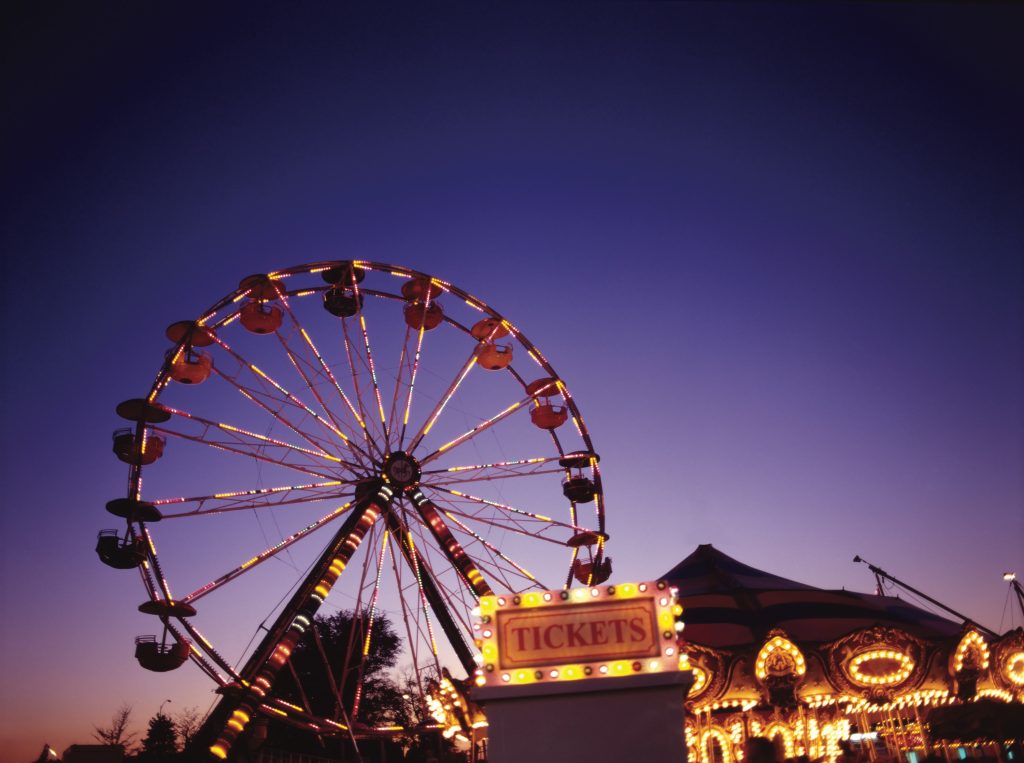
In those days fairs had agriculture, history and competition components, but the midway was always the centerpiece. Forget OSHA; how dizzy could you make yourself on the spinning and rattling Tilt-A-Whirl, and how many times in a row did you dare ride it? The view from the very top of the double Ferris wheel was impressive enough that it yielded my first kiss at the ripe old age of 11.

Every game on the midway had its own barker and its own tricks. Why couldn’t anyone make a basket? Was the ball too big or the hoop too small? One year the guy overseeing the ring toss felt so sorry for me he gave me a stuffed animal out of pity. At the Erie County Fair in Hamburg, New York, there was a giant tent with rows of stools and small boxes arranged like a bingo card. The speaker would call out “number one,” and people hoping to win a set of kitchen china would throw tiny red rubber balls that had as much chance of staying in box number one as a bowling ball has of floating. I couldn’t wait to see the bearded lady, the snake boy of Borneo and the alligator man. And I thought it was all real.

Features at fairs ranged from old-time stock car racing to its ultimate icon, the Demolition Derby. At a county fair in western New York the 3,000-seat grandstand was sold out, with people watching their neighbors destroy cars for nothing more than bragging rights at the local garage the next morning. The last time I watched a derby there were 75 cars and a completely superfluous announcer, since you couldn’t hear a word he said once the crunching began. The fire department got a major workout.

Every fair has a smell and aroma all its own, a combination of hundreds of different forms of food, fried in unimaginable combinations. Some of the most bizarre treats I’ve seen included a burger cooked inside a doughnut. If I could have figured out the overhead and net from selling fully loaded baked potatoes I could’ve been a millionaire.

Dairy and beef cattle, goats, sheep and pigs were judged, and the horse shows at the fair featured every imaginable breed. Every fair, it seemed, had its own “world’s largest pumpkin.” And how, exactly, does one judge a hay contest?

One of my fondest memories of the New York State Fair was the day my name was announced over the entire fairgrounds to report to the State Police exhibit in Hall A. I was 7 years old and my name had been drawn to win a German shepherd puppy. I named him Trooper. It had a better ring than Bumper Cars.

Pleasures of Life

PLEASURES OF LIFE

The Hills Are Still Alive

Remembering Mom and The Sound of Music

By Tom Allen

I was 6 years old when The Sound of Music opened at the Ambassador Theater in Raleigh in August 1965. The movie, loosely based on the life of Maria von Trapp and her singing family, played to sold-out audiences for 61 weeks, one of only a few films the Ambassador ever hosted that required reserved seating.

Somehow my parents snagged a ticket and took me along. I’m sure my mother arranged the outing. A church soprano, she loved Julie Andrews. The Sound of Music was my first movie, and memorable for other reasons. Our tickets were for a Sunday matinee, meaning not only did we attend on the Sabbath, but we also missed church.

For this Sunday outing, we dressed to the nines. Dad wore a suit, my mom a best dress. I remember bundling up like a British schoolboy, donning my houndstooth wool suit and dapper newsboy cap.

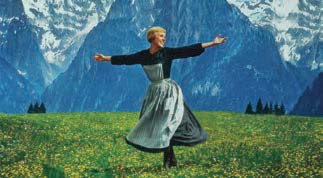
The Ambassador was cavernous compared to our small, county seat theater. When the movie started, the curtain rose in accordion-like folds. And who can forget that opening scene, the camera closing in on Maria — via helicopter — and Andrews making those hills come alive? If we could miss church for such a stirring opening scene, surely Mother Superior could forgive Maria’s tardiness to Mass.

Beautiful scenery, with a musical narrative featuring cool kids romping around the Alps, decked out in traditional Bavarian dress, kept my attention. An intermission, another rarity, meant time to stretch, share a box of popcorn, and wonder if Maria would follow her heart and return to the widowed captain and his children.

Happily, like a Hallmark movie’s predictable plot, the captain ditched the pushy baroness and proposed to Maria. My mom cried when they married. The majesty of the cathedral’s organ during Maria’s procession engulfed the theater and brought chills. Even my dad, never a movie fan, commented how moving the scene was. We sat on the edge of our seats, wondering if the singing von Trapps would be able to compete in the Salzburg Music Festival. We cheered when they not only won but escaped the Nazis. That final trek across the Alps to freedom, accompanied by a reprise of “Climb Ev’ry Mountain” brought the movie to an end and viewers to their feet in a lengthy applause.

Until I was old enough to hang with friends, Mom was my movie companion. The films, mostly beloved Disney favorites, provided fun diversions and cherished memories. But Richard Rodgers and Oscar Hammerstein’s blockbuster, offering moviegoers a glimpse into the life of cloistered nuns as well as a lesson about one of history’s darkest seasons, also gave us the gift of music in sound, sight and lyrics. How many Baby Boomer kids can remember that raindrops on roses and whiskers on kittens are favorite things and that a doe is a deer, a female deer?

Along with Rodgers and Hammerstein, I have my mom to thank for that gift. A music major who chose marriage and having a family over a degree, and possible singing career, she tolerated my dad’s love of country and Southern gospel music. Unlike most of her friends, she wasn’t an Elvis fan. The Beatles were “too much.” Stately hymns and stirring anthems, coupled with the crooning of Como, Crosby and Sinatra, were her preferences. On occasion, she would iron clothes on Saturday afternoons while listening to the Metropolitan Opera on Raleigh’s WPTF but, a product of her times, she liked a little beach music, the Temptations, some Frankie Valli. I can’t remember her singing in the shower, but she wore out our 33 rpm vinyl recording of The Sound of Music. And while my taste varies from Gregorian chant to Morgan Wallen, after listening to that album for hours, I, like Mom, can sing every song.

My mother, as well as my family, was far from perfect — like the real life Maria and von Trapp family. Mom would tell you she was no nun, but her good days, and our family’s good days, far outnumbered the challenging ones. Even in the last weeks of her life, she sang, faintly but clearly. The night she died, recordings of her favorite hymns sang her to heaven. Her goodness was passed down to her two granddaughters, whom she adored. They, like her, fell in love with The Sound of Music, wearing out our VHS copy during their childhood and teenage years. And though she did not live to meet them, I’m sure her granddaughters’ children — three great-grandsons — would be among her beloved favorite things.

Pleasures of Life

PLEASURES OF LIFE

Ueck and Me

There are no bad days at the ballpark

By Ron Johnson 

It was a particularly hot midsummer morning in New Orleans. It was 1964, JFK had been assassinated the previous fall, and I was an 11-year-old knucklehead with a Butch Wax crew cut and a $9.95 Spalding catcher’s mitt from Atlantic Thrift Center. We were spending our second summer in a 900-square-foot brick house about 3 miles east of the city limits, with only a noisy attic fan to protect us from the hot, sticky air.

It was my third year as an enthusiastic collector of Topps baseball cards. I had begun stockpiling them for a required merit project as a Cub Scout from Pack 222, Den 9. It seemed a lot more exciting than stamp collecting. The photos on the cards would come to life on Saturday afternoons in front of our monochrome Western Auto TV. And I had become addicted to the hard slabs of bubble gum, a bonus for me and for my young dentist, Dr. Murret, who looked a little like Vincent Price, and was Lee Harvey Oswald’s first cousin. But that’s a story for another day.

I had some great cards. Pretty much all of them, in fact, from Stan Musial to Mickey Mantle, to my favorite player, Tim McCarver, the 23-year-old catcher for the St. Louis Cardinals. He was a Southern boy from Memphis and was sure to be an all-star for years to come. He might have even been Irish. I could relate to him.

In the ’60s, before cable TV, our roof antenna could pull in a game on Saturdays at 1 p.m. on our minuscule screen. Mostly it was the St. Louis Cardinals playing the Cubs, Reds, Giants, Dodgers or Braves. The games were called by the often brash Dizzy Dean, a former Cardinal pitcher himself, and Pee Wee Reese, the Dodger great, who would provide color — as if Dizzy needed the help. Less frequently, it would be the Yankee “Game of the Week,” which I didn’t mind because I could see the best the American League had to offer, names like Mantle, Roger Maris, Harmon Killebrew and Carl Yastrzemski.

In the years before the hapless Houston Colt .45s (now the Astros) were established and before the Braves moved from Milwaukee to Atlanta, the Cardinals were the closest team to New Orleans. In fact, in those days, they had the largest geographical fan base in the U.S., stretching from Tennessee to Colorado. And they were huge in New Orleans. At night, I could hear Harry Caray call the Cardinal games on KMOX, the 50,000-watt clear channel giant, all the way from St. Louis to the transistor radio in my bedroom. Even after the Colt .45s joined the National League, watching them play baseball was painful. I once saw a Houston pitcher lose both games of a double-header. I saw another throw a no-hitter, and lose.

In the ’60s, St. Louis was an industrial juggernaut with factories up and down Manchester Road, their smell drifting for miles. It was a family-oriented, blue-collar city. The Gateway Arch was under construction. But most of all, St. Louis was the best baseball town in America on the hot summer day my mom and I boarded the “Southern Belle” at Union Station for our annual trip to visit my Aunt Winnie there. My dad would join us when he could, carrying a promise to take me to a Cardinals game at the old Sportsman’s Park, just renamed Busch Stadium.

Stan Musial had retired the previous year but they still had some elite all-stars on the team, including the hard-boiled Bob Gibson; steady Kenny Boyer; Bill White, who eventually became president of the National League; Curt Flood, the centerfielder who changed baseball forever by legally challenging baseball’s reserve clause; and Lou Brock, the prolific base stealer acquired from the Chicago Cubs in one of the most one-sided trades in baseball history.

I always slept in the basement at Aunt Winnie’s house, adjacent to the coal chute, often waking up with residual black dust on my cheeks. No matter. It was the day of the game. After a breakfast of Sugar Pops my dad and I walked down the steep hill to Manchester Road, toward the Mississippi River, and climbed up on the city bus, heading toward our connection and eventual destination at Grand Boulevard and Dodier Street. By the time we got near Busch Stadium, it was getting warm, scorching in fact, on its way to the high 90s. My dad bought me a wool St. Louis Cardinals cap from a street vendor, several sizes too large, in bright red with the iconic redbird logo. A heavy pair of Sears binoculars — which I still have — hung uncomfortably on my neck.

We picked up a scorecard listing the starting lineups. All the usual names were penciled in, except for the one I wanted to see more than any other, Tim McCarver. In his place was a reserve catcher named Bob Uecker. Could it be true? Is it possible that I had come all the way from New Orleans to see my hero, and he wouldn’t be in the lineup? Had he been traded? Had he been injured? I thought it was a fluke. I was confident the, manager Johnny Keane, would change his mind and McCarver would somehow be perched behind the plate that day.

The first thing I saw as we walked up the ramp and through the opening to our seats was the famous home run porch in right field — a trademark of Sportsman’s Park. Our seats were good. My dad made sure of it. He always saw to it that things were near perfect for me. We were on the third base side, about halfway up and partially under the high overhang. The old stadium was intimate and cozy. It felt like we could reach out and touch the players. Comfortably in our seats, we were ready to watch our Cardinals pummel the San Francisco Giants.

Looking down on the field, I saw a big guy in a loose cotton button-down shirt, interviewing Willie Mays. It was Dizzy Dean. Pee Wee Reese was standing nearby, chatting it up with some players around the batting cage. Soon the lineups were exchanged by managers Alvin Dark, a multi-sport athlete with Louisiana ties, and Keane, who would resign at the end of the season to take the same job with the Yankees.

Not known to me at the time, Harold Peter Henry “Pee Wee” Reese was more than just an eight-time all-star shortstop. He was one of the first white players to embrace Jackie Robinson when he arrived in New York. And he stood proudly at the side of Robinson when the boos rang down from racists, at home and on the road. They remained friends until Robinson’s death in 1972.

As the Cardinals took the field, my heart sank. As expected, McCarver’s number 15 wasn’t behind the plate. Instead it was the number 9 of Bob Uecker. All I knew about Uecker  was what I had read on the back of a baseball card. And it wasn’t much.

As the Giants trotted out their own all-star lineup of Mays, Willie McCovey, Duke Snyder and Orlando Cepeda, it was quickly obvious that this was not going to be a good day for the Cardinals, who went on to lose the game 14-3. There was plenty of action, though. Mays, earning a whopping $85,000 in his prime, uncharacteristically dropped a fly ball. Curt Flood slammed hard into the center field fence pursuing a sure double, which he caught, before being knocked out cold. Harvey Kuehn had five hits for the Giants while, totally in character, Uecker was 0-4. Counting Dean and Reese, there were no less than a dozen eventual hall-of-famers on the field that day. It would have been a lifetime of first-game bragging rights for any pre-teen baseball fan, even if his team had been mercilessly embarrassed.

And it would not be the last time I crossed paths with Bob Uecker.

As a young stringer for the New Orleans Times-Picayune, I ran into him at a few events in New Orleans, once at the famous and exclusive Sugar Bowl seafood party, another time at Commander’s Palace, and much later at spring training in Florida. He was always cordial, calling me “Spike.” I am not sure if he recognized me or simply called every young male sportswriter by the same nickname. I even told him the story about his Cards getting crushed 14-3 in St. Louis, which he remembered vividly. And later, when I lived in Dallas, I saw him occasionally at Arlington Stadium when the Brewers were in town to play the Rangers and he was broadcasting. Chance meetings all.

After abandoning my “career” in journalism, I got into the construction equipment business and eventually relocated to the Milwaukee area. On the way from my office in Menomonee Falls to our home near Okauchee Lake in Nashotah, I would sometimes drive by Uecker’s home off Pilgrim Road and wave to him when I saw him in his yard. He would always wave back though I’m certain he had no idea it was “Spike” behind the wheel.

And, of course, I would listen to Bob and his broadcast partner, Pat Hughes, whenever the Brewers were playing on those beautiful summer nights in the Lake Country of southern Wisconsin. Bob was the best ever at making a bad game good.

Known for his appearances on The Tonight Show, his role as Harry Doyle in the movie Major League, and his hall of fame broadcasting career, Ueck was also a skilled salmon fisherman with a nice rig on Lake Michigan. In those days, the lake’s eastern shore was a world class salmon fishery. I spent many days casting for kings and cohos on those nausea-inducing swells.

Like calling a bad baseball game, when the fish were nowhere to be found, you could hear Uecker on the ship-to-shore radio cracking jokes and telling stories with his dry Midwestern wit. I guess the Coast Guard was also amused because they never put a stop to his entertaining diversions. Everyone loved Ueck.

I ran into him at the marina a few times, never troubling him with lengthy conversation, but always happy to have seen him. Bob enjoyed home-smoked salmon for breakfast and would frequently offer a sample to anyone who was around at 5 a.m. A day on the lake was better when it started with Ueck.

I saw him several times at Kuhtz General Store and Tavern, right across Okauchee Lake from my home, near the shoreline where Norwegian Ole Evinrude invented the first practical outboard motor in 1907. Like the great Marquette University basketball coach, Al McGuire, he loved the chili at Kuhtz. So did I. But I never saw him drink anything harder than Diet Coke while entertaining anyone within earshot.

His accomplishments and successes in sports entertainment are too numerous to mention. But what greater aspiration can any human being have than spending their life making people laugh, sometimes on the field, as a player who once led the league in passed balls and errors while catching only 59 games? And what greater distinction can one have than being loved by most everyone who knows you? His self-deprecating manner was legendary. He never promoted himself, he promoted laughter. He seemed uncomfortable in a serious world.

While I thought Ueck belonged to me, and to the people of the Milwaukee area, where he was born, played and broadcasted baseball, fished, and lived and, last January, died, he actually belonged to all of America. For more than 50 years, I have welcomed in each baseball season, thinking of freshly cut grass, the smell of leather, and my connection with Ueck. But it will be quite different this April.

Ueck was part of my life. We certainly were not friends. I am not sure we needed to be. I just knew him a little. And that was enough.

Pleasures of Life

PLEASURES OF LIFE

By Ruth Moose

Acronyms these days are driving me OOMM. Out of my mind. There is a new one every day. Prolific as mosquitoes, they buzz around and are joined by others, both old and new, like some strange alphabetic mating ritual.

“BRB,” I heard someone say. “What?” I asked. “Be right back,” she repeated for my benefit, with just a hint of pity in her voice. They’ve cracked the seal on print and text and have invaded speech, turning it into a game of Hangman.

The acronyms of my youth came from postal letters: PS added after a signature meant “postscript” to signify an additional thought. Is this the granddaddy of them all? The AOA? The Australopithecus of acronyms? I remember notes and letters that ended with the acronym SWAK. “Sealed with a kiss.” Oh, how sweet. And even later still, letters signed TSTSA: “Too sweet to sleep alone.” Naughty, naughty.

Next thing I know it’s OMG everywhere I looked. Oh My God. I admit, I heard that one before I saw it. LOL. That one showed up in an email. Lots of love? Lots of luck? Oh, right. Laugh out loud.

Are we really so busy with texts and emails that the entire word has been rendered obsolete? Reader’s Digest (RD to you), a stalwart American institution of reasonably good taste, recently devoted a whole page to . . . acronyms, replacing the page usually devoted to vocabulary. Codes taken from everywhere, every day. Acronyms that most everyone would (or should) know: TBD (to be determined); ESL (English second language); GMO (genetically modified organism); ROM (range of motion); SPF (sun protection factor); TMI (too much information). I thought I was getting the hang of it until I got to SEP (someone else’s problem) and the last one on the page, JGI. JGI?

Just Google it.

It seems every profession has its own acronyms. Real estate ads have WICs — walk in closets. Book reviewers have ICPID — I couldn’t put it down. Wedding planners never know what to do with the MOG — mother of groom.

Lurking in our everyday, text-heavy world are ones like FWIW (for what it’s worth) or ICYMI (in case you missed it). There is even an online magazine by that five-letter name. Poor thing. Personally, I’d rather spell it out like National Geographic. And, oh, wouldn’t I love to go back in Time?

If an acronym has you totally stumped and you have to ask someone, you might as well paste the scarlet L (thumb and forefinger) on your own forehead — Loser. Face it, you’re hopelessly OOTL (out of the loop). Horrors. You may, from time to time, come across someone who will laugh kindly and decode the acronym for you. This is a WW (win-win). You get to go on your way with a brand new bit of alphabet slang to hang on your belt and then part company with the satisfaction of having behaved like the Good Samaritan.

Recently I sent an email responding to an upcoming event I planned to attend. At the end I added LW.

My recipient fired back, “What is LW?”

Lord Willing.

I thought everybody knew.

Pleasures of Life

PLEASURES OF LIFE

What’s in a Name?

Stelis hallii ‘Southern Pines Hallmark’ makes its debut

By Jason Harpster

Philadelphia has its cheesesteak and Chicago has its deep-dish pizza. Although people are more familiar with its golf and equestrian heritage, Southern Pines has a rich history with orchids that goes back to the 1920s, when Cattleya orchids were grown for cut flowers and shipped on rail to cities for corsages. Carolina Orchid Growers Inc. started in 1927 in Southern Pines and published its first catalog in 1933. At the height of its popularity, the business had a collection that spanned 17 greenhouses and included over 25,000 plants.

Southern Pines is the place the late Jack Webster chose to call home as he traveled and collected orchids from across the globe. Born in Buenos Aires to English parents in 1926, Webster worked in South America as an advertising executive and chose to relocate his family to Southern Pines in 1982. In addition to starting multiple orchid societies across North Carolina, he amassed a collection of over 2,000 orchids and received a total of 16 American Orchid Society awards over 30 years. He shared his love of orchids with others by organizing shows across the state, including three beloved shows at the Weymouth Center for the Arts & Humanities in Southern Pines.

Known for being an artful negotiator, Jack worked with customs and vendors from Brazil, India, Thailand and the Philippines to import plants for local orchid societies. He named all of his awarded plants after his wife, Jean Webster. You can still find divisions of orchids for sale today with her name.

The town of Southern Pines has multiple orchids named after it including, most recently, Stelis hallii ‘Southern Pines Hallmark.’ It was awarded a certificate of horticultural merit on June 15, 2024, at the monthly meeting of the Carolinas Judging Center in Concord, North Carolina. Since this is the first award on record for the species, additional photographs and measurements had to be taken to verify the validity of the species.

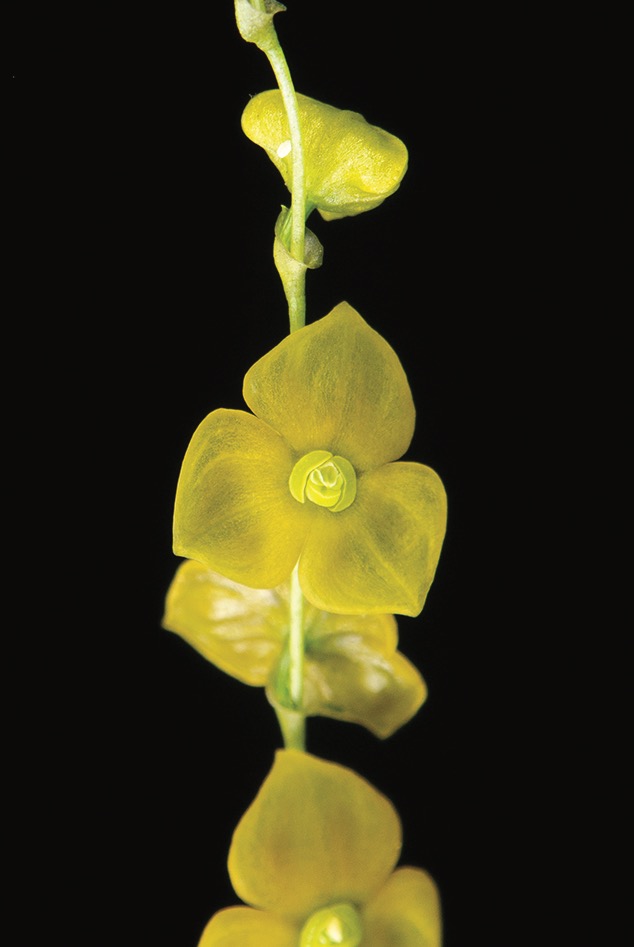
When an orchid is awarded by the AOS, a clonal name is recognized to distinguish the plant from others of the same species or grex. ‘Southern Pines Hallmark’ is an aptly chosen name given its showy, distinctive flowers, which are yellow and orbicular. Other species in the genus tend to be less vibrantly colored, with diminutive flowers. Stelis is a genus of over 500 species found in cloud forests in Central and South America. These plants need high humidity, cool to intermediate temperatures and bright indirect light to thrive.

For the botanical enthusiast, the award description is: 58 flowers and 27 buds alternately arranged on 17 basal, sequential inflorescences to 26-centimeters long borne on a 48-centimeters wide by 35-centimeters high plant grown on an 8-centimeters by 14-centimeters wooden mount; leaves oblanceolate, ascending, 2.5-centimeters wide by 11-centimeters long; sepals broadly ovate, light yellow-green, petals and lip darker minute, yellow-green; column and anther cap yellow-green; substance firm; texture matte; recognized for rarity in cultivation and attractive flowers; native to Colombia, Ecuador and Peru; exhibitor noted that longest inflorescences had been in bloom for over one year.

If a town can be called great based on the things named after it, Southern Pines may not taste as good as Philly or Chi-town, but it’s a lot prettier. 

Pleasures of Life

PLEASURES OF LIFE

A Ghostly Story

A pint of the occult, please, barkeep

By Tony Rothwell

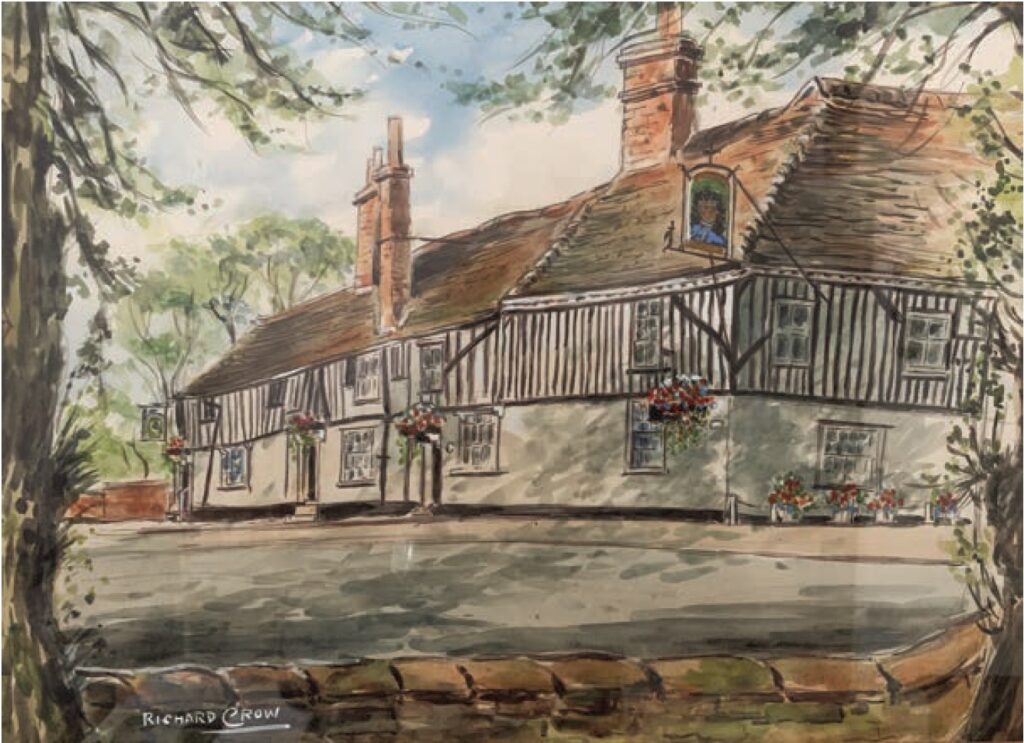
Driving out of London to the east through the beautiful rolling countryside of Essex, you may come across Dedham, a medieval village on the banks of the River Stour. There are a few shops, a handsome church, and a prominent black and white building, the Marlborough Head Hotel. Built in 1495 for a wool merchant, it was first an apothecary and then, in 1704, converted to an inn. The Duke of Marlborough (a forebear of Winston Churchill) was the hero of the day after a number of successful battles in Europe, so it was fitting that the inn should bear his name.

In November 1970, the phone rang at the inn, and a caller with an American accent booked two single rooms. The guests, a man and a woman, arrived at the Marlborough in the early evening and, after settling in, came down to the bar for a drink. Nothing unusual so far. My father, who owned the inn, was filling in behind the bar because Flip, the barmaid, was late.

The man told Dad he was a journalist, sent by Esquire magazine to write an article on English ghosts. He introduced his companion as a medium from the College for Psychical Research in London. They had heard about a ghost sighting in the village and asked my father what he knew about it.

Over the 500-plus years, thousands of stories must have been told in Marlborough’s bar; certainly the inn’s creaking, uneven floorboards, centuries-old beams, huge fireplaces and hidden passages made it the perfect setting for a ghost story.

Dad told them that the previous Saturday night, Halloween, a regular named Phil was walking home in the dark after several pints, and the last thing he remembered before collapsing to the ground was a ghost appearing in front of him. Passersby saw him lying in the road, dead to the world, and carried him back to the inn, where Dad ministered brandy. When he revived, Phil described seeing a white apparition, arms outstretched, screeching.

There was major skepticism in the village about the story, given the alcoholic intake of the storyteller, but it made regional news anyway, and somehow word reached the wider world. The man from Esquire — as luck would have it, already in London — hightailed it out with his medium in tow to investigate. It was, after all, a hot lead.

As Dad told the story, the lady took off her jacket, saying she was getting very warm and was “probably going into a trance.

The London medium started telling Dad his life story — eerily accurate in its detail — including, among other things, that he had two sons, Bill and Tony. But, she said, she was sensing a third name. Charlie.

My elder brother, Bill, got the nickname Charlie when he went away to boarding school, and when I, Tony, followed him to the same school four years later, the nickname transferred to me. There was one other thing: There would be a marriage in the family which would involve someone from Beckenham. As I was the only unmarried person in the family at that point, I took particular interest when Dad passed this bit of information on to me!

Soon the ghost-sighting story started to lose steam. It came out that some village lads had been responsible for the whole thing. They knew Phil always walked home on a Saturday evening around 11 o’clock — following the announcement of “Time gentlemen please!” — and the village, having no streetlights, would be perfect for a big, white-sheeted apparition rising out of the dark. That their prank would go “viral,” or what passed for it in those days, was strictly a bonus.

A year or so later, when I was working in London for a hotel company, I began falling for a very pretty girl, Camilla. We started going out and occasionally went down to her parents’ house in Sussex for the weekend, about 50 miles south of the city. One evening we set out on our usual route but the rush-hour traffic was solid, so Camilla suggested a different way. As we drove through this unknown-to-me territory, I asked where we were. Camilla replied, “Beckenham. We used to live here.” The car swerved a little.

“Did you say Beckenham?” I asked.

“Yes,” she answered, “I’ll show you the house where I grew up.”

I kept the medium’s prediction — now a bit of family lore divined across the bar in the Marlborough Head Hotel — to myself until after we were engaged, now some 52 wedding anniversaries ago. And all because Flip the barmaid was late for work.

Neither the barmaid nor the medium was invited to the wedding — but the story certainly made it. 

Pleasures of Life

PLEASURES OF LIFE

Over the Moon

The beauty among the beasts

By Jason Harpster

Not all Draculas are frightening.

Dracula orchids, also called monkeyface orchids, grow in Central and South America. The genus Dracula means “little dragon” and includes 144 species, many of which have fantastical names of bats, giants, monsters or mythological creatures. Whereas Dracula chimaera and Dracula vampira have appropriate names that fit their grotesque and menacing appearance, Dracula diana stands in stark contrast and is known for its beautiful white flowers.

Daughter of Jupiter and Leto, Diana is a goddess in Roman and Hellenistic religions and is identified with the moon. In Latin, Diana means goddess of light and of the moon, and is often associated with beauty or divinity. In early Roman history, Diana absorbed Artemis’ identity and was later considered a triple deity after merging with Selene and Hecate.

The flowers of Dracula diana are unique to the genus with their predominantly white flowers, which also have a yellow-gold overlay and maroon markings. Some Dracula species have flowers that look like little dragons with their mouths open. Dracula diana has more of a simian appearance; the golden yellow petals resemble eyes, and the pink saccate lip looks like a surprised smile. The flowers are as large as the plant and can reach over 6 inches in length. The native range of this species is West Colombia in cloud forests at elevations around 4,000 to 5,250 feet above sea level, where temperatures rarely exceed 75 degrees Fahrenheit. In addition to being temperature sensitive, the flowers will collapse if humidity drops below 75 percent.

Dracula diana ‘Southern Pines Deity’ AM/AOS was awarded on Oct. 21, 2023, at the Carolinas Judging Center’s monthly judging. The judges commented on how the caudae, the long delicate tips at the ends of the sepals, were gracefully displayed and noted the fullness of the sepals. The creamy white sepals are covered with fine hairs and have a crystalline texture, which makes them sparkle in the sunlight. The flowers on the plant exhibited had better form and were more proportionate than previous awards. The flowers were also the second largest on record for the species.

In consideration of these qualities, the judges awarded the plant an Award of Merit and scored 84 points, which makes ‘Southern Pines Deity’ the highest pointed award on record. It seems fitting that the best example of this species be named after such a special town.

Pleasures of Life Dept.

Pleasures of Life Dept.

Links to the Past

A view from the back nine

By Scott Sheffield

As I eagerly anticipate the playing of the 124th U.S. Men’s Open Golf Championship, I find myself becoming somewhat nostalgic and maybe a little wistful. I have watched every U.S. Open since the late 1950s either on television or in person, and this year’s tournament marks the 60th anniversary of the first Open I watched from the grounds.

The ’64 U. S. Open was held at Congressional Country Club in Potomac, Maryland, a suburb of Washington, D.C. I was 17 years old and a junior member of Belle Haven Country Club in Alexandria, Virginia, also a suburb of D.C. That year the Open Organizing Committee decided to use junior golfers from the area as hole marshals. I was chosen to be one of them.

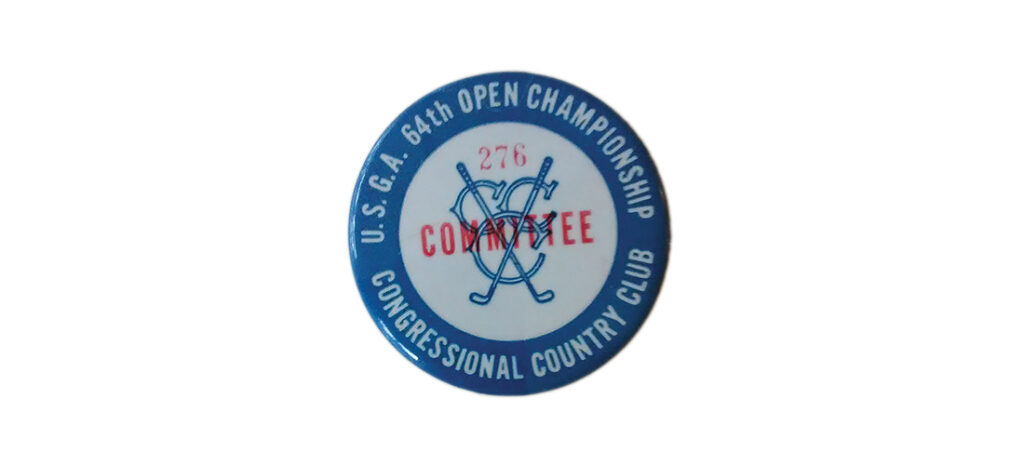
My uniform consisted of a solid dark blue, collarless shirt fashioned from some sort of thin mesh material; a solid red baseball-style cap; and a round white metal badge. In a blue ring around the edge of the badge were the obligatory words stating which Open it was and where it was being played — but what was in the center of the badge is what impressed me. Superimposed over the logo of the club was the word COMMITTEE in bold red letters. I was a member of the Committee! Or at least I thought so then, and never to this day have I tried to discredit that assumption. (The only reason I can state with authority what the badge looked like is because I still have it.)

My assignment was the green on the 15th hole, a par-5. It was situated at the back of the property abutting a fenced personal residence. Some large trees near the fence offered shade, which, as the week progressed, became a welcome and much needed haven from the unusually intense heat and humidity. That area was a refuge for marshals and spectators alike, especially when the kids that lived beyond the fence started selling lemonade at prices that undercut the on-course concession stands — 50 cents for a large, 20-ounce cup and a quarter for 8 ounces, if memory serves. I must have downed 20 large cups or more that week.

I’m convinced volunteers at the championship have it much easier today than in ’64. Our assignments were for the whole day, every day (including practice days), not just a few four-hour shifts. It’s true, volunteers now have to purchase their uniforms, but at least they are well made and can still be worn later. After the tournament in ’64, one of the hottest on record, there was nothing usable left of my uniform. My cap was so sweat-stained I had to throw it away (I wish I hadn’t), and my flimsy shirt literally disintegrated, leaving the badge as my only souvenir.

I have attended six U. S. Open championships in person, three as a volunteer (1964 at Congressional, 2005 and 2014 at Pinehurst No. 2), and three times as a spectator (1973 and 2007 at Oakmont, and 1997 at Congressional). The memories stay with me to this day.

I’ll never forget what Ken Venturi looked like plodding down the last fairway on Saturday afternoon in ’64. Venturi, who under normal conditions appeared thin, looked gaunt and emaciated. As he made his way down the hill toward the green, his shoulders slumped, his gait almost a limp, his color nearly as white as his shirt. I feared he might pass out before he finished the hole. For a while, a golf cart followed the players, apparently in the event Venturi would require medical attention or have to be whisked off the course at a moment’s notice. Thankfully, none of that proved necessary. He parred the hole and won the tournament. We wouldn’t learn until later how serious his condition had been. In ’64, and in most of the years prior, the Open was played over three days — 18 holes on Thursday and Friday, and 36 on Saturday. After Venturi’s struggles, the championship would be contested over four days instead of three. The double round became a relic of the past.

Before I joined the gallery following Venturi, I asked the kids behind the fence how much money they had taken in. They said they were still counting, but the final amount was probably going to be around $3,000. Not a bad haul 60 years ago.

Even though I was only 17 and accustomed to playing 36 holes of golf a day, that week took it out of me. When the Open returned to Congressional in 1997, I went only on Sunday for the final round. At the ripe old age of 50, that was enough for me. I did visit the fence on the 15th that day. Sadly, there was no one there to sell me cut-rate lemonade.  PS

Scott Sheffield is a contributing writer for PineStraw and The Pilot. He may be reached at ssheff@nc.rr.com.

Pleasures of Life Dept.

Pleasures of Life Dept.

All You Knead Is Love

Confessions of a novice baker

By Tom Allen

“Avoid those who don’t like bread and children,” a Swiss proverb says. I’ll second that.

Two years ago, after 10 years in health care and 30 years in local church ministry, I retired. “Whatcha gonna do?” folks asked. Some assumed my wife and I would travel (I thought I’d be underwhelmed by the Grand Canyon — I was wrong), continue writing columns (yep), and most of all, spend time with grandson Ellis, born in April 2022 (you bet).

A chilly, rainy winter marked the first weeks of retirement, perfect for sleeping in. Mid-mornings I poached, scrambled or fried a couple of eggs, Googling various methods to find the perfect recipe. After showering and (sometimes) shaving, I might water houseplants in the sunroom, go for a walk, piddle in the yard, watch Sports Center, or catch up on episodes of Grantchester and The Crown. Afternoons I decluttered the garage and attic, a task I thought would take, maybe, two weeks. Two years later, I’m still decluttering but have mastered the art of selling on Facebook Marketplace.

I came to embrace sleeping late as a gift. But, with wife Beverly still working, other early morning risings became welcomed occasions, silently sipping coffee and watching light pierce our darkened sunroom. And I simplified. After summers of brutal heat and pesky deer, I did away with raised beds, opting to fill our deck with pots of herbs and grape tomatoes, zinnias and cosmos. We emptied and let go of a storage unit and finally joined the legions who ditched cable for streaming. 

I embraced coloring outside the lines, literally, and began dabbling with watercolors. Then, drawing on my years as a hospital laboratory tech, I started to bake bread. My first major in college was medical technology. I loathed the math part but thrived in chemistry and biology labs, mostly because you got to mix this with that and produce something that changed color, fizzed, oozed or lit up.

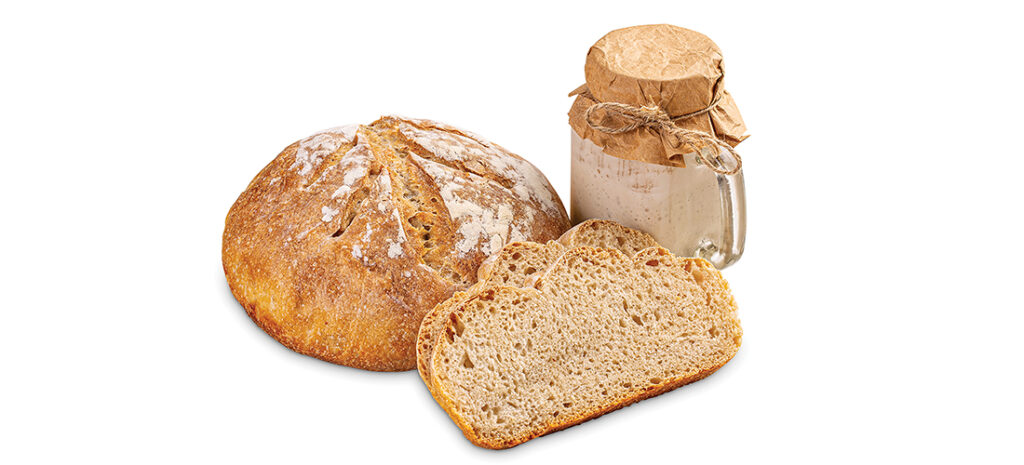
This baker set his sights high, thinking I would join the sourdough social media craze. That lasted about one week. I loved being a granddad to Ellis, not a jar of starter. I decided to have a go at baking yeast bread. I wanted to get my hands in dough, form it into a squishy clump, watch it double in size, then after a few hours, fill our house with that comforting aroma.

Thanks to the same social media that fueled the sourdough frenzy, I discovered a plethora of no-knead bread recipes, most of them variations of Jim Lahey and Mark Bittman’s 2006 no-knead instructions published in The New York Times. The recipe became one of the most popular the Times ever published, mostly due to its simple ingredients — flour, yeast, salt and water — baked in a screaming hot Dutch oven.

Lahey and Bittman’s recipe takes about 24 hours. Most of that time is spent waiting for fermentation and rising. After several trial runs, I settled on a variation that takes fewer hours and produces a round, rustic-looking loaf, a boule in French, with a crackly crust and airy texture. Along with another online recipe that makes two rectangular loaves of honey wheat bread, the Times variation became a go-to, sometimes twice weekly endeavor — one to keep and one to give. I used to think baking bread (and giving it away) imparted an aura to the baker, similar to folks who run marathons or complete The New York Times Sunday crossword before Monday. I don’t know if that holds true for a novice. I do know handing a freshly baked loaf to a neighbor feels good.

I wouldn’t call bread-making a newfound obsession, like my love of Carolina Hurricanes hockey, but there’s something about making bread that’s also comforting and life-affirming. Maybe because yeast, a living organism, leavens and gives life to plain flour and water. Maybe because mixing dough, especially with your hands, and watching simple ingredients morph from a blob into what the 19th century Congregationalist minister John Bartlett called “the staff of life,” is not only short of magic, but likewise sacred. Biblical images abound, from the unleavened bread of Passover to the Last Supper.

From measuring the dry ingredients to mixing the wet, sticky dough with your hands, I wonder if studies have been done to quantify the release of dopamine, one of those feel-good chemicals our brains dole out when we do something challenging, pleasurable or rewarding. Bread-making surely makes the cut.

James Beard once said, “Good bread is the most fundamentally satisfying of all foods, and good bread with fresh butter, the greatest of feasts.”

I’ll have a slice of that, along with a hug from Ellis.  PS

Tom Allen is a retired minister living in Whispering Pines.