
Out of the Blue

OUT OF THE BLUE

Double the Spirit

Warm, kind and generous

By Deborah Salomon

By rights, this column should be brimming with “Christmas spirit.’’ But Santa looks worried. Can the “Christmas spirit” survive with Yule merch suffering tariff shock?

I am the product of a mixed marriage. My father grew up in the Lower East Side Manhattan ghetto of poor Russian and Polish immigrants — all ultra-orthodox Jews. He rejected the strict confines but loved the culture, especially the food. My mother was raised strict Southern Baptist, in Greensboro: no dancing, playing cards or drinking.

They both loved Christmas — the gifts, a big tree with lights, the cookies and fruitcake. Who wouldn’t love the Christmas pageant at Radio City Music Hall with a live donkey, and the animated windows at the Fifth Avenue department stores? Maybe this wasn’t proper but it sure was fun, especially with a new Mary Poppins book under the tree.

I never heard of Hanukkah, or latkes (potato pancakes fried in symbolic oil), or lighting candles for eight days to remember a brave military leader and the miracle of a lantern burning eight days on enough oil for only one.

That changed when we moved to Asheville, which had a vibrant Jewish community. We joined the Reform Temple. I attended religious school.

I married into a relaxed Jewish family and lived for decades in an orthodox Montreal neighborhood. I learned all the intricacies of orthodoxy, but our family was staunchly Reform. Plenty of latkes. No Christmas. But the two holidays, celebrating vastly different events but often falling within the same week, shared one thing: spirit. A spirit more ecumenical than divisive. A happy, respectful spirit. A spirit that addresses the secular and the sacred.

By the ’60s,“Happy Hanukkah’’ had joined the American holiday lexicon. Christian friends enjoyed chanting the alliterative words without knowing the backstory . . . or the preferred spelling. Everybody enjoyed the enthusiasm, the small gifts, one on each of eight nights. Better yet were the close family moments with grandparents and cousins. In other words, the Hannukah “spirit.”

This year Hanukkah ends a few days before Christmas. But a kind spirit is not lit by candles or Rudolph. Certainly not by the latest techno-gadget which will, like those must-have Cabbage Patch dolls, fade from favor. I don’t measure the Christmas spirit in cash. It could be an outing for a senior who no longer drives. Or gently used children’s coats, freshly dry cleaned, in a zippered hanging bag. Maybe an IOU for a dozen rides to church, or a tabletop tree decorated with tiny lights and peppermint Life Savers. I once had a friend who gave out complimentary car washes; another, free babysitting. In many cities Jewish organizations take over volunteer jobs at hospitals on Chistmas day, while church choirs carol at nursing homes.

The Christmas spirit is warm and kind and generous no matter how it’s implemented, and by whom. Participate. Enjoy. Finish off the crown roast with crispy potato latkes. Then pick a language and say a prayer for a better year ahead.

Out of the Blue

OUT OF THE BLUE

Fashionista Frocks

Be-wear the bell bottom

By Deborah Salomon

No, no. Say it isn’t so.

Bell bottoms are back, either solo or as the mean end of a neon pantsuit, maybe with a nipped-in jacket.

Who’s wearing them? Start with the fashion forward TV anchors not yet born in the ’70s, when a similar craze swept America. Of course then they were stretched across the lean, lithe body of John Travolta, gyrating in Saturday Night Fever.

Have you seen him lately?

This second coming snuck back last spring, first as “relaxed” or “unstructured” pants that relieved decades of stovepipe straights and skin-tights. Trouble was, they just looked baggy. Pajama-bottom baggy, especially the jeans.

Jeans, I realize, are like martinis, not to be messed with. Boot cut? Maybe. But never baggy.

Bell bottoms, which flare below the knee, became part of the British Royal Navy uniform in the 1800s. They could be rolled up to prevent getting wet when wearers swabbed the decks. Sailors were even instructed to, in an overboard situation, remove their pants, fill the legs with air, tie them together and use it as a flotation device. I immediately pictured King Charles II thusly occupied and fell over laughing.

Bell bottoms have no place on cowboys, either. Flapping denim might become entangled with stirrups. Boot cuts were as wide as you needed to go to fit over, well, your boots.

Fashion has become a quixotic state of affairs, an art form that reveals much about its wearer. Amish apparel, for example, reflects the tenets of their faith and their extreme modesty. In the secular world our eyes become so accustomed to a fashion that a sudden variant provokes consternation. I remember when, after a decade of miniskirts, the maxi came into vogue, provoking gasps of horror until eyes and minds adjusted.

Horror belongs on the same page as bell bottoms. These pants, as well as leisure suits and sideburns, opened the door to generations of severely repressed men, to whom wearing a pink button-down was practically a federal offense. Ditto earrings and psychedelic prints. “Free at last,” the former preppies shouted as they boogied across the dance floor to “Stayin’ Alive.”

New for fall, ladies can puzzle over the baby doll dress with high waist and very short circular skirt worn over bare legs. In truth, fashion has been an issue since Eve wore fig leaves. Giorgio Armani’s recent funeral turned into a glitterati fest. The clock missed a tick or a tock when Anna Wintour retired from Vogue. And Mona Lisa continues to smirk as she fills out a frumpy brown frock revealing an inch of cleavage. Now, like a fat bear approaching hibernation, I will cease my occasional fashion appraisal, pull on some sweats and take a nap.

Out of the Blue

OUT OF THE BLUE

Sound It Out

A serious case of onomatopoeia

By Deborah Salomon

Lately, when trying not to think about the mess this world is in, my mind wanders to the etymology, history, development, significance of words, especially when uttered by powerful people. Words are free. Anybody can invent a word. Maybe it will enter the lexicon, maybe not. I attempt a colorful vocabulary as a writer and, before that, a student. Nothing a professor likes better than a term paper livened with 50-cent words. Spelled and used correctly, of course.

My favorite words showcase onomatopoeia . . . quite a whopper itself, meaning imitating the sound it defines. The usual illustration is Edgar Allen Poe’s “The Bells,” where sing-song repetition (and alter-whoppers like “tintinnabulation”) suggest Quasimodo pulling the ropes at Notre Dame. The cathedral, not the university. Strange how Americans pronounce those two words differently when referring to the dames residing in Paris and South Bend.

Next conundrum: Which came first, the sound or the word? My mind began spilling out more candidates than M&Ms on an assembly line — a gross exaggeration called hyperbole. Yeah, there’s right much hyperbole floating around these days.

Consider “whistle.” In order to articulate the word, one must purse the lips — as though to whistle. How about “gallop’’ which, when rhythmically repeated mimics the clip-clop of a horse’s hooves. “Soar,” dragged out a bit, allows the kite, then the voice, to rise before leveling off.

“Peck” is as staccato as a hen wandering the barnyard. “Pitter-patter” has no meaning, except how a toddler sounds running across a bare floor in his or her first real shoes. Sadly, it faces obsolescence since most contemporary kiddie footwear belongs to the rubber-soled variety, formerly sneakers until diversified to fit a variety of sports, yet stubbornly called “running” shoes.

Maybe I’m putting the cart before the clip-clop. Not if you agree that “thunder” owns an unspoken rumble that influences enunciation. Same with “scream,” commonly accompanied by a facial contortion, à la Janet Leigh in a Bates Motel shower.

Occasionally, a trope inspires physical rendering, the best being “describe a spiral staircase without using your hands.”

I even dredged up a few words that connect only to their sound, without a clear meaning, like the ocean that “laps” the shore. Lap? Maybe a kitten lapping milk from a saucer —more peaceful than a runner going once around the track in rubber-soled footwear.

Some words, of themselves, trigger action. Say “blink” without blinking.

Once upon a time, meaning what follows may be apocryphal, schools divided their curriculum into headings. My favorite was Language Arts, which likens the study of English to painting sunflowers, a lily pond, maybe a girl with a pearl earring. Right on, especially when active verbs move the brushstroke along. “Mona Lisa smiles . . . ” captures the action better than “Mona Lisa is smiling,” which she isn’t, according to cognoscenti, who mention bad teeth. “Noah fears the water” hits harder than the passive “Noah is afraid of the water.”

Good thing he got over that.

But my best word is “exacerbates,” which shivers like sharp edges clashing.

Conclusion: Words began as a collection of rumbles, splashes, whispers, clicks, chimes, growls, grunts and rustles. Written or spoken, words have become the palette, the gradations, the pictograms, an evolving commodity and, thank goodness, the only thing for which I’m rarely at a loss.

Out of the Blue

OUT OF THE BLUE

Wrap and Roll

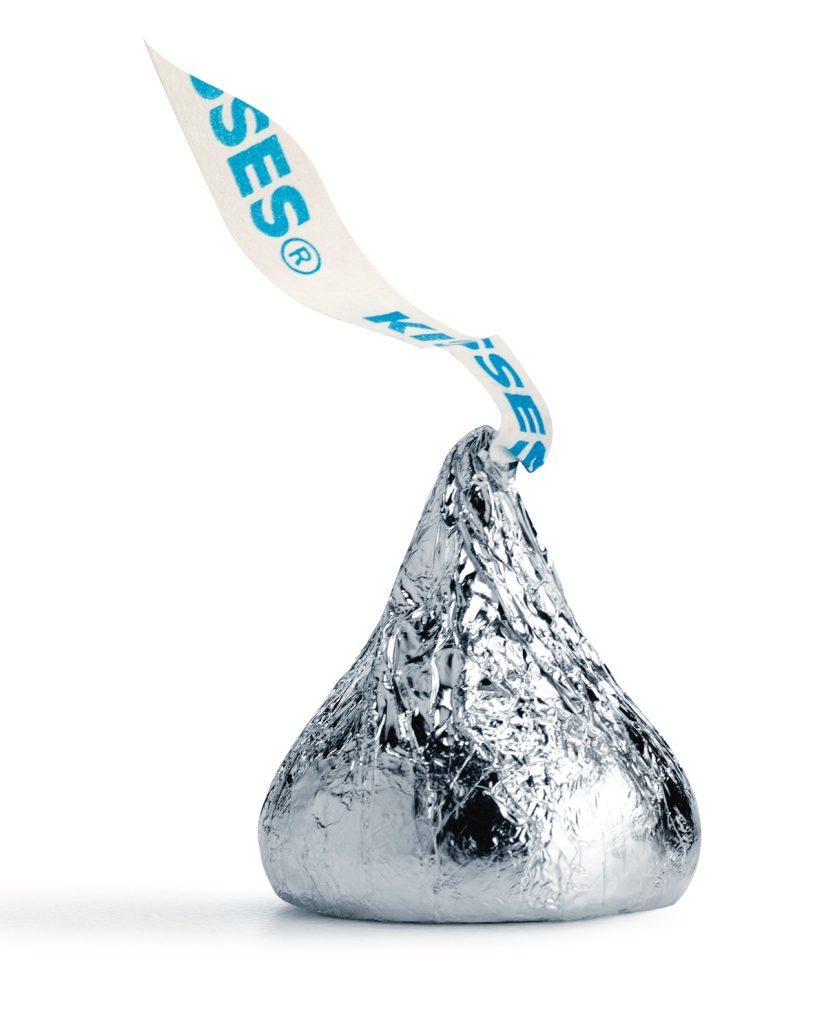
Judging a Hershey’s Kiss by its cover

By Deborah Salomon

These days, given world trade issues, where products originate has become a political issue. Halloween and Christmas won’t be the same if tariffs outprice merch made in China, where neither holiday is celebrated but manufacturing, even with shipping, costs less than producing the stuff Stateside.

Pondering that reminds me of how the Industrial Revolution brought about factories filled with machines that turned out never-dreamed-of products. Some resulted in humorous truisms like, “You can’t put the toothpaste back into the tube.”

How it got there in the first place? Some clever fellow designed and built an assembly line performing a series of functions that turned a flat piece of metal into a tube filled with paste.

These literal “machinations” made mass production possible . . . and a lotta engineers rich, since each product required the design and production of its own machine. Some machines became famous in their own right — like Hershey Kisses, wrapped on a conveyer belt the size of the Jersey Turnpike at the rate of 20,000 a minute at the Hershey, Pennsylvania, factory.

Ever wonder how Oreos are assembled? Are the round wafers identical, top and bottom? The Nabisco website isn’t exactly forthcoming, fearing patent infringement, I guess. At the rate of 400 billion a year in myriad varieties, their machines are calibrated for uniformity. The three-step process turns the chocolate or vanilla wafer on its back, releases the vanilla filling, adds the second wafer. No overhang tolerated. Temperature keeps the filling from oozing out . . . but how is that temp maintained in a factory?

Any malfunction in the process results in the loss of thousands of cookies, which must be converted into the crumbs populating ice cream, yogurt, pie crusts, maybe toothpaste.

I still haven’t figured out how frozen green peas get into plastic bags without spilling all over the factory floor. Another packaging puzzler: the sodden pad that comes between chicken parts and the polystyrene tray. Do we pay for this run-off weighing half a pound?

The most fascinating mechanical wonder is the machine that makes individually wrapped slices of orange processed “cheese.” Betcha never noticed that packages are labeled American “slices” or “singles,’’ not “cheese,” because their formula does not conform to government standards. Unfortunately, Americans value wrappings and convenience more than the flavor of natural cheddar, which melts nicely but develops mold if not properly wrapped and stored. Grilled cheese lovers are squeamish about trimming specks of mold — another quirk for the French to mock.

By the mid-20th century, packaging rendered a brand or product instantly recognizable. Oatmeal still comes in cardboard cylinders, maple syrup in glass jugs with handles, eggs in sectioned boxes. Mayonnaise jars are the same shape, but plastic. The glass originals still deliver soup to a sick friend. Better pasta sauces and a few fruits still come in canning jars with metal twist lids, priced accordingly. Occasionally I see a tall, tin saltines container. In the past, these monoliths enjoyed rebirth as crayon bins. Or Lego storage. The kids made little magnetic Scottie dogs creep up the sides.

Am I the last granny to remember Velveeta bricks in wooden “crates” with sliding tops? Or individual serving yogurts in half the flavors but with snap-on lids?

I still wonder why granulated sugar comes in paper bags, which absorb enough moisture to allow hardening into a brick.

As with mayo jars, I try to reuse containers with secure lids instead of buying new ones at the $1.25 store. For years, the best were 32-ounce Food Lion house brand semi-opaque sherbet containers with a tight lid, perfect for stacking homemade chocolate chip cookies for the flight north to my grandsons. Then FL changed the size and material.

Darn. Took me forever to find a replacement, this time at Lowes Foods: 54 ounce Kemps sherbet, with a secure lid and room for extra cookies.

But first somebody has to eat 54 ounces of sherbet.

Wild strawberry’s the best.

Out of the Blue

OUT OF THE BLUE

Beach Days

Turning down the volume

By Deborah Salomon

About this time of year I long for the beach. Not the honky-tonk kind, its teeming boardwalks lined with high-rise hotels. When my children were small, we caravanned with three other families to Cape Cod for two weeks, sometimes longer. We rented simple cottages several miles from a quiet crescent beach in Dennis, on the bay side of the Cape. A few houses sat high on the bluff near a tiny snack stand. Nothing commercial within sight — not even the parking lot, where you needed a sticker issued by the town.

Just fine white sand, calm water.

I rose at dawn to pack the cooler with lunch, sometimes creative given seafood possibilities and leftovers from the nightly charcoal grill.

Does anything taste better than a wedge of drippy-ripe watermelon by the sea? Or a soggy sandwich filled with garden-ripe tomatoes?

But mostly I loved settling in a low folding chair while water lapped my feet as the tide crept in.

Heaven.

My parents weren’t big on vacations. We spent most summers at my grandparents’ house, in Greensboro. Fear of polio prevented excursions. I remember one jaunt to Jones Beach, a long subway ride from Manhattan, where we lived. I made up for it as an adult, when my husband and I found off-season package deals to St. Thomas, Jamaica, Barbados, Puerto Rico, Antigua — homes to blinding white sand and impossibly turquoise water.

For me, staring out across the sea has a hypnotic effect. The diorama of that Cape Cod cove was enough to wash away — or at least put on hold — fatigue, problems. The children needed nothing more than pails, shovels and beach balls to keep them occupied, while the daddies played touch football and the mommies traded ideas for communal suppers.

Despite ideas, supper was almost always burgers, drumsticks, a big bowl of salad, fruit and Popsicles. One rainy evening I made a splash with spaghetti, a welcome change. S’mores hadn’t been invented but toasted marshmallows worked, as did frozen chocolate-dipped bananas.

By sunset the little ones had faded into bed and the grown-ups opened a bottle of wine.

This was the early ’70s. TVs were black and white. Central AC? Mobile phones? Please, except in James Bond flicks.

I miss the simplicity of those days, on that beach. I miss the soft, steady breeze and warm, rarely hot sun that produced a glorious tan to set off pastel dresses. The beach owned an elemental feel, rightly so, since this cove had probably existed for eons.

When the children were older we spent time at another beach, in Maine, where the expanse of sand was packed hard as concrete and the water, even in August, was cold enough to anesthetize toes. Here, not many people braved the waves. Walking or riding bikes was the primary exercise. Lobster at Barnacle Billy’s, an annual treat. A few locally-owned motels faced the beach, no neon, nothing glamorous. Their decks — perfect for watching the sunrise with coffee and fresh doughnuts from a nearby take-out.

Ahhh . . .

These beach experiences differ from crowded, scorching Southern seashores. They satisfy a need: to turn down the volume, create distance from worrisome headlines.

They allow for naps under the umbrella, for staring at the horizon, for burying toes in the sand and enjoying the sun. For fried clams at a roadside stand. For feeding the gulls, whose raucous rhetoric reminds me of political conventions.

My daughter Wendy felt the same. While at Duke, she and friends would run away to the Outer Banks or Ocracoke. They camped out around a bonfire, probably illegal, but nobody bothered them in November.

Yes, the seashore conveys something basic, timeless, affirming, poetic.

I want to go back.

Out of the Blue

OUT OF THE BLUE

Mothers of Invention

A machine for every task

By Deborah Salomon

The happy truth is Americans have invented and popularized an appliance to perform almost any heretofore manual or mental task, from baby monitors to heart surgery and self-driving cars. The most ubiquitous: cellphones. I love how businesses assume every American owns and uses a cellphone to the fullest extent of its capabilities.

Don’t get me wrong. I’m certainly not knocking them. That would be like knocking Taylor Swift. Or penicillin. Cellphones save lives. But their presence, especially the apps, precludes down time, a blissful indulgence fading fast. There’s proof aplenty in any airport departure lounge, where I slouch in a corner seat, eyes closed, waiting out the delay, while fellow passengers watch Martha Stewart dunk biscotti or Cooper Flagg dunk a basketball.

How about gas fireplaces? A wood-burning fireplace is meant to warm a room. Its beauty and aroma are added attractions. The sight of a glowing log turning to ash doesn’t result from a flipped switch. Why not just put a crackling fire from Netflix on the flatscreen, take the money you saved and buy a cord of dry wood and a bundle of kindling?

Air fryer ovens are huge. Maybe Emeril Lagasse has a mile-long counter, but most kitchens barely accommodate a blender, toaster, food processor and coffeemaker. Yet the ads are so tempting. Let’s build an addition on the house.

Tankless hot water heaters? Sure, you won’t need a clumsy tank in the basement or utility closet. But a power failure shuts off hot water immediately.

I rise long before the sun — and turn on the TV, rich in ads for snake oil, love potions and gadgets like a pedal exerciser where, it seems, electricity pushes the pedals and feet/legs go along for the ride. “So quiet your co-workers won’t know you’re using it.” Personally, I prefer a side of noise and a splash of sweat with my exercise.

But I’d have a hard time living without residential AC.

I don’t hear much about “smart” homes anymore — the kind where you can turn up the heat, switch on the lights and sound system while you’re driving home on the Interstate. That always sounded creepy to me, maybe even dangerous.

Talk about creepy . . . computer-generated personal assistants like Siri, who provide information and answer questions. Most are female, perhaps some kind of 21st century continuation of the cute little secretary image?

And, when your self-driving, self-navigating, self-parking car suffers a fender-bender, how do police or insurance adjusters determine blame, aka, human error?

Occasionally, an improvement backfires. When digital clocks replaced analog, a generation of children had trouble telling time. Same thing, when Velcro replaced shoelaces and the overhand knot became an endangered species.

Of course these are exceptions leading up to the bogeyman called AI, which not even its formulators can explain.

No thanks. I have enough trouble with the real stuff.

Out of the Blue

OUT OF THE BLUE

Cookie Monstrosity

Do crumbs make the man?

By Deborah Salomon

Now, in the sunset of my baking career, I realize that cookies, like clothes, define who we are. That definition is made possible by the plethora of commercial cookies in every shape, flavor and permutation, the poster child being Oreos. Yet questions remain: “How do you like your chocolate chip cookies? Crisp or mushy? Mini, regular or jumbo chips? Bittersweet or a sugar high? Homemade, bakery or commercial?”

For a baseline I offer this personal experience:

My mother adored sweets but never baked, unless you count brownies for the bridge luncheon and slice-and-bake icebox cookies in December, for people who “drop by.” Milano describes her prototype — two tongue-shaped wafers glued together with chocolate. So when push came to shove, she would spread a thin layer of simple chocolate frosting between two vanilla wafers. Back in the days of real vanilla, they were good. Now, the same ploy tastes like Styrofoam.

Milanos themselves have shriveled to nothing, but I love ’em anyway.

Back to matching cookie to personality.

Oreos: Do you twist and lick, or dunk whole? Each camp is battle-ready. Are you a classicist, who rails at Oreo yogurt, Oreo Cakesters?

Fig Newtons retain an almost biblical earthiness; their aficionados recall a time when Birkenstock meant more than a sandal, when only the co-op carried organic veggies. Strawberry Newtons miss the point, although dates might tempt the figgy crowd.

Lorna Doones? A favorite with proper Brits, who prefer a shortbread biscuit with their afternoon tea. Named after the central character in an 1869 British novel, LDs were introduced to the Colonies in 1912. Unpopularity/unfamiliarity now relegates them to an unreachable top shelf.

Garibaldi, the proper name for flat raisin cookies long gone from the monster roster, suited pranksters who insisted the raisins were squished bugs.

Biscotti, despite an Italian aura, belong to intelligentsia wearing plaid and cashmere for weekends at the cottage — a 14-room country manor in the highlands. Either that, or frequenters of the Seattle coffee scene, who know that “Starbuck” is a character lifted from Moby-Dick.

A person’s age may be determined by asking whether he/she remembers Social Teas, so plain and non-sweet I call them punishment cookies. However, they might rightly tempt dunksters with a texture that holds up to cocoa.

The emotionally stunted CEO whose mother denied him cookies because he wouldn’t finish his green beans now, to the ants’ delight, compensates by keeping a box of Nutter Butters in his desk drawer. After all, peanut butter is protein.

Graham crackers, for generations baby’s first treat (since they dissolve in drool), recaptured campfire folks’ attention as s’mores. Recognize s’mores-lovers by their burnt fingers, chocolate-stained T-shirts and faces. At least this mess is worth it.

Is lemon the new chocolate? Observe the interest in Oreo Lemon Thins and Sunkist Thin Shortbread with Lemon Crème Filling. They are cheerful cookies for the smiley-faced set. But watch out, you citrus-seekers. Not all that lemon zing comes from real lemons.

I was terribly upset when Biscoff jumped from passenger flights to supermarket shelves. Aloft, they cause crumbs and greasy fingers. The very mention dredges up memories of long delays, bumpy rides. They make me miss the cute little meal dispensed by flight attendants who weren’t Social Security eligible. When baggage flew free in the underbelly instead of a jammed-up overhead compartment.

A pox on Biscoff!

Picture a svelte 50-something Manhattan career gal, wearing a little black dress and real pearls, slicing a real chocolate wafer icebox cake made with real whipped cream. Alas, Nabisco has discontinued the cookie that made a million reputations. So far, urbanites have found no replacement. Don’t give up. If Voortmans can field an oxymoronic Zero Sugar Fudge Brownie Chocolate Chip cookie, anything’s possible.

Out of the Blue

OUT OF THE BLUE

Strangers on a Plane

To talk or not to talk, that is the question

By Deborah Salomon

From what I’ve noticed, the only remaining conundrum pertaining to air travel is whether a passenger should strike up a conversation with his or her seatmate. If yes, then when? And how? Are there age guidelines? What are the clues that the passenger wedged next to you will be receptive? Notice any body language? I’m assuming the punk rocker with tattoos and wild hair would leave a sweet old lady alone, but who knows? Odd couples happen.

I fly to see my grandsons in Canada three or four times a year. Because I’m old and have a bum knee I get to board first, then watch passengers head down the aisle. Will I get Sumo with T-shirt exposing bellybutton? Mother and fussy baby? Techie toting cellphone, tablet, Kindle, earbuds? Business guy pining for first class? Whatever — I nod, smile, then assume nap mode.

Last trip I encountered someone and something bordering surreal.

I had the window seat — hardly glanced at the woman who stopped to check her boarding pass. I smiled and fished out her safety belt buckle, which had fallen between the seats. I’m not sure how she started the conversation . . . probably, “Are you going home to Montreal?”

“No,” I explained, then shared the reason as I turned to look at her face, full-on. The woman, whose name I learned was Suzanne, was about 60 and uncommonly beautiful, the result of the very best skin, hair, nutrition, exercise and dental care. She lived in Philadelphia, was divorced, a retired RN with two grown daughters.

She asked what I (as a newspaper reporter) call smart questions. Decades ago, this woman would be labeled “well-bred.” Certainly “highly educated.’’

When the beverage cart stopped at our row, Suzanne asked for club soda, which the flight attendant didn’t have.

I asked the purpose of her trip, which proved to be an unusual relationship with a French engineer who worked in northern Quebec. They see each other for a month or two, several times a year, his place or hers.

Interesting. I saw how this arrangement could work for a mature couple, played by Cary Grant and Deborah Kerr. For a title I purloined Alfred Hitchcock’s Strangers on a Train, from the 1950s, when plot and character development mattered.

We spoke of family, travel, technology, aging, health, climate and, of course, politics. Suzanne (not her real name) brought up the subject, gingerly. I broke a self-imposed ban and took the bait.

I told her, a perfect stranger, about losing two children to bipolar disorder, something I rarely discuss. Of course I bragged about my grandsons. I don’t remember if she has any.

The flight from Philly to Montreal lasted an hour-and-a-half. We talked the whole way, connected on many points. I gave her my business card, said she was welcome to email. She offered no identification, not even her surname, which I hardly noticed at the time.

When I got home a friend chided me for revealing personal information to a perfect stranger. “Just wait,” my friend said. “And watch your financial statements. This sounds like a shakedown.”

I was appalled. Has the world become so cynical that random chit-chat becomes suspect? Must we apply “see something, say something” indiscriminately?

Sadly, yes, because these days trust has become a luxury if not a danger. These days children are gunned down at school and pedestrians run over on the sidewalk. And stealing an identity (which I’ve experienced) isn’t much harder than stealing an apple off a pushcart.

I’m beginning to sound like a Twilight Zone episode. However, if my cynical friend is right about the shakedown, then stop the world, I’m outta here.

Out of the Blue

OUT OF THE BLUE

Pet Peeves

There’s always something cringeworthy

By Deborah Salomon

Back in the day when columnists led off with “Back in the day . . . ” or “Webster’s Dictionary defines . . . ” people had “pet peeves,” with peeve defined by Webster as an annoyance or irritation. No explanation on how pet — a warm, fuzzy adjective — got hooked up.

Call them what you will, I’m sure peeves surfaced in the Bible, certainly Shakespeare. By any other name the irritations haven’t gone out of date. Perhaps owning them outright lessens the sting.

Mine include:

Prime-time TV ads for generic versions of remedies that treat sexual dysfunction, both male and female. Ditto “all-body” deodorants hawked on prime time cable. Imagine the questions posed by 8-year-olds.

People who give away puppies in the Walmart parking lot enrage me. Some pups go to good homes, I assume. But for others I fear the worst.

Silly yogurt. Like confetti and birthday cake flavors. The silliest is Oui brand, 5 ounces in a tiny glass cup that, unlike jam and mayo jars, has no reusable lid. My favorite yogurt is lowfat Greek vanilla, with a drizzle of real maple syrup.

“Pancake” syrup . . . yuck. Living and working in Vermont for 21 years taught me that real maple syrup — still gathered and boiled down the old-fashioned way by winter-idled farmers — is true nectar of the gods, priced accordingly but worth the splurge. Mix with mustard and use sparingly on broiled salmon and roasted chicken, plain on cooked carrots, oatmeal. Dilute with cider vinegar for salad greens. March was syrup month long before it was basketball madness.

Talking to a machine. Bank, power and cable companies leave me foaming at the mouth. I finally cracked the code: Say “representative” over and over until you get one, who is usually polite and helpful from six time zones away.

TV anchor-and-weather women wearing cocktail or mini-dresses and strappy sandals at 7 a.m. Cleavage and knees don’t go with bacon and eggs.

Event ticket prices. Moore County boasts an inordinately large roster of lectures, plays, concerts and other entertainments both low- and highbrow. But with ticket prices starting at about $25, how can a couple have a reasonable dinner out and attend for less than $100? Student prices are some help but the upshot keeps Gen Now shackled to streaming. I spent college summers working in New York City. We starving students spread sleeping bags outside Broadway theaters at midnight, to cop SROs available at dawn for $5. What fun! But not new. At Shakespeare’s Globe Theater, common folk stood in the “pit” just below the stage for a penny. This practice inspired the Bard to include characters and situations familiar to mosh-pitters.

Remember Johnny Depp as Edward Scissorhands? Current version: Cecelia cellphone hand. She walks through life, cellphone Krazy Glued to her palm, as though awaiting a call from the ghost of Elvis.

Too many burger joints. I’ve heard tell there’s a spot on U.S. 15-501 that is equidistant from six, maybe seven burger emporia. Enough already!

Climate change deniers. If they have a better answer to the hurricanes, blizzards, floods, tornadoes, heat and cold waves I haven’t heard it. Abandon Mother Earth? For Mars?

Southerners running around on the coldest day sans coats. “I’ll only be out for a minute,” they protest. Get a grip — and a puffy jacket or double-breasted tweed. The trick to staying warm is to not get cold in the first place.

Supermarkets that don’t offer rain checks. “Loss leaders” aim to get shoppers through the door. But unless rain checks are offered for specials not in stock I feel cheated.

Politicians who spit out rambling non-answers to pointed questions. “Yes” and “no” aren’t in their vocabularies. I say, throw ’em into the mosh pit!

Out of the Blue

OUT OF THE BLUE

It’s in the Bag

The clutch that says it all

By Deborah Salomon

Back in the 1940s, radio personality Art Linkletter would go through women’s purses, creating profiles based on what he found.

He was usually spot-on. Sometimes embarrassing, always hilarious.

Not sure if the Smithsonian has a nook devoted to purse profiles. If not, maybe it oughta make room for this revealing artifact. But instead of a dive into contents, I’ll extrapolate information from the purse itself, notably what sets it apart from ancestors.

In a word . . . compartments.

Some ladies like ’em inside, others prefer the exterior. Notice that both interior and exterior may or may not have zipper, snap or Velcro closures. Some side compartments are narrow with no closure, designed to stash eyeglasses but prone to losing them. Others, square and flat, accommodate a tablet.

No, not the kind with lined yellow pages.

Most women designate one compartment for lipstick and a comb. “Compacts” are so Art Deco, along with bright red lipstick and loose powder. Nothing dates a purse more than a skinny flip-phone compartment . . . except maybe the material it’s made from.

Back in the day, ladies’ winter handbags were hand-held leather of various grades, from coarse cowhide to fine calfskin. Queen Elizabeth II set the style. Call it grandmotherly. Spring meant shiny black patent leather. Come summer, you switched to straw or quilted cotton. The advent of vinyl/plastics resulted in stiff imitation leather adorned with brassy bling. They were big and heavy, even empty. A worse affront: designer knockoffs, an insult to YSL, Louis Vuitton and Chanel, sold on Manhattan street corners. But they did establish one rule: A brown YSL goes with any color outfit.

As for shape/size, shoulder bags took over when women ditched the bridge club for a business forum, a court hearing, surgery schedule or middle-school soccer game. Princess Diana put clutches on the map, primarily to hide her cleavage when emerging from a Rolls. A shoulder bag that left hands free to text Chinese take-out became roomy enough to stash leotards for a workout on the way home from the office. 

Contents, or the lack thereof, offer another readout. Here’s what you won’t find in the modern woman’s handbag: a checkbook; cigarettes and lighter; a wad of “emergency” cash; Chiclets; a single-function car key; an address book; a rain bonnet; movie ticket stubs; a Neil Diamond CD; a map; a pencil; bobby pins; stamps; a tiny metal aspirin container; a handkerchief; a safety pin for the dreaded bra strap malfunction.

How come only men carry handkerchiefs?

Speaking of men . . . remember the man bag, which made a splash in the 1990s? Before the invention of pockets, Renaissance noblemen carried coins in “girdle pouches” without incurring ridicule. And a 5,000-year-old mummy named Ötzi the Iceman was found in the Alps beside his purse. No such luck for 20th century gents when, as I recall, even a plain leather crossbody drew giggles.

These days, the most coveted clutch might be a little thing hardly big enough for an iPhone, designed by Judith Leiber, who isn’t above wrapping a snake around black sequins and charging a few thousand for it at Bergdorf’s.

Now if only I didn’t need four new tires . . .