Golftown Journal

Pins and Needles

An old gem delivers a new test

By Lee Pace

The dominoes started falling in 2008 when Pinehurst Resort President Don Padgett II and USGA Executive Director Mike Davis were both of the opinion that Pinehurst No. 2 had evolved over time into a course that was too green, too smooth, too organized and too tidy. That led to the decision in 2009 to hire architects Bill Coore and Ben Crenshaw to recast the fairways, the rough and the bunkers into a presentation more consistent with what architect Donald Ross knew from his days as a young golfer and greenkeeper at Royal Dornoch Golf Club and the St. Andrews Links.

Jim Hyler, the incoming president of the USGA, threw down the gauntlet in February 2010 at the association’s annual meeting, held coincidentally at Pinehurst and just days before Coore and Crenshaw would begin surgery on No. 2.

“We must reset the way that we look at golf courses,” Hyler said. “As we have for the U.S. Open, I believe that our definition of playability should include concepts of firm, fast, and yes, even brown, and allow the running game to flourish. We need to understand how brown can become the new green.”

One of the shapers on the Coore and Crenshaw team was a young Oregonian named Kyle Franz, who had worked on bulldozers the world over, not only for Coore and Crenshaw but Tom Doak, Gil Hanse and other architects. Given a dollop of ambition and entrepreneurial spirit, Franz approached Kelly Miller, head of the ownership family of the Pine Needles and Mid Pines resorts in Southern Pines, and suggested similar overhauls to those classic Ross courses — like No. 2, layouts sculpted from the sandy soils in the early 1900s that over time had become too suffocated in long Bermuda grass. Miller accepted, and away Franz went to Mid Pines, engineering a remarkable face-lift that was finished in 2013 to rave reviews.

Mid Pines was now exquisitely framed with sand, wiregrass, ragged borders and an array of textures, and Franz began tinkering across Midland Road in 2016 on Pine Needles. The result will be on display in late May and early June, when the 2022 U.S. Women’s Open is held at Pine Needles for the fourth time. Its previous champions include Annika Sorenstam in 1996, Karrie Webb in 2001 and Cristie Kerr in 2007.

The banner headline: There will be essentially no rough on the golf course.

No rough at a U.S. Open? Egad. The starched shirts and rep ties are rolling over in their graves.

“I was looking at some photos from 2007, shots showing Cristie coming down the 18th fairway,” Miller says. “You had thick Bermuda everywhere you looked, all green grass. It’s quite a contrast now.”

The last time the Women’s Open was held at Pine Needles, a golfer could stand on the tee of the par-4 fourth hole, for example, and look to the left and see a round bunker with 10 yards of lush grass between the hazard and the fairway. What was the point of the bunker given the ball would rarely run though all the vegetation into it?

Now the bunker is amoeba shaped and juts into the fairway. The right side of the bunker is bordered by tight Bermuda fairway, the left by hardpan sand and pine needles. On the top of the bunker is a profusion of scraggly wiregrass. The fairway on both sides rolls straight into sandy waste areas. Gazing up toward the green, there is nothing that speaks of structure or organization.

“We’ve cleared out all the rough and now have sandscapes, hollows and hardpan,” Franz says. “There are some Pine Valley looks out there.”

Mid Pines opened in 1921 and Pine Needles followed in 1928, the former a lynchpin of a hotel and private club, the latter the drawing card for a hotel and new residential development. Franz marvels at how Ross built disparate layouts within the same footprint of what was known at the beginning as the Knollwood development.

“I love the contrasts between Mid Pines and Pine Needles,” Franz says. “Mid Pines is built more in a bowl, and a lot of balls get kicked back toward the center of the fairway. At Pine Needles, most of the strategic elements of the course are derived from the fact that you’re constantly trying to hit on top of a hill on the tee shot. That’s Ross’ genius with the routing.”

One-third of the holes at Pine Needles have crests running perpendicularly across the fairway. Hit into the slope on one, two, six, seven and 12, and you lose distance. Carry the high point and you get a slingshot boost toward the green. The 18th doesn’t have that ridge, but there’s definitely a speed slot you can catch with a tee ball curved right-to-left. And by expanding the fairway widths, the golfer has more latitude to aim tee shots one way or the other to afford a better angle to the pin on a particular day.

“The course will play firm and fast, the way it should play,” Miller says. “I think it will be fun for the golfers. Last year at the Olympic Club, if you missed the fairway, you were in the hay. There’s virtually no rough here. Kyle has revealed the genius of Ross’ routing — you have to hit to the proper side of the fairway. You can have a tough approach if you hit to the improper side.”

The final significant change to the course from previous Women’s Opens is the speed, firmness and articulations in the putting surfaces. The greens were converted in 2016 to MiniVerde Bermuda, following the trend throughout the Mid-Atlantic of the last dozen years to ride the wave of more heat-tolerant Bermuda grasses that don’t need the water and maintenance demands of summertime. Franz took the opportunity during the conversion to integrate what he calls “horse-and-blade caliber micro-contours” in the greens to add interest and challenge to the putting element.

“There aren’t any elephants buried in these greens, but Kyle put far more movement in them,” Miller says. “There are cool locations on all of them. I think the Bermuda greens and wider fairways will work well. In Ross’ era, golf was played more along the ground. Now it’s more in the air. But the Bermuda greens are firmer and offer a more challenging surface.”

USGA officials expect weekend crowds upward of 15,000 spectators, similar to the draw from 2007, but the corporate hospitality footprint will be more modest given that two years of COVID suffocation left the USGA and potential clients with no clarity of what late May and early June 2022 might allow.

But the vision for the golf course is razor sharp, a remarkable thing indeed for a layout now 94 years young.  PS

Lee Pace has written about the Pinehurst-area golf scene for more than 30 years, including authoring Sandhills Classics — The Stories of Mid Pines & Pine Needles. Write him at leepace7@gmail.com and follow him @LeePaceTweet.

Golftown Journal

Stumbling Into Happiness

When Pinehurst is the journey’s end

By Lee Pace

James Walker Tufts had no grand design on a New England-style village nor wall-to-wall golf courses when he set off from Boston in the mid-1890s. He wanted warm weather and a reasonable train ride from the snowy North to establish a winter resort, and it was by pure coincidence that he happened upon some 5,000 acres of land for sale just west of Southern Pines, the suggestion coming from a Wilmington insurance man he met on the train.

Walker Taylor, legend has it, suggested that the train station in Southern Pines might be a good starting point for Tufts. It was right on two of the nation’s major north-south transportation arteries — the railroad and U.S. Highway 1. Well, highway might be a bit of a stretch for the 1890s, but you get the idea. There was cheap land available, and it was halfway between Boston and Florida.

“It’s an old family story,” says Walker Taylor III. “I have no way of proving its authenticity. But my grandfather always said he directed Mr. Tufts to the Sandhills. True or false, he did get the Tufts’ insurance business. He even opened an office in Pinehurst to service Mr. Tufts.”

So, how did you stumble upon Pinehurst?

Stan Bradshaw and his wife, Jean, were living in St. Louis in 1997 when they channel-surfed across a television showing of Shell’s Wonderful World of Golf. The episode featured Arnold Palmer against Jack Nicklaus, played on Pinehurst No. 2 in April 1994. Those shows were part competition and part golf travelogue, so the Bradshaws were intrigued with the history and ambience of the golf-centric village in the North Carolina Sandhills.

“You know, we ought to look at that place,” Jean said.

Stan agreed, and soon after they booked flights, rooms and golf times for themselves and Jean’s parents. They traveled to Pinehurst in November 1997, and while the men played golf, the ladies toured the village and checked out The O’Neal School, a college preparatory school on Airport Road just northeast of Pinehurst.

Stan and his father-in-law were smitten.

“But how are you going to get Jean to move to a golf resort?” Stan’s father-in-law wondered.

“I’ll figure something out,” Stan answered.

It turns out the women were so impressed with The O’Neal School that Jean was ready to move — lock, stock and barrel. Bradshaw was in the banking, capital management and hedge fund world and could “live anywhere within an hour of an airport,” and thus had the freedom to move wherever suited the family’s interests. They joined Pinehurst Resort and Country Club, bought two lots to the right of the fourth fairway of the No. 2 course in 1999, and built a house.

“We say that the three things that got us to Pinehurst would be Jack, Arnie and The O’Neal School,” Bradshaw says.

Mark Reinemann grew up in Wisconsin and as a golfer “was always looking in the spring to travel somewhere warm for golf — typically either southwest Florida or Scottsdale,” he says. He and his wife over time came to prefer the green of the South over the brown of Arizona, though Florida wasn’t their cup of tea. He visited Pinehurst in the late 1980s, loved the experience, and was introduced to the Country Club of North Carolina through a banking client and CCNC member, Jack Schwerman.

“Jack invited us to stay at his house for a long weekend in 1988 and we just fell in love with CCNC,” says Reinemann, who served seven years on the USGA executive committee and retired from the banking business in 2016. “It was one of those ‘perhaps someday we could be a member here’ moments. Fast forward and here we are.

“We love the charm of the area, the slight change in seasons, the grace and style of the people who live here and, of course, the world-class golf. We never deviated from our plan to move here full time once I retired and have absolutely no regrets. We just love it here.”

Robert “Ziggy” Zalzneck was enraptured as well by CCNC and the Sandhills, on Christmas Day in 1967. At the time, he was a young accounting intern in Raleigh a long way from his Pennsylvania home. He was given access to CCNC by his boss, club co-founder Dick Urquhart, and had the place to himself on the holiday. “I played 36 holes and it was 70 degrees,” says Zalzneck, who later joined the club and has served as president. “It was the prettiest place I’d ever been my whole life. I’ve loved the place ever since.”

Marty McKenzie is a lifelong Pinehurst resident and real estate executive who loves to wax poetic about the “magic bubble” of the village of Pinehurst — the winding streets, the thick tree canopy, the absence of visual clutter.

“As human beings, when we try to describe something to people they’ve never seen, we always use the five senses — it looks like, tastes like, feels like — whatever. When you try to describe Pinehurst to other people and you think of those senses, you can’t find anything. Nothing comes to mind. Pinehurst doesn’t look like anywhere else,” McKenzie says. “People drive into the village and they’re absolutely paralyzed. They look around and say, ‘This is the most beautiful thing I’ve ever seen. How can I be a part of it?’ We take for granted we have the same status as the Washington Monument and Mount Rushmore — all of those are National Historic Landmarks.”

That bubble once snared a first-time visitor to Pinehurst on the second-floor porch of the Magnolia Inn. It was there amid the century-old magnolia trees over Memorial Day weekend in 1994 that Jane Deaton of Sea Island, Georgia, opened her eyes to the magic of Pinehurst.

“We arrived late the night before so we didn’t really know where we were,” she says.  “I walked out on the balcony the next morning and thought, ‘Oh, my God.’ It took my breath away. It was glorious. The village literally unfolded beneath me. I said, ‘I want to live here.’”

That day, Jane and Brian Deaton found a real estate agent and within the week bought a vacant lot at the intersection of Culdee and McKenzie roads, just two blocks behind the Carolina Hotel. Their new home was finished at the end of 1998.

Earl Ellis was a floor trader at the New York Stock Exchange in the 1980s and later a partner in a Wall Street specialist firm. Ellis and his wife, Anne, had a vacation home in Florida, but since Ellis, in his words, “liked Florida but didn’t love it,” they began scouting in the early 1990s for options, including the Carolinas and Georgia coasts. A friend was a founding member at Forest Creek Golf Club and suggested Ellis visit Pinehurst. The Ellises drove through town on the way back north from Florida and got a room at the Holly Inn one day in 1997.

“I just fell in love with the village,” Ellis says. “The thing that’s intriguing about Pinehurst is that if you’re in Pinehurst, you’re in Pinehurst because that’s where you wanted to go. There’s rarely someone who goes through Pinehurst to get somewhere else. So, you don’t have all this transient traffic. Everybody is playing golf and laughing it up at the bars and restaurants. There was something special about the feel of the place.

“It was like Brigadoon. It seemed too good to be true.” PS

Lee Pace has written about the Pinehurst experience for more than three decades from his home in Chapel Hill.

Golftown Journal

Off for Pinehurst

Our embarrassment of riches

By Lee Pace

This email landed in my inbox toward the end
of 2021:

“I’ve been following you via social media the past several months and wanted to seek your advice. I’m planning a golf trip to the Pinehurst area for the fall of 2022. What would you consider ‘must/essentials’ for this trip? I am thinking we will go to the Pinehurst Resort but also wanted your opinion and experience about other courses that might not be as popular but would provide an authentic golfing experience.”

It occurred to me in responding to this golfer from Knoxville that those of us who are local or frequent visitors take the Pinehurst experience for granted when so many have never actually ventured into Moore County. And those of us who are familiar with the wonders of the Sandhills travel scene have to stay on our toes with the constant evolution of the golf, amenity and accommodations market. As Pinehurst Resort President Tom Pashley says, “Someone who hasn’t been here in 10 years would be amazed at what they find.”

A favorite framing in my office is the quintessential drawing of the Pinehurst Golf Lad in New York’s Grand Central Station, circa the Roaring ’20s, his golf bag schlepped over this shoulder amid the nicely dressed swells with the words “Off for Pinehurst.”

Herewith, then, a nickel tour for anyone on their way to Pinehurst:

The Core (the heartbeat of Pinehurst and the Pinehurst Resort and Country Club, where courses No. 1-5 emanate) . . . soak in the history along Heritage Hall and revel in the photos and plaques of golf’s luminaries who have won here . . . pose for a photo beside the statue of Payne Stewart, captured in his exhilaration when his putt dropped to win the 1999 U.S. Open . . . walk the 6-odd miles of the premium courses, No. 2 and No. 4, feeling the taut, sandy loam beneath your feet, absorbing the cacophony of colors and edges of the holes, learning to play the bounce of the ball to an array of green complexes . . . stroll The Cradle short course with a couple of wedges and a putter, bobbing to the strains of Red Hot Chili Peppers popping through a discretely placed speaker in a tree . . . ply your putting skills on the Thistle Dhu putting course, which winds its way a hundred yards out and back over an array of humps and hollows . . . all the while slaking your thirst with a Transfusion from the Cradle Crossing beverage center.

The Village (laid out in 1895 by the landscape architecture firm of Frederick Law Olmsted to resemble a New England village; it’s void of 90-degree road intersections and dominated by white and forest green accouterments) . . . enjoy a hefty deli sandwich on the veranda at the Villager Deli in the heart of Old Town . . . pound a beverage with the locals from a rocking chair on the porch at the venerable Pine Crest Inn, once owned by golf architect Donald Ross . . . sip one of 70 brands of bourbon, rye and Scotch in the hippest bar in town, the North and South in the newly renovated Manor Inn . . . douse some smoked pork shoulder in blackberry habanero sauce at the Pinehurst Brewing Company . . . buy a cashmere sweater at The Gentlemen’s Corner or a rare painting of a Scottish golf scene at Old Sport and Gallery . . . sift through the memorabilia and display cases at the Tufts Archives in the Given Memorial Library and marvel at James Tufts’ original marble soda fountain machine, the source of the fortune from which all these golf riches flowed.

And don’t forget Broad Street, the Southern Pines version of Main Street U.S.A. . . .  there’s nothing quite like a well-run, independent bookstore, and The Country Bookshop is exhibit A . . . for a great burger and pro golf on the big TV, there’s the Bell Tree Tavern, and for dessert there’s The Ice Cream Parlor and its primo location at the corner of Broad and New Hampshire . . . the Sandhills area is chock-full of interesting craft brewing venues, one of the most popular in the Broad Street neighborhood is Southern Pines Brewing Company with its corner location on Pennsylvania and Bennett, spacious outdoor seating and over 30 draft selections.

The Ross Triumvirate (a collection of three pristine Donald Ross courses under the same ownership umbrella — Mid Pines from 1921, Southern Pines Golf Club from 1923 and Pine Needles from 1928) . . . all three have come under the painstaking attention to detail of architect Kyle Franz in the last decade and the essential challenge of each burnished, from the stark crossing features at Southern Pines to the up-and-over fairways at Pine Needles to the exquisite green settings at Mid Pines and its spot nestled in a bowl of surrounding hills . . . play the Pine Needles course, where later this year it will host its fourth U.S. Women’s Open (a fresh-faced Annika Sorenstam won in 1996), dodge the ponds at Mid Pines, where Julius Boros loved to fish during pro tour stops in Greensboro, and play the out-and-back routing at Southern Pines, where Ross made the best use of the land by not shoehorning a ninth-hole return to the clubhouse.

The Outskirts (with three dozen courses within a 30-mile radius of Pinehurst) . . . Three of my favorite courses in the Sandhills are private (Forest Creek North, Country Club of North Carolina Dogwood and Dormie), so if you know someone, beg, borrow and steal for an invitation. There are no such restrictions at Tobacco Road in Sanford, a half hour north of Pinehurst, just a dearth of tee times as the popularity of this eccentric and visually stimulating course has skyrocketed during the COVID-inspired golf boom. Architect Mike Strantz cobbled it from an abandoned sand pit and farmland, and the mammoth mounds, mottled grasses, railroad ties and fescue rough accent the routing.

It’s all quite the experience. I hope our man from Knoxville has fun.

“What a place, what a cluster of golf, what a home for golf,” marvels Mike Keiser, the developer of the noted golf destination Bandon Dunes and a fan of Pinehurst. “Most of these clusters are up north, and you can’t play in the winter. Pinehurst and Pebble Beach are places you can play year around.”

What do you know? It’s the Roaring ’20s again. PS

Lee Pace has written about golf in Pinehurst and the Sandhills for more than three decades. Write him at leepace7@gmail.com and follow him @LeePaceTweet.

Golftown Journal

It’s a Llamaversary

Talamore’s trademark is in its fourth decade

By Lee Pace

When Philadelphia businessman Bob Levy ventured into the Sandhills three decades ago to launch a golf venture halfway between the Pinehurst Resort bastion to the west and the Pine Needles/Mid Pines juggernaut to the east, he was savvy enough to understand the need to have a clever and engaging marketing hook.

Levy remembered a story in Golf Digest in the 1970s about Chi Chi Rodriguez playing a course in Mexico with his golf bag strapped across the back of a donkey and thought a similar beastly caddie idea might work at Talamore Golf Club. He did some research and learned that a llama would be a better idea for the climate of the Sandhills, and thus Talamore opened in 1991 with golfers having the option of hiring a llama to schlep their golf bags around the Rees Jones-designed course.

Photographs of the llamas doing their thing appeared in hundreds of newspapers and golf publications as the club opened its operation just off Midland Road, halfway between Pinehurst and Southern Pines, and Levy’s marketing staff later created a logo featuring the outline of a llama with a flagstick emanating from his midsection. Displayed in green and yellow, the mark had a striking resemblance to the map-and-flag trademark of a certain golf club in Augusta, Georgia.

Talamore staff thought it something of a badge of honor when the club received a cease-and-desist letter from Augusta National’s legal team. The llamas are no longer used as caddies, but they reside in a pen near the 13th green and are a popular diversion and “selfie” fodder for visiting golfers.

“Everyone knows our llama logo,” says director of golf Tag Leon. “We still use it — just not in green and yellow. We were not going to do battle with those guys. But it’s a cool image. We’ve sold a lot of merchandise with the llama over the years.”

Talamore and its sister property on the north side of Midland Road, Mid South Club, were 1990s entrants to the Sandhills golf derby, playing off a bustling golf economy nationwide and the burgeoning popularity of an area that hosted a U.S. Open, U.S Senior Open and U.S. Women’s Open that decade.

Talamore was conceived as a daily fee/resort course amid the early 1990s golf boom and remains so today. Mid South is a 1994 Arnold Palmer/Ed Seay creation originally known as Pinehurst Plantation and planned as the centerpiece of a gated residential community. It changed owners in the early days and was later rebranded as Mid South, and then picked up by Levy in 2004 as a companion course to Talamore. Mid South remains a private club, but guests in the hundred lodges built over two decades at the two addresses have access to the course.

Both courses and the club facilities have undergone extensive renovations in the 2016-17 window, each now sporting Bermuda greens and updated dining and drinking facilities.

“I’ll put our two courses up against anyone,” says Matt Hausser, the general manager over the two courses who started as an assistant golf pro in 2003. “Both courses are in fantastic shape — fast greens and good fairways. It’s a great one-two punch. Mid South has a lot more water, and Talamore has more rolling topography and makes you play a lot of shots. You get a different feel at each course.”

Rees Jones has extensive personal history in the Sandhills and remembers as a kid staying at the Holly Inn when his father, noted architect Robert Trent Jones, visited to attend golf architect meetings and work on the redesign of Pinehurst No. 4 prior to the PGA Tour visiting in 1973, and on the collaboration with Willard Byrd on the design of the Cardinal Course at the Country Club of North Carolina. Rees designed Pinehurst No. 7 in the mid-1980s and immediately afterward was commissioned by Levy for Talamore, the name coming from a Gaelic word meaning “land of great value.”

“Anytime you get an offer to design a golf course in Pinehurst, you get pretty darn excited,” Jones says. “I couldn’t wait to come back here and do Talamore. The land is very rugged. It has an awful lot of character. It lent to a very dramatic golf course. Strategy is a big part of the game at Talamore. In Pinehurst, you’ve got to build character and challenge, there are so many good golf courses.”

The Mid South course winds around a half dozen lakes, the most noteworthy the one providing the anchor for the ninth and 18th holes and the double-green complex. The par-5 ninth runs right-to-left and downhill into the green, and 18 turns left-to-right into the green. There’s a safe approach on both holes and a more aggressive line as well. The clubhouse sits on a plateau overlooking the green complex and the lake.

“This is a dynamite golf course,” said Seay, Palmer’s longtime design associate who lived in the Sandhills area from 1964-68 while working for Ellis Maples on the design and construction of the Country Club of Whispering Pines and Woodlake Country Club. “It’s everything a golfer could want. It’s one of the best we’ve done. Every hole nestles right in. From one hole to the next, you do not find a similar piece of ground. The variation in contour is remarkable for an area thought to be flat. That’s one of the charms of this golf course.”

Mid South and Talamore operate a golf packaging business and can house golfers in villas clustered around the clubhouses and set golfers up with tee times at other area courses. Golfers are feted in-season with Monday and Thursday night pig-pickings at Talamore, and in 2022 Talamore will have installed 10 Toptracer stations and a short game area with a 12,000-square-foot putting green. The new amenities will turn the practice range into part game emporium and part sports bar, giving golfers an interactive and social experience during twilight and evening hours.

“We can sleep 400 people on property,” says Hausser. “We’re giving them more reasons to get on property and stay on property. It will be a great hangout spot.”

Consider the irony: Toptracer’s ball-tracking technology and array of virtual golf courses allow a golfer to tee it up on many world-renowned courses. Imagine playing the harrowing par-4 fourth on Pinehurst No. 2 from a virtual hitting bay just 3 miles away. Pinehurst and its U.S. Open venue have a lot of history, for sure, but Talamore and Mid South are forging new ground in remaining relevant. PS

Golf writer Lee Pace has written about golf in the Sandhills since the late 1980s and has authored a dozen books about clubs, courses and the people who’ve made it special over more than a century.

Golftown Journal

By Lee Pace

It’s the banana ball that balloons into the wind and is funneled into the hinterlands to the right. It’s the duck hook that runs like a scalded dog into the woods left. It’s that bladed wedge that flies into the weeds and dark catacombs beyond the green.

A bad shot at Tobacco Road Golf Club provides opportunity. For Martha Hudson with her trusty iPhone camera, the possibilities are endless.

“Most of the really interesting angles that I find usually happen when I’m playing and I’ve hit a really horrendous shot, or I’m helping someone look for a ball,” says Hudson, a golf staff member at Tobacco Road who manages the course’s social media platforms.

Over the last six years, Hudson has learned to work with dexterity, documenting the skies, shadows and seasons of a course designed by Mike Strantz in 1998 and carved from a sand pit 30 miles north of the village of Pinehurst. Showcased at various times on the club’s Instagram account, which numbers more than 26,000 followers, are the mottled grasses and dramatic hillocks around the blind-shot 13th green; the mammoth mounds bordering the pathway of the tee shot on the first hole; the weathered railroad ties up to the ninth tee, or others providing access to bunkers around the course. There are misty mornings, full moons at dusk, and the ecrus of dormant grass in the winter.

“For me, it’s capturing all of what makes this golf course so unique,” she says. “The features, the green shapes, the undulations, the light at different times of day and different seasons. I wasn’t here when the course was built, but the guys who were here talk about how Mike saw everything as art. That artwork has matured over 20 years. That’s what I try to capture.”

Tobacco Road is one of the Sandhills area’s most distinctive golf courses. It’s appropriate then that the club has one of the most cutting-edge social media presences, particularly on Instagram, the medium of choice for millennial and Generation Z golfers looking for eye candy and interaction with their fellows. It can hardly rival the reach of Pinehurst Resort and Country Club with its 68,000-plus Instagram followers and a worldwide presence via more than a century of existence and its position as a U.S. Open “anchor site,” but Tobacco Road dwarfs every other golf venue in the area.

Hudson, a former collegiate golfer at the University of Alabama-Birmingham and an English major, melds her love of golf — “the Game,” as she refers to it online — a one-of-a-kind golf course, her vocabulary and her camera, into an eclectic mix of images and pithy descriptions.

“I have a concentration in creative writing, so the storytelling aspect of doing the marketing at such a unique place is fulfilling on a creative level for me,” she says. “Tobacco Road is truly a special place, and people are reliving experiences digitally, whether it’s going through their own photos or Instagram or whatever social media platforms they’re on. You get their attention, and then they’ll dig into whatever story you want to tell. A lot of golf courses never take advantage of the opportunity. It’s free. All it takes is effort, a little time and some creativity.”

A mid-1990s golf trip to Myrtle Beach by two Sanford friends and businessmen sparked the idea for Tobacco Road. Mark Stewart was president of Lee Concrete Co., and Tony Woodell was vice president of construction, and their company owned more than 200 acres of old rock and sand quarries on a tobacco and soybean farm just off U.S. 15-501 south of Sanford. The proliferation of courses in the 1990s golf boom prompted them to wonder if a daily fee course located between the population-dense Triangle area and the international golf mecca of the Sandhills might work. They investigated the concept and were led to Strantz, a former Tom Fazio protégé who had recently completed excellent work at Caledonia and True Blue near Pawley’s Island, South Carolina.

Before his death from cancer in 2005, Strantz bequeathed to the mid-Atlantic region a half-dozen dynamic new golf courses. His firm was named Maverick Golf Design for excellent reasons. The architect worked on one course at a time and set up living quarters at the venue. He stood 6-foot-5 and sported shoulder-length hair and a mustache. He rode a horse around the property and made intricate sketches of every hole, then turned the drawings over to his shapers. He would be covered in dirt after working the equipment all day or in paint after marking the lines of the various layers of the course — fairways, fescue rough, love grass, areas to be left in their natural sandy state. Part of the club’s logo is a deer skull that Strantz found while building the course.

“I remember his passion most of all,” says Joe Gay, the club’s original director of golf, who retired in 2015. “He was so enthusiastic about everything. He was excited all the time. We feel blessed Mike provided us with this golf course before he passed away.”

Today the course is ranked No. 49 on Golf Digest’s list of America’s 100 Greatest Public Courses and No. 35 on Golf magazine’s Top 100 Courses You Can Play. The course closed for two months in the summer of 2014 to convert its greens to MiniVerde Bermudagrass.

“It is so visually stunning, and the images just get seared in your mind at certain places, and it just makes you want more,” Hudson says. “You want to understand more of the golf course and why Mike did that or maybe how you could have played it differently.”

Hudson grew up in Black Mountain, just east of Asheville, and played golf in high school in the early 2000s before moving on to UAB. She was working at a daily fee course in Birmingham in January 2015 when she was hired at Tobacco Road. Gay retired later that year, Chris Brown moved up from head professional to director of golf, and Hudson was given more responsibilities, including managing the social media platforms. The course’s Instagram account had under 500 followers at the time.

“Martha has done a great job,” Brown says. “Some people are good with the photos, some with the words. She’s skilled at both. Add to that the fact that everybody has a mobile TV studio in their back pocket. The younger audiences are coming through the door, the guys attracted by Bar Stool and places like that. People get information today through so many different sources. I’m 53. I don’t have to understand it or always agree with it, but I know it works.”  PS

Chapel Hill-based writer Lee Pace has written about golf in the Sandhills since the late 1980s and has authored a dozen books about clubs, courses and the people who made it special. Write him at leepace7@gmail.com and follow him @LeePaceTweet.

Golftown Journal

Traveling Man

Getting an overlapping grip on the world

By Lee Pace

Greg Ohlendorf grew up in a small town less than an hour’s drive south of Chicago and has lived in Beecher, Illinois, all of his 58 years. “Our world is heavily influenced by the hustle and bustle of one of the biggest cities in America,” he says. “The world goes by very, very fast.”

It was natural that the aesthetics and pace of Pinehurst and Southern Pines would be a comfortable counterbalance after his first visit in 1996.

“We drove into town and saw the pine trees, and your blood pressure drops 10 points,” he says. “There’s a peace and a calm about it. You slow down immediately. I love small town charm, and certainly the Sandhills has all you could want. I was completely smitten from that first visit.”

He and wife Melissa stayed at the Carolina Hotel, and he played golf on Pinehurst Nos. 2, 6 and 7. He returned a decade later, this time bringing his son, Cam, and setting up a 14-round golf orgy over seven days that included a half-dozen courses at Pinehurst as well as Pine Needles, Mid Pines, and Forest Creek North and South.

“My wife fell in love with everything about Pinehurst and the Sandhills,” Ohlendorf says. “She thought the climate was great. She’s a Wisconsin girl and likes a sweatshirt-and-blue jeans kind of day. We’d been to Florida enough times, and I was not impressed with the golf. The golf in Pinehurst was compelling.”

Then, in 2014, the Ohlendorfs decided to plant a stake in the Sandhills, purchasing a townhouse at Longleaf and moving in the Thursday of the U.S. Open on Pinehurst No. 2. Today they spend from three to four months in the area to supplement their permanent home in Illinois. Ohlendorf uses his memberships at Pine Needles, Mid Pines and Pinehurst to get all the Donald Ross he wants — not to mention some Rees Jones, Jack Nicklaus, Tom Fazio, Ellis Maples and Gil Hanse, too.

“I love all things Ross and all things Sandhills,” Ohlendorf says.

When the worlds of golf and travel merge, the man knows of what he speaks. As a member of the Golfweek course rating panel since 2004, he’s played over a thousand courses worldwide in 16 countries. His litany of lists includes playing Golf Magazine’s Top 100; Golfweek’s Top 100 Modern Courses; and Golfweek’s Top 100 Classic Courses. He recently published a memoir of his travels in a book, Global Golf Travels.

The volume spans nearly 400 pages and tells of Greg and Melissa’s trips to the British Isles, Hawaii, Australia, Thailand, South Korea, Africa and beyond. Often Cam and nephew Clint make the journeys as well. Ohlendorf was motivated to schlep his golf clubs around the world after his father, who had been tethered to a 24/7/365 family business, died of Alzheimer’s disease. He and Melissa juggle their travel with their “day jobs” of Greg running a community bank in Beecher, and Melissa working as an educational technologist for the local school district.

Carpe diem became my motto after Dad died,” Ohlendorf says. “My book started as a memoir to my family, and specifically for my grandson or granddaughter, who at the time I began, wasn’t even a figment in my son and his wife’s imaginations. I realized, though, that I knew so little of my grandparents’ lives that I wanted to leave something in writing for a future generation to read. Whether or not they cared about golf was secondary, but I thought they might like the ‘wanderlust’ traveler part of my adventure.”

Ohlendorf’s perspective on evaluating a golf course has evolved over the years into a focus on the putting surfaces and their settings. “I’m an architecture junkie but particularly a greens guy,” he says. “My sense of golf is if you shoot 72, you have 36 putts. That’s a perfect round of golf. If half the round is so uninteresting because you have less-than-compelling green sites, that doesn’t do much for me. Pinehurst No. 2 is all about the greens. Pine Needles and Mid Pines have wonderful greens. Dornoch around the greens is wonderful.”

The cover image of his book is a view of Royal Dornoch. “My favorite course in the world,” he says. It was 20 years ago that Ohlendorf first played the course on the northeast coast of Scotland that spawned a young Donald Ross as a greenkeeper and clubmaker. Melissa captured the cover shot from the vicinity of the fifth tee, with the middle part of the frame showing a cluster of the greens of the fifth, sixth and 11th holes. In the background, the hillside and narrow walking path leading to the seventh tee loom, while vivid yellow gorse bushes bloom in the foreground.

“The way the course is routed, with each of the first half dozen holes going ‘out’ but at slightly different angles, made me realize that there was so much more to links golf and its associated wind,” he says. “The tight turf, the revetted bunkers, and the fantastic green sites just caught my imagination.”

Ohlendorf embraces the ambience of Ross’ hometown and the friendliness of the proprietors of the shops, inns and restaurants almost as much as he does the golf experience. Visiting Americans are sure to book a table with expat Chris Surmonte, who runs Luigi, a popular café on Castle Street in the heart of town.

“Dornoch is perfect for the cover for my book,” he says. “When Dornoch’s in full bloom with the gorse, it’s literally breathtaking. You come off the second green to the third tee and it’s spread out below you in full bloom, and you just don’t want to move. It’s the same with the town and the little shops. I’ve passed Chris on the golf course and he’ll yell to me confirming my dinner reservation. Where else can you find that?

“Being a community banker, small towns and small businesses are my bread and butter,” he says. “It’s what I have done for a living. Pinehurst and Dornoch — these little places are meaningful to me.”  PS

Greg Ohlendorf’s book, Global Golf Travels, is available locally at Old Sport & Gallery in the village of Pinehurst or by clicking globalgolftravels.com.

Golftown Journal

A Loop of My Own

When lightning strikes twice

By Lee Pace

I’ve hit many thousands of golf shots over more than four decades, and through early July 2021 two of my favorites had come at Forest Creek Golf Club, the 36-hole facility just northeast of the Village of Pinehurst.

One was a hole-in-one in July 1996. I made an annual trip to Pinehurst in the 1990s with three buddies from Chapel Hill, and we were able to arrange a game at Forest Creek during its first summer of operation. I hit a sweet 6-iron on the sixth hole, and the ball hit the green, bounced and rolled into the cup.

Then, in May 2014, I was invited by Ed Kinney, a longtime friend through our shared affiliations with the University of North Carolina football and basketball programs, to play in the club member-guest. What a memorable weekend — five nine-hole matches on the club’s North and South Courses, a bed in Ed and wife Betty’s comfortable home on Granville Drive, succulent meals, and a lavish gift package (I still have my Scotty Cameron Newport 2 putter).

Ed and I played well together that weekend, and we needed to win our match on Saturday afternoon to collect first place in our flight. We were playing the back nine of the South Course and came to the par-3 17th. The hole was playing fairly long that afternoon, and I hit a 5-wood tight to win the hole and close out our opponents.

That hole is certainly one of the most gorgeous and challenging among the 36 at Forest Creek — a clutch of pine trees and azaleas standing sentinel to the rear, the tree limbs reflected in a pond in front of the green as you gaze from the tee, the rolling higher ground of the eighth fairway in the distance, a very shallow green demanding you get your number dead perfect.

If you’re going to nail the sweet spot and watch that gorgeous right-to-left curve against a deep blue sky, I can’t think of a better venue for it.

Thus I was certainly interested when I received a phone call in early 2018 from one of the partners of Colony 9 LLC, the group that at the end of 2017 had purchased Forest Creek from a consortium of members. They were looking ahead to the club’s 25th  anniversary in 2021 and wanted to talk about publishing a book to commemorate the club’s first quarter-century.

One of the interesting (and sobering) elements to tacking on the years is that you find yourself writing anniversary tributes to events you witnessed in real time. I can remember in the early 1990s having a meeting at the Holly Inn in Pinehurst with a fellow named Larry Torrance, who was on the staff of a new club just outside Pinehurst called Bent Creek. It turns out that “Bent Creek” as well as “The Farm” were two early names the developers wanted to use for their new golf venture, but because other clubs in Texas and Georgia, respectively, already had those names, they decided to go with Forest Creek.

I’ve been fortunate to have a front-row seat to the evolution of the Sandhills area since the late 1980s: from the restoration of Pinehurst No. 2 as a venue for major championships to the emergence of Pine Needles as a regular venue for the U.S. Women’s Open; from the explosion of golf courses in the 1990s to the retrenchment in various corners during economic downturns.

Forest Creek has been a major cog in that story. That it is still standing and standing strong is a testament to the original vision, the resolve of the members and the passion and resources that the Colony 9 partnership provides.

A highlight of my two-plus years working on the book to be introduced in late October at a gala 25-year-anniverary celebration has been the occasional late-afternoon walking round with course superintendent David Lee, who I’ve known dating to his previous job at Hope Valley Country Club in Durham. I know David as “Bushwood” and he knows me as “Shooter,” the nicknames bestowed upon us when we joined the early morning men’s workout group known as F3 in the Durham/Chapel Hill area around 2013. That both of our monikers came from the golf movie realm (his from Caddyshack and mine from Happy Gilmore) are testaments to the place golf holds in our lives.

I sought David out for a twilight nine on July 15, 2021, just as the finishing pieces were coming together to form the book. I wanted to enjoy the nirvana of late afternoon golf, bags slung over our shoulders, no hurry in the world, before finishing this essay. I had reflected earlier in the week on my history at Forest Creek and even plowed through some memorabilia to see if I might have saved that scorecard from 1996, but to no avail.

A fierce thunderstorm to the east threatened our outing at 4 p.m., but David checked the radar and thought the weather was moving away from us. So off we set, the only two golfers, it seemed, on the premises.

We embraced the experience — catching up on work, family, our respective workout regimens, the upcoming football season, plugging various leaks in our respective golf games, the stuff guys talk about when they’re going for a walk in a nice park — with a few golf shots thrown in.

We climbed the steep hill leading to the sixth tee. I tried to catch my breath while measuring the distance with my GPS. I pulled my 5-iron for the 168-yard shot. I put a good move on the ball, and it tracked toward the hole. I knew it would be close but couldn’t see just how close, my aging eyes able to see the landing and bounce of a ball but not always the final resting spot. 

“Nice shot,” David said, then, looking closer, added, “I think that’s in the hole.”

“Seriously?” I responded.

“That or it’s right behind the stick.”

“Maybe it rolled off the back,” I said.

“No, it definitely did not do that.”

I quickened and lengthened my strides toward the green. No sign of the ball. I got to the hole, leaned over, and sure enough, there it was.

Twenty-five years later — same hole, same month of the year, same one.

I phoned one of my playing companions from a quarter-century ago and marveled over the odds.

“Water has a better chance of freezing at 43 degrees than what you just did,” Mick Mixon said. “That is just eerie.”

David phoned one of his assistants as we were playing the seventh hole and asked him to grab the flag from the sixth hole. “If you make a hole-in-one here, you get to keep the pin flag,” he said. The flag was delivered as we hit our tee shots on eight. It will look splendid with Tom Fazio’s autograph and a nice frame.

All I wanted from that twilight nine was to close the loop on my 25 years at Forest Creek. Consider that box properly checked.  PS

Lee Pace has written club histories in the Sandhills area for Pinehurst Resort and Country Club, Pine Needles, Mid Pines and now Forest Creek Golf Club. Contact him at leepace7@gmail.com and follow him on Twitter at @LeePaceTweet.

Golftown Journal

The Short List

Learning how to save shots, and your score

By Lee Pace

Kelly Mitchum is standing front-right of the 10th green at Pinehurst No. 4, his golf ball sitting slightly down in Bermuda rough, a bunker set between him and the putting surface. There’s a good 50 feet of green between the bunker and the cup.

“You can’t assume the only play is the lob wedge just because you’ve got to clear a bunker,” Mitchum says. “You’ve got plenty of room for the ball to run. And you’re going uphill, which will help slow it down.”

Later he’s standing to the right of the 16th green, his ball in light rough 30 feet from the green, with a slight upslope to the putting surface and a pin on the near side of the green.

“Could you putt this?” Mitchum asks. “Yes, you could. This course and No. 2 lend themselves to putting from off the green. Martin Kaymer won the 2014 U.S. Open putting from all over the place.

“The lower the shot, the safer the shot. Always look to go low first.”

Mitchum takes a close look at the pathway a putt would have to take along the turf. “But,” he says, pointing at the grass still glistening with some morning dew, “here I think there’s too much grass to putt through. And it’s a little wet.”

Instead, he takes his 54-degree wedge (the second-most lofted club in his bag, next to the 60-degree), chips the ball into the side slope, watches it bounce and pop up and land gently on the green, well within a putter’s length of making the putt for an up-and-down.

“This is the fun part of golf to me,” he says. “It’s creativity, imagination, strategy.”

Mitchum is leading our group in the Pinehurst Short Game Academy one Friday morning around several holes on the course to illustrate various scenarios golfers find themselves in within 100 yards of the green. The next day, we’ll spend time on course No. 2, the site of three men’s U.S. Opens, a fourth in 2024, and one women’s U.S. Open.

Over the course of two-plus days, Mitchum, the resort’s short-game expert, opens our eyes to a myriad of nuances in reading greens, executing short shots and managing our way around the greens.

To wit:

Grain: Light colored grass or darker?

Sand: Firm packed or fluffy?

Grass: Tight-clipped or longish? Dry or dew-covered?

Green slope: One degree? Two or more?

These questions and more, combined with technique and equipment, blend into the realm of the short game — pitching, chipping, putting and bunker play.

“The short game has been my passion,” says Mitchum, a 23-year veteran of the Pinehurst teaching staff. “Not being super long off the tee, it’s been my way of equalizing and giving me a chance against guys longer off the tee.”

Mitchum went to Pinecrest High School,  played golf at N.C. State, winning the 1991 ACC title, and won the 1993 North and South Amateur. He tried the professional tours for four years and then joined the Pinehurst golf staff in 1998, and while working the resort’s golf schools and giving individual lessons, has found time to play in four PGA Championships and multiple PGA Tour events that come through the Carolinas.

He approached Eric Alpenfels, the resort’s director of golf instruction, in 2017 with the idea of creating a short-game focused school within the Pinehurst Golf Academy.

“It’s been well-received,” Mitchum says. “We’ve pretty much filled up all the short-game availabilities through the summer of 2021.”

Mitchum became a YouTube sensation in July 2015 with a 20-second clip of him striking three right-to-left putts within one second of each other, the balls traveling on different paths and reaching the bottom of the same hole in rapid-fire succession. What made the feat so awe-inspiring is that the third putt hit the hole first, followed by the second, followed by the first.

“There is definitely a huge application from a green-reading standpoint,” Mitchum says of his trick shot, which had more than 100,000 views within six weeks. “It clearly shows you can make a breaking putt on different lines, depending on the speed.”

Green reading is certainly an element of my game I need help with on this July weekend. Over my lifelong golf career, I’ll give a putt a quick plumb-bob and a cursory survey of the green’s landscape, but honestly, I never delved much further.

“You see any young players on the pro tour or amateur golf plumb-bobbing?” Mitchum asks. “Not many. You know why? It doesn’t work very well on a consistent basis.”

Instead, Mitchum teaches learning to feel and read side-to-side break with your feet as well as your eyes. He shows us how to straddle the ball facing the cup and feel which way the ground is sloping.

Next, Mitchum teaches us to take a look at the putt from the low side, about halfway between the ball and the cup; if you determine it’s a right-to-left breaker, stand on the left side.

“If it is, in fact, the low side, you’ll be able to look across the line and see the ground on the other side is higher,” Mitchum says. “You look into the face of the slope and it becomes clear.”

Our putting mechanics are measured and tweaked, and Mitchum follows the green-reading portion with a chapter on speed control.

“No one ever says, ‘I’m going to practice my distance-control putting,’” he says, “but, if forced to say what I think is the most important part of putting, I’d have to lean toward speed control. There are more three-putts because of poor distance control than any other reason.” Once your mechanics and slope-reading skills are honed, distance control is mostly a matter of practice. Mitchum shows us a number of games we can play around the putting green to make it fun and challenging.

“One reason most golfers are bad putters is they don’t practice it,” he says. “And putting practice can get boring. You have to make it interesting and engaging. That’s how you get better.”

Of course, putting is just one element of a comprehensive short-game education. There’s chipping, bunker play and half-wedges. There’s the element of taking it from the practice ground to the golf course. There’s the mind game of figuring airtime, bounce and roll.

Our newfound skills are put to work on The Cradle, the nine-hole par-3 course with holes ranging from 58 to 127 yards. It’s no wonder that Gil Hanse’s creation that opened in 2017 quickly captured Mitchum’s fancy, and he’s taken to playing as many as 30-plus rounds in one day in the annual Winter Solstice Marathon he organizes each December.

“The Cradle’s a lot of fun,” he says. “Every part of your short game gets a test there.”

On the fourth hole, I was 30 feet short of the green and thought I had way too much grass to putt through. I knew a lob wedge wasn’t the play given a fairly tight lie, so I thought of chipping with a 9-iron, landing it short of the green and letting it run up.

I quickly got a lesson in nuance. Contrasting this shot to the one on course No. 4 the day before, Mitchum looked closely at the turf in front of the green. It was almost noon on a sunny day, and the patch had been in sunlight all morning.

“It’s thin and dry,” Mitchum said. “That’s actually really good to roll it through. Remember: Look to go low.”

I analyzed a slight left-to-right break, took the grass and a slight upslope on the green to the hole into consideration and judged my stroke accordingly. The ball rolled to two feet, an easy follow-up for my par. Never before would I have thought to putt that ball, but now after a weekend in Pinehurst I have pages of notes pared down to my ultimate short list.  PS

Lee Pace has written about golf in the Sandhills for three decades. His newest book, Good Walks — Rediscovering the Soul of Golf at 18 Top Carolinas Courses, is available wherever books are sold.

Golftown Journal

All About Moe

Sandhills links to a legend

By Lee Pace

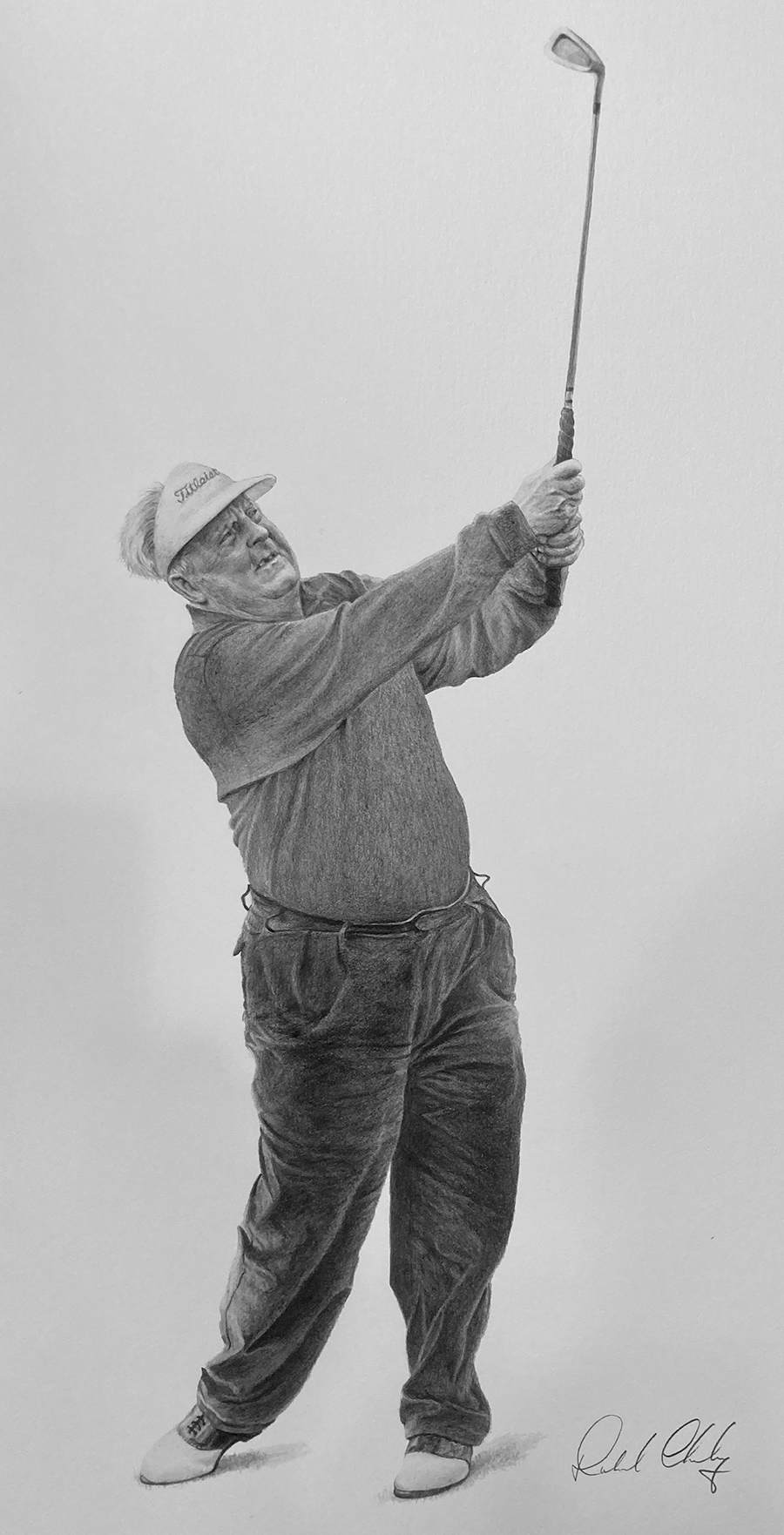
It was a 20-hour drive from the outskirts of Toronto to the Florida coast town of Titusville, and dead in the middle of the drive was Pinehurst. Just as the goldfinch, sparrows and blue jays made their annual migrations in fall and spring from north to south and vice versa, so too did a curious little golf professional named Moe Norman.

Each April headed north and each October going south, Moe drove his Cadillac stuffed with golf clubs, shoes and balls and most of his worldly possessions off I-95 and ventured into the Sandhills, where he found friends, smiles and comfort at Pinehurst, Knollwood Driving Range and Pine Needles, and dropped in on village shops like Gentlemen’s Corner and Old Sport & Gallery.

“Moe was a remarkable guy,” says Eric Alpenfels, director of instruction at Pinehurst Resort and a young intern in the golf shop when he first met Norman in 1983. “He was a big history buff. I think he appreciated Pinehurst for its history. I think people in town made him feel welcome and comfortable. So every fall and every spring, you expected to get a call from Moe or just see him show up to hit balls.”

Norman was a crack Canadian golfer from the Toronto suburb of Kitchener who won back-to-back Canadian Amateurs in the late 1950s, played in the Masters, and in 1966 won five of the 12 Canadian Tour events he entered. Over his career, he shot three 59s, made 17 aces and nine double-eagles, and counted his course records at 41. But he never made a mark on the PGA Tour because with his childlike persona and eccentric ways (he routinely drank two dozen Cokes a day), he was uncomfortable in the fishbowl of tournament golf and nervous around strangers. He never sought psychological treatment, but when the movie Rain Man came out in 1988 with Dustin Hoffman portraying a middle-aged autistic man, many who knew him said, “That’s Moe.”

But he was a mythical figure among golf pros and had an insatiable appetite for hitting balls. He was so straight and so consistent he had the nickname Pipeline Moe.

“I don’t know of any player, ever, who could strike a golf ball like Moe Norman,” Lee Trevino once said. “If he had just had some sort of handler, manager, someone to handle his affairs, everyone would know the name today.”

Moe was short at 5 feet, 6 inches, liked pastel colors, often mixed plaids with stripes, and wore turtlenecks in warm weather. He often said things twice and with a noted up-lilt on the final syllable. He gripped the club in his palms with a wide stance and took what looked to be a three-quarters swing on one plane, ending not with a picturesque follow-through of a limberback but with his hands and club gyrating above his head à la Arnold Palmer. He liked to say he and Ben Hogan were the only golfers who took the clubhead straight down the line exactly 22 inches. He once said he played the same wooden tee for seven years.

The stories of his ball-striking are legendary.

Moe was playing an exhibition with Sam Snead and Porky Oliver at Toronto when they came to a par-4 with a creek crossing the fairway 240 yards out. Snead advised Norman against hitting his driver, saying, “This is a lay-up hole.” 

“Not if you play for the bridge and run it across,” Moe said, and then did exactly that. 

He once hit more than 1,500 drives in a seven-hour exhibition, all landing within a 30-yard-wide landing zone. “I wish we played 30-yard fairways and out-of-bounds,” he once said. “I’d be the only guy hitting driver.”

At other times he’d fire off dozens of piercing 4-irons in succession, pause and chirp to anyone listening, “Never off-line. This swing can’t hit it crooked.”

Once Moe spent several days being filmed hitting balls and giving instructional tips on drivers, fairway woods, long irons and wedge shots. The third morning, the producers planned to ask him about long-distance putting.]

“Moe, we want you to talk about lag putts, how to manage a 50- or 60-footer.”

Norman blew them off. “I never had one. Why would you want to be 50 feet away?”

If someone told him a hole was a “driver-wedge hole,” Moe was liable to hit a wedge off the tee and a driver into the green and say, “You’re right. Driver-wedge.”

Pat McGowan, the head of instruction at Pine Needles, was playing the PGA Tour in the 1980s when he first saw Norman give an exhibition at the Canadian Open.

“Ben Crenshaw, Greg Norman, Nick Faldo, the whole golf world would stop practicing and walk over and watch Moe hit balls,” McGowan says. “I remember the first time I saw him. He hit 25 or 30 straight drives. Every one of them carried over 220 yards and stayed in a 25-yard fairway. Moe smiled at everyone and said, ‘You want me to hit 50? I’ll stay all night.’”

Alpenfels was working the counter at the Pinehurst golf shop in 1983 when someone nodded to a little man and said, “That’s Moe Norman.” Alpenfels remembered the name from conversations with Jim Hardy, his mentor in California. Alpenfels struck up a conversation, watched Norman hit balls and developed a friendship. He was invited to Norman’s winter headquarters at Royal Oak Country Club in Titusville that year to hang out.

“Moe was a brilliant ball-striker,” Alpenfels says. “He virtually could do what he said he could do. If he told you that he was going to hit five drives in a row and that all would land within a 5-foot radius, he’d pretty much do that. He was amazing. From a ball-striking standpoint, it was crazy how good he was.”

Chris Dalrymple, owner of the Gentlemen’s Corner clothing store in the village, remembers Moe would “just appear out of nowhere, sort of like a genie,” and would look around the shop, never buying anything.

“I remember he wore two watches, one on each wrist,” Dalrymple says. “I asked him why he did that. He said, ‘I just do.’”

From Pinehurst, Norman would drive down Midland Road and visit another friend, Greg Gulka, the head pro at Knollwood, and then on to Pine Needles to hit balls with Peggy Kirk Bell and Jim Suttie, the head instructor there in the 1990s.

“The first time I ever saw Moe, he was hitting drivers out of divots,” says Kelly Miller, Mrs. Bell’s son-in-law. “He was rifling golf balls down the range, one after another. They came out of that divot like a rocket.”

Moe had money problems for most of his adult life, saying he “had slept in bunkers all across Canada.” He never had a credit card or a checking account. He refused Miller’s offer for a bed at Pine Needles but would accept several hundred dollars Miller would slip in his pocket after entertaining guests at Pine Needles with an exhibition. Some thought Norman spent most of his nights in his car, but he usually had enough funds for a Motel 6 or Super 8. His finances were buttressed significantly when he met Titleist CEO Wally Uihlein at the 1995 PGA Show. Uihlein watched Norman hit balls and said Norman was a national golfing treasure and allowed that Titleist would pay him a $5,000-a-month stipend for the rest of his life. 

That lasted until September 2004, when Norman died of a heart attack.

“He had everything he needed. He had a good car, a place to stay and wonderful friends,” Alpenfels says. “He’d give you the shirt off his back if you needed it.”

A documentary film about Moe Norman’s life is in the works.

“It’s an underdog story. It’s a story about a guy who never should have succeeded, but did,” says Barry Morrow, the Oscar-winning screenwriter of Rain Man and a co-producer of the film. 

“I think he wanted to be the best at something. And hitting a golf ball was it,” adds Suttie.  PS

Lee Pace has written about golf in The Sandhills for three decades. His newest book, Good Walks — Rediscovering the Soul of Golf at 18 Top Carolinas Courses, will be available wherever you buy books.

His personal favorites include anything by P.G. Wodehouse. Tied for first are Heart of a Goof and Right Ho, Jeeves.

Golftown Journal

Junior Achievement

Another national championship in the Sandhills

By Lee Pace

The second time the USGA gathered the best boys under age 18 to compete for a national championship was 1949, and the venue was Congressional Country Club in Bethesda, Maryland. Gay Brewer and Mason Rudolph traveled together from their homes (Brewer from Kentucky and Rudolph from Tennessee) and roomed together that July week at Georgetown University. Each advanced through his bracket to the championship match, with Brewer, 17 years old, taking a leisurely 6-and-4 victory in the championship match over Rudolph, who was two years his junior.

That week cast the die for both players. Each won multiple times on the PGA Tour, with Brewer collecting the 1967 Masters and playing in two Ryder Cup matches. Rudolph won the Junior Amateur the following year, collected the 1956 Western Amateur and won five times on the pro tour.

Since then, the Junior Amateur has staged an annual audition for many elite players to come, among them Johnny Miller, Eddie Pearce, Gary Koch, David Duval, Tiger Woods, Hunter Mahan and Jordan Spieth.

“That was the first time I’d ever experienced the thrill and the chase of a USGA event,” Woods says of his three straight wins from 1991-93.

“You look at the names on the trophy and know what kind of company you’re in,” says Mahan, the 1999 victor.

“It was not as much about me winning as it is being a part of the fraternity with those guys,” adds Spieth, the champion in 2009 and 2011.

The U.S. Junior Amateur makes its debut in the golf-rich Sandhills in July with the 73rd rendition being staged at the Country Club of North Carolina, July 19-24. Yet another domino falls in the universe of elite competitive golf for Moore County, adding to the largesse of U.S. Opens (three already with one set for 2024 at Pinehurst No. 2) and U.S. Women’s Opens (three at Pine Needles with a return engagement in 2022, and one at Pinehurst No. 2). There has been a Ryder Cup, a U.S. Senior Open and three U.S. Amateurs.

And this national championship continues CCNC’s heritage of every decade or so opening its doors to some variety of high-profile tournament. Since its opening in 1963, the club has been the venue for the PGA Tour, the U.S. Amateur, the U.S. Girls Junior, six Southern Amateurs, a national father-son tournament now more than half a century old, and a host of statewide and regional competitions.

Jack Nicklaus, Hal Sutton, Ben Crenshaw, Tom Kite, Webb Simpson and Scott Hoch have collected trophies at the 36-hole golf haven and residential community located off Morganton Road, halfway between Pinehurst and Southern Pines.

“The club takes a lot of pride in all the events it’s hosted over the years — from USGA national championships to the Carolinas Golf Association events,” says Robbie Zalzneck, a USGA staff administrator and also a CCNC member. “It’s a club that likes to give back. The members have rallied behind the Junior Am. Opening the club up to competitive golf has always been in its DNA.”

CCNC was designed in tandem by Ellis Maples and Willard Byrd and opened in 1963. It was one of the original members of Golf Digest’s 100 Greatest Golf Courses and was site of the 1971 and 1972 Liggett & Myers Match Play Championship on the PGA Tour (won by Dewitt Weaver and Nicklaus) and the 1980 U.S. Amateur (won by Sutton). It has remained among the best courses in the state, and in 2021 was listed No. 16 in North Carolina in both Golf Digest and GOLF magazine rankings of the best courses in every state.

The original course was so popular the club retained Byrd to build nine more holes in 1970. Then, in the late 1970s, the club acquired some land from Robert Trent Jones (who spent time in Pinehurst in the early 1970s doing a renovation of the original Pinehurst No. 4 course) and hired him to build nine new holes, working those into the first nine to create a new course dubbed “The Cardinal” in keeping with the state of North Carolina theme.

Greg Sanfilippo, the USGA’s director of the Junior Amateur, says the two courses set up perfectly to host the best junior players from around the country. Qualifying will be held for a newly expanded field of 264 players on both courses, and match play will be held on the Dogwood.

“We structure our championships as the ultimate tests in the game,” he says. “We want to make sure we’re identifying the best players through shotmaking, testing every club in the bag, controlling spin and distance, and having the mental and physical resolve and ability to work through various situations. The courses at CCNC will really force players to execute sound judgment through each hole.”

The Dogwood Course is now five years into a major renovation directed by golf architect Kris Spence. The club spent some $10 million from 2015-16 on a capital improvement program that included the Dogwood project, construction of a new golf shop, grill room and locker room, a tennis and fitness center, and various upgrades to the existing clubhouse.

The Dogwood project included converting the greens to Champion Bermuda, and the tees and fairways to Zeon zoysia grass, a heat-tolerant strain that doesn’t need overseeding in the winter and gives golfers an outstanding surface from which to clip iron shots and fairway woods. New drainage was installed, all bunkers were rebuilt, and some tees were expanded. The tree coverage that had grown up over time was thinned out, improving air flow and sunlight.

“Dogwood had been one of the top courses in the Southeast for half a century,” says longtime Director of Golf Jeff Dotson. “We needed to set it up for the next 50 years.”

Certainly, one of the favorites for the Junior Am and a young man playing with some “home game pressure,” will be Jackson Van Paris, a 17-year-old who just graduated from Pinecrest High School and will be enrolling this fall on the golf team at Vanderbilt. The Van Paris family moved to Pinehurst from Chicago in 2017 and lives in a house alongside the sixth hole of the Cardinal Course. The club has been Van Paris’ home base as he’s built a sterling resume in junior golf that includes two firsts in the American Junior Golf Association Boys Championship. His most noteworthy achievement was becoming the second-youngest player behind Bobby Jones to win a match in the U.S. Amateur, when he advanced to the Round of 32 as a 14-year-old in 2018 at Pebble Beach.

“This has been a great club to develop my game,” Van Paris says. “I really have access to anything I need as far as practicing, and a great range and great short game facilities. And the courses are two really good golf courses.”

He knows what to expect from the USGA in terms of course setup — narrow fairways, thick rough and quick greens.

“Hitting fairways is going to be super important,” he says. “I can’t let myself get lazy on the tee by thinking, ‘I’ve hit this shot a hundred times.’ I am treating it like I’ll be playing a brand-new golf course. And the USGA always puts a premium on short game. Driver and short game are the most important things to consider.”

That and the mental game. Does it help to have intimate course knowledge and sleep in your own bed, or hurt with the pressure to perform in front of so many friends and clubmates?

“I’ll probably be more nervous than I have been in any other tournament just because it’s at home and everyone expects me to play well,” Van Paris says. “But I also think I can embrace that if I handle it the right way. I keep telling everyone I see, please come out and watch. I want as many people out there as possible. It’s part of learning to play under pressure.”

The great ones learn to thrive under the microscope, leaving the Junior Amateur as another chapter in Van Paris’s evolution — not to mention the Sandhills as a mecca for national championships.  PS

Lee Pace has written about the Sandhills golf scene for more than 30 years. Follow him on Twitter at @LeePaceTweet and contact him at leepace7@gmail.com.