
In the Spirit

In the Spirit

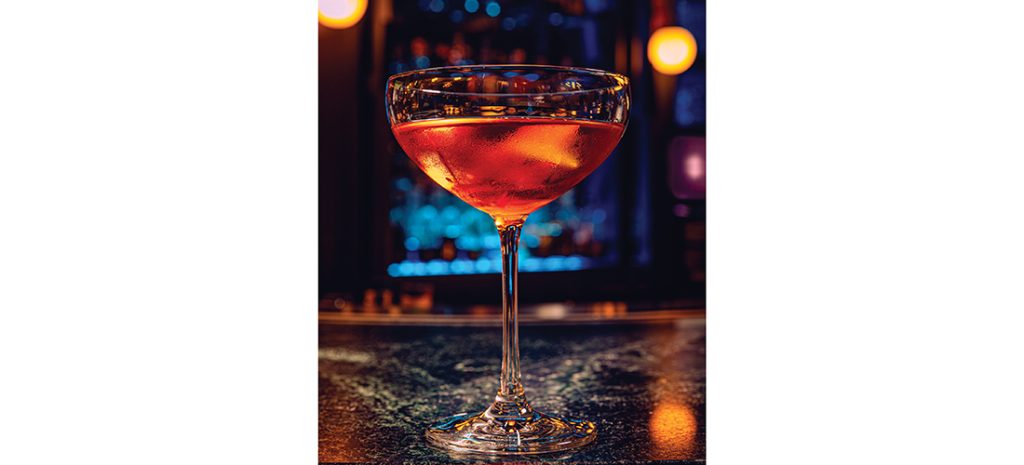
Manhattan Variations

Subtle twists, refined tastes

By Tony Cross

While I was at work last week, I saw a bottle of vermouth that I enjoy and immediately realized that it had been a minute or so since I’ve made and enjoyed a Manhattan. I vowed to make myself one that night.

It was getting a little late by the time I was heading home, and I remembered I was out of Grand Marnier. A quick detour to the local ABC store aaannnddd . . . they’re closed. “Damn it!” I pouted, furious that I had literally missed the window by five minutes. I’ve done that maybe twice in my life. When I got home I went to my cabinet to get a bottle of rye and a bottle of Angostura bitters. As I was reaching for the bitters, my hand was drawn to a small bottle of Angostura cocoa bitters. “This could be good,” I thought. I grabbed the bitters, retrieved my vermouth from the fridge, and away I went whipping up the cocktail. It was so good I’ve been making one every night since.

Those of you who know how to make a Manhattan might wonder why the hell I would need an orange liqueur — it’s not even an ingredient in the drink. And you would be right. Until you try it. I’ll explain. But first, let’s KFC this thing and look at the original recipe.


Manhattan

2 ounces whiskey (bourbon or rye)

1 ounce sweet vermouth

2 dashes Angostura bitters

Bourbon or rye will do, just make sure that the proof is 90 or above. It truly does make a better Manhattan. As far as vermouth goes, my go-to is always Carpano Antica, but other vermouths such as Cocchi, Cinzano, Dolin, etc., will do. As always, make sure your vermouth has been refrigerated after opening. Vermouth that has been sitting in your liquor cabinet is trash — throw it out. The bitters, in my opinion, must be Angostura. There are other aromatic bitters available if you’d like to switch it up, and there is nothing wrong with that, though I still think Angostura reigns supreme. When you are using bitters, make sure that the dashes are not drops. Don’t be scared to give that bottle a shake.

Now, the orange liqueur. When I first got into mixing drinks, I followed Dushan Zaric from Employee’s Only in New York City. His cocktail book was my Bible. In it, he has a recipe for a Manhattan that goes something like this:

Manhattan (Employee’s Only version)

1 1/2 ounces rye whiskey

1 3/4 ounces sweet vermouth

1/2 ounce Grand Marnier

3 dashes Angostura bitters

Right off the bat you’ll notice that there is more vermouth in this version of a Manhattan. Back in the 1800s in legendary bartender Jerry Thomas’ day, this was a vermouth cocktail and it did have orange curaçao. The folks at EO like to honor the cocktail and make it the way it was done 150 years ago. Truth be told, I would do a 2:1 ratio of rye and vermouth but keep the Grand Marnier at 1/2 ounce. It is delicious and a must-try for any whiskey fan.

The next variation was created by bartender Todd Smith when he worked at Bourbon & Branch in San Francisco in 2005. By swapping out the sweet vermouth with amaro (an Italian liqueur), the drink leans more toward the bitter end.

Black Manhattan

2 ounces rye whiskey

1 ounce Amaro Averna

1 dash Angostura bitters

1 dash orange bitters

Last but not least, my latest nightly treat. There’s nothing to it, just the addition of cocoa bitters. I did, however, play around with the specs a little. For instance, I always use a rye when making Manhattans, but it just so happened I had a bottle of Old Scout straight bourbon whiskey that had been gifted to me, so on my second night of making Chocolate Manhattans, I gave it a shot. The Old Scout is a whopping 121 proof (yikes!), but the sweet vermouth takes the edge off and the cocoa bitters makes the cocktail come together. If you don’t have a high proof bourbon, a 90 proof (or higher) rye whiskey will most definitely do. As for garnishes, I usually use a lemon peel — expressing its oils over the cocktail — but, as luck would have it, I purchased and opened a bottle of Luxardo Maraschino cherries and hot damn, does it make that last sip taste like dessert! Cherries, chocolate . . . am I still talking about a grown-up cocktail? You betcha.

As with all of these Manhattan cocktails, the setup and execution are the same: Make sure your drinking coupe is cold. Add all liquid ingredients into a chilled stirring vessel. Use good ice (if possible) and stir until the cocktail is cold and enough water is diluted, then strain your cocktail into the cold coupe.

Chocolate Manhattan

2 ounces Old Scout 6-year straight bourbon whiskey 

1 ounce Carpano Antica vermouth

2 dashes Angostura Cocoa bitters

1 dash Angostura bitters  PS

Tony Cross is a bartender (well, ex-bartender) who runs cocktail catering company Reverie Cocktails in Southern Pines.

The Omnivorous Reader

Hanging Judge

A Carolina courtroom whodunit

By Anne Blythe

If you spend much time in courthouses in North Carolina, you begin to see the complex fabric of their communities.

It might be one thread, one story, one case at a time but, eventually, the many threads are stitched together into a complex tapestry. Katherine Burnette, a district court judge from Oxford who rose to the bench as a former federal and state prosecutor, pulls back the curtain on small-town North Carolina and its dramas in her debut novel, Judge’s Waltz.

It may be fiction, but the storyline created by the attorney-turned-writer — while seemingly over the top at the start — is rooted in insider knowledge from someone who has been in and out of North Carolina courthouses for much of her career.

“Barely audible above the hum of the ancient air conditioner came the creak, creak, creak of the thick rope affixed to the brass chandelier,” writes Burnette in the opening of her mystery. “Swaying ten feet above the intricately carved, pre-Civil War bench, the Honorable Patrick Ryan O’Shea had adjourned to a higher court.”

We quickly find out that O’Shea was not universally revered, nor was he a jurist with great legal acumen. His knack was kissing up to a certain professor in his third year of law school and following suit with a wide swath of politicians who helped him get coveted judicial seats.

“Not noted for his weighty opinions from the bench, O’Shea had come to be noted for the weighty politicians who stood behind him and his bid for a higher court,” Burnette writes. “Apparently, these politicians had garnered their strength and their favors to foist O’Shea upon the unsuspecting Fourth Circuit court.”

O’Shea never got there. His last dance, so to speak, was hanging in a federal courtroom in the Eastern District of North Carolina in nothing more than his black robe. “The only thing that O’Shea could do — was doing — was a slow discordant waltz at the end of a long rope,” Burnette says in her prologue.

The pages of the novel are sprinkled with humor and wit as we meet Buck Davis, the folksy lawyer from Oxford who is tapped by the chief judge in the Eastern District to sort through O’Shea’s cases as Katie O’Connor, an FBI agent Davis remembers fondly from high school, leads the investigation into the judge’s death.

Burnette deftly describes the country roads between Granville County and Raleigh, where the judge’s chambers were. She takes readers into drugstores, restaurants, courthouses and other places that will seem familiar to anyone who has experienced the slower hum of Granville County or the bustling halls of power in the capital city.

You can almost smell the drugstore coffee brewing and taste the Southern food being dished up as the suspense builds over how and why Judge O’Shea found himself suspended from that ceiling. “Today’s courtroom deals were made in the few minutes it took to eat a sausage biscuit,” Burnette writes.

The cast of characters includes Jeb, Buck’s brother, who battles demons from opioid addiction; Walter A. Johnson, the Granville County detective who went to high school with Jeb; and Mary Frances Margaret O’Shea, the widow of the lifeless judge, who does not seem to grieve her loss at all.

Even the relatively minor characters who come and go throughout the mystery are memorable, like the waitress, Wanda, who saunters up to Buck and Katie in the Oak Room with a pencil behind her ear and her weight balanced “on one polyester-clad hip.” The Oxford restaurant is where Buck and Katie often end up as they develop not only their case but also a budding romance.

Wanda gives the couple a dose of reality about the menu choices. There is no wine list, Wanda informs Katie. The choice is strictly by color, red or white. And don’t ask for an exotic imported beer, either. Buck settles for a Miller High Life.

Burnette writes, “Wanda scribbled something on her pad and strolled away. ‘One red, one champagne,’ she hollered to the bartender, confusing Katie.

“‘I didn’t know they served champagne,’ Katie told Buck. ‘No,’ Buck explains. ‘She means the Miller. You know champagne of beers.’”

The mystery of what happened to Judge O’Shea twists and turns as Burnette teases her readers with different scenarios.

Was it suicide?

Was it murder?

At whose hand?

And why?

Katie, Johnson and Buck — with a big assist from Jeb — help pull together the many threads as Burnette takes her readers on a journey to the surprise ending of a novel not only worth picking up but difficult to put down.

The verdict is in. It’s a whodunit and a page-turner that belongs on a summer reading list.   PS

Anne Blythe has been a reporter in North Carolina for more than three decades. She has covered city halls, higher education, the courts, crime, hurricanes, ice storms, droughts, floods, college sports, health care and many wonderful characters who make this state such an interesting place.

Golftown Journal

Down Highway

A gem sparkles in Aiken


By Lee Pace

Before Henry Flagler laid the first railroad tie or built the first ornate hotel room in South Florida, before James Walker Tufts scraped his first rudimentary golf hole out of the sandy loam around Pinehurst, there was Aiken, South Carolina, a small town built on a plain just 15 miles from Augusta, Georgia, and along a key intercontinental railroad stop connecting the major cities of the East to New Orleans.

At first they came in the summertime just after the Civil War from Charleston and surrounds to escape the threats of malaria and yellow fever. Then in the 1880s it became all about the horses — riding, breeding, playing polo, running steeplechases. Streets were named Ruffian and Saratoga. The clay-based soil was ideal for horses’ hooves and traction, the winter temperatures were mild, and the area’s mineral springs thought to be health-giving. There were tennis courts and ample wild game roaming the woods. The Vanderbilts, Goodyears, Appletons, Pinkertons, Graces and Astors wintered there. Kings and presidents visited. 

Aiken was Palm Beach before there was a Palm Beach.

Golf followed as well, first at Palmetto Golf Club in 1892 with a four-hole course that expanded to a regulation 18 by 1895; and then at Highland Park Golf Club in 1912, that course built as an amenity to a new hotel and residential community that has an interesting connection to the Tufts family, Donald Ross and Pinehurst. 

Pinehurst, Camden and Aiken shared the common heritage of being perfectly located circa 1900 to offer warmer winter weather within one day’s train ride from New York, Philadelphia, Boston and other northern climes. This was before Florida had evolved and certainly long before the advent of commercial air traffic. The train coming from the north passed through Raleigh, went to Southern Pines, and from there it was 90 miles to Camden and another 80 to Aiken. 

The Kirkwood Hotel was located in Camden next to the train station and was a 200-room facility that boasted among its amenities in 1903 a nine-hole golf course. Walter Travis, a three-time U.S. Amateur champion who dabbled in course design in the early 1900s, redesigned the original course, and then Ross visited in 1938 to reconfigure the layout known today as Camden Country Club and convert the greens from sand to grass. 

“Camden is one of the special places in the Carolinas,” says Charleston’s Frank Ford III, an accomplished Charleston golfer with multiple championships on state and regional levels. “I’ve had a love affair with that golf course since the first time I saw it. It’s just so much harder than it looks.”

Following James Tufts’ death in 1902, Leonard Tufts took over the operation of the village of Pinehurst. He knew that beyond the resort amenities themselves, convenient accessibility was paramount to being successful in the travel business. The planning, construction and maintenance of good highways became an interest and priority of Tufts, who led the resort until his retirement in 1929, when he turned the reins over to son Richard. 

Leonard was the moving force in building what became Midland Road, connecting the train station in Southern Pines to Pinehurst. At various junctures he would serve as president of the Capital Highway Association and the U.S. Good Roads Association. He was also chairman of the Moore County Good Roads Committee. 

The Atlantic Highway was part of the original National Highways Association created by the federal government in 1911 to create and maintain some 50,000 miles of public highways. The Atlantic linked Maine to Miami and was the precursor to U.S. Highway 1. The road ran from the north through Southern Pines and turned southwest toward Camden, Aiken and Augusta before veering south toward Savannah. 

Tufts by virtue of his perch on these important highway boards could see where opportunities lie. And one area of exploration he thought was to have a series of resort hotels along this key highway running into South Carolina. 

A group of Aiken businessmen in 1912 launched a company to build a hotel, golf club and real estate project on the site of the original Highland Park Hotel, a grand destination with 125 rooms operating from the late 1860s until burning down in 1898. They did so with some unknown degree of consultation, encouragement and perhaps even financial investment from Tufts. The course opened with 11 holes in 1912 and expanded to 18 three years later as Highland Park Golf Club, and remains in business today as Aiken Golf Club. 

“Building hotels and golf courses along Highway 1 was big business in the early 1900s,” says course owner Jim McNair Jr., who inherited the course from his father and personally led a restoration and rebuilding effort in the late 1990s. “We found old newspaper stories talking about Leonard Tufts visiting and helping put a deal together. At the time, no one thought the South was good for anything but resorts — getting people down from the North out of the cold.”

Donald Ross by 1910 was devoting his time almost exclusively to designing golf courses across the eastern United States and apparently was going to route and build the course at Aiken. But his schedule was too jammed, so a fellow Scottish golf pro who had immigrated to the United States named John Inglis did the work with input from Ross. The fortunes of the Highland Park Hotel and its golf course followed that of many enterprises in the Roaring ’20s — success out of the gate and then a devastating collapse in the early 1930s. The town of Aiken eventually took the property over, tore down the hotel and sold the golf course to Jim McNair, a top amateur golfer of the mid-1900s and winner of the Carolinas Amateur in 1946 and ’48. 

McNair Jr. took the operation over in 1986 following his father’s retirement and spent a decade noodling ideas of how to improve the facility and bring back some of the early design features from Inglis and Ross. He pursued Bill Coore and Ben Crenshaw in the mid-1990s to visit the course and consider a restoration job, and Coore looked at the course in 1997 when in town to visit Palmetto Golf Club, which sits just a mile and a half away. McNair took Coore’s advice and suggestions to renovate the course “in-house,” and over two years, McNair and his crew removed some 10,000 trees, rebuilt the greens, put in a new irrigation system, and crafted some broad swaths of sand and assorted vegetation.

“We’ve got more than a century of tradition and have a fun, accessible golf course,” McNair says of his daily fee operation. “But we’re still not the oldest club in town.” 

Today AGC is a terrific experience with a $27 weekend green fee, its 5,800-yard, par-70 measurements belying the challenge of hitting off uneven lies all day and navigating the small and quirky greens (there is even a links-style double green for the first and 17th holes) and the twists and turns through the surrounding neighborhood. It’s on the National Register of Historic Places and is replete with stories like the stone and grass staircase leading from the tee of the par-3 16th down to the green. The curious dimensions of the staircase — requiring at least one or two extra steps at each level before going down the next riser — prompted dancing virtuoso Fred Astaire to navigate them with a makeshift tap dance when he played there during the winter entertainment season.

The evolution of Florida in the first half of the 1900s certainly changed the winter resort business in the South. But fortunately both Palmetto and Aiken Golf Club have survived all manner of economic and wartime obstacles and remain viable today, each with its own niche in a golf-rich environment that includes the shadow of Augusta National down Interstate 20 and another ultra-private club just outside of Aiken, the Tom Fazio-designed Sage Valley. 

Less than a quarter of a mile to the east of the first tee of Aiken Golf Club is U.S. Highway 1, and tracing the left side of the first five holes is the railroad, keeping the Pinehurst-Camden-Aiken connection viable today. PS

Lee Pace’s adventures exploring many of the interesting old golf courses of the Carolinas will be included in a forthcoming book from UNC Press, Good Walks—Strolling Across the Carolinas Golf Landscape, due out in 2020.