Don’t Let Them Eat Cake

Don’t Let Them Eat Cake

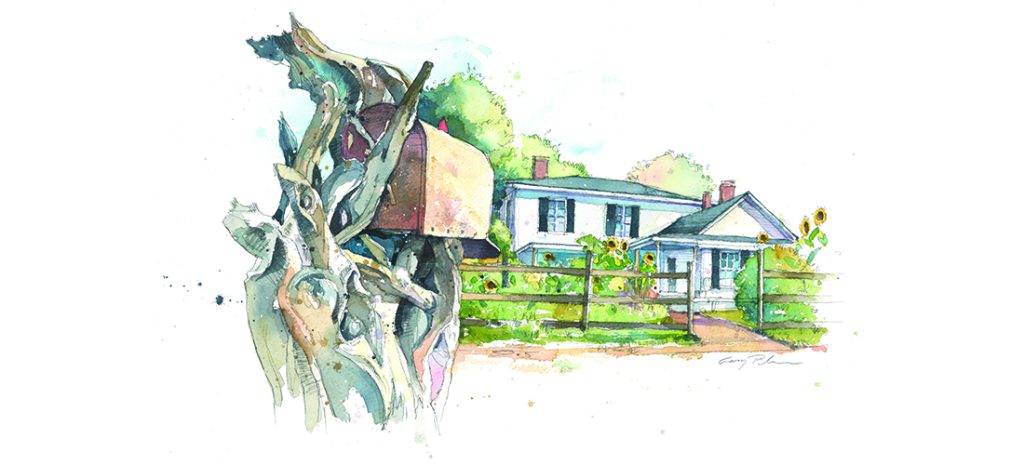
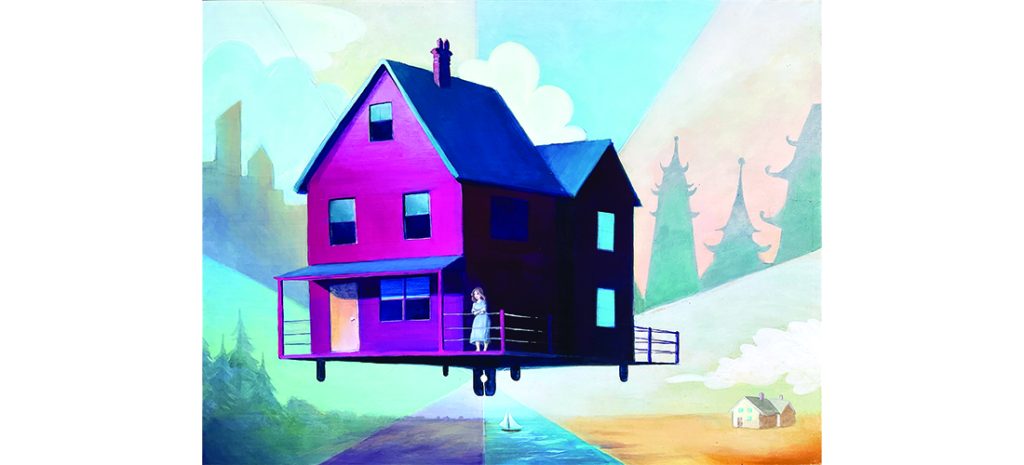
Fiction by Brendan Slocumb     Illustration by Mariano Santillan

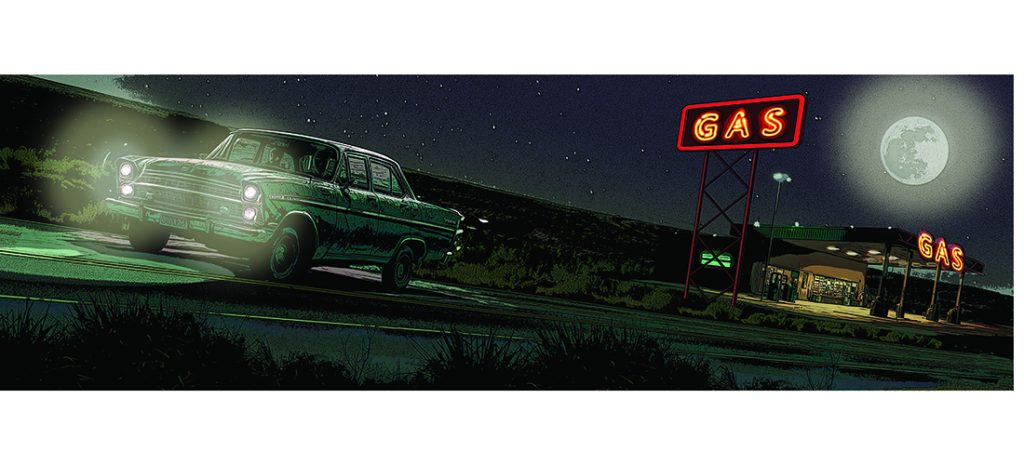
He smelled like the cake factory: frosting, the yeasty stench of batter and butter, but more than anything else, sugar. Baked sugar, tangy and sweet, that coated the back of his tongue and the inside of his eyelashes. Leaving the factory at the end of the shift, he could feel the sugar aroma around him like a coat or a fog, always moving with him. Of course, his friends started calling him Bon Bon. He’d hated the nickname, but by now it had hung on him so long that he didn’t mind it.

He ordered another beer and checked his watch. His buddy, Tig, was late, as usual. Meet me at the bar at 6:30 and DONT BE LATE, Tig had texted him. SERIOUS!!!

Now it was 6:49, and he’d finished the first beer and ordered a second. Why Bon Bon had believed Tig that this time actually was urgent, Bon Bon didn’t know. He’d shown up in his work clothes without changing back into his street clothes, the King Arthur Brand cake flour misting up from his pant legs every time he shifted on the bar stool. 

“You makin’ me hungry, buddy,” Alan, the bartender, told him for the third time. “What do you think of carrot cake? You a big fan?”

“I figured you for a chocolate cake man,” Bon Bon said. “That was your wife in the shop the other day, wasn’t it? She bought the 14-inch and the 18-inch. Double chocolate.”

“Wife loves them,” Alan said, buffing the bar and looking away. His A-shirt, with dozens of stains on it — bourbons, whiskeys, wines — barely covered his paunch. Seemed like Alan loved those chocolate cakes, too.

Bon Bon nodded politely, tried to squeeze out a smile and looked again at the door.

“You must get sick of cakes,” Alan said. “All them sweets. That vanilla confetti cake is my favorite.”

“Never touch the stuff,” Bon Bon said. “I only eat salty stuff. You got more of these?” He pushed the empty dish that had contained pretzels and peanuts towards Alan. The first few months at the factory, Bon Bon had eaten so many pastries that he became nauseated by the sight of anything with sugar in it. 

He looked at the clock. It was 6:54. If Tig didn’t show by 7, Bon Bon was out of there. Home, out of the sugar-stenched clothes and into the shower. He imagined hot water sluicing over him, the powdered sugar circling the drain and disappearing. He fumbled in his pocket for his wallet, looking for a ten, when a familiar voice said behind him, “You stink like the inside of a fat woman’s purse, you know that?”

Tig. Of course. “What?” Bon Bon asked him. “What does the inside of someone’s purse smell like? And where were you?”

“They keep cake in them,” Tig said. “The ladies.”

“Nobody keeps cake in their purse,” Bon Bon told him. “That’s the dumbest thing I ever heard you say.” And he’d heard Tig say plenty of stupid things over the years.

“Come on, let’s go.” Tig was already heading toward the door.

“Go where?” Bon Bon said. “Why did you want to meet here? Now we’re leaving? What’s going on?” Bon Bon grabbed a handful of the peanut-pretzel snack from the newly replenished dish, thanked Alan with a wave and trotted to keep up with Tig, who was already outside

By the time Bon Bon caught up with Tig, he was almost to his car, a beat-up dark green Chevy Malibu, whose passenger door had gotten side-swiped years ago and was missing the side mirror and most of the chrome trim. Tig was what Bon Bon’s mother referred to as “a character.” Overalls, sleeveless shirt, dirt-and-oil-coated John Deere trucker cap, Reebok tennis shoes so faded and stained with oil and dirt that their color would forever be a mystery. 

“Get in,” Tig said.

“Where are we going? When will we be back? I can’t just leave my car — ”

“GET IN,” Tig said, almost an order this time.

Bon Bon never knew why he got in the car that night. Maybe because he’d done other stupid things with Tig in the past and this was just par for the course. You wouldn’t believe what Tig just did, Bon Bon imagined texting his friends later tonight. It would be fodder for conversation for days to come.

The car stunk of cigarette smoke and chaw. A spit cup sloshed in the dashboard console. Bon Bon shoved McDonald’s wrappers, Entenmann’s boxes, Dunkin’ bags and miscellaneous trash off the seat, and got in. Before he could even buckle his seat belt, Tig spun the tires and headed out of the parking lot toward the highway.

“What’s this about?” Bon Bon repeated, swallowing the last of the pretzels.

Tig smiled. Drove for a minute, enjoying the power. Then, dramatically, he said, “I’m about to make us rich.”

“No,” Bon Bon said.

“Yep.”

“OK,” Bon Bon said. “Let me out. Turn around. Stop this piece-of-crap and let me out. I told you before. I’m not getting involved in any of your messed-up money-making — ”

“It’s guaranteed cash and you’re already in it,” Tig said without missing a beat.

“Stop the car. I mean it.” 

“Too late. You’re going to thank me in about 12 hours.” 

“What the hell are you talking about? Twelve hours? What did you do? What are we doing?”

“I just made you 23K. I get 27K, you get 23K.” 

“For what?” Bon Bon asked. Frustration and fury boiled in his gut the way it often did when he had to deal with Tig. “You just handing me 23K for sitting here?”

“For coming with me, yeah,” Tig said, darting a glance at him. Bon Bon couldn’t decipher it. “All you gotta do is drive when I get sleepy.” The highway spooled out before them, the endless ripple of white lines bisecting the night. Few cars were out this late, and all seemed to be going in the other direction.

“Hell no. I don’t know what kind of craziness you’re getting into, but I’m out. I gotta work in the morning. Turn around. Take me back to my car.”

Tig laughed. “Bro, they won’t miss you at that cookie house. Besides, in 12 hours, you’ll have enough money to quit that job and do something that doesn’t leave you smelling like a giant cupcake. Lose that dumbass nickname. Grown man named Bon Bon. I’m doing you a favor.”

“Screw you. Dammit, I knew I should have just gone home.” 

The car banked around a wide curve, then through a series of up-and-down humps in the road. If you drove fast enough, it was like riding a roller coaster. For an instant, you could lose your stomach as you crested the rise.

On the descent, a thump came from the trunk.  

“What was that?” Bon Bon looked in the back seat, stacked neatly with big square boxes: Macbook Air, read several. UN3481, read others, with the logos of a battery and a flame. They were all laptop computers. The back-seat floor was the usual sea of fast-food wrappers, napkins and trash. Nothing moved.

The thump came again, as if whatever was back there shifted back to its original position.

“What’s going on?” Bon Bon asked. He couldn’t hide the note of nervousness now in his voice. “What’s in the back seat? Is that stuff stolen? You raid an Apple Store or something?” He tried to imagine how many laptops would be worth $50,000. There’d have to be at least twenty-five, maybe more.

“Nothing. Don’t worry about it.” The car was going faster now, well over 80 mph. 

“I knew it. I freakin’ knew it. What did you do? I’m not dealing in stolen goods, Tig. Stop the car.”

Tig groped in the driver side door. Bon Bon thought at first that Tig was looking for his wallet or maybe a soda bottle. But after a moment Tig retrieved a small triangular object that seemed to absorb the dim lights from the dashboard before it resolved itself into a gun. It glittered as if alive. Tig gripped the handle and then the muzzle was pointing, impossibly, at Bon Bon himself. 

“T, what the . . . ” 

“Just shut up,” Tig said. “I’m doing you a favor. Nobody is getting hurt. We walk away with more money than either of us has ever seen.”

Bon Bon had only seen Tig this erratic once before. It ended with Carl Simmons walking with a permanent limp and Tig spending three years in prison for aggravated assault. Bon Bon stared at the dark muzzle of the gun. His mouth had gone dry, the pretzel crumbs turned to gooey dust on his tongue. He wiped his hands on his pants and could feel the flour and sugar coating his palms. He wanted to scream. Instead he took a deep breath, looked out the window into the dark, trying to ignore the feel of the gun staring at him. “OK man, just tell me where you got all these computers from. And what we’re going to do with them.” 

“The less you know the better,” Tig told him. “Get some rest. You’ll take over in six hours. We gotta make the drop by 8 a.m.” 

Bon Bon had heard that Tig had gotten into some shady business while he was in prison. This whole scenario was making more sense. Tig, and now Bon Bon, were driving stolen electronics over state lines. He wondered if $23,000 was worth getting caught. If the police pulled them over —

Tig turned on the radio with an aggressive punch of his forefinger. Kellie Pickler’s “Red High Heels” deafened them. Bon Bon turned down the volume.

 Over the next two hours, Bon Bon sat in silence, thinking. Tig couldn’t be reasoned with, that was pretty clear. Bon Bon could wait till Tig fell asleep and turn the car around, but what would happen when Tig woke up? Bon Bon glanced down at the gun again, resting lazily on Tig’s thigh, and looked out the window. He could grab his phone and try putting it on mute and dialing 911, but the phone’s light would turn on and Tig would see it for sure. Bon Bon’s palms felt chalky from the mixture of sweat and cake flour dust. The damp, sugary smell from his trousers made him want to retch. 

“Hey,” he said when lights from the next exit glimmered on the horizon. Signs for gas, food, lodging. “I didn’t get dinner when I was sitting there waiting for you, and I’m starving. Do we need gas?” He pretended to stretch and stifle a yawn.

Tig kept his eyes on the road, but his grip tightened for an instant on the gun, then relaxed again. “OK,” he said after a minute. “I am, too. All right. I’ll pump the gas and you get us some food.” Tig took the exit too fast, the car almost on the berm before he overcorrected. Again came the thump from the trunk. “And don’t try anything, man. I’d hate to kill you, you hear me?”

The gas station was a half-mile down the road, its fluorescent lights bright and disorienting. No cars were parked at the pumps. A single beat-up Honda sat tucked against the building. Bon Bon had been hoping for a late-night police cruiser, an RV, anything.

After the car had come to a halt, Bon Bon got out, making sure his movements were slow and casual. He could run in, tell the attendant to call the cops, who could be here in minutes. He glanced over at Tig, who was staring hard at him. He looked away, pulled open the glass door. He could feel Tig’s eyes on him, even in the snack aisle. 

He picked up several bags of  Flamin’ Hot Cheetos, hot chili and roasted lime Takis, jalapeño Kettle potato chips, and honey barbecue and hot mustard pretzels. Then went to the refrigerators on the wall and pulled out four bottles of Pepsi.

At the cash register, Tig’s gaze brushed his shoulders as Bon Bon paid and the clerk stuffed everything in a plastic sack. Again and again, he contemplated saying something but then imagined Tig leveling the gun at them, the bullets spider-webbing the glass.

The door behind them jingled, and Bon Bon jumped. “You almost done, man?” Tig called in.

“Yeah,” Bon Bon said. The clerk put a handful of change on the counter, and Bon Bon swiped it into his palm. “You owe me 18 bucks,” he told Tig as he brushed past him out the door, out into the cool night and the waiting car.

“Oh you’ll get that and more soon, buddy.” Bon Bon could hear the relief in Tig’s voice. “You feel like driving now?”

“Yeah, I can take over,” Bon Bon said. “You eat up. Did you check on the trunk? On whatever fell over back there?”

“Don’t worry about it. It’s fine,” Tig said. 

Bon Bon pulled out of the parking lot as Tig tore open the purple bag of Takis, stuffing a handful into his mouth. “Damn these are good. You want some?” 

Bon Bon shook his head. “In a sec.” He took a sip of Pepsi.

“These things are spicy,” Tig said, playing on the word spicy. “Whooo-eee.” He cracked open his Pepsi and drained half of the bottle. Bon Bon took a sip of his.

Tig didn’t tell him where they were going, just directed him once to turn south, toward the highway running to the coast. Tig broke into the potato chips and Bon Bon munched on pretzels. They passed city after city, and a rest stop in three miles.

“I’m thirsty,” Tig said when he was halfway through the Honey Barbecue Pretzels. “These pretzels are making me thirsty.”

Seinfeld,” Bon Bon told him without looking over. He checked the rearview mirror. The boxes sat primly on the backseat, giving away nothing.

“What?” 

Seinfeld,” Bon Bon said. “That was a running joke on Seinfeld.” The rest area illuminated the road. “Remember, George said it about 200 times during that show?” They passed the entrance, kept going.

“I don’t know what the hell you’re talking about. You got more to drink?” Tig said. 

“There ain’t no more. We drank it all.” 

“That ain’t funny,” Tig said. “I’m seriously thirsty. We gotta stop.”

“OK,” Bon Bon told him. “Next place we see. I need to take a piss, too,” he added.

They passed a sign. “Next Rest Area: 28 Miles.”

“Damn,” Bon Bon said. “Another half-hour.”

“We can make it,” Tig said, staring out at the darkness. But after another 10 minutes he said, “I really gotta go.”

“So do I,” Bon Bon said. “Bad. I’m going to pull over.”

He eased the Chevy onto the shoulder, put on his flashers. “What the hell you think you doin’?” Tig said, spraying pretzel crumbs onto Bon Bon’s shirt. 

“What? You want me to piss myself in the driver’s seat? I didn’t shower after work because somebody wanted me to meet them at 6:30. So now I smell like cupcakes and if I piss myself I’ll smell a lot worse. That is not a good combination. So you’ve got a choice. Either stop yapping in my face and let me pee, or you can drive the rest of the way in a wet seat.” 

He hoped Tig would be too preoccupied to suggest that he pee in the Pepsi bottle. Tig was. 

“Whatever. Don’t do nothin’ stupid.” Tig got out of the car, slammed the door. Again the thump from the trunk, and then another. 

The car’s headlights beamed into the nondescript grass as Bon Bon climbed out, went around the front of the car. As he reached the berm, he stumbled, tripped, and fell. Then got up, close now to Tig.

“Clumsy idiot,” Tig said, laughing, transferring the gun from his right hand to his left, unzipping. “Next rest stop we’re gonna get something to drink. I’m really thirsty. We got how many miles? 15 or — ”

Wham. The rock that Bon Bon had just picked up struck Tig perfectly, right on the temple. Tig dropped, soundless, so quickly that Bon Bon thought for a second that he was pretending. 

But he wasn’t. A moment later he groaned, reaching for his scalp. Bon Bon lunged for the gun, grabbed it and sprinted back to the car.

In a moment, cinders flew and he was back on the highway, heart in his throat, going 70, 80, 90 miles an hour.

After a couple of miles he slowed slightly, pulse still pounding. The thump from the trunk came again. Bon Bon pulled over, popped the trunk, went around back.

Inside, a young boy lay wedged against tires and fabric, his hands and feet bound with zip ties. His eyes were bigger than any eyes Bon Bon had ever seen, with such terror and misery that Bon Bon couldn’t speak for a moment as he loosened the gag. The boy struggled away, a panicked bird.

“Hey, it’s OK,” Bon Bon said. “That piece of garbage can’t hurt you.”

He looked in the front seat for a knife, scissors, anything to cut the ties, but could find nothing. So he carried the boy to the front seat, tried to make him comfortable.  

“I’m taking you to the police,” Bon Bon told him as he adjusted the seat belt. “The bad man won’t hurt you anymore, OK?” He tried to sound as calm and nonthreatening as he could. 

“You smell like a cupcake,” he told Bon Bon accusingly, voice rough.

Bon Bon laughed. “Story of my life,” he said. “I get that a lot.”

The little boy eyed the bag of pretzels, tucked in between the seats. “Can I have some?”

Bon Bon reached past him for the pretzels, fed him a couple at a time.

“These are making me thirsty, “ he said.”

“Do you like Seinfeld, kid?” Bon Bon said as he pulled out his phone and dialed 911.  PS

Brendan Nicholaus Slocumb is a graduate of UNC Greensboro with a degree in music education. He is the author of The Violin Conspiracy and Symphony of Secrets. He is currently working on his third novel.

Doing It Their Way

Doing It Their Way

Creating a little jewel box

By Deborah Salomon Photographs by John Gessner


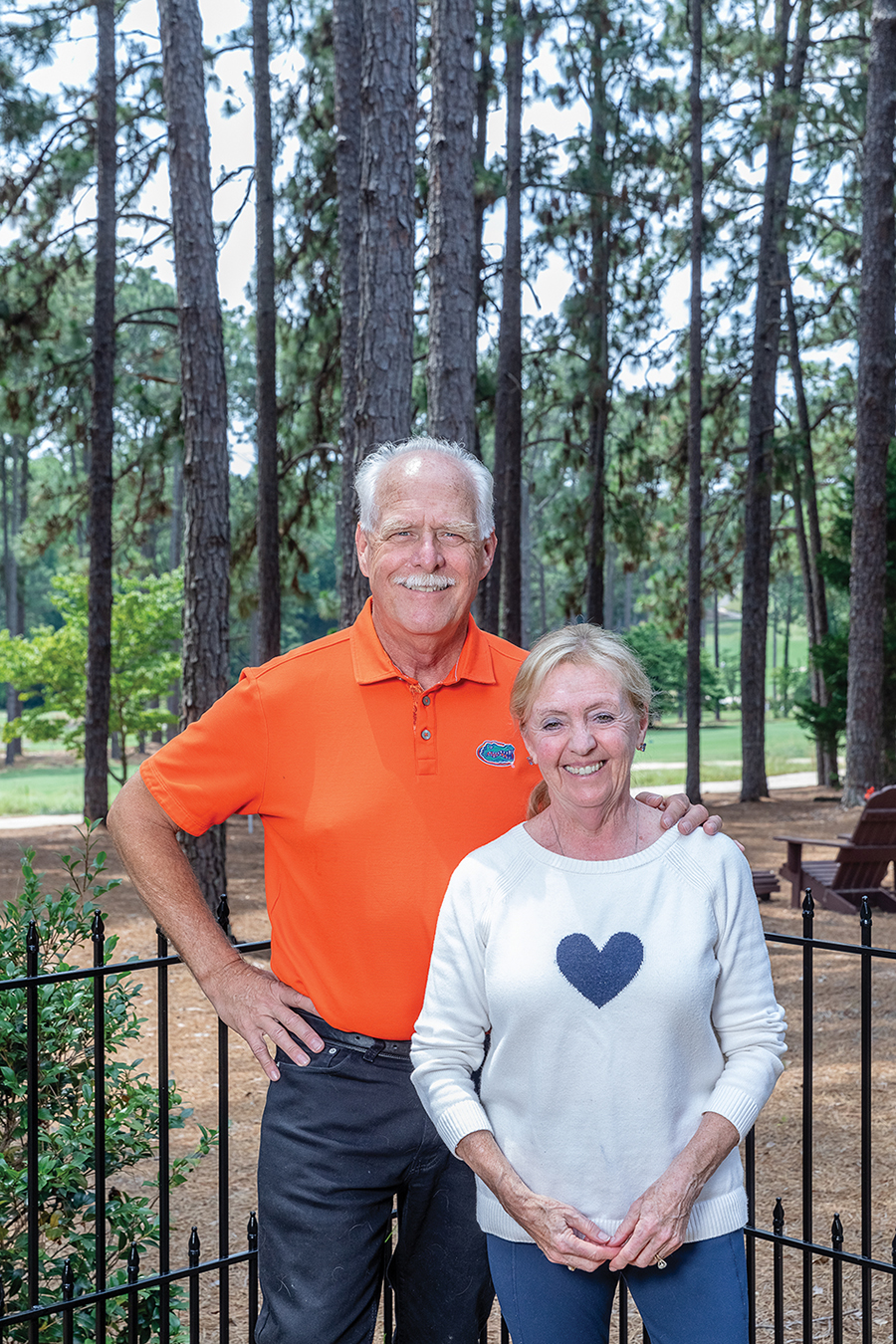
Homes fall into categories: fixer-upper, starter, family, dream, downsized, retirement. In the 20-some years Mike Jones and his wife, Annie Hallinan, have lived in Southern Pines, two homes have added a category: ours. Defying trends, periods, heirlooms and High Point, they plot a floor plan, hang paintings and arrange furniture their way.

This method fits a couple that has traveled the world on larks or for business while employed by AT&T/Verizon. Annie is a petite Scottish lass who, as a cheeky 17-year-old, left home to find adventure, first in London, then New York. Mike, known as a pilot who flies his Cessna to the beach for the day, takes children for a ride or delivers rescued dogs to forever homes, grew up in Connecticut. They discovered Moore County on a 50th birthday jaunt, a look-see after rejecting Myrtle Beach, California and Arizona.

“Pinehurst fit like a beautiful jacket,” Mike recalls. The Moore County airport sealed the deal.

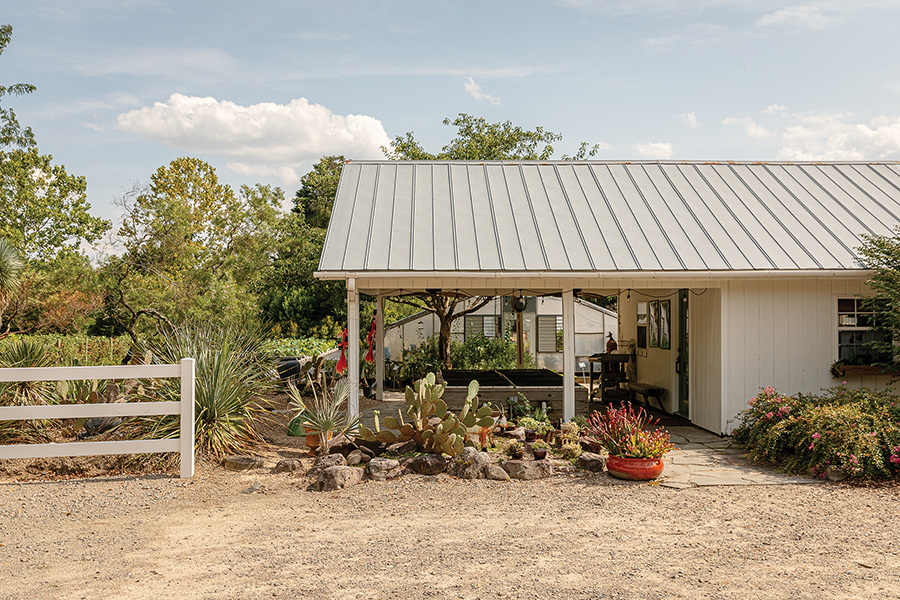
While he was playing golf, Annie — retired on a buyout — bought a house at Talamore, which soon proved too small. So she replaced it with a 7,000-square-foot Italianate villa, once a mail-order orchid nursery, possibly the only residence anywhere with a kitchen door opening directly into the greenhouse.

Lemon basil, anyone?

Chimbly, named for the industrial chimney rising over an outbuilding, became a Knollwood showcase. From there Annie wrote children’s books, and Mike, when not aloft, managed his family’s industrial cleaning products business. After a decade, encapsulating seemed wise, hopefully in the neighborhood they loved.

“We wanted a little jewel box,” Annie says. How about directly across the street?

When its elderly resident vacated this adorable 2,000-square-foot cottage, Mike and Annie pounced. Never mind that it needed everything. For them, this was a plus, an invitation to create, indulge. Who cares if the contractor recommended demolition, then starting fresh?


“Nooo,” Annie insisted. “That would destroy the history, the character.” Instead . . .

“Let’s reallocate space.”

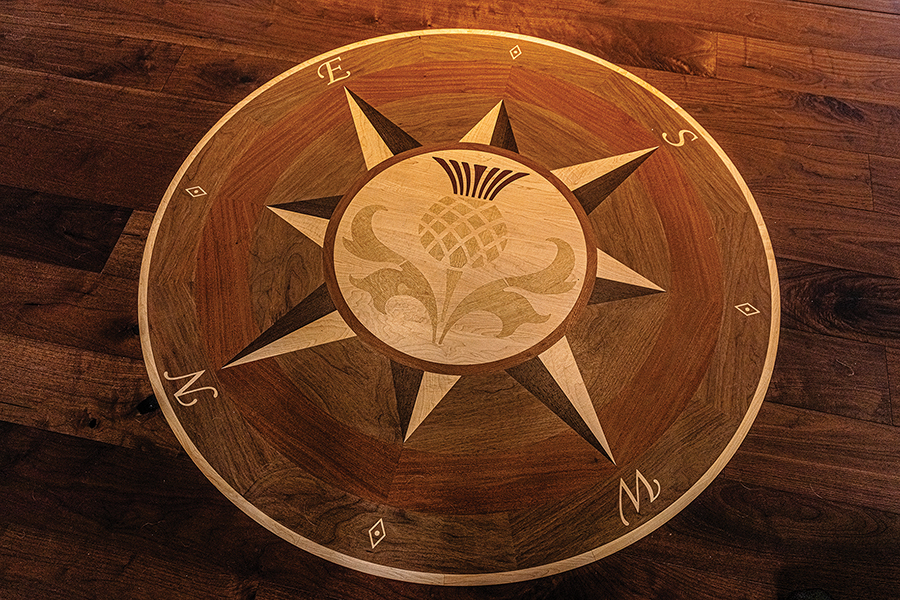
Start by moving the front door and ripping out the kitchen, which made room for an airy vestibule where a wood-paneled archway raises the ceiling and a huge lopsided compass covers the floor. Referencing Mike’s navigational prowess, the “N” arrow points true north, although the vestibule does not. A small rear porch was enclosed, fireplace and leather massage chair added. Now they had somewhere to eat dinner, read, watch storms roll in over the golf course and, Mike adds, “Enjoy each other.”

Let’s build: Annie and Mike named their project The Wee House for good reasons, tiny bedrooms being one. Solution: Convert the front-facing double garage into a master suite and L-angle a new garage which, with the circular drive and mature dogwood tree, channels a European courtyard. Then, add a deck across the back, loaded with flowerpots and a fountain. But don’t mess with the cream-colored shakes and blue roof, since they hint at imagination within.

Let’s cook: Mike does the honors, superbly. “When he’s gone I eat cereal,” Annie admits. The couple entertains often, most recently a party celebrating Mike’s newly minted doctorate in business administration, at 72. His open, flow-through kitchen centers the entire house. He chose bright navy cupboards; a painting over the sink; blue granite countertops uncluttered by appliances; a range placement that allows him to converse with guests while sautéing; the Rolls-Royce of French-door refrigerators; a steam oven for high-rise muffins, yeast breads and his signature salmon en croute; and a “canapé counter” for cocktail party tidbits. Here, like elsewhere, the ceiling fixture masquerades as suspended sculpture.


Let’s be practical: All the systems — heat, AC, plumbing, electrical, needed replacing. Doors were widened and bathrooms, including the shower, made wheelchair accessible just in case. A corner of the yard was fenced for three elderly rescue dogs, should walks become difficult. Annie and Mike each have an office; his, in the basement, hers in a small former bedroom, where Wee House’s only TV is located. Here, they start each day with coffee and the news.

Let’s have fun: Annie calls their quirky little touches “Easter eggs.” There’s Mike’s teddy bear collection, used during Angel Flights, sitting on a ceiling shelf; a second dishwasher in the laundry room/butler’s pantry; a suspended metal rod “toasting bar” running down the center of the dining room table, to clink glasses during dinner party toasts; shelves built to display Annie’s shoe collection; bathroom washbasins hand painted, in the Chinese mode, with serpents and other fanciful motifs, to complement similar wallpaper. But the premier egg has to be the bar Mike contrived from a hall closet opposite the living room, centered on a portrait of a Mexican woman. The walls, countertops, appliances, floor — are all black illuminated by flickering clear Christmas-tree lights. Here, Mike stores his single-malt Scotch.

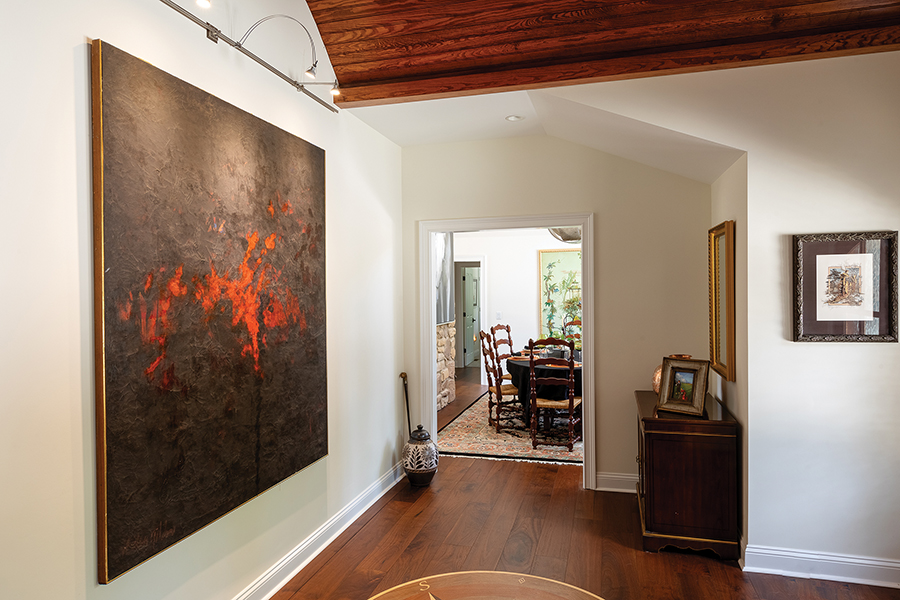
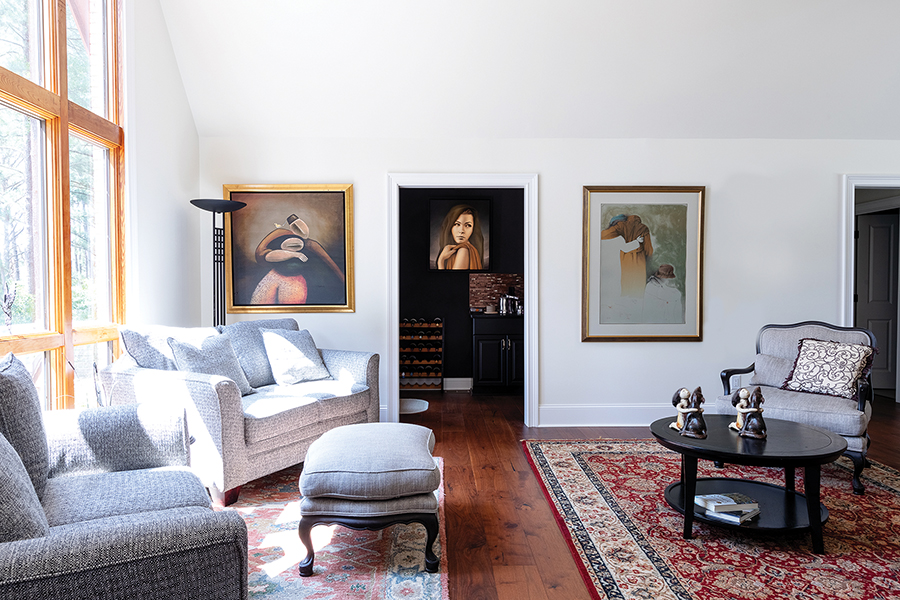
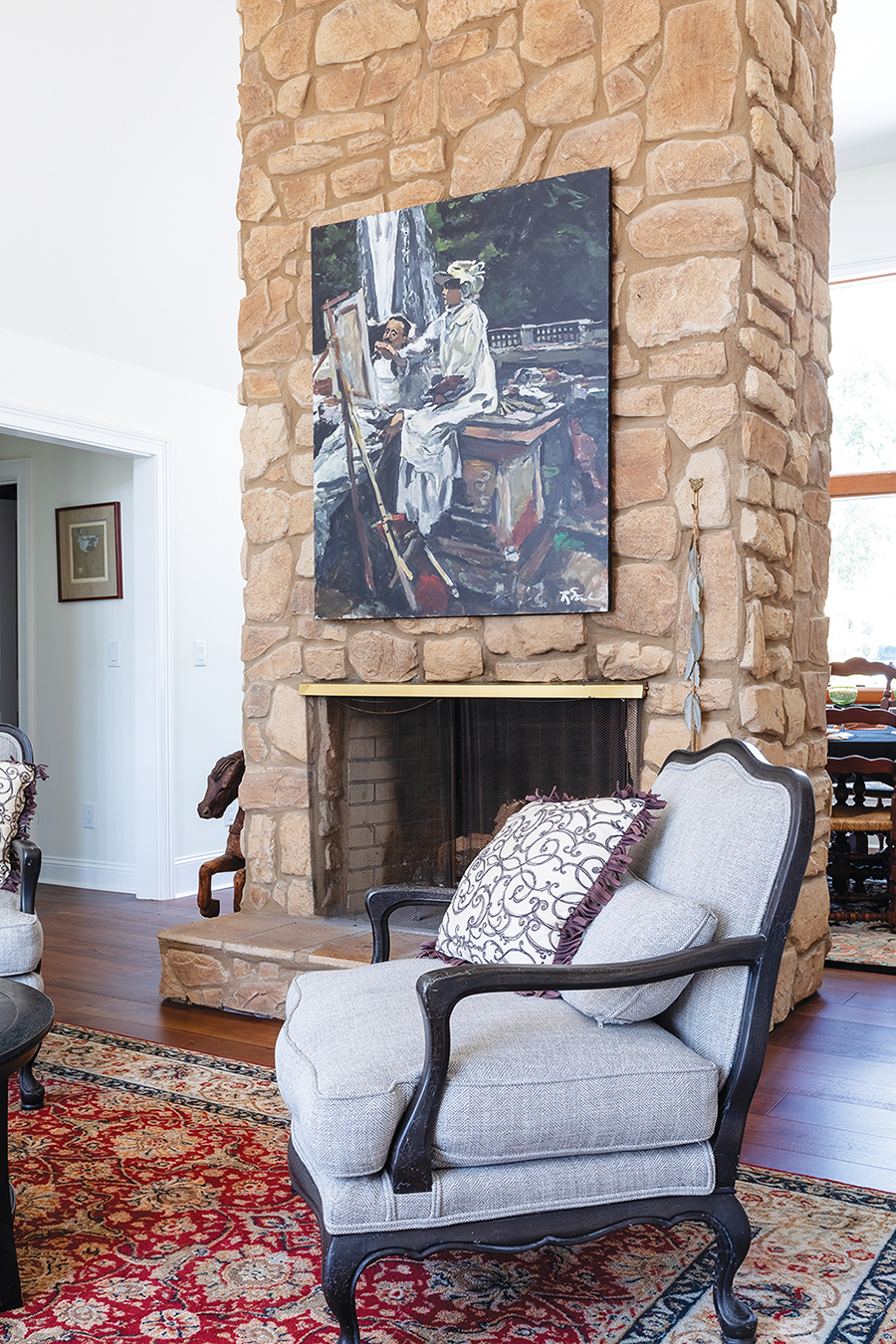
Let’s gather: Only the living room retains some resemblance of the original layout. A stone chimney rises from the wood-burning hearth to the cathedral ceiling. Opposite it, light streams through 14-foot windows with wood-framed panes. Furnishings are comfortable, sparse, not to detract from the art. “I’d rather have art than furniture,” Annie says.


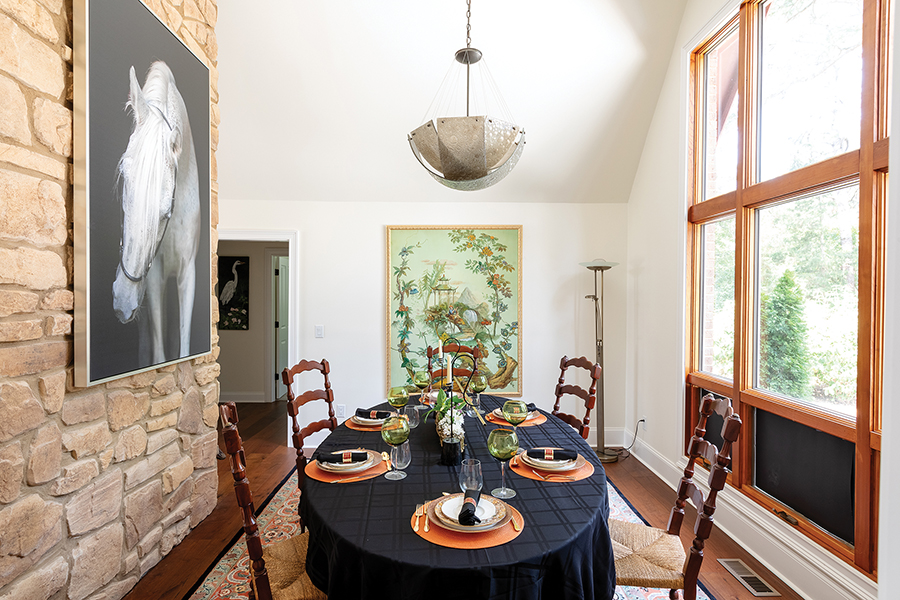
Let’s keep it simple: Clutter is not permitted at Wee House. Annie shudders at the mention. Before vacating Chimbly, she selected which furniture would cross the road, then invited friends to a giveaway. Habitat carted off the rest. “I call it Spartan, spare, no froufrou,” Mike adds. Most of their beloved, often huge, paintings survived the cut, including a nearly life-sized reclining female nude. Some pieces have animal themes, others suggest Modigliani or Chagall. Mike’s favorite is a tabletop-sized carving depicting a woman hugging her dog.

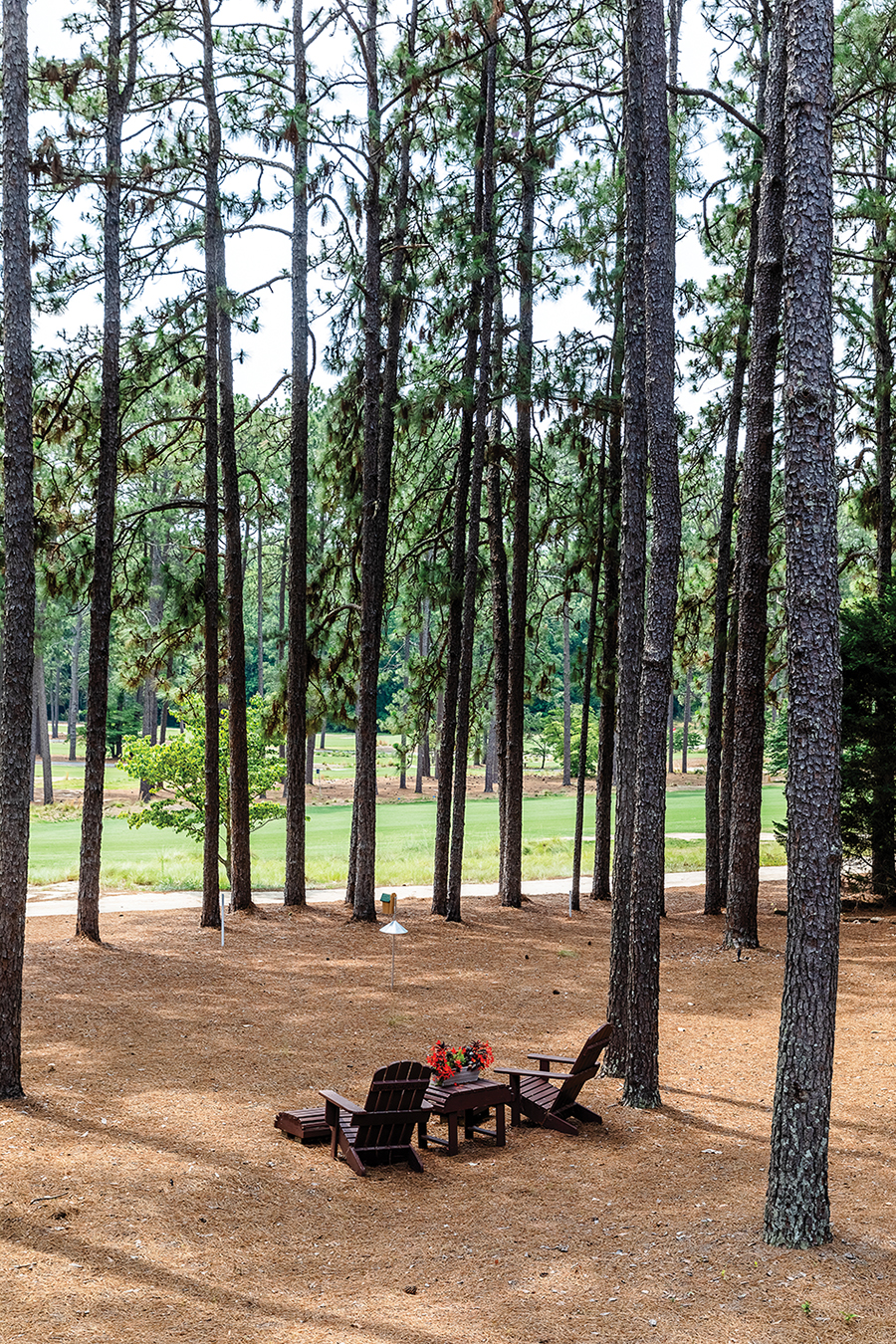
Renovations took more than a year, with Annie and Mike dropping in often. No thought was given to resale of this two-bedroom gem with a small living room but panoramic view of Mid Pines’ 12th fairway — and a kitchen positioned for cooking in the round. “We use every room, every day. We surround ourselves with things that make us happy,” Annie explains, including people, animals, art . . . and each other.  PS

Poem August 2023

Poem August 2023

Washington as Count Dracula

Tryon Place, 1791

Washington comes in. He is wearing

black velvet with gold buckles at the knee

and foot,

a sword with finely wrought

steel hilt, in scabbard

of white leather,

a cocked hat with a cockade and a feather,

also black. His powdered hair

is gathered in a black silk bag.

His hands in gloves of yellow

clasp extended hands.

Above his head medallions

of King and Queen

flicker beneath dripping wicks, the little flames

in circles on the chandeliers

surrounded by bits of glass, like worlds

in the sky, the telescopes of astronomers.

The crystals like Newton’s prisms split

the flames, blue, yellow, red, violet.

As in the “The Masque of the Red Death”

the dance goes on in rooms, where colors

glint from rubies in women’s ears.

He bows deeply, his corneas

refract ideas: science

dances from tiaras, bracelets, rings.

The battle of Alamance

was lost. The Regulators’

defeat had finished the rebellion,

or so Tryon thought.

Washington’s eyes grow red.

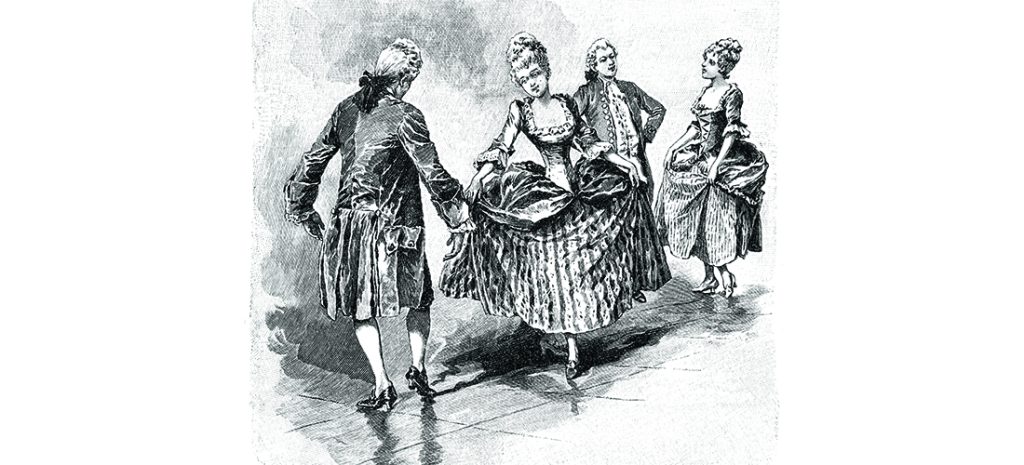
He leads the minuet.

        — Paul Baker Newman

Will Rogers In Old Pinehurst

Will Rogers In Old Pinehurst

The Cowboy Philosopher and American Legend

By David Sowell

In late March of 1928, a plane carrying one of the most popular and influential figures in America landed in Pinehurst. This gentleman had come to promote a sport. It wasn’t golf. In fact, he had once been at the forefront of those who held the game in disdain. Seemingly at every opportunity, he lampooned golf and those who played it. His name was Will Rogers.

Part Cherokee Indian, Rogers was born in Native American Territory in what is now the state of Oklahoma. His story was not a rags-to-riches one. It was more like riches to mega-riches. His father was a very successful rancher, but it appeared that Will was going to have a rough time equaling that success. He was a poor student and received a bare-bones education as he bounced from boarding school to boarding school.

His father hoped to give young Will a leg up by providing him with his own cattle ranch. Rogers soon sold it and went off to Argentina. He tried to make it as a rancher there, but in just five months, he was broke. Too embarrassed to write to his father for help, he took a job tending a load of livestock on a freighter bound for South Africa.

Once ashore, Rogers was hired by the ranch where the livestock were destined to go. The owner was a wealthy Englishman who was very demanding and boisterous, characteristics that didn’t match up well with Will’s laid-back attitude. Rogers quickly found himself on the move again. He hooked on with, of all things, a Wild West show. After a stint there, he moved to Australia, where he worked in a circus.

Rogers eventually returned to the United States and began appearing intermittently on the vaudeville circuit, doing rope tricks with his lariat and offering his humorous observations on the American scene. In 1904, he was one of the performers at a Wild West show at Madison Square Garden in New York City when a huge steer broke loose. The steer jumped over the guard rail and into the stands. Pandemonium ensued. The audience scattered. With his lariat in hand, Will and several of the show’s other performers were in hot pursuit. The steer reached the upstairs balcony where Rogers was able to rope it and guide it back onto the arena floor. 

His heroic actions made the front page of The New York Times, and Rogers’ career skyrocketed, eventually turning him into an early 20th century multi-media darling. He made motion pictures and wrote one of the most successful newspaper columns in that medium’s history. He toured the country doing live shows that sold out wherever he appeared.

Through his folksy commentary in his newspaper column, Rogers captured the hearts of ordinary Americans. The same could hardly be said for the game of golf. It had the look of an activity for those who also yachted as they summered. Two of the country’s most talked about golf zealots were Andrew Carnegie and John D. Rockefeller, the nation’s two richest citizens. Carnegie’s name was bandied about as a potential president of the United States Golf Association, a nascent organization born three days before Christmas in 1894.

Golf’s deep connection to the nation’s upper crust resulted in much of the country’s rank and file looking at the game with contempt, if they looked on it at all. This contempt was fueled by the stance taken by one of America’s most popular presidents — Theodore Roosevelt.

Roosevelt was the quintessential man’s man. While president, he hunted. He boxed. He chopped down trees. On more than one occasion, he took winter swims across the Potomac. Roosevelt let it be known widely and often that he viewed golf with scorn. He called it a game for dudes and snobs.

After Roosevelt’s passing in 1919, Rogers took the point for the anti-golf crowd, drawing huge laughs about the game in his stage act and his writing. Some of his more notable barbs included:

Golf is good for the soul. You get so mad at yourself you forget to hate your enemies.

Long ago when men cursed and beat the ground with sticks, it was called witchcraft. Today it’s called golf.

Rail-splitting produced an immortal president in Lincoln, but golf hasn’t produced even a good Congressman.

Golf antipathy even spilled over into the 1920 presidential election. During the Republican Party convention in Chicago, a deal was cut by the party’s bosses that gave the 1920 nomination for president to Warren G. Harding, a United States senator from Marion, Ohio.

Harding’s team decided that for the general election, they would utilize a “front porch” campaign. Instead of barnstorming the country, their candidate would remain close to home and let supporters and the press come to him.

This homey approach was augmented by a well-orchestrated use of print media and a thorough stroking of the newsreel distributors. (Newsreels were shown in movie houses before the main feature.) One of the first newsreels featuring their candidate showed Harding, adorned in fancy knickers, teeing off and putting at a golf course near his home.

As soon as the golf newsreel began to roll in movie houses around the country, the Harding campaign was inundated with negative reactions to it. One United States senator who was backing Harding said he’d been in a packed theater where the newsreel was shown and there was not one applauding set of hands in the entire place.

It was clear to the Harding team that they had ingested a huge dose of political poison. Desperate to get back on track, they hatched a plan involving baseball that would show the country their man was as mainstream as it gets.

In late August, the Chicago Cubs were on their way to another lackluster finish in the National League pennant race. Sticking to their front porch strategy, the Harding campaign’s plan was to bring the Cubs — whose owner was a Harding backer — to Marion, on one of their off days for an exhibition game.

The Cubs took on a team of locals and a crowd of 7,000 showed up at the rickety Marion ballpark to watch the game. The campaign sent out press releases a few days before chronicling Harding’s playing days as a bare-handed first baseman in his youth and detailed how he was once a major stockholder in a professional team in the Ohio State League. 

Harding arrived at the game with the newsreel cameras rolling and received a rousing welcome from the crowd. He then warmed up the Cubs starting pitcher, future Hall of Famer Grover Cleveland Alexander. After the warm-up session, Harding threw out the first pitch and then whooped it up in the stands for the benefit of the cameras the rest of the afternoon. When the game’s newsreel footage reached the movie houses, the favorable reaction it received more than canceled out Harding’s golfing blunder. He won the election, handily defeating his Democratic opponent, James M. Cox.

Harding’s frequent golfing and the criticism he received about it would dog him all through his presidency. It started the first Sunday he was in the White House, when he skipped church and headed to the course. By 1922, it was a public relations nightmare, and it was about to get even worse because Will Rogers had rolled into town.

When Rogers arrived, he was extended an invitation to the White House to meet the president. His visit was cordial and friendly. Harding even expressed an interest in seeing Will’s show. Rogers’ golf and political jibes quickly became the talk of the town. After just a few shows, one of Harding’s aides went to see Rogers and asked that he not do so many golf jokes about the president because the newspapers were making too much of it.

Although surprised at the request, Rogers agreed to it and eliminated several golf jokes from his act. A couple of nights later, it was announced that Harding was going out to the theater — there were only two shows in town — and Rogers took this to mean he was coming to see him. When the curtain rose, Harding was nowhere to be seen. He had gone to the other show. The following night, Rogers turned the heat back up, putting the previous jokes about Harding’s golf back in his routine and adding more.

One turned out to be quite prophetic. There had been a fire that damaged the Treasury Department building, and Rogers used it for comedic effect. “The fire started on the roof and burned down to where the money was supposed to be and there it stopped. The Harding Administration had beat the fire to it,” Rogers said.

Soon after Rogers’ show left Washington the biggest and most sensational scandal to hit American politics, to that point, broke: Tea Pot Dome.

In 1923, an effort was made to bring Rogers to Pinehurst for a show at the recently opened Theater Building. Due to other contractual obligations, Rogers doubted he could work Pinehurst into his schedule and, on the Pinehurst end, it was felt that Rogers’ fee of $500 was too mercenary.

Five years later, in the spring of 1928, Leonard Tufts, the owner of the Pinehurst Resort, footed the bill for Rogers to make an appearance, and the entertainer was more than happy to make the trip. It would involve two things he had become very passionate about: aviation and polo.

Rogers’ affection for aviation had turned him into the country’s first frequent flyer. Air travel was just what he needed to accommodate his demanding schedule. Paying by the pound, Rogers flew in mail planes to destinations across the country. He became good friends with aviators Charles Lindbergh and Billy Mitchell, regarded as the father of the United States Air Force. Rogers was flown to Pinehurst from Atlanta, where he was performing, by Pinehurst’s Lloyd Yost, a well-known aviator and the manager of the local airfield.

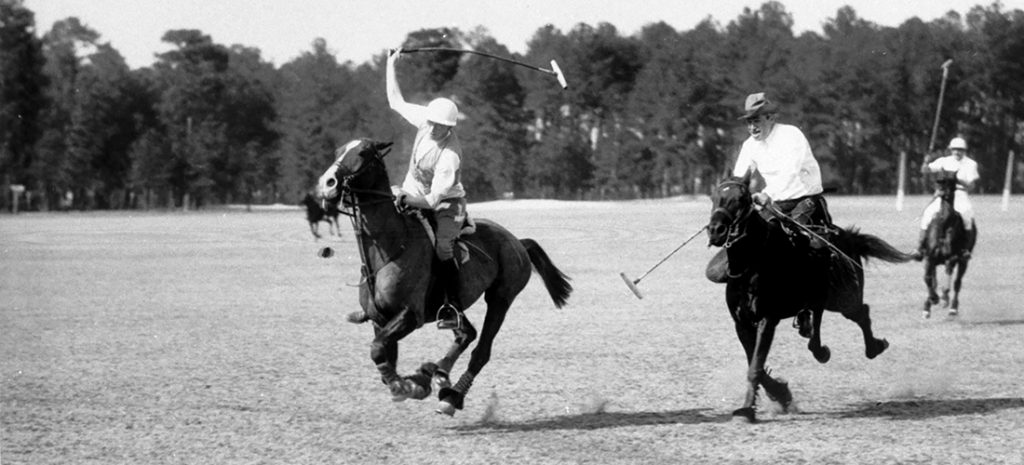
Rogers’ second passion, polo, was a sport every bit as highbrow as golf, the game he had mocked and made fun of for so many years. A fellow performer with Rogers in the Wild West show that fateful day at Madison Square Garden had a decade later begun training horses for polo in New Jersey. Rogers visited him and became hooked on a sport that allowed him to saddle up and get back to his cowboy roots. He became so “all-in” for polo that when he purchased the property for his ranch in Santa Monica, California, a polo field was laid out before the design for the ranch’s house.

Rogers hosted matches on the weekends whenever his travel schedule permitted. The regular participants were some of Hollywood’s biggest names: Clark Gable, Spencer Tracy, Hal Roach, Walt Disney.

Rogers played polo with reckless abandon and had the broken bones to show for it. He once said of the sport, “They call it a gentlemen’s game for the same reason they call a tall man Shorty.” Los Angeles Times sportswriter Frank Finch wrote of Rogers, “He erased the tea-drinking, ‘High Society’ ideas about the mallet sport by appearing at swank polo clubs donned in overalls, cowboy boots, hatless and coatless, his $1.98 shirt open at the throat.”

The polo match in Pinehurst that Rogers saddled up for took place on the grounds of the harness track. The contest featured two local teams. Rogers took part as a member of the “The Yellows.” The match ended in a 3-3 tie with Rogers scoring all three of the Yellow team’s goals.

That evening Rogers put on his one-man show in the Theater Building. His appearance had been highly promoted with ads appearing in local newspapers since early February and was a sold-out performance.

Well before his trip to Pinehurst, Rogers’ jokes about golf seemed to be tapering off. The sport had turned something of a popularity corner. Another icon who, like Rogers, was a hero to the common man had become the country’s most high-profile golf fanatic — Babe Ruth. The baseball slugger’s exploits on the golf course flooded newspapers during the off-season.

And, two years prior to Rogers’ appearance in Pinehurst, Bobby Jones had been celebrated with a ticker-tape parade in New York City when he returned from winning the British Open and British Amateur. In 1930 Jones would collect all four championships in a calendar year — the U.S. Open and U.S. Amateur, British Open and British Amateur  — to complete his Grand Slam, earning a second  ticker-tape celebration. Jones and John Glenn, the fighter pilot, astronaut and senator from Ohio, are the only people to have been so honored twice.

Over the next few years, Rogers developed a friendship with Jones. When Jones was in Hollywood to make a series of short films titled How I Play Golf, he spent time at Rogers’ ranch. Jones would hit golf balls around the ranch’s vast open spaces while Rogers accompanied him on horseback.

Rogers’ career continued to reach new heights. In 1935, he signed a movie contract with Fox Studios that would pay him $8,000 a week — the equivalent $176,000 in 2023. By late July of 1935, he had made four movies that were playing across the country and had just wrapped up the production of a fifth, titled In Old Kentucky. After that stretch of moviemaking, he was ready to get back to traveling.

Two weeks later, near Point Barrow, Alaska, an Eskimo man made a rapid trek on foot, covering 15 miles over rugged terrain in three hours to reach the Army Signal Corps station. So exhausted he could hardly speak, he told the personnel that a plane had crashed and its two occupants were dead. The pilot of the plane was renowned aviator Wiley Post. His passenger was Will Rogers.  PS

David Sowell writes about golf history. He has written for the USGA’s Golf Journal and he is the author of the book The Masters: a Hole-by-Hole History of America’s Golf Classic. He moved to Pinehurst in 2020.

Butterfly Highway

Butterfly Highway

A neighborhood creates a pollinator pitstop

By Jan Leitschuh

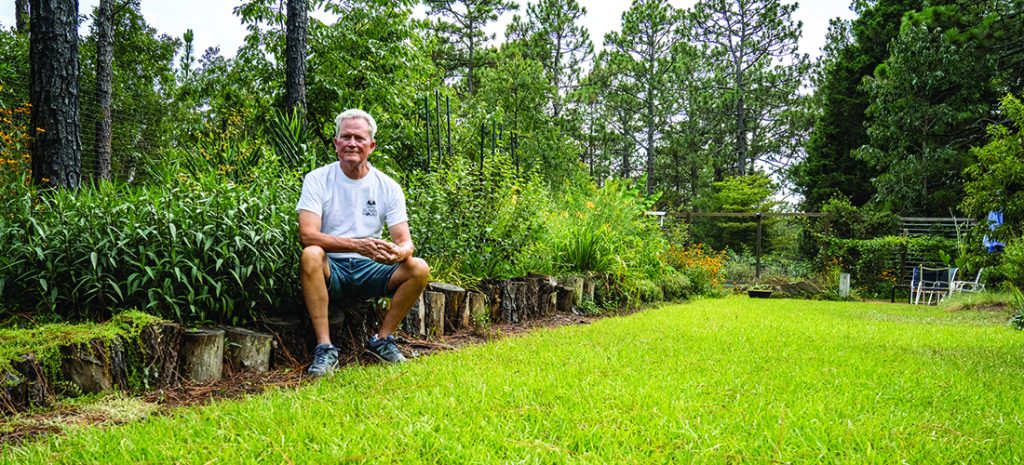
    Left: Dez MacSorley

If you have lived five or six or seven decades, you remember the abundant orange and black monarch butterflies of your childhood. Hardly a summer day would pass without seeing one, if not scores of them.

Today, if you see one, it’s Facebook- or Instagram-worthy because of the butterfly’s rarity. There are a number of reasons the population has crashed in the last couple decades, but crash it has.

One neighborhood in Southern Pines is fighting back. A dedicated group of neighbors is working to transform their long street into a connected and welcoming pollinator paradise, not just for monarchs but all declining butterflies, birds and native insects.

This month, the fall monarch migration begins winging its perilous journey to Mexico, laying eggs on milkweed, exclusively, along the way. An extensive stretch of Sheldon Road will be waiting with open arms with milkweed for eggs and nectar plants for sustenance — all pollinators welcome.

“Pollinators continue to make global headlines as native bees and migrating species such as monarch butterflies decline,” writes the North Carolina Wildlife Federation. “Habitat loss from development is the primary cause of population decline, followed by pesticide and fungicide use, as well as parasites and diseases.”

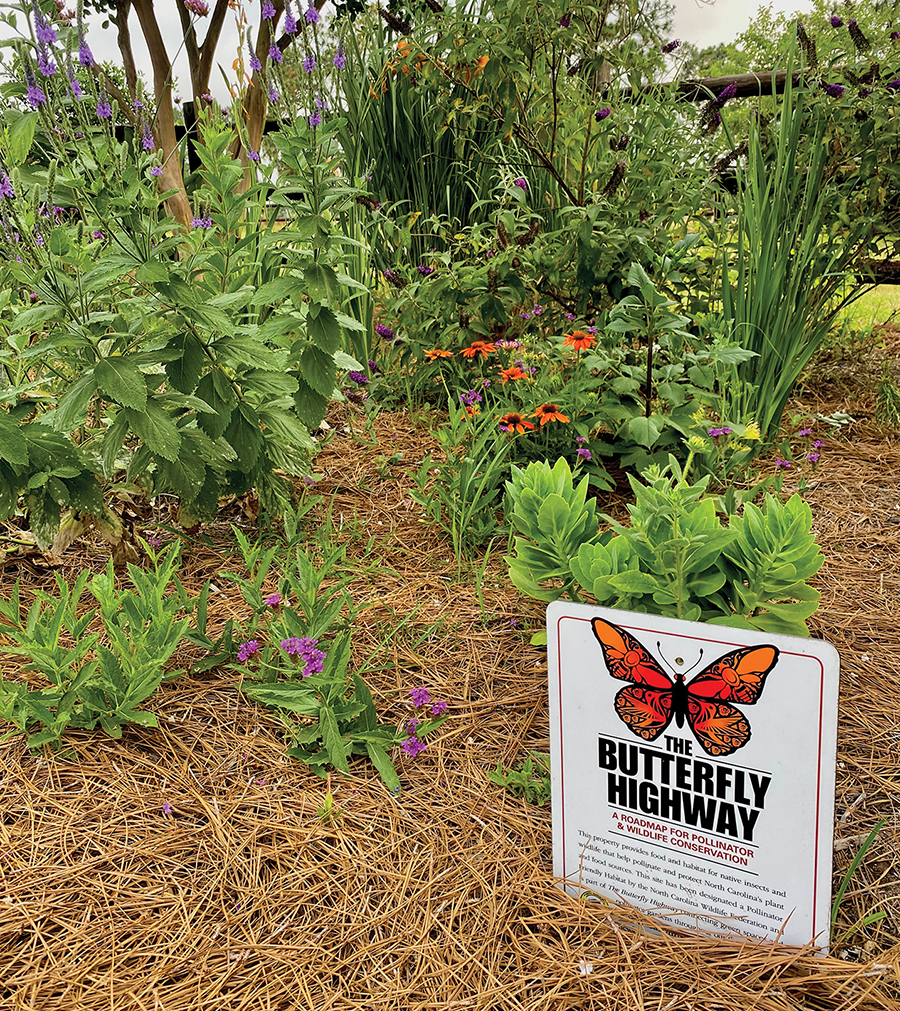
In response, the federation developed the concept of a North Carolina “Butterfly Highway,” a statewide conservation initiative aimed at restoring pollinator habitat, from citizen-driven, backyard “Pollinator Pitstops” to large-scale habitat rejuvenation of roadsides, agricultural margins and development.

Individuals answered the call. Homeowners and garden clubs began taking up the torch to raise awareness and create inviting habitat for these vulnerable and iconic lovelies. Some farms planted long strips of pollinator plants.

Threatened monarchs are at the forefront of the public awareness, as these butterflies only lay their eggs on milkweed species. As milkweed declined due to abundant agricultural use of glysophate weed killers versus mowing (which allows the plant to regenerate from the roots) and general habitat loss, so did the monarchs. Fifteen years ago, I read about the precipitous drop in the monarch populations. Conservation organizations were sounding the alarm and pleading with anyone who would listen to plant milkweed.

A visit to a remote Virginia meadow that fall yielded several ripe pods of the common milkweed variety. I tucked the seeds in my cottage garden here and forgot them. Next spring, I had milkweed, and have ever since. Thus began my butterfly journey, near the southern end of Sheldon Road.

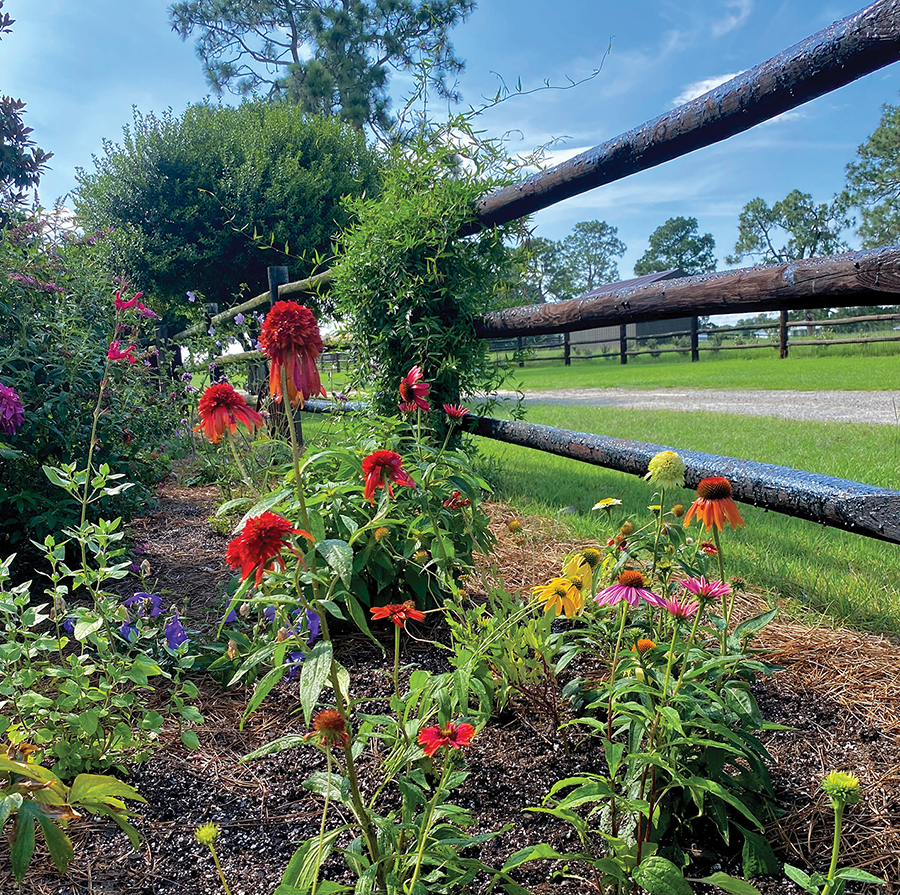
About the same time, interest in native plants and pollinator-friendly gardens ripened into the public awareness too. Nearly a mile away from me, on a horse farm at the far northern, sand-road end of Sheldon, retired landscape architect and beekeeper Dez MacSorley designed her farm and decided to have a pesticide-free, non-manicured, tufted grass lawn. “Aside from the horse pastures, I turned all the other bits of land into a continuous meadow devoted to pollinator-friendly perennials and native grasses,” she says. This is the third year for the meadow and its beneficiaries.

“Come they have, “ MacSorley says. “Butterflies, bees, wasps, birds, moths — all come to feed on, find shelter in and enjoy my little meadow.”

She says her nearby Sheldon neighbors inspired her from the beginning, including avid gardeners Lynn McGugan, Cameron Sadler, Tayloe Moye and Carol Phillips, who has since passed away, all with different, complementary styles, and a passion for supporting and extending the natural environment.


In April 2021, Molly Thompson-Hopton, Cameron and Lincoln Sadler’s niece, started a Facebook garden group for her plant-loving friends, and the photo-sharing, education and awareness caught fire. “I guess you could say a love of wildlife and plants runs in our family,” she says.

“We started trading plants and knowledge,” MacSorley says. One of her neighbors, Sara Hoover, started a milkweed patch on her property adjacent to the Walthour Moss Foundation.

Thompson-Hopton, though living 8 miles away, caught the conservation bug. “After I moved to the family farm in Aberdeen, I got busy planting,” she said. “I knew I wanted to attract pollinators. I stumbled across some clasping milkweed and brought it home. I have four varieties of milkweed now and hope to add more.”

Through the plant trading on Thompson-Hopton’s social media page, I shared some milkweed plants with Lynn McGugan several years ago. She tucked them in near her other pollinator plants. McGugan, a force of nature, does nothing by half-measures. Before long, armed with information, she was out preaching the benefits of milkweed, pollinators and native plantings.

“Pollinator plantings add beauty to any landscape,” says McGugan, “and serve a purpose.”

A skilled photographer, McGugan posted gorgeous, envy-creating photos of various butterflies, caterpillars, moths and native bees feasting on her nectar banquet. Then McGugan and MacSorely hatched a plan to share the plant love even further.

“We intend to extend our pollinator-friendly native plantings down the natural edges of Sheldon Road,” says MacSorley, “creating a natural environmental corridor between all our properties, the Walthour Moss Foundation land and, who knows, maybe including some of the new houses further up Sheldon and along Youngs Road. This is truly the ‘butterfly effect’ at work.”

As tall pines came down and new houses went up this summer on Sheldon and just off it,  McGugan walked up to a job site and grabbed a number off the sign, then started a conversation with Chris Styne of Homes by Dickerson. She found a willing ear in Styne. In a recent email he wrote: “Homes by Dickerson is excited to . . . be a part of such a unique and necessary organization such as this. We are committed to planting flowers at each of our eight new homes being built on Braden and Sheldon Road.”

Encouraged, McGugan has reached out to other builders. She engaged Seth Mabus of Mabus Farm & General Contracting and came away with a commitment for all new builds to include pollinator gardens. “They have the potential for such impact by just including a few beneficial shrubs and trees,” she said. “It all adds up.”

Across the road, farm owner Tricia Greenleaf and John Robertson started their own patch of milkweed this year, right next to a massive, nectar-rich Miss Huff lantana. McGugan offered them rooted cuttings in pots from some of her own flowering shrubs.

McGugan’s near neighbors in horse country, Sadler and Moye, have cultivated stunning gardens too, sisters inheriting their mother Carol’s love of plants.

“Initially,” says Moye, “I bought a milkweed plant because I was interested in having butterflies. It got covered with caterpillars and they were eating the leaves so I used a pesticide and killed all of them. When I told Lincoln what happened, he said, ‘You just killed all the butterflies.’ That was 14 or 15 years ago.” Moye was heartsick, but soon made up for her pesticide error.

“I have been gardening since a child, continuously throughout my life,” she says, “and I believe it saved me in the worst of times. I have become more interested in native plants over the last 10 years. I’m pretty sure Lynn McGugan was my initial inspiration. I saw what she was doing and over the last three years ordered every type of milkweed I could find on the internet along with other native plants.”

On a long stretch of Sheldon Road, from Foundation-adjacent horse farms to suburban new construction and out the other end to Weymouth Woods, a butterfly-friendly corridor is shaping up, thanks to enthusiastic neighbors.

“Nature fills me with joy and I feel like I’m contributing to the greater good by being an active participant,” says Moye.

Sometimes, it takes a village.  PS

Jan Leitschuh is a local gardener, equestrian, avid eater of fresh produce and co-founder of Sandhills Farm to Table.


GREAT PLANTS FOR CATERPILLARS

Butterflies get all the love, and they sip energy-rich nectar from many pollinator-friendly plants. But no caterpillars, no butterflies. Often, when their host plants decline, so does the species. Witness monarchs, who only lay their eggs on milkweed.

As habitat is destroyed, we can help by including a few friendlies for North Carolina butterflies to lay their eggs on, such as:

For monarchs: the milkweed family — common, tuberosa, swamp, clasping and more — offers exclusive food for the monarch caterpillars. These plants tolerate poor soil and never need fertilizing. All milkweeds contain cardiac glycosides in their sap that monarchs consume and store in their bodies. Potential predators learn to steer clear of this bitter, stored substance.

For swallowtail: Dill, fennel, parsley, common rue, carrot greens, tulip tree, wild black cherry.

For fritillaries: passion vine, maypops, violets.

For American painted lady: thistles, mallows, yellow fiddleneck.

For common buckeye: aster, peppermint, tickseed sunflower, chicory.

It Slices. It Dices.

It Slices. It Dices.

Memoir by Stephen E. Smith     Illustration by Harry Blair

Get up! Get up! Get up, up, up!” my mother blurted.

It was at 6:30 a.m., the first day of Christmas break, and as always she felt compelled to rouse her children at the most ungodly hour. I lifted my head from the pillow and stared bleary-eyed at her figure in the bedroom doorway. Wrapped to her chin in a blue terrycloth robe, her fists were planted firmly on her hips. She meant business. “You’re to march yourself down to the Safeway and ask Mr. Short if he’ll give you a job for the holidays,” she ordered. “You can earn enough money to pay for your books next semester. And next time I see Mr. Short, I’ll find out if you asked him for a job.”

“Can’t you even say, ‘Welcome home’?” I asked.

“Sure. Welcome home, Mr. Big Shot College Guy. Now get out of that bed and get yourself down to the Safeway.”

I was suffering from severe sleep deprivation. I’d caught an all-night ride home from North Carolina and had dragged into the house on Janice Drive at 3:15 a.m. But my mother was not to be denied, so I managed to pull on the wrinkled clothes I’d worn the day before and stumbled downstairs to eat a bowl of my brother’s Froot Loops. At 8:30 a.m. I scuffled up Bayridge Avenue to the Eastport Shopping Center, where I found Mr. Short on the dock, supervising the unloading of pallets of dog food from a tractor-trailer. He shook my hand and asked how college was going.

“It’s fine,” I answered. “I was hoping you might have an opening for a cashier during the holidays. I’m not looking to work eight hours a day, but, you know, something part time.”

“If I had an opening, I’d hire you,” he said. “But right now I have all the cashiers I need. I’d have to cut someone else’s hours, and that wouldn’t be fair, especially at Christmas.” My spirits soared. If he didn’t have an opening, I could pass the holidays stretched out on my bed reading P.G. Wodehouse.

“I’ll tell you what,” he continued, “I’ve got a friend who’s the manager at the Drug Fair in Parole. Go see him and tell him I sent you. He’s looking for holiday help.”

A job at Drug Fair was the last thing I wanted, but I had to make an inquiry. My mother was as good as her word, and I knew she’d buttonhole Mr. Short the next time she visited the Safeway. If she found out I hadn’t applied for the Drug Fair job, she’d make my Christmas break miserable, which she had already begun to do by wakening me before sunup.

Among cashiers, there existed a hierarchy, and working a register at Safeway carried with it a degree of status and a wage that was at least $1.75 an hour. Drug Fair was a discount pharmacy, emporium and grocery store, a low-rent warehouse for plastic crap and wilted vegetables, where the discount prices were clearly marked on each item — work for the dimwitted — and the pay was $1.25 an hour.

I caught the bus to Parole and found the Drug Fair manager, a rumpled, balding, ectomorphic fellow with thick wire spectacles and a long pointy nose, puzzling over paperwork in an elevated office that overlooked a line of disheveled employees who were pounding away at their cash registers. He appeared to be in emotional distress, his mouth screwed into a grotesque snarl.

“Excuse me,” I said. He looked up, snatched the glasses from his face and tossed them on the countertop in a display of frustration. “Mr. Short over at Safeway said I should talk with you about working as a cashier for the holidays. I don’t need a full-time job, just some part-time work if you’ve got it.”

Sweet relief swept over his face, his lips stretching into a half smile. “Mr. Short sent you?” he asked.

“He said you might need an experienced cashier.”

“You used to work at the Safeway?”

“For two years, until I went off to college.”

He grinned fully. I was apparently the man he’d been waiting for. He stepped out of his office, planted both feet flat on the linoleum and looked me up and down. “Can you work a register?” he asked.

“Yes, sir.”

“And you’ve worked stock?”

“Yes, sir.”

My God, he was going to hire me! I was going to pass the next two weeks checking out Christmas junk at the Drug Fair for minimum wage! This was not good.

The manager handed me a pen and an application clamped to a clipboard, and I took a couple of minutes to fill in the information.

“Follow me,” he said, and we walked quickly down aisle four toward the back of the crowded store. “I can use you to relieve my regular cashiers for their lunch and supper breaks, and you can help keep the shelves stocked, especially this display. We’re selling the hell out of these things.” He pointed to a chest-high pyramid of black, orange and beige boxes crowned with an unboxed white plastic kitchen device known to every American who owned a TV. “We’ve had to restock this display three times this morning. You know anything about Veg-O-Matics?” he asked.

What happened next was probably brought on by fatigue — or maybe I needed an excuse to get fired before I got hired. Whatever the cause, a synaptic misfire propelled me into the past. I picked up the display device, held it out in front of me and began to deliver the requisite spiel:

“Imagine slicing a whole potato into uniform slices with one motion. Bulk cheese costs less. Look how easy Veg-O-Matic makes many slices at once. Imagine slicing all these radishes in seconds. This is the only appliance in the world that slices whole firm tomatoes in one stroke with every seed in place. Hamburger lovers, feed whole onions into Veg-O-Matic and make these tempting thin slices. Simply turn the dial and change from thin to thick slices. You can slice a whole can of prepared meat at one time. Isn’t that amazing? Like magic, change from slicing to dicing. That’s right, it slices, it dices, it juliennes, perfect every time!”

By the time I’d finished yammering, the manager’s eyes were wide and his jaw slack.

“How’d you learn that?” he asked.

“I used to watch the commercial on TV, and it just sort of stuck in my head.”

My fascination with the Veg-O-Matic stretched back to my junior year in high school. Strung out on testosterone and teenage angst, I suffered insomnia for about six months. On those long, restless nights, I’d roll out of bed after everyone else in the house was asleep, slink down to the “rec” room and turn on the black and white TV. WJZ, the local CBS affiliate, was the only station out of Baltimore that aired anything other than an Indian Chief test pattern in the early a.m., so I’d tune in channel 13 in time to catch Father Callahan of St. Francis Xavier House of Prayer bestowing his benediction. Then I’d settle in for a three-hour run of continuous raise-your-own-chinchillas commercials.

My clandestine obsession with Father Callahan and chinchillas continued for two or three months — until the fateful night when the good Father delivered his usual homily and the chinchilla commercials failed to materialize. Instead, a plastic guillotine-like device appeared on the TV screen, contrasted against a background map of the world, below which were printed the words “World Famous Veg-O-Matic.” Then a disembodied voice said: “Imagine slicing a whole potato into uniform slices with one motion. Bulk cheese costs less. Look how easy Veg-O-Matic makes many slices at once. . . . ”

I’d spent my Father Callahan/chinchilla nights dozing fitfully on the couch and sneaking back to my room before the rest of the family awakened, but on that memorable evening — I’ve come to think of it as Night of the Veg-O-Matic — I sat there stupefied, watching the commercial over and over. I couldn’t take my eyes off the screen, and by morning I had the narration memorized — every nuance, modulation and inflection — to which I could add hand gestures, including the graceful, upturned palm that beckoned, “Buy me, buy me, buy me. . . .”

Later that day, I was eating lunch in the high school cafeteria with my regular buds when freckle-faced Ronnie Wheeler produced a sliced tomato his mother had wrapped in wax paper to keep it from saturating the white bread he needed to construct his BLT. I jumped up, grabbed the tomato slices and ran through the entire Veg-O-Matic routine, spreading the segments across the Formica tabletop and finishing with the obligatory “. . . perfect every time!” 

My friends were speechless, especially Ronnie, whose sandwich was ruined. They stared blankly before bursting into hysterics. The vice-principal, Mr. Wetherhold, a stern disciplinarian who abhorred any form of frivolity, hurried over to our table to discern the source of the disturbance. “What’s going on here?” he asked sternly.

“Do it!” my friends begged. “Do the Veg-O-Matic thing!” They didn’t have to ask twice. When I finished my second run-through, it was Mr. Wetherhold who was howling with laughter. Suffice it to say I spent a good deal of my time in high school doing “the Veg-O-Matic thing” for my friends. They never tired of it.

Now the Drug Fair manager’s face glowed with approval, and I could see that he’d suffered an epiphany. He rushed into the stockroom and reappeared with a folding table. He extended the legs, positioned the table in front of the pyramid of boxes and covered the top with a square of red cheesecloth. He grabbed an onion from the produce aisle, peeled away the skin, and ordered me to deliver my recitation again, this time with the unboxed Veg-O-Matic at my fingertips.

Despite my long and intimate history with the kitchen device, this was the first time I’d worked with one. But I muddled through the presentation by recalling the images I’d watched hundreds of times on TV, each motion transmitted from memory to physical articulation. I made quick work of the onion, repeating the entire monologue. My demonstration, although clumsy, went well enough to instantly earn me the title: 1965 Parole Drug Fair Veg-O-Matic Man.

“You’re hired!” the manager said. “I want you to do a demonstration at the top of every hour. Use all the tomatoes and onions you want, but stay away from the cheese and Spam. That stuff costs money.”

“Yes, sir,” I said dutifully. 

“The rest of the time you can restock these Veg-O-Matics and relieve the cashiers who are going on break. Can you start tomorrow?”

“Yeah,” I said, “I guess.”

“Be here at 8 o’clock, and wear a white shirt.”

Crestfallen, I dragged myself into the parking lot and caught the bus back to Eastport. When I stumbled into our living room, it was 11:30 a.m., and I was whipped.

“Did Mr. Short hire you?” my mother yelled from the kitchen.

“He didn’t have any openings, but I got a job at Drug Fair in Parole.”

“Excellent,” she said.

When I turned up at Drug Fair on Saturday morning ready to begin my new career, the manager had anticipated my every need. The folding table was set up in aisle four, which was stocked with kitchen junk — Melmac dishes, spatulas, plastic forks, spoons and knives, etc. — and beside the table waited a freshly replenished pyramid of multicolored boxes containing the Veg-O-Matics. The tabletop was covered with the red cheesecloth from the day before, and a white apron of the style that loops around the neck and ties in the back was folded neatly on the table. An unopened can of Spam and a brick of Kraft Velveeta cheese were stacked beside the gleaming white Veg-O-Matic display model I’d used in my earlier demonstration, and a bag of assorted vegetables — tomatoes, onions, carrots and potatoes — awaited their fate. As a touch of class, the manager had placed a roll of paper towels on the table, and a beige commercial dome-topped trash can sat directly behind my workspace.

“Here, wear this,” he said, handing me a handsome black clip-on bowtie. I donned my apron and attached the bowtie to the wrinkled collar of my white shirt. “Now show me your stuff. Just use vegetables. The Spam and cheese are for show.”

I launched into my Veg-O-Matic dance at a measured pace, slicing up a small potato and allowing my hands to gracefully execute a lilting swirl at the conclusion of the shtick.

“That was even better than yesterday,” the manager beamed, “although I’d take it a little slower if I were you.” He looked up and down aisle four. “I’ll make an announcement at the top of every hour. You get yourself set up. Sell the hell out of these Veg-O-Matics. If you don’t, you’ll be in a checkout stand all day.” And he left me on my own.

I peeled an onion, and trimmed it to the proper size and shape. I was ready. Or as ready as I was ever going to be.

“We are pleased to direct your attention to aisle four,” I heard the manager announce over the PA system, “where you can view a demonstration of the miracle Veg-O-Matic, the 20th century’s greatest kitchen appliance. It makes an economical and useful Christmas gift! Do all your Christmas shopping in five minutes and have your Veg-O-Matics gift wrapped right here in the store. Christmas cards are available on aisle six.”

After my first two demonstrations, I discovered that operating the Veg-O-Matic wasn’t quite the effortless exercise I’d observed on TV. I directed my attention to the tomato, which I positioned perfectly between the upper and lower blades. “This is the only appliance in the world that slices whole firm tomatoes in one stroke with every seed in place,” I said, as I slammed down the top of the Veg-O-Matic. The tomato exploded like a water balloon, splattering juice and seeds all over my apron and the tabletop. The two customers who had gathered for my demonstration jumped back and bolted for the exit.

I’d created a huge mess. I mopped the tomato slop off my hands with a paper towel and brushed the seeds from my apron, but pulp continued to dribble from the bottom of the Veg-O-Matic, and I had to retreat to the stockroom to wash the blades. So tomatoes were out. Ripe ones, at least. After mopping the splatter from the tabletop, I attempted to slice an onion I’d peeled earlier. I gave a forceful downward thrust and the device worked perfectly, sending a cascade of onion slivers onto the cheesecloth. Still, it was a messy business; pieces of onion got stuck in the blades and had to be pried out. I had the same experience with carrots, stubborn chunks of which had to be worked free with my fingertips.

I settled, finally, on a peeled Idaho Russet potato. I cut the spud into four pieces, which I fed individually into the chopper. And the device worked as intended — neat and clean. The Veg-O-Matic was, after all, meant to transform a time-consuming, chaotic operation into a simple, wholesome procedure. And that’s what it did.

The secret, as with many physical actions, was in the wrist. It was all finesse. I’d place a piece of potato on the bottom blades and apply a sharp downward whack with the top. And voila! the potato was julienned, perfect for hash browns. If I spoke slowly, worked methodically and was meticulous with my cleanup, I could kill the better part of a half hour on each demonstration, thus allowing for only 30 minutes of working at a cash register before my next demonstration.

At first, I was worried that I wouldn’t sell enough Veg-O-Matics to keep my new job, but the pile of boxes diminished at an ever-increasing rate as Christmas approached and the manager was a happy man. I’d sold six to eight Veg-O-Matics with each demonstration, and I noticed that many customers who didn’t make an immediate purchase returned later to snatch up two or three Veg-O-Matics, having chosen convenience over thoughtful reflection. Usually these return customers felt compelled to offer an explanation for their delayed purchase. “You know,” they’d say, “I was thinking about your demonstration, and you’re right, this will make an excellent gift for my mother.”

Every day I’d work straight through until 10 p.m., taking an hour each for lunch and dinner, and then I’d catch the bus home in the dark. I’d shower and collapse into my bed to read for a few seconds in Pigs Have Wings, my latest Wodehouse novel, before falling asleep.

And that’s how it went for seven straight days. I’d turn up at Drug Fair at 8 a.m., an hour before the store opened, to prepare the potatoes for my demonstration. I’d restock the Veg-O-Matic display, piling the boxes high in an ergonomically conical construct of my own contrivance, and check out a register tray so that I could relieve cashiers who went on break.

If my schedule was exhausting, it also had its advantages. I slept like a stone, and the days flew by. At home, I didn’t have a conversation with my mother, father or sister that lasted more than 10 seconds. “Hi, how ya doing?” was as intimate as it got, which suited me. My father was asleep when I left in the morning and when I came in at night, I didn’t have to listen to my mother and sister bicker. Only my brother Mike, with whom I shared a room, was around when I staggered in whacked out from 12 hours of working with the public. He’d fill me in on the day’s drama with my sister, which made me glad I’d be headed back to college soon.

When the store closed at 9 p.m. on Christmas Eve, I used my humongous 5 percent employee discount to purchase gifts for the family — a cheap cotton bathrobe for my mother, which turned out to fit her like a circus tent, a simulated leather wallet for my father, a 45 of Donovan’s “Catch the Wind” for my brother, and the Beatles’ Help! for my sister. I was headed out the door with my packages when the manager stopped me.

“You’ve done a good job,” he said, a genuine smile on his pasty face. “And I’m hoping you’ll consider coming back to work through New Year’s Eve. You won’t be selling Veg-O-Matics, but I need experienced help to run the registers and handle returns. I could use you for at least 12 hours a day.”

Normally I would have responded with an emphatic “No,” but fresh in my memory were the money problems I’d experienced during my first four months at college and the hours I spent in McEwen Dining Hall scraping greasy dishes and scrubbing pots. With my paltry allowance, there was no hope of establishing a relationship with any of the girls I found myself drooling over as they roamed the campus. It was essential I screw up my courage and get myself an on-campus date. I’d have to double with an upperclassman who had a car, and to make that happen, I needed enough money to cover my share of the gas.

“All right,” I answered. “Can I get some overtime?”

“I’ll give you all the overtime you want. You can work 14 hours a day if you skip lunch and dinner.”

“All right,” I answered, “I’ll be glad to help out.”

So on December 27, I was standing behind a cash register refunding money for the Veg-O-Matics I’d sold the week before. “I’d like to get the money back for this thing,” the customer would say, handing me the orange and black box. They occasionally offered excuses such as “I already have one of these” or “I have no use for this piece of junk,” but what they wanted was cash. In almost every case the customer returning the Veg-O-Matic was not the person who’d bought it, so I didn’t consider the returns a criticism of my performance. I handed them the money and stuck the boxes and signed receipts under the register. At the end of the day, I toted the returned Veg-O-Matics to the storeroom and piled them up in the same space they’d occupied when they were new.

To compound this irony, the manager handed me a hammer at closing time on my first post-Christmas day as a cashier and sent me to the stockroom to smash the Veg-O-Matics the store had taken back. “Just bash those veggie things into little bits and put them back in the boxes,” he directed. “And while you’re at it, smash up these toys that didn’t get sold.” The manager didn’t explain why I needed to destroy so much perfectly good merchandise, and I didn’t ask. But I laid into my new task with gusto, obliterating hundreds of Veg-O-Matics along with Chatty Cathy dolls, Etch-A-Sketches, tin airliners, space guns, trains, battery-powered James Bond Aston Martin cars, Rock ’em Sock ’em Robots, Easy-Bake Ovens, electric football games, G.I. Joes, and the occasional Barbie doll, perfectly good toys that might have gone to poor children who’d suffered a sad Christmas. But it was exhilarating work — and strangely gratifying — an anti-capitalistic binge that assuaged the guilt I’d suffered from selling plastic crap to poor people.

But the days were long, and there was no time to hang out with my friends. When I got off work at 9 p.m., I was too worn out to go to parties or ride around with high school buds. I’d catch the bus back to Eastport and fall into bed. The following morning, I’d get up and do it again.

On my last day of work, a Friday, the manager shook my hand. “You’re a lifesaver,” he said, pumping my weary arm. “If you need a job next Christmas, just let me know.”

I smiled, gave him my college post office box number and asked him to send my check there rather than to my home address.

“You should get it before the 10th,” he said.

During the two-and-a-half weeks I’d toiled at Drug Fair, my parents hardly noticed my absence. I was a shadow who flitted in and out at odd hours. And I wanted it that way. I didn’t have to listen to them argue, which was their habitual method of communication during any holiday season when they were forced to remain in each other’s company for more than five continuous minutes. And if my parents didn’t realize the hours I was working, they’d have no idea how much money I was making. Had they an inkling of the cash I was likely to pocket, they would have given me that much less for tuition, room and board, and the endless hours I’d spent slaving at Drug Fair would have been for naught.

On the evening before my return to Elon, in honor of my having been invisible during the holiday season, my mother prepared lasagna, my favorite dish. 

“You headed back tomorrow?” my father asked.

“First thing in the morning,” I answered, “I’m going to catch the bus.”

My mother looked puzzled. “It seems like you just got here,” she said.

“I’ve been working the whole time.”

“Good,” she said. “How much money did you make?”

“I don’t know. I haven’t gotten paid yet — and the wage at Drug Fair isn’t as much as it is at the Safeway. I’ll let you know when the check arrives.” I was lying, of course. I had no intention of telling anyone how much money I’d earned. It was nobody’s business but mine.  PS

Stephen E. Smith is a retired professor and the author of eight books of poetry and prose. He’s the recipient of the Poetry Northwest Young Poet’s Prize, the Zoe Kincaid Brockman Prize for poetry and four North Carolina Press Awards. This is an excerpt from his forthcoming book The Year We Danced: A Memoir.

ADVERTISE

A Bookshop Mystery

A Bookshop Mystery

The collected letters of an American hero

By Bill Case


Right Photo: Lt. Alexandre Stillman, bottom row middle

Last July an unidentified patron entered Pinehurst’s Given Tufts Bookshop, went to the rear of the building and placed a bound volume at the shop’s drop-off table for donated books. Tightly bound with a black, white and red-trimmed cover, the volume’s outward appearance didn’t raise any eyebrows. Curiously, though, its title, Thumbs Up, was not accompanied by any identification of the author.

Before donated materials can reach the shelves for resale, shop manager Jessica Flynn inspects them. When she looked at Thumbs Up, she was both intrigued and puzzled. Far from a traditional book, the volume comprised typed letters in chronological order on 167 pages of onionskin paper, dated from 1940 to 1945. The letters had been written by a World War II Navy pilot detailing the entire sweep of his wartime service, culminating in piloting a B-24 Liberator bomber in the Aleutian Islands and then in unidentified locations in the Pacific theater as he flew missions off the coast of Japan.

Who this pilot was, however, was not altogether clear. None of the letters in Thumbs Up are signed, suggesting the onionskins are carbon copies of originals. One letter, roughly halfway through the book, left a space for a signature and underneath it the words “Lt. A. Stillman — officer in charge, Air Operations.” In another letter sent to the author’s mother, he expresses satisfaction that a newborn relative had been named after him: “Jean Joseph Alexandre.” Could the “A” in “A. Stillman” stand for Alexander?

The volume also contained several pasted-in pen and ink drawings and photographs, including one of the pilot and his crew. It was clear that Thumbs Up was a one-of-a-kind historical document worthy of preservation. Perhaps a family member — if one could be found — would treasure this collection from the front lines of the air battle in the Pacific. But first a positive ID had to be nailed down.

Initial inquiries on U.S. Navy websites turned up nothing pertaining to an A. Stillman, pilot of a B-24 Liberator in the Aleutians and the Pacific. Though dubious that a mere Google search of “Alexander Stillman” would produce any useful information, I went through the motions anyway. On the “Find a Grave” website, I discovered a studio portrait of someone named Alexander Stillman in fully decorated military uniform. The confident-looking, mustachioed officer in the picture bore an uncanny resemblance to a young Ernest Hemingway. The website said this Alexander Stillman was born in 1911 and died in 1984. He would have been 29 to 34 years of age during the period when the Thumbs Up letters were written, a good fit. But was the man in the online photograph and the author of the letters one and the same?

In the pilot’s squadron photo on the first page of Thumbs Up, the man kneeling in the middle of the first row was a smiling mustachioed officer. It was undoubtedly the same man.

Alexander Stillman, it seemed, was the author-pilot, and furthermore, I now had two pictures of him. But, aside from birth and death dates, I knew little else about the man. It was time to chase Alexander Stillman to the end of the internet. Googling on, I located the website of the Stillman Nature Center in South Barrington, Illinois, outside Chicago. The SNC is described as “a private, nonprofit center for environmental education, located on 80 acres of woods, lake, and prairie.” Many birds of prey, including grey owls, populate the preserve. Alexander Stillman, who lived on Penny Road in South Barrington, had donated the land.

The fact that Stillman had the kind of money that would allow him to donate a large tract of valuable acreage to charity suggests a man of independent and rather significant means. And he was. His father, James A. Stillman, it turns out, was the chairman of National City Bank of New York, and the holder of a vast family fortune. In 1901, James married Anne “Fifi” Urquhart Potter. The couple had four children: Anne, Bud, Alexander and Guy (who, like Alexander, was a wartime lieutenant in the Navy). In 1921, James and Fifi became embroiled in a divorce fit for the salacious Page Six of the New York Post — if such a thing existed then — involving charges and countercharges of infidelity. News of the contentious court filings was reported nationwide.

The couple reconciled for a time but the marriage finally ended in 1931. After her divorce was finalized, Fifi again became the subject of national gossip when she married Fowler McCormick, a man 20 years her junior, who was heir to the International Harvester fortune. Fowler had previously been Fifi’s son Bud’s roommate at Princeton University.

A short biography of Stillman on the nature center’s website, researched and written by a one-time student intern named Helen Reinold, praised Stillman’s advocacy for environmental causes, in honor of which he received a Certificate of Life Membership from the National Audubon Society. Though Reinold didn’t, it would seem, have any knowledge of Stillman’s World War II correspondence, she does mention a letter he wrote to his sister-in-law, Guy’s wife, about his grandmother, a famous stage actress named Cora Brown Potter. In the letter Stillman writes of his grandmother that “she had abandoned her only child in order to flee her very dull marriage to Grandfather, going to London to pursue her career as an actress . . . the Toast of London, being so it was inevitable that she should meet the Prince of Wales. The Prince of Wales, later Edward VII, had very little to do except change his clothes four times a day, overeat and drink, of which he died of, and court the most beautiful women of his day. Inevitably Grandmother became his mistress of a long line, but she was one of the last three and to whom he was longest faithful.”


Reinold goes on to detail Stillman’s penchant for international travel. The countries stamped into his passports included France, Colombia, Honduras, Nicaragua, Guatemala, Peru, Brazil, Argentina, Bolivia, Chile, Venezuela, Panama, Ecuador, Egypt, France, Hong Kong, Thailand, Cambodia, India, Denmark and the Bahamas. And, of course, she highlights his heroic military service. “Over the course of three attacks in May and June of 1945,” she writes, “Stillman is credited with the sinking of four enemy Merchant Vessels, two large fishing boats, and a Whale Killer. In addition, he tracked an enemy cruiser and warded off attacks by an enemy plane.” She notes that he received a number of medals and commendations, at least one of which Stillman, himself, describes in Thumbs Up.

VPB 102

1 August 1945

Ma, Bow, Meme and Lou

The night before I broke out a clean khaki shirt, a pair of pants, a cap cover. My shoes were mildewed, twisted and sorry. I put a crease in the pants, wiped the dust off my hat and went to town on the shoes.

Coming down at 9.30 a bit rocky (the boys had broken several bottles over my head the night before and they were still rumbling inside) to the Squadron, I find all the PCCs out of their sack, and the pilots, and the men. My men look beautiful in clean work clothes and bran [sic] white hats. God knows where they got them.

The Skipper says “well, come on” and we stream out and straggle up the blazing sunshine between the tens of planes lined up on the white white coral.

We line up. Under the prop of a plane, and the rest wheel, and face us. A Commander comes out and tells us we can smoke a cigarette. Three of us start and then throw them away. It’s very hot.

The Admiral drives up and walks in front of us.

I stand at attention in front of him; I listen to the citation, look at his stars and my gaze wanders over his head and down between the rows of silent planes resting on the coral “and while attacked by a twin-engine fighter’s” tired planes with holes, controls shot out “sinking a third ship”, engines to be changed but we have no engines, fix and fly “and for extraordinary heroism.”

Dismiss.

If Alexander Stillman enjoyed a certain level of comfort after the war, during it he endured the same deprivations as every other soldier, sailor or Marine. In Thumbs Up, which begins with a letter to his mother written on August 1, 1940, and finishes with a letter dated 13 July 1945 from “somewhere in the Pacific” written on an aircraft carrier headed home, Stillman doesn’t exactly complain about the grueling hours, horrible conditions and continual dangers, but he doesn’t sugarcoat them either. In his July 19, 1945 letter to stepfather Fowler McCormick, he writes: 

“One day I fly 13, 14, 15 hours. Next day I work on the planes. And the next we fly. . . . Have you ever done anything where you sang all the time? This is death, destruction, and hell. We have poor food, no heat, no fresh water. We live 30 people to 40 ft; we have air raids, and we average 5 hours sleep a night. Yet, I do.”

In August of 1944, when Stillman was in Kansas training on his Liberator, he writes to a woman who has professed her affection for him, fatalistically cautioning her:

“You have falled [sic] in love with a flyer and it is perhaps not a good thing. We don’t live in the past and now in our third year of war soon to go out again, we are on borrowed time. Do you realize?”

In addition to the photographs and numerous pen and ink drawings, the book includes the occasional bit of verse. To make his point that the flying conditions in the Aleutians are invariably poor and risky, in June of 1943 he cites “an Alaskan nursery jingle”:

There are bold Alaskan pilots

And there are old Alaskan pilots

But there are no old bold Alaskan pilots.

After 69 missions over Japan, flown from Tinian and Iwo Jima, and numerous others in the Aleutians, the bombings of Hiroshima and Nagasaki brought an end to the war with Japan. On an aircraft carrier bound for home Stillman wrote:

All today over the roaring radio we have listened to crowds in New York, Atlanta, Hollywood, Cleveland going wild. It seems to make us more quiet in the wardroom. Perhaps we remember but don’t want to, the rows of white crosses, the burials we had, the useless searches in acres of ocean, the lousy chow, the brass, the impossible flights, coming in on 40 gals. of gas and will. One lieutenant for the second time on good record, all fair, said “Don’t you feel let down?” I agreed.

And he finishes:

Tonight a carrier takes us home, Eve 91, over the blue and bloody waters, eastward, to the dawn of tomorrow.

I spoke to two of Alexander’s nieces, Alexandra (“Alex”) Stillman, of Alcata, California, and Sharee Brookhart, of Phoenix, Arizona. They remembered their uncle, whom they called Aleck, as a tall, lanky, handsome man who never married or fathered children. They recalled that their father, Aleck’s brother Guy, once confided that Alexander had flown so many missions during the war that many in his squadron feared going up in the air with him, worried Stillman’s “number” had to be coming up soon.

The two sisters thought that perhaps their uncle’s wartime service in the Pacific may well have been the high point of his interesting life. He chose a military funeral in Honolulu at the National Memorial Cemetery of the Pacific. His interment was accompanied by a 21-gun salute.

Whether it’s serendipity or destiny, two of Alexandra’s granddaughters attended Chapman University in Orange, California. Chapman is the home of the Center for American War Letters Archive, something that grew out of the “Legacy Project” begun by Andrew Carroll.

“Just about every aspect of World War II has been written about,” says Andrew Harman, the collection’s archivist. “What we’re trying to dive into now is the mundane, the individual aspects, the experiences that people were writing about in the first person at the time. Our mission is to preserve but, being a part of Chapman University and an academic library, we’re very big on access and research. It’s a room full of white pages if no one is looking at them.”

The Given Tufts bookstore has donated Stillman’s collection to the Center for American War Letters.

The mystery of the identity of the author of Thumbs Up has been solved, and Stillman’s letters now reside in an appropriate home. But who had delivered this fascinating volume to a used bookstore in Pinehurst and why? That, we may never know, but we’re glad they did.  PS

Pinehurst resident Bill Case is PineStraw’s history man. He can be reached at Bill.Case@thompsonhine.com.

Up, Up and Away

Up, Up and Away

Chasing dreams across the sky

By Jenna Biter

There’s a staccato chhh, followed by a smell almost like sulfur. Both emanate from a wicker basket sitting on a driveway in suburban Vass. Inside the odd, oversized vessel crouches a man fiddling with the knob of a propane tank. Positioned just so, his polo shirt embroidered with the kaleidoscopic logo Balloons Over America, his shock of pepper-gray hair barely visible over the basket’s rim, it looks as if the man is the elusive first course of a giant’s picnic lunch. As it turns out, Mark Meyer isn’t the protagonist of Jack and the Beanstalk, though he, too, makes trips into the sky. No, Mark is an aeronaut, preparing to demonstrate just how he hornswoggles gravity so that his hot air balloon can fly.

“The reason that the baskets are still made out of wicker is, if you have a propane leak, it sinks to the bottom of the basket and wicks right out,” Mark says, running a hand over the caning, as gaps of light leak between the reeds. “If the basket was plastic, and there was ever a propane leak, it would all sit right here, and then the ignition source . . . it would go boom. Makes for a bad day.”

Lucky for Mark, not even his worst ballooning days have included explosions. Though incidents are rare, the man of the sky has been gored by a cactus; narrowly and simultaneously missed both a barbed wire fence and a nearby interstate; and scuffled with a mulberry tree while a good friend, Jon Hartway, was along for the flight.


“I look at Jon and say, ‘This ain’t going to be pretty,’” Mark tells the story with feigned sobriety. “So we gift-wrap this mulberry tree, and we’re stuck up against the trunk. Then the balloon comes down, and there are all these purple mulberries just falling all over us.

“Meanwhile, John is laying in the bottom of the basket about to piss himself, he’s laughing so hard. I ask, ‘What is so funny?’ He says, ‘Mark, we got 1,000 hours of combat. We’ve been shot up, aircraft tore up, and never once have you said, ‘This ain’t going to be pretty.’”

Mark belly laughs and catches his wife, Missy’s, eye as she joins in. Missy has been along for the ride since her aeronaut first took flight, either flying beside Mark in the basket or serving as crew chief in the ground-bound chase vehicle.

The fruit salvo from the mulberry tree left fuchsia welts on the balloon, but the story was worth a few stains. In 2014, Hartway died in an Apache helicopter crash while flying a training mission with the Idaho National Guard, making the memory of the mulberry incident all the more precious. The story — and all the others that the Meyers have collected on their adventures in the sky — have colored the couple’s life with the rosy hue of fond memories, nearly three decades’ worth. Mark first piloted a hot air balloon in the mid-’90s, when his daughters, now grown, were still in the house.


“We wanted to buy an aircraft of some sort, but with three daughters, we couldn’t afford a six-seater plane, like a Cherokee Six or something like that,” Mark says matter-of-factly. For nearly 40 years, he served as an Army aviator by day, piloting helicopters — Hueys and Black Hawks — and then fixed-wing turboprops later in his career. Why not share his passion for flight with his family?

“The first balloon, the girls got to pick the color,” Mark says of his daughters Amanda, Morgan and Madison. The Meyers bought their first used setup before their only son, Max, was born. “Never ask three little girls what color balloon they want — because it’s hot pink.”

“When we would go to festivals, little girls would scream, ‘It’s the Barbie balloon!’” Missy says, smiling. In much the same way a new mother insists her baby boy will only be called James but by middle school he’s inevitably Jimmy, the balloon’s official name was Pink Passion, but it was never called anything other than The Barbie Balloon. Though Barbie deflated long ago — for the time being On the Fly is the Meyers’ go-to passenger balloon — the hot pink original flies on in the family house, immortalized in album pages and picture frames on the walls.


At first glance, the Meyer house is a shrine to ballooning. In one side room sits a retired basket rimmed with a bar top and wrapped in twinkle lights. In the same room, a second basket, an antique from 1984, serves as top-shelf liquor storage. Together, the baskets make up something of a fantastical pedal pub that tourists might crowd around, exchanging small talk as they cycle through the clouds. Back in the foyer is a painting of Missy with the reflection of a purple balloon in her sunglasses. A game of “I Spy” the hot air balloon could entertain guests for hours, but the stories behind every photo, keepsake and figurine could occupy them for weeks, the odds and ends representing the memories that come with a full life.

Back outside — and still standing in the middle of his basket — Mark reaches for the double metal burner perched overhead. Click. Then he makes another motion. Vooooosh. A hungry flame climbs into the air, rising higher than the roofline. A passing van bucks to a stop. The driver, like most passersby on a regular Wednesday night, is startled by the biblical pillar of fire. Had the balloon been attached, the burner would have warmed the air and inflated the fabric sack until it stood upright. In the next instant, as quickly as the flame appeared, it disappears — perhaps the first genie to go willingly back into its bottle.

Though the fire has gone out, its warmth hasn’t. After an evening of picking through memories, the Meyers seem to be floating up among the clouds, though they hadn’t left the ground.  PS

You can book a hot air balloon ride with Mark and Missy Meyer at balloonsoveramerica.org.

Jenna Biter is a writer and military wife in the Sandhills. She can be reached at jennabiter@protonmail.com.

Poem July 2023

Poem July 2023

Clay Banks

The creek is old and its banks are steep.

Its flow never stops its work of remaking.

Clay like this wants to keep its form

though scoured by the storm-carried silt,

pitted as by earthbound lightning strikes.

Water is turned by jutting granite,

milky quartz, even soft sandstone,

all of it red with rust going green

as first the ferns unroll their fronds

and vines tease the air with soft thorns

the way childhood returns in old age.


A friend told me how his mother, who

is now constantly looking for her home,

who can’t recognize him or his sister,

was happy to play ball with his toddler,

with his new puppy. She tossed the ball

against the brick patio wall with a spin.

The dog and child ran with confused joy.

Sometimes they fell over each other.

His mother always caught the ball.

She was the only one who seemed to know

exactly where the ball would bounce.

— Paul Jones

Paul Jones is a professor emeritus at The University of North Carolina at Chapel Hill. His latest collection of poetry is called Something Wonderful.

A Perfect Fit

A Perfect Fit

Historic bungalow made-to-measure

By Deborah Salomon

Photographs by John Gessner


Residentially, Pinehurst is a many splendored thing, from Tudors to Taras, Cape Cod cottages to contemporaries mostly upward of 3,000 square feet. They have long pedigrees, and are furnished in family heirlooms with designer upgrades. Built in the age of maids and cooks, their utilitarian kitchens tucked out back have become appliance/gadgetry showcases and their bathrooms, spas.

Now emerges a separate class that defies classification: modest cottages built for resort support staff in a fringe neighborhood called Power Plant because, of course, that’s where the power plant was. The same applies to Laundry Hill and just plain Community Road. A list of Tufts’ employees reveals names like Shaw, Kelly, Fields and McCaskill, forever memorialized on street signs in toney Old Town.

Once left to graceful decay, these bungalows are on the comeback trail, renovated by retirees fascinated by their history, their ghosts.

In May, PineStraw featured an iteration of the cottage Rassie Wicker built for his family — Wicker being Tufts’ legendary engineer, historian, builder and town planner. Its current owner-renovators, Lisa and Bob Hammond, retired medical professionals who performed much of the labor themselves, are vibrant young grandparents captivated by Wicker and the Pinehurst saga.


But before Rassie provided a house for his wife and children, in 1919 he built a tiny cottage for younger brother Roswell Egbert Wicker, known as Bert. Bert installed the area’s first telephones and managed Pinehurst Electric Company. Since Bert and his wife had no children, the size of the home — under 1,000 square feet — was sufficient.

The cottage was named Merrimac. Why, nobody knows.

In 2012, its third owner undertook a major renovation and enlargement with attention to quality and detail, including fabricating a tool to produce moldings that matched the original ones. Heavy paneled doors were refinished; knotty pine floors scraped and stained a rich cherrywood brown; the bathroom modernized and a modestly sized but stunning black and white kitchen installed; screened porch and patio added; ceilings and roof lines modified; and so much more. Then, the owners furnished it with finds of quirky provenance: a Shaker cabinet, an oversized leather sofa beside a coffee table made by shortening the legs of an English kitchen table, a massive hand-hewn Amish dining table, bent-twig chairs, lace café curtains, and Tiffany-esque sconces.


Beadboard is lavished on walls and backsplash, even on a vaulted ceiling in the family-room addition.

The fireplace burns wood, not gas.

Merrimac became a rental property, smaller than most, but prettier than many.


Lorelei and Paul Milan — outgoing, fit, energetic retirees — met at tiny Elmira College in upstate New York. He was from Massachusetts, she from Buffalo. For 32 years they lived and owned a commercial cleaning business in Raleigh. They raised two children in a 3,500-square-foot house with a pool and horses in the backyard. But for retirement they wanted a small town with less bustle. Pinehurst had been a golf destination. Why not drive down, take a look? Their “look” lasted two years since, like many retirees, they wanted something in the village that had already been renovated, preferably a property retaining a charter membership at the resort.

“Let us know if you find a cottage with character,” Lorelei told the real estate agent.

Four days later she got a call. “We walked in and bought it.” Not just the house. All the furnishings. “I wanted it turnkey.”


That meant disposing of their furnishings and settling into a setting more Martha’s Vineyard B&B than Old South. Lorelei extended one kitchen cabinet for drawer space and replaced the stove with a duel fuel model. White walls became fresh pastels. They added two leather chairs and a rug to the family room and a king-sized slated sleigh bed that fills the master bedroom.


By admission, Lorelei is an anti-hoarder, so no clutter. Only her grandmother’s salt and pepper collection on a windowsill and her great-grandmother’s demitasse cups made the cut.

Then, they embarked on a major project: converting a small cart-and-pony shed into an extra bedroom (no bathroom) for visiting children, while also turning a building on the lot line into a three-bay garage, all using materials that matched the house. One bay houses their golf cart, another a giant closet for Lorelei’s outfits and, of primary importance, a third as the “beer fridge.”

About that off-premises closet: Closets had not entirely replaced armoires by the Wicker era. Paul gets the single narrow bedroom closet. He also has custody of the desk facing the front door, which makes this intended sitting room look like an office except for a plaid loveseat.


“Paul is a problem-solver,” his wife explains. Solutions, paperwork and his playlist come together easier when seated at a desk. Besides, friends know to enter through the screened porch into the kitchen which, although compact, exemplifies good design. On its wall hangs a framed photograph of Bert Rassie’s original cottage appearing rather drab compared to its update.

Lorelei misses having a pool, but Merrimac offered a new interest: Moore County history. She has researched the Wickers, their professions and properties, with the help of Jill Gooding, Bert’s grand-niece, who provided information from the Wicker family Bible. Lorelei compiled her findings into booklets, part of a submission to the Village Heritage Foundation, which in 2020 awarded this cottage — and Rassie Wicker’s — Pinehurst Historic Plaques.

Whether Bert enjoyed the decade he lived here is not known. Lorelei and Paul Milan’s delight is obvious. They can sit on the terrace and wave to passers-by. They are only a few minutes from world-class golf, a pool and other club amenities. Their home is small enough to be cozy, large enough to entertain. True, they have only one guest room plus the guest cottage, which their daughter reminded them won’t be sufficient for grandchildren. Paul’s eyes twinkle, as he whispers, “Hotel.”

The criteria for historic preservation varies. Nobody disallows air conditioning or WiFi. The best examples retain the ambience of antiquity. Old maps of young Pinehurst decorate the walls of Merrimac. Its paned windows remain wavy glass, and its dimensions, with the exception of the family/living room addition, match the needs of original occupants, who were skilled worker bees, not captains of industry from Pittsburgh, New York and Boston. A century old, this little gem is, above all, serendipity for modern retirees Lorelei and Paul Milan.

“It’s perfect,” Lorelei says, before dashing off to meet an old friend for golf. “We live in every square foot, every day. Aren’t we so lucky?”  PS