A Touch of England

A Touch of England

Creating a cottage garden in Pinehurst

By Rob VanderVoort 

Photographs by John Gessner

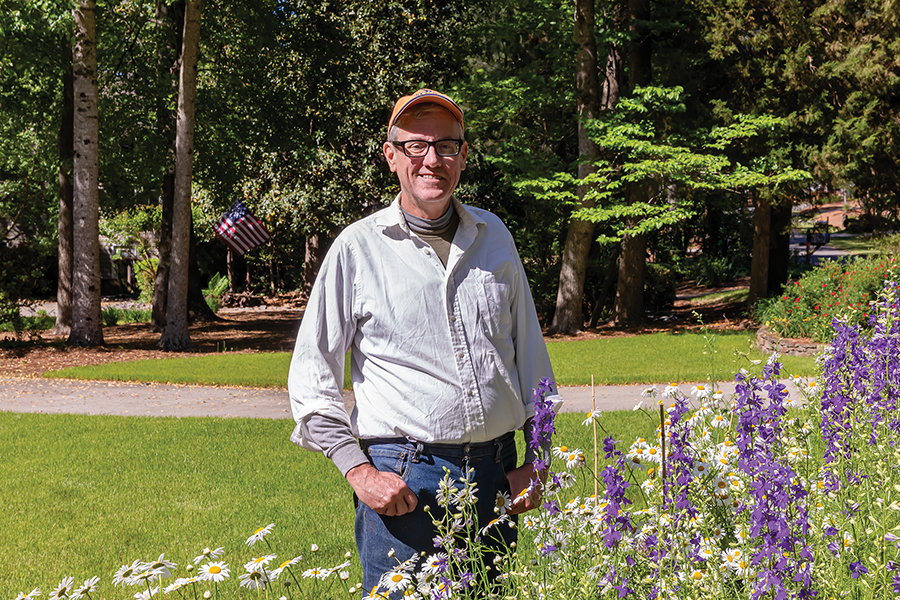
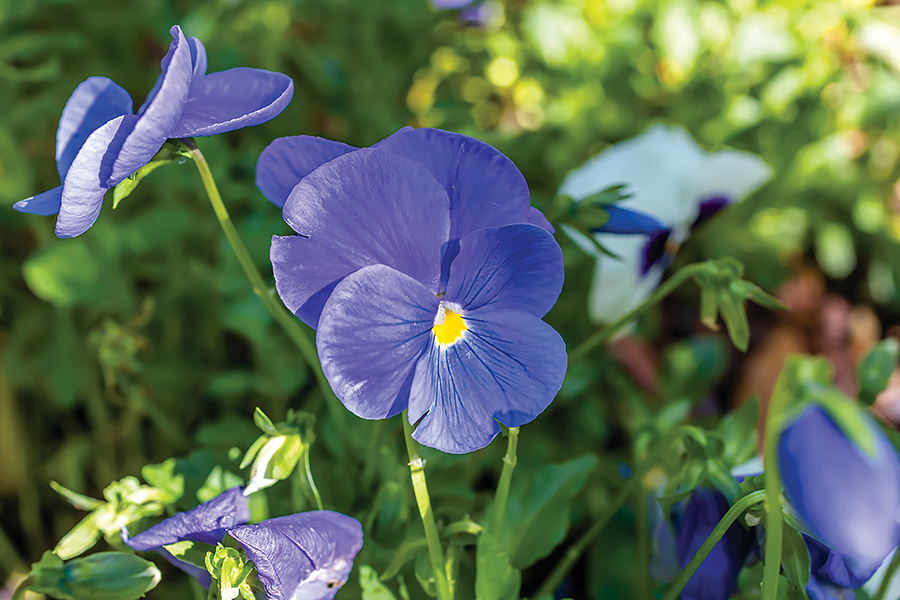
Cottage gardening originally developed in England, using dense, informal plantings of native flowers and herbs to create the most charming effects. When I was asked to design a garden for a property off Pinehurst No. 3 I was excited because I knew the house and was sure it would work perfectly with the cottage garden style. The beds feature foxgloves, daisies, iris, larkspurs, columbines, snapdragons and violas, all traditional cottage garden plants.

I like to keep the iris and columbines close to the path. Columbine is best there because the flowers are so complex. They are usually two-toned, the light petals contrasting with the darker, spurred sepals that make the flowers look like a group of small birds. This intricacy has to be seen up close to be appreciated. Columbines look great by a gate but are lost in the distance.

Iris, in contrast, can be seen from the street. I keep it by the path to show off its foliage. Unlike most perennials that go dormant in the winter, the grayish, lance-shaped leaves of the iris persist year-round. They have a striking, sculptural quality that is enhanced by proximity to hardscape elements like fences and walks. They also play nicely with masses of fuzzy gray lamb’s ears, the contrasting texture set off by a similarity of color.

Larkspurs and oxeye daisies form the bulk of the planting. These bloom consistently at the same time as foxgloves, so their cool blue and the white can set off the warm dark pink of the foxgloves. And, oh, the foxgloves! They are truly magnificent. Their height and spire-like form give an architectural element to the mixed plantings. Snapdragons echo their form on a smaller scale, and violas bring the color down to the ground plane.

You won’t often find foxgloves in garden centers, except the occasional blooming plant in the spring. I start mine from seed in mid-summer and set them out in the fall. I find this technique works for many biennials and perennials that do well in regions north of us but can’t take our summer heat. Essentially you treat them like over-wintered annuals. Sow them in the summer, transplant them out in the fall, enjoy the flowers in the spring, and then remove the plants when they’re finished blooming in May or June. Hollyhocks, delphinium, sweet William, bells of Ireland, snapdragons and sweet peas all do well with this treatment, although I’d wait till Christmas to sow the sweet peas.

If you’re interested in trying a cottage garden of your own, a handy resource is Cool Flowers, a great short book by Lisa Mason Ziegler. Ziegler is a cut flower grower in the Virginia Beach, Virginia, area, in the same horticultural zone as Pinehurst. She explains this technique in greater detail. I wish you luck!  PS

Robert VanderVoort studied and taught landscape architecture at N.C. State University and has gardened in the Sandhills for more years than he cares to say. Reach him at voortex16@gmail.com.

Flourishing in a Field of Dreams

Flourishing in a Field of Dreams

When nothing can keep a good man down

By Claudia Watson  

Photographs by Laura L. Gingerich

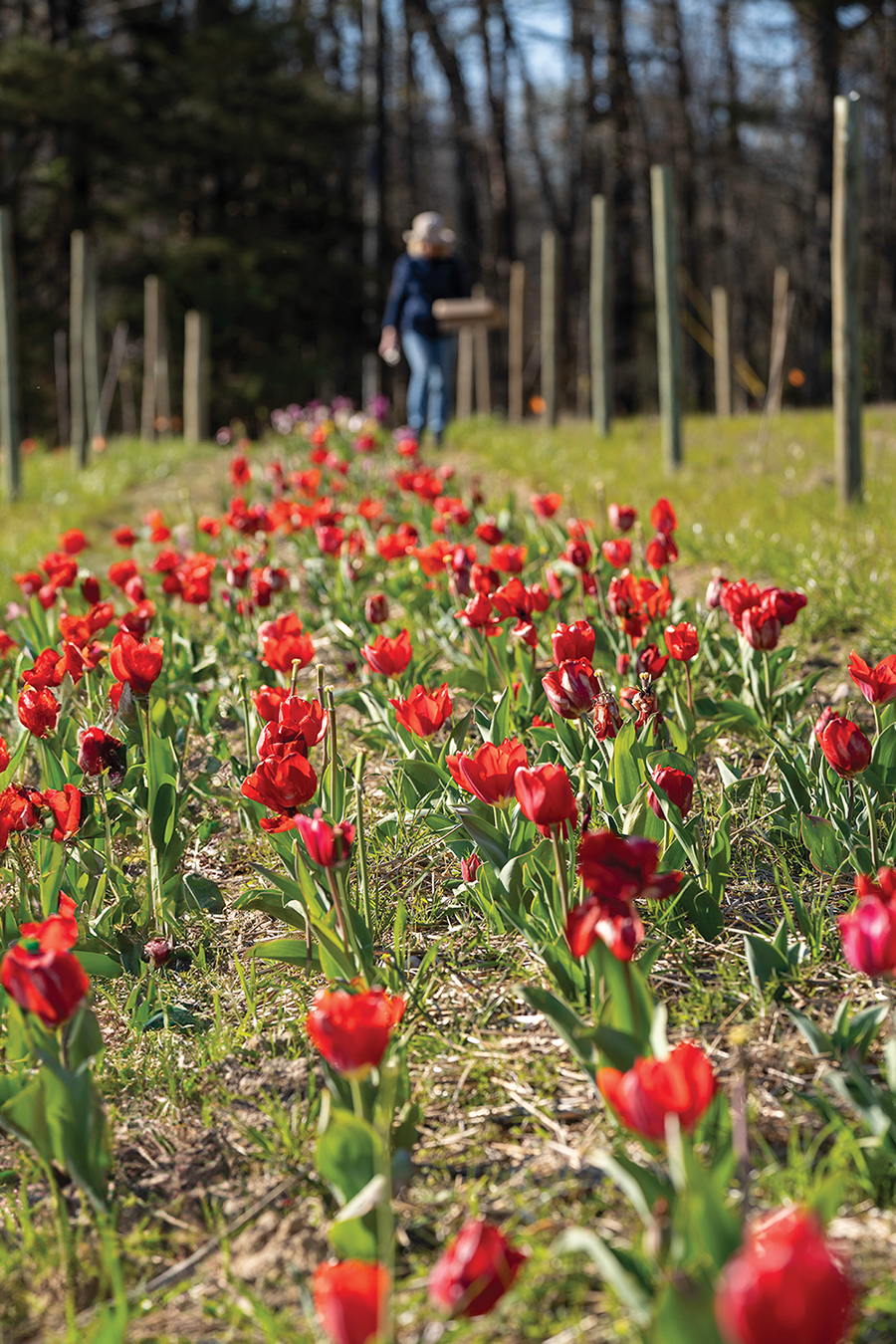
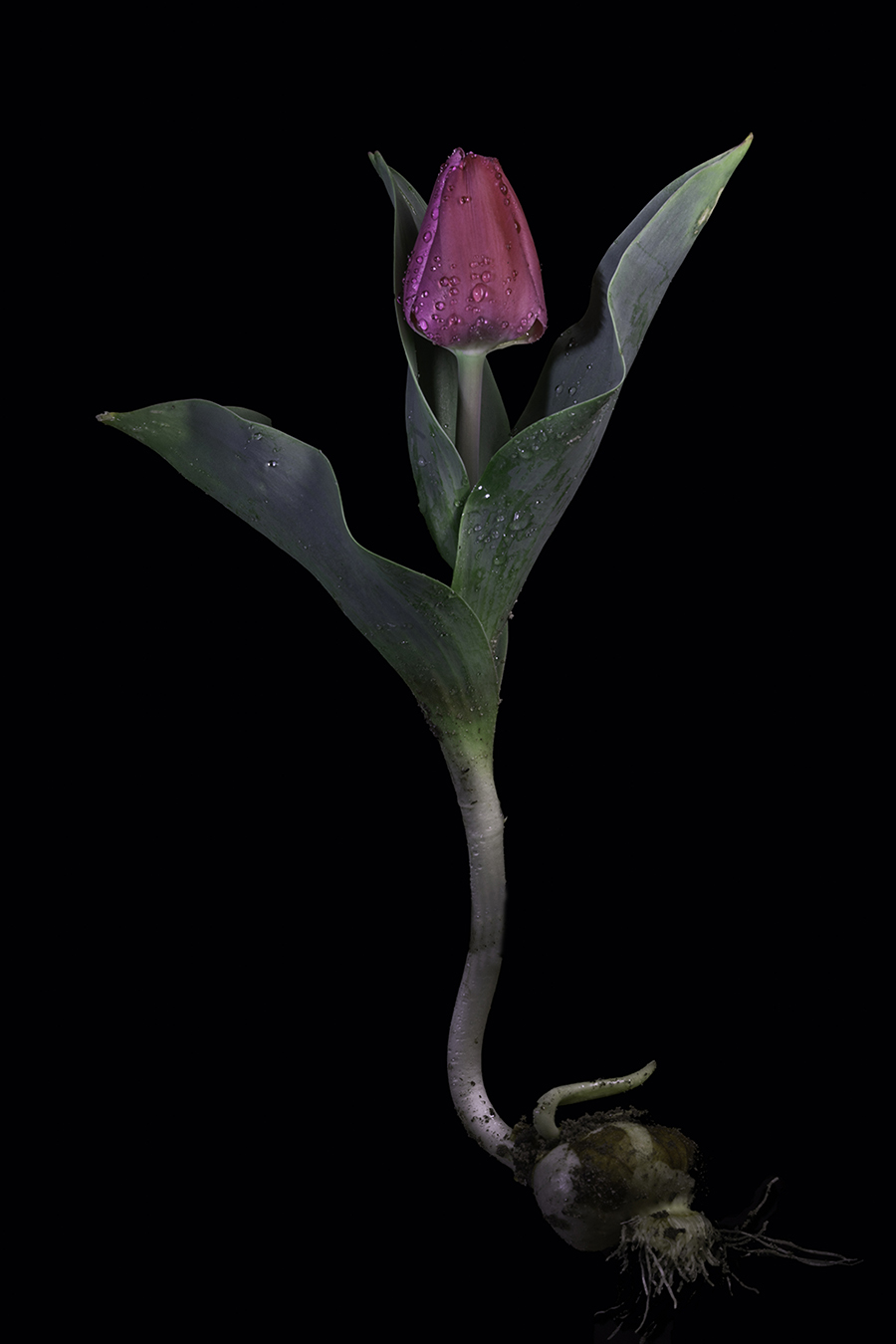
Acres of farmland rest under the rays of golden sunlight, soothing the bareness of winter’s rough edges. But there’s a surprise at the turn on the highway. A tidy roadside patch of vibrant tulips bursts through the hard-crusted earth, shouting, “Look at me!”

Families, children dressed in their Easter best, grannies and young lovers, all tiptoeing through fields of tulips, not in Holland, but bucolic White Hill. Photographers follow. All sharing the unexpected joy and the promise of hope at Blueberry Hill Farm.

This April marks the second year Blueberry Hill Farm, known for its juicy-sweet, plump blueberries, hosts a festival of blooms, a much-anticipated harbinger of spring. And that’s just what the farm’s owners, Anthony and Janice Dyson, wished for.

“I wanted the area in front of our retail storefront to be colorful and welcoming with a small roadside patch of flowers,” says Janice. “We felt folks would stop to see the flowers and come in to see all the fresh products we offer from the farm, not just at the blueberry time.”

Then she grins, adding that their eldest son, David, ignited with imagination, had a more significant dream.

A graduate of N.C. State University’s Landscape Agriculture program and a professional landscaper, David always shared his mother’s fondness for flowers. “When I graduated, I managed a commercial landscaping business. We used a lot of fall, spring and summer flowers,” he says. “When my mom told me her idea, I thought, ‘Hey, I can do this but on a larger scale.’”

After months of research and meetings with large tulip farm owners in North Carolina, David did the implausible. In the fall of 2022, instead of planting a simple flower bed for his mom, he planted 20,000 tulips in several trial plots by the roadside and on the gentle slope that borders a large pond on their 25-acre farm. Success followed.

“Last spring it wasn’t uncommon to see people blow by us on the highway, turn around, and come back to walk in the fields and cut some flowers to take with them,” he says. “That made my day.”

The new technicolor landscape on Blueberry Hill Farm is joyful and optimistic, revealing its poignancy only after you discover how it’s been achieved.

On a summer’s day in 2017, David, his wife, Katie, younger brother, Derek Dyson, and others took a couple of river boats to a swimming spot on the Black River in Sampson County.

“We’d been there a lot over the years, and I knew it well. I dove into the water several times, but the last time I didn’t come back up,” says David, recalling the terror of being helplessly submerged under water. “I felt like I had 10 seconds to live.”

The others jumped in and searched the murky river. Nothing. Then Derek, a firefighter for Sanford, found him, and they pulled David to the river’s edge. He was airlifted to the New Hanover Regional Medical Center in Wilmington.

David had crushed the C5 vertebra in his spine, causing him to be paralyzed from the waist down and classified as a person with quadriplegia. After surgery he was transferred to the Shepard Center in Atlanta, one of the nation’s top hospitals for rehabilitation, where he remained for nine weeks.

“When we came home, I couldn’t sit up without help,” he says. He and Katie sold their two-story home and built a handicap-accessible home for themselves and their son, Carson. His physical therapy regimen is nearly a full-time job. Now, he frequently drives his handicap-accessible van from their home in Greensboro to White Hill. Anthony says David can get anywhere in his standing power chair.

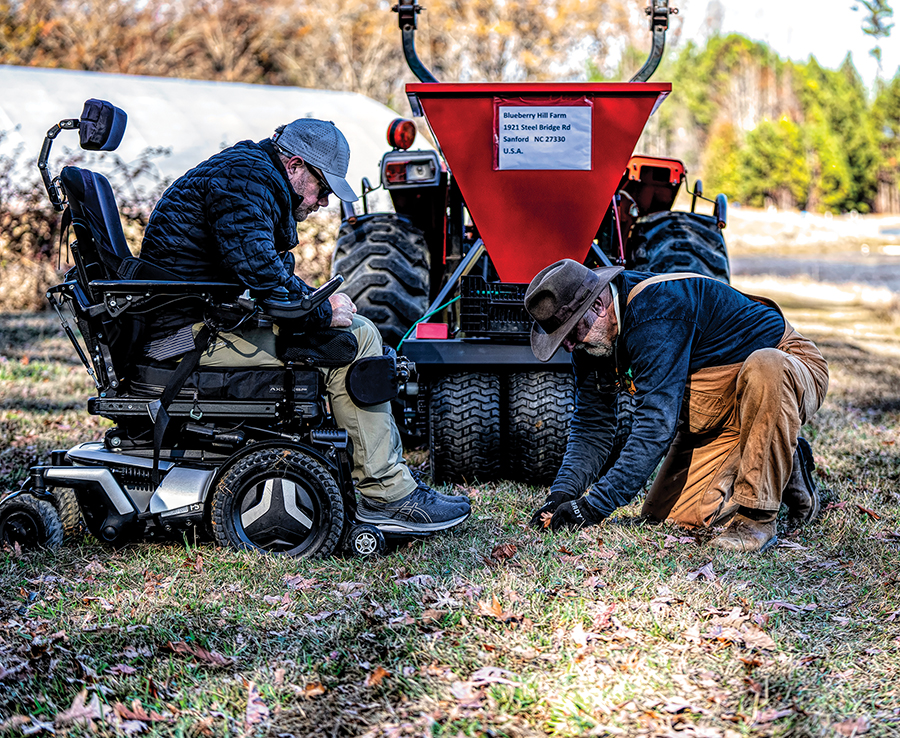
A modified ATV, courtesy of North Carolina Vocational Rehabilitation, has put David back into the fields at Blueberry Hill Farm, where he’s in control and savors every moment.

“Though I can’t plant, this ATV gives me the ability to go anywhere in any weather condition on the farm,” he says, using a dashboard lever to lock his chair into the ATV floorboard. I hop in and fasten my seatbelt. “Do you want to go 5 mph or 50?” he says with a smile as we take off. It’s November, and it’s tulip-planting day.

“I utilize my entire agriculture background for the farm,” he says, pointing to the rows of dormant blueberry, raspberry and blackberry bushes and muscadine vines. “Now, it’s the flowers, too. We handle it all, from the soil amendments through harvest and everything in between.”

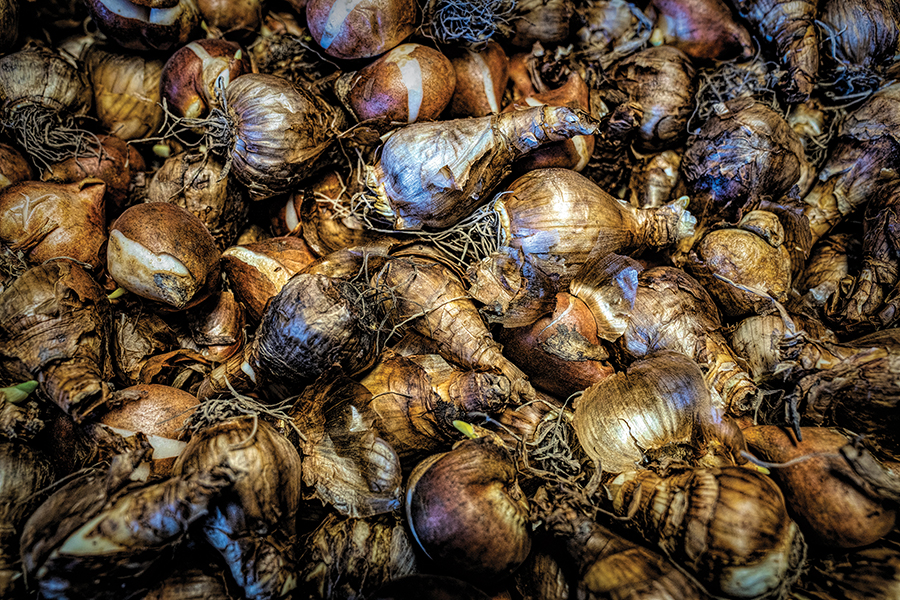
A few days before my visit, over 45,000 tulip bulbs arrived in a refrigerated semi-trailer and were off-loaded into the farm’s cooler. “This is all David’s doing,” says Anthony, opening the cooler door where stacks of plastic crates marked with the bulb’s variety and color waited. “He’s a whiz on the computer and quite adept at sourcing, and all of our tulip bulbs are shipped to us directly from the Netherlands.”

The tulip often invokes thoughts of the Netherlands, and indeed, the Dutch deserve credit for its global popularity and exciting history. However, it is not indigenous to that country. The tulip is native to a vast area, including the arid climates of Africa, Asia and Europe. It’s a perennial, bulbous plant that blooms in various colors from early to mid-spring. Like most bulbs, it needs cool dormancy (vernalization) to bloom, making it challenging to grow in North Carolina.

“The weather is finicky — especially nowadays — it’s hot, then cold,” says David, a loyal Wolfpack fan sporting his N.C. State cap as he steers the ATV. “When planting, the soil temperature must be 55 degrees or below to ensure good root development before winter sets in.” Last November the soil was too warm to plant until late in the month, as referenced in the region’s newly acquired 8A growing zone. Pre-cooled bulbs from the Netherlands ensure proper root development and avoid stunned blooms.

“Soggy soil is the kiss of death for bulbs,” he says. “But our soil is very sandy, and it drains a bit too fast to hold the needed moisture for tulips.” Organic matter should be worked 10 inches into the soil, followed by applying slow-release nitrogen-phosphorus-potassium fertilizer (10-10-10 or 3-5-3). Tulips also need plenty of sunshine.

This spring at Blueberry Hill Farm, visitors will experience variety. Tulipa Darwin hybrids are among the showstoppers, including the vibrant yellow ‘Novi Sun’ and one of the tallest tulips, ‘World’s Favorite’, a tomato-red flower with golden yellow petal edges.

If you crave sweets, ‘Tom Pouce’, aptly named for the lusciously sweet Dutch pastry, is your treat. This flower is pale to bright pink with a creamy, golden-yellow base. And just in time for spring weddings, the pure white and very statuesque ‘Wedding Dress’.

We’re also planting some remarkable mixtures of Triumph, Darwin hybrid, Double, Lily-flowering and Single Late tulips to offer constant color throughout the spring season,” says David.

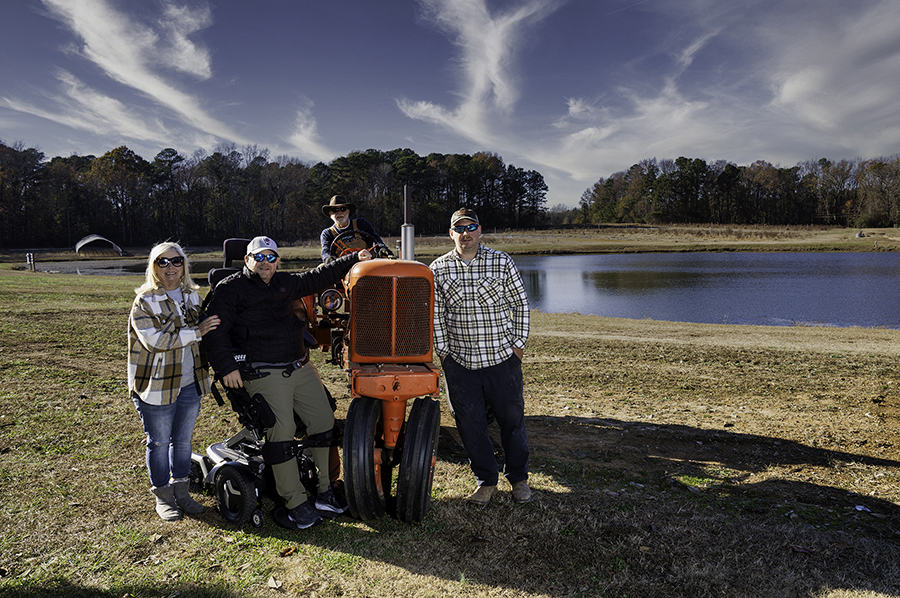
At the edge of one field, he stops the ATV a few feet from a beloved orange 1952 Allis-Chalmers tractor nicknamed Allis. She’s just recovered from a spitting and sputtering session that called for repairs. Healthy again, Allis is pulling a bulb-planting machine the farm purchased from the Netherlands.

“It’s our new tool and we’ll get all 45,000 bulbs set out in the next couple of days,” David says. “In 2022 my dad made a template out of PVC pipe that the workers pushed into the soil to plant the 20,000 bulbs. It took weeks.”

Standing by the bulb planter, Derek hollers, “Hey, what color do you want next? Yellow?”

“No. Yella!” shouts Janice, enthusiastically correcting her son’s pronunciation. “In my family, it was always ‘yella’ and they tease me about it.”

Derek dumps a crate holding hundreds of “yella” tulip bulbs into the bulb planter. Allis pulls the planter over an intended row, using its steel discs to cut a 10-inch-deep trench, drop one bulb with roots down, and then cover the trench with its three rear wheels, settling the soil.

“Hey, no bulbs left behind!” says eagle-eyed David, pointing to some bulbs that jumped the trench and need planting.

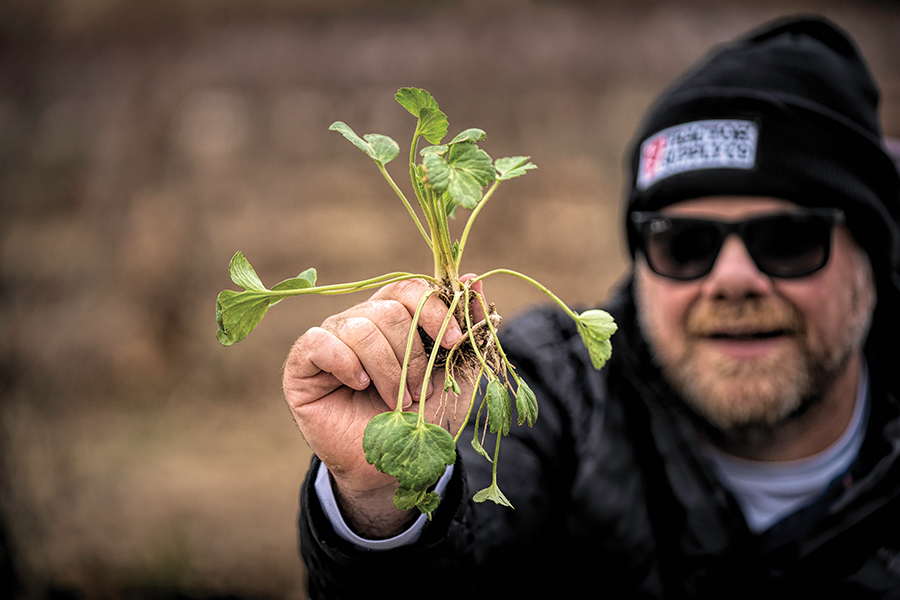
“It’s only our second year, and this is amazing,” he adds as he presses the accelerator lever on the ATV and takes off across the edge of the farm. Here, he’s carefully choreographed mixed planting to include a mood-lifting view of thousands of perennial daffodils (Narcissi), anemones, globes of alliums, Spanish bluebells (Hyacinthoides hispanica), and cobalt-blue grape hyacinth (Muscari armeniacum) blooming en masse along with the tulips.

Once those early spring flowers fade, a stunning display of 10,000 peony-like ranunculi will appear, including Ranunculus aviv and Ranunculus picotee varieties. Hundreds of unfurling peonies and poppies will inspire the romantic.

When the summer heat rises, the landscape gives way to summer perennials, including natives, rose mallow (Hibiscus lasiocarpos), black-eyed Susan (Rudbeckia hirta), and lupine (Lupinus). Vibrant zinnias and sunflowers grown from seed will provide an energizing space in late summer.

After a final pass of the farm, we head back to the pond, where it’s time for a family photo with Allis, the tractor.

“It’s truly magic,” Janice says as she surveys the farm in the late afternoon sun. “David is strong, determined, courageous and unstoppable. Along with our faith, this farm heals us and keeps us moving forward.”

David stands next to Allis with the assistance of his chair, mother and father. He is quiet but smiling. Perhaps fueled by gratitude, he understands the power of the moment — a moment of joy for life on the land that provides their hearts with peace, plenty and purpose.

Spring is nature’s reminder that resilience blooms from within.  PS

The Dyson family actively encourages visitors to take a stroll, cut flowers or just come and share the joy of spring. Blueberry Hill Farm, located at 3250 White Hill Road, Sanford, is open 10 a.m. to 6 p.m. Monday through Saturday, and 1 p.m. to 6 p.m. Sunday. It’s a u-pick farm for berries and flowers (they supply the clippers and flat box for flowers). Fresh-cut flowers are available for pickup, as is a tasty jar of sugar-free Traffic Jam, or Blueberry Jam made with the farm’s berries, in the storefront. Admission: $4 per person; u-pick flowers $1.50 per stem. No pets, please.

(Instagram @blueberryhillupick).

Claudia Watson is a freelance writer and longtime contributor to PineStraw and The Pilot who finds joy daily, often in a garden.

Buzzing with the Bees

Buzzing with the Bees

How Midnight Supply came to “bee”

By Jenna Biter  

Photographs by John Gessner

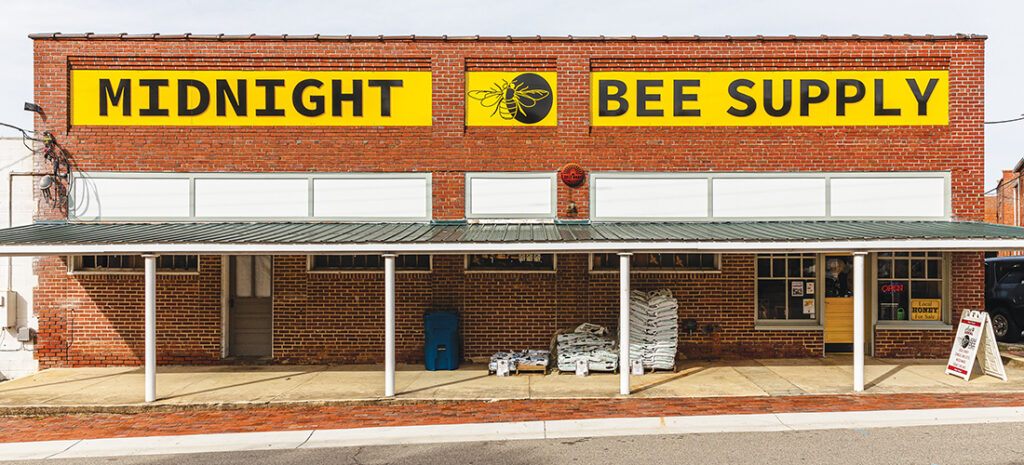
OPEN glows red on the window near another sign advertising local honey for sale. In the space between the two, what resembles a stack of wooden bankers boxes, or maybe a tall wooden filing cabinet, can be seen through the glass, sitting near the front of the country store. It’s quiet on the outside but, inside, it’s a veritable — sorry — beehive of activity.

The peculiar woody contraption won’t be there long.

The next customer will push through the shop’s happy honey-yellow door, tender payment at the counter, and in exchange, haul the thing away to fill it with the humming of a colony of tens of thousands of honeybees.

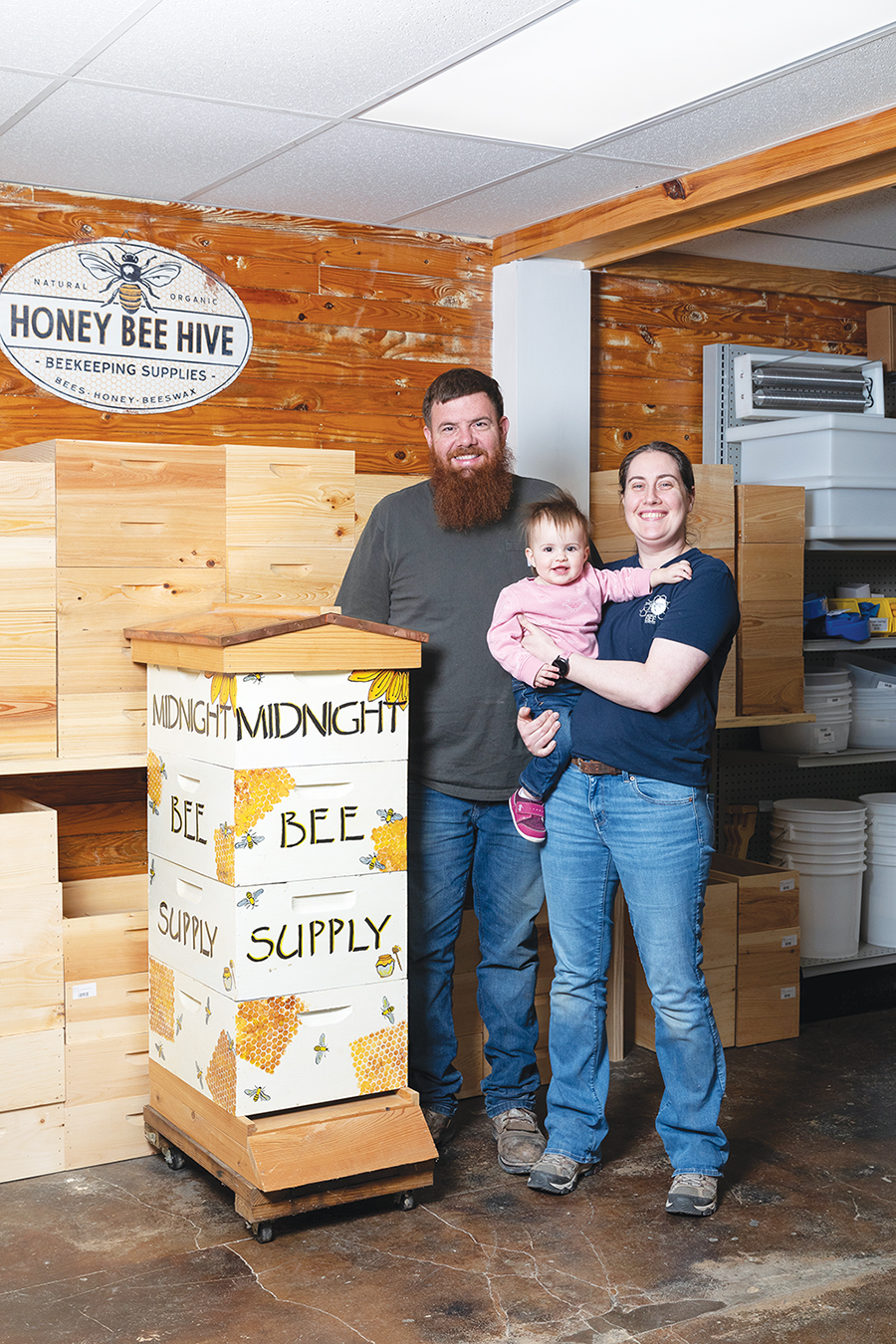
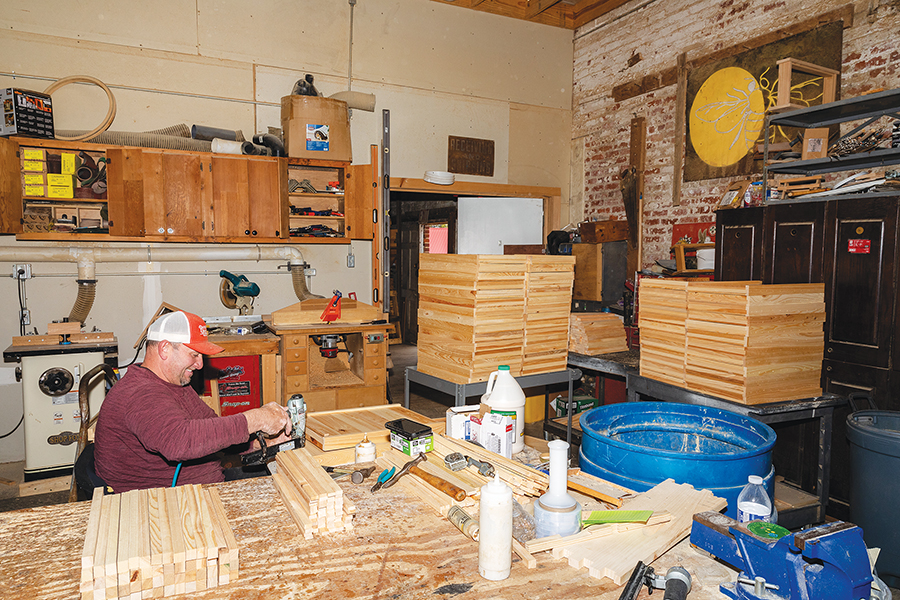
That’s because, as you might have figured, the thing isn’t a pile of hand-carved bankers boxes or a filing cabinet hewn from pine. It’s a beehive, one of the many that Erin and Calvin Terry Jr. make and sell at Midnight Bee Supply, their beekeeping storefront/woodshop on East Maple Street, in Vass.

“A bee box is like a mayonnaise jar,” Calvin says. “It’s a mayonnaise jar because it’s got mayonnaise in it.” He pauses. “If that same jar’s got jelly in it . . . ”

Erin joins in, as if they’d rehearsed the line 100 times like Abbott and Costello, Wheeler and Woolsey, Bert and Ernie, “ . . . it’s a jelly jar.

“So a box is a box, but when you fill it with bees, it’s a bee box,” Erin says, delivering the punchline.

The couple’s 1-year-old daughter, Maggie, babbles approvingly from her Pack ’n Play behind Mom’s chair. An enlarged printout of a Google review hangs above her on the office wall. “The store smells wonderful, like fresh cut wood,” it reads. From a room over, the buzzing of saws adds an exclamation point.

Midnight Bee Supply has been operating out of that brick warehouse in Vass since 2016, a handful of years after Calvin got into the business on something of a whim. While studying at N.C. State, the construction engineering major registered for a beekeeping course, enjoyed it, got high marks in it, and parlayed the experience into a part-time job working for Jack Tapp, a beekeeper who ran Busy Bee Apiaries out of the basement of his Chapel Hill home.

“Whoever was building his hives at the time wanted some ridiculous price for a cypress hive body,” Calvin says.

“His background is in construction and things like that,” Erin says of her husband. “So he looked at that and went,Oh, I could build that.’”

Calvin spent his Fourth of July learning how to construct bee boxes for Tapp. “I took him five, and he said, ‘Yeah, give me 50,’” Calvin says. He filled the order, no problem, then follow-ups, and more after that, eventually taking orders from David Bailey, who bought Busy Bee in 2013, renamed it Bailey Bee Supply, and moved the business to a plaza in Hillsborough.

“David took it to the next level,” Calvin says. “I was still in school, and we were doing a lot of deliveries to Bailey Bee Supply at midnight.”

Hence Midnight Bee Supply. The business had a name before it had a place.

At first Calvin built the bee boxes in his grandfather’s Johnson Street workshop and sold out of his parents’ garage on Saturdays. Now, a dozen or so years later and a mile across town, he’s ripping through more than 100,000 board-feet each year.

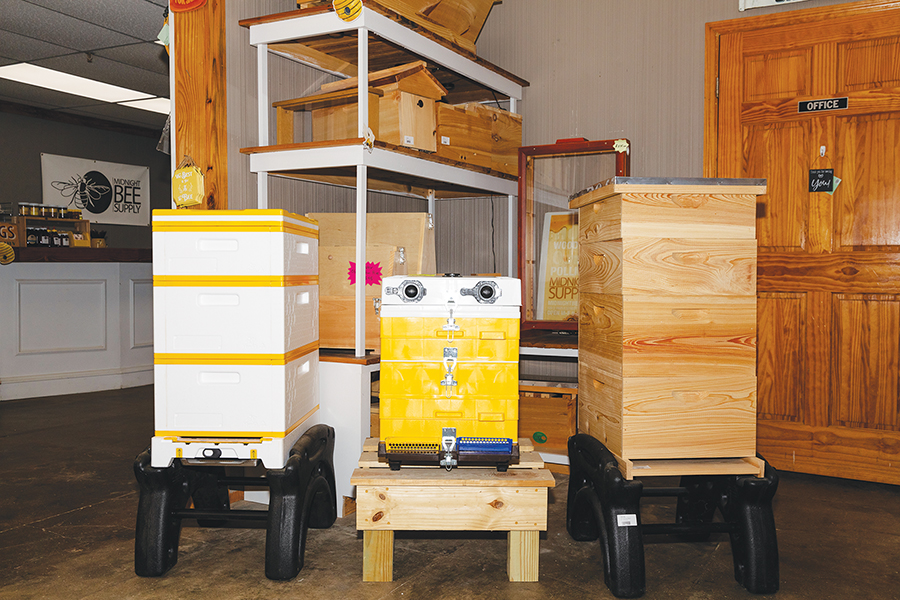
Calvin points to a stack of softwood planks piled high on the woodshop floor. He says something but the mechanical droning of planers and table saws drowns out his words. Back on the other side of the shop door, the noise fades and, with the lilt of a fourth-generation Vass native, he explains that cypress makes all the difference in the high-quality preassembled hives like the ones at the front of the store. The wood’s oils provide a level of natural waterproofing that extends hive longevity. Pine, on the other hand, is the budget option. Regardless of the material, Calvin and his handful of employees shape the wood into the Langstroth hive body preferred by the vast majority of customers.

Considered the father of American beekeeping, Philadelphia native Rev. Lorenzo L. Langstroth patented his eponymous beehive on Oct. 5, 1852, and it remains the most common style used in North America today. Langstroth’s design is modular, constructed from a series of vertically hung boxes and removable frames with 3/8-inch gaps called “bee space.” The small gaps ensure that the bees won’t seal their home shut with honeycomb or bee glue, making it easier for beekeepers to conduct hive inspections and honey collection without irritating the colony.

Calvin starts in on the anatomy of a Langstroth hive. “You’ve got a bottom board,” he says, patting the stack at the front of the store, almost as if he’s patting the rump of the family dog. “That’s a deep box.” The lesson swivels into something more like internal medicine. “If you want your top box honey only, no eggs, a queen excluder keeps . . . ”

Calvin and Erin whirl through the store, pointing to and naming all the accoutrements a beekeeper could want — specialty boxes for harvesting honeycomb, slatted racks, and different frames and feeders, as well as pest control supplies and supplemental honeybee food for the hard winter months.

“That’s basically a large centrifuge used to separate the wax from the honey,” Erin says, eyeing a silver-bellied cylinder called a honey extractor. “We’ve got a little bit of everything for anything you might be doing.” And that includes Erin’s expert beekeeping advice.

Like Calvin, she attended N.C. State, though their time on the Raleigh campus didn’t overlap. Erin, who has a degree in natural resources, conducted research with mosquitoes and genetics, and post-graduation, took a job with the school’s honeybee research lab. It was a six-month temp job tailor-made for her research experience that transformed into a happy seven years.

“I loved the bees,” Erin says, “so the longer I was there, the more I was getting into beekeeping, not just research. And then when we met, it just kind of snowballed into this,” she says, her voice lifting as she looks around the store. The earthy aroma of sawdust hangs in the air.

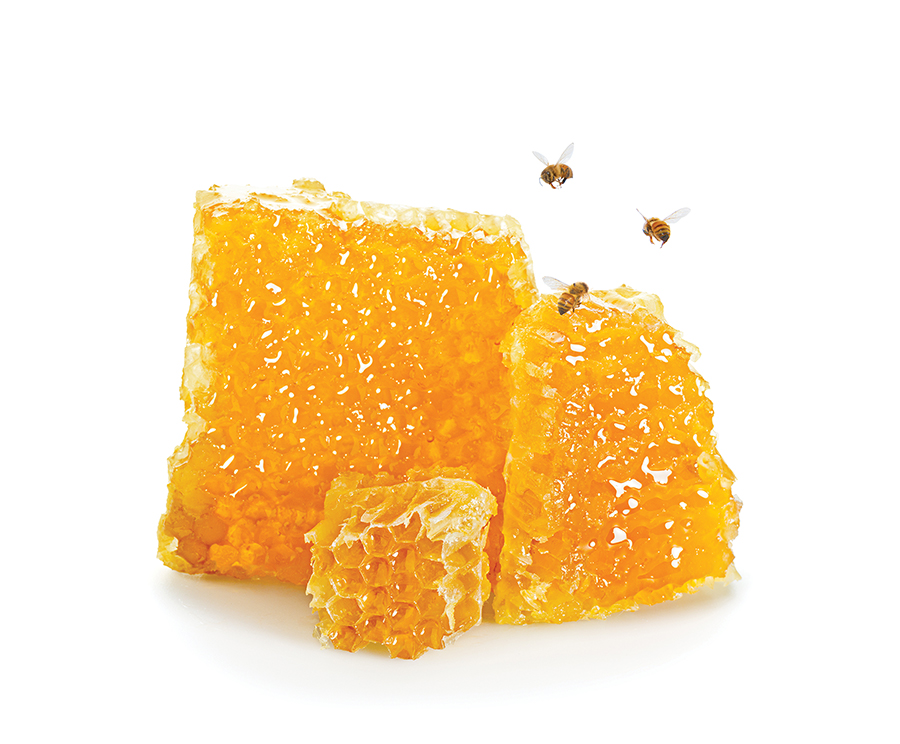
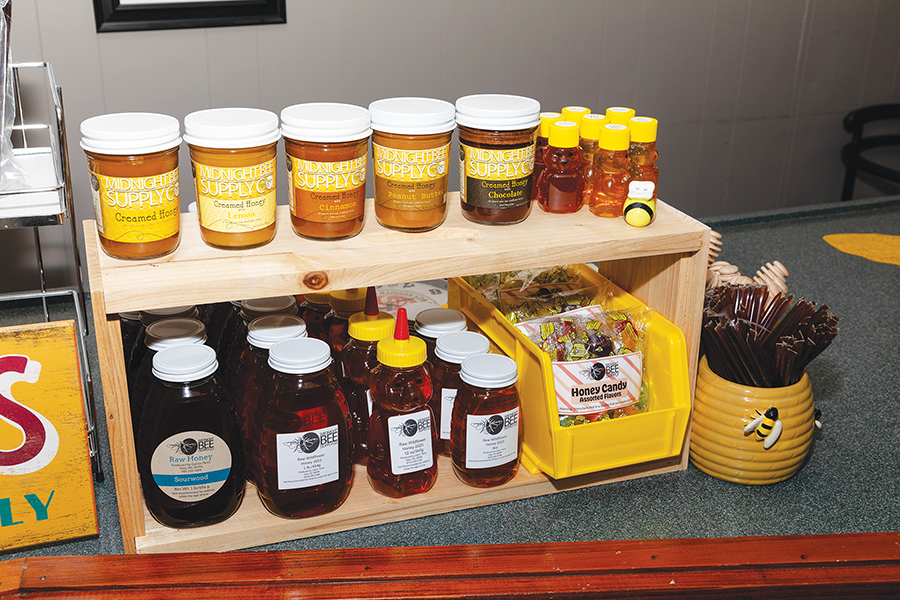
For consumers who prefer honeybee products without the chance of stings, the Terrys sell beeswax candles, quilts handmade by Grandma, and of course, raw and creamed honeys produced from their own apiary and bottled by Calvin’s parents.

Honey production has always been part of Calvin’s business model. “We keep several hundred hives of bees,” Erin says. “You keep bees, you make honey.”

Anticipating the life cycle of the honeybee, which revolves around the flow of nectar, is what the Terrys do, both as beekeepers and as a beekeeping supplier. “First of February starts spring for us,” Erin says. “Spring is busy on all fronts because this is when beekeepers are thinking about their bees most.” After enduring the freezing winter — all the while feeding on honey stores and protecting the queen bee from the elements — the vulnerable survivors emerge from the hives to forage for nectar and restart honey production. Beekeepers help that process along.

It’s that brisk but sunny time of year when customers flow steadily into the front while wholesale orders ship out the back. Sixteen pallets of hives are waiting to be picked up.

“We stay busy, absolutely,” Erin says.

As busy as . . .  well, you know.  PS

Jenna Biter is a writer and military wife in the Sandhills. She can be reached at jennabiter@protonmail.com.

The Legend Next Door

The Legend Next Door

Three acclaimed poets, Stephen E. Smith, Shelby Stephenson and Joseph Bathanti, share their recollections of St. Andrews University’s Ronald Bayes, a driving force in North Carolina’s literary world


Making Magic in the Hinterland

By Stephen E. Smith

The sun is at our backs as we turn off U.S. 1 onto 15-501 South toward Laurinburg, ticking away the 25.2 miles to the least likely poetry mecca in America — the tiny St. Andrews College campus. It’s January 15, 1980, and my brother-in-poetic-crime, future N.C. Poet Laureate Shelby Stephenson, and I are on our way to hear Black Mountain poet Joel Oppenheimer, poetry editor for The Village Voice, a news and culture publication known for being the country’s first alternative newsweekly, give a reading from his new St. Andrews Press book, Names, Dates, & Places.

Trust me: Laurinburg, North Carolina, for all its attributes, is a far, far distance, socially and intellectually, from Greenwich Village, New York. So how is it that a significant 20th century American poet was reading at what was then called St. Andrews College? Maybe there was mystery and magic at the heart of it. But if you adhere to the Great Man Theory, the answer is, in a literary sense, simple: Ron Bayes.

I met Ron in July 1972 at a meeting of the North Carolina Writers Conference in Wilmington. I happened into the luncheon meeting where he was holding forth on his literary plans for St. Andrews College — a creative writing major, a national literary magazine (The St. Andrews Review), a student literary magazine (Cairn), a literary press that would publish 15 books a year, a reading series that would, if his plans came to fruition, be the envy of every college and university in the state, a visiting artist program, weekly student poetry readings, etc. It seemed overly ambitious for a newly cobbled-together college in the hinterland, but Ron was emphatic. He would do it all.

The assembled writers, many of whom were college professors who organized readings and edited literary magazines, were skeptical. They understood the time and effort necessary to accomplish the litany of projects Ron enumerated. He’d have to contend with the college bureaucracy, academic politics, the scarcity of funding, department jealousy and infighting, and an underlying lack of interest from students and faculty. The barriers were formidable. And Ron would have to carry out his plans while teaching his classes and writing and publishing his own work. It seemed an impossible undertaking.

More than 50 years later, it’s safe to say that Ron Bayes delivered on every promise: America’s finest poets visited the St. Andrews campus, gave readings, and conducted workshops. Literary magazines flourished. Student readings were held every Thursday night, and chapbooks of their work were published. Writers of national and regional import had their books published by St. Andrews Press.

For at least 20 years, Shelby Stephenson and I attended the readings, and we can testify that the St. Andrews campus was a hotbed of literary enthusiasm. Where else in North Carolina could you have dinner with James Dickey, James Laughlin or Robert Bly in a mediocre Chinese restaurant?

On that January night in 1980, I had a lengthy conversation with Joel Oppenheimer, and we became fast friends, corresponding until he died in 1988. I learned all I needed to know about the Black Mountain School of Poetry. On another memorable occasion, Robert Creeley, an unassuming and generous Black Mountain devotee, and I talked for hours at dinner at one of Laurinburg’s restaurants. I could list a hundred such evenings fraught with enlightenment if time and space permitted. The St. Andrews poetry scene was vibrant and enticing. I was never disappointed by an evening listening to aspiring poets read their creations on the tiny campus tucked away in languid Laurinburg. 

Alas, all things pass away, and so it was with the St. Andrews poetry scene. Literary magazines moved online, poetry readings became less popular with students, publishing and distributing books proved prohibitive, and the college’s institutional focus shifted to more financially rewarding pursuits. Shortly before he retired, Ron, who remained steadfastly enthusiastic about his teaching, told me that his students stared out the window and yawned, their interests attracted by more practical pursuits. The college’s financial foundation was always tenuous, and the emphasis on the academic experience adapted to ensure institutional survival. But none of these inevitable transformations detract from Ron’s achievement. He was a leader in North Carolina’s writing community for over 50 years, and a poet of national reputation who taught and inspired thousands of students.

A few years ago, I pulled into a parking lot on the Delmarva Peninsula behind an old clunker with a St. Andrews parking sticker peeling off the back bumper. I asked the middle-aged driver if he knew Ron Bayes. He beamed and nodded. “That guy changed my life,” he said. “My world is a lot more interesting because I had Ron Bayes as a teacher and mentor.”

Ron would have been pleased.

Lyrical Earthliness

By Shelby Stephenson

Ronald H. Bayes wooed and wowed the universe with poetry and his love for the arts; moreover, his compassion for helping others get into print still seems miraculous to me; plus, he created the atmosphere for hundreds of writers to read at the St. Andrews Forum, which he also founded. The roll of writers seems endless: James Laughlin, Robert Bly, Betty Adcock, Julie Suk, Stephen Smith, Joseph Bathanti, Tom Wolfe, Mary de Rachewiltz, Agnes McDonald, Shirley Moody, Margaret Baddour, Ann Deagon, Jonathan Williams, Jeffery Beam, Guy Owen, Paul Jones, Tom Hawkins, Anna Wooten, Marty Silverthorne, Fred Chappell, Terry Smith, Joel Oppenheimer, Robert Creeley, Lenard Moore, Glenna Luschei, Tom Patterson and on and on, even as he was writing his own poems seemingly right out of worlds of conversations.

What a beautiful life! To create situations for himself and others to find themselves in the Arts!

Fred Chappell: “Few poets have written so broadly and intensively of our modern culture as Ronald Bayes has done.” Betty Adcock: “Ron Bayes and his work have been our connection to schools of thought and poetry outside the South, as far away as Japan. A chief mentor and publisher of poets in North Carolina for decades, he is one of our treasures.” North Carolina’s current poet laureate, Jaki Shelton Green, aptly describes the Bayesian predicament: “A perpetual feverish stimulation navigating extreme terrain and a resounding fate of the senses.”

Ronald H. Bayes’ The Collected Poems (St. Andrews University Press, 2015) teems with the politics of resonant symbols. The Bayesian artistry presents, “in minutest detail, a poignant and intense emotional lingering, lyrical as hollyhocks forever blooming,” Fred Chappell has written, adding, “We owe him ebullient thanks.”

Here are some of the titles of books Ronald H. Bayes has written: Dust and Desire; History of the Turtle; The Casketmaker; Porpoise; King of August; Tokyo Annex; A Beast in View; Guises: A Laurinburg Litany; Fram.

I cannot overstate the fact that Ronald H. Bayes has been out-front, always making new worlds for word-lovers. Every entry in The Collected Poems shows that he is on his own, always experimental, carrying on out of his love of Black Mountain writers and artists and, especially, Ezra Pound. All the while Bayes gives his own beautifully aesthetic songs of emotions moving freely in and out of the music of his lines. In Fram, for example, he presents his life as a boy in Umapine, Oregon. Bayes’ vision dazzles word-games and pun-puns. Inner experiences seem outer; yet what appears beyond the page sings with feeling. “Home”: “I think / think of the years and long light and the end of light.” The syllables buoy longing. Images keep moving: “A matter of toward. / A matter of affirmative through.”

Readers enjoy entering his lines. Joseph Bathanti has written: Ronald H. Bayes “has given his life to the state of North Carolina, to the state of poetry in North Carolina, and made it the state of poetry.”

Patron Saint of Poetry

By Joseph Bathanti

No one of Ron Bayes’ stature — as poet, critic, playwright, renowned iconic professor for years and years at, then, St. Andrews Presbyterian College in Laurinburg — was more selfless, more over-the-top generous, or turned on more people to poetry. He was beloved by his students, beloved by anyone with whom he crossed paths, including cats and dogs — cats especially — whom he adored.

Ron never married, and he never had his own blood-children, but the legions of St. Andrews student-poets he launched over his long, sterling career remain his children; he loved them passionately without stint.

Hundreds of testimonials to Ron from former students have been recorded, and here’s just one sampling from Tom Patterson, St. Andrews, class of 1974, an illustrious North Carolina writer, art critic, and renowned authority on Outsider Art: “Ron Bayes changed my life. Had it not been for him I would not have attended St. Andrews, and wouldn’t have become the kind of writer I am. Had it not been for Ron, in fact, I might not have become a writer at all.” Neal Bushoven, Ron’s great friend and another iconic St. Andrews professor, once declared: “At one point, Ron Bayes had over half of the campus writing poetry.”

But it was not just St. Andrews students and faculty who sat at Ron’s bronzed feet. More than anyone before him, or after him, he democratized poetry across the state of North Carolina. Ron made writing poetry, for so many of us, not only the thing to do, but the only thing to do. Through his visionary and blazing work ethic — and the fact that he seemed to know every living writer on the planet — Ron single-handedly created in Laurinburg, N.C., of all places, on the campus of St. Andrews, the crosshairs, the nexus, the very heart of poetry in our fair state.

In 1969, he founded not only St. Andrews Press, but also the college’s Writers Forum. For 41 years, every blessed Thursday evening, without fail, he hosted readings on campus by poets, fiction writers, essayists, playwrights, you-name-it. Imagine: 41 years — like DiMaggio’s streak of hitting safely in 56 straight games. A record that will never be broken.

Yes, very famous writers arrived — Carolyn Kizer, Reynolds Price, Romulus Linney, James Dickey, Diane Wakoski, Tom Wolfe, Dana Gioia, Richard Blanco. The list of luminaries who read at The Writers Forum is mind-blowing. Ron was also intimates with Black Mountain College legends like Robert Creeley, Jonathan Williams, Joel Oppenheimer, Charles Olson, Ed Dorn, Fielding Dawson — and he hauled them to campus as well. But there were also student and fledgling poets, poets from the community, voices seldom heard, voices yearning to be heard, who also, in many cases, were launched at the St. Andrews Writers Forum. He evangelized so many of us.

I remember receiving my invitation from Ron to read in The Writers Forum in 1985. I nearly fainted — not only that I had been invited to read at the premier haven for writers in North Carolina, but that Ron Bayes (everyone with a stake in poetry in North Carolina knew who that was) — had written to me and had signed his very name on the postcard-invitation.
A postcard I still have and cherish.

I also want to be very clear: Ronald Homer Bayes was a giant among North Carolina writers, as well as writers well beyond our state’s borders. He was very much celebrated and known in Japan, especially. In fact, he was great friends with Yukio Mishima, one of the most significant writers of the 20th century, considered again and again for the Nobel Prize for Literature during the 1960s. Ron is the author of 14 groundbreaking, often avant-garde and always ahead of their time volumes of poetry; two books of prose; a monograph of literary criticism, John Reed and the Limits of Idealism; as well as two works for the stage, An Evening with Ezra Pound and An Evening with William Carlos Williams.

What’s more, I have never known another with more extemporaneous facility in spinning the English language into the most voluptuous and surprising locutions at a whim. He quoted verbatim, down to the syllable, Pound and Auden, Kipling and Yeats. He was powerfully funny, gloriously irreverent, charismatic, and notoriously philanthropic. Ron always managed to surreptitiously scoop up the check after those Thursday night feasts — near-bacchanals — at Fong’s and New China before the wild motorcade to campus for the ritual Thursday night readings.

But let me circle back to Ron’s students and close on that note: how he loved them, how they worshipped him. The holy man at St. Andrews, he handed them fire. He remains, to my mind, North Carolina’s patron saint of poetry. On that sacred note — and not a whit of blasphemy intended from this acolyte of St. Ron’s — here’s an excerpt from the penultimate email I received from him: “I think from the middle of Nov. til Xmas week was the most satisfying and pleasant time ever. 9 former students flew out to Asheville for a reunion at Black Mt. They are now all in their late 40’s and early 50’s and came from as far away as Chicago, NY, and Atlanta.  All that time back ! and as a highlight of the first of two nights, they gave a reading from my works they had put together. I was the audience of one. It was too sweet and flattering to tear up. I just smiled.”  PS

Apprentice House Press will publish Stephen Smith’s memoir The Year We Danced in May. Shelby Stephenson was North Carolina’s Poet Laureate 2015-18; his current books are Cow Mire Songs and Country. Joseph Bathanti was North Carolina’s Poet Laureate 2012-2014 and is the author of the recent books, Light at the Seam and The Act of Contrition & Other Stories.

Philadelphia Airport

Rather tired at the Philadelphia Airport

And the plane to board

An hour and three coffees away.

What irony that at five-thirty a.m.

I am at last moved by emotion

(It has been a long time)

When the unavoidable, continual soft-music loudspeaker

Romps a certain German polka.

And I remember another airport,

Other years,

And I who have never wished to go back before

Wish to go back.

But one never can in time

(And does space matter much?).

Want some irony?

In Germany it was (you weren’t there)

And I loved you: Christ! With what passion of intensity,

Jealous of whomever you were with

With the dawn pink and blue and grey and

The trees mushrooms clumping

Like wanting Breughel

To red-in country rompers

— Or maybe someone good at satyrs—

And I remember the other airport

I remember a polka

And that I loved you.

Now each in maze muddled and oh-so-adjusting

And we no longer love . . . why kid? And I am not

Even jealous in wild imaginings.

A few people

A few more people

Now we move . . . you move . . . I move . . . from progress

To progress

Unlove to unlove

Anticipating only departures.

            — Ronald Bayes

Poem April 2024

Poem April 2024

Penumbra

My father taught me a civil trick.

If you get caught during a rainstorm

at a downtown restaurant, just ask

the bartender if someone left a black umbrella. They will present you with

a cardboard box chock full of them.

It is not a lie: Someone really has left behind each one. You have left many. Part of the loophole is to make sure to give that umbrella to someone who needs it, or at the very least, leave it

in a shady vestibule, on the coat rack next to that sad windbreaker. Otherwise it doesn’t count. Now they could call this all a life hack, but I consider that lacking. The process of inheritance is about so much more than getting what you need.

            — Maura Way

Maura Way’s second collection of poetry, Mummery,
was published in November 2023 by Press 53.

Divine Downtown Digs

Divine Downtown Digs

Life on Another Level

By Deborah Salomon

Photographs by John Gessner

Back in the 1920s, a fella named Herb Beck decided, given the growing popularity of motor cars, to convert his buggy repair shop in downtown Southern Pines to an auto service center. The one-story brick corner location already had drive-through bays. Later, a second story was added that, according to a diagram provided by the Moore County Historical Association, became the Boy Scouts clubhouse.

Those grease monkeys and energetic boys should see it now. Industrial remnants — gone. Instead, Holly Floyd and husband Tyler Horney have created a “loft” living space rivaling anything Robert De Niro, Beyoncé and the late John Kennedy Jr. called home when factories became million-dollar condos in the SoHo, Tribeca and Meatpacking District of Manhattan.

“I wanted to create a gallery for my art,” Holly explains. Since her art includes enormous pottery urns, sparkling crystal vases and paintings ranging from Victorian portraits to Picasso-esque Cubism, the loft needed display cases, pedestals, spot lighting and angled walls which create the 4,000-square-foot maze.

Parisian lofts inhabited by starving artists it’s not. Rather, the door at the top of a long, steep staircase opens onto a Technicolor world strewn with eye candy. This loft is edgy-chic, with a surprise around each corner. Take the rooster motif. “I like chickens,” Holly admits. They are everywhere, from an enormous, stylized portrait to a thumbnail glass strutter in a wall-mounted shadowbox filled with other fascinating miniatures brought back from Europe and elsewhere.

This is a space choreographed by a woman secure in her tastes, with designer Awena Hurst to help realize them. 

Holly, who is Texas born, Lumberton raised, and Tyler, a Moore County native, purchased the downtown building in 2009 with the intention of converting the ground floor to retail space. “Why not live upstairs?” within walking distance of the Sunrise Theater and fine dining, she thought. In the past, Holly had lived at Loblolly, a quasi-Tudor Weymouth estate designed by Aymar Embury II, and also at The Roost, a Cape Cod cottage near Campbell House, home to the Arts Council galleries. Roost? Rooster?

Holly wanted their new home to vibrate with color and originality, starting at the front door, which opens into a hallway lined with showcases, ending at the living room, where the principal color is a hunter/leafy green accented by a green velveteen chair, pale green walls, and additional shades woven into settee upholstery. On the floor, a custom-hooked wool rug patterned with symbols: Holly’s monogram, butterflies representing her children, sunbursts, alpha and omega and, of course, roosters. Windows are covered with shutters and Roman shades decorated with birds.

The fireplace is faux, but the deck overlooking downtown has been outfitted for grilling. Watches can be set by Amtrak arrivals, surely less startling than police sirens punctuating SoHo nights.

In an era of kitchen extravaganzas, hers is modestly sized; one counter doubles as a minibar, with sink and refrigerator. Cupboards are gray-stained wormy maple with painted brick backsplash and a soffit display case filled with . . . roosters.

“This is a one-person kitchen,” Holly says: ample, simple and functional. It opens into the living room on one side and on the other, a small dining room with an expandable birdseye maple table. The sideboard is no-nonsense Welsh, while a dainty asymmetric crystal chandelier is shaped like palm fronds. Angled walls throughout the midsection pit turquoise against pale yellow.

Now look down. Most of the heavily knotted pine flooring is original to the building. Once considered inferior grade, a century later these imperfections add character. Wooden doors of assorted sizes from an antique door dealer in Virginia provide texture, although wall openings had to be tailored to their individual, sometimes irregular sizes.

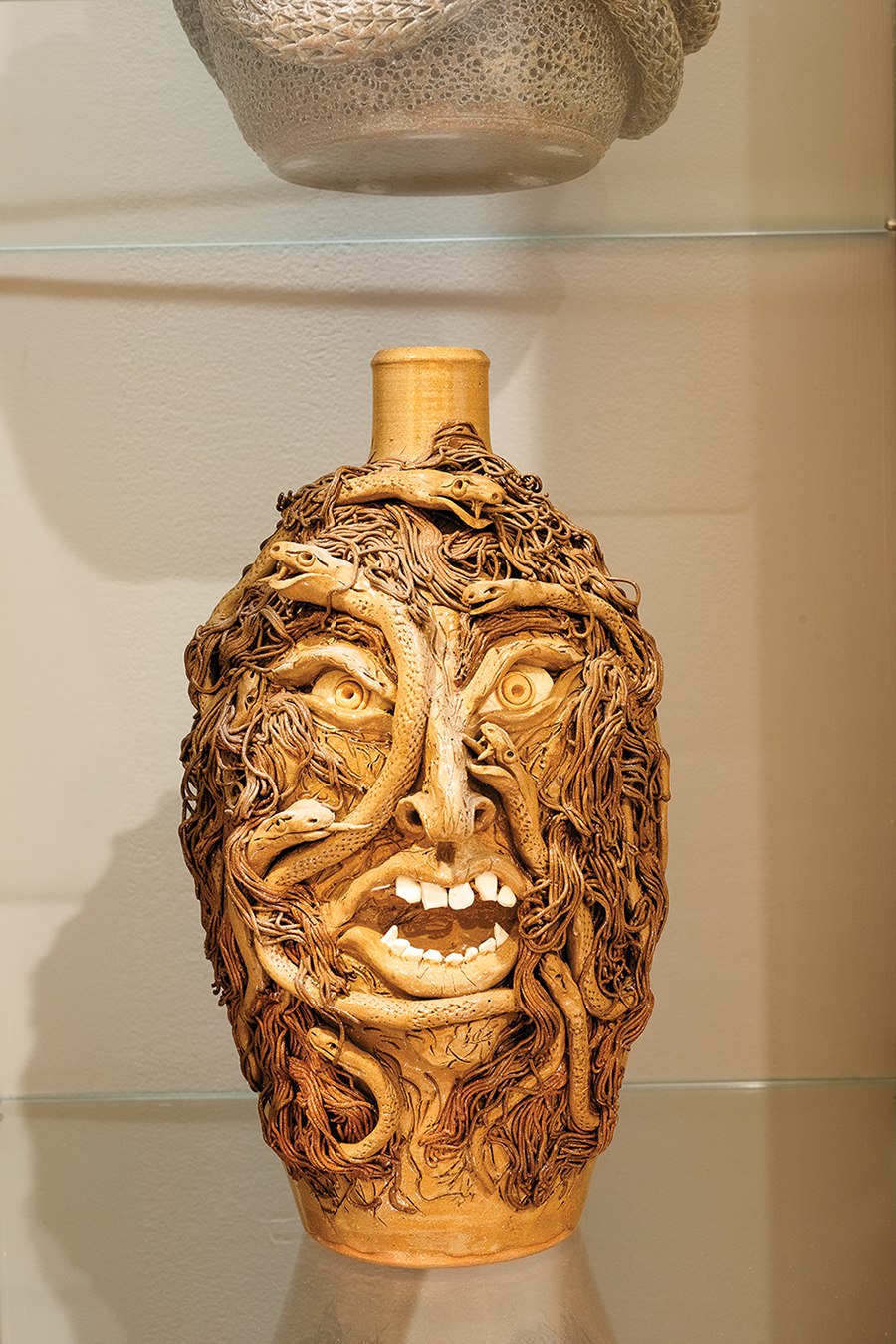
The star of the living area has to be the pottery Holly has collected from Seagrove and elsewhere. Smaller pieces, like a Noah’s Ark crammed with animals or the familiar “ugly jugs,” are displayed in built-in cabinets. Enormous urns — one a 4-foot scarlet Christmas gift from Tyler — stand on pedestals separated by window seats.

A gentler green continues into the master suite, with a small sofa occupying a bay. Teddy bears on a mini chair were made from fur coats, one belonging to Holly’s mother, whose presence is felt throughout.

Something’s missing: multiple wall-mounted TV screens. A small screen on a swinging arm is tucked between the kitchen and living room. “Never the bedroom!” Holly exclaims. But she allowed one in the master bathroom “so I could see what’s happening in the world while I get ready.” Their only big screen dominates the man cave, originally a second apartment, with daring terra-cotta-hued walls and heavy antique case pieces. There’s a small office for Tyler and two guest bedrooms for children and grandchildren, where Holly’s palette veers uncharacteristically into blue. Birds perch on branches over one bed, a trompe l’oeil effect accomplished by decals Holly found online.

“I’m all about whimsy,” she admits, further illustrated by a powder room where the basin sits on a stained artist’s worktable. Globs of “paint” — decals again — appear to have been splashed against the wall.

After a year-long renovation, Holly and Tyler moved in last November. The only thing Holly misses is having a dog.

Repurposing commercial and industrial buildings, barns and carriage houses played out across North Carolina as cotton mills and tobacco warehouses became upscale residences. Occasionally, space “over the store” was available, saving its occupants a tedious commute. Downtown Southern Pines has several iterations, including a new-construction all-loft building and, on Broad Street, a legendary bordello over a bowling alley, reconfigured for a family with young children as a loft with roof garden near the park.

However, living day-to-day with fine art and museum-quality crafts requires a particular mindset. Holly Floyd has it, for her glorious, decorative “stuff.”

“I find it comforting,” she says. “Like memories brought back by Christmas tree ornaments.”  PS

Poem March 2024

Poem March 2024

Julian

In christening gown and bonnet,

he is white and stoic as the moon,

unflinching as the sun burns

through yellow puffs of pine

pollen gathered at his crown

while I pour onto his forehead

from a tiny blue Chinese rice cup

holy water blessed

by John Paul II himself

and say, “I baptize you, Julian Joseph,

in the name of the Father, and of the Son,

and of the Holy Spirit.”

Nor does he stir when the monarchs

and swallowtails,

in ecclesiastical vestments,

lift from the purple brushes

of the butterfly bush

and light upon him.

    — Joseph Bathanti

Joseph Bathanti was the North Carolina poet laureate from 2012-2014. He will be inducted into the North Carolina Literary Hall of Fame in October.

First in Flight

First in Flight

A lifetime in the company of birds

Story and Photographs
by Todd Pusser

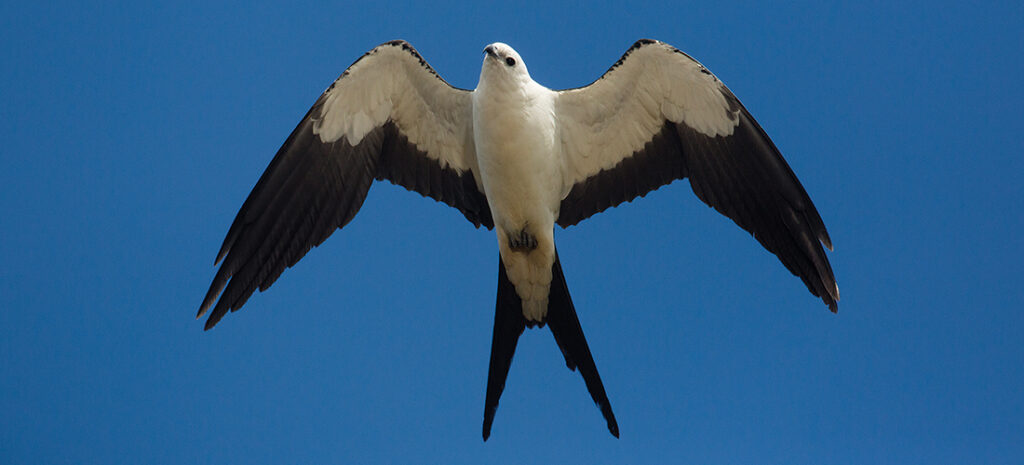
Feature Photo: Swallow-tailed Kite, Mississippi

The western slope of Mauna Kea, on the Big Island of Hawaii, does not immediately scream tropical paradise. At 7,000 feet above sea level, it is dry and arid. Scattered shrubs and small trees dot the landscape as far as the eye can see. The scenery contrasts sharply with the lush, flower-filled rainforests and pristine sandy beaches that most people picture when they hear the word Hawaii. But these dry forests hold a treasure, something found nowhere else on the planet.

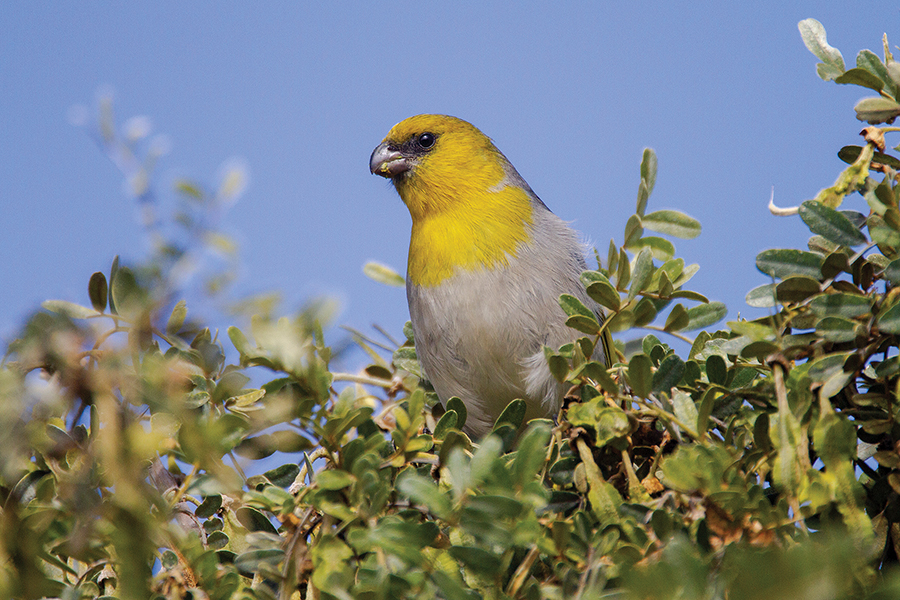
A distinct bell-like whistle echoes across the blue sky, nearby. As I am slowly walking toward an odd-looking tree with branches draped in clusters of seed pods reminiscent of green beans, a flash of yellow catches my eye. I stop. A few seconds later, a small, finch-like bird sporting yellow, grey and white feathers emerges from a tight cluster of branches and snips off one of the strange, beany-looking seed pods. With surgical precision, the bird pries open the pod with its thick beak and scarfs down the protein-rich seeds nestled inside. Framing its bright yellow head in my camera’s viewfinder, I press the shutter.

The bird, commonly known as the palila, or Loxioides bailleui by its scientific lexicon, is among the most critically endangered birds on the planet. Current estimates suggest fewer than 1,000 adults survive on the western slopes of Mauna Kea. The palila is a specialist, feeding almost exclusively on the alkaloid-rich seeds (which are toxic to most other animals) of the māmane tree, another Hawaiian endemic. Māmanes are long-lived, capable of reaching 500 years in age, but are slow to mature, taking 25 years or more for seedlings to grow into a tree capable of producing a food resource for the birds. So intertwined are the lives of the palila and the māmane tree that some have likened their bond to that of a mother and child. 

Islands are arks of incredible biodiversity. Hawaii, as the most isolated island chain on the planet, is especially so. Before humans reached its shores, Hawaii was once home to an incredibly rich assemblage of plants, flowers, trees, insects and birds. Being stuck out in the middle of the Pacific Ocean, the islands were never settled by any frog, snake, ant or mosquito. It was paradise, the quintessential tropical Eden — or in the words of Mark Twain, “the loveliest fleet of islands that lie anchored in any ocean.”

Things changed with the arrival of Polynesians and their canoes on Hawaii’s shores around 1,000 A.D. The arrival of Europeans in 1778 only accelerated the process. Cats, dogs, pigs, invasive plants, mosquitoes and viruses were introduced — some intentionally, some unintentionally — to the islands. Natural resources were consumed, and the land was terraformed to meet the demands of an ever-growing human population. The extreme mega-diversity that had long characterized the Hawaiian Islands soon whittled down to a tiny fraction of its former self. The state now bears the depressing moniker of “the extinction capital of the world.” As recently as the end of 2023, the United States Fish and Wildlife Service declared eight species of Hawaiian birds officially extinct.

Eagle Springs is just about as far away from Hawaii as one can get. Yet, it is in this tiny enclave, surrounded by longleaf pines and turkey oaks, where my fascination with birds began. I don’t know how to explain it, but I have always been obsessed by wild creatures. The fascination is most assuredly innate, for my parents never showed more than a passing interest in the wildlife outside our back door.

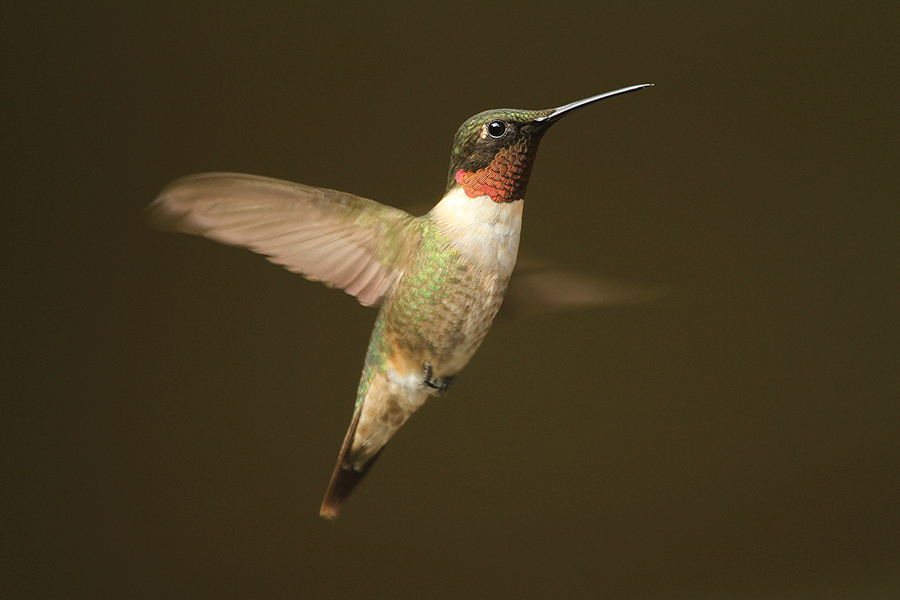
I still recall with vivid clarity, as a kid, watching hummingbirds hover in front of feeders filled with sugar water at a family friend’s house and listening to the incessant calls of whip-poor-wills echoing through the pines on humid summer evenings while swimming in our backyard pool.

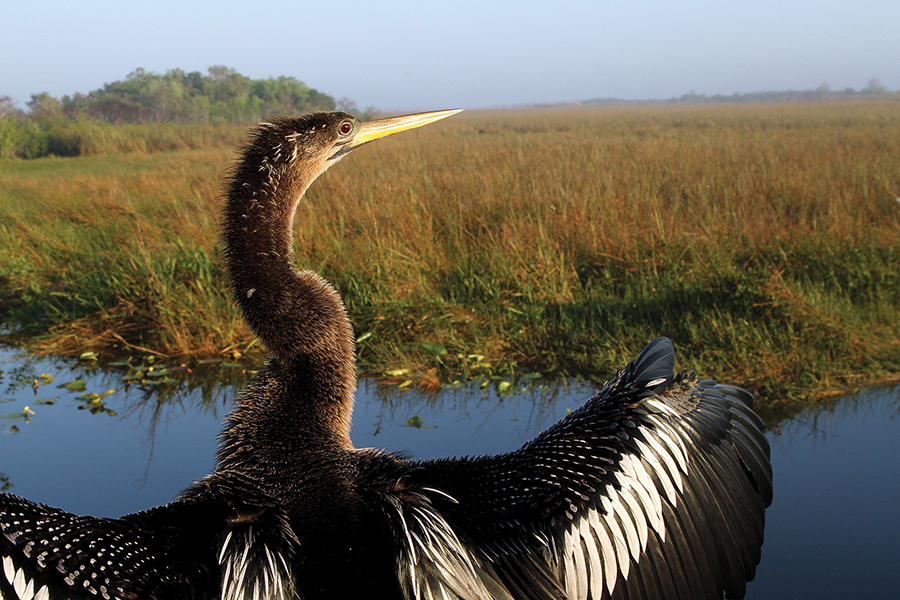
Left: Anhinga in Florida’s Everglades

Middle: Palila from the Big Island of Hawaii

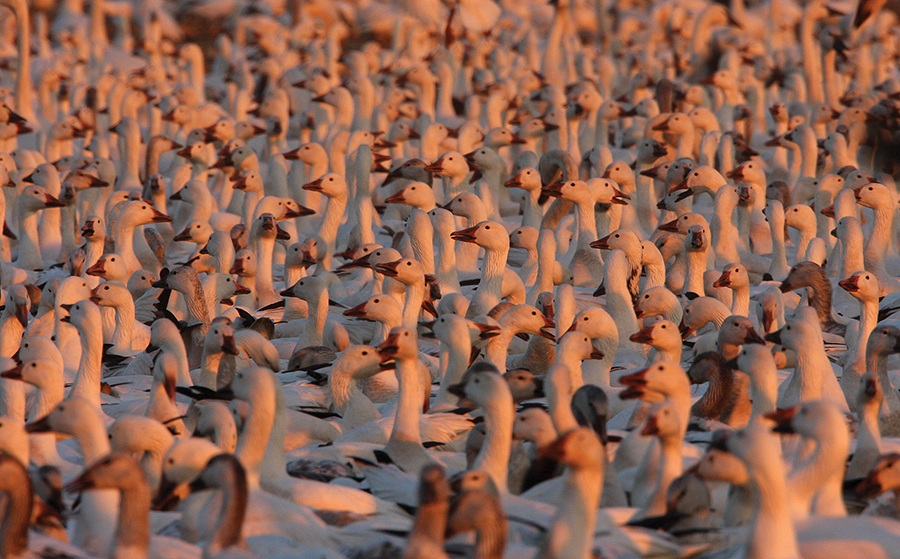
Right: Snow Geese Flock in late afternoon light, North Carolina


Later — nerd alert — I won my high school’s science fair by collecting and examining the regurgitated pellets (yuck, I know), full of undigested bone and fur, from a pair of red-tailed hawks that nested in a tall longleaf pine near our house. The project was born from no school assignment. I was simply curious as to what the birds of prey were eating. See, I told you it was innate.

It was around this time that I picked up a camera in an effort to try to document the amazing wildlife I was seeing. Through trial and error — mostly error — I learned the ins and outs of apertures, shutter speeds and film type to best record animals in the field. For all the Gen Z’ers that might be reading, this was back in the stone age of analog, well before the instant feedback of an LCD screen. Did I mention I had to walk uphill, both ways, to collect those hawk pellets?

Birds were, and still are, a subject I find infinitely fascinating, both as a naturalist and as a photographer. Their variety in color, form and behavior is endless. With over 10,000 species (and new ones being discovered every year), birds are among the most diverse vertebrates on the planet. From the Arctic to the Antarctic, and throughout every continent and ocean in between, birds are taking flight right now.

Many people obsessively keep a detailed list of all of the birds they observe in their yard, county, state and country. Millions upon millions of dollars are spent each year on binoculars, spotting scopes and travel to places, both near and far, just to add new species to life lists. Millions more are spent on birdseed and backyard nest boxes. Indeed, birds are among the most popular of animals. Even my grandmother enjoyed watching bluebirds outside her kitchen window each spring.

Though I keep no life lists of my own, I do maintain field notebooks filled with interesting wildlife observations encountered during my travels. Over the years I have had the good fortune of seeing some extraordinary birds in some extraordinary places.

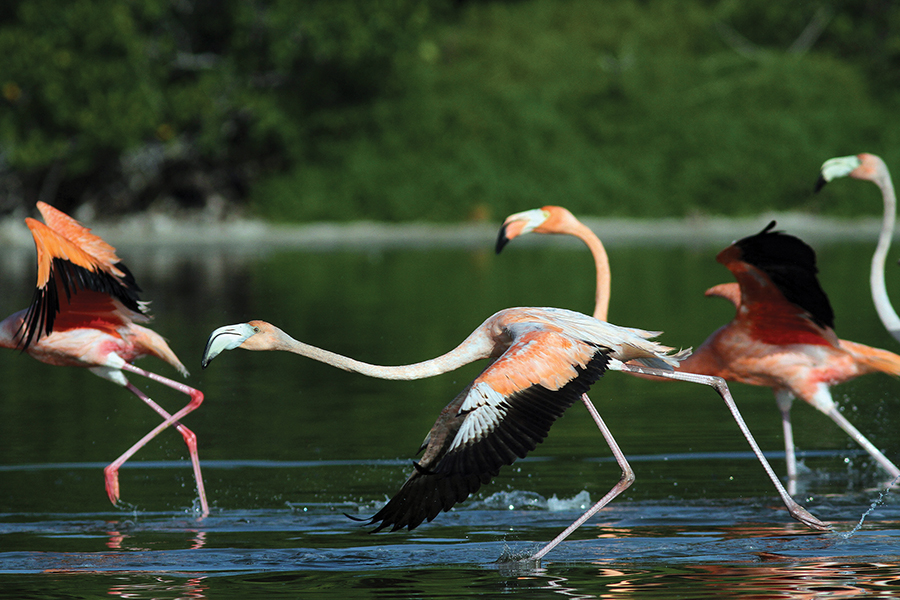
Left: Flamingo Takeoff, Yucatan, Mexico

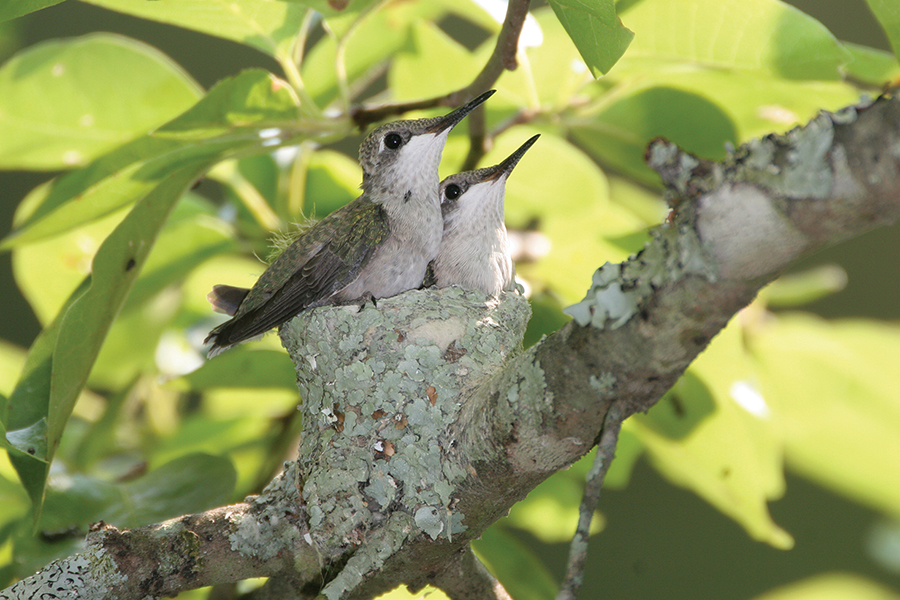
Left, middle: Ruby-throated Hummingbird Chicks, Pinehurst, N.C.

Right, middle: Ruby-throated Hummingbird, Hoffman, N.C.

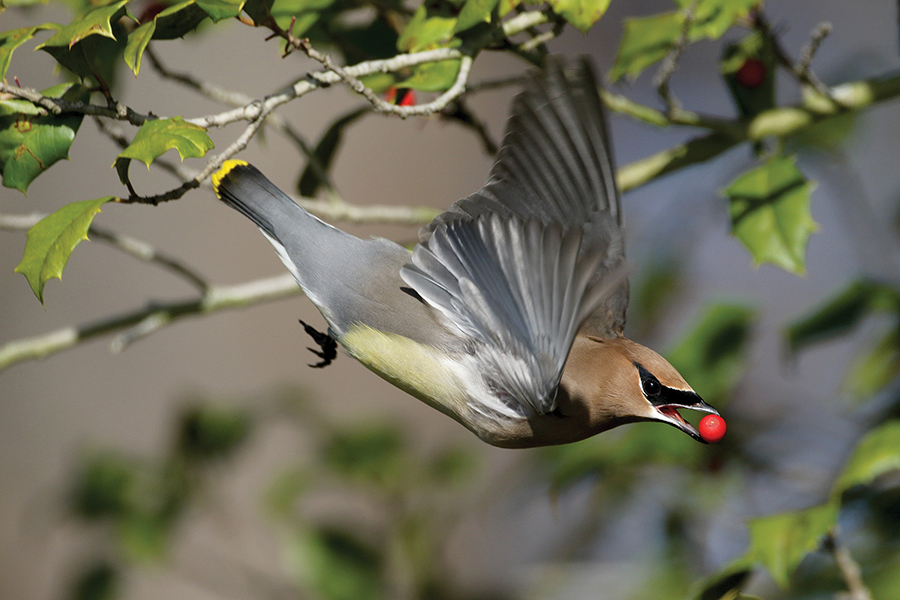
Right: Cedar Waxwing and holly berry, Virginia


On a remote island in Antarctica, I once sat on a hillside covered in tussock grass, watching a pair of courting wandering albatross, who possess the longest wingspan of any bird, dancing and weaving against a backdrop of rugged snow-covered mountains. I have laughed out loud watching the comical antics of tufted puffins on a foggy day in the middle of Alaska’s Bering Sea. During a golden-hued sunset in the Bahamas, I marveled as a flock of ground-nesting Abaco parrots flew high over stands of tall Caribbean pines. Along the rocky shores of New Zealand, I observed the smallest species of penguin, the little blue, leap from the ocean like a miniature dolphin. Another time in the Arizona desert, on a smoldering hot August day, I saw a roadrunner catch a lizard beneath a canopy of thorny cacti.

There is no denying the thrill of seeing amazing birds in exotic, far-off places, but my most memorable and cherished avian encounters have actually occurred right here in North Carolina, much closer to home.

Years back, a kind couple from Pinehurst allowed me to set up a tripod and camera in their guest bedroom, where I spent the day photographing the nest of a ruby-throated hummingbird that was perched precariously on a tiny branch just outside their second-floor window. It was the first, and only, time I have been able to observe, in intimate detail, the life history of a species that so captured my childhood imagination.

Once, while my partner, Jessica, and I walked our late, beloved dog, Dexter, down a trail at Merchants Millpond State Park on a bright spring afternoon, a barred owl flew silently over our heads and landed in a tree nearby. I have marveled at a kettle of Mississippi kites hunting dragonflies, in high, swooping arches, over the Pee Dee River near Rockingham. Most poignant of all, on a bitterly cold winter’s day in the heart of Pocosin Lakes National Wildlife Refuge, I watched awestruck, with my father by my side, as tens of thousands of snow geese descended into a corn field, just yards away from where we stood. That feeling of joy and happiness, of being able to share such an incredible spectacle with my old man, is something I will carry for the rest of my life.

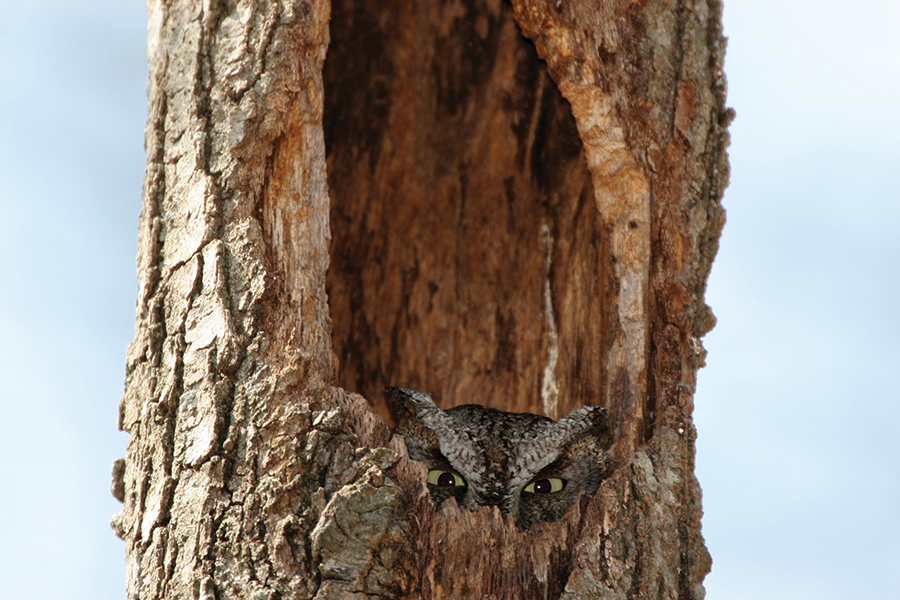
Left: Eastern Screech Owl Peekaboo, Pinehurst, N.C.

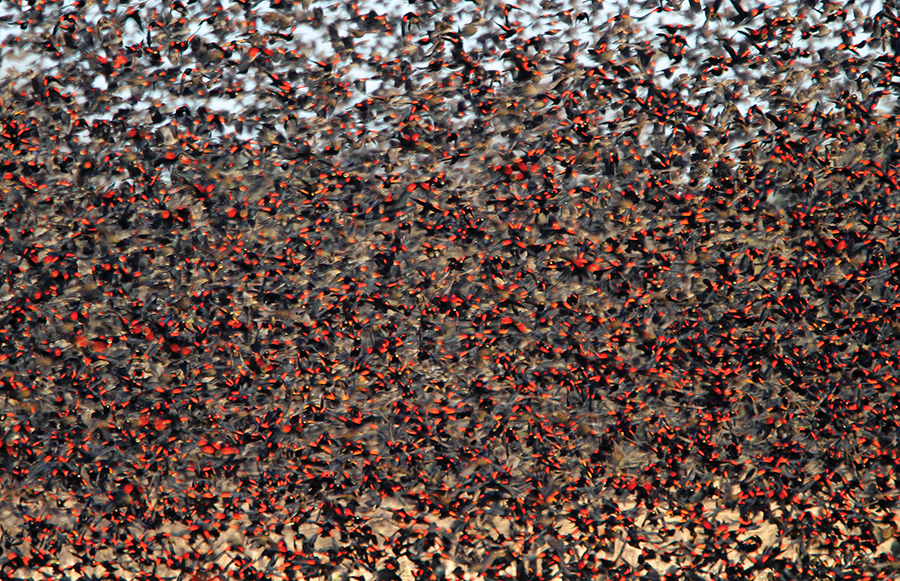
Left, middle: Red-winged Blackbirds, N.C.

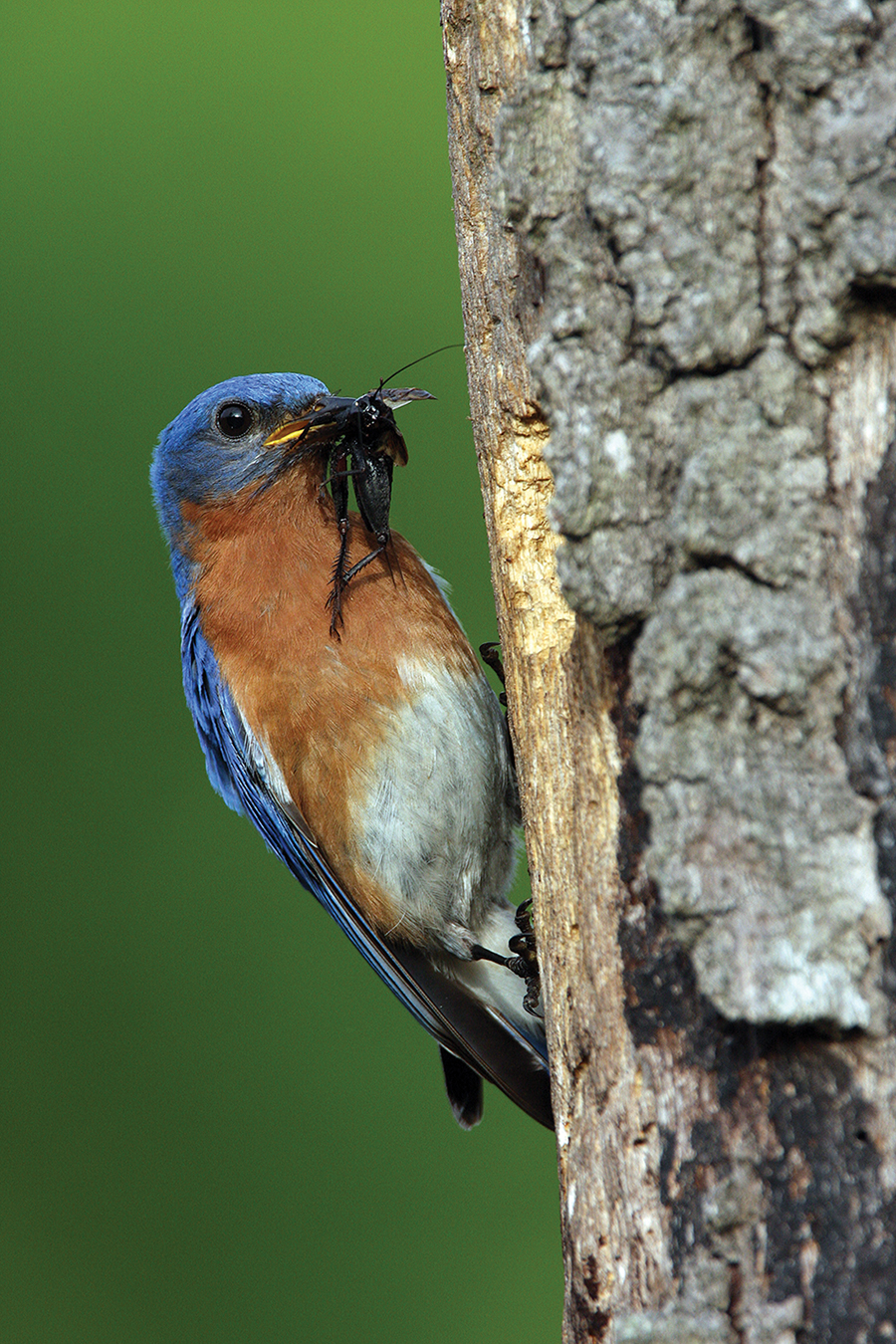
Right, middle: Eastern Bluebird and cricket, N.C.

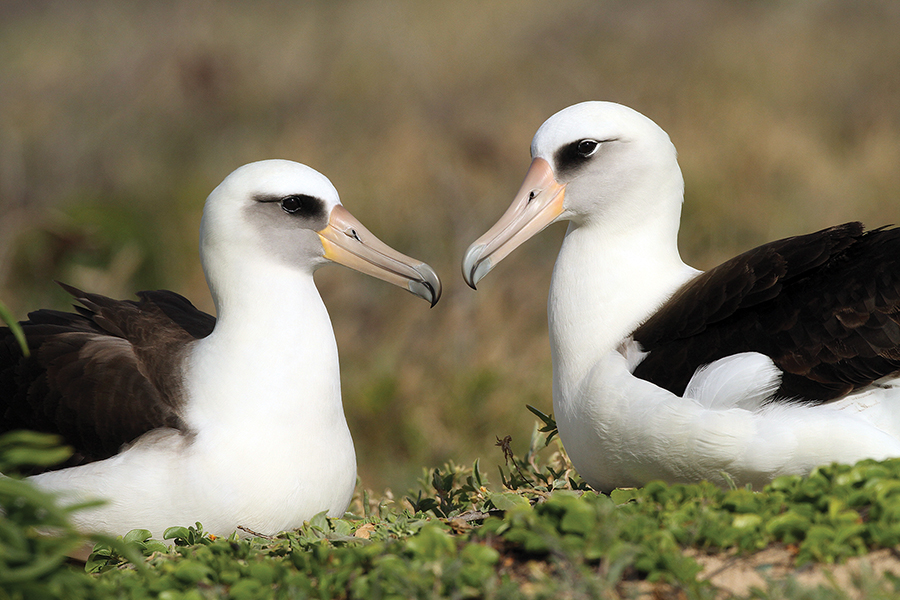
Right: Laysan Albatross mated pair, Hawaii


Sadly, many of the bird species I have photographed over the years are endangered. Consider the palila, mentioned earlier. There are a lot of things stacked against that species. Small population size, coupled with a very specialized diet and restricted home range, is a recipe for extinction in a human-dominated world. All it takes is one infectious disease or a large fire, like the recent one that destroyed the historic town of Lahaina on nearby Maui, to erase it from the planet.

Closer to home, take the iconic whip-poor-will, vocal denizen of our summer nights. Recent studies have shown its population to be in steep decline across much of its range. Scientists still do not have solid answers for why their numbers are dropping, though there are clues, such as the corresponding decline of a favored prey item — large moths — and an obvious loss of habitat. Likely it is a combination of many things, including some yet to be discovered.

But it’s not all gloom and doom. Populations of the iconic bald eagle have bounced back due to successful conservation action. Ditto for peregrine falcons. I never saw many wild turkeys growing up in Eagle Springs, but on a recent trip back home, I glimpsed one sneaking along the edge of the yard before disappearing into the pines, providing evidence that the restocking program of this important game bird by our state’s wildlife commission is paying off.

The fact remains, many, many populations of bird species continue to decline. For some, all that will be left in the future will be a few tattered museum specimens and photographs.

On my bookshelf, next to where I am typing, is a book titled Lost Animals: Extinction and the Photographic Record, by Errol Fuller. Nestled within its pages are image after image, most in black and white, of animals, including many birds, that are no longer with us on this planet. The one that strikes the biggest chord for me is of Martha, the last of the passenger pigeons, photographed around 1912 in her cage at the Cincinnati Zoo in Ohio.

At one time, the passenger pigeon was the most numerous bird species in North America. In 1813, while traveling near Louisville, Kentucky, John James Audubon recorded a flock of pigeons migrating south that he conservatively estimated to contain one billion individual birds. The immense flock passed overhead for three full days, completely blocking out the sky. It boggles the mind to think that in just 100 years from that remarkable observation, the passenger pigeon would be extinct, hunted to oblivion. If, as the saying goes, “a picture is worth a thousand words,” seeing that image of Martha, the very last of her kind, perched stoically in the corner of her cage, really drives home that sentiment and offers a sobering reminder that even the most common species can be wiped out in the relative blink of an eye.

Being outside, away from traffic and the computer screen, photographing birds is therapeutic. The images captured are little tokens of place and time that frequently remind me of family and friends who were standing next to me as I pressed the shutter. Today, I especially love showing pictures to my 4-year-old daughter. Nothing beats seeing her blue eyes sparkle with wonder at seeing a colorful bird for the first time.

Hopefully, the images will instill a sense of awe, respect, and appreciation, in her (and others) for all forms of life that call this remarkable planet home.  PS
Naturalist and photographer Todd Pusser grew up in Eagle Springs. He works to document the extraordinary diversity of life both near and far. His images can be found at www.ToddPusser.com.

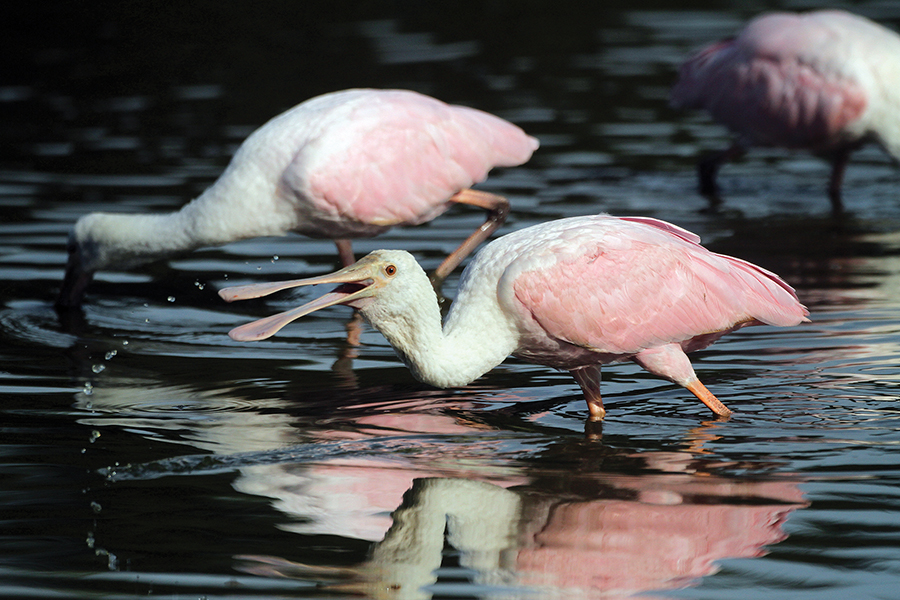
Left: Roseate Spoonbill, Florida

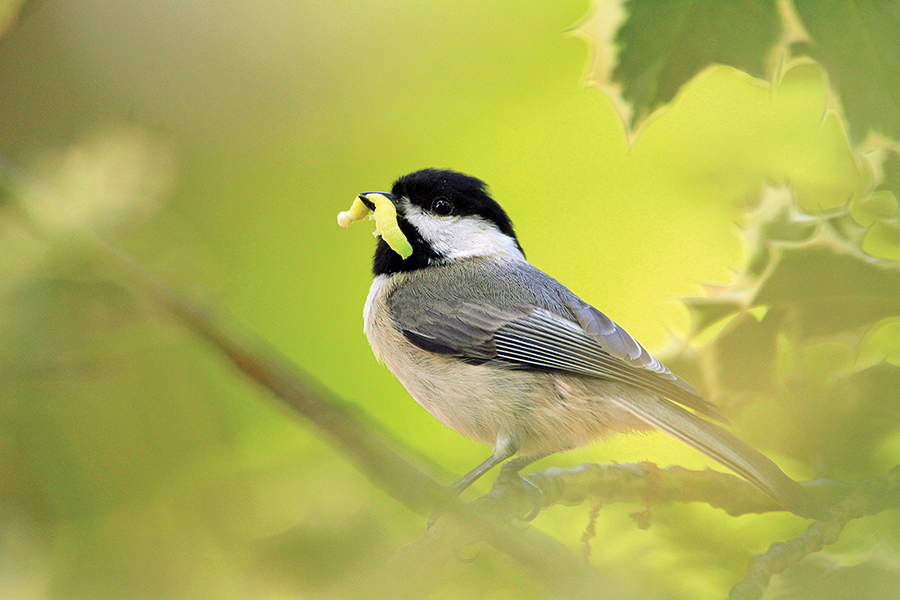
Left, middle: Carolina Chickadee and caterpillar, Virginia 

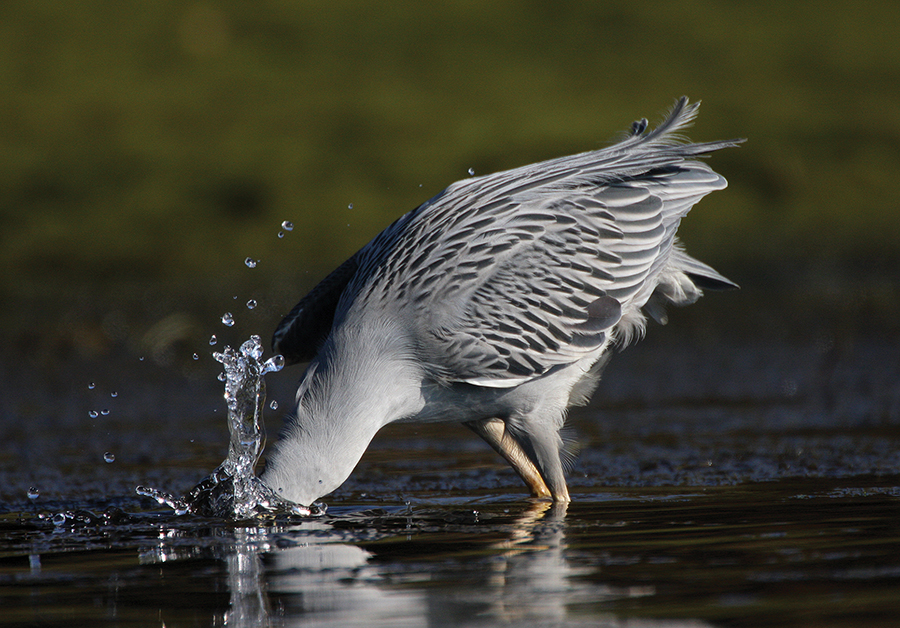
Right, middle: Yellow-crowned Night Heron hunting, Florida

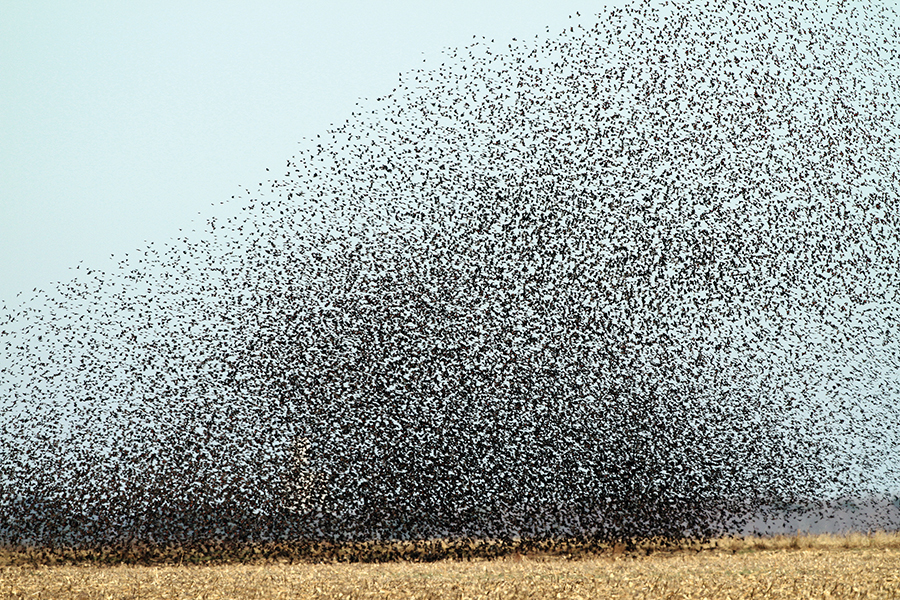
Right: Blackbird tornado, N.C.

Sun-Raised Sheep

Sun-Raised Sheep

Farming at the bleating edge

By Jenna Biter  

Photographs by John Gessner

Peafowl nap high in the rafters of a classic red barn. One bird, awakened by a buzz buzz buzzing, pecks a housefly out of the air like Mr. Miyagi with chopsticks. And the buzzing stops.

Now, the peacock is presumably less irritated, as well as less hungry, and the fly can’t buzz down to the wobbly-legged lambs, whose developing immune systems are better off without whatever infections the insect might be spreading.

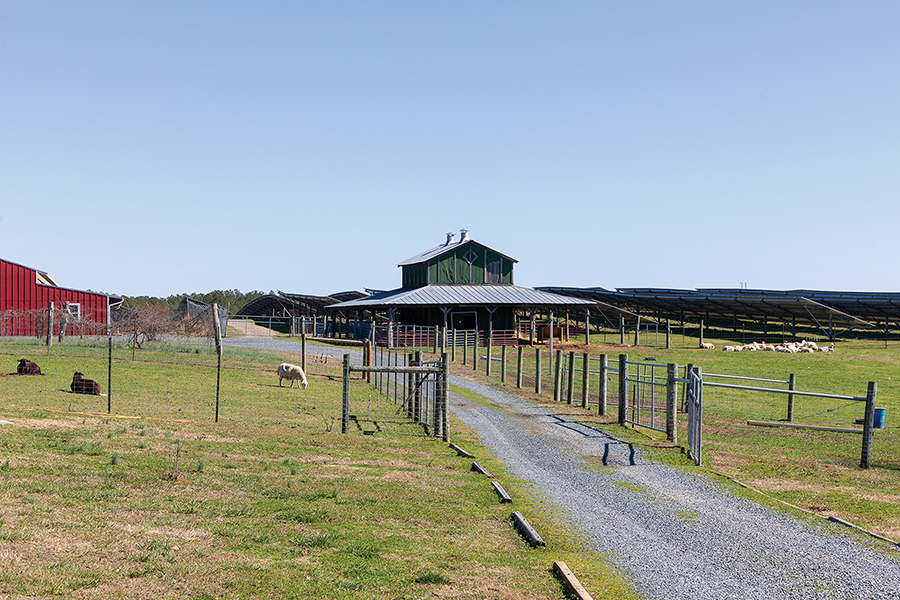
The lambs’ young stomachs aren’t even strong enough to digest what will become their steady diet of grass. When they do grow strong enough, at a couple of months old, they’ll leave the red barn to join the flock munching its way across a quilt of pastures tucked down a gravel drive beside a flea market in Biscoe.

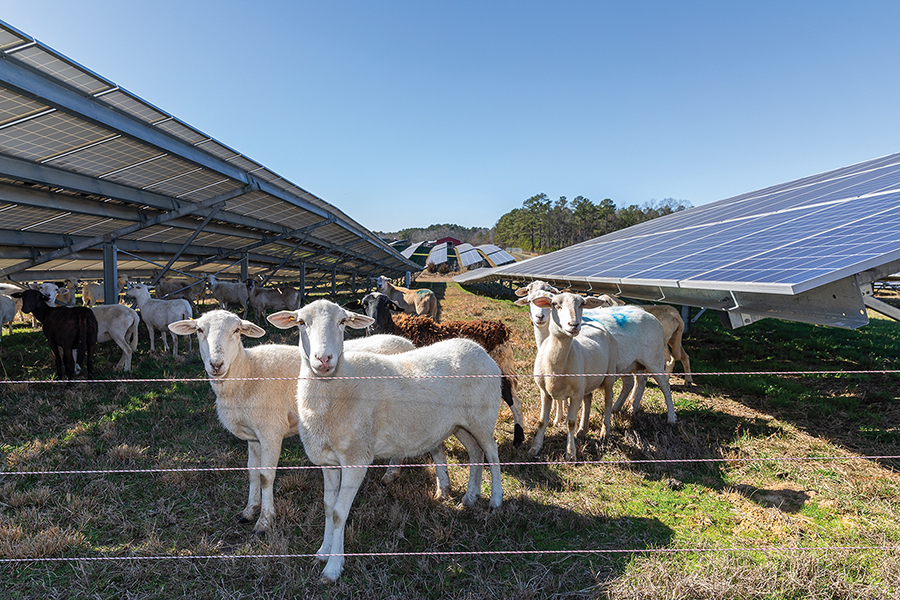
A few westward turns out of Moore County and into Montgomery, the 500-head Katahdin flock grazes beneath the shade of solar panels, where the Old World meets the Ewe, uh, New.

“They use this word ‘agrivoltaics,’” says Joel Olsen, a Charlotte native who owns the Montgomery Sheep Farm, with his wife, Tonje, “which doesn’t mean anything to most people.” That’s something the couple seems on a mission to change.

To people who do know, agrivoltaics is a techy sort of twofer: It’s when a solar farm moonlights as a traditional crop farm or, as with the Olsens, a livestock farm.

“The power here at the farm goes into the local grid, and this . . . ” Joel trails off in search of the right explanation. “Right now,” he says, “we’re powering all of Biscoe and Star — every single home, school, business, factory.”

He looks out at the gleaming fields of silvery tech, more than 100,000 solar panels in all.

“It’s a ton of power, 28 megawatts,” he says, delight warming his Carolina accent. While the solar panels stare up at the sun, quietly collecting golden rays to redistribute as green energy, the flock, unbeknownst to them, is on the clock.

With each happy chomp, the sheep mow the grass beneath and between the panel rows, so the greenery doesn’t shoot up and disrupt the solar harvest.

“When you get shade, it reduces your output, it reduces your income,” Joel says. Despite the clear cause and effect, during the early days of O2  — the name of his N.C. solar development company — he learned that solar farm groundskeeping was often overlooked, low budget, and the first thing to go wrong.

In 2012, the Olsens set out to change the status quo.

With a nostalgia for the lamb dishes of her childhood in Norway — where country sheep, geolocated by bells tinkling on their collars, foraged freely in the summertime — Tonje created Sun Raised Farms, a matchmaking agribusiness that pairs solar farms with ovine maintainers.

“We try to find the best sheep farmers in the area, so they can get free pasture for their lambs on the solar farm, and then we pay them to maintain it,” Tonje says. What can’t be grazed due to natural or technological terrain, Sun Raised Farms hires a human crew to care for.

“It’s kind of a win-win for the farmers,” Tonje says with a smile.

In the next instant, Joel flashes back in time to the beginning of their hike up agrivoltaics’ steep learning curve, a path that originally rejected them like Sisyphus.

“We had a local 21-year-old who bought 13 sheep to put on our first solar farm, and after two weeks, the neighbor’s hunting dogs got out, went right through a hole in the fence, and killed them all,” he says with a disapproving cluck. “That was step one.”

Joel guesstimates that now — with nearly two dozen solar parks under the management of Sun Raised Farms and more than a decade into the learning curve — the Olsens are about 17 steps into their agrivoltaics project. Since 2016, the endeavor has included the Montgomery Sheep Farm, what the Olsens view as a sort of research hub to establish best practices for their farming partners.

Cursed with what Joel characterizes as chalky, inhospitable soil, the century-old property began as a failed farm called the Tobacco Stick Ranch, and then transitioned into a hunting preserve. Its five minutes of fame came in 2006 when The Daily Show’s Nate Corddry used the name and the grounds in a sketch poking fun at then-Vice President Dick Cheney for blasting fellow quail hunter Harry Whittington with birdshot — an incident that actually happened in Texas.

Now the tobacco barn, workshop, farmhouse — all of the compound’s eight or so buildings — have been rehabilitated into a working farm wired into its own private solar microgrid, independent from the panels that feed the community grid.

Via a network of electrical boxes, a solar carport and four Tesla Powerwall 2 batteries hidden away in a mudroom, the farm powers itself most of the time.

“It’s one of the first off-grid farms in the country,” Joel says. “It demonstrates that farms can not only raise their own food, but also generate electricity for their own operations.”

In the distance, the techno-farm’s big power plant is a metallic patchwork that blankets 120 of the property’s 200 sprawling acres. Amidst the panels, inverters and breakers, a labyrinth of thigh-high electric fencing partitions the sheep into 28 micro-pastures, so they don’t overgraze any one section.

Though divided into smaller flocks, the sheep bleat back and forth in a never-ending game of barnyard Marco Polo. White-blond dogs stand watch nearby, wagging their tails. They don’t seem to speak sheep.

By day, the dogs live up to their gentle names like Elsa, Casper and Luna, politely asking for pats with their heads lowered in obeisance. By night, these Great Pyrenees protectors channel their pedigree to fend off coyotes and foxes lurking just beyond the chicken-wire fence.

Across a dirt road, back inside the red barn, the peafowl, some doves and a turkey dutifully continue their watch over the 100 young lambs. At the far end of the barn, a barrel-chested rooster seems preoccupied. He perches self-importantly on the back of a ewe, as if he’s directing a barnyard rehearsal for one of the farm tours that roll through every spring and fall.

Like the circle of life, the tours always end in dinner: a sun-powered, four-course, farm-to-table meal featuring the Montgomery Sheep Farm’s lamb by way of Sun Raised Foods, the Olsens’ avenue for bringing their farmers’ stock to market.

“A lot of the criticism solar farm developers received was because they took farmland away from the community,” Tonje says. “With this model, they kind of give back.”  PS

Jenna Biter is a writer and military wife in the Sandhills. She can be reached at jennabiter@protonmail.com. You can purchase tickets for a Montgomery Sheep Farm tour and dinner at sunraisedfoods.com.

The French Connection

The French Connection

The heroic life and death of James McConnell

By Bill Case

He was shot out of the sky over the French countryside more than a century ago, but for residents of Carthage, North Carolina, the presence of James Rogers McConnell endures. Memorials to the fallen World War I aviator can be found in nearly every corner of the Moore County seat. A highway marker on McReynolds Street explains that McConnell “flew for France in (the) Lafayette Escadrille,” a legendary unit of pilots serving under the French flag though hailing from America.

Fronting the Moore County courthouse is a Washington Monument-style obelisk. Its inscription says McConnell “fought for humanity, liberty and democracy, lighted the way for his countrymen, and showed all men how to dare nobly and die gloriously.”

Diners at the Pik N Pig restaurant adjacent to Carthage’s airport will find a massive bronze and granite plaque dedicated to McConnell near the barbecue’s front door. Gifted by a grateful government of France, its text is engraved in French. Alongside is another plaque translating the tribute into English. Planes landing in Carthage do so at the Gilliam-McConnell Airfield. The facility’s founder and owner, Roland Gilliam, jokes that his name is first only because “G comes before M in the alphabet.”

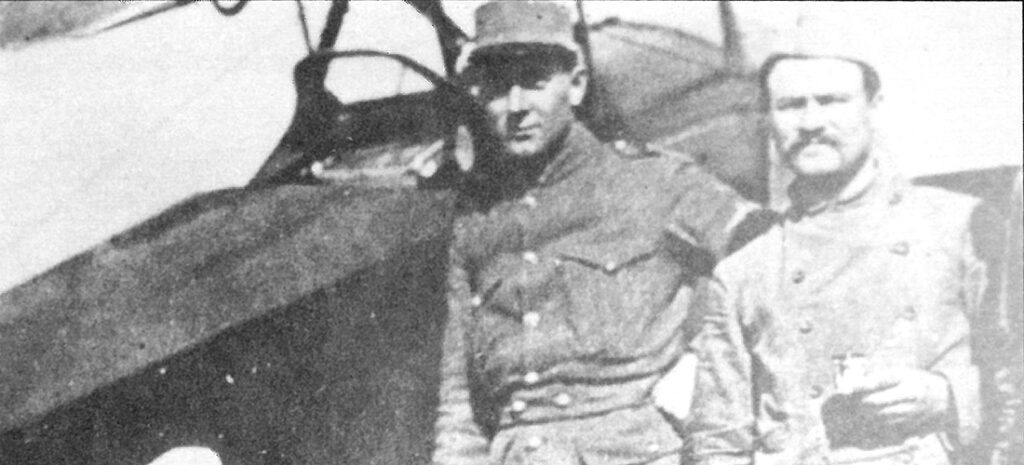
In September 2023, Gilliam paid further homage to Carthage’s favorite son by opening (together with curator Debby Campbell) the James Rogers McConnell Air Museum near the airfield. Among the treasured artifacts on display is a slightly smaller than full-scale replica of a similar model of the Nieuport biplane McConnell flew in dogfights against the Germans.

Motorists on N.C. 24 can’t miss the magnificent 20-foot-high mural painted by renowned North Carolina artist Scott Nurkin. It depicts a uniformed McConnell, his biplane and the phrase Flying for France, referring to the title of the aviator’s book, published by Doubleday, Page & Co. in 1917 — a stirring account of McConnell’s time with the Lafayette Escadrille. Visitors at the Carthage Museum on Rockingham Street view an exhibit honoring the flier that includes several of his personal items. A commemorative edition of Flying for France can be purchased there.

McConnell lived in Carthage for only two years before heading to France in 1915. Following his move to Carthage from New York City in 1912, he worked as the land and industrial agent for the local Randolph & Cumberland Railway — something of a family business since his father, Samuel Parsons McConnell, served as superintendent and part owner of the railroad after health concerns precipitated his move south.

In addition to his job with the railroad, James McConnell moonlighted with the Sandhill Board of Trade, an organization dedicated to the promotion of area agriculture and other business activities. As board secretary, he ingratiated himself with area farmers, wrote pamphlets and sought new uses of the Sandhills’ natural resources, including whether or not the smooth red clay underlying the Randolph & Cumberland railroad tracks might prove suitable for making bricks.

What motivated James McConnell to involve himself in World War I? Frank C. Page’s introduction to Flying for France provides a clue. In a chance meeting in January 1915 outside the county courthouse McConnell had surprising news. “Well, I’m all fixed up and am leaving on Wednesday,” he told Page.

“Wherefore?” asked Page.

“I’ve got a job driving an ambulance in France,” responded the 27-year-old.

World War I was raging across Europe, and the bloodbath was intense in the trenches of the French countryside. As a volunteer ambulance driver with the American Field Service, McConnell would transport wounded French soldiers from the front to the American Ambulance Hospital in Neuilly, France. It promised to be gruesome and dangerous work.

Privately funded, the AFS had no relationship with the American government. The U.S. was sitting on the sidelines, adhering to President Woodrow Wilson’s policy of strict neutrality toward the combatant nations. (Great Britain, France, Italy, Russia and Serbia were fighting Germany, Bulgaria, Austria-Hungary and the Ottoman Empire.) Employing the catchphrase “He kept us out of war,” Wilson had just been re-elected to a second presidential term. America would not declare war against Germany until April 1917.

With America steadfastly neutral, Page wondered why his friend was intent on risking his life in a foreign war, leaving behind his business career, his father and numerous friends. McConnell had an answer. Imagining The Great War as an event of historical importance, he felt he would be missing the opportunity of a lifetime if he failed to get involved. “These Sandhills will be here forever, but the war won’t, so I am going,” he told Page. Then he added, “And I’ll be of some use, too, not just a sightseer looking on; that wouldn’t be fair.”

McConnell was just one among many idealistic young men, often from affluent backgrounds, who volunteered their services as ambulance drivers during the war. The AFS targeted upscale undergrads and alumni of prestigious universities, including the University of Virginia in Charlottesville, McConnell’s alma mater. Though he never graduated, it is no exaggeration to say that he became as legendary a figure at UVA as he is today in Carthage. Enrolling in 1908, he studied two years at the College of Arts and Sciences, and then one year at the law school. One law professor, observing his pupil’s restlessness, remarked that McConnell exhibited “hatred of the humdrum, an abhorrence of the commonplace, and a passion for the picturesque.”

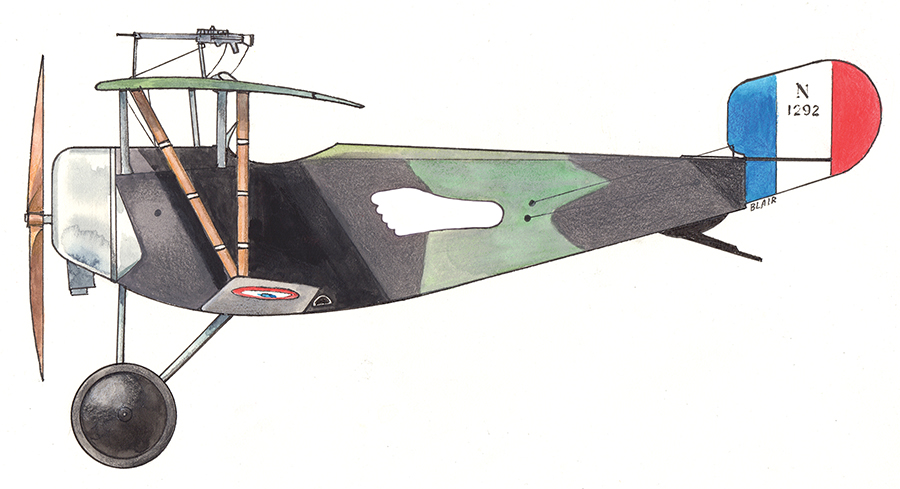
Left: McConnell and his mécanicien pose beside his Nieuport 11, bearing footprint that represented the University of Virginia’s ‘Hot Foot Society’
Middle: Nieuport 11 N1292 of Sgt. James R. McConnell
Right: James R. McConnell


McConnell thrust himself into UVA’s social whirl, joining a plethora of campus organizations, fraternities and secret societies. He became a cheerleader, editor-in-chief of the campus yearbook and, presaging later activities, founded the Aero Club. Clad in Highland clan finery, McConnell played bagpipes to entertain well-lubricated friends. Named king of the outrageous “Hot Foot Society” (both the king and queen were males), he led a procession of raucous fellow jesters in medieval dress throughout the campus.

McConnell’s most spectacular prank was the furtive attachment of a chamber pot atop the head of a statue of Thomas Jefferson, about to be unveiled in a public ceremony attended by President William Howard Taft. A plumber discovered the pot barely in time to save UVA embarrassment and probably McConnell’s expulsion.

Practical jokes were in McConnell’s rear-view mirror by the time he joined Section 2 of the AFS at Pont-a-Mousson in northeastern France on Feb. 11, 1915. “Tomorrow, I am going to the front with our squad and 12 ambulances,” he wrote a friend. “I am having a glorious experience.” He quickly made his presence felt, bravely rescuing wounded French soldiers while under fire. The French military awarded him the Croix de Guerre.

McConnell also impressed his AFS ambulance team members, including Henry Sydnor Harrison, a writer for Collier’s magazine. “I took note of my driver (McConnell),” recalled Harrison. “He gave me at once a sense of mature responsibleness above his years and inspired confidence.” McConnell, he wrote, was “boyishly delighted by the discovery I was a writer” and thereafter, the two men’s conversations centered around books.

Harrison left the AFS after four months service but continued to correspond with McConnell. “There came a long letter from him written in the first flush of his contact with the front,” reported the Collier’s scribe, “and I had not gone far with it before it came over me like a discovery: Why, hang it, the fellow can write!”

Yes, he could. And when New York-based publishers got wind of McConnell’s talent, they sought firsthand accounts of his experiences at the front. He wrote vividly. A piece in the September 1915 issue of Outlook transports the reader into McConnell’s rattling Daimler ambulance: “The work at night is quite eerie, and on moonless nights quite difficult. It is only in the dazzling light of the illuminating rockets that shoot into the air and sink slowly over the trenches that one can see to proceed with any speed. It is night, too, that our hardest work comes, for that is usually the time when attacks and counterattacks are made and great numbers of men are wounded . . . men with legs and arms shot away, mangled faces, and hideous body wounds. It is a time when men die in the ambulances before they reach the hospital.”

Driving an ambulance in a war zone not only provided writing grist for McConnell but other literary talents too. An extraordinary cadre of famed writers attended to wounded soldiers during World War I , including Ernest Hemmingway, John Dos Passos, W. Somerset Maugham, Dashiell Hammett, Southern Pines’ own James Boyd, E.E. Cummings, Louis Bromfield, Archibald MacLeish, Gertrude Stein and Robert W. Service.

During his time with the AFS, McConnell, who never married, befriended a young nurse at the hospital, Mademoiselle Marcelle Guérin. Their relationship appears to have been a passionate one, at least at first. Writing Guérin from the field, he proclaimed, “You are everything to me over here or elsewhere, for that matter.” Later correspondence, though always amicable, suggests the romance had cooled. Marcelle commenced a romance with a Russian while McConnell chattily enlightened her about his flirtations with a beautiful barmaid named Rosa.

After 10 months transporting the wounded, McConnell got directly into the fight. “All along I had been convinced that the United States ought to aid in the struggle against Germany,” he explained in Flying for France. “With that conviction, it was plainly up to me to do more than drive an ambulance. The more I saw the splendor of the fight the French were fighting, the more I felt like an ‘embusque’ — what the British call a ‘shirker.’ So, I made up my mind to go into aviation.” He quit the AFS.

McConnell joined the French Foreign Legion on Oct. 1, 1915, plunging into flight training in Pau, France. “My elation at arriving there was second only to my satisfaction at being a French soldier,” McConnell wrote. “It was a vast improvement, I thought, to the American ambulance.”

By the spring of 1916, McConnell had achieved proficiency in piloting a Nieuport biplane. He described the aircraft as the “smallest, fastest rising biplane in the French service. It can travel 110 miles an hour and is a one-man apparatus with a machine gun mounted on its roof and fired by the pilot with one hand while with the other and his feet he operates the controls.”

France was in the midst of forming an aviation squadron consisting of pilots from the United States. The French government hoped the exploits of the new unit would push the U.S. into taking up arms against Germany. On March 16, 1916, the director of French aeronautics announced the formation of the N-124 American Escadrille.

The Escadrille’s initial roster listed seven pilots: McConnell; William Thaw from Pittsburgh; Norman Prince from Boston; New Yorkers Elliott Cowdin and Victor Chapman; Texan Bert Hall; and, Kiffin Rockwell from Asheville, North Carolina. The majority came from well-educated and wealthy backgrounds. All except McConnell, Prince and Cowdin had fought in the trenches with the Foreign Legion before opting to join the Escadrille. French Capt. Georges Thenault was placed in charge of the group. Thirty-eight Americans and four Frenchmen would ultimately fly for the unit.

Germany protested that the name of the squadron, American Escadrille, violated America’s neutrality toward the belligerents. Thus, the unit was rechristened the Lafayette Escadrille, honoring the memory of Marquis de Lafayette, the Frenchman who nobly aided the patriots’ cause during the American Revolutionary War.

On April 16, 1916, the American aviators were ordered to join the Escadrille at Luxeuil in the Vosges Mountains. McConnell endured spartan conditions during his flight training, but facilities at the new location were grand. Each pilot had his own private quarters at a villa adjacent to the town’s hot baths. The men dined with the officers at the best hotel in town, and an automobile was available at their beck and call. McConnell felt like a “summer resorter rather than a soldier,” until reflecting on “the ancient custom of giving a man selected for the sacrifice a royal time of it before the appointed day.”

And the possibility of a fiery death for N-124 Lafayette Escadrille aviators was not remote. Missions (two-hour sorties, two to three times daily) were seldom routine. William Sydnor Harrison pointed this out in his tribute to McConnell: “The pilots of N-124 are not ordered for routine observation work; they are not asked to carry messages or take photographs, or regulate artillery fire, or bring up planes from Paris,” he wrote in the Sandhill Citizen. “They are fighters pure and simple, and their place in the air is where the danger is thickest.”

While romance and adventure were attached to being a World War I aviator, flight in an open cockpit could be a harrowing experience. “Mere words are difficult to describe the pure agony of mind and body,” wrote Escsadrille member Laurence Rumsey. “The sub-zero temperature permeated the very marrow of your bones. Despite three or four pairs of gloves, fingers coiled around the stick would be paralyzed in five minutes.”

McConnell’s first sortie on May 13, 1916, produced anxious moments along with his aerial “baptism of fire.” Having never previously flown above 7,000 feet and shivering in the cold, he climbed in his Nieuport up over a cloudbank to an altitude of 14,000 feet, losing contact with his fellow pilots. “Not a single plane was visible anywhere, and I was growing very uncertain about my position,” he recounted in Flying for France. “My splendid isolation had become oppressive, when, one by one, the others began bobbing up above the cloud level, and I had company again.”

On the heels of that scare, enemy shrapnel suddenly enveloped McConnell’s biplane. “It was interesting to watch the flash of the bursting shells, and the attendant smoke puffs — black, white, or yellow, depending on the shrapnel used . . . Strangely enough, my feelings about it were wholly impersonal.”

Four days later, McConnell’s fellow North Carolinian Kiffin Rockwell scored the Escadrille’s first aerial victory, shooting down a German LVG two-seater. According to McConnell, Rockwell closed within 30 yards, “pressed on the release of his machine gun, and saw the enemy gunner fall backward and the pilot crumple up sideways in his seat,” before their plane crashed to the earth.

The Escadrille and everyone in Luxeuil, “particularly the girls” (according to McConnell), celebrated Rockwell’s accomplishment. According to Jon Guttman, author of SPA 124 Lafayette Escradrille, Kiffin’s brother Paul, “who was in Paris when he heard the news, rushed to Luxeuil with an 80-year-old bottle of bourbon whiskey. After drinking a shot, Rockwell offered one to (Victor) Chapman, but he declined, suggesting that each pilot be entitled to one slug of the ‘Bottle of Death’ every time he shot down an enemy aeroplane.”

Other squadron aviators would achieve victories, including Chapman, Thaw, Cowdin, Prince, Hall, and the incomparable Raoul Lufbery, whose 16 kills would make him one of the Allies’ foremost aces. Despite once causing an enemy plane to careen hopelessly out of control McConnell was not credited with any confirmed victories, since no one observed the near-certain crash.

Soon after Rockwell’s victory, the Escadrille was ordered to the Verdun sector. “A commodious villa halfway between the town of Bar-le-Duc and the aviation field had been assigned to us,” wrote McConnell, “and comforts were as plentiful as at Luxeuil.” But he sensed a “gigantic battle” in the offing, given “the endless convoys of motor trucks, the fast-flowing stream of troops, and the distressing number of ambulances.”

Left: The pilots of N124 pose at Luxeuil in May 1916. From left to right: Cpls. Chapman and Cowdin, Sgt. W. Bert Hall, Sous-Lt. Thaw, Capitaine Georges Thenault, Lt. Alfred de Laage de Meux, Sgt. Prince and Cpls. Rockwell and McConnell. Sitting before Thenault and de Laage is Thenault’s dog Fram.
Right: Mural of James McConnell in downtown Carthage


The Battle of Verdun was the longest and bloodiest of the war. Combined Allied and German casualties tallied over 700,000. The Escadrille was not immune from the carnage. Clyde Balsey suffered a severe wound to his thigh from an explosive bullet. He managed to land his plane in a meadow and was taken to a field hospital, where he lingered for an extended period before dying.

While hospitalized, Balsey developed an intense thirst. To quench it, Victor Chapman commandeered two bags of oranges he intended to deliver to the hospital following his final sortie of the day. It would prove to be Chapman’s last flight. He was killed in a dogfight just after shooting down an enemy plane. McConnell described the Escadrille’s reaction in Flying for France: “We talked in lowered voices after that; we could read the pain in one another’s eyes. If only it could have been someone else, was what we all thought . . . I kept thinking of him lying over there, and the oranges he was taking to Balsey.”

To cope with their grief, Escadrille aviators sought distractions. Consumption of alcohol topped the list. The squadron’s carousing while on leave in Paris reportedly reached epic proportions. McConnell wrote of other pastimes. “At the big table, several sportive souls start a poker game, while at a smaller one, two sedate spirits wrap themselves in the intricacies of chess. Captain Thenault labors away at the messroom piano, or in lighter mood plays with Fram, his police dog. A phonograph grinds out the ancient query, ‘Who Paid the Rent for Mrs. Rip Van Winkle,’ or some other ragtime ditty.” On a Paris sojourn, the flyers bought a lion cub, Whiskey, and adopted the feline as the squadron mascot.

Another diversion for the Americans was decorating their aircraft. All the Nieuports displayed the unit’s insignia — a Sioux warrior chief in full headdress. The pilots added their own personal touches. McConnell put the moniker “MAC” on his biplane. He later switched to a white “Hot Foot,” recalling his collegiate merrymaking.

McConnell avoided serious aerial mishaps until late August 1916, when a crash caused him a debilitating back injury. He initially denied being in pain, but Capt. Thenault saw through the ruse and ordered him to the hospital at Vitry-le-Francois. The flier spent most of his 45-day recuperation in the Paris home of Mrs. Alice Weeks, who had lost a son in the war. During his convalescence, McConnell worked on his writings for his publisher, Doubleday, Page & Company.

On Sept. 23, 1916, Kiffin Rockwell, one of McConnell’s best friends in the unit, was shot down and killed. A crestfallen McConnell wrote, “No greater blow could have befallen the Escadrille. Kiffin was its soul. He was loved and looked up to by not only every man in our flying corps but by everyone who knew him.”

In early October, Norman Prince, an original N-124 member, also perished. Seemingly on the road to recovery from an injury suffered in a landing accident, Prince expired after a blood clot developed on his brain. Four of N-124’s first nine pilots perished in six months.

On Oct. 16, 1916, N-124 was deployed to Cachy, France, to fight in the Battle of the Somme. McConnell, though still suffering from his injury, rejoined the unit. The new encampment was a rude awakening. “Instead of being quartered in villa or hotel, the pilots were directed to a portable barracks newly erected in a sea of mud,” wrote McConnell. Damp cold “penetrated through every crack.” Under-equipped in their new surroundings, the pilots begged for blankets from neighboring escadrilles.

McConnell’s gloomy ennui with the situation is evident in a Dec. 11, 1916, letter. “Have done little on the article. I’ve felt on the bum and Whiskey (the lion cub) chewed my fingers so it’s hard to hold a pen,” he confided. “Only flown once since my return.”

McConnell was not the only Escadrille member hurting. In a subsequent letter, he referred to N-124 as a “great aggregation of cripples.” In late January 1917, the Escadrille was redeployed to take part in a spring offensive. But another malady put McConnell back on the disabled list. In February, he wrote Mademoiselle Guérin to inform her he was back in the hospital due to “the itch,” a near-intractable form of dermatitis plaguing many in the Escadrille. McConnell would not exit the infirmary until early March.

He wrote Guérin numerous letters during this stay and following his return to duty with N-124. The correspondence suggests the rekindling of their dormant romance. He tells the young nurse that her letters are “like water to a man dying of thirst.” He acknowledges enjoying a visit with her more than any in his entire life.

McConnell’s final letter to Guérin, written March 16 , three days before his death, concludes, “Thank your mother for being so very nice to me, and give her my love, and keep some for yourself.” Decades later, Guérin would confide that McConnell was the great romance of her life.

On March 19, 1917, McConnell, together with fellow aviators Edmond Genet and Edwin Parsons, took off on patrol from an airfield in Sainte Juste, France. Still dogged with relentless back pain, McConnell had to be maneuvered by his mechanics into the bucket seat of his Nieuport 17. After the three aviators were aloft, a clogged oil line caused Parsons’ motor to malfunction, and he returned home.

Continuing the sortie, Genet and McConnell encountered two German two-seaters and separately attacked them. Jon Guttman’s book describes the dogfight: “The gunner of Genet’s opponent shot away his main upper wing support and wounded him in the left cheek. Recovering, (Genet) closed until the two aeroplanes nearly collided, but failed to bring down his quarry. He then searched for McConnell for 15 minutes, until enemy anti-aircraft fire and the increasing likelihood of losing his upper wing convinced him to head home. To his horror, he learned that McConnell had not returned.”

It was not until March 24 that McConnell’s death was confirmed. Two German planes that had been observed close on McConnell’s tail fired on him. After a “desperate fight,” McConnell had crashed. Several bullets were found in his body. His ailing back may have played a role in his death, since he could not turn to spot enemy aircraft to his rear. McConnell’s crumpled Nieuport was found in full throttle. He likely died before hitting the ground.

McConnell may have had a premonition of his impending death. He left the following instructions with the Escadrille: “My burial is of no import. Make it as easy as possible for yourselves. I have no religion and do not care for any service. If the omission would embarrass you, I presume I could stand the performance. Good luck to the rest of you. God damn Germany and vive la France.” 

In the end, he did in fact “stand the performance.” Three women, all claiming to be McConnell’s fiancée, attended his memorial service at the Escadrille’s base. The French military awarded him a second Croix de Guerre. Initially buried in the meadow where he crashed in Flavy-le-Martel, France, at his father’s request McConnell was later reinterred at the Lafayette Escadrille memorial near Paris.

The U.S. Congress declared war against Germany 18 days after McConnell’s death. The Escadrille’s remaining American pilots were promptly transferred to a U.S. Army aviation unit. McConnell was the last American pilot killed in the conflict prior to the U.S. entry into the war.

The editor of the Sandhill Citizen, H.E. Foss, gave credit to McConnell for seeing what was at stake in the war long before the government and most Americans. “Democracy and autocracy were face-to-face on the soil of France, and Jim was a democrat,” Foss opined. “He saw early and clearly, what we have been slow to discover, that in this struggle our future is at stake scarcely less than that of England and France. Thus, he was not only ‘Flying for France,’ but for the land of his birth.”

Carthage held its own memorial service. It was announced at the ceremony that the new county hospital about to open 6 miles from Carthage would be named the James R. McConnell Hospital. Following its shipment from France to North Carolina, the French-language plaque honoring McConnell was displayed at that hospital. It would be the tablet’s first home but not its last. After that hospital closed, the plaque was moved in 1929 to the new Moore County Hospital in Pinehurst. Then, in 1940, the Carthage Chamber of Commerce persuaded the hospital to send the tablet to the county seat. Positioned near the old town hall, the plaque remained there until 2011, when Roland Gilliam convinced the city that it should be displayed at the airport.

Nor did UVA forget McConnell, its first alum killed in the war. The university commissioned Mt. Rushmore sculptor Gutzon Borglum to create a statue in memory of the flier. Dedicated in 1919, “The Aviator” depicts a winged and leather-helmeted McConnell soaring Icarus-like in the air. Today, the statue rests on the plaza of the university’s Clemons Library.

And despite the passage of a century, the French continue to venerate McConnell and the N-124 Lafayette Escadrille. In 2016, airport founder Roland Gilliam, and fellow Carthage fliers Jim Wiltjer and Felice Schillaci, received invitations from French officials to attend the 100th anniversary of the founding of N-124. An unforgettable part of their pilgrimage was attending a ceremony held at James McConnell’s original gravesite, still lovingly maintained and covered by flowers, alongside a Flavy-le-Martel cornfield. The tribute was not extravagant — about 25 attended and the French and American national anthems came from a boom box. It was precisely the sort of performance McConnell would be happy to stand.  PS

Pinehurst resident Bill Case is PineStraw’s history man. He can be reached at Bill.Case@thompsonhine.com.