

SIMPLE LIFE
The Gift of Nature
And the power of the Earth to heal
By Jim Dodson
One morning this past February, I stepped out to assess how my garden had fared from one of the coldest, soggiest winters in memory.
It wasn’t a pretty sight.
The Asian-themed shade garden I’d spent a decade creating in our backyard under towering oaks appeared to be devastated, buried beneath drifts of sodden leaves and dozens of downed tree limbs. The only visible signs of life were weeds and grass creeping over the garden beds like an insurgent army.
I’m no rookie in landscape gardening. I’ve built — and restored — three major gardens in my life, including an ambitious native garden in a forest on a coastal hilltop in Maine, where we lived for two decades.
Hard weather, as they say up in Maine, makes good timber — a theory, I’ve discovered, that’s applicable to human beings as well as gardens.
I remembered this eternal truth as I took stock of my battered garden, wondering if it would ever look as glorious as it did last summer.
After a morning of clearing debris and raking out beds that showed little to no signs of life, I ruefully joked to Wendy, my wife, that our “ruined” garden was the final insult from a winter we were both eager to forget.
It started on All Saints’ Day back in November, with the death of Wendy’s mom, a lovely Irish lady who spent her career teaching children how to love art. In the end, dementia robbed “Miss Jan” of her sparkling wit and even the ability to recognize those she loved. At least she spent her final days on our terrace, warming her face in the late autumn sunshine. The last thing she said to me was, “Look, isn’t the sun beautiful today?” She never spoke again.
For the first time ever, three of our four children, admittedly all grown-ups, failed to make it home for the holidays, which made for a too-quiet house at Thanksgiving and lots of empty stockings. Fortunately, our youngest, Liam, showed up two days before Christmas, briefly brightening the mood before I went under the knife for a full left-knee replacement that left me wondering, as the New Year dawned, what dump truck ran over me.
I skipped the narcotic painkillers in favor of Tylenol, however, because I was under the intense pressure of a tight deadline to correct and return within a fortnight my editor’s marks on the most important book of my life. As a proud Luddite, I was forced to use a complex digital editing system that left me feeling like a child trying to operate a jumbo jet. Fortunately, in the nick of time, my digitally savvy bride stepped in to get the job done. Printed manuscripts, I learned, evidently went out of fashion with handwriting.
To make things more fun, as I wrestled with a hoisted leg and new technology, a work crew arrived to renovate our Donna Reed-era primary bathroom, knocking down walls and pulling up floors — making such a godawful racket, it seemed they were taking out half the house.
Most disturbing of all, amid this clamor and craziness, I lost my longtime gardening pal, Boo Radley, our beloved 14-year-old cat, who suffered a sudden series of seizures that grew more horrifying as the days went along. We finally put him peacefully to sleep on his favorite blanket.
Every family, of course, goes through periods of intense stress and challenge when the chaos of life seems to pile up like snow against the door. That’s just part of making the human journey. To place our winter of discontent in proper context, as my late Scottish father-in-law liked to say, ours were “pretty high-class problems in a world that is full of sorrow and woe.”
It took an unexpected birthday card from a dear old friend to lift my cloud of gloom and remind me of what’s really important in the grand scheme of things.
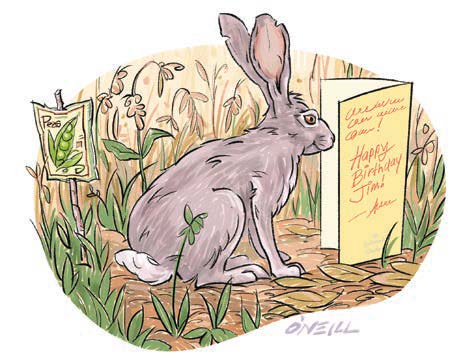
Ashley Walshe’s clever card amounted to a gentle poke from the universe, depicting an old, gray rabbit nibbling something in the garden. She knows I have a thing for woodland rabbits.
“Another year,” read the card. “Another gray hare — Happy Birthday!”
You may know Ashley from the soulful monthly Almanac she writes for the magazine, and from her many years adding earthy wisdom and wit to our editorial team. Among other things, she is a gifted poet and a true daughter of the Earth.
Not surprisingly, it was her accompanying hand-written message that reminded me of the lessons in gratitude and joy we’ve shared over the many years of friendship:
“In all seriousness,” she wrote, “thank you for showing me the joy of growing backwards . . . The secret, perhaps, to this wild, wonderful life on Earth.”
The idea of growing backwards is simply our way of describing a life in tune with nature, timeless values (some would call “old-fashioned”) that promote kindness and compassion to all living creatures and a deep reverence for the Earth.
In a year that has already seen apocalyptic wildfires out West, a record number of killer tornados in the heartland and a hurricane that will be remembered for generations, it isn’t much of a stretch to realize Mother Earth is sending us a serious message about our behavior.
Last November, Ashley and husband Alan nearly lost everything they own — including their lives — when their first home on a pretty hillside just outside Asheville was almost washed away by Hurricane Helene.
“At the height of the storm,” she remembers, “we were huddled in our house with our dog, Dirga, watching frightening torrents of water roar down the mountainside, washing away many of the houses around us. I remember asking Mother Mary to please keep us safe.”
Moments later, the couple heard a loud crash of trees that fell directly in the path of the rampaging waters, diverting the Biblical flood away from their home.
It was, she says, “a miracle. Nature saved our house.”
After escaping for a time to stay with friends outside the danger zone, the couple returned to find their home still intact but surrounded by a world of mud and debris.
“Helene brought me back to a higher level of consciousness, a desire to let go of things that don’t really matter in the course of daily life,” she says. “It also brought out an amazing amount of kindness and support among complete strangers who helped each other through the crisis. I think it changed many lives.”
The good news, she says, is that her bare yard is now a blank canvas awaiting the creation of a “wonderful new garden.”
Days after she told me this, she sent me a photograph of the lone plant that miraculously survived the Great Flood — a single, gorgeous tulip that popped up with the coming of spring. “Nature always gives us a gift,” she wrote.
That same afternoon, I noticed my own garden miraculously springing to life.
By now, it should really be something.