

THE ARTIST KNOWN AS COWMAN
The Artist Known as Cowman
b. 1949? — d. not long ago now
Fiction by Daniel Wallace
Illustrations by Keith Borshak
He wasn’t always Cowman. Before he was Cowman he was just a boy, and like a boy he played in the fields, in the river and the woods, near the lake, and down the road. He worked with his family planting things. In the summertime he didn’t wear shoes or a shirt, just a pair of cut-off jeans passed down from brother to brother, the blue worn nearly white, and sometimes he wore a hat, when the sun bore down so hot he could feel it boiling his brains. This is the way it was from May to the middle of September, and by then he looked less a boy than he looked like something that was once a boy, or that could become a boy, under the proper supervision and a bath.
Near the end of a long afternoon sometimes beneath the spindly towering pine trees that were everywhere, he cleared the pine needles away until he made an open patch of dirt. With the palms of both of his hands he would smooth it out, harder and faster, until the dirt pressed so hard into his skin that no bath would ever get it out completely. His hands would always be a little bit darker than the rest of him and that makes for an interesting biographical detail.
Then he would take a stick and carve a picture into the ground, and maybe some words. In the beginning, he always said, he drew nothing but cows.
This is how it started, becoming what he later became: Cowman.
Now of course he’s known the world over.
But before. Before all this, where was he?
A valley where there was a river — small at times, then bigger, frothy and white, then . . . not. Mountains this way, that. A hill, a dale. No place anyone has ever been, however, nor a place they would want to go, and for precisely this reason it remained undiscovered by the likes of you or us for centuries probably. It had no name, this place. For generations the people there weren’t aware there were other places, so isolated was this little town, quiet and dark in the hills and in the dales, the mountainous extremes of their lives. Why name it? Why name something there is no more of than one?
Home is what he called it. He hasn’t been home in such a long time and knows now he will never see that forgotten patch of soil ever again. But the day he left he knew he never would. All of his work is influenced by what he no longer has.
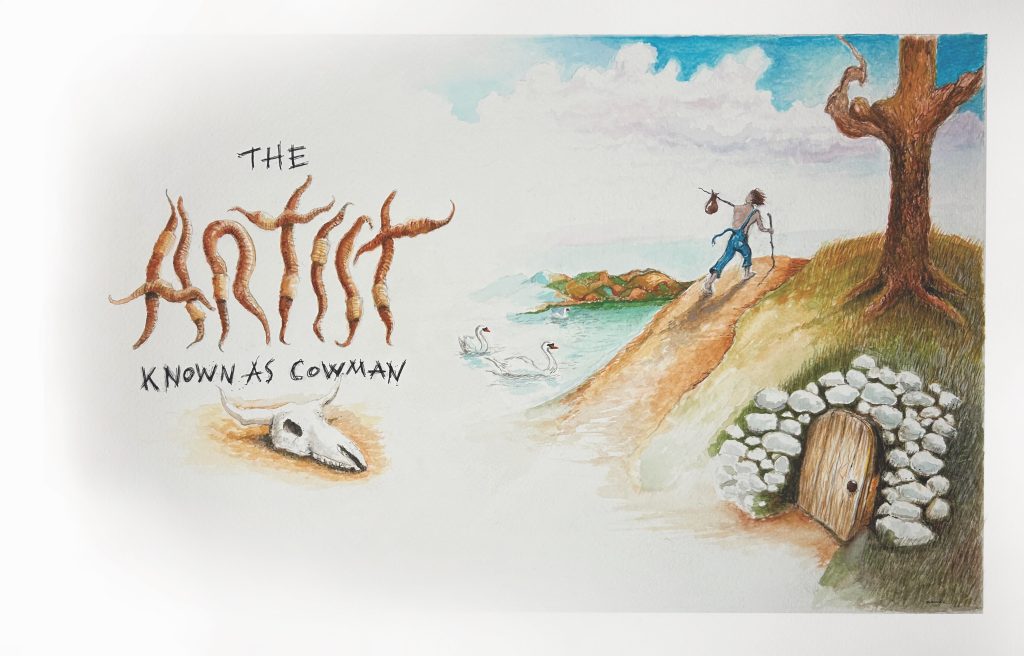
Dug into the side of a hill was his house. Two-sided wooden walls, the front stone, the back wall a dense red clay, which, true, he grew up eating. Not for the main meals. Just a little something in-between. When a new baby came they just dug deeper into the mountain for room.

Worms were a problem. When it rained the wall dripped. But it mostly did the job it had to do.
The wall in his room had a streak of lime running through it. The pale white against the dull orange was like a late summer sunset, he said. The artist transforms the world with his eyes, even when his world is no more than an ambitious hole.
The fifth of seven, Cowman was. The first three were girls, the second three were boys, and the last was some odd combination of the two but less than either. They called it Tarp. While the others were passing fine in almost every respect — the boys big and strong, the girls industrious, pleasant — all of Tarp’s parts were either bigger or smaller than they were supposed to be, and inside his head was probably not something anyone could actually think with, no better than a peach pit, really, or gravel. Truth be told he never did amount to much and had he amounted to anything no one would have been more surprised than he. Everything surprised him, though. Even chairs and rocks.
The others were named, in order of their birth, Estem, Maudry, Ebee, Root and Mold. The Cowman’s real name is not included in the list, as it has been carefully lost to time. It has variously been suggested to be Remly, Tirk, Lebby, Crop, Moses or Pisky. No one can say. Cowman has thus become Cowman, now and forever, and can avoid the embarrassing parenthetical approximations which attach themselves to the nomenclature of famous geniuses.
Estem, Maudry and Ebee, his sisters, were beyond beautiful. They all had thick auburn hair and perfect freckles. It was said no man could look at any one of them without falling in love, and thus the daughters were never in the same place at the same time. Except once, one time, and a man fell in love with all three of them and courted each on a revolving basis. Finally, they all said no, and his heart was broken once a day for three days running by each of them in turn, repeated on a loop for months, and he did not live long thereafter.
Mold and Root were large — Mold largely fat, and Root like one big muscle. Root’s strength was legendary. He once threw a wild bobcat high into the air using naught but his little finger — and caught it with his face. Before this legendary event he was a handsome man, too. Or handsome enough.
Mold’s girth impressed as well. He was one of those constant growers — ever expanding, like a balloon blown up by God. One morning he overslept and could not leave the room through the same door he entered it and stayed there for several months. He eventually became so big that he filled the room from side to side, floor to ceiling. Root dug him out. He remained an outdoor child after that, and for as long as he lived was never allowed within the dwelling of another human being again. Sad.
Cowman, being the seventh child and the third boy, spent most of his childhood either lost or forgotten. The seeds of art are born within the desolate souls of the suffering. Wagon trips across the wide valley to visit relatives who lived in a holler never failed to exclude him — not out of cruelty, or dislike, but out of pure absentmindedness. His family had a sense of him, but they could never be sure — like something glimpsed quickly out of the corner of your eye — was there a – ? did we have a – ? He was more of an idea, a vague one at that. Maybe he was a dream — a communal dream? Communal dreams were common in that time and place. Hard to conceive of nowadays, that people were too poor to have dreams of their own, but had to share them with their family, sometimes the entire village. But it was true. Dreams were crowded places. Cowman did not help his cause by being quiet in an exceptional way. He was neither small, nor large. He rarely complained, by nature content. When he would wake up and find his entire family had gone he tried to pitch in by cleaning up around the house and doing worm duty on the back wall. Then he might go fishing.
And then, of course, it goes without saying, sometimes he would make his art. He would use a stick, or a piece of charcoal, or pieces of bark crumbled almost into dust, making the line he wanted across the plank wooden floors of the front room. The famous Cowman line, a line that came from his bones and from the rest of him, from all his parts, and flowed into his hand and through whatever he was holding. He knew who he was before anyone else did, but he kept himself to himself. When he came of age he packed a small tote and left the red clay enclosure to parts unknown even to him and was never missed because no one was really sure he had ever been there at all. He did miss the old life, though, from time to time. He was a cave dweller at heart.
Why did he leave that place? No one left, ever, there being no known place to leave to. But he saw a light no one else could see, heard a song sung for him alone, and he smelled something sweet over yonder, something that could not be found in the red-clay, lime-striped box he called home.
He sought it out.
He seeks it still.
II
Cowman crossed many hills, many dales, and over the last of both came to the first town. So many people, dozens upon dozens, all of them arrayed in colorful garb and shoes made of shiny leather. Some wore hats that looked like clouds and hair that curled and bounced like a small animal living on their heads. Not the sort of people he was used to, and he not theirs. They gave him the side eye and hustled past, as if they were afraid he might bite them, for he looked like someone who lived at the bottom of a swamp, wearing clothes made of mud and dead leaves. A nice woman took him home with her, a young widow named Mary. She gave him a bath and a haircut. He was so handsome then. No one could ever believe he was the same boy who had scared the dogs with his face. She showed him the ways of the world, too — Mary, to whom all thanks are given by him for everything always.
Oh, Mary.
He left at the end of the year, fluent in the ways of human beings, breaking Mary’s heart into so many pieces that no one was able to put it back together again. The first of many broken hearts left in his wake — but what could be done? Not a single thing. He had his work and that was all that mattered. No heart could pine for him more than he pined for the making of great things.
He is most in love with that which has yet to exist.
That’s what mattered to him, and that’s what matters to him still.
(His poor children, though. The less said about them the better.)
III
An old man now, crumbling, silent, possibly happy as a clam, but who can say, waiting for death with his trademark wrinkly grin and nursed by his 7th wife, the lovely Sophia, who is 63 years his junior. All Cowman makes now are dreams, dreams made of bits and pieces of clay and leaves, caves and pine trees, rivers, hills and dales and of Mary, of course, to whom all thanks are given by him for everything always. He has regrets, to be sure, but none that really matter. He can’t remember much of what he’s done, the good things or the bad. He can’t remember his friends or his enemies or his children or any of his many wives, including the one at his bedside now. She is quite beautiful, though, this woman. Her skin is smooth and brown and her golden hair shines like sun on water. She reminds him of nothing because there is nothing in his mind. But he could look at her face forever, and so this is what he does.