
Simple Life

For the Time Being

To count the hours . . . or make them count

By Jim Dodson

My office over the garage, which I fondly call the “Tree House,” is a place where time stands still, in a manner of speaking, something of a museum for dusty artifacts and funky souvenirs that followed me home from six decades of traveling journalism. Among them is a collection of wristwatches that accompanied me most of the way.  They’re part of what I call Uncle Jimmy Bob’s Museum of Genuine & Truly Unremarkable Stuff.

Most unremarkably (if you know me), many of the watches are broken or simply worn out from the misfortune of being attached to my person. Suffice it to say, I have a history of being tough on timepieces, having cracked more watch crystals than I can count, and either lost or damaged half a dozen of these loyal beauties by various means.

I suspect that a good shrink could have a field day with the fact that all these defunct watches are the same model and brand — the famous Timex Expedition models, an outdoors icon known for its durability and rustic beauty.

You can blame black-and-white television for this unholy devotion.

See, when I was a little kid and the TV world was not yet in living color — I was a highly impressionable son of a successful advertising executive, it should be noted — my favorite commercial was a spot for Timex watches in which suave company pitchman John Cameron Swayze subjected Timex watches to a series of live  “torture tests” in order to prove that the durable timepiece could “take a licking and keep on ticking.”

To this day I remember watching slugger Mickey Mantle wearing his Timex during batting practice. Other favorites included watches freed from solid blocks of ice by a wielded hammer, also dropped to the bottom of fish tanks for hours or put through the washing machine cycle, even attached to the bow of a roaring speedboat!

In fifth grade, I actually wrote a research paper on Timex watches, learning that the company started in 1854 in Waterbury, Connecticut, producing an affordable six-dollar clock using an assembly line process that may have inspired Henry Ford to do the same with cars half a century later. The company made its name by selling durable pocket watches for one dollar. Even Mark Twain carried one. During the Great Depression, they also introduced the first Mickey Mouse watch.

I received my first Timex watch for Christmas in 1966 and wore it faithfully everywhere — to bed, to baseball practice, even to Scout Camp where I took it off to do the mile swim and never saw it again, the start of a tradition. 

The next one I owned was an Expedition model purchased for about 25 bucks with lawn-mowing money. I wore that sucker all the way through high school, occasionally losing and finding it in unexpected places while putting it through the kind of personal abuse that would have made me a natural for Timex TV spots.

For high school graduation, my folks gave me an elegant Seiko watch, a sleek Japanese quartz model that never needed winding and kept perfect time but never felt right on my wrist. 

I have no idea what happened to that lovely timepiece. Or at least I ain’t telling.

By the end of college, I was safely back to Timex Expeditions, the cheap and durable watch that would accompany me  — one lost or broken model at a time — across the next four decades.

I mention this because a month or so ago, during a particularly busy stretch, I misplaced my longest-running Expedition and, feeling it might be the end of time or at least civilization as we know it, impetuously ordered a replacement model from the internet with guaranteed 24-hour delivery  . . . only to discover, the very day the new watch arrived, that the missing watch was under my car seat all along, keeping perfect time.

God only knows how it got there.

But the message wasn’t lost on me.

Why do I need anything delivered within 24 hours?  Instead, perhaps it’s time to slow down and pay attention to what is already happening here and now, to pause and take notice of the simple things that give my life its greatest purpose and meaning. 

The start of a new year is a time when many of us pause to take stock of how far we’ve come this year and may be headed in the year to come.  After a certain age, the question of how to make use of whatever time we have left to do the things we still hope — or need — to do is also on our minds.

Yet in modern America, “where time is money,” most of us live by the silent tyranny of the ticking clock, obsessed with achieving deadlines and keeping schedules. With no time to waste, we put everything on the clock or at least mark it down in the Day-Timer, making helpful “To-Do” lists and dinner reservations, planning holidays a year in advance, booking flights to warmer seas, appointments with the decorator or therapist, paying the mortgage on time, picking up the kids at 3 —all of it shaped by, and subject to, the hopeless idea of saving time.

Someone, my late Grandmother Taylor liked to say, is always waiting beneath the clock for a child to be born, a life to pass on, a decision to be made or a verdict to be rendered. A proper Southern Baptist lady who knew the Scriptures cold but enjoyed her evening toddy, she often told me, “Child, for the time being, you’re on God’s time. This is heaven.”

A nice thought, but just to complicate matters on the planetary scale, there’s the shadow of the infamous Doomsday Clock to contend with, the symbolic timepiece created by the world’s concerned scientists that chillingly charts the steady devolvement of the planet’s environmental and nuclear climates. In 2019, the minute hand was moved forward to two minutes to midnight.

So what happens next?

Presumably, God only knows that, too.

When it comes to contemplating the passing of time, I often think about the month “out of time” my wife and young son and I spent following our noses through rural Italy and the Greek Islands with no firm travel agenda or even hotel reservations. We met an extraordinary range of unforgettable characters and ate like gypsy kings. We swam in ancient seas, probed temple ruins and disappeared into another time, discovering a race of people who happily ignore the clock if it involves the chance for an interesting conversation about life, food or family. For the time being, it really was heaven. Somewhere along the way, I managed to lose yet another Expedition watch — but failed to notice for several days.

To us, a siesta between noon and 3 p.m. would be unthinkable in the heart of an ordinary work day, generally viewed as either a costly indulgence or colossal waste of time. Yet in Italy, Spain and many Arab cultures, the idea of pausing to take rest and recharge batteries in the midst of a busy day is viewed as a sensible restorative act, a way to slow down and keep perspective in a world forever speeding up.   

From the mystical East, my Buddhist friends perceive time as an endless cycle of beginning and ending, life and death and rebirth, time that is fluid and forever moving toward some greater articulation of what it means to be human. Native American spirituality embraces a similar idea of the sacred hoop of life, a cycle of rebirth that prompted Chief Seattle to remark that we humans struggle with life not because we’re human beings trying to be spiritual, but the other way around. A version of this quote is also attributed to French Jesuit priest and philosopher Pierre Teilhard de Chardin, proving great souls think alike, even in different languages.

How ironic, in any case, that a booming West Coast city that is home to time-saving megaliths of commerce like Amazon, Starbucks, Costco and Microsoft is named for a man who lovingly presaged, decades ahead of his time, that we humans essentially belong to the Earth and not the other way around, and that, in time, when the last tree falls and final river is poisoned, we will finally learn that we cannot eat money or replace whatever is forever lost in time.

Fearing his own time brief on this planet, Transcendentalist Henry Thoreau went to live by Walden Pond “because I wished to live deliberately, to front only the essential facts of life, and see if I could not learn what it had to teach, and not, when I came to die, discover that I had not lived.”

I hold a similar desire close to my own aging heart, though in the short-term I sure would like to finish a trio of half-written novels I’ve been cobbling on for years, write a few more books about subjects that greatly interest me, and maybe — if there’s any time leftover — build a cabin in the Blue Ridge like the one my late papa and I always talked about “someday” building together.

For the record, just for fun, I’d also like to learn to speak Italian, play the piano and spend a full summer exploring the fjords and forests of Scandinavia with my wife. 

So much to do. So little time to do it.

That seems to be our fate. At least mine.

On golden autumn afternoons and quiet winter days, however, I swear I can almost hear Chief Seattle, Father De Chardin and Grandma Taylor whispering to me that we are all living on God’s Time, wise to wake up and slow down and live fully in the now as we journey into a brave new decade, hopefully appreciating the many gifts of time and its precious brevity. 

For the time being, I now have two fine Expedition watches that can take a licking and keep on ticking.

Though how long I can do the same, goodness me, only time will tell.  PS

Contact Editor Jim Dodson at jim@thepilot.com.

Simple Life

A Walk in the Dark

The nocturnal world reveals its secrets — and the beauty of an Elephant Angel

By Jim Dodson

Every morning for the past few years, a couple of hours before sunrise, while much of the world has yet to stir, regardless of weather or season, my wife and I walk a mile with our dogs through the darkness. Sometimes a little farther than that.

Neither wind nor rain, neither sleet nor snow — and certainly not dark of night — can keep us from our appointed rounds.

What began as a simple way for two humans and three canines to get their feet and bloodstreams moving has become a daily ritual that seems almost second nature now, the one time during a busy week when we — the humans — have time to talk and walk or simply be together. We talk of many things or nothing at all, frequently walking in a mindful silence worthy of Benedictine monks.

We carry a flashlight to shine if necessary but prefer to travel by the light of the stars and an ever-changing moon, plus whatever illumination hails from the odd lighted porch or lamppost.

Fortunately our neighborhood has only a few street lights, which make night skies more vibrant and provide deep stretches of darkness where we rely on faith and trust that one of us won’t step headfirst into an open manhole or fall over someone’s curbed bag of leaves.

That’s a risk I’m happy to take. We live in a world too full of clamor and noise, and save for those wee hours when maintenance crews at the nearby shopping center operate industrial-sized leaf blowers that can be heard for country miles (against city noise codes, by the way, and something that has many in the neighborhood up in arms). The predawn silence and stillness may be the best thing about a walk in the dark, a healing glimpse of a world that was. “Silence is the sleep that nourishes wisdom,” said Francis Bacon.

Our two older dogs — Mulligan the aging mixed breed foundling (Queen bee, deaf in one ear) and Ajax the golden retriever dandy (pedigreed goofball) — know nothing of Bacon, except the kind they beg to eat, but do know the way by heart though the darkness, chugging bravely ahead. Gracie, the sweet young Staffordshire terrier we rescued from life on the streets, likes to pause and sniff the earth where others have passed, keeping a sharp eye out for breakfasting rabbits, still learning her way through a civilized world. 

Darkness, it seems to me, gets a pretty bum rap.

As kids, we are programmed against the night by popular culture and to fear the darkness and everything that potentially lurks therein — the monster in the closet, the bogeyman beneath the bed, witches who consort with the moon, robbers waiting in the bushes, black cats and burglars on the prowl.

Later in life, of course, it’s the metaphorical darkness that drives the daylight narrative with news of yet another incomprehensible mass murder of innocents in broad daylight by some despondent loner enveloped by his own inner darkness.

Friends — and everyone has them — who’ve made the journey through the Stygian darkness of depression live in a state of perpetual twilight, unable to sleep, untethered from a world that seems to hold scant promise of joy or hope. Their journey back to the light is one of the bravest things you can witness.

Meanwhile, the Web’s dark side is reportedly shadowing all of our lives, spinning fantastic conspiracies while stealing our identities and credit card numbers. Is it a coincidence that the television ads that run in the predawn hours aggressively peddle home security systems, identity protection and male impotence cures? Probably not. These are what we fear most in our darkest hours of the night. 

And yet, it is that very darkness where we take refuge and rest and recharge batteries, snuggle down beneath the duvet, temporarily abandon all cares and set loose on travels through our dreams. For all its magnificent abilities to reveal the workings of living creatures, modern science still cannot fully explain why all living things — even honeybees — need sleep. But thankfully we do. And the best benefits of sleep occur, sleep experts agree, in a dark and silent place.     

A campfire in the daytime seems, well, rather pale and pointless. But on a dark night in the wild, surrounded by the watchful eyes of living creatures great and small, what is more comforting than a crackling fire that sends up sparks to heaven when you toss on another log?

In her marvelous book Learning to Walk in the Dark, spiritual writer Barbara Brown Taylor points out that the human body requires equal amounts of darkness and light to function properly, an ancient circadian rhythm of sleeping and waking that matches the cycle of day and night, allowing natural healing properties in both man and nature to do their thing.

“I have learned things in the dark that I would never have learned in the light,” Brown writes, “things that have saved my life over and over again, so that there is really only one logical conclusion. I need darkness.”

“Someone I loved once gave me a box full of darkness,” concurs the poet Mary Oliver. “It took me years to understand that this, too was a gift.”

Madeleine L’Engle sagely chimes in from a wrinkle somewhere in time, “Maybe you have to know the darkness before you can appreciate the light.”

Which brings us happily back to lights on our daily walk made mythical by the winter darkness.

Beginning in October (seemingly earlier every year), it’s fun to see the year’s latest crop of illuminated creatures of the night that appear on lawns weeks before Halloween  — gigantic black cats, towering ghouls, giant spiders, fake graveyards, skeletal hands reaching up from the azaleas. It’s all in good fun, meant to mock the very thing we are meant to fear: the mysterious darkness.

Our favorite by a wide margin is the Great Lighted Pumpkin that appears every year at the start of October, floating high in the limbs of an ancient white oak near the corner where we turn for home. He smiles benevolently upon us as if he gets the joke — a beacon of cheerfulness in a season of manufactured fright.

Come December — the hemisphere’s darkest month —  it’s the deep winter darkness that makes the lights of our daily trek through the neighborhood such a visual feast, a kinetic pleasure. As the curtain comes down on another year in the life of this struggling old planet, we hopeful types dutifully light candles and build bonfires to politely rage against the notion of going gently into that good night.

As if to indicate our unwavering commitment to optimism in the face of present concerns, we string lights on trees and lampposts, erect illuminated reindeer and waving Santas, blinking constellations of shrubs meant to light the darkened way. Clearly, there is a message in this.

During the years we resided on a coastal hill in Maine, surrounded by several hundred acres of a deep beech and hemlock forest, our little ones lived for the annual lighting of trees around the property, particularly an elderly American beech that stood in the side yard off the eastern porch.

In order to get up into the limbs of the old tree, I needed a large step ladder and a healthy snort of good Kentucky bourbon for courage in order to finagle the tiny lights into the highest branches. Our resident squirts maintained that the creatures who resided in the surrounding forest — a peaceable kingdom that included a family of white tail deer, a lovesick moose who occasionally wandered over the lawn, a fat lady porcupine who waddled past and a flock of wild turkey, not to mention a couple mischievous made-up story time bears named Pete and Charley — needed our lit-up beech to brighten their cold winter nights.

Not everyone grasped this. The UPS guy, for example, wondered why we bothered to put up holiday lights on a forested hilltop where nobody but us could see them.

Before I could reply, my wee son Jack spoke up.

“The birds can see them,” he calmly explained. “And so can angels.”

One year, in any case, I forgot to check whether the current bulbs were still operational and carefully put up several strings only to discover they were dead as Jacob Marley’s doorknocker.

In frustration, I went out and purchased several new strings of holiday lights and tested them before haphazardly flinging them into the limbs as darkness fell and an intense downpour of sleet began.

Upon flipping the switch, something remarkable happened, proof that children see things that grown-ups lose the ability to see without help.

The old beech bloomed to life with glittering lights in the icy darkness and I breathed a sigh of relief.

“Look, Daddy,” Jack said matter-of-factly. “An elephant angel.”

By golly he was right. I can only describe what he saw — the outline of an elephant with wings, soaring heavenward — as exactly that.

A few days later, even the UPS guy, delivering Christmas presents from faraway Carolina, was deeply impressed.  PS

Contact Editor Jim Dodson at jim@thepilot.com. 

Simple Life

Above It All

The rewards of life’s upward climb

By Jim Dodson

Never lose the opportunity to see anything beautiful, British clergyman Charles Kingsley once advised, for beauty is God’s handwriting, a wayside sacrament.

Because I rise well before dawn wherever I happen to be, I stepped outside to see what I could see from 4,000 feet.

A fog bank was rolling silently down the side of the mountain like a curtain opening on the sleepy world, revealing 50 miles of forested hills in the light of a chilly quarter moon.

The only other lights I saw were a few remaining stars flung somewhere over East Tennessee. The only sound I heard was the wind sighing over the western flank of Beech Mountain.

An owl hooted on a distant ridge, saying goodbye to summer.

In a world where it is almost impossible to get lost or find genuine silence and solitude, this moment was a rare thing of beauty.

I stood there for probably half an hour, savoring the chill, an over-scheduled man of Earth watching the moon vanish and a pleated sky grow lighter by degrees, drinking in the mountain air like a tonic from the gods, savoring a silence that yielded only to the awakening of nature and first stirrings of birdsong.

After an endless summer that wilted both garden and spirit down in the flatlands, a golf trip with three buddies to the highest mountain town in the eastern United States was exactly what I needed.

A door opened behind me on the deck.

My oldest friend, Patrick, stepped out, a cup of tea in hand, giving a faint shiver.

“Beautiful, isn’t it? “ he said. “Hard to believe we’re not the only ones up here.”

Such is the power of a mountain. The lovely house belonged to our friends Robert and Melanie, and though there were hundreds of houses tucked into the mountain slopes all around us, from this particular vantage point none was visible or even apparent, providing the illusion of intimacy— a world unmarked by man.

“So what does this make you think about?” My perceptive friend asked after we both stood for several silent minutes taking in the splendor of a chilly mountain dawn.

I admitted that, for a few precious moments, I felt as if I were standing on the deck of the post-and-beam house I built for my family on a hilltop of beech and birch and hemlock near the coast of Maine, our family home for two decades, surrounded by miles of protected forest. The skies, the views, even the smell of the forest were nearly identical. Sometimes I missed that place more than I cared to admit.

“I remember,” said Patrick with a smile. “It was quite on a hill.”

“The highest in our town. It felt like the top of the world. My sacred retreat for a transcendental Buddho-Episcopalian who has a keen fondness for good Methodist covered dish suppers.”

Patrick laughed.

He knew exactly what I meant. Old friends do. We’ve talked philosophy and gods and everything else sacred and profane for more than half a century.

In every spiritual tradition, mountains are places where Heaven and Earth meet, symbolic of transcendence and a human need to elevate mind, body and spirit. As long as our types have walked the Earth, hilltops and mountains have provided a powerful means of escape and spiritual retreat, a way to literally rise above the demands and hustle of everyday life.

Moses received the Ten Commandments on Mount Sinai, which translates to mean “The Mount of God.” In Greek lore, it was believed that to spend a night on Mount Olympus would result in either madness or direct communication with the gods. Japan’s Mount Fuji is one of that nation’s three sacred mountains and a World Heritage site that has inspired artists and pilgrimages for centuries.

“Being up here,” I added, “reminds me of an experience Jack had that I would like to have.”

Jack is my only son, a documentary filmmaker and journalist living and working in the Middle East. He and his sister, Maggie, grew up with Patrick’s daughter, Emily. The three of them are all adults now, birds that have successfully flown the nest. We are proud papas.

In January of 2011, though, as part of Elon University’s outstanding Periclean  Scholars program, Jack and a few of his chums joined thousands of spiritual pilgrims for the five-hour night climb up Sri Pada — also known as Adam’s Peak —  to see the sunrise from an ancient temple on Sri Lanka’s most holy mountain, a pilgrimage of 5,000 steps traveled annually by thousands of Hindus, Buddhists, Christians and Muslims for some 1,700 years.

Jack had been asked by his advisor to go to Sri Lanka and make a film about the service work of the Periclean class ahead of his own class’ project with a rural health organization in India. The resulting 45-minute film, The Elephant in the Room, examined the environmental issues of Sri Lanka using the fate of the nation’s endangered elephants to tell a broader story about how the world’s natural system are under severe stress. Jack wrote, filmed, edited and narrated most of the film in partnership with two of his Periclean colleagues.

As he reminded me the other day during one of our weekly phone conversations from Israel, his unexpected pilgrimage to the mountaintop came at a critical moment of his junior year when he had burned out from too much work and not enough rest. In addition to his studies, he was burning the candle at both ends, teaching himself to make films and working as an editor on the school newspaper.

“When I look back, I realize I was getting pretty discouraged about both school and journalism at that moment,” he explained. “But the trip to Sri Lanka came at a good moment because it was the first time I got to make a film my own way about the things that struck me as important, just using my instincts about things we were seeing in our travels. It was a moment of real clarity and freedom.”

The climb up Sri Pada in the pre-dawn winter darkness was one of the highlights of his Sri Lankan film odyssey, a surprisingly challenging climb even for a fit outdoor-loving kid from Maine who grew up climbing mighty Mount Katahdin with his mates. Jack and his fellow Pericleans paused on the ancient steps several times to catch their breath before pushing on to the summit. On the way up, they passed — or were passed by — the young and old, the healthy and feeble, men and women of all ages, shapes and sizes, rich and poor, trudging ever upward. He told me he saw young men carrying their grandmothers on their backs, others carrying torches, bundles and food — couples, families, pilgrims from the Earth’s four major faiths all seeking a common holy mountain top.

“We arrived about 10 minutes after the sunrise,” he remembers. “But the whole mountaintop was bathed in this beautiful golden light. We stood in the courtyard of that temple sweaty and tired but also incredibly happy and at peace. It was very moving. I caught some of it on film. The view was incredible,” he recalled. “We were so glad we made the climb. It was just what I needed.”

Though he’s gone on to make more than a dozen timely films about everything from debtor’s prison in Mississippi to the opioid crisis across America, my son’s earnest and charming little film about the fate of elephants in Sri Lanka — his first full-length effort — is probably his old man’s favorite to date, full of simple images that reveal his budding talents. It is filled with poignant fleeting encounters with ordinary people and moments that have become familiar hallmarks of Jack’s homegrown filmmaking style.

A year after he made Elephants in the Room, his more ambitious and technically refined film about a pioneering rural health care organization in India got shown at a World Health Organization gathering in Paris. His sophomore achievement ultimately landed him a job at one of the top documentary houses before he went on to graduate school at Columbia, met his wife and began a promising career as an independent filmmaker.

I saw a nice change in my son after he came down from that sacred mountain: a fresh resolve, a clearer mind. During our recent phone chat from Israel, I asked if he ever thinks about his climb to the mountaintop on that winter morning in Sri Lanka.

“I do,” he replied. “When I got back to Elon, I started to learn about meditation and developed a different attitude about what I was doing. I still think about that climb from time to time. It was an experience that stays with you.”

We also talked about the last really challenging hike we took together, a grueling hike up Mount Katahdin with his Scout troop. I was 50 at the time. Jack was 13.

Truthfully, I’d convinced myself that I was in excellent shape for a 50-year-old Eagle Scout. But I never made it to the top. My dodgy knees gave out a thousand feet below the summit, prompting me to rest my weary legs at the ranger station beside Chimney Pond while Jack and his teenage buddies scampered up Cathedral Trail to the summit. 

As I contentedly waited, a passage from James Salter’s beautiful novel Light Years came to mind.

“Children are our crop, our fields, our earth. They are birds let loose into darkness. They are errors renewed. Still, they are the only source from which may be drawn a life more successful, more knowing than our own. Somehow they
will do one thing, take one step further, they
will see the summit. We believe in it, the radiance that streams from the future, from days we will not see.”

Above it all, as we watched the chilly sunrise from the top of Beech Mountain, my old friend Patrick simply smiled and nodded when I mentioned this. PS

Contact Editor Jim Dodson at jim@thepilot.com.

You can see Jack’s work at www.JackDodson.net  and The Elephant in the Room at: https://vimeo.com/30460629

Simple Life

Smoke and Memory

Both are easily gone in a puff

By Jim Dodson

On a cool and misty autumn afternoon not long ago, I found myself taking up a secret pleasure I’d abandoned years ago.

While doing book research for the day in Staunton, Virginia, the lovely Shenandoah Valley town just off the Great Wagon Road that brought thousands of Scots-Irish to the American South, I turned up my coat’s collar and took a stroll though downtown in search of a cup of tea and a bookshop before hitting the road for home.

On the corner, I spotted an old-fashioned tobacco shop.

Its window display featured a selection of gorgeous, hand-carved pipes with names such as Mastro Geppetto and Savinelli Estate.

Beyond them, two gents sat in comfortable wing chairs, smoking pipes and having a quiet rainy day conversation.

On a lark, I stepped inside.

If Marcel Proust’s main character in Swann’s Way associated the taste of a simple madeleine with childhood, my version might well be a whiff of pipe smoke.

The scent of aromatic pipe smoke, you see, has a similar effect on me, conjuring up nice family memories and not a little amusement at my own youthful vanity.

Walter Dodson, my paternal grandfather, a cabinetmaker whose name I bear, smoked a Dr. Grabow pipe, the inexpensive brand once manufactured in the pretty Carolina mountain town of Sparta. Walter was a man of few words but a rural polymath who could make anything with his hands. He taught me to fish and how to cut a straight line with a handsaw.

Some of my fondest memories of him are of fishing together in a Florida bayou or watching my grandfather work in his carpenter’s shop, his Grabow pipe clenched in his teeth, fragrant smoke drifting all around us. Walter was the age I am today — mid 60s — but looked positively ancient to me, and a bit like an old Indian chief. In fact, family lore holds that his mother was a woman of Native American heritage.

I was 10 or 12 years old at the time of these encounters, a bookish kid under the influence of adventure tales in which wise forest wizards and noble Indian chiefs smoked pipes. So it all seemed perfectly natural and wildly romantic to me.

I never worked up the courage to ask my grandfather if I could try a puff of his Grabow pipe, and he never offered.

Ironically, about this same time, heeding the new surgeon general’s warnings about the health hazards of smoking, both my parents ditched their cigarettes, hoping my older brother and I wouldn’t take up the habit.

They needn’t have worried.

Following the prescribed formula for pulling an “all-nighter” for a geology exam my freshman year at college, like an idiot I drank an entire pot of black coffee and smoked half a pack of Camels, my first cigarettes ever. Somewhere around midnight, after throwing up and peeing myself silly, I fell asleep and managed to miss my 8 a.m. exam.

I’ve never touched another cigarette.

That same autumn, however, I drove home on a beautiful October afternoon to surprise my father at his office, hoping we might slip out for nine holes of golf before dark.

I found him sitting in his office reading Markings, a spiritual classic by Dag Hammarskjöld, the Scandinavian diplomat who’d served as the secretary-general of the United Nations.

He was also smoking a handsome wooden pipe.

“Oh no! You’ve discovered my secret pleasure,” he said with a sheepish grin.

Given my recent unhappy run-in with cigarettes, not to mention his own abandoned habit, I was surprised to see him smoking anything.

He explained that pipes were different from cigarettes. For one thing, you didn’t inhale pipe smoke into your lungs but allowed it to circulate in the air around you, “pleasing both the nose and the soul” — one reason, he reckoned, so many writers, poets and philosophers chose to smoke a pipe.

“It was either Charles Darwin or James Barrie who said a pipe stimulates noble thoughts” he said.

“Maybe it was either Santa Claus or Hugh Hefner,” I suggested. “They smoke pipes, too.”

I learned that he’d bought his first pipe in London during the Blitz and brought the habit home with him. “I thought it made me look like an intellectual,” he added with a chuckle. “Truth is, it reminded me of home. Your granddad smoked a pipe. It was pure comfort, a pacifier with smoke and memory.”

I wondered how frequently he smoked his pipes. There were three on his desk. Two looked new, one looked very old.

“Not very often.  A dozen times a year, tops. It’s not a habit — more a simple pleasure.”

He laughed, handing me his oldest-looking pipe. It had a cracked stem.

“This one belonged to your grandfather. You can have it, if you wish.”

“Can I smoke it?”

“Better try this one instead. Fits the hand nicely. Not much bite.”

It was a handsome thing, burled briarwood, a simple Italian affair with an elegant long stem. He showed me how to pack and light it and watched me puff away, reminding me not to inhale.

“So what do you think, college boy?” He asked.

I liked it.

He smiled. “We won’t tell your mother.”

That Christmas, though, he gave me a copy of Markings and a gorgeous handmade-Italian pipe that looked like it had been carved from a knot of mahogany.

I loved my new pipe even if my new college girlfriend didn’t.

She was a fellow English lit major, a self-described Marxist who had expensive tastes in footwear. She laughed out loud when she saw me pull out my fancy new Italian pipe and fire it up at a party where the guests were smoking a different kind of pipe and something that smelled like burning shag carpet.

“My God,” she hooted. “You look like an idiot! Next thing you’ll be wearing a corduroy jacket with elbow patches and calling yourself a Republican.” Had I been quicker on my feet, I might have told her that Che Guevara and her personal hero Virginia Woolf both smoked pipes, and that William Wordsworth carried his favorite pipe with him during his famous Lake District rambles. I could just picture the bard sitting on the crumbling wall at Tintern Abbey, dreaming of his lost Lucy as he sent perfect smoke rings into the still summer air.

We broke up a short time later — irreconcilable differences over politics and pipes — at which point I went straight out and bought a second-hand corduroy jacket with elbow patches, hoping I might look like John le Carré on the back cover of his latest espionage thriller.

By the time I was a married father living in a forest of birch and beech trees near the coast of Maine, I owned several handmade pipes, which I typically only smoked when summer vanished and the weather turned.

Our kids, however, always loved watching me smoke my pipe, probably because I could blow smoke rings prettier than either Bilbo Baggins or Gandalf the wizard.

Which may explain why, on that recent misty afternoon in western Virginia, realizing it had been many years since I even held a pipe in my hand, I impulsively bought a cheap Missouri Meerschaum pipe and an ounce of mild tobacco and had a fine time making smoke rings as I hoofed around town.

Back home, I went searching for a box in the basement that contained items from my office desk in Maine and found a few of my favorite pipes from those days, but not my grandfather’s Grabow or even the handsome Italian number my father gave me once upon a time.

They may be waiting somewhere in an unopened box, like artifacts from a carpenter’s workshop or a spy novelist’s corduroy jacket.

Or maybe they simply vanished, like smoke and memory.  PS

Contact Editor Jim Dodson at jim@thepilot.com.

Simple Life

The Reluctant Pilgrim

By Jim Dodson

Two decades ago, on the eve of the new millennium, the acclaimed Cambridge biologist Rupert Sheldrake was asked what single change in human behavior could make a better world.

Every tourist, he replied, should become a pilgrim.

Sheldrake earned the distinction of being the “world’s most controversial scientist” because he rejected the conventional belief that nature and the universe can only be explained by scientific data. 

His journey from atheism to an ever-expanding spiritual awareness and eventual embrace of his Christian heritage produced several fine books on the subject along the way, but it began with his simple curiosity about the common spiritual practices of the world’s religious traditions, highlighted by pilgrimages that awakened and expanded his own evolving views of human consciousness. 

What Sheldrake was getting at, I think, was that a tourist travels the world in search of new experiences that provide superficial pleasure or delight, a material quest, if you will, that looks outward rather than probing inward.

A pilgrim, on the other hand, travels over unknown territory with an open mind and spirit willing to face any physical obstacle that arises, stepping out of the daily routine to deepen one’s awareness of a divine presence and the journey within. Pilgrimages are as old  and varied as the world’s many religions, personal journeys that mean different things to every pilgrim. 

Two decades ago, I took my dying father on a journey back to England and Scotland to play the golf courses where he learned to play the game as a lonely airman just before D-Day. Ours wasn’t a conventional spiritual pilgrimage, I suppose, though in retrospect I see it as something akin. For 10 days we traveled and talked about his life and mine, leaving nothing unspoken between us, ushering his long journey to a beautiful close and enriching mine in ways I’m still counting up today.

A couple of years later, in the midst of an unexpected divorce, my young daughter, Maggie, and our elderly golden retriever spent an entire summer camping and fly-fishing our way to the fabled trout streams of the West. Like a couple of modern-day pilgrims from Geoffrey Chaucer’s Canterbury Tales — or maybe a Hope-and-Crosby road movie — we went in search of new meaning and old rivers, lost the dog briefly in Yellowstone, blew up the truck in Oklahoma, saw soul-stirring countryside and met a host of colorful characters who made us laugh and cry, creating a bond my daughter and I share to this day.

When Maggie’s little brother, Jack, asked to have his own mythic adventure, we took off the summer before 9/11 hoping to see every wonder of the Classical World. Owing to events in a suddenly unraveling planet, age-old conflicts in the Middle East, China and Africa, we only got as far as the island of Crete before turning for home. But traveling together through the ruins of a mythological world — following the footsteps of Homer and Herodotus, Marcus Aurelius and Aristotle — brought us both a deeper understanding of how we got here. Today, my son works as a documentary journalist in the Middle East, still trying to make sense of its age-old conflicts.

As it happens, I wrote books about these family adventures, which in my mind perfectly fit the definition of a spiritual pilgrimage, a journey over unknown ground that mystically leaves the traveler changed for the better.   

Last August, my wife and I joined 30 other pilgrims from our Episcopal Church for a more traditional spiritual walk along the Via Francigena — the ancient pathway linking Canterbury to Rome. In Medieval times, Christian pilgrims traveled the long road to pay homage to the tombs of the apostles Peter and Paul before catching ships to the Holy Land. 

I’ll confess, at first I was hesitant to go — a reluctant pilgrim who prefers to walk alone — or with only one or two others on such travels.

In a sense, my wife and I reversed this ancient tradition by making our first trip to the Holy Land weeks before our Tuscan walk to attend my son Jack’s wedding to a lovely Palestinian gal he met in graduate school at Columbia University.  The wedding festivities lasted several nights in Old Jaffa, the ancient port town next to Tel Aviv, where legend holds that Saint Peter received his vision to take Christianity to the gentiles of the Levant.

For the father of the groom, perhaps the most moving moment of this life-changing journey came on the morning of the ceremony when my wife, daughter and her fiancé Nathanial went for a swim on the beautiful beach that links the modern city of Tel Aviv to the ancient one of Jaffa. Afterward, following Arab tradition, I walked to the Char family patriarch’s house to ask permission for his beautiful granddaughter to marry my son. Tannous, 77, smiled and gave his blessing and we shared an embrace as both familiess applauded and music broke out.

An hour or so later, the wedding took place at a stunning basilica on the bluffs over the Mediterranean Sea. The rooftop celebration went on well after midnight beneath a full summer moon, prompting my own bride and me to slip away and stand on Jaffa’s famous Bridge of Wishes, where we quietly renewed our own wedding vows — for it was our wedding anniversary, too.  As we walked home to bed through Jaffa’s moonlit streets, I suddenly remembered that I’d left my watch on the beach where we swam that afternoon.

True, it was only an inexpensive Timex Expedition watch, one of half a dozen Expeditions I’ve owned — and lost — over the decades. But in this instance, it seemed like a metaphor for our travel through time and space.

The last full day of this family pilgrimage was spent following a scholar from Hebrew University through the familiar and rarely explored corners of Old Jerusalem, whose famous public spaces — the Wailing Wall, the Via Delorosa, the Church of the Sepulcher, the Dome of the Rock — were jammed with tourists throwing down money on “holy” relics and cheap souvenirs while young Israeli guards kept watch with Uzis in hand, a stunning contrast that made these famous pilgrimage sites feel oddly oppressive.

It was only in the much quieter Armenian and Christian sectors of the old city, where tourists rarely venture and the churches are spectacular, airy and cool, that I found myself breathing easier and wondering why the so-called holy sites had felt anything but.

An answer of sorts revealed itself weeks later when we set off on foot with our fellow pilgrims on the Via Francigena, an 80-mile walk through the stunning countryside and soulful hill towns of Tuscany.

On our first day out, we walked 18 miles through lush vineyards and olive orchards — sampling ripening grapes and recently cured olives as we went — traversing a forest where the annual wild boar hunt had just begun. Owing to my dodgy knees, I volunteered to be a sweeper bringing up the rear of the group, a pattern I repeated all week. This allowed me to walk at my own pace, get to know other pilgrims who took their turn bringing up the rear, and travel at my leisure, frequently by myself for hours at a time, entirely off the clock of the world and my lost Expedition watch — as our group leader Greg liked to say — off the hamster wheel of our lives.

At the end of each grueling hike, I enjoyed getting to know my fellow travelers over pasta and good red wine, rowdy fellowship and swapping tales of blistered feet and the day’s ah-ha! moments.  The excellent gelato cured a lot of what ailed my aching feet and muscles.

For this pilgrim, however, it was the quiet hours of walking alone or with my wife that I came to savor most, following a stony trail traveled by untold thousands before us across the ages, through deep forests or over sweeping hilltops where distant villages and Medieval abbeys — our destination each day — sat like painted kingdoms in a Medici fresco.

My only real concern was the fabled Tuscan heat of late summer. But after walking for two days in the heat, something rather marvelous happened.

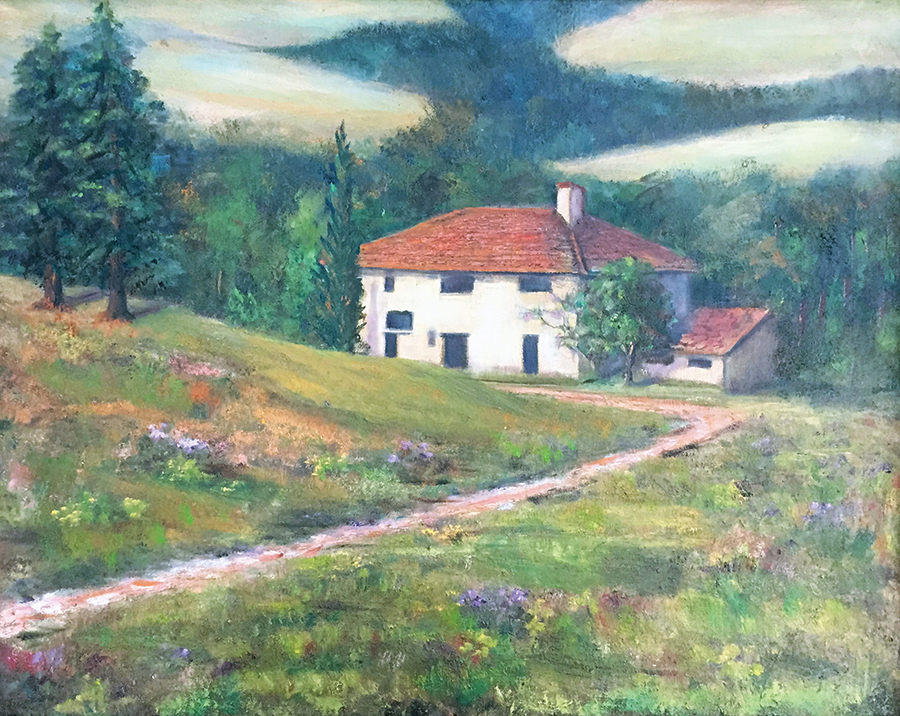
I emerged from a deep glen where I’d stopped to look at chestnut trees and wild mushrooms to find Wendy waiting for me on a rise in the stony road, just as a thunderstorm broke and a cooling rain fell. Over the hill, we came upon idle orchards and an abandoned farmhouse being reclaimed by the wild. 

We sheltered there for a while, soaking in the glorious rain, looking at the vacant rooms, wondering about the people who once called this beautiful ruin a home half a century ago or just last year.

Unexpectedly, I found this to be the most moving moment of the entire pilgrimage, a reminder of our own brief walk through the storms of life and a changing universe. Wendy was kind enough to take a photograph of it.

The rain mercifully followed us to Siena and Rome, where the skies cleared, the sun bobbed out, the heat returned and the summer tourists swarmed over the Vatican and its celebrated museums.

I bailed out halfway on the official Vatican tour, feeling as oppressed by the grandeur of  monumental Rome as the holy relics of Old Jerusalem, concluding I must either be a poor excuse for a Christian pilgrim or a true country mouse.

Back home, I had a friend who is a gifted artist secretly paint the abandoned farmhouse, and gave it to my wife for Christmas.

She loved the painting but joked that it was really for me. I couldn’t disagree, pointing out that I also gave myself a new Expedition watch for our next pilgrimage.  PS

Contact Editor Jim Dodson at jim@thepilot.com.
Simple Life

The Road to Happiness

It’s an upward climb filled with twists and turns, but joy is in the journey

By Jim Dodson

A dear friend phoned the other day just to say hello, a gifted young poet I hired many years ago as our organization’s first staff writer, who went on to become the senior editor of this magazine. I always knew the time would come when Ashley would fly away to new horizons, which she did after many years of our working together, moving to the mountains where she became a teacher, artist and musician. Lucky for us, her soulful perspective continues to grace the magazine’s pages.

As old friends do, we spent a full half hour catching up on each other’s lives.

I was pleased to learn about her current boyfriend and their travels to art festivals across the Southeast, where they sell handmade crafts created from sea glass, answering the muse and enjoying life on the road.

“You sound pretty happy,” I ventured at one point.

“I am. Maybe never happier. How about you?”

I replied that I was happy at that moment because I was talking to her while sitting in a well-worn Adirondack chair on the lawn where I begin and end most of my day in quiet reflection, watching the dawn arrive and the day depart, usually with Mulligan the dog and Boo the cat by my side. When she called, my companions and I happened to be watching the first fireflies of the season dance in the dusk.

During our years working together, Ashley and I often fell into lengthy conversations about life, love, matters of faith and favorite poets. Among other things, we share an Aquarian sensibility about the future and how we must spiritually evolve in order to get there in one piece as a race of scattered and fractured human beings.

I wasn’t surprised when she asked what things make me happy these days.

I gave her my short and simple list: rainy Sundays, walks with my wife and our dogs, working in my garden, driving back roads, early church, books and movies that stir the heart, phone calls from my grown children and suppers on the porch with friends.

“What about writing?” she asked.

“Cheap therapy.”

She laughed.

“Maybe you should write a book about happiness.”

This notion made me laugh.

Somewhere I’d read that there are more than 500 books on the subject of happiness in print, proving happiness is purely in the eye — or soul — of the beholder.

Besides, I confessed, my kind of happiness was increasingly fueled by things I’d given up or simply no longer needed for the journey, a list that included, but was not limited to, late-night fears of failure, desires for wealth or fame, judging other flawed human beings, even my once all-consuming love of sports was practically gone.

True to the spirit of our talks, I turned the question around on her. Ashley didn’t hesitate.

“I think happiness comes when you are following your heart and doing good things for others.”

Her prescription reminded me of something I’d just read in commentator David Brooks’ outstanding new book The Second Mountain — The Quest for a Moral Life.

“Often,” Brooks writes, “we say a good life is a happy life. We live, as it says in our founding document, in pursuit of happiness. In all forms of happiness we feel good, elated, uplifted. But the word ‘happiness’ can mean a lot of different things.”

Brooks makes an important distinction, for instance, between things that make us happy — a good marriage, a successful career, a sense of material achievement — and the rarer experience of joy.

“Happiness involves a victory for the self, an expansion of self. Happiness comes when we move toward our goals, when things go our way. You get a big promotion. You graduate from college. Your team wins the Super Bowl. You have a delicious meal. Happiness often has to do with some success, some new ability, or some heightened sensual pleasure.”

Joy, on the other hand, he posits, has to do with some transcendence of self, comes almost unbidden when “the skin barrier between you and some other person or entity fades away and you feel fused together. Joy is present when mother and baby are gazing adoringly into each other’s eyes, when a hiker is overwhelmed by the beauty in the woods and feels at one with nature, when a gaggle of friends are dancing deliriously in union. Joy often involves self-forgetting.

”We can help create happiness,” Brooks concludes, “but we are seized by joy. We are pleased by happiness, but we are transformed by joy.”

The day after catching up with Ashley, I was on a winding road deep in the Blue Ridge mountains of Virginia, chasing pieces of Wagon Road history and human stories for my next book — something that always makes me happy — unable to get our conversation about happiness out of my head.

The art of happiness, if there is such a thing, my version of it anyway, seems to be about an inward journey cultivated by intentionally making room in life for small restorative acts and daily rituals that invite you to step out of your hectic, overscheduled life into what Irish mystics called a thin space, a place where duty and obligation are put on hold and deeper mindfulness is possible. Without my early morning communion with the stars and the grateful prayers I send up like sparks from a signal fire to the gods, my day is curiously never fully complete.

For what it’s worth, I also agree with Ashley the poet and Brooks the wise counselor that service of the smallest order to others in a world where there is so much isolation, loneliness and suffering may be the truest pathway to a happier, more meaningful life, a true “Second Mountain” existence.

Since most of my days are spent in quiet working isolation — Hemingway, not a happy camper, called writing the “loneliest art” — I find myself these days almost unconsciously seeking out opportunities to commit some kind of tiny random act of kindness to a fellow stranger in need. The other day, I chased down a harried mother’s runaway grocery cart in the parking lot of Harris-Teeter. She had an infant on her hip and was struggling to unlock her SUV. Her grateful smile and warm thanks were like a liberating breeze to a weary brain that had been arm-wrestling words and sentences onto the page most of that day.

During our pre-dawn walks around the neighborhood each day, my wife began stopping by the house of an elderly shut-in lady to walk her newspaper from the curb to a chair by her front door. We’ve never seen our neighbor’s face. But the dogs insist on stopping to deliver her paper the final 50 feet. To paraphrase C.S. Lewis on prayer, this minuscule act of neighborliness may do nothing whatsoever for God, but it sure makes us all feel a tiny bit happier.

The 17th-century Buddhist monk Gensei wrote, “With the happiness held in one inch-square heart, you can fill the whole space between heaven and Earth.”

Sometimes, we need to be reminded of this fact. A friend who works with the homeless explained to me that perhaps the hardest things homeless people deal with on a daily basis is a feeling that they are not worthy of noticing or speaking to — are, in effect, invisible travelers in our midst.

This prompted a change a shift in my awareness and behavior, from that of feeling uneasy and even slightly resentful whenever I reach into my pocket to offer whatever modest sum may be there, to making a point of looking in the eyes and sharing a few words of ordinary greeting or simple recognition, maybe even learning a name and sharing mine. We are, after all, all traveling the same road between Earth and heaven.

It’s a lesson I seem destined to repeatedly learn. Watching Notre Dame cathedral in Paris burn live on CNN back in the spring, I was suddenly transported to a rainy July day 18 years ago when my son, Jack, then 10, and I were coming out of the famous cathedral in a thunderstorm. Surrounded by a swarm of tourist umbrellas dashing for cover, as we hurried past a lone ragged man with blind eyes standing in the downpour, simply holding out an upturned palm, a character straight from Victor Hugo, a dignified beggar for God.

No one was stopping. But when I saw my son glance back, something stopped me. I gave my son 100 francs and asked him to go and give it to the man. Without hesitation, he threaded back through the on-rushing umbrellas and placed the folded money into the man’s outstretched hand.

What happened next still gives me goose bumps of unexpected joy — the kind of self-forgetting transcendence David Brooks speaks of.

The blind man placed his free hand gently on Jack’s head, as if bestowing a blessing. Watching, my eyes filled with tears, or maybe simply rain. Or both. “What did he say to you?” I asked as we hurried off to find a dry lunch in a cozy Left Bank bistro.

“I don’t know,” he said with a happy smile. “But it was in French and it sounded nice.”

Last summer, at the end of a walking pilgrimage across Tuscany with my wife and 30 other pilgrims, I skipped the private tour of the Vatican’s famous Sistine Chapel in favor of climbing a leafy Roman hill to a small Greek Orthodox Church where I sat on a simple wooden pew for God knows how long listening to morning prayers being sung in Greek by three exquisite voices.

Save for an elderly woman manning a small stand at the rear entrance of the church, I was the only worshipper in the building, sitting beneath the tiny dome of a stunning blue ceiling painted with stars, angels and saints.

Time completely vanished, taking my weary feet with it.

Unexpectedly, it was the happiest moment of my long journey that week.

On the way out, the old woman smiled and waved me over to her stand, handing me a small gilt-framed portrait of an Eastern Saint. I’m still not sure which one.

When I reached into my pocket to pay, she gave me a gentle smile and nod, waving me on with gentle words.

I have no idea what she said to me. I believe it was in Greek and it sounded nice.  PS

Contact Editor Jim Dodson at jim@thepilot.com.

Simple Life

Stormy Weather

After withstanding decades of hurricanes, Wilmington’s Blockade Runner is ready to defy the odds once more

By Jim Dodson

On October 10 of last year, Hurricane Michael made landfall on the panhandle of Florida packing sustained winds of 160 mph, a storm verging on Category 5 that entered the record books as the third strongest hurricane on record. After fully devastating Mexico Beach, Michael churned toward the Carolinas as a tropical storm over the next two days, claiming 54 lives from Florida to Virginia, causing $25 billion in property damage.

On the afternoon Michael arrived in North Carolina, I watched on my iPhone weather app as the storm spread its mayhem over Charlotte and took some comfort that the winds and rain were expected to diminish to 30 mph tropical gusts by the time the storm reached the Triad.

The winds and rain arrived on schedule around 3 p.m. Since we live in a neighborhood filled with century-old hardwoods, I stepped outside to see how our elderly trees were handling the winds after one of the wettest autumns on record.

The winds suddenly increased and something blew off my roof with a clatter. It turned out to be a chimney cap, airlifted halfway across our front yard. As I walked over to pick it up, keeping an eye on the churning treetops, things got even crazier. I heard what sounded remarkably like an oncoming freight train and turned around just in time to see the peak of our neighbor’s roof vanish beneath what appeared to be a madly swirling cloud.  Having once been dangerously close to a large tornado, I wasn’t anxious to repeat the experience.

I headed straight inside to chase wife and dogs to the basement but suddenly remembered that I’d left the door to my home office over the garage standing ajar. Like one of those Russian babushkas who insisted on sweeping her stoop before evacuating the Chernobyl nuclear site, I foolishly bolted out the back door even as my phone began shrieking a weather alarm to take shelter immediately.

Taking two steps at once, I reached the top of the garage steps just as the large wooden electrical pole at the rear of our property, bearing a major transformer and various cable lines, snapped like a twig and flew past me like the witch from The Wizard of Oz, crashing into our backyard with a vivid explosion of sparks. For several seconds, I stood there stunned by what I’d seen . . . until I had the good sense to turn around bolt for the basement.

What turned out to be a microburst or tornado, spawned by the fury of Michael’s tropical remnants, knocked over half a dozen ancient trees along our street and plunged the neighborhood into darkness for more than a week. We were among the fortunate ones, though. Our generator came on, and chainsaws came out and neighbors began appearing outside to help assess the damage and begin the cleanup process. Several folks on the street suffered major damage from trees that toppled directly onto their houses, but fortunately there we no serious injuries on our side of town.

My thoughtful neighbor Ken, who lives across the street and had a massive oak take out his center chimney and new second-floor bathroom renovation, shook his head and said it best. “Incredible, isn’t it? Nature’s power always seems to have the final word.”

A few weeks ago, I mentioned this frightening scenario and Ken’s comment to Bill Baggett as we sat together in a newly renovated room on the top floor of the historic Blockade Runner Hotel at Wrightsville Beach. Baggett, 72, simply smiled.

“Nature’s fury has the only word,” he added.

With the first of June looming — the official start of the Atlantic hurricane season that lasts until November 30 —  Baggett and his sister Mary, who jointly own and operate arguably the most beloved and well-known hotel on the North Carolina coast, are something akin to experts on the fickle fury of hurricanes and the unpredictable damage they leave in their aftermath.

Since their family purchased the Blockade Runner from its original owner, Lawrence Lewis of Richmond, Virginia, in 1971, the Baggetts — who assumed operational management of the property in 1984 — have ridden out half a dozen major Atlantic hurricanes and several near misses while hunkered down inside their cozy seaside hotel. Their legacy began with Hurricane Diana in 1984 and continued through last September’s Hurricane Florence, the sea monster that preceded Michael and turned Wilmington and much of Eastern North Carolina into a vast world of water, marooning the Port City for weeks.

In 1984, Diana blew out the hotel’s old-style windows and flooded the ground floor of the hotel with wind-driven rain. “Structurally the hotel was fine. It’s made of reinforced industrial concrete.” Baggett recalled that the worst thing that happened was that the covering for the air vents blew off, allowing rain to flood rooms and public spaces, while destroying plaster walls and ceilings “The hotel was soaked, a real mess, physically and legally,” he said.

When the Baggetts declined to accept their insurance company’s insufficient payout of just $12,000 to cover the extensive damages, they took their case to court, enlisting an expert witness in the person of a retired meteorologist from the Miami Hurricane Center named Robert Simpson, for whom the Saffir-Simpson Hurricane scale is named. His testimony resulted in a more satisfactory settlement  — and a new insurance company going forward.

Three hurricanes in quick succession followed within a decade. Hurricanes Fran (September 1996; 27 fatalities, $5 billion total damage), Bonnie (August 1998, no fatalities but 950,000 people evacuated from the Carolinas, total damage: $1 billion) and Floyd (September 1999, extensive flooding, 76 fatalities, $6.5 billion in total damage) tested the moxie of the Baggetts and their stout lodging. In 1989, even Hurricane Hugo took a passing swipe that blew out Blockade Runner’s windows but otherwise left the property unscathed. 

“Fran was pretty bad,” Baggett recalled. “It took a typical path up the Cape Fear and right over the top, sucking up water from both sides of the hotel — the ocean on one side, the sound on the other. For a while, it was like being in an aquarium,” he allowed with a laugh. “There were six of us in the hotel that night — Mary and myself, one of our cooks and several maintenance folks. Around 11 p.m., the window wall blew out and the water came rushing in, ruining carpets and floors. It was a long night but really the damage in that instance was fortunately fairly minimal. The hotel itself was fine.”

In Fran’s aftermath, in fact, emergency crews from the Red Cross, power companies and relief agencies billeted at the Blockade Runner, which was up and running in a matter of days. “The real issue,” Baggett explained, “was that Fran did serious damage to docks along the sound — prompting fears that the annual Flotilla might be cancelled. Fortunately, everyone worked hard to get the island back in shape and the event came off.”

For her part, Hurricane Bonnie looked fearsome but passed over relatively quickly, moving so swiftly she only took a portion of the Blockade Runner’s roof.

Floyd, however, brought rain on a Biblical scale that flooded numerous towns across the Eastern portions of the state, killing livestock and damaging crops. But once again, with its new roof, the Blockade Runner was updated and “hurricane ready,” as Bill Baggett put it. When Hurricane Matthew banged along the entire east coast in early October of 2016, the hotel barely noticed its passing.

And then, last September, came Florence — a Cat-4 monster that brought new levels of devastation to Wilmington and surrounding region.

“We were a little concerned that she was predicted to come ashore as a Cat-4 hurricane, but we planned to stay in the hotel and ride it out regardless,” said Hurricane Bill Baggett. “I mean, where would we evacuate to — some stick-built motel on the mainland? This hotel is made from industrial reinforced concrete. Besides, by the time the hurricane was on top of us, the only real concern we had — besides water — was the wind.”

By the time Florence rolled over Wrightsville Beach early on Friday morning, September 14, wind shear had weakened the storm to Category 1, wind gusting to 105 mph, which was still sufficient to take out the roof of the Blockade Runner’s balcony and soak some of the hotel’s premium seaside suites.

The major problem with Florence was a record high storm surge of 10 to 13 feet at high tide and the volume of rain. Over two days the storm stalled and lingered over the region, dumping more than 45 inches of rain in places — including on top of the hotel — downing thousands of power lines and trees, making Florence the wettest tropical cyclone to ever hit the Carolinas.

“We lost vents again and had water in some of our tunnels,” Baggett told me, “but for the most part we were in better shape than most people around us.” Because of their working partnership with BELFOR, the property damage specialists who work across the country, response teams were on the site within a day, bringing emergency fuel that allowed the hotel to operate its three large cooling generators and drying machines.

In the aftermath of Florence, much of Wilmington was underwater for the next two weeks, as were numerous towns and cities across Eastern North Carolina.

Fifty-seven deaths were attributed to the storm, and $24 billion in damages to property in North Carolina alone, more than the cost of Matthew and Floyd combined.

As many have done in the wake of Florence, in the process of repairing the damage to their hotel balcony suites, the Baggetts decided to undertake a comprehensive renovation of their landmark hotel, enlisting designer Terry Allred to give the property a fresh new tropical look from top to bottom. The extensive $11 million redo, which includes makeovers of every guest room, dining room and public spaces, is ready to welcome longtime customers and perhaps a new generation of beachcombers to the hotel just as a new summer vacation season dawns.

“Hurricanes are amazingly unpredictable things,” Bill Baggett mused as he showed me through the bright new suites on the balcony floor. “It’s a new roll of the dice every time one of those storms comes out of the Caribbean. But with a jewel like this, Mary and I feel like we are stewards of the hotel. It’s been a pleasure to try and improve it over the years, regardless of whatever comes at us from the sea.” He paused and smiled. “One thing for sure. When the next one comes, we’ll still be here in the hotel.”   PS

Contact Editor Jim Dodson at jim@thepilot.com.

Simple Life

Dirty Hands, Happy Heart

And other gifts from the universe

By Jim Dodson

When all else fails, Mulligan the dog and I head for the garden.

Possibly because I hail from a family of Carolina farmers and rabbit tobacco preachers, digging in the dirt is not only second nature and something that draws me closer to my maker, but also serves as a cheap and effective therapy in a world that seems increasingly shaped by the insatiable gods of work and money.

For many Americans, work has become something of its own secular religion. According to Gallup, Americans average more hours of work per year than any of our fellow developed nations, yet 87 percent of U.S employees don’t feel fulfilled by how they earn their living. That’s a staggering problem that helps contribute to rising depression and addiction across all sectors of society.

In 1919, as Fast Company recently noted, 4 million Americans went on strike to demand fairer wages and a five-day work week — the beginning, historians point out, of the so-called American leisure class. As a result, weekends became enshrined in the culture. The bad news? We’re losing ground to our obsession to work longer and harder with diminishing returns, the average American working a full day longer than the 40-hour work week fought for by our early 20th century ancestors.

Maybe you’re one of the fortunate ones who loves what you do. I certainly am, having enjoyed a varied journalism career and book-writing life that has taken me to places I only dreamed about as a kid. Today, I own the privilege of serving as editor of four robust arts-and-culture magazines staffed by a talented crew of folks across this state. We’re a merry band of storytellers and artists who love what we do and never take that gift from the gods for granted. How we spend our time away from the job says a lot about us, a lesson some of us had to learn the hard way.

At age 30, in 1983, I was the senior writer for the largest news magazine in the South, the Sunday Magazine of the Atlanta Journal-Constitution, a magazine where Margaret Mitchell once worked and the South’s finest writers appeared. Over my seven years in Atlanta, covering everything from Klan rallies to presidential candidacies, I took only two or three full weeks of vacation. When I finally received the summons to Washington, D.C., for the interview I’d grown up hoping for, I felt utterly empty, burned-out, ready to find a new way of earning my daily crust.

The unexpected epiphany came following my big interview in Washington when I phoned my father from the outer office of Vice President George H. W. Bush. I’d been one of the first reporters to travel with Bush during the 1980 presidential campaign and gotten to know him fairly well — sharing a love of baseball, beer and New England.

My dad asked how the job interview went. I told him it seemed to go well,  save for one small problem: I wasn’t sure I wanted the job — or even to be a journalist any more.

“I have an idea,” he said calmly. “Why don’t you change your flight plans back to Atlanta and stop off in North Carolina?”


The next morning, he picked me up at Raleigh’s airport and drove us to Pinehurst.

My Haig Ultra golf clubs were in the back seat of his car. They hadn’t been touched by me in years. For at that point, almost incomprehensibly I hadn’t played a full round of golf — the game I loved best — more than once or twice while living in the hometown of Bobby Jones. Instead, I’d worked myself into an early grave — or so I feared.

After our round on famed No. 2 we sat together on the porch of the Donald Ross Grill and talked over beers about what I feared might be a premature midlife crisis, or worse.

He could have laughed at my youthful angst. But he didn’t. My old man was one great fellow, a former newsman and advertising executive with a poet’s heart. My nickname for him was Opti the Mystic.

After listening to me pour out my tale of existential career woe, he smiled and remarked, “I wouldn’t give up on journalism just yet, sport. You have a God-given talent for stringing together words and telling stories of the heart. I do, however, have a small suggestion for you. You may laugh.”

“Try me,” I said, desperate for any guidance from Opti.

“Perhaps you should try writing about things you love instead of things you don’t.”

I looked at him and laughed.

“What kinds of things?” I asked.

He shrugged and sipped his beer. He was 66 years old, the age I am today.

“Only you can answer that. Use your imagination. What do you love? You’ll find the best answer there. It may sound ridiculously corny to you, but try telling the universe what you love and you may be surprised at the results. The path is never straight. But trust your gut. One thing leads to another, including people.”

Humoring him, I admitted that I loved golf and being in nature but didn’t know a soul in either of those worlds and couldn’t imagine how I would find my way into them. Once a single-handicap golfer, as I’d proven that day at No. 2, I couldn’t even break a hundred on the golf course anymore. Having grown up hiking and camping in the mountains and forests of my home state, it had been years since I’d been deep in the woods. I’d even loved mowing neihborhood lawns and working in my mom’s garden, but hadn’t done that in almost a decade.

Still, something got into my head. Or maybe it was my gut. 

A short time later, I withdrew my name from consideration for jobs in Washington, quit my gig in Atlanta and took a 2-month writing sabbatical at the Virginia Center for Creative Arts at Sweet Briar College.

It was springtime in Virginia. I wrote for three or four hours every morning, working on a novel about a Georgia farm family for a legendary editor at Harper & Row.

In the afternoons, I took long walks through the pasturelands, fields and woods of beautiful Amherst County, Patrick Henry country.

One afternoon I helped an elderly couple down the road weed their garden and took home a stunning bunch of peonies that reminded me of my mom’s garden back home in Greensboro.

The novel was a dud. My heart was never in it. But the legendary editor, pointing out that books would come when the timing was right, insisted that I call Judson Hale at Yankee Magazine in New Hampshire. I followed up on his advice and soon found myself working as the first Southerner and senior writer in Yankee Magazine’s history. I got myself a pup from a Vermont Humane Society, lived in a cottage by the Green River and taught myself to fly-fish. My heartbeat slowed. I even rediscovered my lost passion for golf on an old course where Rudyard Kipling once chased the game.

A few years after that, a story I wrote about a forgotten hero of women’s golf even landed me a sweet job at Golf Magazine and a decade’s service as the golf editor for American Express, a job that took me around the world and inspired me to take my dad back to England and Scotland where he learned to play golf as a soldier during the war. He was dying of cancer. It was our final journey. The little book I wrote about, Final Rounds, became a bestseller that’s still in print.

Opti had been right about all of it — the power of doing what you love, listening to heart and gut while expressing your desires and gratitude to a generous universe. Whatever else may be true, I am proof that one good thing — and more important, one good person — can invariably lead to another.

Over the next two decades, I built a house on a forested hill on the coast of Maine, fathered two wonderful children and basically invested their college funds into a massive English garden in the woods. A dozen books followed, including Arnold Palmer’s memoirs.

That job brought me home again thanks to a chance to teach writing at Hollins University in Virginia and simultaneously help my partners create distinctive arts-and-culture magazines that people in this state seem almost as passionate about as we are.

Today, I consciously belong to an intentionally slower world, taking time to do the work I love but never failing to spend time in the garden with my dog, Mulligan. A golf round with my childhood pal never hurts, either.

Perhaps I’ve just come full circle. In any case, friends tell me I’m more productive than ever. If so, that’s probably because dirty hands make for a happy heart, as an aging gardener once said to me.

That aging gardener was my mom, who had a magical way with peonies and roses.

May was her favorite month, the month where spring gardens reach their glory.

Mulligan agrees with me that our roses and peonies have never looked better.  PS

Contact Editor Jim Dodson at jim@thepilot.com.

Simple Life

Life and Limb

My cabins in the sky

By Jim Dodson

One of my secret pleasures is a mind-candy house program on Animal Planet called Treehouse Masters, in which an infectiously enthusiastic house designer and self-described “tree whisperer” named Pete Nelson and his merry band of workers create mind-boggling treehouse retreats for clients. His stated mission is to help customers get back to nature and in touch with their inner kid.

It’s a pure fantasy show that combines three of my favorite things — houses, trees and memories of climbing them during my childhood. It was probably inevitable for a kid who grew up on a diet of adventure books, and camping and hiking forests all over the western portions of this state and neighboring Virginia, that I would eventually get around to building a treehouse, especially after I saw Disney’s 1960 version of Swiss Family Robinson. The shipwrecked but enterprising Robinson clan lashed together a furnished treehouse palace that featured running water from a turning wheel, thatch-roofed bedrooms, a full-service kitchen and salvaged ship’s wheel that raised the ladder each evening to protect against wild animals or unwelcome visitors. They lived with a pair of large friendly dogs and a parrot, and even had a piano that somehow survived the shipwreck.

In my opinion, those lucky Robinsons had the perfect life.

Of course, I was only 7, a kid who’d had a happy but fairly solitary life building forts in the woods and reading adventure books, the son of a Southern newspaperman who hauled his young family across the Deep South to his various posts before coming permanently home to Greensboro in 1959 — shortly before the shipwrecked Robinsons showed up in Cinemascope on the big screen.

My first treehouse was a distinctly modest platform affair — more lookout stand that actual shelter. Perched in a patch of hardwoods in a public park across the street from the apartment we rented while our first house was being built in a rural subdivision, it was probably illegal. But so were the Robinsons. You reached the platform by inching up a thick-knotted rope. The platform was probably only 10 feet off the ground but it felt amazingly close to heaven in the trees, the ideal place for me to sit and read and keep an eye out for wild animals or unwanted visitors.

At the rear of our new property, my father knocked together an impressive one-room treehouse he furnished with a second-hand dining room table, four mismatched chairs and an old rickety bookcase. I spent a year furnishing that rustic pied-à-terre in the sky with my favorite childhood books and “interesting” stuff I found all over creation until one regrettable summer afternoon I found three girls from the neighborhood having an unauthorized tea party with their dolls in my cherished aerie. Without thinking of the consequences, I fetched a garden hose to cool off the party and quickly felt the wrath of several outraged mothers, hastening the demise of my beloved place on high.

That’s why, when I stumbled across Treehouse Masters, my inner child was set loose from detention.

The New Age treehouses Pete Nelson and his crew create are elaborate affairs that make the industrious Robinsons look like rank beginners. They typically include all the creature comforts of the modern Earth-bound home and then some: fancy woodstoves and electric lights; flush toilets and outdoor showers; kitted-out gourmet kitchens and decks with breathtaking views from high in the trees, rivaling anything you would find in a swanky vacation home.

My favorite segment of the show, however, is when the host calls on fellow treehouse nuts who have created their own unique handcrafted cabins in the sky, retreats that display incredible craftsmanship, artistry and ecological harmony.

One I particularly enjoyed involved a bearded chap who built himself a gorgeous treehouse that was more like a storybook chapel over a stony brook in the Connecticut woods. It was essentially a meditation and reading room with large windows, a simple desk, woodstove, small functioning kitchen and a room where he could sit for hours watching nature through the seasons, forgetting the rest of the world.

His was a slightly more elaborate version of the treehouse I fully intended to someday create above a vernal pool in the forest behind the post-and-beam house I helped build with my own hands on a forested hill in Maine.

The spot — on a beautiful hillside deep among hemlock and birch and proximate to geologic kettles left by the receding ice age — overlooked a seasonal stream and vernal pool dominated by a large lichen-covered stone that I named my “Thinking Rock.” This is where the transcendental kid in me often escaped with my dogs to read, think, smoke a pipe and get right with God and nature.

The bittersweet irony is that the forested retreat I long had in mind never got off the ground, so to speak, because, in the blink of an eye, my own kids were grown and heading off to college, and I was feeling an unexpected gravitational pull of my old Carolina home.

Impossible as it once seemed, I said goodbye to the rugged timbered house and English garden-in-the-woods that I spent nearly two decades building and cultivating, a place where I fully expected to end my days and eventually become part of the landscape when who I am moved on, leaving only a trail of ashes behind.

But life, to paraphrase Emerson, is full of compensations. A few years back, my wife and I purchased a lovely old bungalow that once upon a time was my favorite house in the heavily forested neighborhood where I grew up — two doors away, in fact, from the house where my family lived for almost 40 years.

I joke that I’ve all but completed the Sacred Redneck Circle of Life.

A large part of the place’s allure, I must admit, was the two-car and workshop garage in back that featured a funky little second-floor apartment you reach by climbing a set of rickety wooden steps that take you to rooftop height amidst century-old white oak trees.

Because the house sits on perhaps the highest point in the entire neighborhood, the first time I climbed those steps and turned around to check out the view, my heart leapt like a kid up a tree.

From just under the white oak canopy that reminded me of the arched ceiling of a Medieval cathedral — providing wonderful cooling shade all summer — I could see the world with a bird’s-eye-view: vaulting trees and rooftops across the neighborhood, not to mention birds and squirrels galore, passing clouds, a huge patch of sky by day, a glorious quilt of stars by night.

Suddenly I had the treehouse I’d always dreamed of owning, this one equipped with electric power and heat, small kitchenette and bathroom with fully functioning toilet and shower. The cheap dark-wood paneling gives it a perfect rustic air and a couple of overhead fans keeps the place cool in summer. If it isn’t quite worthy of Treehouse Masters, it fits me like lichens on a thinking rock.

Just outside the door, I hung a large set of Canterbury chimes from a stout limb of the massive white oak at the foot of the steps. When the wind blows a certain way, I swear I hear the first five notes of “Amazing Grace.”

These days, if you visit my “treehouse,” you will find a pair of comfortable reading chairs (one of which my dog Mulligan occupies when she’s officially on duty), several bookcases filled with favorite books, a French baker’s table where I write, a wicker daybed where I sometimes seek horizontal inspiration on late afternoons, various vintage posters and prints I’ve collected from four decades of journalism and travel, a cabinet case filled with some of my own books and a few awards, a second cabinet that holds “Uncle Jimmy’s Genuine Real Stuff Museum,” framed photos of my children and a pair of large rare portraits of Walter Hagen and young Fidel Castro, themed lamps (a blue coat soldier, a Bengali elephant, a monkey climbing a palm tree), several busts (Ben Franklin, Alexander the Great, a Templar knight), three sets of old golf clubs, a full golf library, several checkered golf flags, and a large replica of the first American flag with thirteen stars in a circle of blue.

Nobody in their right mind would want all this stuff in their real house. But like the Swiss Family Robinson, this oddball collection from a long journey home has finally found the perfect place in my cabin in the sky. PS

Contact Editor Jim Dodson at jim@thepilot.com.

Simple Life

Confessions of a Happy Old Guy

And the joys of life in the slow lane

By Jim Dodson

A close colleague needed to speak in confidence the other day. She looked so serious.

“I don’t know how to tell you this,” she said, “but I have to tell you something important.”

I feared she might be quitting her job to join a kazoo band or something even worse, appear on a reality show. So I braced for impact.

“I was behind you in traffic yesterday. You drive like an old man!”

She burst out laughing.

I laughed, too — and agreed with her. She wasn’t the first to point out my maddening old-fashioned driving habits, or as I prefer to simply call them, careful. For the record I haven’t had a moving violation in 40 years, something one can accomplish only by moving slowly through the busy intersections of life. Knock wood.

A year ago, however, I turned 65. In the eyes of my government, my insurance agent and my beloved colleague, this apparently means I’ve achieved official Old Man status. So essentially, my driving habits are finally catching up to my age.

Over this year, in fact, since word has spread like kudzu on a redneck barn, I’ve received several “special dinner” invitations from companies eager to tell me all about their exciting products and services designed to “make your senior years happier, safer and more fulfilling.”

One was from a lawyer pointing out the dangers of failing to update my final will and testament, presumably so craven heirs don’t rob me blind. Another was from a financial firm eager to feed me at the Olive Garden in order to convince me that I should try a reverse mortgage that would allow me to sell my house piece-by-piece in order to finance a speedboat or buy a timeshare in Cabo San Lucas. Not long after that, two dinner invites from local funeral homes offered a fancy last supper with small talk of coffins over coffee.

The truth is, I’m perfectly fine officially being an Old Guy. I’ve never felt happier or more fulfilled than at this very moment, even without a speedboat. My health is good, the important parts all seem to work, I love what I do every day and look forward to many years of doing it as I chug along in the slow lane of life.

I never plan to retire or even slow down because I’ve always moved at more or less the same modest speed. Slow and steady wins the race, as the moral goes, assuming you even care about winning the rat race. Never hurry, never worry was the personal motto of the late great Walter Hagen, a dapper fellow who walked slow and lived large while winning 45 golf tournaments, a total that included 11 major championships and four British Opens. Successful living, said the late great Leroy Robert Paige, a.k.a. “Satchel,” — hall-of-fame Major League pitcher who played his last game for the Peninsula Grays of the Carolina League at age 60 in 1966 — is really a question of mind over matter. “If you don’t mind,” he counseled, “it don’t matter.”

Besides, the evidence is pretty compelling that I’ve been an old man since the day I was born.

A small chronological sampling:

It’s February, 1953, and I am born. My mother thinks I’m the cutest baby ever. My father jokes that I look like Dwight D. Eisenhower. My mother doesn’t think this is funny, doesn’t speak to my father for a week. Years later, whenever she’s annoyed with me, she’ll sigh and say, “I guess you were just born an old man, Sugar Pie.”

It’s 12 years later, 1965. My favorite Beatle is George Harrison, the “quiet one” whose guitar gently weeps. I teach myself guitar and spend endless solitary hours learning to play like George. Paul McCartney tells the Associated Press that “George is the old man of the group.” In tribute, I try growing a beard like George. It goes nowhere. Then again, I’m only in fifth grade.

Now we’re in the early avocado-colored ’70s. The music, the cars, the groovy way college girls look — it’s all quite wonderful. I grow my hair long and spend an entire summer at college smoking pot, which only puts me to sleep. So I quit smoking pot, buy a Dr. Grabow pipe and a corduroy sports coat with leather elbow patches. My hippie girlfriend jokes that she’s dating William F. Buckley and is shocked when I admit digging the music of Burt Bacharach. I am the only guy in my dorm who watches the Watergate Hearings from beginning to end — and enjoys it.

Now it’s the 1980s and I’m an investigative reporter for a magazine in Atlanta, engaged to a beautiful TV anchorwoman who works late on weekends. Way past my normal bedtime, she likes to unwind from her job by dragging me to glamorous late-night parties where everyone is buzzing from funny white powder inhaled off the bathroom counter. More than once I sneak off to a stranger’s bedroom to grab a quick nap or watch reruns of Hee Haw with a Falstaff beer. The engagement is predictably short.

In the late 1990s, I become a father of two, the happiest thing that’s ever happened to me. I build my own house and a faux English garden deep in a beech forest near the coast of Maine. I love reading books to our little ones and normally fall asleep before they do. We like the same G-rated movies and yellow food group. They grow way too soon. Apparently I never did. But at least I am fully trained for grandparenthood.

Two summers ago, while driving my vintage Buick Roadmaster in crazy rush hour traffic outside Philadelphia, a snarky young dude in a BMW opened his window and yelled, “Hey, Chevy, wanna drag race me to Wallyworld?” He howled at his own wit. I smiled politely back. When the light changed, however, I opened up my Roadmaster’s massive 350-hp, eight-cylinder Corvette engine and taught that little twerp never to mess with an old man driving his old man’s Buick.

For the record, old guys like shirts with roomy pockets. This is a known fact and I’m no different. I want a shirt with pockets large enough for car keys, screwdrivers, grocery store lists, directions to the party, a sandwich for later, a tape measure, various auto parts, mysterious things you find in the yard and so forth. Pocket protectors, however, are ridiculous. What do you take me for, a complete old geek?

Also, long ago, I decided that certain essentials in life should primarily be basic white. This includes, but is not limited to, golf balls, toilet paper, underwear, snow, vanilla ice cream, dress shirts, and the look on any idiot BWM owner’s face who thinks he can beat my Buick to Wallyworld. (By the way, genius, Chevy’s wagon was a Ford).

If you’re going to jabber during the movie, please do us both a big favor and sit elsewhere, preferably in another county. I have a hard enough time hearing what’s going on in the movie without having to listen to your witless commentary. And if you speak to me in a crowded party, don’t be surprised if I just smile at you like a drooling village idiot because I can’t understand a blessed word anyone says to me in noisy, crowded places.

Ditto if I forget your name. Please don’t take it personally. Next time just wear your name tag — preferably written in LARGE EASILY DISCERNABLE LETTERS. For the record, I forget lots of names of things these days, including those of movie stars, old flames, neighbors, song titles, state capitals, sports stars, candidates I voted for, candidates I wish I voted for and so on. On the other hand, I can name every dog I ever owned, just one of many reasons a dog really is an old man’s best friend. You never forget them.

Finally, I love going to the grocery store without a shopping list. Talk about free-range fun for Old Guys! Roaming the aisles like a man on a mission who can’t remember what he’s looking for, I just grab whatever catches my fancy on the oft chance it might include whatever item my wife specifically asked me to bring home. True, this often means a quick return to the store to get the correct item but, hey, that just means you can repeat the process and double your fun, taking home other great stuff that captures your fancy.

Frankly, I could rattle on forever about the simple pleasures of finally being a certified Old Guy — going to bed early and rising before the chickens, reading poetry, biographies and histories in my tree house office, long walks with the dogs and road trips with my bride, small suppers with friends, stargazing, classical music, lonely back roads, rainy Sundays, weekend gardening, watching birds, early church, late afternoon naps, Kate Hepburn movies, historic battlegrounds, old houses, Scottish golf courses, expensive bourbon, bumping into old friends I actually remember, and other stuff I invariably forget how much I enjoy.

Whew, just the thought of all that activity exhausts me.

I’d better go grab a quick nap before I run to the store to fetch supper items I probably won’t remember to get.  PS

Contact Editor Jim Dodson at jim@thepilot.com.